Sue Grafton

 Z Is For Zero

April 24, 2018

This title was to be the final alphabet mystery series novel by Sue Grafton.

A is for AlphabetSadly, she died December 282017 and, according to her daughter, the final book will never be completed and the series ends with Y is for Yesterday.

April 24, 1940, however, should be B is for Birthday, the day Grafton was born in Louisville, Kentucky.

Although I’m not a big mystery reader, I do admire writer’s who display the tenacity it takes to achieve success. Grafton was such a writer.

Her early life was marred by a difficult home life as both her parents’ were alcoholics and, according to Grafton, “From the age of five onward, I was left to raise myself.”

It was her father’s influence which sparked an interest in writing. According to the Infallible Wikipedia:

“Grafton’s father was enamored of detective fiction and wrote at night. He taught Grafton lessons on the writing and editing process and groomed her to be a writer. Inspired by her father, Grafton began writing when she was 18 and finished her first novel four years later. She continued writing and completed six more novels. Only two of these seven novels (Keziah Dane and The Lolly-Madonna War) were published. Grafton would later destroy the manuscripts for her five early, unpublished novels.”

Success eluded her so she began writing screenplays and worked steadily for 15 years as such. The skills she acquired in this occupation were essential as she learned about story structure, realistic dialogue and how to create effective action sequences.

The Alphabet Mystery series begins in 1982 with A is for Alibi. Also from Wikipedia:

“Grafton had been fascinated by mysteries series whose titles were related, such as John D. MacDonald’s Travis McGee series, each of which included a color in the title, and Harry Kemelman’s Rabbi Small series, each of which included a day of the week in the title. While reading Edward Gorey’s The Gashlycrumb Tinies, a picture book with an alphabetized list of ways for children to die, Grafton decided to write a series of novels whose title would follow the alphabet. She immediately sat down and made a list of all of the crime-related word that she knew.”

It was after the publication of G is for Gumshoe that Grafton was able to quit writing screenplays and focus on her novels.  There is one book in the series which does not comply with the naming conventions and that’s the letter ‘X’ – which is the complete title of the 24th book.

It was at a writer’s conference a few years back that I was told by an agent that having a series is the way to go. Of course, series or not, one must still obtain a publisher, have a marketing plan and do all the leg work to promote one’s books. For most writers, in my opinion, that’s the harder task than penning the book.
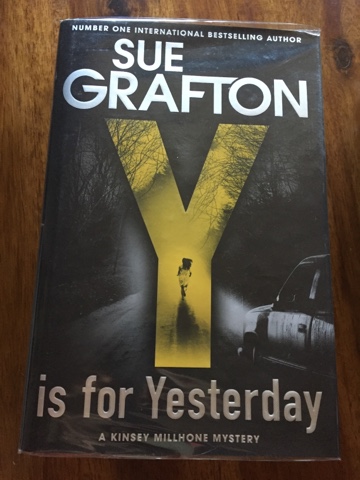
Writer’s write and, despite the lack of a publisher, it’s what we are compelled to do. Sue Grafton was also compelled to write so a toast to her memory on her birthday and the gift Dishe left behind with those 25 alphabet books.

To read more about Sue Grafton, here’s a link: https://en.wikipedia.org/wiki/Sue_Grafton


1965 Ford Mustang

April 17, 2018

Where Were You In ’62?

Ford Thunderbird. Chevy Corvette. Volkswagen Beetle. Ford Mustang.

Just saying the name of each of these particular cars evokes instant pictures in the brains of people who grew up in the 1960’s and 70’s in the United States. One could claim each of these cars is iconic and hearkens back to a time when turning 16 and getting to drive your first car were rites of passage.

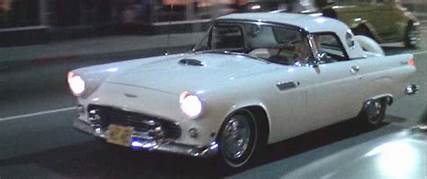
American Graffiti ThunderbirdThe line “Where were you in ’62?” is in reference to the movie American Graffiti where then unknown actor Richard Dreyfuss becomes obsessed with finding the blonde who is driving the white Thunderbird. He never does but the already iconic Thunderbird is cemented in legend and, for his character, is what defines his final teenage experience.

The Ford Mustang was that car for me. Introduced mid-year 1964 – it’s initial release is known as the 1964 1/2 Ford Mustang – it sold over 120,000 cars in its first six months and an additional 600,000 in 1965 catapulting the vehicle to fame. It was introduced on April 17, 1964 and was Ford’s most successful car launch since the Model A.

From the infallible Wikipedia:

“The Ford Mustang was brought out five months before the normal start of the 1965 production year. The early production versions are often referred to as ‘1964½ models’ but all Mustangs were advertised, VIN coded and titled by Ford as 1965 models, though minor design updates for fall 1965 contribute to tracking 1964½ production data separately from 1965 data (see data below). with production beginning in Dearborn, Michigan, on March 9, 1964; the new car was introduced to the public on April 17, 1964 at the New York World’s Fair.

Executive stylist John Najjar, who was a fan of the World War II P-51 Mustang fighter plane, is credited by Ford to have suggested the name. Najjar co-designed the first prototype of the Ford Mustang known as Ford Mustang I in 1961, working jointly with fellow Ford stylist Philip T. Clark. The Mustang I made its formal debut at the United States Grand Prix in Watkins Glen, New York, on October 7, 1962, where test driver and contemporary Formula One race driver Dan Gurney lapped the track in a demonstration using the second “race” prototype. His lap times were only slightly off the pace of the F1 race cars.”

In thinking about the Mustang, memories from a four year span – from age 14 to 18 – seem to have that car as a part of them.

ford mustangFirst, a description of the car. It’s a 1964 1/2. White with a black convertible rag top. Red leather seats. Pretty much every teenager’s dream as the coolest car. I know it was mine.

One memory is particularly strong. I had just gotten my driver’s license earlier in the day, my 16th birthday. It’s August and it’s hot. Around 8 p.m. I find some reason why I absolutely need to borrow the car and go someplace. The store? Who knows. What I do know is that when you are 16 and have the freedom of a car for the first time in your life there’s a heady moment when you feel the world belongs to you. That was my moment.

I drove the car to the appointed place and did my errand. After that I did the ONE thing my parents told me I was NOT to do. I headed to downtown Yakima to cruise the “Ave.” Yakima Avenue was, for years, the go to spot for teens looking to see and be seen, as American Graffiti-like as Modesto California in the early 1960’s. It was there that guys and girls would talk from car window to car window and, if there was mutual interest, meet in the parking lot of Shultz Furniture, and get to know one another.Yakima Avenue cruises.jpg

Another thing about Yakima Avenue is that the street lighting was really, really good. So good, in fact, that one might not notice that they had failed to illuminate their headlights.

In my 16 year old brain I think ‘what harm can come from one run on the Ave?’ I drive east without incident and then head back west. So far so good. My parents’ warning resonates in my head and I don’t stop or talk to anyone but dutifully head for home. police car lightsThen, behind me, blue and red lights come on. My heart pounds. Oh crap.

I’ve had my license less than 24 hours and I’m about to get my first ticket. My hand shakes as I hand the officer my license. He asks if I know why he pulled me over. I say no.

“You’re driving without your lights on.”

He goes back to his patrol car and I wait, on the verge of tears, for the bad news.

A minute later he hands me back a paper – a warning – and my license.

“We just want you to be safe. Keep your lights on,” he says.

I make it home, the car intact and me without a ticket and never did tell my parents about it. Some secrets are best kept to oneself for forty some years.

The next day I purchased a keychain with a little plastic light bulb and kept my set of car keys on it for several years, a reminder to turn my lights on at night. I’ve never once forgotten since that incident.

There are other memories associated with the Mustang including being taught  to drive by my dad and, during the very first lesson, accidentally driving up and over a snow bank on our street… My first kiss while riding in the back seat. My sister was at the wheel that night and we were giving my boyfriend a ride to his house… New Year’s Eve the winter before I graduate college and it’s 15 below zero and I vow to never again live in a place where it can get that cold… The top down and sitting up on the edge of the back seat to wave at people while riding in the Sunfair parade. Yes, all of them American Graffiti type moments never to be re-lived.

It was a sad day when I learned my dad had sold that car (Washington license plate number EEE 161) and an important piece of my teen years.

american Graffiti poster.jpgFor more information, here’s the Wikipedia link to the Mustang and, for those who have never seen American Graffiti, it’s a classic movie worth the time it takes to watch.

https://en.wikipedia.org/wiki/Ford_Mustang

https://en.wikipedia.org/wiki/American_Graffiti

The Safety Pin

April 10, 2018

From Practical to Ridiculous

It was patented on April 10, 1849, as a way for the inventor to pay off a $15 debt. Today, this device is a ubiquitous part of everyday life. What is it? The safety pin.Original safety pin design

Although we take its clever design for granted, the safety pin is truly ingenious and, for those of us who used cloth diapers on our children or who ever has had a torn hem or  a loose fitting garment, it’s been the one thing that’s saved us.

From the infallible Wikipedia:

“American mechanic Walter Hunt is regarded as the inventor of the safety pin that bears resemblance to those used today. The safety pin included a clasp that covered the point and kept it from opening, and a circular twist at the bend to act as a spring and hold it in place. Charles Rowley (Birmingham, England) independently patented a similar safety pin in October 1849, although the company no longer makes these.

Hunt invented the device in order to pay off a $15 debt to a friend. He used a piece of brass wire that was about 8 inches long and made a coil in the center of the wire so it would open up when released. The clasp at one end was devised in order to shield the sharp edge from the user.

After being issued U.S. patent #6,281 on April 10, 1849,  Hunt sold the patent to W. R. Grace and Company for $400 (roughly $10,000 in 2008 dollars). Using that money, Hunt then paid the $15 owed to a friend and kept the remaining amount of $385 for himself. What Hunt failed to realize is that in the years to follow, W.R. Grace and Company would make millions of dollars in profits from his invention.”

vintage diaper pinsThe safety pin was an especially great invention for mothers everywhere to keep the baby’s diaper pinned without stabbing the child. Making a large pin with a cute animal as the protective head has been a popular adaptation for decades.

It never occurred to me, however, that a safety pin would be used for anything other than, well, holding together fabric in some fashion.  Boy was I wrong. Today safety pins are routinely used as jewelry and to, ahem, enhance one’s body art. insane face piercingWhen Punk Rock became a thing in the late 70’s and early 80’s the practice of using a safety pin as a decorative piercing became popular with the musicians and their followers.

Tattoos and piercings – any numbers of which are safety pins – are a common fashion in the 21st century. Additionally, safety pins have been incorporated into impressive jewelry designs.

Along with a G-2 pen and paperclips, safety pins are – in my opinion – an indispensable item one should carry with them at all times! So hooray for Walter Hunt and the invention of this invaluable item.

And, of course, a link to Wikipedia to whet your appetite for knowledge: https://en.wikipedia.org/wiki/Safety_pin

Tony Orlando

April 3, 2018

…Now The Whole Damn Bus Is Cheering

He is, perhaps, best known for the April 1973 hit “Tie A Yellow Ribbon Round the Ole Oak Tree.” Happy 74th birthday to Tony Orlando who was born April 3, 1944.tony orlando

No doubt Tony Orlando and this song are intertwined for all time. ‘Yellow Ribbon’ was his and the group Dawn’s biggest hit ever, reaching number one on both the US and UK charts for four weeks in April 1973.

The song has become an ingrained part of the American culture with the symbol of the ribbons representing enduring love and devotion to those who, for whatever reasons, must be separated from their loved ones for a period of time.

Unlike popular thought, however, according to one of the song’s writers, L. Russell Brown, it was not about an ex-con coming home. From the infallible Wikipedia:

tie_yellow_ribbon_on_the_oak“This is NOT the story of a convict who had told his love to tie a ribbon book to a tree outside of town. I know because I wrote the song one morning in 15 minutes with the late lyrical genius Irwin Levine. The genesis of this idea came from the age old folk tale about a Union prisoner of war – who sent a letter to his girl that he was coming home from a confederate POW camp in Georgia… Anything about a criminal is pure fantasy…”
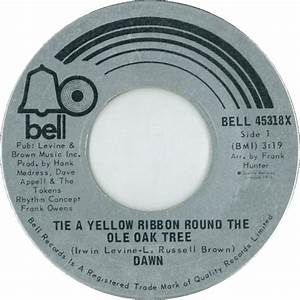
Tie a Yellow Ribbon 45 record.jpgBillboard has ranked “Yellow Ribbon” as the number one song for 1973, selling 3 million records in the United States in just three weeks. In fact, BMI (Broadcast Music Inc) which tracks songs for artists claims the song as been played over 3 million times in 17 years of continuous airplay. That’s true staying power.

I have a particularly strong memory of this song as it was played at every dance I attended in the mid-1970’s. In May of 1975 I became President (called the Worthy Advisor) of my local Rainbow Girl’s Assembly. One of our traditions was to have a dance afterwards, often hiring a (bad) local band to play music. I, however, took it a different direction and got my Dad to agree to be the DJ and spin records. He was a good sport and, as a Junior High School teacher, understood kids and also knew what was popular.

At one point the very recognizable introduction to this song filled the room and all the kids swarmed to the dance floor. Everything was normal until right at the very end of the song when Tony sings “Now the whole damn bus is cheering and I can’t believe I see…” I was dancing with my boyfriend but my attention was directed to two of my guy friends – Ben and Brad – who had sung a couple songs earlier for entertainment at my installation. I turned just in time to see them each down on one knee, one arm extended towards me, and belting out the final lines of the song. For a 17 year old it was an epic moment. And one that probably belongs in a novel.

A couple of links:

https://en.wikipedia.org/wiki/Tie_a_Yellow_Ribbon_Round_the_Ole_Oak_Tree

https://en.wikipedia.org/wiki/Tony_Orlando

I’ve now listened to this song a dozen times to find a good quality version which best shows the cool epic-ness of 1973.

A Blast From The Past

The Day Mt. St. Helen’s awoke

March 27, 2018

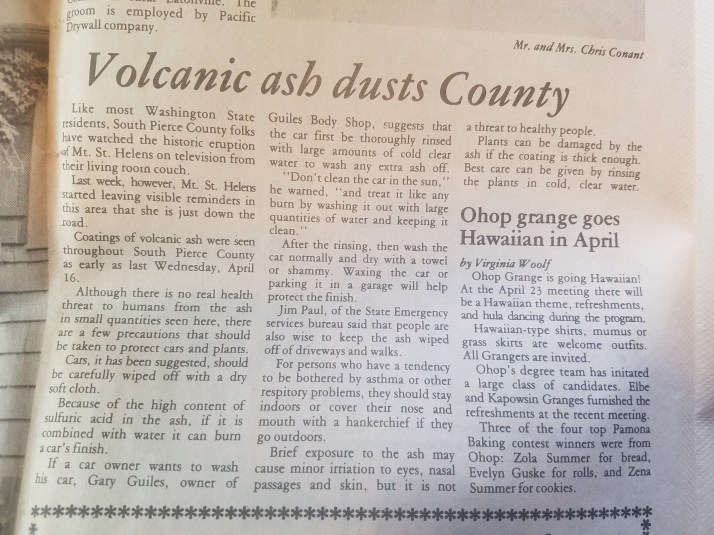
Mt. St. Helens March 1980It was on March 27, 1980, that the first plumes of steam escaped from Mt. St. Helen’s. Just over seven weeks later, the mountain experienced a 5.1 earthquake which caused the north side of the volcano to slide away and triggered the largest debris avalanche in recorded US history.
From the Infallible Wikipedia:

“The magma in St. Helen’s burst forth into a large-scale pyroclastic flow that flattened vegetation and buildings over 230 square miles. More than 1.5 million metric tons of sulfur dioxide was released into the atmosphere. On the Volcanic Explosivity Index scale, the eruption was rated a five, and categorized as a Plinian eruption.

The collapse of the northern flank of St. Helens mixed with ice, snow, and water to create lahars (volcanic mudflows). The lahars flowed many miles down the Toutle and Cowlitz Rivers, destroying bridges and lumber camps. A total of 3,900,000 cubic yards of material was transported 17 miles south into the Columbia River by the mudflows.

For more than nine hours, a vigorous plume of ash erupted, eventually reaching 12 to 16 miles above sea level.  The plume moved eastward at an average speed of 60 miles per hour with ash reaching Idaho by noon.”

This information is, of course, widely known. As a young reporter for the weekly Eatonville Dispatch in South Pierce County, Washington, that first puff of steam was part of a rather amazing life experience.

At a distance of only 47 miles – as the crow flies so to speak – from the mountain, Eatonville residents soon noticed fine layers of ash dusting the community. Week after week I wrote stories about the impact of the ash fall and provided reports in the paper as to all the latest activity.

The most interesting event, however, began two months earlier with a rather odd story told to me by a young couple who were driving home from Ashford to Eatonville one winter night. They claimed that they were followed by three bright orbs which sped up and slowed down in concert with their car. These young people were visibly upset by the incident and believed they had been followed by UFO’s. The photo here is NOT from that event but is illustrative of what they described.Blue glowing Orbs over Oakland, CA 2013

Another theory, however, was posited in late March in conjunction with the increased earthquake and volcanic rumblings. And that is the phenomenon known as Earthquake lightning. It is believed that lightning can be triggered by earthquakes and that, perhaps, the presence of these lights was associated with the impending eruption of Mt. St. Helen’s.

Also from the Infallible Wikipedia:

“The lights are reported to appear while an earthquake is occurring, although there are reports of lights before or after earthquakes, such as reports concerning the 1975 Kalapana earthquake. They are reported to have shapes similar to those of the auroras, with a white to bluish hue, but occasionally they have been reported having a wider color spectrum. The luminosity is reported to be visible for several seconds, but has also been reported to last for tens of minutes. Accounts of view-able distance from the epicenter varies: in the 1930 Idu earthquake, lights were reported up to 70 miles (110 km) from the epicenter.”

To this day I’ve never quite known what was or was not the truth with this account. I do know that when I was in the area where the phenomenon occurred in the two months prior to Mt. St.Helen’s awakening I was hyper aware and constantly scanned the rearview mirror for strange lights. I never did see any.

Dispatch article April 23 1980It was not until the April 23rd issue when I reported the first dusting of ash in Eatonville. Less than a month later the mountain blew.
As always, a couple of links:

https://en.wikipedia.org/wiki/Mount_St._Helens

https://en.wikipedia.org/wiki/Earthquake_light

Happy Birthday Barbie

I’m a Barbie Girl

March 20, 2018

If you are planning to write a novel set in 2018 then you might consider Michael and Jessica as the names of your main characters. That is if your characters are in their 20’s or 30’s and you want to have their names sound authentic for someone born in the 1980’s or 1990’s.

Last week we discovered that Barbie and Ken were both introduced in the month of March. Barbie in 1959 and Ken in 1961.

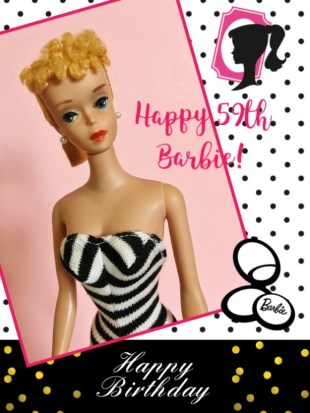
Happy 59th Birthday BarbieThe name Barbara was, at the time, a very popular name. It first hit the top ten names list in 1927 and remained there until 1958, a whopping 31 years. If you expand a bit, the name was a top 20 name for a total of 38 years. Whether one can blame Barbara’s free fall from popularity on the Barbie Doll is debatable. Having the most famous fashion doll in the world bear that name no doubt made more than a few parents reconsider it as a good choice for their daughter. After all, who would want to name their child after a doll? Another factor is that names, particularly girl’s names, tend to be popular for a period of time then are not used for decades.

Ken – or Kenneth – was a solid boy’s name from 1924 until 1964 ranking in the top 20 every year. Because both names are ranked individually, the popularity of the name is artificially reduced. But again, names which are strongly associated with certain people or characters tend to lose popularity. It is possible Ken and Kenneth were the victims of this.Ken birthday with Barbie Harem

What about our heroine of today, Jessica? She first entered the top 10 in 1976 and remained there until the year 2000. It was the first or second most popular girls name from 1981 until 1997! No wonder everyone probably knows someone named Jessica.

Of course Michael may be the most popular guy’s name ever. It was in 1944 when the name broke into the top 10 and… it’s never left. It occupied the number one spot for an unprecedented 41 years! It’s been so popular that I recall back in the 1980’s you could even buy a black and white generic card which had printed on it “Happy Birthday Mike.” ( I knew this as one of my brothers is named Michael!) It may have run its course, however, since in 2016 it was only the 8th most popular name for boys and may soon exit the top ten.

Now, if you are expecting a baby in the next year and don’t want your child to have the same name as every other Tom, Dick, and, er, Harry, then cross the following names off your list immediately:

1 Noah Emma
2 Liam Olivia
3 William Ava
4 Mason Sophia
5 James Isabella

These names were the most popular names for babies born in 2016.

For this week’s article I did not plumb the depths of the infallible Wikipedia! But here’s the link to the Social Security Name Index where you can, like me, waste hours of your time ‘research’ what to name your characters.

https://www.ssa.gov/cgi-bin/babyname.cgi

Update: March 2022

Five years later and the list has changed dramatically! Here are the top five names for boys and girls from 2021:

Boys              Girls

  1. Oliver             Charlotte
  2. Declan            Aurora
  3. Theodore       Violet
  4. Jasper            Hazel
  5. Silas               Luna

Happy Birthday Ken!

A case of Kenvy

March 13, 2018

Her introduction in March 1959 sent shockwaves through the toy world and resulted in a nearly complete abandonment of a name which had been in the top 10 for popularity for four decades. The Barbie Doll truly had that impact.

Ken dollLittle girls everywhere loved Barbie. What wasn’t to like? She was pretty, had a great wardrobe, and was the perfect size for small hands. But there was something missing. That something arrived in mid-March 1961: Ken.

Now Barbie had a boyfriend! Ken was every parent’s dream guy for their daughter. He was clean cut, handsome, had hands and arms which were stiff and straight, and a head which could only turn left and right, and was missing guy parts. Then, in 1977, Ken got a celebrity makeover. Gone was the military haircut and the square-jawed face. His new look featured longer hair, dimpled chin, bent arms, a head that swiveled, jewelry and – the most important thing of all – permanent underwear.

He and Barbie were a ‘couple’ until 2004 when Mattel announced their breakup. From the infallible Wikipedia:

“In February, 2004, Mattel announced a split for Ken and Barbie, with Russell Arons, vice president of marketing at Mattel, saying that Barbie and Ken ‘feel it’s time to spend some quality time – apart…Like other celebrity couples, their Hollywood romance has come to an end’, though Arons indicated that the duo would ‘remain friends’. He also hinted that the separation might be partially due to Ken’s reluctance to getting married. In February, 2006 however, a revamped version of the Ken doll was launched, though it was stated that their relationship is still purely platonic. In 2011, Mattel launched a massive campaign for Ken to win Barbie’s affections back. The pair officially reunited in Valentine’s Day 2011.”

Barbie solo in the spotlight.jpgI got my first Barbie Doll for Christmas 1961. Her wardrobe consisted of a bathing suit, a short gold dress, a black evening gown (Solo in the Spotlight!) and a wedding dress. Based on how those clothes ‘survived’ the years I must have played with that doll a lot. The wedding dress, particularly, is mostly a rag but I still have it.
Yet,  I never got the one thing I really wanted for my Barbie which was a Ken.

Three houses down the street from me lived a little girl named Martha. As the youngest – by nearly 10 years – of three girls, it seemed as if Martha had everything. Her Barbie wore the best clothes, relaxed in really cute wicker furniture and, most important, she had a Ken.  I liked going to Martha’s house – despite the fact she was three years younger than me – because of her great Barbie collection.

But I was never allowed to play with her Ken. He was sacrosanct. And I had Kenvy.

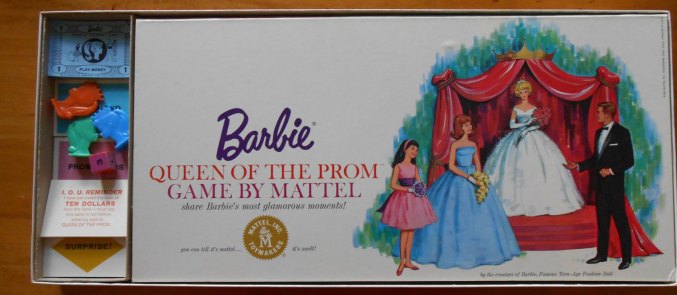
Queen of the Prom game.jpgThe closest I ever got to having a Ken was when I played the game “Barbie, Queen of the Prom.” In that game you had to navigate the board to collect a prom dress, appropriate accessories and, most important, a date. There were four choices: Ken, Allan, Tom and Poindexter. No one ever wanted Poindexter. Probably because he looked like he was about twelve.  By the time I was playing that game, it was the mid-1960’s and Ken’s military crew cut was going out of style. No, the desirable date for Queen of the Prom was Allan, a freckled face red head with a winning smile.Queen of the Prom dates

Eventually I got over my Kenvy. Probably when I had a daughter of my own who also LOVED her Barbie dolls (she had dozens, I only ever had two) and who also had a couple of Ken dolls. She played with her dolls for hours but I was most amused by the Ken and Barbie interaction. Whichever Barbie was the favored doll got the Ken. It was that simple. The pair would go on dates and, often, I would see them ‘kissing’ each other as my daughter’s imagination created romantic scenarios. On occasion I would sit on the floor and play Barbie’s with her. But I was never allowed to play with the Ken’s. Some things never change. Okay, so maybe I still have Kenvy.

For more information about Ken click on this link: https://en.wikipedia.org/wiki/Ken_(doll)

Because there was so much to talk about JUST with Ken, I will be discussing name etymology next week and the cultural impact Barbie and Ken have had over the past 58 years.

Iditarod Race, Alaska

Just Short of Magic

March 6, 2018

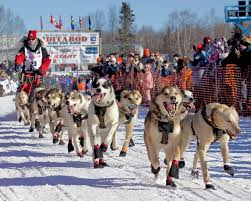
iditarodIt’s one of the most grueling races in the world and participants encounter blizzards, white out conditions and temperatures, with wind chills as low as -131 degrees.
Held in early March each year the Iditarod has come to symbolize the heartiness and determination of Alaskans.

A few race details from the infallible Wikipedia:

“The Iditarod Trail Sled Dog Race is an annual long-distance sled dog race run in early March from Willow to Nome, entirely within the US state of Alaska. Mushers and a team of 16 dogs, of which at least 5 must be on the towline at the finish line, cover the distance in 8–15 days or more. The Iditarod began in 1973 as an event to test the best sled dog mushers and teams but evolved into today’s highly competitive race. Then a record, the second fastest winning time was recorded in 2016 by Dallas Seavey with a time of 8 days, 11 hours, 20 minutes, and 16 seconds.”

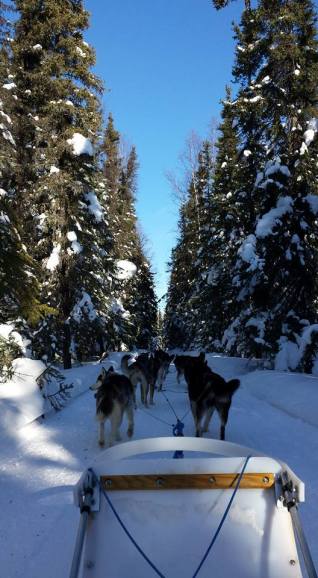
In 2017 the race began on March 6th. A few weeks later I experienced a tiny sliver of what that adventure is like when I got to ride on a dog sled just outside of Fairbanks, Alaska.

view of the back end of the dogs just short of magicWhat I determined in the five days I spent there with my two best friends from high school, Cindy and Daphne, were the following:

  1. It takes a very sturdy person to live in the Alaskan interior. I would not do well there.
  2. Minus 26 degrees is really, really cold.
  3. Riding on a dog sled is a rush of an experience

Just short of magicI am forever grateful to my two friends for the once in a lifetime event. It was, as the name of the business stated, Just Short of Magic. It was a beautiful, sunny day and the temperature was 10 degrees.

In addition to the ride, we were instructed on how to harness the dogs to the sled and each got a turn driving the sled. As Daphne pointed out “it’s a good core workout!”

I also learned that the dogs are not all Siberian Huskies. In fact, most of their dogs were not Huskies. The dogs, however, must possess certain traits as follows:

  1. Thick paw pads
  2. Hearty appetite
  3. Want to pull 85 percent of the time
  4. Dense fur

If a dog does not have these four traits then Alaskans have a name for those dogs: pets.

Snide and Daphne Just short of magicAlthough the adventure was only a couple of hours it was, as their business name proclaimed, just short of magic. I relished the rush of cold air, the way the sled flew over the snow, the cacophony of the barking dogs, and the sparkle of the white snow.

And if you happen to find yourself in Alaska when the snow is still on the ground and the temperature is below freezing, this is my number one recommended thing to do!

For more information about the Iditarod, Wikipedia tells all: https://en.wikipedia.org/wiki/Iditarod_Trail_Sled_Dog_Race

And to book a dog sled experience: https://justshortofmagic.com/dog-sled-tours/

Just short of magic me and Daphne

Update: People have been curious as to the origins of the Iditarod. Also from the infallible Wikipedia:

“The most famous event in the history of Alaskan mushing is the 1925 serum run to Nome, also known as the “Great Race of Mercy.” It occurred when a large diphtheria epidemic threatened Nome. Because Nome’s supply of antitoxin had expired, Dr. Curtis Welch refused to use it and instead sent out telegrams seeking a fresh supply of antitoxin. The nearest antitoxin was found to be in Anchorage, nearly one thousand miles away. The only way to get the antitoxin to Nome was by sled dog as planes could not be used and ships would be too slow. Governor Scott Bone approved a safe route and the 20-pound (9.1 kg) cylinder of serum was sent by train 298 miles (480 km) from the southern port of Seward to Nenana, where it was passed just before midnight on January 27 to the first of twenty mushers and more than 100 dogs who relayed the package 674 miles (1,085 km) from Nenana to Nome. The dogs ran in relays, with no dog running over 100 miles (160 km).”

You May Already Be a Winner!

February 27, 2018

God shows himself in mysterious ways…

the-voice-mail-boxyou-may-already-be-a-winner-jack-ziegleA good editor is the key to making sure whatever is written reads right and, well, doesn’t make ridiculous mistakes. In late February 1997 an American Family Publisher’s Sweepstakes entry was received by the Bushnell Assembly of God Church. It began thus:

“God, we’ve been searching for you”

Apparently when dealing with the topic of God the Infallible Wikipedia is silent. Therefore, I share this brief clip from the Spokesman Review:

“If God were to win, the letter stated, ‘What an incredible fortune there would be for God! Could you imagine the looks you’d get from your neighbors? But don’t just sit there, God.’

Sweepstakes officials did not return several telephone calls for comment Thursday.

(Pastor Bill) Brack said his 140-person congregation is considering whether to mail in the entry. The church could use the money.

And if American Family chooses a different winner?

‘God would be disappointed,’ Brack joked.”

This story reminded me of something similar which I experienced a couple of years ago. I make frequent trips from Seattle to Yakima to help with my 94 year old father. I have a 10 year old Garmin GPS which I like to turn on and use to give me approximate arrival times, elevation, etc.

One day as I was headed back home I stopped at the westbound Indian John rest area and, since I hadn’t yet sent my husband an update as to my estimated arrival time (ETA) I tapped out a quick text message as I was about to continue west. It wasn’t until I received his reply that I realized autocorrect on my phone had done this:

“God says I’ll be home at 4:30”

Apparently the terminology “GPS” didn’t exist in my phone and switched it to the word “God” instead.

I believe I got back a reply something to the effect of “its good God knows when you’re getting home.”

Ever since then when I send messages about my ETA I type in “God” and refer to the GPS as “God.” I do get strange looks from time to time. The way I see it is that it’s good to have God giving me travel advice.

GPS goes crazyIf I had any doubt that my GPS truly was God my disbelief was dispelled about a year and half ago. I was on my way back from Yakima and was driving up I-82 towards Ellensburg. I glanced over at the GPS but what I saw left no doubt that some higher power was in charge. Instead of an elevation of about 2700 feet as expected “God” let me know I was at over… 50,000 feet! As Doc Brown says in Back To The Future “Roads? Where we’re going we don’t need… roads!” Although the photo I snapped was a bit fuzzy, you can clearly see the elevation and God’s instruction that I am to continue to the alley. What alley, I never did find out. This craziness continued until Thorp when, apparently, I was no longer flying and once again on solid pavement.
To read the entire article on God perhaps winning the sweepstakes, here’s the link: http://www.spokesman.com/stories/1997/feb/28/god-you-may-have-won-11-million-sweepstakes/

And, of course, the original movie trailer from the 1977 George Burns and John Denver flick “Oh, God.”

Paricutin Pyroclastics

February 20, 2018

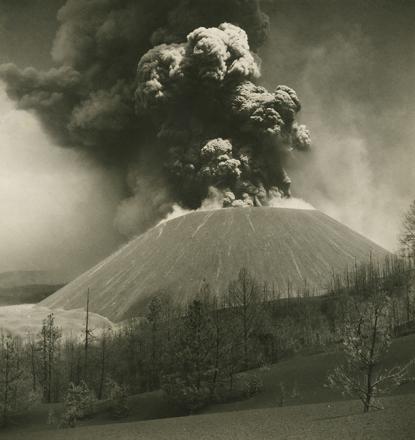
volcano 1943Geologically, nine years is a very short time period. But for farmer Dionisio Pulido of Paricutin, Mexico, the event which began at 4 p.m. on February 20, 1943, forever altered his life.
As he is quoted in the infallible Wikipedia:

“‘At 4 p.m., I left my wife to set fire to a pile of branches when I noticed that a crack, which was situated on one of the knolls of my farm, had opened . . . and I saw that it was a kind of fissure that had a depth of only half a meter. I set about to ignite the branches again when I felt a thunder, the trees trembled, and I turned to speak to Paula; and it was then I saw how, in the hole, the ground swelled and raised itself 2 or 2.5 meters high, and a kind of smoke or fine dust – grey, like ashes – began to rise up in a portion of the crack that I had not previously seen . . . Immediately more smoke began to rise with a hiss or whistle, loud and continuous; and there was a smell of sulfur.’

“He tried to find his family and oxen but they had disappeared so he rode his horse to town where he found his family and friends, happy to see him alive. The volcano grew fast and furiously after this.   Celedonio Gutierrez, who witnessed the eruption on the first night reported:

‘…when night began to fall, we heard noises like the surge of the sea, and red flames of fire rose into the darkened sky, some rising 800 meters or more into the air, that burst like golden marigolds, and a rain like artificial fire fell to the ground.’”

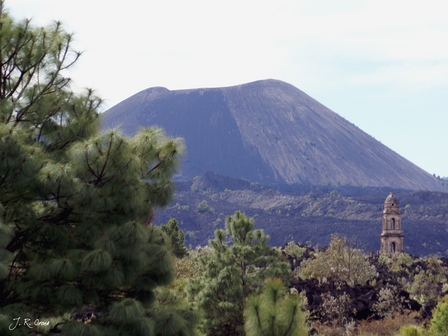
And thus began a eruption which provided scientists an opportunity to study and record how a  volcano is formed. During this time the volcano not only destroyed Pulido’s farm but forced the permanent evacuation of two towns, caused the deaths of three people (but not the farmer!), grew to 1341 feet, and allowed scientists to witness the entire life cycle of a volcano.

Also from the infallible Wikipedia:

“The importance of the Parícutin eruption was that it was the first time that volcanologists were able to fully document the entire life cycle of a volcano. The event brought geologists from all over the world,  but the principal researchers were William F. Foshag of the Smithsonian Institution and Dr. Jenaro Gonzalez Reyna from the Mexican government, who came about a month after the eruption started and stayed for several yeParicutinVolcanojpg-1552186_lg.jpgars. These two wrote detailed descriptions, drew sketches and maps and took samples and thousands of photographs during this time. Many of these are still used today by researchers. Foshag continued to study the volcano until his death in 1956. Between 1943 and 1948, almost fifty scientific articles were published in major journals about the volcano, with even more since. The worldwide effort to study Parícutin increased understanding of volcanism in general but particularly of scoria cone formation.”

As a child I have a distinct memory of sitting in a darkened classroom and watching a documentary about this event. In elementary school it was always a favorite moment when one of the Audio Visual (AV) helpers wheeled the tall cart into the classroom. Atop the cart was a black and white TV connected by wires to a 1960’s version of video equipment. Off would go the lights and some item of interest would flicker to life.School AV cart

As a child seeing a volcano literally grow out of the ground where nothing had been was terrifying. Could that happen in MY backyard? Being that my natural state was to worry about such things I’m pretty certain I was quite concerned  for my home. Over the years I, no doubt, saw dozens of programs this way but none ever made quite the same impression on me.

Thankfully Yakima was not prone to sudden volcanic eruptions and my family was able to live in blissful calm… until May 18, 1980. But THAT is a story for another day.

For those who want to learn more:

https://en.wikipedia.org/wiki/Par%C3%ADcutin

Not sure if this is the video I saw but the music alone is enough to instill terror into a child….

https://video.search.yahoo.com/search/video;_ylt=A0SO8zjY84paVDAA0RNXNyoA;_ylu=X3oDMTEzbGZiMWJ1BGNvbG8DZ3ExBHBvcwMxBHZ0aWQDVUlDMV8xBHNlYwNwaXZz?p=Paracutin+documentary&fr2=piv-