Archives

Hedonic Escalation

The Perfect Combination

March 19, 2018

salted caramelI can think of nothing which tastes better  and scientific research now backs up my claim.

Termed ‘hedonic escalation’ the research confirms what people experience when they are unable to stop eating a particular food.  This article from the UK Independent – and  not from the Infallible Wikipedia – draws its conclusions from a test conducted at the University of Florida a few years ago:

“Marketing analysts Dr Cammy Crolic and Professor Chris Janiszewski revealed that eating it actually causes a rare phenomenon called ‘hedonic escalation.’

Here, our instinctive brains keep craving more and more with every mouthful as it detects new flavours with each bite.

By contrast, with other foods we tend to experience ‘hedonic adaptation’ – the point where your appetite says you’ve had enough.

‘Hedonic escalation is more likely to occur when a palatable food consists of a complex combination of flavours, and a person is motivated to taste additional flavours on each successive bite,’ the researchers write. ‘Hedonic escalation can also increase consumption and influence food choice.’”

So what is this mystery food? Salted Caramel. Today, March 19, is National Chocolate Caramel day, the perfect day to enjoy two perfect foods together.

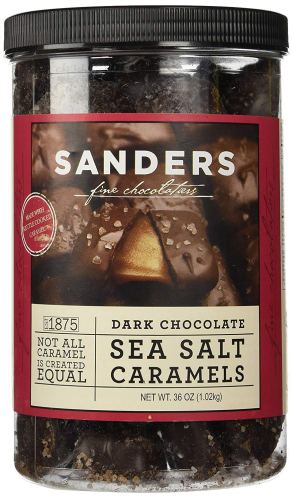
I’ve noticed more and more foods touting the substance in recent years. Last December, during a pre-Christmas shopping trip, I happened upon a jar of Dark Chocolate Sea Salt caramels. Over the past several years I have found that when, given a choice of chocolates, I tended to seek out the ones with caramel. So when I saw this large jar AND it was dark chocolate, I had to have them.

The first bite was wonderful, the second was heaven, and by the time the morsel was consumed I was addicted. But I was good and did not eat the entire jar. In fact I showed amazing discipline, eating one – at most – each day. Soon Christmas was over but the jar of deliciousness remained. And I’d only eat just one on any given day and sometimes none at all. By the time early March rolled around I stared forlornly at the nearly empty vessel. I would miss my Dark Chocolate Sea Salt Caramels because, Costco being Costco, they were, no doubt, only available for the holiday season.

Sanders chocolate.jpgThen one day a miracle occurred. The hubby and I were at Costco (we’re there at least once a week!) and on a whim I haul him over to the candy and chocolate section to see if there was anything else which might fill the void in my life. And then I spied them! A glorious Costco size stack of jar after jar of Sanders Dark Chocolate Sea Salt Caramels beckoned to me. Oh sweet mysteries of life!

Now my biggest fear is that Costco will run out (Under $20 for 36 ounces of wonder). So what I need everyone who reads my blog to do is this: go to Costco today and buy at least one jar. It’s the least you can do to properly celebrate National Chocolate Caramel day. Plus, if I know anything about Costco, the more they sell, the higher the likelihood they will keep them on the shelves forever. Do it for you. Do it for me. Do it for all of America.

A couple of important links:

On Hedonic Escaltion:

https://academic.oup.com/jcr/article-abstract/43/3/388/2199201?redirectedFrom=fulltext

https://www.independent.co.uk/life-style/salted-caramel-not-stop-eating-science-university-florida-hedonic-sugar-fat-a8078296.html

You don’t even have to leave home!:

https://www.costco.com/Sanders-Dark-Chocolate-Sea-Salt-Caramels-36-oz.%2c-2-pack.product.100321779.html

p.s. – I considered writing about the history of chocolate and caramel but tossed that out the window. For those who do not know, Chocolate’s origins can be traced to  MesoAmerica some 1500 years ago. And Caramel? It’s cooked sugar!

The Great Seattle Snowstorm of 1916: Remembering the Snowpocalypse

No Snow Event has come close in the past 100-plus years

February 5

A Tuesday Newsday Classic Updated

It really should not come as a surprise when snow arrives in the Puget Sound region the first week of February. It could be worse, however, if one looks back in time. The year was 1916 and on February 5th of that year, the Puget Sound region was still reeling from a heavy snowfall which began late on January 31st. It was a 24 hour period from February 1st to 2nd, however, which produced a whopping 21 and half inches of the white stuff. That record snowfall still stands.

union street after 1916 snowstorm

Union Street in Seattle as viewed from 9th Avenue, February 1916. Photo from University of Washington Libraries, Special Collections (link below)

The Infallible Wikipedia gives us but a brief glimpse of that event:

“From January 31 to February 2, 1916, another heavy snow event occurred with 29 in (74 cm) of snow on the ground by the time the event was over.”

However, it does link to a more comprehensive article from HistoryLink.org which, I’ve found over the years, provides excellent coverage of Seattle history minutiae. From the article:

When the big snow of 1916 began to fall on a cold Monday on January 31, 1916, there may have been more cameras than shovels in the hands of amateurs. The flurry of snapshots of our second greatest snowstorm illustrate snow-stopped streetcars, closed schools, closed libraries, closed theaters, closed bridges, a clogged waterfront, collapsed roofs, and — most sensationally — the great dome of St. James Cathedral, which landed in a heap in the nave and choir of the sanctuary. (There were no injuries to persons.)

The unusually cold January already had 23 inches of snow on the ground when, on the last day of the month, it began to fall relentlessly. Between 5 p.m. on Tuesday, February 1 and 5 p.m. on Wednesday, February 2, 21.5 inches accumulated in the Central Business District at the Weather Bureau in the Hoge Building. This remains (in 2002) a record — our largest 24-hour pile.

9th and James 1916 snowstorm

James street as viewed down 9th Avenue. Smith Tower – then the tallest building in Seattle – is on the left. February 1916. Photo from the University of Washington Libraries, Special Collections (link below)

The 1916 snow was a wet snow, and it came to a foul end — a mayhem of mud that mutilated bridges and carried away homes.”

In the category of how quickly we forget, it was in 2017 that the record for snowfall on any February 5th was set when two inches was recorded at Sea-Tac airport. An additional 5.1 inches fell on February 6th for a total of 7.1 inches on these two dates. Then in 2019 and again in 2021, the Puget Sound was hit with two fairly large snow events in February.

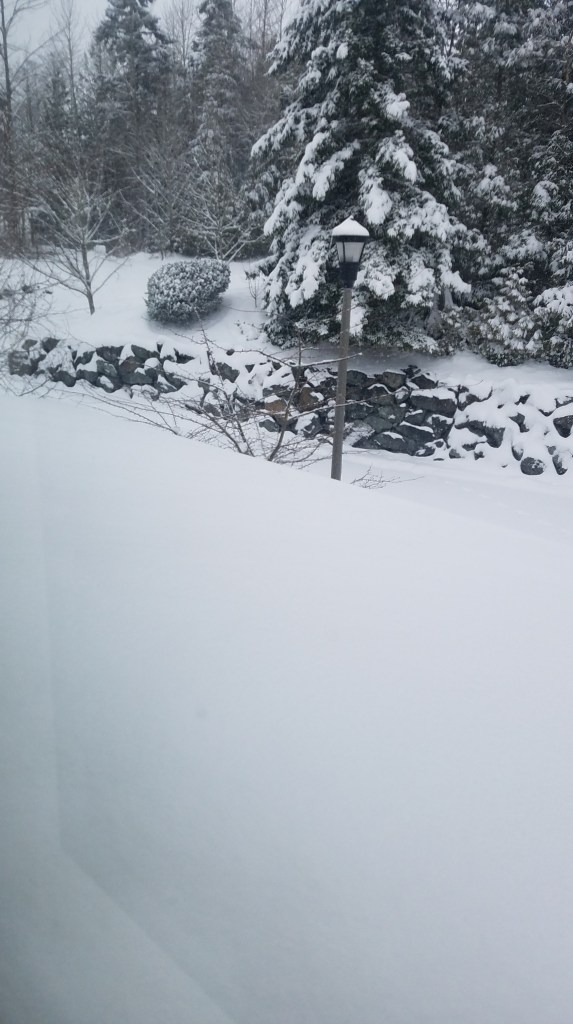
What I wrote on the morning of February 4, 2019: “Since the hubby and I moved north from the greater Seattle area in 2018, I cannot accurately compare the amount of snow from our old house to the one here in Mount Vernon. As of this morning we have between 3 and 4 inches and it is still snowing. The view from my office window – with a little wind in play – gives the appearance of being in a powdery snow globe.”

I cannot complain about Puget Sound snow, however. This region has some of the mildest weather in the world and I think of the white stuff as a wondrous treat to be enjoyed. Ensconced in my warm house with a morning cup of coffee – or later in the day with a mug of hot buttered rum – the beautiful coat of white is a magical event.

Too soon the temperatures will rise, the snow will melt, and we will be back to the brown and green scenery which characterizes a Puget Sound winter. One thing I do know is that within a few short weeks, the plum and cherry tree blossoms will erupt in shades of violet and pink and carpets of purple, yellow and white crocus will spread across the landscape. All we will recall from winter will be a few short days in February when the landscape was transformed into a winter wonderland.

On February 4, 2019, this was the view out my office window. Four days later the Puget Sound region was slammed with over 6 inches more.

Interesting perspective on the February 5/6 2017 event:

http://www.seattleweatherblog.com/snow/biggest-february-snowstorm-generation-wallops-seattle/

An article which highlights the biggest Puget Sound snowstorms:

http://www.historylink.org/File/3681

Some great historic photos of the February 1916 snowstorm:

http://archiveswest.orbiscascade.org/ark:/80444/xv07321

The February 8, 2019 snow event which gave us about six inches.
The February 13, 2021 Snowstorm which dumped just over a foot of snow in Mount Vernon.

A Puzzling Situation

January 29, 2019

January 29th – smack in the middle of winter – is the perfect time to stay indoors and celebrate National Puzzle Day by assembling a centuries old favorite: the jigsaw puzzle.

Peop the puzzler.jpg

A helper joins the puzzle fun.

The first commercial jigsaw puzzles were introduced in the 1700’s in England. They were named as such based on the process used to create them. From the Infallible Wikipedia:

” The engraver and cartographer John Spilsbury, of London, is believed to have produced the first jigsaw puzzle around 1760, using a marquetry saw. Early jigsaws, known as dissections, were produced by mounting maps on sheets of hardwood and cutting along national boundaries, creating a puzzle useful for the teaching of geography. Such ‘dissected maps’ were used to teach the children of King George III and Queen Charlotte by royal governess Lady Charlotte Finch.

Since their inception, jigsaw puzzles have evolved and changed. The original puzzles – made exclusively from wood – were costly and out of reach for the ordinary person. That began to change, however, in the late 1800’s when cardboard puzzles were introduced.

The popularity of the cardboard jigsaw puzzle exploded during the Great Depression as they were relatively inexpensive and could be put together, taken apart, and reassembled innumerable times, thus providing hours of entertainment.

The manufacturing method has improved over the years. Most modern puzzles are cut from paperboard. The process to create a thousand piece puzzle, for example, requires large presses which exert as much as 700 tons of pressure and precision cutting.

Jigsaw puzzles also come in a variety of sizes. A child’s first puzzle is likely to be from four to nine pieces. For something a bit more challenging, an adult can assemble a 300 piece puzzle in an hour or two. A thousand piece puzzle may take numerous sessions over several days.

If you have all winter and unlimited space, then you might want to pick up the 52,110 piece puzzle produced by MartinPuzzle in November 2018. It features a collage of animals and is 274 by 80 inches in size! Or, just short of 23 feet by 7 feet. I don’t know about anyone else, but my dining room table is not that big.

puzzle-50000.jpg

The animal collage puzzle with 52,110 pieces

The 50 pound behemoth is currently on sale for a mere $346… down from its list price of $576. And, if you’re worried about finding the right pieces, it comes in four boxes each containing 28 separate sections of 465 pieces.

playskool-wooden-us-map-2.jpg

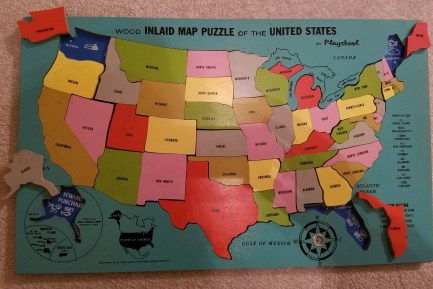
The very first puzzle I remember assembling.

The first puzzle I fell in love with was a 1960’s wooden map of the United States. As a young child I would dump out the pieces and then put all 50 of them back in. While Hawaii was gypped and had no pieces, Michigan was the coolest state as it had two pieces! That puzzle was my primer for memorizing all 50 states and their capital cities.

No doubt my mother noted my interest in puzzles and soon they appeared as birthday and Christmas gifts. I still have  several of the ones I was given.

After my son arrived I introduced him to puzzles while he was still a baby. He, like his mother, was fascinated. By the time he was one and half he was able to put together a 24 piece puzzle! At the time I did not realize that this was unusual baby behavior. But we went with it. Over the years, this activity is one he and I continue to enjoy doing together. At times we engage in ‘competitive’ puzzling where we will race to see who can put in the most pieces. To gain the other’s attention when placing a piece, we might tap our fingers on the puzzle in dramatic fashion. It’s all in good fun and mostly we have developed a cooperative puzzling style. He will work on the main body and I’ll usually put together as much of a section as I can off to the side then, once I’m bored with it, I’ll drag it to its approximate spot and turn it over to him. Then it’s off to a new section for me.

monopoly puzzle.jpgMy favorite puzzles are ones with a central theme and multiple smaller pictures: National Parks, American Presidents, and Board Games are a few which we’ve assembled that come to mind.

My least favorite ones are those which have little visual interest such as those touted as ‘the world’s most difficult’ puzzle as they tend to be quite monochromatic.

I’ve tried to curtail my puzzle ‘habit’ in recent years. But often, when I am near a Goodwill or Value Village store, the temptation is just too great and in I go in search of a ‘new to me’ puzzle to keep me company on a cold winter’s day. It’s the best.

A couple of links about National Puzzle Day and Jigsaw puzzles specifically:

https://nationaltoday.com/national-puzzle-day/

https://en.wikipedia.org/wiki/Jigsaw_puzzle

In case you want to buy the 52,110 piece puzzle:

https://www.mcprint.eu/en/puzzle-shop/puzzle-52110-pieces-the-first-jigsaw-puzzle-that-has-more-than-50000-pieces/?time=1548648257#card

Or for something a bit smaller: https://www.amazon.com/s/?ie=UTF8&keywords=largest+jigsaw+puzzle&tag=geminipcstand-20&index=aps&hvadid=33784252994&hvqmt=p&hvbmt=p&hvdev=c&ref=pd_sl_6sy53x6u1y_p

Winter Solstice

Midwinter’s Night Dreams

December 18, 2018
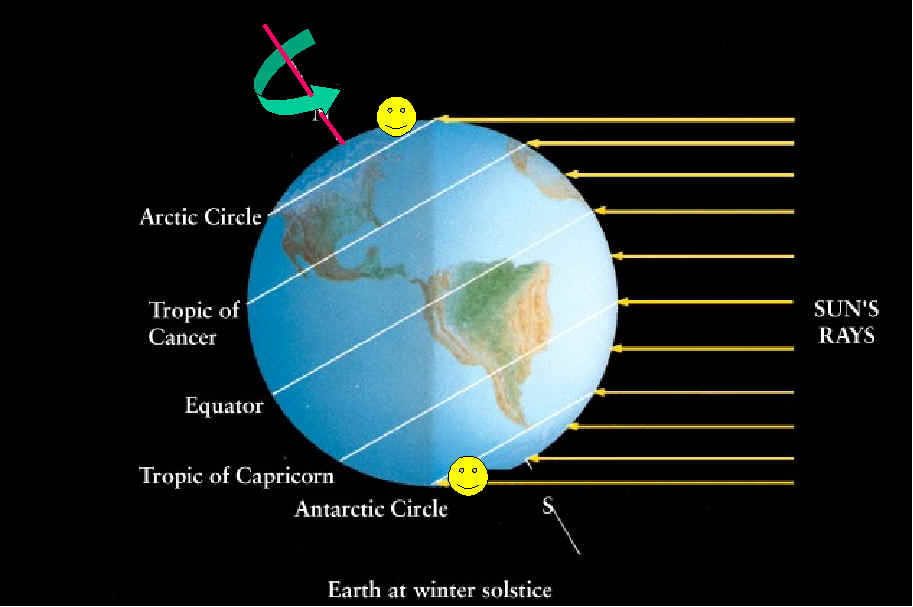
earth at winter solsticeAt 2:23 p.m. on Friday, December 21, 2018, here in the Pacific Northwest, the earth will be tilted furthest away from the sun and we will experience the shortest number of daylight hours in the northern hemisphere annually.

For most of us, we have been taught that it is also the first day of winter. That, however, is disputed. Come to find out, most meteorologists now subscribe to a different theory which places our beginning of winter at the first of December.

Known as meteorological winter, the premise is that northern winters comprise the three coldest – and snowiest – months of the year. Those would be December, January, and February. While I would normally go to the Infallible Wikipedia for citation first, this topic deserves a more scientific site. Here’s what the National Oceanic and Atmospheric Administration (NOAA) has to say:

“Meteorologists and climatologists break the seasons down into groupings of three months based on the annual temperature cycle as well as our calendar. We generally think of winter as the coldest time of the year and summer as the warmest time of the year, with spring and fall being the transition seasons, and that is what the meteorological seasons are based on. Meteorological spring includes March, April, and May; meteorological summer includes June, July, and August; meteorological fall includes September, October, and November; and meteorological winter includes December, January, and February.”
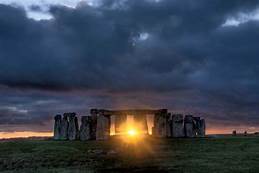
stonehendge solstice

Stonehenge in England. The monument was erected as a way for earlier people to mark the lowest point of the sun each year.

Wait! I said to myself last year when I first learned of this discrepancy. You mean to tell me that WINTER starts on December First – not three weeks later? It was a welcome revelation.

Every fall I find myself missing summer and the longer days of light. I had come to dread winter, counting down the days until the solstice when the number of hours of daylight began to increase once again. But because I thought of winter as starting on the 21st or 22nd, that meant that spring didn’t arrive until March 21st or 22nd.

It never made sense. By September 1, the temperatures have cooled enough at night that I would think “It feels like fall.” Similarly, when December rolls around, it’s consistently 40 degrees and rainy – and quite often we will get a snowfall sometime in the first three weeks of the month.

Yet, with this new information I’ve been able to reset my internal calendar. Now, since I think of December 21/22 as being nearly a month into winter, the season doesn’t seem nearly so long or so bleak. Suddenly, once Christmas and New Year’s Days are over, it’s only two short months until spring arrives, not three. It’s made a huge difference in my outlook.

I also remind myself that there are locales where it is much, much worse. I will give thanks that I do not live in Bodo, Norway where, on the solstice, there will be less than one hour of light. A whopping 49 minutes in fact. According to Timeanddate.com:
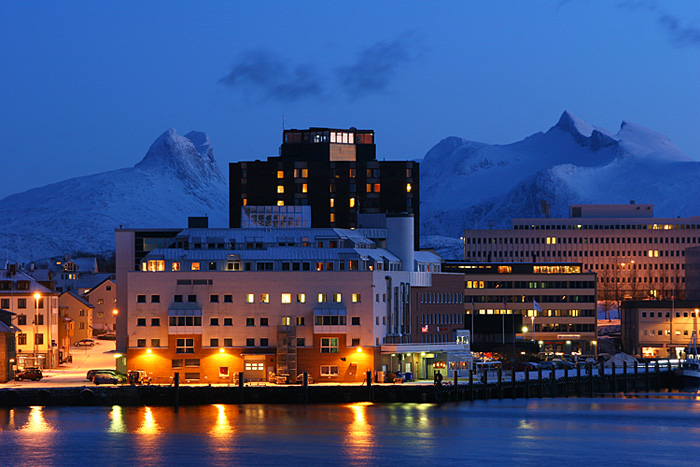
Bodo Norway

Bodo Norway in winter

“December Solstice (Winter Solstice) is on Friday, December 21, 2018 at 11:22 pm in Bodø. In terms of daylight, this day is 23 hours, 11 minutes shorter than on June Solstice.”

Personally, I think there needs to be a national push to get the official first day of winter/spring/summer/fall changed. We can restore the two solstices to their rightful places as ‘midsummer’ and ‘midwinter’.

This year I’m embracing winter in all its glory. And on December 21st at 2:23 p.m. me, my hubby, and my son, daughter, and daughter’s significant other, will all raise a mug of hot buttered rum and salute the shortest daylight hours of the year at that moment when the earth pauses and the northern hemisphere begins its tilt back towards the sun. Happy winter everyone!

As always, a few links:

https://www.ncei.noaa.gov/news/meteorological-versus-astronomical-seasons

https://en.wikipedia.org/wiki/Winter_solstice

https://www.timeanddate.com/sun/norway/bodo

Midwinter’s Night Dreams

December 18, 2018

earth at winter solsticeAt 2:23 p.m. on Friday, December 21, 2018, here in the Pacific Northwest, the earth will be tilted furthest away from the sun and we will experience the shortest number of daylight hours in the northern hemisphere annually.

For most of us, we have been taught that it is also the first day of winter. That, however, is disputed. Come to find out, most meteorologists now subscribe to a different theory which places our beginning of winter at the first of December.

Known as meteorological winter, the premise is that northern winters comprise the three coldest – and snowiest – months of the year. Those would be December, January, and February. While I would normally go to the Infallible Wikipedia for citation first, this topic deserves a more scientific site. Here’s what the National Oceanic and Atmospheric Administration (NOAA) has to say:

“Meteorologists and climatologists break the seasons down into groupings of three months based on the annual temperature cycle as well as our calendar. We generally think of winter as the coldest time of the year and summer as the warmest time of the year, with spring and fall being the transition seasons, and that is what the meteorological seasons are based on. Meteorological spring includes March, April, and May; meteorological summer includes June, July, and August; meteorological fall includes September, October, and November; and meteorological winter includes December, January, and February.”

stonehendge solstice

Stonehenge in England. The monument was erected as a way for earlier people to mark the lowest point of the sun each year.

Wait! I said to myself last year when I first learned of this discrepancy. You mean to tell me that WINTER starts on December First – not three weeks later? It was a welcome revelation.

Every fall I find myself missing summer and the longer days of light. I had come to dread winter, counting down the days until the solstice when the number of hours of daylight began to increase once again. But because I thought of winter as starting on the 21st or 22nd, that meant that spring didn’t arrive until March 21st or 22nd.

It never made sense. By September 1, the temperatures have cooled enough at night that I would think “It feels like fall.” Similarly, when December rolls around, it’s consistently 40 degrees and rainy – and quite often we will get a snowfall sometime in the first three weeks of the month.

Yet, with this new information I’ve been able to reset my internal calendar. Now, since I think of December 21/22 as being nearly a month into winter, the season doesn’t seem nearly so long or so bleak. Suddenly, once Christmas and New Year’s Days are over, it’s only two short months until spring arrives, not three. It’s made a huge difference in my outlook.

I also remind myself that there are locales where it is much, much worse. I will give thanks that I do not live in Bodo, Norway where, on the solstice, there will be less than one hour of light. A whopping 49 minutes in fact. According to Timeanddate.com:

Bodo Norway

Bodo Norway in winter

“December Solstice (Winter Solstice) is on Friday, December 21, 2018 at 11:22 pm in Bodø. In terms of daylight, this day is 23 hours, 11 minutes shorter than on June Solstice.”

Personally, I think there needs to be a national push to get the official first day of winter/spring/summer/fall changed. We can restore the two solstices to their rightful places as ‘midsummer’ and ‘midwinter’.

This year I’m embracing winter in all its glory. And on December 21st at 2:23 p.m. me, my hubby, and my son, daughter, and daughter’s significant other, will all raise a mug of hot buttered rum and salute the shortest daylight hours of the year at that moment when the earth pauses and the northern hemisphere begins its tilt back towards the sun. Happy winter everyone!

As always, a few links:

https://www.ncei.noaa.gov/news/meteorological-versus-astronomical-seasons

https://en.wikipedia.org/wiki/Winter_solstice

https://www.timeanddate.com/sun/norway/bodo

Update for 2022: the solstice arrives at 1:48 p.m. on Wednesday, December 21st. Be sure to mark your calendars!

When the Saints Go Marching In

Saint BarbaraThy Name Is Barbara

December 4, 2018

I’m still not sure how I feel about Saint Barbara. It is kind of cool to have a special day and a feast… not everyone has a name associated with a Saint after-all.  December 4th is Saint Barbara’s day. But how it came about is, well, pretty unbelievable.  From the Infallible Wikipedia:

“According to the hagiographies, Barbara, the daughter of a rich pagan named Dioscorus, was carefully guarded by her father who kept her locked up in a tower in order to preserve her from the outside world. Having secretly become a Christian, she rejected an offer of marriage that she received through her father.

“Before going on a journey, her father commanded that a private bath-house be erected for her use near her dwelling, and during his absence, Barbara had three windows put in it, as a symbol of the Holy Trinity, instead of the two originally intended. When her father returned, she acknowledged herself to be a Christian; upon this he drew his sword to kill her, but her prayers created an opening in the tower wall and she was miraculously transported to a mountain gorge, where two shepherds watched their flocks. Dioscorus, in pursuit of his daughter, was rebuffed by the first shepherd, but the second betrayed her. For doing this, he was turned to stone and his flock was changed to locusts.

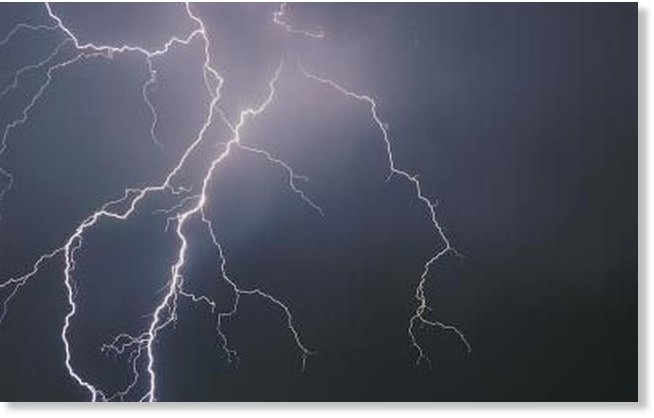
thunder“Dragged before the prefect of the province, Martinianus, who had her cruelly tortured, Barbara held true to her Christian faith. During the night, the dark prison was bathed in light and new miracles occurred. Every morning, her wounds were healed. Torches that were to be used to burn her went out as soon as they came near her. Finally, she was condemned to death by beheading. Her father himself carried out the death-sentence. However, as punishment for this, he was struck by lightning on the way home and his body was consumed by flame. Barbara was buried by a Christian, Valentinus, and her tomb became the site of miracles.”
Because the facts of her story could not be verified, her Sainthood was downgraded in 1969 and the feast day removed from the official calendar. But that does not deter those who wish protection during war and from lightning strikes to offer up a prayer against bad things happening to them. Also from the Infallible Wikipedia:

“Saint Barbara is one of the Fourteen Holy Helpers. Her association with the lightning that killed her father has caused her to be invoked against lightning and fire; by association with explosions, she is also the patron of artillery and mining.”

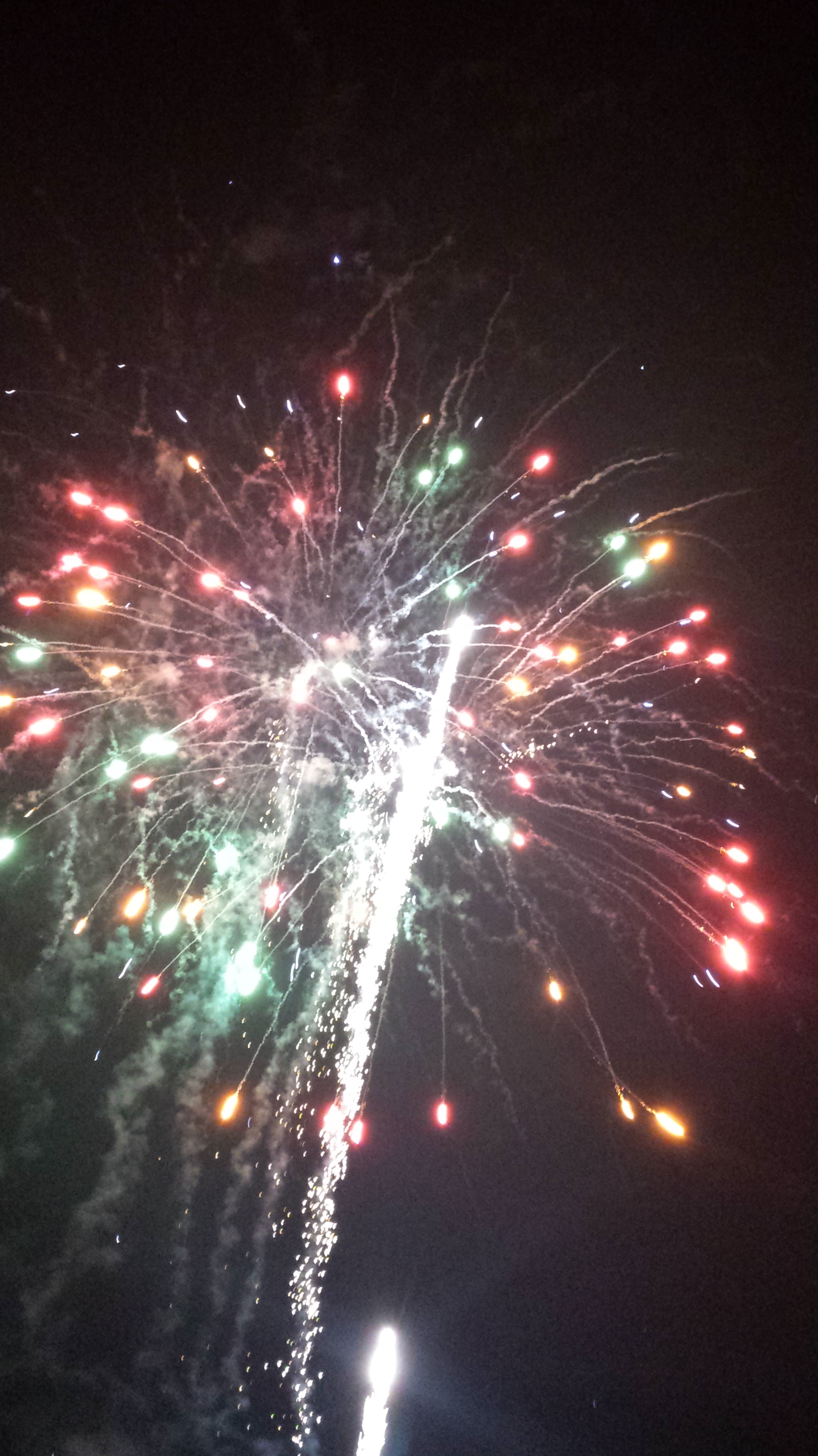
skyrockets12.jpgI think with a bit of planning, I could turn December 4th into a really cool event day. Have a big feast, set off some fireworks, and tell the story of Saint Barbara. And for good measure if the Gods can provide a thunder and lightning storm that day, even better. So mark it on your calendars for 2019, it will be an explosively good time.


No blog post is complete without a link to the Infallible Wikipedia:

https://en.wikipedia.org/wiki/Saint_Barbara

Most Popular Birthdate

How Do YOU celebrate?

September 18, 2018

One needs only to know a little about human gestation to proffer a guess as to why the most popular dates for babies to be born are in mid-September.

According to the National Center for Health Statistics (NCHS) the most common day for births in 2017 is September 9th. The previous most popular day, from 1973 to 1999 according to a Harvard study, was September 16th.heatmapbirthdays1

In fact, in the 2017 numbers, we discover the most common days to be:

  1. September 9
  2. September 19
  3. September 12
  4. September 17
  5. September 10
  6. July 7
  7. September 20
  8. September 15
  9. September 16
  10. September 18

The Infallible Wikipedia offers the following explanation:

“According to a public database of births, birthdays in the United States are quite evenly distributed for the most part, but there tend to be more births in September and October. This may be because there is a holiday season nine months before (the human gestation period is about nine months), or because the longest nights of the year also occur in the Northern Hemisphere nine months before. However, it appears the holidays have more of an effect on birth rates than the winter: New Zealand, a Southern Hemisphere country, has the same September and October peak with no corresponding peak in March and April. The least common birthdays tend to fall around public holidays, such as Christmas, New Years Day and fixed-date holidays such as July 4 in the US. This is probably due to hospitals and birthing centres not offering labor inductions and elective Cesarean sections on public holidays.

Based on Harvard University research of birth records in the United States between 1973 and 1999, September 16 is the most common birthday in the United States and December 25 the least common birthday (other than February 29, because of leap years). In 2011, October 5 and 6 were reported as the most frequently occurring birthdays.”

retro_kissing_christmas_couple_postcard-r4661dfa97e2e4cb59c6edd2e92557d9c_vgbaq_8byvr_512It is duly noted that the approximate conception dates for 9 of those 10 dates is between December 17th and December 28th… apparently a lot of people commemorate Christmas and New Years with their own personal celebrations.

Chances are good that you know someone who has a birthday this week. In the past week alone I’ve had Facebook inform me of at least 4 ‘friends’ on every single day with birthdays.

Last year I noted this trend on Facebook and my niece, whose birthday is September 30th, commented that she was teasing one of her friends about being born on the 16th because of ‘when’ she was likely to have been conceived. And then the light went on for my niece… who was a week late… Can you say Happy New Year?!

And, finally, is another friend of mine whose birthday is September 18th. For years, he told me, they would rib their Dad about the link between that date and Christmas. Dad finally had enough and blew up one day, exclaiming, “Okay! It was Christmas Eve! Now drop it.”baby in christmas present

In the world of irony it’s even more delicious that my friend’s daughter was born… on September 18th. Merry Christmas, everyone.

A couple of links to amuse you:

http://thedailyviz.com/2016/09/17/how-common-is-your-birthday-dailyviz/ (a cool interactive map where you can see how popular your birthday is and where it ranks. Mine is the 37th most popular date)

https://en.wikipedia.org/wiki/Birthday (because it’s the Infallible Wikipedia, right?)

… the Dog Days of Summer

Dog Days and Cat Nights

August 14, 2018

beagle with fanWhen the heat arrives in July and August each year inevitably someone comments that it is the “Dog Days” of summer. What, exactly, are Dog Days?
It’s actually in reference to the star Sirius which, ancients believed, contributed to the excessive heat beginning in mid-July. Although you can see Sirius – it is the star which is nearest to our solar system – throughout the year, it is in summer when it rises in conjunction with the sun each morning. It is this phenomenon which prompted the term Dog Days. There is some debate as to when Dog Days occur and it depends on who you ask.

From the Infallible Wikipedia:

“Various computations of the dog days have placed their start anywhere from 3 July to 15 August and lasting for anywhere from 30 to 61 days. They may begin or end with the cosmical or heliacal rising of either Sirius in Canis Majoror Procyon (the “Little Dog Star”) in Canis Minor and vary by latitude, not even being visible throughout much of the Southern Hemisphere. Sirius observes a period of almost exactly 365¼ days between risings, keeping it largely consistent with the Julian but not the Gregorian calendar; nonetheless, its dates occur somewhat later in the year over a span of millennia.

In antiquity, the dog days were usually reckoned from the appearance of Siriusaround 19 July (Julian) to relieving rains and cool winds, although Hesiod seems to have counted the worst of summer as the days leading up to Sirius’s reappearance.

In Anglo-Saxon England, the dog days ran from various dates in mid-July to early or mid-September. Canonical “dog daies” were observed from July 7 to September 5 in the 16th-century English liturgies. They were removed from the prayer books at the restoration of the monarchy in 1660 and their term shortened to the time between July 19 and August 20. During the British adoption of the Gregorian calendar in 1752, they were shifted to July 30 to September 7.

Many modern sources in the English-speaking world move this still earlier, from July 3 to August 11, ending rather than beginning with or centering on the reappearance of Sirius to the night sky.”

The star Sirius is the brightest star in our skies as it is a mere 8.7 light years from Earth. It is best observed in the winter as it is seen quite near the very recognizable constellation Orion. Orion dominates the night sky, appearing on the southern horizon. Sirius can be seen just below and to the left of Orion’s ‘belt’.f0895f14aed5a68fee572ee10326772f--orions-belt-sirius

Dog Days are not exclusive to the American experience, however, and on August 16th each year, it is celebrated as follows:

“It is possible that the Roch, the legendary medieval patron saint of dogs celebrated by the Catholic Church on 16 August, owes some of his legacy to the dog days. From the period of his self-proclaimed protectorate over the island, the Danish adventurer Jørgen Jürgensen is remembered in Iceland as Jorgen the Dog-Day King (Icelandic: Jörundur hundadagakonungur).”

I would be remiss if I didn’t also share the legend of Cat Nights. I had never heard of such a celebration until researching for this post. But according to the Old Farmer’s Almanac, they are described thusly:

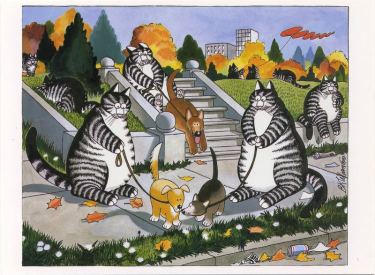
The term ‘Cat Nights’ harks back to a rather obscure old Irish legend concerning witches and the belief that a witch could turn herself into a cat eight times, but on the ninth time (August 17), she couldn’t regain her human form. This bit of folklore also gives us the saying, ‘A cat has nine lives.’ Because August is a yowly time for cats, this may have prompted the speculation about witches on the prowl in the first place.”kliban cats walking dogs

But back to Dog Days. One of my earliest memories is of the very first summer after my family moved to Yakima… must have been late July or August 1962. My mother was insistent that we ‘younger’ children (I turned 5 in 1962) go to bed at 8 p.m. It did not matter that it was still light outside. We went to bed regardless. In the northern hemisphere the sun does not set until well after 9 p.m. that time of year and in Yakima it was closer to 10. We went to bed regardless. And it did not matter that it was uncomfortably hot. We went to bed regardless. It was a few years later when we got air conditioning which finally made the hottest of days bearable.

I vividly recall lying in my bed – which was under a window – and watching the lightweight cotton curtains billowing in the hot wind. Just outside my window I can hear children laughing and playing outside.  I thought it was terribly unfair that I had to be in bed, unable to sleep, while the rest of the neighborhood was having fun in our backyard.

I moved away from Yakima in great part to avoid the excessive heat which arrived in mid-July each year and often remained until late August or early September.

Ironically, these past nine years I have found myself back in my hometown to help with my dad (who is now 95).

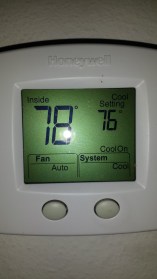
20180810_082117This year and last – as his body fat has diminished – he has a much more difficult time managing his internal temp. He’s frequently cold, even on the very hottest of summer days, and a battle rages over whether the thermostat is set to cooling or heating! Frequently the furnace is running and the indoor temperature is close to 80 degrees. Either my brother (who lives with my dad) or I will switch it to AC only to have dad turn on the furnace. He does this even if the outdoor temp is over 100 degrees. The picture to the left is one I took a few days ago in Yakima, right after switching the thermostat back to cool.
On a recent trip I was lying in bed, trying to go to sleep, and harkened back to 1962… and just like then it was hot and difficult to get comfortable. Of course the reason was because my dad had turned the furnace on!

A couple of links about Dog Days and Cat Nights:

https://en.wikipedia.org/wiki/Dog_days

https://www.almanac.com/fact/cat-nights-begin-the-term-cat-nights-holiday

Glacier Peak: The Volcano That Get’s No Respect

June 12th

A Tuesday Newsday Classic from 2018

One night – a month ago in early May – the news that Kilauea volcano in Hawaii had erupted dominated the news. Reports on the lava flows and subsequent explosive discharges provided our TV stations in Western Washington an opportunity to remind all of us that there are five active volcanoes in our state.

seattle with glacier peak

“Five?” I exclaimed to my hubby as we sat in the living room of our new Mount Vernon, Washington, condo. “I dispute that there are five ACTIVE volcanoes here!”

Of course such a claim sent me straight to the internet.

I knew of the two obvious active ones: Mt. St. Helen’s and Mt. Baker as both had activity in the past 40 years. And you can hardly read anything about Mt. Rainier without being reminded that although it is dormant it’s not dead and ‘could’ erupt this week or not for a thousand years.

Which left ‘two’ unaccounted for volcanos. The first one was easy: Mt. Adams. I grew up seeing Mt. Adams on most days walking to school in Yakima. But it has always been my understanding that it is not in any danger of eruption as it truly is a long dormant mountain.

So what was the last volcano? In addition to Washington’s four mountains, there were Mt. Hood in Oregon as well as the Three Sisters and then two in California, Shasta and Lassen Peak.

I was, frankly, a veritable volcano snob, having not only lived through the eruption of Mt. St. Helen’s but also growing up with the volcanic mountains so much a part of the experience. I know my mountains! But the gauntlet had been thrown down and I set out to disprove the report. There was not, I was certain, a ‘fifth’ Washington state volcano.

Imagine my dismay when, according to the infallible Wikipedia (as well as the US Geologic Survey), the benign sounding Glacier Peak turned out to be the missing volcano.

Glacier Peak!? I’d heard of it but the name alone reinforces visions of cold and ice. A volcano? It’s a volcano?

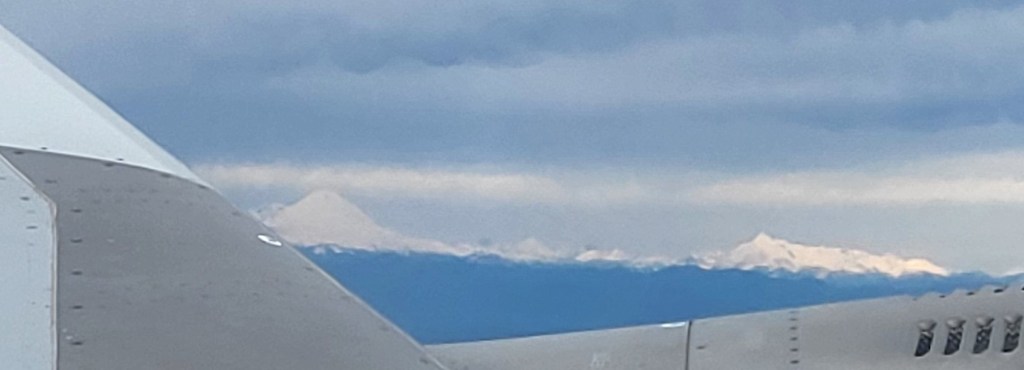
From my view out of a plane, looking north, in November 2025. On the left is Mt. Baker and on the right, with the bump is Glacier Peak.

Indeed it is. At 10,541 feet it is the fourth tallest peak in the state and is located a scant 50 miles southeast from where I now live and only 70 miles northeast of Seattle.

And, like Volcan de Fuego in Guatamala and our other four peaks, it is a stratovolcano, the kind of volcano which can erupt violently.

From the Infallible Wikipedia:

“Of the five major volcanoes in Washington, only Glacier Peak and Mount St. Helens have had large eruptions in the past 15,000 years. Since both volcanoes generate magma of dacitic origin, the viscous magma builds up since it cannot flow through the eruptive vent. Gradually, the pressure grows, culminating in an explosion that ejects materials such as tephra, which in its simplest form, is ash.

Tephrochronology and radiocarbon dating indicate that Glacier Peak eruptions occurred in 1700 AD ± 100 years, 1300 AD ± 300 years, 900 AD ± 50 years, 200 AD ± 50 years, 850 BC, 3150 BC, and in 3550 BC. The Volcanic Explosivity Index (VEI) for three of these was 2 to 4, small compared to the 5 of the 1980 eruption of Mount St. Helens. They were characterized mainly by a central vent eruption, followed by an explosive eruption. These eruptions varied in outcome; some produced lahars, some pyroclastic flows, and others lava domes.

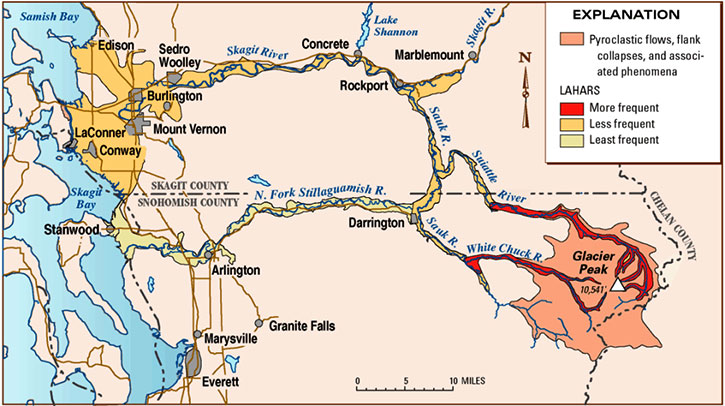
A little more than 13,000 years ago, a sequence of nine tephra eruptions occurred within a period of less than a few hundred years. Associated with these eruptions were pyroclastic flows. Mixed with snow, ice and water, these formed lahars that raced into three nearby rivers, filling their valleys with deep deposits. Subsequently the mudflows drained into both the North Fork of the Stillaguamish River (at that time an outlet of the Sauk River) and Skagit Rivers. In Arlington, 60 miles downstream, lahars deposited seven feet of sediment. Subsequent erosion of lahar deposits near Darrington led to the current river system with the Stillaguamish River separated from the Sauk/Skagit Rivers. Lahar debris was deposited along both the Skagit and Stillaguamish Rivers all the way to Puget Sound. A small portion of the erupted tephra was deposited locally. However, most of the tephra reached higher levels of the atmosphere, and was transported by the wind hundreds of miles. Deposits from this congregation were as thick as 1 foot near Chelan and 0.3 inches near Missoula, Montana.

Since these events, Glacier Peak has produced several lahars. The largest events were 5,900 and 1,800 years ago and were associated with dome-building eruptions. In both cases, the lahars traveled down the Skagit River to Puget Sound.”

It was actually this last sentence which most caught my attention… I repeat:

In both cases, the lahars traveled down the Skagit River to Puget Sound.

Let’s see… where does the Skagit River flow before arriving at Puget Sound? Oh yes, I know, Mount Vernon.

lahar flows glacier peak

Armed with this revelation about Washington’s mostly unknown volcano, my hubby will attest to the fact that I’ve become obsessed. In my weekly or more drives up and down Interstate 5 I have found myself, on clear days, scanning the mountains to the east. Which one is Glacier Peak? And, more importantly, how is it I never knew which one it was and that it’s a volcano?

I’ve come to believe that Glacier Peak is like the Rodney Dangerfield of volcanoes. It just doesn’t get any respect. There are no roads which will take you to its base. There’s no park, no visitor centers, no campgrounds. And every single day hundreds of thousands of people drive within less than a hundred miles of it, oblivious to its existence.

As an experiment I’ve started asking people two questions: first if they had ever heard of Glacier Peak and, second, that it’s a volcano. Consistently, the answer is no.

I’m now on a one-woman crusade to help Glacier Peak get that respect. It’s the least I can do for the volcano in my backyard.

Washington_State_volcanoes

As always, links to a couple of Infallible Wikipedia articles, USGS, and – for those of you under the age of 50 – Rodney Dangerfield. Gotta have those cultural references.

https://en.wikipedia.org/wiki/Glacier_Peak

https://en.wikipedia.org/wiki/Glacier_Peak_Wilderness

https://volcanoes.usgs.gov/volcanoes/glacier_peak

https://youtu.be/Z_OuflwjeiY (Rodney Dangerfield YouTube clip)

Paricutin Pyroclastics

February 20, 2018

volcano 1943Geologically, nine years is a very short time period. But for farmer Dionisio Pulido of Paricutin, Mexico, the event which began at 4 p.m. on February 20, 1943, forever altered his life.

As he is quoted in the infallible Wikipedia:

“‘At 4 p.m., I left my wife to set fire to a pile of branches when I noticed that a crack, which was situated on one of the knolls of my farm, had opened . . . and I saw that it was a kind of fissure that had a depth of only half a meter. I set about to ignite the branches again when I felt a thunder, the trees trembled, and I turned to speak to Paula; and it was then I saw how, in the hole, the ground swelled and raised itself 2 or 2.5 meters high, and a kind of smoke or fine dust – grey, like ashes – began to rise up in a portion of the crack that I had not previously seen . . . Immediately more smoke began to rise with a hiss or whistle, loud and continuous; and there was a smell of sulfur.’

“He tried to find his family and oxen but they had disappeared so he rode his horse to town where he found his family and friends, happy to see him alive. The volcano grew fast and furiously after this.   Celedonio Gutierrez, who witnessed the eruption on the first night reported:

‘…when night began to fall, we heard noises like the surge of the sea, and red flames of fire rose into the darkened sky, some rising 800 meters or more into the air, that burst like golden marigolds, and a rain like artificial fire fell to the ground.’”

And thus began a eruption which provided scientists an opportunity to study and record how a  volcano is formed. During this time the volcano not only destroyed Pulido’s farm but forced the permanent evacuation of two towns, caused the deaths of three people (but not the farmer!), grew to 1341 feet, and allowed scientists to witness the entire life cycle of a volcano.

Also from the infallible Wikipedia:

“The importance of the Parícutin eruption was that it was the first time that volcanologists were able to fully document the entire life cycle of a volcano. The event brought geologists from all over the world,  but the principal researchers were William F. Foshag of the Smithsonian Institution and Dr. Jenaro Gonzalez Reyna from the Mexican government, who came about a month after the eruption started and stayed for several yeParicutinVolcanojpg-1552186_lg.jpgars. These two wrote detailed descriptions, drew sketches and maps and took samples and thousands of photographs during this time. Many of these are still used today by researchers. Foshag continued to study the volcano until his death in 1956. Between 1943 and 1948, almost fifty scientific articles were published in major journals about the volcano, with even more since. The worldwide effort to study Parícutin increased understanding of volcanism in general but particularly of scoria cone formation.”

As a child I have a distinct memory of sitting in a darkened classroom and watching a documentary about this event. In elementary school it was always a favorite moment when one of the Audio Visual (AV) helpers wheeled the tall cart into the classroom. Atop the cart was a black and white TV connected by wires to a 1960’s version of video equipment. Off would go the lights and some item of interest would flicker to life.School AV cart

As a child seeing a volcano literally grow out of the ground where nothing had been was terrifying. Could that happen in MY backyard? Being that my natural state was to worry about such things I’m pretty certain I was quite concerned  for my home. Over the years I, no doubt, saw dozens of programs this way but none ever made quite the same impression on me.

Thankfully Yakima was not prone to sudden volcanic eruptions and my family was able to live in blissful calm… until May 18, 1980. But THAT is a story for another day.

For those who want to learn more:

https://en.wikipedia.org/wiki/Par%C3%ADcutin

Not sure if this is the video I saw but the music alone is enough to instill terror into a child….

https://video.search.yahoo.com/search/video;_ylt=A0SO8zjY84paVDAA0RNXNyoA;_ylu=X3oDMTEzbGZiMWJ1BGNvbG8DZ3ExBHBvcwMxBHZ0aWQDVUlDMV8xBHNlYwNwaXZz?p=Paracutin+documentary&fr2=piv-

Tsunami!

December 26, 2017

TsunamifloodBigI admit it. I’m a complete nerd when it comes to natural disasters. I’m fascinated by tornadoes and all nature related phenomenon. And while we are mostly able to deal with windstorms, snowstorms and the occasional earthquake here in the Pacific Northwest, it’s impossible to imagine what December 26, 2004 must have been like for the people who experienced a rare mega-thrust earthquake and the devastating tsunami which struck near Sumatra in the Indian Ocean.

According to the infallible Wikipedia:

“It is the third-largest earthquake ever recorded on a seismograph and had the longest duration of faulting ever observed, between 8.3 and 10 minutes. It caused the entire planet to vibrate as much as 1 centimeter (0.4 inches) and triggered other earthquakes as far away as Alaska. Its epicenter was between Simeulue and mainland Indonesia. The plight of the affected people and countries prompted a worldwide humanitarian response. In all, the worldwide community donated more than US$14 billion (2004) in humanitarian aid. The event is known by the scientific community as the Sumatra–Andaman earthquake. The resulting tsunami was given various names, including the 2004 Indian Ocean tsunami, South Asian tsunami, Indonesian tsunami, the Christmas tsunami, and the Boxing Day tsunami.”

What was particularly remarkable about this particular earthquake is that this was the first tsunami of this magnitude which was so widely filmed and seen in ‘real time.’ This scenario was repeated on March 11, 2011 when another mega thrust earthquake triggered yet another deadly tsunami, this time in Japan.

Until the videos started to pour in, I could only imagine what a tsunami might look like. To see how the water literally overpowers everything in its path is truly unfathomable. For the scientific community the knowledge gained is, no doubt, invaluable but we are made somber with the understanding that over 230,000 people were lost in this one event.

There have, of course, been other mega thrust quakes and tsunamis in the world. Scientists now believe that the west coast of the United States and Canada was hit by such an event on January 26, 1700. Information on the Cascadia quake has been pieced together through written Japanese records of a tsunami which did not correlate with a known earthquake in the region on that date. Evidence of the event has been  via oral stories of the indigenous peoples of the Pacific Northwest and also physical evidence from British Columbia south to Northern California.

Is the Pacific Northwest at risk for a mega-thrust quake? Such an event strikes the coast, on average, every 500 years and scientists believe there have been at least seven such events in the past 3,500 years. It is now 317 years since the 1700 quake.

Tsunami evacuation sign.pngDown at Long Beach, Washington, there are the blue tsunami signs which direct people to routes that would, ostensibly, lead them to higher ground. Recently I saw a program on HGTV where a family was purchasing a vacation home ten miles north in Ocean Park. Personally, I would buy something no more than a mile north of Long Beach; in lesser known Seaview would be better. From that location there is a road which quickly gets you up on top of a rather tall promontory. If, however, one happens to be on the north end of the peninsula when such an earthquake occurs it’s probably best to carry an auto- inflatable rubber boat with you when visiting the coast.

For all you other science nerds out there, here are two Wikipedia links for you:

https://en.wikipedia.org/wiki/2004_Indian_Ocean_earthquake_and_tsunami

https://en.wikipedia.org/wiki/Cascadia_subduction_zone

And two YouTube videos of the 2004 Boxing Day tsunami:

https://www.youtube.com/watch?v=my4UD9Wfqvk