Ask any person of my generation if they know who Barnabas Collins is and you are likely to get an enthusiastic response something to the effect of:
“I made sure I was home by 4 o’clock every day so I wouldn’t miss an episode.”
The aforementioned Barnabas was, by any definition, the romantic hero of the always melodramatic Dark Shadows. One look at his face and you might ask yourself “Really?”
Hold that thought. We’ll get back to his appeal in a bit.
June 27, 1966 marked the date when Dark Shadows premiered on ABC. The show, originally cast in black and white, captured the imaginations of millions of teens and pre-teens and became ‘must watch’ TV. In the course of its five year run, 1,225 episodes were aired. Like other daytime soap operas it featured storylines which took months to resolve and characters that became household names. But unlike any other shows at that time it was centered on vampires and werewolves, time travel and alternate existences.
From the infallible Wikipedia:
“Perhaps one of ABC’s first truly popular daytime series, along with the game show Let’s Make a Deal, Dark Shadows found its demographic niche in teenagers coming home from school in time to watch the show at 4 p.m. Eastern / 3 p.m. Central, where it aired for almost all of its network run, the exception being a 15-month stretch between April 1967 and July 1968, when it aired a half-hour earlier. Originally, it was aired in black-and-white, but the show went into color starting with the August 11, 1967 installment transmission. It became one of ABC’s first daytime shows to actually win its timeslot, leading to the demise of NBC’s original Match Game and Art Linkletter’s long-running House Party on CBS, both in 1969.”
Dark Shadows reached its peak in March 1969. It was in those episodes when Barnabas figured prominently and was romantically involved with Angelique Bouchard. One particular episode stands out.
Barnabas was in love with the blonde beauty and he takes her to his room. Ahem. Barnabas is conflicted as he wants to be with her but is concerned his passion will carry him away and he will ‘bite’ Angelique’s neck, thus killing her and she, too, will become a vampire. An outcome he does not want. I cannot recall if he did or did not bite her but I do recall that the show implied that the two of them engaged sexually. Powerful stuff for a kid of 12.
Barnabas did not have to be young or classically handsome as he was a compelling character and we Dark Shadow’s fans were completely enthralled.
I know that Dark Shadows influenced me as a writer. The power of the show was derived by what was left out; the idea of mysterious forces at work which left much to the imagination. In the late 1960’s and early 1970’s you couldn’t air a program that showed explicit acts and that, I think, was a good thing.
For viewers, and readers, our imagination is what fuels the enjoyment we derive from a compelling TV show or well told story in a novel.
All but a few of the Dark Shadows episodes survive. I’m pretty sure if I were to watch them now the mystique would evaporate. Instead, I choose to let the snippets of remembered scenes live in my brain to serve as inspiration.
Just When You Thought It Was Safe To Go Back in the water…
“We started the film without a script, without a cast, and without a shark.”
As quipped by Richard Dreyfuss on the filming of the classic film, Jaws, which premiered on June 20, 1975. Despite its rocky start, technical problems throughout filming, and costing more than double its budget, Jaws, is regarded as one of the best films of all times. From the Infallible Wikipedia:
“In the years since its release, Jaws has frequently been cited by film critics and industry professionals as one of the greatest movies of all time. It was number 48 on American Film Institute’s 100 Years… 100 Movies, a list of the greatest American films of all time compiled in 1998; it dropped to number 56 on the 10 Year Anniversary list. AFI also ranked the shark at number 18 on its list of the 50 Best Villains, Roy Scheider’s line “You’re gonna need a bigger boat” 35th on a list of top 100 movie quotes, Williams’ score at sixth on a list of 100 Years of Film Scores, and the film as second on a list of 100 most thrilling films, behind only Psycho. In 2003, The New York Times included the film on its list of the best 1,000 movies ever made.”
It took only two weeks for the film to recoup production costs and it is recognized as the first ‘summer blockbuster’ film, setting a template for future filmmakers.
Of course the long term effect was the impact on people’s psyches, preying on our fear of an unknown, unseen killer, lurking in the ocean’s depths. In reality the average number of people killed by great white sharks annually is six. Not exactly an Amity Island level of vicious attacks.
So should we be afraid to go back in the water?
In December 2005 my family and I were about to go snorkeling at a benign looking bay called Kanahena Cove on Maui. It was just after sunrise and we were the only four people there: myself, my husband and our son, age 15, and our daughter, age 12. Because we had to share snorkel sets we decided that my husband and son would go first. So my daughter and I were on the lava rocks near where the guys had, a moment earlier, climbed into the water.
Just then, a car drives past on the road (about 20 yards away) and screeches to a halt. A woman gets out and erupts into a tirade:
“You know, there are sharks in the water,” she yells at us, “and one could take her in a single bite (pointing to my daughter).”
Dumfounded, I stare at the woman, unable to utter a word. She continues her rant:
“The sharks are angry at George Bush for the war in Iraq, which is why there have been increased shark attacks.”
The screed went on for another minute although I don’t recall all she said. What I do know is that my 12 year old daughter WAS afraid to get in the water and all of us retain a rather vivid memory of that day.
Personally, I’m skeptical that politics motivate sharks. I would speculate that other factors such as increased human presence, the El Nino and La Nina changes in ocean water temperatures and food sources, are more likely to influence attacks.
For the record? In 2015 there were 98 shark attacks, six of them fatal. Which is 40 more than the number of attacks in 2005. So much for that woman’s theory. I wonder who the sharks were mad at that year?
“Let us go forth, the tellers of tales, and seize whatever prey the heart long for, and have no fear. Everything exists, everything is true, and the earth is only a little dust under our feet.”
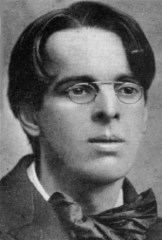
Awarded the Pulitzer Prize for literature in 1923, William Butler Yeats interpreted the honor as belonging to his beloved Ireland. The poet was born on June 13, 1865 and, despite a number of years in England, his writing and politics were inspired by his early life on the Emerald Isle.
His poetry should be read through the lens of Yeats fascination with the occult. From the infallible Wikipedia:
“Yeats had a life-long interest in mysticism, spiritualism, occultism and astrology. He read extensively on the subjects throughout his life, became a member of the paranormal research organisation “The Ghost Club” (in 1911) and was especially influenced by the writings of Emanuel Swedenborg. As early as 1892, he wrote: “If I had not made magic my constant study I could not have written a single word of my Blake book, nor would The Countess Kathleen ever have come to exist. The mystical life is the centre of all that I do and all that I think and all that I write.”
Personally, I find his own life’s story even more implausible than his writing. He met Maud Gonne, the woman who most inspired him, when he was 24 years old. Thus began a relationship which spanned over 30 years, involved four marriage proposals and four rejections AND a fifth proposal to Maud’s 21 year old daughter. Maud’s own story is book worthy and she must have been one heck of a woman!
In fairness to Yeats – who seemed to have some warped code of honor – the fourth proposal to her involved terms and conditions which he hoped she would find unacceptable. Once that final offer was rejected he sought out a younger woman (he was 51 by then) who could produce an heir. Since Maud’s daughter, who at the age of 15 had herself proposed to him, upon his proposal said no he found another woman:
“That September, Yeats proposed to 25-year-old Georgie Hyde-Lees (1892–1968), known as George, whom he had met through Olivia Shakespear. Despite warnings from her friends—‘George … you can’t. He must be dead’—Hyde-Lees accepted, and the two were married on 20 October. Their marriage was a success, in spite of the age difference, and in spite of Yeats’ feelings of remorse and regret during their honeymoon. The couple went on to have two children, Anne and Michael. Although in later years he had romantic relationships with other women, Georgie herself wrote to her husband ‘When you are dead, people will talk about your love affairs, but I shall say nothing, for I will remember how proud you were.’”
Truly any fiction writer could not conceive of a plot line as convoluted as the true life of WB Yeats. Multiple proposals, unrequited love, political intrigue, and the execution of his romantic and political rival, connect the pieces of the tale!
June 6 is an important day in US History. But since we all learned about D-Day in our US History classes (or you can pick up my friend Irene Fernandes wonderful novel ‘They Also Served’ for a firsthand account of a war-bride in England during WWII) I have instead chosen another ground breaking event for the subject this week.
Yes, it was on June 6, 1933, when the first commercially successful drive in movie theatre opened in Pennsauken, New Jersey. The father of the drive in movie was one Richard Hollingshead. From the infallible Wikipedia:
“Hollingshead conducted outdoor theater tests in his driveway at 212 Thomas Avenue in Riverton. After nailing a screen to trees in his backyard, he set a 1928 Kodak projector on the hood of his car and put a radio behind the screen, testing different sound levels with his car windows down and up. Blocks under vehicles in the driveway enabled him to determine the size and spacing of ramps so all automobiles could have a clear view of the screen. Hollingshead applied for a patent of his invention on August 6, 1932, and he was given U.S. Patent 1,909,537 on May 16, 1933.”
The American public, already in love with the automobile, also loved the drive-in movie. They reached their peak of popularity in the 1950’s and early 1960’s when some 4,000 Drive-ins existed throughout the United States.
The phenomenon was not without its detractors, however, and drive in movies – which allowed people to view films from the privacy of their car – were labeled ‘passion pits.’ Teenagers, particularly, adored them as it afforded an opportunity to, well, you know.
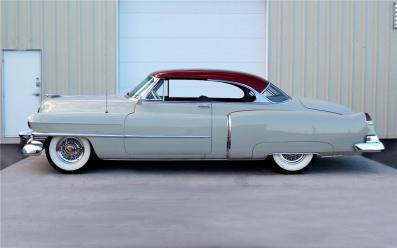
Speaking of which, there were several drive-in movie theaters in my hometown of Yakima, Washington. One evening my sister and I and two of our friends decided to go to the Fruitvale Drive-in (sadly, no longer there). The car my sister drove was a 1950 yellow Cadillac with a red roof; a hand me down from our grandparents. This tank of a car had all the whistles and bells popular in 1950 including a gauge which told you how good your driving was. Ok, not really, it had to do with gas mileage, but as children our grandfather told us it was evaluating his driving with an arrow that point to words like ‘poor’, ‘fair’, ‘good’ and ‘excellent.’ But, most important of all, it featured a movable spotlight affixed to the car just outside the driver’s side window. There was a handle inside the car to control the light.
On this particular night my sister and one of her friend’s were in the front seat and me and one of my friend’s were in the back. Our attentions were soon drawn to the activities taking place in the backseat of the car parked in front of us. We watched with intense teenage curiosity as the silhouetted heads of the couple descended lower and lower until they were no longer visible. Now THIS was interesting (unlike the movie whose name I forget). We, of course, giggled and speculated on WHAT exactly might be going on in that car and then my sister remembered ‘the light.’
“Do it!” we encouraged. So she did. A moment later a blaze of floodlight swamped the erstwhile lovers and you never saw feet flail or heads snap up so fast! We descended into paroxysm of laughter. The light was off a moment later but then we worried that we would be in trouble for the illumination during the movie. A few horns honked in objection of the sudden light and we two residents of the back seat ducked down so as not to be seen. Our prank, however, was not exposed and I do believe the lovers in the other car spent the rest of the movie upright. Talk about coyly ‘interrupt-us’.
According to the “Today in History” site it was on May 30, 1539, when explorer Hernando de Soto landed near Tampa Bay, Florida. Being that it was almost June and not January, de Soto didn’t spend long there. After all, Disney World would not be carved from the alligator infested swamp lands until October, 1971, 432 years later. And June in Florida is rather hot and humid, so I can’t really blame him for not wanting to be there that time of year. Who would?
De Soto is an interesting explorer. Sponsored by Spain his mission appears to have been to claim what was to become the United States for the mother country. He left Florida and meandered about the south through Georgia, South Carolina and Tennessee. Things were going okay until he got to Alabama where he encountered a rather hostile group of native people. According to the infallible Wikipedia:
“De Soto’s expedition spent another month in the Coosa chiefdom before turning south toward the Gulf of Mexico to meet two ships bearing fresh supplies from Havana. Along the way, de Soto was led into Mauvila (or Mabila), a fortified city in southern Alabama. The Mobilian tribe, under Chief Tuskaloosa, ambushed de Soto’s army. Other sources suggest de Soto’s men were attacked after attempting to force their way into a cabin occupied by Tuskaloosa. The Spaniards fought their way out, and retaliated by burning the town to the ground. During the nine-hour encounter, about 200 Spaniards died, and 150 more were badly wounded, according to the chronicler Elvas. Twenty more died during the next few weeks. They killed an estimated 2,000-6,000 warriors at Mabila, making the battle one of the bloodiest in recorded North American history.”
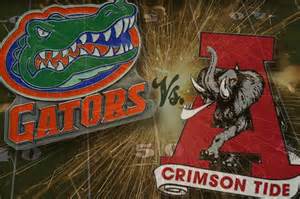
De Soto was, it seemed the first team to face the mighty Crimson Tide. The Spaniards escaped to Mississippi but their quest for a national championship was doomed. Their bad luck continued and they were plagued by more unhappy natives, disease and lack of supplies. De Soto, committed to his mission, eventually was stopped by the Big Muddy near what is the happy sounding, present day, Sunflower Landing, Mississippi. He saw that body of water as a pain in the neck, keeping him from his westward march for domination. His relationship with the Mississippi River did not end well. No, it wasn’t the natives who killed him nor did he drown in the river. Instead it was a fever. He died May 21, 1542 in a native village on the western banks of the river near present day MacArthur, Arkansas.
It ended up that it was the stodgy British who, seventy years later, successfully established colonies in the new world. But those people had to live in Massachusetts in the winter since cheap flights to Florida were not yet a thing. I would have been stodgy too.
For more about alligators (because they fascinate me and it’s kinda freaky to think, if the urban legend is true, that EVERY pond, lake, roadside ditch and swamp in Florida contains at least one), click this link: https://en.wikipedia.org/wiki/American_alligator
See a penny, pick it up… All day long you’ll have good luck.
Which is especially true on May 23rd, National Lucky Penny Day!
Most everyone has, I would imagine, found a penny on the ground. Some people will only pick up those where Lincoln’s image is face up believing that it’s actually bad luck to pluck a penny which has been laying face down.
I don’t go with that because any day I find money on the ground is a good day.
Whenever I find a coin I look at the date and then I like to think about significant life events from that year.
The U.S. penny was first minted in 1793 and has, as you might imagine, gone through some changes over the years. Until 1857 it was composed of one hundred percent copper. The amount of copper was reduced over time in an effort, partially, to keep the amount of copper in it equivalent to the value of the coin. Another reason for less copper was that the metal became a very valuable commodity for the production of weapons.
For a time they were made of bronze, brass, and even steel during WWII. Today’s coins are a combination of copper and zinc and the metals in them are worth more than the face value of the coin.
Did you know that until 1857 a penny was about the same size as today’s Susan B. Anthony dollar coin?
And, of course, the designs have varied over the years with today’s Lincoln head penny being the standard since the Centennial of his birth in 1909. In the past few years the obverse has changed and special set of four coins were struck in 2009 in honor of Lincoln’s birth bicentennial. From the infallible Wikipedia:
Birth and early childhood in Kentucky: this design features a log cabinand Lincoln’s birth year 1809. (snip) It has been nicknamed the “Log Cabin Penny”.
Formative years in Indiana: this design features a young Lincoln reading while taking a break from rail splitting. (snip) It’s called the “Indiana Penny”.
Professional life in Illinois: this design features a young professional Lincoln standing before the Springfield Illinois State Capitol. (snip) It’s been dubbed the “Illinois Penny.”
Presidency in Washington, D.C.: this design features the half completed Capitol dome.
The Lincoln Memorial design was permanently retired and, following the special 2009 mint, the Union Shield in now the obverse design.
So if you find a penny on the ground today, pick it up. It might just bring you luck!
If historians were to pick ONE significant event from each year in history what would the most important from 1891 be? The formation of the US Forest Service? No. The opening of Carnegie Hall? Definitely not. The patent of corkboard? Not even close.
No the most significant event of 1891 was when, on May 16th, George Hormel opened a small butcher shop in Austin, Minnesota and introduced the world to… SPAM!
What was significant about the product is that it took pork and ham and cooked it in its own container thus giving it a rather long shelf life. Oh that innovative George Hormel!
Since its creation Spam has become a ubiquitous part of pop culture and the worldwide psyche. It’s eaten throughout the world but especially in Great Britain and also in the Philippines. In the United States more Spam is eaten in Hawaii than in any other state. From the infallible Wikipedia:
“Spam is especially popular in the state of Hawaii, where residents have the highest per capita consumption in the United States. Its perception there is very different from on the mainland.
A popular native sushi dish in Hawaii is Spam musubi, where cooked Spam is placed atop rice and wrapped in a band of nori. Varieties of Spam are found in Hawaii that are unavailable in other markets, including Honey Spam, Spam with Bacon, and Hot and Spicy Spam.
Hawaiian Burger King Restaurants began serving Spam in 2007 to compete with the local McDonald’s chains. In Hawaii, Spam is so popular that it is sometimes referred to as ‘The Hawaiian Steak’.”
My exhaustive research uncovered the existence of a SPAM museum in Austin, Minnesota. Putting that on my bucket list!
Highlighted in a variety of movies and TV shows, SPAM was immortalized in pop culture by the comedic troupe Monty Python. And, of course, it’s the term which has become synonymous with junk mail. More from Wikipedia:
“Spam was featured in an iconic 1970 Monty Python sketch called ‘Spam’. Set in a café which only served dishes containing Spam, including ‘Spam, Spam, Spam, Spam, Spam, Spam, baked beans, Spam, Spam, Spam and Spam’, the piece also featured a companion song. By the 1990’s, Spam’s perceived ubiquity led to its name being adopted for unsolicited electronic messages, especially spam email.”
Be sure to check out these two links to learn more about Spam!
This is a reposting of a Classic Tuesday Newsday from May 9, 2017. It has been updated with a personal story.
As American as apple pie and motherhood… is the celebration each year of mother’s everywhere. It was on May 9, 1914, that President Woodrow Wilson
signed a proclamation which designated the second Sunday in May as the day
to show ‘love and reverence for the Mother’s of our country” who had lost
sons in war. The proclamation decreed that the American Flag be displayed on
government buildings.
Of course the intent of the original holiday has long since been hijacked by commercialization. I doubt Anna Jarvis – the woman who pushed for the
proclamation –envisioned today’s celebration.
The modern American efforts can be traced to May 9, 1905, the day Jarvis’ mother died. Distraught by her loss, Anna committed herself to continue her
mother’s work.
From the infallible Wikipedia:
“In 1868, Ann Jarvis, mother of Anna Jarvis, created a committee to establish a ‘Mother’s Friendship Day’, the purpose of which was ‘to reunite families that had been divided during the Civil War.’ (The senior)
Jarvis – who had previously organized ‘Mother’s Day Work Clubs’ to improve sanitation and health for both Union and Confederate encampments undergoing a typhoid outbreak – wanted to expand this into an annual memorial for mothers, but she died in 1905 before the celebration became popular. Her daughter, who became almost obsessed with her, would continue her mother’s efforts.”
The idea caught on, and with the passage of the proclamation in Congress, soon people were purchasing cards and flowers for Mom and taking her to dinner. Jarvis was appalled by this and spent the rest of her life fighting against what Mother’s Day had become:
“She was arrested in 1948 for disturbing the peace while protesting against the commercialization of Mother’s Day, and she finally said that she ‘…wished she would have never started the day because it became so out of
control …’”
Anna Jarvis lost that battle. Today Mother’s Day is the third most popular day to send greeting cards (eclipsed only by Christmas and Valentine’s Day). It’s estimated that $18.6 BILLION will be spent this year. Approximately 87
percent of all consumers will participate and spend, on average, $152.
So, if you want to honor the Mom’s in your life the traditional way, forgo the commercial cards and just write a note, don’t take her to dinner but do take her to church, give her a carnation and fly the American Flag… and, men, be prepared to sleep on the couch.
Update May 9, 2023: As I was reflecting on this post today I was struck by how much my world has changed since May 2017. At that point in time I was going back and forth from my home in Western Washington to Yakima about once every three or four weeks. My mother was then living at Apple Creek, an adult family home. Her mind had been ravaged by dementia, she was unable to walk, and conversations with her were at a basic level.
Mother’s Day 2017 – The last year with my Mom
For a few years, by then, I had wondered each time ‘is this the last Mother’s Day with my mom?’ As it turned out, 2017 was that year. On May 14th I was in Yakima to give Mom a card and spend some time with her. Just over six months later she was gone.
Things continued to change. I lost my dad in October 2019 and my father-in-law in July 2022. The only one left of that generation still with us is my mother-in-law (MIL). At 95 there are good days and bad days and this past weekend the hubby and I drove the hour north to go visit her for an early Mother’s Day (I somehow got the date of Mother’s Day confused and was a week early. That sometimes occurs when you are focused on a topic and writing about something which hasn’t yet happened!)
But back to my MIL. She still lives in the family farmhouse, cared for by my sister-in-law and her hubby.
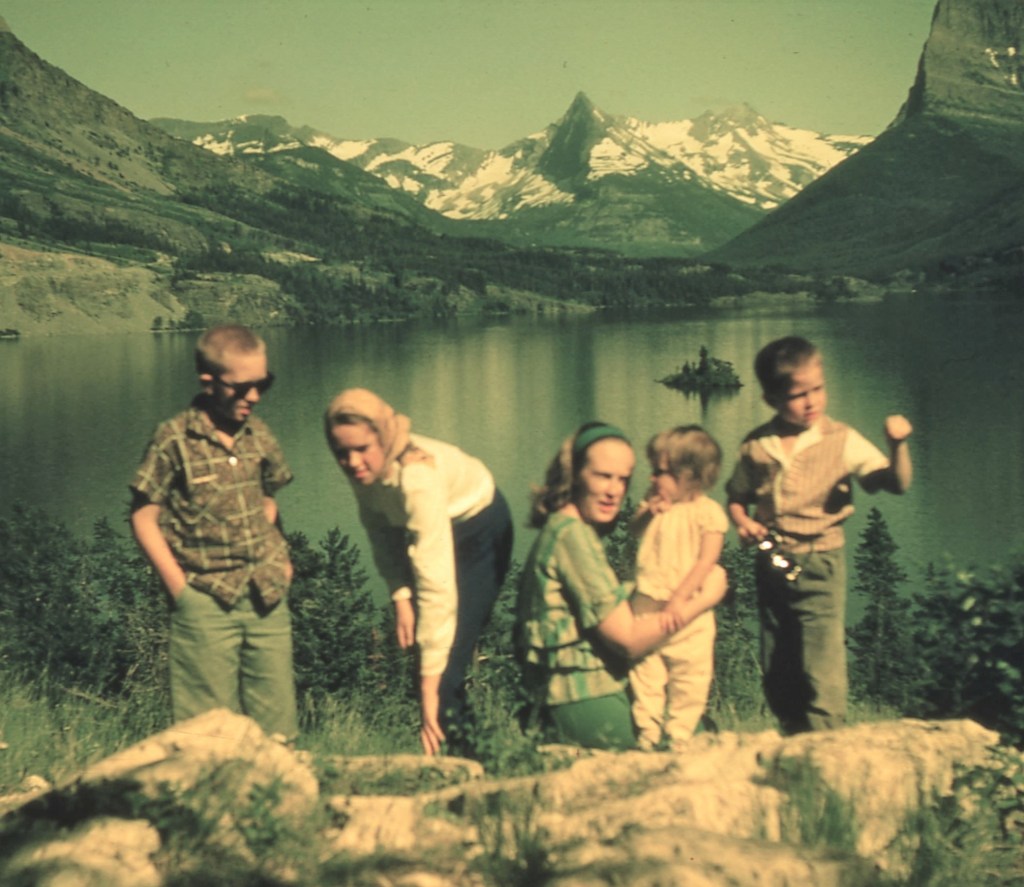
My Mother In Law with her four children, circa 1964
So I spent the afternoon visiting with my MIL. We reminisced – with the aid of a book one of her granddaughters put together – looking at some of the hundreds of family photos. For about an hour and half, my MIL identified various family members – all long since gone – and locations. We talked about the circumstances of her childhood; how her father had died of tuberculosis when my MIL was not even four years old. How it was that she came to be mostly raised by her grandmother due to the tumultuous life of her own mother.
As we perused the photos I used post it notes which I will transcribe to labels and add to my copy of the book in the near future, the genealogist in me not wanting to lose this important family history. We talked and visited until it seemed she was tired and it was the right time to take a break.
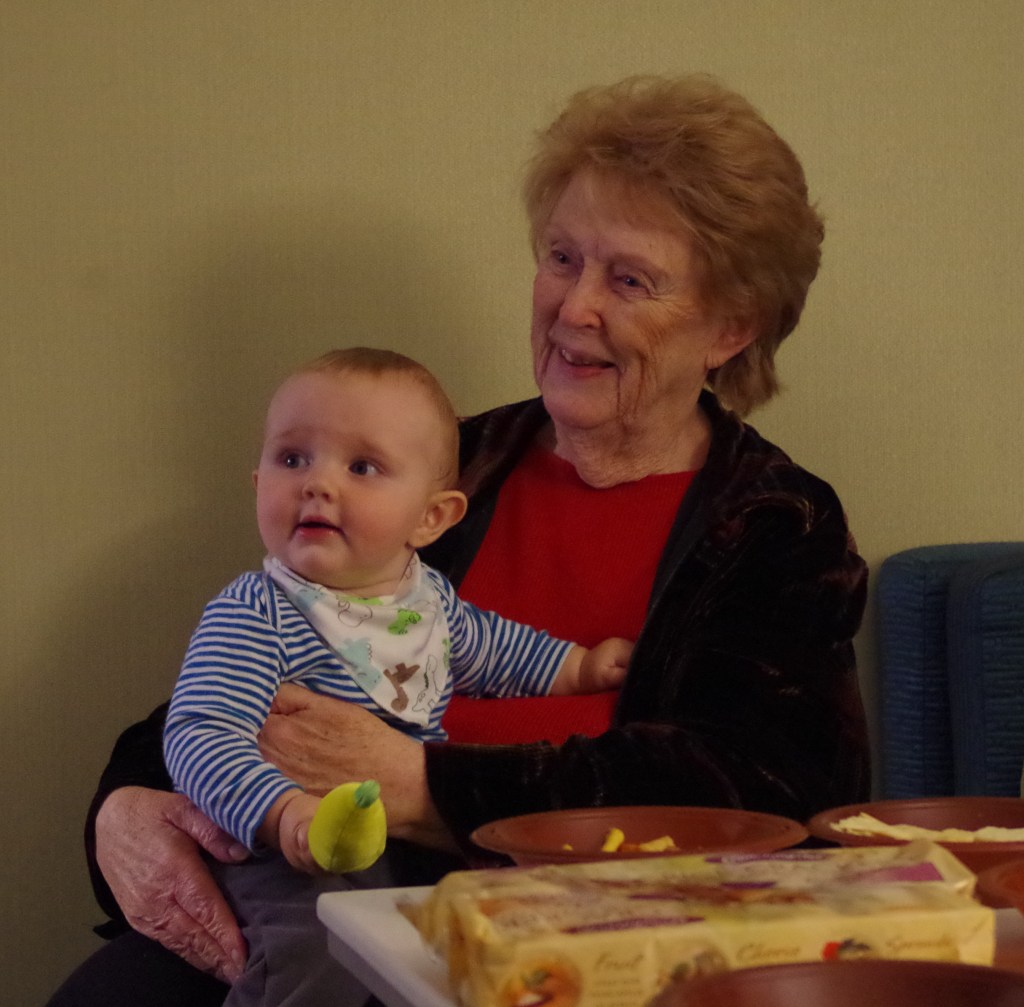
Great Grandma with her great grandson 2016
Later, after sharing a dinner with the family, we took our leave. Hugs were shared and promises of ‘yes, we’ll come back soon’ were given. And we will.
I think Anna Jarvis was absolutely correct. Mother’s Day really should be a day about honoring our mother’s with the greatest gift we can give them: our time and attention. That, afterall, is what Mothers everywhere cherish most.
This is the Tuesday Newsday Post from May 2, 2017, updated with an additional personal story.
My exhaustive search for an interesting tidbit for May 2nd turned up very little. It would seem that everyone was tired after all of the May Day activities on May 1st.
May 1st, like some of its calendar counterparts in the fall and winter, is a significant date. Prior to it becoming International Workers Day to honor labor, it was also the date of the ancient celebration of Beltane. This event was one where the women were excited because they could FINALLY get the cows out of the house and drive the beasts to the field. Kind of the equivalent of the mom who tells her kids “Go outside and play!” They followed up this bovine removal by making a huge bonfire and, I would surmise, to burn all the straw that – after many months of being the peasants version of rugs – undoubtedly assaulted the poor woman’s olfactory senses and encouraged the proliferation of vermin.
A huge outdoor feast was held around the bonfire. We refer to this as ‘camping.’ No doubt the men stood around the fire drinking mead all night and the celebration became rowdier and rowdier. This would, of course, lead to men doing stupid things… like jumping through the fire. From the Infallible Wikipedia:
“According to 18th century writers, in parts of Scotland there was another ritual involving the oatmeal cake. The cake would be cut and one of the slices marked with charcoal. The slices would then be put in a bonnet and everyone would take one out while blindfolded. According to one writer, whomever got the marked piece would have to leap through the fire three times. According to another, those present would pretend to throw him into the fire and, for some time afterwards, they would speak of him as if he were dead. This ‘may embody a memory of actual human sacrifice’, or it may have always been symbolic.”
But back to the long-suffering wives. I can only imagine that May 2nd was THEIR day of celebration. The cows were now out of the hovel, it was as clean as it would ever be and, with their men passed out from too much drink, it was a time to kick back and enjoy one day without backbreaking labor.
It’s at times like these when I reflect on all our modern conveniences: houses with central heating, running water, heck- hot water from the tap, flushing toilets, supermarkets. There are so many things to be thankful for in today’s world. It is nearly impossible to imagine what life was like for our ancestors hundreds of years ago.
Camping, perhaps, gets us as near to how it might have been. As I was growing up my mother would have nothing to do with activities which involved sleeping out in the forest. It was definitely not her thing. That might have been because it WAS my grandmother’s thing and my Mom hated being dragged out into the wilderness as a kid.
I suppose having not been introduced to the activity when I was young, I found the concept exciting and intriguing. I dabbled in backpacking on a couple of adventures with my BFF Daphne when we were about 20. Certainly the hubby and I had any number of memorable camping adventures, sleeping in tents and cooking over campfires, as we traversed the Western US in our early married years.
I think it was our very first camping experience, however, which stands out and serves as a reminder of how difficult it can be to not have running water, flushing toilets, and a decent kitchen.
The year is 1979 and we have been dating for a couple of months when the boyfriend – now the hubby – has signed up to run the seven mile Chuckanut Foot Race in Bellingham. The run is on Saturday morning, July 7th, and our plan is that after the race is over we are going to drive up to the North Cascades via Highway 20 and go camping. I live in Eatonville, Washington – an hour’s drive from West Seattle – where he lives. From there to Bellingham is another hour and a half-ish. I had gone to West Seattle on Friday night so we could get and early start and make it to the race the next morning.
Having a good time exploring the North Cascades with nary a care in the world.
By the time we get there and he runs it and then eat lunch and then dink around seeing the sights and meandering our way up Highway 20, the day is nearly over.
Being young and clueless, it never occurred to us that perhaps there would NOT be a campsite miraculously waiting for our arrival. By the time we get to the campground it is near dusk and the place is full.
Ever determined, we find a service road that goes between two campsites and one of the occupants of the adjacent campsite says, sure, put your tent up there, we’ll never tell.
So there we are, struggling to get the tent set up (it was a monstrosity – an old canvas tent from the 1950’s which must have weighed 150 pounds. JK. No idea how much it weighed, but it was heavy) in the near dark and we haven’t even gotten to fixing dinner.
Eventually, with the tent erected, we turn our attention to dinner. Thank goodness for canned foods because we were exhausted and cooking was NOT on my agenda. The BF got his little charcoal fueled hibachi going and we opened a can of ravioli and a can of asparagus. I cannot recall if we had an actual pan. I think we did have ONE pan, but perhaps we didn’t. What I do know is that we ended up sharing whatever container between us and not using plates. We heated the asparagus first and ate that, then the Ravioli. Truly, the ONE thing which made the whole ridiculous situation bearable was that we had a bottle of champagne – well not real champagne as it was Andres.
After finishing the food and the entire bottle of Andres, I crept off into the bushes to take care of business and then crawled into the sleeping bag for the night. The one pan and two plastic cups were dirty but I didn’t care.
The BF( now the hubby) carrying the Hibachi out from our ‘campsite’ the next morning
That experience alone should have been enough to deter us but it wasn’t. We got smarter about what we packed and we upgraded our camping equipment over time. A little gas powered stove. Containers of water. A lighter weight tent. Air mattresses. A tent trailer. A bigger trailer. Hotel rooms.
But one thing has endured over the years. Any time we’ve gone on a camping trip we always have Ravioli, Asparagus, and Bubbly, on our first night camping. And for a few nights or a week, a camping adventure is fun but not as a way of life. I’m much too reliant on my creature comforts, not to mention that sleeping on the ground in a sleeping bag on top of an air mattress which will, undoubtedly, go flat in the middle of the night is not my idea of a fun time.
And Andres. We no longer drink that either. Gotta draw the line somewhere.
Stan Fields: “Miss Rhode Island, please describe your idea of a perfect date.”
Cheryl ‘Rhode Island’: “That’s a tough one. I’d have to say April 25th. Because it’s not too hot, not too cold, all you need is a light jacket.”
If you’ve never seen the movie Miss Congeniality, I encourage you to request it from your local library, rent it on Netflix or your preferred movie provider. I have always found the movie to be funny, poignant and effectively showcase the human spirit. The casting was superb with Candice Bergen who tries to hold on to her glory days as a former beauty queen turned pageant director; William Shatner is priceless as Stan Fields, the smarmy host of the show; Heather Burns as the naïve Miss Rhode Island; and, of course, Sandra Bullock, as Gracie Hart, FBI agent turned pageant contestant to get to the bottom of an evil plot to take down the fictional Miss United States pageant.
The Infallible Wikipedia provides a more in depth summary. I include the first two paragraphs since, if you have not seen the movie, I would not want to ruin the ending:
“In 1982, a very young Gracie Hart steps into a playground fight to beat up a bully who is threatening a boy she likes. However, the boy feels humiliated at being rescued ‘by a girl’, and rejects her rudely, whereupon she punches him in the nose and leaves to sulk alone. Years later, Gracie is now a tough Special Agent for the FBI. During a sting operation against Russian mobsters, she disobeys her superior’s orders in order to save a mob boss who appears to be choking, which causes one of the other agents to be shot. She is demoted to a desk job as punishment.
Soon after, the agency is alerted, via a letter from the notorious domestic terrorist known only as ‘The Citizen’, to a bomb threat at the upcoming 75th annual Miss United States beauty pageant in San Antonio, Texas. Gracie’s partner Eric Matthews is put in charge, and he relies on Gracie’s suggestions, but he takes credit for them himself. One of Gracie’s ideas is to plant an agent undercover at the event. When all possible candidates are deemed unfit, Eric then suggests that Gracie take on that role, replacing Miss New Jersey, who was to be disqualified. Beauty pageant coach Victor Melling teaches Gracie how to dress, walk, and behave like a contestant. Though initially appalled, she comes to appreciate Victor’s thoroughness. Gracie enters the pageant as ‘Gracie Lou Freebush’, representing New Jersey, and becomes friends with Cheryl Frasier, who is Miss Rhode Island. As the competition begins, Gracie impresses the judges during the talent competition with her glass harp skills and self-defense techniques.”
There are so, so many memorable lines from the movie. The one above is excellent but I think my favorite is this clip:
And, of course, the clip for the April 25th quote:
What I most like about the movie is watching Gracie’s transformation as a character. While the movie pokes some gentle fun at the beauty pageant industry what shines through, ultimately, is Gracie learning to respect and like these people – so different from herself – which, I believe, is the foundation of all good relationships.
April 25 is also significant for my family as that is one of my two brother’s birthdays. In recent years he’s eschewed his birthday, forbidding us from giving him cards or even acknowledging the day. At my nephew’s marriage a couple weeks ago, I was struck by the fact that my siblings and I had become a part of the older generation. The father of the groom – my oldest brother who was not born on April 25 – had recently celebrated his 50th wedding anniversary.
I totally get why my other brother prefers to not celebrate his birthday. But then again, none of us can wish ourselves younger than what we are. We are a sum of our lived experiences. Those of us who are Baby Boomers have a shared cultural knowledge, particularly, of our growing up years in the 50’s, 60’s, and 70’s. Then again, we can no more step into the shared cultural experiences of those who grew up in the 80’s, 90’s, and 00’s.
So rather than lament getting older, perhaps we all need to find our ‘Perfect Date’ whatever it might be. It might not be April 25. Maybe it changes. For me it’s that day – coming soon – when the temperature hits 75 degrees, there’s a light breeze, and I can soak in the warmth and a bit of sun. My feet will be in sandals, I will FINALLY be able to wear a short sleeved top and my capris, and it will be a day when I won’t have a pressing obligation on my calendar. THAT would be the perfect date. And I plan to embrace it when it arrives.
 Ask any person of my generation if they know who Barnabas Collins is and you are likely to get an enthusiastic response something to the effect of:
 Barnabas was in love with the blonde beauty and he takes her to his room. Ahem. Barnabas is conflicted as he wants to be with her but is concerned his passion will carry him away and he will ‘bite’ Angelique’s neck, thus killing her and she, too, will become a vampire. An outcome he does not want. I cannot recall if he did or did not bite her but I do recall that the show implied that the two of them engaged sexually. Powerful stuff for a kid of 12.
 If you wish to learn more, here’s the Wikipedia link: https://en.wikipedia.org/wiki/Dark_Shadows
 Personally, I find his own life’s story even more implausible than his writing. He met Maud Gonne, the woman who most inspired him, when he was 24 years old. Thus began a relationship which spanned over 30 years, involved four marriage proposals and four rejections AND a fifth proposal to Maud’s 21 year old daughter. Maud’s own story is book worthy and she must have been one heck of a woman!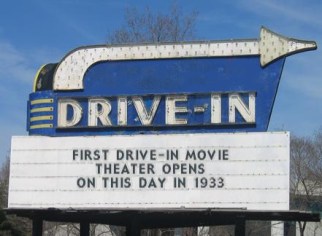
 Speaking of which, there were several drive-in movie theaters in my hometown of Yakima, Washington. One evening my sister and I and two of our friends decided to go to the Fruitvale Drive-in (sadly, no longer there). The car my sister drove was a 1950 yellow Cadillac with a red roof; a hand me down from our grandparents. This tank of a car had all the whistles and bells popular in 1950 including a gauge which told you how good your driving was. Ok, not really, it had to do with gas mileage, but as children our grandfather told us it was evaluating his driving with an arrow that point to words like ‘poor’, ‘fair’, ‘good’ and ‘excellent.’ But, most important of all, it featured a movable spotlight affixed to the car just outside the driver’s side window. There was a handle inside the car to control the light.
 De Soto was, it seemed the first team to face the mighty Crimson Tide. The Spaniards escaped to Mississippi but their quest for a national championship was doomed. Their bad luck continued and they were plagued by more unhappy natives, disease and lack of supplies. De Soto, committed to his mission, eventually was stopped by the Big Muddy near what is the happy sounding, present day, Sunflower Landing, Mississippi. He saw that body of water as a pain in the neck, keeping him from his westward march for domination. His relationship with the Mississippi River did not end well. No, it wasn’t the natives who killed him nor did he drown in the river. Instead it was a fever. He died May 21, 1542 in a native village on the western banks of the river near present day MacArthur, Arkansas.
 you might imagine, gone through some changes over the years. Until 1857 it was composed of one hundred percent copper. The amount of copper was reduced over time in an effort, partially, to keep the amount of copper in it equivalent to the value of the coin. Another reason for less copper was that the metal became a very valuable commodity for the production of weapons.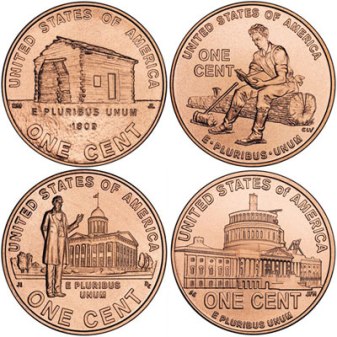
 No the most significant event of 1891 was when, on May 16th, George Hormel opened a small butcher shop in Austin, Minnesota and introduced the world to… SPAM!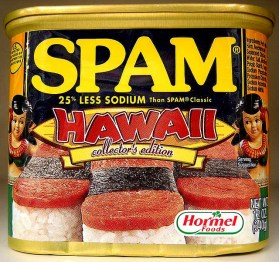


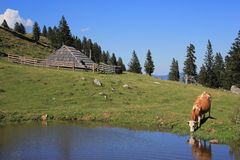 , like some of its calendar counterparts in the fall and winter, is a significant date. Prior to it becoming International Workers Day to honor labor, it was also the date of the ancient celebration of Beltane. This event was one where the women were excited because they could FINALLY get the cows out of the house and drive the beasts to the field. Kind of the equivalent of the mom who tells her kids “Go outside and play!” They followed up this bovine removal by making a huge bonfire and, I would surmise, to burn all the straw that – after many months of being the peasants version of rugs – undoubtedly assaulted the poor woman’s olfactory senses and encouraged the proliferation of vermin.
 A huge outdoor feast was held around the bonfire. We refer to this as ‘camping.’ No doubt the men stood around the fire drinking mead all night and the celebration became rowdier and rowdier. This would, of course, lead to men doing stupid things… like jumping through the fire. From the Infallible Wikipedia:

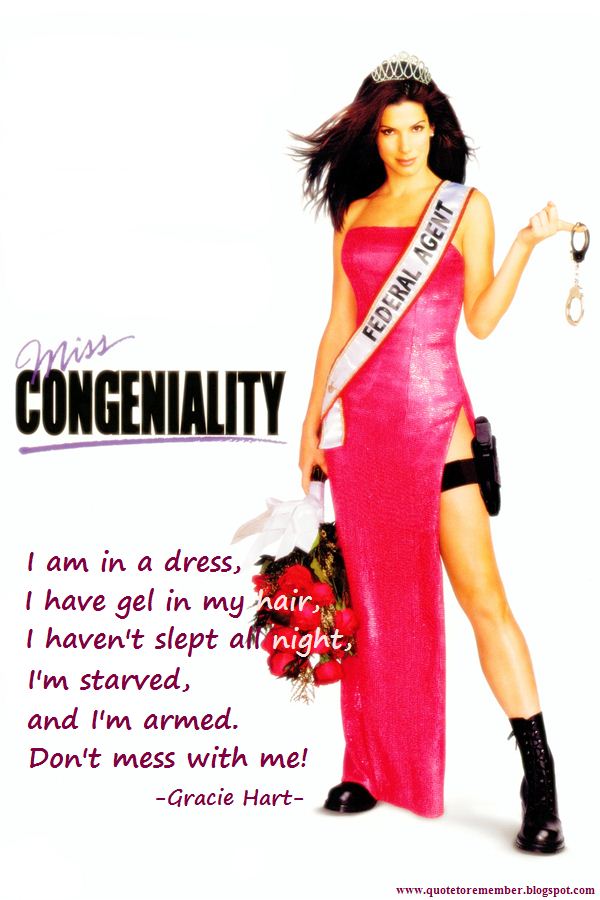 If you’ve never seen the movie Miss Congeniality, I encourage you to request it from your local library, rent it on Netflix or your preferred movie provider. I have always found the movie to be funny, poignant and effectively showcase the human spirit. The casting was superb with Candice Bergen who tries to hold on to her glory days as a former beauty queen turned pageant director; William Shatner is priceless as Stan Fields, the smarmy host of the show; Heather Burns as the naïve Miss Rhode Island; and, of course, Sandra Bullock, as Gracie Hart, FBI agent turned pageant contestant to get to the bottom of an evil plot to take down the fictional Miss United States pageant.
 barbaradevore.com