Archives

Take The Plunge!

The Swimming Pool

July 23, 2019

With the extreme temperatures which have gripped much of the United States the past week, people – especially parents with kids at home – often seek out water as a way to find relief.

It’s appropriate, then, that the first swimming school in the U.S. opened on July 23, 1827, in Boston, Massachusetts. The proprietor, German immigrant Franz Lieber, believed that swimming was a healthy activity necessary to aid a boy’s growth.  Unfortunately, the swimming school failed after two years
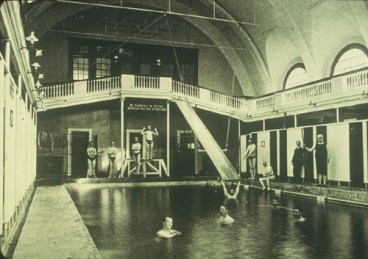
public_bath_interior

First public pool in Brookline, Massachusetts

Now I can’t find the reason for this failure except to say that it might have been due to the absence of a heated water holding area where his young charges could safely swim. If those boys were forced to swim in the Charles River, they likely found it somewhat unpleasant. Alas, it was another 60 years before the first public swimming pool opened in nearby Brookline.

Over the years, the swimming pool has become a staple of American life; a desired amenity for traveling Americans and nearly a requirement for suburban homes across the southern half of the nation.

In my research I found some interesting ‘records’ for pools. From the Infallible Wikipedia:

“According to the Guinness World Records, the largest swimming pool in the world is San Alfonso del Mar Seawater pool in Algarrobo, Chile. It is 1,013 m (3,323 ft) long and has an area of 8 ha (20 acres). At its deepest, it is 3.5 m (11 ft) deep. It was completed in December 2006.

The largest indoor wave pool in North America is at the West Edmonton Mall and the largest indoor pool is at the Neutral Buoyancy Lab in the Sonny Carter Training Facility at NASA JSC in Houston.

In 2014, the Y-40 swimming pool at the Hotel Terme Millepini in Padua, Italy became the deepest indoor pool at 42.15 m (138.3 ft), certified by the Guinness Book of World Records. The recreational diving center Nemo 33 near Brussels, Belgium previously held the record (34.5 m (113 ft)) from May 2004 until the Y-40 was completed in June 2014.

Fleishacker pool San Francisco

Fleishhacker Pool which was really more of a man made lake complete with boats

The Fleishhacker Pool in San Francisco was the largest heated outdoor swimming pool in the United States. Opened on 23 April 1925, it measured 1,000 by 150 ft (300 by 50 m) and was so large that the lifeguards required kayaks for patrol. It was closed in 1971 due to low patronage.

In Europe, the largest swimming pool opened in 1934 in Elbląg (Poland), providing a water area of 33,500 square metres (361,000 sq ft).

One of the largest swimming pools ever built was reputedly created in Moscow after the Palace of Soviets remained uncompleted. The foundations of the palace were converted into the Moskva Pool open-air swimming pool after the process of de-Stalinisation. However, after the fall of communism, Christ the Saviour Cathedral was re-built on the site between 1995 and 2000; the cathedral had originally been located there.

The highest swimming pool is believed to be in Yangbajain (Tibet, China). This resort is located at 4200 m AMSL and has two indoor swimming pools and one outdoor swimming pool, all filled with water from hot springs.”
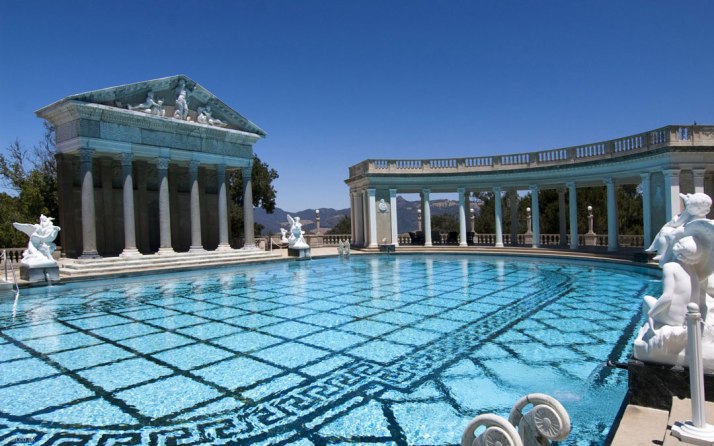
Hearst castle pool

One of the world’s most iconic and beautiful pools located at Hearst Castle in California.

If you want to really indulge in pool envy one needs only to watch the HGTV show “Ultimate Pools” which features beautiful private oases of the rich but not famous.

Having grown up in Yakima, Washington, the hot, dry summers made it a natural spot for pools to proliferate. When my family moved there in the early 1960’s, however, very few families I knew had built in backyard pools. Instead, the first ‘pool’ I recall was about the size of large area rug and constructed of industrial canvas and metal poles. It was no more than 18 inches tall. Once it was filled with icy cold water my sister and I would, on hot days, lay in the shallow water to cool off.

For my 7th birthday a new pool arrived. It was round and about the size of a small bedroom. Its hard plastic walls stood about 3 feet tall and it was definitely an upgrade.  It was during this time, however, that I was introduced to the public swimming pool. The best summer days were those when we got to go down to Franklin Park – about a mile from our house – and pay our 10 cents to swim.
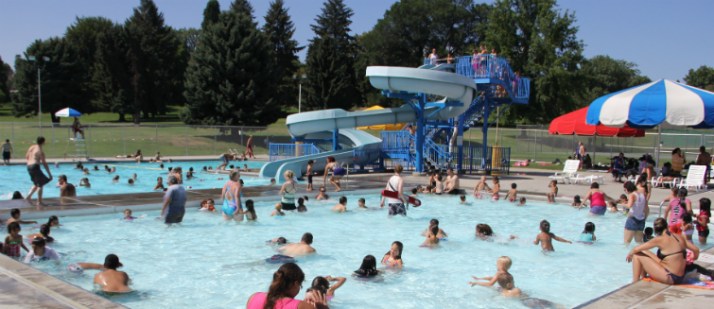
Franklin-pool-1

I was unable to find an historic photo of the death board at Franklin Park. It was located on the other side of the water slide in the original pool. The pool in the foreground was added sometime after 1980.

It seemed as if we were gone all day but I’m pretty certain it was only for a couple of hours. The pool was constructed in an ‘L’ shape with one area being the shallow end and the other being the terrifying end. In the years I went to Franklin pool there was one thing I never did. I never jumped off the high dive board. I can still see that board, suspended over the deep end, beckoning me like the death trap I was certain it must be. Yet other, much braver, young souls would scale the ladder, walk the plank, and then plunge 47 feet to their death.  Okay, so maybe it wasn’t 47 feet. More like fifteen. And to the best of my knowledge no one ever died. But I was not taking any chances. Mostly I got cold after a short time swimming and would go hang out in the locker room with the girl who worked there. I remember her name was Nancy and she was in high school and very kind to this annoying child.

It was in the summer of 1973, however, that things really changed. That was the year my parents decided to put a pool in the backyard of our home. What an exciting summer that was. One morning a crew arrived with backhoes and soon there was a huge hole behind our house. For several weeks we watched the daily progress until one day in late summer the pool was complete and the hoses began to flow.

That pool was the dream of every teenage girl. A diving board was set just above the water so no death defying plunges were required; and it featured a curved water slide that flung the rider into the pool.

Pete demonstrating the water slide September 1973

My brother demonstrating proper use of the water slide. September 1973

As for me, I still got cold far too easily and discovered that the best way to ‘swim’ was with the aid of an air mattress. Hours were spent each of the next several summers floating on my conveyance about the pool, getting in the water when I got too hot, but would soon return to the lazy comfort of my air mattress.
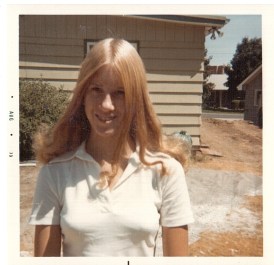
Barb 1973 during pool construction

16 year old me out investigating the pool construction site August 1973. They had to remove a deck at the side of the house to access the yard. (behind me)

Eventually the upkeep of the pool became too much and was one of the factors which prompted our parents to sell the house and move in 1984. What great memories I have of those summers in the 1970’s and the hours spent afloat on that pool. When we are young we often don’t appreciate something so special. Ah, to be 16 again with nary a care in the world and a pool to call my own!

As always a couple of links:

https://en.wikipedia.org/wiki/Swimming_pool

Pool envy:

https://www.hgtv.com/shows/ultimate-pools

History of pools:

https://www.swimmingpool.com/pool-living/pool-history-facts-and-terms/history-pools

That’s The Pits!

Cherries!

July 2, 2019

The item which caught my attention for this week’s blog is the amusing ‘contest’ of cherry pit spitting. Yes, it’s a thing.

cherry spit site.jpgHeld annually in Eau Claire, Michigan, since 1974, the record ‘spit’ of a cherry pit is 93 ft 6.5 inches. The competition has been dominated by one family with the patriarch, Rick Krause, holding the record for longest spit (over 72 feet) until 1993. Since then, his son, Brian ‘Pellet Gun’ Krause has won 10 times with his record breaking discharge occurring the first week of July in 2003. In recent years Brian’s sons have also competed.

rick krause.png

Patriarchal Cherry pit spitter Rick Krause in 2010. Photo from Lifecompassblog.com

Others have stepped up to put their spitting skills to the test, but the Krause family continues to dominate.

It is appropriate, therefore, as we celebrate all things red, white, and blue this week, to pay tribute to one of my favorite red things: the cherry.

Every July I can hardly wait for the harvest of this fruit to begin in the Yakima Valley. For there is truly nothing better than picking a cluster of the ruby orbs and (after they’re cleaned off) biting into the soft, juicy flesh. As a fan of the sweet varieties such as Bing and Sweetheart, an explosion of flavor reminds me how much I’ve missed them since the previous year.

The cherry has a long history of cultivation with evidence that the fruit has been grown since prehistoric times. From the Infallible Wikipedia:

“The English word cherry derives from Old Northern French or Norman cherise from the Latin cerasum, referring to an ancient Greek region, Kerasous (Κερασοῦς) near Giresun, Turkey, from which cherries were first thought to be exported to Europe. The indigenous range of the sweet cherry extends through most of Europe, western Asia, and parts of northern Africa, and the fruit has been consumed throughout its range since prehistoric times. A cultivated cherry is recorded as having been brought to Rome by Lucius Licinius Lucullus from northeastern Anatolia, also known as the Pontus region, in 72 BC.

Cherries were introduced into England at Teynham, near Sittingbourne in Kent, by order of Henry VIII, who had tasted them in Flanders.

Cherries arrived in North America early in the settlement of Brooklyn, New York (then called ‘New Netherland’) when the region was under Dutch sovereignty. ”

In the United States, the first record of cherry trees being planted was 1639.

Bing cherriesSweet cherries are grown most successfully in Washington, Oregon, California, Wisconsin, and Michigan (hence the location of the cherry pit spitting contest). Most sour cherry varieties are grown in Michigan, Utah, New York and Washington.
To successfully grow cherries, the climate must have cold winters although varieties have been developed recently which have allowed California to compete in cherry production. Also from the Infallible Wikipedia:

“Most cherry varieties have a chilling requirement of 800 or more hours, meaning that in order to break dormancy, blossom, and set fruit, the winter season needs to have at least 800 hours where the temperature is below 45 °F (7 °C). “Low chill” varieties requiring 300 hours or less are Minnie Royal and Royal Lee, requiring cross-pollinization, whereas the cultivar, Royal Crimson, is self-fertile. These varieties extend the range of cultivation of cherries to the mild winter areas of southern US. This is a boon to California producers of sweet cherries, as California is the second largest producer of sweet cherries in the US.”

My relationship with the cherry has not always been an enjoyable one, however. In the 1970’s, my father took over managing a cherry orchard which my grandfather – a banker – had gotten as way of repayment of a loan gone bad some years earlier. In those years Dad had two jobs: Junior High School history teacher and orchardist. My first summer ‘job’ as a teenager was picking cherries.

By early July in Yakima the weather usually turns quite warm. It is common for there to be a spate of days when the thermometer inches into the upper 90’s and low 100’s.  It’s then that the cherries ripen and harvest begins. For the pickers, work commences shortly after daybreak while the orchard is still cool.

One summer, with my then boyfriend and his younger sister, we arrived – along with all the migrant workers – to begin our job. Each person was assigned a tree, given a ladder and a bucket. Now when I say bucket, we are not talking about a pail like those favored by children at the beach. Nope. The metal buckets I knew held a lot of cherries, some 4 1/2 gallons worth, and it seemed to take forever to fill one up.

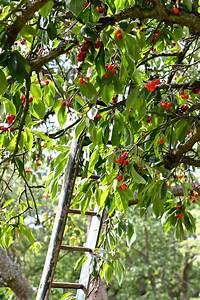
ladder in cherry orchardPicking cherries requires a delicate method. You must hold the fruit at the very top of the stem (stem less cherries are not saleable in the fresh market) and gently twist so that the stem is removed from the branch without pulling the spur off the tree. Then you place – do NOT drop – the fruit into the bucket. Lather, rinse, repeat. My rough estimates are thus: 80 cherries for a gallon times 4.5 gallons equals 360 cherries for one bucket. It takes a long time to pick 360 cherries plus, with one’s assigned ‘tree’, you also had to climb up 12 to 15 feet while balancing a bucket of heavy fruit.

Now what, you may ask, is ‘the spur’?” It’s a knobby growth at the end of a branch and if it’s pulled off that branch will not produce cherries the next year. My father the orchardist was rather persnickety about those spurs being preserved.

By noon time – having been there picking since 5 a.m. – the heat would have arrived and I would have picked… seven buckets of fruit. That’s 2,420 cherries each day of harvest… and be paid seven whole dollars. Some of the migrant workers could pick up to 200 buckets a day. I’ve never figured out how.

Okay, the job truly sucked. Although seven bucks went farther in nineteen seventy something than it does today. But it wasn’t a lot of money.

My experience as a cherry picker makes me appreciate the delicious fruit even more. When my sister brought a bag of the freshly picked delights to me yesterday, it was a taste of heaven. For the next few weeks I will jealously guard my cherries, making the bounty last until late July. By then I will have satisfied my craving for the fleshy fruit for another year.

The best part? I didn’t have to pick them!

patriotic pie

Happy 4th of July everyone!

A couple of links for you:

https://en.wikipedia.org/wiki/Cherry

http://memory.loc.gov/diglib/legacies/loc.afc.afc-legacies.200003151/default.html

“I’m Going To Thread The Needle”

May 21, 2019

Oakfield_Tornado_71896Mid-May in the United States is often a dangerous time to be in the central plains. The month is prime tornado season, a month when hundreds of twisters can occur in what is described as an ‘outbreak.’
While tornado’s have been observed during every month of the year, my research revealed that the third week of May (the 20th to the 27th) has produced a phenomenal number since 1955. In fact, there have been 1,448 recorded U.S. tornadoes in this date range!

One of the deadliest and most damaging tornado sequences began on May 21, 2011 and continued for six days. From the Infallible Wikipedia:

“On May 21, a small system of thunderstorms developed in Brown County, Kansas while another system formed to the southeast of Emporia, Kansas. The Brown county system spawned a brief tornado over Topeka, Kansas, causing minor damage. This system also caused significant damage in Oskaloosa, Kansas, and other communities. Meanwhile, the Emporia system spawned an EF3 tornado that struck Reading, Kansas; one person was killed, several others were injured, and at least 20 houses were destroyed. These two systems developed several other tornadoes throughout the evening.

A moderate risk of severe weather was issued for much of the Midwest, as well as further south to Oklahoma for May 22. (snip). Late that afternoon, a large, intense EF5 multiple-vortex tornado left catastrophic destruction in Joplin, Missouri. Causing 158 fatalities, it was the deadliest single tornado in the U.S. since at least 1947.”

The next day, May 23, tornadic activity continued but was minor compared to Joplin. The sequence was capped by an EF5 tornado in El Reno, Oklahoma on May 24. Also from the Infallible Wikipedia:

“ At 12:50 p.m. CDT, the SPC issued a Particularly Dangerous Situation  (PDS) tornado watch for parts of central Oklahoma, including Oklahoma City and northern Texas, in effect until 10:00 p.m. CDT. Numerous tornadoes touched down in several regions, with the first activity being in western Oklahoma that afternoon where several very intense tornadoes developed, including another EF5 (the sixth of the year). They did not cause extensive damage in Oklahoma City, but 11 deaths were reported among extensive damage just to the southwest of the OKC metro. Other tornado clusters developed in central Kansas that afternoon and in the Dallas-Fort Worth Metroplex that evening.”

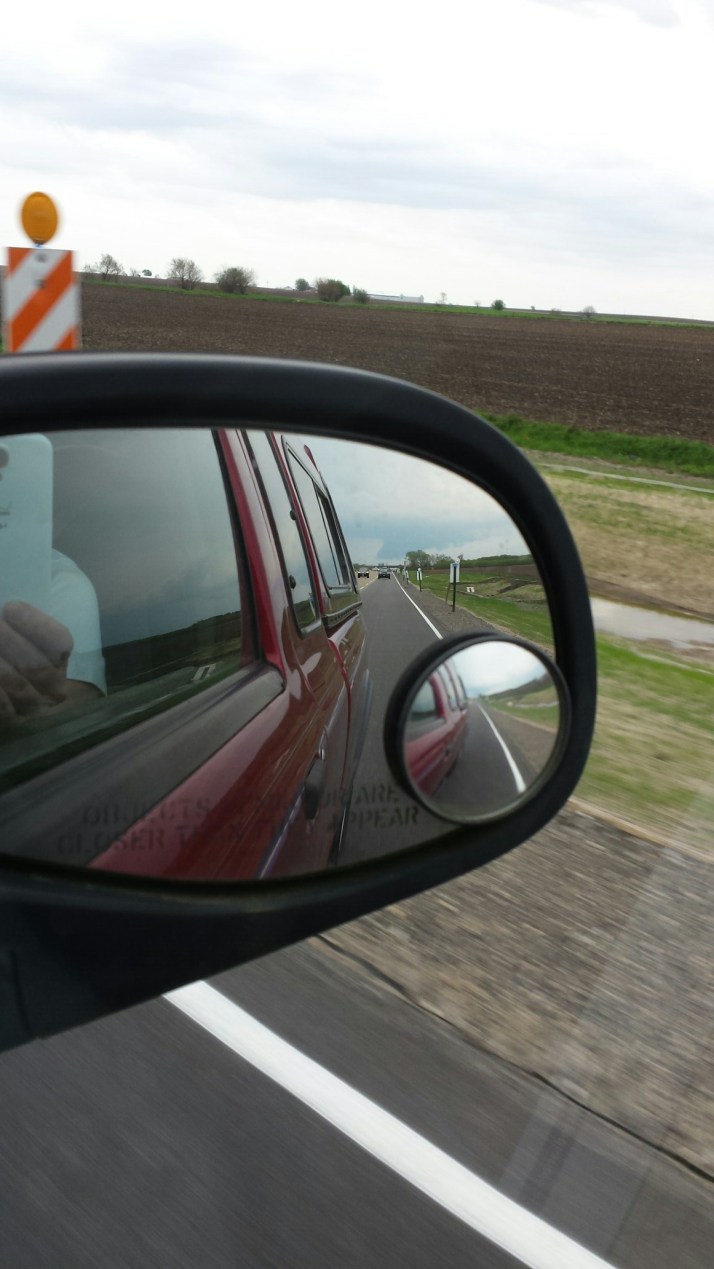
As I have watched the tornado activity these past few days it prompts a memory of when drove with my son from Seattle to Nashville in May 2014.

The morning of May 11, Mother’s Day, we arose before daylight. We had spent the night in Mitchell, South Dakota. The previous day I followed the severe weather reports on my brand new smart phone. It looked like the central US from northern Iowa through Oklahoma, Kansas and Missouri, would be impacted. That morning we had a choice to make:

Head south and risk being in the path of tornadoes or continue along I-90 and hope to skirt the storms by going far to the east before taking I-65 south to Nashville.

Barb's cell phone photos May to August 2014 101

What looks like a possible wedge cloud forming in the side view mirror

We were up before dawn, racing across Minnesota. By early afternoon we crossed the Mississippi River into Wisconsin. It was when I-90 turned south at Tomah that things started to change.

The sky clouded and the winds picked up. We stopped only for gas breaks, choosing to eat nuts, fruit, and veggie straws in the car.

As a bonafide National Weather Service junkie, I can tell you there are two colors which strike fear when they appear on the weather map: bright yellow and red. The first means ‘tornado watch.’ The second is ‘tornado’ warning – as in ‘a tornado is on the ground’. I watched as county after county in Iowa turned yellow, the storm marching toward Illinois and us.

Mothers Day 2014 Tornado EvasionBy the time we got to the Chicago suburbs we had but one thought: get through as quickly as possible. Chicago is a maze of roads with bypasses for the bypasses for the bypasses… if you’re willing to pay. Were we ever.
We zigzagged to the southwest, me counting out dollar bills and change to get us through each toll booth. When I could look up from the map my eyes were drawn to the threatening western sky. And the Illinois counties turned yellow. Finally, a mere 30 miles away, we could see a black cloud headed directly for Joliet. Could we outrun it? A couple minutes later we turned east and entered Indiana unscathed.

We hurried south, making a pit stop at a rest area/park near Rensselaer. I was amazed – and said so – that there were people having a picnic there when the weather map indicated that the spot was right in the path of the severe weather.

By this time the hubby – back home in Kirkland – was tracking the storms and giving advice. Of course my son and I were driving somewhat blind as to the real-time nature of the event and appreciated the text messages alerting us to the dangers.

We were just outside of Indianapolis when the hubby advised that there was tornado activity passing through that city. The conditions deteriorated and driving became more treacherous. Not sure what to do, my son turned the truck around and we headed north once again. But, we were now informed by the hubby, the system to the north was also a problem, so not to go north. We stopped at a Love’s Travel stop 7 miles south of Lebanon. Perched on a slight rise with a full western view we watched the dark clouds form to our southwest and speculated where the storm would head. We couldn’t continue south and couldn’t go north. We watched for several minutes before I, with growing alarm at the spectacle, said to my son, “We can’t stay here.”

Back on the road a minute later he headed south…

“What,” I asked, “are you going to do?”

“I’m going to thread the needle.”

And so we did. The rain poured but we were now on the backside of the front. By the time we exited Indianapolis, the weather cleared. A short time later and well after 8 p.m. and dark, we stopped at a rest area. When we got back to the truck my son asked me if I could drive. He’d done most of the day’s driving, nearly 14 hours behind the wheel… but we were both spent and knew it would be folly to continue to Nashville that night.

That hotel in Columbia, Indiana – a lovely little town – was the best thing we’d seen that day. Not the most interesting, mind you, but definitely the best.

The links:

https://en.wikipedia.org/wiki/Tornado_outbreak_sequence_of_May_21%E2%80%9326,_2011

https://en.wikipedia.org/wiki/Tornadoes_of_2014

https://www.weather.gov/gid/102204

Update May 2022 – I’m including a video posted by storm chaser, Skip Talbot, from May 11, 2014. While it’s likely we would have been south and east of the tornadoes, one can never really know…

To The Bat Cave

Carlsbad Caverns

May 14, 2019

This spectacle occurs at sunset daily from mid-spring until late fall. And if you ever go to Carlsbad Caverns National Park, it’s a sight to behold. What is it? The nightly flight of nearly a half million bats.

20181004_145630.jpg

The flight of the bats is but one thing to recommend a visit to the 20th National Park established on May 14, 1930. The caverns themselves are spectacular with the main event Big Room providing incredible sights around every turn in the path.

From the Infallible Wikipedia:

“Carlsbad Cavern includes a large limestone chamber, named simply the Big Room, which is almost 4,000 feet (1,220 m) long, 625 feet (191 m) wide, and 255 feet (78 m) high at its highest point. The Big Room is the fifth largest chamber in North America and the twenty-eighth largest in the world.”

20181004_103246.jpg

The top of the natural entry way… only 725 to the bottom.

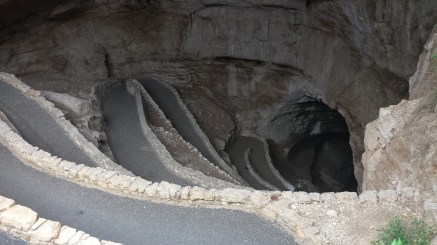
Visitors to the cave have two options for entry. Two years after it opened, elevators were installed to take tourists some 725 feet down to the Big Room. The traditional entry involves hiking down a switchback trail over a mile long and takes well over an hour.

When the hubby and I visited Carlsbad last October we opted for the switchback trail down which, in my opinion, enhanced the experience. By the time we arrived at the Big Room, our appetites were whetted.  It’s impossible to describe how large the space is and, at times, it was easy to forget we were in a cave. The ceiling soared high above our heads and many of the stalagmites and columns were the size of redwoods. In contrast there were also delicate formations known as ‘straws’ – thin tubes of limestone formed by centuries of slowly dripping calcite and ribbons. There were small lakes and ponds and fantastically named features like the Giant Dome and the Bottomless Pit. It took us well over three hours for the descent into and tour of the Big Room.

20181004_121935

A fraction of the spectacular sights to see in Carlsbad.

After our tour we returned to the surface via the elevators and then back to our motel to rest up before returning for the nightly bat flight. If you want to be awed by nature, then this phenomenon will capture your imagination. We arrived at the stone amphitheater near sunset. The ranger on duty explained to the assembled group what was about to happen. We were instructed  to watch the cavern opening – aptly named the bat cave – for the emergence of the bats.

(I did not shoot this video. The night we were there it was our understanding that recording it was not allowed)

The ranger cautioned that he would talk only until the first bats appeared and instructed the audience that when someone saw the bats they were to raise their hand and spin it in a circular motion. A few minutes later several arms shot into the air and the group fell silent. All you could hear and see was the sound of thousands of bat wings whirring and the twilight skies filled with the silhouettes of the tiny creatures as they flew away in search of food.

From the National Park Service:

“What triggers emergence of the bats from the cave at night is something of a mystery. The only scientific correlation found with the emergence of bats is civil twilight (28 minutes past sunset). Bats flying around the roost site can see light entering Bat Cave from Carlsbad Cavern’s second natural entrance. But based on the variability of the bats emergence, civil twilight is not the only explanation.

20181004_122734

Stalactites cling to the ceiling

The out flight can last up to three hours, depending on a variety of factors, including the number of bats in the colony. Bats can begin returning at any time, particularly when they have pups to nurse (in which case they typically head out to feed again before morning). The number of bats returning usually peaks around dawn. When the bats fly over the amphitheater, you can hear their wings and also smell them. The Brazilian (Mexican) free-tail bats have a unique odor—not all bat species have an obvious odor. The bats spiral out of the cave in a counter-clockwise direction. It is not known why they choose to spiral counter-clockwise, but current research suggest a variety of factors play roles. One of these may be an internal ‘compass’ in the bats that is based on the earth’s magnetic poles.”

20181004_103032.jpgWe stayed until it was too dark to really see the bats any longer. Even then we were reluctant to depart. Mark another place off my list of places I’ve always wanted to visit!

A couple of links:

https://www.nps.gov/cave/index.htm

https://en.wikipedia.org/wiki/Carlsbad_Caverns_National_Park

Hedonic Escalation

The Perfect Combination

March 19, 2018

salted caramelI can think of nothing which tastes better  and scientific research now backs up my claim.
Termed ‘hedonic escalation’ the research confirms what people experience when they are unable to stop eating a particular food.  This article from the UK Independent – and  not from the Infallible Wikipedia – draws its conclusions from a test conducted at the University of Florida a few years ago:

“Marketing analysts Dr Cammy Crolic and Professor Chris Janiszewski revealed that eating it actually causes a rare phenomenon called ‘hedonic escalation.’

Here, our instinctive brains keep craving more and more with every mouthful as it detects new flavours with each bite.

By contrast, with other foods we tend to experience ‘hedonic adaptation’ – the point where your appetite says you’ve had enough.

‘Hedonic escalation is more likely to occur when a palatable food consists of a complex combination of flavours, and a person is motivated to taste additional flavours on each successive bite,’ the researchers write. ‘Hedonic escalation can also increase consumption and influence food choice.’”

So what is this mystery food? Salted Caramel. Today, March 19, is National Chocolate Caramel day, the perfect day to enjoy two perfect foods together.

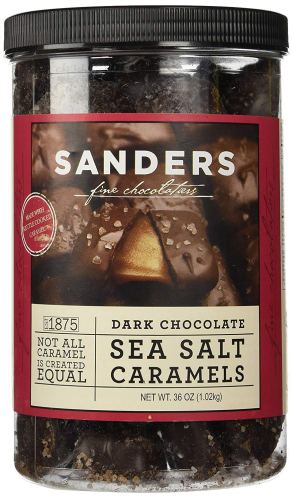
I’ve noticed more and more foods touting the substance in recent years. Last December, during a pre-Christmas shopping trip, I happened upon a jar of Dark Chocolate Sea Salt caramels. Over the past several years I have found that when, given a choice of chocolates, I tended to seek out the ones with caramel. So when I saw this large jar AND it was dark chocolate, I had to have them.

The first bite was wonderful, the second was heaven, and by the time the morsel was consumed I was addicted. But I was good and did not eat the entire jar. In fact I showed amazing discipline, eating one – at most – each day. Soon Christmas was over but the jar of deliciousness remained. And I’d only eat just one on any given day and sometimes none at all. By the time early March rolled around I stared forlornly at the nearly empty vessel. I would miss my Dark Chocolate Sea Salt Caramels because, Costco being Costco, they were, no doubt, only available for the holiday season.

Sanders chocolate.jpgThen one day a miracle occurred. The hubby and I were at Costco (we’re there at least once a week!) and on a whim I haul him over to the candy and chocolate section to see if there was anything else which might fill the void in my life. And then I spied them! A glorious Costco size stack of jar after jar of Sanders Dark Chocolate Sea Salt Caramels beckoned to me. Oh sweet mysteries of life!

Now my biggest fear is that Costco will run out (Under $20 for 36 ounces of wonder). So what I need everyone who reads my blog to do is this: go to Costco today and buy at least one jar. It’s the least you can do to properly celebrate National Chocolate Caramel day. Plus, if I know anything about Costco, the more they sell, the higher the likelihood they will keep them on the shelves forever. Do it for you. Do it for me. Do it for all of America.

A couple of important links:

On Hedonic Escaltion:

https://academic.oup.com/jcr/article-abstract/43/3/388/2199201?redirectedFrom=fulltext

https://www.independent.co.uk/life-style/salted-caramel-not-stop-eating-science-university-florida-hedonic-sugar-fat-a8078296.html

You don’t even have to leave home!:

https://www.costco.com/Sanders-Dark-Chocolate-Sea-Salt-Caramels-36-oz.%2c-2-pack.product.100321779.html

p.s. – I considered writing about the history of chocolate and caramel but tossed that out the window. For those who do not know, Chocolate’s origins can be traced to  MesoAmerica some 1500 years ago. And Caramel? It’s cooked sugar!

The Great Seattle Snowstorm of 1916: Remembering the Snowpocalypse

No Snow Event has come close in the past 100-plus years

February 5

A Tuesday Newsday Classic Updated

It really should not come as a surprise when snow arrives in the Puget Sound region the first week of February. It could be worse, however, if one looks back in time. The year was 1916 and on February 5th of that year, the Puget Sound region was still reeling from a heavy snowfall which began late on January 31st. It was a 24 hour period from February 1st to 2nd, however, which produced a whopping 21 and half inches of the white stuff. That record snowfall still stands.

union street after 1916 snowstorm

Union Street in Seattle as viewed from 9th Avenue, February 1916. Photo from University of Washington Libraries, Special Collections (link below)

The Infallible Wikipedia gives us but a brief glimpse of that event:

“From January 31 to February 2, 1916, another heavy snow event occurred with 29 in (74 cm) of snow on the ground by the time the event was over.”

However, it does link to a more comprehensive article from HistoryLink.org which, I’ve found over the years, provides excellent coverage of Seattle history minutiae. From the article:

When the big snow of 1916 began to fall on a cold Monday on January 31, 1916, there may have been more cameras than shovels in the hands of amateurs. The flurry of snapshots of our second greatest snowstorm illustrate snow-stopped streetcars, closed schools, closed libraries, closed theaters, closed bridges, a clogged waterfront, collapsed roofs, and — most sensationally — the great dome of St. James Cathedral, which landed in a heap in the nave and choir of the sanctuary. (There were no injuries to persons.)

The unusually cold January already had 23 inches of snow on the ground when, on the last day of the month, it began to fall relentlessly. Between 5 p.m. on Tuesday, February 1 and 5 p.m. on Wednesday, February 2, 21.5 inches accumulated in the Central Business District at the Weather Bureau in the Hoge Building. This remains (in 2002) a record — our largest 24-hour pile.

9th and James 1916 snowstorm

James street as viewed down 9th Avenue. Smith Tower – then the tallest building in Seattle – is on the left. February 1916. Photo from the University of Washington Libraries, Special Collections (link below)

The 1916 snow was a wet snow, and it came to a foul end — a mayhem of mud that mutilated bridges and carried away homes.”

In the category of how quickly we forget, it was in 2017 that the record for snowfall on any February 5th was set when two inches was recorded at Sea-Tac airport. An additional 5.1 inches fell on February 6th for a total of 7.1 inches on these two dates. Then in 2019 and again in 2021, the Puget Sound was hit with two fairly large snow events in February.

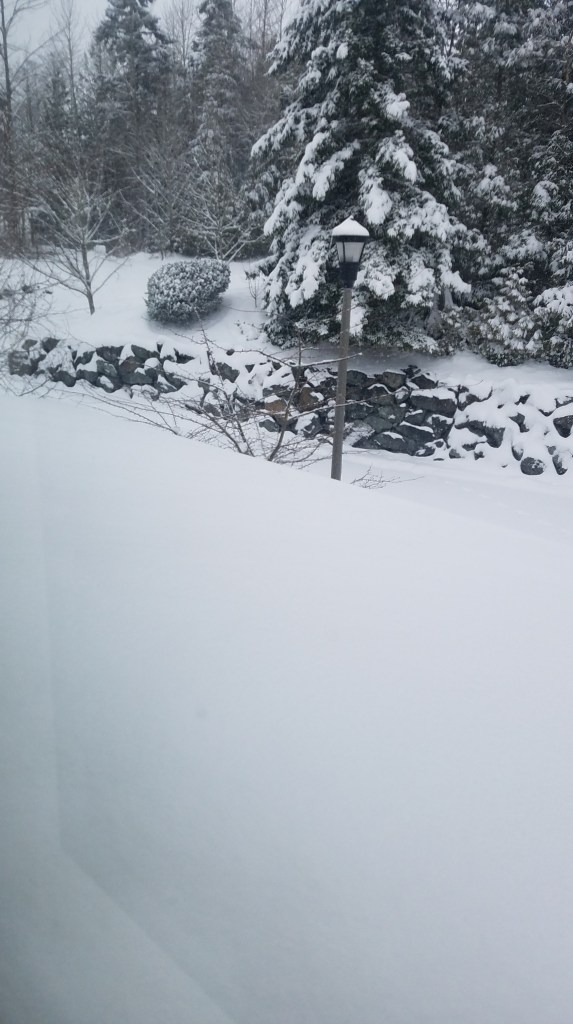
What I wrote on the morning of February 4, 2019: “Since the hubby and I moved north from the greater Seattle area in 2018, I cannot accurately compare the amount of snow from our old house to the one here in Mount Vernon. As of this morning we have between 3 and 4 inches and it is still snowing. The view from my office window – with a little wind in play – gives the appearance of being in a powdery snow globe.”

I cannot complain about Puget Sound snow, however. This region has some of the mildest weather in the world and I think of the white stuff as a wondrous treat to be enjoyed. Ensconced in my warm house with a morning cup of coffee – or later in the day with a mug of hot buttered rum – the beautiful coat of white is a magical event.

Too soon the temperatures will rise, the snow will melt, and we will be back to the brown and green scenery which characterizes a Puget Sound winter. One thing I do know is that within a few short weeks, the plum and cherry tree blossoms will erupt in shades of violet and pink and carpets of purple, yellow and white crocus will spread across the landscape. All we will recall from winter will be a few short days in February when the landscape was transformed into a winter wonderland.

On February 4, 2019, this was the view out my office window. Four days later the Puget Sound region was slammed with over 6 inches more.

Interesting perspective on the February 5/6 2017 event:

http://www.seattleweatherblog.com/snow/biggest-february-snowstorm-generation-wallops-seattle/

An article which highlights the biggest Puget Sound snowstorms:

http://www.historylink.org/File/3681

Some great historic photos of the February 1916 snowstorm:

http://archiveswest.orbiscascade.org/ark:/80444/xv07321

The February 8, 2019 snow event which gave us about six inches.
The February 13, 2021 Snowstorm which dumped just over a foot of snow in Mount Vernon.

A Puzzling Situation

January 29, 2019

January 29th – smack in the middle of winter – is the perfect time to stay indoors and celebrate National Puzzle Day by assembling a centuries old favorite: the jigsaw puzzle.

Peop the puzzler.jpg

A helper joins the puzzle fun.

The first commercial jigsaw puzzles were introduced in the 1700’s in England. They were named as such based on the process used to create them. From the Infallible Wikipedia:

” The engraver and cartographer John Spilsbury, of London, is believed to have produced the first jigsaw puzzle around 1760, using a marquetry saw. Early jigsaws, known as dissections, were produced by mounting maps on sheets of hardwood and cutting along national boundaries, creating a puzzle useful for the teaching of geography. Such ‘dissected maps’ were used to teach the children of King George III and Queen Charlotte by royal governess Lady Charlotte Finch.

Since their inception, jigsaw puzzles have evolved and changed. The original puzzles – made exclusively from wood – were costly and out of reach for the ordinary person. That began to change, however, in the late 1800’s when cardboard puzzles were introduced.

The popularity of the cardboard jigsaw puzzle exploded during the Great Depression as they were relatively inexpensive and could be put together, taken apart, and reassembled innumerable times, thus providing hours of entertainment.

The manufacturing method has improved over the years. Most modern puzzles are cut from paperboard. The process to create a thousand piece puzzle, for example, requires large presses which exert as much as 700 tons of pressure and precision cutting.

Jigsaw puzzles also come in a variety of sizes. A child’s first puzzle is likely to be from four to nine pieces. For something a bit more challenging, an adult can assemble a 300 piece puzzle in an hour or two. A thousand piece puzzle may take numerous sessions over several days.

If you have all winter and unlimited space, then you might want to pick up the 52,110 piece puzzle produced by MartinPuzzle in November 2018. It features a collage of animals and is 274 by 80 inches in size! Or, just short of 23 feet by 7 feet. I don’t know about anyone else, but my dining room table is not that big.

puzzle-50000.jpg

The animal collage puzzle with 52,110 pieces

The 50 pound behemoth is currently on sale for a mere $346… down from its list price of $576. And, if you’re worried about finding the right pieces, it comes in four boxes each containing 28 separate sections of 465 pieces.

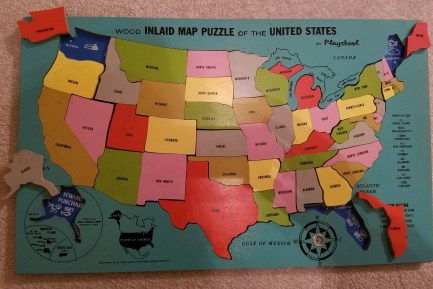
playskool-wooden-us-map-2.jpg

The very first puzzle I remember assembling.

The first puzzle I fell in love with was a 1960’s wooden map of the United States. As a young child I would dump out the pieces and then put all 50 of them back in. While Hawaii was gypped and had no pieces, Michigan was the coolest state as it had two pieces! That puzzle was my primer for memorizing all 50 states and their capital cities.

No doubt my mother noted my interest in puzzles and soon they appeared as birthday and Christmas gifts. I still have  several of the ones I was given.

After my son arrived I introduced him to puzzles while he was still a baby. He, like his mother, was fascinated. By the time he was one and half he was able to put together a 24 piece puzzle! At the time I did not realize that this was unusual baby behavior. But we went with it. Over the years, this activity is one he and I continue to enjoy doing together. At times we engage in ‘competitive’ puzzling where we will race to see who can put in the most pieces. To gain the other’s attention when placing a piece, we might tap our fingers on the puzzle in dramatic fashion. It’s all in good fun and mostly we have developed a cooperative puzzling style. He will work on the main body and I’ll usually put together as much of a section as I can off to the side then, once I’m bored with it, I’ll drag it to its approximate spot and turn it over to him. Then it’s off to a new section for me.

monopoly puzzle.jpgMy favorite puzzles are ones with a central theme and multiple smaller pictures: National Parks, American Presidents, and Board Games are a few which we’ve assembled that come to mind.
My least favorite ones are those which have little visual interest such as those touted as ‘the world’s most difficult’ puzzle as they tend to be quite monochromatic.

I’ve tried to curtail my puzzle ‘habit’ in recent years. But often, when I am near a Goodwill or Value Village store, the temptation is just too great and in I go in search of a ‘new to me’ puzzle to keep me company on a cold winter’s day. It’s the best.

A couple of links about National Puzzle Day and Jigsaw puzzles specifically:

https://nationaltoday.com/national-puzzle-day/

https://en.wikipedia.org/wiki/Jigsaw_puzzle

In case you want to buy the 52,110 piece puzzle:

https://www.mcprint.eu/en/puzzle-shop/puzzle-52110-pieces-the-first-jigsaw-puzzle-that-has-more-than-50000-pieces/?time=1548648257#card

Or for something a bit smaller: https://www.amazon.com/s/?ie=UTF8&keywords=largest+jigsaw+puzzle&tag=geminipcstand-20&index=aps&hvadid=33784252994&hvqmt=p&hvbmt=p&hvdev=c&ref=pd_sl_6sy53x6u1y_p

Winter Solstice

Midwinter’s Night Dreams

December 18, 2018

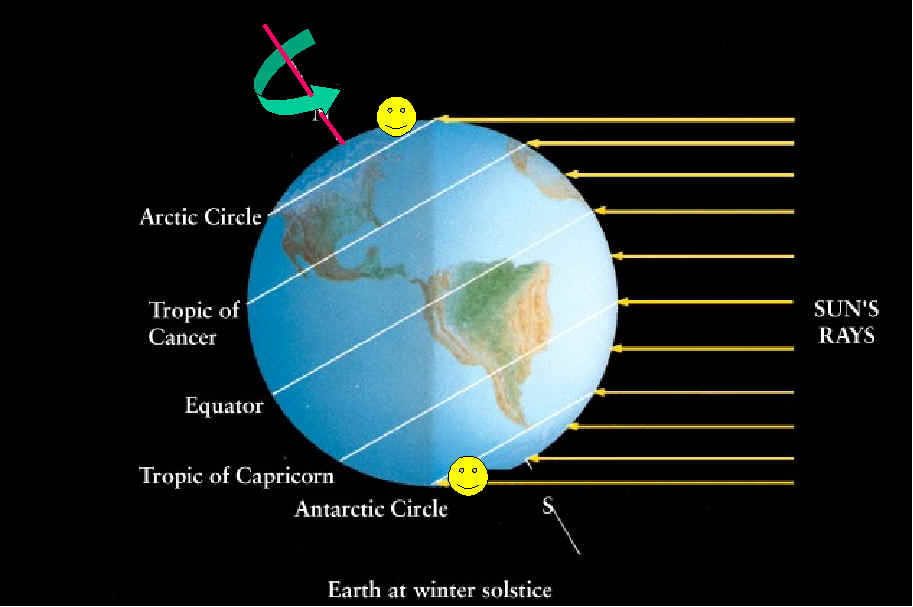
earth at winter solsticeAt 2:23 p.m. on Friday, December 21, 2018, here in the Pacific Northwest, the earth will be tilted furthest away from the sun and we will experience the shortest number of daylight hours in the northern hemisphere annually.

For most of us, we have been taught that it is also the first day of winter. That, however, is disputed. Come to find out, most meteorologists now subscribe to a different theory which places our beginning of winter at the first of December.

Known as meteorological winter, the premise is that northern winters comprise the three coldest – and snowiest – months of the year. Those would be December, January, and February. While I would normally go to the Infallible Wikipedia for citation first, this topic deserves a more scientific site. Here’s what the National Oceanic and Atmospheric Administration (NOAA) has to say:

“Meteorologists and climatologists break the seasons down into groupings of three months based on the annual temperature cycle as well as our calendar. We generally think of winter as the coldest time of the year and summer as the warmest time of the year, with spring and fall being the transition seasons, and that is what the meteorological seasons are based on. Meteorological spring includes March, April, and May; meteorological summer includes June, July, and August; meteorological fall includes September, October, and November; and meteorological winter includes December, January, and February.”

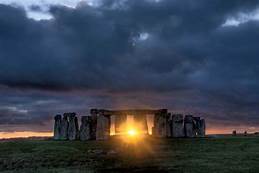
stonehendge solstice

Stonehenge in England. The monument was erected as a way for earlier people to mark the lowest point of the sun each year.

Wait! I said to myself last year when I first learned of this discrepancy. You mean to tell me that WINTER starts on December First – not three weeks later? It was a welcome revelation.

Every fall I find myself missing summer and the longer days of light. I had come to dread winter, counting down the days until the solstice when the number of hours of daylight began to increase once again. But because I thought of winter as starting on the 21st or 22nd, that meant that spring didn’t arrive until March 21st or 22nd.

It never made sense. By September 1, the temperatures have cooled enough at night that I would think “It feels like fall.” Similarly, when December rolls around, it’s consistently 40 degrees and rainy – and quite often we will get a snowfall sometime in the first three weeks of the month.

Yet, with this new information I’ve been able to reset my internal calendar. Now, since I think of December 21/22 as being nearly a month into winter, the season doesn’t seem nearly so long or so bleak. Suddenly, once Christmas and New Year’s Days are over, it’s only two short months until spring arrives, not three. It’s made a huge difference in my outlook.

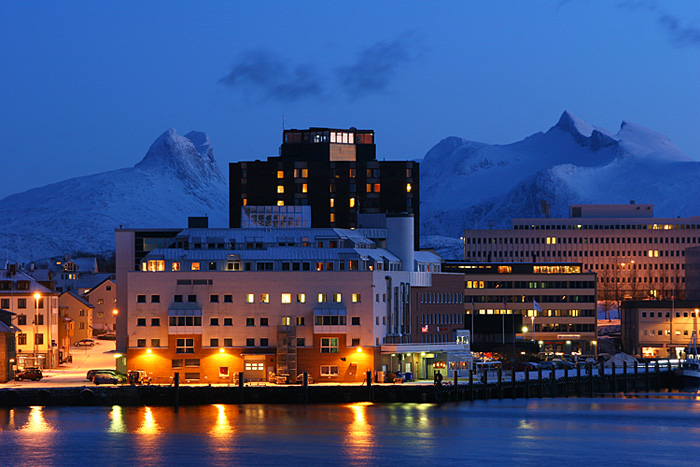
I also remind myself that there are locales where it is much, much worse. I will give thanks that I do not live in Bodo, Norway where, on the solstice, there will be less than one hour of light. A whopping 49 minutes in fact. According to Timeanddate.com:

Bodo Norway

Bodo Norway in winter

“December Solstice (Winter Solstice) is on Friday, December 21, 2018 at 11:22 pm in Bodø. In terms of daylight, this day is 23 hours, 11 minutes shorter than on June Solstice.”

Personally, I think there needs to be a national push to get the official first day of winter/spring/summer/fall changed. We can restore the two solstices to their rightful places as ‘midsummer’ and ‘midwinter’.

This year I’m embracing winter in all its glory. And on December 21st at 2:23 p.m. me, my hubby, and my son, daughter, and daughter’s significant other, will all raise a mug of hot buttered rum and salute the shortest daylight hours of the year at that moment when the earth pauses and the northern hemisphere begins its tilt back towards the sun. Happy winter everyone!

As always, a few links:

https://www.ncei.noaa.gov/news/meteorological-versus-astronomical-seasons

https://en.wikipedia.org/wiki/Winter_solstice

https://www.timeanddate.com/sun/norway/bodo

Midwinter’s Night Dreams

December 18, 2018

earth at winter solsticeAt 2:23 p.m. on Friday, December 21, 2018, here in the Pacific Northwest, the earth will be tilted furthest away from the sun and we will experience the shortest number of daylight hours in the northern hemisphere annually.

For most of us, we have been taught that it is also the first day of winter. That, however, is disputed. Come to find out, most meteorologists now subscribe to a different theory which places our beginning of winter at the first of December.

Known as meteorological winter, the premise is that northern winters comprise the three coldest – and snowiest – months of the year. Those would be December, January, and February. While I would normally go to the Infallible Wikipedia for citation first, this topic deserves a more scientific site. Here’s what the National Oceanic and Atmospheric Administration (NOAA) has to say:

“Meteorologists and climatologists break the seasons down into groupings of three months based on the annual temperature cycle as well as our calendar. We generally think of winter as the coldest time of the year and summer as the warmest time of the year, with spring and fall being the transition seasons, and that is what the meteorological seasons are based on. Meteorological spring includes March, April, and May; meteorological summer includes June, July, and August; meteorological fall includes September, October, and November; and meteorological winter includes December, January, and February.”

stonehendge solstice

Stonehenge in England. The monument was erected as a way for earlier people to mark the lowest point of the sun each year.

Wait! I said to myself last year when I first learned of this discrepancy. You mean to tell me that WINTER starts on December First – not three weeks later? It was a welcome revelation.

Every fall I find myself missing summer and the longer days of light. I had come to dread winter, counting down the days until the solstice when the number of hours of daylight began to increase once again. But because I thought of winter as starting on the 21st or 22nd, that meant that spring didn’t arrive until March 21st or 22nd.

It never made sense. By September 1, the temperatures have cooled enough at night that I would think “It feels like fall.” Similarly, when December rolls around, it’s consistently 40 degrees and rainy – and quite often we will get a snowfall sometime in the first three weeks of the month.

Yet, with this new information I’ve been able to reset my internal calendar. Now, since I think of December 21/22 as being nearly a month into winter, the season doesn’t seem nearly so long or so bleak. Suddenly, once Christmas and New Year’s Days are over, it’s only two short months until spring arrives, not three. It’s made a huge difference in my outlook.

I also remind myself that there are locales where it is much, much worse. I will give thanks that I do not live in Bodo, Norway where, on the solstice, there will be less than one hour of light. A whopping 49 minutes in fact. According to Timeanddate.com:

Bodo Norway

Bodo Norway in winter

“December Solstice (Winter Solstice) is on Friday, December 21, 2018 at 11:22 pm in Bodø. In terms of daylight, this day is 23 hours, 11 minutes shorter than on June Solstice.”

Personally, I think there needs to be a national push to get the official first day of winter/spring/summer/fall changed. We can restore the two solstices to their rightful places as ‘midsummer’ and ‘midwinter’.

This year I’m embracing winter in all its glory. And on December 21st at 2:23 p.m. me, my hubby, and my son, daughter, and daughter’s significant other, will all raise a mug of hot buttered rum and salute the shortest daylight hours of the year at that moment when the earth pauses and the northern hemisphere begins its tilt back towards the sun. Happy winter everyone!

As always, a few links:

https://www.ncei.noaa.gov/news/meteorological-versus-astronomical-seasons

https://en.wikipedia.org/wiki/Winter_solstice

https://www.timeanddate.com/sun/norway/bodo

Update for 2022: the solstice arrives at 1:48 p.m. on Wednesday, December 21st. Be sure to mark your calendars!

When the Saints Go Marching In

Saint BarbaraThy Name Is Barbara

December 4, 2018

I’m still not sure how I feel about Saint Barbara. It is kind of cool to have a special day and a feast… not everyone has a name associated with a Saint after-all.  December 4th is Saint Barbara’s day. But how it came about is, well, pretty unbelievable.  From the Infallible Wikipedia:

“According to the hagiographies, Barbara, the daughter of a rich pagan named Dioscorus, was carefully guarded by her father who kept her locked up in a tower in order to preserve her from the outside world. Having secretly become a Christian, she rejected an offer of marriage that she received through her father.

“Before going on a journey, her father commanded that a private bath-house be erected for her use near her dwelling, and during his absence, Barbara had three windows put in it, as a symbol of the Holy Trinity, instead of the two originally intended. When her father returned, she acknowledged herself to be a Christian; upon this he drew his sword to kill her, but her prayers created an opening in the tower wall and she was miraculously transported to a mountain gorge, where two shepherds watched their flocks. Dioscorus, in pursuit of his daughter, was rebuffed by the first shepherd, but the second betrayed her. For doing this, he was turned to stone and his flock was changed to locusts.

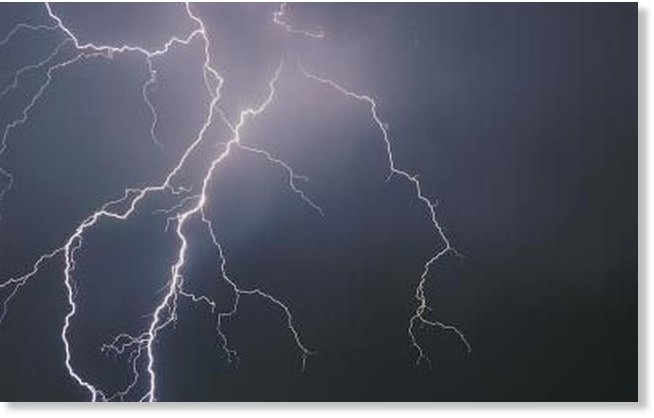
thunder“Dragged before the prefect of the province, Martinianus, who had her cruelly tortured, Barbara held true to her Christian faith. During the night, the dark prison was bathed in light and new miracles occurred. Every morning, her wounds were healed. Torches that were to be used to burn her went out as soon as they came near her. Finally, she was condemned to death by beheading. Her father himself carried out the death-sentence. However, as punishment for this, he was struck by lightning on the way home and his body was consumed by flame. Barbara was buried by a Christian, Valentinus, and her tomb became the site of miracles.”
Because the facts of her story could not be verified, her Sainthood was downgraded in 1969 and the feast day removed from the official calendar. But that does not deter those who wish protection during war and from lightning strikes to offer up a prayer against bad things happening to them. Also from the Infallible Wikipedia:

“Saint Barbara is one of the Fourteen Holy Helpers. Her association with the lightning that killed her father has caused her to be invoked against lightning and fire; by association with explosions, she is also the patron of artillery and mining.”

skyrockets12.jpgI think with a bit of planning, I could turn December 4th into a really cool event day. Have a big feast, set off some fireworks, and tell the story of Saint Barbara. And for good measure if the Gods can provide a thunder and lightning storm that day, even better. So mark it on your calendars for 2019, it will be an explosively good time.

No blog post is complete without a link to the Infallible Wikipedia:

https://en.wikipedia.org/wiki/Saint_Barbara

Most Popular Birthdate

How Do YOU celebrate?

September 18, 2018

One needs only to know a little about human gestation to proffer a guess as to why the most popular dates for babies to be born are in mid-September.

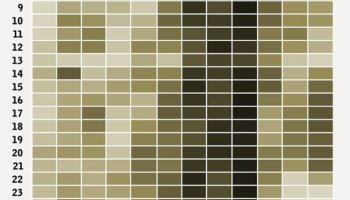
According to the National Center for Health Statistics (NCHS) the most common day for births in 2017 is September 9th. The previous most popular day, from 1973 to 1999 according to a Harvard study, was September 16th.heatmapbirthdays1

In fact, in the 2017 numbers, we discover the most common days to be:

  1. September 9
  2. September 19
  3. September 12
  4. September 17
  5. September 10
  6. July 7
  7. September 20
  8. September 15
  9. September 16
  10. September 18

The Infallible Wikipedia offers the following explanation:

“According to a public database of births, birthdays in the United States are quite evenly distributed for the most part, but there tend to be more births in September and October. This may be because there is a holiday season nine months before (the human gestation period is about nine months), or because the longest nights of the year also occur in the Northern Hemisphere nine months before. However, it appears the holidays have more of an effect on birth rates than the winter: New Zealand, a Southern Hemisphere country, has the same September and October peak with no corresponding peak in March and April. The least common birthdays tend to fall around public holidays, such as Christmas, New Years Day and fixed-date holidays such as July 4 in the US. This is probably due to hospitals and birthing centres not offering labor inductions and elective Cesarean sections on public holidays.

Based on Harvard University research of birth records in the United States between 1973 and 1999, September 16 is the most common birthday in the United States and December 25 the least common birthday (other than February 29, because of leap years). In 2011, October 5 and 6 were reported as the most frequently occurring birthdays.”

retro_kissing_christmas_couple_postcard-r4661dfa97e2e4cb59c6edd2e92557d9c_vgbaq_8byvr_512It is duly noted that the approximate conception dates for 9 of those 10 dates is between December 17th and December 28th… apparently a lot of people commemorate Christmas and New Years with their own personal celebrations.

Chances are good that you know someone who has a birthday this week. In the past week alone I’ve had Facebook inform me of at least 4 ‘friends’ on every single day with birthdays.

Last year I noted this trend on Facebook and my niece, whose birthday is September 30th, commented that she was teasing one of her friends about being born on the 16th because of ‘when’ she was likely to have been conceived. And then the light went on for my niece… who was a week late… Can you say Happy New Year?!

And, finally, is another friend of mine whose birthday is September 18th. For years, he told me, they would rib their Dad about the link between that date and Christmas. Dad finally had enough and blew up one day, exclaiming, “Okay! It was Christmas Eve! Now drop it.”baby in christmas present

In the world of irony it’s even more delicious that my friend’s daughter was born… on September 18th. Merry Christmas, everyone.

A couple of links to amuse you:

http://thedailyviz.com/2016/09/17/how-common-is-your-birthday-dailyviz/ (a cool interactive map where you can see how popular your birthday is and where it ranks. Mine is the 37th most popular date)

https://en.wikipedia.org/wiki/Birthday (because it’s the Infallible Wikipedia, right?)