The Debut of Sledding in the Olympics
February 9, 2021
Over the years, a variety of competitions have been added to the Winter Olympics. On February 9, 1932, the two-man Bobsled made its debut and has been a fan favorite ever since.

For anyone unfamiliar with the event, think sledding but much, much faster. The first competitions, predating the Olympic Games, occurred in St. Moritz, Switzerland in the 1800’s.
The Infallible Wikipedia tells us:
“Its foundation began when hotelier Caspar Badrutt (1848–1904) convinced some wealthy English regulars to remain through the entire winter at his hotel in the mineral spa town of St. Moritz, Switzerland. He had been frustrated that his hotel was only busy during the summer months. By keeping his guests entertained with food, alcohol, and activities, he quickly established the concept of ‘winter resorting’. Within a few years, wintering at Badrutt’s St Moritz hotel became very fashionable in Victorian Britain. However, with increased numbers this led some guests to search for new diversions. In the early 1870s some adventurous Englishmen began adapting boys’ delivery sleds for recreational purposes.”
The hotel guests loved the sleds and soon they competed in races down the streets and alleys of St. Moritz. The ‘runs’ became longer and the speeds faster which led to crashes and injuries. Complaints from the townspeople increased.
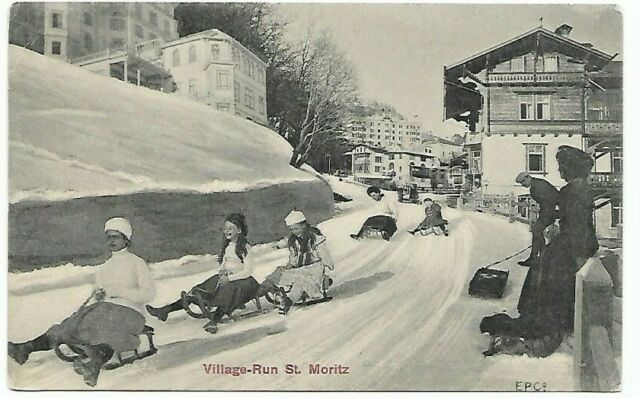
(Badrutt’s) “solution was to build a basic natural ice run for his guests outside the town near the small hamlet named Cresta in the late 1870s. Badrutt took action because he did not want to make enemies in the town and he had worked hard and investing a lot of time and money in popularizing wintering in St. Moritz so he was not going to let customers stop coming due to boredom.”
The Bobsled – either the two-man or four-man – is controlled by a steering mechanism in the nose of a bullet shaped ‘car.’ The participants sit in a crouched position facing forward inside the car which is guided by the pilot. The additional participants serve as pushers to gain initial speed and then as ballast which helps the Bobsled go faster down the icy track.
Besides Bobsled another winter event, the Luge, also involves excessive speeds. The Luge, however, is sport where the participant lays face up on an open, lightweight sled and uses his or her feet to guide it.
Both sports are rather heart stopping at times. The world record for Bobsled speed is 125 mph! Lugers generally race between 75 and 90 mph.
Given a choice between watching the summer or winter games, I’ve always been a bigger fan of the snow sports whether it’s skating, skiing, or sledding.
I think this may stem from my childhood days growing up in Yakima. While most of winter in Yakima tends to be marked by sunny, cold, and dry, there are usually a few big enough snow events which made sledding – which is an inexpensive pastime – possible. The street I grew up on was perfect for a beginner sledding experience. It had a slope, but was gentle enough that a five year old could manage it.
As the years went on, I graduated to bigger hills. A walk south to where 31st Avenue crossed Tieton drive brought we adventurous sliders to the top of a rather daunting slope. At the bottom of that slope lived my cousins. When we got bored with our pedestrian hill we ventured to theirs.
Then, the year I was twelve I was allowed one day to head to the holy grail of all sledding hills in Yakima: Franklin Park.
From top to bottom, the hill is probably about 60 feet. The center of the 45 degree slope is flat like a cookie sheet. But on either side are terraces, each of the half dozen around 10 feet high. After a big snow, of course, the hill comes alive with hundreds of kids and every one of them wants to slide down the sloped ‘cookie sheet’ in the middle. It doesn’t take long for the snow to reveal the un-slidable grass from the activity of all those kids.
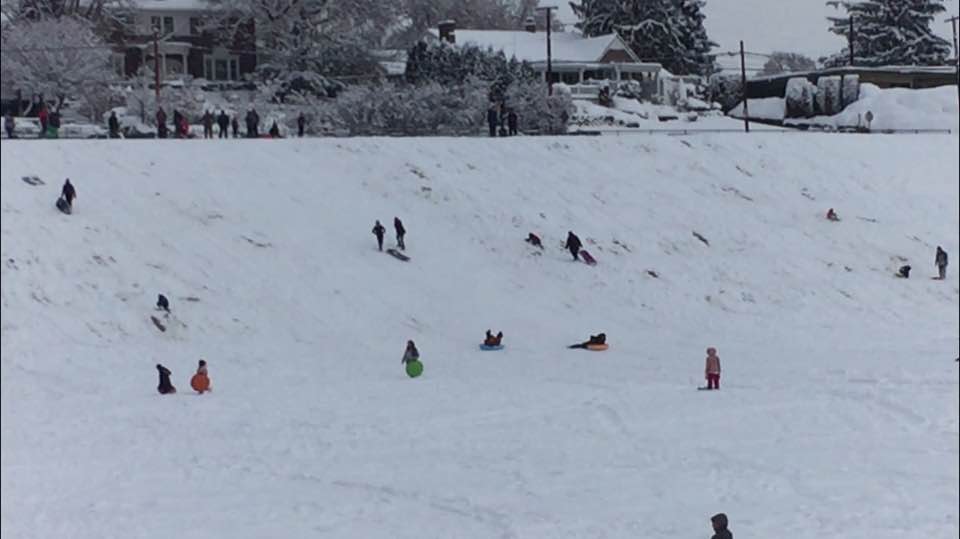
On the particular day I was allowed to go I ended up relegated to trying to figure out how to sled the terraces. I lay down on my sled, hands on the cross bar and inched my way to the top of the highest terrace; the sled dropped down over the edge and I flew. For exactly 10 feet before the sled lurched to a stop in the deep snow.
This was not, you might imagine, a particularly successful method of sledding. But I persevered and dragged the sled to the next terrace ledge, lay down and once again pushed the sled over the ledge, pretty much bouncing down the next terrace with a similar result.
Now I cannot recall for sure on which terrace disaster struck, but strike it did during this, my first and only time sledding at Franklin Park.
Down the slope I went and when I got to the bottom of the third level, the front of the sled reared up and smacked me in the face. I rolled off the sled, the stinging pain letting me know my decision making abilities were not very good. But the worst part of all was that my glasses, which I needed for distance vision, lay broken in two in the snow.
Despite that experience, I have persisted. There’s nothing quite so exhilarating as when you gain momentum and go hurtling down a slippery slope, knowing that you are likely out of control, but loving the speed and the flying sensation.

Our family cabin was, for years, a destination for New Year’s or President’s Day weekends. When the kids arrived, we introduced them to the joys of sledding and everyone looked forward to those trips.
On one particular afternoon, we were all outside playing in the snow and my dad had driven up from Yakima. He had to have been in his late 70’s at the time, but there he was sliding down the hill with the kids and having a great time. Or he was right up until the boat sled in which he was riding sailed over a berm and he landed hard, bruising his tailbone. It was at that moment he declared his sledding days over. About five years ago I did the exact same thing in the exact same spot and, like my dad, ended up bruised and battered.

I have my doubts that I’ll ever get back on a sled but I haven’t counted it out quite yet. After we sold the cabin this past summer, two of the metal boat sleds came to live in my garage. Now all I need is a snowy day. Not too far from where I live is an epic hill which would be perfect for a run.
But, with no big snow storms on the horizon, I’ll do the next best thing. I typed in ‘virtual luge’ on my computer and got hundreds of hits. For best results, view it on a full size TV. And for a couple of minutes you can see what it would be like to ride a two man bobsled. And you won’t even need to wear a helmet or your mittens. But a cup of hot chocolate with a dollop of whip cream would be heavenly.
And a couple of links: