Archives

The 100-Year Legacy of the National Christmas Tree

 A 102 Year Tradition

December 24th

2019NCTL_Ceremony.jpg

The 2019 National Christmas Tree

At 3 p.m. on Monday, December 24th, 1923, an American tradition began which continues to this day. That event was the lighting of the first National Christmas tree.

Now, 102 years later, the event occurs earlier in the month – this year on December 4th – as it has since 1954 during a month long event known as the Pageant of Peace. But back to the beginning.

The concept of a National Christmas tree was the idea of Frederick Morris Feiker, an engineer with General Electric. He, along with Vermont US Senator Frank L. Greene, convinced President Calvin Coolidge to light the tree.

Alumni of Middlebury College in Vermont paid for the transport of a 48 foot tall balsam fir to be transported to Washington, D.C. with GE providing 2,500 green, red, and white electric lights.

From the Infallible Wikipedia:

calvin-coolidge-was-the-first-president-to-instate-a-public-christmas-celebration-at-the-white-house-with-the-first-national-chris.jpg

President Calvin Coolidge and dignitaries at the first National Tree Lighting ceremony in 1923

“At 3 p.m. on December 24, 1923, a 100-voice choir from the First Congregational Church assembled on the South Portico of the White House and began a two-hour concert of Christmas carols. At 5 p.m. (dusk) on Christmas Eve, President Coolidge touched a button at the foot of the tree which lit the lights and electric candles adorning the tree, but he did not speak. A searchlight from the nearby Washington Monument was trained on the tree to help illuminate it as well. The Coolidge family invited citizens of the city to sing Christmas carols on the Ellipse after dark. Between 5,000 and 6,000 people thronged the park, joined by 3,000 more people by 9 p.m. The crowds were joined by the Epiphany Church and First Congregational Church choirs, which sang carols, and the Marine Band played Christmas-themed music. The singing ended shortly before midnight. After the white residents of the city had dispersed, African American residents of the city were permitted on the park grounds to see the National Christmas Tree. An outdoor Christian worship service was held, and a mass choir composed of signing groups from area community centers sang more Christmas carols. An illuminated Christian cross was flashed on the Washington Monument, and men dressed as shepherds walked from the National Christmas Tree to the monument.”

300px-US_National_Christmas_Tree_1923The following year Coolidge objected to cutting down a tree for the event so a 35 foot tall live Norway Spruce was located and planted in a new location near the Treasury Building. This tree survived until 1929 when it was determined that the plant had been damaged and needed to be replaced. This began a series of live trees being planted, dying, and being replaced until, in 1934, the last tree was cut down in that location.

In December 1934, the tree and the ceremony were moved to Layfayette park, north of the White House. There it remained for only a few short years before returning to its original site on the Ellipse where it remains to this day. Over the years there have been many, many trees which have served in the role. Additionally, the ceremonies and events associated with it have become quite extensive. If you’d like to read more about its history, here’s the Wikipedia link https://en.wikipedia.org/wiki/National_Christmas_Tree_(United_States) and also the link to the official website https://thenationaltree.org/lighting-ceremony/2019-national-christmas-tree-lighting-ceremony/.

Although I’ve never seen the National Tree, I do love driving around during the Christmas season and viewing all the wonderful outdoor decorations. There is nothing quite so beautiful as a blue spruce or fir tree at night covered with lights AND an inch or two of snow on its branches.

My first memory of such a tree was when I was probably 7 or 8. My bedroom in Yakima faced towards our backyard. Our neighbor, Ray Broten, spent a lot of time keeping his yard beautiful. No matter the season, his was always manicured and trimmed to perfection. That particular December, the spruce tree located in the southwest corner of his backyard cut through the darkness with blue, green, red, and white lights, illuminating my bedroom each night. After I went to bed there was many a time I stole back over to the window and just stood and looked out at his beautiful tree. My favorite nights were when a soft snow was falling, muting the darkness with a blanket of white.

When I got too cold, I’d crawl back in to bed, and as I warmed up and drifted off to sleep, the shine of those lights would bathe the room with a soft glow.

This tradition continued for a number of years until the time I moved away from Yakima. Although those years are long ago, the memory is etched with clarity as Mr. Broten unknowingly created one of my fondest recollections.

May your Christmas also be one of wonderful reminiscences and the creation of new memories. Merry Christmas one and all.

Arches National Park

November 12, 2019

With more than 2000 natural sandstone arches located within, Arches National Park has the highest concentration of these features in the world. Although it had been named a National Monument in 1929, it was on November 12, 1971, when Arches National Park was created.

Windows arches national park.jpg
Situated in eastern Utah, it’s remote location and rugged terrain make getting there a challenge. The Utah park, however, has become a magnet for hikers, climbers, and nature lovers, attracting some 1.6 million visitors in 2018.
According to the Infallible Wikipedia:
“The Arches area was first brought to the attention of the National Park Service by Frank A. Wadleigh, passenger traffic manager of the Denver and Rio Grande Western Railroad. Wadleigh, accompanied by railroad photographer George L. Beam, visited the area in September 1923 at the invitation of Alexander Ringhoffer, a Hungarian-born prospector living in Salt Valley. Ringhoffer had written to the railroad in an effort to interest them in the tourist potential of a scenic area he had discovered the previous year with his two sons and a son-in-law, which he called the Devils Garden (known today as the Klondike Bluffs). Wadleigh was impressed by what Ringhoffer showed him, and suggested to Park Service director Stephen T. Mather that the area be made a national monument.”
Over the years, like so many of our nation’s National Parks, Arches has been loved to the point of fragile features being in danger of destruction. Consequently, there are now bans within the park which make climbing some of the more famous arches illegal.
The hubby and I have had the privilege of visiting Arches twice. The first time was in the summer of 1984. We arrived on a hot July day which was not conducive to outdoor activities. Being young and in decent shape, however, we did exit the car and hiked  in the Windows region of the park.

Balancing rock arches np.jpg

Cold and rainy Thursday October 11, 2018 in Arches NP

The second trip was in October of 2018 along with several hundred of those 1,599,998 other visitors on a rainy – which is rare since the park gets less than 10 inches of precipitation a year – weekday. What struck me about the differences between those two visits is that the park had been ‘discovered’ in the intervening years. On the first trip we saw maybe a half dozen other cars and some 12 tourists.  In 2018, despite the inclement weather and a number of  flooded roads, the place was crawling with people. Finding a place to park the car at some of the stops was a challenge at times.

Our method of touring, 24 years later, has changed. In eighty four, I would cram as many things into our travels as possible, never allowing nearly enough time to pause and marvel at nature’s grandeur. A year ago, our inclinations to be mountain goats now subdued, getting out and hiking for a mile or two wasn’t happening. Instead, rather than the slap and dash tourists of yesteryear, we stopped frequently and walked short paths to where we could stand and simply appreciate the amazing features, listen for birds and insects, and find joy in the moment.
The term ‘Stop and Smell the Roses’ may be cliche, but the idea behind it is solid. Too often we rush to the airport, wait in lines to be crammed into a plane, then fly to a destination where the modern amenities make our lives easy. There’s nothing easy about visiting Arches or many of Utah’s spectacular landscapes… but it is so very worth the trip.

My Wawona

Yosemite National Park

October 1, 2019

El Capitan
El Capitan

October 1, 1890 marked the official inclusion of this region into the newly formed National Park System. Long before that, however, the Yosemite Valley had inspired the natives who resided in the area as well as the early white settlers.

It was, contrary to popular belief, James Mason Hutchings and artist Thomas Ayres who were the first Americans to tour the area in 1855.

From the Infallible Wikipedia:

“Hutchings and Ayres were responsible for much of the earliest publicity about Yosemite, writing articles and special magazine issues about the Valley. Ayres’ style in art was highly detailed with exaggerated angularity. His works and written accounts were distributed nationally, and an art exhibition of his drawings was held in New York City. Hutchings’ publicity efforts between 1855 and 1860 led to an increase in tourism to Yosemite.”

Although the greater Yosemite area had been set aside by Congress in 1864, the Valley and Mariposa Grove were ceded to California to manage as a state park. The two areas had seen an influx of homesteaders and were being rapidly commercialized as well as being used for the grazing of sheep and cattle; the old growth sequoias were being logged.

Most people associate the founding of Yosemite with early environmentalist John Muir. Rightly, he is credited with not only pushing for park expansion but also  lobbied for the federal government to take back the iconic valley and grove.

Also from the Infallible Wikipedia:

“It was because of Muir that many National Parks were left untouched, such as Yosemite Vally National Park. One of the most significant camping trips Muir took was in 1903 with then president Theodore Roosevelt. This trip persuaded Roosevelt to return ‘Yosemite Valley and Mariposa Grove to federal protection as part of Yosemite National Park.'”

The years long efforts paid off when, in 1906, Roosevelt signed a bill which stripped the two areas still managed by California from the state and they were returned to the federal government which finally created a unified Yosemite National Park.

half dome.jpg
Half Dome

One trip to Yosemite is all it takes for a person to understand the granduer and how special a place it is. From towering El Capitan, to the massive Half Dome, or the fascinating Tuolome Meadows, Yosemite is a visual feast.

And the hubby and I wondered, when we visited in September 2015, how come it had taken us so long to get there. We arrived on the day after Labor Day which was a good thing as the summer crowds were gone. Reservations are generally required months – if not a year – in advance for the various hotels. I figured we were out of luck but checked anyway as we drove south a few days before our planned stay. What a surprise! There were rooms available at the Wawona Hotel or space in ‘dry’ tents. We opted for the hotel.

It was only after we arrived at the park that it dawned on me that the Wawona Hotel was nowhere near the Yosemite Valley. That day had turned into a driving ordeal. My hubby suffers from vertigo. Being close to any ledge can trigger a sensation of spinning as well as nausea. Knowing this, it was my duty to do the driving so that he could close his eyes as needed when navigating cliff-side roads.

Up, up, up we traveled from the eastern side of the park to the 9,943 foot high Tioga Pass – the highest mountain pass in California. Come to find out, THAT was the easiest road. From there we wound our way through Yosemite’s high country. Then we had to go down. From Tuolome Meadows – elevation 8,619 feet – to the Valley floor was a 4,619 foot descent. And all of it seemed to be a series of endless switchbacks and curvy roads carved in to the sides of mountains.

It was with a sense of relief we reached the bottom when it hit me… Wawona was another 30 miles which we had to add to the 230 we’d already traveled that day. No rest for the driver as the road climbed back up the other side through yet another series of switchbacks,cliffs, and amazing vistas.

Now close to sunset, we found the hotel and were charmed at the thought of staying in a 1870’s structure.

Wawona-Hotel-patios
Adirondack chairs on the veranda

Our room was in the more recently added section… built at the turn of the last century. Located at the far western end of the first floor, the room opened out on to a wide veranda adorned with honeysuckle.

But that’s where the charm ended. The room itself featured a double bed and a twin bed. There was a sink attached to the wall next to the twin bed with a door in the wall next to it. The door, however, was locked.

The room was completed with a small square closet, small dresser and a table and chair. No TV and no phone. But we were up for the adventure and the price – less than $70 a night – was a steal even with having to use the bathroom down the stairs.

As we went to bed that night we could hear, through the thin walls, talking in the room next door; two men were conversing in German. We laughingly dubbed them Hans and Fritz and, although the hubby had taken German in high school, were unable to decipher their conversation.

Our feast…

The next day, after breakfast in the hotel dining room, we headed out for a full day of touring. That evening we bought deli meats, fruits, crackers, and a bottle of wine which we ate and drank while sitting in the Adirondack chairs outside our room on the veranda. A pink and purple sunset was the perfect icing on a wonderful day.

Despite the older beds and somewhat rustic accommodations we slept well… that was until about 7:30 the next morning when our German neighbors’ talking awoke us. It was then we discovered where the locked door next to the sink led. When the hotel was built, the rooms all shared Jack and Jill bathrooms. To accommodate a more modern customer the bathrooms had been designated as a private bath for one of the rooms only, and the door to the adjacent room was locked.

We had the room without a private bath. Our German neighbors, Hans and Fritz, had the bathroom. Did I mention that the walls were paper-thin and not insulated?

Soon, some rather unfortunate sounds penetrated into our hearing range. We dressed as quickly as we could and headed to breakfast… and decided that the Germans would hereafter be known as Fritz… and a scatological term which rhymes with Fritz.

Of course the thing one most recalls about any trip are the occurrences which are out of the ordinary. Our stay at the Wawona turned out to be the most memorable part. And we wouldn’t change a thing.

Wawona hotel barb
The author and traveling companion Alvin the Chipmunk (in his National Park Ranger gear) in front of the ‘old’ section of the Wawona Hotel

A couple of websites to visit:
https://en.wikipedia.org/wiki/Yosemite_National_Park
https://en.wikipedia.org/wiki/Wawona_Hotel
For those who want to see the Wawona Hotel’s claim to fame, be sure to check out the movie 36 Hours.
https://en.wikipedia.org/wiki/36_Hours_(1965_film)

Alvin
Alvin – our traveling companion

This is…

American Idol!

June 11, 2019

top-12-contestants-american-idol

These four words burst into our collective consciousness on June 11, 2002 and launched one of the most successful reality TV franchises in American History.

The show was an instant hit, showcasing the talent of people looking for their big break. Week after week fans tuned in to follow the stories of the lucky few selected to compete in the contest. The premise was, according to the Infallible Wikipedia, this:

“Each season premieres with the audition round, taking place in different cities. The audition episodes typically feature a mix of potential finalists, interesting characters and woefully inadequate contestants. Each successful contestant receives a golden ticket to proceed on to the next round in Hollywood. Based on their performances during the Hollywood round (Las Vegas round from the tenth through twelfth seasons), 24 to 36 contestants are selected by the judges to participate in the semifinals. From the semifinals onward the contestants perform their songs live, with the judges making their critiques after each performance. The contestants are voted for by the viewing public, and the outcome of the public votes is then revealed during a results segment. The results segment feature group performances by the contestants as well as guest performers. The Top-three results also features homecoming events for the Top 3 finalists. The season reaches its climax in a two-hour results finale show, where the winner of the season is revealed.”

Along with the judges, viewers at home became music critics, repeating such phrases as “that was pitchy,” and “You’re going to Hollywood.” The judge everyone loved to hate, however, was Simon Cowell, who un-apologetically skewered the singing of contestants with such pithy remarks like “It was all a little bit like angry girl in the bedroom screaming on the guitar.”

carrie-underwood-american-idol-results-2005-photo-GC

I would argue that the high water mark for the show was in 2005 with the crowning of Carrie Underwood as the winner. She has been, by far, the most successful AI alum and her win and subsequent stardom created much excitement and interest in the show. That excitement coalesced into the 2007 season with it being the number one show on TV that year. Also from the Infallible Wikipedia:

“American Idol ended the season as the top show of the 2006–2007 TV season. Its Wednesday episodes ranked first with an average of 30.02 million viewers, followed by the Tuesday episodes which averaged 29.54 million. The premiere episode became the series’ highest rated debut episode, viewed by 37.44 million viewers and receiving a 15.8/36 Nielsen rating in the Adult 18-49 demographic.”

In my household AI fever kicked in to high gear when my teenage daughter became enthralled with it and AI took over our lives. Just before 8 o’clock each evening I’d hear the thunder of her footsteps coming down the stairs and soon we were wrapped up in the drama.

That year there was extra interest as a contestant from Bothell – six miles north of where we lived – was making a name for himself on the show.

Blake Lewis was, at the time, a local Seattle musician whose beat-boxing ability provided enough novelty that he earned a golden ticket to Hollywood. At first, it seemed, the judges viewed him as a one trick pony who would not survive the first round of performances. Week after week, however, Lewis proved that he could sing. He made each song his own with original arrangements, and defied the odds, advancing in each round.

For my 14 year old daughter and a couple of her friends, Lewis became almost an obsession like the Beatles were in the 1960’s, or David Cassiday in the 1970’s, or the Backstreet Boys in the 1990’s (It’s what 14 year old girls are known to do!) Of course, Mom was pulled in to that universe also, as we then had to vote for him every week. And I’m not talking about dialing the phone one time and being done. Oh no. On American Idol they encouraged the viewers to vote many, many times. Hundreds of times. Once the performances were over we’d start dialing and continue until they closed them down.

And Lewis became the last man, literally, standing.

When the contest is down to the final three it’s time for the ‘hometown’ visit. Or, as the cynic in me believes, just another way to market the AI franchise to the public.

In the week before Lewis was to arrive in Bothell, my daughter and her friends “L” and “D” spent a couple of afternoons making t-shirts and posters and plotting the big event. Lewis’ female fans called themselves “Blaker Girls.”

During that week I became the ‘cool’ mom. I bought the many supplies and, on a warm, sunny afternoon on May 11, drove the trio of girls to Bothell so they could see ‘their’ American Idol. I figured there would be a crowd so we got there several hours in advance, secured a parking spot and joined the throng of over 7000.

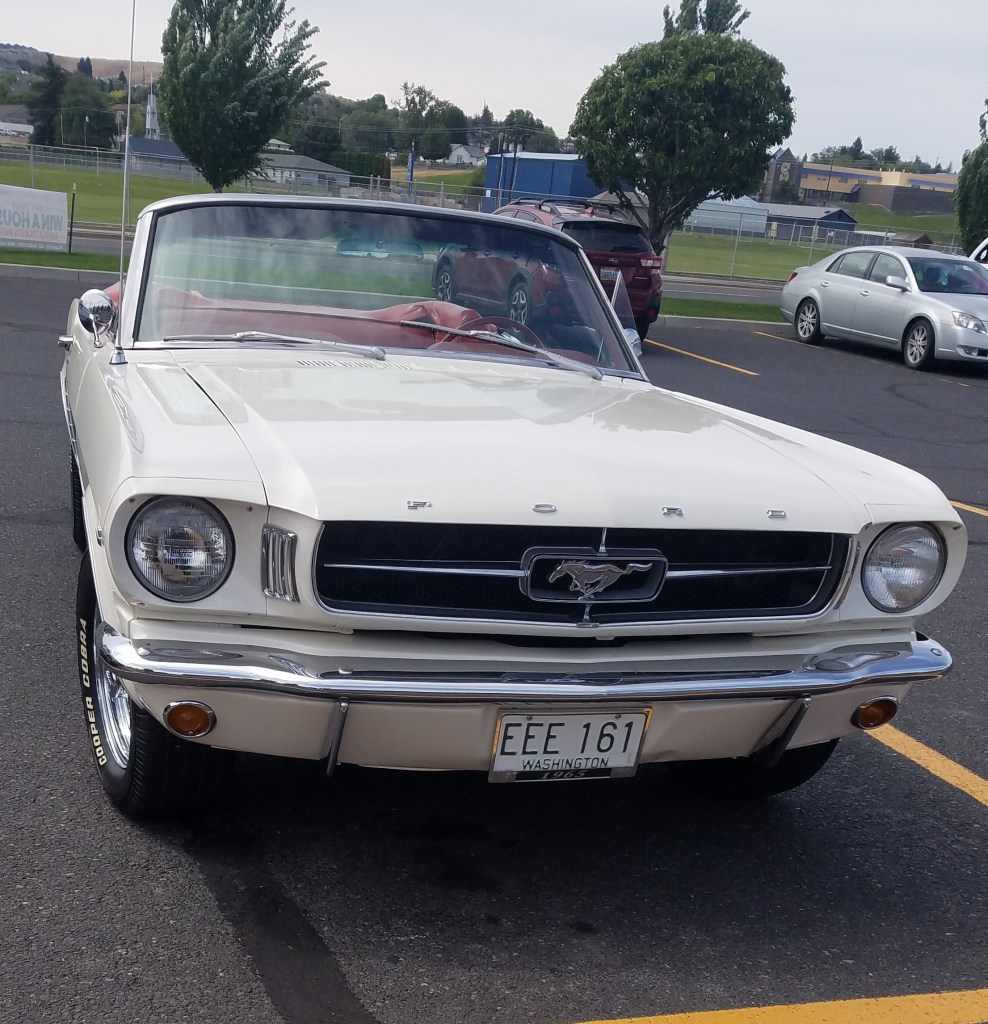
The girls were not disappointed. The fans were amped up for the parade and, after a long wait, there he was… riding on the back of a Mustang convertible, smiling and waving to the crowd.

After the parade, we moved with the hoards down to the park where he was to perform live and receive his hometown hero’s welcome.

From the Seattle Time’s article:

The Bothell crowd of more than 7,000 was growing restless. Where was its American Idol?

Some teens chanted “We want Blake!” Others hoisted “We Ache for Blake” or “Bothell Boy, You Rock!” signs. And then, off in the distance, the twirling lights of police cars, the thundering beats of the Inglemoor Marching Band and Blake Lewis, all smiles and waves and two-fingered kisses, sailing down Main Street in a Mustang convertible with his beaming parents.

It was a highlight in a full day of events for Lewis that started at 8 a.m. at KCPQ/Fox studios for a television performance on the morning newscast. There was a lunchtime “mini-concert” at Seattle’s Westlake Center, a parade through downtown Bothell and another performance at the Park at Bothell Landing in the afternoon.”

Lewis ended up finishing second the next week, much to our disappointment.

For the next couple of years my daughter faithfully watched American Idol and even went to the American Idol tour with a friend in 2009. For me there has never been a more fun season than that one. I no longer watch the show, but for a few months in the spring of 2007, it was a magic time. Sadly, our computer crashed that summer and all the evidence of the Blake Lewis hometown visit are gone…*

A few links:

https://en.wikipedia.org/wiki/American_Idol

https://en.wikipedia.org/wiki/American_Idol_(season_6)

https://www.seattletimes.com/entertainment/a-tidal-wave-of-idol-worship/

*Update June 11, 2020 – During the lockdown of the past few months, I have sorted, organized, and sorted again. Lo and behold, video evidence of the visit to Blake’s Hometown parade exists! Many thanks to my nephew Chris, who put together the photos I took that day as well as found at least one I did not take. Not sure who did, but this Mom appears at the 2:19 mark with camera in hand next to the screaming teens. Enjoy!

Automate This!

June 4, 2019

The Curse of Automation

atm533On June 4, 1973, the US patent for the ATM machine was issued to Don Wetzel, Tom Barnes, and George Chastain.

As with many such inventions, it did not spring spontaneously into use as there were others who had conceived of the idea for at least three decades prior. Cash machines were used in both Japan and Great Britain for nearly a decade before they arrived in the United States.

For the purposes of this article, however, we will go with 1973 as the year this form of automation entered our American lives. From the Infallible Wikipedia:

“After looking firsthand at the experiences in Europe, in 1968 the ATM was pioneered in the U.S. by Donald Wetzel, who was a department head at a company called Docutel. Docutel was a subsidiary of Recognition Equipment Inc of Dallas, Texas, which was producing optical scanning equipment and had instructed Docutel to explore automated baggage handling and automated gasoline pumps.

On September 2, 1969, Chemical Bank installed the first ATM in the U.S. at its branch in Rockville Centre, New York. The first ATMs were designed to dispense a fixed amount of cash when a user inserted a specially coded card. A Chemical Bank advertisement boasted ‘On Sept. 2 our bank will open at 9:00 and never close again.’ Chemical’s ATM, initially known as a Docuteller was designed by Donald Wetzel and his company Docutel. Chemical executives were initially hesitant about the electronic banking transition given the high cost of the early machines. Additionally, executives were concerned that customers would resist having machines handling their money. In 1995, the Smithsonian National Museum of American History recognised Docutel and Wetzel as the inventors of the networked ATM.

By 1974, Docutel had acquired 70 percent of the U.S. market; but as a result of the early 1970s worldwide recession and its reliance on a single product line, Docutel lost its independence and was forced to merge with the U.S. subsidiary of Olivetti.

Wetzel was recognised by the United States Patent Office as having invented the ATM in the form of U.S. Patent # 3,761,682; the application had been filed in October 1971 and the patent was granted in 1973. However, the U.S. patent record cites at least three previous applications from Docutel, all relevant to the development of the ATM and where Wetzel does not figure, namely US Patent # 3,662,343, U.S. Patent # 3651976 and U.S. Patent # 3,68,569. These patents are all credited to Kenneth S. Goldstein, MR Karecki, TR Barnes, GR Chastian and John D. White.”

Automation, of course, is not limited to the dispensing of money. It’s everywhere in our world. And nowhere is it more frustrating and confusing than in public restrooms.

When one enters such a place it becomes a midway house of horrors as one never knows what is or is not automated. Like the toilet.

auto flush toilet.jpgUpon entry into the stall I dread seeing the little black box with the red light attached to the back of the throne. I don’t know if it’s just me but it seems as if the slightest movement will trigger the flushing mechanism and the toilet turns into an unruly bidet, spraying the unsuspecting (me!) customer with a premature shower of love. Sometimes this occurs multiple times sending this user screaming from the stall.

Now I also don’t know about others but I always (ALWAYS!) wash my hands before I leave the restroom. Having survived the automatic flushing toilet, the next gauntlet is the sink. I am never sure if swiping my hands under the faucet will trigger a flow of water or if I must push on the neck of the faucet or, heaven forbid, use an old-fashioned handle. An automatic faucet is a mystery. What is the exact placement of one’s hands to produce the elusive water? Too high or too low and you get nothing, instead looking like a magician swiping your digits back and forth in an attempt to conjure up the desired fluid.

Need soap? The device on the nearby wall never gives any clue as to how its operated. I stare at it and try to guess. My first attempt is yet another magical wave of my hand. If that does not work then I start pressing on what looks like levers and buttons. The mound of clear gel on the counter below the machine provides evidence that I am not the first to guess incorrectly how to use it.

Now, with soap in hand and an idea of how to get water to flow, I wash my hands then turn to the scariest step of all: drying.

modern day stocksIn some restrooms you have a choice between paper towels and, nowadays, the device where you put your hands down into what looks like modern day stocks. The machine springs to life and blasts out a stream of air produced from the engines of a Boeing 747. In my hands go. I watch in fascinated horror as the skin on them wrinkles and flaps like the upper arms on Miss Luhman, the infamous fourth grade teacher who, when she was conducting the school choir, held all children’s attention with fascinated attention on her flappy arms.

Or, heaven forbid, it’s an automatic towel dispenser. Usually there are two such devices, side by side, in the restroom which provides the opportunity to do the paper towel dispenser dance (TM). I stand a foot away from the silver boxes, extend my arms straight out and then move my hands simultaneously in a frenetic motion as though doing that 1960’s dance The Swim.

At last – if I’m lucky – two inches of blessed brown paper appears. I tear it off, dry three fingers, then start the dance once again. After three or four rounds of wild gyrations, my hands are dry, I’ve gotten the day’s workout, and I escape still slightly wet but mostly unscathed.

Ain’t automation grand?

https://en.wikipedia.org/wiki/Automated_teller_machine

Actual footage of me attempting to get a paper towel from an automatic dispenser.

On The Road to the Little House

May 7, 2019

Perhaps more than any other books I’ve ever read, this series captured my young imagination and inspired me to want to write and record my world.

The first “Little House” book was published in 1932. Six more followed over the next decade and Laura Ingalls Wilder was propelled from a farmer’s wife to one of the most beloved children’s book authors in history.

As a child I was entranced by the thought of living in a cabin in the big woods of Wisconsin, or in a dugout carved into the banks of Plum Creek in Minnesota, or in a claim shanty on the wind swept prairies of South Dakota. What adventures awaited!

I’ve had as a goal to visit the many homestead sites. In September 2013 I, along with my 20 year old daughter, went to Mansfield, Missouri, and toured the museum and also the house where Laura lived as an adult. This past week was round two as the hubby and I meandered from Wisconsin to South Dakota and traced a portion of the Ingalls family pioneer journey.

The takeaway for me as an adult – considering it from the perspective of a wife and mother – is how very difficult it was, especially for Laura’s mother, Caroline.

20190501_133545.jpg

A cold day in late April at the Little House In The Big Woods

20190501_133037.jpg20190501_133141.jpgOur first stop was in Wisconsin. Although the Ingalls’ cabin is long gone, those who preserved the sites have erected faithful reproductions of the original structures. The little house in Wisconsin was certainly that: little. The main room was no bigger than a small bedroom by today’s standards. For the pioneers, this room was kitchen, dining room, living room, and laundry room (at least half the year). The entire family slept in a room the size of a closet.

20190504_143632

The doorway of the dugout is approximately where the author is standing. (Above) What the inside of the dugout may have looked like. (right)

20190505_122910.jpg20190504_143326

It was the next ‘house’, however, that really gave me pause. Laura’s family purchased a farm near Walnut Grove, Minnesota… but there was no ‘house.’ Instead the family lived for some months in a ten by twelve room dug out of a bank above a creek. The actual dugout collapsed years ago, but a reproduction exists in South Dakota. When I walked in to that room I was struck by two things in particular. The first was the smell. It was a combination of earth, mold and dampness. It was depressing and dark. As Laura describes life in the dugout she tells how her mother whitewashed the dirt walls and floor with  a lime mixture. I imagine the lime served several purposes including pest control and to brighten the room. How hard it must have been for Caroline Ingalls to cook, clean, and care for her children in that tiny, tiny space.

In South Dakota the Ingalls family had to, once again, start from scratch. It was not hard to imagine how alone and desolate Caroline must have felt as one of the first pioneers in DeSmet. Their homestead was 160 acres – one quarter mile square – and it was a half mile south of the town. There were no neighbors, just the wildlife which called the prairie home. The Ingalls claim shanty was just that: a shanty. Unlike the cabin in Pepin, their home was a tiny one room building with the beds for a family of six in every corner, a stove in the center, and a few chairs and a table. The thin walls not much protection against the persistent winds and cold. Over time the shanty was expanded to include 2 small bedrooms and 12 by 16 living room.

20190505_124403.jpg

A reproduction of the claim shanty after 2 additions. The last addition is the 12 x 16 section on the left.

What resilience these people possessed!

When we stopped at the Ingalls homestead near DeSmet, the woman who owns and runs the property came by to speak to us. I said to her I suspected when the Ingalls family arrived there that Caroline told Charles she was done moving and carving out homes in the wilderness. Our hostess confirmed my supposition. Laura’s parents lived the rest of their lives in that community, eventually moving to a proper house in the town eight years after their arrival.

20190505_115005.jpgIt is impossible to truly capture each of these places on paper. But Laura Ingalls Wilder’s narrative description of each location comes close. I felt as if her spirit was there with us in South Dakota, especially, as I mapped out some travels to the spots she describes in her books.

It was at Lake Henry when the magic occurred. The hubby and I noticed the water in a nearby slough was roiling. Upon closer examination we discovered hundreds of fish flopping and thrashing about! We walked close to the spectacle, mesmerized by the yellow perch which spawn this time of year once the water raises to a certain temperature. From there we meandered across the back-roads, and observed white tailed deer, a muskrat which waddled across the road, and hundreds of birds: pelicans, herons, eagles, hawks, geese, and all variety of smaller ones.

We were reluctant to leave but how very glad we were able to experience a tiny portion of the pioneer’s journey.

So which of the three would have been the best? Probably the cabin in Wisconsin. But I am thankful for modern amenities: electricity, running water, flushing toilets, refrigeration, automobiles, and airplanes. What a blessed era in which to live.

A few links. First is to my blog article from February 7, 2017 about Laura Ingalls Wilder: https://barbaradevore.com/2017/02/07/laura-ingalls-wilder/

And some links to the various historical sites:   

 https://www.lauraingallspepin.com/big-woods-cabin.html

http://walnutgrove.org/ingalls-dugout-site.html

https://www.ingallshomestead.com/history

I know everyone would be disappointed if there was not at least one link to the Infallible Wikipedia:

https://en.wikipedia.org/wiki/Laura_Ingalls_Wilder

The Legacy of Fleetwood Mac’s Rumours Album

I heard some Rumours…

April 2nd

This album sat atop the Billboard charts for 31 non-consecutive weeks in 1977 and early 1978. Its chart dominance began on April 2, 1977 and, according to one of the principles of the group who recorded it, it was “the most important album we ever made.”fleetwood-mac-rumours-album-cover.jpg

The album was Rumours and the group Fleetwood Mac.

Theirs is a story which shows that finding the right blend of talent, relentless commitment, and a lot of hard work, are necessary to make it in the music industry. The Fleetwood Mac story begins in 1967 as explained in the Infallible Wikipedia:

“Fleetwood Mac was founded by guitarist Peter Green, drummer Mick Fleetwood and guitarist Jeremy Spencer. Bassist John McVie completed the lineup for their self-titled debut album. Danny Kirwan joined as a third guitarist in 1968. Keyboardist Christine Perfect, who contributed as a session musician from the second album, married McVie and joined in 1970. At this time it was primarily a British blues band, scoring a UK number one with ‘Albatross’ and had lesser hits with the singles ‘Oh Well’ and ‘Black Magic Woman’. All three guitarists left in succession during the early 1970s, to be replaced by guitarists Bob Welch and Bob Weston and vocalist Dave Walker. By 1974, all three had either departed or been dismissed, leaving the band without a male lead vocalist or guitarist.”

The group was plagued by skullduggery from their manager, drug and alcohol addictions of some band members, departures of multiple guitarists, and an inability to make it big as a British Blues band. Then, in 1974 the band moved to Los Angeles. It was in that moment the magic began to happen. Also from the Infallible Wikipedia:

“After (Bob) Welch announced that he was leaving the band, Fleetwood began searching for a replacement. While Fleetwood was checking out Sound City Studios in Los Angeles, the house engineer, Keith Olsen, played him a track he had recorded in the studio, ‘Frozen Love’, from the album Buckingham Nicks (1973). Fleetwood liked it and was introduced to the guitarist from the band, Lindsey Buckingham, who was at Sound City that day recording demos. Fleetwood asked him to join Fleetwood Mac and Buckingham agreed, on the condition that his music partner and girlfriend, Stevie Nicks, be included. Buckingham and Nicks joined the band on New Year’s Eve 1974, within four weeks of the previous incarnation splitting.”

With the new members in place, the band took to the studio to record their (second!) self titled album, 1975’s “Fleetwood Mac.” It was a commercial success, selling over 7 million copies and featuring the memorable tracks: Over My Head, Say You Love Me (vocals Christine McVie), Rhiannon,  and Landslide (vocals Stevie Nicks).

In many ways, the two women’s distinctive voices came to define the group’s sound and propel their musical style towards mainstream pop.

With the release of Rumours in January 1977 and its subsequent rise to the top of the Billboard album charts, Fleetwood Mac cemented their spot in the Rock and Roll history books. The Infallible Wikipedia gives the details:

“By 1980, 13 million copies of Rumours had been sold worldwide. As of 2013, sales were over 40 million copies. As of May 2016, Rumours has spent 630 weeks in the UK Top 75 album chart and is the 11th best-selling album in UK history and is certified 13× platinum by the British Phonographic Industry, the equivalent of 3.9 million units shipped. The record has received a Diamond Award from the Recording Industry Association of America for a 20× platinum certification or 20 million copies shipped, making it, as of 2012, the joint fifth best-selling album in US history (by number of copies shipped).” (Ed note: it is still, as of 2019, one of the top ten best-selling albums of all time)

Fleetwood-Mac.jpgAlthough the group has continued to record and perform over the years, with some members leaving, new ones coming in, and then old ones rejoining, those of us of a certain age no doubt think of Fleetwood Mac as the following five individuals who were the group in 1977: Mick Fleetwood, Christine McVie, John McVie, Stevie Nicks and Lindsey Buckingham.

During a foray in to Value Village (a Western Washington thrift store) about a year ago I was – as is my habit – perusing the used CD’s when I spied it: Fleetwood Mac – Greatest Hits. I plucked the CD from the shelf and spirited it home. Last fall when the hubby and I were about to embark on a three week, three thousand mile, road trip, I was forced to reduce down my box of ‘hitchhikers.’ This is what I lovingly call the approximately 25 CD’s which travel with me to Yakima and back every couple of weeks.

The purge process involved looking at every CD we own (who knows 100? 150? 200?) and determining which of the CD’s deserved a place in the box and which had a cut or two to be recorded onto a thumb drive. One by one I evaluated with the thumb drive pile growing ever higher and the box group getting smaller. “Would I,” I asked myself with each CD, ” listen to every song on this?”

There were only a handful which met that standard…  FM’s Greatest Hits was one of them. And so it remains in the box of hitchhikers. My only wish is that “Landslide” had been included on the CD as it is, by far, my favorite of their songs.

For those not familiar with it, here it is. Enjoy!

The FM story is fascinating and far too much to include in my weekly blog. Thankfully Wikipedia provides exhaustive information for those interested:

https://en.wikipedia.org/wiki/Fleetwood_Mac

https://en.wikipedia.org/wiki/List_of_Billboard_200_number-one_albums_of_1977

https://en.wikipedia.org/wiki/Rumours_(album)

When I first posted this a few years ago, I had asked a question on Facebook. Couldn’t now tell you the question, but here is the answer: these five albums stayed at number 1 on the album charts longer than any others since the mid-1950s.

Weeks Album Artist Year(s) Source
54 West Side Story Soundtrack 1962-63 [44]
37 Thriller Michael Jackson 1983–84 [45]
31 Rumours Fleetwood Mac 1977–78 [45]
South Pacific Soundtrack 1958–59 [44]
Calypso Harry Belafonte 1956–57 [44]

… Blackberry Pie

Rubus Armeniacus

August 28, 2018

For those of us who love the results, putting up with nasty scratches and purple fingers is but a small price to pay for the culinary delights one experiences.

And for those who have ever found this invader in their yard or garden there are mixed emotions surrounding it.

I am talking of probably the most ubiquitous plant of the Pacific Northwest, the Rubus Armeniacus. More commonly known as the Himalayan Blackberry.himalayan blackberry

Like a number of other things, the Himalayan was a transplant to the area. The species originated in Armenia and Northern Iran. And we can thank – or blame – famed horticulturist Luther Burbank for its introduction to the PNW.

It all began in 1901 when 10 acres of land was purchased for the Boys Parental School on the north end of Mercer Island. The school focused on providing support for boys who needed extra structure in their lives. According to the information on Luther Burbank Park:

“The name of the Boys Parental School was changed to Luther Burbank School in 1931. Luther Burbank Park is named after the famous horticulturist born March 7, 1849 in Massachusetts. Burbank pioneered the hybridization of plans and ‘grafting’ trees, and is credited with creating the baking potato and many flowers. He also created the Himalaya blackberry – loved by some for its luscious fruit, despised by others for its invasiveness. Ironically, many of Luther Burbank Park’s delicate native vegetation are choked with Himalaya blackberry bushes. Burbank passed away in 1926. The State of Washington took over in 1957, and moved the school operations to Echo Glen near Preston in 1966.”

While I would disagree that Burbank ‘created’ the Himalayan Blackberry, it was his fault that the plant got a foothold here.

Its success, in a little over 100 years, is impressive. From Mercer Island it spread everywhere on the west side of the Cascades, often choking out its native counterpart, the Pacific Blackberry.

I found this information on the Himalayan, from the Infallible Wikipedia, especially telling:

“The species was introduced to Europe in 1835 and to Australia and North America in 1885. It was valued for its fruit, similar to that of common blackberries (Rubus fruticosus and allies) but larger and sweeter, making it a more attractive species for both domestic and commercial fruit production. The cultivars ‘Himalayan Giant’ and ‘Theodore Reimers’ are particularly commonly planted.

Rubus armeniacus soon escaped from cultivation and has become an invasive species in most of the temperate world. Because it is so hard to contain, it quickly got out of control, with birds and other animals eating the fruit and then spreading the seeds.”

While I don’t recall ever dealing with blackberry plants in Yakima, my first memory of the plant was as a young teen while on vacation with my parents and sister to the Long Beach peninsula. My mother organized an outing to go pick berries which were found in abundance along the roads. We were collecting berries and, apparently, the lady whose property on which were picking took exception. She sicced her dogs on us! No one got bit but we were more careful about where we picked after that.

I learned to make blackberry pie the year after I was first married. Since my hubby’s birthday is the third week of August, it always coincides with blackberry harvest. And his favorite type of pie is blackberry. We bought our first house in West Seattle and the blackberries were one of many out of control things at that property.

Each of the three summers we were there, at the end of the harvest, we pruned them back. Each year I picked enough for the fresh pies as well as plenty to freeze and then bag for future use, something I continue to do, always finding a patch near where we live.

It was in February – the second year in West Seattle – that I decided to make a blackberry pie from some of the frozen berries. Being a CPA, my hubby was in the midst of tax season and had to work most Saturdays. To reward him I spent a fair portion of the day cooking homemade lasagna and the pie.

Dinner – my brother was there that night too – was a hit. The lasagna was delicious, the garlic French bread savory, and the green salad with fresh tomatoes and green onions a delight.

And then it was time for the pièce de résistance. I proudly carried the blackberry pie to the dining room where the two guys oohed and aahed over it. I cut three large wedges, served up with vanilla ice cream, and handed each their piece.

Yummy!

Before taking a bite of the pie, I looked over at my brother who was just kinda pushing his piece around on his plate and not eating. Weird. So I sliced off a forkful of mine and popped it in my mouth… and spit it out. I glanced down to the end of the table and my husband’s face told the story. His lips were pursed in a tight ‘o’ formation and his head was pulled back in surprise, his eyes wide.

I started to laugh… and could not stop. It was one of a half dozen times in my life where I laughed until I cried. Soon the guys were laughing too, all of us wiping the tears from our cheeks.

When the hilarity died down, I did what any self-respecting cook would do. I retrieved the sugar bowl from the kitchen and we passed it around, lifting the crust and sprinkling generous amounts on the cooked berries.

I surmised what, exactly, had occurred. When I pulled the berries from the freezer and put them in a bowl to thaw there was an excess of liquid. Seeing the berries look like they should for pie filling, I simply forgot to add the sweetener.

C&HSugar. Always remember to put sugar in your pies. And remember to be careful where you go to pick your berries. Mom said.

A couple links for your education:

http://www.mercergov.org/Page.asp?NavID=1175

https://en.wikipedia.org/wiki/Rubus_armeniacus

…Grumpy Old Men

Get off my lawn!

August 21, 2018

get-off-my-lawnThis sentiment is most associated with a crotchety old man who, in a moment of exasperation, yells at the kids in his neighborhood.

And who can blame him, really? Those pesky kids can be as irritating and destructive as any unwanted vermin, especially when they decide his yard is the best place for a game of football.

In defense of the old guy, however, it’s not like his life is easy. No doubt he has a sore back, a nagging wife, and requires a daily afternoon nap (or two). Welcome to the world of senior citizens.

But rest assured, older Americans, today is your lucky day. Although we have no idea what inspired the day, it was proclaimed as such by President Ronald Regan that the event be celebrated on August 21st each year.

The Infallible Wikipedia is silent in regards to this important holiday. But on the National Day Calendar the following is shared:

“This day was created as a day to support, honor and show appreciation to our seniors and to recognize their achievements. Their valuable contributions to our communities create better places to live.

Take time today to spend with seniors you know, and listen to their stories of wisdom and experience, gain from their hard-earned knowledge.

‘For all they have achieved throughout life and for all they continue to accomplish, we owe older citizens our thanks and a heartfelt salute. We can best demonstrate our gratitude and esteem by making sure that our communities are good places in which to mature and grow older — places in which older people can participate to the fullest and can find the encouragement, acceptance, assistance, and services they need to continue to lead lives of independence and dignity.’

~ President Ronald Reagan – August 19, 1988 Proclamation 5847”

Getting older is an interesting process. And then that day arrives when you are offered your first senior discount! What an event! There you are, your $200 stack of Nordstrom’s finest piled on the checkout counter and the salesperson smiles at you then confidentially asks if you qualify for a senior discount. Of course, she intones, she really can’t tell but wants to save you thirty dollars… so you cave and admit you are eligible.

That is, of course, the way it happens the first time, right?

Well, not exactly. Here’s the real story.

I’ve just picked up a couple loaves of bread and a package of English Muffins at the Franz Bakery outlet. My purchase comes to three bucks and change. I’m counting out the bills and riffling through my coins looking for the exact amount when it happens.

“Are you old enough for a senior discount?”

Mortification overwhelms me. Do I look like I’m a senior? Oh. My. Gawd. I calculate what the ‘discount’ would be and realize it’s 30 cents. Thirty freaking cents.

franz kirkland

I look up at the clerk, smile and say, “Sorry, no.” Then grab the bread and scurry out the door. It wasn’t quite how I imagined my first time would be.

Since then (It was just last week, wink wink!) I’ve learned to embrace the whole Senior thing and enjoy the inevitable ‘No! You don’t look 60 comments’ I get. Of course I also embrace the philosophy of ‘Youth through chemicals’ and have discovered ways to mask the more obnoxious signs of aging. Clairol is your friend!

2017-Senior-Pass-Annual-Front-1_1.jpgA few days ago, my hubby informed me that the next time we visit a National Park he will be eligible to purchase the “America The Beautiful” pass – a one time purchase admitting him to the NP’s for the rest of his life. Now that’s a Senior Discount worth admitting your age.

So, those of you over a certain age, go out and celebrate National Senior Citizen’s day and be sure to ask for your damn discount.

https://www.nps.gov/planyourvisit/passes.htm

https://nationaldaycalendar.com/national-senior-citizens-day-august-21/

… The Astor Street Opry Company

Shanghaied In Astoria

August 7, 2018

Shanghaiing or crimping: the practice of kidnapping people to serve as sailors by using  trickery, intimidation, or violence.  A crimp is someone who uses these methods to conscript a person against their will. A related term, press gang, refers specifically to impressment practices in Great Britain’s Royal Navy.

shanghaied1.jpgNow, while I have not been kidnapped in the form of shanghaiing, I did enjoy being in Astoria this past weekend and watching a performance of “Shanghaied In Astoria” – a musical melodrama now in its 35th season.

It’s good old fashioned, politically incorrect fun with over the top characters and toe tapping tunes. From the Infallible Wikipedia:
 

“Shanghaied In Astoria is a musical melodrama that is performed by the Astor Street Opry Company every summer in Astoria, Oregon. It has run since 1984, and has been attended by over 55,000 people. Traditionally the play is performed three days a week from July to September. (snip)

The story is set in 1904 Astoria around the Scandinavian Midsummer Festival. The Norwegian hero, Eric Olson, must rescue his sweetheart Miss Virginia Sweet from Max Krooke, her ward.”


Sneak Not Snake

A couple of sturdy women with the character Sneak. He knocked it out of the park!

I’ve attended the play five times now and can sing along with the cast. In fact, I even participated in a walk on role a couple of summers ago.

 
During intermission of each performance (the past four years at the least) they sell auction tickets for baskets.
 
The first year I bought tickets to be entered in a drawing for a walk on part. I won the honor of getting to play the part of the sheriff! I was given a badge, a play gun, and had one line: “Stop Krooke you crook!”
 
When I attended with my sister, niece and her fiance the next year, I once again purchased tickets and, once again, won the role of the sheriff!
 
Having done it the previous year, I didn’t want to do it again so I offered it to the members of my group but no one (not even my niece’s now husband who, ironically, is a police officer) wanted the role. So I gave it to a guy sitting next to me. He was thrilled!
 
Due to some family circumstances I was unable to attend last year, but we did make it this year. But, alas, they were not raffling off the role of the sheriff so I bought tickets for one of the baskets and… won.
 
Sturdy women.jpgSo I have a 100 percent success rate for raffles at Shanghaied. What’s not to like?
 
If you are ever visiting Long Beach or Astoria in the summer, it’s a fun evening of tossing popcorn at the villains, booing, hissing and cheering the hero (Sweet but Dumb!)
 
 
And be sure to enter the raffle drawing – who knows you might just get your big break on the stage!
 
A few links:
The Astor Street Opry Company:  http://asocplay.com/
 
A brief explanation on Wikipedia (of course):  https://en.wikipedia.org/wiki/Shanghaied_in_Astoria
 
And a video from a few years ago about the production: https://www.youtube.com/watch?v=sR0xTIsV8vQ