Ze Plane! Ze Plane!

January 14, 2020

Welcome To Fantasy Island!

These four words have become – for many middle aged Americans (and older) – a now cliché phrase to signify one’s involvement in something almost other worldly or unbelievable.

When the made for TV movie, Fantasy Island, premiered on January 14, 1977, I’m not sure the viewing audience quite knew what they were watching.

The premise was this: a mysterious foreign proprietor granted fantasies – for a price of $50,000 – to people looking for resolutions to a problem in their life. Add to this a little person with an annoying voice and childlike demeanor, a tropical locale and, voila! you had a successful TV series.

From the Infallible Wikipedia:

“Before it became a television series, Fantasy Island was introduced to viewers in 1977 and 1978 through two made-for-television films. Airing from 1978 to 1984, the original series starred Ricardo Montalbán as Mr. Roarke, the enigmatic overseer of a mysterious island somewhere in the Pacific Ocean, where people from all walks of life could come and live out their fantasies, albeit for a price.

mr. roarke

The dapper Mr. Roarke

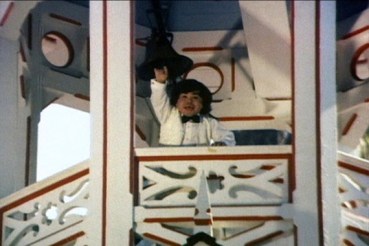
Roarke was known for his white suit and cultured demeanor, and was initially accompanied by an energetic sidekick, Tattoo, played by Hervé Villechaize. Tattoo would run up the main bell tower to ring the bell and shout ‘Ze plane! Ze plane!‘ to announce the arrival of a new set of guests at the beginning of each episode. This line, shown at the beginning of the series’ credits, became an unlikely catchphrase because of Villechaize’s spirited delivery and French accent.”

Besides the mysterious Mr. Roarke and the diminutive Tattoo, the guest stars for the series featured popular actors and actresses of the day.

What I found interesting in researching Fantasy Island was the difference between what I recall when watching the show and the summary I found. Also from the Infallible Wikipedia:

“The nature of a fantasy varied from story to story and were typically very personal to each guest on some level. They could be as harmless as wanting to be reunited with a lost love to something more dangerous like tracking down a cold-blooded killer who murdered someone close to the guest. Usually, the fantasy would take an unexpected turn and proceed down a quite different path than the guest expected. Some resolve in ‘The Monkey’s Paw’ style. He or she would then leave with some new revelation or renewed interest about themselves or someone close to them. Many times, Roarke would reveal in the end that someone they met during the course of their fantasy was another guest living a fantasy of their own. Both guests often left the island together. (snip)

Although some fantasies were rooted in the real world, many others involved supernatural (such as ghosts, demons, or witchcraft) or mythological (mermaids, genies, Greek goddesses) elements. Time travel was often a required element, if not a specific request, to fulfill one’s fantasy.
Tattoo1

Tattoo ringing the bell to announce guests’ arrival

Roarke often preceded particularly risky fantasies with a stern warning, a word of caution, or even a suggestion that the guest select another fantasy instead. He would then inform his guests that he was powerless to stop a fantasy once it had begun and that they must allow the fantasy to play out until its ultimate conclusion. Despite this, on rare occasions, Roarke would appear halfway through a fantasy to offer a guest an opportunity to terminate their fantasy, warning the guest that continuing the fantasy may lead to serious consequences (possibly even death). However, at that point, the guest would decide on their own to see the fantasy to its end, either for selfless reasons (regarding someone they had met during the fantasy) or naivety of what is in store for them. In the most serious cases, however, Roarke would invariably intervene and ensure his guests’ safety.”


fantasy-plane2

The plane bringing the guests

Mostly I recall that Fantasy Island aired on Saturday nights right after the Love Boat. Despite the two memorable main characters and the predictability of the opening scenes, I could not tell you who or what particular plot was featured during the show’s run. It was a surprise to read the summary above as I would have said it was a lighthearted sort of program. Clearly that was not the case.

The series was revived for one season in 1998-99 and a Horror movie based on the characters is set for release on February 14, 2020. Count me out on that one. I don’t do Horror. Ever. The producers must figure there’s a market for it despite the flop of the revival series 20 years ago.

The thing I found most interesting about Fantasy Island was to learn that Ricardo Montalbán  died on January 14, 2009… 32 years to the day after the 1977 premiere. An unbelievable coincidence which seems apropos…

A couple of links:

https://en.wikipedia.org/wiki/Fantasy_Island

https://en.wikipedia.org/wiki/Ricardo_Montalb%C3%A1n

Answers to the FB quiz:

  1. Robin Williams as Mork. Mork and Mindy
  2. Judd Hirsch as Alex Rieger. Taxi
  3. Bill Bixby as Dr. David Banner. The Incredible Hulk
  4. Ricardo Montalban as Mr. Roarke. Fantasy Island (the made for TV movie debuted in 1977, the series in 1978


Looking For Space

New Year’s Eve

December 31, 2019

He was the unlikeliest of stars. From his wire rimmed granny glasses, to his bowl cut hair, and his nasally voice, this introvert took the pop world by storm in the mid 1970’s. Henry John Deutschendorf Jr., however, possessed two qualities which proved to be the essential ingredients necessary for success: he could write songs and he was persistent.
.
John Denver early years.jpgThe world, of course, knew him as John Denver. Born on New Year’s Eve 1943 in Roswell, New Mexico, one can wonder if some other world force was at play when he arrived in this world.
.
His childhood was not an easy one. His father, being a Captain in the Air Force, was moved every two years which prevented Denver from forming strong friendships. Denver, however, found his talent and his solace in the guitar given him on his eleventh birthday from his grandmother. From the Infallible Wikipedia:
.
“He learned to play well enough to perform at local clubs by the time he was in college. He adopted the surname ‘Denver’ after the capital of his favorite state, Colorado. He decided to change his name when Randy Sparks, the founder of The New Christy Minstrels, suggested that ‘Deutschendorf’ would not fit comfortably on a marquee. Denver attended Texas Tech University in Lubbock and sang in a folk-music group called ‘The Alpine Trio’ while pursuing architectural studies. He was also a member of the Delta Tau Delta Fraternity. Denver dropped out of the Texas Tech School of Engineering in 1963 and moved to Los Angeles, where he sang in folk clubs. In 1965, Denver joined the Mitchell Trio, replacing founder Chad Mitchell. After more personnel changes, the trio later became known as ‘Denver, Boise, and Johnson’ (John Denver, David Boise, and Michael Johnson).”
.
In the late 1960’s Denver self produced a number of songs he’d written and gave them out as Christmas presents. Included on this record was one titled Babe I Hate To Go. When Milt Okun, Denver’s producer of his recently released RCA album Rhymes and Reason heard the song, he pitched it to the popular trio of Peter, Paul, and Mary. The song’s title was changed to Leavin’ On A Jet Plane and catapulted to number one on the Billboard Hot 100.
.
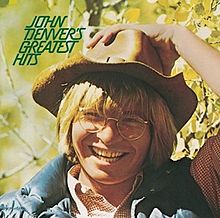
220px-JohnDenversGreatestHitsBut RCA was not actively promoting Denver’s album via a tour, so the persistent Denver took matters into his own hands. Also from the Infallible Wikipedia:
.
“Denver himself embarked on an impromptu supporting tour throughout the Midwest, stopping at towns and cities as the fashion took him, offering to play free concerts at local venues. When he was successful in persuading a school, college, American Legion hall, or local coffee house to let him play, he would spend a day or so distributing posters in the town and could usually be counted upon to show up at the local radio station, guitar in hand, offering himself for an interview. With his foot in the door as author of ‘Leaving on a Jet Plane’, he was often successful in gaining some valuable promotional airtime, usually featuring one or two songs performed live. Some venues would let him play for the ‘door’; others restricted him to selling copies of the album at intermission and after the show. After several months of this constant low-key touring schedule, however, he had sold enough albums to persuade RCA to take a chance on extending his recording contract. He had also built a sizable and solid fan base, many of whom remained loyal throughout his career.”
.
It was his album, Poems, Prayers, and Promises, released in 1971 which sent his career soaring. The single Take Me Home, Country Roads proved popular and peaked at number two on the charts.
.
The highlight of Denver’s career was in 1974 and 1975 with a series of number one hits, solidifying him as a superstar: Sunshine on My Shoulders, Annie’s Song, Thank God I’m a Country Boy, and I’m Sorry. Additionally, he had three number one albums in the same era, starred in a number of TV specials and performed opposite George Burns in the movie Oh, God.
.
In all, Denver wrote hundreds of songs and produced more than 50 albums. Of his 44 released singles, 11 became number one hits.
.
There is  much, much more to his story and I encourage my readers to visit the John Denver website and read the Wikipedia overview. (links below)
.
I had heard Denver’s songs during my early teens but dismissed them as country. It was in 1973, however, that I understood how his songs had impacted the culture. I was over at my best friend Daphne’s house and she walked out of her bedroom carrying his Greatest Hits album and we listened to it together.
.
From then on I was a fan and found in his music a troubadour who captured the emotions of life in his insightful lyrics and memorable tunes.
.
Many of the guys I knew sported wire rimmed glasses and Denver-esque hairdos. I even made a shirt for my boyfriend in the style Denver wore.
.
.
Of all his songs my favorite is Looking For Space. In it, Denver captures some elemental truths about the nature of people and life.
.
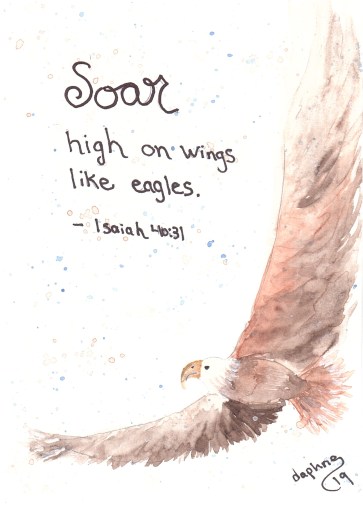
When Daphne, a triplet, unexpectedly lost one of her two brothers in the fall of 2017, it was this song I shared with her in memory of him… and when I lost my Dad earlier this year, she evoked the emotions of that song for me by painting this picture.
Soar on Wings of Eagles
.
As John Denver so poignantly wrote:
.
And to find out who you are
When you’re looking to try and reach the stars
It’s a sweet, sweet, sweet dream
Sometimes I’m almost there
Sometimes I fly like an eagle
But sometimes I’m deep in despair
Sometimes I fly like an eagle, like an eagle
I go flying, flying
.
.
None of us can know the triumphs and trials which await us in the New Year. Live each day to the fullest my friends.

The 100-Year Legacy of the National Christmas Tree

 A 102 Year Tradition

December 24th

2019NCTL_Ceremony.jpg

The 2019 National Christmas Tree

At 3 p.m. on Monday, December 24th, 1923, an American tradition began which continues to this day. That event was the lighting of the first National Christmas tree.

Now, 102 years later, the event occurs earlier in the month – this year on December 4th – as it has since 1954 during a month long event known as the Pageant of Peace. But back to the beginning.

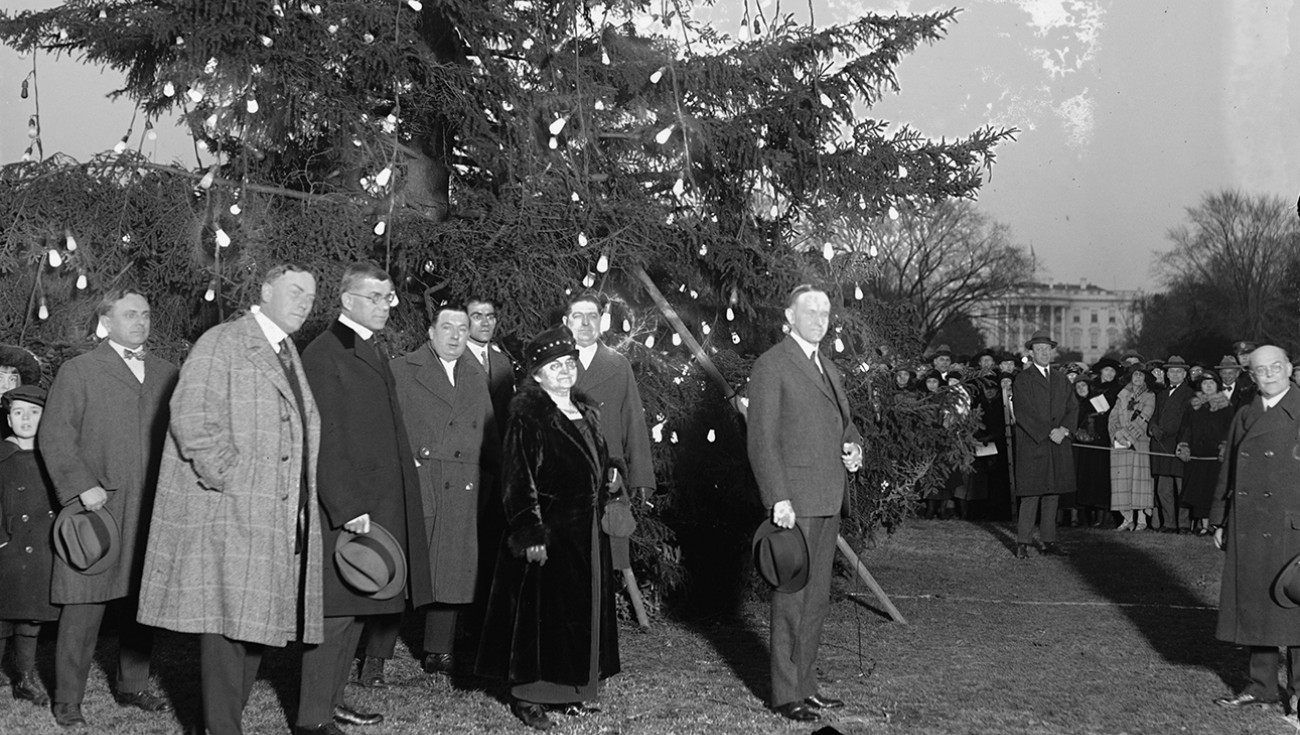
The concept of a National Christmas tree was the idea of Frederick Morris Feiker, an engineer with General Electric. He, along with Vermont US Senator Frank L. Greene, convinced President Calvin Coolidge to light the tree.

Alumni of Middlebury College in Vermont paid for the transport of a 48 foot tall balsam fir to be transported to Washington, D.C. with GE providing 2,500 green, red, and white electric lights.

From the Infallible Wikipedia:

calvin-coolidge-was-the-first-president-to-instate-a-public-christmas-celebration-at-the-white-house-with-the-first-national-chris.jpg

President Calvin Coolidge and dignitaries at the first National Tree Lighting ceremony in 1923

“At 3 p.m. on December 24, 1923, a 100-voice choir from the First Congregational Church assembled on the South Portico of the White House and began a two-hour concert of Christmas carols. At 5 p.m. (dusk) on Christmas Eve, President Coolidge touched a button at the foot of the tree which lit the lights and electric candles adorning the tree, but he did not speak. A searchlight from the nearby Washington Monument was trained on the tree to help illuminate it as well. The Coolidge family invited citizens of the city to sing Christmas carols on the Ellipse after dark. Between 5,000 and 6,000 people thronged the park, joined by 3,000 more people by 9 p.m. The crowds were joined by the Epiphany Church and First Congregational Church choirs, which sang carols, and the Marine Band played Christmas-themed music. The singing ended shortly before midnight. After the white residents of the city had dispersed, African American residents of the city were permitted on the park grounds to see the National Christmas Tree. An outdoor Christian worship service was held, and a mass choir composed of signing groups from area community centers sang more Christmas carols. An illuminated Christian cross was flashed on the Washington Monument, and men dressed as shepherds walked from the National Christmas Tree to the monument.”

300px-US_National_Christmas_Tree_1923The following year Coolidge objected to cutting down a tree for the event so a 35 foot tall live Norway Spruce was located and planted in a new location near the Treasury Building. This tree survived until 1929 when it was determined that the plant had been damaged and needed to be replaced. This began a series of live trees being planted, dying, and being replaced until, in 1934, the last tree was cut down in that location.

In December 1934, the tree and the ceremony were moved to Layfayette park, north of the White House. There it remained for only a few short years before returning to its original site on the Ellipse where it remains to this day. Over the years there have been many, many trees which have served in the role. Additionally, the ceremonies and events associated with it have become quite extensive. If you’d like to read more about its history, here’s the Wikipedia link https://en.wikipedia.org/wiki/National_Christmas_Tree_(United_States) and also the link to the official website https://thenationaltree.org/lighting-ceremony/2019-national-christmas-tree-lighting-ceremony/.

Although I’ve never seen the National Tree, I do love driving around during the Christmas season and viewing all the wonderful outdoor decorations. There is nothing quite so beautiful as a blue spruce or fir tree at night covered with lights AND an inch or two of snow on its branches.

My first memory of such a tree was when I was probably 7 or 8. My bedroom in Yakima faced towards our backyard. Our neighbor, Ray Broten, spent a lot of time keeping his yard beautiful. No matter the season, his was always manicured and trimmed to perfection. That particular December, the spruce tree located in the southwest corner of his backyard cut through the darkness with blue, green, red, and white lights, illuminating my bedroom each night. After I went to bed there was many a time I stole back over to the window and just stood and looked out at his beautiful tree. My favorite nights were when a soft snow was falling, muting the darkness with a blanket of white.

When I got too cold, I’d crawl back in to bed, and as I warmed up and drifted off to sleep, the shine of those lights would bathe the room with a soft glow.

This tradition continued for a number of years until the time I moved away from Yakima. Although those years are long ago, the memory is etched with clarity as Mr. Broten unknowingly created one of my fondest recollections.

May your Christmas also be one of wonderful reminiscences and the creation of new memories. Merry Christmas one and all.

Bob Dylan

Blowin’ In The Wind

December 10, 2019

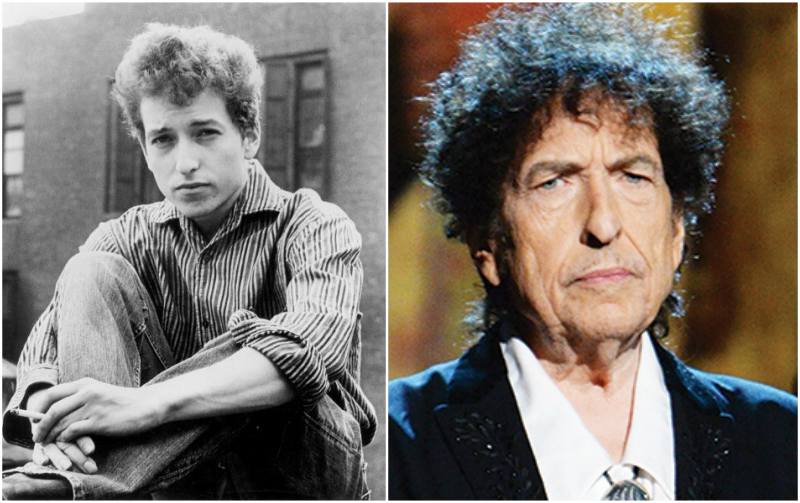
Every year on December 10th, the Nobel Prize winners are announced. This particular winner from 2016 came as quite the surprise. When one thinks of American authors who have been recognized names such as Ernest Hemingway, John Steinbeck, and Pearl S. Buck come to mind.

Bob Dylan, however, was awarded the prize for his “his profound impact on popular music and American culture, marked by lyrical compositions of extraordinary poetic power.”

Bob Dylan

Bob Dylan then and now

As a songwriter, many of his early songs defined a mood and a generation. Blowin’ In The Wind became an anthem for the 1960’s war protest movement. The Times They Are a Changin’ is perhaps his best known song from this volatile era.

In nearly six decades, he’s created an amazing amount of work, not just in music but in other art forms as well. From the Infallible Wikipedia:

“Since 1994, Dylan has published eight books of drawings and paintings, and his work has been exhibited in major art galleries. He has sold more than 100 million records, making him one of the best-selling music artists of all time. He has also received numerous awards, including the Presidential Medal of Freedom, ten Grammy Awards, a Golden Globe Award, and an Academy Award. Dylan has been inducted into the Rock and Roll Hall of Fame, Minnesota Music Hall of Fame, Nashville Songwriters Hall of Fame, and the Songwriters Hall of Fame. The Pulitzer Prize Board in 2008 awarded him a special citation for ‘his profound impact on popular music and American culture, marked by lyrical compositions of extraordinary poetic power.’ In 2016, Dylan was awarded the Nobel Prize in Literature…”

Perhaps no other activity best defines his career as that of what has been dubbed ‘The Never Ending Tour.’ Dylan has performed over 3,000 concerts, often more than 100 a year, since June 1988, Also from the Infallible Wikipedia:

“In 2019, Dylan undertook two tours in Europe. The first commenced in Düsseldorf, Germany, on March 31, and ended in Valencia, Spain, on May 7. He played his 3000th show of the Never Ending Tour on April 19, 2019, in Innsbruck, Austria. Dylan’s second tour began in Bergen, Norway, on June 21, and ended in Kilkenny, Ireland, on July 14. Dylan’s touring company has announced his tour of the USA in the fall of 2019, commencing in Irvine, California on October 11 and ending in Washington D.C. on December 8.

In October 2019, Dylan’s touring company that he would play 14 concerts in Japan in April 2020.

Love him or not, Dylan is most certainly an original, following his own path and vision, always eschewing convention. Despite turning 78 on May 24th, he continues to keep a schedule which most people of a similar age would find impossible.

I must admit, I do not own a single Bob Dylan record/CD. It may have something to do with his distinctive voice.

When my daughter was a young teen she heard Bob Dylan for the first time. Her always expressive face registered surprise at the gravelly nature of it… and not in a positive way.

Of course the Hubby – ever one to capitalize on things which bugged her – did his best Bob Dylan impression, singing “The answer… my friend… is blowin’… in … the  wind.” Be sure to use your best raspy Dylan voice and insert pauses where the ellipses are for best results.

It has since become a running family joke. Mention Bob Dylan and someone is certain to try their hardest to imitate the man.

Here are a couple of links including three of Dylan singing the aforementioned Blowin’ In the Wind at various times in his career. I can only imagine that Dylan who, after all this time, must be sick of performing the song.

https://en.wikipedia.org/wiki/Bob_Dylan

https://en.wikipedia.org/wiki/List_of_Nobel_laureates_in_Literature

Here are a couple more ‘versions’ of Dylan singing Blowin’ In The Wind:

https://youtu.be/ifFZeVQxxEY

https://youtu.be/1k9tqQL6-9A

Nobel prize information dylan.jpg

You Light Up My Life

November 19, 2019

Debby Boone’s One Hit Wonder

You_light_up_my_life_posterOn November 19, 1977, this song was in the middle of a 10 week run as the number one song in America. You Light Up My Life was the one and only Top 40 hit from Debbie Boone, daughter of 50’s teen idol Pat Boone. It reached number one on October 15 and stayed in that position through December 23, making it – at the time – the only recording to stay that long in the top spot in Billboard history.

According to the Infallible Wikipedia:

“Besting her chart performance in Billboard, Boone’s ‘You Light Up My Life’ single topped Record World’s Top 100 Singles Chart for an unbroken record of 13 weeks. On Billboard’s chart, Boone was unseated from #1 by the Bee Gees, with ‘How Deep Is Your Love,’ the first of three #1 singles from the ‘Saturday Night Fever’ soundtrack. On Record World’s chart, Boone kept the Bee Gees out of the number-one spot. In Cash Box Magazine, ‘You Light Up My Life’ managed only an eight-week stay at the top of the chart, before being dethroned by Crystal Gayle’s ‘Don’t It Make My Brown Eyes Blue’.

The single, which was certified Platinum by the Recording Industry Association of America (RIAA), also hit #1 on the Adult Contemporary chart and reached #4 on the Country chart. The single peaked at #48 I’m the UK Singles Chart. Boone’s hit single led to her winning the 1978 Grammy Award for Best New Artist, with additional Grammy nominations for Best Pop Vocal Performance, Female and Record of the Year. Boone also won the 1977 American Music Award for Favorite Pop Single.

Decades after its release, the Debby Boone version is still considered one of the top ten Billboard Hot 100 songs of all time. In 2008, it was ranked at #7 on Billboard’s ’Hot 100 All-Time Top Songs’ list (August 1958 – July 2008). An updated version of the all-time list in 2013 ranked the song at #9.

Although it was written by (Joe) Brooks as a love song, the devout Boone interpreted it as inspirational and proclaimed that it was instead God who ‘lit up her life.’”

The song was tainted by controversy, however, as songwriter Brooks apparently did not want to pay the agreed upon amount owed Kasey Cisyk, the artist who sang it for the movie of the same name, and whose version is included on the 1977 soundtrack.

Boone was told, when recording the song for release as a single, exactly how to sing it and her vocals were dubbed onto the original orchestral track.

At the time, I recall that Boone received much derision and the song was labeled as saccharin. In reading what occurred, however, I feel bad for both the women caught up in the controversy. Perhaps Cisyk was denied her shot at a Top 40 career and, perhaps, Boone was lulled into a sense of inevitability that she would become a star like her father. Although in listening to both versions, I think Boone’s is better.

Boone released additional songs into the pop market, but none ever came close to the success of “You Light Up My Life.” Her career eventually led her back to country music – where she had started – and then to work in the Christian music world.

In the fall of 1977, you simply could not avoid the song. It was played hour after hour on the radio. That autumn was one of the most memorable in my life: I was living away from my parents for the first time, having joined the Alpha Phi sorority at the University of Puget Sound. While I was studying, I don’t think I was studying quite as much as I should have been. Instead, I was attending frat parties every weekend and going on dates! That era in my life was punctuated by music and there were a couple other songs which should have, in my opinion, been number one instead.

These included Billy Joel’s Just The Way You Are – an infinitely better song; Rita Coolidge’s version of We’re All Alone; Carly Simon’s Nobody Does It Better; and Don’t It Make My Brown Eyes Blue by Crystal Gayle. The list of great songs also includes big  hits – but never number ones – from Foreigner, Heart, Fleetwood Mac, Styx, Supertramp, and Steely Dan.

Yes, 1977 was an epic year for music and will, unfortunately, forever be associated with You Light Up My Life.

And in case you’d like to hear the Casey Cisyk version and really get the worm stuck in your head (it’s been in mine since I wrote this!) here’s that video also. Note that you are seeing Didi Conn on screen – she is doing a lip-sync to Cisyk’s vocals. Enjoy!

The links:

https://en.wikipedia.org/wiki/You_Light_Up_My_Life_(song)

https://en.wikipedia.org/wiki/1977_in_music#October

Arches National Park

November 12, 2019

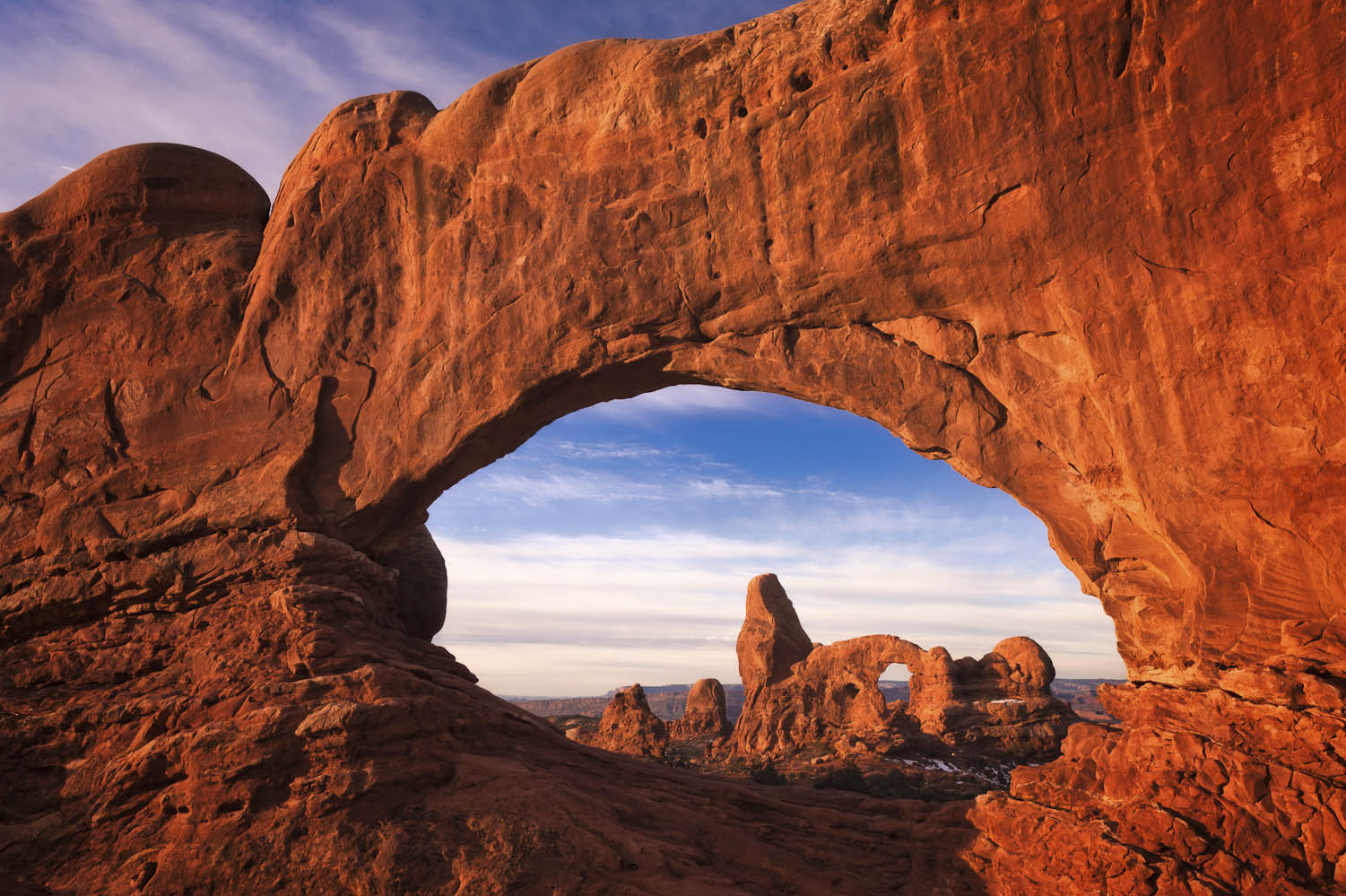
With more than 2000 natural sandstone arches located within, Arches National Park has the highest concentration of these features in the world. Although it had been named a National Monument in 1929, it was on November 12, 1971, when Arches National Park was created.

Windows arches national park.jpg
Situated in eastern Utah, it’s remote location and rugged terrain make getting there a challenge. The Utah park, however, has become a magnet for hikers, climbers, and nature lovers, attracting some 1.6 million visitors in 2018.
According to the Infallible Wikipedia:
“The Arches area was first brought to the attention of the National Park Service by Frank A. Wadleigh, passenger traffic manager of the Denver and Rio Grande Western Railroad. Wadleigh, accompanied by railroad photographer George L. Beam, visited the area in September 1923 at the invitation of Alexander Ringhoffer, a Hungarian-born prospector living in Salt Valley. Ringhoffer had written to the railroad in an effort to interest them in the tourist potential of a scenic area he had discovered the previous year with his two sons and a son-in-law, which he called the Devils Garden (known today as the Klondike Bluffs). Wadleigh was impressed by what Ringhoffer showed him, and suggested to Park Service director Stephen T. Mather that the area be made a national monument.”
Over the years, like so many of our nation’s National Parks, Arches has been loved to the point of fragile features being in danger of destruction. Consequently, there are now bans within the park which make climbing some of the more famous arches illegal.
The hubby and I have had the privilege of visiting Arches twice. The first time was in the summer of 1984. We arrived on a hot July day which was not conducive to outdoor activities. Being young and in decent shape, however, we did exit the car and hiked  in the Windows region of the park.

Balancing rock arches np.jpg

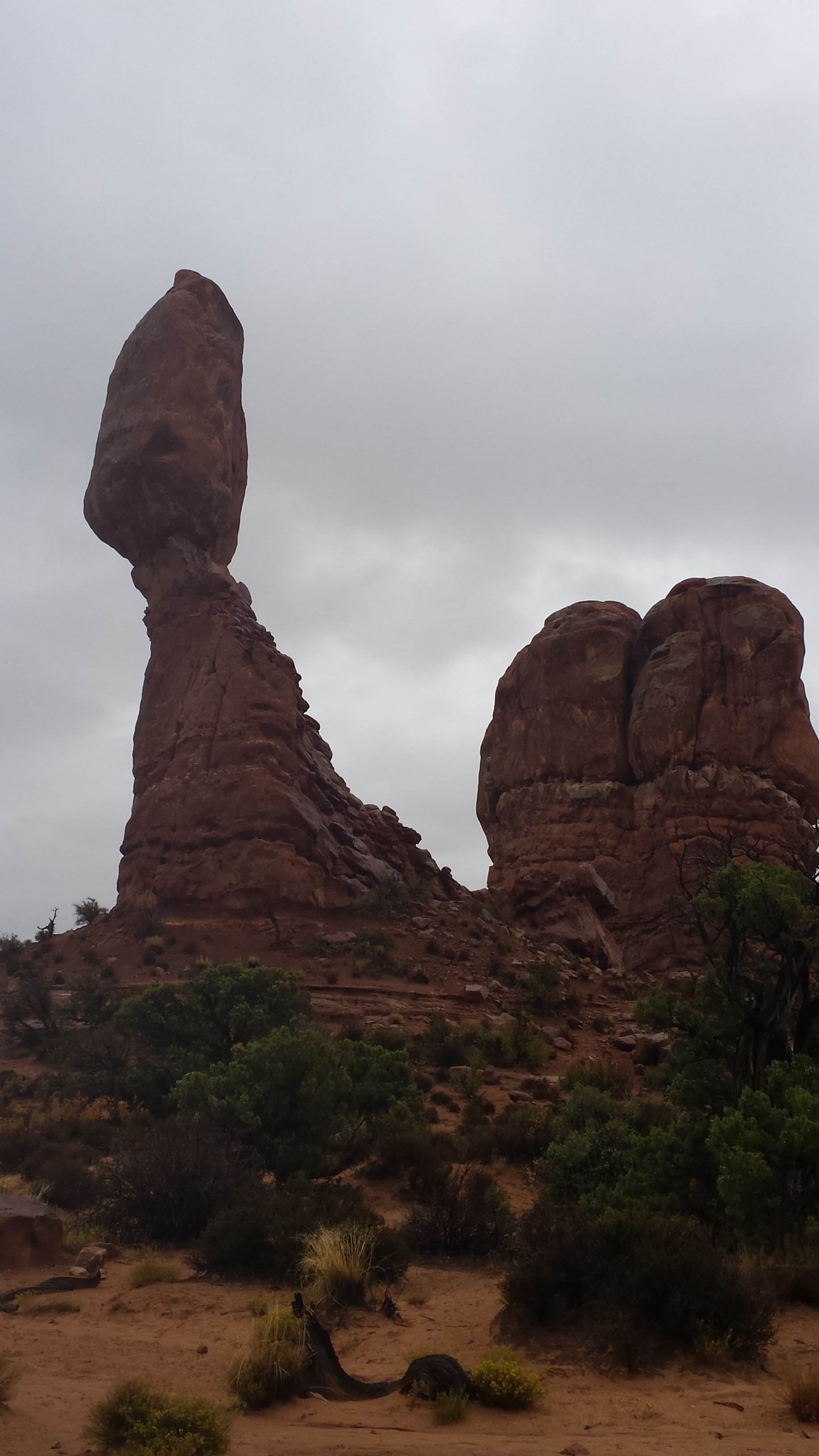
Cold and rainy Thursday October 11, 2018 in Arches NP

The second trip was in October of 2018 along with several hundred of those 1,599,998 other visitors on a rainy – which is rare since the park gets less than 10 inches of precipitation a year – weekday. What struck me about the differences between those two visits is that the park had been ‘discovered’ in the intervening years. On the first trip we saw maybe a half dozen other cars and some 12 tourists.  In 2018, despite the inclement weather and a number of  flooded roads, the place was crawling with people. Finding a place to park the car at some of the stops was a challenge at times.

Our method of touring, 24 years later, has changed. In eighty four, I would cram as many things into our travels as possible, never allowing nearly enough time to pause and marvel at nature’s grandeur. A year ago, our inclinations to be mountain goats now subdued, getting out and hiking for a mile or two wasn’t happening. Instead, rather than the slap and dash tourists of yesteryear, we stopped frequently and walked short paths to where we could stand and simply appreciate the amazing features, listen for birds and insects, and find joy in the moment.
The term ‘Stop and Smell the Roses’ may be cliche, but the idea behind it is solid. Too often we rush to the airport, wait in lines to be crammed into a plane, then fly to a destination where the modern amenities make our lives easy. There’s nothing easy about visiting Arches or many of Utah’s spectacular landscapes… but it is so very worth the trip.

Still Going…

The Energizer Bunny

October 29, 2019

In the world of advertising, this campaign was particularly brilliant. The story begins in 1983 when Duracell featured a dozen stationary, identical light pink bunnies, all battery powered, drumming on snare drums. The announcer intoned that the one with the Duracell battery would last longer. Eventually, all the batteries die with the exception of the one powered by Duracell.

On October 30, 1988, however, a new bunny emerged on the advertising scene and stole the show from Duracell.

energizer-bunnyThe Energizer Bunny was also pink but instead of being one of a crowd which outlasts the others, this rabbit had attitude. It wore hip sunglasses. It was hot pink. It moved around the room on blue flip flop sandals. And it had a big ole bass drum with the word “ENERGIZER” emblazoned across the surface. In short, it had important elements of a great advertising campaign in that it was memorable and humorous. The bunny has appeared in over 100 commercials and has been featured on TV shows and in movies.

From the Infallible Wikipedia:

“Commercials after the first started out with the Bunny leaving the studio it performed the ‘Drumming Bunny’ ad in, then wandering into the sets of a couple of realistic-looking commercials for fictional products, interrupting them. As the campaign progressed, many of these ads were standalone (for fake products such as ‘Sitagin Hemorrhoid Remedy’, ‘Nasotine Sinus Relief’, ‘TresCafe Coffee’, ‘Alarm’ deodorant soap, etc.) and even a few featured celebrities (such as Lyle Alzado promoting a snack called ‘Pigskins’, and Ted Nugent doing an ad for a Mexican food chain called ‘Cucaracha’) only to have the Bunny march through, beating his drum, because he was ‘still going’ (one infamous commercial was for a fake long-distance telephone company with a couple in the United Kingdom talking to their son, who was supposedly in New York and exclaimed that he ‘sounded like he’s right next door’, and when the Bunny came in, he knocked down the divider to show they really were next to each other). Eventually real-life products and icons would do a crossover with the Energizer Bunny (Michael J. Fox doing a Pepsi ad, and the opening of TV shows such as Alfred Hitchcock Presents and ABC’s Wide World of Sports). The Energizer Bunny has appeared in more than 115 television commercials.”

The Energizer Bunny has come to represent something or someone which keeps going and going, seemingly without end.

In late November 2010 I was in Yakima staying to take care of my parents who were in crisis that week. My mom – who had dementia and mobility issues due to a stroke a year earlier – needed round the clock assistance. Between my Dad, a part time caregiver, plus help from both my sister and me, they had been managing okay.

The Tuesday before Thanksgiving, however, Dad collapsed and was discovered by the caregiver. 9-1-1 was summoned and he spent three days in the hospital. A difficult patient, he convinced the doctor to release him earlier than the Doc thought prudent, and arrived home on Friday, November 26th proclaiming he was just fine.

A little after 10 p.m, he went in to take a shower. I heard him calling for help a few minutes later and rushed in to discover him collapsed on the floor. After many struggles I was able to get him up onto the seat of my mother’s walker, but he was slumped to one side. He objected to the thought of calling 9-1-1 (again!) so I called my sister who, along with her husband, came over. Eventually we did call the medics who arrived and discovered his heart was pounding at about 200 BPM and suggested he go to the hospital.

No way was he agreeing to that and kept insisting that the medics just put him to bed. Which they did. Convinced by the EMT’s that he might not survive the night, my sister and I took turns with an all night vigil.

Around 8 a.m., and with Dad still with us, I was up and out in the kitchen contemplating how to deal with two parents in need of assistance. A noise to my left drew my attention. I looked up and here came my dad, using my mom’s smaller aluminum walker, advancing with purpose and determination and seemingly unfazed by all which had happened. That entire day he moved with frenetic energy, straightening things, switching from one thing to another, hardly sitting down all day.

I described the whole thing to my sister this way: “Dad is like the Energizer Bunny.”

For the next nine years, this has been the way we’ve described our dad. There have been countless episodes of the pounding heart which takes him down for a day or two. When he’s recovered, though, watch out! Because it was always back to Energizer Bunny mode.

Eventually, however, even the strongest, most durable batteries run out of energy. And so it was for my father on October 24. His strong heart – in spite of what I am now certain were Tachycardia events – was the battery which kept him going to the age of 96 and a half.

RIP our Energizer Bunny.

The links:

https://en.wikipedia.org/wiki/Energizer_Bunny

https://www.shawandsons.com/obituary/vincent-devore

Won’t You Be My Neighbor

October 15, 2019

Mister Roger’s Neighborhood

“One of the greatest gifts you can give anybody is the gift of your honest self. I also believe that kids can spot a phony a mile away.”

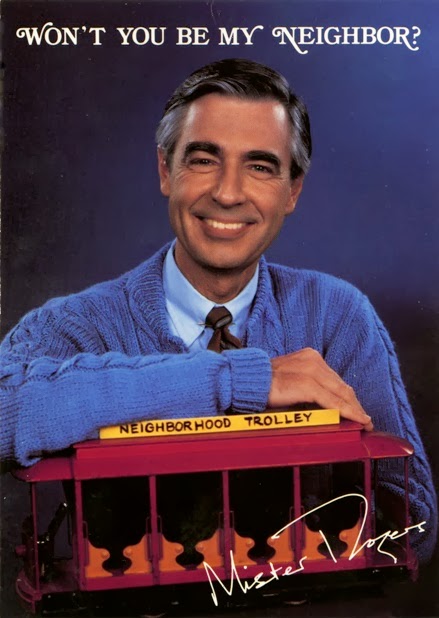
Mr RogersThis philosophy by the late Fred Rogers guided his unlikely career as TV personality and the creator and host of Mister Roger’s Neighborhood (MRN). It premiered on October 15, 1962 as a regional show on CBC Television (out of Toronto, Canada). In 1966 he moved the program to Philadelphia. A year later, with funding from Sears Roebuck, it was nationally syndicated.

Like many such programs of the 1950’s and 60’s, MRN was low tech and low budget. It featured simple puppets which acted out plays with what looked to be handmade cardboard buildings and props. Rogers was always seen entering the front door of his house and many of his scenes – which featured such visitors as delivery man Mr. McFeely and Officer Clemons – take place in a very basic living room.

Rogers, however, ventured out into his ‘neighborhood’ to share with his young viewers interesting things about the world. From the Infallible Wikipedia:

“During each half-hour segment, Rogers speaks directly to the viewer about various issues, taking the viewer on tours of factories, demonstrating experiments, crafts, and music, and interacting with his friends. Rogers also made a point to simply behave naturally on camera rather than acting out a character (snip). The half-hour episodes were punctuated by a puppet segment chronicling occurrences in the Neighborhood of Make-Believe. Another segment of the show consisted of Rogers going to different places around the neighborhood, where he interviews people to talk about their work and other contributions that focused on the episode’s theme, such as Brockett’s Bakery, Bob Trow’s Workshop, and Negri’s Music Shop. In one episode, Rogers took the show behind-the-scenes on the set of The Incredible Hulk, which aired on CBS from 1978 to 1982.

At the start of each episode, the show’s logo appears as the camera pans slowly over a model of the neighborhood, while the ‘Neighborhood Trolley’ crosses several streets from left to right as the text reads ‘Mister Rogers Talks About…’, as the camera goes from the neighborhood to inside the Rogers’ television house. (snip) Fred Rogers is seen coming home with his jacket on, singing ‘Won’t You Be My Neighbor?’ He goes into the closet door by taking off his jacket, and hanging it up, and grabs a cardigan zipper sweater to put on. After that, he takes his dress shoes off, and grabs a pair of blue sneakers to put on. One of Rogers’ sweaters now hangs in the Smithsonian Institution, a testament to the cultural influence of his simple daily ritual.”

The last episode of the show was filmed in December 2000. Fred Rogers died on February 27, 2003.

I was only peripherally aware of Mr. Roger’s Neighborhood since it aired on PBS when I was ten and far beyond the target audience’s age. That all changed, however, when my son was little. At age three, watching MRN became a daily ritual and, I think, greatly impacted him. It was one of the few programs on TV which had his rapt attention. Mostly, my child would turn the thing off if given a chance. But not that show.

One morning I was busy with my infant daughter and happened to walk into our family room during MRN. There my son, still in his pajamas, sat on the floor in front of the TV and he was ‘talking’ to Mr. Rogers. Of course that was how the show was designed. Fred Rogers would look directly at the screen and often ask questions of his viewers as to their feelings. My son was answering every one. To him, Mr. Rogers was a friend and as real as any other person in his life.

I greatly admire Fred Rogers and how he followed his own vision and path and I try to live by his mantra by being my ‘honest self’ as it’s one of the best gifts anyone can give to another person.

You can read much more here:

https://en.wikipedia.org/wiki/Mister_Rogers%27_Neighborhood

Close Encounters of the Cervidae Kind

October 8, 2019

Public Service Announcement

20180718_090456 (2)

Soon after we moved to our new home one of the neighbors stopped by to welcome us

This week’s blog is really more of a public service announcement (PSA). Each year when I turn the calendar to October I know it is time once again to think about the very scary…. Cervidae. Or, as most people know the species, deer.

With approximately 21 million deer living in the United States, it should surprise no one that conflicts between people and deer will arise. Back to that in a moment. But first a little information on the Mule deer species, the most common cervidae in the Pacific Northwest, as told by the Infallible Wikipedia:

“Deer are browsers. During the winter and early spring, they feed on Douglas fir, western red cedar, red huckleberry, salal, deer fern, and lichens growing on trees. Late spring to fall, they consume grasses, blackberries, apples, fireweed, pearly everlasting, forbs, salmonberry, salal, and maple. The mating or ‘rutting’ season occurs during November and early December. Bucks can be observed running back and forth across the roads in the pursuit of does. After the rut, the bucks tend to hide and rest, often nursing wounds. They suffer broken antlers, and have lost weight. They drop their antlers between January and March. Antlers on the forest floor provide a source of calcium and other nutrients to other forest inhabitants. Bucks regrow their antlers beginning in April through to August.

The gestation period for does is 6–7 months, with fawns being born in late May and into June. Twins are the rule, although young does often have only single fawns. Triplets can also occur. Fawns weigh 2.7 to 4 kg (6.0 to 8.8 lb) and have no scent for the first week or so. This enables the mother to leave the fawn hidden while she goes off to browse and replenish her body after giving birth. She must also eat enough to produce enough milk to feed her fawns. Although does are excellent mothers, fawn mortality rate is 45 to 70%. Does are very protective of their young and humans are viewed as predators.

Deer communicate with the aid of scent and pheromones from several glands located on the lower legs. The metatarsal (outside of lower leg) produces an alarm scent, the tarsal (inside of hock) serves for mutual recognition and the interdigital (between the toes) leave a scent trail when deer travel. Deer have excellent sight and smell. Their large ears can move independently of each other and pick up any unusual sounds that may signal danger.

At dawn, dusk, and moonlit nights, deer are seen browsing on the roadside. Wooded areas with forests on both sides of the road and open, grassy areas, i.e. golf courses, attract deer. Caution when driving is prudent because often as one deer crosses, another one or two follow.”

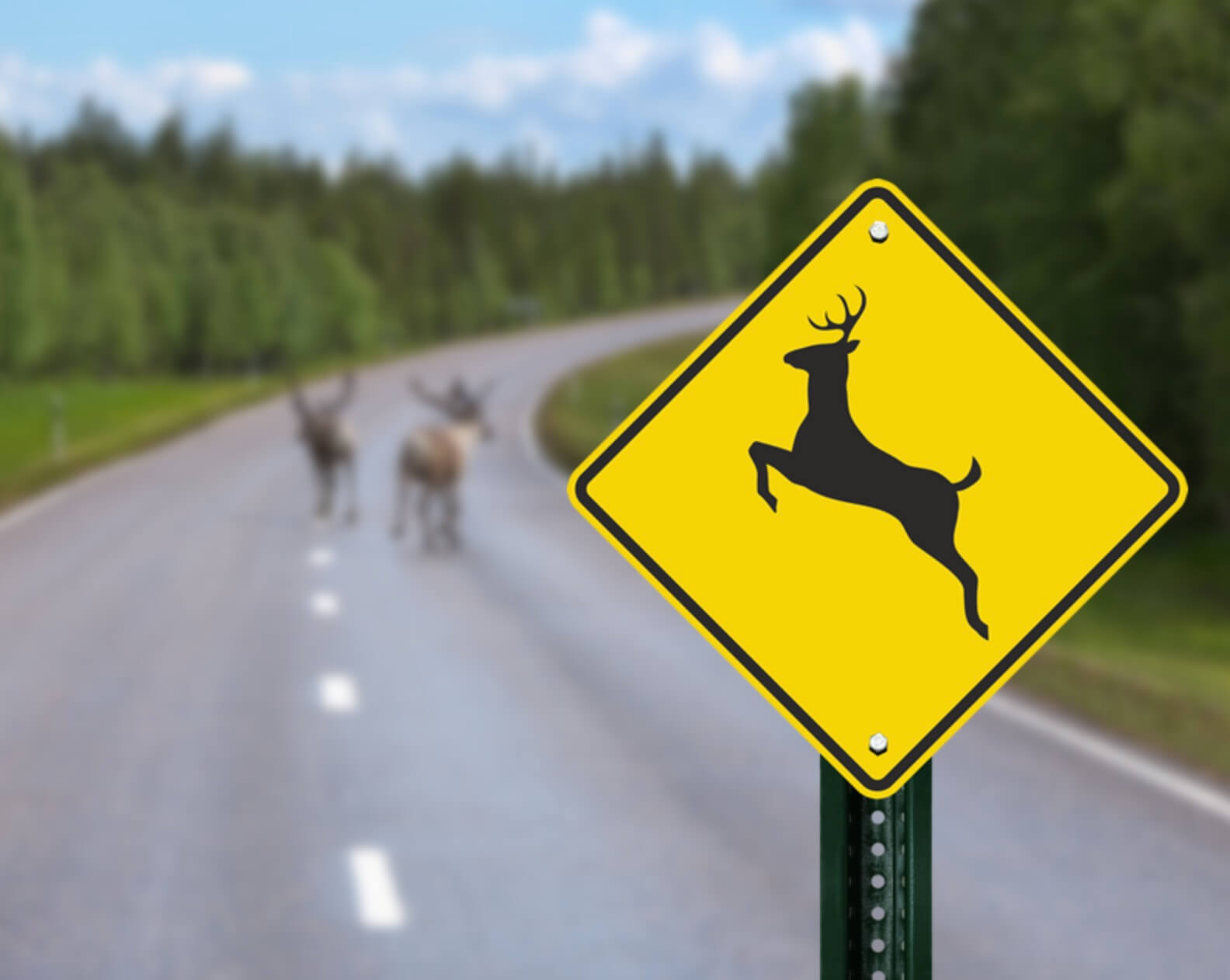
DEERThe last line brings me back to the PSA. From October through December you are much more likely to see deer near or on the road and are much more likely to hit one with your car. The reasons are likely due to mating season and to the need for the animals to forage farther and farther for food to sustain them through the winter.

At the ripe old age of 22 I learned the hard way a universal truth about deer. Driving home from Tacoma to Eatonville one early October night in my trusty Ford Pinto, a deer ran out in front of me. I braked and missed the animal… then made a classic mistake. I put my foot on the gas and sped up. Yep. I hit the second deer.

Over the years I’ve encountered many deer on the roads and have been known to freak out a bit when driving, especially at dusk. I’m constantly watching the sides of the highway looking for the critters.

My concern is justified. I hit my second deer one morning in spring while on my way to work. Yes, I’m paranoid.

My most illustrative encounter occurred in late September while driving a group of teenage girls to a weekend camp out on Hood Canal. It was a Friday and by the time we stopped for fast food and then wove our way through the Seattle metro traffic, it was dark.

As we made our way along State Highway 106 and approached Twanoh State Park, the young woman who was riding shotgun asked why I was driving so slow.

“I’m looking for deer,” I replied, then continued, “They are active this time of year and day.”

I then proceeded to tell her about my two deer related accidents and issued the following warning:

deer on road.jpg“So if you are ever driving and a deer jumps out in front of you, STOP, because they always travel in pairs.”

“Always?” she questioned.

“Pretty much always,” I replied.

And then, not three minutes later, it happened.

From my left a deer bounded across the road in front of the van. I hit the brakes and stopped. A moment later the second deer crossed exactly where the car would have been had I not stopped.

“How did you do that?” she asked, a look of awe on her face in the low glow of the dashboard lights.

“It’s my deer karma,” I replied.

Yes, deer karma is a thing. I have another friend who is certain that I attract the critters. On a different road trip a few years earlier I was a passenger going from Moscow, Idaho, to Seattle one night. It was late June and we had been talking about my deer encounters. This poor woman was panicked, worried about ‘when’ (not if!) some random buck or doe would pop up in front of us. For 240 miles everything was fine and I kept saying that I was not capable of conjuring up random deer… that was until the very top of Snoqualmie Pass. As she drove around the last sweeping curve there, right in the middle of Interstate 90, was a deer. Just standing there in the center lane.

“I knew it! I knew it!” she exclaimed. “It’s you. They’re your totem animal.”

As for me I had no explanation. I’d never before seen a deer standing in the middle of Snoqualmie Pass and never have again. Yet, there the deer was, confirming to her that I attracted the animals.

Personally, I think it would be much easier to have a dog, a cat, or a chipmunk, for my totem animal. Or a sloth. A sloth would be nice as it would never jump out in front of me while driving.

The links:

https://en.wikipedia.org/wiki/Black-tailed_deer

https://www.simplemost.com/10-states-youre-likely-hit-deer-avoid-collision/

My Wawona

Yosemite National Park

October 1, 2019

El Capitan
El Capitan

October 1, 1890 marked the official inclusion of this region into the newly formed National Park System. Long before that, however, the Yosemite Valley had inspired the natives who resided in the area as well as the early white settlers.

It was, contrary to popular belief, James Mason Hutchings and artist Thomas Ayres who were the first Americans to tour the area in 1855.

From the Infallible Wikipedia:

“Hutchings and Ayres were responsible for much of the earliest publicity about Yosemite, writing articles and special magazine issues about the Valley. Ayres’ style in art was highly detailed with exaggerated angularity. His works and written accounts were distributed nationally, and an art exhibition of his drawings was held in New York City. Hutchings’ publicity efforts between 1855 and 1860 led to an increase in tourism to Yosemite.”

Although the greater Yosemite area had been set aside by Congress in 1864, the Valley and Mariposa Grove were ceded to California to manage as a state park. The two areas had seen an influx of homesteaders and were being rapidly commercialized as well as being used for the grazing of sheep and cattle; the old growth sequoias were being logged.

Most people associate the founding of Yosemite with early environmentalist John Muir. Rightly, he is credited with not only pushing for park expansion but also  lobbied for the federal government to take back the iconic valley and grove.

Also from the Infallible Wikipedia:

“It was because of Muir that many National Parks were left untouched, such as Yosemite Vally National Park. One of the most significant camping trips Muir took was in 1903 with then president Theodore Roosevelt. This trip persuaded Roosevelt to return ‘Yosemite Valley and Mariposa Grove to federal protection as part of Yosemite National Park.'”

The years long efforts paid off when, in 1906, Roosevelt signed a bill which stripped the two areas still managed by California from the state and they were returned to the federal government which finally created a unified Yosemite National Park.

half dome.jpg
Half Dome

One trip to Yosemite is all it takes for a person to understand the granduer and how special a place it is. From towering El Capitan, to the massive Half Dome, or the fascinating Tuolome Meadows, Yosemite is a visual feast.

And the hubby and I wondered, when we visited in September 2015, how come it had taken us so long to get there. We arrived on the day after Labor Day which was a good thing as the summer crowds were gone. Reservations are generally required months – if not a year – in advance for the various hotels. I figured we were out of luck but checked anyway as we drove south a few days before our planned stay. What a surprise! There were rooms available at the Wawona Hotel or space in ‘dry’ tents. We opted for the hotel.

It was only after we arrived at the park that it dawned on me that the Wawona Hotel was nowhere near the Yosemite Valley. That day had turned into a driving ordeal. My hubby suffers from vertigo. Being close to any ledge can trigger a sensation of spinning as well as nausea. Knowing this, it was my duty to do the driving so that he could close his eyes as needed when navigating cliff-side roads.

Up, up, up we traveled from the eastern side of the park to the 9,943 foot high Tioga Pass – the highest mountain pass in California. Come to find out, THAT was the easiest road. From there we wound our way through Yosemite’s high country. Then we had to go down. From Tuolome Meadows – elevation 8,619 feet – to the Valley floor was a 4,619 foot descent. And all of it seemed to be a series of endless switchbacks and curvy roads carved in to the sides of mountains.

It was with a sense of relief we reached the bottom when it hit me… Wawona was another 30 miles which we had to add to the 230 we’d already traveled that day. No rest for the driver as the road climbed back up the other side through yet another series of switchbacks,cliffs, and amazing vistas.

Now close to sunset, we found the hotel and were charmed at the thought of staying in a 1870’s structure.

Wawona-Hotel-patios
Adirondack chairs on the veranda

Our room was in the more recently added section… built at the turn of the last century. Located at the far western end of the first floor, the room opened out on to a wide veranda adorned with honeysuckle.

But that’s where the charm ended. The room itself featured a double bed and a twin bed. There was a sink attached to the wall next to the twin bed with a door in the wall next to it. The door, however, was locked.

The room was completed with a small square closet, small dresser and a table and chair. No TV and no phone. But we were up for the adventure and the price – less than $70 a night – was a steal even with having to use the bathroom down the stairs.

As we went to bed that night we could hear, through the thin walls, talking in the room next door; two men were conversing in German. We laughingly dubbed them Hans and Fritz and, although the hubby had taken German in high school, were unable to decipher their conversation.

Our feast…

The next day, after breakfast in the hotel dining room, we headed out for a full day of touring. That evening we bought deli meats, fruits, crackers, and a bottle of wine which we ate and drank while sitting in the Adirondack chairs outside our room on the veranda. A pink and purple sunset was the perfect icing on a wonderful day.

Despite the older beds and somewhat rustic accommodations we slept well… that was until about 7:30 the next morning when our German neighbors’ talking awoke us. It was then we discovered where the locked door next to the sink led. When the hotel was built, the rooms all shared Jack and Jill bathrooms. To accommodate a more modern customer the bathrooms had been designated as a private bath for one of the rooms only, and the door to the adjacent room was locked.

We had the room without a private bath. Our German neighbors, Hans and Fritz, had the bathroom. Did I mention that the walls were paper-thin and not insulated?

Soon, some rather unfortunate sounds penetrated into our hearing range. We dressed as quickly as we could and headed to breakfast… and decided that the Germans would hereafter be known as Fritz… and a scatological term which rhymes with Fritz.

Of course the thing one most recalls about any trip are the occurrences which are out of the ordinary. Our stay at the Wawona turned out to be the most memorable part. And we wouldn’t change a thing.

Wawona hotel barb
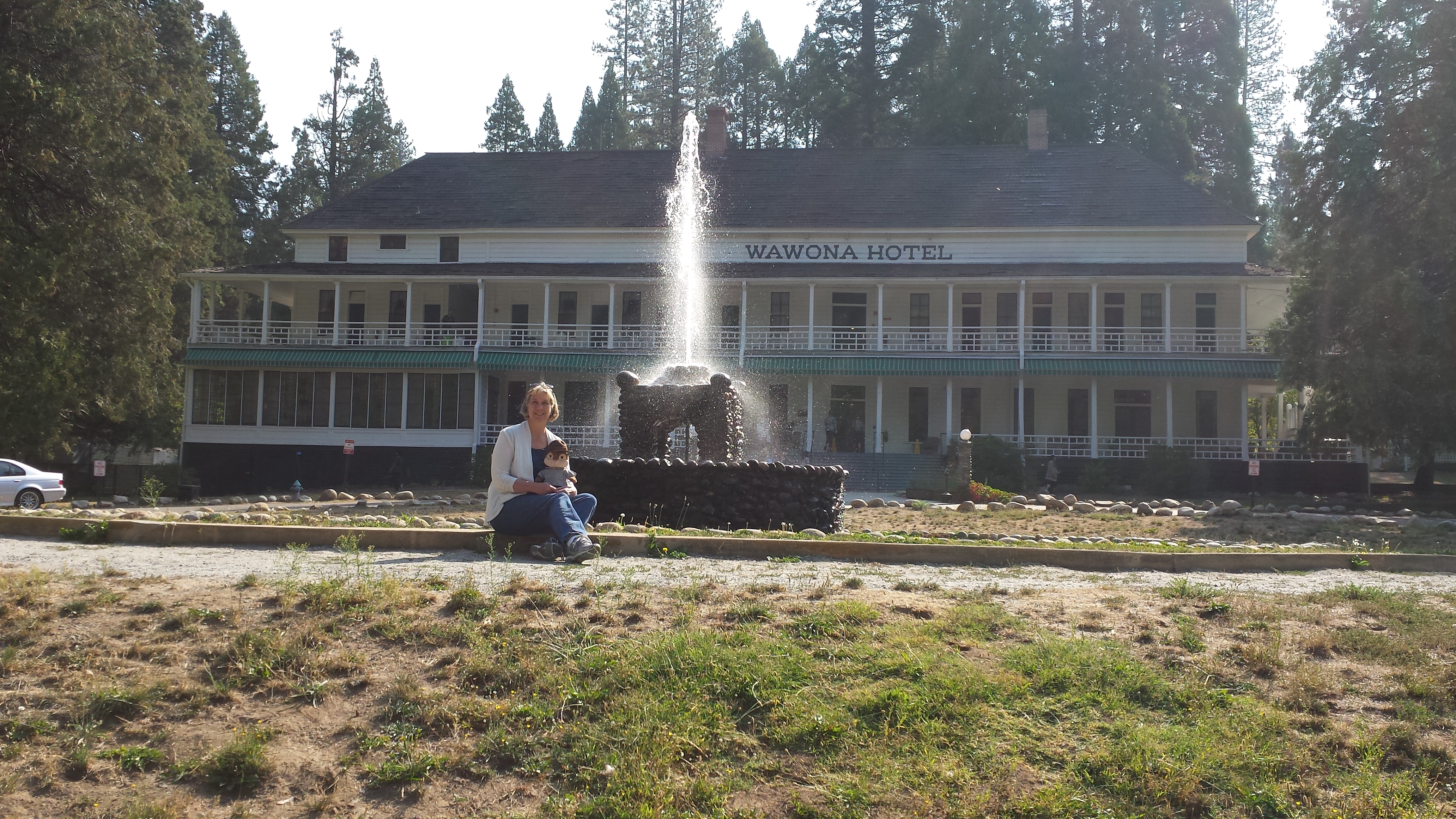
The author and traveling companion Alvin the Chipmunk (in his National Park Ranger gear) in front of the ‘old’ section of the Wawona Hotel

A couple of websites to visit:
https://en.wikipedia.org/wiki/Yosemite_National_Park
https://en.wikipedia.org/wiki/Wawona_Hotel
For those who want to see the Wawona Hotel’s claim to fame, be sure to check out the movie 36 Hours.
https://en.wikipedia.org/wiki/36_Hours_(1965_film)

Alvin
Alvin – our traveling companion