Archives

The Iconic Impact of The Sound of Music

My dream of being on stage started with this musical

May 4th

The 1965 promotional poster

A Tuesday Newsday Classic

When this film was released in the spring of 1965, I wonder if its creators ever dreamed of the incredible impact it would have on the world.

The Sound of Music was the number one film of that year and spent 29 of 52 weeks at the top of the box office lists; its popularity continued into 1966. In all, it was in the premier slot for a total of 40 weeks and became the highest grossing film of all time – a distinction it held for five years.

Frankly, one would have to have lived in a technology devoid place for their entire life to never have heard of the film.

It began life as a Broadway Musical in 1959 before it was adapted for the silver screen. The story was based on an autobiographical book by Maria Von Trapp who, along with her family, escaped Austria just as WWII was about to begin. The Infallible Wikipedia tells us:

“Based on the 1949 memoir The Story of the Trapp Family Singers by Maria von Trapp, the film is about a young Austrian postulant in Salzburg, Austria, in 1938 who is sent to the villa of a retired naval officer and widower to be governess to his seven children. After bringing love and music into the lives of the family, she marries the officer and, together with the children, finds a way to survive the loss of their homeland to the Nazis.”

The movie is first and foremost a love story

What sets the movie apart is a combination of elements. The story line has so many great themes: two different love stories. Maria and the Captain, of course, but also 16 year old Lisle and the confused Nazi youth, Rolf. There are gut-wrenching decisions to be made as the Von Trapp’s plot their escape from their beloved Austria, forced to give up everything rather than sacrifice their values. But most of all it’s the Rogers and Hammerstein score which has resonated through the years.

The opening scene alone, with the larger than life song Sound of Music being belted out by the heroine Maria on the Austrian mountaintop, pulls the audience in. From there, the music truly tells the story. Maria is a problem to be solved; one must ‘Climb Every Mountain,’ and face life’s difficulties in ‘I Have Confidence.’

The toe tapping tunes continue on: My Favorite Things, Do-Re-Mi, and Sixteen Going on Seventeen.  And so many more.

The movie won multiple awards. Also from the Infallible Wikipedia:

The Sound of Music received five Academy Awards, including Best Picture and Best Director, Wise’s second pair of both awards, the first being from the 1961 film West Side Story. The film also received two Golden Globe Awards, for Best Motion Picture and Best Actress, the Directors Guild of America Award for Outstanding Directorial Achievement, and the Writers Guild of America Award for Best Written American Musical. In 1998, the American Film Institute (AFI) listed The Sound of Music as the fifty-fifth greatest American movie of all time, and the fourth greatest movie musical. In 2001, the United States Library of Congress selected the film for preservation in the National Film Registry, finding it “culturally, historically, or aesthetically significant”.

For Americans in 1965, life was quite different than today. Most of the families I knew rarely went out to eat in a restaurant or to the movies. Going to see The Sound of Music at the Capitol Theatre in Yakima was such a treat and likely only the third film I’d ever seen in a theatre; the first two being Mary Poppins and My Fair Lady from the year before.

Brigitta, played by Angela Cartwright, was always reading

In the mid-sixties, women and girls still wore dresses everywhere. Such was the case for when I saw the Sound of Music. I have a distinct memory of wearing a pink dress and, likely my saddle shoes. I was hooked from the first moment.

Soon after seeing the movie, the album arrived in our house and was played over and over – to the point, no doubt, where it developed skips and that crackling sound that comes from a worn out record.

My sister and I acted out the Sound of Music in our bedroom or in the backyard with the neighbor kids. We took on the various roles. I always wanted to be Lisle but the character of Brigitta, her nose always in a book, was more accurate.

The year I was 10 I learned that the local Warehouse theatre group was going to produce the stage version of the Sound of Music. I got a wild hair that I needed to try out and get the role of Brigitta. But when I asked my Mom, it was a resounding ‘you don’t want to do that.’ Which when translated meant that SHE didn’t want me to do that.

I was crushed that I wasn’t going to be able to live out my dream of being on stage in the Sound of Music. A girl I knew from school got the role of Brigitta. I don’t believe we ever went to the production.

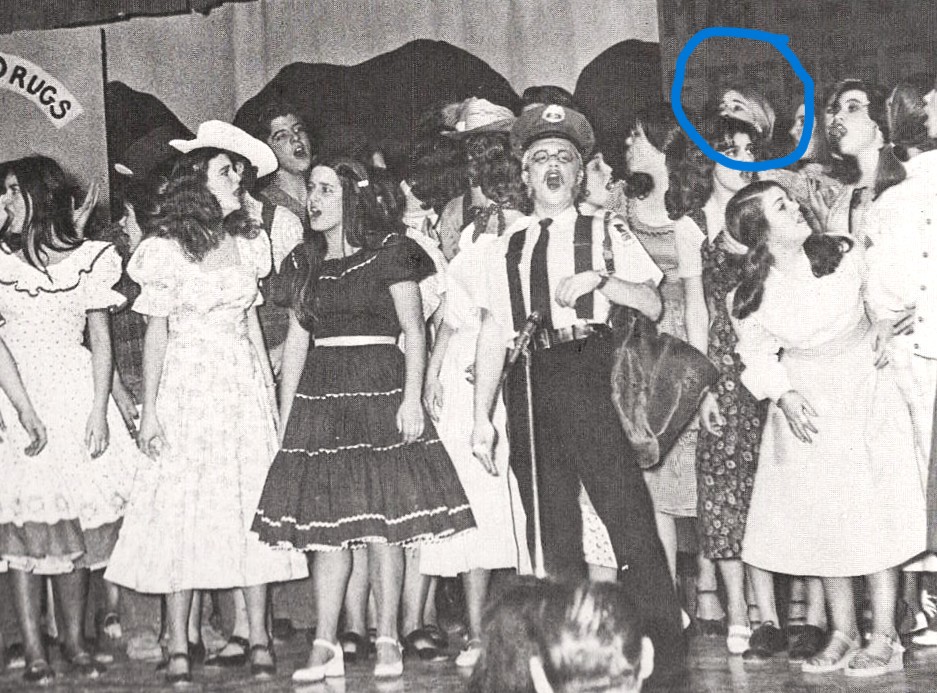
Relegated to the back in “The Most Happy Fella” I did managed to get my head above the crowd enough to see the audience.

Eventually, I did get to be on stage in two musicals while in high school, which I wrote about here: https://barbaradevore.com/?s=anything+goes

But even the disappointment of not getting to be in the local theatre production at age 10 did not deter me from my love of the Sound of Music. When they first started broadcasting the film on commercial TV I made sure to watch it every year. This was followed with owning the VHS version and, ultimately, on DVD.

Sing Along Night poster for the Lincoln Theatre

Up until the Covid-19 Pandemic shut down large gatherings, the Lincoln Theatre in Mount Vernon would host an annual Sound of Music viewing and singalong, encouraging attendees to dress as characters from the movie.

I haven’t yet made that event, but it’s on my bucket list. For the record, I no longer identify with Brigitta or Lisle, but to join all the other wannabe Maria’s out there would be the best.

A couple of links:

https://en.wikipedia.org/wiki/The_Sound_of_Music_(film)

https://en.wikipedia.org/wiki/List_of_1965_box_office_number-one_films_in_the_United_States

Kittenmania: the year we were taken over by cats

The Baker’s Dozen

April 13th

A Tuesday Newsday Classic from 2021

One of the things I look forward to each week is getting ‘show prep’ from my favorite Disc Jockey who also happens to be my brother. He sends interesting and humorous facts and events in advance of each Tuesday, providing me fun ideas for the particular date I need.

This week he shared the following for today, April 13, 2021. He writes:

“1969: An Australian Siamese cat named Blue Danielle had 13 kittens. It’s no longer a record, but it deserves honorable mention. The purring alone must have driven everyone crazy.”

Which got me wondering, what WAS the largest litter of kittens ever born?

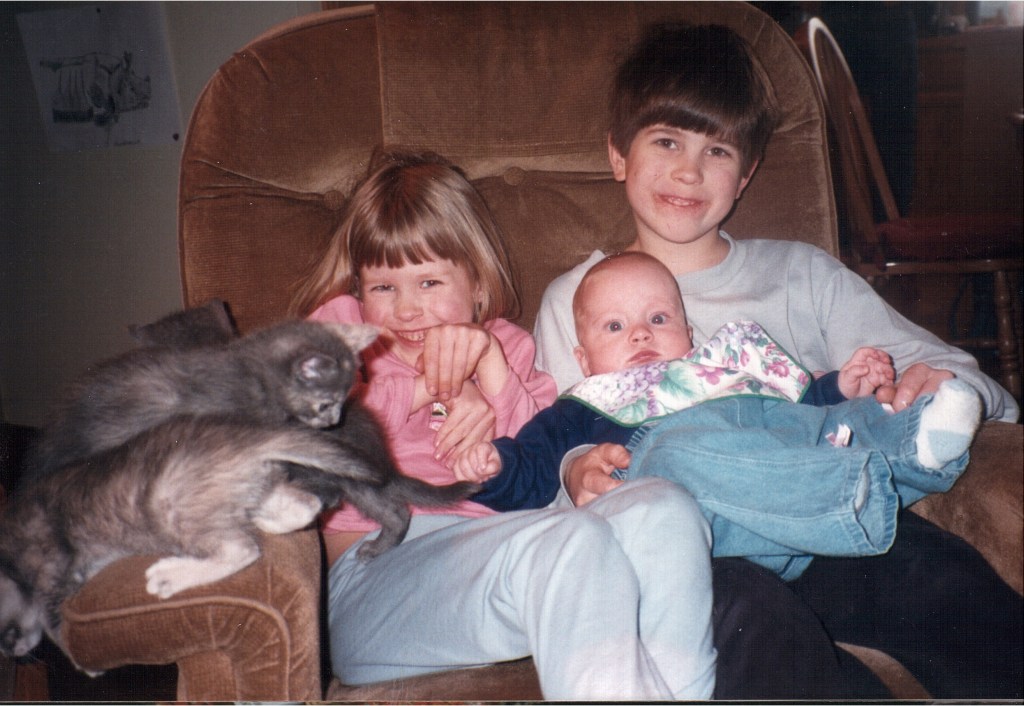
When you really, really love kittens. Son and daughter with kittens Winky and Peop in 1999.

The record was set the very next year when a four year old Burmese cat named Taragone Antigone produced 19 kittens. Unfortunately, only 15 survived (14 males, one  female). I gleaned this information from a website called The Nest which also stated “Clementine, a mixed domestic shorthair gave birth to 15 (11 survived) in New York in 1976, and that same year a Siamese named Tikatoo had a litter of 15 in Canada.” (see link below)

The Infallible Wikipedia does not list the information on the largest litters, but helpfully details the, ahem, mating habits of felines. Perhaps the most interesting fact in that regard is this:

“Because ovulation is not always triggered by a single mating, females may not be impregnated by the first male with which they mate. Furthermore, cats are super fecund that is, a female may mate with more than one male when she is in heat, with the result that different kittens in a litter may have different fathers.”

Another interesting aspect is that cats are known to give birth to as many as three litters a year. With litters averaging from 3 to 9 kittens, it doesn’t take long to be overrun by cats. I should know.

My family’s kitten adventures began in December 1998 when our one and half year old cat, Purr, went into heat. It was a conscious decision on my part to let the cat do this as I knew that having a batch of kittens was highly desired, especially by my then 5 year old daughter.

As Purr’s big day approached, the excitement in the house grew. Then, one morning late in February 1999, the process began. Much to my daughter’s delight, she got to witness the birth event and immediately bonded with all four of the kittens.

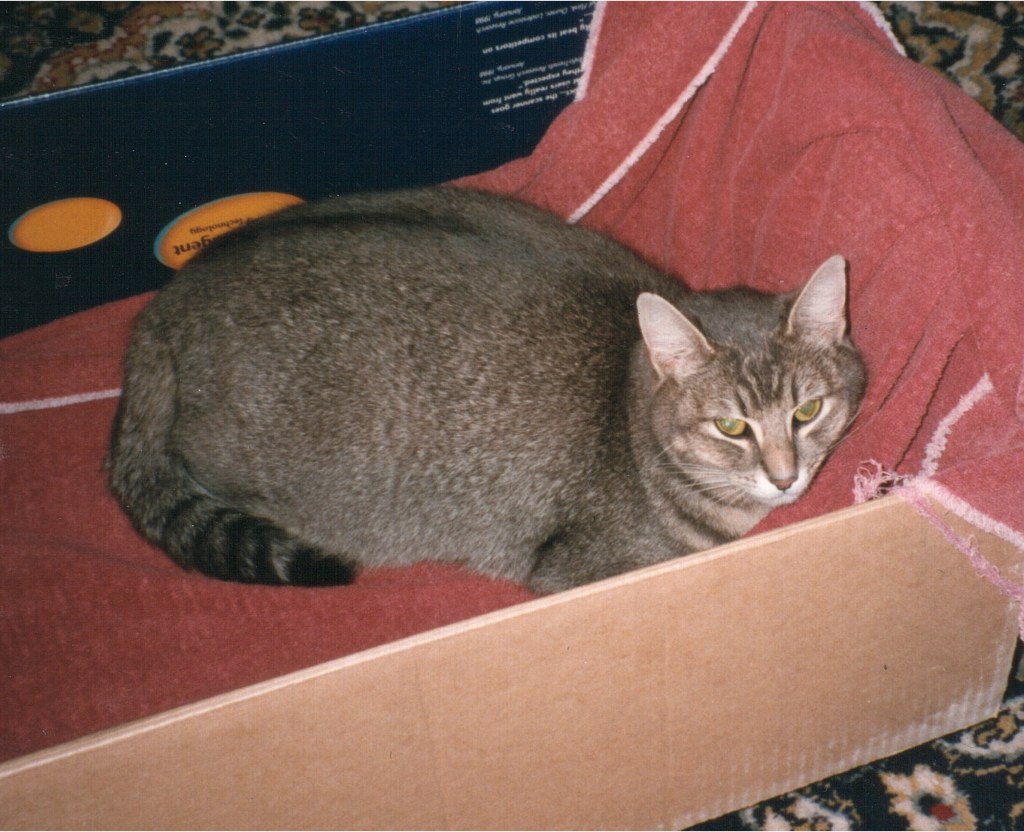
Purr in the ‘nest’ my daughter prepared for her. The kittens were born shortly after.

It didn’t take long for each cat’s personality to shine through and the four were named: Kinky – the lone male – named for the crook in his tail; Winky – who had one eye which blinked independent of the other; Phantom – who had a half dark, half light face; and, finally, People Cat – so named because of her propensity to climb out of the box and love on whatever person was there.

Kittenmania took over. The cats lived in our large laundry room, kept inside by a baby gate once they started roaming. But soon they were all over the house and, especially, upstairs in the playroom or the kids’ rooms.

Since keeping five cats was not an option, at five weeks I’d moved fully into ‘find them a home’ mode but not before promising that we would keep ‘one’ of the kittens. My targets for people to adopt them were classmates of the kids and soon Winky left to be loved by a third grade girl and her family.

Phantom, it turned out, was not the right cat for us. She was afraid of everything: loud noises, sudden movement, and the other cats. Sudden incontinence was the response to these factors, so she needed a calm environment with an understanding owner. Her salvation was the veterinary assistant.

It looked as though Kinky would be our cat as my son’s teacher, Mrs. B., was all set to adopt Peop (as we had started calling her). But when Mrs. B’s husband objected, the adoption was off. I was secretly glad as Peop had become my personal assistant, supervising whenever I worked at my desk, and I wanted to keep her.

So our little family of three cats was set. Or so I thought.

One day in early April I had an appointment to have Mama Purr spayed. Then the unthinkable happened. She escaped the house and was gone for 24 hours. The last time that happened…

Purr looking beautiful and irresistible to the eligible bachelors

Yep. She was pregnant once again.

Purr got bigger and bigger and soon we were anxiously awaiting the new arrivals. She rejected Peop and Kinky (something which was true for the rest of her days) who moved upstairs to hang with the family and Purr stayed downstairs as she began the process of nesting once again.

Unfortunately, I had an out of town conference which took me away at the critical moment. With Grandma and Grandpa there to watch the kids we were all set.

Then on day two of the conference, a flurry of emails from my nine year old son announced the kittens’ arrival.

Peop helping the author with editing.

“Mom,” the first email proclaimed, “Purr has four kittens!”

I noticed a string of emails from him and clicked open the second, then the third, fourth and fifth emails.

“Now there are five!”

“Mom – there are six kittens!”

“Now there are seven!”

My stomach dropped as I counted three more emails in the thread. How many kittens did Purr just have? What were we going to do with all those kittens?!

I open the next email.

“Purr has eight kittens!” the email happily proclaimed.

It took every ounce of courage to open the next one.

“That’s all.”

I let out a shudder. While eight would be hard to manage I was thankful it had ended there.

Kinky wanted to be king of the household but Purr never let him usurp her throne.

When I arrived home the next day I found a moving mass of cats in the laundry room. Purr looked oh so pleased with herself.

Soon the reality of having ELEVEN cats in the house took over. The litter box for Mama and babies required cleaning every two hours. I took old vinyl tablecloths and turned them upside down in the laundry room to keep the carpet (who puts carpet in a laundry room? Asking for a friend) from getting urine soaked. Our house smelled like a cattery. Probably because it was.

When our niece came to visit, the kids ‘introduced’ her to the new kittens – three of which are shown here. I think our niece looks a bit concerned.

That summer all we did was manage cats and eventually were able to find homes for the crew, much to Purr’s dismay. And Purr? That randy lady did make it to the vet (as did Peop and Kinky) so that future, possibly record breaking, litters of kittens would not happen.

But had I known then that the record was 19 I totally think Purr could have broken it. Then she would have been famous and I would have had a nervous breakdown. It probably worked out for the best.

A couple of links:

https://en.wikipedia.org/wiki/Cat

https://pets.thenest.com/record-number-kittens-born-one-litter-8346.html

Discovering Dad’s Mustang: A Heartfelt Reunion

EEE 161 Rides Again

March 9th

A Tuesday Newsday Classic

It was on March 9, 1964 when the first Mustang automobile rolled off the assembly line at Ford Motor company’s Dearborn, Michigan plant. Today, the Mustang continues as one of the best selling and most popular cars ever produced by Ford.

For those who have been reading my blog for several years, you may recall that three years ago I posted about the 1965 Mustang here: https://barbaradevore.com/2018/04/17/1965-ford-mustang/

Today’s Tuesday Newsday is going to be a bit of a departure, as I have nothing particularly new from the Infallible Wikipedia to share on this topic. You can, of course, go there and read up on everything you might hope to learn about the Mustang.

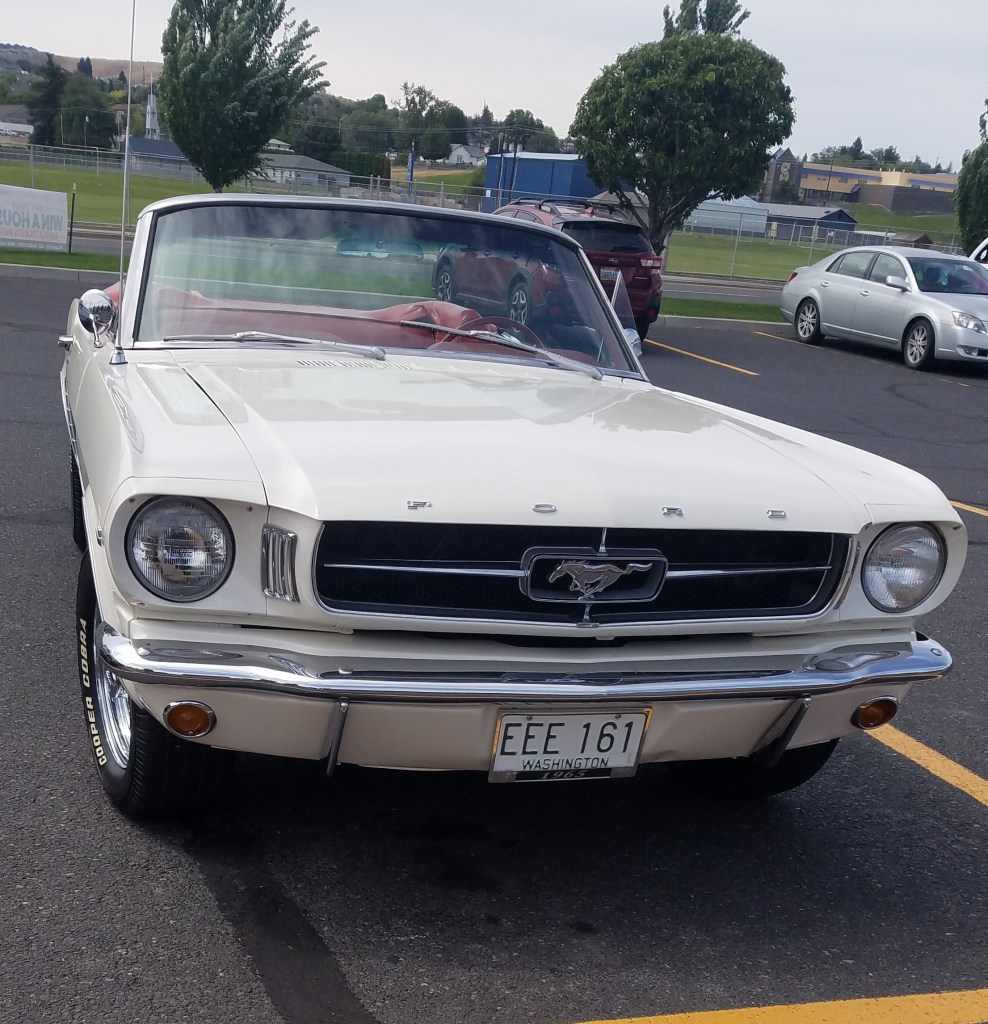
My Dad’s 1965 White Mustang convertible

What I do know is that the Mustang was a huge hit from the day it launched and has spawned clubs for owners, like the Mustang Club of America, matchbox cars, models, and an almost cult like following for the distinctively designed vehicle.

As with the Volkswagen beetle, or the Porsche, or the Corvette, the Mustang’s of the 1960’s are instantly recognizable and highly collectible.

While the majority of the early Mustangs have ended up in junk yards and recycled, some have been lucky enough to survive down through the years. This is the story of one such Mustang.

We pick up the story of the Mustang my Dad purchased slightly used circa 1966. It is now July 11, 2020 and my father has been gone just over 10 months. Despite being in the middle of the Covid Pandemic, I have estate business to tend to and have traveled to Yakima and am staying with my sister. Her home is situated in the middle of apple, cherry, and pear orchards just west of Selah – a smaller city four miles north of Yakima. Yakima County boasts a population of just under 250,000 people so it is not huge, but is certainly not small either.

On this particular Saturday it’s sunny and warm with a high in the low 90’s. In the mid-afternoon the two of us drive down into Selah in my sisters Honda with a load of items to be donated to Goodwill. From there we head south to a Safeway store in Yakima for a few dinner items. Our intended route is actually a big circle as we head to her place via the ‘back’ way which is to travel west on highway 12, then north on Old Naches Highway, and finally head east up Mapleway Road.

My sister is driving and we are, as is our nature, chatting away. Just as we reach the crest the hill I notice a white convertible about 500 yards ahead of us. It’s distinctive Mustang back end causes me to blurt out, “Look, it’s Dad’s car.”

A wave of nostalgia washes over me. Oh those summers when we drove around with that black rag top down, flirting with boys during forbidden runs up and down Yakima Avenue, not a care in the world with real life still a few years away.

A moment in time. It’s Memorial Day weekend 1973. We are getting the car ready so that the Yakima Rainbow Girls can ride in the convertible for the parade. In the photo are my Mom supervising (in her bathrobe!), my Dad and sister securing the red leather seatback cover, and my best friend Pam standing in the open car.

Of course, I didn’t really think it WAS my dad’s car. After all, he had sold the car in the 1980’s and the family lost track of it over the years. Realistically, what were the chances the car still existed? Even so, I urged my sister to get a little closer so we could at least see the license plate. She obliged and I strained my eyes to make out the letters and numbers.

EEE 161.*

“It IS dad’s car!” I exclaim. “Follow him!”

The Mustang, now at a stop sign where the main road goes right, turns. A minute later we are at the same spot and also turn right. A minute after that, we sail past the road which leads to my sister’s house and are headed back down into Selah, retracing our route from earlier.

On we go, now in hot pursuit of Dad’s car.

“I want to talk to him,” I tell her. From behind we can tell it’s a middle aged man sporting a baseball cap driving the car.

We travel past the school, city hall, the bank, the telephone company, and turn north on Wenas Road. My eyes are fixed on the Mustang wondering just how far he’s going to drive. From my perspective, it didn’t matter. Catching up with him was my goal; being with the car once again important somehow.

My sister pulls into the left lane to try and get up next to the car but then the driver signals a right turn into the parking lot of the True Value hardware store. We sail past.

It takes us several minutes to get turned around but at last we pull up next to the parked – and now empty – car and wait for the driver to return.

Not wanting to be creepy or draw suspicion, I force myself to sit and wait. And wait. And, after five interminable minutes our quarry emerges from the store headed to his car which was once my Dad’s car.

I climb out of the passenger seat of my sister’s vehicle and step forward, catching his attention.

“This will be the weirdest conversation you’ve had all week,” I say and then continue, “But this was my Dad’s car.”

“Really? He must have sold it to my Mom back in the early 1980’s. What was his name?”

“Vincent DeVore. I’ve never forgiven him for selling it.”

This elicits a chuckle. I forge on. “Unfortunately my dad passed at the end of October. But I think it would please him to see what great shape the Mustang is in.”

“I’m sorry about your Dad. My mom died in December. The car was stored in her garage until January when it came to me.  She had the leather seats recovered and the whole thing has been repainted. She used to take it to the classic car shows. She loved this car.”

“It looks amazing,” I say and mean it.

“Yeah. I learned to drive in this car,” he says and to which I reply, “So did I! It was the best.”

What then followed was the snapping of a couple of photos of both my sister and I with the car. We also learned that he lives less than a mile from my sister and is the neighbor of my brother-in-law’s best friend. And that day was the first day he’d had the car out and driving around with the top down, reliving just for a short time, his sweet teenage memories in the car of his – and my youth.

My sister enjoying being reunited with EEE 161.
Maybe next time I’ll get to sit in the car once again

As for me, it was only one of several surreal events following my Dad’s death. In a way I found it comforting and, every once in a while, am reminded that even though Dad is gone, his spirit lives on.

*In 1958, license plates in Washington were assigned by county. All plates in Yakima County started with the letter “E.” The Mustang’s plate was likely issued new with the car in 1965. Visit this website for how this all worked. http://staff.washington.edu/islade/counties/index.htm

https://en.wikipedia.org/wiki/Ford_Mustang

Mount Rainier

The Mountain Is Out

March 2, 2021

The Mountain Is Out.

These four words, for anyone who grew up or has lived in the Greater Puget Sound region, mean but one thing: it’s a clear day and from all vantage points, one can see Mount Rainier.

Photo taken by the author one cold January 1980 morning near Graham, Washington

Of all the natural features which define Washington State it is, arguably, Mount Rainier which is most associated with the state. And is it any wonder? At 14,411 feet it is one of the highest peaks in the United States. What gives Mt. Rainier its prominence, literally, is the fact that you can see an uninterrupted 13,210 feet of the volcano, making it the largest mountain in the contiguous 48 United States and the fourth largest mountain on the North American continent.

It was on March 2, 1899, when Mount Rainier National Park was established as the nation’s fourth national park (after Yellowstone, Sequoia, and Yosemite).

My parents on the White Pass ski lift headed up for a hike.

The Infallible Wikipedia provides us with some fascinating geologic facts:

“Mount Rainier is a stratovolcano in the Cascade Volcanic Arc that consists of lava flows, debris flows, and pyroclastic ejecta and flows. Its early volcanic deposits are estimated at more than 840,000 years old and are part of the Lily Formation (about 2.9 million to 840,000 years ago). The early deposits formed a ‘proto-Rainier’ or an ancestral cone prior to the present-day cone. The present cone is more than 500,000 years old.

The volcano is highly eroded, with glaciers on its slopes, and appears to be made mostly of andesite. Rainier likely once stood even higher than today at about 16,000 ft (4,900 m) before a major debris avalanche and the resulting Osceola Mudflow approximately 5,000 years ago. In the past, Rainier has had large debris avalanches, and has also produced enormous lahars (volcanic mudflows), due to the large amount of glacial ice present. Its lahars have reached all the way to Puget Sound, a distance of more than 30 mi (48 km).

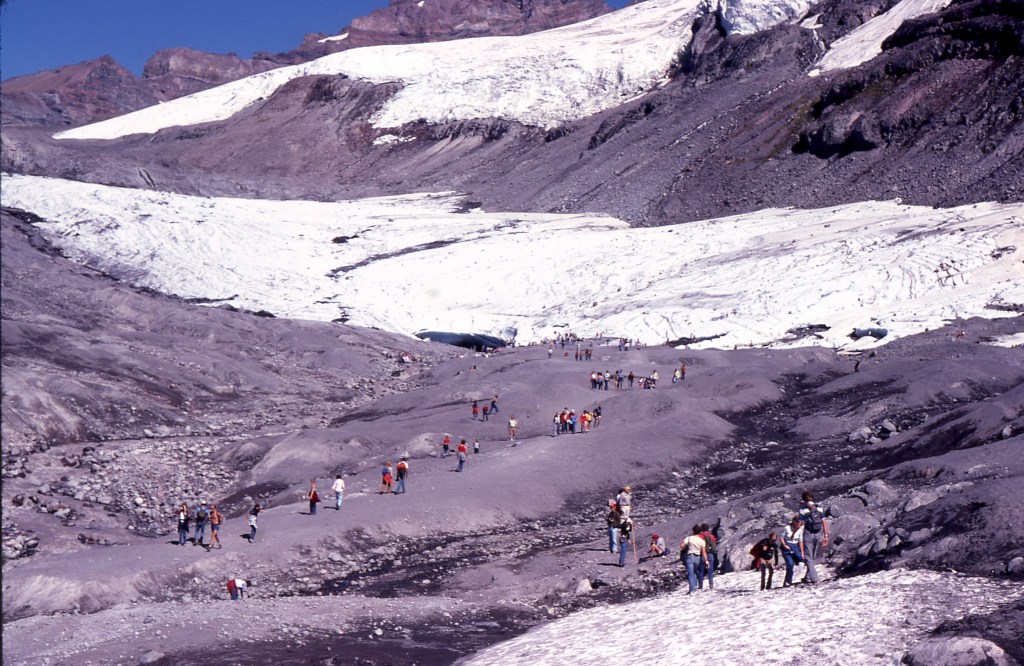
The hole in the middle is the entry to the Paradise Ice Caves

Around 5,000 years ago, a large chunk of the volcano slid away and that debris avalanche helped to produce the massive Osceola Mudflow, which went all the way to the site of present-day Tacoma and south Seattle. This massive avalanche of rock and ice removed the top 1,600 ft (500 m) of Rainier, bringing its height down to around 14,100 ft (4,300 m). About 530 to 550 years ago, the Electron Mudflow occurred, although this was not as large-scale as the Osceola Mudflow.

After the major collapse approximately 5,000 years ago, subsequent eruptions of lava and tephra built up the modern summit cone until about as recently as 1,000 years ago. As many as 11 Holocene tephra layers have been found.

In the world of geology, a thousand years is like a blink of the eye. Which is one reason why Mount Rainier is one of 16 mountains worldwide known as ‘Decade Volcanoes.’ To put it succinctly, it means that these volcanoes have given indications that they are likely to erupt AND they are located in areas where an eruption would no doubt result in catastrophic property destruction and/or a large loss of life. 

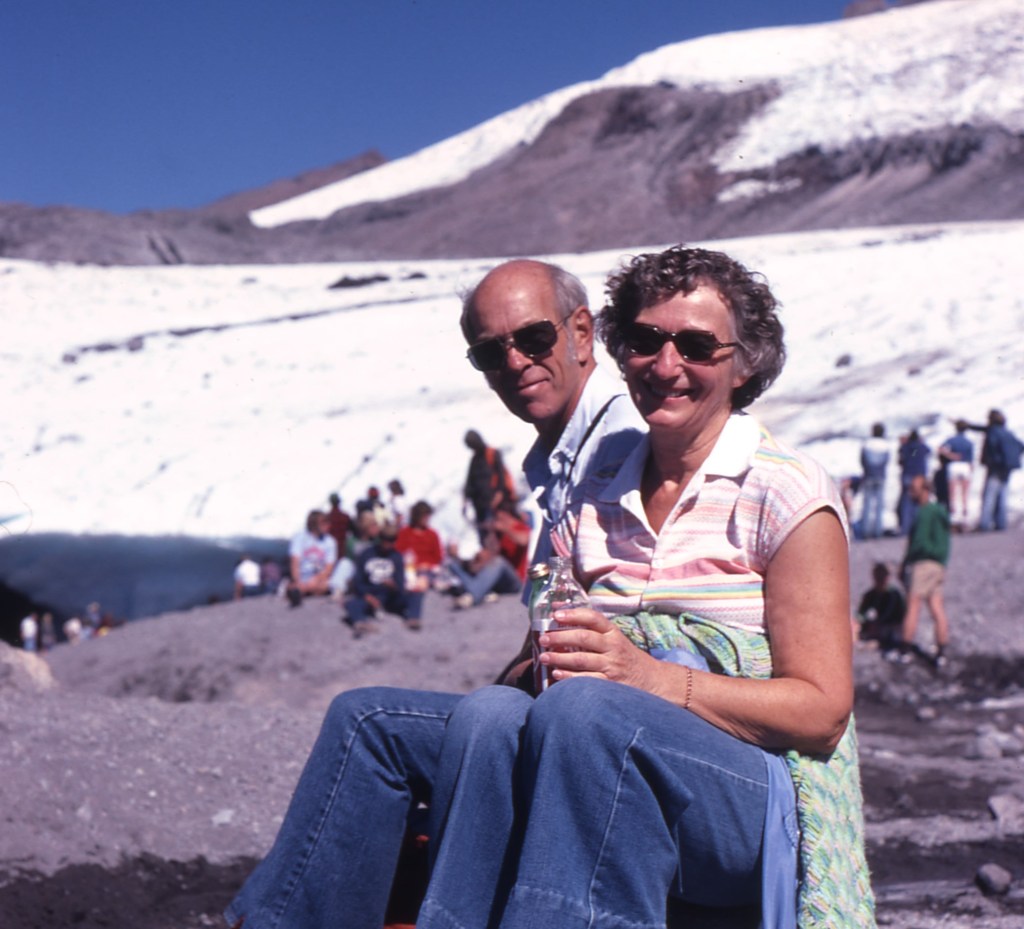
With my parents at the Paradise Ice Caves early 1980’s

That could mean that we will witness such an eruption of Mt. Rainier in our lifetime or, perhaps, it will be hundreds of years from now.

It’s hard to imagine Mt. Rainier as being any different than how it’s been during my lifetime. I simply cannot recall a time when I did not know of it. Perhaps my earliest memory would be on a trip from Yakima to Long Beach, Washington with my family including my grandmother – my Dad’s mother – in the 1960’s.

The most direct route to the coast was via White Pass which, coincidentally, follows a route just south of the southeast park entrance. And there is this spot on the other side of the summit where you come around the corner and, on a clear day, feel as if you can touch it. Over the years that moment has always been the one which says ‘welcome to Western Washington.’ My grandmother snapped a photo from the back seat of the car. It was only the first of many photos I have of the mountain.

I would venture that I’ve driven through the National Park well over 100 times and have visited both Sunrise and Paradise multiple times. Back in the early 1980’s, the hubby and I – along with my parents – hiked up to the Paradise ice caves. It was a truly ethereal experience to be standing in a blue translucent cave made of ice. Today, they are gone.

The hubby in 1980 something on one of many trips to the mountain.

As a newspaper reporter in Eatonville in 1979-80, I learned that the folks in Pierce County think of Mount Rainier as ‘theirs.’ Afterall, it was originally named Tahoma or Tacoma by the natives of the area. And it dominates the region. 

One summer evening shortly after I moved to Eatonville, I was on the phone with one of the town council members to ask him a few questions about a story I was working on. It was around 8:30 p.m. and getting on towards sunset. We were talking when all of the sudden he says, “Strawberry Ice Cream.”

“Excuse me,” I replied, “What’s this about strawberry ice cream?”

“The mountain,” he replied, “Looks just like strawberry ice cream… and then it will be blueberry.”

And so it did. Although I didn’t have a view from my place of the mountain like he did, it only took a few steps outside my apartment and to the north for me to have a nice view of Pierce county’s ice cream ‘Sundae.’

White Pass viewpoint with the hubby in 2016. On this particular day we were treated to a phenomenon known as lenticular clouds.

But it was on a trip from Nashville to Seattle a few years ago which reminded me that not everyone understands what an impact Mount Rainier has on those who see and enjoy it regularly. I was seated on the aisle and as we approached Seattle, I knew we would be passing the mountain to the north. As its massive white flanks came into view through one of the windows a row down and across the aisle, I craned my neck for a look. My frustration grew as the couple directly across from me kept their window covering closed. No longer able to hold back I said to them, “You really should open your window. Mount Rainier is right next to us.”

The man slid the opening up and both he and his wife exclaimed over how close and how immense it was.

Then he proceeded to say to me “Are you sure that’s Mount Rainier?”

I suppressed a laugh at the absurdity of the question. It’s easily one of the most recognizable peaks in the world, especially when you are right next to it and its larger than life.

“Trust me,” I replied, “I grew up here and that most definitely is Mount Rainier. Isn’t it nice for the mountain to be out today?”

The links:

https://en.wikipedia.org/wiki/Mount_Rainier_National_Park

https://www.nps.gov/mora/index.htm

Like A Song on the Radio

Thank you, Mr. Marconi

June 2, 2020

Marconi RadioThere is a saying that he who gets to the patent office first matters more than who invented it. This is likely true for the invention of radio. Guglielmo Marconi – first to the patent office – filed on June 2, 1896, eclipsing others also working on the budding technology.

The story begins decades earlier and, as is often the case, the Infallible Wikipedia sums it up:

“The idea of wireless communication predates the discovery of ‘radio’ with experiments in ‘wireless telegraphy’ via inductive and capacitive induction and transmission through the ground, water, and even train tracks from the 1830s on. James Clerk Maxwell showed in theoretical and mathematical form in 1864 that electromagnetic waves could propagate through free space. It is likely that the first intentional transmission of a signal by means of electromagnetic waves was performed in an experiment by David Edward Hughes around 1880, although this was considered to be induction at the time. In 1888 Heinrich Rudolf Hertz was able to conclusively prove transmitted airborne electromagnetic waves in an experiment confirming Maxwell’s theory of electromagnetism.”

Fascinated by the possibility of transmitting sounds via Hertzian (as radio waves were called at the time) waves, Marconi began experiments building the equipment needed in the attic of his home. He was only 20 years old.

“A breakthrough came in the summer of 1895, when Marconi found that much greater range could be achieved after he raised the height of his antenna and, borrowing from a technique used in wired telegraphy, grounded his transmitter and receiver. With these improvements, the system was capable of transmitting signals up to 2 miles (3.2 km) and over hills. The monopole antenna reduced the frequency of the waves compared to the dipole antennas used by Hertz, and radiated vertically polarized radio waves which could travel longer distances. By this point, he concluded that a device could become capable of spanning greater distances, with additional funding and research, and would prove valuable both commercially and militarily. Marconi’s experimental apparatus proved to be the first engineering-complete, commercially successful radio transmission system.”

Encouraged by his parents, he left Italy for England – his mother accompanied him – and was able to gain the interest of the British Government and, eventually, financial backing. While Marconi’s system was used primarily for short distance maritime communications at first, his company continued to experiment and expand the distance the radio waves traveled. It was Marconi’s system which made it possible for 700 passengers aboard the Titanic to be rescued.

GE F-96

My brother had a radio like this one given to him by our grandparents. His is currently in a storage locker… this beauty belongs to someone who graciously posted it on the internet.

Innovation in radio proceeded at an amazing pace with the commercial side of it soon eclipsing the more mundane maritime uses. By 1938 four of every five homes had a radio. Families gathered around for favorite programs, whether they were music, ‘theater,’ or the news of the day. The radio became an essential part of society.

All of today’s wireless digital communications via phones, pads, and portable computers, began with the invention of the radio.

Marconi – along with Karl Braun – shared the 1909 Nobel Prize “for their contributions to the development of wireless telegraphy.”

transistor radio

My sister was the queen of the transistor radio with one nearly glued to her ear for several years.

By the 1960’s, despite the fairly recent addition of commercial television, radio was still king. Especially for teenagers. It was radio which helped foment the rock and roll revolution; it was radio which unified the baby boom generation. Every town seemed to have at least one radio station and the wise ones were spinning the popular teen records of the day.

In Yakima – where I grew up – there were three stations of note in the later 1960’s and early 1970’s. I remember my dad always wanting to listen to KIT. At 1280 on the dial it featured news and WWII era music. As a card-carrying teen that was not on my list of cool radio stations. There were, however, two stations I listened to: KMWX and KQOT.

Being that I kept a diary (note to my younger self – what you wrote about was mostly ridiculous) and that listening to the radio was so important, I recorded this gem from April 25, 1971:

“Today was Pete’s Birthday. He liked the Grippu Sue and I gave him.* We went on Daylight Savings, so it stays light till almost 8:30. That means KQOT stays on the air until 7:45 and on May 1st, they will stay on until 8:30. That means I get to hear Neal Gray all through the ‘Sommer.’ (Sommer? Get it? Bob Sommers D.J.) YEA!”

Three days later, I posted this entry:

“Today was an interesting day, you see, today was Patty Hooper’s dog’s birthday, so I told her I would dedicate “Me and You and a Dog named Boo” to her dog, Sairy, if I could get through… well I got through and dedicated it but it is really weird to hear Bob Sommer’s voice on the radio and telephone, then your own. Patty was listening and called right after the song was over. Command Performance is kind of fun.”

It was, apparently, about this time that I became radio obsessed, even going so far (Two days after that!) to try to figure out the trick for getting through to the D.J.’s. For one of my dialing adventures, it took me… 292 times to get through.

Scan_20200602

The author at age 14. Cassette recorder, radio (it was an older one my parents had). I’m not sure where the clock radio is… and you can see my blue 1972 diary off to the side. I was kinda messy.

The rest of the 1971 diary has occasional references to the two radio stations. What I do recall during those years is sitting on the bed in my room, listening to the radio and waiting for my favorite songs. I cannot recall what sort of radio it was, but it was my daily companion. I was given a cassette tape recorder for my 13th birthday, and a new clock radio for my 14th. Together they afforded me the opportunity to ‘record’ songs when they came on the air. Many a tape was filled with badly recorded favorite songs AND, often, the D.J.’s playing the live requests. Those tapes were played over and over.

In today’s world, the importance of radio for young people has faded. Kids pop in their earbuds and open their Spotify or Pandora** apps on their phones; in an instant their favorite songs begin to play. Somehow I think they are missing out on the experience of calling the radio station, requesting ‘the’ song, and then listening for hours to hear it.

I’ve included a video of Al Stewart’s ‘Song on the Radio’ as it seems to capture the spirit of the 1970’s

For those of us who grew up during AM radio’s golden age of rock and roll we did not realize at the time that it wouldn’t always be that way. No doubt there will be more amazing innovations for wireless digital communications and, one day, I imagine the teens of today will pine for the good ole days. It’s the way of the world.

*I have no idea what this thing was… in another entry I write that the gripper is ‘a big blow up plastic hand.’ Who knew?

**It’s highly likely that Spotify and Pandora are ‘last year’s’ hot apps. I await correction from those in the know.

A couple of links:

https://en.wikipedia.org/wiki/History_of_radio

https://en.wikipedia.org/wiki/Guglielmo_Marconi

KQOT operated as a ‘rock’ station from 1962 until 1979 and is now Christian station KYAK: https://en.wikipedia.org/wiki/KYAK

Hummingbirds!

May 19, 2020

If You Fill It, They Will Come

hummingbird 2011 003

Anna’s Hummingbird is a year round resident of Western Washington. The author took this photo in her backyard in 2011.

As one drives through the suburbs this time of year, it is hard to not notice the red topped and bottomed glass or plastic bottles hanging from eaves and hooks.

With apologies to the movie ‘Field of Dreams,’ those of us who hang these bottles know, “If you fill it, they will come.”

Beginning in the middle of March, one sure sign that spring is here is the arrival of hummingbirds.

These tiny birds – the smallest of any bird species – are born entertainers. When they find a food source they will defend it with vigor, putting on a show of swoops and dives, as they zoom to and from the feeder. If one sits quietly nearby, the birds may hover and look at you, or will be observed pausing mid-air before flying off in a burst of speed.

They are truly amazing creatures. There are 338 known species, the majority of which are found in South America. In fact there are as many as 140 different species which co-exist with each other in the Andes range. It is likely the species originated on that continent and have spread from there to North America.

Calliope-Hummingbird-male-1200x800

Calliope Hummingbird photo from the internet

black chinned hummer

Black Chinned Hummingbird photo from the internet

Only a few hummingbird types are usually found in Washington State: Anna’s, Rufous, Black-Chinned, and Calliope. A couple other species have been spotted, but their visits are considered accidental.

There are a number of things which make the birds unique.  One is the enlarged brain region responsible for vision. From the Infallible Wikipedia:

“The enlargement of this region responsible for visual processing indicates an enhanced ability for perception and processing of fast-moving visual stimuli which hummingbirds encounter during rapid forward flight, insect foraging, competitive interactions, and high-speed courtship.”

Additionally, hummingbirds have developed in such a way that they can adapt – in flight – to environmental factors such as wind. Wikipedia continues:

“While hovering, the visual system of a hummingbird is able to separate apparent motion caused by the movement of the hummingbird itself from motions caused by external sources, such as an approaching predator. In natural settings full of highly complex background motion, hummingbirds are able to precisely hover in place by rapid coordination of vision with body position.”

The article does go way down into the weeds with technical terms and scientific explanation; worth the longer read to learn more about these tiny acrobats. One of the most interesting aspects of hummingbirds, I think, is their ability to slow their metabolism enough to go into a state of hibernation.

“The metabolism of hummingbirds can slow at night or at any time when food is not readily available: the birds enter a hibernatory, deep-sleep state (known as torpor) to prevent energy reserves from falling to a critical level. During nighttime torpor, body temperature falls from 40 to 18 °C, with heart and breathing rates both slowed dramatically (heart rate to roughly 50 to 180 beats per minute from its daytime rate of higher than 1000).

During torpor, to prevent dehydration, the GFR ceases, preserving needed compounds such as glucose, water, and nutrients. Further, body mass declines throughout nocturnal torpor at a rate of 0.04 g per hour, amounting to about 10% of weight loss each night. The circulating hormone, corticosterone, is one signal that arouses a hummingbird from torpor.

Use and duration of torpor vary among hummingbird species and are affected by whether a dominant bird defends territory, with nonterritorial subordinate birds having longer periods of torpor.”

Just outside my window there are at least four or five of my favorite birds providing me with inspiration.  Occasionally one will zip past my open window, a barely recognizable streak. On beyond – in the tree next to our house I watch as they perch at the top of slender branches. The Anna’s hummingbirds are also known for their vocal chirps, some of which sound like the warning beep of a smoke detector whose battery has worn out.

Winter20112012 004

Anna’s hummingbird at our feeder in winter

Winter20112012 008

Our cat Purr watching the show from inside the warm house

I first started feeding them in the 1980’s, putting up the feeders in early spring and retiring them in late August. For years I had understood the birds to be seasonal visitors. Then – some ten years ago – I noticed they were still outside my window in the fall. So I kept refilling their food source. And the birds stayed all winter.

In my reading I learned that only the Anna’s variety will remain year round in the mostly temperate climate of Western Washington.

When we moved to Mount Vernon two years ago, of course I put out the feeder in hopes of attracting a few birds. It worked. This year – without the need to be in Yakima half the time – I upped the stakes. For Mother’s Day my son gave me two additional feeders of a design which I had recently purchased and found it encouraged more birds to participate. With three active feeders, I am now cooking nectar about once a day!

I do believe we have three of the four species here: Anna’s, Rufous, and Black-Chinned. It’s possible the other is here also, but further observation is required.

Occasionally I will have a hummingbird hover just outside the window of my second story office. This occurred once last week and its message was clear: our feeder is empty. When I arrived downstairs and checked, the bird was correct. It was time to carry out my part of the bargain… fill it and they will stay.

Update: May 19, 2022 Due to some commitments this year, I opted to not put out my feeders in the winter. Yet, in mid-March the hummers arrived right on schedule and are just as voracious as always, draining a feeder a day. Today is the exception as I’m having to clean and replace nectar in TWO of the feeders!

I shot this video clip last night. Walked out on our front step and this bird flew right at me, intent on warning me off! The video is a little choppy because it was within inches of my face, coming at me with its beak… the sound you hear is it ‘popping’ it’s tail feathers to make that clicking noise. 

A few links:

https://en.wikipedia.org/wiki/Hummingbird

https://en.wikipedia.org/wiki/List_of_hummingbird_species

https://www.beautyofbirds.com/hummingbirdswashingtonstate.html

Century 21 Exposition

April 21, 2020

… All Roads lead to Seattle

Century_21_Exposition_logo1The year was 1962. The space race was a real thing. And Americans everywhere were awed by the spectacle of extra-terrestrial travel to the moon and beyond.

And no event summed up America’s love affair with technology, space, and the future more than the Century 21 Exposition in Seattle which opened on April 21st.

The idea had been hatched seven years earlier. From the Infallible Wikipedia:

“The fair was originally conceived at a Washington Athletic Club luncheon in 1955 to 8130b5bdb8adfdbd937324996d49da37mark the 50th anniversary of the 1909 Alaska-Yukon-Pacific Exposition , but it soon became clear that that date was too ambitious. With the Space Race underway and Boeing having ‘put Seattle on the map’ as ‘an aerospace city’, a major theme of the fair was to show that ‘the United States was not really ‘behind’ the Soviet Union in the realms of science and space’. As a result, the themes of space, science, and the future completely trumped the earlier conception of a ‘Festival of the [American] West’.”

Science and technology became the primary focus of the fair. Companies from around the U.S. exhibited a variety of ‘future’ products with a push, particularly, focused on the home of the future. For 13 minutes of pure Seattleite amusement, you can take a trip back in time in this video from Bell Telephone touting how easy communication would one day be. Had they only known…

https://ia800300.us.archive.org/31/items/Century21964/Century21964_512kb.mp4

But it was the space race between the United States and the USSR which was the story which coalesced into my hubby’s family lore.

Gherman Titov was a Soviet cosmonaut and the second man to orbit the earth in outer space. Think of him as the Russian equivalent of John Glenn; a hero in his country. HistoryLink.org – a Washington State history site – chronicles that visit:

“May 5 was incredibly hectic at the Century 21 Exposition, thanks to a visit from Russian cosmonaut Major Gherman Titov, who attracted some of the largest crowds the fair had seen since its opening on April 21. At times, the diminutive 5-foot 4-inch Titov found it hard to see anything other than the Space Needle, as taller spectators gathered around him, hoping to glimpse or photograph one of the few men that had been in outer space. Scores of news reporters compounded the crush.

c21_titov1

Gherman Titov with a few Camp Fire Girls who were there on May 5, 1962.

The Russian cosmonaut wasn’t the only one to gather crowds. More than 10,000 Camp Fire Girls were on hand to dedicate the World’s Fair flagpoles, funded by candy mint sales. An estimated 20,000 people — more than a quarter of the day’s total attendance of 75,758 — were there to take part in Camp Fire Girl celebrations. Because of the large crowds, Century 21 Exposition manager Ewen Dingwall (1913-1996) announced that starting May 12, the fair would open an hour earlier each day, at 9:00.

Throughout the day Titov signed autograph books and handed out color photos of himself, especially to children. At one point he handed his photo to a baby in a stroller.”

The baby in the stroller? My husband’s younger sister, Liz!

Back in the 1980’s – when I heard this story for the first time – I contacted the Seattle PI and was able to get a photo of Liz with the cosmonaut. We then framed it and gave that to her as a present. Unfortunately, the photo is stowed away in a box in the attic of the family home… and no one is brave enough to navigate the bat guano to go find it. I will be looking through my physical archives to see if I kept a copy.

In speaking with my Mother in Law, Jean, yesterday, she shared the following:

“We were there that day because I took our older daughter’s Campfire Group. We heard the Cosmonaut was on the grounds and we went out of our way to avoid all that, but ran right in to it. He bent down and talked to Liz who was in a stroller. She was little at that time (editor’s note – she was a few days shy of her first birthday). Normally, I would not take that many in a crowd – there were at least 10 Campfire Girls with us.”

My Mother in Law is looking to see if a copy of the newspaper article and photo might be in their file cabinet. Of course Liz remembers nothing of that day.

As I was putting together the story for this week’s blog, I was reminded of how there are days in our lives which become significant but we do not recognize it at the time. Family events like these highlight how crucial it is to stop and reflect on events which impact our lives.

I was six that year and I know that my family traveled to Seattle from Yakima for the event. But I cannot recall what we did or any specifics about it. I do know that the day it opened was my dad’s 39th birthday…now 58 years ago. Just last year on April 21st, all my siblings, their spouses, and two of my nieces, gathered together at the Adult Family Home where my dad had recently moved, to celebrate his 96th birthday. It was a lovely day and perfect weather.

20200420_152237

My Dad’s 96th birthday, April 21, 2019, with his four children

Dad had told me that he didn’t want to celebrate his birthday. But my sister and I insisted and promised it would be ‘just’ family. We ignored his protests and proceeded anyway.

20190421_130235

Dad (and my sister) with his last birthday cake

Dad rallied for the event and seemed to enjoy the cake, the cards, and a few small presents. Turns out that we were all glad we did. Six months and three days later he was gone.

Carpe Diem!

https://en.wikipedia.org/wiki/Century_21_Exposition

https://www.historylink.org/File/10104

Salt and Pepper

I have a few items of memorabilia from the Century 21 Exposition. My most prized is a pair of aluminum salt and pepper shakers shaped like the Space Needle. The top of one is shown here.

Daffodil Days

March 17, 2020

Solo DaffodilA harbinger of spring, this particular flower is one of the earliest to appear during the first weeks of March.

The Narcissus – also known as daffodil and jonquil – has been cultivated for centuries. People are drawn to its sunny shades; a welcome splash of color at the end of winter.

A member of the Amaryllis family, its showy blossom reminds one of a face surrounded by a large bonnet.  There are thousands of varieties, ranging from tiny clusters of white and yellow flowers, as well as fist sized blossoms in brilliant yellow. Less common blooms can also include combinations of orange and pink.

It was believed, at one time, that the bulb contained cancer curing properties. In fact, the bulb actually contains toxins which can lead to illness and, in rare cases, death if ingested. Rather than getting into the tall weeds in regards to that, here’s a link to the Infallible Wikipedia for those who wish to learn more:  https://en.wikipedia.org/wiki/Narcissus_(plant)

Mt. Baker and Daffodils

Skagit Valley daffodils with Mt. Baker in the distance. March 16, 2020

The Narcissus is so popular and so prevalent, that authors have for years used it in their works.

Also from the Infallible Wikipedia:

“Shakespeare, who frequently uses flower imagery, refers to daffodils twice in The Winter’s Tale  and also The Two Noble Kinsmen. Robert Herrick alludes to their association with death in a number of poems. Among the English romantic movement writers none is better known than William Wordsworth’s short 1804 poem I Wandered Lonely as a Cloud which has become linked in the popular mind with the daffodils that form its main image. Wordsworth also included the daffodil in other poems. Yet the description given of daffodils by his sister, Dorothy is just as poetic, if not wordsworth-lonely-daffodils2-500x334more so, just that her poetry was prose and appears almost an unconscious imitation of the first section of the Homeric Hymn to Demeter (see Greek culture, above). Among their contemporaries, Keats refers to daffodils among those things capable of bringing ‘joy forever’.”

That’s pretty high praise for a flower!

I always think of the third week of March as the season of the daffodil. While I cannot recall when, exactly, I became aware of the flower, I have always rejoiced when I see their heads pop up from the cold ground, knowing that winter is losing its grip.

My most memorable daffodil experience occurred one lovely spring afternoon in March 1993. I had been out running errands. In my company that day were my three year old son and a belly so large that it was near bursting.

We arrived back at our house sometime after 3:30 p.m. My in-laws were there; ready to provide care for the three year old as my official ‘due date’ was March 19th.

Weary after hours of errands, I sat down for a few minutes but could tell something was not right. A few minutes later, at 4 pm, I feared that my water had broken.

Now, with child number one, I had not experienced natural labor. He was a stubborn one and it took hours and hours along with a labor inducing drug to convince him to arrive.

Those who say that Pitocin and the natural hormone released by a mother’s body during labor are the same, don’t know what they are talking about. Which is why I wanted to avoid its use with child number two.

I went up to the bedroom and called the Doctor’s office, hoping that I could go in and have them check to see if, in fact, my water had broken. Nope. I was instructed to go to the hospital.

The next ten minutes involved tears, calling the hubby to tell him that he needed to come home and take me, and more tears as I wrapped my head around the situation. I assured the hubby during our call that he had plenty of time since I was not experiencing any labor pains. The tears were caused by my anticipation of a 22 hour ordeal similar to the first labor which would involve an IV drip of Pitocin.

Packing was a slow process (have I mentioned how huge I was?) as I gathered all my needed items together and, anyway, I figured I had time. As I was puttering around the bedroom and the bathroom, I kept having these ‘twinges.’ Didn’t think much about it until it occurred to my thick brain that it might be natural contractions, something I had not experienced the first time.

So I timed the twinges… and they were two minutes apart. Wow. I took my now packed bag downstairs and told my mother in law, who was standing in the kitchen, the news about the time between contractions. And then the first big one hit.

The next thing I did was step over to the sink and grip the counter, breathing through the event as best I could. On the other side of the window in our backyard my focus landed on the clusters of bright yellow blooms.

At the end of the contraction my mother-in-law exclaimed, “How soon will he get home? I didn’t sign up to be a midwife!”

And so it went for probably another 15 minutes, me gripping the counter in front of the sink as if it were a life preserver, daffodils swimming before my eyes. Soon the hubby arrived and a flurry of activity ensued with hasty goodbyes to the in laws and our eldest child, then what seemed an excruciatingly long  trip to the hospital, and admittance.

Daffodil princess

Daughter in search of daffodils March 2010 – ten years ago

Three and half hours from the onset of labor, at 7:30 p.m., our daughter was born (without any artificial labor inducing drugs OR any pain relief as there was no time!).

The next day, looking out my window at the landscaping across the street from the hospital, I could see daffodils; bunch after bunch greeted us all along the streets as we drove home with our new baby.

My daughter and I cherish the daffodil as our shared flower, a symbol of spring, new life, and connection from mother to child. Happy Birthday to you, my beloved mid-March child!


In 2021, the daughter requested a birthday trip to the Daffodil fields near Mount Vernon

The 100-Year Legacy of the National Christmas Tree

 A 102 Year Tradition

December 24th

2019NCTL_Ceremony.jpg

The 2019 National Christmas Tree

At 3 p.m. on Monday, December 24th, 1923, an American tradition began which continues to this day. That event was the lighting of the first National Christmas tree.

Now, 102 years later, the event occurs earlier in the month – this year on December 4th – as it has since 1954 during a month long event known as the Pageant of Peace. But back to the beginning.

The concept of a National Christmas tree was the idea of Frederick Morris Feiker, an engineer with General Electric. He, along with Vermont US Senator Frank L. Greene, convinced President Calvin Coolidge to light the tree.

Alumni of Middlebury College in Vermont paid for the transport of a 48 foot tall balsam fir to be transported to Washington, D.C. with GE providing 2,500 green, red, and white electric lights.

From the Infallible Wikipedia:

calvin-coolidge-was-the-first-president-to-instate-a-public-christmas-celebration-at-the-white-house-with-the-first-national-chris.jpg

President Calvin Coolidge and dignitaries at the first National Tree Lighting ceremony in 1923

“At 3 p.m. on December 24, 1923, a 100-voice choir from the First Congregational Church assembled on the South Portico of the White House and began a two-hour concert of Christmas carols. At 5 p.m. (dusk) on Christmas Eve, President Coolidge touched a button at the foot of the tree which lit the lights and electric candles adorning the tree, but he did not speak. A searchlight from the nearby Washington Monument was trained on the tree to help illuminate it as well. The Coolidge family invited citizens of the city to sing Christmas carols on the Ellipse after dark. Between 5,000 and 6,000 people thronged the park, joined by 3,000 more people by 9 p.m. The crowds were joined by the Epiphany Church and First Congregational Church choirs, which sang carols, and the Marine Band played Christmas-themed music. The singing ended shortly before midnight. After the white residents of the city had dispersed, African American residents of the city were permitted on the park grounds to see the National Christmas Tree. An outdoor Christian worship service was held, and a mass choir composed of signing groups from area community centers sang more Christmas carols. An illuminated Christian cross was flashed on the Washington Monument, and men dressed as shepherds walked from the National Christmas Tree to the monument.”

300px-US_National_Christmas_Tree_1923The following year Coolidge objected to cutting down a tree for the event so a 35 foot tall live Norway Spruce was located and planted in a new location near the Treasury Building. This tree survived until 1929 when it was determined that the plant had been damaged and needed to be replaced. This began a series of live trees being planted, dying, and being replaced until, in 1934, the last tree was cut down in that location.

In December 1934, the tree and the ceremony were moved to Layfayette park, north of the White House. There it remained for only a few short years before returning to its original site on the Ellipse where it remains to this day. Over the years there have been many, many trees which have served in the role. Additionally, the ceremonies and events associated with it have become quite extensive. If you’d like to read more about its history, here’s the Wikipedia link https://en.wikipedia.org/wiki/National_Christmas_Tree_(United_States) and also the link to the official website https://thenationaltree.org/lighting-ceremony/2019-national-christmas-tree-lighting-ceremony/.

Although I’ve never seen the National Tree, I do love driving around during the Christmas season and viewing all the wonderful outdoor decorations. There is nothing quite so beautiful as a blue spruce or fir tree at night covered with lights AND an inch or two of snow on its branches.

My first memory of such a tree was when I was probably 7 or 8. My bedroom in Yakima faced towards our backyard. Our neighbor, Ray Broten, spent a lot of time keeping his yard beautiful. No matter the season, his was always manicured and trimmed to perfection. That particular December, the spruce tree located in the southwest corner of his backyard cut through the darkness with blue, green, red, and white lights, illuminating my bedroom each night. After I went to bed there was many a time I stole back over to the window and just stood and looked out at his beautiful tree. My favorite nights were when a soft snow was falling, muting the darkness with a blanket of white.

When I got too cold, I’d crawl back in to bed, and as I warmed up and drifted off to sleep, the shine of those lights would bathe the room with a soft glow.

This tradition continued for a number of years until the time I moved away from Yakima. Although those years are long ago, the memory is etched with clarity as Mr. Broten unknowingly created one of my fondest recollections.

May your Christmas also be one of wonderful reminiscences and the creation of new memories. Merry Christmas one and all.

Peak DeVore

August 6, 2019

As someone born into a family with an uncommon last name, I notice whenever I see that name. A year ago in June I wrote about my ignorance of Washington State geology when I admitted I did not realize Glacier Peak was this state’s ‘fifth’ volcano. (You can read all about it at https://barbaradevore.com/2018/06/12/glacier-peak-washington/)

Fast forward to August 3… when I receive the following text from the hubby:

1200px-Devore_Peak,_from_White_Goat_Mountain.jpg

Devore Peak in the Glacier Peak Wilderness

“Just saw on King 5 there is a Devore Creek fire near Stehiken. Comes down from Devore Peak.”

What!?

How is it I never knew of this Devore Peak or Creek? Yet, here it has been, hiding out 20 miles northeast of Glacier Peak, undoubtedly since the time the first settlers imparted their names on things.

From the Infallible Wikipedia:

“Devore Peak is an 8,360+ ft (2,550+ m) mountain summit located in the Glacier Peak Wilderness of the North Cascades in Washington State. The mountain is situated in Chelan County, on land managed by Wenatchee National Forest. Its nearest higher peak is Martin Peak, 3.36 mi (5.41 km) to the southwest, and Tupshin Peak lies 1.55 mi (2.49 km) to the north-northeast. Precipitation runoff from the peak drains to nearby Lake Chelan via tributaries of the Stehekin River.”

So it got me thinking… where else are things named Devore (or DeVore as my family spells it) that I do not know about?

127px-Devore_City_Sign

DeVore, California welcome sign

Of course I know about DeVore, California although I’ve never been there. The town was a stop on historic Route 66. It has since been incorporated into sprawling, 81 square mile, San Bernardino. Much of the DeVore neighborhood was leveled by a wildfire in 2003, with 904 homes destroyed.

DCIM100MEDIADJI_0139.JPG

Lovely Cataract Falls near Devore, Indiana

If you travel 1,723 miles to the east you will find a dot-on-the-road community in Indiana also named Devore. Originally named Mill Creek, some interloper relative of mine got a post office located there and probably named it after himself.

But back to Devore Peak. Despite my extensive internet research I cannot find any ancestor or relative after whom the mountain is named although I suppose it could be the Reverend John DeVore. He was the first minister to establish a church north of the Columbia River in Steilacoom. From the Washington State History link site:

“(Lafayette)Balch (Steilacoom’s founder) persuaded Reverend John F. DeVore (1817-1889) and his wife Jane Devore (d. 1860) to relocate to Steilacoom in 1853. DeVore built a two-story Methodist Episcopal church that also served as a school and meeting hall. When the church bell, ordered from the East, arrived with a balance due, residents took up a collection. Afterward the bell became town property, used to signal emergencies and public meetings along with the call to worship.”

Steilacoom,_WA_-_Protestant_Church_monument_01.jpg

Monument in Steilacoom, Washington commemorating the erection of the first Protestant Church by Reverend John DeVore

When a college student, I drove down there one day from nearby University of Puget Sound (which was founded as a Methodist college) and located the marker for Reverend DeVore. Alas, the Reverend is not a direct ancestor and I was never able to establish any relationship.

But it does make one wonder – unless you have a very common last name – how many others share yours?

According to the website HowManyOfMe.com, (http://howmanyofme.com/) in the 2010 census there were 13,501 people in the United States with the last name of DeVore. When you consider that there are some 329 million in the country that’s only .004 percent of all people with the same last name. If I extrapolate that even further and add my first name there were 65 other people named Barbara DeVore in the U.S. that year.

As I was growing up I knew of only one other person with the last name DeVore who was not related to our family. That would be the butcher who worked at the Safeway on 36th and Tieton Drive in Yakima. I was always so very amused when I would go to the store with my mother. If the shopping trip involved a visit to the meat counter inevitably the exchange would go something like this:

Butcher: “Good Afternoon, Mrs. DeVore.”

Mom: “Good Afternoon, Mr. Devoir.”

And then they both would laugh.

Yes, Mr. Devoir the butcher spelled it different. But the two of them obviously enjoyed the inside joke of having the ‘same’ last name.

As I was writing this article I could not think of a single person I’ve met casually with the last name DeVore. Through my genealogy research and DNA matching, I’ve found quite a number of cousins and have enjoyed getting to know many of them on Facebook.

Occasionally I will have someone ask do you know ‘fill-in-the-blank’ DeVore? Often I am able to say he/she is my second cousin, once removed. But mostly it doesn’t come up.

I rather like the unique name and the mystery of it all. According to a book about the DeVore families compiled by Betty DeVore Mann in 1992, the history of the name is this:

19311

“There is a small, stately chateau in Normandy, near Alencon and 3 kilometers from Remalard, named Chateau de Vore. The de Vore family left in the 17th century. Several American Devores have interviewed the 2 remaining de Vores in Paris. They knew very little about their ancestry, because their grandfather was the illegitimate son of a wealthy family and he was sent away when he was very young. He carried his mother’s maiden-name. And so the story goes…”

She also adds “the Huguenot Society tells us that Devore is of Huguenot origin. The Huguenots were the French Protestants who were persecuted and made a mass exodus from France between 1550 and 1780.”

When I got my DNA information back recently it confirmed that I was 3 percent French*. While the family history will likely remain hidden in the mists of time, the pursuit of it has dogged me since I became old enough to ask “Who am I? And what am I doing here?”

Who knows, maybe there’s an historical novel in there, the intrigue of an illegitimate child who grows to a man. It is the story of a man who must disavow his country for his religion, never able to claim his true heritage, who must establish a new life in a distant land.

Perhaps not my family’s story… after all I know that my great-great grandfather Hartley DeVore was a shoemaker in Wisconsin in 1850. Not nearly as romantic!

As always, links:

https://en.wikipedia.org/wiki/Devore_Peak

https://en.wikipedia.org/wiki/Devore,_California

https://en.wikipedia.org/wiki/Devore,_Indiana

*In my most recently updated DNA profile, the French connection has disappeared. I covered THAT topic here: https://barbaradevore.com/2022/07/26/ancestor-hunting-dna/