Tag Archive | Sammamish Washington

Easter Confusion

One never quite remembers year to year when it will be

April 16, 2024

Back on April 16, 2019, I posted an article about Easter which, that year, was on April 21st.

I’ve decided – even though Easter was sixteen days ago – to repost the article since I think people sometimes forget how convoluted a formula it takes to figure it out each year and what they can look forward to next year.

Traditional Easter egg dyeing event with my kids which, based on this 1999 photo, would have likely been on April 3rd since Easter was on April 4th that year.

When I was a child and began to understand the concept of time and dates, I was fascinated with how this one holiday could be on a different day – heck, month even – from year to year.

And so I learned that you could figure out the date of Easter with the following:

“The first Sunday following the first full moon after the vernal equinox.”

Even this requires that one knows what a vernal and an equinox might be. 

Vernal is a fancy word for things related to ‘spring’ and an ‘equinox,’ according to Dictionary.com, is “the time when the sun crosses the plane of the earth’s equator, making night and day of approximately equal length all over the earth and occurring about March 21 (vernal equinox, or spring equinox ) and September 22 (autumnal equinox ).”

While all of this is, in today’s world, is seemingly straight forward, for Christians throughout the world – and as early as 325 AD with the first council of Nicea – the date on which Easter is celebrated has been disputed.

According to the Infallible Wikipedia:

“Easter and the holidays that are related to it are moveable feasts which do not fall on a fixed date in the Gregorian or Julian calendars which follow only the cycle of the sun; rather, its date is offset from the date of Passover and is therefore calculated based on a lunisolar calendar similar to the Hebrew calendar. The First Council of Nicaea (325) established two rules, independence of the Jewish calendar and worldwide uniformity, which were the only rules for Easter explicitly laid down by the council. No details for the computation were specified; these were worked out in practice, a process that took centuries and generated a number of controversies. It has come to be the first Sunday after the ecclesiastical full moon that occurs on or soonest after 21 March, but calculations vary.”

The full moon of March 2020 was on the 8th which meant that Easter was on the Sunday after the April full moon, on the 12th. The moonrise that day was spectacular even with using a phone to take this photo.

One might think that setting out a fairly straight forward calculation would end the debate but, over the centuries, it’s become more confusing.

Things really went sideways when, in 1582, Pope Gregory XIII decreed that the Julian calendar was way off and introduced his own calendar. The Gregorian calendar is the one we still use today. I wrote about it here: https://barbaradevore.com/2022/10/11/october-1582/

So what does that have to do with Easter and how to calculate the date? There are people in the world who still – over 400 years later – like the Julian calendar and use it to determine the date on which Easter is celebrated.

There’s also the whole question of the equinox. Back in the fourth century there was no modern science used to calculate the exact moment of the equinox. Instead it was determined based on the above mentioned lunisolar calendar. Which is a fancy way of saying that the people who use such calendars needed a way to adjust the dates based on what was happening around them. Think of it as the spring equinox begins 14 days AFTER the new moon or, approximately, with the full moon of the season.

According to religious rules about Easter, then, the holiday is not truly based on it being on the first Sunday following the full moon after the vernal equinox. No, the calculation is based on it occurring on the first Sunday following the full moon AFTER March 21.

In 2019, Easter fell on April 21. But should it have? The full moon and the vernal equinox both occurred on March 20 – a mere 3 hours and 45 minutes apart – with the equinox crossing the finish line first at 2:58 pm (PDT).  The moon was full at 6:43 p.m. So by scientific calculation, Easter SHOULD have happened on March 24.

Instead, the rule – for those who follow the Gregorian calendar – is to think of March 21 as the hard and fast equinox which places Easter on this coming Sunday. In the Infallible Wikipedia article, there’s an interesting table which shows the calculated dates of Easter for each competing calendar.

Note that in 2019, there is a column for Astronomical Easter giving that year three different dates from which to choose. The chart is also incorrect as we know the scientific full moon occurred on March 20 and not the 21.

And for the record? The most common date for Easter to occur since the inception of the Gregorian calendar through the year 3000 is April 16. You will be happy to note that in four years April 16th is, once again, the date of Easter on both the Gregorian and Julian calendars.

One of these days I’m certain the whole controversy will be settled. In 1997 a movement was afoot to make a change. Also from the Infallible Wikipedia:

My son, age 1 1/2 at a Timberline neighborhood community Easter egg hunt in 1991. Like this year Easter was on March 31 which explains why everyone is dressed in coats and sweaters for the mid-March hunt.

“At a summit in Aleppo, Syria, in 1997, the World Council of Churches (WCC) proposed a reform in the calculation of Easter which would have replaced the present divergent practices of calculating Easter with modern scientific knowledge taking into account actual astronomical instances of the spring equinox and full moon based on the meridian of Jerusalem, while also following the Council of Nicea position of Easter being on the Sunday following the full moon. The recommended World Council of Churches changes would have sidestepped the calendar issues and eliminated the difference in date between the Eastern and Western churches. The reform was proposed for implementation starting in 2001, but it was not ultimately adopted by any member body.”

And so it goes. All I know is that hunting for Easter Eggs is usually much more pleasant the third weekend of April than it is in late March. But what’s stopping us from boiling a pot of eggs, coloring them, and then hiding them among the grass on our likely too long lawns? Nothing. Think of it as second Easter for when the weather is, we hope, nicer.

The links!

https://en.wikipedia.org/wiki/Easter

https://www.staff.science.uu.nl/~gent0113/easter/easter_text2b.htm

https://en.wikipedia.org/wiki/Lunisolar_calendar

Kittenmania: the year we were taken over by cats

The Baker’s Dozen

April 13th

A Tuesday Newsday Classic from 2021

One of the things I look forward to each week is getting ‘show prep’ from my favorite Disc Jockey who also happens to be my brother. He sends interesting and humorous facts and events in advance of each Tuesday, providing me fun ideas for the particular date I need.

This week he shared the following for today, April 13, 2021. He writes:

“1969: An Australian Siamese cat named Blue Danielle had 13 kittens. It’s no longer a record, but it deserves honorable mention. The purring alone must have driven everyone crazy.”

Which got me wondering, what WAS the largest litter of kittens ever born?

When you really, really love kittens. Son and daughter with kittens Winky and Peop in 1999.

The record was set the very next year when a four year old Burmese cat named Taragone Antigone produced 19 kittens. Unfortunately, only 15 survived (14 males, one  female). I gleaned this information from a website called The Nest which also stated “Clementine, a mixed domestic shorthair gave birth to 15 (11 survived) in New York in 1976, and that same year a Siamese named Tikatoo had a litter of 15 in Canada.” (see link below)

The Infallible Wikipedia does not list the information on the largest litters, but helpfully details the, ahem, mating habits of felines. Perhaps the most interesting fact in that regard is this:

“Because ovulation is not always triggered by a single mating, females may not be impregnated by the first male with which they mate. Furthermore, cats are super fecund that is, a female may mate with more than one male when she is in heat, with the result that different kittens in a litter may have different fathers.”

Another interesting aspect is that cats are known to give birth to as many as three litters a year. With litters averaging from 3 to 9 kittens, it doesn’t take long to be overrun by cats. I should know.

My family’s kitten adventures began in December 1998 when our one and half year old cat, Purr, went into heat. It was a conscious decision on my part to let the cat do this as I knew that having a batch of kittens was highly desired, especially by my then 5 year old daughter.

As Purr’s big day approached, the excitement in the house grew. Then, one morning late in February 1999, the process began. Much to my daughter’s delight, she got to witness the birth event and immediately bonded with all four of the kittens.

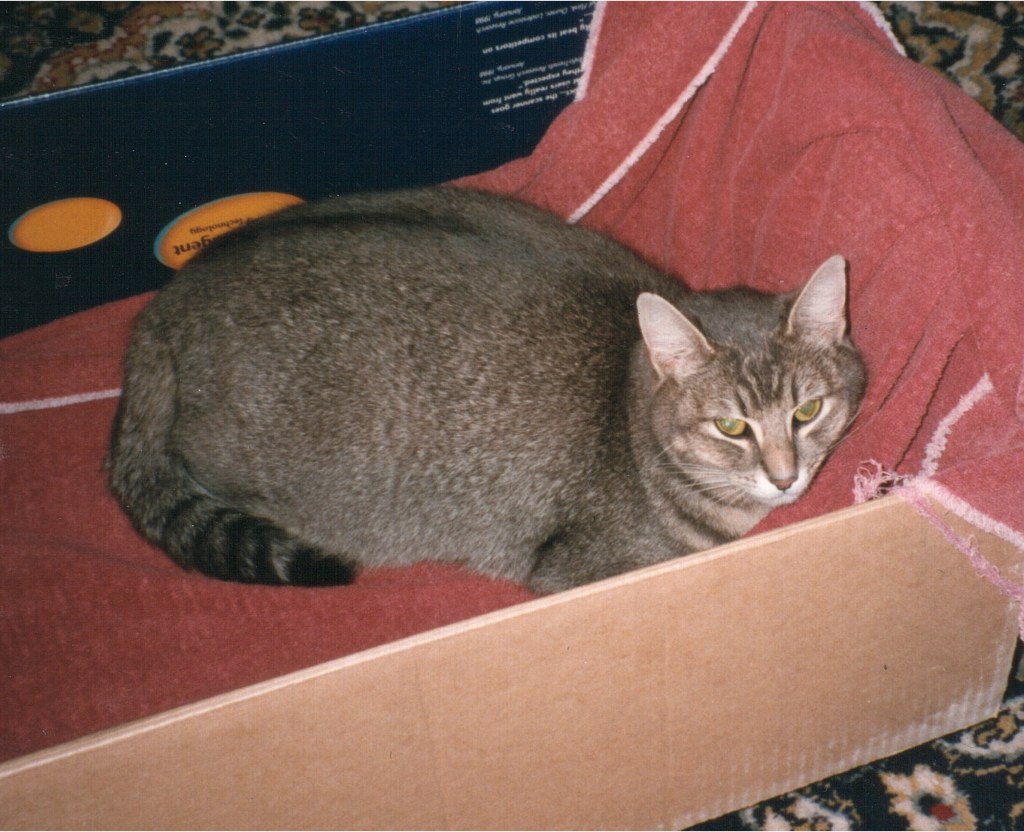
Purr in the ‘nest’ my daughter prepared for her. The kittens were born shortly after.

It didn’t take long for each cat’s personality to shine through and the four were named: Kinky – the lone male – named for the crook in his tail; Winky – who had one eye which blinked independent of the other; Phantom – who had a half dark, half light face; and, finally, People Cat – so named because of her propensity to climb out of the box and love on whatever person was there.

Kittenmania took over. The cats lived in our large laundry room, kept inside by a baby gate once they started roaming. But soon they were all over the house and, especially, upstairs in the playroom or the kids’ rooms.

Since keeping five cats was not an option, at five weeks I’d moved fully into ‘find them a home’ mode but not before promising that we would keep ‘one’ of the kittens. My targets for people to adopt them were classmates of the kids and soon Winky left to be loved by a third grade girl and her family.

Phantom, it turned out, was not the right cat for us. She was afraid of everything: loud noises, sudden movement, and the other cats. Sudden incontinence was the response to these factors, so she needed a calm environment with an understanding owner. Her salvation was the veterinary assistant.

It looked as though Kinky would be our cat as my son’s teacher, Mrs. B., was all set to adopt Peop (as we had started calling her). But when Mrs. B’s husband objected, the adoption was off. I was secretly glad as Peop had become my personal assistant, supervising whenever I worked at my desk, and I wanted to keep her.

So our little family of three cats was set. Or so I thought.

One day in early April I had an appointment to have Mama Purr spayed. Then the unthinkable happened. She escaped the house and was gone for 24 hours. The last time that happened…

Purr looking beautiful and irresistible to the eligible bachelors

Yep. She was pregnant once again.

Purr got bigger and bigger and soon we were anxiously awaiting the new arrivals. She rejected Peop and Kinky (something which was true for the rest of her days) who moved upstairs to hang with the family and Purr stayed downstairs as she began the process of nesting once again.

Unfortunately, I had an out of town conference which took me away at the critical moment. With Grandma and Grandpa there to watch the kids we were all set.

Then on day two of the conference, a flurry of emails from my nine year old son announced the kittens’ arrival.

Peop helping the author with editing.

“Mom,” the first email proclaimed, “Purr has four kittens!”

I noticed a string of emails from him and clicked open the second, then the third, fourth and fifth emails.

“Now there are five!”

“Mom – there are six kittens!”

“Now there are seven!”

My stomach dropped as I counted three more emails in the thread. How many kittens did Purr just have? What were we going to do with all those kittens?!

I open the next email.

“Purr has eight kittens!” the email happily proclaimed.

It took every ounce of courage to open the next one.

“That’s all.”

I let out a shudder. While eight would be hard to manage I was thankful it had ended there.

Kinky wanted to be king of the household but Purr never let him usurp her throne.

When I arrived home the next day I found a moving mass of cats in the laundry room. Purr looked oh so pleased with herself.

Soon the reality of having ELEVEN cats in the house took over. The litter box for Mama and babies required cleaning every two hours. I took old vinyl tablecloths and turned them upside down in the laundry room to keep the carpet (who puts carpet in a laundry room? Asking for a friend) from getting urine soaked. Our house smelled like a cattery. Probably because it was.

When our niece came to visit, the kids ‘introduced’ her to the new kittens – three of which are shown here. I think our niece looks a bit concerned.

That summer all we did was manage cats and eventually were able to find homes for the crew, much to Purr’s dismay. And Purr? That randy lady did make it to the vet (as did Peop and Kinky) so that future, possibly record breaking, litters of kittens would not happen.

But had I known then that the record was 19 I totally think Purr could have broken it. Then she would have been famous and I would have had a nervous breakdown. It probably worked out for the best.

A couple of links:

https://en.wikipedia.org/wiki/Cat

https://pets.thenest.com/record-number-kittens-born-one-litter-8346.html