Archives

Agatha Christie: The Queen of Mystery Novels

What really happened the summer of 1980?

September 15th

Any list of the greatest novelists of the last one hundred years would be incomplete without this person on it. She wrote 66 novels and 14 collections of short stories and also the world’s longest running play, Mousetrap.

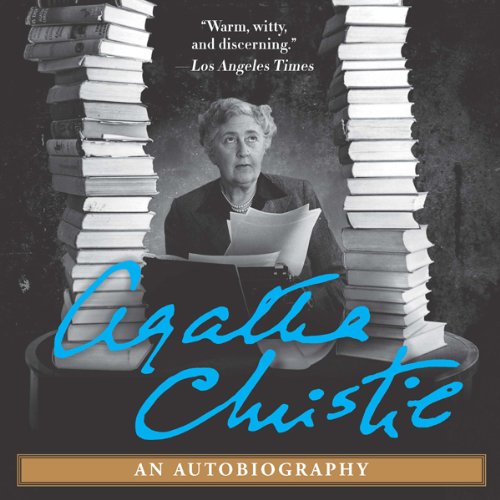
Agatha Christie amid a stack of the
many books she has written

Agatha Mary Clarissa Miller was born on September 15, 1890. We know her as Agatha Christie. The Guinness World Records names her as the fiction author whose books have sold more than any other in history at over 2 billion copies. It’s the sort of success that aspiring novelists can only dream of.

Like most writers, it was a number of years after she began penning her stories before she was published. From the Infallible Wikipedia:

“At eighteen, Christie wrote her first short story, ‘The House of Beauty’, while recovering in bed from an illness. It consisted of about 6,000 words on ‘madness and dreams’, a subject of fascination for her. Her biographer, Janet Morgan, has commented that, despite ‘infelicities of style’, the story was ‘compelling’. (The story became an early version of her story ‘The House of Dreams’.) Other stories followed, most of them illustrating her interest in spiritualism and the paranormal. These included ‘The Call of Wings’ and ‘The Little Lonely God’. Magazines rejected all her early submissions, made under pseudonyms (including Mac Miller, Nathaniel Miller, and Sydney West); some submissions were later revised and published under her real name, often with new titles.

Every aspiring author needs a creepy doll… or two!

Around the same time, Christie began work on her first novel, Snow Upon the Desert. Writing under the pseudonym Monosyllaba, she set the book in Cairo and drew upon her recent experiences there. She was disappointed when the six publishers she contacted declined the work. Clara suggested that her daughter ask for advice from the successful novelist Eden Phillpotts, a family friend and neighbour, who responded to her enquiry, encouraged her writing, and sent her an introduction to his own literary agent, Hughes Massie, who also rejected Snow Upon the Desert but suggested a second novel.

(snip)

Christie had long been a fan of detective novels, having enjoyed Wilkie Collins’s The Woman in White and The Moonstone, and Arthur Conan Doyle’s early Sherlock Holmes stories. She wrote her first detective novel, The Mysterious Affair at Styles, in 1916. It featured Hercue Poirot a former Belgian police officer with ‘magnificent moustaches’ and a head ‘exactly the shape of an egg’, who had taken refuge in Britain after Germany invaded Belgium. Christie’s inspiration for the character came from Belgian refugees living in Torquay, and the Belgian soldiers she helped to treat as a volunteer nurse during the First World War. Her original manuscript was rejected by Hodder & Stoughton and Methuen. After keeping the submission for several months, John Lane at The Bodley Head offered to accept it, provided that Christie change how the solution was revealed. She did so, and signed a contract committing her next five books to The Bodley Head, which she later felt was exploitative.It was published in 1920.”

Until I found this in my image search today,
I did not realize that I wasn’t the only one who adhere’s to this philosophy!

Her personal life was not without strife. When her father died in 1902 – Christie was 11 years old – the family’s financial situation changed. As Christie later said that it marked the end of her childhood.

Despite this, she did manage to participate in British social life and had a number of short lived relationships prior to meeting Archie Christie when she was 22 years old. The two were married on Christmas Eve 1914.

The birth of her only child, a daughter, occurred in 1919. With the death of her mother in 1926 she fell into a deep depression. Two years later she and Archie divorced when he admitted to an extramarital affair.

She did eventually remarry in 1930 to archaeologist Max Mallowan – a marriage which lasted until her death in 1976.

The backdrop to her personal life, however, was always writing. She often incorporated her own experiences and places she’d visited into her novels.

Perhaps the most interesting aspect of this was her work in hospital dispensaries during both World Wars. While there she became familiar with a variety of poisons which found their way into her works. Christie had a real gift in finding creative ways to kill off her characters.

While I cannot recall exactly when I became aware of Christie’s books, I imagine it was probably as a young teenager. Undoubtedly I read a number of her novels but it was the 1974 movie Murder On the Orient Express which truly brought her works to the attention of countless Americans. I have enjoyed all the movies based on her books.

I also believe I saw Mousetrap in London in 1980. Unfortunately, my memory is fuzzy and I’m not sure if I imagined the whole thing. But it does seem as if I did attend the play. It was in mid-July and early August of 1980 when my parents had taken my sister and me on a three week trip to Norway, England, and Scotland.

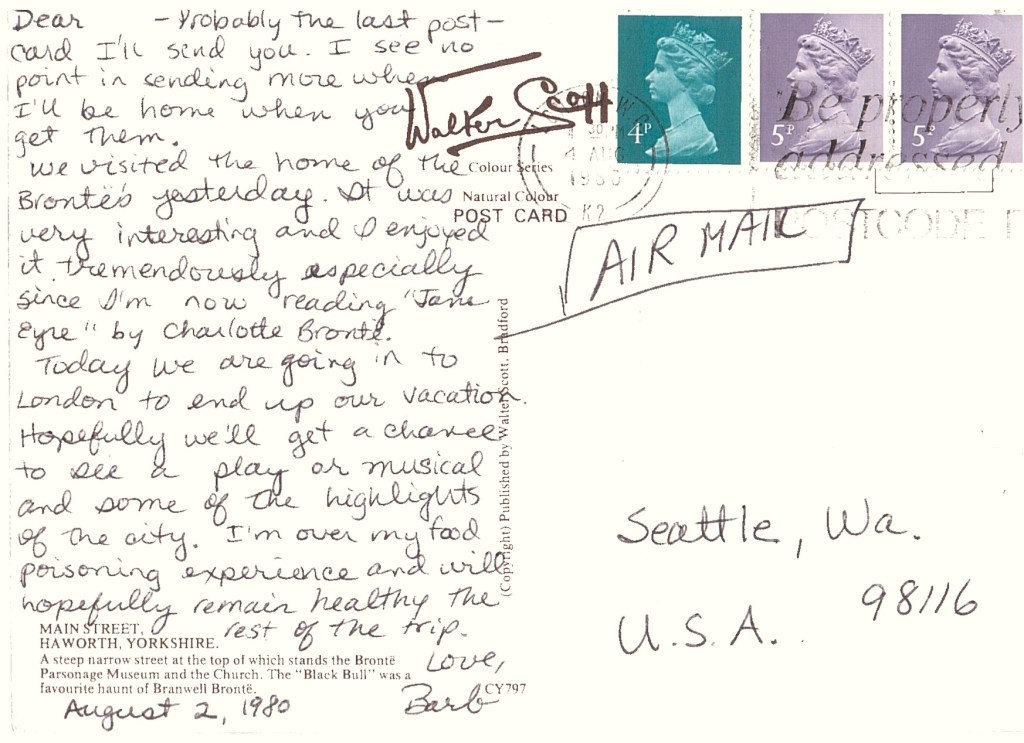
Although we spent the first day in London, the next morning we flew to Bergen, Norway, and began a multi-day bus tour of that country, ending up in Olso. From there, it was fly back to England for car touring as my dad rented a vehicle and we drove up through the countryside to Scotland. After Edinburgh, we returned to London. It was there, on August 2nd, that I write a postcard to my fiancé as follows:

The book I purchased in a London bookshop and read while on the trip; the postcard is the front of the one I sent on my last day in England. This copy of Jane Eyre was likely printed between 1927 and 1936 by Greycaine Ltd., Watford, Herts, Great Britain.

True to what I wrote, it was the final missive I sent. Did I or did I not attend Mousetrap? What was the cause of my malady? Was it truly food poisoning as I believed or had someone doctored my food? Was the ‘poison’ the source of my fuzzy memory? Agatha Christie would, no doubt, approve of such a storyline.

Alas, dear reader, forty years after the fact, it is a mystery which might never be solved. Sounds like the makings of a novel.

The link:

https://en.wikipedia.org/wiki/Agatha_Christie

September 12, 2022 – Update from original post in 2020: The mystery has been solved! Buried in a previously undiscovered box, I found the program from when we attended in 1980. Although it was the 25th year plus three, I still purchased it… for one pound!

The back cover of the program showing St. Martin’s theatre where we saw the Mousetrap in late July 1980
A list of the cast from the evening we were there. I set the paper over the inside facing page for reference

One Giant Leap for Mankind

Men walk on the moon

July 21, 2020

“One small step for man… one giant leap for mankind.”

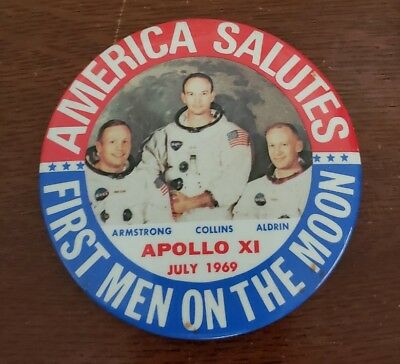
Man on the Moon 1969These words were spoken at 2:56 a.m. (UTC) on July 21, 1969 when astronaut Neil Armstrong took the first steps on the moon.

For those of a technical bent one could argue that those famous steps took place on July 20th; at least that was true for those of us living on the west coast of the United States. Everyone was glued to their television sets all that Sunday afternoon and evening, the drama playing out in a single day.

The race to the moon began over a decade earlier in November 1957 with the creation of the National Aeronautics and Space Administration (NASA) by then President Dwight Eisenhower. Its formation was in response to the USSR’s launch of Sputnik 1, the first artificial satellite. This was followed in early 1961 with the first earth orbit by a human. (see my blog about the Century 21 Exposition and the day a Russian cosmonaut visited!)

The U.S. – now behind in the space race – was urged by President John F. Kennedy to throw their resources and national enthusiasm behind the program. On May 25, 1961 he implored Congress thus:

“I believe that this nation should commit itself to achieving the goal, before this decade is out, of landing a man on the Moon and returning him safely to the Earth. No single space project in this period will be more impressive to mankind, or more important for the long-range exploration of space; and none will be so difficult or expensive to accomplish. We propose to accelerate the development of the appropriate lunar space craft. We propose to develop alternate liquid and solid fuel boosters, much larger than any now being developed, until certain which is superior. We propose additional funds for other engine development and for unmanned explorations—explorations which are particularly important for one purpose which this nation will never overlook: the survival of the man who first makes this daring flight. But in a very real sense, it will not be one man going to the Moon—if we make this judgment affirmatively, it will be an entire nation. For all of us must work to put him there.”

— Kennedy’s speech to Congress

Despite setbacks in the Apollo program, resources were poured into the ambitious plans. With each Apollo mission, the systems were refined as the best and the brightest minds of the day labored to solve the myriad of problems encountered. From the Infallible Wikipedia:

“In July 1962 NASA head James Webb announced that lunar orbit rendezvous would be used and that the Apollo spacecraft would have three major parts: a command module (CM) with a cabin for the three astronauts, and the only part that returned to Earth; a service module (SM), which supported the command module with propulsion, electrical power, oxygen, and water; and a lunar module (LM) that had two stages—a descent stage for landing on the Moon, and an ascent stage to place the astronauts back into lunar orbit.] This design meant the spacecraft could be launched by a single Saturn V rocket that was then under development.

(snip)

Project Apollo was abruptly halted by the Apollo 1 fire on January 27, 1967, in which astronauts Gus Grissom, Ed White, and Roger B. Chaffee died, and the subsequent investigation. In October 1968, Apollo 7 evaluated the command module in Earth orbit, and in December Apollo 8 tested it in lunar orbit. In March 1969, Apollo 9 put the lunar module through its paces in Earth orbit, and in May Apollo 10 conducted a “dress rehearsal” in lunar orbit. By July 1969, all was in readiness for Apollo 11 to take the final step onto the Moon.

Ap11InitialThe Soviet Union competed with the US in the Space Race, but its early lead was lost through repeated failures in development of the N1 launcher, which was comparable to the Saturn V. The Soviets tried to beat the US to return lunar material to the Earth by means of un-crewed probes. On July 13, three days before Apollo 11’s launch, the Soviet Union launched Luna 15, which reached lunar orbit before Apollo 11. During descent, a malfunction caused Luna 15 to crash in Mare Crisium about two hours before Armstrong and Aldrin took off from the Moon’s surface to begin their voyage home. The Nuffield Radio Astronomy Laboratories radio telescope in England recorded transmissions from Luna 15 during its descent, and these were released in July 2009 for the 40th anniversary of Apollo 11.”

It was truly an amazing feat as has been chronicled in book, documentary, and a feature length movie.

At the time Armstrong, particularly, became a national hero; the very face of American greatness. No doubt that mission motivated a whole generation of science minded kids to dream of one day traveling into space beyond the moon.

It was truly an inspirational moment and ranks up there with other events that you absolutely remember where you were and what you were doing.

In those days most families had a single television. So you watched whatever your parents watched. With three basic channels (ABC, CBS, NBC) the choices were limited. On July 20, 1969, ALL three channels were broadcasting just one thing: man landing on the moon.

I was 11 years old that July day and it was a pretty typical Yakima summer day with temperatures in the low 90’s. Like any self respecting kid, I’d watched the initial landing but then wandered off to do other things.

Sometime after dinner, the family gathered around the TV once again to watch the first steps on the moon by Armstrong. A couple of things stick out. Despite having a color television, the moon landing was all in black and white. The American Flag they planted was stiff since there was not any sort of breeze to flap the cloth. And everything was done very, very slowly.

My older brother and I decided to play cards as a way to pass the time. The game was called Casino and it consisted of trying to collect more cards than the other person AND obtain certain specialty cards which were worth points. I remember the two of spades was a desired card, and I doubt I could play the game today. At the time I was pretty good at the game AND very competitive. My brother and I were sitting on the floor of the family room a few feet from the TV, playing our game, and looking up every once in a while to see if anything was happening (it wasn’t).

Finally, just before 8 p.m., Armstrong slowly bounced his way down the steps of the Lunar module, his echo-y micro phoned voice coming through the TV as he intoned, “that’s one small step for man, one giant leap for mankind.”

It was years later when I learned that he had not said what he planned, since the sentence was supposed to be “that’s one small step for A man, one giant leap for mankind.” Personally, I think it was much cooler the way it came out.

Soon after his grand arrival – not being particularly interested in watching the astronauts collect rocks – I drifted away to do other more interesting 11 year old things. I do think we all went outside and stared up at the quarter moon that night, in awe of what had been accomplished.

casino cardsI really can’t recall who won the Casino game, so I’ll just claim I did and squabble with my brother when he reads this. And, BTW, Mr. P., the Shaw and Sons little league guy was out. That’s what Dad always said. Higher and Higher. Cherry Cola. Sibling rivalry and inside jokes are the best.
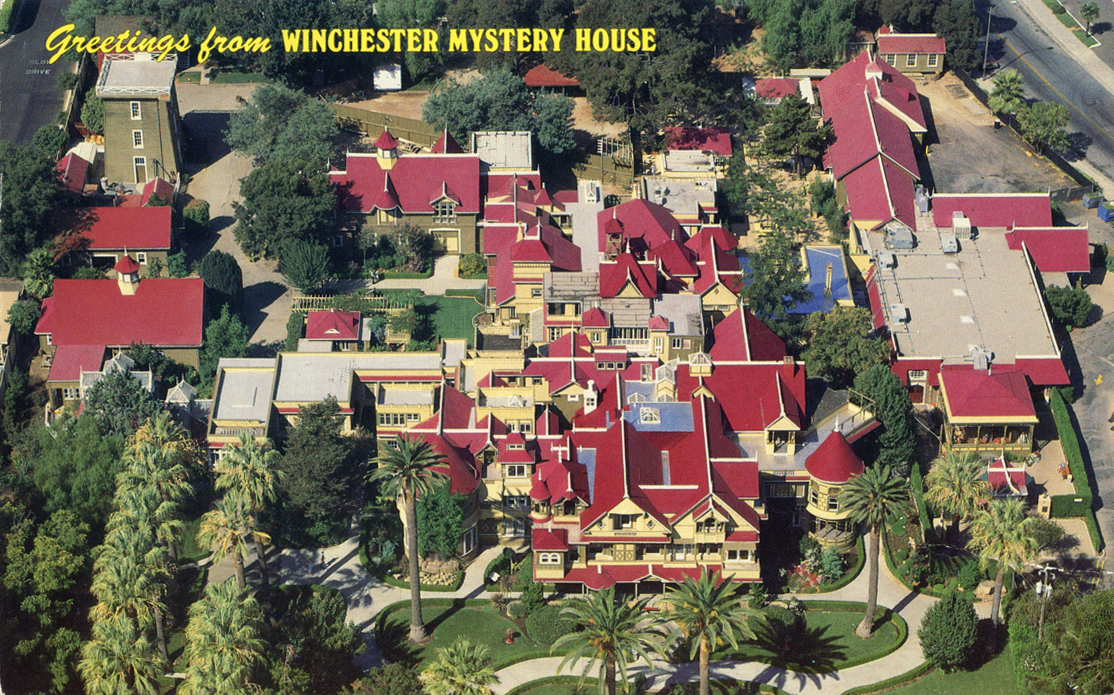
Winchester Mystery House

38 Years of continual construction

June 30, 2020

winchester_mystery_house

The sprawling footprint of the Winchester Mystery House, San Jose, California

By the time the last hammer was silenced in 1922, this house comprised a 24,000 sq. ft.  “foot print” which had been added one room at a time over the course of 38 years. It was a short nine months later, on June 30, 1923, when the house opened for its first tours. The Winchester Mystery house – as it known – is a fascinating place to visit. And the story behind its genesis is the stuff of novels.

Sarah Winchester was the heiress to the Winchester Repeating Arms Company. Her husband, William, had died in 1881 of tuberculosis. Sarah, then age 42, had lost her only child 15 years earlier just six weeks after the baby’s birth; she came to believe that the tragedies which had befallen her were due to the immorality associated with the guns manufactured by Winchester Arms.  Like so many of that age, she consulted a psychic who told her to leave Connecticut and go west. Her mission, she came to believe, was to spend the rest of her life spending her considerable fortune to build a house to atone for husband’s company.

Sarah Winchester

Sarah Winchester

She purchased an 8 room house located on a sprawling farm in the Santa Clara valley of California in 1884; she immediately hired workers to transform the structure into a Victorian mansion. No architect was ever engaged and no blueprint ever produced. It was Sarah who designed and added the rooms. From the Infallible Wikipedia:

“There are roughly 161 rooms, including 40 bedrooms, 2 ballrooms (one completed and one unfinished) as well as 47 fireplaces, over 10,000 panes of glass, 17 chimneys (with evidence of two others), two basement levels and three elevators. Winchester’s property was about 162 acres (66 ha) at one time, but the estate has since been reduced to 4.5 acres (1.8 ha) – the minimum necessary to contain the house and nearby outbuildings. It has gold and silver chandeliers, hand-inlaid parquet floors and trim, and a vast array of colors and materials. Due to Mrs. Winchester’s debilitating arthritis, special ‘easy riser’ stairways were installed as a replacement for her original steep construction. This allowed her to move about her home freely as she was only able to raise each foot a few inches. There was only one working toilet for Winchester; it has been said that ‘all other restrooms were decoys to confuse spirits’ and that this is also ‘the reason why she slept in a different room each night’. The home’s conveniences were rare at the time of its construction. These included steam and forced-air heating, modern indoor toilets and plumbing, push-button gas lights, and Mrs. Winchester’s personal (and only) hot shower from indoor plumbing. There are also three elevators, including an Otis electric and one of which was powered by a rare horizontal hydraulic elevator piston. Most elevator pistons are vertical to save space, but Winchester preferred the improved functionality of the horizontal configuration.”

Winchester-Banner-1

Front entry to the estate

Upon Sarah Winchester’s death September 5, 1922, the property and all her belongings were inherited by her niece and personal secretary who took what they wanted and sold the remaining furniture in an estate sale. The house was considered mostly worthless due to damage sustained during the 1906 San Francisco quake and considered unsellable due to the size and nature of the house.

A local investor, however, purchased it for $139K then leased it to a couple who gave the first tours. That couple, John and Mayme Brown, eventually purchased the house ten years later and it is still owned and operated by their heirs.

2709270244_eee185a1feIf you are in the bay area and have a few hours, a visit to the Winchester Mystery House is worth the time and money. Our family visit occurred in 1995. For my daughter – who was two that year – the intricacies of the house were lost. My five year old son, however, was enthralled. Around every corner was another oddity – a set of three stair risers leading to a door. Which, when opened, revealed a wall. There were rooms where, when you looked up, you saw windows into more rooms. Stairs which once led to upper floors… those levels long since removed but the stairs remained. Up and down the many staircases the tour went… room, after room, after room.stairs to nowhere

My son talked about the mystery house for months, intent, I think, on building his own such house. Thankfully, his obsession waned, as we could not afford unending building projects.

Today, my  now 30 year old son is more minimalist, recognizing that one does not need a lot of space to comfortably live. At the time of our visit to Sarah’s mansion, we lived in a nearly 4,000 square foot house. The problem with a large house is that soon you are filling that house with stuff. Always more stuff. In the past two years the hubby and I have made a concerted effort to reduce our stuff.

One of the blessings of the extended stay at home orders of the COVID-19 pandemic is that there has been time to focus on reduction. Each week, it seems, another box is sorted and purged, the proverbial grain separated from the chaff.

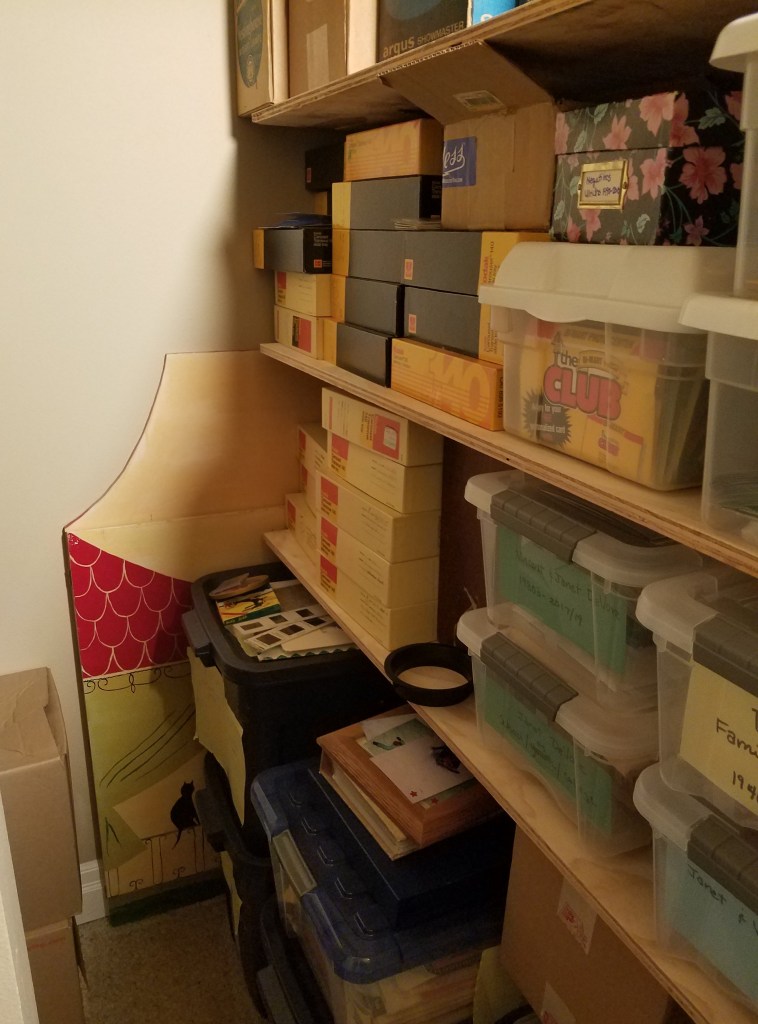
I’m pretty much down to my last big purge: photographs. A couple days ago I ventured in to what I call the “Harry Potter closet” as it is a space under the lower level stairs reminiscent of where the boy wizard lived before discovering his magic powers. Since we moved in it has been the repository for all the bins of family history, the slides of my grandparents as well as our own, 8 and 16 mm movie projectors and reels, VHS and digital camera tapes, and boxes and boxes of photos.

Harry Potter closet

The ‘Harry Potter’ closet after the reorganization. Picture on the left is the entry way.  The picture on this right is what’s stored under the stairs behind the wall from the first photo.

Last Saturday much of the contents of the closet were extricated and then organized and stacked back in the closet for the next purge. Sunday, the first bin of photos dating from the 1990’s to the early 2000’s hit the dining room table.

Ironically, in my first sort, I found photos from our 1995 trip to San Jose but not a single picture from the visit to Sarah Winchester’s house. I wonder what happened to those photos? It’s truly a mystery.

A couple of links:

https://en.wikipedia.org/wiki/Winchester_Mystery_House

https://winchestermysteryhouse.com/

  • Update June 30, 2022 – The Harry Potter closet got an upgrade! Shelves have been built thanks to the hubby and son. Reorganization has taken place but the ongoing photo project is slow going. A few photos of construction and reorg. 
The Harry Potter closet getting shelves
The Harry Potter closet with all the photos, slides, and historical documents
More of the collection…

Game & Watch: Nintendo’s First Handheld Revolution

April 28th

Long before Angry Birds and Candy Crush

A Tuesday Newsday Classic

Decades before anyone had ever uttered the phrases Angry Bird, Temple Run, Word’s with Friends, or Candy Crush, the first wave in digital gaming had arrived in the States from Japan.

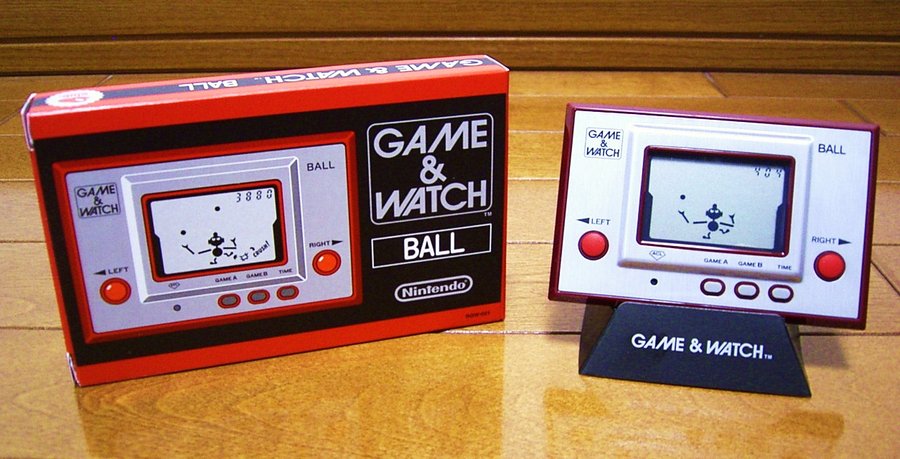
nintendo_game_and_watch___ball
The first Game and Watch released: Ball

On April 28, 1980, a then unknown manufacturer by the name of Nintendo, launched the first of its 4 ½ by 2 ½ handheld electronic game series in the US. And thus the Game and Watch was born, a precursor to the iPhone and Android games of today.

For less than $20 a consumer was able to buy a device which featured – usually – two different games played by pushing tiny buttons to move items around on the screen. From the Infallible Wikipedia:

“The Game & Watch brand is a series of handheld electronic games produced by Nintendo from 1980 to 1991. Created by game designer Gunpei Yokoi, each Game & Watch features a single game to be played on an LCD screen in addition to a clock, an alarm, or both. It was the earliest Nintendo video game product to gain major success.

The units are based on a 4-bit CPU from the Sharp SM5xx family, that include a small ROM and RAM area and an LCD screen driver circuit, although prior to the emulation in MAME there was a misconception in that every unit used a custom ASIC instead of a proper microcontroller.

The series sold a combined of 43.4 million units worldwide.”

Yokoi is said to have conceived the idea while on a bullet train when he observed a fellow traveler playing with his calculator. He reasoned that a small device which would also serve as a clock and alarm and allow the person to play a game could fill the desire for entertainment when unable to do other things.

In all, there were 59 different titles sold. It wasn’t until Nintendo established offices in the United States when the Game and Watch distribution became more widespread in this country.

Our family were early adopters of Game and Watch for one very good reason: The hubby went to work for Nintendo soon after they established their headquarters in Tukwila, Washington. (Yes, it’s true. Their first Washington address was there and NOT Redmond.)

I don’t know why, exactly, we bought all those Game and Watch games, except that Nintendo had an inventory and there was likely an employee discount. Regardless, soon we had friends and family asking for the games and we obliged.

The first one released was called Ball and featured a character later dubbed “Mr. Game & Watch” who juggled balls. He is according to the Infallible Wikipedia: “a generic amalgam of black, open-mouthed, big-nosed cartoonish stick figure silhouettes.” That first game – and three others released in quick succession – sold fewer than 250,000 games worldwide. Two other early games – Vermin and Fire – each sold about a million.

Which is where we enter the story. At the Nintendo warehouse in Tukwila there must have been stacks and stacks of unsold games. It is likely the first one we ever had was Fire and it was one of my favorites. We referred to the game as ‘Burning Babies.’ Yes, politically incorrect but in those days no one had ever uttered that phrase.

My description of the game Fire: On screen you see a cartoonish ambulance on the right side of the screen and a burning multi-story building on the left. Two Mr. Game and Watch characters carry what looks to be a safety net. Their job is to catch the ‘people’ who are literally leaping from the burning building. It starts out benign enough with one tiny person jumping and you must move the firefighters left and right with their net to stop the jumper from hitting the ground. You must then bounce the burning baby across three sections from the building to the ambulance. As the game progresses, a second jumper leaps soon after the first and you must now figure out which one to catch first. It’s like a bad juggling game where soon there are as many as four jumpers on the screen at once! Drop one and you get a tiny little angel icon indicating a lost life. Truly, you have not known stress until you’re frantically trying to save the tiny burning babies. Oh, and as your score increases, so does the speed with which they jump. Yes, that’s me playing the game in the short video below. Yes, it still is stressful when the babies splat on the ground!

Soon, the hubby was bringing home more Game and Watches. The titles included Parachute, Octopus, Fire Attack, Manhole, and Turtle Bridge. Each one seemed to include violent ends to the poor little electronic people or critters if you didn’t do your job. (Which is the common element for the four listed on the FB page!) These were followed by Nintendo’s own characters of Donkey Kong, Donkey Kong, Jr., and Mario’s Cement Factory, as well as licensed character games featuring such cultural icons as Popeye, Mickey Mouse, and Snoopy.

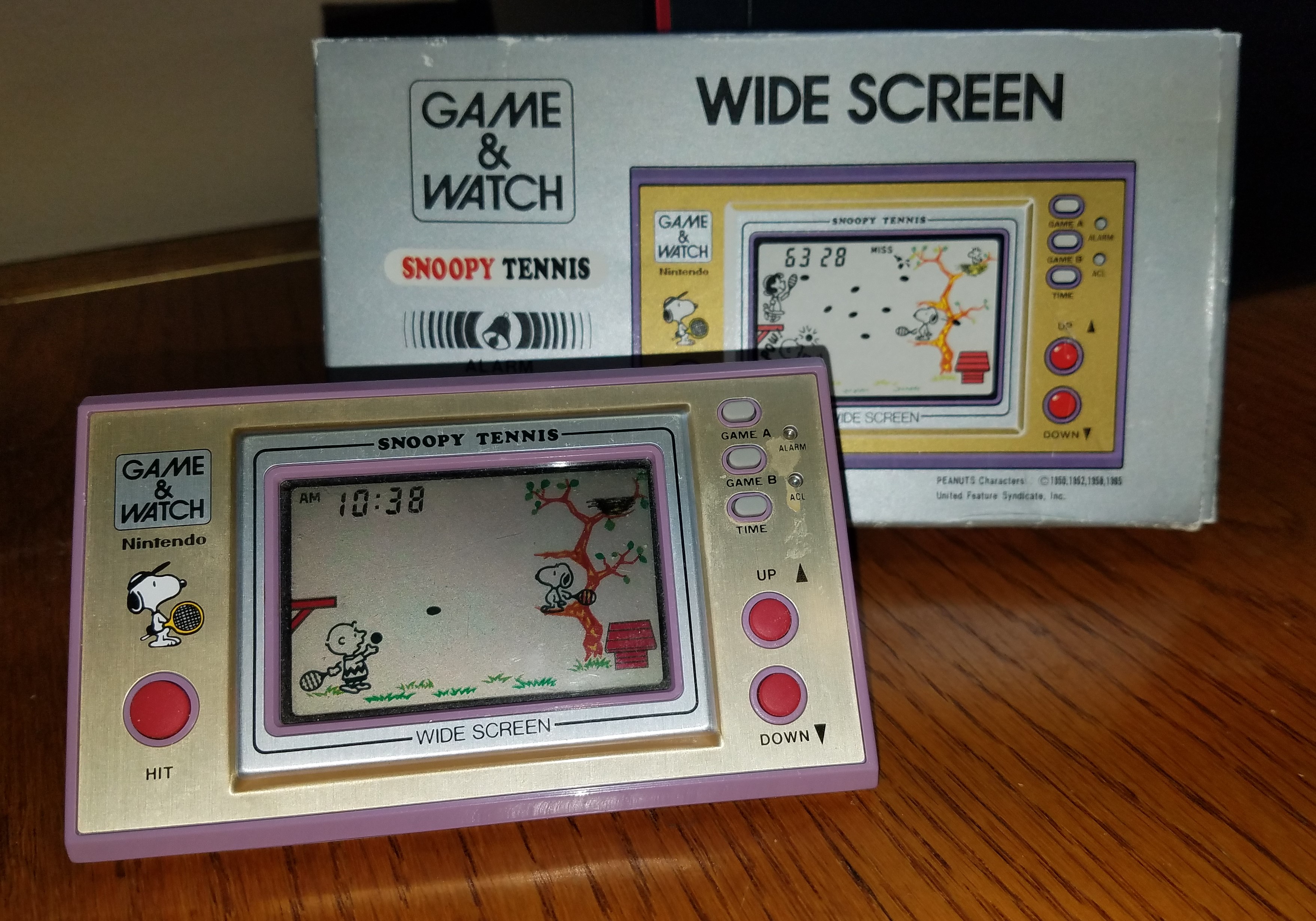
We gave my mother Snoopy Tennis for Christmas in the early 1980’s. It was the perfect game for her as she was a lifelong tennis player and got a real kick out of the tiny Charlie Brown wielding his tiny tennis racket to serve balls to Snoopy who had to jump up and down tree branches to hit it. If he missed, a happily sleeping Woodstock awoke and squawked about it. In the alarm feature, Lucy and piano player Schroeder make an appearance. The best part is that with Snoopy Tennis no tiny imaginary people died.

Snoopy Tennis
Snoopy Tennis was released on April 28, 1982, two years to the day after the first Game and Watch made its appearance.

My mother absolutely owned that game. I think her high score was in the ten thousands and, boy, did those tennis balls come fast and furious. She worked those controls like a boss. Everyone who watched her play was awed. At some point her thumbs got too overworked and she had to give up the game. It bubbled up out of a box when we were going through my parents’ house last summer so we now have two of that game. Hers is the one shown here.

I think about how far electronic games have come since then. I prefer games where when I lose, nothing dies. Which is why I love Candy Crush. Having completed over 5000 levels, I’m in rarefied territory and know of only one friend at a higher level. Like my Mom, I kinda own the game. But I think if my Mom had ever played Candy Crush, she would have given me a run for my money.

The links:

https://en.wikipedia.org/wiki/List_of_Game_%26_Watch_games

https://en.wikipedia.org/wiki/Game_%26_Watch_series

The 100-Year Legacy of the National Christmas Tree

 A 102 Year Tradition

December 24th

2019NCTL_Ceremony.jpg

The 2019 National Christmas Tree

At 3 p.m. on Monday, December 24th, 1923, an American tradition began which continues to this day. That event was the lighting of the first National Christmas tree.

Now, 102 years later, the event occurs earlier in the month – this year on December 4th – as it has since 1954 during a month long event known as the Pageant of Peace. But back to the beginning.

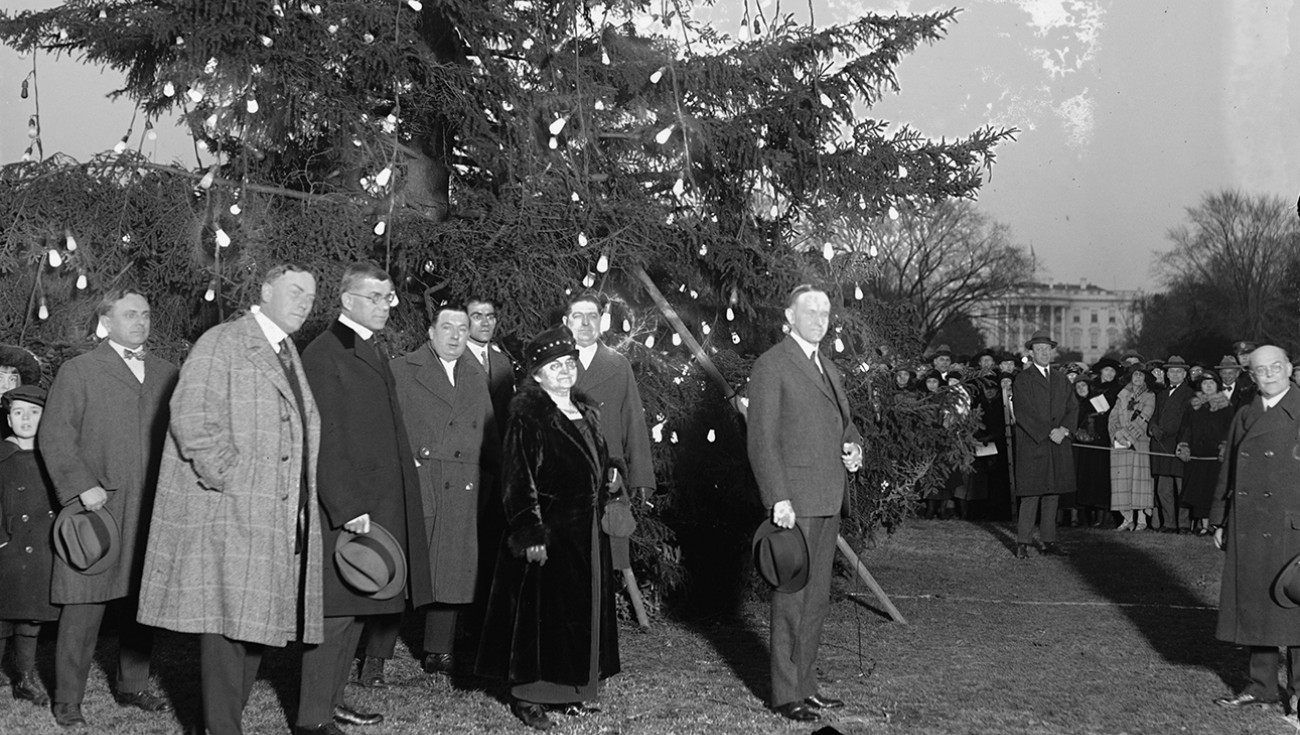
The concept of a National Christmas tree was the idea of Frederick Morris Feiker, an engineer with General Electric. He, along with Vermont US Senator Frank L. Greene, convinced President Calvin Coolidge to light the tree.

Alumni of Middlebury College in Vermont paid for the transport of a 48 foot tall balsam fir to be transported to Washington, D.C. with GE providing 2,500 green, red, and white electric lights.

From the Infallible Wikipedia:

calvin-coolidge-was-the-first-president-to-instate-a-public-christmas-celebration-at-the-white-house-with-the-first-national-chris.jpg

President Calvin Coolidge and dignitaries at the first National Tree Lighting ceremony in 1923

“At 3 p.m. on December 24, 1923, a 100-voice choir from the First Congregational Church assembled on the South Portico of the White House and began a two-hour concert of Christmas carols. At 5 p.m. (dusk) on Christmas Eve, President Coolidge touched a button at the foot of the tree which lit the lights and electric candles adorning the tree, but he did not speak. A searchlight from the nearby Washington Monument was trained on the tree to help illuminate it as well. The Coolidge family invited citizens of the city to sing Christmas carols on the Ellipse after dark. Between 5,000 and 6,000 people thronged the park, joined by 3,000 more people by 9 p.m. The crowds were joined by the Epiphany Church and First Congregational Church choirs, which sang carols, and the Marine Band played Christmas-themed music. The singing ended shortly before midnight. After the white residents of the city had dispersed, African American residents of the city were permitted on the park grounds to see the National Christmas Tree. An outdoor Christian worship service was held, and a mass choir composed of signing groups from area community centers sang more Christmas carols. An illuminated Christian cross was flashed on the Washington Monument, and men dressed as shepherds walked from the National Christmas Tree to the monument.”

300px-US_National_Christmas_Tree_1923The following year Coolidge objected to cutting down a tree for the event so a 35 foot tall live Norway Spruce was located and planted in a new location near the Treasury Building. This tree survived until 1929 when it was determined that the plant had been damaged and needed to be replaced. This began a series of live trees being planted, dying, and being replaced until, in 1934, the last tree was cut down in that location.

In December 1934, the tree and the ceremony were moved to Layfayette park, north of the White House. There it remained for only a few short years before returning to its original site on the Ellipse where it remains to this day. Over the years there have been many, many trees which have served in the role. Additionally, the ceremonies and events associated with it have become quite extensive. If you’d like to read more about its history, here’s the Wikipedia link https://en.wikipedia.org/wiki/National_Christmas_Tree_(United_States) and also the link to the official website https://thenationaltree.org/lighting-ceremony/2019-national-christmas-tree-lighting-ceremony/.

Although I’ve never seen the National Tree, I do love driving around during the Christmas season and viewing all the wonderful outdoor decorations. There is nothing quite so beautiful as a blue spruce or fir tree at night covered with lights AND an inch or two of snow on its branches.

My first memory of such a tree was when I was probably 7 or 8. My bedroom in Yakima faced towards our backyard. Our neighbor, Ray Broten, spent a lot of time keeping his yard beautiful. No matter the season, his was always manicured and trimmed to perfection. That particular December, the spruce tree located in the southwest corner of his backyard cut through the darkness with blue, green, red, and white lights, illuminating my bedroom each night. After I went to bed there was many a time I stole back over to the window and just stood and looked out at his beautiful tree. My favorite nights were when a soft snow was falling, muting the darkness with a blanket of white.

When I got too cold, I’d crawl back in to bed, and as I warmed up and drifted off to sleep, the shine of those lights would bathe the room with a soft glow.

This tradition continued for a number of years until the time I moved away from Yakima. Although those years are long ago, the memory is etched with clarity as Mr. Broten unknowingly created one of my fondest recollections.

May your Christmas also be one of wonderful reminiscences and the creation of new memories. Merry Christmas one and all.

Five Famous Babies

May 28, 2019Dionne quintuplets with mother

Born on May 28, 1934, this set of five identical girls was believed to be the first quintuplets to have all survived such a birth. The chances of an identical five are 1 in 55 million. The news raced around the globe, catapulting the Dionne sisters to international fame.

Already the parents of five children, Oliva (father) and Elzire (mother), were a poor family from Ontario, Canada.  From the Infallible Wikipedia:

“Elzire suspected she was carrying twins, but no one was aware that quintuplets were even possible. The quintuplets were born two months premature. In 1938, the doctors had a theory that was later proven correct when genetic tests showed that the girls were identical, meaning they were created from a single egg cell. Elzire reported having had cramps in her third month and passing a strange object which may have been a sixth fetus.

Dr. Allan Roy Dafoe is credited with ensuring the successful live birth of the quintuplets. Originally, he diagnosed Elzire with a ‘fetal abnormality’. He delivered the babies with the help of two midwives, Aunt Donalda and Madame Benoit Lebel, who were summoned by Oliva Dionne in the middle of the night.

Émilie and Marie shared an embryonic sac, Annette and Yvonne shared an embryonic sac, and it is believed that Cécile shared an embryonic sac with the miscarried sixth baby. All but Émilie were later discovered to be right-handed and all but Marie had a counter-clockwise whorl in their hair.

The quintuplets’ total weight at birth was 13 pounds, 6 ounces. Their individual weights and measurements were not recorded. The quintuplets were immediately wrapped in cotton sheets and old napkins, and laid in the corner of the bed. Elzire went into shock, but she recovered in two hours.

The babies were kept in a wicker basket borrowed from the neighbours, covered with heated blankets. They were brought into the kitchen and set by the open door of the stove to keep warm. One by one, they were taken out of the basket and massaged with olive oil. Every two hours for the first twenty-four, they were fed water sweetened with corn syrup. By the second day they were moved to a slightly larger laundry basket and kept warm with hot-water bottles. They were watched constantly and often had to be roused. They were then fed with ‘seven-twenty’ formula: cow’s milk, boiled water, two spoonfuls of corn syrup, and one or two drops of rum for a stimulant.”

Dionne Quintuplets (6)Even without television or the internet, their birth created media frenzy.  The Province of Ontario – after four months – placed the quints into a guardianship and removed the girls from their parents.  The parents were declared unfit to raise the five girls (but not their other children!).

Dr. Dafoe with quintuplets

Dr. Dafoe with the girls.


A nursery facility was constructed across the street from the Dionne’s farmhouse and staff was hired to care for the girls. Not unlike animals on display in a zoo, the girls were taken out side to a play area three times a day. The paying public could observe them through one way screens. Also from the Infallible Wikipedia:

“Approximately 6,000 people per day visited the observation gallery that surrounded the outdoor playground to view the Dionne sisters. Ample parking was provided and almost 3,000,000 people walked through the gallery between 1936 and 1943. Oliva Dionne ran a souvenir shop and a concession store opposite the nursery and the area acquired the name ‘Quintland’. tourists with viewing clockThe souvenirs, picturing the five sisters, included autographs and framed photographs, spoons, cups, plates, plaques, candy bars, books, postcards, and dolls. Oliva also sold stones from the Dionne farm that were supposed to have a magical power of fertility. Midwives Madame LeGros and Madame LeBelle also opened their own souvenir and dining stand. The quintuplets brought in more than $50 million in total tourist revenue to Ontario. Quintland became Ontario’s biggest tourist attraction of the era, surpassing the Canadian side of Niagara Falls.”Tourists rushing in to view the quintuplets


This arrangement lasted until Dr. Dafoe’s death in 1943 when the girls were nine. Their parents successfully sued the Ontario government for the return of their children.

Unfortunately, the quintuplets continued to be exploited, but this time by their father who used the funds the girls had earned through public appearances and merchandise sales.  He built a large house which featured uncommon luxuries but kept secret from his daughters’ the source of the wealth.  All the girls left home at age 18.

The famous five have been the subject of books, documentaries and movies. Today, in our more enlightened times, we can clearly see the harm which they suffered. In 1998, the three surviving sisters were awarded $2.8 million dollars in compensatory damages from the Ontario government for exploitation.

There have been other high profile ‘multiples’ births since 1934. The McCaughey septuplets, born in 1997, were the first set of seven to all survive birth. The most to be born to one mother and all survive are octuplets with two known such births. The most recent set, the Suleman octuplets, arrived in 2009. Unlike the Dionne sisters, these births were the result of fertility drugs and/or in vitro-fertilization.

From a fairly young age, I thought that I’d like to have twins someday. While that never happened, one of my best friends in high school (and to this day!) was a triplet. What a surprise it must have been for her parents’ with the following scenario: a son was born, then a daughter… then twins (a boy and a girl), followed by… triplets (boy, boy, girl).

I had a conversation with her mother one day after the birth of my son. I told her I was in awe of what she had done and how hard she must have worked to care for that brood of seven. I told her I found taking care of just one baby to be a difficult endeavor. She just smiled and said that it was a lot of effort, but worth it.

Then in the early 2000’s another friend of mine announced she was expecting triplets! I sprang into action and – when she ended up bed-ridden two months prior to her due date – I started sending her daily emails with naming strategies for her three babies. A few examples:

wilma pebbles bettyThe Flintstones: Wilma, Betty, Pebbles

British Royalty: Elizabeth, Mary, Victoria

The Jetsons: Jane, Judy, Rosie

Gilligan’s Island: Ginger, Maryann, Lovey

Bewitched: Samantha, Tabitha, Eldora

The Supreme’s: Diana, Florence, Mary

spice girls    Spice Girls: Sporty, Posh, Ginger

You get the idea. I continued to pepper her with outlandish names until the girls arrived in early June of 2002. Despite the exhaustive list, none of my suggested name combinations were chosen.

So even though I never ended up with ‘multiples’ I did get to join in the fun and awe of such an event and was more than happy with having two ‘singles.’

The links:

https://en.wikipedia.org/wiki/Dionne_quintuplets

https://en.wikipedia.org/wiki/McCaughey_septuplets

https://en.wikipedia.org/wiki/Suleman_octuplets

https://en.wikipedia.org/wiki/Multiple_birth


Facebook answers! The Jackson 5, The Spice Girls, The Dionne Quintuplets, The Beach Boys


Meet Me in St. Louis

Meet Me in St. Louis… Meet Me at the Fair

April 30, 2019

Festival Hall St. Louis.jpg

Festival Hall at the 1904 Louisiana Purchase Exposition

The 1904 Louisiana Purchase Exposition – also known as the St. Louis World’s Fair – is considered by some to be the most significant world’s fair ever.  It was an exposition unlike any the world had ever seen and featured pavilions, gardens, electric light displays, and introduced a number of modern marvels. It opened April 30th and ran through December 1st that year; it drew just shy of 20 million people.

Fair goers marveled at communication wonders like the wireless telephone and also an early fax machine. The x-ray machine was introduced at the fair and two other life saving medical inventions were prominently featured: the Finsen light and Infant Incubators. In the world of transportation, air travel and electric streetcars were both highlighted, but it was the first showing of the personal automobile which created the most buzz.

Yet there was one innovation which, more than any others, captured the imagination of a nation and was destined to be steeped in controversy and take on the qualities of an urban legend. The invention: the ice cream cone.

According to the Infallible Wikipedia, here’s the story:

“Edible cones were patented by two entrepreneurs, both Italian, separately in the years 1902 and 1903. Antonio Valvona, an ice cream merchant from Manchester, UK, patented a biscuit cup producing machine in 1902, and in 1903, Italo Marchioni, an italian ice cream salesman, filed for the patent of a machine which made ice cream containers.

Ice_cream___2A.jpgAt the St. Louis World’s Fair in 1904, a Syrian/Lebanese concessionaire named Arnold Fornachou was running an ice cream booth. When he ran short on paper cups, he noticed he was next to a waffle vendor by the name of Ernest Hamwi, who sold Fornachou some of his waffles. Fornachou rolled the waffles into cones to hold the ice cream – and this is believed by some (although there is much dispute) to be the moment where ice-cream cones became mainstream.

Abe Doumar and the Doumar family can also claim credit for the ice cream cone. At the age of 16, Doumar began to sell paperweights and other items. One night, he bought a waffle from another vendor transplanted to Norfolk, Virginia from Ghent in Belgium, Leonidas Kestekidès. Doumar proceeded to roll up the waffle and place a scoop of ice cream on top. He then began selling the cones at the St. Louis Exposition. His “cones” were such a success that he designed a four-iron baking machine and had a foundry make it for him. At the Jamestown Exposition in 1907, he and his brothers sold nearly twenty-three thousand cones. After that, Abe bought a semiautomatic 36-iron machine, which produced 20 cones per minute and opened Doumar’s Drive In in Norfolk, Virginia, which still operates at the same location over 100 years later.

While the Ice Cream cone does not appear to have been ‘invented’ at the fair, it certainly gained a foothold in popular culture. With the advent of electricity, ice cream – once a delicacy only for the wealthy – became a mainstay for the average person; an affordable treat during a Saturday outing.

Over the years, of course, refrigeration – one of the top 3 inventions ever (the other two are electricity and flushing toilets) in my opinion – made it possible for people to have ice cream stored in their freezer at home. The ability to buy the ice cream and commercially made cones at the local grocer completed the deal.

Personally, I love ice cream cones. I will always choose to have my ice cream in a cone if one is available. As a child I recall that my mother used to purchase the cake style cones and we usually had a choice between vanilla, chocolate, and strawberry ice cream.

waflet conesThen, probably in the early 1970’s, my mother came home from the store one day with colored cake cones. In addition to the boring beige, there were the exciting colors of green, pink, and brown. But even more exciting was the ice cream. It was called chocolate marble and it was an instant favorite. Swirled into the vanilla were ribbons of chocolaty fudge. Now that was an ice cream cone.

Over the years I’ve tried various flavors when at an ice cream shop: Blueberry, Huckleberry, Strawberry cheesecake to name a few… and those are all delicious. But nothing can ever beat a Vanilla chocolate swirl waffle cone. It’s the best.

The links for today:

https://en.wikipedia.org/wiki/Ice_cream_cone

https://en.wikipedia.org/wiki/Louisiana_Purchase_Exposition

History of Ice Cream Cone


Diary of a Young Girl

March 12, 2019

Required reading for all junior high students in the 1970’s, Anne Frank: Diary of a Young Girl, both inspired and dismayed.

anne-and-margot-frank.jpg

Margot and Anne Frank

Although the exact date of the 15 year old’s death is in question, March 12, 1945, is designated as such.

While I tend to avoid controversial and depressing topics, there is no question that this book ranks within the top tier of the most important works of the 20th century and deserves recognition as such.

Anne Frank lived in the Netherlands on June 12, 1942 – her 13th birthday – along with her parents and sister. It was on that date she was given her first ‘diary.’ From the Infallible Wikipedia:

“During the Nazi occupation of the Netherlands, Anne Frank received a blank diary the diaryas one of her presents on June 12, 1942, her 13th birthday. According to the Anne Frank House, the red, checkered autograph book which Anne used as her diary was actually not a surprise, since she had chosen it the day before with her father when browsing a bookstore near her home. She began to write in it on June 14, 1942, two days later.

On July 5, 1942, Anne’s older sister Margot received an official summons to report to a Nazi work camp in Germany, and on July 6, Margot and Anne went into hiding with their father Otto and mother Edith. They were joined by Hermann van Pels, Otto’s business partner, including his wife Auguste and their teenage son Peter. Their hiding place was in the sealed-off upper rooms of the annex at the back of Otto’s company building in Amsterdam. Otto Frank started his business, named Opekta, in 1933. He was licensed to manufacture and sell pectin, a substance used to make jam. He stopped running his business while everybody was in hiding. But once he returned, he found his employees running it. The rooms that everyone hid in were concealed behind a movable bookcase in the same building as Opekta. Mrs. van Pels’s dentist, Fritz Pfeffer, joined them four months later. In the published version, names were changed: The van Pelses are known as the Van Daans, and Fritz Pfeffer as Albert Dussel. With the assistance of a group of Otto Frank’s trusted colleagues, they remained hidden for two years and one month.”

The family and the others were discovered in August 1944 and taken to concentration camps. It was in the Bergen-Belsan camp where Anne, who contracted Typhus, and her sister both died. Of the hidden group, only Otto Frank survived. Those who concealed the family found and saved her diaries and gave the books to her father. It was he who got them published.interior pages of diary

I can’t say exactly when I was first required to read the book, but no doubt it was in junior high (middle school to Americans under the age of 40). The timing of it coincided with when I became obsessed with keeping a diary. Perhaps I had visions of my musings being enshrined forever in a similar manner. Young teenage girls are, particularly, susceptible to drama and tragedy. Unlike Anne Frank, however, my diary entries included such riveting entries such as this one:

“March 1 (1972)

Well here we go again another month gone by. I’m 14 years, 7 months today. It was strange today we have had about four inches of snow, oh joy! I felt like I was being watched. We had a meeting at Mrs. Hughey’s this evening. We started Co-education volleyball in P.E. but I didn’t take it because I can’t, doctor’s orders. Yea! It can’t be that bad but if you take a look at last year’s diary today, you’d understand!”

Even I, the author of the above passage, have no idea what a couple of the references are about. I do know that playing co-ed volleyball when you have the coordination and look of a newborn colt is about the worse torture you can inflict on a teenage girl. The reason I couldn’t play volleyball is that I was still recovering from a nine day case of the hard measles. (We didn’t have a measles vaccination then… get your kids vaccinated. Trust me on this) While I was sick I lost approximately 10 pounds… weight I already could not afford to lose since I was, according to the identification pages at the front of my diary, 5’7” and 110 pounds. Yes, the colt reference is accurate. And, apparently, getting snow in early March isn’t that uncommon either.

diary-2

This author’s diaries. 1972 is on top.

What I do know is that the keeping of a diary galvanized for me a thing which has been a lifelong passion: to write. My musings – set in an easier time in history – will never carry the same weight and warnings of Anne Frank. I’m okay with that. The five years of books which I still have are reminder enough that being a teenager is an awkward and difficult time in life. Anne Frank’s diaries – despite being written under the most challenging of circumstances – still ring true as to the thoughts and emotions of a girl on the cusp of becoming a woman.

For more about Anne Frank and her diary, a couple of links:

https://en.wikipedia.org/wiki/The_Diary_of_a_Young_Girl

https://en.wikipedia.org/wiki/Anne_Frank


Beware Hitchhikers!

February 26, 2019

When one thinks of the most spectacular places in the world, this location is always near the top of the list.  The nearly 5 million visitors a year who trek to its rim, no doubt, help to confirm this impression.  Tomorrow, February 26, 2019, marks a century since it was designated as the 17th National Park in the United States.  Happy 100th birthday to the Grand Canyon!Grand Canyon retro poster

Its statistics and early history, from the Infallible Wikipedia, are as follows:

“The Grand Canyon  is a steep-sided canyon carved by the Colorado River in Arizona, United States. The Grand Canyon is 277 miles (446 km) long, up to 18 miles (29 km) wide and attains a depth of over a mile (6,093 feet or 1,857 meters).(snip)

… Nearly two billion years of Earth’s geological history have been exposed as the Colorado River and its tributaries cut their channels through layer after layer of rock while the Colorado Plateau was uplifted. While some aspects about the history of incision of the canyon are debated by geologists, several recent studies support the hypothesis that the Colorado River established its course through the area about 5 to 6 million years ago. Since that time, the Colorado River has driven the down-cutting of the tributaries and retreat of the cliffs, simultaneously deepening and widening the canyon.

For thousands of years, the area has been continuously inhabited by Native Americans, who built settlements within the canyon and its many caves. The Pueblo people considered the Grand Canyon a holy site, and made pilgrimages to it. The first European known to have viewed the Grand Canyon was García López de Cárdenas from Spain, who arrived in 1540.”

It’s one thing to read about a place in an article or even to see a program on TV or in a theatre. Only when experienced first hand, however, does the grandeur of The Grand Canyon hit you and inspire you to marvel that such a place could exist.grand canyon sunset

In the one time I visited, I learned a valuable lesson. Do not pick up hitchhikers.

When the Hubby and I visited the Grand Canyon in July 1982 we did just that although we didn’t know it at the time. Our road trip – which took us on an over 3000 mile two week adventure – led us to the north rim of the Grand Canyon. Because we were in the National Forest they allowed you, at that time, to camp outside of developed campgrounds. We found a lovely spot not too far from the Canyon rim, pitched our tent and ‘roughed’ it for the night. There was no picnic table or shelter. It was just us, our Honda Civic wagon, and our tent.

The next morning we were up early with the intention of driving to the South rim to visit the National Park. By this point in our trip, however, we were tired of sleeping on the ground and it was time to head home. So we drove the 215 miles to the visitor center, looked down into the gaping hole that is the Grand Canyon and called it good. Then we drove across Arizona, over the Hoover Dam, and up through Nevada to Las Vegas.

It was close to 8 p.m. and we’d been up since 6 a.m. I lobbied to stay the night in Sin City but the Hubby made a really valid point. It was, literally, still 108 degrees outside and he did NOT want to be driving across the Nevada desert during the heat of the day. So we continued north. The sun set and we switched drivers. I was now at the wheel, speeding across Nevada in the dark. And I was feeling a bit sleepy. Because we were young and foolish we kept driving despite our fatigue. We had the windows rolled down so the relatively cooler air would cool us and keep us awake. This seemed to work pretty well until around 11 p.m. or so when I noticed something was moving on the dashboard. At first I thought it was the rag that the Hubby kept there to wipe the dust and film from the insides of the window. Then, when the ‘rag’ moved again, I screamed and proceeded to stop the car in the middle of US Highway 95. By this time the Hubby, of course, suggested in a rather firm way that perhaps I should pull over to the side of the road. Which I somehow managed to do, despite my fear there was a snake or a giant spider in the car.

Doors flew open. Overhead lights illuminated. There we were, unloading the car in the middle of the night in the Nevada desert. Out came the cooler and the bags of food and clothes. We were about to start on everything stored in back when our hitchhiker revealed his (her?) identity: a deer mouse.deermouse

Around the interior of the car our guest scurried and, we were sure, was more frightened of us beating on the backs of seats, than we were of it. I guess it decided that we were no longer the friendly hosts we had been since he got in while we camped on the north rim of the Grand Canyon some 700 miles earlier. The mouse leaped from the car and scurried across the highway into the night.

The adrenaline rush provided me with an alertness which lasted another hour or so before I needed to sleep. The Hubby took over the wheel once again and he made it until about two a.m. when he parked on the side of the road and we both slept in the seats of the car until sometime after sunrise. Later that day we discovered that our guest had chewed through a sleeve of saltine crackers, gnawing off the corner of every single one. I hope he enjoyed his meal because we threw out the rest. And did I mention we were young and foolish? We did what young and foolish people do – we drove all the way back to Seattle that day. It was an epic road trip.

As always, a couple of links:

https://en.wikipedia.org/wiki/Grand_Canyon

https://www.nps.gov/grca/planyourvisit/index.htm


The Great Seattle Snowstorm of 1916: Remembering the Snowpocalypse

No Snow Event has come close in the past 100-plus years

February 5

A Tuesday Newsday Classic Updated

It really should not come as a surprise when snow arrives in the Puget Sound region the first week of February. It could be worse, however, if one looks back in time. The year was 1916 and on February 5th of that year, the Puget Sound region was still reeling from a heavy snowfall which began late on January 31st. It was a 24 hour period from February 1st to 2nd, however, which produced a whopping 21 and half inches of the white stuff. That record snowfall still stands.

union street after 1916 snowstorm

Union Street in Seattle as viewed from 9th Avenue, February 1916. Photo from University of Washington Libraries, Special Collections (link below)

The Infallible Wikipedia gives us but a brief glimpse of that event:

“From January 31 to February 2, 1916, another heavy snow event occurred with 29 in (74 cm) of snow on the ground by the time the event was over.”

However, it does link to a more comprehensive article from HistoryLink.org which, I’ve found over the years, provides excellent coverage of Seattle history minutiae. From the article:

When the big snow of 1916 began to fall on a cold Monday on January 31, 1916, there may have been more cameras than shovels in the hands of amateurs. The flurry of snapshots of our second greatest snowstorm illustrate snow-stopped streetcars, closed schools, closed libraries, closed theaters, closed bridges, a clogged waterfront, collapsed roofs, and — most sensationally — the great dome of St. James Cathedral, which landed in a heap in the nave and choir of the sanctuary. (There were no injuries to persons.)

The unusually cold January already had 23 inches of snow on the ground when, on the last day of the month, it began to fall relentlessly. Between 5 p.m. on Tuesday, February 1 and 5 p.m. on Wednesday, February 2, 21.5 inches accumulated in the Central Business District at the Weather Bureau in the Hoge Building. This remains (in 2002) a record — our largest 24-hour pile.

9th and James 1916 snowstorm

James street as viewed down 9th Avenue. Smith Tower – then the tallest building in Seattle – is on the left. February 1916. Photo from the University of Washington Libraries, Special Collections (link below)

The 1916 snow was a wet snow, and it came to a foul end — a mayhem of mud that mutilated bridges and carried away homes.”

In the category of how quickly we forget, it was in 2017 that the record for snowfall on any February 5th was set when two inches was recorded at Sea-Tac airport. An additional 5.1 inches fell on February 6th for a total of 7.1 inches on these two dates. Then in 2019 and again in 2021, the Puget Sound was hit with two fairly large snow events in February.

What I wrote on the morning of February 4, 2019: “Since the hubby and I moved north from the greater Seattle area in 2018, I cannot accurately compare the amount of snow from our old house to the one here in Mount Vernon. As of this morning we have between 3 and 4 inches and it is still snowing. The view from my office window – with a little wind in play – gives the appearance of being in a powdery snow globe.”

I cannot complain about Puget Sound snow, however. This region has some of the mildest weather in the world and I think of the white stuff as a wondrous treat to be enjoyed. Ensconced in my warm house with a morning cup of coffee – or later in the day with a mug of hot buttered rum – the beautiful coat of white is a magical event.

Too soon the temperatures will rise, the snow will melt, and we will be back to the brown and green scenery which characterizes a Puget Sound winter. One thing I do know is that within a few short weeks, the plum and cherry tree blossoms will erupt in shades of violet and pink and carpets of purple, yellow and white crocus will spread across the landscape. All we will recall from winter will be a few short days in February when the landscape was transformed into a winter wonderland.

On February 4, 2019, this was the view out my office window. Four days later the Puget Sound region was slammed with over 6 inches more.

Interesting perspective on the February 5/6 2017 event:

http://www.seattleweatherblog.com/snow/biggest-february-snowstorm-generation-wallops-seattle/

An article which highlights the biggest Puget Sound snowstorms:

http://www.historylink.org/File/3681

Some great historic photos of the February 1916 snowstorm:

http://archiveswest.orbiscascade.org/ark:/80444/xv07321

The February 8, 2019 snow event which gave us about six inches.
The February 13, 2021 Snowstorm which dumped just over a foot of snow in Mount Vernon.