May 28, 2019
Born on May 28, 1934, this set of five identical girls was believed to be the first quintuplets to have all survived such a birth. The chances of an identical five are 1 in 55 million. The news raced around the globe, catapulting the Dionne sisters to international fame.
Already the parents of five children, Oliva (father) and Elzire (mother), were a poor family from Ontario, Canada. From the Infallible Wikipedia:
“Elzire suspected she was carrying twins, but no one was aware that quintuplets were even possible. The quintuplets were born two months premature. In 1938, the doctors had a theory that was later proven correct when genetic tests showed that the girls were identical, meaning they were created from a single egg cell. Elzire reported having had cramps in her third month and passing a strange object which may have been a sixth fetus.
Dr. Allan Roy Dafoe is credited with ensuring the successful live birth of the quintuplets. Originally, he diagnosed Elzire with a ‘fetal abnormality’. He delivered the babies with the help of two midwives, Aunt Donalda and Madame Benoit Lebel, who were summoned by Oliva Dionne in the middle of the night.
Émilie and Marie shared an embryonic sac, Annette and Yvonne shared an embryonic sac, and it is believed that Cécile shared an embryonic sac with the miscarried sixth baby. All but Émilie were later discovered to be right-handed and all but Marie had a counter-clockwise whorl in their hair.
The quintuplets’ total weight at birth was 13 pounds, 6 ounces. Their individual weights and measurements were not recorded. The quintuplets were immediately wrapped in cotton sheets and old napkins, and laid in the corner of the bed. Elzire went into shock, but she recovered in two hours.
The babies were kept in a wicker basket borrowed from the neighbours, covered with heated blankets. They were brought into the kitchen and set by the open door of the stove to keep warm. One by one, they were taken out of the basket and massaged with olive oil. Every two hours for the first twenty-four, they were fed water sweetened with corn syrup. By the second day they were moved to a slightly larger laundry basket and kept warm with hot-water bottles. They were watched constantly and often had to be roused. They were then fed with ‘seven-twenty’ formula: cow’s milk, boiled water, two spoonfuls of corn syrup, and one or two drops of rum for a stimulant.”
 Even without television or the internet, their birth created media frenzy. The Province of Ontario – after four months – placed the quints into a guardianship and removed the girls from their parents. The parents were declared unfit to raise the five girls (but not their other children!).
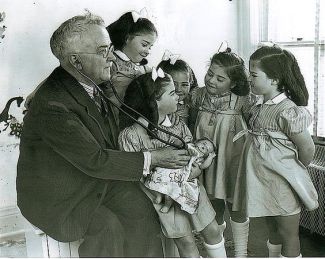
Dr. Dafoe with the girls.
A nursery facility was constructed across the street from the Dionne’s farmhouse and staff was hired to care for the girls. Not unlike animals on display in a zoo, the girls were taken out side to a play area three times a day. The paying public could observe them through one way screens. Also from the Infallible Wikipedia:
“Approximately 6,000 people per day visited the observation gallery that surrounded the outdoor playground to view the Dionne sisters. Ample parking was provided and almost 3,000,000 people walked through the gallery between 1936 and 1943. Oliva Dionne ran a souvenir shop and a concession store opposite the nursery and the area acquired the name ‘Quintland’.  The souvenirs, picturing the five sisters, included autographs and framed photographs, spoons, cups, plates, plaques, candy bars, books, postcards, and dolls. Oliva also sold stones from the Dionne farm that were supposed to have a magical power of fertility. Midwives Madame LeGros and Madame LeBelle also opened their own souvenir and dining stand. The quintuplets brought in more than $50 million in total tourist revenue to Ontario. Quintland became Ontario’s biggest tourist attraction of the era, surpassing the Canadian side of Niagara Falls.”
This arrangement lasted until Dr. Dafoe’s death in 1943 when the girls were nine. Their parents successfully sued the Ontario government for the return of their children.
Unfortunately, the quintuplets continued to be exploited, but this time by their father who used the funds the girls had earned through public appearances and merchandise sales. He built a large house which featured uncommon luxuries but kept secret from his daughters’ the source of the wealth. All the girls left home at age 18.
The famous five have been the subject of books, documentaries and movies. Today, in our more enlightened times, we can clearly see the harm which they suffered. In 1998, the three surviving sisters were awarded $2.8 million dollars in compensatory damages from the Ontario government for exploitation.
There have been other high profile ‘multiples’ births since 1934. The McCaughey septuplets, born in 1997, were the first set of seven to all survive birth. The most to be born to one mother and all survive are octuplets with two known such births. The most recent set, the Suleman octuplets, arrived in 2009. Unlike the Dionne sisters, these births were the result of fertility drugs and/or in vitro-fertilization.
From a fairly young age, I thought that I’d like to have twins someday. While that never happened, one of my best friends in high school (and to this day!) was a triplet. What a surprise it must have been for her parents’ with the following scenario: a son was born, then a daughter… then twins (a boy and a girl), followed by… triplets (boy, boy, girl).
I had a conversation with her mother one day after the birth of my son. I told her I was in awe of what she had done and how hard she must have worked to care for that brood of seven. I told her I found taking care of just one baby to be a difficult endeavor. She just smiled and said that it was a lot of effort, but worth it.
Then in the early 2000’s another friend of mine announced she was expecting triplets! I sprang into action and – when she ended up bed-ridden two months prior to her due date – I started sending her daily emails with naming strategies for her three babies. A few examples:
 The Flintstones: Wilma, Betty, Pebbles
British Royalty: Elizabeth, Mary, Victoria
The Jetsons: Jane, Judy, Rosie
Gilligan’s Island: Ginger, Maryann, Lovey
Bewitched: Samantha, Tabitha, Eldora
The Supreme’s: Diana, Florence, Mary
 Spice Girls: Sporty, Posh, Ginger
You get the idea. I continued to pepper her with outlandish names until the girls arrived in early June of 2002. Despite the exhaustive list, none of my suggested name combinations were chosen.
So even though I never ended up with ‘multiples’ I did get to join in the fun and awe of such an event and was more than happy with having two ‘singles.’
The links:
https://en.wikipedia.org/wiki/Dionne_quintuplets
https://en.wikipedia.org/wiki/McCaughey_septuplets
https://en.wikipedia.org/wiki/Suleman_octuplets
https://en.wikipedia.org/wiki/Multiple_birth
Facebook answers! The Jackson 5, The Spice Girls, The Dionne Quintuplets, The Beach Boys

 At the St. Louis World’s Fair in 1904, a Syrian/Lebanese concessionaire named Arnold Fornachou was running an ice cream booth. When he ran short on paper cups, he noticed he was next to a waffle vendor by the name of Ernest Hamwi, who sold Fornachou some of his waffles. Fornachou rolled the waffles into cones to hold the ice cream – and this is believed by some (although there is much dispute) to be the moment where ice-cream cones became mainstream.
 Then, probably in the early 1970’s, my mother came home from the store one day with colored cake cones. In addition to the boring beige, there were the exciting colors of green, pink, and brown. But even more exciting was the ice cream. It was called chocolate marble and it was an instant favorite. Swirled into the vanilla were ribbons of chocolaty fudge. Now that was an ice cream cone.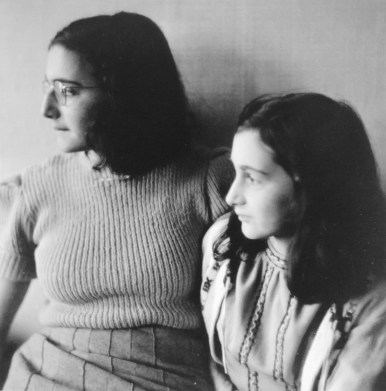
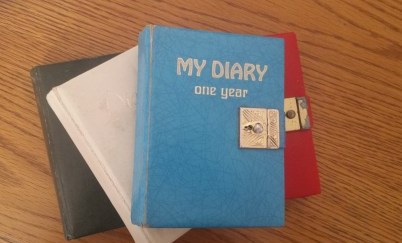
 as one of her presents on June 12, 1942, her 13th birthday. According to the Anne Frank House, the red, checkered autograph book which Anne used as her diary was actually not a surprise, since she had chosen it the day before with her father when browsing a bookstore near her home. She began to write in it on June 14, 1942, two days later.






 Over the years Coney Island was truly ground zero for amusement rides, especially the roller coaster.
 When you ride the Matterhorn, according to the promotional Disney website, you will:
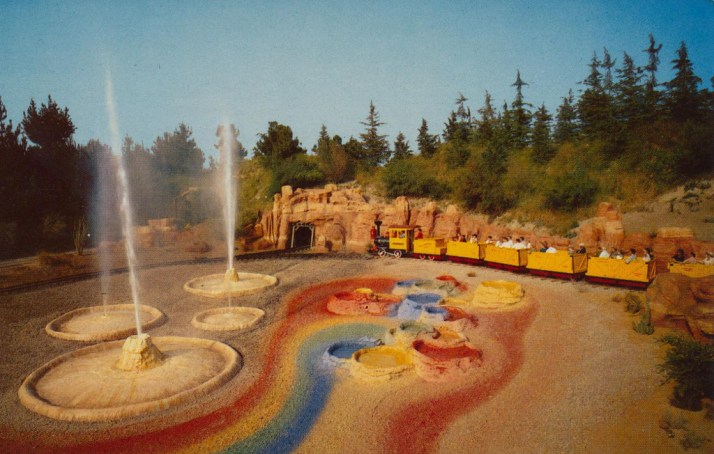 When I first visited Disneyland in the summer of 1970, the ride, called “Mine Train through Nature’s Wonderland,” was a sedate meander through an array of western landscapes including mountains, deserts, and geyser basins. My parents, my sister and I enjoyed the ride at the time, not realizing that it was destined to be re-purposed. The ride was closed in early 1977 and reopened as a roller coaster in September 1979.
 The woman in question was Anastasia Nikolaevna, better known as the Grand Duchess, daughter of the last Russian Tsar Nicholas II. She was born on June 5, 1901.
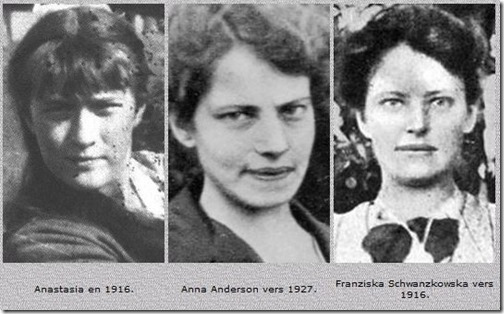 To add to the intrigue, no less than ten women claimed to have been Anastasia. The most famous was a woman by the name of Anna Anderson who insisted she was the Grand Duchess until the day she died.
 And thus ended years of questions and impostors and the mystery of Anastasia turned out not to be a mystery after all.


 Last week we explored the world of horseracing and author Dick Francis. This week we will be discussing galloping. But unlike how a horse gallops, this galloping took place on November 7, 1940 and has since become a text-book example of what NOT to do when building a bridge.
 Although I was not around in 1940, I was going to school in Tacoma on February 13, 1979 when another bridge met the same fate as Galloping Gertie. It was then when I grasped the power of a Pacific Northwest windstorm. During the night prior to its sinking, sustained winds of 85 mph buffeted the Hood Canal floating bridge . They estimated gusts up to 120 mph (called a ‘hurricane’ most anyplace else as any sustained wind over 72 mph is classified as such) had occurred. The structure was swamped and at 7 a.m. that dark, windy and rainy morning, the bridge sank.
 Fast forward to November of 1990 and yet a third Washington state bridge met a similar doom. We watched in fascinated horror live TV news on the morning of November 25th as the floating bridge – being resurfaced to continue carrying traffic while a new span was constructed – which connected Mercer Island to Seattle was inundated. As my husband no doubt said at the time: “surf’s up!”