Archives

Yellowstone National Park

One of the world’s most magical places

March 1, 2022

The family at the northern entrance to the park in 2013

There are only a few places in the world I consider to be magical. This site – which became America’s first National Park – is such a place.

Long before that event, however, stories of this fantastical spot were dismissed as the ravings of madmen. Yet, as more and more intrepid explorers ventured into the American west, the stories of superheated water shooting hundreds of feet into the air, boiling mud lakes, and running water in winter, could no longer be dismissed as pure fantasy. Eventually, the stories proved to be true and, on March 1, 1872, Yellowstone National Park was established. Today marks the 150th anniversary of that event.

As always, the Infallible Wikipedia, shares some of that history:

“In 1806, John Colter, a member of the Lewis and Clark Expedition, left to join a group of fur trappers. After splitting up with the other trappers in 1807, Colter passed through a portion of what later became the park, during the winter of 1807–1808. He observed at least one geothermal area in the northeastern section of the park, near Tower Fall.  After surviving wounds he suffered in a battle with members of the Crow and Blackfoot tribes in 1809, Colter described a place of ‘fire and brimstone’ that most people dismissed as delirium; the supposedly mystical place was nicknamed ‘Colter’s Hell’. Over the next 40 years, numerous reports from mountain men and trappers told of boiling mud, steaming rivers, and petrified trees, yet most of these reports were believed at the time to be myth.
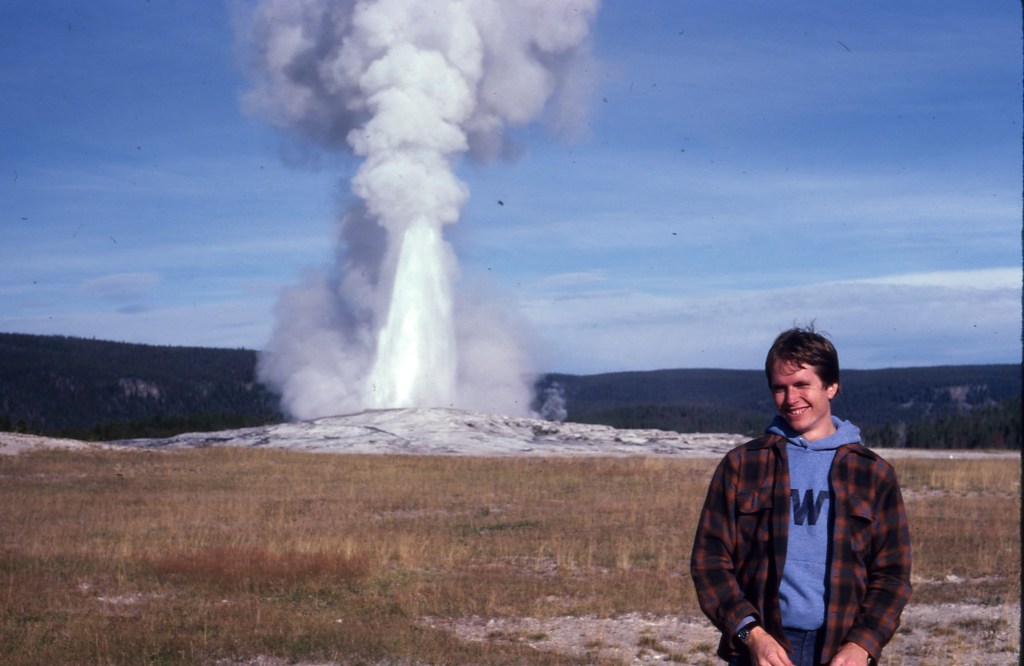
Honeymooner Hubby at Old Faithful September 2, 1980

After an 1856 exploration, mountain man Jim Bridger (also believed to be the first or second European American to have seen the Great Salt Lake) reported observing boiling springs, spouting water, and a mountain of glass and yellow rock. These reports were largely ignored because Bridger was a known ‘spinner of yarns.’ In 1859, a U.S. Army Surveyor named Captain William F. Raynolds embarked on a two-year survey of the northern Rockies. After wintering in Wyoming, in May 1860, Raynolds and his party—which included naturalist Ferdinand Vandeveer Hayden and guide Jim Bridger—attempted to cross the Continental Divide over Two Ocean Plateau from the Wind River drainage in northwest Wyoming. Heavy spring snows prevented their passage, but had they been able to traverse the divide, the party would have been the first organized survey to enter the Yellowstone region.”

The author at Liberty Cap in the Mammoth Hot Springs region July 1982

While today we take for granted our National Parks, in the early years the western lands were often auctioned off, with the thought that having private enterprise take over regions would be best for getting the vast western lands settled.

Thankfully, due primarily to the efforts of geologist Ferdinand Hayden, Congress was convinced to create Yellowstone NP, preserving the lands for future generations to enjoy in as natural a state as possible.

Now, to be fair, this article could go on for pages and pages. There have been books written about the park and its 150 year history. It truly is an amazing story and a good start is on the Infallible Wikipedia page or the official National Park Service site (links below).

Reading about Yellowstone – or even watching video – simply does not do it justice. It has to be seen, smelled, felt, to truly be embraced by the magic of the place.

The author on a hike 1982. The upper geyser basin in the background.

As a child, my family never strayed far from home when we went on vacations. Each summer was a week or two at the beach. As a teenager, we took one trip to California and Disneyland with a stop at Crater Lake in Oregon on the way home.

I was 23 years old the first time I laid eyes on Yellowstone. The hubby and I had been married two days earlier and our honeymoon trip was, in theory, to drive back to Tampico, Illinois to visit his sister and her family. It turned in to so much more.

It was late afternoon on September 1, 1980, when we drove into Yellowstone. From my accounting of that day:

“About 5 p.m. we were at the park entrance. We did stop briefly in West Yellowstone for gas and miscellaneous groceries. While in the park that evening we stopped to see the mud paint pots and smaller geysers. (The hubby) was amazed at me upon witnessing someone who was seeing Yellowstone for the first time.

At every new site, I’d get excited just like a kid at Christmas. The same words always flowed from my mouth: ‘Oh! Wow!’”

Riverside Geyser adorned with a rainbow. 1982

Actually, I think my reaction was more like ‘Oooh! Oooh! Oooh!’

It was not until the next day that I saw a few of the ‘big’ geysers, including Old Faithful. Once again, I was stunned by the amazing displays:

“Two of the more notable geysers we saw erupting were Grand and Riverside. Grand was by far the more spectacular of the two, shooting 200-250 feet into the air.”

That 24 hour visit to Yellowstone was a lot like speed dating. We crammed as much into the visit as our time allowed before continuing east to Illinois.

Yet the ‘date’ left me wanting more. Two summers later we planned and then set out on a two week western US trip which took us back to Yellowstone. Our goal for that trip was to drive on every road in the park, and stay at least one night in each distinctive region. On that trip we found ourselves, literally, walking in the middle of an elk herd! (It was dusky and we were on our way to a campfire program put on by the ranger) We counted 29 does and fawns.

Upright petrified trees can only be seen on an insane hike called ‘Climb Through Time.’
Son and daughter at Minerva Terrace 2013

We saw a moose, marmots, and bison. We climbed to the top of Mt. Washburn and enjoyed spectacular views. We shared our camping spot with an Italian couple who had inadvertently joined us when they didn’t understand how the system worked. We visited the Grand Canyon of the Yellowstone and the Mammoth Hot Springs area. We did a ‘climb through time’ to see a standing petrified forest.

And we achieved our goal of driving every road in the park.

When we left Yellowstone on August 1st, I felt as if I had gotten my fill… at least for a few years.

The pair of us returned in 1989, and then brought the kids in 1998 when they were 8 and 5. Our last visit to the park was in 2013, the kids now 23 and 20, as part of a journey to move our daughter to Nashville.

Even writing about the trips creates a yearning to visit Yellowstone once again. Perhaps it is time to start planning for at least one more journey to this magical place.

The links:

https://en.wikipedia.org/wiki/Yellowstone_National_Park

https://www.nps.gov/yell/index.htm
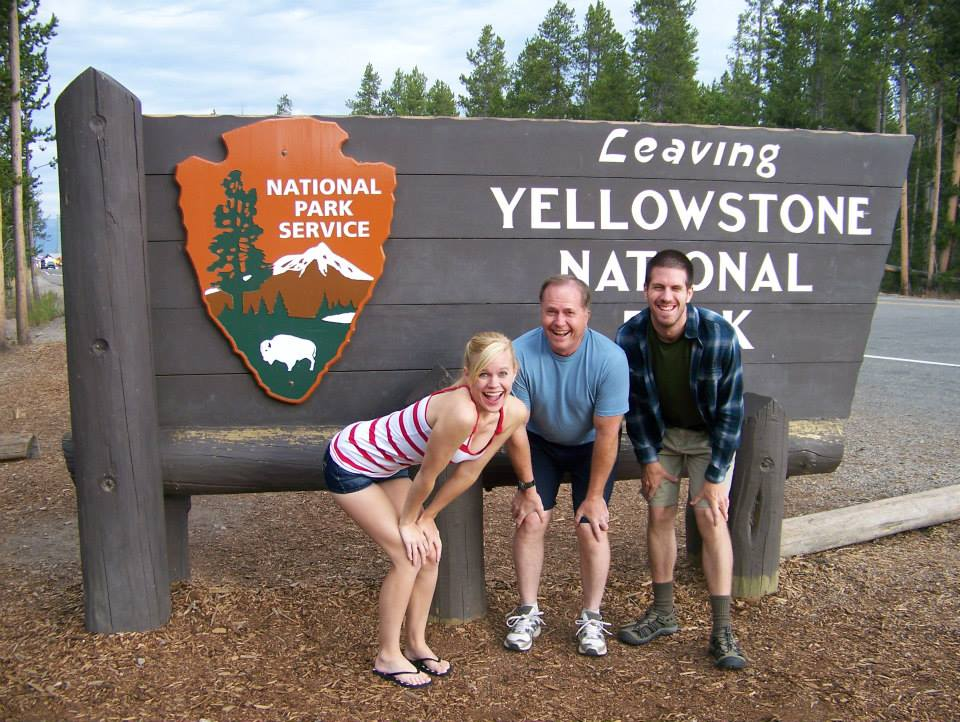
The hubby and kids from our last Yellowstone visit in September 2013

The Dakotas

But Which One Was First?

November 2, 2021

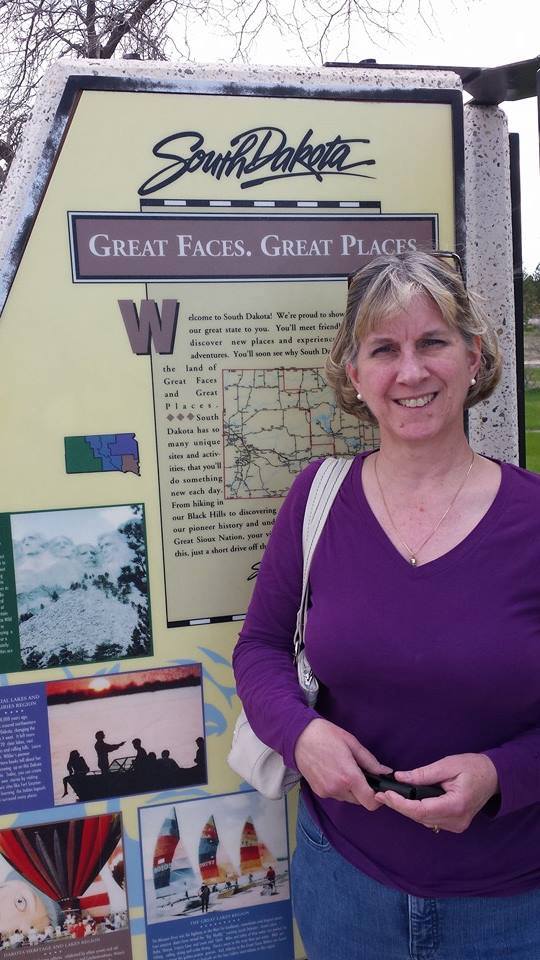
The author in South Dakota in 2014

Up until November 2, 1889, this region was collectively known as Dakota Territory. But it was on that date when the two were split and became the 39th and 40th states in America. But which was first? South Dakota or North Dakota? No one knows for sure.

 The Infallible Wikipedia shares the following story:

“As the southern part of the former Dakota Territory, South Dakota became a state on November 2, 1889, simultaneously with North Dakota. They are the 39th and 40th states admitted to the union; President Benjamin Harrison shuffled the statehood papers before signing them so that no one could tell which became a state first.”

The scene is all blue and yellow at an entrance to North Dakota Road Sign

Or, if you prefer it from the perspective of the other half:

“North Dakota was admitted to the Union on November 2, 1889, along with neighboring South Dakota, as the 39th and 40th states. President Benjamin Harrison shuffled the statehood papers before signing them so that no one could tell which became a state first; consequently, the two states are officially numbered in alphabetical order.”

Sure sounds like North Dakota thinks they were first. For those paying attention, there were four states admitted to the union in November 1889. Besides these two, Montana and Washington were welcomed on November 8th and 11th respectively. But back to the Dakotas.

I find it interesting that they were split north and south since in reading about them geographically, an east/west split would have probably made more sense. The Eastern half of both states are considered part of the Great Plains with climates and an emphasis on agriculture which reflects this. For both states, the majority of their populations live in the Eastern half.

West of the Missouri river – which bisects all of South Dakota and most of North Dakota – the terrain changes. One notices that there are more mountains and the landscape is more rugged as the climb towards the Rocky Mountains begins.

Both states have abundant natural resources particularly gold in South Dakota, rich oil deposits in North Dakota.

The number of folks who call each state home live in their cities as follows for South Dakota:

“Sioux Falls is the largest city in South Dakota, with a 2010 population of 153,888, and a metropolitan area population of 238,122. The city, founded in 1856, is in the southeast corner of the state. (snip)

Rapid City, with a 2010 population of 67,956, and a metropolitan area population of 124,766, is the second-largest city in the state. It is on the eastern edge of the Black Hills, and was founded in 1876. (snip)

The next eight largest cities in the state, in order of descending 2010 population, are Aberdeen (26,091), Brookings (22,056), Watertown (21,482), Mitchell (15,254), Yankton (14,45), Pierre (13,646), Huron (12,592), and Vermillion (10,571)”

North Dakota’s cities are even smaller with Fargo, based on 2021 estimated numbers, coming in the largest at 125,804 residents. The next nine are:

Bismarck (74,129), Grand Forks (54,243), Minot (47,236), West Fargo (38,654), Williston (32,189), Dickinson (24,007), Mandan (23,190), Jamestown (14,840), Watford City (9,345)

I compared these numbers to the three cities of Bellevue, Kirkland, and Redmond, Washington – where the family lived for many years – which has a combined population of about 331,000 people. King County claims 2.3 million people. The two Dakota states combined have about 1.67 million population.

Over the years, the hubby, the kids, and me, have been to both North and South Dakota. Never more than a few days at a time and mostly as brief stops to visit a National Park, Monument, or to spend the night on the way somewhere else.

After the hubby I were married in 1980 something, we drove east on our way to Illinois so that I could meet his older sister and her family. It was day four of our drive when I first saw South Dakota. Well, that’s not entirely accurate. I cannot claim actually ‘seeing’ much since we arrived at the hotel where we were able to get reservations in the middle of the night. It was now September 3rd.

After a short night’s sleep, we were up and out the door by 9 a.m. I wrote about that day with the following:

“Our major stop of the day was at Mt. Rushmore. We saw the presidents and then had a picnic lunch on the shores of Horsethief Lake. We barbequed 3 veal cubesteaks on the hibachi.

The author in all of her age 23 glory at Mt. Rushmore in early September 1980

By 1:30 we left Rapid City, S.D. and headed east on I-90. We drove all day until we got to the Lake Vermillion Recreation area, only to discover that it was no longer a picnic area (or a campground as shown on our AAA map!)

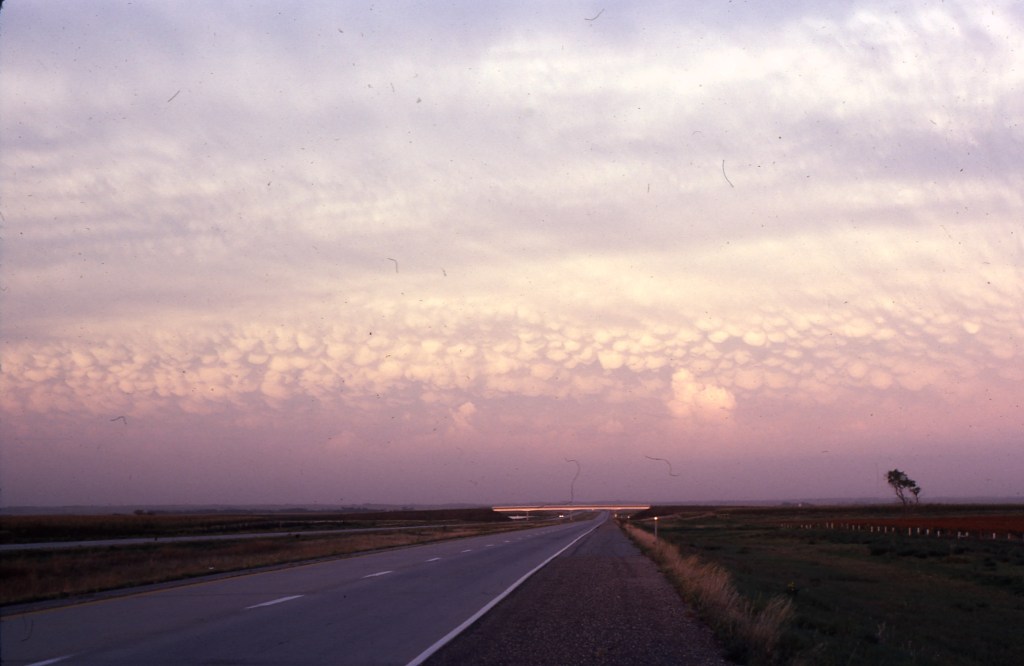
We almost cooked dinner there, but gusty winds made us decide differently. We also learned why it was called Lake Vermillion as just at sunset, the lake turned a deep, blood red color. It was quite pretty against the deep green grass along its bank and the blue and purple puffed clouds in the eastern sky.

The sky which caused us to rethink our plans for camping out on the South Dakota prairie.

Sioux Falls was only a few miles down the road so we decided to eat there. We also decided to stop there – instead of in Fairmont, Minn – when we saw a huge thunder and lightning storm boiling up in front of us.

We stayed at the ‘Thrifty Scot Motel.’ We ended up eating dinner at the “Happy Chef’ – a VIP’s or Sambo type restaurant.* We tried to eat at a Mexican restaurant but it had closed by the time we found it.

One nice feature of the Thrifty Scot was that they had doughnuts and Orange juice for breakfast at no extra cost. We paid $22 for our room there.”

A 1960’s era matchbook cover from Sambo’s restaurant. Because back then not only was the theme politically incorrect, but smoking inside a restaurant was also allowed!

A few things come to mind as I read this account from 40 some years ago. One, anyone under the age of 60 has likely NEVER heard of VIP’s since the last of the chain of 53 restaurants closed in 1988. Two, you can be forgiven for not knowing what a Sambo’s is either as it filed for Chapter 11 in 1981. The owners, Sam Battistone Sr. and Newell Bohnett, combined their names to get the name “Sambo’s” never intending it to be associated with the popular 1899 children’s story of the Indian boy Sambo who turns tigers to butter.

I also guess that the Thrifty Scot was ahead of its time, giving ‘breakfast’ to the travelers for free. J Nowadays, I’d likely skip both the doughnut and the OJ.

In all fairness to North Dakota, we traversed THAT State on the return from Illinois. Unfortunately, I was sick which prompted a stop in Fargo at the emergency clinic, the acquisition of a sulfa prescription for a bladder infection, and then spent the night in the highly entertaining town of Bowbells. (Population 587 in 1980… now about 336) Which is also a story for another post or, possibly, the basis for a work of fiction.

Personally, I think everyone who has the time and the means should attempt to visit every state in the United States. There are interesting things to see and do and one gets a different perspective when one goes beyond the familiar surrounds of where they live.

For more information about the two Dakotas and other items in the post here are some links:

https://en.wikipedia.org/wiki/North_Dakota

https://en.wikipedia.org/wiki/South_Dakota

https://en.wikipedia.org/wiki/Sambo%27s

https://en.wikipedia.org/wiki/VIP%27s_(restaurant)

https://en.wikipedia.org/wiki/Bowbells,_North_Dakota

https://en.wikipedia.org/wiki/The_Story_of_Little_Black_Sambo

Scituate, Massachusetts

What a Mann!

October 5, 2021

When one thinks of the earliest communities settled by the European immigrants, no doubt the word ‘Plymouth’ rolls off most people’s tongues.

New England was not, however, just that one community, but a whole network of towns and villages, dotting the east coast like sand dollars.

As someone who loves history and genealogy, I was thrilled to learn in my research that I can trace several of my family lines to some of the earliest settlements of the now northeast United States.

One of these places is a small town in Massachusetts named Scituate. The spelling alone is enough to cause most people to stop and say ‘how do you pronounce THAT!?’ So let’s get that out of the way. It’s pronounced ‘SIT – U- ATE.’ Just think of it as something you do at dinner each night.

It was on October 5, 1636 when the town was incorporated. Happy 385th birthday!

For those who don’t recall, Plymouth was settled in 1620 when the Pilgrims arrived. Following the success of the early settlers, no doubt word got back to England, and more people made the treacherous sea voyage seeking refuge in the new land.

The Infallible Wikipedia tells us this about Scituate:

“The Wampanoag and their neighbors have inhabited the lands Scituate now stands on for thousands of years. The name Scituate is derived from ‘satuit‘, the Wampanoag term for cold brook, which refers to a brook that runs to the inner harbor of the town. In 1710, several European colonizers emigrated to Rhode Island and founded Scituate, Rhode Island, naming it after their previous hometown.

European colonization brought a group of people from Plymouth about 1627, who were joined by colonizers from the county of Kent in England. They were initially governed by the General Court of Plymouth, but on October 5, 1636, the town incorporated as a separate entity.

The Scituate lighthouse at sunrise.

The Williams-Barker House, which still remains near the harbor, was built in 1634. Twelve homes and a sawmill were destroyed in King Phillip’s War in 1676.

In 1717, the western portion of the original land grant was separated and incorporated as the town of Hanover, and in 1788, a section of the town was ceded to Marshfield. In 1849, another western section became the town of South Scituate, which later changed its name to Norwell. Since then, the borders have remained essentially unchanged.

Fishing was a significant part of the local economy in the past, as was the sea mossing industry. The sea was historically an integral part of the town with occasional incidents such as that described February 13, 1894, in which eight men clinging to the vessel’s rigging on a schooner grounded off Third Cliff apparently died before a large crowd watching from shore ‘literally frozen to the ropes’ while unsuccessful rescue efforts continued through the day and their apparently lifeless bodies were covered by nightfall. A small fishing fleet is still based in Scituate Harbor, although today the town is mostly residential.”

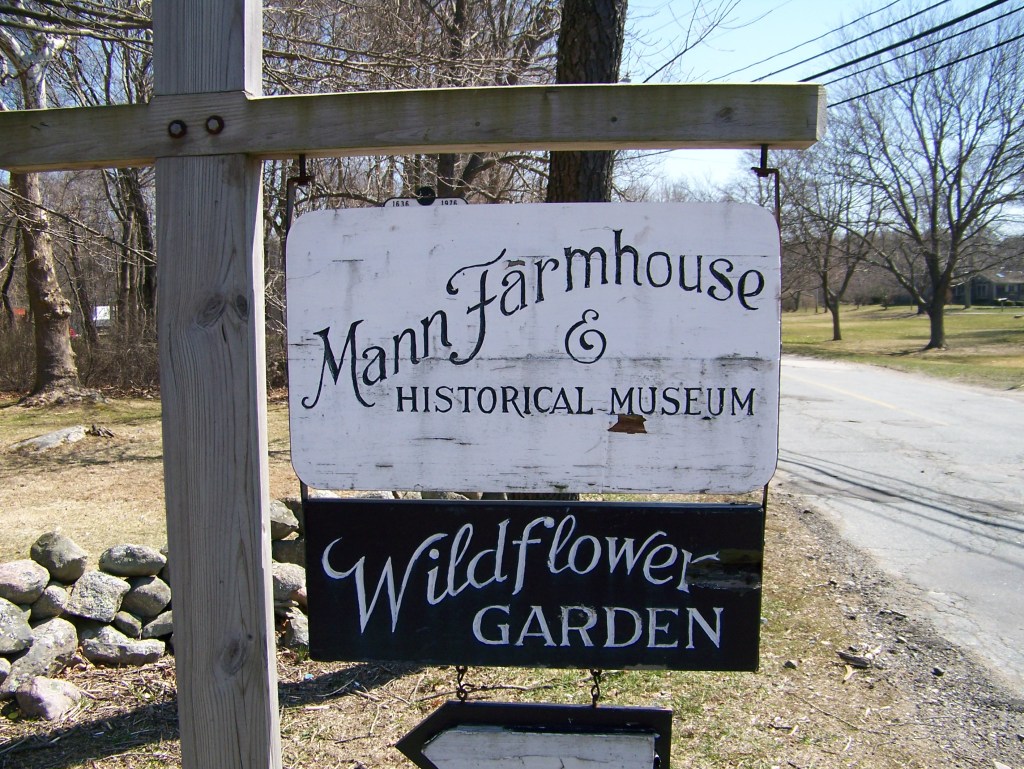
Sign outside the Mann house in Scituate. Photo taken by author 2008

In April 2008, the hubby, daughter, and I took a trip to Massachusetts. We spent two nights in Plymouth. Day three was designated as the day to drive north and stay in the greater Boston area. But something had started niggling at me. Didn’t I have ancestors who came from Massachusetts? I had done research some 10 years earlier and hit the genealogic jackpot when I was able to connect up with a whole string of people who zoomed the family line back from 1848 Wisconsin to Scituate and before that across the Atlantic to England. I now have the Mann’s traced back to 1457.

Although it was the days before Ancestry.com or 23andMe, there were programs on the internet where one could store their family trees. So I logged in and, low and behold, as I worked backwards I found Richard Mann, an early founder of Scituate.

Armed with this information I knew we HAD to go through Scituate! Once headed north, we soon found ourselves inching our way there. There were no interstate highways or tollways, just idyllic backroads decorated with budding deciduous trees and bright spring flowers dotting the landscape. The houses we passed were classic New England colonials and saltboxes. It was all very charming.

Scituate was, well, situated on the coast; still primarily a fishing village three hundred and seventy some years later.

And, of course, I was determined to find the home of great-great-great-great-great-great-great-great -grandpa Dick.

As it turns out, my direct ancestral line left Scituate sometime in the early 1700’s when one Abigail Mann married the (it turns out) scoundrel Simon Baxter, Sr. and moved to Connecticut. That didn’t work out so well for her in the long run as Simon got involved with another woman. Divorce, though rare, was granted in this case to great-great-great-great-great-great grandma Abby since Simon had engaged in “fornication with the widow Rebecca Berg” according to the documents of the day. Yikes.

My Mann ancestry

Fortunately for me, they had managed to produce a son, Simon Baxter, Jr. and HE had a daughter Prudence who fared much better than her grandmother and married one Aristides Huestis (my son is, no doubt, thankful I didn’t want to name him after Aristides). The Huestis family lived in Crown Point, New York. They were hardy people and produced a large gaggle of offspring including my great-great-great-great grandmother, Polly Huestis Noyes, who ended up being an early settler into the state of Wisconsin in 1848.

And on the western migration went clear to the other side of country in only 275 short years.

But I digress. Because there are moments in life when one takes a step back and says ‘this explains so much.’ The visit to Scituate was one of those times.

Poor grandma Abby didn’t have a chance, of course, since the way of the world was very patriarchal at the time. While she married scoundrel Simon and moved away, her brother stayed. And his eldest son, and the eldest son after that, and so on and so forth with a new male heir produced each generation. All the way to the 1970’s when the last direct male descendent of Richard Mann, Percy, died without offspring.

Oh dear. What to do with the house in Scituate? How about we make it a museum?

Which is exactly what they did.

This is a nice thing to do for ancestor hunters because much of the heritage of that particular family line has been preserved for all us ‘Mann’ descendents.

So we arrive at the Mann farmhouse on a cool, but sunny, April afternoon. The house (now the museum) is shut up tighter than a reticent New Englander’s mouth. But the gardens and property were open, so we wander about.

And then we find it – the prize which all genealogists want – that thing, that one thing which makes you say “Huh? So THAT’s where that trait comes from!”

Tucked away behind the house and far from the gardens is a tree… surrounded by a car. That’s not entirely accurate. This whitewashed account is from the Scituate Historical Society:

“After Percy Mann had a run-in with the town’s officials in the 1920’s, he decided that rather than pay vehicle registration fees, driver’s license fees, and car insurance, he would just drive his automobile into the back yard, park it and never drive it again. Over the course of time a tree grew up through the middle of the car, which remains where Percy left it almost a century ago.”

The remains of Percy Mann’s car in 2008

I still laugh when I imagine how this whole thing REALLY went down. Old Percy must have been as stubborn as a Nor’easter in November. No one, not even the town leaders, were going to tell him he had to pay fees and get a license to drive a car. “Ah, hell,” one imagines he railed, “I did fine with my horse and wagon and no one’s gonna force me to buy a g-damned license for it!”

So he did what any rational Mann man would do. He drove the car onto the property and never touched it again. That’ll show ‘em.

There is absolutely no doubt my DeVore family is related to the Mann’s, possessing that same stubborn New England Yankee obstinate spirit. It’s in the genes.

As always, a link or two:

https://en.wikipedia.org/wiki/Scituate%2C_Massachusetts

http://scituatehistoricalsociety.org/mann-house/

http://freepages.rootsweb.com/~dyer/genealogy/Mann/D1.htm

Boston, Massachusetts

To Wooster and Beyond

September 7, 2021

One of the best parts of travel is climbing behind the wheel of a car and exploring interesting historical places. Boston is one of those places where history seems to live on every corner.

The Old North Church, Boston Commons, Bunker Hill, and Paul Revere’s house are but a few of the many  locations one can visit.

Paul Revere statue on a rainy day in April 2008

Boston – which was named as a settled town on September 7, 1630 – was one of the earliest and most influential places in America.

Of course The Infallible Wikipedia has something to say on the subject:

“Boston is one of the oldest municipalities in the United States, founded on the Shawmut Peninsula in 1630 by Puritan settlers from the English town of the same name. It was the scene of several key events of the American Revolution, such as the Boston Massacre, the Boston Tea Party, the Battle of Bunker Hill and the siege of Boston. Upon American independence from Great Britain, the city continued to be an important port and manufacturing hub as well as a center for education and culture. The city has expanded beyond the original peninsula through land reclamation and municipal annexation. Its rich history attracts many tourists, with Faneuil Hall alone drawing more than 20 million visitors per year. Boston’s many firsts include the United States’ first public park (Boston Common, 1634), first public or state school (Boston Latin School, 1635) and first subway system (Tremont Street subway, 1897).

Today, Boston is a thriving center of scientific research. The Boston area’s many colleges and universities make it a world leader in higher education, including law, medicine, engineering and business, and the city is considered to be a global pioneer in innovation and entrepreneurship, with nearly 5,000 startups. Boston’s economic base also includes finance, professional and business services, biotechnology, information technology and government activities.

In the United States today, the greater Boston area is the tenth largest Metropolitan Statistical Area and the largest city in New England.

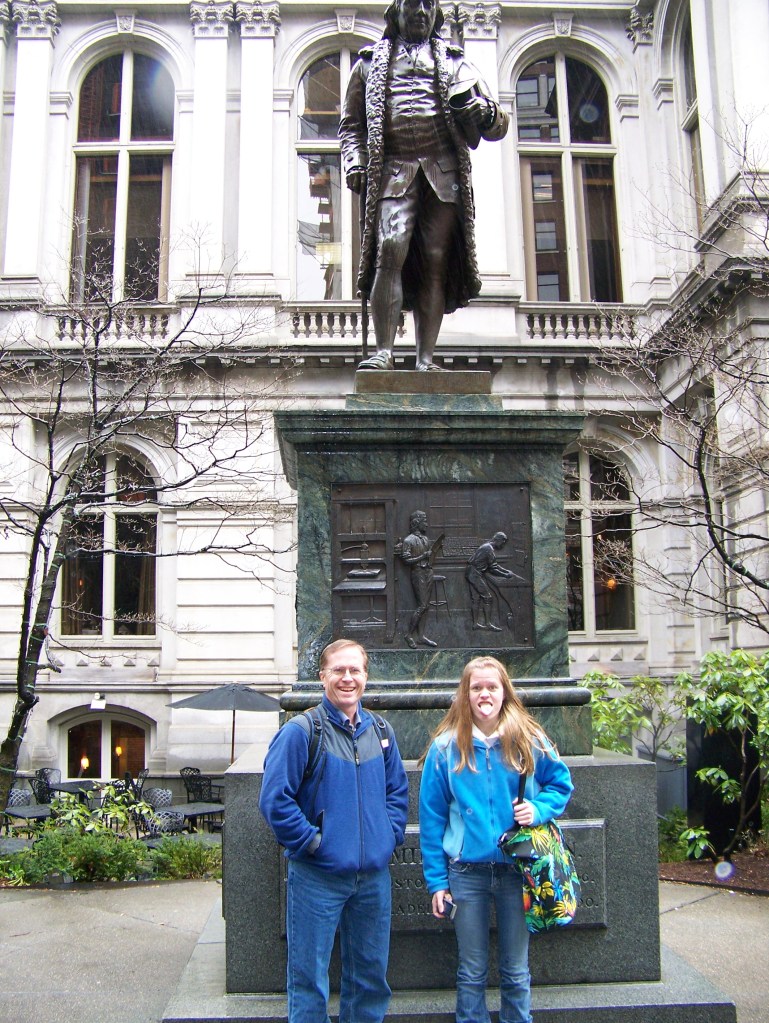
The hubby and daughter at Ben Franklin’s birthplace

The hubby, daughter, and I had the chance to visit Boston in 2008 when she was the representative for Massachusetts for the Washington Idaho Rainbow Girls. We only had one day in Boston proper, but visited a number of the historic sites. The city was a busy, vibrant place even on that cold and rainy April day. We walked around the city and thoroughly enjoyed the historical immersion.

Now, getting into Boston was a completely different experience. Because our trip would take us into western Massachusetts, renting a car was essential.

On the day we arrived at Logan Airport we picked up our luggage then made our way to the rental car lot. The clerk was not too concerned about which car he assigned us; instead he told us to pick one from this one particular row of vehicles.

So out we wandered to the dozens of identical make cars. How to choose? We decided on one with New York license plates for no other reason than our niece and my sister were visiting in New York while we were in Massachusetts.

Soon we were ensconced in the car and off on our adventures. On our second night – after our first down in Plymouth – we stayed in a hotel out in Revere. This afforded us reasonable access to Boston proper with about a 20 minute commute.

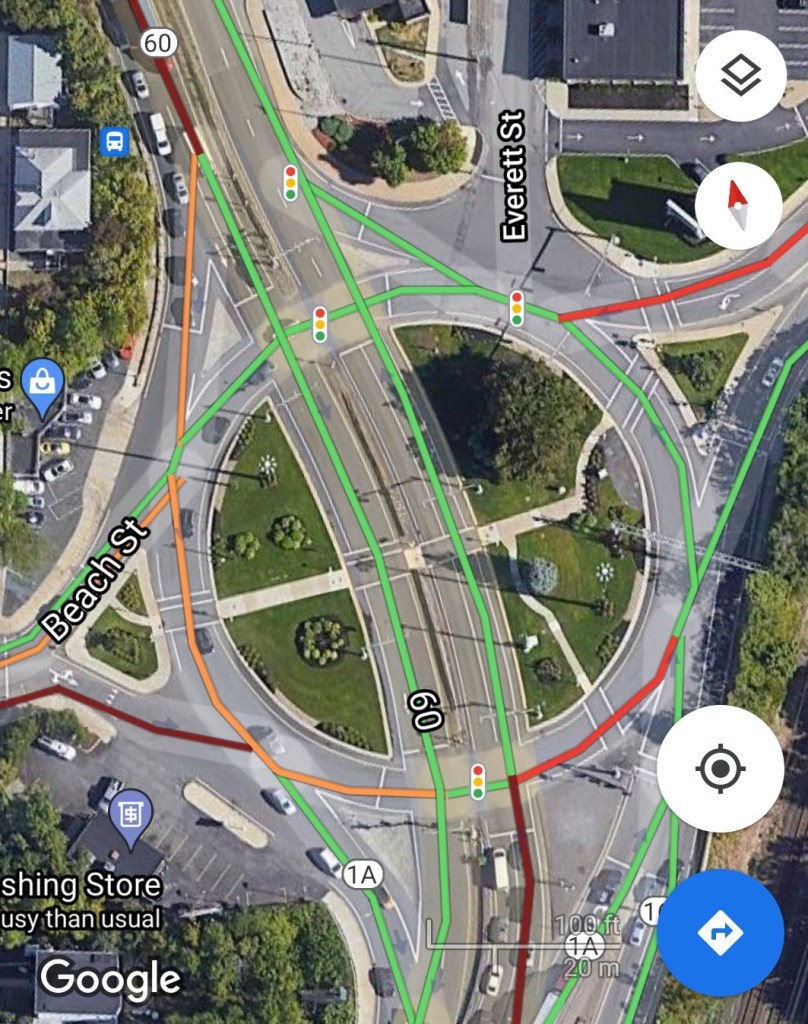
Soon we learned that to get to Boston the most direct way was to head south on Everett Street and then merge into the traffic rotary (we call them roundabouts in Washington) and then on to the 1-A.

It was a great plan in theory. In fact there were two things wrong with our plan. Did I mention that we were driving a car with New York plates?

New York license plates? Not a good idea.

As it turns out, people in Massachusetts pretty much hate New Yorkers. Might be related to the Red Sox and the Yankees, but I’m speculating. Or it might be that they just have no patience for anyone who does not drive as crazy as they do.

We were honked at, gestured at, and given the double middle finger salute multiple times over the course of the week.

But back to the rotary. This particular roundabout was HUGE… and the cars were doing at least 40 miles per hour and, in some cases, traveling three abreast.

The death trap rotary as seen from my map App

The hubby, like a good granny driver, pulls up to the stop sign and then waits for a break in the traffic; but there is no break in traffic. Cars whiz by at speeds which made my head spin.

Meanwhile there are now cars backing up behind us. Horns are honked at us as if doing so will somehow motivate the hubby to hit the accelerator and dive into the path of oncoming death.

Then the weirdest thing occurs. The car behind us – his patience apparently all used up – pulls around us on the left and, in a life endangering move, zooms into the rotary, squeezing between a truck and a car. This happens a couple more times – honking horns, hand gestures, and illegal passing – while the hubby is evaluating the possibility of success. Eventually he spies two feet of open space, floors the gas pedal and we rocket into the rotary, somehow emerging unscathed.

In fact our visit to Massachusetts was one driving adventure after another. Heaven help you if you miss your exit and end up in Jamaica Plain. But that’s a story for another day. And woe unto you if you are relying on paper maps… by the time we got to Worcester (pronounced Wooster, by the way) street signs had all but disappeared. I guess most people have lived there for so long that they don’t need street signs.

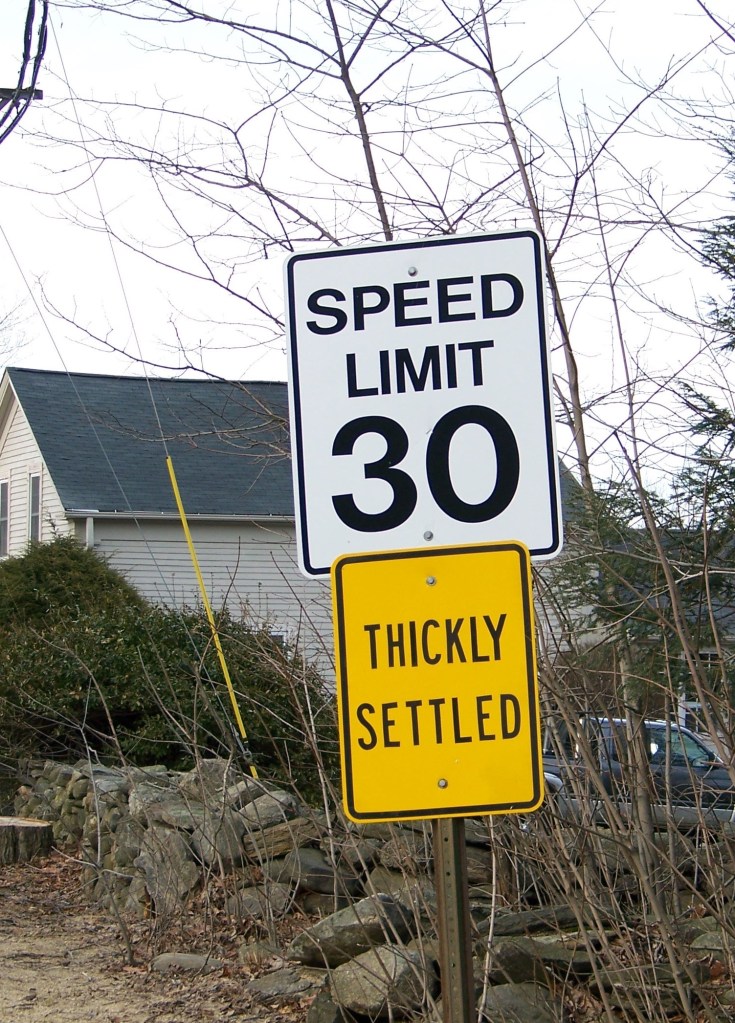
The street signs we found were mostly of this variety…

Somehow we made it to Barre (pronounced Barry) for our event despite the navigator (that would be me) making wild guesses as to which road we needed to take.

So just remember this… if you are flying into Boston and need a rental car, never ever, under any circumstances agree to drive one with New York plates. On second thought, hiring an Uber might be a better plan.

A link or two:

https://en.wikipedia.org/wiki/Boston

https://en.wikipedia.org/wiki/Roundabout

The Beginnings of Disneyland: A Magical Journey

The Happiest Place On Earth

July 20th

A Tuesday Newsday Classic

Where oh where to begin with this week’s topic? For those of us born from the mid-1950’s on, there was never a time when this, the ‘happiest place on earth’ did not exist.

We learned about Disneyland via Sunday night’s Wonderful World of Color which featured Disneyland’s Sleeping Beauty’s castle against a back drop of brilliant fireworks. It was an aspirational sort of thing, I suppose, instilling in our Baby Boomer hearts the desire to go to Disneyland and find our own happiness there.

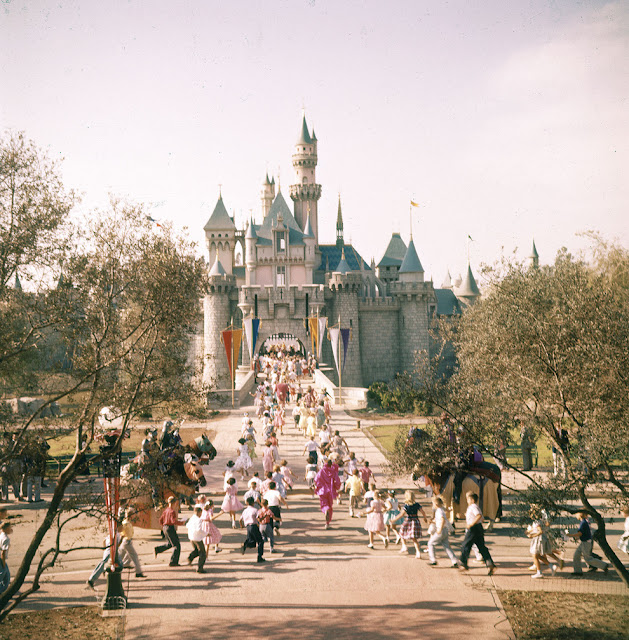
The crowd running towards Sleeping Beauty’s castle July 17, 1955

It was the third week of July 1955, when the park officially opened, one year and one day from when construction began. Walt Disney’s concept came while sitting on a bench at a quiet park one day and watching his two daughters play. Instead of parents just observing from the sidelines, he mused, wouldn’t it be great to have a place where kids and parents could have fun together?

It would be nearly 20 years before Disneyland would finally become a reality.

The Disneyland most people know today would be nearly unrecognizable to Disney himself. The first rides were, for lack of a better term, rather bland. There was not a roller coaster to be found anywhere within the park. It’s most popular early attractions were “Jungle Cruise,” “Autopia,” and “Rocket to the Moon” (later to Mars). Guests strolled along Main Street, hopped aboard the Disneyland Railroad, or sailed the raft over to Tom Sawyer Island for fun. There were a few carnival type rides but by today’s standards those would be considered ‘kiddie’ rides.

Opening day was a disaster. From the Infallible Wikipedia:

Walt Disney and his grandson taking a break from the 101 degree temperatures on opening day

“Traffic was delayed on the two-lane Harbor Boulevard. Famous figures who were scheduled to show up every two hours showed up all at once. The temperature was an unusually high 101 °F (38 °C), and because of a local plumbers’ strike, Disney was given a choice of having working drinking fountains or running toilets. He chose the latter, leaving many drinking fountains dry. This generated negative publicity since Pepsi sponsored the park’s opening; disappointed guests believed the inoperable fountains were a cynical way to sell soda, while other vendors ran out of food. The asphalt that had been poured that morning was soft enough to let women’s high-heeled shoes sink into it. Some parents threw their children over the crowd’s shoulders to get them onto rides, such as the King Arthur Carrousel.

In later years, Disney and his 1955 executives referred to July 17, 1955, as ‘Black Sunday’. After the extremely negative press from the preview opening, Walt Disney invited attendees back for a private ‘second day’ to experience Disneyland properly.”

Despite the inauspicious start, Disney persevered, never resting and always looking for innovative ideas and opportunities to improve the park and thus the experience for paying guests.

The first roller coaster, the now iconic Matterhorn, opened in 1959. It was eventually joined by a second coaster, Space Mountain, in 1977.

The Matterhorn under construction 1959

Although many of the original attractions are still a part of Disneyland, the Disney company has never been afraid to update and upgrade to keep pace with the changing technology or the desires of the public. Many of the attractions kids of the 1960’s and 70’s remember fondly are long since gone.

As a child – and knowing about Disneyland – it was a place I wanted to go. For my family, however, it was not within reach. It was only after the passing of my grandmother in January 1970 that the wheels were set in motion for a trip which took my Dad, Mom, Sister, and me south to Anaheim. I chronicled my first Disneyland visit in a previous blog post https://barbaradevore.com/2020/05/26/the-great-american-road-trip/.

Having gotten a taste of the Disney experience, I was excited when – along with the Rainbow Girls – I had another day at the park in late July 1976. And much like the first visit, it was a one day visit. The rides were few and mostly I recall riding the Matterhorn and meeting the Big Bad Wolf.

My sister encounters the Big Bad Wolf

It was after the hubby and I had been married for nearly eight years when we hatched our ultimate Disneyland plan. We flew to California in January 1988 to spend three entire days at the theme park. While there, we agreed, we would ride EVERY ride they had to offer; see every show; eat all the food. We would immerse ourselves in all Disney, all the time.

A few things stand out from that trip. One, when we arrived at John Wayne airport it was probably 8 or 9 p.m. and 60 degrees. To us, coming from 40 and rain Seattle in January, it seemed like summer. We laughed at a woman standing near the open air luggage carousel who was, literally, wearing a parka, fur hat, and big mittens.

Second, we videotaped pretty much every ride. Alas, without the magic of the machine which can convert VHS those tapes are consigned to a dusty box in the Harry Potter closet. (see article here: https://barbaradevore.com/2020/06/30/winchester-mystery-house/) One of these days I do plan to get those old tapes digitized!

Third, it was truly one of the best vacations the hubby and I took. We were 30 and 31 years old, did not yet have children, could afford to pay for whatever we wanted, and for three days we got to act like teenagers but better. Not only did we go on ALL the rides (yes, even the ‘kiddie’ rides), but we did several of the best ones multiple times. Space Mountain? check/check. Matterhorn? check/check/check. Haunted Mansion? check/check/check. Big Thunder Railroad? check/check/check/check/check.

In the years since, we’ve taken our children to Disneyland a couple of times and to DisneyWorld once. The hubby and I even had a solo day at Epcot a few years ago. But I’m not so keen on roller coasters any more. Those are, sadly, more the province of the young and less fragile among us. Even so, I think it would be fun to return to Disneyland with our adult children (neither of whom have any children at this point) during a time of year when the crowds are reduced and we can once again ride any ride we like as many times as we want. That, to me, would be magical.

Hubby and me with the two littlest ones on the Disneyland railroad 1995
Hubby and kids waiting for Big Thunder Railroad roller coaster circa 1998
Disneyland circa 1998

As Walt Disney said on opening day in 1955:

“To all who come to this happy place: Welcome. Disneyland is your land. Here age relives fond memories of the past, and here youth may savor the challenge and promise of the future.”

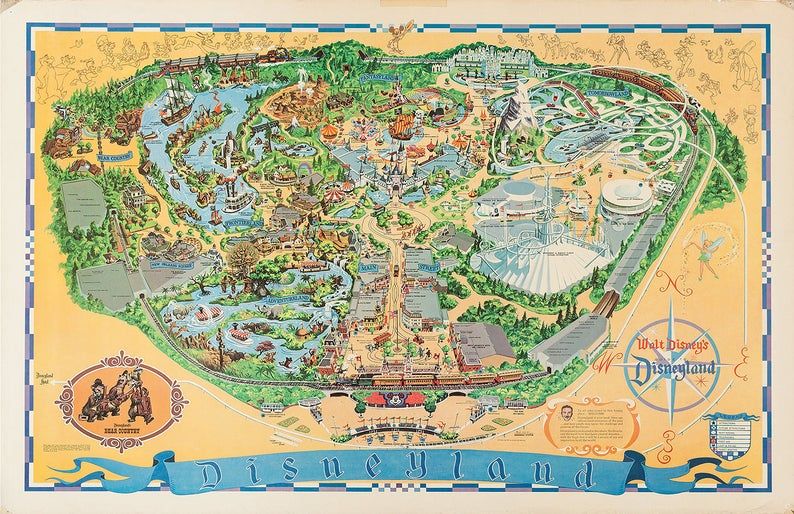
Disneyland Map 1970

https://en.wikipedia.org/wiki/Disneyland

Star Wars: The Original Trilogy Experience

“I’ve Got a Bad Feeling About This”

May 25th

A Tuesday Newsday Classic

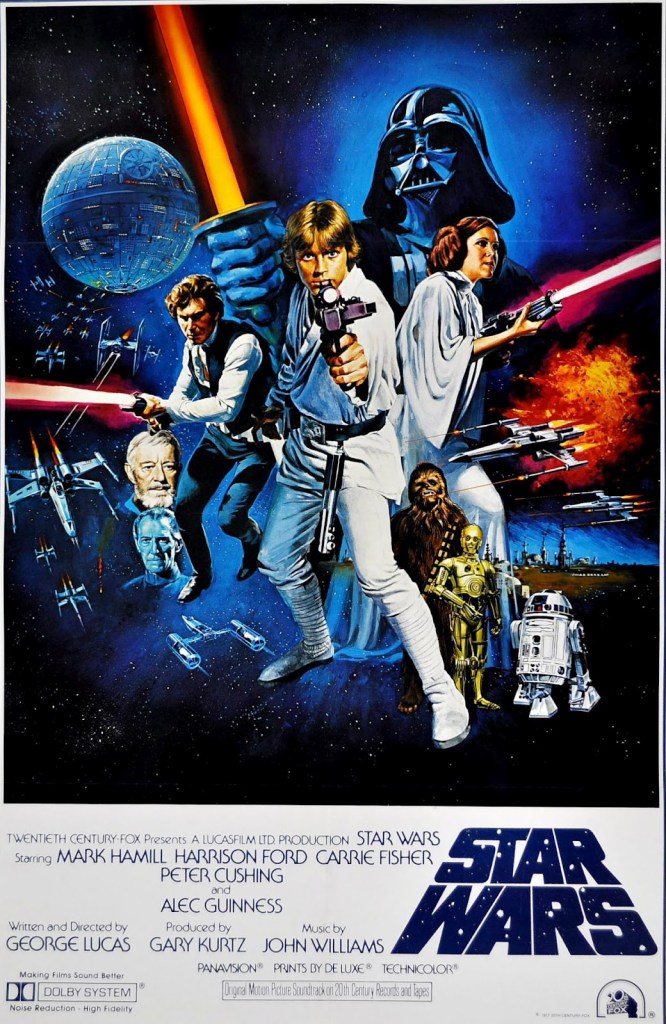
From the moment these words first scrolled up the movie screen – along with the dramatic opening chords of John William’s soundtrack – moviegoers were immersed in a fictional world full of drama, conflict, intrigue, good vs. evil, and – ultimately – a cliffhanger ending to the first of what was to become, arguably, the most successful franchise in movie history.

Star Wars: A New Hope was released on May 25, 1977. From the Infallible Wikipedia:

“After a turbulent production, Star Wars was released in a limited number of theaters (snip), and quickly became a blockbuster hit, leading to it being expanded to a much wider release. The film opened to critical acclaim, most notably for its groundbreaking visual effects. It grossed a total of $775 million (over $550 million during its initial run), surpassing Jaws (1975) to become the highest-grossing film at the time until the release of E.T. the Extra-Terrestrial (1982).

“When adjusted for inflation, Star Wars is the second-highest-grossing film in North America (behind Gone with the Wind) and the fourth-highest-grossing film in the world. It received ten Oscar nominations (including Best Picture), winning seven. In 1989, it became one of the first 25 films that was selected by the U.S. Library of Congress for preservation in the National Film Registry for being ‘culturally, historically, or aesthetically significant’. (snip) Today, it is widely regarded by many in the motion picture industry as one of the greatest and most important films in film history.”

It was, in many ways, the quintessential ‘cowboy’ movie but updated for an audience who had watched men land on the moon in 1969. It appealed to, particularly, the male need for adventure. Its heroes were simultaneously recognizable, yet also fresh: Luke Skywalker – still a boy – who chooses to leave his boring home and seek out adventure; Obi-Wan Kenobe, the sage elder who takes Skywalker under his wing and teaches him the ways of the freedom fighting Jedi; Princess Leia who redefines the idea of a damsel in distress; and, especially, the bootlegger Han Solo whose swashbuckling antics left millions of women with serious crushes.

Rather than recount the plot of the movie for those who have never seen it, the Infallible Wikipedia offers a summary (https://en.wikipedia.org/wiki/Star_Wars_(film)) or you can Google ‘Star Wars A New Hope’ which produces 24.9 million results.

Harrison Ford, Peter Mayhew, Mark Hamill, Carrie Fisher in their roles as
Han Solo, Chewbacca, Luke Skywalker, and Princess Leia.

Personally, I think every person should watch at least the 1977 movie through the lens of the classic American cowboy movie. The weapons and horses may be different but the formula is still the same.

I must also admit that I did NOT see the first movie that year. At age 19, I thought the movie was for kids. In fact, I cannot say for sure when I did eventually see the film. The second movie, The Empire Strikes Back, arrived in theatres on May 19, 1980 and the third, The Return of the Jedi, on May 25, 1983.

All of this is mentioned for one reason. As far as I’m concerned, episodes IV, V, and VI ARE Star Wars. The original cast, the campiness, and the fun of those movies were not to be replicated.

By early 1983 pretty much everyone had seen the first two movies and eagerly awaited the release of The Return of the Jedi. The hubby and me were no different.

R2D2 and C3PO

Finally the day arrived. Of course it was a Wednesday and with the need to show up at our jobs the next day, we were not going to be a part of a midnight showing. Instead we waited a couple of weeks for when Microsoft reserved the ENTIRE UA150 theatre in Seattle for an exclusive showing for its employees (of which I was one).

That’s when the hubby and I hatched a plan. Across the street from that venue on 6th and Blanchard in downtown Seattle was the UA70 which was showing both of the first two movies. On the day of the event, we arrived that morning – like at 9 a.m. – to view movie number one. We may have been two of only a handful of people present when the place opened. This was immediately followed by the second movie and then, after grabbing a bite to eat, we joined the Microsoft crew for Jedi. Now, we were not quite as crazy as some of the Microsofties who arrived dressed in costume and sporting light sabers. Although some people thought our marathon Star Wars day was over the top.

I still experience the Microsoft event in my mind when, as soon as the iconic ‘A long time ago, in a galaxy far, far away,’ appeared on the screen a cheer rocked the theatre. For the next two hours and 13 minutes, the venue was filled with cheers and gasps and applause as our heroes eventually won the day.

The UA150 in Seattle during the 1980 release of The Empire Strikes Back. From the Seattle Times archives

We loved doing the Star Wars ‘triple’ and learned a few things: Harrison Ford is much sexier than Mark Hamill; the line ‘I’ve got a bad feeling about this’ repeats multiple times throughout all three movies; the hubby does an amazing job sounding like a wookie; and ewoks may be cute but they are totally annoying.

Eventually we purchased VHS, and then DVD, versions of the three movies and introduced our kids to them. We also watched a couple subsequent Star Wars movies in the theaters but, truly, it was never the same. After enduring the obnoxious Jar Jar Binks character, we quit watching and were content to occasionally revisit the three originals and that galaxy far, far away from the comfort of our living room.

The Day Mt. St. Helens Erupted: May 18, 1980

Vancouver, Vancouver! This is it!

May 18th

A Tuesday Newsday Classic

There are only a very few days in our lives which we recall with complete clarity. One’s wedding day, the birth of a child, the death of a loved one. There are also days which are touchstones because they affect so very many people. December 7, 1941. September 11, 2001. May 18, 1980.

The last date was, particularly for those of us living in Washington and Oregon, the day when we understood the terrible, yet awesome, power of nature. In less than two minutes, the top 1,314 feet of Mount St. Helen’s was blasted away and swept down the north face of the mountain, leveling everything in its path.

Photographer Keith Ronnholm was in the right spot at 8:32 a.m. on May 18, 1980 when he captured the eruption in a series of still shots.

From the Infallible Wikipedia:

“The landslide exposed the dacite magma in St. Helens’ neck to much lower pressure, causing the gas-charged, partially molten rock and high-pressure steam above it to explode a few seconds after the landslide started. Explosions burst through the trailing part of the landslide, blasting rock debris northward. The resulting blast directed the pyroclastic flow laterally. It consisted of very hot volcanic gases, ash and pumice formed from new lava, as well as pulverized old rock, which hugged the ground. Initially moving at approximately 220 miles per hour (350 km/h), the blast quickly accelerated to around 670 mph (1,080 km/h), and it may have briefly passed the speed of sound.

Pyroclastic flow material passed over the moving avalanche and spread outward, devastating a fan-shaped area 23 miles across by 19 miles long (37 km × 31 km). In total about 230 square miles (600 km2) of forest was knocked down, and extreme heat killed trees miles beyond the blow-down zone. At its vent the lateral blast probably did not last longer than about 30 seconds, but the northward-radiating and expanding blast cloud continued for about another minute.

Superheated flow material flashed water in Spirit Lake and North Fork Toutle River to steam, creating a larger, secondary explosion that was heard as far away as British Columbia, Montana, Idaho, and Northern California.”

This is the scientific description of what happened. The only way to describe that day on a personal level was ‘surreal.’

At 8:32 a.m. the hubby (he was the fiancé on that day) and I had just awoken. We were up in Blaine, Washington, the last town (population 2,683 in 1980) before crossing the border to British Columbia.

We had been there since Friday night when we arrived and sat in the family kitchen and announced our engagement. The weekend had been spent visiting, playing cards, and hanging out. The hubby and I were to leave in the early afternoon and head to Seattle where he lived. I would have to head further south to Eatonville.

But I digress. 8:32 a.m. and there are two loud ‘claps’ and the walls of the house shudder. I’m thinking earthquake or, possibly, that the bull my future father in law kept out in the field, had escaped and was ramming the house. This was not an impossibility since it had happened once before.

I say to my hubby, “Maybe the bull got loose.” But his reply is prescient when he says “It’s Mount St. Helen’s.”

It was nearly two hours before his words were proven true and the TV news stations began showing video of the nearly 80,000 foot ash plume soaring above the now sheared mountain. Planes flew over the Toutle and Cowlitz rivers with photographers filming entire houses and forests being swept down the rivers, taking out bridges and all vegetation in its path. We were glued to the TV.

I had but one thought, I needed to get back to Eatonville as I was the sole reporter for the weekly paper and – although the community was not in the path of the ash cloud – being less than 60 miles from the mountain, it WAS the news story of the week, perhaps the year or even the decade.

That evening, after checking in with the publisher and working on a story for the paper to be included in the layout the next day, I was at my apartment fixing myself some dinner. I turned on the TV – KOMO 4 – and at first I thought something was wrong with the TV. It was a hand-me-down, early 1960’s, black and white which had been my grandmother’s TV when she was still alive.

All I could see on the TV was a black screen with a smudge of white appearing every so often. But it wasn’t the fact that there wasn’t much picture so much as what I was hearing. It became evident quickly that I was watching a film from someone who had been caught in the eruption. Someone who wasn’t sure if they were going to live or die. It was riveting. I later learned that the person was Dave Crockett and he did survive. But 57 others did not that day.

In the summer of 1985, the (now) hubby, me, my Mom and Dad, drove to Mt. St. Helen’s and along the forest service roads on the east side of the mountain. Nothing had yet been developed. There wasn’t a visitor centers or restroom. Just a few Honey Buckets set up where the crowds had organically gathered. We stopped at a pond where every tree surrounding it had been blown down or broken. Yet, new sprouts had started to grow, and tadpoles skittered through the shallows.

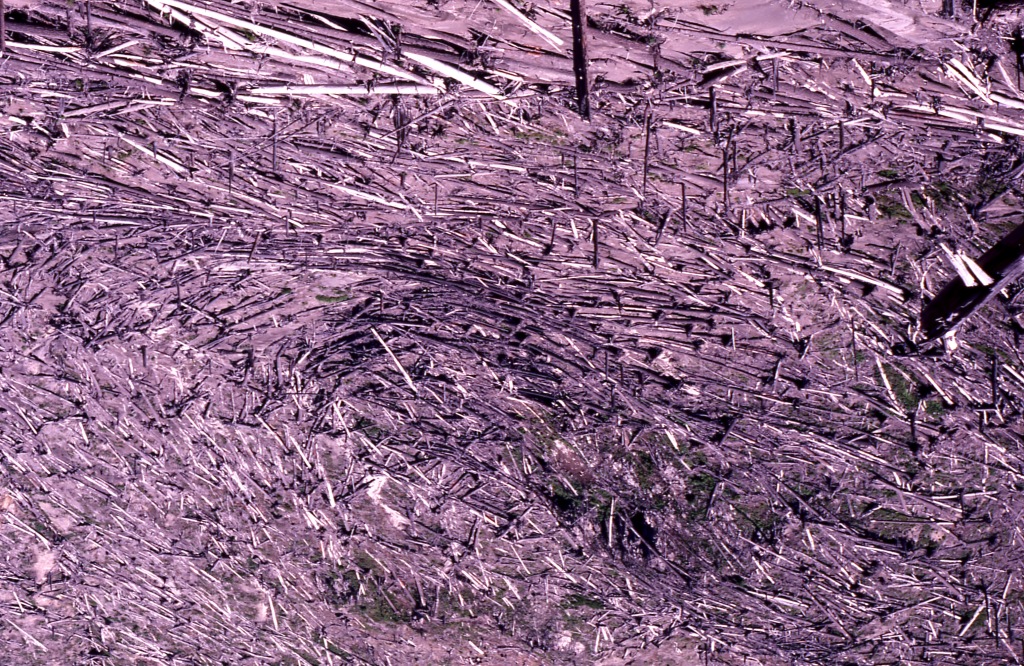
The pyroclastic flow tossed the trees around like toothpicks, laying them out in swirl patterns. Taken by the author on the 1985 tour.
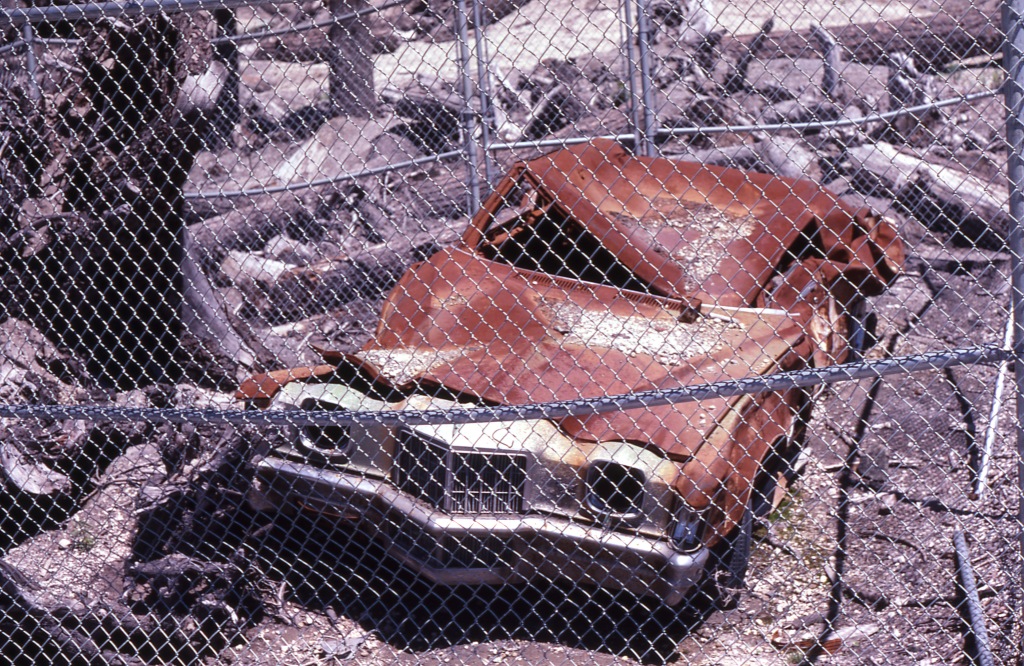
I’ve always wondered about the occupants of this car and their last terrifying moments. Taken by the author on the 1985 tour.

We saw a destroyed car, a sad monument to whoever was caught behind the wheel. We stood below the mountain and looked up in amazement at miles of the once 70 to 80 foot tall trees now scattered across the landscape like some giants’ game of pick-up sticks.

We stopped on a ridge to the northeast of the mountain and gazed down at a log clogged Spirit Lake and into the steaming crater of the mountain.

At the time – as is so often the case – we didn’t fully appreciate that the sites we saw that day would soon be gone, changed by snow and sun, rain and wind, and the regeneration of life.

A pond regenerates after the blast. Taken by the author on the 1985 tour.
My parents during the 1985 tour of Mt. St. Helens. They had been plunged into volcanic darkness in Yakima five years earlier the morning the mountain erupted.

Every year on May 18th I pause and reflect on the events of that day, still as clear in my mind as if it was last week. Mt. St. Helen’s eruption changed me; in so many imperceptible ways it marked the moment when I began to view the world from an adult perspective, recognizing there are forces in the universe over which neither I nor anyone else has control.

Mt. St. Helen’s made me more cautious and more aware of the transitory nature of life. But it also brings to mind the phrase from the Roman poet, Horace, ‘Carpe Diem.’ Seize the Day. Every day is the right day to do just that. Go seize yours.

The links:

https://en.wikipedia.org/wiki/1980_eruption_of_Mount_St._Helens

Photographing the Eruption of Mount St. Helens from 10 Miles Away

Mousemania!

The Rise of the Microsoft Mouse

April 20th

A Tuesday Newsday Classic

The 1980’s was an exciting era in the world of computers. Where once only large corporations had such capabilities, the advent of affordable, personal computers heralded a decade of new products to make computer use easier.

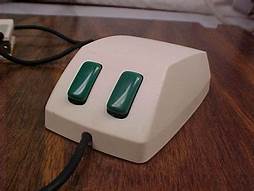
Microsoft’s first mouse circa 1983

Until 1983 no one outside of engineering labs had ever heard of a computer mouse. Yet today, the device is an essential piece of a desktop computer set up.

From the Infallible Wikipedia:

“The earliest known written use of the term mouse in reference to a computer pointing device is in Bill English’s July 1965 publication, ‘Computer-Aided Display Control’ likely originating from its resemblance to the shape and size of a mouse, a rodent, with the cord resembling its tail. The popularity of wireless mice without cords makes the resemblance less obvious.

The plural for the small rodent is always ‘mice’ in modern usage. The plural for a computer mouse is either ‘mice’ or ‘mouses’ according to most dictionaries, with ‘mice’ being more common. The first recorded plural usage is ‘mice’; the online Oxford Dictionaries cites a 1984 use, and earlier uses include J. C. R. Licklider’s ‘The Computer as a Communication Device’ of 1968.”

One company which saw the potential in the mouse was – at the time – fledgling software giant Microsoft.

They got on the mouse bandwagon early, bundling their version of a mouse with two of their software programs. Also from the Infallible Wikipedia:

Being a bit of rebel, I had a Macintosh computer for many years and had just such a mouse on my desk.

“The Microsoft Mouse is a computer mouse released by Microsoft in 1983. It is the first mouse released by the company, and it was bundled with Microsoft Word, Notepad, and an on-screen teaching tutorial for an initial price of $195.

Nicknamed the ‘green-eyed mouse,’ the Microsoft Mouse featured a pair of green buttons. It also featured a more curved body than the blockier designs more common of mice at the time. As with other mice at the time, the Microsoft Mouse used a steel ball for tracking.

The initial version featured an InPort ISA interface, requiring a Microsoft bus card to be installed in the computer. Later versions were available with DE-9 or DB-25 serial connectors. All versions of the Microsoft Mouse could be used with IBM-compatible and other DOS systems.”

In 1983, I was working for Microsoft in the telemarketing sales division. The company was small enough, however, that friendships developed with individuals across all departments. One such friendship was with one very enthusiastic National Training Manager who, one day, saw me walking down the hall and asked me to step into his office as he wanted to show me something.

The memory is crystal clear. Alan’s office is little more than a cube, big enough for his desk, chair, and a file cabinet. But what I most recall is that his office is an interior one and has no window (ironic for Microsoft, right?). Additionally, his overhead light is not on and all illumination is provided by the glow of his computer monitor. Again, computers and monitors in 1983 had no graphical interface, just glowing green letters on a black screen.

He sits at his chair and says ‘watch this’ and then proceeds to put his hand on a little box and push it around his desk while a tiny straight line cursor jumps all over the screen. The demonstration continues as he clicks a button on the device which locks the cursor in place, then types a few words.

A few months later, our telemarketing group had ‘Mouse’ day with the introduction of Microsoft’s version of the device. Product introduction days were always exciting as our group created ways to make it special and get ourselves motivated.

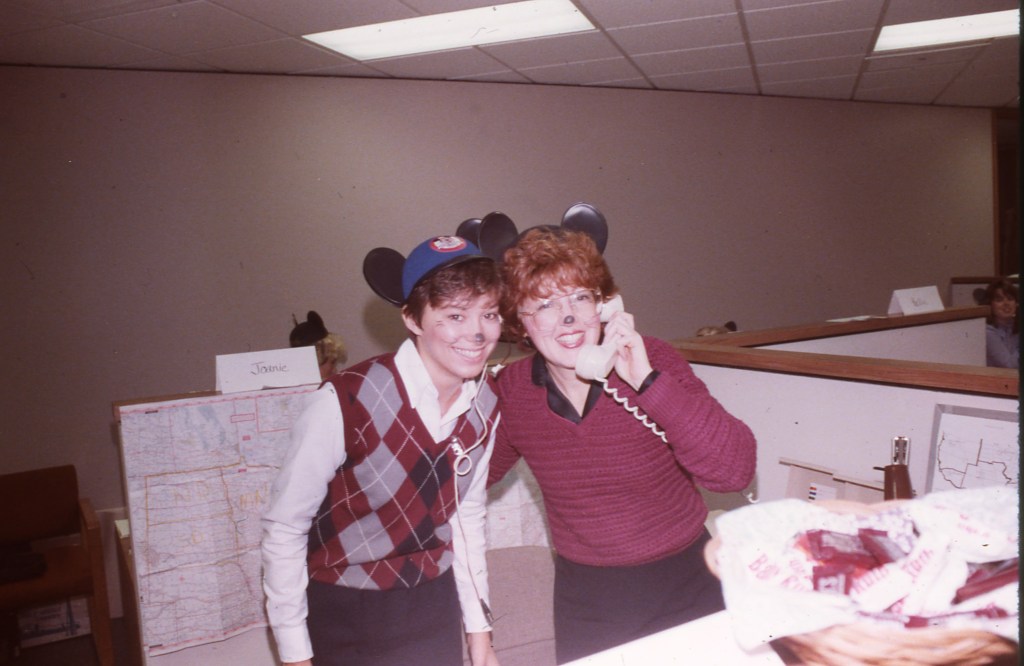
Two of my telemarketing co-horts, Sue and Susie, on ‘Mouse’ day.

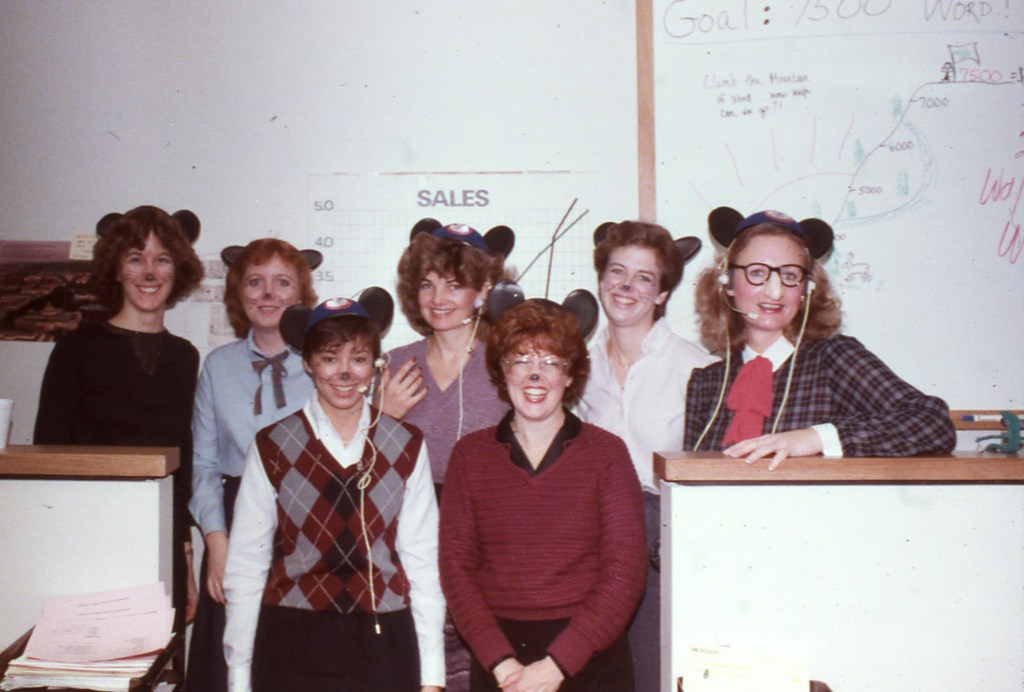
Mouse day, it turns out, featured everyone wearing Disneyland mouse ears as we called every last buyer in every computer store in the nation. At the front of the room was a large white board where our goals were written. As the day wore on, we would add our sales to the list, and whoops of excitement echoed through the cube farm as we reached each new goal.

I don’t recall how many we sold that first day or in subsequent weeks, but the bundle was hugely popular as consumers embraced the technology.

Most memorable was a funny incident which happened a short time after. In addition to the telemarketing group, we also had a customer service division for people to call in and get help when their products had issues. Often those calls were directed to a crack group of the most patient people in the universe: technical support.

I can clearly see two of my tech support buddies, both of whom were always willing to answer our questions when a buyer would, inevitably, ask us some technical thing that we – as mere salespeople – had no clue how to answer.

I can’t recall if it was Clay or Dolores who told me this story; but one day he/she received a tech support call from a woman who was complaining that her mouse was not working correctly. The tech people always worked through a list of known issues first, asking questions to drill down in order to solve the problem. Most issues they’d encountered before and would either be able to get it fixed it or would send the person to customer service to start the order replacement process.

This particular woman was certain that her software had a problem because every time she moved the mouse around all she got on the screen were squiggly lines and gibberish text. So the tech person had her move the mouse, click the button, and then type something. On the call went for five, then ten minutes, with no known bug causing the issue.

Finally, the woman – clearly exasperated – yelled ‘my arm’s getting tired.’

The tech support person paused and then asked her to describe how she was holding the mouse. It turned out that she was treating the mouse as though it was a touch screen device. All that time she had been holding it up and moving it around on the screen’s surface.

Over the years I’ve had ‘Microsoft’ dreams – not quite nightmares but close – where I’m back working at the company. In these dreams, however, I’m not donning Mouse ears and calling buyers; I work in tech support and field calls from people asking me questions for which I do not know the answers. Talk about stress.

The telemarketing crew fall of 1983, goals on the white board and all in the ‘Mouse’ spirit. The author with her big 80’s hair is at far left.

I think of Clay and Dolores often and smile at the stories they shared which often made the stress of working at Microsoft in the early 80’s just a little bit less. Hats off to all tech support people everywhere, you are my heroes.

The links:

https://en.wikipedia.org/wiki/Microsoft_Mouse

https://en.wikipedia.org/wiki/Computer_mouse

Discovering Dad’s Mustang: A Heartfelt Reunion

EEE 161 Rides Again

March 9th

A Tuesday Newsday Classic

It was on March 9, 1964 when the first Mustang automobile rolled off the assembly line at Ford Motor company’s Dearborn, Michigan plant. Today, the Mustang continues as one of the best selling and most popular cars ever produced by Ford.

For those who have been reading my blog for several years, you may recall that three years ago I posted about the 1965 Mustang here: https://barbaradevore.com/2018/04/17/1965-ford-mustang/

Today’s Tuesday Newsday is going to be a bit of a departure, as I have nothing particularly new from the Infallible Wikipedia to share on this topic. You can, of course, go there and read up on everything you might hope to learn about the Mustang.

My Dad’s 1965 White Mustang convertible

What I do know is that the Mustang was a huge hit from the day it launched and has spawned clubs for owners, like the Mustang Club of America, matchbox cars, models, and an almost cult like following for the distinctively designed vehicle.

As with the Volkswagen beetle, or the Porsche, or the Corvette, the Mustang’s of the 1960’s are instantly recognizable and highly collectible.

While the majority of the early Mustangs have ended up in junk yards and recycled, some have been lucky enough to survive down through the years. This is the story of one such Mustang.

We pick up the story of the Mustang my Dad purchased slightly used circa 1966. It is now July 11, 2020 and my father has been gone just over 10 months. Despite being in the middle of the Covid Pandemic, I have estate business to tend to and have traveled to Yakima and am staying with my sister. Her home is situated in the middle of apple, cherry, and pear orchards just west of Selah – a smaller city four miles north of Yakima. Yakima County boasts a population of just under 250,000 people so it is not huge, but is certainly not small either.

On this particular Saturday it’s sunny and warm with a high in the low 90’s. In the mid-afternoon the two of us drive down into Selah in my sisters Honda with a load of items to be donated to Goodwill. From there we head south to a Safeway store in Yakima for a few dinner items. Our intended route is actually a big circle as we head to her place via the ‘back’ way which is to travel west on highway 12, then north on Old Naches Highway, and finally head east up Mapleway Road.

My sister is driving and we are, as is our nature, chatting away. Just as we reach the crest the hill I notice a white convertible about 500 yards ahead of us. It’s distinctive Mustang back end causes me to blurt out, “Look, it’s Dad’s car.”

A wave of nostalgia washes over me. Oh those summers when we drove around with that black rag top down, flirting with boys during forbidden runs up and down Yakima Avenue, not a care in the world with real life still a few years away.

A moment in time. It’s Memorial Day weekend 1973. We are getting the car ready so that the Yakima Rainbow Girls can ride in the convertible for the parade. In the photo are my Mom supervising (in her bathrobe!), my Dad and sister securing the red leather seatback cover, and my best friend Pam standing in the open car.

Of course, I didn’t really think it WAS my dad’s car. After all, he had sold the car in the 1980’s and the family lost track of it over the years. Realistically, what were the chances the car still existed? Even so, I urged my sister to get a little closer so we could at least see the license plate. She obliged and I strained my eyes to make out the letters and numbers.

EEE 161.*

“It IS dad’s car!” I exclaim. “Follow him!”

The Mustang, now at a stop sign where the main road goes right, turns. A minute later we are at the same spot and also turn right. A minute after that, we sail past the road which leads to my sister’s house and are headed back down into Selah, retracing our route from earlier.

On we go, now in hot pursuit of Dad’s car.

“I want to talk to him,” I tell her. From behind we can tell it’s a middle aged man sporting a baseball cap driving the car.

We travel past the school, city hall, the bank, the telephone company, and turn north on Wenas Road. My eyes are fixed on the Mustang wondering just how far he’s going to drive. From my perspective, it didn’t matter. Catching up with him was my goal; being with the car once again important somehow.

My sister pulls into the left lane to try and get up next to the car but then the driver signals a right turn into the parking lot of the True Value hardware store. We sail past.

It takes us several minutes to get turned around but at last we pull up next to the parked – and now empty – car and wait for the driver to return.

Not wanting to be creepy or draw suspicion, I force myself to sit and wait. And wait. And, after five interminable minutes our quarry emerges from the store headed to his car which was once my Dad’s car.

I climb out of the passenger seat of my sister’s vehicle and step forward, catching his attention.

“This will be the weirdest conversation you’ve had all week,” I say and then continue, “But this was my Dad’s car.”

“Really? He must have sold it to my Mom back in the early 1980’s. What was his name?”

“Vincent DeVore. I’ve never forgiven him for selling it.”

This elicits a chuckle. I forge on. “Unfortunately my dad passed at the end of October. But I think it would please him to see what great shape the Mustang is in.”

“I’m sorry about your Dad. My mom died in December. The car was stored in her garage until January when it came to me.  She had the leather seats recovered and the whole thing has been repainted. She used to take it to the classic car shows. She loved this car.”

“It looks amazing,” I say and mean it.

“Yeah. I learned to drive in this car,” he says and to which I reply, “So did I! It was the best.”

What then followed was the snapping of a couple of photos of both my sister and I with the car. We also learned that he lives less than a mile from my sister and is the neighbor of my brother-in-law’s best friend. And that day was the first day he’d had the car out and driving around with the top down, reliving just for a short time, his sweet teenage memories in the car of his – and my youth.

My sister enjoying being reunited with EEE 161.
Maybe next time I’ll get to sit in the car once again

As for me, it was only one of several surreal events following my Dad’s death. In a way I found it comforting and, every once in a while, am reminded that even though Dad is gone, his spirit lives on.

*In 1958, license plates in Washington were assigned by county. All plates in Yakima County started with the letter “E.” The Mustang’s plate was likely issued new with the car in 1965. Visit this website for how this all worked. http://staff.washington.edu/islade/counties/index.htm
https://en.wikipedia.org/wiki/Ford_Mustang

Scott Hamilton: The Inspiring Journey of an Olympic Champion

King of the Ice

February 16, 2021

The 1984 Olympic Men’s Skate medalists, left to right: Brian Orser(2nd), Scott Hamilton(1st), Jozef Sabovčík(3rd)

A Tuesday Newsday classic

This 1984 Olympic Gold medalist was, perhaps, the most unlikely of stars to achieve brilliance. To this day he is, however, one of the most popular U.S. men’s figure skaters ever; an individual who is a testament to the power of determination, hard work, and a positive attitude.

It was on February 16, 1984, when 25 year old Scott Hamilton won Olympic Gold at the games in Sarajevo, Yugoslavia (Now Bosnia and Herzegovina)

His skating story began 14 years earlier when he first took to the ice at age 11. Two years later, he was entering skating competitions. For the athletically inclined Hamilton, choosing an appropriate sport was likely a challenge.

When he was two years old he stopped growing. What followed were tests and speculation over why. From the Infallible Wikipedia:

“After numerous tests and several wrong diagnoses (including a diagnosis of cystic fibrosis that gave him just six months to live), the disease began to correct itself. His family physician sent him to Boston Children’s Hospital to see a Dr. Shwachman. He was told the doctor had no idea what was wrong and to go home and stop the diets in order to live a normal life. Years later, it was determined that a congenital brain tumor was the root cause of his childhood illness.”

The impact was huge. During the years of his greatest amateur skating success he was only 5 feet 2 ½ inches tall and weighed 108 pounds. Obviously, playing football or ice hockey was not an option.

Hamilton parlayed his small stature – what many would see as a liability – into his greatest asset. Not only was he was fast on the ice, but he developed his athleticism such that he made the jumps and his intricate footwork look effortless. Although not allowed in competition, his signature back flip at the end of his exhibition routines always brought fans to their feet. Only the strongest and most daring of skaters can successfully execute the move.

When he retired from amateur skating, he was the 1984 reigning world champion in the Men’s division. From there he went on to have a successful professional career and has, arguably, done more to elevate the sport of ice skating than any other individual ever. Also from the Infallible Wikipedia:

“After turning professional, Hamilton toured with the Ice Capades for two years, and then created ‘Scott Hamilton’s American Tour,’ which later was renamed Stars on Ice. He co-founded, co-produced and performed in Stars on Ice for 15 years before retiring from the tour in 2001 (though he still returns for occasional guest performances).

He has been awarded numerous skating honors, including being the first solo male figure skater to be awarded the Jacques Favart Award (in 1988). In 1990 he was inducted into the United States Olympic Hall of Fame.”

His road in life has not been easy. He survived testicular cancer in 1997 only to have a second brain tumor be discovered in 2004. After a successful surgery for the benign tumor, yet a third tumor was found in 2016. So far he’s been successful in shrinking the tumor through dietary changes.

Although I’d watched Olympic figure skating before, it was the 1984 Olympics and Scott Hamilton particularly, which became the impetus for a decade of following the sport. And what better place to be for watching the Olympics than in a magical place such as Whistler.

The hubby and I – along with his sister and mother – had joined a Whatcom Community college group for a weekend skiing sojourn. Yes, I was 26 years old when I took my first lessons… at Whistler. At the end of each day, we’d return to the rental house (a precursor to the AirBnB concept) for food and fellowship and to watch the Olympics. And what an Olympics it was. We rooted for hometown favorites Rosalyn Summers, Phil and Steve Mahre, and Oregonian Bill Johnson.

The memory that sticks with me most is of the hubby and my sister-in-law out at a pub in Whistler Village. The TV is on over the bar and we are watching the events. But we can’t hear the play by play because there is no sound. Instead, dance music is blaring through the bar. And the pair of them – hubby and sister – are ‘dancing’ while sitting in their chairs, and making quite the spectacle. I imagine the pub owners had second thoughts about those chairs as they were on wheels which allowed the chair dancing shenanigans. Shenanigans which, I might add, nearly got us kicked out of that bar.

Home a few days later, I cheered as I watched Scott Hamilton win the Gold medal, the first US man to do so in the Olympics in 24 years.

What followed over the next six years was attending the US National championships at the Tacoma dome in 1987, and seeing “Stars On Ice” at least twice at the Seattle Center Arena. It was during Stars on Ice that we finally saw Hamilton skate in person. It was worth it. What an amazing skater and showman, his performances unforgettable.

I leave you with this from a publication titled ‘CancerTutor.com.’

“Hamilton is a firm believer in ‘getting up’ after the fall. He pointed to a chapter in his book, The Great Eight, titled ‘Fall Down, Get Up, Smile Like Kristi Yamaguchi.’

‘In one of her [skating] programs, she took a hard fall on a really difficult jump — and she got up, went right back to her program like nothing happened. I realized in that moment there’s a life lesson: I’m gonna fall down. I’m gonna make mistakes. But it’s what’s next — it’s how you get up. The more times you get up, the stronger you are.’”

Some links:

https://en.wikipedia.org/wiki/Scott_Hamilton_(figure_skater)

https://www.scotthamilton.com/