Tag Archive | Redmond Washingrton

Microsoft Millionaires

My ‘Forrest Gump-esque’ experience in the 1980’s

January 21, 2025

A Tuesday Newsday Classic Updated
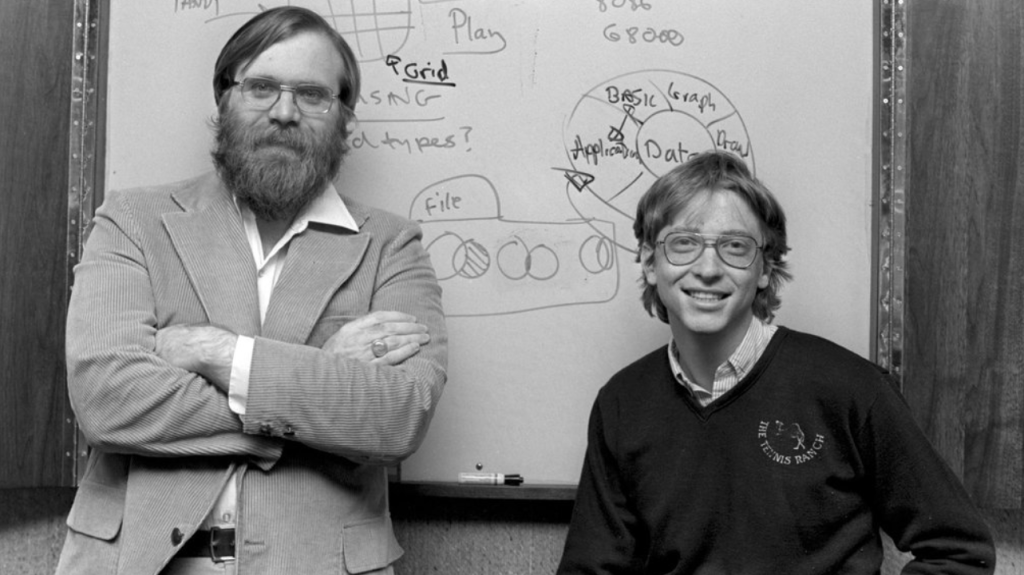
Paul Allen and Bill Gates in the late 1970’s and how I picture both of them in my memory.

When this young man dropped out of college, I’m sure it was a huge disappointment to his family. After all, he’d scored a perfect 1600 on his SAT’s and graduated from the prestigious Lakeside School in Seattle. But the world was changing rapidly in the early to mid-1970’s and he had bigger visions than attending classes and frat parties.

Of course, we all know his story. Along with a close friend, he went on to become a co-founder of one of the world’s most successful computer software development companies: Microsoft.

Early 1980’s Company Logo

But I’m not writing about Bill Gates. This is about Paul Allen, the less ‘famous’ of the Microsoft pair. And without whom Microsoft would never have existed.

If he were alive today, he would be celebrating his 72nd birthday.

According to the Infallible Wikipedia:

“He attended Lakeside School, a private school in Seattle where he befriended Bill Gates, with whom he shared an enthusiasm for computers, and they used Lakeside’s Teletype terminal to develop their programming skills on several time-sharing computer systems. They also used the laboratory of the Computer Science Department of the University of Washington, doing personal research and computer programming; they were banned from the laboratory in 1971 for abuse of their privileges there.

Gates and Allen joined with Ric Weiland and Gates’ childhood best friend and first collaborator, Kent Evans, to form the Lakeside Programing Club and find bugs in Computer Center Corporation’s software, in exchange for extra computer time. In 1972, After Evan’s sudden death due to a mountain climbing accident, Gates turned to Allen for help finishing an automated system of Lakeside’s entire class scheduling procedure. They then formed Traf-O-Data to make traffic counters based on the Intel 8008 processor. According to Allen, he and Gates would go ‘dumpster diving’ in their teenage years for computer program code.
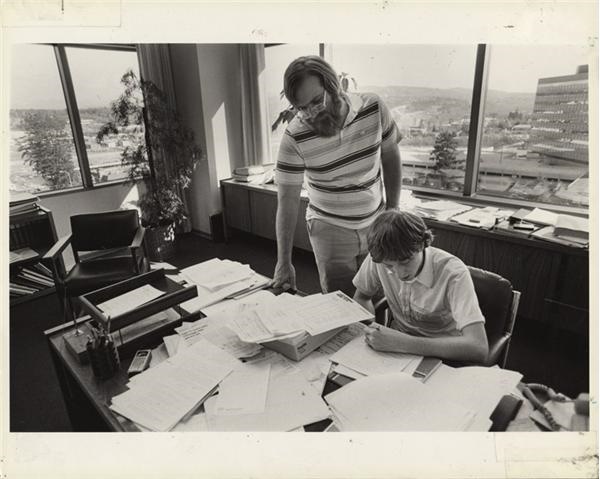
This photo purports to be from 1984. If so, it was likely right after the company moved ‘across’ I-520 to Corporate Campus East. This would have been my final year at Microsoft.

Allen attained a perfect SAT score of 1600 and went to Washington State University, where he joined the Phi Kappa Theta fraternity.”

Allen was hired by Honeywell, located in Boston, as a computer programmer and left WSU. Gates, now attending nearby Harvard, and Allen reconnected. It was Allen who convinced Gates to leave Harvard, move to Albuquerque, New Mexico and form Micro-Soft (To combine the two terms microcomputer and software). In January 1979, the company moved to Bellevue, Washington.

Also from the Infallible Wikipedia:

“The relationship became less close between Allen and Gates as they argued even over small things. Allen effectively left Microsoft in 1982 after being diagnosed with Hodgkin’s lymphoma, though he remained on the board of directors as vice chairman. Gates reportedly asked Allen to give him some of his shares to compensate for the higher amount of work that Gates was doing. According to Allen, Gates said that he ‘did almost everything on BASIC and the company should be split 60–40 in his favor. Allen agreed to this arrangement, which Gates later renegotiated to 64–36. In 1983, Gates tried to buy Allen out at $5 per share, but Allen refused and left the company with his shares intact; this made him a billionaire when Microsoft went public. Gates later repaired his relationship with Allen, and the two men donated $2.2 million to their childhood school Lakeside in 1986. They retained a friendship for the rest of Allen’s life.”
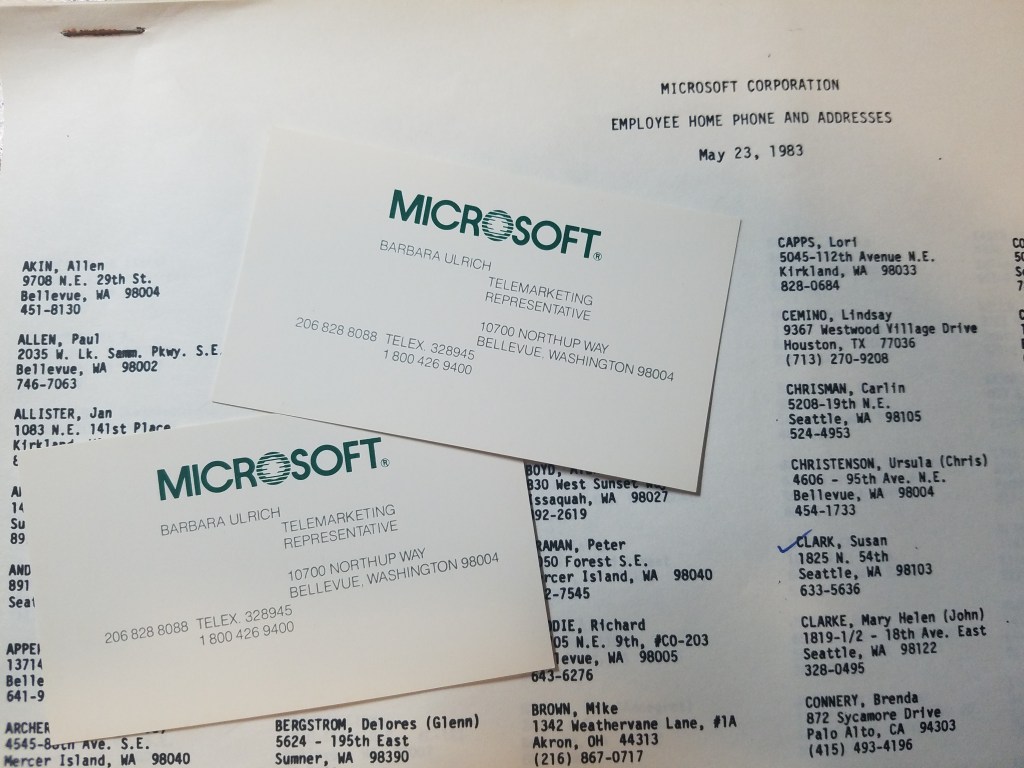
Being that I keep anything which might be historical in nature, I still have several Microsoft employee address lists and a few of my business cards. When I joined the company in early January 1983 there were 205 people at corporate and 21 field sales reps. Which means I was one of the first 250 employees of Microsoft.

Allen went on to do many great things for the world including donating over $2 Billion towards science, technology, education, wildlife conservation, the arts, and community services.

You can read more about Allen’s extraordinary life and find links to his biography here:

https://en.wikipedia.org/wiki/Paul_Allen

In the past eight years of writing my Tuesday Newsday blog I’ve shared only a few stories about my ‘Forest Gump-esque’ experiences at Microsoft. I was hired there in early 1982 as part of a group of three young women who would be launching a retail telemarketing division for the company.

Our trio faced nearly insurmountable odds – which we did not know when we took the jobs – as we were tasked with calling out to every retail store in our region (I had the west coast. The. Entire. West. Coast.), working in conjunction with Microsoft’s field sales reps, to sell such programs as Basic, Fortran, and Cobol compilers, the always popular Flight Simulator and Typing Tutor, and the early spreadsheet program, MultiPlan.

The phone calls were often brutal with the stores’ buyers either not taking our calls or, more often, asking if we sold Lotus 1-2-3, our competitors sizzling hot multi-functional program which dwarfed Microsoft’s Multiplan. Word Processing program? Bah. Didn’t exist then.
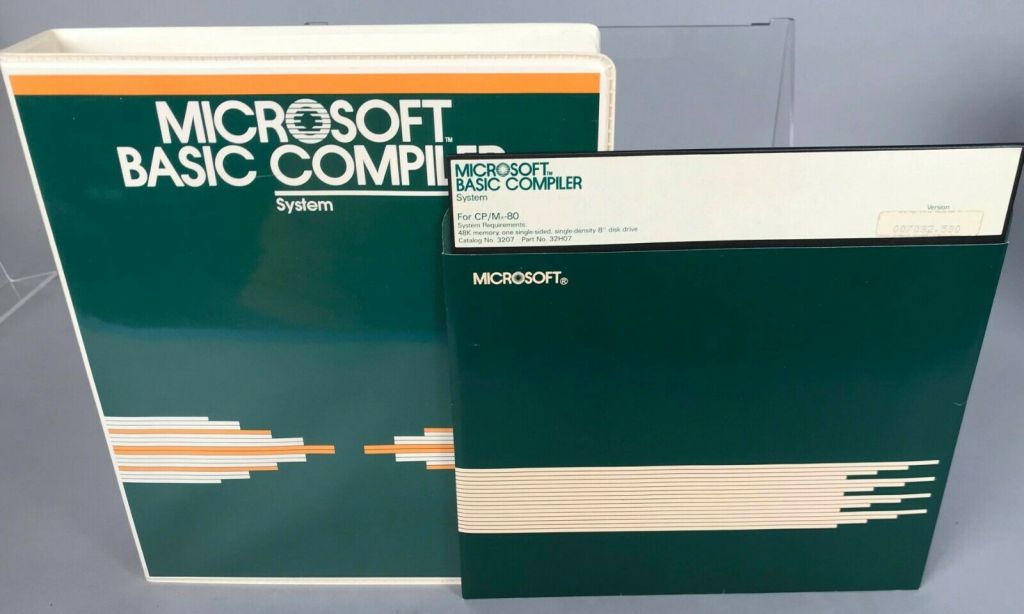
There was nothing sleek OR sexy about the early Microsoft products. But they were green…

We worked hard, we played hard, and the burnout rate was high.

I left Microsoft, having experienced that same mentioned burnout, in the fall of 1984 and went to work for another computer company located in Kirkland six weeks later. One day, likely the summer of 1986, my then boss, Tom, took me to lunch for my birthday. We went to a favorite Japanese sushi place in Totem Lake called Izumi.

We sat up at the small sushi bar, the only people in the restaurant when we arrived. We had just gotten our food when a group of 4 or 5 men also arrived, and took a table nearby. I didn’t pay much attention to the group as Tom and I were talking. Tom, being a loud and gregarious individual, dominated the exchange and the room.

Izumi was a favorite where the hubby and me liked to go

Somehow our conversation got on to Microsoft and Tom asked why I had left the company. Before I could answer, I noticed the table of nearby men had gone silent and were all looking at us, and one of them said “I can’t escape it, no matter where I go.” That man was Paul Allen.

Perhaps that moment, more than any other, illuminated how he felt about Microsoft – at least in 1986 when he and Gates were still working to repair their relationship – and summed up for me my Microsoft experience also. For anyone living in the Seattle area, you either worked for, know someone who worked for, or you once worked for, Microsoft. It was inescapable. And not particularly pleasant.

I wanted to say something to Paul Allen that day, but felt that if I had it would have been about as welcome as a drunk fan asking a movie star for an autograph. Instead – as if by mutual agreement – he returned his attention to his group and Tom and I changed our topic.

I left Applied Computer Sciences and the corporate world in the late 1980’s, putting my energies in to raising my kids and doing volunteer work.

If I had any regrets in leaving Microsoft it was, perhaps – unlike Paul Allen – that I was never eligible for stock options, a nice perk that would have made life a bit easier.

I did, however, learn something much more valuable and it is a mantra I’ve carried through my life which goes like this:

Bill Gates and Paul Allen were wildly successful. Microsoft was wildly successful. But just because I worked for the company, however, was not enough to make me wildly successful. It is up to each of us, individually, to follow our own path, pursue our own dreams and interests, and find those things which bring us joy and fulfillment. That, I think, is the true definition of success.

It was a hard lesson but I’m forever thankful for learning it and those brief, brutal, and impactful, Microsoft years.

https://en.wikipedia.org/wiki/Paul_Allen

https://en.wikipedia.org/wiki/Microsoft

Pac Man Fever

… and the Donkey Kong King of the Arcade

October 10, 2023

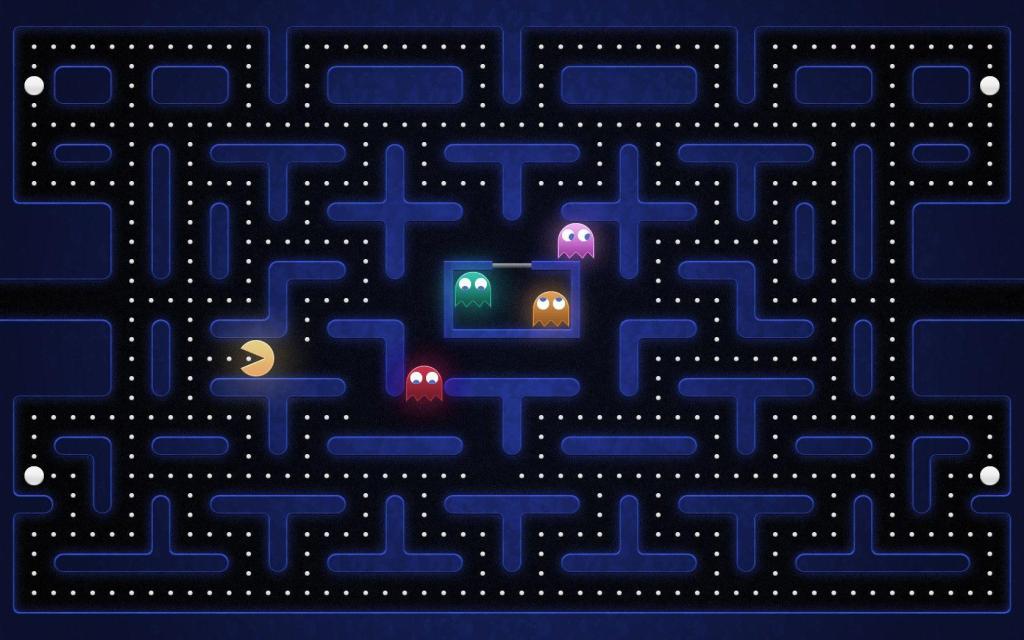
It was in October of 1980 when the United States was truly invaded by the Japanese. We are not talking about the military here. No, the first wave of this invasion featured four ghosts named Inky, Blinky, Pinky, and Clyde and a round yellow fellow with a huge pie shaped mouth dubbed Pac-Man. The game, which had been released in Japan a little over four months earlier, was an instant hit. Young people flocked to arcades and taverns where Pac-Man eagerly gobbled up their quarters.

Staples of the Video Arcade were Pac-Man and Donkey Kong. Ms. Pac-Man – a spin off of PacMan – and the perennial favorite Space Invaders rounded out this game room.

Soon, Pac-Man merchandise flooded America as did other Japanese companies looking to capitalize on Pac-Man fever.

From the Infallible Wikipedia:

 “When Pac-Man was released, the most popular arcade video games were space shooters—in particular, Space Invaders and Asteroids. The most visible minority were sports games that were mostly derivatives of PongPac-Man succeeded by creating a new genre. Pac-Man is often credited with being a landmark in video game history and is among the most famous arcade games of all time. It is also one of the highest-grossing video games of all time, having generated more than $2.5 billion in quarters by the 1990s.

The character has appeared in more than 30 officially licensed game spin-offs, as well as in numerous unauthorized clones and bootlegs.According to the Davie-Brown Index, Pac-Man has the highest brand awareness of any video game character among American consumers, recognized by 94 percent of them. Pac-Man is one of the longest running video game franchises from the golden age of video arcade games. It is part of the collection of the Smithsonian Institution in Washington, D.C. and New York’s Museum of Modern Art.”

There were a number of other Japanese companies which, seeing the success of Pac-Man released arcade games, but there were two companies which dominated the market in 1982: Sega (Pac Man) and Nintendo. While Sega established its US headquarters in Irvine, California, Nintendo first landed in Tukwila, Washington

And that’s where my hubby enters the scene. In 1981 he was hired by a CPA firm in Burien who had a client that needed an auditor. So he was sent out to do the job and thus began a seven year relationship with a different Japanese invader: Donkey Kong.

Iconic characters Donkey Kong and the damsel Pauline.

While many think of Nintendo as a behemoth company, when Donkey Kong was first sold into the US market they had a grand total of six employees: two Seattle based salesmen; the company president (Mr. A – the son in law of Nintendo’s Japanese founder); two Japanese developer/engineers; and one American to assemble and make the arcade games compatible for the US market.

It was in June 1982, as Donkey Kong’s popularity skyrocketed to the top of the arcade market (and made the two US salesmen millionaires), that the hubby was hired as the company’s US controller. Those were crazy days with incredible long hours but also a real sense of family within the fledgling company.

In 1982 we hosted an April Fool’s day party the theme of which was bad jokes and to play video games. The hubby was even able to have a couple of full size arcade games (borrowed from Nintendo) for the attendees to enjoy. We continued this tradition for several years.

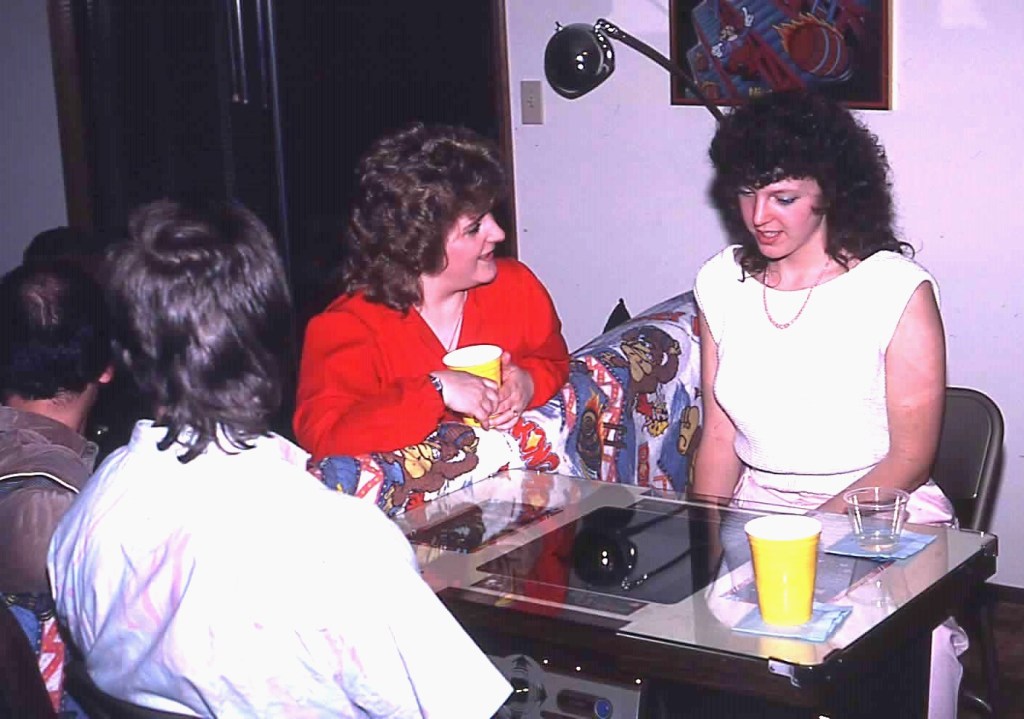
Friends at the 1987 April Fools Day party enjoying a game of Donkey Kong on our Cocktail Table game console. Note the blanket on the back of the couch and the framed DK poster.

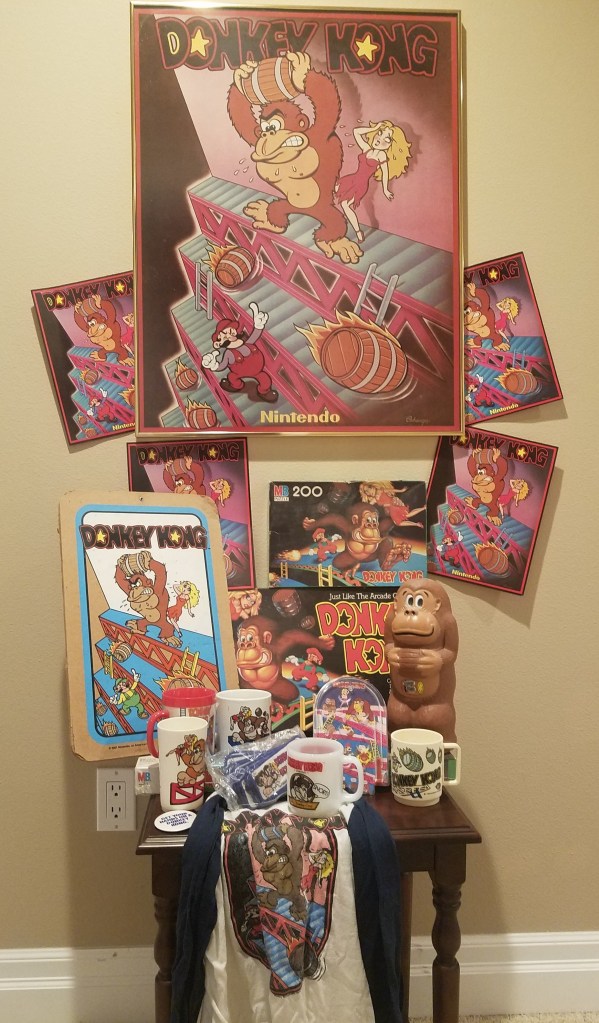
By the time he left the company in the late 1980’s we had acquired a variety of Donkey Kong themed items: mugs, cups, socks, both electronic and board games, shirts, a bulletin board, an aped shaped ‘bank’ and, the most prized possession of all: an electronic cocktail tabletop Donkey Kong game.

Over the years all of the Donkey Kong stuff has moved with us several times. Perhaps the items are worth some money. But that was never the point. More that these things are reminders of that crazy chapter in our lives, some good, some not so good. So I keep them in a cupboard because… well, just because it’s part of our history.

Our Donkey Kong merchandise collection (minus the blanket)

When the daughter and her (then boyfriend) hubby moved back to the PNW in 2020, we gifted them the cocktail table Donkey Kong Game. Of course it came with the stipulation that we could visit it if we were so inclined. But that rarely happens. Our son-in-law does sometimes fire the game up when they have friends over. Unlike the days of Pac-Man and Donkey Kong fever, however, quarters are no longer needed. All you have to do is plug the thing in, press a button, and soon Donkey Kong has abducted the maiden with Mario chasing them up the steel girder, jumping over the never ending barrels.

When the machine comes to life, one is struck by the simplicity of the 40 year old computer graphics, long ago eclipsed by more sophisticated games and machines. Even so, every once in a while it’s fun to escape back to the 1980’s when arcade games were king and the Japanese took the country by storm.

To read more about these two arcade phenomenon’s click here:

https://en.wikipedia.org/wiki/Pac-Man

https://en.wikipedia.org/wiki/Donkey_Kong_(video_game) (there are errors in this not-so Infallible  Wikipedia article. Specifically, Nintendo’s first headquarters were in Tukwila, not Redmond, Washington)

Mousemania!

The Rise of the Microsoft Mouse

April 20th

A Tuesday Newsday Classic

The 1980’s was an exciting era in the world of computers. Where once only large corporations had such capabilities, the advent of affordable, personal computers heralded a decade of new products to make computer use easier.

Microsoft’s first mouse circa 1983

Until 1983 no one outside of engineering labs had ever heard of a computer mouse. Yet today, the device is an essential piece of a desktop computer set up.

From the Infallible Wikipedia:

“The earliest known written use of the term mouse in reference to a computer pointing device is in Bill English’s July 1965 publication, ‘Computer-Aided Display Control’ likely originating from its resemblance to the shape and size of a mouse, a rodent, with the cord resembling its tail. The popularity of wireless mice without cords makes the resemblance less obvious.

The plural for the small rodent is always ‘mice’ in modern usage. The plural for a computer mouse is either ‘mice’ or ‘mouses’ according to most dictionaries, with ‘mice’ being more common. The first recorded plural usage is ‘mice’; the online Oxford Dictionaries cites a 1984 use, and earlier uses include J. C. R. Licklider’s ‘The Computer as a Communication Device’ of 1968.”

One company which saw the potential in the mouse was – at the time – fledgling software giant Microsoft.

They got on the mouse bandwagon early, bundling their version of a mouse with two of their software programs. Also from the Infallible Wikipedia:

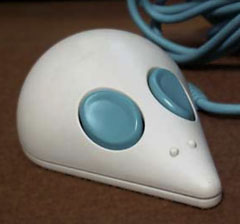
Being a bit of rebel, I had a Macintosh computer for many years and had just such a mouse on my desk.

“The Microsoft Mouse is a computer mouse released by Microsoft in 1983. It is the first mouse released by the company, and it was bundled with Microsoft Word, Notepad, and an on-screen teaching tutorial for an initial price of $195.

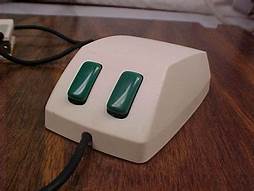
Nicknamed the ‘green-eyed mouse,’ the Microsoft Mouse featured a pair of green buttons. It also featured a more curved body than the blockier designs more common of mice at the time. As with other mice at the time, the Microsoft Mouse used a steel ball for tracking.

The initial version featured an InPort ISA interface, requiring a Microsoft bus card to be installed in the computer. Later versions were available with DE-9 or DB-25 serial connectors. All versions of the Microsoft Mouse could be used with IBM-compatible and other DOS systems.”

In 1983, I was working for Microsoft in the telemarketing sales division. The company was small enough, however, that friendships developed with individuals across all departments. One such friendship was with one very enthusiastic National Training Manager who, one day, saw me walking down the hall and asked me to step into his office as he wanted to show me something.

The memory is crystal clear. Alan’s office is little more than a cube, big enough for his desk, chair, and a file cabinet. But what I most recall is that his office is an interior one and has no window (ironic for Microsoft, right?). Additionally, his overhead light is not on and all illumination is provided by the glow of his computer monitor. Again, computers and monitors in 1983 had no graphical interface, just glowing green letters on a black screen.

He sits at his chair and says ‘watch this’ and then proceeds to put his hand on a little box and push it around his desk while a tiny straight line cursor jumps all over the screen. The demonstration continues as he clicks a button on the device which locks the cursor in place, then types a few words.

A few months later, our telemarketing group had ‘Mouse’ day with the introduction of Microsoft’s version of the device. Product introduction days were always exciting as our group created ways to make it special and get ourselves motivated.

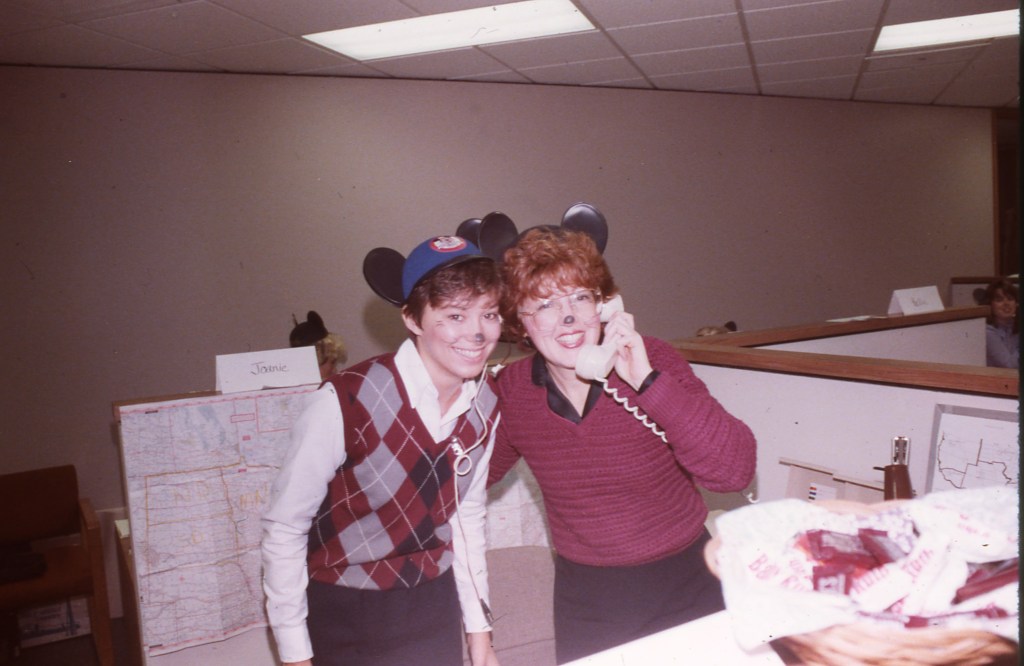
Two of my telemarketing co-horts, Sue and Susie, on ‘Mouse’ day.

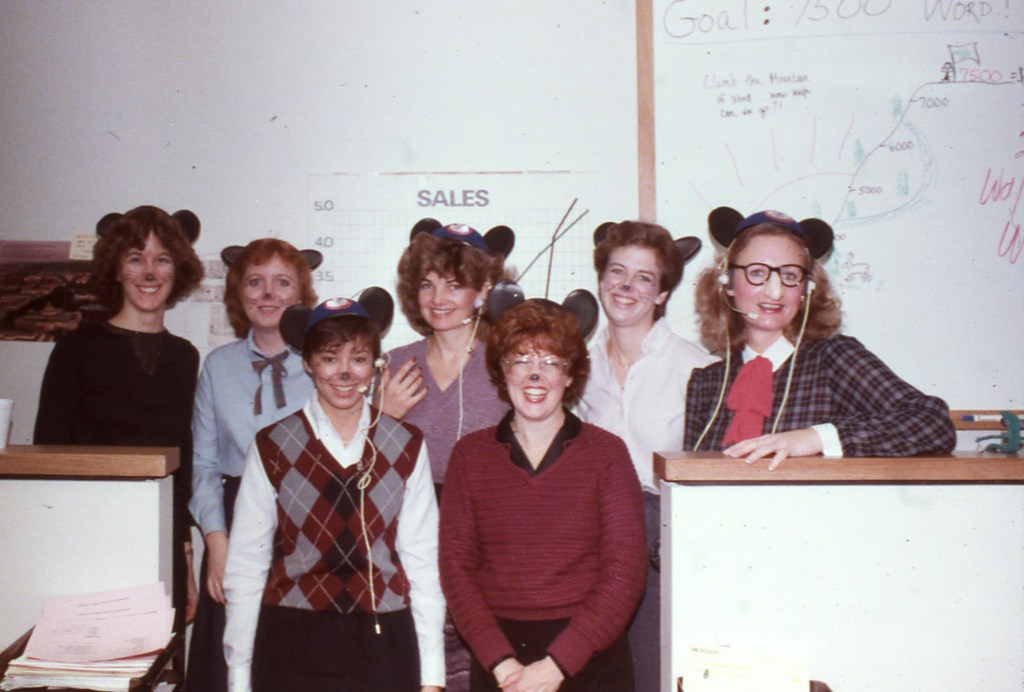
Mouse day, it turns out, featured everyone wearing Disneyland mouse ears as we called every last buyer in every computer store in the nation. At the front of the room was a large white board where our goals were written. As the day wore on, we would add our sales to the list, and whoops of excitement echoed through the cube farm as we reached each new goal.

I don’t recall how many we sold that first day or in subsequent weeks, but the bundle was hugely popular as consumers embraced the technology.

Most memorable was a funny incident which happened a short time after. In addition to the telemarketing group, we also had a customer service division for people to call in and get help when their products had issues. Often those calls were directed to a crack group of the most patient people in the universe: technical support.

I can clearly see two of my tech support buddies, both of whom were always willing to answer our questions when a buyer would, inevitably, ask us some technical thing that we – as mere salespeople – had no clue how to answer.

I can’t recall if it was Clay or Dolores who told me this story; but one day he/she received a tech support call from a woman who was complaining that her mouse was not working correctly. The tech people always worked through a list of known issues first, asking questions to drill down in order to solve the problem. Most issues they’d encountered before and would either be able to get it fixed it or would send the person to customer service to start the order replacement process.

This particular woman was certain that her software had a problem because every time she moved the mouse around all she got on the screen were squiggly lines and gibberish text. So the tech person had her move the mouse, click the button, and then type something. On the call went for five, then ten minutes, with no known bug causing the issue.

Finally, the woman – clearly exasperated – yelled ‘my arm’s getting tired.’

The tech support person paused and then asked her to describe how she was holding the mouse. It turned out that she was treating the mouse as though it was a touch screen device. All that time she had been holding it up and moving it around on the screen’s surface.

Over the years I’ve had ‘Microsoft’ dreams – not quite nightmares but close – where I’m back working at the company. In these dreams, however, I’m not donning Mouse ears and calling buyers; I work in tech support and field calls from people asking me questions for which I do not know the answers. Talk about stress.

The telemarketing crew fall of 1983, goals on the white board and all in the ‘Mouse’ spirit. The author with her big 80’s hair is at far left.

I think of Clay and Dolores often and smile at the stories they shared which often made the stress of working at Microsoft in the early 80’s just a little bit less. Hats off to all tech support people everywhere, you are my heroes.

The links:

https://en.wikipedia.org/wiki/Microsoft_Mouse

https://en.wikipedia.org/wiki/Computer_mouse

Game & Watch: Nintendo’s First Handheld Revolution

April 28th

Long before Angry Birds and Candy Crush

A Tuesday Newsday Classic

Decades before anyone had ever uttered the phrases Angry Bird, Temple Run, Word’s with Friends, or Candy Crush, the first wave in digital gaming had arrived in the States from Japan.

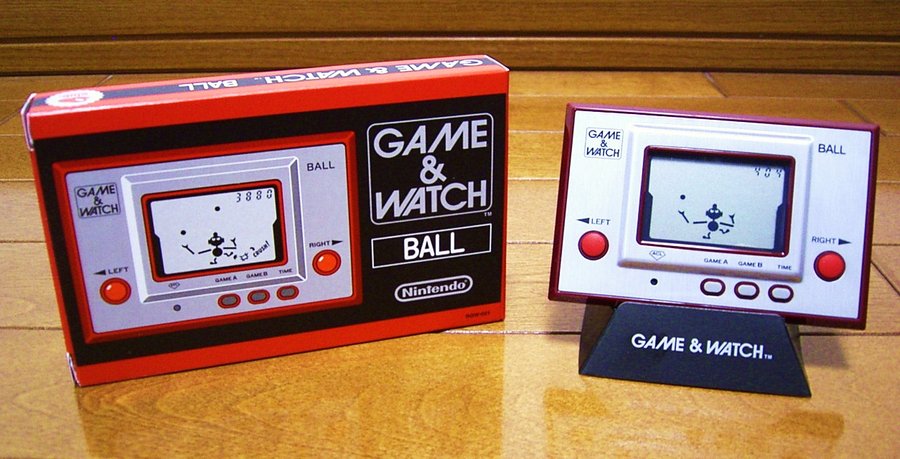
nintendo_game_and_watch___ball
The first Game and Watch released: Ball

On April 28, 1980, a then unknown manufacturer by the name of Nintendo, launched the first of its 4 ½ by 2 ½ handheld electronic game series in the US. And thus the Game and Watch was born, a precursor to the iPhone and Android games of today.

For less than $20 a consumer was able to buy a device which featured – usually – two different games played by pushing tiny buttons to move items around on the screen. From the Infallible Wikipedia:

“The Game & Watch brand is a series of handheld electronic games produced by Nintendo from 1980 to 1991. Created by game designer Gunpei Yokoi, each Game & Watch features a single game to be played on an LCD screen in addition to a clock, an alarm, or both. It was the earliest Nintendo video game product to gain major success.

The units are based on a 4-bit CPU from the Sharp SM5xx family, that include a small ROM and RAM area and an LCD screen driver circuit, although prior to the emulation in MAME there was a misconception in that every unit used a custom ASIC instead of a proper microcontroller.

The series sold a combined of 43.4 million units worldwide.”

Yokoi is said to have conceived the idea while on a bullet train when he observed a fellow traveler playing with his calculator. He reasoned that a small device which would also serve as a clock and alarm and allow the person to play a game could fill the desire for entertainment when unable to do other things.

In all, there were 59 different titles sold. It wasn’t until Nintendo established offices in the United States when the Game and Watch distribution became more widespread in this country.

Our family were early adopters of Game and Watch for one very good reason: The hubby went to work for Nintendo soon after they established their headquarters in Tukwila, Washington. (Yes, it’s true. Their first Washington address was there and NOT Redmond.)

I don’t know why, exactly, we bought all those Game and Watch games, except that Nintendo had an inventory and there was likely an employee discount. Regardless, soon we had friends and family asking for the games and we obliged.

The first one released was called Ball and featured a character later dubbed “Mr. Game & Watch” who juggled balls. He is according to the Infallible Wikipedia: “a generic amalgam of black, open-mouthed, big-nosed cartoonish stick figure silhouettes.” That first game – and three others released in quick succession – sold fewer than 250,000 games worldwide. Two other early games – Vermin and Fire – each sold about a million.

Which is where we enter the story. At the Nintendo warehouse in Tukwila there must have been stacks and stacks of unsold games. It is likely the first one we ever had was Fire and it was one of my favorites. We referred to the game as ‘Burning Babies.’ Yes, politically incorrect but in those days no one had ever uttered that phrase.

My description of the game Fire: On screen you see a cartoonish ambulance on the right side of the screen and a burning multi-story building on the left. Two Mr. Game and Watch characters carry what looks to be a safety net. Their job is to catch the ‘people’ who are literally leaping from the burning building. It starts out benign enough with one tiny person jumping and you must move the firefighters left and right with their net to stop the jumper from hitting the ground. You must then bounce the burning baby across three sections from the building to the ambulance. As the game progresses, a second jumper leaps soon after the first and you must now figure out which one to catch first. It’s like a bad juggling game where soon there are as many as four jumpers on the screen at once! Drop one and you get a tiny little angel icon indicating a lost life. Truly, you have not known stress until you’re frantically trying to save the tiny burning babies. Oh, and as your score increases, so does the speed with which they jump. Yes, that’s me playing the game in the short video below. Yes, it still is stressful when the babies splat on the ground!

Soon, the hubby was bringing home more Game and Watches. The titles included Parachute, Octopus, Fire Attack, Manhole, and Turtle Bridge. Each one seemed to include violent ends to the poor little electronic people or critters if you didn’t do your job. (Which is the common element for the four listed on the FB page!) These were followed by Nintendo’s own characters of Donkey Kong, Donkey Kong, Jr., and Mario’s Cement Factory, as well as licensed character games featuring such cultural icons as Popeye, Mickey Mouse, and Snoopy.

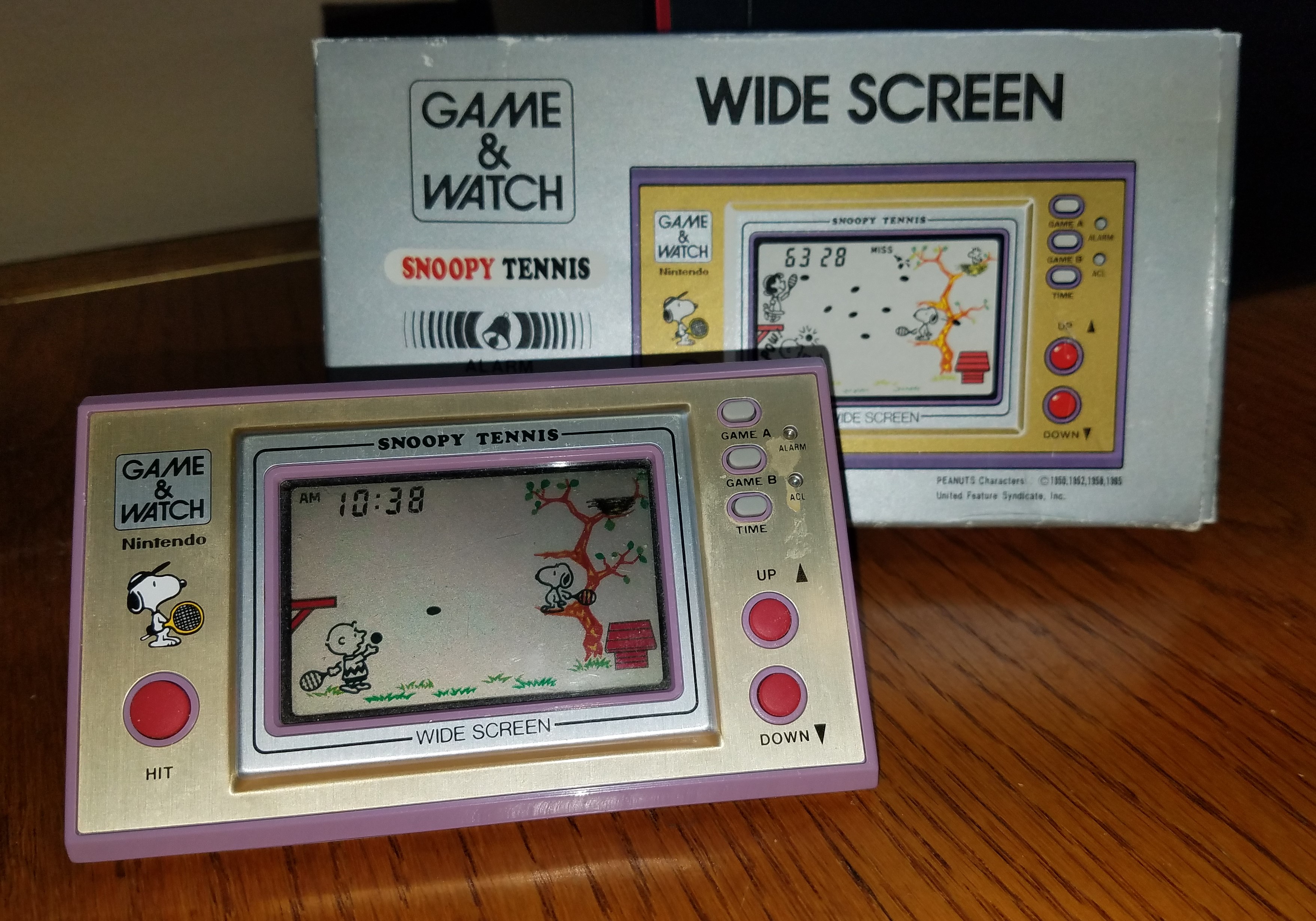
We gave my mother Snoopy Tennis for Christmas in the early 1980’s. It was the perfect game for her as she was a lifelong tennis player and got a real kick out of the tiny Charlie Brown wielding his tiny tennis racket to serve balls to Snoopy who had to jump up and down tree branches to hit it. If he missed, a happily sleeping Woodstock awoke and squawked about it. In the alarm feature, Lucy and piano player Schroeder make an appearance. The best part is that with Snoopy Tennis no tiny imaginary people died.

Snoopy Tennis
Snoopy Tennis was released on April 28, 1982, two years to the day after the first Game and Watch made its appearance.

My mother absolutely owned that game. I think her high score was in the ten thousands and, boy, did those tennis balls come fast and furious. She worked those controls like a boss. Everyone who watched her play was awed. At some point her thumbs got too overworked and she had to give up the game. It bubbled up out of a box when we were going through my parents’ house last summer so we now have two of that game. Hers is the one shown here.

I think about how far electronic games have come since then. I prefer games where when I lose, nothing dies. Which is why I love Candy Crush. Having completed over 5000 levels, I’m in rarefied territory and know of only one friend at a higher level. Like my Mom, I kinda own the game. But I think if my Mom had ever played Candy Crush, she would have given me a run for my money.

The links:

https://en.wikipedia.org/wiki/List_of_Game_%26_Watch_games

https://en.wikipedia.org/wiki/Game_%26_Watch_series