Archives

Celebrating Robert Redford: Hollywood’s Golden Heartthrob

A Movie Star for the Ages

August 18

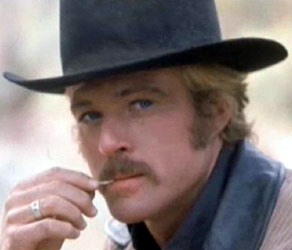
1973 was a pivotal year for this actor, his role in Butch Cassidy and the Sundance Kid (BC&TSK) catapulted him to the stratosphere of Hollywood stardom. Robert Redford, who turned 37 that year, didn’t look a day over 30 and for women – young and old alike – he became a sex symbol. Happy 89th birthday to, perhaps, the most successful actor of the late 20th century, who was born on August 18, 1936.

Redford as The Sundance Kid

Prior to his breakout role in BC&TSK, Redford found his first acting roles on Broadway which then led to television. These roles eventually brought him to the big screen with his first significant role as the male lead in the 1967 movie Barefoot in the Park opposite Jane Fonda.

But Redford was not content to be typecast due to his looks, passing up lead roles in both The Graduate and Who’s Afraid of Virginia Woolf. In BC&TSK, however, he found a role which resonated with him and a co-star in Paul Newman which proved to be box office gold.

Over the next several years, Redford had hit after hit. According to the Infallible Wikipedia:

“Starting in 1973, Redford experienced an almost unparalleled four-year run of box office success. The western Jeremiah Johnson’s (1972) box office earnings from early 1973 until it’s second re-release in 1975 would have placed it as the No. 2 highest-grossing film of 1973. The romantic period drama with Barbara Streisand, The Way We Were (1973), was the 11th highest-grossing film of 1973. The crime caper reunion with Paul Newman, The Sting (1973), became the top-grossing film of 1974 and one of the top 20 highest-grossing movies of all time when adjusted for inflation, plus landed Redford the lone nomination of his career for the Academy Award for Best Actor. The romantic drama The Great Gatsby (1974) was the No. 8 highest-grossing film of 1974. As well, 1969’s Butch Cassidy and the Sundance Kid placed as the No. 10 highest-grossing film for 1974 as it was re-released due to the popularity of The Sting. In 1974 Redford became the first performer since Bing Crosby in 1946 to have three films in a year’s top ten grossing titles. Each year between 1974 and 1976, movie exhibitors voted Redford Hollywood’s top box-office star. In 1975, Redford’s hit movies included 1920s aviation drama, The Great Waldo Pepper (1975), and the spy thriller Three Days of the Condor (1975), alongside Faye Dunaway, which finished at Nos. 16 and 17 in box office grosses for 1975, respectively. In 1976 he co-starred with Dustin Hoffman in the No. 2 highest-grossing film for the year, the critically acclaimed All the President’s Men. In 1975, 1977 and 1978, Redford won the Golden Globe for Favourite World Film Star, a popularity-based award that is no longer awarded.”

Paul Newman and Robert Redford in the Academy Award’s 1973 Best Picture “The Sting.”

Of course not all his films were box office winners and, like so many celebrities, age puts certain roles and images out of reach. But Redford was, perhaps, the most committed actor of his generation, turning to directing and producing when acting had all but played out. His most significant achievement post Hollywood heartthrob was in the creation of the Independent movie festival, Sundance.

Held annually near Provo, Utah, the Sundance Film Festival has become the place to launch independent films. In 2008, for example, 125 such films premiered at the festival.

Although Redford officially retired from acting in 2018, there is little doubt that his legacy will be felt for years to come.

It’s so very difficult to pick a favorite Redford role and film. As a romance writer, for me there is perhaps no sadder film than The Way We Were… the 1973 hit with Barbra Streisand. It’s a film which very much influenced me creatively. The storyline was compelling to this angsty 16 year old, rooting for the pair to live happily ever after. That is not how that story ends, however, and somehow I felt sorry for both of the main characters. Redford is outstanding in the role and one believes he is the golden boy Hubbell who wants and needs the perfect life and wife, frustrated by Katie’s strident politicization of everything around her. That said, from a teenagers perspective, he was so very likable, while Streisand was not.

But he was also terrific in All The President’s Men, Three Days of the Condor, and The Electric Horseman.

In the past few years I’ve connected with one of my Dad’s former students, Lisa, on Facebook. The same age as me, she is not at all shy about her lifetime love of Robert Redford. I would bet you a dozen doughnuts by the time you read this, she will have already posted birthday greetings to her high school (and beyond!) crush. And I will, as I have the past several years, give her a bad time about it. I mean, Redford is over 20 years older than either of us… but that doesn’t matter to her. She loves all things Robert Redford.

As for me, I picture Robert Redford in my head during the final scene from The Way We Were. Moments earlier he – along with his new paramour – have a chance meeting with Streisand. He returns to where she is passing out ‘Ban The Bomb’ fliers. From the look on her face, you know she still has a thing for him and why wouldn’t she? He’s devastatingly handsome… a shock of wavy blonde hair down across his forehead, suggestive blue eyes that seem to know it would never work, upturned coat collar, and his square jaw and ever so sardonic slight curve of the mouth. That’s the Robert Redford who captured the hearts of millions of women around the world. And if we had the chance to do it all again, would we? Could we? In a heartthrob’s beat, yes.

A few links:

https://en.wikipedia.org/wiki/Robert_Redford

https://en.wikipedia.org/wiki/Butch_Cassidy_and_the_Sundance_Kid

https://en.wikipedia.org/wiki/The_Way_We_Were

Animal House

July 28, 2020

“Oh Boy! Is This Great!”

Of all the years to be a college co-ed, 1978 was the best.

Culturally, it was the height of the ‘me’ generation’s influence. Commonplace restrictions from previous decades had all but been abandoned, leaving the youth to do the one thing they wanted: have fun.

animal-house-movie-poster-1020258451On July 28, 1978, a movie hit the theaters which encapsulated precisely this attitude, capturing the imagination of a generation. That movie: Animal House.

The idea for the movie came about via National Lampoon, a wildly popular magazine with college students. In fact, the official title of the movie is “National Lampoon’s Animal House.” The plot – to sum it up in a couple sentences is this: “Loser college guys join fraternity where anything goes. Fraternity gets kicked off campus and members, in an effort to save the fraternity, wreak havoc on campus and during the homecoming parade.”

With a budget of only 3 million allocated to its production, the executives at Universal Studios almost didn’t allow it to be made. But the writers were committed to the project, effectively wearing down the studio who basically told them ‘okay, but don’t expect much.’

According to the Infallible Wikipedia:

“National Lampoon’s Animal House is a 1978 American sex comedy film directed by John Landis and written by Harold Ramis, Douglas Kenney and Chris Miller. It stars John Belushi, Peter Riegert, Tim Matheson, John Vernon, Verna Bloom, Thomas Hulce, Stephen Furst, and Donald Sutherland. The film is about a trouble-making fraternity whose members challenge the authority of the dean of the fictional Faber College.

The film was produced by Matty Simmons of National Lampoon and Ivan Reitman for Universal Pictures. It was inspired by stories written by Miller and published in National Lampoon. The stories were based on (Harold) Ramis’s experience in the Zeta Beta Tau fraternity at Washington University in St. Louis, Miller’s Alpha Delta Phi experiences at Dartmouth College in New Hampshire, and producer Reitman’s at McMaster University in Hamilton, Ontario.”

In many ways, the low budget contributed to the film’s success. No one had heard of any of the actors, John Belushi and Donald Sutherland excepted. Rather than turn the film into a showcase for the popular cast of Saturday Night Live as was suggested, it turned out that the ensemble of newcomers brought an element of collegiality to it that made the film unique.

One big hurdle was finding a college willing to allow the movie to be filmed on their campus. One after another turned it down since, after reading the script, determined the publicity would be detrimental to their institution. It was an act of bravery that one administrator finally agreed to it. Also from the Infallible Wikipedia:

“The president of the University of Oregon in Eugene, William Beaty Boyd, had been a senior administrator at the University of California in Berkeley in 1966 when his campus was considered for a location of the film The Graduate. After he consulted with other senior administrative colleagues who advised him to turn it down due to the lack of artistic merit, the college campus scenes set at Berkeley were shot at USC in Los Angeles. The film went on to become a classic, and Boyd was determined not to make the same mistake twice when the producers inquired about filming at Oregon. After consulting with student government leaders and officers of the Pan Hellenic Council, the Director of University Relations advised the president that the script, although raunchy and often tasteless, was a very funny spoof of college life. Boyd even allowed the filmmakers to use his office as Dean Wormer’s.”

ah-party

John ‘Bluto’ Blutarksi leads the way during a Delta House Toga party

Now, I will say, if you’ve never seen the movie you should. As my now adult children know, there are some cultural references one absolutely needs to have. Animal House is such a film. The film is littered with quotable and iconic concepts many of which repeat to this day.

Ever hear of a toga party? You have Animal House to thank.

Double secret probation? Animal House. 

“Was It Over When The Germans Bombed Pearl Harbor? Hell No!” Animal House.

“Fat, Drunk, And Stupid Is No Way To Go Through Life, Son.” Animal House.

Food Fight? Animal House.

That summer, it went on to become the third highest grossing film of 1978 and – in the course of its run – took in a whopping 141.6 million. Not bad for a film which cost under $3 million to make and which the studio execs thought would flop.

When all was said and done, once again from the Infallible Wikipedia:

“In 2001, the United States Library of Congress deemed the film ‘culturally, historically, or aesthetically significant’ and selected it for preservation in the National Film Registry. Animal House is first on Bravo’s 100 Funniest Movies. In 2000, the American Film Institute ranked the film No. 36 on 100 Years… 100 Laughs, a list of the 100 best American comedies. In 2006, Miller wrote a more comprehensive memoir of his experiences in Dartmouth’s AD house in a book entitled, The Real Animal House: The Awesomely Depraved Saga of the Fraternity That Inspired the Movie, in which Miller recounts hijinks that were considered too risqué for the movie. In 2008, Empire magazine selected Animal House as one of The 500 Greatest Movies of All Time. The film was also selected by The New York Times as one of The 1000 Best Movies Ever Made.”

Back to 1978 and the phenomenon which had college students donning sheets and partying to the chants of “Toga! Toga! Toga!”

When I returned to the University of Puget Sound that September, everyone was talking about Animal House. Soon the Toga parties began and there were a handful of fraternity guy’s intent on channeling their inner Bluto.

Alpha Phi Halloween event 1978

A few sorority sisters ready for a Halloween party 1978.

Unfortunately, or fortunately, depending on your perspective, my sorority was located next door to the house which fashioned itself after the Delta’s of Animal House fame. There were shenanigans and crazy antics all that fall. Parties flowed out of their house and into the common areas, empty aluminum cans smashed against heads exactly like the John Belushi character did in the film, Christmas lights tossed into our basement level patio where they would ‘pop.’ And who knows what, exactly, was going on the night that a group of them appeared on the lawn outside our windows with that blow up doll.

Around 10 pm one night I heard a commotion outside of my room and the unmistakable thump, thump, thump of a large group of people making their way in unison down the hallway. What the heck?

A moment later: the sound of running feet. The door bursts open and one of my two roomies, Sheila, rushes in, slams the door behind her and presses her back to the closed door.

I can still picture her, a wild look in her eye, dressed in her full length flannel nightgown, hands pressed hard against the door, panting.

“There’s naked Phi Delts in our hall,” she gasped.

Now, to be clear, my other roommate Cathy and I DID NOT reopen that door to confirm her report. In fact, we wanted nothing to do with the conga line of nude men mooning the members of our sorority.

A minute or two later, the group reached the end of the hall and exited the building. Their bare hineys were last seen disappearing back into what I would consider UPS’ nominee for ‘Delta’ house.

In retrospect, my two years there were a rather surreal experience, greatly amplified by the culture of the time embodied in no small part by the movie Animal House.

In the iconic words of Kent ‘Flounder’ Dorfman “Oh boy! Is this Great!”

Indeed it was.

The links:

https://en.wikipedia.org/wiki/Animal_House

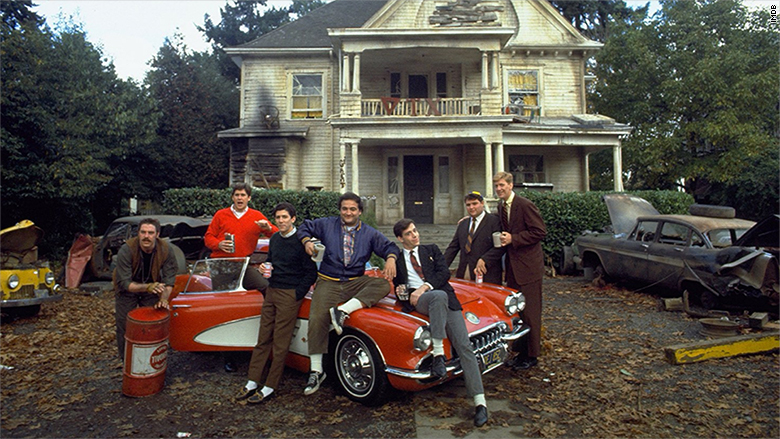
180726143707-animal-house-780x439Who’s who in the Facebook Photo (left to right):

Bruce McGill – “D-Day”; Tim Matheson – “Otter”; Peter Riegart “Boon”; John Belushi – “Bluto”; Tom Hulce – “Pinto”; Stephen Furst – “Flounder”; James Widdoes – “Hoover”


Honda Civic

Popular for four decades

July 14, 2020

1972 civic ad 2July 14, 1972 marks the date the Honda Civic was introduced. The Civic was, arguably, the beneficiary of a number of factors which catapulted it to the top of the small car class.
It was, however, the energy crisis which gripped the United States in late 1973 and into 1974 that proved to be its best marketing.

Without going down into the weeds as to the political reasons why, in 1974 the world experienced a gas shortage. The typical American of the day drove heavy, gas-guzzling automobiles. With gas costing around 50 cents a gallon, the amount of money it took to fill a tank was very affordable and not something most people considered when purchasing a car. By 1974, however, the price of gas had skyrocketed to $3 and $4 a gallon.

Enter the introduction of the compact and sub-compact car. While the big American automakers quickly rolled out such contenders as the Ford Pinto and the Chevy Vega, it was Japan’s Honda who found the winning formula.  The Civic’s cost, size, and great gas mileage marked a change in thinking in regards to the type of car a large portion of the American public wanted.

In 1973 – its first year being sold in the United States – just under 33,000 Civic’s were purchased. The following year sales were 43,000. Then in 1975, there was a 137 percent increase in sales with over 102,000 of the cars hitting the road. Since its introduction to the U.S. in 1973 until 2015, over 7.3 million have been sold.

Honda Civic’s were everywhere. Their distinctive look – sort of a tiny, boxy car – made them hard to miss. At the time, however, it was other features which made them popular. From the Infallible Wikipedia:

“It was equipped with a 1,169 cc (71.3 cu in) four-cylinder water-cooled engine and featured front power disc brakes, reclining vinyl bucket seats, simulated wood trim on the dashboard, as well as optional air conditioning and an AM/FM radio. The Civic was available as a two- or four-door fastback sedan, three- and a five-door hatchback, as well as a five-door station wagon. Due to the 1973 oil crisis, consumer demand for fuel efficient vehicles was high, and due to the engine being able to run on either leaded or unleaded fuel, it gave drivers fuel choice flexibility over other vehicles.”

EPSON MFP image

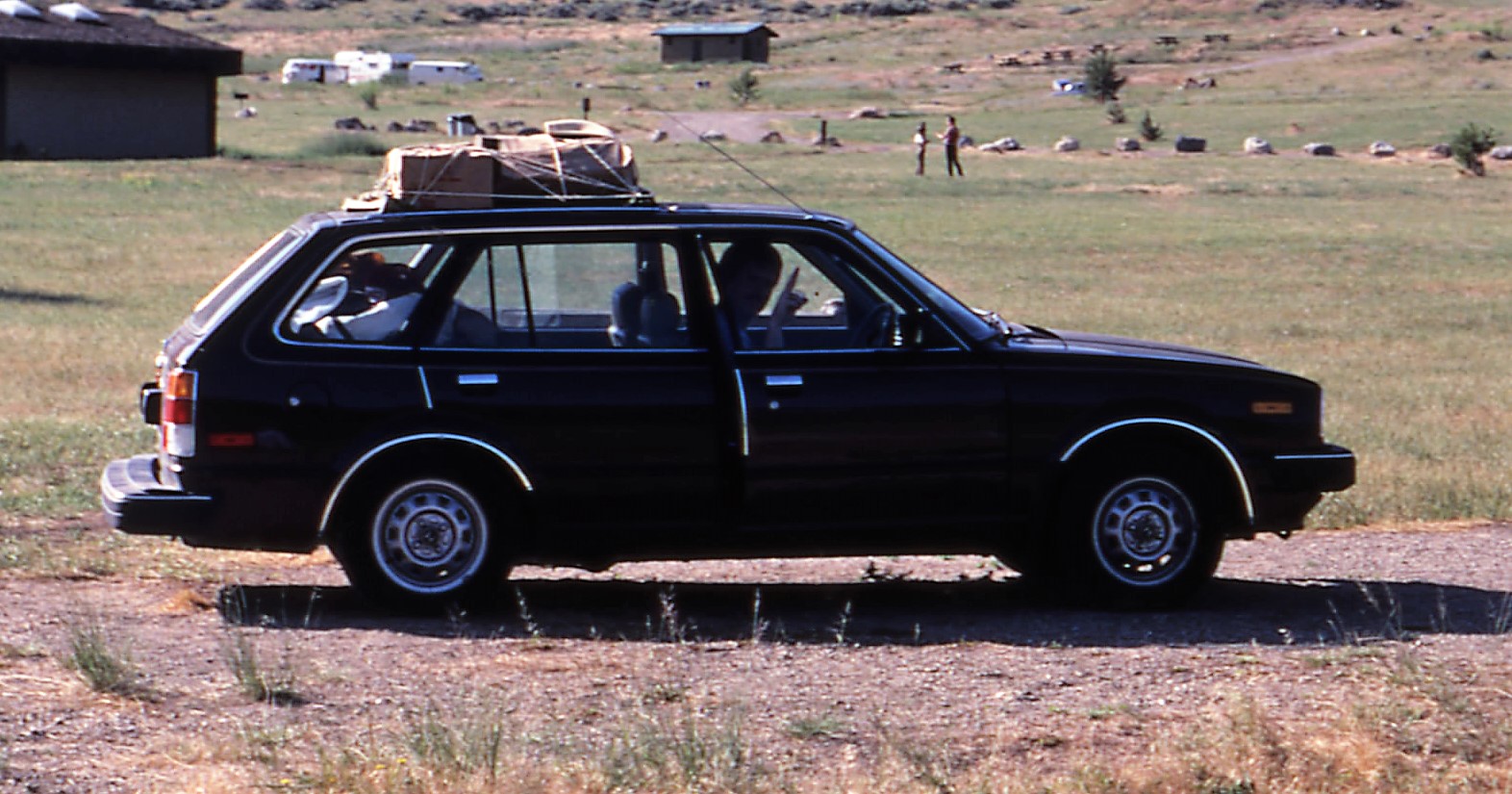
On the road in July 1982 at Lewis and Clark Caverns, Montana

In 1982, the hubby and I became a part of the Honda Civic family. The five-door station wagon seemed a great choice. During those years we often took off on weekends to go camping or for brief getaways. That summer, we embarked on a two week trip which took us to several National Parks, including Yellowstone, Grand Teton, and the Grand Canyon. Our little brown wagon served us well, conveying us over 3600 miles. The next year it took us to Vancouver Island and the year after that to Colorado and back.

EPSON MFP image

At Mesa Verde, Colorado, in 1984. The hubby is getting something from the car we need for dinner.

It was a great commuter car also: reliable, comfortable, and the always good gas mileage. When we retired the car in 1986 it was not because the car was no longer working but because we had purchased a boat and needed a vehicle capable of towing.

I do wonder if trading in the Honda so we could buy a boat was the right decision, however. There’s a saying that the two happiest days in a boat owner’s life are the day they buy it… and the day they sell it. Our first boat quickly earned its nickname – the Boat From Hell – or BFH as it was abbreviated. But that’s a totally different story.

Our Honda was never the car from hell, but a reliable friend, always ready to travel on a new adventure, never once letting us down. No wonder there were millions of them out on the road.

https://en.wikipedia.org/wiki/Honda_Civic

https://en.wikipedia.org/wiki/1973_oil_crisis

EPSON MFP image

July 31, 1982 at the Gardiner, Montana, entrance to Yellowstone.

Does She or Doesn’t She…

Only her hairdresser knows for sure

May 12, 2020

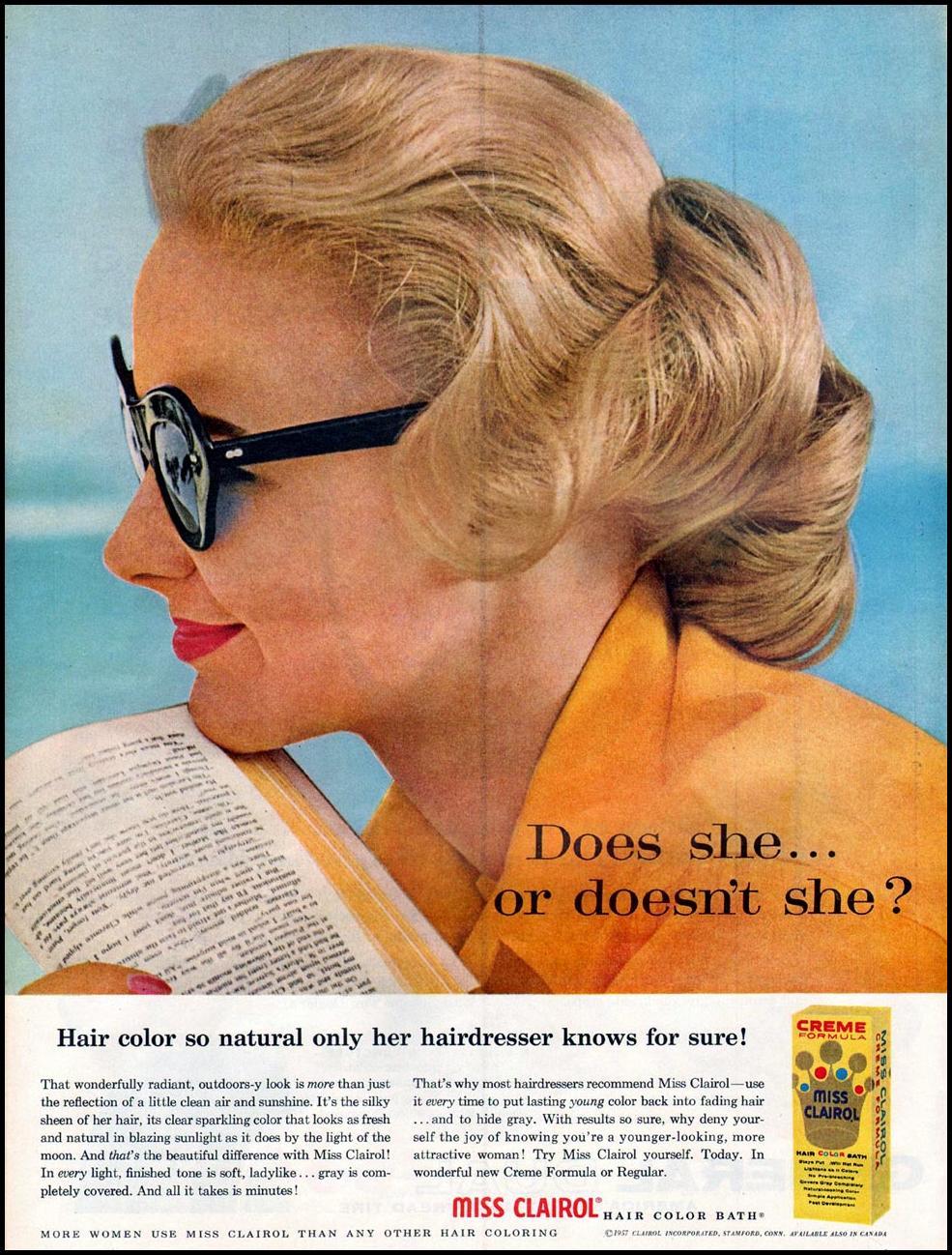
Miss ClairolIn the era of COVID-19 this slogan from a 1960’s home hair coloring commercial has become outdated. With the shuttering of the beauty salon in the name of public safety, women (primarily) of a certain age, are seeing their true hair color for the first time in years.
Which, of course, got me wondering about the history of coloring one’s hair. The first documented use of anything to change a person’s hair color appears to be by the Celtic people between 30 and 60 B.C. From the Infallible Wikipedia:

“Diodorus Siculus, a Greek historian, described in detail how Celtic people dyed their hair blonde: ‘Their aspect is terrifying… They are very tall in stature, with rippling muscles under clear white skin. Their hair is blond, but not naturally so: they bleach it, to this day, artificially, washing it in lime and combing it back from their foreheads. They look like wood-demons, their hair thick and shaggy like a horse’s mane. Some of them are clean-shaven, but others—especially those of high rank—shave their cheeks but leave a moustache that covers the whole mouth…’.

The dyeing of hair is an ancient art that involves treatment of the hair with various chemical  compounds. In ancient times, the dyes were obtained from plants. Some of the most well known are henna (Lawsonia inermis), indigo, Cassia obovata, senna, turmeric and amla. Others include katam (buxus dioica), black walnut hulls, red ochre and leeks. In the 1661 book Eighteen Books of the Secrets of Art & Nature, various methods of coloring hair black, gold, green, red, yellow, and white are explained. The development of synthetic dyes for hair is traced to the 1860s discovery of the reactivity of para-phenylenediamine (PPD) with air. Eugène Schueller, the founder of L’Oréal, is recognized for creating the first synthetic hair dye in 1907. In 1947 the German cosmetics firm Schwarzkopf launched the first home color product, ‘Poly Color’. Hair dyeing is now a multibillion-dollar industry that involves the use of both plant-derived and synthetic dyes.”

Nowadays you will see people with a veritable rainbow of colors in their hair, sporting bright hues of red, orange, green, blue, and purple.

The more traditional application of hair dye, however, still prevails with most using it to change to a preferred color or to hide the gray.

Unfortunately the Infallible Wikipedia’s statistics were from some eight years ago, but an internet search turned up a fun webpage with all sorts of facts on hair. It was one sentence in particular from Hollee Wood, the site’s author, which was most interesting:

“In our world of ever-changing hair color, it’s no secret that nearly 85% of women color their hair at least once every eight weeks (compared to just 7% in 1950). I mean… at that rate, it’s probable that you even color your hair! *gasp*”

Her article had a whole bunch of statistics including the fact that by the time most American’s reach age 60, nearly 60 percent of us will have grey hair.

Barb the towhead

The author in all her towheaded glory at age four

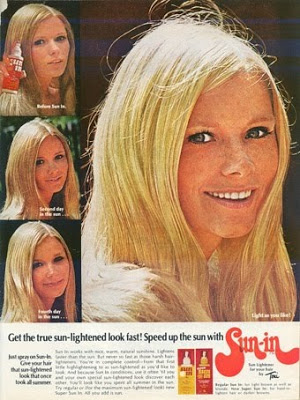
I’ve had a lifelong, on again off again, relationship with hair coloring products. Born a towhead (for those who do not know it’s a term to describe, usually, an extremely blonde child) I was blonde until about fifth grade and then my hair began to turn into a mix which I would describe as dirty blonde. My personal identity, however, was as a blonde and – when I was in ninth grade – I discovered a product which would bring back the blonde: Sun-In. The year was 1972 and both girls and guys did not believe in cutting one’s hair. It was the era of the hippie.

Sun-In 3I started using Sun-In approved by and aided by my mother! Every couple of months we would apply the stuff and, due to probably allowing it to stay on my hair longer than we should, I became blonder and blonder. This continued throughout high school and my first three years of college.
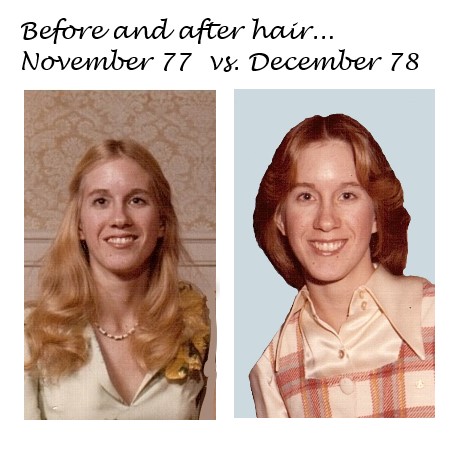
In the summer of 1978, with the long haired hippie era over, I did a very radical thing: I cut my hair. That fall I quit using Sun-In and my roots began to betray me. When I went home for Thanksgiving I did the second radical thing: I dyed my hair darker to try and locate my natural color. When I arrived back at the University of Puget Sound after the break, I got more than a few snapped heads with the total change in my appearance.

1977 vs 1978With the 1980’s came the era of big hair which, for someone whose hair has zero natural curl, required a different chemical process: the permanent wave. Turns out my hair was a fairly light brown and looked even lighter due to the perm.
By the late 1980’s, however, big hair was out and shorter hair was in. With motherhood in 1990 came the need for a practical haircut with little time to fuss over it.

And then, sometime in the mid 1990’s, my sister in law got me re-hooked on hair bleach and every couple of months I’d meet up with her to get my fix. And so it continued for nearly two decades until last fall when I decided it was time to wean myself from blonde (has anyone noticed how blonde starts to look like gray on an older person?) and back to light brown with highlights.

On March 16, 2020, the unthinkable occurred. All hair salons and barbershops in many states were deemed ‘dangerous’ for the spread of the Coronavirus and shut down. You could almost hear the panicked cry of millions of women across the U.S. as their ability to hide their natural hair color came to a crashing halt.

Now, two months later, they are – as the saying goes – showing their true colors. The worst case I saw was a woman with red hair… but the top of her head was pure white for at least an inch on either side of her part.

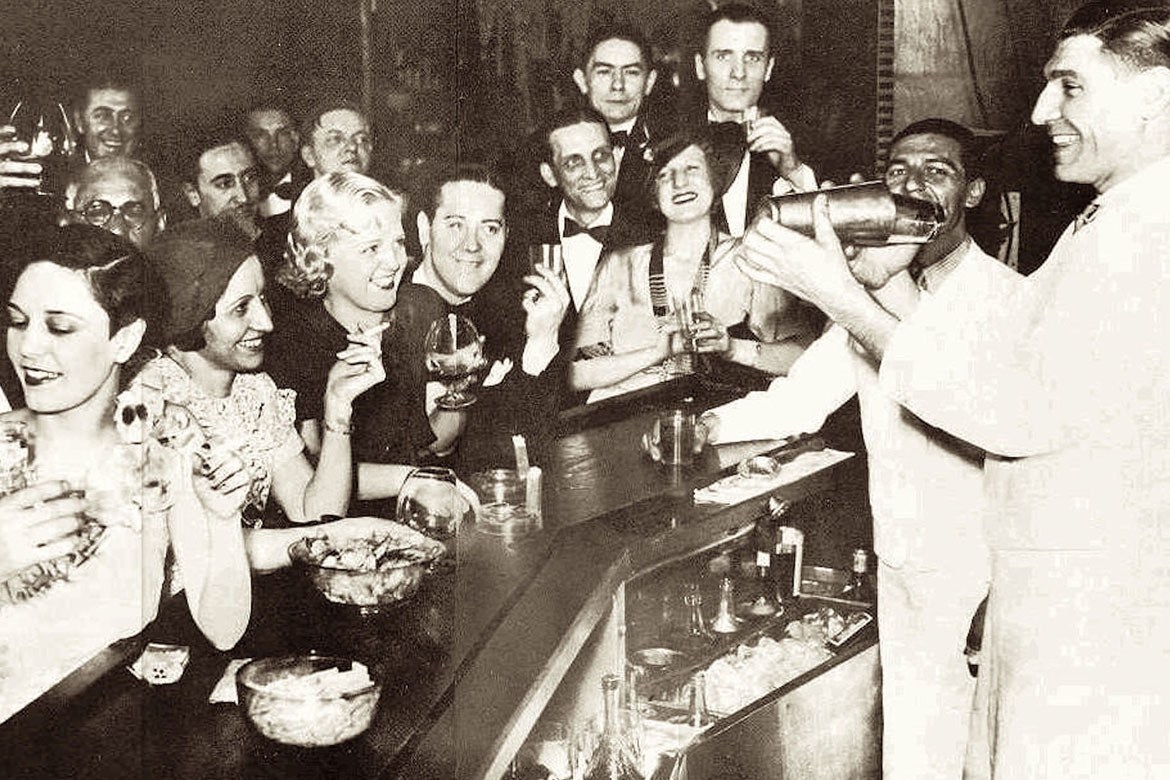
speakeasy

A speakeasy in the 1920’s

This whole thing has sparked what I call the “Speakeasy” of the 2020’s. In the 1920’s – under alcohol prohibition – secret locations where you could go to consume liquor sprang up in cities across the nation. During that time no one spoke publicly of these establishments but they did a booming business as history now tells us.

I find myself looking suspiciously at anyone with a decent haircut or obviously colored hair. “Where did you get your hair done?” I ask. They just smile and shrug their shoulders, unwilling to share their secrets.

As for me, I’m apparently part of the 40 percent who have not gone grey by age 60. Sure there are spots, but overall, I’m weathering the great graying of America okay. I am thinking of growing my hair long, buying some Sun-In, and reliving the glory days of 1974.

The question remains, however, with a twist: ‘will she or won’t she? Only her hairdresser – if she ever gets to see her again – knows for sure.

The links:

https://www.holleewoodhair.com/hair-color-statistics/

https://en.wikipedia.org/wiki/Hair_coloring

https://en.wikipedia.org/wiki/Speakeasy

1974 Olympic National Park

The author at the height of the Sun-in years, 1974, shown here with her first co-conspirator, Mom, and also Dad, who never dyed his hair and never once squeezed the magic potion on my head.

Update May 12, 2022 – Thankfully, hair salons have reopened and we women who want a bit of color have options once again! Here’s to all the hardworking cosmetologists out there who will remain unnamed. Hey, we don’t want to give up our secrets.

Nintendo Game and Watch

April 28, 2020

The First handheld Electronic Games

Decades before anyone had ever uttered the phrases Angry Bird, Temple Run, Word’s with Friends, or Candy Crush, the first wave in digital gaming had arrived in the States from Japan.

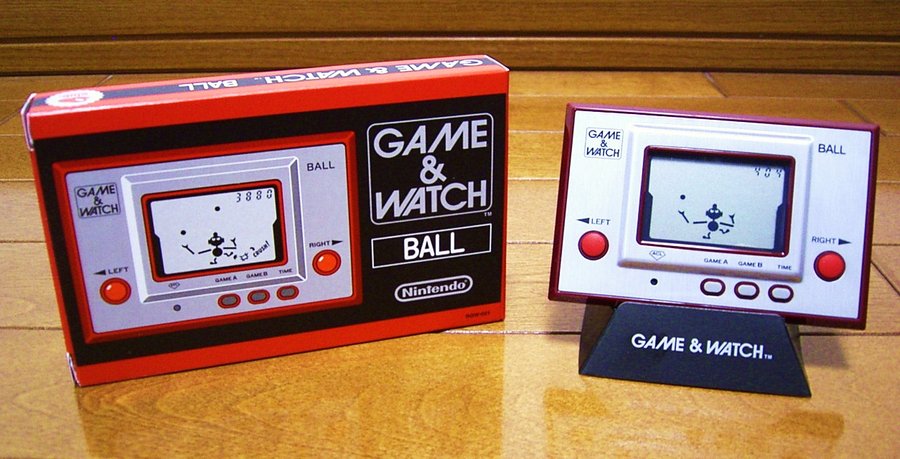
nintendo_game_and_watch___ball

The first Game and Watch released: Ball

On April 28, 1980, a then unknown manufacturer by the name of Nintendo, launched the first of its 4 ½ by 2 ½ handheld electronic game series in the US. And thus the Game and Watch was born, a precursor to the iPhone and Android games of today.

For less than $20 a consumer was able to buy a device which featured – usually – two different games played by pushing tiny buttons to move items around on the screen. From the Infallible Wikipedia:

“The Game & Watch brand is a series of handheld electronic games produced by Nintendo from 1980 to 1991. Created by game designer Gunpei Yokoi, each Game & Watch features a single game to be played on an LCD screen in addition to a clock, an alarm, or both. It was the earliest Nintendo video game product to gain major success.

The units are based on a 4-bit CPU from the Sharp SM5xx family, that include a small ROM and RAM area and an LCD screen driver circuit, although prior to the emulation in MAME there was a misconception in that every unit used a custom ASIC instead of a proper microcontroller.

The series sold a combined of 43.4 million units worldwide.”

Yokoi is said to have conceived the idea while on a bullet train when he observed a fellow traveler playing with his calculator. He reasoned that a small device which would also serve as a clock and alarm and allow the person to play a game could fill the desire for entertainment when unable to do other things.

In all, there were 59 different titles sold. It wasn’t until Nintendo established offices in the United States when the Game and Watch distribution became more widespread in this country.

Our family were early adopters of Game and Watch for one very good reason: The hubby went to work for Nintendo soon after they established their headquarters in Tukwila, Washington. (Yes, it’s true. Their first Washington address was there and NOT Redmond.)

I don’t know why, exactly, we bought all those Game and Watch games, except that Nintendo had an inventory and there was likely an employee discount. Regardless, soon we had friends and family asking for the games and we obliged.

The first one released was called Ball and featured a character later dubbed “Mr. Game & Watch” who juggled balls. He is according to the Infallible Wikipedia: “a generic amalgam of black, open-mouthed, big-nosed cartoonish stick figure silhouettes.” That first game – and three others released in quick succession – sold fewer than 250,000 games worldwide. Two other early games – Vermin and Fire – each sold about a million.

Which is where we enter the story. At the Nintendo warehouse in Tukwila there must have been stacks and stacks of unsold games. It is likely the first one we ever had was Fire and it was one of my favorites. We referred to the game as ‘Burning Babies.’ Yes, politically incorrect but in those days no one had ever uttered that phrase.

My description of the game Fire: On screen you see a cartoonish ambulance on the right side of the screen and a burning multi-story building on the left. Two Mr. Game and Watch characters carry what looks to be a safety net. Their job is to catch the ‘people’ who are literally leaping from the burning building. It starts out benign enough with one tiny person jumping and you must move the firefighters left and right with their net to stop the jumper from hitting the ground. You must then bounce the burning baby across three sections from the building to the ambulance. As the game progresses, a second jumper leaps soon after the first and you must now figure out which one to catch first. It’s like a bad juggling game where soon there are as many as four jumpers on the screen at once! Drop one and you get a tiny little angel icon indicating a lost life. Truly, you have not known stress until you’re frantically trying to save the tiny burning babies. Oh, and as your score increases, so does the speed with which they jump. Yes, that’s me playing the game in the short video below. Yes, it still is stressful when the babies splat on the ground!

Soon, the hubby was bringing home more Game and Watches. The titles included Parachute, Octopus, Fire Attack, Manhole, and Turtle Bridge. Each one seemed to include violent ends to the poor little electronic people or critters if you didn’t do your job. (Which is the common element for the four listed on the FB page!) These were followed by Nintendo’s own characters of Donkey Kong, Donkey Kong, Jr., and Mario’s Cement Factory, as well as licensed character games featuring such cultural icons as Popeye, Mickey Mouse, and Snoopy.

We gave my mother Snoopy Tennis for Christmas in the early 1980’s. It was the perfect game for her as she was a lifelong tennis player and got a real kick out of the tiny Charlie Brown wielding his tiny tennis racket to serve balls to Snoopy who had to jump up and down tree branches to hit it. If he missed, a happily sleeping Woodstock awoke and squawked about it. In the alarm feature, Lucy and piano player Schroeder make an appearance. The best part is that with Snoopy Tennis no tiny imaginary people died.

Snoopy Tennis

Snoopy Tennis was released on April 28, 1982, two years to the day after the first Game and Watch made its appearance.

My mother absolutely owned that game. I think her high score was in the ten thousands and, boy, did those tennis balls come fast and furious. She worked those controls like a boss. Everyone who watched her play was awed. At some point her thumbs got too overworked and she had to give up the game. It bubbled up out of a box when we were going through my parents’ house last summer so we now have two of that game. Hers is the one shown here.

I think about how far electronic games have come since then. I prefer games where when I lose, nothing dies. Which is why I love Candy Crush. Having completed over 5000 levels, I’m in rarefied territory and know of only one friend at a higher level. Like my Mom, I kinda own the game. But I think if my Mom had ever played Candy Crush, she would have given me a run for my money.

The links:

https://en.wikipedia.org/wiki/List_of_Game_%26_Watch_games

https://en.wikipedia.org/wiki/Game_%26_Watch_series

Remembering Karen Carpenter: The Voice That Captivated a Generation

February 4

Karen Carpenter

A Tuesday Newsday Classic

February 3, 1959. August 16, 1977. December 8, 1980. February 4, 1983. April 5, 1994.

For any person who is a true fan, any one of these dates might invoke an unpleasant memory of the ‘day the music died’ for them. Each date marks the passing of a well loved and famous musical artist. Do you recall where you were and what you were doing on any one of these days?

My brother – who is a disc jockey – still talks about August 16, 1977. The day Elvis died. For Nirvana fans it’s April 5, 1994. Beatles devotees recall December 8, 1980 as a day which shocked the world. And, of course, February 3, 1959, marks the tragic date when Buddy Holly died in a plane crash along with a few others.

Karen Carpenter early 1970s

Karen Carpenter in the early 1970’s

If you don’t recognize February 4, 1983, you can be forgiven. But for me that was the date when the first artist whose voice and music truly captured me, died: Karen Carpenter.

To this day I wonder it was an avoidable outcome if only…  if only her mother had been more loving and less controlling… if only she hadn’t been forced to come out from behind her drums… if only the press had not been so awful to her… if only she could have loved herself the way her fans loved her.

By all accounts, Karen’s life could have become a fairy-tale come true. At the age of nineteen Karen, as one half of The Carpenters, saw their first big hit “Close To You” rocket to the top of the pop charts. Fame and financial success followed with a string of Top Ten records. Concerts, TV specials, and an invitation to the White House were all a part of those heady years.

And yet. Karen was particularly sensitive to body image. From the Infallible Wikipedia:

“Carpenter began dieting while in high school. Under a doctor’s guidance, she began the Stillman diet, eating lean foods, drinking eight glasses of water a day, and avoiding fatty foods. She reduced her weight to 120 pounds and stayed approximately at that weight until around 1973, when the Carpenters’ career reached its peak.  That year, she happened to see a photo of herself taken at a concert in which her outfit made her appear heavy. Carpenter hired a personal trainer who advised her to change her diet. The new diet caused her to build muscle, which made her feel heavier instead of slimmer. Carpenter fired the trainer and began her own weight loss program using exercise equipment and counting calories. She lost about 20 pounds and intended to lose another five pounds. Her eating habits also changed around this time, with Carpenter trying to get food off her plate by offering it to others at the meal as a taste.”

With increased success, came increased pressure to look and be perfect. By most accounts it seems that Karen spent her life trying to gain her mother’s love and approval. Older brother Richard was the focus of the family’s attention. At age 3 he was playing the piano and had been identified as a child prodigy with immense talent. It must have come as a huge shock to her parents when it was Karen and her amazing voice that proved to be the secret to success. Also from the Infallible Wikipedia:

“(Karen) Carpenter had a complicated relationship with her parents. They had hoped that Richard’s musical talents would be recognized and that he would enter the music business, but were not prepared for Karen’s success. She continued to live with them until 1974. In 1976, Carpenter bought two Century City apartments which she combined into one; the doorbell chimed the opening notes of ‘We’ve Only Just Begun’.”

Karen carpenter in grip of her disease

In this photo, you can clearly see that she is not at a healthy weight.

Most of the focus on Anorexia Nervosa came after Karen’s untimely death. In the decades since there has been research and a public push to find solutions for those who are afflicted by the disorder. Karen Carpenter’s struggle has been largely responsible for this.

One of the things I would have loved would have been to attend a Carpenter’s concert. Alas, being only 13 when they hit the top of the charts, it was not going to happen. My mother believed rock and roll concerts (the Carpenters were not exactly rock and roll BTW) were not appropriate places for young women. In fact, the first concert I attended was a decade later, long after the Carpenters were no longer touring.

For several years in the 1970’s, however, I purchased every one of their albums and would listen to Karen’s dulcet tones for hours on end. I loved her voice.

Fast forward to Friday, February 4, 1983. I was working at Microsoft – then located near the Burger Master on Northup Way in Belleuve, Washington – paying more attention to selling computer software and not listening to music for hours each day.

It was payday and at lunchtime one of my fellow Microsofties, Sue C., and me decided to go deposit our paychecks in the bank. We headed to downtown Kirkland, a few miles north. Once our banking was complete, we drove south on Lake Washington Boulevard. We likely had the radio on – background to our chatting – when I heard the announcement “Pop star Karen Carpenter has died.”

I think Sue was behind the wheel and immediately stopped the car as we both exclaimed shock and dismay. How could it be? What I most recall about that day is that it seemed dark to me. In reality, according to the weather history, it was a fairly mild, clear day. But in my mind, it’s dark.

Karen Carpenter was such a part of our growing up experience; she was 32 years old, a mere seven years older than ourselves.

In 1989 I watched with interest the CBS TV movie The Karen Carpenter Story. In the years since her death I had not listened much to The Carpenters. The moment I heard those favorite songs and her voice, however, it was as if I was transported back to the early 1970’s. What a voice. It was filled with emotion and able to convey a sadness that transcended the years. Like so many artists who died young, I wonder what wonderful songs the world missed out on when Karen Carpenter left us on February 4, 1983.

A few links:

https://en.wikipedia.org/wiki/Karen_Carpenter

I couldn’t make up my mind as to which of these two songs to share… so I did both. I think Superstar also captures the depth of whatever pains she felt in life.

Superstar: https://youtu.be/SJmmaIGiGBg

Links to three other posts I’ve made about Karen Carpenter:

Wedding Woes

Just like me, they long to be…

The 100-Year Legacy of the National Christmas Tree

 A 102 Year Tradition

December 24th

2019NCTL_Ceremony.jpg

The 2019 National Christmas Tree

At 3 p.m. on Monday, December 24th, 1923, an American tradition began which continues to this day. That event was the lighting of the first National Christmas tree.

Now, 102 years later, the event occurs earlier in the month – this year on December 4th – as it has since 1954 during a month long event known as the Pageant of Peace. But back to the beginning.

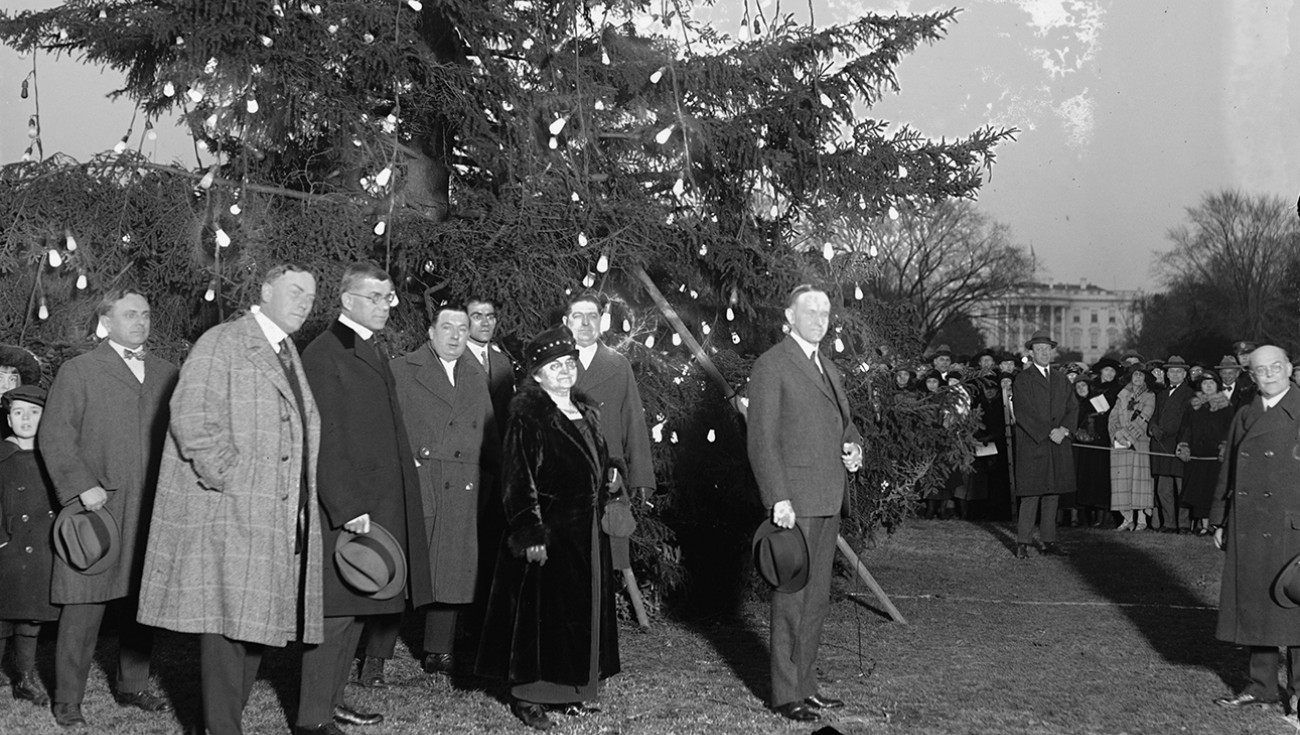
The concept of a National Christmas tree was the idea of Frederick Morris Feiker, an engineer with General Electric. He, along with Vermont US Senator Frank L. Greene, convinced President Calvin Coolidge to light the tree.

Alumni of Middlebury College in Vermont paid for the transport of a 48 foot tall balsam fir to be transported to Washington, D.C. with GE providing 2,500 green, red, and white electric lights.

From the Infallible Wikipedia:

calvin-coolidge-was-the-first-president-to-instate-a-public-christmas-celebration-at-the-white-house-with-the-first-national-chris.jpg

President Calvin Coolidge and dignitaries at the first National Tree Lighting ceremony in 1923

“At 3 p.m. on December 24, 1923, a 100-voice choir from the First Congregational Church assembled on the South Portico of the White House and began a two-hour concert of Christmas carols. At 5 p.m. (dusk) on Christmas Eve, President Coolidge touched a button at the foot of the tree which lit the lights and electric candles adorning the tree, but he did not speak. A searchlight from the nearby Washington Monument was trained on the tree to help illuminate it as well. The Coolidge family invited citizens of the city to sing Christmas carols on the Ellipse after dark. Between 5,000 and 6,000 people thronged the park, joined by 3,000 more people by 9 p.m. The crowds were joined by the Epiphany Church and First Congregational Church choirs, which sang carols, and the Marine Band played Christmas-themed music. The singing ended shortly before midnight. After the white residents of the city had dispersed, African American residents of the city were permitted on the park grounds to see the National Christmas Tree. An outdoor Christian worship service was held, and a mass choir composed of signing groups from area community centers sang more Christmas carols. An illuminated Christian cross was flashed on the Washington Monument, and men dressed as shepherds walked from the National Christmas Tree to the monument.”

300px-US_National_Christmas_Tree_1923The following year Coolidge objected to cutting down a tree for the event so a 35 foot tall live Norway Spruce was located and planted in a new location near the Treasury Building. This tree survived until 1929 when it was determined that the plant had been damaged and needed to be replaced. This began a series of live trees being planted, dying, and being replaced until, in 1934, the last tree was cut down in that location.

In December 1934, the tree and the ceremony were moved to Layfayette park, north of the White House. There it remained for only a few short years before returning to its original site on the Ellipse where it remains to this day. Over the years there have been many, many trees which have served in the role. Additionally, the ceremonies and events associated with it have become quite extensive. If you’d like to read more about its history, here’s the Wikipedia link https://en.wikipedia.org/wiki/National_Christmas_Tree_(United_States) and also the link to the official website https://thenationaltree.org/lighting-ceremony/2019-national-christmas-tree-lighting-ceremony/.

Although I’ve never seen the National Tree, I do love driving around during the Christmas season and viewing all the wonderful outdoor decorations. There is nothing quite so beautiful as a blue spruce or fir tree at night covered with lights AND an inch or two of snow on its branches.

My first memory of such a tree was when I was probably 7 or 8. My bedroom in Yakima faced towards our backyard. Our neighbor, Ray Broten, spent a lot of time keeping his yard beautiful. No matter the season, his was always manicured and trimmed to perfection. That particular December, the spruce tree located in the southwest corner of his backyard cut through the darkness with blue, green, red, and white lights, illuminating my bedroom each night. After I went to bed there was many a time I stole back over to the window and just stood and looked out at his beautiful tree. My favorite nights were when a soft snow was falling, muting the darkness with a blanket of white.

When I got too cold, I’d crawl back in to bed, and as I warmed up and drifted off to sleep, the shine of those lights would bathe the room with a soft glow.

This tradition continued for a number of years until the time I moved away from Yakima. Although those years are long ago, the memory is etched with clarity as Mr. Broten unknowingly created one of my fondest recollections.

May your Christmas also be one of wonderful reminiscences and the creation of new memories. Merry Christmas one and all.

Still Going…

The Energizer Bunny

October 29, 2019

In the world of advertising, this campaign was particularly brilliant. The story begins in 1983 when Duracell featured a dozen stationary, identical light pink bunnies, all battery powered, drumming on snare drums. The announcer intoned that the one with the Duracell battery would last longer. Eventually, all the batteries die with the exception of the one powered by Duracell.

On October 30, 1988, however, a new bunny emerged on the advertising scene and stole the show from Duracell.

energizer-bunnyThe Energizer Bunny was also pink but instead of being one of a crowd which outlasts the others, this rabbit had attitude. It wore hip sunglasses. It was hot pink. It moved around the room on blue flip flop sandals. And it had a big ole bass drum with the word “ENERGIZER” emblazoned across the surface. In short, it had important elements of a great advertising campaign in that it was memorable and humorous. The bunny has appeared in over 100 commercials and has been featured on TV shows and in movies.

From the Infallible Wikipedia:

“Commercials after the first started out with the Bunny leaving the studio it performed the ‘Drumming Bunny’ ad in, then wandering into the sets of a couple of realistic-looking commercials for fictional products, interrupting them. As the campaign progressed, many of these ads were standalone (for fake products such as ‘Sitagin Hemorrhoid Remedy’, ‘Nasotine Sinus Relief’, ‘TresCafe Coffee’, ‘Alarm’ deodorant soap, etc.) and even a few featured celebrities (such as Lyle Alzado promoting a snack called ‘Pigskins’, and Ted Nugent doing an ad for a Mexican food chain called ‘Cucaracha’) only to have the Bunny march through, beating his drum, because he was ‘still going’ (one infamous commercial was for a fake long-distance telephone company with a couple in the United Kingdom talking to their son, who was supposedly in New York and exclaimed that he ‘sounded like he’s right next door’, and when the Bunny came in, he knocked down the divider to show they really were next to each other). Eventually real-life products and icons would do a crossover with the Energizer Bunny (Michael J. Fox doing a Pepsi ad, and the opening of TV shows such as Alfred Hitchcock Presents and ABC’s Wide World of Sports). The Energizer Bunny has appeared in more than 115 television commercials.”

The Energizer Bunny has come to represent something or someone which keeps going and going, seemingly without end.

In late November 2010 I was in Yakima staying to take care of my parents who were in crisis that week. My mom – who had dementia and mobility issues due to a stroke a year earlier – needed round the clock assistance. Between my Dad, a part time caregiver, plus help from both my sister and me, they had been managing okay.

The Tuesday before Thanksgiving, however, Dad collapsed and was discovered by the caregiver. 9-1-1 was summoned and he spent three days in the hospital. A difficult patient, he convinced the doctor to release him earlier than the Doc thought prudent, and arrived home on Friday, November 26th proclaiming he was just fine.

A little after 10 p.m, he went in to take a shower. I heard him calling for help a few minutes later and rushed in to discover him collapsed on the floor. After many struggles I was able to get him up onto the seat of my mother’s walker, but he was slumped to one side. He objected to the thought of calling 9-1-1 (again!) so I called my sister who, along with her husband, came over. Eventually we did call the medics who arrived and discovered his heart was pounding at about 200 BPM and suggested he go to the hospital.

No way was he agreeing to that and kept insisting that the medics just put him to bed. Which they did. Convinced by the EMT’s that he might not survive the night, my sister and I took turns with an all night vigil.

Around 8 a.m., and with Dad still with us, I was up and out in the kitchen contemplating how to deal with two parents in need of assistance. A noise to my left drew my attention. I looked up and here came my dad, using my mom’s smaller aluminum walker, advancing with purpose and determination and seemingly unfazed by all which had happened. That entire day he moved with frenetic energy, straightening things, switching from one thing to another, hardly sitting down all day.

I described the whole thing to my sister this way: “Dad is like the Energizer Bunny.”

For the next nine years, this has been the way we’ve described our dad. There have been countless episodes of the pounding heart which takes him down for a day or two. When he’s recovered, though, watch out! Because it was always back to Energizer Bunny mode.

Eventually, however, even the strongest, most durable batteries run out of energy. And so it was for my father on October 24. His strong heart – in spite of what I am now certain were Tachycardia events – was the battery which kept him going to the age of 96 and a half.

RIP our Energizer Bunny.

The links:

https://en.wikipedia.org/wiki/Energizer_Bunny

https://www.shawandsons.com/obituary/vincent-devore

Saturday Night Live

Still Crazy After All These Years

November 20, 2018

When this TV show hit the airwaves in October 1975, it was considered edgy and pushing the boundaries of societal good taste. For teenagers and twenty-something’s it became ‘must see’ TV. We are, of course, talking about Saturday Night Live which is now in its 44th season.

140207_2721464_Paul_Simon_s_Monologue_Worries_anvver_4

Paul Simon – Still Crazy After All These Years – in the turkey costumer on SNL.

No doubt I watched the November 20, 1976, episode live when singer/songwriter Paul Simon hosted the show and donned a turkey costume for one of the sketches. In the sketch he sings the first five lines of the song:

I met my old lover
On the street last night
She seemed so glad to see me
I just smiled
And we talked about some old times
And we drank ourselves some beers
Still crazy after all these years
Still crazy after all these…

From there he complains about how stupid he feels being dressed up as a turkey, eventually leaves the stage, and has a backstage conversation with Lorne Michaels – SNL’s producer – before the bit is over.

It was things like this which propelled SNL into the pop culture of the 1970’s and soon had young people repeating lines like:

“We’re just two wild and crazy guys!” and “Never mind” and my personal favorite, “Jane, you ignorant sl*t.”

All three of these were repeated multiple times in multiple episodes, as were another dozen characters who said memorable things.

soon-will-be-the-foxes

Two Wild and Crazy guys! – Dan Akroyd and Steve Martin

The first featured Steve Martin and Dan Akroyd who took on the persona of two socially awkward Czechoslovakian brothers, Yortuk and Georg Festrunk, who continually tried to pick up American women. But always failed.

“Never mind” was from the genius of Gilda Radner whose character Emily Litella would pontificate on some subject. From the Infallible Wikipedia:

“Emily Litella is an elderly woman with a hearing problem who appeared 26 times on SNL’s Weekend Update op-ed segment in the late 1970s. Attired in a frumpy dress, sweater and Lisa Loopner glasses, Litella was introduced with professional dignity by the news anchors, who could sometimes be seen cringing slightly in anticipation of the malapropisms they knew would follow. These sketches were, in part, a parody of the Fairness Doctrine, which at the time required broadcasters in the United States to present opposing viewpoints on public issues.

Litella would peer through her bifocal glasses and, in the character’s high-pitched, warbly voice, would read a prepared statement in opposition to an editorial that the TV station had supposedly broadcast. Litella would become increasingly agitated as her statement progressed. Midway in her commentary, it became apparent to the anchor, and the audience, that Litella had misheard or misunderstood the subject of the editorial to which she was responding. A typical example:

‘What is all this fuss I hear about the Supreme Court decision on a ‘deaf’ penalty? It’s terrible! Deaf people have enough problems as it is!’

The news anchor would interrupt Litella to point out her error, along the lines, ‘That’s death penalty, Ms. Litella, not deaf … death.’ Litella would wrinkle her nose, say something like, ‘Oh, that’s very different,’ then meekly turn to the camera and say, smiling, ‘Never mind!’”

Of course the last one was completely over the top in the 1970’s as saying the word ‘slut’ on TV was just not done. But that’s exactly what Dan Akroyd – in the role of a news anchor – would deadpan to his co-anchor, Jane Curtin, during a segment titled “Point/Counterpoint”. And the audience loved it.

53-46720-akroyd-curtain-1516730738

Point/Counterpoint with Curtin and Akroyd

It was society altering humor which has influenced several generations. I was 18 when it first hit the airwaves. Although I watched at my home in Yakima the first two years I have a distinct memory of hurrying into the TV room at the Alpha Phi house at the University of Puget Sound to watch it while in college from 1977 through 1979. There was always a fairly large group to view it with me.

Nowadays, when I see the program, I find myself shaking my head as what the current generation finds funny no longer resonates with me. Alas, we are all products of our time. I will forever think of Dan Akroyd, Gilda Radner, John Belushi, Jane Curtin, Bill Murray, Garret Morris, and Laraine Newman as the REAL SNL cast!

SNL cast 1975 to 1979

SNL cast member 1976 to 1979, left to right, Garrett Morris, Jane Curtin, John Belushi, Laraine Newman, Dan Akroyd, Gilda Radner and Bill Murray

As I have been known to do with my kids is to provide them with the cultural reference – usually in the form of a video – whenever my husband or I quote something from SNL. A roll of the eyes lets me know that they’re not interested to which I respond “Never mind.”

As always, a few links:
https://www.nbc.com/saturday-night-live/video/paul-simons-monologue-worries/n8639

https://en.wikipedia.org/wiki/Recurring_Saturday_Night_Live_characters_and_sketches_introduced_1977%E2%80%931978

https://en.wikipedia.org/wiki/Emily_Litella

Sadie Hawkins Day

November 13, 2108

Catch and Release?

sadietitleThe origin of Sadie Hawkins Day is, no doubt, an anachronism to the young people of today who would be simultaneously surprised and offended by it. But on November 13, 1937, the event was introduced in a popular comic strip and soon, in the vernacular of today, went viral.

 For those who have never heard the term, it was cartoonist Al Capp who, in his syndicated comic Lil’ Abner, wrote it as a plot-line device.

According to the Infallible Wikipedia:

“In Li’l Abner, Sadie Hawkins was the daughter of one of Dogpatch’s earliest settlers, Hekzebiah Hawkins. The ‘homeliest gal in all them hills,’ she grew frantic waiting for suitors. When she reached the age of 35, still a spinster, her father was worried about Sadie living at home for the rest of her life. In desperation, he called together all the unmarried men of Dogpatch and declared it ‘Sadie Hawkins Day’. A foot race was decreed, with Sadie pursuing the town’s eligible bachelors. She was specifically interested in a handsome boy named Adam who was already in a courtship with a cute girl, Theresa, whose father was the area’s largest potato farmer, Bill Richmand, and, unlike Sadie, had a number of courtship offers. Adam was invited to the race because Miss Theresa and Adam weren’t actually engaged. With matrimony as the consequence of losing the foot race, the bachelors of the town were running for their freedom. Adam scored fourth place out of 10, leaving John Jonston as Sadie’s prize. It is possible that the concept’s origins are in an inversion of the myth of Atalanta, who, reluctant to marry, agreed to wed whoever could outrun her in a footrace.

            ‘When ah fires [my gun], all o’ yo’ kin start a-runnin! When ah fires agin—- after givin’ yo’ a fair start—- Sadie starts a runnin’. Th’ one she ketches’ll be her husbin.’

            The town spinsters decided that this was a good idea, so they made Sadie Hawkins Day a mandatory yearly event, much to the chagrin of Dogpatch’s bachelors. If a woman caught a bachelor and dragged him, kicking and screaming, across the finish line before sundown, by law he had to marry her.”

sadie hawkins cartoon

The 1937 cartoon which started it all.

The idea caught on and, just two years later, an article in Time magazine claimed over 200 Sadie Hawkins dances were being held that year at colleges throughout the United States. By 1952 it was estimated that the annual November event was celebrated in 40,000 venues!

Sadie Hawkins Dance, 1949d

Some late 1940’s Sadie Hawkins costumes

Even today, Sadie Hawkins festivities remain popular in the mid-west and south and women – perhaps still shy about asking a boy out – can feel free to pursue the guy of their dreams on November 13.

When I was a teenager, Tolo was our high school version of Sadie Hawkins Day. Apparently a Tolo Dance is unique to the Pacific Northwest. It was started at the University of Washington by Mortar Board, an all women’s honorary society, known there as the Tolo Club. The first dance held by the Tolo Club was conceived as a fundraiser. Like a Sadie Hawkins Day dance, it was the girls who asked the boys.

But back to high school. There was something frightening about the concept of asking a guy to go out. What if he said ‘no’? What if he told his friends and laughed about you behind your back? What if, what if, what if…

And yet somehow I screwed up the courage to ask one my junior year. His name was Mel, he was a senior, and he was an assistant editor on the yearbook staff. We had worked together on the annual since the beginning of school. I thought he was cute, had a good sense of humor, and would be fun to ask to Tolo.

In those days people didn’t do crazy things to ask someone, you just waited until the person was alone and then swoop in. Perhaps I asked him during class one day. I’m pretty sure I’ve tried to block the incident from my memory because I don’t recall exactly how or when I asked him. All I know is that I did and that he said he would.

When the day of the big event arrived I was a wreck, obsessing over what I had chosen to wear (Don’t judge – all I can say is that double knit was a thing in 1973). And obsessing over what we would talk about all evening and if he really wanted to even go with me.

So we went to Tolo, danced, hung out with Mort (editor of the annual that year) and his date a bit, made small talk, and then Mel took me home. The evening ended with a polite ‘thanks for asking me, I had a good time’ verbal handshake and then he left.

 Afterwards I was determined to not let the less than stellar date affect our friendship in class and things went back to normal. Mel’s most famous moment in high school occurred a few months later in the spring of 1974 when he became the one and only student at Eisenhower High School to – at an after school track meet – participate in the nationwide phenomenon of … streaking! He graduated that June – in cap and gown – and I have never seen him again.

The next year there was no way I going to put myself through another awkward evening. I stayed on the sidelines and have never regretted that decision.

 What the experience of asking Mel to Tolo did for me was two things:

  • First, it made me totally appreciate the challenge for men – at least in my day – of having to read the tea leaves of a woman’s interest levels. It’s darn intimidating to figure out if she’ll say ‘yes’ or ‘no.’
  • Second, from experiences such as that, I gained valuable insight which has made it easier to penetrate the heads of the fictional characters I write. If I can conjure up the way I felt  when I asked someone out or endured an awkward date, then I can imagine a character – male or female – having similar trepidation’s.

sadielife2-life-magazine

Some Sadie Hawkins girls participating in catch and release.

So here’s to Sadie Hawkins day… hope you ladies out there looking to ask that perfect guy out on a date find a keeper. Otherwise, there’s always catch and release.

A couple of links for you:

https://en.wikipedia.org/wiki/Sadie_Hawkins_Day

https://en.wikipedia.org/wiki/Sadie_Hawkins_dance

https://en.wikipedia.org/wiki/Al_Capp