Archives

The Iconic Impact of The Sound of Music

My dream of being on stage started with this musical

May 4th

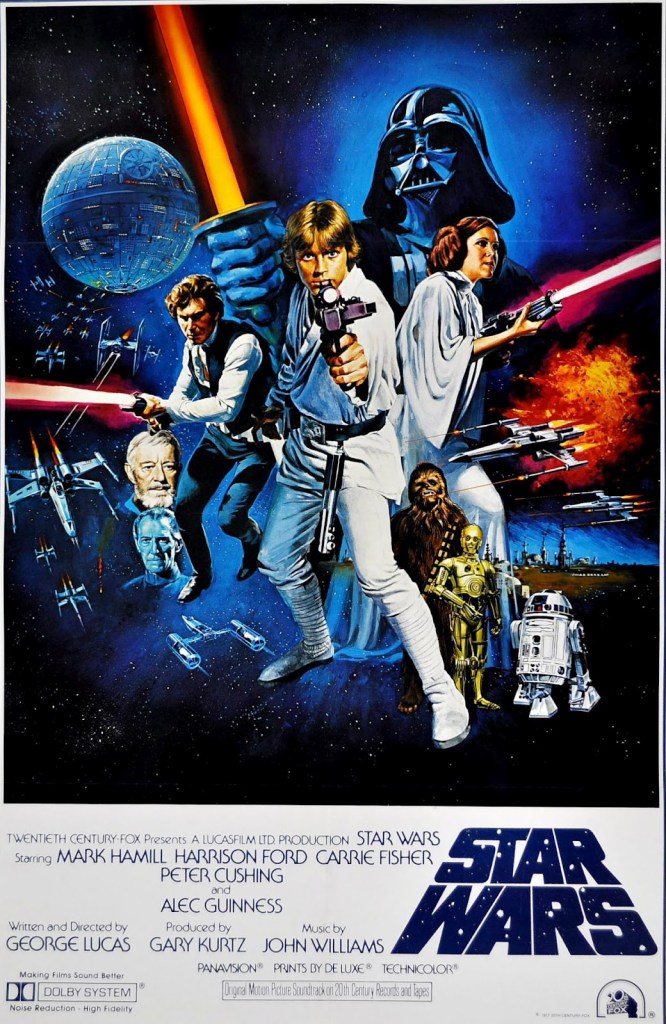
The 1965 promotional poster

A Tuesday Newsday Classic

When this film was released in the spring of 1965, I wonder if its creators ever dreamed of the incredible impact it would have on the world.

The Sound of Music was the number one film of that year and spent 29 of 52 weeks at the top of the box office lists; its popularity continued into 1966. In all, it was in the premier slot for a total of 40 weeks and became the highest grossing film of all time – a distinction it held for five years.

Frankly, one would have to have lived in a technology devoid place for their entire life to never have heard of the film.

It began life as a Broadway Musical in 1959 before it was adapted for the silver screen. The story was based on an autobiographical book by Maria Von Trapp who, along with her family, escaped Austria just as WWII was about to begin. The Infallible Wikipedia tells us:

“Based on the 1949 memoir The Story of the Trapp Family Singers by Maria von Trapp, the film is about a young Austrian postulant in Salzburg, Austria, in 1938 who is sent to the villa of a retired naval officer and widower to be governess to his seven children. After bringing love and music into the lives of the family, she marries the officer and, together with the children, finds a way to survive the loss of their homeland to the Nazis.”

The movie is first and foremost a love story

What sets the movie apart is a combination of elements. The story line has so many great themes: two different love stories. Maria and the Captain, of course, but also 16 year old Lisle and the confused Nazi youth, Rolf. There are gut-wrenching decisions to be made as the Von Trapp’s plot their escape from their beloved Austria, forced to give up everything rather than sacrifice their values. But most of all it’s the Rogers and Hammerstein score which has resonated through the years.

The opening scene alone, with the larger than life song Sound of Music being belted out by the heroine Maria on the Austrian mountaintop, pulls the audience in. From there, the music truly tells the story. Maria is a problem to be solved; one must ‘Climb Every Mountain,’ and face life’s difficulties in ‘I Have Confidence.’

The toe tapping tunes continue on: My Favorite Things, Do-Re-Mi, and Sixteen Going on Seventeen.  And so many more.

The movie won multiple awards. Also from the Infallible Wikipedia:

The Sound of Music received five Academy Awards, including Best Picture and Best Director, Wise’s second pair of both awards, the first being from the 1961 film West Side Story. The film also received two Golden Globe Awards, for Best Motion Picture and Best Actress, the Directors Guild of America Award for Outstanding Directorial Achievement, and the Writers Guild of America Award for Best Written American Musical. In 1998, the American Film Institute (AFI) listed The Sound of Music as the fifty-fifth greatest American movie of all time, and the fourth greatest movie musical. In 2001, the United States Library of Congress selected the film for preservation in the National Film Registry, finding it “culturally, historically, or aesthetically significant”.

For Americans in 1965, life was quite different than today. Most of the families I knew rarely went out to eat in a restaurant or to the movies. Going to see The Sound of Music at the Capitol Theatre in Yakima was such a treat and likely only the third film I’d ever seen in a theatre; the first two being Mary Poppins and My Fair Lady from the year before.

Brigitta, played by Angela Cartwright, was always reading

In the mid-sixties, women and girls still wore dresses everywhere. Such was the case for when I saw the Sound of Music. I have a distinct memory of wearing a pink dress and, likely my saddle shoes. I was hooked from the first moment.

Soon after seeing the movie, the album arrived in our house and was played over and over – to the point, no doubt, where it developed skips and that crackling sound that comes from a worn out record.

My sister and I acted out the Sound of Music in our bedroom or in the backyard with the neighbor kids. We took on the various roles. I always wanted to be Lisle but the character of Brigitta, her nose always in a book, was more accurate.

The year I was 10 I learned that the local Warehouse theatre group was going to produce the stage version of the Sound of Music. I got a wild hair that I needed to try out and get the role of Brigitta. But when I asked my Mom, it was a resounding ‘you don’t want to do that.’ Which when translated meant that SHE didn’t want me to do that.

I was crushed that I wasn’t going to be able to live out my dream of being on stage in the Sound of Music. A girl I knew from school got the role of Brigitta. I don’t believe we ever went to the production.

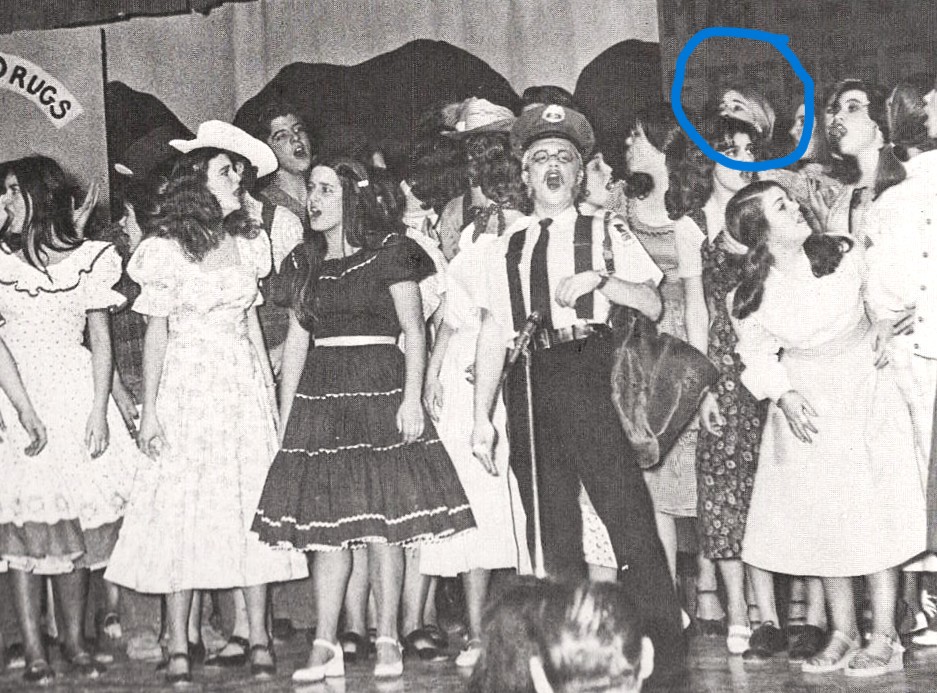
Relegated to the back in “The Most Happy Fella” I did managed to get my head above the crowd enough to see the audience.

Eventually, I did get to be on stage in two musicals while in high school, which I wrote about here: https://barbaradevore.com/?s=anything+goes

But even the disappointment of not getting to be in the local theatre production at age 10 did not deter me from my love of the Sound of Music. When they first started broadcasting the film on commercial TV I made sure to watch it every year. This was followed with owning the VHS version and, ultimately, on DVD.

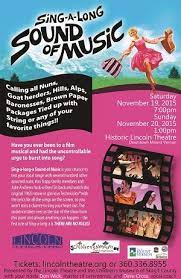
Sing Along Night poster for the Lincoln Theatre

Up until the Covid-19 Pandemic shut down large gatherings, the Lincoln Theatre in Mount Vernon would host an annual Sound of Music viewing and singalong, encouraging attendees to dress as characters from the movie.

I haven’t yet made that event, but it’s on my bucket list. For the record, I no longer identify with Brigitta or Lisle, but to join all the other wannabe Maria’s out there would be the best.

A couple of links:

https://en.wikipedia.org/wiki/The_Sound_of_Music_(film)

https://en.wikipedia.org/wiki/List_of_1965_box_office_number-one_films_in_the_United_States

Mousemania!

The Rise of the Microsoft Mouse

April 20th

A Tuesday Newsday Classic

The 1980’s was an exciting era in the world of computers. Where once only large corporations had such capabilities, the advent of affordable, personal computers heralded a decade of new products to make computer use easier.

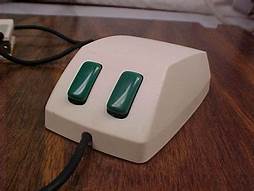
Microsoft’s first mouse circa 1983

Until 1983 no one outside of engineering labs had ever heard of a computer mouse. Yet today, the device is an essential piece of a desktop computer set up.

From the Infallible Wikipedia:

“The earliest known written use of the term mouse in reference to a computer pointing device is in Bill English’s July 1965 publication, ‘Computer-Aided Display Control’ likely originating from its resemblance to the shape and size of a mouse, a rodent, with the cord resembling its tail. The popularity of wireless mice without cords makes the resemblance less obvious.

The plural for the small rodent is always ‘mice’ in modern usage. The plural for a computer mouse is either ‘mice’ or ‘mouses’ according to most dictionaries, with ‘mice’ being more common. The first recorded plural usage is ‘mice’; the online Oxford Dictionaries cites a 1984 use, and earlier uses include J. C. R. Licklider’s ‘The Computer as a Communication Device’ of 1968.”

One company which saw the potential in the mouse was – at the time – fledgling software giant Microsoft.

They got on the mouse bandwagon early, bundling their version of a mouse with two of their software programs. Also from the Infallible Wikipedia:

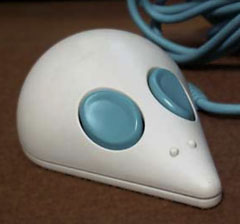
Being a bit of rebel, I had a Macintosh computer for many years and had just such a mouse on my desk.

“The Microsoft Mouse is a computer mouse released by Microsoft in 1983. It is the first mouse released by the company, and it was bundled with Microsoft Word, Notepad, and an on-screen teaching tutorial for an initial price of $195.

Nicknamed the ‘green-eyed mouse,’ the Microsoft Mouse featured a pair of green buttons. It also featured a more curved body than the blockier designs more common of mice at the time. As with other mice at the time, the Microsoft Mouse used a steel ball for tracking.

The initial version featured an InPort ISA interface, requiring a Microsoft bus card to be installed in the computer. Later versions were available with DE-9 or DB-25 serial connectors. All versions of the Microsoft Mouse could be used with IBM-compatible and other DOS systems.”

In 1983, I was working for Microsoft in the telemarketing sales division. The company was small enough, however, that friendships developed with individuals across all departments. One such friendship was with one very enthusiastic National Training Manager who, one day, saw me walking down the hall and asked me to step into his office as he wanted to show me something.

The memory is crystal clear. Alan’s office is little more than a cube, big enough for his desk, chair, and a file cabinet. But what I most recall is that his office is an interior one and has no window (ironic for Microsoft, right?). Additionally, his overhead light is not on and all illumination is provided by the glow of his computer monitor. Again, computers and monitors in 1983 had no graphical interface, just glowing green letters on a black screen.

He sits at his chair and says ‘watch this’ and then proceeds to put his hand on a little box and push it around his desk while a tiny straight line cursor jumps all over the screen. The demonstration continues as he clicks a button on the device which locks the cursor in place, then types a few words.

A few months later, our telemarketing group had ‘Mouse’ day with the introduction of Microsoft’s version of the device. Product introduction days were always exciting as our group created ways to make it special and get ourselves motivated.

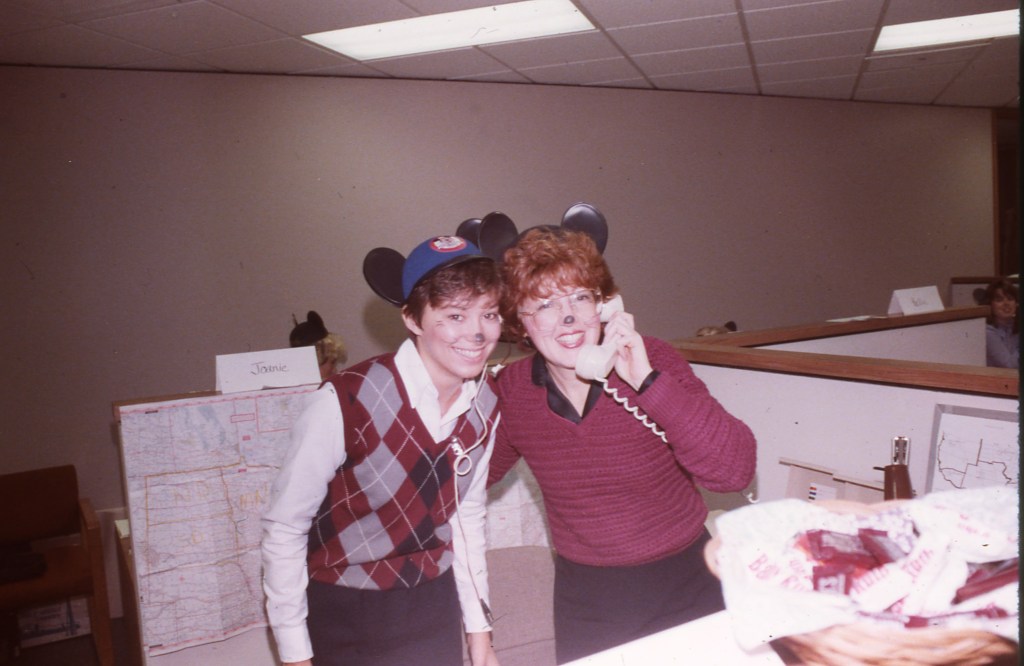
Two of my telemarketing co-horts, Sue and Susie, on ‘Mouse’ day.

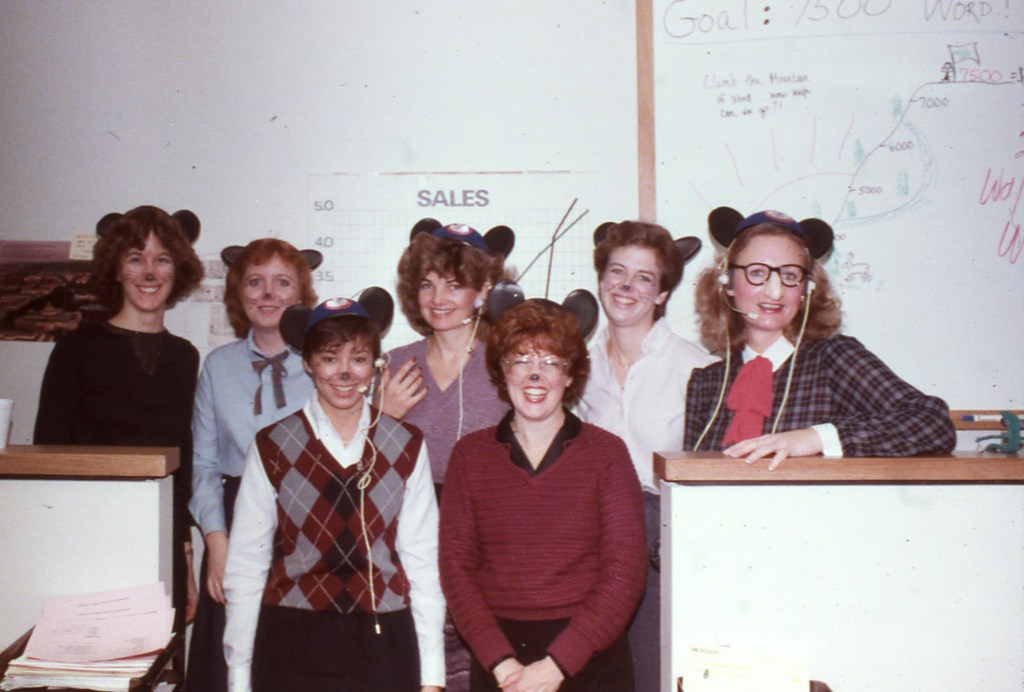
Mouse day, it turns out, featured everyone wearing Disneyland mouse ears as we called every last buyer in every computer store in the nation. At the front of the room was a large white board where our goals were written. As the day wore on, we would add our sales to the list, and whoops of excitement echoed through the cube farm as we reached each new goal.

I don’t recall how many we sold that first day or in subsequent weeks, but the bundle was hugely popular as consumers embraced the technology.

Most memorable was a funny incident which happened a short time after. In addition to the telemarketing group, we also had a customer service division for people to call in and get help when their products had issues. Often those calls were directed to a crack group of the most patient people in the universe: technical support.

I can clearly see two of my tech support buddies, both of whom were always willing to answer our questions when a buyer would, inevitably, ask us some technical thing that we – as mere salespeople – had no clue how to answer.

I can’t recall if it was Clay or Dolores who told me this story; but one day he/she received a tech support call from a woman who was complaining that her mouse was not working correctly. The tech people always worked through a list of known issues first, asking questions to drill down in order to solve the problem. Most issues they’d encountered before and would either be able to get it fixed it or would send the person to customer service to start the order replacement process.

This particular woman was certain that her software had a problem because every time she moved the mouse around all she got on the screen were squiggly lines and gibberish text. So the tech person had her move the mouse, click the button, and then type something. On the call went for five, then ten minutes, with no known bug causing the issue.

Finally, the woman – clearly exasperated – yelled ‘my arm’s getting tired.’

The tech support person paused and then asked her to describe how she was holding the mouse. It turned out that she was treating the mouse as though it was a touch screen device. All that time she had been holding it up and moving it around on the screen’s surface.

Over the years I’ve had ‘Microsoft’ dreams – not quite nightmares but close – where I’m back working at the company. In these dreams, however, I’m not donning Mouse ears and calling buyers; I work in tech support and field calls from people asking me questions for which I do not know the answers. Talk about stress.

The telemarketing crew fall of 1983, goals on the white board and all in the ‘Mouse’ spirit. The author with her big 80’s hair is at far left.

I think of Clay and Dolores often and smile at the stories they shared which often made the stress of working at Microsoft in the early 80’s just a little bit less. Hats off to all tech support people everywhere, you are my heroes.

The links:

https://en.wikipedia.org/wiki/Microsoft_Mouse

https://en.wikipedia.org/wiki/Computer_mouse

The International Order of the Rainbow for Girls

April 6, 2021

99 years young

The official emblem of the Order

My mother in law has often said that the toughest job in the world is being a kid. Her argument being that kids have so much to learn and are faced with ever changing rules and expectations, that figuring it all out is a difficult job.

I would add, however, that it is the teenage years which are the most challenging for any young person. You take hundreds of puberty driven boys and girls and put them in giant Petri dish called school and, well, it’s a tough few years.

For many teenagers – if they are lucky – find their salvation through sports, music, other arts, or outdoor programs like Scouts. My saving activity was The International Order of the Rainbow for Girls. It was founded on April 6, 1922, now just one year short of its 100th anniversary.

Its beginnings were humble enough. A group of adults who belonged to the Mason and Eastern Star organizations in McAlester, Oklahoma, had learned of a group for teenage boys, The Order of DeMolay, and decided that they would start their own similar program but for girls.

At the time, it was vogue for such groups to have ceremonies of initiation as well as those which were followed to open and close their meetings. Thus it was a Methodist minister, the Reverend W. Mark Sexson, who wrote the ceremonies for the organization, basing them on the Biblical story of Noah, the great flood, and the rainbow of promise.

Each Assembly consists of 20 officers who include the president, known as the Worthy Advisor, and a set of four additional elected officers who, in succession, become Worthy Advisor. Additionally, there are a Secretary, Treasurer, Chaplain, Drill Leader, Musician and Choir Director. There are also seven officers who represent the seven colors of the rainbow and, finally, two officers who let people in and out during the meetings.

Fun activities such as a weekend at Potts of Gold – a Rainbow Camp on Hood Canal – make up the varied program.

For the record, I do consider myself an expert on the organization and was able to write all of the above without research. Even so, I was curious what the Infallible Wikipedia had to say on the subject. I discovered the following:

“The International Order of the Rainbow for Girls has Assemblies in 46 states in the United States as well as in several other countries. The states that do not currently have Assemblies are Delaware, Minnesota, Utah, and Wyoming.

The countries outside the United States that have assemblies are are Aruba, Australia (in Queensland, New South Wales and South Australia), Bolivia, Brazil (in Parana, São Paulo, Distrito Federal, Minas Gerais, Mato Grosso do Sul, Tocantins, Para, Espírito Santo and Santa Catarina, Canada (in Ontario and New Brunswick), the Philippines, Italy, Mexico, and Romania. Rainbow has had assemblies in the following countries, mostly due to American military presence: Cuba, Germany, France, Panama and Vietnam.

Its headquarters are at the International Temple in McAlester, Oklahoma built in 1950-1951 for the Order’s use.”

Over the years, the focus of the organization has changed. The early years were ones of expansion with the opening of more and more assemblies being the primary mission.

Community Service is a huge part of the organization’s focus. Here the girls’ are collecting donations for MEOW cat rescue.

By the 1940’s and WWII, the first indicators of a change of mission were seen with the members stepping up to aid in the war effort. After the war, the social aspects took precedence. The organization grew to its largest in the 1950’s boasting an international membership of over 250,000 girls. Today the group primarily emphasizes community service, public speaking, and personal development of the young women who are its members.

I became aware of the Rainbow Girls through my older sister who was invited to join by a friend. Off my sister would go to this mysterious place every two weeks and was often gone for activities on the weekend. So, like any self-respecting younger sister, I bugged her until she relented and brought home a membership application one day in March 1971.

It is a very distinct memory I have of sitting on the floor of my room, the sun streaming in the western window, as I filled out the paperwork. I was stumped when I got to the first blank.

“What’s the name and number of the Assembly?” I yelled to my sister in the next room.

“Yakima number one,” the shouted reply proclaimed.

Well, that’s cool, I thought. Who wouldn’t want to be in the number ONE assembly?*

I finished the application and it was turned in and then, one month later on April 19 I became a member. It was love at first sight. Everything about the Rainbow Girls appealed to me and played to my strengths (which were not sports, band, or wilderness survival!). It was Rainbow where I learned to plan and organize things; I loved being with just girls at a time in my life when boys were icky and awful. I got to hang out with older girls and adults who were patient in teaching me how to be a valuable member of a team. I had activities that were wholesome. Mostly, I seized every opportunity to improve myself, take on responsibility, and learn to be a leader.

In January of 1974 I was my Assembly’s Worthy Advisor and then repeated that job when one of the members had to step down in May 1975. I supported my sister when she became the president – the Grand Worthy Advisor – of the state level program for Washington and Idaho the next month. A year later I was selected to serve as the Editor of the jurisdiction newspaper and then subsequently elected to one of the top five jobs at the state level the next year, completing my time in the order.

My sister presents me to be installed as Worthy Advisor of Yakima Assembly #1, January 1974

Or so I thought. Over the next decades I found a multitude of ways to give back to the organization which gave me so much. I served as an adult advisor in a variety of capacities, motivated to insure Rainbow would be there for my own daughter when she arrived in those perilous teenage years. My stated mission was to successfully get her from childhood to adulthood in a safe place without falling prey to the many temptations modern society presents. In that mission I succeeded.

There’s a song which was written for the order and it has a line in it which is “Rainbow, you’ll always be mine.” For so many of the women I know who have belonged, this thought – more than any other – encapsulates just exactly how we feel about The International Order of the Rainbow For Girls.

My final meeting as Mother Advisor for Bellevue Assembly #120, January 2010

*Yakima was the first Assembly in the state of Washington, not the world. I plan to tell that story on August 3, 2021… so stay tuned.

A couple of links:

https://en.wikipedia.org/wiki/International_Order_of_the_Rainbow_for_Girls

https://www.gorainbow.org/

www.nwrainbow.org

March 30, 1964

What is the date Jeopardy Premiered?

If I mention the names Don Pardo and Art Fleming, what’s the first thing you think of?

For anyone born after about 1975, it’s unlikely those names mean a thing to you. But if I add in the name Alex Trebek , nearly 100 percent of people will immediately say “Jeopardy!”

Art Fleming, the original host

Long before Trebek became the host, the first two were the memorable announcer and host, respectively, of Jeopardy which premiered as a daytime TV program on March 30, 1964.

The 1960’s was the golden age of TV game shows. Jeopardy joined seven other such shows already on the air that year including Let’s Make A Deal and The Price Is Right. Only Let’s Make A Deal has run continuously on TV longer, edging out Jeopardy by 3 months.

The show got its start thanks to iconic TV producer Merv Griffin. From the Infallible Wikipedia:

“In a 1963 Associated Press profile released shortly before the original Jeopardy! series premiered, Merv Griffin offered the following account of how he created the quiz show:

“My wife Julann just came up with the idea one day when we were in a plane bringing us back to New York City from Duluth. I was mulling over game show ideas, when she noted that there had not been a successful ‘question and answer’ game on the air since the quiz show scandals. Why not do a switch, and give the answers to the contestant and let them come up with the question? She fired a couple of answers to me: ‘5,280’—and the question of course was ‘How many feet in a mile?’. Another was ’79 Wistful Vista’; that was Fibber and Mollie McGee’s address. I loved the idea, went straight to NBC with the idea, and they bought it without even looking at a pilot show.

Griffin’s first conception of the game used a board comprising ten categories with ten clues each, but after finding that this board could not easily be shown on camera, he reduced it to two rounds of thirty clues each, with five clues in each of six categories. He originally intended requiring grammatically correct phrasing (e.g., only accepting ‘Who is …’ for a person), but after finding that grammatical correction slowed the game down, he decided to accept any correct response that was in question form. Griffin discarded his initial title of What’s the Question? when skeptical network executive Ed Vane rejected his original concept of the game, claiming, ‘It doesn’t have enough jeopardies.’”

Announcer Don Pardo whose recognizable voice graced the airwaves for decades

The format of giving contestants the answers and requiring the questions had previously been used by the Gil Fates-hosted program CBS Television Quiz, which aired from July 1941 until May 1942.”

Of course the references in the above article highlight just how long ago Jeopardy got its start, especially the citation of Fibber McGee. But I digress.

I’m pretty sure I’ve watched Jeopardy pretty much since its beginnings. Now mind you, as a kid the only time I saw the program would have been during summer vacation or being home sick from school. Holding down the 11:30 a.m. spot on NBC made Jeopardy required TV for the ill child. Once lunch was over (soup and saltine crackers, no doubt) and the boring old news came on, it was time to sleep.

The other reason I know Jeopardy occupied my brain is that I still have the Fifth Edition Jeopardy Board Game which I’m pretty sure was either a birthday or Christmas present in 1964.

Imagine a completely old school sort of game. The answer board cover is made from white indestructium.* There are white one inch square removable plastic tabs that cover the answers for each Jeopardy round. You know its old because the dollar amounts (printed in blue on the tabs) are $10, $20, $30, $40, and $50 for regular and double those numbers (in red) for the second round. Oh, and did I mention how they kept the answers ‘secret?’ By use of the always cool, see through red plastic used in kid’s decoder kits of the 1960’s.

My 1960 something game… the blue clicker is missing but everything else is there. You can buy a fifth edition version for about $13.00 on Ebay in 2026.

But the best part was by far the ‘buzzers’ used by the players when they knew the right question. In this case, however, ‘buzzer’ is a misnomer because the devices were frog style clickers in red, blue, yellow, and green. After a few games of vigorous use those clickers no longer clicked; our alternative was for the contestants to make a buzzing noise with their mouths which, you might imagine, led to some hilarity.

My friends and I loved the game. It’s actually in amazing shape considering the use it had. Or maybe I’m misremembering all the use and, perhaps, it was just me who was the complete trivia nerd. The game, after spending decades tucked away in my parents’ house, came back to me in the fall of 2019.

Over the years, however, Jeopardy continued to be a part of my life. In the 1980’s, after dinner, the hubby and I would often watch Jeopardy and Wheel of Fortune. The hubby seemed to know every Jeopardy answer and had it out before my brain had time to process. In fact, I often thought that the hubby should try out for Jeopardy.

Alex Trebek

His rapid trivia skills were passed down to the next generation as our daughter also loves Jeopardy and is really good at it. In fact, both her former roommate and fiancé (now her hubby) got to the point of not wanting to even watch Jeopardy with her because she seemed to know every answer and, like her father, was very fast.

After she moved in the spring of 2020 and no longer had cable TV, she mostly quit watching. Some of the joy of the show, no doubt, was lost with the passing of Alex Trebek. She did admit that a couple of the ‘tryout’ hosts were pretty good.

“I need my Jeopardy host to be pretty dry in their delivery,” she told me.

I think any Jeopardy fan hopes that a worthy replacement will be found for Trebek ; one who will assure that the 57 year tradition that is Jeopardy will continue for years and generations to come.

* Indestructium is a word coined by the hubby to describe any linoleum or plastic material manufactured in the mid-20th century which is basically impossible to damage or destroy.

The Infallible Wikipedia links:

https://en.wikipedia.org/wiki/Jeopardy!

https://en.wikipedia.org/wiki/List_of_longest-running_American_television_series

Discovering Dad’s Mustang: A Heartfelt Reunion

EEE 161 Rides Again

March 9th

A Tuesday Newsday Classic

It was on March 9, 1964 when the first Mustang automobile rolled off the assembly line at Ford Motor company’s Dearborn, Michigan plant. Today, the Mustang continues as one of the best selling and most popular cars ever produced by Ford.

For those who have been reading my blog for several years, you may recall that three years ago I posted about the 1965 Mustang here: https://barbaradevore.com/2018/04/17/1965-ford-mustang/

Today’s Tuesday Newsday is going to be a bit of a departure, as I have nothing particularly new from the Infallible Wikipedia to share on this topic. You can, of course, go there and read up on everything you might hope to learn about the Mustang.

My Dad’s 1965 White Mustang convertible

What I do know is that the Mustang was a huge hit from the day it launched and has spawned clubs for owners, like the Mustang Club of America, matchbox cars, models, and an almost cult like following for the distinctively designed vehicle.

As with the Volkswagen beetle, or the Porsche, or the Corvette, the Mustang’s of the 1960’s are instantly recognizable and highly collectible.

While the majority of the early Mustangs have ended up in junk yards and recycled, some have been lucky enough to survive down through the years. This is the story of one such Mustang.

We pick up the story of the Mustang my Dad purchased slightly used circa 1966. It is now July 11, 2020 and my father has been gone just over 10 months. Despite being in the middle of the Covid Pandemic, I have estate business to tend to and have traveled to Yakima and am staying with my sister. Her home is situated in the middle of apple, cherry, and pear orchards just west of Selah – a smaller city four miles north of Yakima. Yakima County boasts a population of just under 250,000 people so it is not huge, but is certainly not small either.

On this particular Saturday it’s sunny and warm with a high in the low 90’s. In the mid-afternoon the two of us drive down into Selah in my sisters Honda with a load of items to be donated to Goodwill. From there we head south to a Safeway store in Yakima for a few dinner items. Our intended route is actually a big circle as we head to her place via the ‘back’ way which is to travel west on highway 12, then north on Old Naches Highway, and finally head east up Mapleway Road.

My sister is driving and we are, as is our nature, chatting away. Just as we reach the crest the hill I notice a white convertible about 500 yards ahead of us. It’s distinctive Mustang back end causes me to blurt out, “Look, it’s Dad’s car.”

A wave of nostalgia washes over me. Oh those summers when we drove around with that black rag top down, flirting with boys during forbidden runs up and down Yakima Avenue, not a care in the world with real life still a few years away.

A moment in time. It’s Memorial Day weekend 1973. We are getting the car ready so that the Yakima Rainbow Girls can ride in the convertible for the parade. In the photo are my Mom supervising (in her bathrobe!), my Dad and sister securing the red leather seatback cover, and my best friend Pam standing in the open car.

Of course, I didn’t really think it WAS my dad’s car. After all, he had sold the car in the 1980’s and the family lost track of it over the years. Realistically, what were the chances the car still existed? Even so, I urged my sister to get a little closer so we could at least see the license plate. She obliged and I strained my eyes to make out the letters and numbers.

EEE 161.*

“It IS dad’s car!” I exclaim. “Follow him!”

The Mustang, now at a stop sign where the main road goes right, turns. A minute later we are at the same spot and also turn right. A minute after that, we sail past the road which leads to my sister’s house and are headed back down into Selah, retracing our route from earlier.

On we go, now in hot pursuit of Dad’s car.

“I want to talk to him,” I tell her. From behind we can tell it’s a middle aged man sporting a baseball cap driving the car.

We travel past the school, city hall, the bank, the telephone company, and turn north on Wenas Road. My eyes are fixed on the Mustang wondering just how far he’s going to drive. From my perspective, it didn’t matter. Catching up with him was my goal; being with the car once again important somehow.

My sister pulls into the left lane to try and get up next to the car but then the driver signals a right turn into the parking lot of the True Value hardware store. We sail past.

It takes us several minutes to get turned around but at last we pull up next to the parked – and now empty – car and wait for the driver to return.

Not wanting to be creepy or draw suspicion, I force myself to sit and wait. And wait. And, after five interminable minutes our quarry emerges from the store headed to his car which was once my Dad’s car.

I climb out of the passenger seat of my sister’s vehicle and step forward, catching his attention.

“This will be the weirdest conversation you’ve had all week,” I say and then continue, “But this was my Dad’s car.”

“Really? He must have sold it to my Mom back in the early 1980’s. What was his name?”

“Vincent DeVore. I’ve never forgiven him for selling it.”

This elicits a chuckle. I forge on. “Unfortunately my dad passed at the end of October. But I think it would please him to see what great shape the Mustang is in.”

“I’m sorry about your Dad. My mom died in December. The car was stored in her garage until January when it came to me.  She had the leather seats recovered and the whole thing has been repainted. She used to take it to the classic car shows. She loved this car.”

“It looks amazing,” I say and mean it.

“Yeah. I learned to drive in this car,” he says and to which I reply, “So did I! It was the best.”

What then followed was the snapping of a couple of photos of both my sister and I with the car. We also learned that he lives less than a mile from my sister and is the neighbor of my brother-in-law’s best friend. And that day was the first day he’d had the car out and driving around with the top down, reliving just for a short time, his sweet teenage memories in the car of his – and my youth.

My sister enjoying being reunited with EEE 161.
Maybe next time I’ll get to sit in the car once again

As for me, it was only one of several surreal events following my Dad’s death. In a way I found it comforting and, every once in a while, am reminded that even though Dad is gone, his spirit lives on.

*In 1958, license plates in Washington were assigned by county. All plates in Yakima County started with the letter “E.” The Mustang’s plate was likely issued new with the car in 1965. Visit this website for how this all worked. http://staff.washington.edu/islade/counties/index.htm

https://en.wikipedia.org/wiki/Ford_Mustang

The Iconic ‘Without You’: 1972’s smash hit

‘The killer song of all times’

February 23, 2021

A Tuesday Newsday Classic

Paul McCartney once said of this ballad that it is ‘the killer song of all times.’ Pretty high praise from someone who’s written more than a few great songs himself.

Since its release by the group Badfinger on their 1970 album ‘No Dice’, Without You has been recorded by over 180 artists. Of those Harry Nillson’s version was the most successful, sitting atop the Billboard Hot 100 for 4 weeks from February 19 to March 11, 1972.

Tom Evans and Pete Ham

The song was borne through the work of two of Badfinger’s members: Pete Ham and Tom Evans. The Infallible Wikipedia shares how the song was written:

“Pete Ham wrote a song originally titled ‘If It’s Love’, but it had lacked a strong chorus. At the time of writing, the band shared residence with the Mojos at 7 Park Avenue in Golders Green. One evening, in the midst of the parties, songwriting, touring, in Golders Green, Ham and his girlfriend Beverly Tucker were about to go out for the evening. But just as they were leaving Tom Evans said he had an idea for a song – Ham said, ‘Not tonight, I’ve promised Bev.’ But she thought he would be wondering if he had done the right thing later, if he went out, – she told him – ‘Go into the studio, I’m fine about it’ … He said, ‘Your mouth is smiling, but your eyes are sad.’ The song Ham wrote that night was called ‘If it’s Love’ and has the verse ‘Well I can’t forget tomorrow, when I think of all my sorrow, I had you there but then I let you go, and now it’s only fair that I should let you know … if it’s love’. But Ham wasn’t happy with the chorus.

Evans’ relationship with his future wife Marianne influenced his lyrics:

Nillson’s 45 version of the song

One evening he [Evans] went to her [Marianne’s] friend Karen and told Karen, ‘She’s left me. I need her back. I can’t live without her.’ He flew to Bonn to find her – he wrote a song called ‘I Can’t Live’. Its chorus included ‘I can’t live, if living is without you, I can’t live, I can’t give any more.’ And so the merging of the two songs, Ham and Evans created the hit [with] Ham’s verse, ‘warm, sweet, sentimental’ and Evans’ chorus, ‘intense, dramatic, heartbreaking.’

Both Ham and Evans said they did not consider the song to have much potential at the time Badfinger recorded it, and the track was slotted to close the first side of their 1970 album No Dice. Badfinger’s recording of the song, which is more brusque than its successors’ versions, was not released as a single in Europe or North America.”

The lyrics and the melody are an amazing combination of a soulful, unforgettable tune, and lyrics which capture the pain of heartbreak.

In the writing of this article, I ended up listening to the ten most successful versions of the song. It was recorded by several country artists, as well as R&B favorite Ruby Winters and, more recently pop Diva, Mariah Carey. Pop Groups Heart and Air Supply each have versions.

And all, in my opinion – including the original Badfinger rendition – pale in comparison to Nillson’s version; when he sings the song, seems to really mean it. Now, I suppose that my love of that interpretation can be traced back to the fall of 1971 when pop radio was a huge part of my life.

I remember listening to this song as well as hearing it played at the various dances I attended. Who wouldn’t want to dance with that cute guy you had a crush on while the words ‘Can’t live, if living is without you’ seemed the most romantic thing you’d ever heard? Exactly.

For teenagers, it seems, everything is MORE. Feelings are more intense. First love is more intense. First breakup is more intense. Without You captured all of that in one heart-wrenching song.

From the perch of a different time of life, however, one comes to understand that along the way that first love usually fades and others follow. That first breakup – which at the time does seem like the end of the world – starts to be not quite so life ending.

The intense feelings give way to other needs: to eat, to work, to live life. And, for most people, one eventually understands that, as cliché as it may sound, life does go on.

Being a teenager was emotionally exhausting if for no other reason than most teens hold the erroneous belief that NO ONE EVER has felt the same way as them. But it’s simply not true.

If someone had told me this at the time I probably wouldn’t have believed them. Of course no one had ever felt like I felt. In my arrogance I was certain that I had a monopoly on heartache and disappointment.

It was only some decades later that I belatedly came to understand that everyone has problems in life. Or, as I frequently say, Everyone has ‘stuff.’ I might have used a different, not as benign word but, since this is a family friendly blog, I’ll leave it as stuff.

Whatever ‘stuff’ you are facing my friends, I wish you the strength to get through it.

A few links:

https://en.wikipedia.org/wiki/Without_You_(Badfinger_song)

https://en.wikipedia.org/wiki/Harry_Nilsson

Scott Hamilton: The Inspiring Journey of an Olympic Champion

King of the Ice

February 16, 2021

The 1984 Olympic Men’s Skate medalists, left to right: Brian Orser(2nd), Scott Hamilton(1st), Jozef Sabovčík(3rd)

A Tuesday Newsday classic

This 1984 Olympic Gold medalist was, perhaps, the most unlikely of stars to achieve brilliance. To this day he is, however, one of the most popular U.S. men’s figure skaters ever; an individual who is a testament to the power of determination, hard work, and a positive attitude.

It was on February 16, 1984, when 25 year old Scott Hamilton won Olympic Gold at the games in Sarajevo, Yugoslavia (Now Bosnia and Herzegovina)

His skating story began 14 years earlier when he first took to the ice at age 11. Two years later, he was entering skating competitions. For the athletically inclined Hamilton, choosing an appropriate sport was likely a challenge.

When he was two years old he stopped growing. What followed were tests and speculation over why. From the Infallible Wikipedia:

“After numerous tests and several wrong diagnoses (including a diagnosis of cystic fibrosis that gave him just six months to live), the disease began to correct itself. His family physician sent him to Boston Children’s Hospital to see a Dr. Shwachman. He was told the doctor had no idea what was wrong and to go home and stop the diets in order to live a normal life. Years later, it was determined that a congenital brain tumor was the root cause of his childhood illness.”

The impact was huge. During the years of his greatest amateur skating success he was only 5 feet 2 ½ inches tall and weighed 108 pounds. Obviously, playing football or ice hockey was not an option.

Hamilton parlayed his small stature – what many would see as a liability – into his greatest asset. Not only was he was fast on the ice, but he developed his athleticism such that he made the jumps and his intricate footwork look effortless. Although not allowed in competition, his signature back flip at the end of his exhibition routines always brought fans to their feet. Only the strongest and most daring of skaters can successfully execute the move.

When he retired from amateur skating, he was the 1984 reigning world champion in the Men’s division. From there he went on to have a successful professional career and has, arguably, done more to elevate the sport of ice skating than any other individual ever. Also from the Infallible Wikipedia:

“After turning professional, Hamilton toured with the Ice Capades for two years, and then created ‘Scott Hamilton’s American Tour,’ which later was renamed Stars on Ice. He co-founded, co-produced and performed in Stars on Ice for 15 years before retiring from the tour in 2001 (though he still returns for occasional guest performances).

He has been awarded numerous skating honors, including being the first solo male figure skater to be awarded the Jacques Favart Award (in 1988). In 1990 he was inducted into the United States Olympic Hall of Fame.”

His road in life has not been easy. He survived testicular cancer in 1997 only to have a second brain tumor be discovered in 2004. After a successful surgery for the benign tumor, yet a third tumor was found in 2016. So far he’s been successful in shrinking the tumor through dietary changes.

Although I’d watched Olympic figure skating before, it was the 1984 Olympics and Scott Hamilton particularly, which became the impetus for a decade of following the sport. And what better place to be for watching the Olympics than in a magical place such as Whistler.

The hubby and I – along with his sister and mother – had joined a Whatcom Community college group for a weekend skiing sojourn. Yes, I was 26 years old when I took my first lessons… at Whistler. At the end of each day, we’d return to the rental house (a precursor to the AirBnB concept) for food and fellowship and to watch the Olympics. And what an Olympics it was. We rooted for hometown favorites Rosalyn Summers, Phil and Steve Mahre, and Oregonian Bill Johnson.

The memory that sticks with me most is of the hubby and my sister-in-law out at a pub in Whistler Village. The TV is on over the bar and we are watching the events. But we can’t hear the play by play because there is no sound. Instead, dance music is blaring through the bar. And the pair of them – hubby and sister – are ‘dancing’ while sitting in their chairs, and making quite the spectacle. I imagine the pub owners had second thoughts about those chairs as they were on wheels which allowed the chair dancing shenanigans. Shenanigans which, I might add, nearly got us kicked out of that bar.

Home a few days later, I cheered as I watched Scott Hamilton win the Gold medal, the first US man to do so in the Olympics in 24 years.

What followed over the next six years was attending the US National championships at the Tacoma dome in 1987, and seeing “Stars On Ice” at least twice at the Seattle Center Arena. It was during Stars on Ice that we finally saw Hamilton skate in person. It was worth it. What an amazing skater and showman, his performances unforgettable.

I leave you with this from a publication titled ‘CancerTutor.com.’

“Hamilton is a firm believer in ‘getting up’ after the fall. He pointed to a chapter in his book, The Great Eight, titled ‘Fall Down, Get Up, Smile Like Kristi Yamaguchi.’

‘In one of her [skating] programs, she took a hard fall on a really difficult jump — and she got up, went right back to her program like nothing happened. I realized in that moment there’s a life lesson: I’m gonna fall down. I’m gonna make mistakes. But it’s what’s next — it’s how you get up. The more times you get up, the stronger you are.’”

Some links:

https://en.wikipedia.org/wiki/Scott_Hamilton_(figure_skater)

https://www.scotthamilton.com/

The Infallible Wikipedia

The World’s greatest Encyclopedia

January 12, 2021

Back when the internet first started there was an explosion of new programs and new concepts. Connections were slow and done only via dial up. Pretty much anyone over the age of 40 no doubt recalls the noise the computer made as it connected you right before the computer generated AOL voice intoned, “You’ve got mail.”

Wikipedia’s familiar logo

In those days, all of our information came from traditional sources like newspapers, television, and books. Who among us – having grown up in the 1950’s through to the 1980’s – did NOT have a set of encyclopedias we used for research when those pesky term papers were due?

The physical encyclopedia was replaced in the late 1990’s by a CD program you loaded whenever you needed information. But it was not long – with the advent of higher speed internet and improvements in technology – a few people figured out that the internet itself was the most massive library in the world. Enter The Infallible Wikipedia.

It was on January 12, 2001, when Wikipedia was registered as a business. The rest, as one might say, is history.

In the early days there were a number of online encyclopedias which popped up. Several of those were offshoots from traditional encyclopedias. But they could not keep up with Wikipedia’s unique structure.

From The Infallible Wikpedia about The Infallible Wikipedia:

“Wikipedia is a multilingual open-collaborative online encyclopedia created and maintained by a community of volunteer editors using a wiki-based editing system. It is one of the 15 most popular websites as ranked by Alexa, as of January 2021 and The Economist magazine placed it as the ’13th-most-visited place on the web’. Featuring no advertisements, it is hosted by the Wikimedia Foundation, an American non-profit organization funded primarily through donations.

A person reading a Wikipedia article. From http://www.playfm.gr

Wikipedia was launched on January 15, 2001, by Jimmy Wales and Larry Sanger. Sanger coined its name as a portmanteau of ‘wiki’ and ‘encyclopedia.’ It was initially an English-language encyclopedia, but versions in other languages were quickly developed. With 6.2 million articles, the English Wikipedia is the largest of the more than 300 Wikipedia encyclopedias. Overall, Wikipedia comprises more than 55 million articles, attracting 1.7 billion unique visitors per month. (snip)

 In 2006, Time magazine stated that the open-door policy of allowing anyone to edit had made Wikipedia the biggest and possibly the best encyclopedia in the world, and was a testament to the vision of Jimmy Wales. The project’s reputation improved further in the 2010s as it increased efforts to improve its quality and reliability, based on its unique structure, curation and absence of commercial bias.”

Since its founding, Wikipedia has done much to improve accuracy. That said – as with everything – it is up to each researcher to verify their sources. I have found that the links at the bottom of each Wikipedia article is a good place to start.

A set of traditional encyclopedias

For me – as an information junkie – I love that Wikipedia exists. While it doesn’t have articles on every topic in the world, the amount it does have is stunning. My parents’ set of 1950 something Encyclopedia Americanas can’t even begin to compare.

By the time I was using our family’s Encyclopedia set they were at least 10 to 15 years out of date

I do think I must credit my son with coining the phrase ‘The Infallible Wikipedia’ It was likely around 2002 or 2003 – as Wikipedia was just starting to take off – when our family became aware of the site. Every time one of us would often go to the internet in search of information, it seemed as if Wikipedia would be one of the hits. Because of the unique way Wikipedia uses its volunteer editors, however, one never knew if the information one found was accurate or not.

So my son started referring to any information we found on the site as being Infallible. Of course it was anything but Infallible.

The nickname stuck and not a one of us: hubby, son, or daughter, refers to Wikipedia without adding the moniker ‘Infallible.’

Four years ago when I wrote my very first blog post about musical legend Jim Croce, here’s what I said:

“You can visit the Jim Croce website for more information: http://jimcroce.com/ and there’s always the infallible Wikipedia: https://en.wikipedia.org/wiki/Jim_Croce

Since that day – January 10, 2017 – I have now written 198 blog posts. And every single one of them references “The Infallible Wikipedia” in some way. There have been a few occasions where The Infallible Wikipedia was silent on the topic I chose. But, fortunately for me and my loyal readers, those occasions are rare.

Although it may sound like I’m mocking it, I’m not. Wikipedia is an amazing resource and it sure beats the heck out of trying to find relevant information in a 20 year old encyclopedia or searching through card catalogs at the library, both being methods I had to use during  youth and into adulthood.

So it is with great sincerity that I wish a Happy 20th anniversary to the Amazing, Helpful, Incredible, Irreplaceable, Infallible Wikipedia.

A link to the Infallible Wikipedia on, er, the Infallible Wikipedia

https://en.wikipedia.org/wiki/Wikipedia

Bonus question: How many times did I use the term Infallible Wikipedia in this article? The answer is 11 – a new record!

Awkward Embarrassing Moment: My Trivial Pursuit Story

Trivial Pursuit – The Game

December 15th

A Tuesday Newsday Classic

There is a saying that your greatest embarrassment is merely someone else’s momentary amusement.

Such is the case for today’s Tuesday Newsday and the introduction on December 15, 1979 of a game which is a verifiable cultural phenomenon. It was on that date when the game Trivial Pursuit (TP) made its first appearance.

Created by two Canadians, Chris Haney, a photo editor for Montreal’s The Gazette, and Scott Abbott, a sports editor for The Canadian Press, the game was invented when the pair wanted to play Scrabble but discovered a number of pieces missing. Why, they mused, don’t we just make up our own game? One does wonder if alcohol was involved that night. Certainly this author – who eschews dangling participles – has been highly critical of the plethora of them for which TP is legend. You would think that people involved in communications and writing might know better. But I digress.

Thanks to the Infallible Wikipedia, we learn that:

“The object of the game is to move around the board by correctly answering trivia questions. Questions are split into six categories, with each one having its own color to readily identify itself; in the classic version of Trivial Pursuit, the Geography category is blue, Entertainment is pink, History is yellow, Arts & Literature is originally brown, later purple, Science & Nature is green, and Sports & Leisure is orange. The game includes a board, playing pieces, question cards, a box, small plastic wedges to fit into the playing pieces, and a die.

TORONTO “Trivial Pursuit” inventors, former journalists Chris Haney (l), brother John Haney, and Scott Abott (r), play their board game based on trivia questions. The game in great demand in the U.S.A. and Canada, is sold out in many retail outlets. Photo dated Feb. 6, 1984.

Playing pieces used in Trivial Pursuit are round and divided into six sections like wedges of pie. A small plastic wedge, sometimes called cheese (like cheese triangles), can be placed into each of these sections to mark each player’s progress.

During the game, players move their playing pieces around a track which is shaped like a wheel with six spokes. This track is divided into spaces of different colors, and the center of the board is a hexagonal “hub” space. At the end of each spoke is a “category headquarters” space. When a player’s counter lands on a square, the player answers a question according to its color, which corresponds to one of the six categories. If the player answers the question correctly, his turn continues; a correct answer on a category headquarters space awards a wedge of that color if the player does not yet have one. (snip)

Once a player has collected one wedge of each color and filled up his playing piece, he must return to the hub and answer a question in a category selected by the other players. If this question is answered correctly, that player wins the game. Otherwise, the player must leave the center of the board and try again on the next turn.”

By the time the hubby and I were married in 1980, TP was all the rage. Of course we purchased the game and played it often with family and friends.

After awhile we became familiar with some of the games less desirable traits. Things like the fact that it could drag on forever and the players would lose interest. Or that there were some topics which were so ridiculous that there was no way any normal person would ever know the answer.

A typical Obscure Author question next to the brown AL bubble… Persian poets? Really?

In fact, to this day, we refer to the original Arts and Literature ‘brown’ segment as Obscure Authors. Now, my hubby is a trivia brain so this game was right up his alley. Except for the Obscure Authors category, that is.

For me, well, my knowledge of stuff was more broad based and mostly I would venture WAG’s* if I had no clue to the answer.

Sometime in the mid-1980’s, during a rather robust game of TP with a group of friends, I was getting close to the finish and the opportunity to win the game when I landed on green, Science and Nature. It should have been my first clue.

I got a question which, when I answered it, turned into a moment of great embarrassment.

For those familiar with TP you know that, except for the occasional true or false, you simply have to know the answer. Here’s a sample:

Note that there are no ‘multiple choice’ options. Just a whole series of ridiculous questions that most people do not know. Also note not one but TWO questions with those dangling participles!

We return to the game where I was given the Science and Nature question but, unfortunately, answered it as if it was from the Geography section.

Here’s what I was asked: Where is the Coccyx located?

To which I answered: Egypt.

Contrary to popular belief, the Coccyx is nowhere to be found in this photo…

Guess I should have taken a class in anatomy and physiology.

There are many, in fact now over 100 million coccyx’s in Egypt, so the answer was, technically, correct. The answer on the back of the card, however, informed me that the coccyx is one’s tailbone.

I was pretty much laughed out of the room.

When the hubby and I moved a few years ago, our copy of TP and all the add on card sets we’d acquired were among the things which we donated, having not played the game in years.

And, for the record, there were two other answers which caused family squabbles. The answers were ‘Higher and Higher’ and ‘Cherry Cola.’ Can’t recall the exact questions, but at the time it was a huge controversy. In retrospect it truly was a trivial pursuit.

*WAG = Wild A** Guess

https://en.wikipedia.org/wiki/Trivial_Pursuit

Hallmark Ornaments

Not A Creature Was Stirring, Not Even Chris Mouse

December 8, 2020

When Hallmark introduced these in 1973, no one could even begin to imagine how, over the next 40 plus years, the company would lead the industry through an unprecedented demand for Christmas ornaments.

A display in a Hallmark store, circa 2013

That first year, Hallmark only had 18 different ornament designs available for sale. Apparently buoyed by the success of sales that year, however, the collectible ornaments were expanded the next year. Betsey Clark – a popular artist featuring whimsical big eyed children- had two entries that year, up from one the year before. Seen also for the first time were scenes from Currier & Ives as well as an iconic Norman Rockwell holiday painting. The number of balls was tripled but yarn figures – prominent the first year – were only half of what they’d been in 1973.

It went this way for several more years with more and more Ornament balls being offered… but with a catch. A shopper could not just walk into a Hallmark store or retailer and purchase the exact same ornament they saw the previous year. Each ornament incorporated the production year into the design. Once the baubles were sold out, that was it.

The introduction of annual ornament series spurred interest. Each fall, collectors would rush to the store to snap up the newest one.

My sister’s 1978 Betsey Clark ornament

Surprisingly (at least to this author) is that the Infallible Wikipedia does not have a page devoted just to the Hallmark phenomenon. It does, however, offer up this information on a more generic page:

“In 1973, Hallmark Cards started manufacturing Christmas ornaments. The first collection included 18 ornaments, including six glass ball ornaments. The Hallmark Keepsake Ornament collection is dated and available for just one year. By 1998, 11 million American households collected Hallmark ornaments, and 250,000 people were member of the Keepsake Ornament Collector’s Club. There were as many as 400 local Keepsake Ornament Collector’s Club chapters in the US.  One noted Christmas ornament authority is Clara Johnson Scroggins who has written extensively on the topic and has one of the largest private collections of Christmas ornaments.

In 1996, the ornament industry generated $2.4 billion in total annual sales, an increase of 25% over the previous year. Industry experts estimated more than 22 million US households collected Christmas ornaments, and that 75% of those households collected Hallmark Keepsake Ornaments.”

And, according to the official Hallmark webpage, “What began as glass balls and yarn figurines has grown to more than 8,500 ornaments past and present, and a reputation for quality, craft, and above all, spirit.”

My first foray into the world of Hallmark ornaments began, coincidentally, the year I got married. During a trip into Hallmark I happened to go peruse the ornament section and, there it was, the perfect ornament to commemorate a couple’s first Christmas together.

Our first Hallmark ornament… the reverse says
“Christmas Is A Love Story Written In Our Hearts.”

I had to have it despite the fact that it was an extravagance not in the budget. The hubby was okay with the purchase of it and even another one which featured everyone’s favorite Christmas mouse, Mickey.

From that initial addictive purchase came more. Two more Hallmark ornaments were acquired in 1981. It was 1985, however, when things started to ramp up in my household.

That year saw the introduction of an ornament titled ‘Chris Mouse.’

Mr. Mouse was just about the most adorable creature you’d ever seen. His tiny little self was wearing what looked to be a sky blue night shirt and a red night cap. In his teeny hands he held a hunter green book with ‘1985’ on the cover in gold. But best of all was that he was sitting at the base of an old fashioned gold candle holder, leaning against a 4 inch tall red candle. At the top of the candle glows a yellow ‘flame’ which, when the ornament’s cord is plugged into a socket on a string of Christmas lights, is lit up.

I was enchanted and had to have that ornament.

Chris Mouse #1 who captured my heart

Soon I discovered that my Chris Mouse was only the first in the series. I eagerly looked forward to the next year’s entry. When it arrived in the stores the next fall I wandered in one day to take a look. Like the previous year, it was cute and this time featured Mr. Mouse asleep in a pinecone house, a tiny night light adding to the magic. I didn’t like it quite as well as the first one so I decided I might wait until after Christmas to buy it, maybe even find it on sale.

Sometimes, however, things work against you and such was the case in 1986. Just before Christmas I came down with a bad cold and was laid up for several days including on Christmas. The mouse was forgotten until, a few days after the holiday, I ventured out to the stores to do some bargain hunting. Alas, the second in the series was nowhere to be found.

In the following years, my lesson learned, I always purchased the ornaments I wanted well before Christmas. The Chris Mouse series? Ended up being 13 ornaments in all, each starring the adorable mouse in the blue nightshirt and red cap, each time doing something which featured a lovely little lighted object. It just so happened that I only had 12 of them and, every Christmas, I lamented not having the missing ornament.

Chris Mouse #2 who took years to join the line up

That was until a few years ago when there, under the tree for me one Christmas, was an unexpected surprise. Santa’s helper – who I call hubby – had located the missing Chris Mouse and bought it for me. The prodigal rodent joined his brother’s on the tree, the series now complete.

It takes several large Rubbermaid totes to house all the Hallmark ornaments in their original boxes. One bin is full of the lighted and motion ornaments, the other primarily a collection of whimsical critters. A third tote holds glass balls but only a dozen or so are part of the Hallmark collection.

By the late 1990’s with more than enough decorations to fill at least two trees, I stopped buying ornaments.

2020, however, seems like the perfect excuse to purchase a new bauble with which to commemorate this unusual year. An online search revealed that my local dealer is just down the hill. Time for a shopping adventure…

The links:

https://en.wikipedia.org/wiki/Christmas_ornament

https://www.hallmark.com/ornaments/