Archives

Dorothy Hamill

February 13, 2018

hamil newsweekThe year was 1976 and Olympic fever was in full force that February. There was one person, particularly, everyone was talking about. From her cute, bobbed haircut to her signature skating move, girls everywhere wanted to look like her and boys wanted to date her.
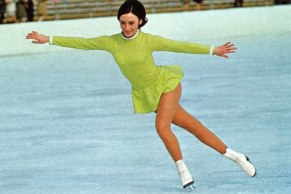
On February 13, the skater won the women’s Olympic gold medal in figure skating. Her name was Dorothy Hamill and she was 19 years old.

From the infallible Wikipedia:

“At the 1976 Winter Olympics in Innsbruck, Austria, Hamill came in second in the figures and then won the short and long programs, taking the gold medal. She was the last single skater to win the Olympics without a triple jump. Hamill also won the 1976 World Championships and then turned professional.

“Hamill is credited with developing a new skating move — a camel spin that turns into a sit spin – which became known as the “Hamill camel.” The bobbed hairstyle that she wore during her Olympic performance was created by stylist Yusuke Sugaand started a fad, known as the “short and sassy” look. Her glasses with oversized frames also started a trend in the 1970s. The media dubbed her ‘America’s sweetheart.’”

Only seven American women have ever won gold in Women’s Olympic Figure skating: Tenley Albright (1956), Carol Heiss (1960), Peggy Fleming (1968), Dorothy Hamill (1976), Kristi Yamaguchi (1992), Tara Lipinski (1998) and Sarah Hughes (2002).

peggy-fleming-olympicsAnother Olympic fact, Peggy Fleming was the only US athlete to win a gold medal in the 1968 Olympics. The skating program had been decimated seven years earlier when a fatal plane crash on February 15, 1961, claimed the lives of the entire US skating team and coaches who were  en-route to Belgium for an international competition. Also from the infallible Wikipedia:
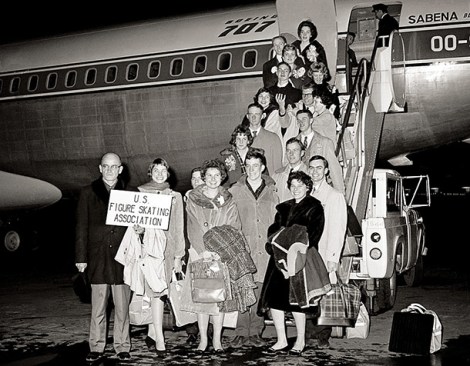
“All 18 athletes of the 1961 U.S. figure skating team and 16 family members, coaches, and officials were among the fatalities. The dead included 9-time U.S. ladies’ champion, turned coach, Maribel Vinson-Owen and her two daughters, reigning U.S. ladies’ champion Laurence Owen (age 16) and reigning U.S. pairs champion Maribel Owen (age 20).  Maribel Owens’s pairs champion partner Dudley Richards and reigning U.S. men’s champion Bradley Lord also died, along with U.S. ice dancing champions Diane Sherbloom and Larry Pierce. The team also lost U.S. men’s silver medalist Gregory Kelley, U.S. ladies’ silver medalist Stephanie Westerfeld, and U.S. ladies’ bronze medalist Rhode Lee Michelson.  Laurence Owen was the cover story for the February 13 issue of Sports Illustrated.”hamill history sabena plane

Although I was never an Olympian, I first tried ice skating about age 8 when our neighbor, Royce, sprayed water on his family’s driveway to create an ice rink. Royce, who was several year’s older, had outgrown a pair of skates which I got to borrow. I was very excited about this and, after the skating session, rushed home to ask my mother if we could buy the skates.

My mother, ever practical, told me ‘no.’ I think it had a lot to do with the fact that, in reality, there were few days in any winter – even in Yakima – where the temperatures were cold enough to create an ice rink; also, I did have a tendency to flit from one interest to another and, no doubt, the obsession with ice skating would soon fade. This is why Dorothy Hamill, and not me, won the 1976 Olympic Gold medal. That and the fact that I’m one of the most un-athletic people I know!

As always a couple of links:

https://en.wikipedia.org/wiki/Dorothy_Hamill

https://en.wikipedia.org/wiki/Sabena_Flight_548

Monopoly Board Game

February 6, 2018

Take A Walk On The Boardwalk

Monopoly walk boardwalkThe moment you draw a Chance card that says  “Take A Walk On The Boardwalk” probably one of two things happen:

You’re either giddy because now you can buy the iconic Monopoly property; or you’re in despair because the rents will wipe you out.

The game, which was first published on February 6, 1935, is – I think – a rather polarizing experience.  Monopoly was, according the infallible Wikipedia:

derived from The Landlord’s Game, which was created by Elizabeth Magie in the United States in 1903 as a way to demonstrate that an economy which rewards wealth creation is better than one in which monopolists work under few constraints and to promote the economic theories of Henry George and in particular his ideas about taxation. It was first published by Parker Brothers in 1935. The game is named after the economic concept of monopoly—the domination of a market by a single entity. It is owned and produced by the American game and toy company Hasbro.”

People who play the game seem to either love it or hate it. And it’s easy to see why they hate it. It pits players against each other who are encouraged to rejoice at another player’s bad luck. Many a monopoly game has ended with an overturned board and scattered money and properties.

Which seems appropriate since the a friend of Magie’s, Charles Todd,  introduced the game to one Charles Darrow – who took the game and began selling it as his own. Also from Wikipedia:

Monopoly national parks.jpg“According to an advertisement placed in The Christian Science Monitor, Charles Todd of Philadelphia recalled the day in 1932 when his childhood friend, Esther Jones, and her husband Charles Darrow came to their house for dinner. After the meal, the Todd’s introduced Darrow to The Landlord’s Game, which they then played several times together. At that point the game was entirely new to Darrow, and he asked the Todd’s for a written set of the rules. After that night, Darrow went on to utilize this by distributing the game himself as Monopoly – an act for which the Todd’s refused to speak to Darrow ever again.

After Darrow had excellent sales during the Christmas season of 1934, the Parker Brothers bought the game’s copyrights from Darrow. After finding Darrow was not the sole inventor of the game, Parker bought the rights to Magie’s patent.”

I often played the game as a child but found the hours long commitment to be more than was enjoyable. Not to mention that I simply was not cutthroat enough to be merciless to my opponents. The early parts of the game – going around the board and buying properties – is fun but once those houses and hotels start getting erected… well, that’s a good time to end it.

monopoly wineopoly board game

In cleaning out our game cupboard recently, we came across several versions of Monopoly including one based on National Parks and also on Wineries. There are also city, state, international and specialty versions of the game. We asked our children if they were interested in the one’s we have. While the oldest said no, our daughter seems to love the game, and is slated to get the various versions the next time she has a way to transport them to where she lives.

For my part, if I never play Monopoly again I can live with that.Monopoly Rich_Uncle_1946_Cover

Here’s a link to the article about the game and, believe it or not, a separate page to tell you all about Rich Uncle Pennybags!

https://en.wikipedia.org/wiki/Monopoly_(game)

https://en.wikipedia.org/wiki/Rich_Uncle_Pennybags

National Nothing Day

January 16, 2018

A “Nothing” sort of day

January 16, it turns out, is historically one of the most boring days in history. The three most exciting things I could find for this date were 1) Debut of the Donny and Marie Show in 1976  2) Cher and Greg Allman’s divorce finalized in 1979 & 3) Wayne Newton performs his 25,000th show in Las Vegas in 1996.

January 16 Boring celebsTruly riveting events. Which is why January 16th being “National Nothing” Day seems appropriate.*

The day was started in 1972 by San Francisco Examiner columnist Harold Pullman Coffin. The day was created, according to the infallible Wikipedia as a way:

“…to provide Americans with one National day when they can just sit without celebrating, observing or honoring anything.”

There truly is no lack of irony with what I discovered about this event. Wikipedia’s article is what’s known as an ‘orphan’ with not a single link to anything about this event. Yet the ‘day’ was significant enough to be included in the 1975 printing of Chase’s Calendar of Events (first published in 1957).

Chase’s Calendar was also started by someone in the newspaper business. Bill Chase worked for the Flint (Michigan) Journal in the library. Hours and Hours of clipping and filing news stories prompted the idea of the publication which, as of 2012, had been updated and produced annually for 55 years.

There are a couple of takeaways from all this. First, is that if you are a writer and love trivial facts there’s probably a book inside of you. It amazes me the things that someone has turned into a book. Second, is that unless I’m sick, I can’t possibly sit and do ‘nothing’ all day. But, of course when one looks at the description of the day it doesn’t literally mean to not do anything.

I can’t think of anything more boring than sitting around and doing ‘nothing.’

Mrs. RennWhen I was in high school I had a fabulous teacher by the name of Mrs. Renn. Sadly, the year I was in her class she was diagnosed with terminal cancer. But that did not stop her from coming to school every day and imparting her knowledge and wisdom to a bunch of ungrateful teenagers. One day I recall one of the students must have complained about the literature we were discussing and that she was bored. Mrs. Wren didn’t get mad at the student but took the opportunity to impart her philosophy on life. I paraphrase but the message was this “there is no excuse to EVER be bored; if you have your mind, you can always find something interesting to read, or write, or do.”
The impact was huge. I’ve carried that message and that day with me all these years and I’m eternally grateful to Mrs. Renn for giving me wisdom at a moment in time when I needed to hear it.

So my plans for National Nothing Day is to seize the opportunity to use that time to have the very best day possible ‘doing’ all sorts of interesting (to me) things.

I enjoyed this article about the man who started Chase’s Calendar: http://www.annarbor.com/news/chasing-down-days-ann-arbor-founder-of-chases-calendar-of-events-turns-90/

And the Wikipedia article: https://en.wikipedia.org/wiki/National_Nothing_Day

What are YOU going to do today when there’s ‘nothing’ to celebrate, recognize or observe?

*Martin Luther King Day (he was born January 15th) was designated as a Federal holiday in 1983 and it was not until the year 2000 when all 50 states observed it. Since it falls on the third Monday in January it has occurred on January 16th five times since its creation (1989, 1995, 2006, 2012, 2017) now making the January 16th designation as “Nothing Day” erroneous some years.

New Year’s Resolutions

January 2, 2018

What’s Your Resolution?

A search on Thesaurus.com turns up 43 words as synonyms for the word ‘resolution.’  Some of those included are: ‘aim’ ‘dedication’ ‘fortitude’ ‘heart’ ‘mettle’ ‘moxie’ and ‘perseverance.’

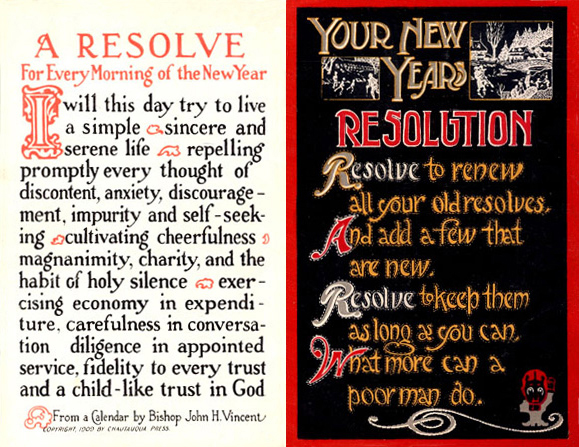
Postcards2CardsNewYearsResolution1915

During the first week of January this year, 41 percent of American’s will make at least one New Year’s resolution and 44 percent of the resolutions are related to self-improvement. In order to succeed in the fulfillment of their goals it usually requires dedication, fortitude, and perseverance.

I rather like that we have a specific date each year when the psychological odometer turns over. Some people will commit their plans to paper (or electronic paper!) while others will simply make a mental note as to what it is they wish to improve or achieve in the coming 365 days.

Although the first recorded ‘resolutions’ seem to be connected to John Wesley (founded the Methodist Church) and the formation of ‘Watchnight’, people have designated certain dates as the beginning of a new year for thousands of years. From the infallible Wikipedia:

“Babylonians made promises to their gods at the start of each year that they would return borrowed objects and pay their debts.

The Romans began each year by making promises to the god Janus, for whom the month of January is named.

In the Medieval era, the knights took the ‘peacock vow’ at the end of the Christmas season each year to re-affirm their commitment to chivalry.

At watchnight services, many Christians prepare for the year ahead by praying and making these resolutions.

This tradition has many other religious parallels. During Judaism’s New Year, Rosh Hashanah, through the High Holidays and culminating in Yom Kippur (the Day of Atonement), one is to reflect upon one’s wrongdoings over the year and both seek and offer forgiveness. People can act similarly during the Christian liturgical season of Lent, although the motive behind this holiday is more of sacrifice than of responsibility. In fact, the Methodist practice of New Year’s resolutions came, in part, from the Lenten sacrifices. The concept, regardless of creed, is to reflect upon self-improvement annually.”

Several years ago, after reading a book which provided a methodology to identify those goals which were the most important, I created a list of things I wanted to achieve. Each year I pull out that list and review it and only one thing remains which I have not accomplished. Who knows which one it is?

Here’s the list:

-Get children successfully launched in life. Success would be if they are self sufficient, self-directed and motivated; they know how to go after those things they want in life.

– Create a program for the Bellevue Rainbow (Girls) which will be the pinnacle of success.

-Write/Publish a book

In looking at the list I realize I should have separated the last goal into two goals. Writing a book – I discovered – was a whole different animal than getting one published. Since I made the list I have completed five 80,000 word (or greater) novels. Each time I write the words ‘The End’ there is a feeling of accomplishment. And yet.

Back to resolutions. Yes, I probably should lose 20 pounds. Yes, I probably should exercise more. Yes, I should write thank you notes more often and either hire a housekeeper or get my lazy one to work harder. But none of those things will be on my list this year. Just one thing is there: publish my novel(s).

New years app.jpgSo here’s a toast to 2018 as a whole blank slate of a year stretches before us. Whatever your goal may be I wish you the : ‘aim’ ‘dedication’ ‘fortitude’ ‘heart’ ‘mettle’ ‘moxie’ and ‘perseverance’ to achieve it. Happy New Year!

As always, a few links of interest:

https://www.statisticbrain.com/new-years-resolution-statistics/

https://www.livescience.com/42255-history-of-new-years-resolutions.html

https://en.wikipedia.org/wiki/New_Year’s_resolution

Grand Ole Opry

Will The Circle Be Unbroken?

November 28, 2017

It was called the Golden Age of Radio and one of the best known programs was first produced on November 28, 1925. In fact, that program is still heard every week as a live stream on the internet and is the longest running radio broadcast in US history.303

WSM  radio called the program a ‘barn dance.’ The name we all know it by: The Grand Ole Opry.

From the infallible Wikipedia:

“The phrase ‘Grand Ole Opry’ was first uttered on the air on December 10, 1927.  At the time, Barn Dance followed the NBC Red Network’s Music Appreciation Hour, a program of classical music and selections from grand opera presented by classical conductor Walter Damrosch. On that particular night, Damrosch had remarked that ‘there is no place in the classics for realism.’ In response, Opry presenter George Hay said:

‘Friends, the program which just came to a close was devoted to the classics. Doctor Damrosch told us that there is no place in the classics for realism. However, from here on out for the next three hours, we will present nothing but realism. It will be down to earth for the earthy.’

Hay then introduced DeFord Bailey, the man he had dubbed the ‘Harmonica Wizard’, saying:

‘For the past hour, we have been listening to music taken largely from Grand Opera. From now on, we will present the Grand Ole Opry.’

Bailey then stepped up to the mic to play ‘The Pan-American Blues,’ his song inspired by the Pan-American, a premier L&N Railroad passenger train.”

When people wanted to watch the broadcasts, the producers obliged but the show quickly outgrew its original locale. It moved a half dozen times – to larger and larger facilities – before finding a home in the 3,000 seat Ryman Auditorium in 1943. Then, in 1956, a new medium entered the equation and once a month, for the next few years, the Opry was broadcast on television.

In the 1960’s it was determined that the Ryman – old and falling into disrepair – was no longer adequate. Additionally, Nashville’s central core suffered from urban decay and the show’s owners made the decision to build a new facility on farmland east of town. The 4,000 seat facility opened in June 1974 and, despite catastrophic flooding of the Cumberland River in May 2010, continues as the home of the Grand Ole Opry.

322One interesting thing is that a circle was cut from the floor of the Ryman Theater and installed in the center of the new Opry stage. When our family visited Nashville in March 2013 we toured the facility and stood in the famous ‘circle.’ Later that evening we attended a show which featured Craig Morgan as that night’s main act. I was surprised, however, by the number of long time Opry acts which were still being performed including a ‘Minnie Pearl’ impersonator and also Little Jimmy Dickens who, until he died in 2015, was the oldest Opry member.

316If you go to Nashville, a visit to the Grand Ole Opry is a must and very worthwhile.
For more about the Opry: https://en.wikipedia.org/wiki/Grand_Ole_Opry

There’s a song which is sung following the induction of new members into the Opry ranks. It’s titled “Will the Circle Be Unbroken?” Take a listen:

November 28, 2022 – Over the years of writing this blog if I’ve learned one thing, its that certain topics seem to rise to the top and coincide with monumental life events. When I posted this on Tuesday, November 28, 2017, it was with the knowledge that my mother was not long for this earth. Two days later she passed, giving significance to this song and the concept of the unbroken circle.

Pac Man Fever

…and the Kong who was King

October 10, 2017

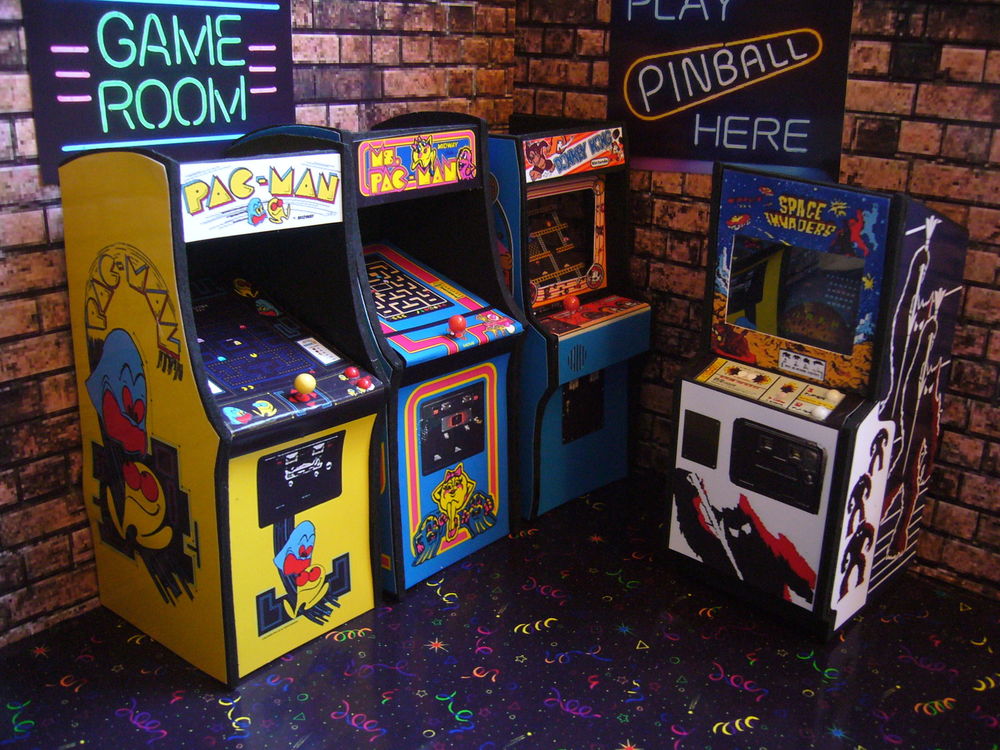
Arcade room gamesIt was in October of 1980 when the United States was truly invaded by the Japanese.  We are not talking about military here. No, this invasion featured four ghosts named Inky, Blinky, Pinky, and Clyde and a round yellow fellow with a huge pie shaped mouth dubbed Pac-Man. (There are articles which place the release date on October 10 but that date is disputed)
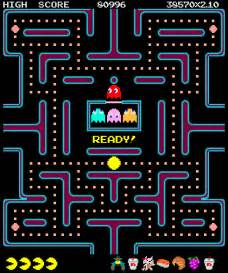
The game, which had been released in Japan a little over four months earlier, was an instant hit. Young people flocked to arcades and taverns where Pac-Man eagerly gobbled up their quarters.

Soon, Pac-Man merchandise flooded America as did other Japanese companies looking to capitalize on Pac-Man fever.

From the infallible Wikipedia:

pacman screen“When Pac-Man was released, the most popular arcade video games were space shooters—in particular, Space Invaders and Asteroids. The most visible minority were sports games that were mostly derivatives of PongPac-Man succeeded by creating a new genre. Pac-Man is often credited with being a landmark in video game history and is among the most famous arcade games of all time. It is also one of the highest-grossing video games of all time, having generated more than $2.5 billion in quarters by the 1990s.

The character has appeared in more than 30 officially licensed game spin-offs, as well as in numerous unauthorized clones and bootlegs.  According to the Davie-Brown Index, Pac-Man has the highest brand awareness of any video game character among American consumers, recognized by 94 percent of them. Pac-Man is one of the longest running video game franchises from the golden age of video arcade games. It is part of the collection of the Smithsonian Institution in Washington, D.C. and New York’s Museum of Modern Art.”

Donkey Kong PaulineMy hubby was hired by a CPA firm in Burien who had a client that needed an auditor. So they sent him out to do the job and thus began a seven year run with a different Japanese invader: Donkey Kong. While many think of Nintendo as a behemoth company, when Donkey Kong was first being sold into the US market they had six employees: two Seattle based salesmen, the company president, a couple of Japanese developer/engineers, and one American to make the build’s happen.

It was in 1982, after Donkey Kong’s popularity skyrocketed (and made the two US salesmen millionaires) that the hubby was hired as the company’s US controller. Those were crazy days with incredible long hours but also a real sense of family within the fledgling company.

We hosted an April Fool’s day party several years the theme of which was bad jokes and to play video games.  We even brought in full size arcade games (borrowed from Nintendo) for the attendees to enjoy.

When he left the company in the late 1980’s we had acquired a variety of Donkey Kong themed items: mugs, cups, socks, both electronic and board games, shirts, a bulletin board, an aped shaped ‘bank’ and, the most prized possession of all: an electronic cocktail tabletop game.

Yes, we still have all those things including the game table. But, unlike the days of Pac-Man and Donkey Kong fever, quarters are no longer needed. All you have to do is plug the thing in, press a button to load the game, and escape back to the 1980’s when arcade games were king and the Japanese took the country by storm.pac man blinky

To read more about these two arcade phenomenon click here:

https://en.wikipedia.org/wiki/Pac-Man

https://en.wikipedia.org/wiki/Donkey_Kong_(video_game) (there are some errors in this article. Specifically, Nintendo’s first headquarters were in Tukwila, not Redmond, Washington)

October 10, 2022 Update: When the daughter and her (then boyfriend) hubby moved back to the PNW, we gifted them the cocktail table Donkey Kong Game which we can visit pretty much anytime we want. As I organized things I put all of the Donkey Kong collection together and here’s a photo of most of the items we collected.

The Ice Cream Sundae

I miss Farrell’s!

July 25, 2017

Hot-Fudge-SundaeNo doubt July 25th is an extremely important day for ice cream lovers everywhere. Yes, it’s the ‘official’ National Hot Fudge Sundae Day!
You might think something like this would be controversy free. You would be wrong.

According to the Infallible Wikipedia the invention of the Ice Cream Sundae is disputed. The town of Two Rivers, Wisconsin asserted the concoction was created as follows:

“Two Rivers’ claim is based on the story of George Hallauer asking Edward C. Berners, the owner of Berners’ Soda Fountain, to drizzle chocolate syrup over ice cream in 1881. Berners eventually did and wound up selling the treat for a nickel, originally only on Sundays, but later every day. According to this story, the spelling changed when a glass salesman ordered canoe-shaped dishes. When Berners died in 1939, the Chicago Tribune headlined his obituary ‘Man Who Made First Ice Cream Sundae Is Dead’.  Two Ithaca High School students, however, claim that Berners would have only been 16 or 17 in 1881, so it is therefore “improbable” that he would have owned an ice cream shop in that year. They also state that the obituary dates Berners’ first sundae to 1899 rather than 1881.

Residents of Two Rivers have contested the claims of other cities to the right to claim the title ‘birthplace of the ice cream sundae’. When Ithaca, New York, mayor Carolyn K. Peterson proclaimed a day to celebrate her city as the birthplace of the sundae, she received postcards from Two Rivers’ citizens reiterating that town’s claim.”

The rival towns who also claim they were first are Buffalo and Ithaca, New York and Evanston and Plainfield, Illinois.

So how did it come to be called an Ice Cream Sundae? Mostly it can be traced back to the “Blue Laws” which were in place in the 1800’s. Carbonated Soda water – like alcohol – was considered inappropriate for consumption on the Sabbath. Because Ice Cream Soda’s could not be sold on Sunday in Evanston and Plainfield Illinois particularly, the inventive soda fountain owners began selling ice cream with the syrup poured over it – sans the soda – and thus created the first ice cream sundaes in that state. Rather than call it a ‘Sunday’ which was considered shocking, the spelling was changed to the now instantly recognizable ‘Sundae.’

I’m not sure who decided to pour hot chocolate over ice cream and create the hot fudge sundae, but it’s a good thing they did. Nothing quite says summer like a couple scoops of ice cream, hot fudge, and whipping cream with a cherry on top!

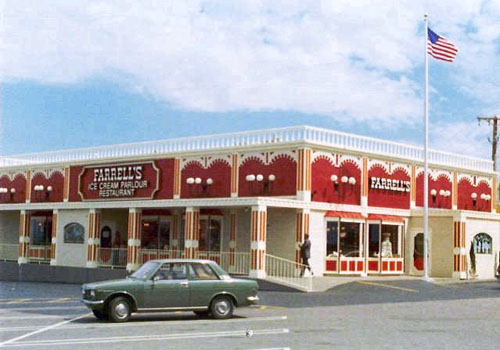
farrells01

Back in my teen years a real treat was to get to go to Farrell’s – an ice cream and burgers restaurant which hearkened back to the days of the Soda Fountain. This was a special event for this kid from Eastern Washington as there was not a Farrell’s in Yakima. We looked forward to the rare trips to Seattle and surrounds because it often meant that we could go gorge ourselves on ice cream. In addition to hot fudge and other Sundaes, Farrell’s staff would sing happy birthday if you were so lucky to be there on your big day. Heaven help you if you ordered the Pig Trough. It was a dozen scoops of ice cream and the rule was that YOU had to eat it all by yourself! Finish it and you were awarded a badge which said “I made of Pig of myself at Farrell’s” and the workers would parade through the restaurant with kazoos and much fanfare to celebrate your achievement. I was never so brave to order a Pig’s Trough!

Going to Farrell’s capped off the annual summer convention where a few thousand Rainbow Girls and their chaperones would gather each year. On the last night of the event, literally hundreds of girls would descend upon the Farrell’s in Tukwila? Tacoma? Spokane? ( I cannot recall the exact locations any longer!) and take over the restaurant. Truly, the staff did not know what hit them.

Scan_20200725One of my favorite memories of Farrell’s (I think it was Farrell’s) was when one of our adult advisors taught us all how to balance a fork on our nose. That was the sort of silliness we enjoyed. This photo of her doing just that  is probably from the last time I went to a Farrell’s.

I rather doubt any one would open a restaurant like Farrell’s in today’s world. It was sure a lot of fun but healthy?

For more information about ice cream Sundaes and their many variations and history click here: https://en.wikipedia.org/wiki/Sundae

Or for a brief history of Farrell’s click here: http://oldlarestaurants.com/farrells/

https://en.wikipedia.org/wiki/Farrell%27s_Ice_Cream_Parlour

Wienermobile

Oh, I Wish I Were An Oscar Mayer Wiener!

July 18, 2017

Wienermobile 6There cannot be found a more momentous day in history than July 18, 1936. For it was on that day when a universally recognized symbol of American marketing debuted.

Yes, we are talking about the day the Wienermobile first rolled out onto the streets of America.

Truly it was a stroke of marketing genius to create a car which looks like a giant hot dog. And no doubt the Oscar Mayer people relish this day in their history.

Of course the Wienermobile has evolved over the years. Today, there are eight Wienermobiles and they are assigned regionally throughout the United States. The drivers are known as ‘Hotdoggers’ and to be a Hotdogger you must be a College Senior about to graduate and then commit to one year as a driver. On average some 2000 people a year apply for the job but in the end only 12 are chosen. So it is quite the honor to be a Wienermobile driver.

From the infallible Wikipedia:

“The Oscar Mayer Wienermobile has evolved from Carl Mayer’s original 1936 vehicle to the vehicles seen on the road today. Although fuel rationing kept the Wienermobile off the road during World War II, in the 1950s Oscar Mayer and the Gerstenslager Company created several new vehicles using a Dodge chassis or a Willys Jeep chassis. One of these models is on display at the Henry Ford Museum in Dearborn, Michigan. These Wienermobiles were piloted by “Little Oscar” (portrayed by George Molchan) who would visit stores, schools, orphanages, and children’s hospitals and participate in parades and festivals.

In 1969, new Wienermobiles were built on a Chevrolet motor home chassis and featured Ford Thunderbird taillights. The 1969 vehicle was the first Wienermobile to travel outside the United States. In 1976 Plastic Products, Inc., built a fiberglass and styrofoam model, again on a Chevrolet motor home chassis.

In 1988, Oscar Mayer launched its Hotdogger program, where recent college graduates were hired to drive the Wienermobile through various parts of the nation and abroad. Using a converted Chevrolet van chassis, Stevens Automotive Corporation and noted industrial designer Brooks Stevens built a fleet of six Wienermobiles for the new team of Hotdoggers.”

In 1995 the Wienermobile got plumped up as it grew to 27 feet long and 11 feet tall! It was amazing! New versions are not as long but they are taller at 14 feet in height.

Then, on June 26 of this year, the latest innovations for hot dog delivery were introduced. Yes, it’s true, there is now a Weinerdrone!wienerdrone

https://www.youtube.com/watch?v=9nWXcboDjqo

For more information about the iconic Wienermobile, click here:

https://en.wikipedia.org/wiki/Wienermobile

I’m sure that after reading this you all will want a hot dog. In the wurst way.

Drive In Movies

An environment ripe for shenanigans!

June 6, 2017

drive in theatre

June 6 is an important day in US History. But since we all learned about D-Day in our US History classes (or you can pick up my friend Irene Fernandes wonderful novel ‘They Also Served’ for a firsthand account of a war-bride in England during WWII) I have instead chosen another ground breaking event for the subject this week.

Yes, it was on June 6, 1933, when the first commercially successful drive in movie theatre opened in Pennsauken, New Jersey. The father of the drive in movie was one Richard Hollingshead. From the infallible Wikipedia:

“Hollingshead conducted outdoor theater tests in his driveway at 212 Thomas Avenue in Riverton. After nailing a screen to trees in his backyard, he set a 1928 Kodak projector on the hood of his car and put a radio behind the screen, testing different sound levels with his car windows down and up. Blocks under vehicles in the driveway enabled him to determine the size and spacing of ramps so all automobiles could have a clear view of the screen. Hollingshead applied for a patent of his invention on August 6, 1932, and he was given U.S. Patent 1,909,537 on May 16, 1933.”

The American public, already in love with the automobile, also loved the drive-in movie. They reached their peak of popularity in the 1950’s and early 1960’s when some 4,000 Drive-ins existed throughout the United States.

The phenomenon was not without its detractors, however, and drive in movies – which allowed people to view films from the privacy of their car – were labeled ‘passion pits.’ Teenagers, particularly, adored them as it afforded an opportunity to, well, you know.

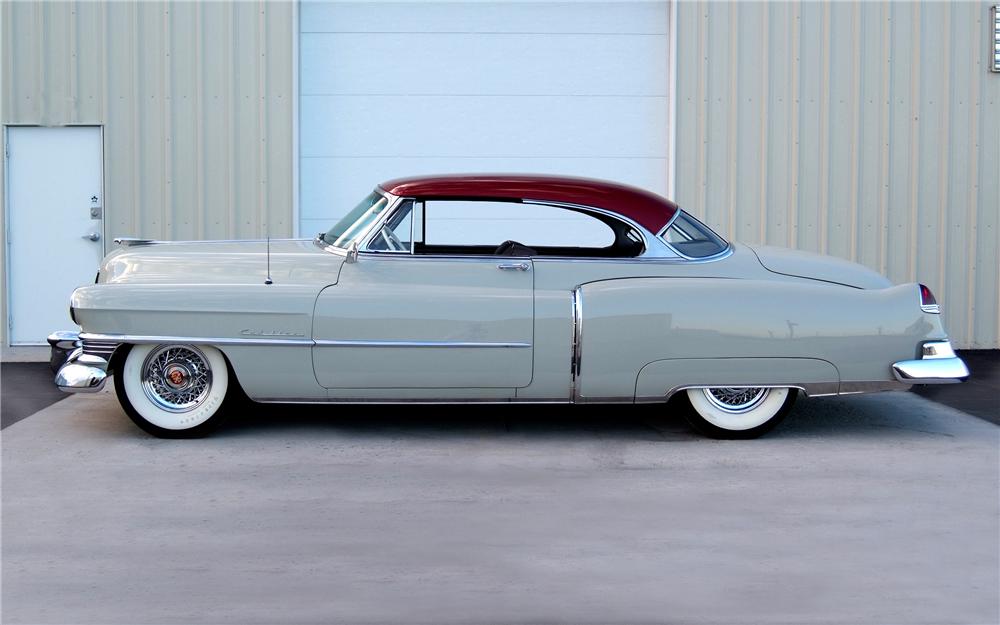
1950 cadillacSpeaking of which, there were several drive-in movie theaters in my hometown of Yakima, Washington. One evening my sister and I and two of our friends decided to go to the Fruitvale Drive-in (sadly, no longer there). The car my sister drove was a 1950 yellow Cadillac with a red roof; a hand me down from our grandparents.  This tank of a car had all the whistles and bells popular in 1950 including a gauge which told you how good your driving was. Ok, not really, it had to do with gas mileage, but as children our grandfather told us it was evaluating his driving with an arrow that point to words like ‘poor’, ‘fair’, ‘good’ and ‘excellent.’ But, most important of all, it featured a movable spotlight affixed to the car just outside the driver’s side window. There was a handle inside the car to control the light.

On this particular night my sister and one of her friend’s were in the front seat and me and one of my friend’s were in the back. Our attentions were soon drawn to the activities taking place in the backseat of the car parked in front of us. We watched with intense teenage curiosity as the silhouetted heads of the couple descended lower and lower until they were no longer visible.  Now THIS was interesting (unlike the movie whose name I forget). We, of course, giggled and speculated on WHAT exactly might be going on in that car and then my sister remembered ‘the light.’

“Do it!” we encouraged. So she did. A moment later a blaze of floodlight swamped the erstwhile lovers and you never saw feet flail or heads snap up so fast! We descended into paroxysm of laughter. The light was off a moment later but then we worried that we would be in trouble for the illumination during the movie. A few horns honked in objection of the sudden light and we two residents of the back seat ducked down so as not to be seen. Our prank, however, was not exposed and I do believe the lovers in the other car spent the rest of the movie upright. Talk about coyly ‘interrupt-us’.

If you want to know more about the rise and decline of the drive-in movie theater click on this link: https://en.wikipedia.org/wiki/Drive-in_theater

Do you have a story from when you went to the drive in? Please post it in the comments section! I would love to read it.

SPAM!

Spam, Spam, Spam, Spam!

May 16, 2017

If historians were to pick ONE significant event from each year in history what would the most important from 1891 be? The formation of the US Forest Service? No. The opening of Carnegie Hall? Definitely not. The patent of corkboard? Not even close.

spam and beansNo the most significant event of 1891 was when, on May 16th, George Hormel opened a small butcher shop in Austin, Minnesota and introduced the world to… SPAM!

What was significant about the product is that it took pork and ham and cooked it in its own container thus giving it a rather long shelf life. Oh that innovative George Hormel!

Since its creation Spam has become a ubiquitous part of pop culture and the worldwide psyche. It’s eaten throughout the world but especially in Great Britain and also in the Philippines. In the United States more Spam is eaten in Hawaii than in any other state. From the infallible Wikipedia:

“Spam is especially popular in the state of Hawaii, where residents have the highest per capita consumption in the United States. Its perception there is very different from on the mainland.SPAM the Hawaiian Steak

A popular native sushi dish in Hawaii is Spam musubi, where cooked Spam is placed atop rice and wrapped in a band of nori. Varieties of Spam are found in Hawaii that are unavailable in other markets, including Honey Spam, Spam with Bacon, and Hot and Spicy Spam.

Hawaiian Burger King Restaurants began serving Spam in 2007 to compete with the local McDonald’s chains.  In Hawaii, Spam is so popular that it is sometimes referred to as ‘The Hawaiian Steak’.”

My exhaustive research uncovered the existence of a SPAM museum in Austin, Minnesota. Putting that on my bucket list!

Highlighted in a variety of movies and TV shows, SPAM was immortalized in pop culture by the comedic troupe Monty Python.  And, of course, it’s the term which has become synonymous with junk mail. More from Wikipedia:

“Spam was featured in an iconic 1970 Monty Python sketch called ‘Spam’. Set in a café which only served dishes containing Spam, including ‘Spam, Spam, Spam, Spam, Spam, Spam, baked beans, Spam, Spam, Spam and Spam’, the piece also featured a companion song. By the 1990’s, Spam’s perceived ubiquity led to its name being adopted for unsolicited electronic messages, especially spam email.”

Be sure to check out these two links to learn more about Spam!

https://en.wikipedia.org/wiki/Spam_%28food%29

http://brasscastlearts.blogspot.com/2011/05/hormel-spams-world-may-16-1891.html