Maybe It’s Only Yesterday…

July 16, 2019

Zager & Evans.jpgThis song, which charted as number 1 on the Billboard Hot 100 the third week of July in 1969, stayed in the top spot for six weeks that summer.  It portrayed a Dystopian future which, one might argue, was just too downer a message for the ‘make love, not war’ crowd of the decade.

In The Year 2525 was destined to become a “one hit wonder.”

When one looks at the events of 1969, is it any surprise this song captured the imagination of a country that a week later witnessed two men walk on the moon? Technology, it seemed, had no limits and it was just a matter of time before robots usurped humans and the reign of homo-sapiens would end.

From the Infallible Wikipedia:

“‘In the Year 2525’ opens with an introductory verse explaining that if humanity has survived to that point, it would witness the subsequent events in the song. Subsequent verses pick up the story at 1,010-year intervals from 3535 to 6565. In each succeeding millennium, life becomes increasingly sedentary and automated: thoughts are pre-programmed into pills for people to consume, machines take over all work, resulting in eyes, teeth, and limbs losing their purposes, and marriage becomes obsolete since children are conceived in test tubes. Then the pattern as well as the music changes, going up a half step in the key of the song (chromatic modulation), after two stanzas, first from A-flat minor, to A minor.

For the final three millennia, now in B flat minor, the tone of the song turns apocalyptic: the year 7510 marks the date by which the Second Coming will have happened, and the Last Judgment occurs one millennium later. By 9595, with the song now in B minor, the Earth becomes completely depleted of resources, potentially resulting in the death of all life.

The song ends in the year 10,000. By that time, humanity has become extinct. But the song notes that in another solar system (or universe), the scenarios told in the song may still be playing out, as the beginning of the song repeats and the recording fades out.

The overriding theme, of a world doomed by its passive acquiescence to and over-dependence on its own overdone technologies, struck a resonant chord in millions of people around the world in the late 1960’s.  The song was #1 on the Billboard Hot 100 singles chart during the Apollo 11 moon landing.”

decca record 2525.jpgThe song was written by Rick Evans, one half of the duo of (Denny) Zager and Evans. One remarkable fact about the song is that it is the only song (still true 50 years later) which reached number one on both the US and UK music charts.

Over the past weekend I had the opportunity to see my two older brothers and asked each separately if they knew what one hit wonder was the number one song for mid July 1969. I expected my brother the disc jockey would get it and he did.

It was my older brother, who turned 21 that summer, who took but a moment to consider the question and responded not with the song title but with the name of the artist. Which is quite rare. So often we know the song but not who recorded it. He waxed poetic for a few minutes about how great the music of the late 1960’s was and what an impression it made on an entire generation.

As for me – not yet really listening to the popular music of the day – the song was inescapable. I know I heard it when it came on the radio as well as when my brother played it on his reel to reel tape deck.  As someone on the verge of her teen years, I spent considerable time contemplating the lyrics and it marked my questioning ‘who am I and what am I doing here?’ The world they imagined for the year 2525 and beyond was not a place I wanted to live and I found it all very depressing.

Fast forward to today and although computers, robots, and drones are now part of our world it would seem as though people spend more time now working on personal care and fitness, unwilling to become the lifeless blobs imagined. And that is a good thing.

As a work of fiction, In the Year 2525, serves as a cautionary tale. But don’t take my word for it… copy the link to your browser, watch the video, and enjoy the trip back to the Year 1969 when earthlings went to the moon and the world paused to imagine the future.

https://en.wikipedia.org/wiki/In_the_Year_2525

https://en.wikipedia.org/wiki/Zager_and_Evans


Life is like…

… a box of chocolates. You never know what you’re gonna get. – Forrest Gump

July 9, 2019

Hanks with OscarWith two academy awards and five total Best Actor nominations to his name, this performer is considered one of – if not the – best of his generation. Yet, while in school, he was a self identified geek, extremely shy, unpopular, and average looking. He, however, has more than made up for his rocky start. Happy 63rd birthday to Tom Hanks.
Hanks career began like many other actors: performing parts in plays in high school and in college. As connections were in the theater world, those led to television auditions. He landed a role alongside Peter Scolari in the 1981 sitcom Bosom Buddies, a show about two men who disguise themselves as women to secure inexpensive housing. Hanks TV career did not last long. According to the Infallible Wikipedia:

“After landing the role, Hanks moved to Los Angeles. Bosom Buddies ran for two seasons, and, although the ratings were never strong, television critics gave the program high marks. ‘The first day I saw him on the set,’ co-producer Ian Praiser told Rolling Stone, ‘I thought -Too bad he won’t be in television for long- I knew he’d be a movie star in two years.’ However, although Praiser knew it, he was not able to convince Hanks. ‘The television show had come out of nowhere,’ Hanks’ best friend Tom Lizzio told Rolling Stone.”

Hanks role on Bosom Buddies earned him a guest role on the immensely popular TV show Happy Days and drew the attention of up and coming director, Ron Howard. Howard encouraged Hank to audition for the role of the wisecracking brother in the 1984 film Splash. Instead, Hanks won the romantic lead role of Allen Bauer, a young man who falls in love with the mermaid (Daryl Hannah).

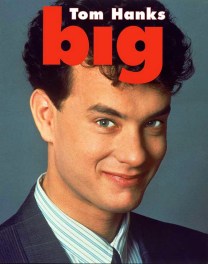
tom-hanks-big-movie-poster.jpgMore leading roles followed. He was nominated for his first Academy Award for his portrayal of a 12 year old boy who is transformed into an adult in the comedy Big.  The true date of his stardom can be set as 1993 with the blockbuster film Sleepless in Seattle, followed immediately by his performance as a man dying of AIDS in the dramatic movie Philadelphia.
His performance in Philadelphia garnered a second Academy Award nomination and his first win. In 1995, Hanks became only the second actor in history to be awarded the Best Performance by an Actor in a lead role in consecutive years. Forrest Gump also earned the Academy Award for Best Picture, was the highest grossing US film of 1994, and second behind Disney’s The Lion King in the entire world.

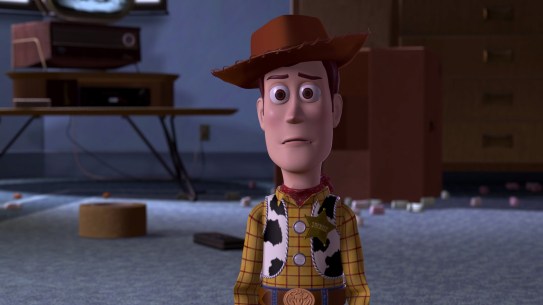
woody-personnage-toy-story-2-06.jpgIn the subsequent years Hanks has been involved with innumerable projects both in front of and behind the camera as director and as a voice actor. One of his more memorable and enduring roles is that of Sheriff Woody in Toy Story and its sequels.

His work and legacy continue to the present. According to the Infallible Wikipedia:

“Hanks is ranked as the fourth highest all-time box office star in North America, with a total gross of over $4.5 billion at the North American box office, an average of $100.8 million per film. Worldwide, his films have grossed over $9.0 billion. (snip) As of January 2019, Hanks is currently voted #1 on Ranker’s ‘The Best Actors in Film History.’”

I think I first became aware of Tom Hanks in his role as Josh Baskin in Big. Although I had seen the movie Splash I would not have been able to identify Hanks as the lead! But in Big, his every-man persona really shone through. By the time Sleepless in Seattle hit the big screen I, like so many others, was a fan.

I find it difficult to identify just one of his performances as my favorite. But I do have a list and it mostly involves the romantic comedy’s (is anyone surprised?).

  1. Sleepless In Seattle (I covered it in a Tuesday Newsday blog last year: https://barbaradevore.com/2018/05/01/sleepless-in-seattle/)
  2. Big
  3. Toy Story
  4. The DaVinci Code
  5. You’ve Got Mail

You can read all about Hanks long and continuing career here:

https://en.wikipedia.org/wiki/Tom_Hanks

I leave you with this quote from Hanks and his philosophy on movies: “A story has the opportunity to enlighten us, because as we connect the extraordinary moments on film with the ordinary moments of our lives, we ask ourselves, ‘What am I going to do the next time I’m scared? What would it be like to say goodbye to my family for the last time?’”

That’s The Pits!

Cherries!

July 2, 2019

The item which caught my attention for this week’s blog is the amusing ‘contest’ of cherry pit spitting. Yes, it’s a thing.

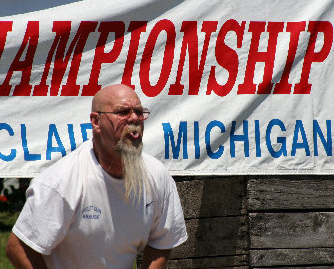
cherry spit site.jpgHeld annually in Eau Claire, Michigan, since 1974, the record ‘spit’ of a cherry pit is 93 ft 6.5 inches. The competition has been dominated by one family with the patriarch, Rick Krause, holding the record for longest spit (over 72 feet) until 1993. Since then, his son, Brian ‘Pellet Gun’ Krause has won 10 times with his record breaking discharge occurring the first week of July in 2003. In recent years Brian’s sons have also competed.
rick krause.png

Patriarchal Cherry pit spitter Rick Krause in 2010. Photo from Lifecompassblog.com

Others have stepped up to put their spitting skills to the test, but the Krause family continues to dominate.

It is appropriate, therefore, as we celebrate all things red, white, and blue this week, to pay tribute to one of my favorite red things: the cherry.

Every July I can hardly wait for the harvest of this fruit to begin in the Yakima Valley. For there is truly nothing better than picking a cluster of the ruby orbs and (after they’re cleaned off) biting into the soft, juicy flesh. As a fan of the sweet varieties such as Bing and Sweetheart, an explosion of flavor reminds me how much I’ve missed them since the previous year.

The cherry has a long history of cultivation with evidence that the fruit has been grown since prehistoric times. From the Infallible Wikipedia:

“The English word cherry derives from Old Northern French or Norman cherise from the Latin cerasum, referring to an ancient Greek region, Kerasous (Κερασοῦς) near Giresun, Turkey, from which cherries were first thought to be exported to Europe. The indigenous range of the sweet cherry extends through most of Europe, western Asia, and parts of northern Africa, and the fruit has been consumed throughout its range since prehistoric times. A cultivated cherry is recorded as having been brought to Rome by Lucius Licinius Lucullus from northeastern Anatolia, also known as the Pontus region, in 72 BC.

Cherries were introduced into England at Teynham, near Sittingbourne in Kent, by order of Henry VIII, who had tasted them in Flanders.

Cherries arrived in North America early in the settlement of Brooklyn, New York (then called ‘New Netherland’) when the region was under Dutch sovereignty. ”

In the United States, the first record of cherry trees being planted was 1639.

Bing cherriesSweet cherries are grown most successfully in Washington, Oregon, California, Wisconsin, and Michigan (hence the location of the cherry pit spitting contest). Most sour cherry varieties are grown in Michigan, Utah, New York and Washington.

To successfully grow cherries, the climate must have cold winters although varieties have been developed recently which have allowed California to compete in cherry production. Also from the Infallible Wikipedia:

“Most cherry varieties have a chilling requirement of 800 or more hours, meaning that in order to break dormancy, blossom, and set fruit, the winter season needs to have at least 800 hours where the temperature is below 45 °F (7 °C). “Low chill” varieties requiring 300 hours or less are Minnie Royal and Royal Lee, requiring cross-pollinization, whereas the cultivar, Royal Crimson, is self-fertile. These varieties extend the range of cultivation of cherries to the mild winter areas of southern US. This is a boon to California producers of sweet cherries, as California is the second largest producer of sweet cherries in the US.”

My relationship with the cherry has not always been an enjoyable one, however. In the 1970’s, my father took over managing a cherry orchard which my grandfather – a banker – had gotten as way of repayment of a loan gone bad some years earlier. In those years Dad had two jobs: Junior High School history teacher and orchardist. My first summer ‘job’ as a teenager was picking cherries.

By early July in Yakima the weather usually turns quite warm. It is common for there to be a spate of days when the thermometer inches into the upper 90’s and low 100’s.  It’s then that the cherries ripen and harvest begins. For the pickers, work commences shortly after daybreak while the orchard is still cool.

One summer, with my then boyfriend and his younger sister, we arrived – along with all the migrant workers – to begin our job. Each person was assigned a tree, given a ladder and a bucket. Now when I say bucket, we are not talking about a pail like those favored by children at the beach. Nope. The metal buckets I knew held a lot of cherries, some 4 1/2 gallons worth, and it seemed to take forever to fill one up.

ladder in cherry orchardPicking cherries requires a delicate method. You must hold the fruit at the very top of the stem (stem less cherries are not saleable in the fresh market) and gently twist so that the stem is removed from the branch without pulling the spur off the tree. Then you place – do NOT drop – the fruit into the bucket. Lather, rinse, repeat. My rough estimates are thus: 80 cherries for a gallon times 4.5 gallons equals 360 cherries for one bucket. It takes a long time to pick 360 cherries plus, with one’s assigned ‘tree’, you also had to climb up 12 to 15 feet while balancing a bucket of heavy fruit.
Now what, you may ask, is ‘the spur’?” It’s a knobby growth at the end of a branch and if it’s pulled off that branch will not produce cherries the next year. My father the orchardist was rather persnickety about those spurs being preserved.

By noon time – having been there picking since 5 a.m. – the heat would have arrived and I would have picked… seven buckets of fruit. That’s 2,420 cherries each day of harvest… and be paid seven whole dollars. Some of the migrant workers could pick up to 200 buckets a day. I’ve never figured out how.

Okay, the job truly sucked. Although seven bucks went farther in nineteen seventy something than it does today. But it wasn’t a lot of money.

My experience as a cherry picker makes me appreciate the delicious fruit even more. When my sister brought a bag of the freshly picked delights to me yesterday, it was a taste of heaven. For the next few weeks I will jealously guard my cherries, making the bounty last until late July. By then I will have satisfied my craving for the fleshy fruit for another year.

The best part? I didn’t have to pick them!

patriotic pie

Happy 4th of July everyone!

A couple of links for you:

https://en.wikipedia.org/wiki/Cherry

http://memory.loc.gov/diglib/legacies/loc.afc.afc-legacies.200003151/default.html

These Are The Good Old Days

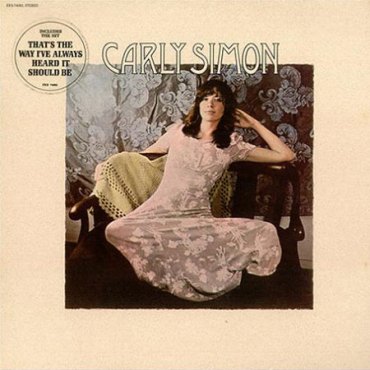
carly simon debut albumJune 25, 2019

Carly Simon

I have been waiting over two years to find a Tuesday on which I can feature this musical artist. As one of my favorite ‘hitchhikers’ when I travel back and forth from Yakima to my home, her lovely contralto voice frequently fills my car with many beloved songs from my teen years. I would argue that nobody does it better than Grammy and Academy Award winner Carly Simon. June 28 is her 74th birthday.

In anticipation of this article, I plugged in her greatest hits CD and imagined I, like Carly, was a legend in my own time, singing in the footlights. Alas, I think anyone listening would have said to me you’re so vain to think your voice could compare to hers.

Ultimately, the right thing to do is tell you all about Simon’s life and her amazing career. By all appearances hers was a storybook existence. The daughter of publisher Richard Simon of Simon and Shuster, she grew up as one of three girls seemingly given every advantage. She was, however, sexually assaulted at age 7 by a teenage friend of the family. The event caused the young Carly to withdraw into herself. From the Infallible Wikipedia:

” ‘It was heinous’, (Simon said) adding, ‘It changed my view about sex for a long time.’ Simon began stuttering severely when she was eight years old. A psychiatrist tried unsuccessfully to cure her stuttering. Instead, Simon turned to singing and songwriting. ‘I felt so strangulated talking that I did the natural thing, which is to write songs, because I could sing without stammering, as all stammerers can.’ Simon attended Riverdale Country School and also (briefly) Sarah Lawrence College, before dropping out to pursue music.”

Additionally, she lost her father who – by all accounts was a mostly absent father – at age 15. She teamed up for a short time with her sister, Lucy, and then with another group. It was her impressive talent which propelled her forward as a solo artist. The self titled debut album, Carly Simon, debuted in March 1971 when she was 26.

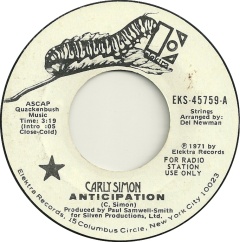
Her first top ten hit, That’s the Way I’ve Always Heard it Should Be, hailed from the album.  Her second album, Anticipation, was released nine months later and the title song made it all the way to number 3 on the charts.

Also from the Infallible Wikipedia:

“Simon scored the biggest success of her career in 1972–73, with ‘You’re So Vain’. It hit No. 1 on the U.S. Pop and Adult Contemporary charts, and sold over a million copies in the United States alone. It was one of the decade’s biggest hits and propelled Simon’s breakthrough album No Secrets to No. 1 on the U.S. album charts, where it stayed for five consecutive weeks. The album achieved Gold status that year, and by its 25th anniversary in 1997 it had been certified Platinum.”

carly-simon-anticipation-1971-7.jpgFor me it was the song Anticipation which has always garnered a strong emotional response. In fact I found in some of my teenage writings where I had written out all the lyrics to the song and even named the beginnings of one of my early attempts at story telling ‘Anticipation.’
Now, decades later, I am always carried back to 1971 and 1972 when I hear that song and the poignant lyrics are as true today as they were then:


We can never know about the days to come
But we think about them anyway
And I wonder if I’m really with you now
Or just chasing after some finer day.

Anticipation, Anticipation
Is making me late
Is keeping me waiting

And I tell you how easy it is to be with you
And how right your arms feel around me.
But I rehearsed those words just late last night
When I was thinking about how right tonight might be.

Anticipation, Anticipation
Is making me late
Is keeping me waiting

And tomorrow we might not be together
I’m no prophet, I don’t know natures way
So I’ll try to see into your eyes right now
And stay right here, ’cause these are the good old days.


The song is pure in thought and sentiment. Cherish today, for tomorrow is not promised. Carly was right. These ARE the good old days.

https://en.wikipedia.org/wiki/Carly_Simon

I Believe In Yesterday

June 18, 2019

Paul McCartney

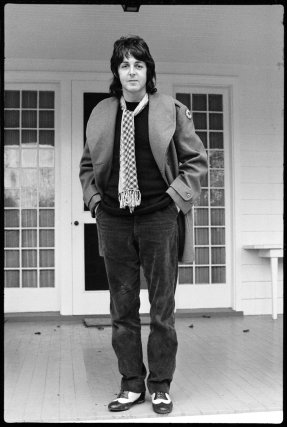
The Infallible Wikipedia article about this artist, born June 18, 1942, is one of the longest I’ve ever seen.  Which might explain why I’ve been reluctant to write about him until now.  No words are capable of capturing his musical greatness or the impact of his compositions. That artist is Paul McCartney.paul-mccartney-twitter-14.jpg

The numbers are staggering: He has written or co-written 32 songs which were number one on the Billboard Hot 100; more than 2200 artists have covered his iconic song “Yesterday”;  has won 18 Grammy Awards; twice inducted in to the Rock and Roll Hall of Fame; is personally worth $1.2 BILLION; and was knighted by the Queen of England in 1997.

McCartney was, of course, one of the four members of the Beatles. But he truly was so much more than that.  He wrote, or co-wrote with John Lennon, the majority of their songs.  From the Infallible Wikipedia:

“At the age of fifteen on 6 July 1957, McCartney met John Lennon and his band, the Quarrymen, at the St Peter’s Church Hall fête in Woolton. The Quarrymen played a mix of rock and roll and skiffle, a type of popular music with jazz, blues and folk influences. Soon afterwards, the members of the band invited McCartney to join as a rhythm guitarist, and he formed a close working relationship with Lennon.”

Three years later the group renamed themselves the Beatles. While the group rocketed to international fame, the relationships between the members were contentious. McCartney was seen as picky and also the one who forced the Beatles to go beyond the simple songs which defined their early work. The three other members all seemed to resent McCartney and how he took control. Finally, in April 1970, McCartney left the group and strode out as a solo artist.

Paul and Linda McCartney.jpgIt was the influence and support of his wife, Linda, which defined the next 25 years of his career. The solo career was short lived. He formed the band Wings along with his wife, ex-Moody Blue’s guitarist Denny Laine, and also drummer Denny Seiwell.
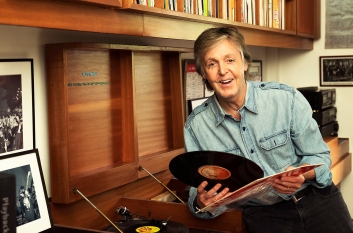
While the band never saw the same level of fan hysteria as the Beatles, Wings achieved enviable success. Also from the Infallible Wikipedia:

“In March 1973, Wings achieved their first US number-one single, ‘My Love‘, included on their second LP, Red Rose Speedway, a US number one and UK top five. McCartney’s collaboration with Linda and former Beatles producer Martin resulted in the song ‘Live and Let Die‘, which was the theme song for the James Bond film of the same name. Nominated for an Academy Award, the song reached number two in the US and number nine in the UK. It also earned Martin a Grammy for his orchestral arrangement. Music professor and author Vincent Benitez described the track as ‘symphonic rock at its best’”Band on the run

More number one hits followed such as “Band on The Run” and “With a Little Luck.”

But, as had happened with the Beatles, disagreements with band members led to the band’s breakup in April 1981.

McCartney has not achieved the same commercial success as with either the Beatles or Wings, but he continues to stretch and grow as an artist, exploring orchestral, classical, and electronica styles in the past quarter century. In September 2018 he released his album, Egypt Station, which became his first album to make it on to the Billboard Hot 200 chart in 36 years. It debuted as number one.paul-mccartney-press-cr-Mary-McCartney-billboard-1548.jpg

Having grown up in the 1960’s with an older brother who adored the Beatles and then ‘discovering’ music on my own in the 1970’s, McCartney was, of course, a household name. Girls of the era often referred to him as the ‘cute’ Beatle. Personally, I’ve never was a huge Beatles or Wings fan, but both group’s music were inescapable.

My favorite story about McCartney occurred during his tenure with Wings. My sister became a Junior High school teacher after she graduated college in 1979. One day she overheard a couple of students discussing the band Wings and one of them said “Did you know Paul McCartney was in another group before Wings?”

My sister had to stop herself from laughing out loud. ‘Another’ group? Like the Beatles? Ah, how quickly one’s fame can flee.

So happy 77th birthday to Paul McCartney.

A link to the exhaustive Wikipedia articles:

https://en.wikipedia.org/wiki/Paul_McCartney

https://en.wikipedia.org/wiki/The_Beatles

https://en.wikipedia.org/wiki/Paul_McCartney_and_Wings

And a youtube link to the iconic ‘Yesterday.”

This is…

American Idol!

June 11, 2019

top-12-contestants-american-idol

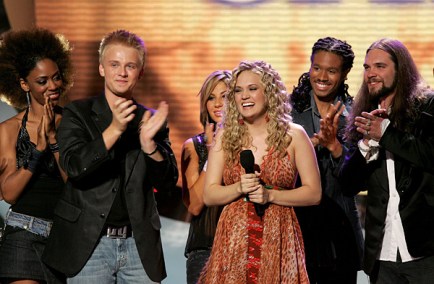
These four words burst into our collective consciousness on June 11, 2002 and launched one of the most successful reality TV franchises in American History.

The show was an instant hit, showcasing the talent of people looking for their big break. Week after week fans tuned in to follow the stories of the lucky few selected to compete in the contest. The premise was, according to the Infallible Wikipedia, this:

“Each season premieres with the audition round, taking place in different cities. The audition episodes typically feature a mix of potential finalists, interesting characters and woefully inadequate contestants. Each successful contestant receives a golden ticket to proceed on to the next round in Hollywood. Based on their performances during the Hollywood round (Las Vegas round from the tenth through twelfth seasons), 24 to 36 contestants are selected by the judges to participate in the semifinals. From the semifinals onward the contestants perform their songs live, with the judges making their critiques after each performance. The contestants are voted for by the viewing public, and the outcome of the public votes is then revealed during a results segment. The results segment feature group performances by the contestants as well as guest performers. The Top-three results also features homecoming events for the Top 3 finalists. The season reaches its climax in a two-hour results finale show, where the winner of the season is revealed.”

Along with the judges, viewers at home became music critics, repeating such phrases as “that was pitchy,” and “You’re going to Hollywood.” The judge everyone loved to hate, however, was Simon Cowell, who un-apologetically skewered the singing of contestants with such pithy remarks like “It was all a little bit like angry girl in the bedroom screaming on the guitar.”

carrie-underwood-american-idol-results-2005-photo-GC

I would argue that the high water mark for the show was in 2005 with the crowning of Carrie Underwood as the winner. She has been, by far, the most successful AI alum and her win and subsequent stardom created much excitement and interest in the show. That excitement coalesced into the 2007 season with it being the number one show on TV that year. Also from the Infallible Wikipedia:

“American Idol ended the season as the top show of the 2006–2007 TV season. Its Wednesday episodes ranked first with an average of 30.02 million viewers, followed by the Tuesday episodes which averaged 29.54 million. The premiere episode became the series’ highest rated debut episode, viewed by 37.44 million viewers and receiving a 15.8/36 Nielsen rating in the Adult 18-49 demographic.”

In my household AI fever kicked in to high gear when my teenage daughter became enthralled with it and AI took over our lives. Just before 8 o’clock each evening I’d hear the thunder of her footsteps coming down the stairs and soon we were wrapped up in the drama.

That year there was extra interest as a contestant from Bothell – six miles north of where we lived – was making a name for himself on the show.

Blake Lewis was, at the time, a local Seattle musician whose beat-boxing ability provided enough novelty that he earned a golden ticket to Hollywood. At first, it seemed, the judges viewed him as a one trick pony who would not survive the first round of performances. Week after week, however, Lewis proved that he could sing. He made each song his own with original arrangements, and defied the odds, advancing in each round.

For my 14 year old daughter and a couple of her friends, Lewis became almost an obsession like the Beatles were in the 1960’s, or David Cassiday in the 1970’s, or the Backstreet Boys in the 1990’s (It’s what 14 year old girls are known to do!) Of course, Mom was pulled in to that universe also, as we then had to vote for him every week. And I’m not talking about dialing the phone one time and being done. Oh no. On American Idol they encouraged the viewers to vote many, many times. Hundreds of times. Once the performances were over we’d start dialing and continue until they closed them down.

And Lewis became the last man, literally, standing.

When the contest is down to the final three it’s time for the ‘hometown’ visit. Or, as the cynic in me believes, just another way to market the AI franchise to the public.

In the week before Lewis was to arrive in Bothell, my daughter and her friends “L” and “D” spent a couple of afternoons making t-shirts and posters and plotting the big event. Lewis’ female fans called themselves “Blaker Girls.”

During that week I became the ‘cool’ mom. I bought the many supplies and, on a warm, sunny afternoon on May 11, drove the trio of girls to Bothell so they could see ‘their’ American Idol. I figured there would be a crowd so we got there several hours in advance, secured a parking spot and joined the throng of over 7000.

The girls were not disappointed. The fans were amped up for the parade and, after a long wait, there he was… riding on the back of a Mustang convertible, smiling and waving to the crowd.

After the parade, we moved with the hoards down to the park where he was to perform live and receive his hometown hero’s welcome.

From the Seattle Time’s article:

The Bothell crowd of more than 7,000 was growing restless. Where was its American Idol?

Some teens chanted “We want Blake!” Others hoisted “We Ache for Blake” or “Bothell Boy, You Rock!” signs. And then, off in the distance, the twirling lights of police cars, the thundering beats of the Inglemoor Marching Band and Blake Lewis, all smiles and waves and two-fingered kisses, sailing down Main Street in a Mustang convertible with his beaming parents.

It was a highlight in a full day of events for Lewis that started at 8 a.m. at KCPQ/Fox studios for a television performance on the morning newscast. There was a lunchtime “mini-concert” at Seattle’s Westlake Center, a parade through downtown Bothell and another performance at the Park at Bothell Landing in the afternoon.”

Lewis ended up finishing second the next week, much to our disappointment.

For the next couple of years my daughter faithfully watched American Idol and even went to the American Idol tour with a friend in 2009. For me there has never been a more fun season than that one. I no longer watch the show, but for a few months in the spring of 2007, it was a magic time. Sadly, our computer crashed that summer and all the evidence of the Blake Lewis hometown visit are gone…*

A few links:

https://en.wikipedia.org/wiki/American_Idol

https://en.wikipedia.org/wiki/American_Idol_(season_6)

https://www.seattletimes.com/entertainment/a-tidal-wave-of-idol-worship/

*Update June 11, 2020 – During the lockdown of the past few months, I have sorted, organized, and sorted again. Lo and behold, video evidence of the visit to Blake’s Hometown parade exists! Many thanks to my nephew Chris, who put together the photos I took that day as well as found at least one I did not take. Not sure who did, but this Mom appears at the 2:19 mark with camera in hand next to the screaming teens. Enjoy!

Automate This!

June 4, 2019

The Curse of Automation

atm533On June 4, 1973, the US patent for the ATM machine was issued to Don Wetzel, Tom Barnes, and George Chastain.

As with many such inventions, it did not spring spontaneously into use as there were others who had conceived of the idea for at least three decades prior. Cash machines were used in both Japan and Great Britain for nearly a decade before they arrived in the United States.

For the purposes of this article, however, we will go with 1973 as the year this form of automation entered our American lives. From the Infallible Wikipedia:

“After looking firsthand at the experiences in Europe, in 1968 the ATM was pioneered in the U.S. by Donald Wetzel, who was a department head at a company called Docutel. Docutel was a subsidiary of Recognition Equipment Inc of Dallas, Texas, which was producing optical scanning equipment and had instructed Docutel to explore automated baggage handling and automated gasoline pumps.

On September 2, 1969, Chemical Bank installed the first ATM in the U.S. at its branch in Rockville Centre, New York. The first ATMs were designed to dispense a fixed amount of cash when a user inserted a specially coded card. A Chemical Bank advertisement boasted ‘On Sept. 2 our bank will open at 9:00 and never close again.’ Chemical’s ATM, initially known as a Docuteller was designed by Donald Wetzel and his company Docutel. Chemical executives were initially hesitant about the electronic banking transition given the high cost of the early machines. Additionally, executives were concerned that customers would resist having machines handling their money. In 1995, the Smithsonian National Museum of American History recognised Docutel and Wetzel as the inventors of the networked ATM.

By 1974, Docutel had acquired 70 percent of the U.S. market; but as a result of the early 1970s worldwide recession and its reliance on a single product line, Docutel lost its independence and was forced to merge with the U.S. subsidiary of Olivetti.

Wetzel was recognised by the United States Patent Office as having invented the ATM in the form of U.S. Patent # 3,761,682; the application had been filed in October 1971 and the patent was granted in 1973. However, the U.S. patent record cites at least three previous applications from Docutel, all relevant to the development of the ATM and where Wetzel does not figure, namely US Patent # 3,662,343, U.S. Patent # 3651976 and U.S. Patent # 3,68,569. These patents are all credited to Kenneth S. Goldstein, MR Karecki, TR Barnes, GR Chastian and John D. White.”

Automation, of course, is not limited to the dispensing of money. It’s everywhere in our world. And nowhere is it more frustrating and confusing than in public restrooms.

When one enters such a place it becomes a midway house of horrors as one never knows what is or is not automated. Like the toilet.

auto flush toilet.jpgUpon entry into the stall I dread seeing the little black box with the red light attached to the back of the throne. I don’t know if it’s just me but it seems as if the slightest movement will trigger the flushing mechanism and the toilet turns into an unruly bidet, spraying the unsuspecting (me!) customer with a premature shower of love. Sometimes this occurs multiple times sending this user screaming from the stall.

Now I also don’t know about others but I always (ALWAYS!) wash my hands before I leave the restroom. Having survived the automatic flushing toilet, the next gauntlet is the sink. I am never sure if swiping my hands under the faucet will trigger a flow of water or if I must push on the neck of the faucet or, heaven forbid, use an old-fashioned handle. An automatic faucet is a mystery. What is the exact placement of one’s hands to produce the elusive water? Too high or too low and you get nothing, instead looking like a magician swiping your digits back and forth in an attempt to conjure up the desired fluid.

Need soap? The device on the nearby wall never gives any clue as to how its operated. I stare at it and try to guess. My first attempt is yet another magical wave of my hand. If that does not work then I start pressing on what looks like levers and buttons. The mound of clear gel on the counter below the machine provides evidence that I am not the first to guess incorrectly how to use it.

Now, with soap in hand and an idea of how to get water to flow, I wash my hands then turn to the scariest step of all: drying.

modern day stocksIn some restrooms you have a choice between paper towels and, nowadays, the device where you put your hands down into what looks like modern day stocks. The machine springs to life and blasts out a stream of air produced from the engines of a Boeing 747. In my hands go. I watch in fascinated horror as the skin on them wrinkles and flaps like the upper arms on Miss Luhman, the infamous fourth grade teacher who, when she was conducting the school choir, held all children’s attention with fascinated attention on her flappy arms.

Or, heaven forbid, it’s an automatic towel dispenser. Usually there are two such devices, side by side, in the restroom which provides the opportunity to do the paper towel dispenser dance (TM). I stand a foot away from the silver boxes, extend my arms straight out and then move my hands simultaneously in a frenetic motion as though doing that 1960’s dance The Swim.

At last – if I’m lucky – two inches of blessed brown paper appears. I tear it off, dry three fingers, then start the dance once again. After three or four rounds of wild gyrations, my hands are dry, I’ve gotten the day’s workout, and I escape still slightly wet but mostly unscathed.

Ain’t automation grand?

https://en.wikipedia.org/wiki/Automated_teller_machine

Actual footage of me attempting to get a paper towel from an automatic dispenser.

Five Famous Babies

May 28, 2019Dionne quintuplets with mother

Born on May 28, 1934, this set of five identical girls was believed to be the first quintuplets to have all survived such a birth. The chances of an identical five are 1 in 55 million. The news raced around the globe, catapulting the Dionne sisters to international fame.

Already the parents of five children, Oliva (father) and Elzire (mother), were a poor family from Ontario, Canada.  From the Infallible Wikipedia:

“Elzire suspected she was carrying twins, but no one was aware that quintuplets were even possible. The quintuplets were born two months premature. In 1938, the doctors had a theory that was later proven correct when genetic tests showed that the girls were identical, meaning they were created from a single egg cell. Elzire reported having had cramps in her third month and passing a strange object which may have been a sixth fetus.

Dr. Allan Roy Dafoe is credited with ensuring the successful live birth of the quintuplets. Originally, he diagnosed Elzire with a ‘fetal abnormality’. He delivered the babies with the help of two midwives, Aunt Donalda and Madame Benoit Lebel, who were summoned by Oliva Dionne in the middle of the night.

Émilie and Marie shared an embryonic sac, Annette and Yvonne shared an embryonic sac, and it is believed that Cécile shared an embryonic sac with the miscarried sixth baby. All but Émilie were later discovered to be right-handed and all but Marie had a counter-clockwise whorl in their hair.

The quintuplets’ total weight at birth was 13 pounds, 6 ounces. Their individual weights and measurements were not recorded. The quintuplets were immediately wrapped in cotton sheets and old napkins, and laid in the corner of the bed. Elzire went into shock, but she recovered in two hours.

The babies were kept in a wicker basket borrowed from the neighbours, covered with heated blankets. They were brought into the kitchen and set by the open door of the stove to keep warm. One by one, they were taken out of the basket and massaged with olive oil. Every two hours for the first twenty-four, they were fed water sweetened with corn syrup. By the second day they were moved to a slightly larger laundry basket and kept warm with hot-water bottles. They were watched constantly and often had to be roused. They were then fed with ‘seven-twenty’ formula: cow’s milk, boiled water, two spoonfuls of corn syrup, and one or two drops of rum for a stimulant.”

Dionne Quintuplets (6)Even without television or the internet, their birth created media frenzy.  The Province of Ontario – after four months – placed the quints into a guardianship and removed the girls from their parents.  The parents were declared unfit to raise the five girls (but not their other children!).
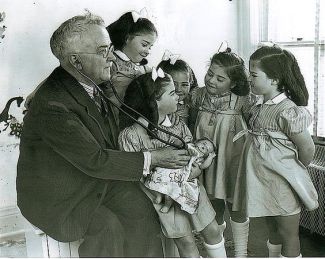
Dr. Dafoe with quintuplets

Dr. Dafoe with the girls.


A nursery facility was constructed across the street from the Dionne’s farmhouse and staff was hired to care for the girls. Not unlike animals on display in a zoo, the girls were taken out side to a play area three times a day. The paying public could observe them through one way screens. Also from the Infallible Wikipedia:

“Approximately 6,000 people per day visited the observation gallery that surrounded the outdoor playground to view the Dionne sisters. Ample parking was provided and almost 3,000,000 people walked through the gallery between 1936 and 1943. Oliva Dionne ran a souvenir shop and a concession store opposite the nursery and the area acquired the name ‘Quintland’. tourists with viewing clockThe souvenirs, picturing the five sisters, included autographs and framed photographs, spoons, cups, plates, plaques, candy bars, books, postcards, and dolls. Oliva also sold stones from the Dionne farm that were supposed to have a magical power of fertility. Midwives Madame LeGros and Madame LeBelle also opened their own souvenir and dining stand. The quintuplets brought in more than $50 million in total tourist revenue to Ontario. Quintland became Ontario’s biggest tourist attraction of the era, surpassing the Canadian side of Niagara Falls.”Tourists rushing in to view the quintuplets


This arrangement lasted until Dr. Dafoe’s death in 1943 when the girls were nine. Their parents successfully sued the Ontario government for the return of their children.

Unfortunately, the quintuplets continued to be exploited, but this time by their father who used the funds the girls had earned through public appearances and merchandise sales.  He built a large house which featured uncommon luxuries but kept secret from his daughters’ the source of the wealth.  All the girls left home at age 18.

The famous five have been the subject of books, documentaries and movies. Today, in our more enlightened times, we can clearly see the harm which they suffered. In 1998, the three surviving sisters were awarded $2.8 million dollars in compensatory damages from the Ontario government for exploitation.

There have been other high profile ‘multiples’ births since 1934. The McCaughey septuplets, born in 1997, were the first set of seven to all survive birth. The most to be born to one mother and all survive are octuplets with two known such births. The most recent set, the Suleman octuplets, arrived in 2009. Unlike the Dionne sisters, these births were the result of fertility drugs and/or in vitro-fertilization.

From a fairly young age, I thought that I’d like to have twins someday. While that never happened, one of my best friends in high school (and to this day!) was a triplet. What a surprise it must have been for her parents’ with the following scenario: a son was born, then a daughter… then twins (a boy and a girl), followed by… triplets (boy, boy, girl).

I had a conversation with her mother one day after the birth of my son. I told her I was in awe of what she had done and how hard she must have worked to care for that brood of seven. I told her I found taking care of just one baby to be a difficult endeavor. She just smiled and said that it was a lot of effort, but worth it.

Then in the early 2000’s another friend of mine announced she was expecting triplets! I sprang into action and – when she ended up bed-ridden two months prior to her due date – I started sending her daily emails with naming strategies for her three babies. A few examples:

wilma pebbles bettyThe Flintstones: Wilma, Betty, Pebbles

British Royalty: Elizabeth, Mary, Victoria

The Jetsons: Jane, Judy, Rosie

Gilligan’s Island: Ginger, Maryann, Lovey

Bewitched: Samantha, Tabitha, Eldora

The Supreme’s: Diana, Florence, Mary

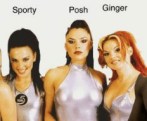
spice girls    Spice Girls: Sporty, Posh, Ginger

You get the idea. I continued to pepper her with outlandish names until the girls arrived in early June of 2002. Despite the exhaustive list, none of my suggested name combinations were chosen.

So even though I never ended up with ‘multiples’ I did get to join in the fun and awe of such an event and was more than happy with having two ‘singles.’

The links:

https://en.wikipedia.org/wiki/Dionne_quintuplets

https://en.wikipedia.org/wiki/McCaughey_septuplets

https://en.wikipedia.org/wiki/Suleman_octuplets

https://en.wikipedia.org/wiki/Multiple_birth


Facebook answers! The Jackson 5, The Spice Girls, The Dionne Quintuplets, The Beach Boys


“I’m Going To Thread The Needle”

May 21, 2019

Oakfield_Tornado_71896Mid-May in the United States is often a dangerous time to be in the central plains. The month is prime tornado season, a month when hundreds of twisters can occur in what is described as an ‘outbreak.’
While tornado’s have been observed during every month of the year, my research revealed that the third week of May (the 20th to the 27th) has produced a phenomenal number since 1955. In fact, there have been 1,448 recorded U.S. tornadoes in this date range!

One of the deadliest and most damaging tornado sequences began on May 21, 2011 and continued for six days. From the Infallible Wikipedia:

“On May 21, a small system of thunderstorms developed in Brown County, Kansas while another system formed to the southeast of Emporia, Kansas. The Brown county system spawned a brief tornado over Topeka, Kansas, causing minor damage. This system also caused significant damage in Oskaloosa, Kansas, and other communities. Meanwhile, the Emporia system spawned an EF3 tornado that struck Reading, Kansas; one person was killed, several others were injured, and at least 20 houses were destroyed. These two systems developed several other tornadoes throughout the evening.

A moderate risk of severe weather was issued for much of the Midwest, as well as further south to Oklahoma for May 22. (snip). Late that afternoon, a large, intense EF5 multiple-vortex tornado left catastrophic destruction in Joplin, Missouri. Causing 158 fatalities, it was the deadliest single tornado in the U.S. since at least 1947.”

The next day, May 23, tornadic activity continued but was minor compared to Joplin. The sequence was capped by an EF5 tornado in El Reno, Oklahoma on May 24. Also from the Infallible Wikipedia:

“ At 12:50 p.m. CDT, the SPC issued a Particularly Dangerous Situation  (PDS) tornado watch for parts of central Oklahoma, including Oklahoma City and northern Texas, in effect until 10:00 p.m. CDT. Numerous tornadoes touched down in several regions, with the first activity being in western Oklahoma that afternoon where several very intense tornadoes developed, including another EF5 (the sixth of the year). They did not cause extensive damage in Oklahoma City, but 11 deaths were reported among extensive damage just to the southwest of the OKC metro. Other tornado clusters developed in central Kansas that afternoon and in the Dallas-Fort Worth Metroplex that evening.”

As I have watched the tornado activity these past few days it prompts a memory of when drove with my son from Seattle to Nashville in May 2014.

The morning of May 11, Mother’s Day, we arose before daylight. We had spent the night in Mitchell, South Dakota. The previous day I followed the severe weather reports on my brand new smart phone. It looked like the central US from northern Iowa through Oklahoma, Kansas and Missouri, would be impacted. That morning we had a choice to make:

Head south and risk being in the path of tornadoes or continue along I-90 and hope to skirt the storms by going far to the east before taking I-65 south to Nashville.

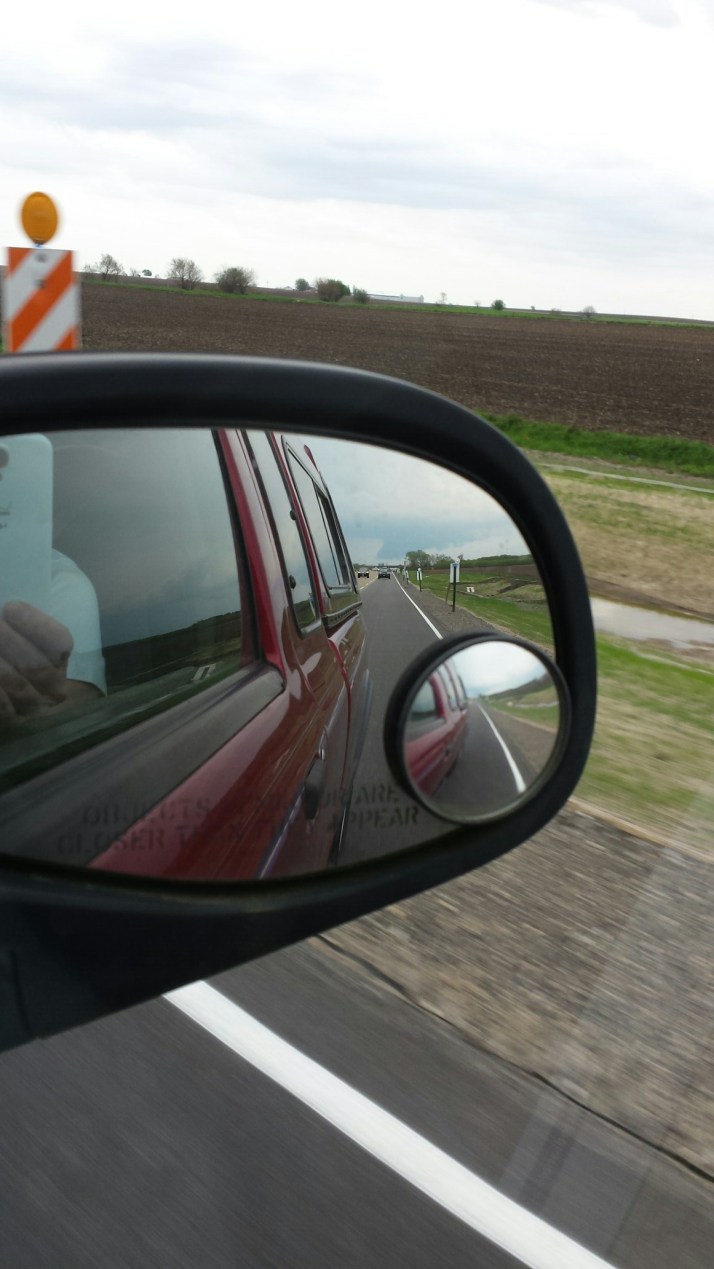
Barb's cell phone photos May to August 2014 101

What looks like a possible wedge cloud forming in the side view mirror

We were up before dawn, racing across Minnesota. By early afternoon we crossed the Mississippi River into Wisconsin. It was when I-90 turned south at Tomah that things started to change.

The sky clouded and the winds picked up. We stopped only for gas breaks, choosing to eat nuts, fruit, and veggie straws in the car.

As a bonafide National Weather Service junkie, I can tell you there are two colors which strike fear when they appear on the weather map: bright yellow and red. The first means ‘tornado watch.’ The second is ‘tornado’ warning – as in ‘a tornado is on the ground’. I watched as county after county in Iowa turned yellow, the storm marching toward Illinois and us.

Mothers Day 2014 Tornado EvasionBy the time we got to the Chicago suburbs we had but one thought: get through as quickly as possible. Chicago is a maze of roads with bypasses for the bypasses for the bypasses… if you’re willing to pay. Were we ever.
We zigzagged to the southwest, me counting out dollar bills and change to get us through each toll booth. When I could look up from the map my eyes were drawn to the threatening western sky. And the Illinois counties turned yellow. Finally, a mere 30 miles away, we could see a black cloud headed directly for Joliet. Could we outrun it? A couple minutes later we turned east and entered Indiana unscathed.

We hurried south, making a pit stop at a rest area/park near Rensselaer. I was amazed – and said so – that there were people having a picnic there when the weather map indicated that the spot was right in the path of the severe weather.

By this time the hubby – back home in Kirkland – was tracking the storms and giving advice. Of course my son and I were driving somewhat blind as to the real-time nature of the event and appreciated the text messages alerting us to the dangers.

We were just outside of Indianapolis when the hubby advised that there was tornado activity passing through that city. The conditions deteriorated and driving became more treacherous. Not sure what to do, my son turned the truck around and we headed north once again. But, we were now informed by the hubby, the system to the north was also a problem, so not to go north. We stopped at a Love’s Travel stop 7 miles south of Lebanon. Perched on a slight rise with a full western view we watched the dark clouds form to our southwest and speculated where the storm would head. We couldn’t continue south and couldn’t go north. We watched for several minutes before I, with growing alarm at the spectacle, said to my son, “We can’t stay here.”

Back on the road a minute later he headed south…

“What,” I asked, “are you going to do?”

“I’m going to thread the needle.”

And so we did. The rain poured but we were now on the backside of the front. By the time we exited Indianapolis, the weather cleared. A short time later and well after 8 p.m. and dark, we stopped at a rest area. When we got back to the truck my son asked me if I could drive. He’d done most of the day’s driving, nearly 14 hours behind the wheel… but we were both spent and knew it would be folly to continue to Nashville that night.

That hotel in Columbia, Indiana – a lovely little town – was the best thing we’d seen that day. Not the most interesting, mind you, but definitely the best.

The links:

https://en.wikipedia.org/wiki/Tornado_outbreak_sequence_of_May_21%E2%80%9326,_2011

https://en.wikipedia.org/wiki/Tornadoes_of_2014

https://www.weather.gov/gid/102204

Update May 2022 – I’m including a video posted by storm chaser, Skip Talbot, from May 11, 2014. While it’s likely we would have been south and east of the tornadoes, one can never really know…

To The Bat Cave

Carlsbad Caverns

May 14, 2019

This spectacle occurs at sunset daily from mid-spring until late fall. And if you ever go to Carlsbad Caverns National Park, it’s a sight to behold. What is it? The nightly flight of nearly a half million bats.

20181004_145630.jpg

The flight of the bats is but one thing to recommend a visit to the 20th National Park established on May 14, 1930. The caverns themselves are spectacular with the main event Big Room providing incredible sights around every turn in the path.

From the Infallible Wikipedia:

“Carlsbad Cavern includes a large limestone chamber, named simply the Big Room, which is almost 4,000 feet (1,220 m) long, 625 feet (191 m) wide, and 255 feet (78 m) high at its highest point. The Big Room is the fifth largest chamber in North America and the twenty-eighth largest in the world.”

20181004_103246.jpg

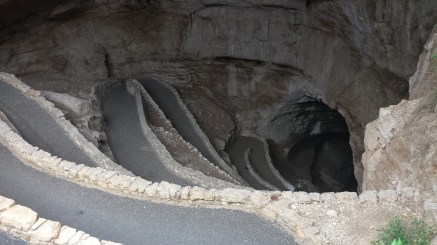
The top of the natural entry way… only 725 to the bottom.

Visitors to the cave have two options for entry. Two years after it opened, elevators were installed to take tourists some 725 feet down to the Big Room. The traditional entry involves hiking down a switchback trail over a mile long and takes well over an hour.

When the hubby and I visited Carlsbad last October we opted for the switchback trail down which, in my opinion, enhanced the experience. By the time we arrived at the Big Room, our appetites were whetted.  It’s impossible to describe how large the space is and, at times, it was easy to forget we were in a cave. The ceiling soared high above our heads and many of the stalagmites and columns were the size of redwoods. In contrast there were also delicate formations known as ‘straws’ – thin tubes of limestone formed by centuries of slowly dripping calcite and ribbons. There were small lakes and ponds and fantastically named features like the Giant Dome and the Bottomless Pit. It took us well over three hours for the descent into and tour of the Big Room.

20181004_121935

A fraction of the spectacular sights to see in Carlsbad.

After our tour we returned to the surface via the elevators and then back to our motel to rest up before returning for the nightly bat flight. If you want to be awed by nature, then this phenomenon will capture your imagination. We arrived at the stone amphitheater near sunset. The ranger on duty explained to the assembled group what was about to happen. We were instructed  to watch the cavern opening – aptly named the bat cave – for the emergence of the bats.

(I did not shoot this video. The night we were there it was our understanding that recording it was not allowed)

The ranger cautioned that he would talk only until the first bats appeared and instructed the audience that when someone saw the bats they were to raise their hand and spin it in a circular motion. A few minutes later several arms shot into the air and the group fell silent. All you could hear and see was the sound of thousands of bat wings whirring and the twilight skies filled with the silhouettes of the tiny creatures as they flew away in search of food.

From the National Park Service:

“What triggers emergence of the bats from the cave at night is something of a mystery. The only scientific correlation found with the emergence of bats is civil twilight (28 minutes past sunset). Bats flying around the roost site can see light entering Bat Cave from Carlsbad Cavern’s second natural entrance. But based on the variability of the bats emergence, civil twilight is not the only explanation.

20181004_122734

Stalactites cling to the ceiling

The out flight can last up to three hours, depending on a variety of factors, including the number of bats in the colony. Bats can begin returning at any time, particularly when they have pups to nurse (in which case they typically head out to feed again before morning). The number of bats returning usually peaks around dawn. When the bats fly over the amphitheater, you can hear their wings and also smell them. The Brazilian (Mexican) free-tail bats have a unique odor—not all bat species have an obvious odor. The bats spiral out of the cave in a counter-clockwise direction. It is not known why they choose to spiral counter-clockwise, but current research suggest a variety of factors play roles. One of these may be an internal ‘compass’ in the bats that is based on the earth’s magnetic poles.”

20181004_103032.jpgWe stayed until it was too dark to really see the bats any longer. Even then we were reluctant to depart. Mark another place off my list of places I’ve always wanted to visit!

A couple of links:

https://www.nps.gov/cave/index.htm

https://en.wikipedia.org/wiki/Carlsbad_Caverns_National_Park