“I Think I Love You!”
November 27, 2018
 For teenage girls in the early 1970’s, he was the heart-throbiest of heartthrobs. His female fans cried, screamed and swooned. The guys of the era attempted to imitate his hair and his clothes. And on November 27, 1970, his group’s song “I Think I Love You” sat atop the pop charts. The idol: David Cassidy.
His was a meteoric rise fueled, no doubt, by a combination of connections, classic good looks, and the ability to sing. Born in 1950 to actor parents Jack Cassidy and Evelyn Ward, his childhood was unusual in that he was mostly raised by his maternal grandparents while his parents traveled for work.
It was in 1956, at the age of six, two years after his parents’ divorce that he learned of the event! His father remarried that year and it was his father’s second marriage, to Broadway musical phenom Shirley Jones, which became Cassidy’s ticket to worldwide fame.
From the Infallible Wikipedia:
“On January 2, 1969, Cassidy made his professional debut in the Broadway musical The Fig Leaves Are Falling. It closed after four performances, but a casting director saw the show and asked Cassidy to make a screen test. In 1969, he moved to Los Angeles. After signing with Universal Studios in 1969, Cassidy was featured in episodes of the television series Ironside, Marcus Welby, M.D., Adam-12 Medical Center and Bonanza.
 “In 1970, Cassidy took the role of Keith Partridge, son of Shirley Partridge, who was played by Cassidy’s real stepmother and series lead Shirley Jones. The Partridge Family series creator Bernard Slade and producers Paul Junger Witt and Bob Claver did not care whether Cassidy could sing, knowing only that his androgynous good looks would guarantee success. Shortly after production began, though, Cassidy convinced music producer Wes Farrell that he was good enough, and he was promoted to lead singer for the series’ recordings.”
The fever which gripped his fans was dubbed “Cassidymania.” Also from the Infallible Wikipedia:
“Ten albums by The Partridge Family and five solo albums were produced during the series, with most selling more than a million copies each. Internationally, Cassidy’s solo career eclipsed the already phenomenal success of The Partridge Family. He became an instant drawing card, with sellout concert successes in major arenas around the world. These concerts produced mass hysteria, resulting in the media coining the term ‘Cassidymania’.
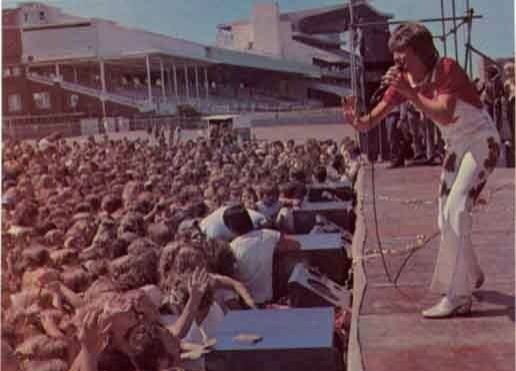
For example, he played to two sellout crowds of 56,000 each at the Houston Astrodome in Texas over one weekend in 1972. His concert in New York’s Madison Square Garden sold out in one day and resulted in riots after the show. His concert tours of the United  Kingdom included sellout concerts at Wembley Stadium in 1973. In Australia in 1974, the mass hysteria was such that calls were made to have him deported from the country, especially after the madness at his 33,000-person audience concert at Melbourne Cricket Ground.”
As is always the case, the mania eventually ends, and an aging idol is soon replaced with someone younger. Cassidy, however, continued as a singer/songwriter/actor, with a solid career well into the early 2000’s.
Sadly, he battled a lifelong alcohol addiction and it was this which destroyed his liver. He died on November 21, 2017, awaiting a liver transplant.
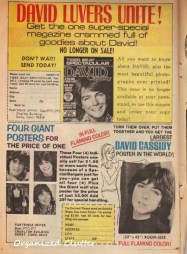 As a 13 year old girl in 1970, I was precisely the demographic which was all agog over David Cassidy. I never put up posters on my walls, however, but I did watch the Partridge Family almost every Friday night. And I might have had a teeny bit of a crush on Keith Partridge.
I Think I Love You is one of ‘those’ songs, instantly recognizable from the first chord and the compelling lyrics… Baa-baa-baa-baa, baa baa baa, baaaa… and one that I will forever associate with those awkward teenage years. In a good way.
For those who have forgotten or never seen any of the 1970’s sitcom or heard the song, enjoy! For the rest of us, it’s a trip down memory lane.
About David Cassidy: https://en.wikipedia.org/wiki/David_Cassidy
About The Partridge Family: https://en.wikipedia.org/wiki/The_Partridge_Family

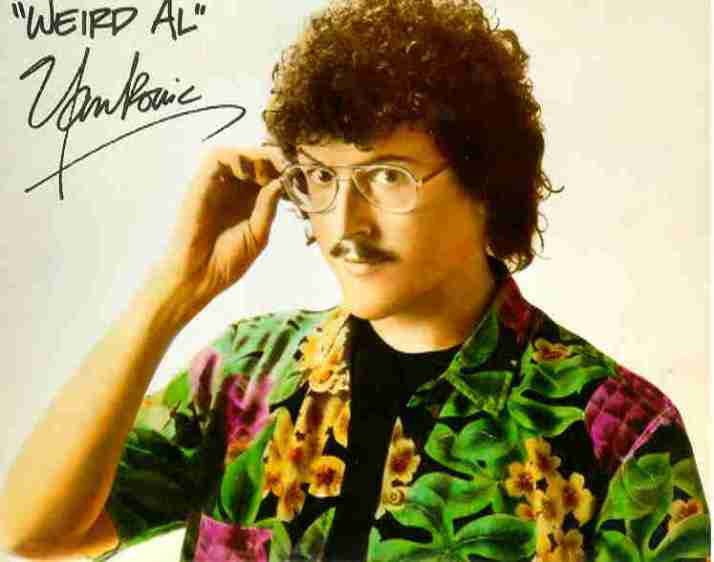
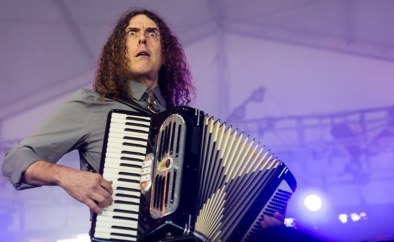 With the release of his 2014 album, Mandatory Fun, his published song list stood at 194. A truly huge number which speaks to his endurance as an artist. In fact, Weird Al’s career has outlasted most of the musicians whose song’s he’s parodied.


 The frat which impacted us the most were the Phi Delta Theta’s – aka Phi Delt’s (their house pictured above) – whose members included most of the UPS football team as well as a fair number of the wild boys. And during Hell Week they did interesting things.
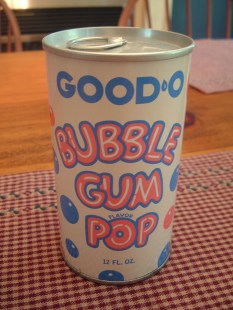 By the middle of the decade, the Beatles were in the rear-view mirror and the hard rock of the late sixties and early seventies had given way to bubblegum and pop. And could there be any better symbols than two sugary treats to describe this song by a group called The Starland Vocal Band?
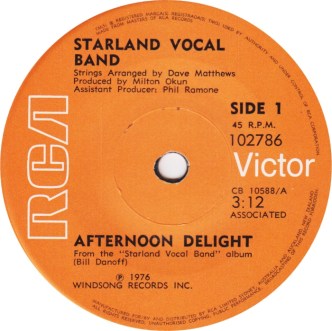 In the world of music, Afternoon Delight is what’s known as a ‘One Hit Wonder.’ Although the musicians who made up the group had some success before and after their big song, it was Afternoon Delight which catapulted them to a brief moment of fame.
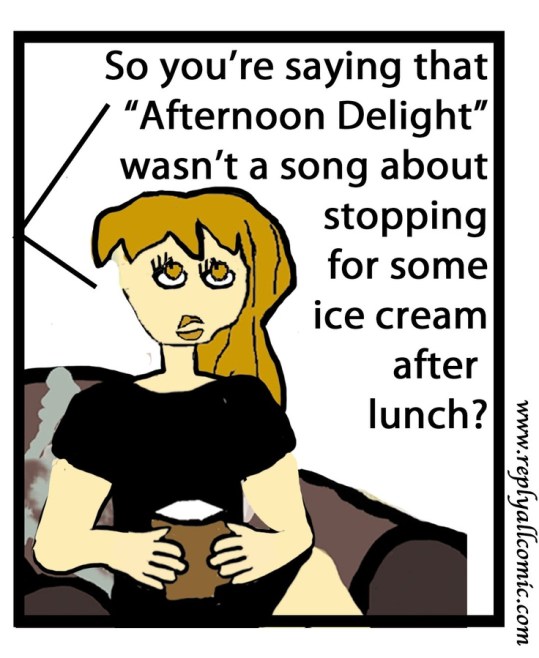 At the time, the lyrics were a little bit shocking, especially to the parents of younger Baby Boomers who had pretty much lost control of their children by then. We, thinking we were hip and edgy, embraced the song with a wink and knowing nod because, well, our generation invented it, after all. What could our parents possibly know?
 It was on June 19, 1971 when her double sided single It’s Too Late/I Feel The Earth Move hit number one on the Billboard charts and remained there for five weeks.
 In the summer of 1971, Tapestry was one of three albums which I wore out. The angst of King’s songs spoke – not only to me – but to a whole generation of teenagers experiencing love and heartbreak for the first time. Although I couldn’t directly relate to the lyrics of It’s Too Late, there was a sadness and loneliness which emanated loud and clear. It was a perfect breakup song.
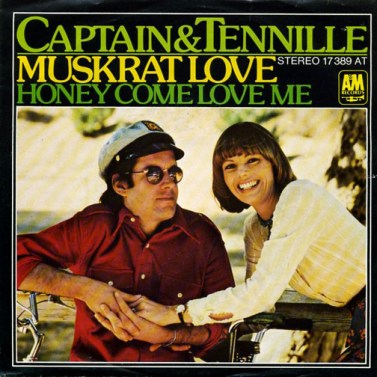 It was a different song, however, which was just downright weird and creepy and which no one can figure out why the duo recorded it (or the band America for that matter). That song: Muskrat Love.
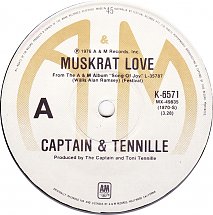 by having the song’s end run into the locked groove of the 45.”
 Around noon he waved at me from outside (my sewing room at the time was our dining room and the windows looked to the east) and pointed to a large maple tree which straddled the property line between us and the neighbor. I looked up to where he was pointing and there were the two raccoons asleep on separate branches some 30 to 40 feet above the ground. The presence of the nocturnal omnivores was observed by all in the house and then everyone continued on with their activities.

 “This is NOT the story of a convict who had told his love to tie a ribbon book to a tree outside of town. I know because I wrote the song one morning in 15 minutes with the late lyrical genius Irwin Levine. The genesis of this idea came from the age old folk tale about a Union prisoner of war – who sent a letter to his girl that he was coming home from a confederate POW camp in Georgia… Anything about a criminal is pure fantasy…”
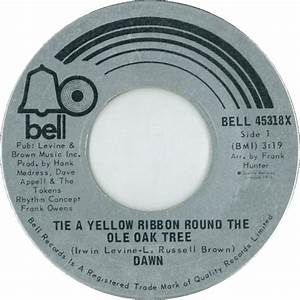 Billboard has ranked “Yellow Ribbon” as the number one song for 1973, selling 3 million records in the United States in just three weeks. In fact, BMI (Broadcast Music Inc) which tracks songs for artists claims the song as been played over 3 million times in 17 years of continuous airplay. That’s true staying power.
 In the past 50 years there has not been an artist, more than this one, who has provided the soundtrack for our lives. He embodies the concept of be ‘an original’ and has, since the beginning of his long career, gone his own way. In addition to his commercial success, he’s been recognized by his own country and was knighted on January 30, 1998.
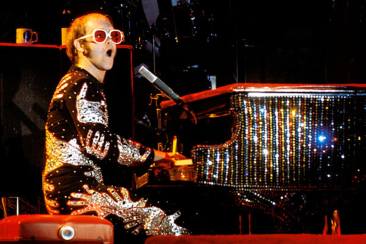 As a teenager in the 1970’s you could not turn on the radio without hearing many of Elton John’s songs. One song in particular stands out for me. It was late fall of 1972 and I was a sophomore in high school. And there was this guy – Ron – who I had a thing for. He, however, was pretty clueless when it came to the whole dating thing, so our relationship never went beyond ‘friends.’ Mostly we’d sit with each other at the Eisenhower High School basketball games and talk to each other in the one class we shared.
 “It won an Academy Award for Best Original Song. David and Bacharach also won Best Original Score. The song was recorded by B. J. Thomas in seven takes, after Bacharach expressed dissatisfaction with the first six. In the film version of the song, Thomas had been recovering from laryngitis, which made his voice sound hoarser than in the 7-inch release. The film version featured a separate vaudeville-style instrumental break in double time while Paul Newman performed bicycle stunts.”
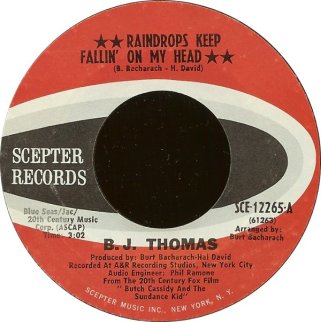 Raindrops keep falling on my head but that doesn’t mean, my eyes will soon be turning red- crying’s not for me. And I’m never gonna stop the rain by complaining, because I’m free- nothing’s worrying me!”
 Ultimately, the BJ Thomas version has been given the nod as a significant song. Also from the infallible Wikipedia:
