Archives

Wedding Woes

Karen Carpenter Connections

August 31st

A Tuesday Newsday Classic from 2021 updated

By my count, I have only 43 Tuesday Newsday posts before I hit the magic number of 366. That’s a whole lot of posts. So some days, like for August 31st, it can be difficult to hit on just the right topic.

As I was surfing the web… er, researching… I found myself watching a documentary on The Carpenters. For those who have been reading my blog posts for a while, you know that I’ve featured something about The Carpenters twice so far.

Richard Gere and Debra Winger in the romantic movie ‘An Officer and a Gentleman

To be fair, I WAS researching actor Richard Gere whose birthday is August 31, 1946. I had watched a couple of clips from two of the movies he was in (Looking For Mr. Goodbar and An Officer and a Gentleman) when a Carpenters video popped up and then I remembered a connection between myself and Karen Carpenter.

So, my friends, this is the third post for arguably one of my two favorite musical acts.

It was on August 31, 1980, when Karen Carpenter was married. Unfortunately, her marriage lasted only 14 months and, in many ways accelerated the downward spiral that ended with her death in February 1983 (https://barbaradevore.com/2020/02/04/goodbye-to-love/).

From the Infallible Wikipedia:

“In early interviews, Carpenter showed no interest in marriage or dating, believing that a relationship would not survive constant touring, adding ‘as long as we’re on the road most of the time, I will never marry’. In 1976, she said the music business made it hard to meet people and that she refused to just marry someone for the sake of it. Carpenter admitted to Olivia Newton-John that she longed for a happy marriage and family.(snip) After a whirlwind romance, she married real-estate developer Thomas James Burris on August 31, 1980, in the Crystal Room of The Beverly Hills Hotel. Burris, divorced with an 18-year-old son, was nine years her senior. A few days prior to the ceremony, Karen was taped singing a new song, ‘Because We Are in Love’, and the tape was played for guests during the wedding ceremony. The song, written by her brother and Tom Bettis, was released in 1981. The couple settled in Newport Beach.

James Burris and Karen Carpenter at their August 31, 1980 wedding

Carpenter desperately wanted children, but Burris had undergone a vasectomy and refused to get an operation to reverse it. Their marriage did not survive this disagreement and ended after 14 months. Burris was living beyond his means, borrowing up to $50,000 (the equivalent of $142,000 in 2020) at a time from his wife, to the point where reportedly she had only stocks and bonds left. Carpenter’s friends also indicated he was impatient. Karen Kamon, a close friend, recounted an incident in which she and Carpenter went to their normal hangout, Hamburger Hamlet, and Carpenter appeared to be distant emotionally, sitting not at their regular table but in the dark, wearing large dark sunglasses, unable to eat and crying. According to Kamon, the marriage was ‘the straw that broke the camel’s back. It was absolutely the worst thing that could have ever happened to her.’

In September 1981, Carpenter revised her will and left her marital home and its contents to Burris, but left everything else to her brother and parents, including her fortune estimated at 5–10 million dollars (between $14,000,000 and $28,000,000 in 2020). Two months later, following an argument after a family dinner in a restaurant, Carpenter and Burris broke up. Carpenter filed for divorce on October 28, 1982, while she was in Lenox Hill Hospital.”

By August of 1980, I was no longer obsessed with The Carpenters. My life had moved on. I had graduated college in May 1979 and also met the man who would become my hubby.

That year I took a job in Eatonville, Washington, as the sole reporter (and grunt of all things small town newspaper) for The Dispatch. When I wasn’t out covering a story, weekends often involved driving to Seattle to spend time with my boyfriend. Life was full and busy. Then in May of 1980 we became engaged and planned our wedding for the end of August.

The soon to be hubby and I discussed having an outdoor ceremony in a park in West Seattle. My mother had other plans.

Instead we ended up at Westminster Presbyterian Church in Yakima on August 30th. We had not given much thought to that particular date. As it turned out, that was the Saturday of Labor Day weekend which prompted more than a few guests unable to make it due to other plans.
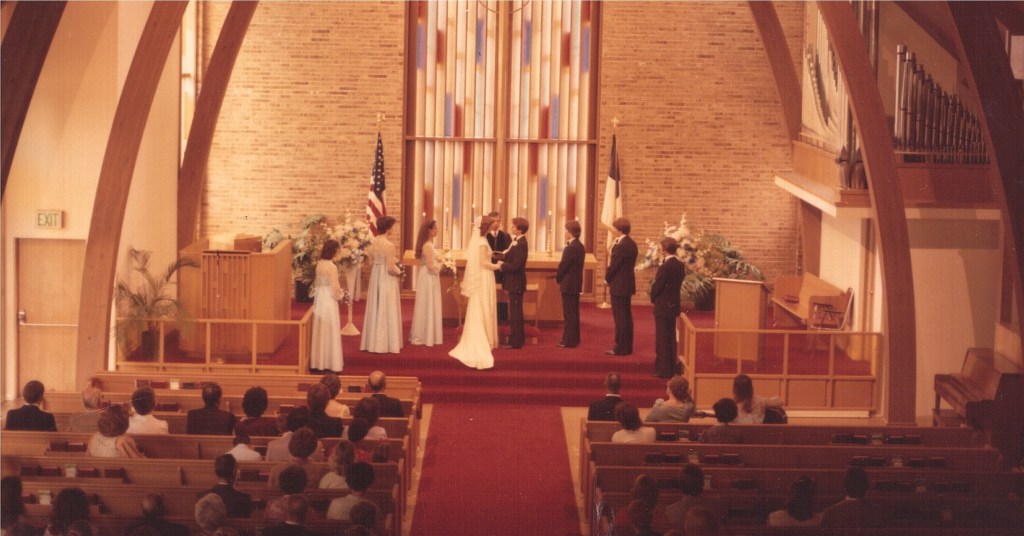
Reciting our vows at Westminster Presbyterian Church

A couple weeks prior to the ceremony, the soon to be hubby was on the phone with one of his friends, encouraging him to attend. It was in this conversation when one particular phrase was uttered which has come back to haunt the hubby over the years:

“You should definitely come since you’re practically guaranteed great weather.”

According to WeatherUnderground at the time our OUTDOOR reception in my parents backyard was to take place, it was a decidedly un-summerlike 61 degrees with rain. An even more astonishing fact is that the record low temperature for August 30th in Yakima was 36 degrees set on that date in… 1980.

There were a few other glitches that day also. The hubby’s brother never arrived as he was attending a Porsche car rally near Mt. Hood the day before and his car broke down.

Then, as I was literally about to start the traditional walk down the aisle, the photographer whispers to me, “There was a problem with the camera and none of the pictures I took turned out. We’ll have to do them over.”

Pro Tip to photographers everywhere, this is NOT something you tell a bride just before she walks down the aisle.

Turns out that some of the outdoor photos did turn out… like this one of us, our attendants, and our soloist before the rain started. Note the gray stuff in the grass. Yup. Mount St. Helen’s ash – a little more than three months after the eruption – was still everywhere in Yakima.

So there I was, standing in the church on what is supposed to be the perfect day and all I can think about is what the heck are we going to do about the photos AND listening to the rain drops echoing on the skylights overhead wondering how the party next to the pool will turn out.

With our parents… The hubby’s were married 77 years before his dad died in 2023. Mine celebrated their 70th in 2017 a couple months before my mom passed. Dad followed her in 2019. The hubby’s mom will turn 99 in October.

But all things being equal, it actually was a perfect way to start a marriage. Because weddings are not marriages. Marriages are all about overcoming the various challenges which life tosses at you. In the 41 years since that cold and rainy summer day, there have been broken bones, illness, and challenges which have all but swamped us. But there has also been laughter, adventures, and joy.

So Happy 46th Anniversary to the hubby. It’s been quite the ride.

The links:

https://www.wunderground.com/history/daily/us/wa/yakima/KYKM/date/1980-8-30
https://en.wikipedia.org/wiki/Karen_Carpenter

https://en.wikipedia.org/wiki/Richard_Gere

Exploring the Legacy of Jane Eyre

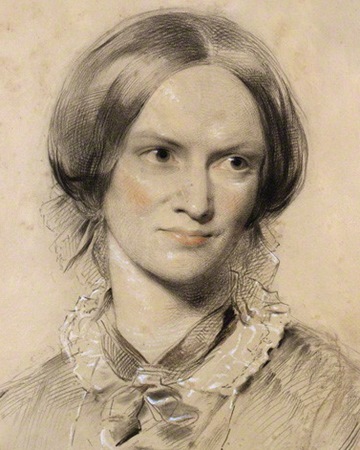
Charlotte Brontë: Victorian era trailblazer

August 24th

It was on August 24, 1847, when Charlotte Brontë finished her manuscript Jane Eyre. Less than two months later, the novel was published.

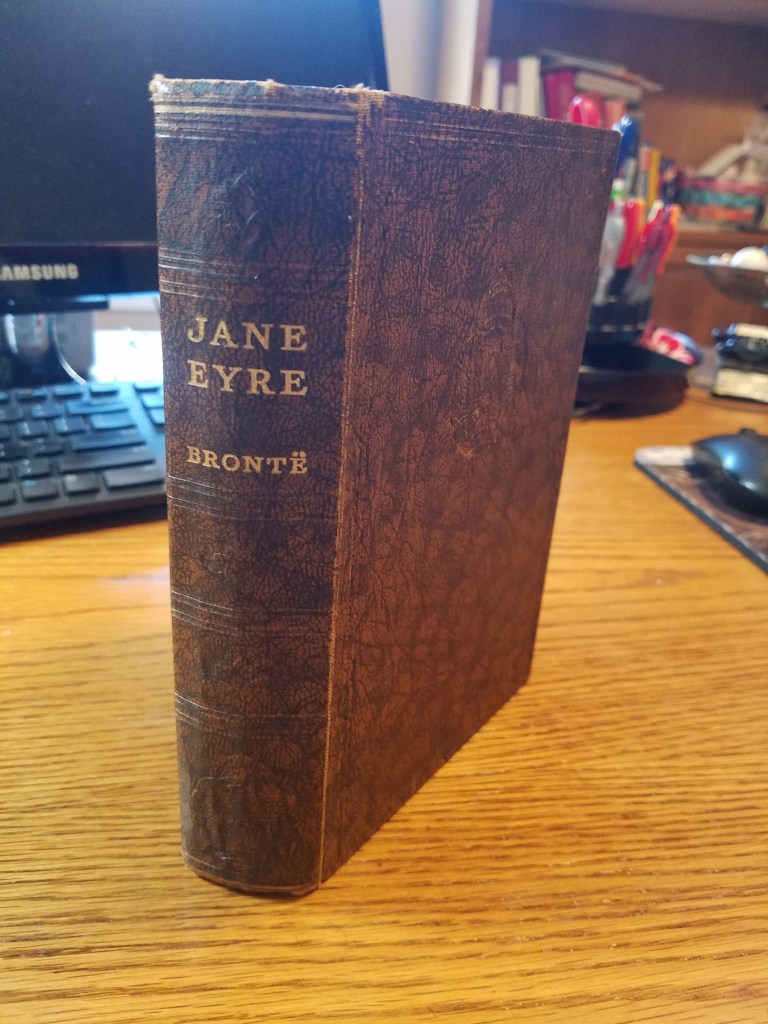
My 1920’s era copy of Jane Eyre which I purchased in a British bookshop the summer of 1980.

For those writers, like myself, who aspire to having our works in print, the pace with which she saw success and the subsequent praise for her novel, inspires.

Victorian England serves as the backdrop for Jane Eyre. From page one the reader sees a harsh world where one’s circumstances dictate where life will take them. The first person protagonist, orphan Jane, learns these lessons early due to poor treatment at the hands of her cousins and aunt. She is sent off to a boarding school where additional cruel handling awaits her; it’s a central tenet of the novel.

The book was considered groundbreaking as to its style and themes. Unlike most literature of the day, Jane Eyre delves into the deeper thoughts of the heroine. The Infallible Wikipedia tells us:

“The novel revolutionised prose fiction by being the first to focus on its protagonist’s moral and spiritual development through an intimate first-person narrative, where actions and events are coloured by a psychological intensity. Charlotte Brontë has been called the ‘first historian of the private consciousness,’ and the literary ancestor of writers like Proust and Joyce.

The book contains elements of social criticism with a strong sense of Christian morality at its core, and it is considered by many to be ahead of its time because of Jane’s individualistic character and how the novel approaches the topics of class, sexuality, religion, and feminism. It, along with Jane Austen’s Pride and Prejudice, is one of the most famous romance novels of all time.”

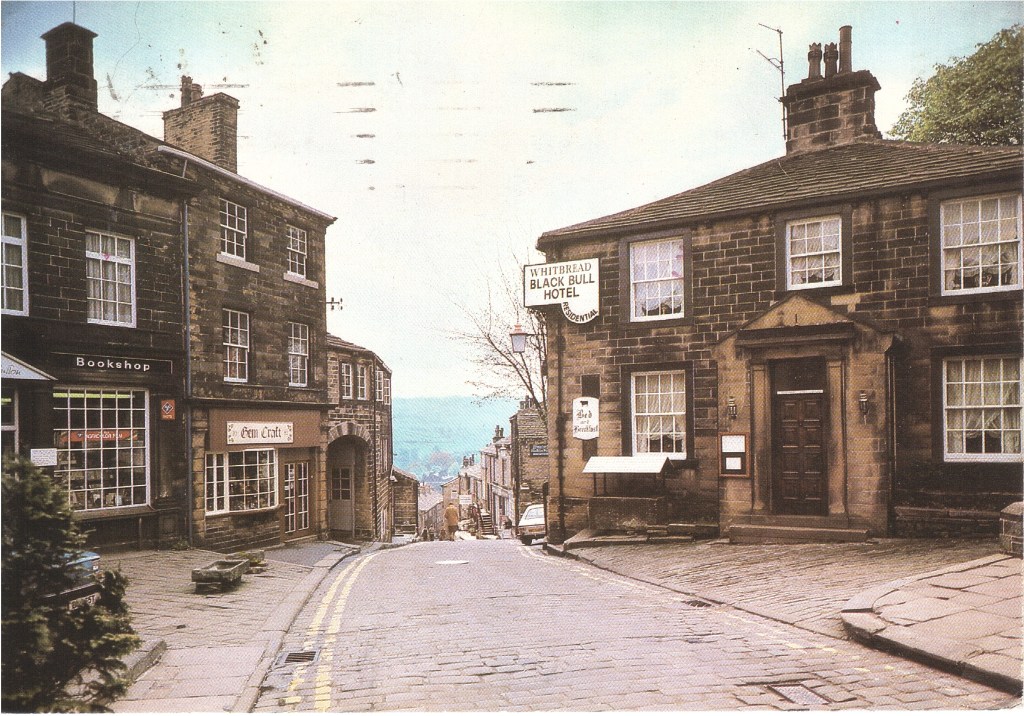
Haworth, Yorkshire Postcard circa 1980

Jane Eyre – along with Wuthering Heights by Charlotte’s sister Emily Brontë, – was among a handful of novels which inspired my interest in the romance genre. At the time I first read the books, I did not truly understand how these two sisters had to overcome societal gender prejudices to live a very non-traditional life. Jane Eyre was initially published under the pen name of Currer Bell to provide legitimacy to the novel since female writers were unheard of at that time.

Also from the Infallible Wikipedia:

“Brontë’s first manuscript, ‘The Professor’, did not secure a publisher, although she was heartened by an encouraging response from Smith, Elder & Co. of Cornhill, who expressed an interest in any longer works Currer Bell might wish to send. Brontë responded by finishing and sending a second manuscript in August 1847. Six weeks later, Jane Eyre was published. It tells the story of a plain governess, Jane, who, after difficulties in her early life, falls in love with her employer, Mr Rochester. They marry, but only after Rochester’s insane first wife, of whom Jane initially has no knowledge, dies in a dramatic house fire. The book’s style was innovative, combining Romanticism, naturalism with gothic melodrama, and broke new ground in being written from an intensely evoked first-person female perspective. Brontë believed art was most convincing when based on personal experience; in Jane Eyre she transformed the experience into a novel with universal appeal.

Jane Eyre had immediate commercial success and initially received favourable reviews. G. H. Lewes wrote that it was ‘an utterance from the depths of a struggling, suffering, much-enduring spirit’, and declared that it consisted of ‘suspiria de profundis! (sighs from the depths). Speculation about the identity and gender of the mysterious Currer Bell heightened with the publication of Wuthering Heights by Ellis Bell (Emily) and Agnes Grey by Acton Bell (Anne). Accompanying the speculation was a change in the critical reaction to Brontë’s work, as accusations were made that the writing was ‘coarse’, a judgement more readily made once it was suspected that Currer Bell was a woman. However, sales of Jane Eyre continued to be strong and may even have increased as a result of the novel developing a reputation as an ‘improper’ book.

Charlotte Bronte was only 38 when she died.

In the summer of 1980, while on a trip to Europe with my parents and sisters, we stopped into a bookstore in a town a bit south of London. My mother, particularly, was a huge fan of Victorian and Edwardian novels and loved nothing better than time spent perusing the stacks in a library or bookstore.

It was there, this particular July day, where I found a used copy of Jane Eyre. What a great choice of a book to read while touring the English countryside.

Soon I was lost in its pages, absorbed by Jane’s story. And soon my father – behind the wheel of the car we had rented – began chastising me for having my nose in a book rather than looking out the window.

For me, reading the book while traveling in Bronte’s homeland was the ultimate experience. One can only imagine what a place might look like unless they have been in that location. By the time we visited Haworth, Yorkshire, I knew what a moor looked and smelled like. I could see Jane struggling across them, sleeping among the crags, enduring the rain. I could envision the town, the church, and the geography.

To glance up from the pages and then out the window of the car stimulated my imagination in ways which induced the images to remain long after my return home.

I often see the book on the shelf in my office, a reminder of that trip so many years prior. Bound in a mottled brown and black leather, the volume at the time seemed contemporary to Bronte’s own life.

When I showed the book to my son our curiosity emerged as to the date of the printing. The only hint was ‘Printed and Bound in Great Britain by Greycaine Limited, Watford, Herts.’ A Google search revealed that the book was likely produced sometime between 1927 and 1936.  Even so, its cover, pages, and typestyle bespeaks of a different era.

I’m certain for Charlotte Bronte her fiction was borne of personal experience as to how the world was in her time. As a contemporary fiction writer, my own prose is reflective of my own time. Perhaps some future reader will be able to glimpse, if only for a short time, what the world of today looked like.

The links:

https://en.wikipedia.org/wiki/Jane_Eyre

https://en.wikipedia.org/wiki/Charlotte_Bront%C3%AB

From the Facebook post: Emily – Wuthering Heights; Charlotte – Jane Eyre; Anne – Agnes Grey.

Lackadaisical. Loafing. Slacking. Slothful. Idle. Laggard.

Celebrating National Lazy Day

August 10th

By now there is one word which should be at the forefront of your brain: Lazy. Of course I couldn’t be described as lazy and do the research for this week’s Tuesday Newsday. But here I am writing about August 10th, which is National Lazy Day.

It’s that one day a year when we are given permission to sit back and relax.

The Infallible Wikipedia has several entries on laziness, but I got bored reading them as they started discussing all the psychological reasons someone might be perceived as being lazy when in fact they might be depressed, or have ADHD, or a variety of other syndromes.

Instead, the National Day’s Calendar website had the right idea with this tongue in cheek summation on how best to celebrate and observe National Lazy Day:

“Take this test to prepare yourself for the day. Lazy people fact #72432143726413424.

If you were too lazy to read that number, you’re ready to celebrate this day.

The number one rule of any lazy day is if you can’t reach it, you don’t need it.

Don’t break the rule.

We assigned an alternative word for lazy for the day.

We call it very relaxed.

What is the official exercise of #NationalLazyDay?

Diddly squats.

For some tips on how to enjoy a successful lazy day visit A Pint-Sized Life Blog.

We were too lazy to give you our own list.

NATIONAL LAZY DAY HISTORY

The creator and origin of #NationalLazyDay could not be found.

Have a great day!”

I would venture to guess that there is not a person alive who hasn’t used the phrase ‘I’m being lazy today,” when, in fact, what they’re really saying is that they need a break after an intense period of activity.

As I have, ahem, matured, I’ve decided that being ‘lazy’ is necessary. Unlike my younger days, I find that a bit of a nap midway through the day is imperative to getting things done. Although chores may not get completed as quickly as they once did, eventually the things which need to happen are accomplished.

Last year in one of my posts I wrote about keeping house and discussed the luxury of hiring someone to come in and clean for me.( https://barbaradevore.com/2020/03/24/national-cleaning-week/)

I know many of you are familiar with my ‘lazy’ housekeeper and how she eats chocolates all day and reads trashy romance novels rather than work.

But my lazy housekeeper really isn’t that lazy, it’s more that she is easily distracted and can find dozens of other more interesting things to do with her time. I attribute her inefficiency to ADHD because she simply cannot stay focused on one thing for too long.

She might vacuum for 15 minutes and then remember that she needed to send an email to someone, so off she’ll go to take care of that. On her way she might notice that the hummingbird feeder is empty, so will stop to make new nectar. When she returns a half hour later to finish the undone housework, she might actually mop the floor before she remembers she needs a few things from the grocery store or have an inspiration for a scene in a story she’s writing.

These bursts of energy and activity are quite exhausting and soon it’s time to play a game on the phone or, better, shut her eyes for a short respite.

Which, finally, begs the question “Is being ‘lazy’ actually beneficial?”

Internet research provided plenty of articles to support this hypothesis. I decided it was too much work to quote anymore articles on the benefits or pitfalls of laziness but will paraphrase the conclusions.

A person we perceive as lazy might not, in fact, be so. Such an individual is often thinking about the easiest and most time effective way to complete a task. Others might, in fact, be writers. For those who don’t know, writing requires having time to cogitate what it is you are going to write.

Like this article. Before I started to type I spent quite a bit of time considering how I would present the topic and decided to research the synonyms to start it out; additionally, I wanted to find a personal angle on laziness, hence the lazy housekeeper. It really did involve a great deal of deliberation which, to the casual observer, might present as laziness.

So that’s my story and I’m sticking to it. Now, if you’ll excuse me, all this brain work has left me feeling a bit droopy and a nap sounds like a great way to spend August 10th, National Lazy Day.

The links:

https://en.wikipedia.org/wiki/Laziness

https://nationaldaycalendar.com/national-lazy-day-august-10/

http://news.ku.edu/2018/08/15/new-research-suggests-evolution-might-favor-survival-laziest

The Birthday Paradox

What are the odds?

July 27, 2021

The next time you are in a group of 30 or more people and you want to have an icebreaker activity, have the group line up by the day of the month they are born. Odds are 70 percent that two of the people in the group will share the same day.

This is a phenomenon known as the Birthday Paradox or Birthday Problem. It’s all based on exponents and probabilities. According to the Infallible Wikipedia (who got the information from a whole bunch of smart scientists), this is how it works:

“In probability theory, the birthday problem or birthday paradox concerns the probability that, in a set of n randomly chosen people, some pair of them will have the same birthday. In a group of 23 people, the probability of a shared birthday exceeds 50%, while a group of 70 has a 99.9% chance of a shared birthday. (By the pigeonhole principle, the probability reaches 100% when the number of people reaches 367, since there are only 366 possible birthdays, including February 29.)

These conclusions are based on the assumption that each day of the year is equally probable for a birthday. Actual birth records show that different numbers of people are born on different days. In this case, it can be shown that the number of people required to reach the 50% threshold is 23 or fewer.

The birthday problem is a veridical paradox: a proposition that at first appears counterintuitive, but is in fact true. While it may seem surprising that only 23 individuals are required to reach a 50% probability of a shared birthday, this result is made more intuitive by considering that the comparisons of birthdays will be made between every possible pair of individuals. With 23 individuals, there are (23 × 22) / 2 = 253 pairs to consider, which is well over half the number of days in a year (182.5 or 183). (snip)

The history of the problem is obscure. The result has been attributed to Harold Davenport; however, a version of what is considered today to be the birthday problem was proposed earlier by Richard von Mises.”

Personally, my brain kinda goes ‘tilt’ when I see cryptic scientific characters and formulas which show me how to calculate all of this. So I leave that to you brainiac statistics folks and share my own personal experience with this phenomenon.

The first time I encountered this was as a 13 year old in my 8th grade English class. More about that in a bit. Often, when I’m in a group situation and looking for a way to engage people in conversation, I will ask them their birthday (not the year, just the day) and talk about the paradox. This will often get others interested and soon the entire group is comparing days until, and it usually happens, we find the pair with the same birthday.

Over the years I have been the person who matches another who shares my birthday fairly often. I can think of at least five times this has occurred.

But it was that first time which I think might have the odds makers scrambling to figure out the possibilities.

Back to 8th grade English class. In the room there are probably 5 rows with six desks in each row, so 30 possible students. I do not believe we had 30, more like 24. On this particular day I was in my chair in the front row (I’ve always been one to sit in front in a class) with my friend Bonnie behind me and a girl I didn’t really know, Alice, behind her.

We are working independently on something and Mr. Albrecht, our teacher, doesn’t care if we are talking to one another. So I’m working on my project and can hear Bonnie and Alice chatting away. The two of them, who had only recently met in that class, had taken an instant liking to one another and were becoming fast friends.

Then one of them, I think Alice, asks Bonnie her birth date. To which Bonnie replies, “August First.” Alice squeals and says, “No way. My birthday is also August First.”

By now, they have my full attention. I turn around and reply, “You’re not going to believe this, but my birthday is also August First!”

“No it’s not!” Bonnie objects, “You’re joking. You’re just saying that because Alice and I the same birthday.”

I shake my head and say, “No, it really is August First.”

The debate continues for several minutes as they simply do not believe me. Finally we all agree to bring in copies of our birth certificates to prove it.

The next class day I had mine in hand and eagerly awaited the moment when I would show them I did, in fact, share the same birthday (and in this case, year) as the other two.

Pages 8 and 9 of the Wilson Junior High annual. Birthday buddies and me have checkmarks on our ‘lovely?’ photos.

We huddle together at the end of class and each produce our documents. Bonnie and Alice shake their heads in disbelief as they examine my certificate. Yes, all three of us were born on August First of the same year. It turned out, however, that I was the oldest of the trio having arrived a mere 43 minutes after midnight to make the cut.

María Laura, María Emilia and María Eugenia Fernández Roussee (born 5 July 1960). The triplets are a well known musical group in Argentina

It was a rather amazing coincidence. In all the years since I’ve never heard of another situation like it. In my Google explorations to calculate the odds of such a thing happening, it was nearly impossible to make the search engine understand what I was asking. So, all you readers out there, what ARE the odds of three random people in a group of 24 sharing the same birthday and year?

Yes, I do personally know two sets of triplets… and for the purpose of the Birthday Paradox those don’t count.

I think it is a rather narrow probability and that maybe, our little unrelated trio, defied the odds. It truly is a paradox.

A few links:

https://en.wikipedia.org/wiki/Birthday_problem

https://betterexplained.com/articles/understanding-the-birthday-paradox/

Pokémon Go: The Ultimate Viral Phenomenon of 2016

Gotta Catch ‘Em All

July 6th

Until early 1999, I had never heard the word “Pokémon” which is a shortened version of the Japanese term for the iconic Gameboy creatures, Pocket Monsters, created in 1996.

Pikachu – the iconic symbol of Pokémon .

It was in the spring of 1999 when Pokémon trading cards took over the elementary school where my son was in the third grade. For a number of months we made frequent treks to the card store so that my son could buy a packet of the cards to add to his collection and, ostensibly, trade with his school mates.

Like all such fads, the trading card obsession faded and by Fourth grade year, it was over. Or so I thought.

If everyone thought the Pokémon cards were a big deal they had not, in the words of the Bachman Turner Overdrive song You Ain’t Seen Nothing Yet.

It was on July 6, 2016 when Pokémon Go was launched and became a worldwide experience.

From the Infallible Wikipedia:

“The game was referred to as a ‘social media phenomenon’ which has brought people together from all walks of life. 231 million people engaged in 1.1 billion interactions that mentioned Pokémon Go on Facebook and Instagram in the month of July. Numerous media outlets referred to the surge in popularity as ‘Pokémon Go Mania’, or simply ‘Pokémania’.The massive popularity of the game resulted in several unusual positive effects. For example, the game placed players where they can help catch criminals and report crimes in progress, although it has also placed some in harm’s way, and has even aided law enforcement’s community relations. albeit with caveats. Businesses also benefited from the nearby presence of PokéStops (or them being PokéStops themselves) with the concomitant influx of people, and the intense exploration of communities has brought local history to the forefront.

The highly coveted Charizard trading card

For those unfamiliar with the game, it popularized AR – Augmented Reality –with users being able to find and capture the Pokémon which appeared as animated creatures on an i-phone or Android device. Think of it this way: when you open the Pokémon Go app on your phone, the world appears in a cartoonish form with grass, trees, water, and buildings. If a Pokémon is nearby it will materialize on the screen and provide the user an opportunity to ‘catch’ it by throwing a Pokéball at the creature. Once caught, the Pokémon is added to the user’s collection. The goal, initially, is to catch at least one of every Pokémon. These, most often, can be evolved into a new Pokémon – so long as you have earned enough points to do so by capturing many, many of the original Pokémon.

PokéStops can be found in every community, and when accessed give the user rewards in the form of additional Pokéballs and other game enhancers.

Despite many of the initial players not continuing, the game’s early success garnered a number of firsts. Also from the Infallible Wikipedia:

“The game was awarded five Guinness World Records in August 2016: most revenue grossed by a mobile game in its first month ($206.5 million); most downloaded mobile game in its first month (130 million downloads); most international charts topped simultaneously for a mobile game in its first month (top game in 70 different countries); most international charts topped simultaneously for a mobile game in its first month (top grossing in 55 countries simultaneously); and fastest time to gross $100 million by a mobile game (reached in 20 days on July 26). By September 2016, Pokémon Go had been downloaded over 500 million times worldwide, and became the fastest game to make over $500 million in revenue. Pokémon Go was awarded the App Store’s breakout hit of 2016. Pokémon Go was reported to be the most searched game on Google in 2016.

The crowd which descended upon us in search of Charizard on August 21, 2016 in Bellevue.

Pokémon Go arrived at my house about a month after its release. I’d been in Yakima and arrived back in Kirkland about 7 p.m. one August evening and just as I turned down our street I notice my son out walking. I pull to the curb and ask him where he’s going. At that moment he admits his friend Vincent had gotten him started on Pokémon Go.

Curious, I went out walking with him the next night to see how it all worked. This went on for two weeks and then I cracked and loaded the app on my phone. Soon my son and I were venturing out in search of rare Pokémon, making trips to parks and other places to ‘catch them all.’

The ‘oldest’ creature in my collection is the Charizard I caught on August 21, 2016. AR allows one to take ‘pictures’ with your Pokémon

The most amazing Pokémon day of all was on August 21, 2016. We had driven to the Downtown Park in Bellevue (across from Bellevue Square) and there – with hundreds of our ‘best’ friends – wandered about the park capturing digital monsters.

And then it happened. The rarest of rare Pokémon, the ONE everyone had coveted from way back in the card collecting days of 1999, pops up on our screen and we are standing – literally – a few feet away from the GPS location where it spawned.

A collective roar goes up across the park and – I kid you not – the pounding of hundreds of pairs of feet headed our way shake the ground like an earthquake. My hands are trembling as I attempt to capture Charizard (I’m still a very green novice at this point), ignoring the masses who are descending upon us in their frenzy to capture the beast. Of course I am attempting the same thing. On the third attempt, the elusive fire dragon is locked in my Pokéball and the son and I emerge from behind the bushes to an unreal scene. I did have the presence of mind to snap a couple of photos of the massive crowd that evening.

Since that day both my son and daughter have quit playing the game. I admit it has lost a lot of its appeal; it was a fun way to spend time with my adult children. Even so, I still play it as it gives me something to do when a passenger on a trip. But nothing will ever replace the thrill of the hunt on that August night in the summer of 2016 when Pokémon ruled the world.

https://en.wikipedia.org/wiki/Pok%C3%A9mon_Go

https://en.wikipedia.org/wiki/Pok%C3%A9mon

The conversation is between my son and I after the great Charizard spawn and capture on August 21, 2016

Update July 6, 2022: I have, for the most part, quit playing Pokémon Go and removed the app from my phone. That said, my data still exists out there on some database. If I’m truly bored I can simply reload the game and see what’s new in Pokéworld.

Picture Perfect Postcards

June 8, 2021

No doubt if someone who lived in the 1870’s were alive today, they would be in awe of the instantaneous nature of an email or a text message. People then had equivalent forms of communication but without it being instant. A letter was very much like email, used to expound on longer subjects. It was the postcard, however, which served the purpose of a quick communication and, literally, cost only a penny to send; the text message of its day.

It was on June 8, 1872 when the US Congress endorsed the penny postcard. What this meant is that the US postal service began printing blank postcards with the postage paid… all for a penny.

The idea originated in Prussia, but was initially met with skepticism. From the Infallible Wikipedia:

“A Prussian postal official, Dr. Heinrich von Stephan, first proposed an ‘open post-sheet’ made of stiff paper in 1865. He proposed that one side would be reserved for a recipient address, and the other for a brief message. His proposal was denied on grounds of being too radical and officials did not believe anyone would willingly give up their privacy. In October 1869, the post office of Austria-Hungary accepted a similar proposal (also without images), and 3 million cards were mailed within the first 3 months. With the outbreak of the Franco-Prussian War in July 1870, the government of the North German Confederation decided to take the advice of Austrian Dr. Emanuel Herrmann and issued postals for soldiers to inexpensively send home from the field.

The rest of the world followed suit and post cards soon became standard. Novelty post cards featuring some sort of image on one side can be traced to 1870, but they cost 2 cents to mail plus the cost of purchasing the cards. The first souvenir ‘picture’ post card is believed to have been a scene from Vienna sent in 1870.

As more and more people became literate, sending letters and post cards served as a way to keep families and friends connected. 1890 to 1915 was considered the ‘Golden Age’ of postcards. Also from the Infallible Wikipedia:

“Cards showing images increased in number during the 1880s. Images of the newly built Eiffel Tower in 1889 and 1890 gave impetus to the postcard, leading to the so-called ‘golden age’ of the picture postcard. (snip) …the Chicago World’s Fair in 1893 excited many attendees with its line of ‘Official Souvenir’ postals, which popularized the idea of picture postcards. The stage was now set for private postcard industry to boom, which it did once the United States government changed the postage rate for private cards from two cents to one in May 1898.

(snip) Demand for postcards increased, government restrictions on production loosened, and technological advances (in photography, printing, and mass production) made the boom possible. In addition, the expansion of Rural Free Delivery allowed mail to be delivered to more American households than ever before. Billions of postcards were mailed during the golden age, including nearly a billion per year in United States from 1905 to 1915, and 7 billion worldwide in 1905. Many postcards from this era were in fact never posted but directly acquired by collectors themselves.

Changes in tariffs put a damper on postcards as the cost of producing them became much more expensive – or, perhaps, they were being replaced with newer technology. Coincidentally the first US transcontinental telephone network was completed in 1915.

Postcards today are primarily the province of tourists, purchased in gift shops and sent to friends and family back home to let them know they are being ‘thought’ of by the sender.

I have a bit of a love hate relationship with postcards. Like many vacationers, I have purchased them in gift shops with the intention of writing a short greeting and mailing them off. My office supply collection contains more than a few which were purchased but never sent. I admire those who actually mail the cards they buy!

The postcard sender award goes, hands down, to a good friend of my son’s. I first met Jim when he was 12. A gregarious kid, he took an immediate like to my more reserved child. They were going to be best buddies regardless of what my son might think. Soon they were hanging out together, sharing common interests and intellects. Jim was a frequent visitor to our house and he loved to talk. His brain retained everything and he was a voracious reader, especially of historical topics.

Then the unthinkable happened. His father got a job. In another state. Clear across the county. Junior year of high school, Jim moved to Virginia.

But Jim was undaunted, determined to not let his best friend or adopted family forget about him.

The first postcard from Jim arrived shortly after he moved. And then another arrived. And another. It started to feel a bit like the Dursley’s mailbox with the letters arriving from Hogwarts for Harry Potter. (see clip below)

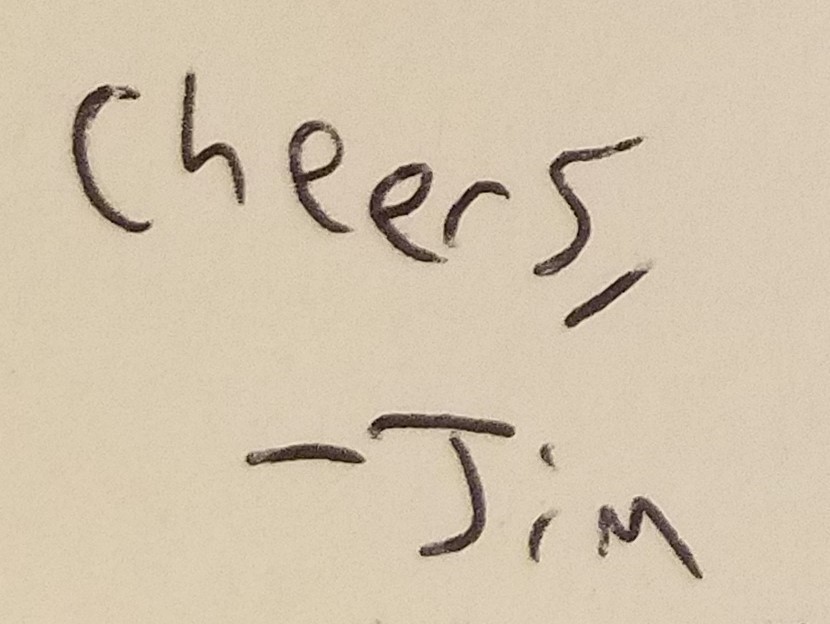
Unlike the Dursely’s, however, our entire family looked forward to those postcards. We enjoyed seeing what interesting places Jim visited and reading the witty and funny things he would write. Every card was concluded with his signature close of “Cheers, Jim.” This continued for years.

Jim went on to college, got his degree in history and has turned his love of the subject combined with his natural oratorical abilities into jobs. He worked as a costumed history tour guide for the National Parks during the summers he was in college; he eventually became a professor.

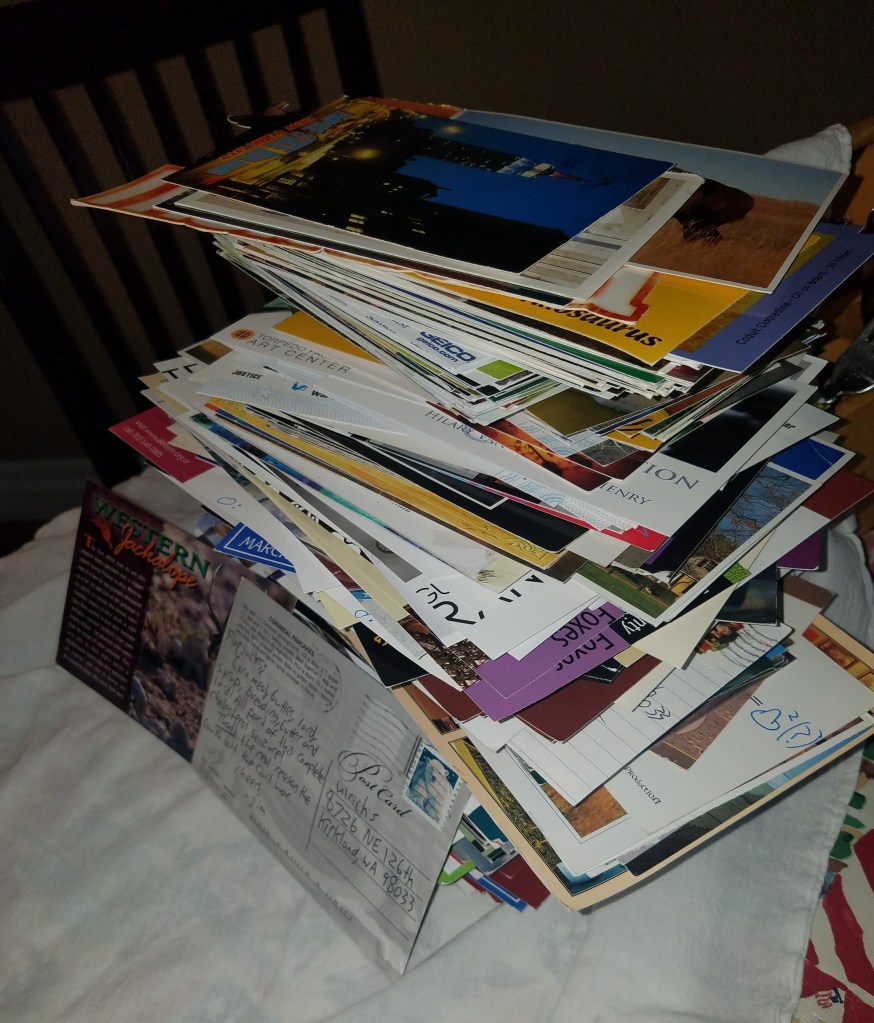
It’s been quite a while since one of those postcards arrived but we have saved every one. At first I was the one who kept them and then my son, recognizing that there was something very special about them, took over the job.

Perhaps historians of the future will look back on earlier times and see the value of the written word on paper. It imbues our records with a personal experience that electronic communications cannot match. Jim’s postcards prove that it doesn’t have to be a fancy five dollar card to be special. A few lines on a postcard are more than enough and just as meaningful. Cheers to you, Jim, and that unique place you hold in our hearts.

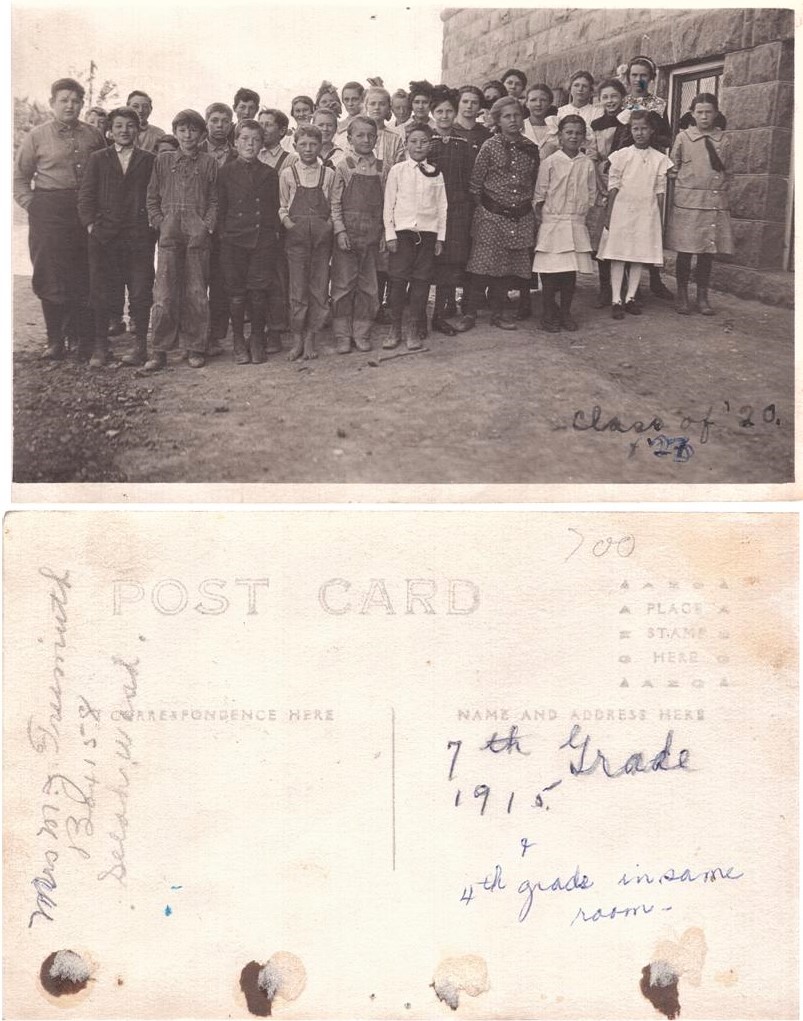
The two postcards pictured above are from my grandmother’s things. The top one is probably circa 1915 as is the one of her 7th grade class in Selah, Washington. She is the taller girl on the right next to the window of the building. Which is ironic since her adult height topped out at about 5’4″.

I have vintage postcards from the 1940’s onward… too many to share. The stack of postcards are ALL from Jim!

A link:

https://en.wikipedia.org/wiki/Postcard#:~:text=The%20first%20commercially%20produced%20card%20was%20created%20in,%22Lipman%27s%20Postal%20Card%22.%20These%20cards%20had%20no%20images.

Mousemania!

The Rise of the Microsoft Mouse

April 20th

A Tuesday Newsday Classic

The 1980’s was an exciting era in the world of computers. Where once only large corporations had such capabilities, the advent of affordable, personal computers heralded a decade of new products to make computer use easier.

Microsoft’s first mouse circa 1983

Until 1983 no one outside of engineering labs had ever heard of a computer mouse. Yet today, the device is an essential piece of a desktop computer set up.

From the Infallible Wikipedia:

“The earliest known written use of the term mouse in reference to a computer pointing device is in Bill English’s July 1965 publication, ‘Computer-Aided Display Control’ likely originating from its resemblance to the shape and size of a mouse, a rodent, with the cord resembling its tail. The popularity of wireless mice without cords makes the resemblance less obvious.

The plural for the small rodent is always ‘mice’ in modern usage. The plural for a computer mouse is either ‘mice’ or ‘mouses’ according to most dictionaries, with ‘mice’ being more common. The first recorded plural usage is ‘mice’; the online Oxford Dictionaries cites a 1984 use, and earlier uses include J. C. R. Licklider’s ‘The Computer as a Communication Device’ of 1968.”

One company which saw the potential in the mouse was – at the time – fledgling software giant Microsoft.

They got on the mouse bandwagon early, bundling their version of a mouse with two of their software programs. Also from the Infallible Wikipedia:

Being a bit of rebel, I had a Macintosh computer for many years and had just such a mouse on my desk.

“The Microsoft Mouse is a computer mouse released by Microsoft in 1983. It is the first mouse released by the company, and it was bundled with Microsoft Word, Notepad, and an on-screen teaching tutorial for an initial price of $195.

Nicknamed the ‘green-eyed mouse,’ the Microsoft Mouse featured a pair of green buttons. It also featured a more curved body than the blockier designs more common of mice at the time. As with other mice at the time, the Microsoft Mouse used a steel ball for tracking.

The initial version featured an InPort ISA interface, requiring a Microsoft bus card to be installed in the computer. Later versions were available with DE-9 or DB-25 serial connectors. All versions of the Microsoft Mouse could be used with IBM-compatible and other DOS systems.”

In 1983, I was working for Microsoft in the telemarketing sales division. The company was small enough, however, that friendships developed with individuals across all departments. One such friendship was with one very enthusiastic National Training Manager who, one day, saw me walking down the hall and asked me to step into his office as he wanted to show me something.

The memory is crystal clear. Alan’s office is little more than a cube, big enough for his desk, chair, and a file cabinet. But what I most recall is that his office is an interior one and has no window (ironic for Microsoft, right?). Additionally, his overhead light is not on and all illumination is provided by the glow of his computer monitor. Again, computers and monitors in 1983 had no graphical interface, just glowing green letters on a black screen.

He sits at his chair and says ‘watch this’ and then proceeds to put his hand on a little box and push it around his desk while a tiny straight line cursor jumps all over the screen. The demonstration continues as he clicks a button on the device which locks the cursor in place, then types a few words.

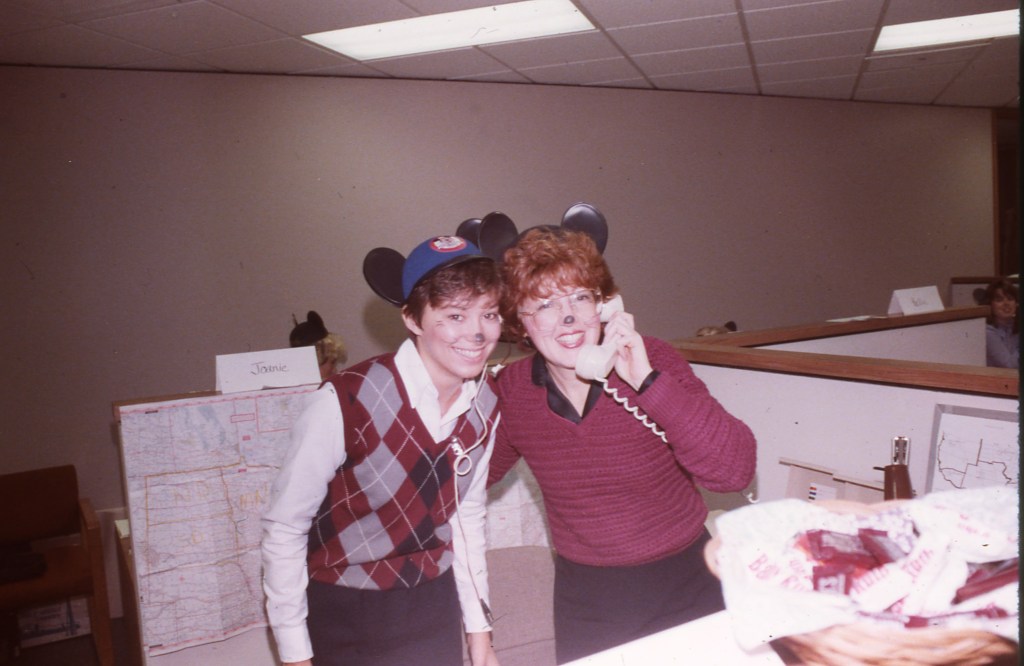
A few months later, our telemarketing group had ‘Mouse’ day with the introduction of Microsoft’s version of the device. Product introduction days were always exciting as our group created ways to make it special and get ourselves motivated.

Two of my telemarketing co-horts, Sue and Susie, on ‘Mouse’ day.

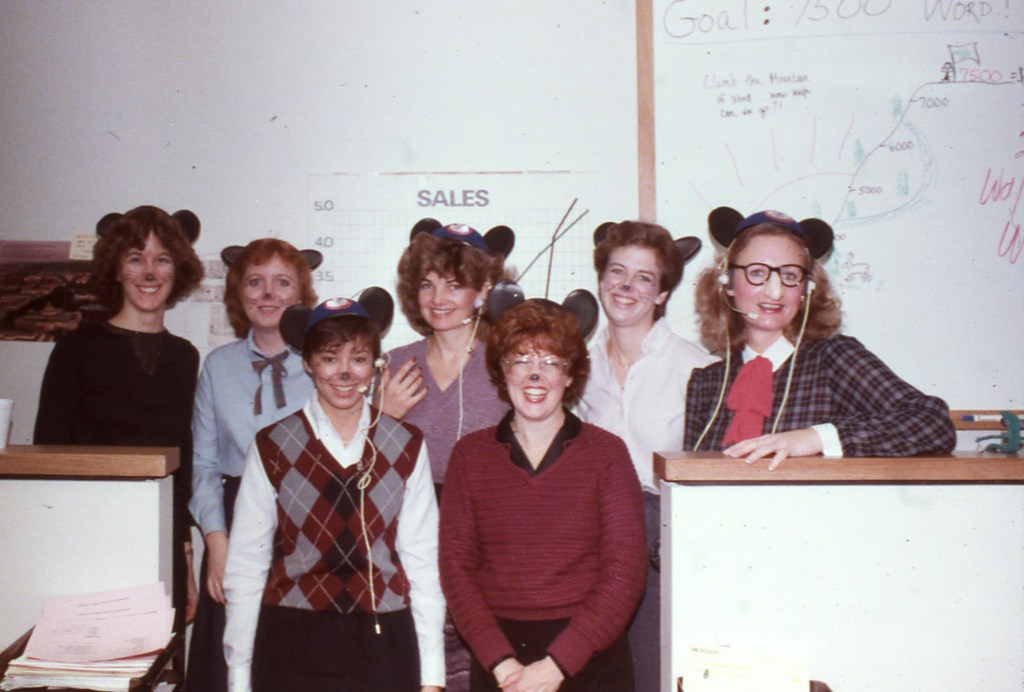
Mouse day, it turns out, featured everyone wearing Disneyland mouse ears as we called every last buyer in every computer store in the nation. At the front of the room was a large white board where our goals were written. As the day wore on, we would add our sales to the list, and whoops of excitement echoed through the cube farm as we reached each new goal.

I don’t recall how many we sold that first day or in subsequent weeks, but the bundle was hugely popular as consumers embraced the technology.

Most memorable was a funny incident which happened a short time after. In addition to the telemarketing group, we also had a customer service division for people to call in and get help when their products had issues. Often those calls were directed to a crack group of the most patient people in the universe: technical support.

I can clearly see two of my tech support buddies, both of whom were always willing to answer our questions when a buyer would, inevitably, ask us some technical thing that we – as mere salespeople – had no clue how to answer.

I can’t recall if it was Clay or Dolores who told me this story; but one day he/she received a tech support call from a woman who was complaining that her mouse was not working correctly. The tech people always worked through a list of known issues first, asking questions to drill down in order to solve the problem. Most issues they’d encountered before and would either be able to get it fixed it or would send the person to customer service to start the order replacement process.

This particular woman was certain that her software had a problem because every time she moved the mouse around all she got on the screen were squiggly lines and gibberish text. So the tech person had her move the mouse, click the button, and then type something. On the call went for five, then ten minutes, with no known bug causing the issue.

Finally, the woman – clearly exasperated – yelled ‘my arm’s getting tired.’

The tech support person paused and then asked her to describe how she was holding the mouse. It turned out that she was treating the mouse as though it was a touch screen device. All that time she had been holding it up and moving it around on the screen’s surface.

Over the years I’ve had ‘Microsoft’ dreams – not quite nightmares but close – where I’m back working at the company. In these dreams, however, I’m not donning Mouse ears and calling buyers; I work in tech support and field calls from people asking me questions for which I do not know the answers. Talk about stress.

The telemarketing crew fall of 1983, goals on the white board and all in the ‘Mouse’ spirit. The author with her big 80’s hair is at far left.

I think of Clay and Dolores often and smile at the stories they shared which often made the stress of working at Microsoft in the early 80’s just a little bit less. Hats off to all tech support people everywhere, you are my heroes.

The links:

https://en.wikipedia.org/wiki/Microsoft_Mouse

https://en.wikipedia.org/wiki/Computer_mouse

Kittenmania: the year we were taken over by cats

The Baker’s Dozen

April 13th

A Tuesday Newsday Classic from 2021

One of the things I look forward to each week is getting ‘show prep’ from my favorite Disc Jockey who also happens to be my brother. He sends interesting and humorous facts and events in advance of each Tuesday, providing me fun ideas for the particular date I need.

This week he shared the following for today, April 13, 2021. He writes:

“1969: An Australian Siamese cat named Blue Danielle had 13 kittens. It’s no longer a record, but it deserves honorable mention. The purring alone must have driven everyone crazy.”

Which got me wondering, what WAS the largest litter of kittens ever born?

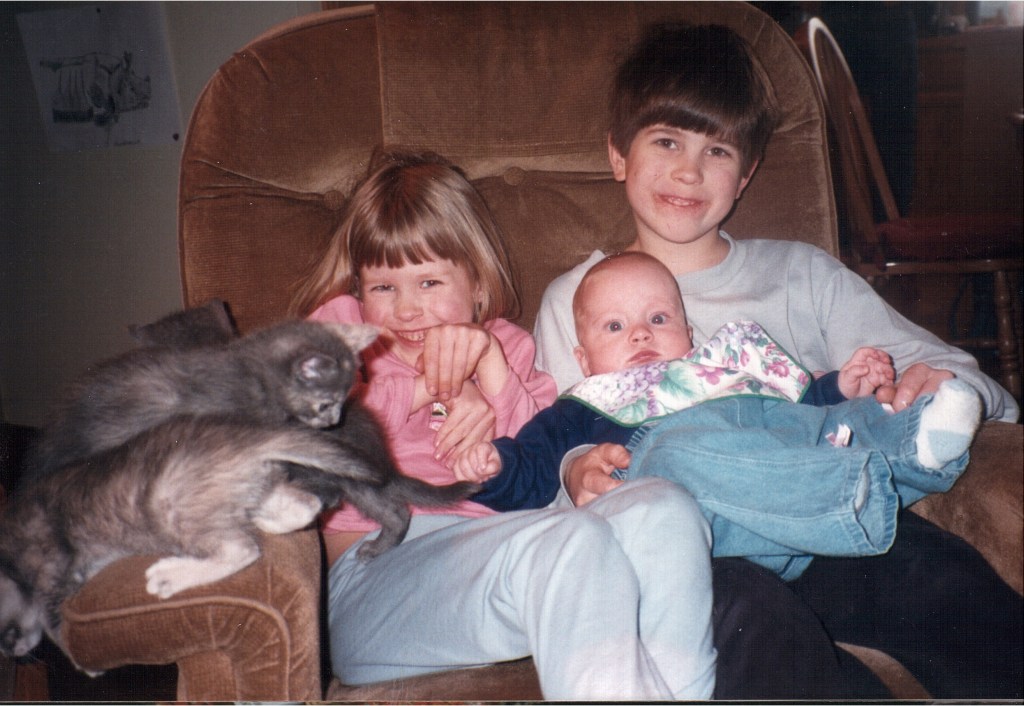
When you really, really love kittens. Son and daughter with kittens Winky and Peop in 1999.

The record was set the very next year when a four year old Burmese cat named Taragone Antigone produced 19 kittens. Unfortunately, only 15 survived (14 males, one  female). I gleaned this information from a website called The Nest which also stated “Clementine, a mixed domestic shorthair gave birth to 15 (11 survived) in New York in 1976, and that same year a Siamese named Tikatoo had a litter of 15 in Canada.” (see link below)

The Infallible Wikipedia does not list the information on the largest litters, but helpfully details the, ahem, mating habits of felines. Perhaps the most interesting fact in that regard is this:

“Because ovulation is not always triggered by a single mating, females may not be impregnated by the first male with which they mate. Furthermore, cats are super fecund that is, a female may mate with more than one male when she is in heat, with the result that different kittens in a litter may have different fathers.”

Another interesting aspect is that cats are known to give birth to as many as three litters a year. With litters averaging from 3 to 9 kittens, it doesn’t take long to be overrun by cats. I should know.

My family’s kitten adventures began in December 1998 when our one and half year old cat, Purr, went into heat. It was a conscious decision on my part to let the cat do this as I knew that having a batch of kittens was highly desired, especially by my then 5 year old daughter.

As Purr’s big day approached, the excitement in the house grew. Then, one morning late in February 1999, the process began. Much to my daughter’s delight, she got to witness the birth event and immediately bonded with all four of the kittens.

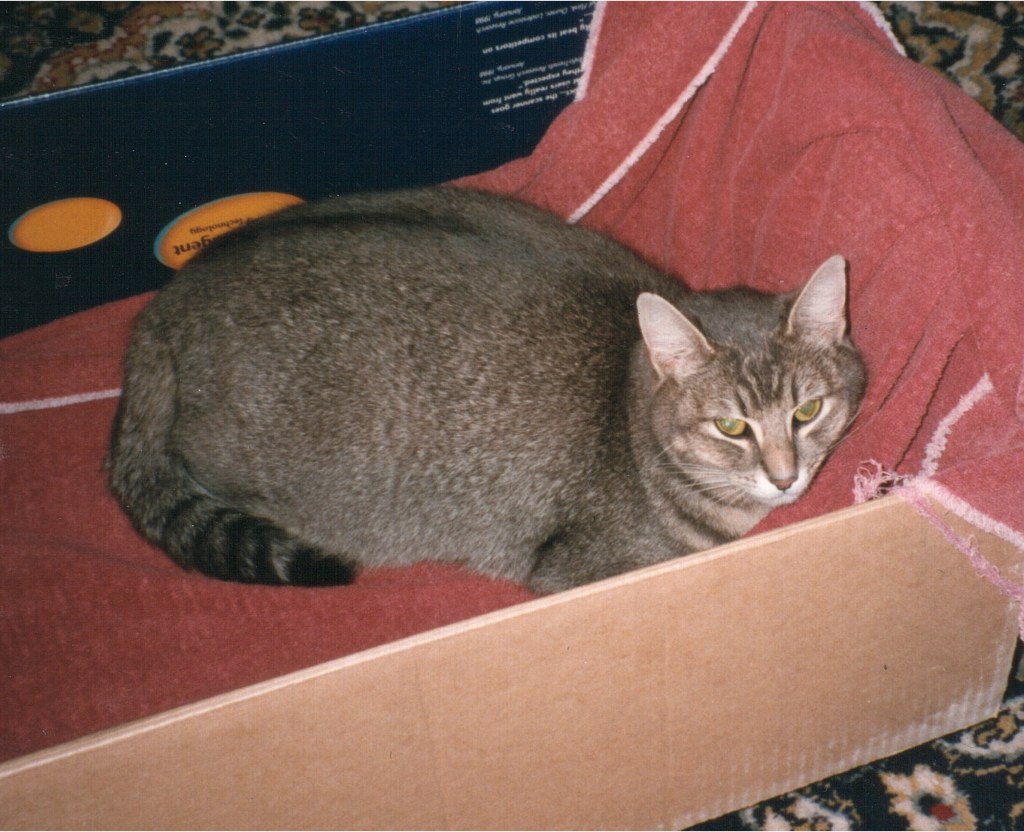
Purr in the ‘nest’ my daughter prepared for her. The kittens were born shortly after.

It didn’t take long for each cat’s personality to shine through and the four were named: Kinky – the lone male – named for the crook in his tail; Winky – who had one eye which blinked independent of the other; Phantom – who had a half dark, half light face; and, finally, People Cat – so named because of her propensity to climb out of the box and love on whatever person was there.

Kittenmania took over. The cats lived in our large laundry room, kept inside by a baby gate once they started roaming. But soon they were all over the house and, especially, upstairs in the playroom or the kids’ rooms.

Since keeping five cats was not an option, at five weeks I’d moved fully into ‘find them a home’ mode but not before promising that we would keep ‘one’ of the kittens. My targets for people to adopt them were classmates of the kids and soon Winky left to be loved by a third grade girl and her family.

Phantom, it turned out, was not the right cat for us. She was afraid of everything: loud noises, sudden movement, and the other cats. Sudden incontinence was the response to these factors, so she needed a calm environment with an understanding owner. Her salvation was the veterinary assistant.

It looked as though Kinky would be our cat as my son’s teacher, Mrs. B., was all set to adopt Peop (as we had started calling her). But when Mrs. B’s husband objected, the adoption was off. I was secretly glad as Peop had become my personal assistant, supervising whenever I worked at my desk, and I wanted to keep her.

So our little family of three cats was set. Or so I thought.

One day in early April I had an appointment to have Mama Purr spayed. Then the unthinkable happened. She escaped the house and was gone for 24 hours. The last time that happened…

Purr looking beautiful and irresistible to the eligible bachelors

Yep. She was pregnant once again.

Purr got bigger and bigger and soon we were anxiously awaiting the new arrivals. She rejected Peop and Kinky (something which was true for the rest of her days) who moved upstairs to hang with the family and Purr stayed downstairs as she began the process of nesting once again.

Unfortunately, I had an out of town conference which took me away at the critical moment. With Grandma and Grandpa there to watch the kids we were all set.

Then on day two of the conference, a flurry of emails from my nine year old son announced the kittens’ arrival.

Peop helping the author with editing.

“Mom,” the first email proclaimed, “Purr has four kittens!”

I noticed a string of emails from him and clicked open the second, then the third, fourth and fifth emails.

“Now there are five!”

“Mom – there are six kittens!”

“Now there are seven!”

My stomach dropped as I counted three more emails in the thread. How many kittens did Purr just have? What were we going to do with all those kittens?!

I open the next email.

“Purr has eight kittens!” the email happily proclaimed.

It took every ounce of courage to open the next one.

“That’s all.”

I let out a shudder. While eight would be hard to manage I was thankful it had ended there.

Kinky wanted to be king of the household but Purr never let him usurp her throne.

When I arrived home the next day I found a moving mass of cats in the laundry room. Purr looked oh so pleased with herself.

Soon the reality of having ELEVEN cats in the house took over. The litter box for Mama and babies required cleaning every two hours. I took old vinyl tablecloths and turned them upside down in the laundry room to keep the carpet (who puts carpet in a laundry room? Asking for a friend) from getting urine soaked. Our house smelled like a cattery. Probably because it was.

When our niece came to visit, the kids ‘introduced’ her to the new kittens – three of which are shown here. I think our niece looks a bit concerned.

That summer all we did was manage cats and eventually were able to find homes for the crew, much to Purr’s dismay. And Purr? That randy lady did make it to the vet (as did Peop and Kinky) so that future, possibly record breaking, litters of kittens would not happen.

But had I known then that the record was 19 I totally think Purr could have broken it. Then she would have been famous and I would have had a nervous breakdown. It probably worked out for the best.

A couple of links:

https://en.wikipedia.org/wiki/Cat

https://pets.thenest.com/record-number-kittens-born-one-litter-8346.html

March 30, 1964

What is the date Jeopardy Premiered?

If I mention the names Don Pardo and Art Fleming, what’s the first thing you think of?

For anyone born after about 1975, it’s unlikely those names mean a thing to you. But if I add in the name Alex Trebek , nearly 100 percent of people will immediately say “Jeopardy!”

Art Fleming, the original host

Long before Trebek became the host, the first two were the memorable announcer and host, respectively, of Jeopardy which premiered as a daytime TV program on March 30, 1964.

The 1960’s was the golden age of TV game shows. Jeopardy joined seven other such shows already on the air that year including Let’s Make A Deal and The Price Is Right. Only Let’s Make A Deal has run continuously on TV longer, edging out Jeopardy by 3 months.

The show got its start thanks to iconic TV producer Merv Griffin. From the Infallible Wikipedia:

“In a 1963 Associated Press profile released shortly before the original Jeopardy! series premiered, Merv Griffin offered the following account of how he created the quiz show:

“My wife Julann just came up with the idea one day when we were in a plane bringing us back to New York City from Duluth. I was mulling over game show ideas, when she noted that there had not been a successful ‘question and answer’ game on the air since the quiz show scandals. Why not do a switch, and give the answers to the contestant and let them come up with the question? She fired a couple of answers to me: ‘5,280’—and the question of course was ‘How many feet in a mile?’. Another was ’79 Wistful Vista’; that was Fibber and Mollie McGee’s address. I loved the idea, went straight to NBC with the idea, and they bought it without even looking at a pilot show.

Griffin’s first conception of the game used a board comprising ten categories with ten clues each, but after finding that this board could not easily be shown on camera, he reduced it to two rounds of thirty clues each, with five clues in each of six categories. He originally intended requiring grammatically correct phrasing (e.g., only accepting ‘Who is …’ for a person), but after finding that grammatical correction slowed the game down, he decided to accept any correct response that was in question form. Griffin discarded his initial title of What’s the Question? when skeptical network executive Ed Vane rejected his original concept of the game, claiming, ‘It doesn’t have enough jeopardies.’”

Announcer Don Pardo whose recognizable voice graced the airwaves for decades

The format of giving contestants the answers and requiring the questions had previously been used by the Gil Fates-hosted program CBS Television Quiz, which aired from July 1941 until May 1942.”

Of course the references in the above article highlight just how long ago Jeopardy got its start, especially the citation of Fibber McGee. But I digress.

I’m pretty sure I’ve watched Jeopardy pretty much since its beginnings. Now mind you, as a kid the only time I saw the program would have been during summer vacation or being home sick from school. Holding down the 11:30 a.m. spot on NBC made Jeopardy required TV for the ill child. Once lunch was over (soup and saltine crackers, no doubt) and the boring old news came on, it was time to sleep.

The other reason I know Jeopardy occupied my brain is that I still have the Fifth Edition Jeopardy Board Game which I’m pretty sure was either a birthday or Christmas present in 1964.

Imagine a completely old school sort of game. The answer board cover is made from white indestructium.* There are white one inch square removable plastic tabs that cover the answers for each Jeopardy round. You know its old because the dollar amounts (printed in blue on the tabs) are $10, $20, $30, $40, and $50 for regular and double those numbers (in red) for the second round. Oh, and did I mention how they kept the answers ‘secret?’ By use of the always cool, see through red plastic used in kid’s decoder kits of the 1960’s.

My 1960 something game… the blue clicker is missing but everything else is there. You can buy a fifth edition version for about $13.00 on Ebay in 2026.

But the best part was by far the ‘buzzers’ used by the players when they knew the right question. In this case, however, ‘buzzer’ is a misnomer because the devices were frog style clickers in red, blue, yellow, and green. After a few games of vigorous use those clickers no longer clicked; our alternative was for the contestants to make a buzzing noise with their mouths which, you might imagine, led to some hilarity.

My friends and I loved the game. It’s actually in amazing shape considering the use it had. Or maybe I’m misremembering all the use and, perhaps, it was just me who was the complete trivia nerd. The game, after spending decades tucked away in my parents’ house, came back to me in the fall of 2019.

Over the years, however, Jeopardy continued to be a part of my life. In the 1980’s, after dinner, the hubby and I would often watch Jeopardy and Wheel of Fortune. The hubby seemed to know every Jeopardy answer and had it out before my brain had time to process. In fact, I often thought that the hubby should try out for Jeopardy.

Alex Trebek

His rapid trivia skills were passed down to the next generation as our daughter also loves Jeopardy and is really good at it. In fact, both her former roommate and fiancé (now her hubby) got to the point of not wanting to even watch Jeopardy with her because she seemed to know every answer and, like her father, was very fast.

After she moved in the spring of 2020 and no longer had cable TV, she mostly quit watching. Some of the joy of the show, no doubt, was lost with the passing of Alex Trebek. She did admit that a couple of the ‘tryout’ hosts were pretty good.

“I need my Jeopardy host to be pretty dry in their delivery,” she told me.

I think any Jeopardy fan hopes that a worthy replacement will be found for Trebek ; one who will assure that the 57 year tradition that is Jeopardy will continue for years and generations to come.

* Indestructium is a word coined by the hubby to describe any linoleum or plastic material manufactured in the mid-20th century which is basically impossible to damage or destroy.

The Infallible Wikipedia links:

https://en.wikipedia.org/wiki/Jeopardy!

https://en.wikipedia.org/wiki/List_of_longest-running_American_television_series

Sleep Deprived? The Impact of Daylight Savings Time

The movement to eliminate the bi-annual change grows louder

March 16th

Early Daylight Savings Time was promoted as being Patriotic

A Tuesday Newsday Classic

Standardization of time really began to plague the world with the advent of the train. Prior to then, society was largely agrarian with people waking at sunrise and retiring at sunset.

But with transportation that could take travelers hundreds of miles over the course of a single day, problems with lack of a standard time arose. When they said the train would arrive at 3 p.m., was that 3 p.m. in New York City or 3 p.m. in Chicago?

The first such standardization was established in Great Britain in 1847 and spread from there. In the United States it was on November 18, 1883 when the first coordinated efforts were established. This system was in effect until March 1919 when someone got the bright idea for ‘Daylight Savings Time (DST).’

Of course the Infallible Wikipedia has articles in regards to this event:

“During World War I, in an effort to conserve fuel, Germany began observing DST on May 1, 1916. The rest of Europe soon followed. The plan was not adopted in the United States until the Standard Time Act of March 19, 1918, which confirmed the existing standard time zone system and set summer DST to begin on March 31, 1918 (reverting October 27). The idea was unpopular, especially with farmers. In fact, Daylight Saving Time meant they had less time in the morning to get their milk and harvested crops to market. Congress abolished DST after the war, overriding President Woodrow Wilson’s veto. DST became a local option. New York City continued to observe a metropolitan DST, while rural areas outside the city did not.”

Everyone went back to standard time but then another war came and on February 9, 1942, President Franklin D. Roosevelt instituted year round ‘war time.’ It was just a more patriotic name for year round DST. When the war ended a number of states liked DST and adopted summertime DST.

Also from the Infallible Wikipedia:

“From 1945 to 1966 there was no federal law on daylight saving time, so localities could choose when it began and ended or drop it entirely. What emerged was a complicated patchwork of daylight saving policies that varied in length and by city, state and municipality. As of 1954, only California and Nevada had statewide DST west of the Mississippi, and only a few cities between Nevada and St. Louis. In the 1964 Official Railway Guide, 21 of the 48 contiguous states had no DST anywhere. By 1965, there were 18 states that observed daylight saving for six months each year, 18 states that didn’t have formal policies but held cities or towns with their own daylight saving standards and another 12 states that didn’t implement daylight saving at all.”

The first Daylight Savings clock is set ahead one hour on March 31, 1918

It was a complete mess. Enter the US Congress and the Uniform Time Act of 1966. Basically the law established DST to run from the last Sunday of April to the last Sunday of October for all 50 states. There were rules regarding when and how states could opt out of the program, but for the most part the majority of the states went along with it.

Over the years, it has been the norm to move the clocks ahead in the spring and change them back in the fall. In recent years, more and more people have been clamoring for picking ‘one’ time and doing away with the sleep disrupting prospect of time change.

In the past six years, more than 30 states have officially advocated for the option of year round DST. And why not? The US is no longer a primarily agrarian society but, rather, a 24/7 civilization thanks to a stable power grid and technology that never sleeps. Morning daylight is not required to function.

In my home state, the lawmakers took it one step further. One more Wikipedia reference:

“In 2019, the Washington State Legislature passed Substitute House Bill 1196, which would establish year-round observation of daylight saving time contingent on the United States Congress amending federal law to authorize states to observe daylight saving time year-round.”

We here in Washington are still waiting for Congress to act on it.

Which is why, this fine Tuesday, the 16th of March, following the mad dash to reset millions of clocks, millions of people are struggling to adjust to that hour of lost sleep and working to reset their internal clocks to DST.

I guess the good thing about getting older has been that my sleeping habits are such that the switch to and from DST no longer upsets my schedule quite so badly. These days I seem to sleep for about 6 to 6 ½ hours a night no matter what. I don’t like it particularly and when I get a 7 hour stretch enjoy it for the gift it is.

This year the transition was the easiest ever. I went to sleep around eleven standard time on Saturday night and woke up at six (DST) on Sunday. The whole day ended up being a busy one without a nap and by the time bedtime rolled around, I was adjusted.

Of course I would prefer to not wake up at 4 or 5 a.m. with my brain fully engaged in trying to solve life’s challenges, but on Monday morning it did give me time to contemplate DST and what exactly I was going to write about for this week’s Tuesday Newsday.

Cartoon by Keefe Chamberlain @ http://www.nergon.com

For all you fellow geeks out there, here’s the link to Wikipedia and the history of time:

https://en.wikipedia.org/wiki/Standard_time

https://en.wikipedia.org/wiki/Daylight_saving_time_in_the_United_States

March 16, 2022 Update:

A few days ago the US Senate passed the Sunshine Protection Act. If passed by the US House and then signed by the President, Daylight Savings Time could become permanent! https://www.govtrack.us/congress/bills/117/hr69