Tag Archive | Yakima Washington

The Ice Cream Truck

The best thing on a hot August afternoon

August 17, 2021

Lost in the hazy memories of childhood summers are the snippets from hot afternoons spent playing outside with the gaggle of kids who lived on my street.

Our days were filled with pick up softball games, bikes, Barbie Dolls and board games. But there was one distinctive sound which caused our collective to drop everything and run home. That sound was the blare of the song Greensleeves.

In suburban communities throughout the United States, the ice cream truck has been a summer fixture for several generations now.

It seemed to me that the ‘truck’ which roamed our streets was open like this one and the driver turned in his seat to get the treats

They also, according to the Infallible Wikipedia, are very popular in Britain and are described thus:

“An ice cream van (British) or ice cream truck (North American) is a commercial vehicle that serves as a mobile retail outlet for ice cream, usually during the spring and summer. Ice cream vans are often seen parked at public events, or near parks, beaches, or other areas where people congregate. Ice cream vans often travel near where children play — outside schools, in residential areas, or in other locations. They usually stop briefly before moving on to the next street. Along the sides, a large sliding window acts as a serving hatch, and this often displays pictures of the available products and their prices. Most ice cream vans tend to sell both pre-manufactured ice pops in wrappers, and soft serve ice cream from a machine, served in a cone, and often with a chocolate flake (in Britain), a sugary syrup, or toppings such as sprinkles. While franchises or chains are rare within the ice cream truck community (most trucks are independently owned and run), some do exist.”

When one is a child, we often take for granted certain things. One of those things was the ice cream truck which came down our street frequently during the summer. Of course I didn’t think about it much. All I thought about was how I was going to get my hands on the nickel (and when the price went up, a dime and a nickel) I needed to buy a treat.

In the houses up and down my street, our mothers’ doled out the coins needed. Soon we all lined up, patiently or not, for our turn to peruse the desired frozen treats, the cloud of cold steam from the dry ice billowing out like some magician’s trick. The truck always stopped between our house and the Tuttle’s house. This strategic location often produced a dozen eager customers as my family boasted four children and the Tuttle’s had six. Added to our ten were several groups of three additional children within a few houses and even more further up the street. That was a lot of potential customers!

Vintage ad for a Creamsicle from the late 1960’s

Soon I’d have the frozen delight in hand and would sit on the curb with the others. I can envision our gangly group, in pedal pusher pants or shorts and the summer footwear of choice: thongs. For those born after about 1970, we never called them flip-flops, they were thongs and every single one of us wore them all summer long despite the occasional bee sting or stubbed toe.

But I digress. Although I often thought about buying something new and different, I always got the same thing: an orange creamsicle.

My mother, no doubt in a futile attempt to cut back on the money spent at the ice cream truck, developed her own frozen treats. She would fill an ice cube tray with (I think) chocolate fudge jello and freeze the little squares. Into each square was inserted a wooden popsicle stick. These would be doled out on hot August afternoons when the ice cream truck did not come up our street.

When my own children were growing up I would often make Koolaid based popsicles in specially designed holders. My daughter could go through several every day.

Of course one of the reasons for this is that there were no ice cream trucks which ventured the steep driveway up to the house where we lived. Unlike the street where I grew up, my pair of children mostly played with one another or with a friend or two invited over for the afternoon.

A delicious fudge bar and ice cream cone.

When we moved to Kirkland in 2004 the kids were 14 and 11 and past the age where the ice cream truck was a motivating factor. Even so, there were many afternoons when I’d hear the familiar Greensleeves, it’s Pavlovian tune beckoning to youngsters.

In the past three years I have yet to hear or notice an ice cream truck in our neighborhood. Perhaps, with the advent of instant grocery deliveries, it’s now been swept into the dustbin of history. I think our society is a little less rich if that is the case.

Perhaps the next time I’m at the store, I’ll purchase a package of creamsicles, blare Greensleeves from Spotify, and then close my eyes and imagine I’m 8 years old once again, sitting on the curb and savoring that wonderful childhood treat.

https://en.wikipedia.org/wiki/Ice_cream_van

Memories of Driver’s Ed: Lessons from the 70s

For some it took longer than others!

August 3

At one time this test was an important rite of passage for the American teenager, an indication that they were about to enjoy one of the privileges of adulthood: being able to drive.

For one Mariam Hargrave of Yorkshire, England, no doubt it was an ordeal. It was on August 3, 1970, when the 62 year old finally passed her driving test. Although the Infallible Wikipedia has an article about driver’s tests, they ignore poor Mrs. Hargraves. Instead, I was able to glean this information:

“By April 1970 Mrs. Miriam Hargrave had failed her test thirty-nine times. In the eight preceding years she had received two hundred and twelve driving lessons at a cost of £300. She set the new record while driving triumphantly through a set of red traffic lights in Wakefield, Yorkshire. Disappointingly, she passed at the fortieth attempt (3 August 1970) but eight years later she showed some of her old magic when she was reported as saying that she still didn’t like doing right-hand turns. — Stephen Pile, ‘The Book of Heroic Failures’”

Back in 1970’s Yakima it was a big deal to learn how to drive. By the time I was in high school, they were offering Driver’s Ed classes which involved learning the rules of the road and practicing driving. I doubt there were any braver educators anywhere than those who willingly climbed into a car with a 15 ½ year old, hormone driven, child and allowed them to command a 2,000 pound vehicle on city streets.

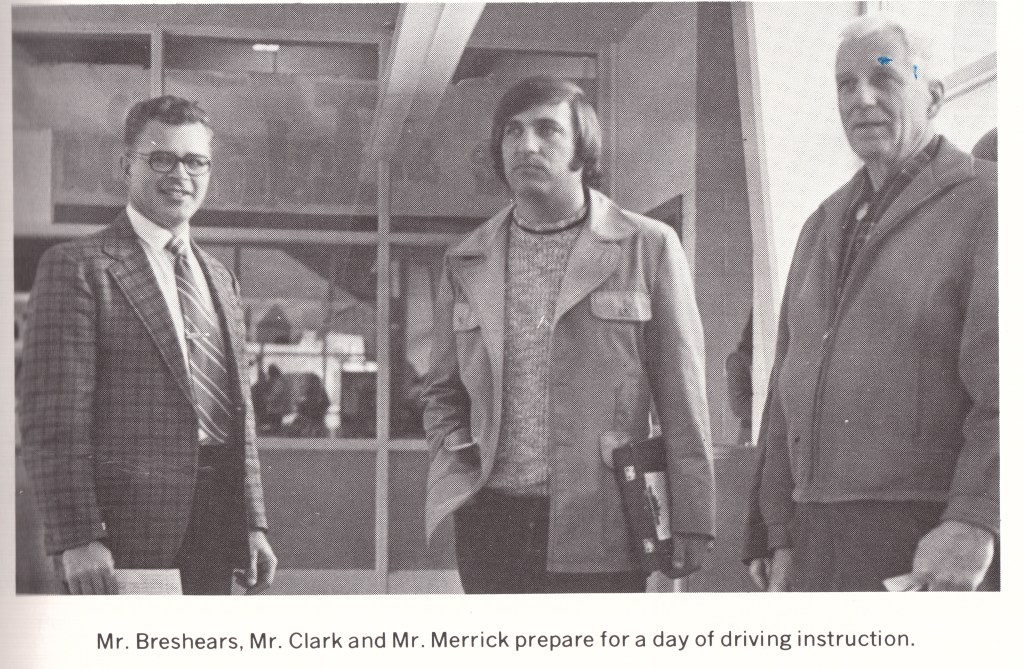
Yet, they did. I seem to recall my Driver’s Ed teacher, Mr. Breshears, always popping antacid tablets. I suppose the only thing which gave the instructors any comfort at all was the fact that the cars were equipped with a set of brakes for the front seat passenger.

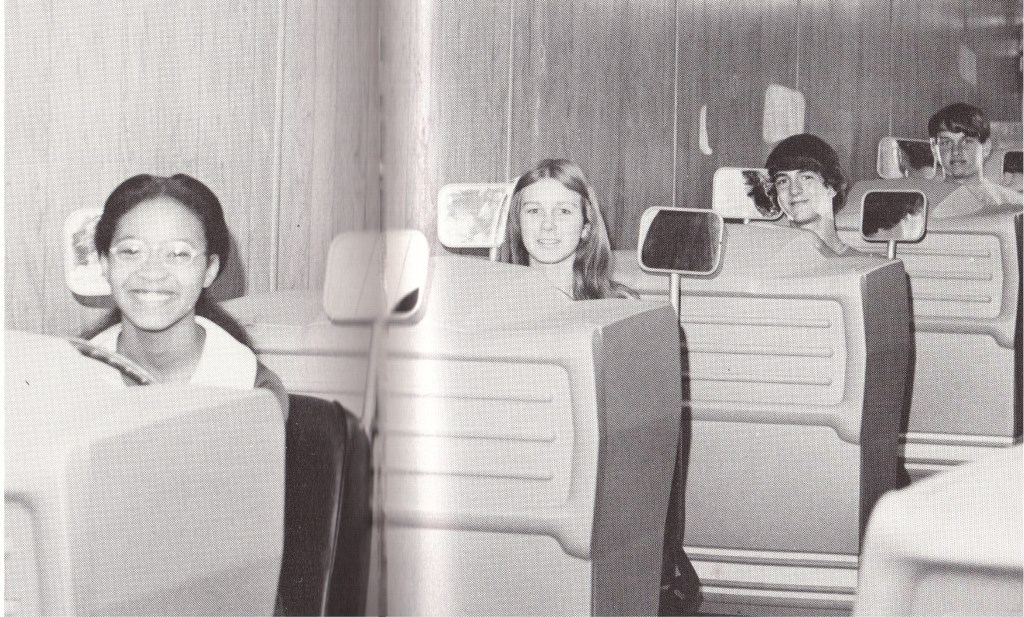
Our simulators looked something like this set up from 1969.

Three students at a time would go drive with the teacher. It was a bit terrifying since not all budding drivers had the benefit of a parent who worked with them after school. There was one student I recall who tested Mr. Breshears patience each time they got behind the wheel. Those instructor brakes got quite the workout.

But the favorite part of Driver’s Ed class was getting to go to the Simulator. It was a windowless trailer which had been equipped with two parallel rows of seats, separated by an aisle sort of like being on a bus, and all faced forward. Each station had a steering wheels, brakes, etc. to look like the driver’s area of a car. At the front of the trailer was a large screen. Once all the students were settled into their places, the lights would be dimmed and the screen would come to life as though one was behind the wheel, driving down the street. It was our job to accelerate in unison with what we saw on the screen. It was also imperative that we hit the brakes at the right time.

From the IKE Reveille year book, 1972

Driver’s training films seemed to mostly consist of tree lined city blocks which, at first, seemed like lovely enclaves of blissful American life. But no. Those streets were every driver’s worst nightmare. Balls of all sorts would suddenly bounce out into the road followed by adorable tikes chasing them. Woe unto those who didn’t hit the brakes in time!

Sophomore class officers from Eisenhower High School, Yakima, pose for a photo for the 1973 annual.

There were dogs and cats; there were other vehicles; things fell off the backs of trucks, branches crashed down. Who knew how truly hazardous things could be in one bucolic town?

Of course, some cheeky student would purposefully ‘run’ over the simulated hazards and a little red light would illuminate on their console, publically shaming them for an egregious infraction. I always wondered if students who ‘ran’ over cats, dogs, and children, failed the course.

Over the years I have learned just how accurate those simulations were as I’ve encountered many of the hazards portrayed. Thankfully, it’s only occasionally that such things happen. The hubby and I, if we are in the car together, will comment in unison ‘Driver’s Training film!’ when something we experienced in the simulator occurs in real life.

This photo is from the Eisenhower High School 1973 annual. The headline above this proclaimed “380 license-hungry students swamp driver education course this year.” Apparently there were a bunch of us who turned 16 in 1973.

The  instruction I received was successful and on my 16th birthday I took the tests – written and driving – and emerged as a licensed driver and, despite losing points for parallel parking, never came close to Mariam Hargrave’s, 212 lessons, eight years of time, and over $700 (US) spent.

The links:

An entertaining look at early simulators:

https://www.dmv-written-test.com/washington/practice-test-1.html?utm_source=bing&utm_medium=cpc&utm_term=%2Bwa%20%2Bstate%20%2Bdriver%27s%20%2Btest%20%2Bpractice&utm_campaign=DMV%20-%20Search%20-%20WA%20-%20EN%20-%20CAR~Driver%20Question%20Test&msclkid=ee5a27bd586710c0735246b5495d31f5# (Can you pass the written test for Washington State?)

https://en.wikipedia.org/wiki/Driving_test

https://en.wikipedia.org/wiki/The_Book_of_Heroic_Failures

Dairy Queen Days

A summertime tradition

June 22, 2021

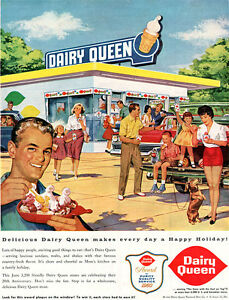
Dairy Queen’s famous soft serve vanilla cone

Nothing says ‘summer’ to me more than a trip to a drive in burger restaurant on a warm afternoon for something cold and frosty. Back in 1960’s Yakima, Washington there were only two places our family went when we wanted an ice cream based treat. The first was the A&W root beer stand for a float. The second was Dairy Queen. McDonald’s didn’t come to Yakima until the 1970’s and I’d never heard of Burger King or Wendy’s during my childhood.

Dairy Queen was the quintessential fast food joint for a hamburger, fries, and a milk shake. But more than that it was the only place one could get a soft serve ice cream cone.

It was the development of soft serve which led to the founding of the first Dairy Queen, in Joliet, Illinois, on June 22, 1940.

The Infallible Wikipedia shares:

“The soft-serve formula was first developed in 1938 by John Fremont ‘J.F.’ ‘Grandpa’ McCullough and his son Alex. They convinced friend and loyal customer Sherb Noble to offer the product in his ice cream store in Kankakee, Illinois. On the first day of sales, Noble dished out more than 1,600 servings of the new dessert within two hours. Noble and the McCulloughs went on to open the first Dairy Queen store in 1940 in Joliet, Illinois. While this Dairy Queen has not been in operation since the 1950s, the building still stands at 501 N Chicago Street as a city-designated landmark.

Since 1940, the chain has used a franchise system to expand its operations globally from ten stores in 1941 to one hundred by 1947, 1,446 in 1950, and 2,600 in 1955.”

On the Dairy Queen website they list 4,421 locations in 49 states. Texas boasts the largest number of restaurants with 594 stores. It continues to be a popular chain throughout the Midwest and the South with between 130 and 260 stores in each state. The only state without a DQ is Vermont. Washington State has the largest number of Dairy Queen restaurants of the Western states with 101 locations. Any way you scoop it, that’s a lot of ice cream.

When I became a teenager my friend Karen and I would sometimes walk to the Dairy Queen which was less than a mile from my house – and only four blocks from hers – just for one of those soft serve cones or, even better, one dipped in chocolate.

The summer my kids were 9 and 6 I dubbed it the Dairy Queen summer. Once a week we’d go through the drive through at the Redmond Way Dairy Queen for those same soft serve cones. In those days I would often just get a Dr. Pepper. What was I thinking?!

In the last year of my Dad’s life his world grew smaller and smaller. But some things never changed. One of those was the joy he got from getting a chocolate chip Blizzard from Dairy Queen. He’d been having increasing difficulties swallowing and the treat seemed to help soothe his throat.

One afternoon in August of 2019, I decided to take him on an outing to Dairy Queen for a Blizzard. This was no small task since getting him to the car, settled into the passenger seat, and then stowing his walker, was always an ordeal.

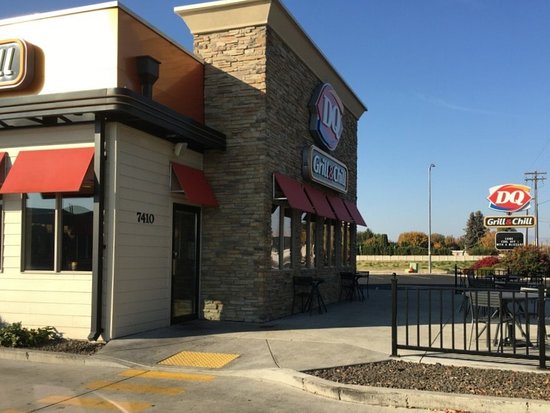
As we were headed to the restaurant, located out in West Yakima, he grew more and more agitated, questioning where the ‘he**’ I was taking him and proclaiming the adventure as ridiculous. “Dairy Queen,” I answered him, but he was not to be placated. That was NOT the right Dairy Queen.

The west Yakima Dairy Queen which caused so much angst

At the time I didn’t realize there were actually a half dozen stores in the town. I only knew of two. One in downtown Yakima and the one where I was heading.

Those were the longest 5.2 miles I’ve ever driven; eventually we arrived and got the treat but he carped about the amount of time it took all the way there and then the 5. 2 miles back again to his adult family home.

A few weeks later I had the chance to redeem myself. Off we headed to Dairy Queen, but this time I was taking no chances. I headed to the one I was sure he wanted; located in downtown Yakima it was a much closer 3.2 miles.

We were stopped by every traffic light in town (it was late afternoon and folks were headed home from work) and the carping started up, with a repeat of the previous trip. When we FINALLY got to the Dairy Queen some 20 minutes later, there was a bit of a line for the drive through. I figured the car ahead of us must have been ordering for a family of 15 based on how long it took. But I was desperate. No way was I exiting that line and driving anywhere else without that Blizzard. Eventually he got the treat and was placated for a few minutes. I needed a nap.

It was only after we were back – nearly an hour later – and he was dozing in his chair that I put Dairy Queen into the map application on my phone. I was dismayed to discover that the nearest store to where he lived was… 1.4 miles away. Next time, I promised, we would go there.

Alas, the weather changed and the Dairy Queen trips were done for the summer. By the end of October he was gone.

One of these warm June or July days I think I will splurge and raise a chocolate dipped cone in a toast to Dairy Queen for its place in our family history. Maybe I’ll even try a chocolate chip Blizzard in honor of Dad.

Naw. I’m a chocolate dipped ice cream cone girl all the way. Some things never change.

The link: https://en.wikipedia.org/wiki/Dairy_Queen

Bigfoot: Fact or Fiction?

60 Seconds of Film that went Viral

October 20, 2020

In the now 53 years since this film clip was released to the public, the debate rages:  is Bigfoot real or just a myth?

It was on October 20, 1967, when a grainy 16 mm film was recorded, elevating public consciousness of Bigfoot into the national consciousness. In subsequent days and years it made headlines as it purported to provide proof that Sasquatch did, indeed, exist.

The film was shot by Roger Patterson, along with Bob Gimlin, in the mountains near Bluff Creek in coastal Del Norte County California, about 40 miles south of the Oregon border. While most people likely believe that Patterson, and Gimlin who is shown riding a horse in the clip, were somehow randomly in this spot and happened to see Bigfoot, the real story pushes the bounds of believability.

We visit the Infallible Wikipedia and learn:

“Patterson said he became interested in Bigfoot after reading an article about the creature by Ivan T. Sanderson in True magazine in December 1959. In 1961 Sanderson published his encyclopedic Abominable Snowmen: Legend Come to Life, a worldwide survey of accounts of Bigfoot-type creatures, including recent track finds, etc. in the Bluff Creek area, which heightened his interest. Thereafter, Marian Place wrote:

‘In 1962 he visited Bluff Creek and talked with a whole host of Bigfoot-believers. In 1964 he returned and met a timber-cruiser named Pat Graves, who drove him to Laird Meadows. There Patterson saw fresh tracks—for him an almost unbearably exciting, spine-chilling experience. What a tremendous feat it would be—what a scientific breakthrough—if he could obtain unshakable evidence that these tracks were not the work of a prankster, but the actual mark of a hitherto unknown creature! If he succeeded, he would be famous! And rich! Alas, fame and fortune were not gained that year, nor the next, nor the next. Patterson invested thousands of hours and dollars combing Bigfoot and Sasquatch territory. He fought constant ridicule and a shortage of funds. … he founded … the Northwest Research Foundation. Through it he solicited funds . … The response was encouraging and enabled him to lead several expeditions. … In 1966 he published a paperback book at his own expense. … He added the income from its sales and his lectures to the search fund. As each wilderness jaunt failed to see or capture the monster, one by one the thrill-seekers dropped out. But Patterson never gave up.’

Patterson’s book, Do Abominable Snowmen of America Really Exist?, was self-published in 1966. The book has been characterized as ‘little more than a collection of newspaper clippings laced together with Patterson’s circus-poster style prose’. The book, however, contains 20 pages of previously unpublished interviews and letters, 17 drawings by Patterson of the encounters described in the text, 5 hand-drawn maps (rare in subsequent Bigfoot books), and almost 20 photos and illustrations from other sources. It was first reprinted in 1996 by Chris Murphy, and then again re-issued by Murphy in 2005 under the title The Bigfoot Film Controversy, with 81 pages of additional material by Murphy.”

Signs such as this one abound in the Pacific Northwest

What comes through is a man on a quest to prove Bigfoot existed and, perhaps, was willing to do anything in service of that ambition.

Over the years, researchers have studied Patterson’s film in an effort to prove or debunk its veracity.

At least one person, who knew Patterson, claimed he had rented a costume to use in the shooting of his film. Is it a huge creature or just a man in costume which is seen in the roughly minute long footage? No record of that costume rental exists and, like so many of the Bigfoot legends, is shrouded in mystery and a chain of unverifiable events.

Patterson’s footage seemed to ignite the public’s interest in Bigfoot and what has followed are a decades’ long series of individuals who claim to have seen Bigfoot. Added to the Patterson legacy are stories of Bigfoot captures, as well as recovery of a deceased Bigfoot. None have ever come to fruition. Hollywood got in on the action with the production of Harry and the Henderson’s, a fictional film which chronicled the story of a family who befriend one of the creatures and bridge the gap between humans and Bigfoot.

Wood carving of “Harry” from Harry and the Hendersons on Highway 2 in Washington State.

The debate rages to this day. A brief perusal of all the newspaper articles and citations in the Wikipedia article alone provides insight into the fact that one could spend their entire life just investigating this one topic, as was the case for Roger Patterson.

Patterson died in 1972 of cancer, just five years after the capture of the infamous footage.

Now, full disclosure: I thought it would be kind of fun to write an account of a possible Bigfoot encounter of my own and then say at the end ‘just kidding.’ I was prepared to do so but in the world of crazy connections I learned something about Roger Patterson which I had never known. He grew up, lived and died in my own hometown: Yakima, Washington.

Not only that, but getting the film footage out to the public was only possible due to Patterson’s brother in-law Albert DeAtley who provided the funding needed.

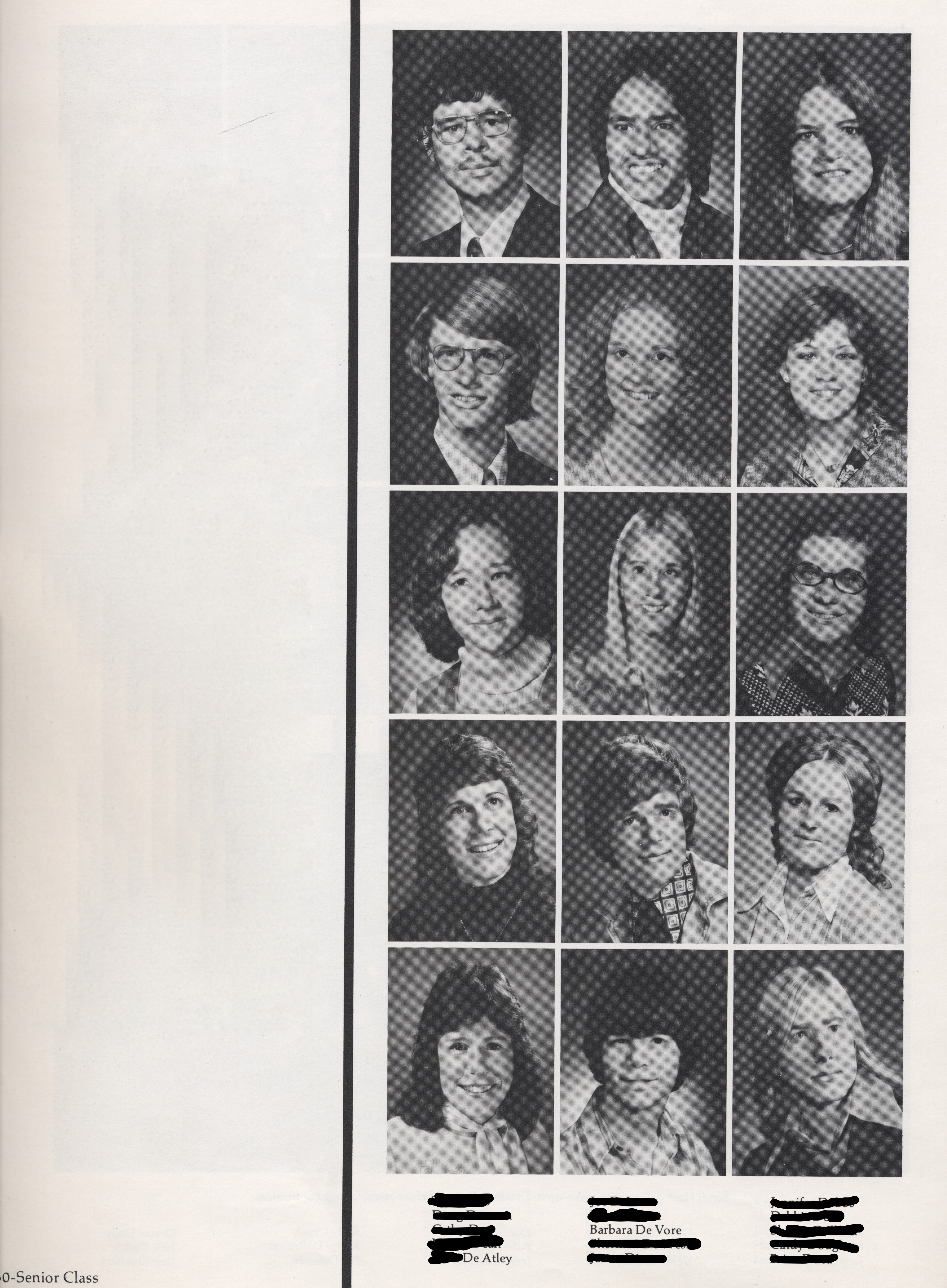
Page from my High School Yearbook. This author is middle photo, three up from bottom. Roger Patterson’s niece is bottom left.

Hmmm, I thought, I went to school with a DeAtley. Which sent me to my high school annual and, sure enough two spots down and one spot over from where my own Senior picture appears is a picture of Roger Patterson’s niece.

How is it possible that I was in classes with her, graduated the same year, and never knew of this connection?

I have, however, had a couple ‘real’ Bigfoot ‘encounters.’ The most memorable one occurred a few years ago during a visit to Long Beach, Washington. Little did I know that day when Bigfoot appeared before me that I would be able to chronicle my own experience with the creature… thankfully I got away despite Mr. Bigfoot’s attempts at capture as shown in this photo…

Bigfoot attempting to capture me… circa 2016

The one and only ‘Bigfoot’ link I’m sharing today is about the Patterson-Gimlin film (shown above). Thank you Wikipedia for the always exhaustive- and infallible – information on important subjects.

https://en.wikipedia.org/wiki/Patterson%E2%80%93Gimlin_film

The History of Canning

The Great Canned Peaches Escapade

September 22, 2020

A stroll down most any aisle in a modern grocery store reveals shelf after shelf of this item which is taken for granted in today’s world.

Yet, this method for the preservation of food has only been around for 200 years and, without it, our way of life would not be possible.

The process of canning foods was invented in 1809 by Frenchman Nicholas Appert. Appert – a brewer and confectioner – “observed that food cooked inside a jar did not spoil unless the seals leaked, and developed a method of sealing food in glass jars.”

The French Government was in need of a reliable food source for its troops during the Napoleonic War and had offered a cash reward for anyone who could successfully develop one. Ironically, the war was over before canned foods were available. Regardless, it was an invention whose time had come.

From the Infallible Wikipedia:

“The original fragile and heavy glass containers presented challenges for transportation, and glass jars were largely replaced in commercial canneries with cylindrical tin can or wrought-iron canisters (later shortened to “cans”) following the work of Peter Durand (1810). Cans are cheaper and quicker to make, and much less fragile than glass jars. Glass jars have remained popular for some high-value products and in home canning. Can openers were not invented for another thirty years – at first, soldiers had to cut the cans open with bayonets or smash them open with rocks. Today, tin-coated steel is the material most commonly used. Laminate vacuum pouches are also used for canning, such as used in MREs and Capri Sun drinks.

Image from Press Connect

To prevent the food from being spoiled before and during containment, a number of methods are used: pasteurisation, boiling (and other applications of high temperature over a period of time), refrigeration, freezing, drying, vacuum treatment, antimicrobial agents that are natural to the recipe of the foods being preserved, a sufficient dose of ionizing radiation, submersion in a strong saline solution, acid, base, osmotically extreme (for example very sugary) or other microbially-challenging environments.

Other than sterilization, no method is perfectly dependable as a preservative. For example, the spores of the microorganism Clostridium botulinum (which causes botulism) can be eliminated only at temperatures above the boiling point of water.”

This time of year, with fruits and vegetables in abundance, the industrious individuals who like to do such things might turn their efforts to canning their favorites at home. Caution, of course, is always a necessity to avoid improper methods and exposing themselves and others to botulism.

From the pioneers of the 1800’s to the thrifty housewives of the Great Depression, canning was a necessary activity each summer and fall.

My mother was never one of those. I think she endured more than her share of  rugged independence growing up from the late 1920’s until she left for college in the 1940’s. There was, however, one food she adored and canned it every year: peaches.

The Yakima Valley is fertile grounds for fruit orchards, its main crops being cherries, apricots, peaches, plums, pears, and apples. We each have our own favorites. For me, as a child, I have a distinct memory of biting into a fresh peach and declaring to my mother it was ‘my favorite fruit.’ I would say that they now share the ‘favorite’ status with cherries, blueberries, and raspberries.

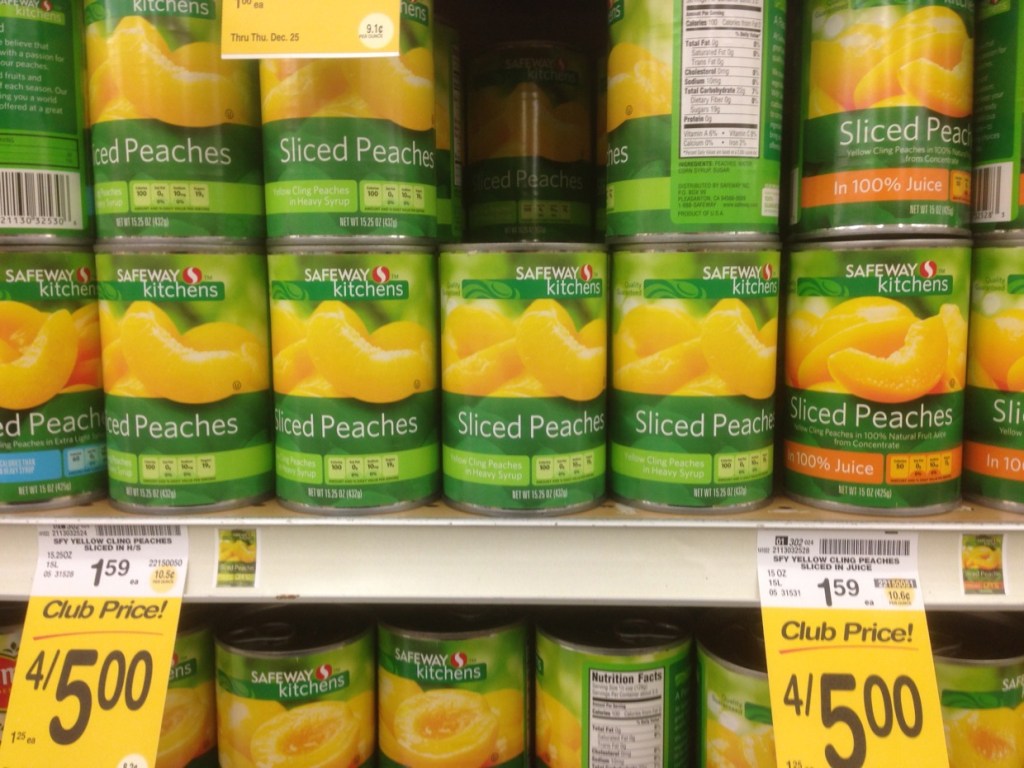
They were, I’m guessing, my mother’s favorite also. Because it was the ONE thing that she canned every year. When the fuzzy orbs were finally ripe, a flat or two of them would make their way to our house and for one or two hot afternoons, she’d can the peaches.

By the time I was about 10, she discovered that there were a couple of custom canneries in the area where she could take her peaches and let them do the final part of the process. For a few years I was ‘employed’ as one of her helpers and she, my dad, and me and my sister, would go to Toppenish for an afternoon of canning. 32 ounce cans, purchased from the cannery, were supplied to us sterilized and ready to go.

The peaches would be blanched and we would remove the skins, cut them in half, pull out the seed and the roughage in the middle, before sliding the slippery fruit into big tubs. It seems as if my dad was in charge of packing the halves into the cans and my mom would add the requisite sugar. Once a dozen cans were filled it was on to the conveyer belt and off to be cooked and sealed.

A few days later our hard work was rewarded when Mom would arrive home with stacks and stacks of canned peaches in the large tin cans.

Of course one issue was where to store said peaches. Growing up in a late 1950’s, 1300 square foot house (after an addition!) provided no pantry space. So the next best place was in the unused bottom of my older brother’s closet.

The date is September 25, 1970 and I – now age 13 – have spent the entire day at home by myself. My brother, age 17, is at work and then has gone out with friends. My sister, age 15, is at an all day event and slumber party. My parents have gone to Seattle to attend the opera and will not be home until well after midnight.

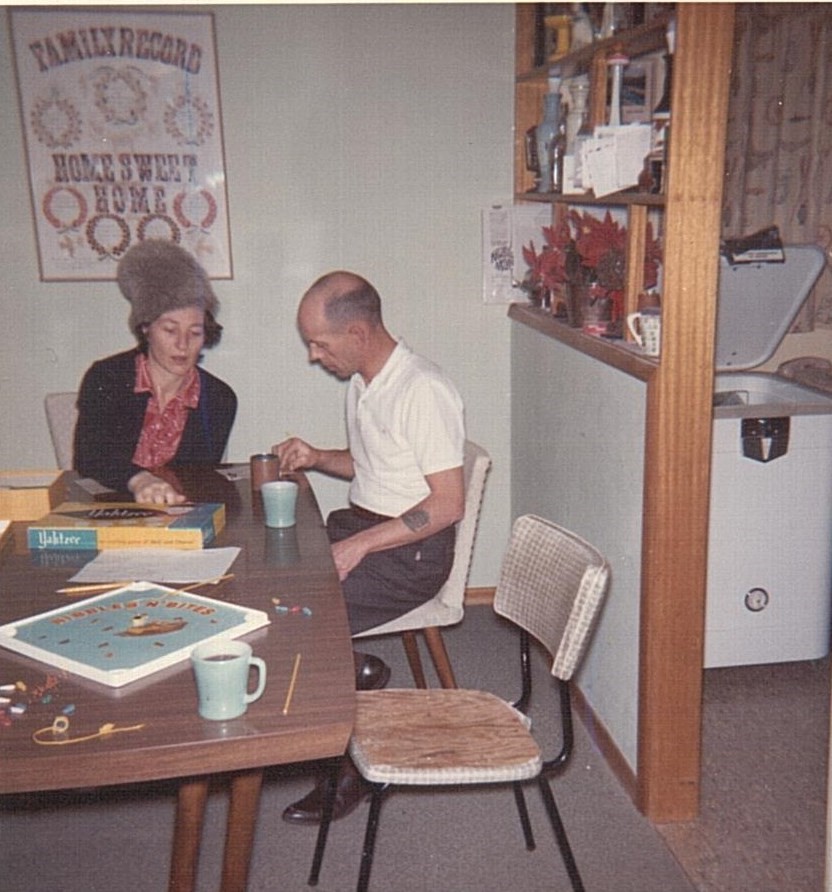
The tiny house as it looked in the 1960’s – before the addition and before new chairs.

Somewhere around two in the afternoon I am in my room just sort of hanging out when I hear a loud ‘thump.’ Being home and alone there is a niggle of fear which this noise inspires. So I leave my room and walk the entire house. Which doesn’t take long since it is a ranch house and, as I said, only 1300 square feet. The doors are all secure and I can find no evidence of anyone trying to break in.

I return to my room and  some time later I hear another ‘thump.’ I am truly mystified. I know it’s coming from somewhere within the house, but cannot figure out where.

By this time there’s another phenomenon in play. There’s a yeasty sort of smell permeating the air, as if someone is baking bread. But, since I do not know how to cook and no one else is home, that is also a mystery.

Fast forward to about midnight. My brother arrives home. I tell him about the two thumps (verified by my Diary entry from the next day, September 26th) but, like me, he’s mystified. A short time later he goes to his room and opens the closet and I think some sort of expletive may have escaped his lips.

Of course I hurry across the hall and peer into the closet. There’s yellow slime on everything and what appears to be a couple of cans of my mom’s precious peaches with their side seams opened up.

The brother – who’s tired after working all day – decides to shut the closet door and go to bed. Right.

And then our parents get home and my mom immediately notices the smell. We tell them about the slime, the split cans, and the thumps. An evaluation of the canned peaches reveals a swelling of the containers and its determined they need to be removed from the closet to the outside. While my parents are doing this, I’m in my brother’s room. He’s in bed and I’m standing about four feet from the open closet. According to the diary:

“one box was still in there (the closet). I heard a fizzing sound, said ‘oh no’ and a can blew up on us.”

My diary entry does not begin to describe what actually occurred. My brother and I heard the sound at the same moment and locked eyes in mutual understanding of what was about to happen. I dove for the side of the bed away from the open closet while my brother yanked the blankets over his face for protection. The can blew. Little bits of vomited peach rained down on us, splattering the walls and ceiling. And then we started to laugh hysterically.

The last flat of botulism laden peaches were expedited to the back yard where my dad – in some sort of sacrificial ritual worthy of Brits at Stonehenge – used an ice pick and a hammer to puncture each and every can. From the small hole an arcing stream of peach guts formed an impressive pureed rainbow across the crisp, black September night.

My mother never went back to that cannery. She found one in Ellensburg it seems and went there for a few years until they closed down. From then on, canned peaches were purchased from the grocery store shelves. Which is kind of anti-climatic after the great exploding peaches event of 1970.

Okay, I’m weird. There’s something satisfying about being able to get the peel of a peach removed in one piece.

A couple of useful links:

https://en.wikipedia.org/wiki/Canning

https://visitfarmfreshfun.com/yakima-valley-produce-schedule.asp

Celebrating Robert Redford: Hollywood’s Golden Heartthrob

A Movie Star for the Ages

August 18

1973 was a pivotal year for this actor, his role in Butch Cassidy and the Sundance Kid (BC&TSK) catapulted him to the stratosphere of Hollywood stardom. Robert Redford, who turned 37 that year, didn’t look a day over 30 and for women – young and old alike – he became a sex symbol. Happy 89th birthday to, perhaps, the most successful actor of the late 20th century, who was born on August 18, 1936.

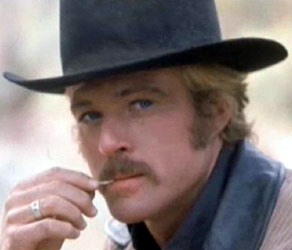
Redford as The Sundance Kid

Prior to his breakout role in BC&TSK, Redford found his first acting roles on Broadway which then led to television. These roles eventually brought him to the big screen with his first significant role as the male lead in the 1967 movie Barefoot in the Park opposite Jane Fonda.

But Redford was not content to be typecast due to his looks, passing up lead roles in both The Graduate and Who’s Afraid of Virginia Woolf. In BC&TSK, however, he found a role which resonated with him and a co-star in Paul Newman which proved to be box office gold.

Over the next several years, Redford had hit after hit. According to the Infallible Wikipedia:

“Starting in 1973, Redford experienced an almost unparalleled four-year run of box office success. The western Jeremiah Johnson’s (1972) box office earnings from early 1973 until it’s second re-release in 1975 would have placed it as the No. 2 highest-grossing film of 1973. The romantic period drama with Barbara Streisand, The Way We Were (1973), was the 11th highest-grossing film of 1973. The crime caper reunion with Paul Newman, The Sting (1973), became the top-grossing film of 1974 and one of the top 20 highest-grossing movies of all time when adjusted for inflation, plus landed Redford the lone nomination of his career for the Academy Award for Best Actor. The romantic drama The Great Gatsby (1974) was the No. 8 highest-grossing film of 1974. As well, 1969’s Butch Cassidy and the Sundance Kid placed as the No. 10 highest-grossing film for 1974 as it was re-released due to the popularity of The Sting. In 1974 Redford became the first performer since Bing Crosby in 1946 to have three films in a year’s top ten grossing titles. Each year between 1974 and 1976, movie exhibitors voted Redford Hollywood’s top box-office star. In 1975, Redford’s hit movies included 1920s aviation drama, The Great Waldo Pepper (1975), and the spy thriller Three Days of the Condor (1975), alongside Faye Dunaway, which finished at Nos. 16 and 17 in box office grosses for 1975, respectively. In 1976 he co-starred with Dustin Hoffman in the No. 2 highest-grossing film for the year, the critically acclaimed All the President’s Men. In 1975, 1977 and 1978, Redford won the Golden Globe for Favourite World Film Star, a popularity-based award that is no longer awarded.”

Paul Newman and Robert Redford in the Academy Award’s 1973 Best Picture “The Sting.”

Of course not all his films were box office winners and, like so many celebrities, age puts certain roles and images out of reach. But Redford was, perhaps, the most committed actor of his generation, turning to directing and producing when acting had all but played out. His most significant achievement post Hollywood heartthrob was in the creation of the Independent movie festival, Sundance.

Held annually near Provo, Utah, the Sundance Film Festival has become the place to launch independent films. In 2008, for example, 125 such films premiered at the festival.

Although Redford officially retired from acting in 2018, there is little doubt that his legacy will be felt for years to come.

It’s so very difficult to pick a favorite Redford role and film. As a romance writer, for me there is perhaps no sadder film than The Way We Were… the 1973 hit with Barbra Streisand. It’s a film which very much influenced me creatively. The storyline was compelling to this angsty 16 year old, rooting for the pair to live happily ever after. That is not how that story ends, however, and somehow I felt sorry for both of the main characters. Redford is outstanding in the role and one believes he is the golden boy Hubbell who wants and needs the perfect life and wife, frustrated by Katie’s strident politicization of everything around her. That said, from a teenagers perspective, he was so very likable, while Streisand was not.

But he was also terrific in All The President’s Men, Three Days of the Condor, and The Electric Horseman.

In the past few years I’ve connected with one of my Dad’s former students, Lisa, on Facebook. The same age as me, she is not at all shy about her lifetime love of Robert Redford. I would bet you a dozen doughnuts by the time you read this, she will have already posted birthday greetings to her high school (and beyond!) crush. And I will, as I have the past several years, give her a bad time about it. I mean, Redford is over 20 years older than either of us… but that doesn’t matter to her. She loves all things Robert Redford.

As for me, I picture Robert Redford in my head during the final scene from The Way We Were. Moments earlier he – along with his new paramour – have a chance meeting with Streisand. He returns to where she is passing out ‘Ban The Bomb’ fliers. From the look on her face, you know she still has a thing for him and why wouldn’t she? He’s devastatingly handsome… a shock of wavy blonde hair down across his forehead, suggestive blue eyes that seem to know it would never work, upturned coat collar, and his square jaw and ever so sardonic slight curve of the mouth. That’s the Robert Redford who captured the hearts of millions of women around the world. And if we had the chance to do it all again, would we? Could we? In a heartthrob’s beat, yes.

A few links:

https://en.wikipedia.org/wiki/Robert_Redford

https://en.wikipedia.org/wiki/Butch_Cassidy_and_the_Sundance_Kid

https://en.wikipedia.org/wiki/The_Way_We_Were

Where Were You in ’62? American Graffiti

1973 was the defining year for Baby Boomers

August 11

AMerican graffitiWhen one thinks of Modesto, California, it is likely to be associated with an American experience which occurred primarily from the 1950’s through the 1970’s. Having a car had become a status symbol and driving it among one’s peers – or cruising as its known – became an essential element of growing up. On August 11, 1973, the film American Graffiti was released, serving to enshrine the cruiser phenomenon into our shared culture.
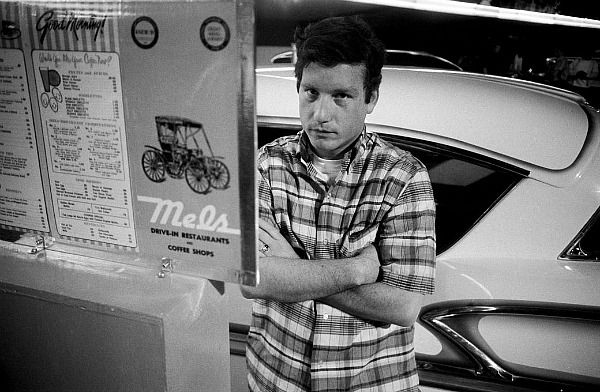
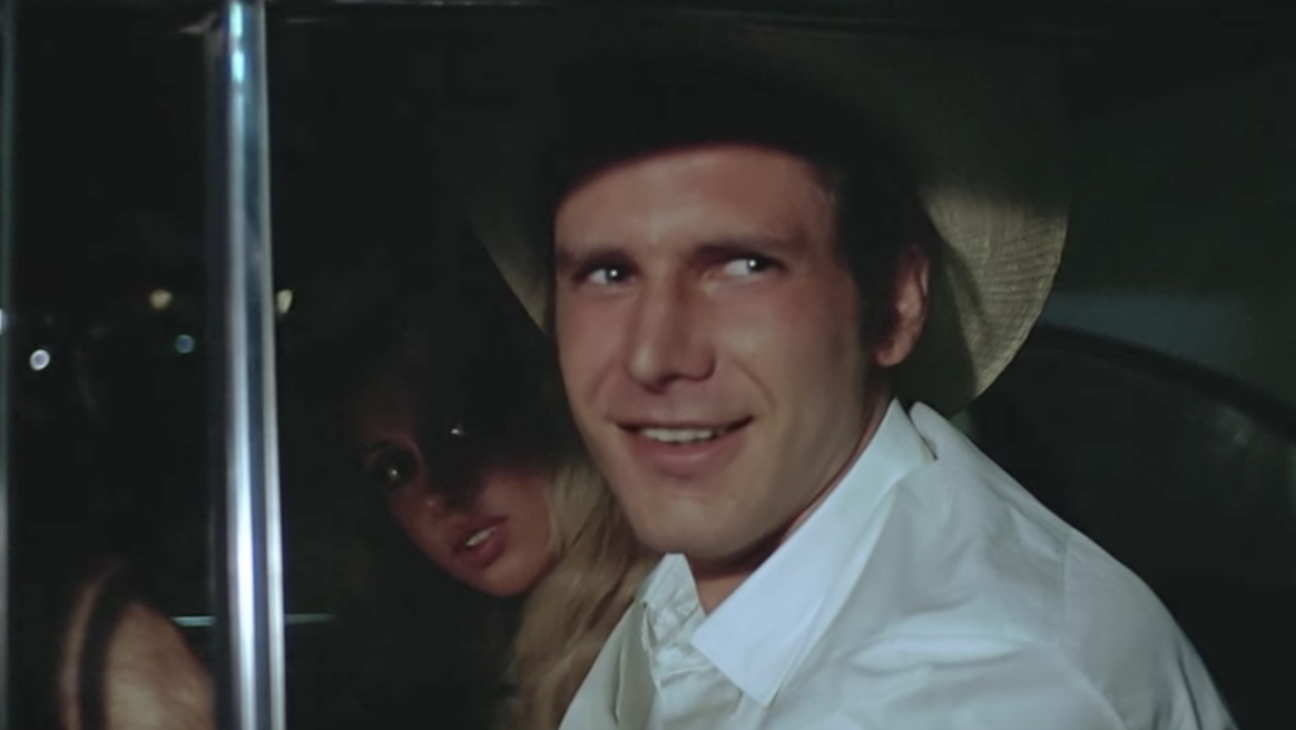
The film was a dark horse hit that year, capturing five academy award nominations including one for best picture. It was George Lucas’ first film, show-casing his talent as an ‘outside the box’ filmmaker.

The original budget was only $600,000, which forced Lucas to use mostly unknown actors, a limited film crew, and to secure low cost contracts for the music. The lack of money kept the film from having an original soundtrack, only two cameramen, and truly launched the careers of Richard Dreyfuss and Harrison Ford.

To encapsulate the main plot, we turn to the Infallible Wikipedia:

“On their last evening of summer vacation in September 1962, recent high school graduates and longtime friends Curt Henderson and Steve Bolander meet two other friends, John Milner, the drag-racing king of the town, and Terry ‘The Toad’ Fields, in the parking lot of the local Mel’s Drive-In in Modesto, California. Curt and Steve are scheduled to travel ‘Back East’ the following morning to start college. Despite receiving a $2,000 scholarship from the local Moose Lodge, Curt has second thoughts about leaving Modesto. Steve gives Terry his 1958 Chevrolet Impala to care for until he returns at Christmas. Steve’s girlfriend, Laurie, who is also Curt’s sister, arrives in her car. Steve suggests to Laurie, who is already glum about him going to college, that they see other people while he is away to ‘strengthen’ their relationship. Though not openly upset, she is displeased, which affects their interactions the rest of the evening.”

Rather than have a main protagonist, Lucas saw the four main male characters has being equal, all based on various stages of his adolescent self. Although somewhat cliché’ now, the four loosely represent the college man, the popular guy, the nerd, and the greaser. The entire movie takes place during the one night and culminates the next morning with information as to what happens with each of the four. At the time it was a unique storytelling method.

As word started to get around Universal Studios that the film was good, funds were put in place for marketing and other studio support. It paid off. Also from the Infallible Wikipedia:

dreyfuss

Richard Dreyfuss as Curt Henderson

“Produced on a $777,000 budget, it has become one of the most profitable films of all time. Since its initial release, American Graffiti has garnered an estimated return well over $200 million in box-office gross and home video sales, not including merchandising. In 1995, the United States Library of Congress deemed the film ‘culturally, historically, or aesthetically significant’ and selected it for preservation in the National Film Registry.”

hARRISON FORD

Bob Falfa, aka Harrison Ford

Perhaps the thing I find most interesting about this film as well as others from the 1970’s (see my post from July 28th on the film Animal House; link below) is that the adults in charge at that time truly did not understand the impact the Baby Boomers exerted on the culture. 1973, the year that American Graffiti appeared, there were 37 million teenagers and another 21 million in the generation were ages 20 to 27. For those 58 million people the storylines in American Graffiti resonated.

On the day the movie was released I was 16 years old, possessed a ten day old driver’s license, and lived in a city where the cruising culture was king.

yakima mid 1960's

This is the Yakima I remember as a girl in the 1960’s. I’ve seen this photo dozens of times and the bustle never ceases to amaze me.

Everyone there knew the term “Dragging the Ave” which meant cruising up and down Yakima Avenue. Initially, I was forbidden by my parents to drive on the Ave after dark. But, being the youngest of four, the other three had done an outstanding job of bending the rules for me and I’m not sure what, exactly, happened, but by the time I was a junior in high school, I was a regular in the Friday and Saturday night promenades.

One thing I never did was drag the ‘Ave’ solo. I participated with a variety of friends, but my frequent partners in crime were my two best buddies who – to provide them a bit of anonymity – will henceforth be called by their aliases Deborah and Cynthia.

On the particular night which stands out, it was Deborah riding shotgun. A warm summer’s evening and the opportunity to see and be seen was at its best.

SchoolLogo_1403Now, in Yakima in the mid-1970’s, there were two major high schools: AC Davis and Dwight D. Eisenhower (IKE). Yes, there were other high schools in the surrounding communities, but those two were the biggies. We attended IKE.

To us, those who attended Davis were cross-town rivals and somewhat of a mystery; a forbidden fruit, if you will. Although we recognized a few who attended Davis, for the most part we didn’t know them and they didn’t know us.davis

So Deborah and I are driving along and, at one of the stoplights, a car carrying a couple of guys is idling next to my car and we engage in a shouted conversation between the two vehicles. Mostly it’s Deborah doing the talking out the passenger side window. There’s flirting and banter. The light changes, we drive on.

At the next light, or perhaps the one after, first names are exchanged. Then one of the guys says to Deborah, “what’s your last name?”

To which she replies, “Guess.”

The two of us giggle away as the guys venture forth with such answers as “Smith? Jones?”

Deborah replies, “Nope.”

More names are proffered then followed by the same question “what’s your last name?”

And the same answer “Guess.”

This went on for at least two runs up and down Yakima Avenue as the guys try to get us to stop and meet them in person. The name guessing continues until Deborah says to me “These guys are not very bright, are they?”

All because they kept asking the same question and never understanding that she was, in fact, telling them her last name. Every. Single. Time. By now you, the reader, should have ‘Guess’-ed it, but they never did.

Once we became bored with the game, I managed to ‘lose’ them and soon the night was over and by the time I was 19 or 20, ‘Dragging the Ave’ had lost its appeal, relegated to the status of a cultural reference.

Thanks to American Graffiti, that phenomenon is preserved. Future generations who happen upon the movie will, perhaps, regret that they did not live in the era of muscle cars, cheap gas, and summer nights dragging the Ave.

Although the tagline was ‘Where were you in ’62?’, it was the summer of ’73 and American Graffiti which was the defining year for the Baby Boomers.

The links:

https://en.wikipedia.org/wiki/American_Graffiti

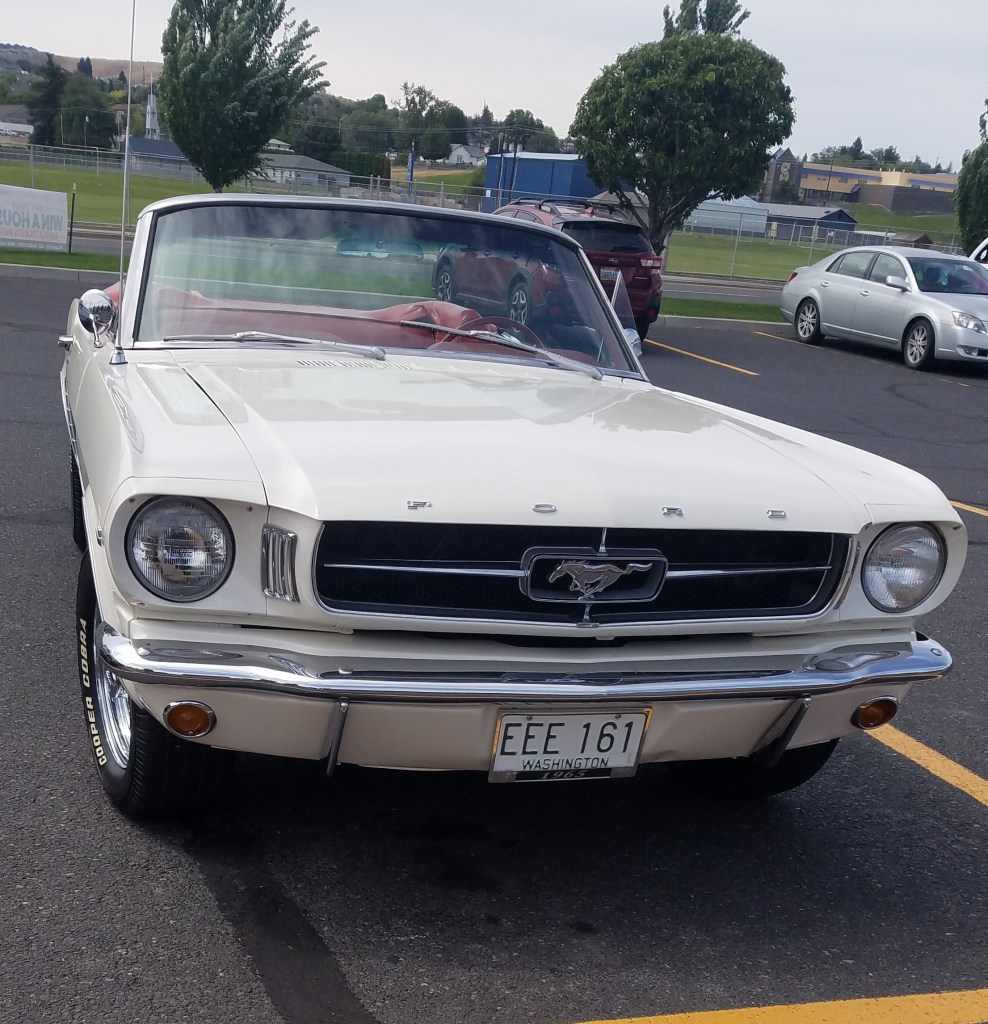
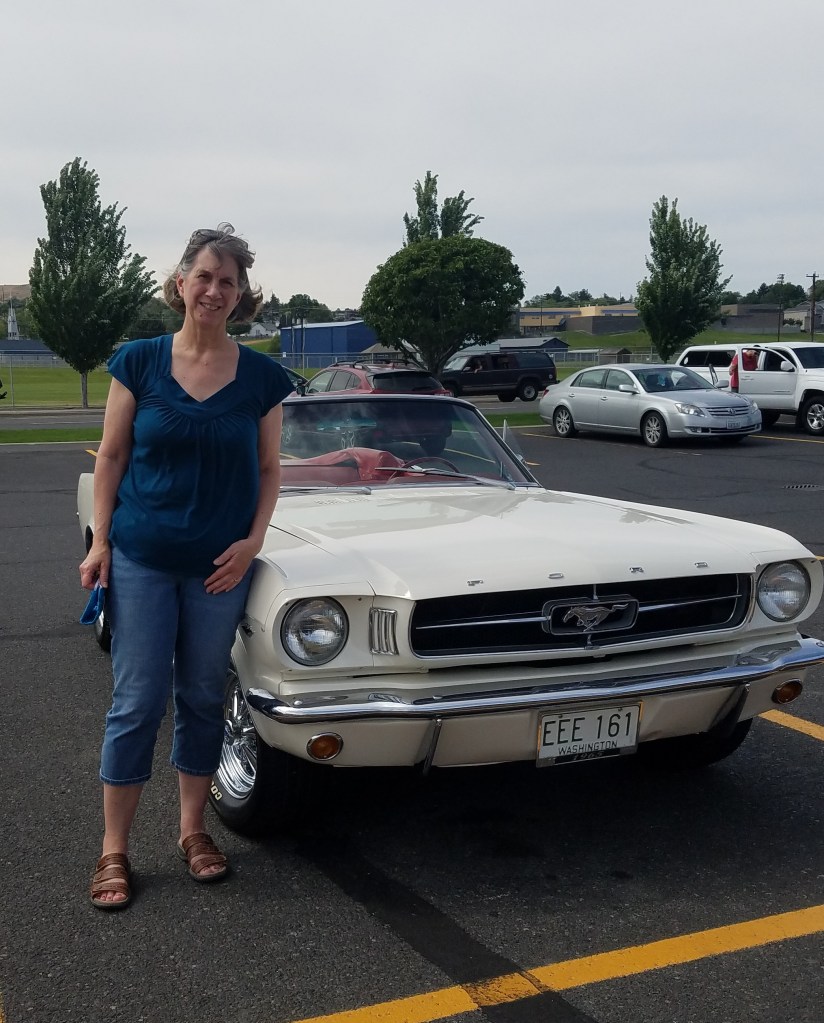
https://barbaradevore.com/2018/04/17/1965-ford-mustang

https://barbaradevore.com/2020/07/28/animal-house

Take The Plunge!

The Swimming Pool

July 23, 2019

With the extreme temperatures which have gripped much of the United States the past week, people – especially parents with kids at home – often seek out water as a way to find relief.

It’s appropriate, then, that the first swimming school in the U.S. opened on July 23, 1827, in Boston, Massachusetts. The proprietor, German immigrant Franz Lieber, believed that swimming was a healthy activity necessary to aid a boy’s growth.  Unfortunately, the swimming school failed after two years

public_bath_interior

First public pool in Brookline, Massachusetts

Now I can’t find the reason for this failure except to say that it might have been due to the absence of a heated water holding area where his young charges could safely swim. If those boys were forced to swim in the Charles River, they likely found it somewhat unpleasant. Alas, it was another 60 years before the first public swimming pool opened in nearby Brookline.

Over the years, the swimming pool has become a staple of American life; a desired amenity for traveling Americans and nearly a requirement for suburban homes across the southern half of the nation.

In my research I found some interesting ‘records’ for pools. From the Infallible Wikipedia:

“According to the Guinness World Records, the largest swimming pool in the world is San Alfonso del Mar Seawater pool in Algarrobo, Chile. It is 1,013 m (3,323 ft) long and has an area of 8 ha (20 acres). At its deepest, it is 3.5 m (11 ft) deep. It was completed in December 2006.

The largest indoor wave pool in North America is at the West Edmonton Mall and the largest indoor pool is at the Neutral Buoyancy Lab in the Sonny Carter Training Facility at NASA JSC in Houston.

In 2014, the Y-40 swimming pool at the Hotel Terme Millepini in Padua, Italy became the deepest indoor pool at 42.15 m (138.3 ft), certified by the Guinness Book of World Records. The recreational diving center Nemo 33 near Brussels, Belgium previously held the record (34.5 m (113 ft)) from May 2004 until the Y-40 was completed in June 2014.

Fleishacker pool San Francisco

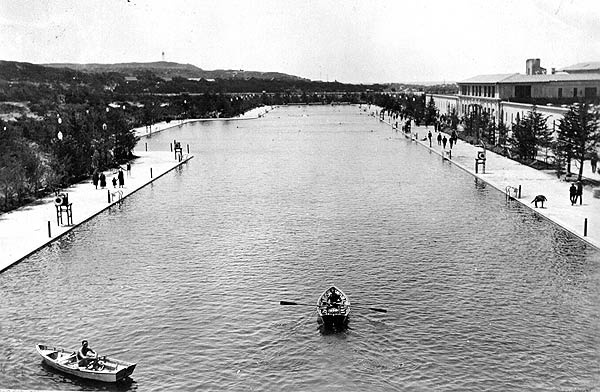
Fleishhacker Pool which was really more of a man made lake complete with boats

The Fleishhacker Pool in San Francisco was the largest heated outdoor swimming pool in the United States. Opened on 23 April 1925, it measured 1,000 by 150 ft (300 by 50 m) and was so large that the lifeguards required kayaks for patrol. It was closed in 1971 due to low patronage.

In Europe, the largest swimming pool opened in 1934 in Elbląg (Poland), providing a water area of 33,500 square metres (361,000 sq ft).

One of the largest swimming pools ever built was reputedly created in Moscow after the Palace of Soviets remained uncompleted. The foundations of the palace were converted into the Moskva Pool open-air swimming pool after the process of de-Stalinisation. However, after the fall of communism, Christ the Saviour Cathedral was re-built on the site between 1995 and 2000; the cathedral had originally been located there.

The highest swimming pool is believed to be in Yangbajain (Tibet, China). This resort is located at 4200 m AMSL and has two indoor swimming pools and one outdoor swimming pool, all filled with water from hot springs.”

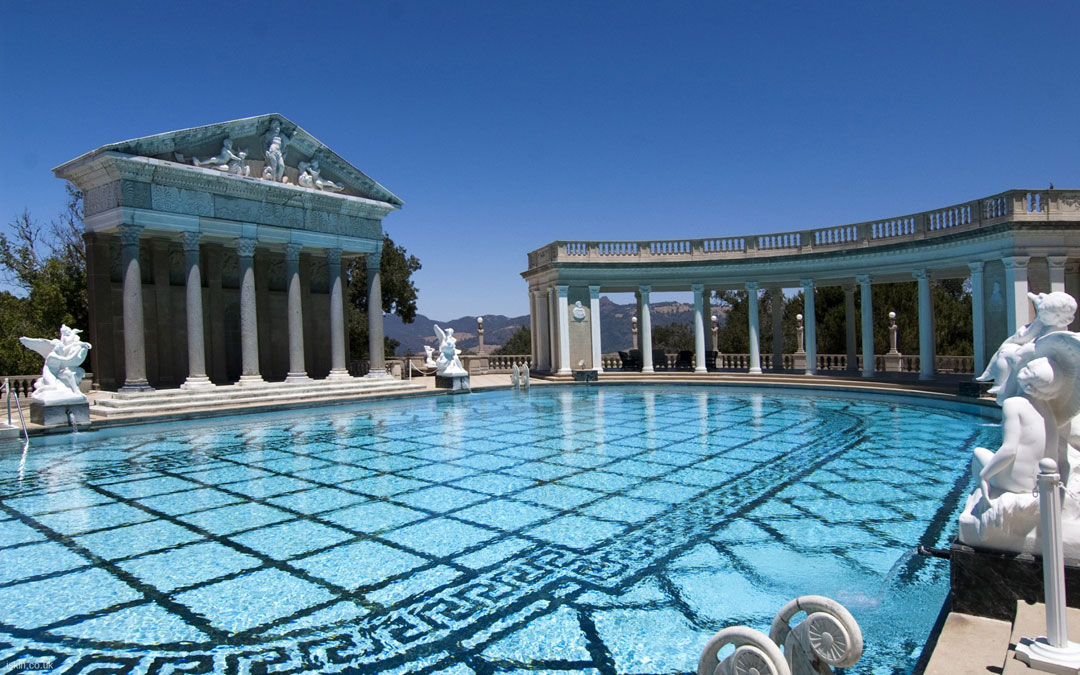
Hearst castle pool

One of the world’s most iconic and beautiful pools located at Hearst Castle in California.

If you want to really indulge in pool envy one needs only to watch the HGTV show “Ultimate Pools” which features beautiful private oases of the rich but not famous.

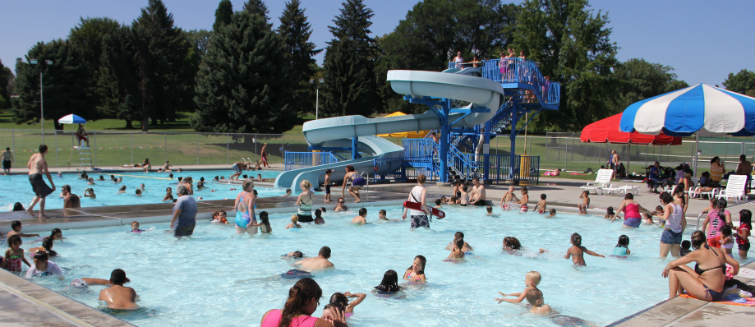
Having grown up in Yakima, Washington, the hot, dry summers made it a natural spot for pools to proliferate. When my family moved there in the early 1960’s, however, very few families I knew had built in backyard pools. Instead, the first ‘pool’ I recall was about the size of large area rug and constructed of industrial canvas and metal poles. It was no more than 18 inches tall. Once it was filled with icy cold water my sister and I would, on hot days, lay in the shallow water to cool off.

For my 7th birthday a new pool arrived. It was round and about the size of a small bedroom. Its hard plastic walls stood about 3 feet tall and it was definitely an upgrade.  It was during this time, however, that I was introduced to the public swimming pool. The best summer days were those when we got to go down to Franklin Park – about a mile from our house – and pay our 10 cents to swim.

Franklin-pool-1

I was unable to find an historic photo of the death board at Franklin Park. It was located on the other side of the water slide in the original pool. The pool in the foreground was added sometime after 1980.

It seemed as if we were gone all day but I’m pretty certain it was only for a couple of hours. The pool was constructed in an ‘L’ shape with one area being the shallow end and the other being the terrifying end. In the years I went to Franklin pool there was one thing I never did. I never jumped off the high dive board. I can still see that board, suspended over the deep end, beckoning me like the death trap I was certain it must be. Yet other, much braver, young souls would scale the ladder, walk the plank, and then plunge 47 feet to their death.  Okay, so maybe it wasn’t 47 feet. More like fifteen. And to the best of my knowledge no one ever died. But I was not taking any chances. Mostly I got cold after a short time swimming and would go hang out in the locker room with the girl who worked there. I remember her name was Nancy and she was in high school and very kind to this annoying child.

It was in the summer of 1973, however, that things really changed. That was the year my parents decided to put a pool in the backyard of our home. What an exciting summer that was. One morning a crew arrived with backhoes and soon there was a huge hole behind our house. For several weeks we watched the daily progress until one day in late summer the pool was complete and the hoses began to flow.

That pool was the dream of every teenage girl. A diving board was set just above the water so no death defying plunges were required; and it featured a curved water slide that flung the rider into the pool.

Pete demonstrating the water slide September 1973

My brother demonstrating proper use of the water slide. September 1973

As for me, I still got cold far too easily and discovered that the best way to ‘swim’ was with the aid of an air mattress. Hours were spent each of the next several summers floating on my conveyance about the pool, getting in the water when I got too hot, but would soon return to the lazy comfort of my air mattress.

Barb 1973 during pool construction

16 year old me out investigating the pool construction site August 1973. They had to remove a deck at the side of the house to access the yard. (behind me)

Eventually the upkeep of the pool became too much and was one of the factors which prompted our parents to sell the house and move in 1984. What great memories I have of those summers in the 1970’s and the hours spent afloat on that pool. When we are young we often don’t appreciate something so special. Ah, to be 16 again with nary a care in the world and a pool to call my own!

As always a couple of links:

https://en.wikipedia.org/wiki/Swimming_pool

Pool envy:

https://www.hgtv.com/shows/ultimate-pools

History of pools:

https://www.swimmingpool.com/pool-living/pool-history-facts-and-terms/history-pools

…The Mahre Brothers

Olympic Champions with Silver & Gold

February 19, 2019

Phil and Steve Mahre. PHOTO: Lori Adamski-PeekThis pair of skiers are, no doubt, the most famous Washingtonians to win Olympic medals. It was on February 19, 1984 when the twin brothers slalomed to gold and silver, being the first siblings to compete and place in the same event.

Phil and Steve Mahre were born on May 10, 1957, in Yakima, Washington.  They grew up at White Pass which, as fate would have it, tends to be buried under snow some six months each year. It was there they learned to ski. And learn they did. Phil – the oldest of the two by four minutes – won 27 World cup races during his career, the fourth highest number for an American.

It was, however, the dramatic competition in Sarajevo which cemented the twin’s legacy and also focused attention on the Pacific Northwest. From the Infallible Wikipedia:

“At the 1984 Winter Olympics in Sarajevo, Mahre again medaled in the slalom, this time taking the gold while Steve won the silver for a Mahre twin 1–2 sweep. Steve had led the first of two runs, skiing flawlessly and building a large half-second lead over Swede Jonas Nilsson with Phil in third place, another two-tenths back. Phil skied a fine second run to grab the lead, then Nilsson skied next and faltered, dropping out of the medals. Steve skied down last, needing only a solid run to take the gold, but a series of mistakes dropped him into second place, and Phil became the Olympic champion. Meanwhile, unknown to the racers, Phil’s wife Holly had given birth to their second child, a son, in Arizona an hour before the race started. Phil did not find out about it until a TV interview after the race.

phil-mahre-vault-slalom-sarajevo-olympics.jpgThe Mahres won two of the five alpine skiing medals taken by Americans, all from the Northwest. Portland’s Bill Johnson (downhill) and Seattle’s Debbie Armstrong also won gold and Christin Cooper of Sun Valley took the silver for an American 1–2 finish in the women’s giant slalom.”

It was probably around 1974 when I first heard about the Mahre brothers. I had friends who went to school in Naches with the brothers. It was fun over the next nine years to follow their career and cheer for them in the Olympics. It was shortly after the 1984 gold-silver win when the brothers retired from competitive skiing, their spot in the history books cemented.

As I was working on this article I was reminded of a story told by a gal who grew up in Wenatchee and learned to ski at Mission Ridge. Rosemary was a few years older than I but we both worked in the telemarketing cube farm for Microsoft in the winter of 1983. She and I covered the west coast, me California and she the Pacific Northwest. What I most recall about her were her stories. It was always fun to listen to her tales of adventure as a single woman. And she was fearless. Despite the many things she had done, her persona was that of an airhead. Personally, I think it was all an act which she used to disarm people.

In the winter of 1983, Rosemary decided to join a Microsoft group that skied together. The ensemble consisted of a half dozen software programmers and her, the lone female. On one particular Monday in late January or February, she came in to work and related to me that she had gone skiing with the guys for the first time. She had ridden the lift to the top with one of the programmers and when they skied off the chair, the pair found themselves at the top of a slope filled with moguls.

the_mogulsHer fellow skier asked her if perhaps the black diamond run might be a bit difficult and would she like to try something easier?

“Oh no. I think I can handle it,” she replied, then said to him “Why don’t you go first.”

Which he did. And barely managed to stay upright as he picked his way down the bumpy slope. What happened next, according to Rosemary’s story, was epic. She adjusted her goggles, took firm control of her ski poles, and flew down the hill, attacking the moguls like a boss.

Her partner, still staring at her open mouthed as she swept up next to him at the bottom, managed to ask, “Where did you learn to ski like that?”

To which she replied “I was on the 1968 Olympic B team.”

Oh yes, there was so much more to Rosemary than met the eye.

Despite having grown up an hour’s drive from White Pass, I did not learn to ski until I was in my mid-20’s. In fact I took my first ski lessons in the early 1980’s. The hubby and I – along with his sister and Mom – spent several days at Whistler during the 1984 Olympics watching the events in Sarajevo in the evenings at a pub, cheering on the Mahre’s  and the rest of the American’s in their quest for gold.

While I never once came close to skiing like either Phil or Steve Mahre or my co-worker Rosemary, I did have an appreciation and awe of what they could do with a pair of boards and a couple of sticks in the snow. I felt an incredible pride when, in February 1984, the twins from little ole Yakima, Washington, won Olympic silver and gold.

As always, a few links of interest:

https://www.seattlepi.com/sports/article/Where-Are-They-Now-Phil-Mahre-1984-Gold-Medalist-1195145.php

https://en.wikipedia.org/wiki/Phil_Mahre

https://en.wikipedia.org/wiki/Alpine_skiing_at_the_1984_Winter_Olympics

Ted Ligety won two gold medals, 8 years apart… his 2014 Medal was also won on February 19! Although Bill Johnson also won gold in 1984, his medal was won on February 15, four days earlier than Phil Mahre.

… Barnum’s Animal Crackers

Statue of Paul Revere in Boston

… on the porch

April 18, 2023

This is an update to a Tuesday Newsday Classic from April 18, 2017

April 18th… it conjures up that most famous poem by Longfellow which begins…

“Listen my children and you shall hear
Of the midnight ride of Paul Revere,
On the eighteenth of April, in Seventy-five;
Hardly a man is now alive
Who remembers that famous day and year.”

But that’s not the important topic this week. Nor is our topic the catastrophic earthquake which all but destroyed San Francisco on April 18, 1906.

No, today we honor the Animal Cracker. Yes, April 18 IS “National Animal Cracker Day.”

The crackers were first imported to the United States from England in the late 19th Century. They proved so popular that Stauffer’s Biscuit Company began production in York, Pennsylvania in 1871. It was in 1902 when they became known as ‘Barnum’s Animals’ and were packaged in the circus themed boxes which are so recognizable. Just prior to Christmas that year a string was added to the box so the cookies could be hung on a tree. Now, over 100 years later, the boxes still retain the string but I doubt many know why there is a string!

Some other interesting facts from the Infallible Wikipedia:

animal crackers“Barnum’s Animals Crackers are all produced in the Fair Lawn, New Jersey, bakery by Nabisco Brands. More than 40 million packages of Barnum’s Animals Crackers are sold each year, both in the United States and exported to 17 countries worldwide. The cookies are baked in a 300-foot (91 m)-long traveling band oven. They are in the oven for about four minutes and are baked at the rate of 12,000 per minute. About 15,000 cartons and 330,000 cookies are produced in a single shift, using some 30 miles of string on the packages. This runs to nearly 8,000 miles (13,000 km) of string a year. Those bright circus boxes are produced in three colors – red, blue, and yellow – with different variety of animals on each.”

I know all of you would be disappointed if I didn’t share some personal anecdote which relates to our topic. So with apologies to Longfellow, here it goes:

Listen my readers and you shall hear
of the midnight antics from Senior year…
It cost but a quarter for of box of treats,
Yes Animal Crackers for boys that were neat.
Up to the front porch of our desire’s house
My friend Snide and I always sly as a mouse.
A poem attached to each as a clue
Just “who,” it asked, “left these cookies for you?”
The unlucky ones found bushes and trees
Draped with rolls and rolls of contraband TP
Animal Crackers, though, were more easily bought,
Since, heaven forbid, we didn’t want to get caught.

The animal crackers caper was a one year thing for me. The summer before senior year I had been dating a guy, but he had gone away to college in September of 1974. There were some letters exchanged, but it became obvious that the relationship was all but over. So, along with a few select friends, we had lots of free time on Friday and Saturday nights, especially since we were not the party hardy kind of girls.

There was this one guy from choir that I was maybe, sorta interested in. But I doubt he knew I existed.

To be sure, I’m not sure exactly how the whole animal crackers thing started. What I do know is that Toilet Papering houses was all the rage in the 1970’s but it was also a messy thing AND you were likely to get caught. There was another challenge in that local stores would not sell large quantities of it to teenagers, so obtaining it was problematic. Did I mention getting caught was not on my list of good ideas? Did I mention that I DID get caught once which was motivation to not have it happen again?

So instead of TP, we found the boxes of Animal Crackers at the 7-11 on 16th and Summitview Avenues in Yakima. We would then write out the poems on paper and tape them to the boxes. Finally, under cover of dark, we would drive to the street where the guy we liked lived, park a half a block away, and then sneak up to the porch to leave the cookies. We did NOT ring the doorbells or make any noise whatsoever. 

To this day I have no idea if these guys ever figured out who left the boxes. That’s not entirely true. In the spring of my senior year, having never gotten any traction with Choir Guy #1, I left cookies one night for a new one – Choir Guy #2 – who I had actually gotten to know during practice for the annual musical. I’m pretty sure HE knew who left the cookies. We ended up dating for two years. So apparently the great Animal Crackers caper worked at least once. And all for a quarter and a little creativity

For those who want to know more about these tasty treats I direct you to: https://en.wikipedia.org/wiki/Animal_cracker

Eisenhower High School’s Football coach lived just up the street from us… and was frequently adorned with TP from loving students. Photo of his house from the 1972 Reveille Year Book.