Tag Archive | food

Cherries!

One of summer’s best fruits

July 2, 2024

A Tuesday Newsday Classic Updated
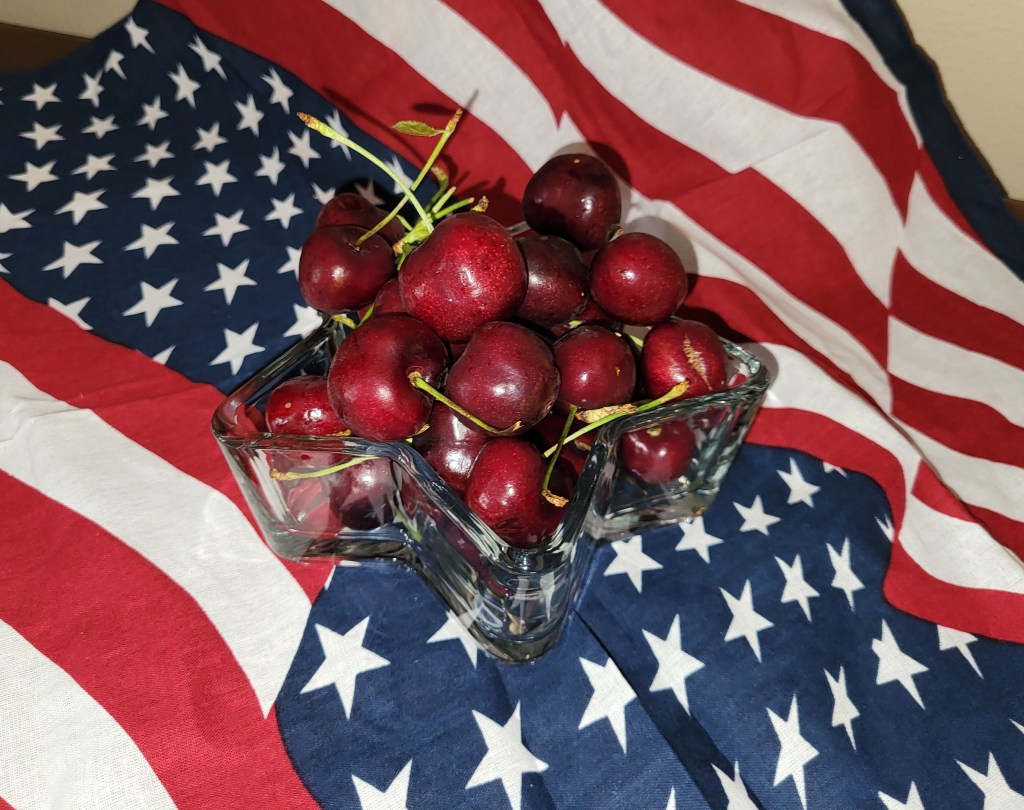
A few cherries purchased, not picked, at Fred Meyer.

The item which caught my attention for this week’s blog is the amusing ‘contest’ of cherry pit spitting. Yes, it’s a thing.

Held annually in Eau Claire, Michigan since 1974, the record ‘spit’ of a cherry pit is 93 ft 6.5 inches. The competition has been dominated by one family with the patriarch, Rick Krause, holding the record for longest spit (over 72 feet) until 1993. Since then, his son, Brian ‘Pellet Gun’ Krause has won 10 times with his record breaking discharge occurring the first week of July in 2003. In recent years Brian’s sons have also competed.

Others have stepped up to put their spitting skills to the test, but the Krause family continues to dominate.

Cherry pit spitter-champion Brian ‘Pellet Gun’ Krause

It is appropriate, therefore, as we celebrate all things red, white, and blue this week, to pay tribute to one of my favorite red things: the cherry.

Every July I can hardly wait for the harvest of this fruit to begin in the Yakima Valley. For there is truly nothing better than picking a cluster of the ruby orbs and (after they’re washed off) biting into the soft, juicy flesh. As a fan of the sweet varieties such as Bing and Sweetheart, an explosion of flavor reminds me how much I’ve missed them since the previous year.

The cherry has a long history of cultivation with evidence that the fruit has been grown since prehistoric times. From the Infallible Wikipedia:

“The English word cherry derives from Old Northern French or Norman cherise from the Latin cerasum, referring to an ancient Greek region, Kerasous (Κερασοῦς) near Giresun, Turkey, from which cherries were first thought to be exported to Europe. The indigenous range of the sweet cherry extends through most of Europe, western Asia, and parts of northern Africa, and the fruit has been consumed throughout its range since prehistoric times. A cultivated cherry is recorded as having been brought to Rome by Lucius Licinius Lucullus from northeastern Anatolia, also known as the Pontus region, in 72 BC.

Cherries were introduced into England at Teynham, near Sittingbourne in Kent, by order of Henry VIII, who had tasted them in Flanders.

Cherries arrived in North America early in the settlement of Brooklyn, New York (then called ‘New Netherland’) when the region was under Dutch sovereignty.”

In the United States, the first record of cherry trees being planted was 1639.

Sweet cherries are grown most successfully in Washington, Oregon, California, Wisconsin, and Michigan (hence the location of the cherry pit spitting contest). Most sour cherry varieties are grown in Michigan, Utah, New York and Washington.

To successfully grow cherries, the climate must have cold winters although varieties have been developed recently which have allowed California to compete in cherry production.

My relationship with the cherry has not always been an enjoyable one. In the 1970’s, my grandfather divested his properties to his two daughters and my father took over managing a cherry orchard. The orchard was repayment to my grandfather – a banker – from a loan gone bad some years earlier.

My Dad had never been a farmer but during the summer – when not a Junior High School history teacher – he was a hands on orchardist. It was natural, then, that my first summer ‘job’ as a teenager was picking cherries.
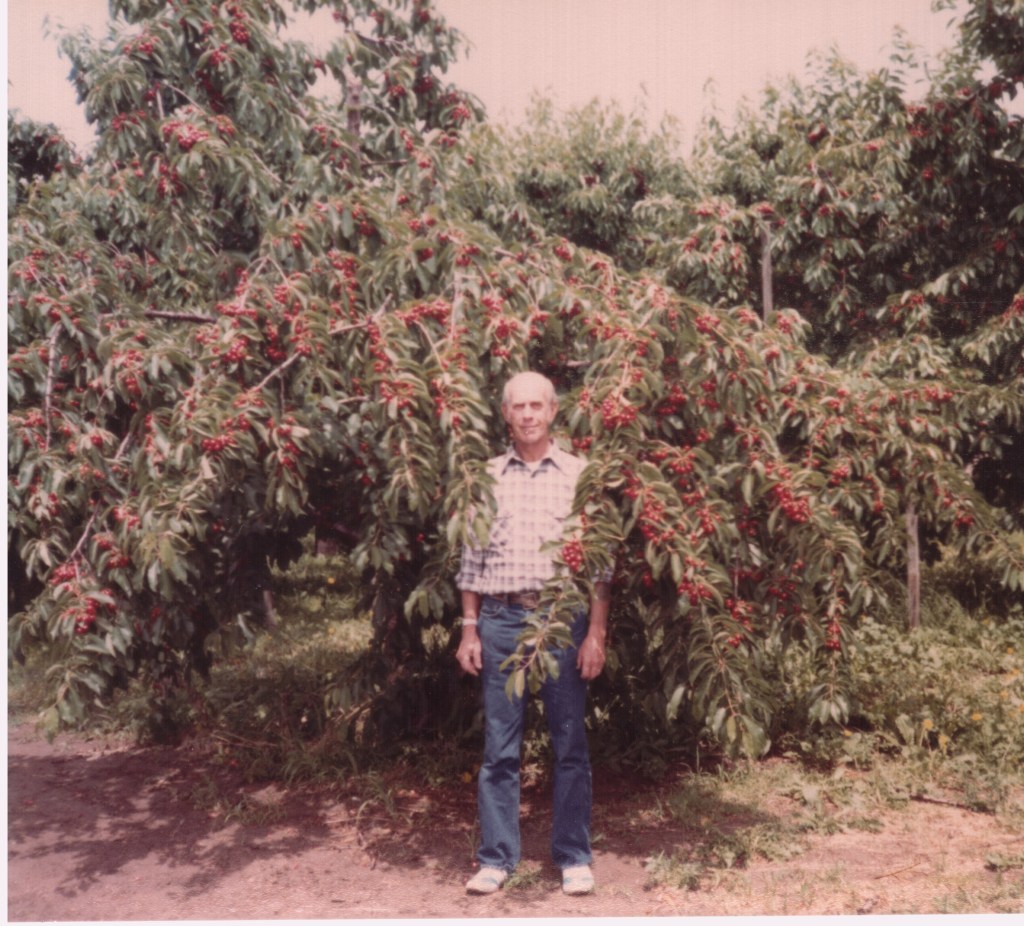
My Dad – schoolteacher turned orchardist – caught by a loaded cherry tree in Selah, Washington, circa 1980.

By early July in Yakima, summer is in full force and the weather usually turns quite warm. It is common for there to be a spate of days when the thermometer inches into the upper 90’s and low 100’s.  It’s then that the cherries ripen and harvest begins. For the pickers, work commences shortly after daybreak while the orchard is still cool.

One early July morning, with my then boyfriend and his younger sister, I arrived – along with all the migrant workers – to begin my job. Each person was assigned a tree, given a ladder and a bucket. Now when I say bucket, we are not talking about a pail like those favored by children at the beach. Nope. The metal buckets I knew held a lot of cherries, some four and half gallons worth. It took FOREVER to fill one up.

Different fruits require being harvested in certain ways. Picking cherries, it turns out, is quite the delicate operation. You must grasp the fruit at the very top of the stem where it is attached to the branch and gently twist so that the stem is removed from the branch without pulling the ‘spur’ off the tree. Then you place – never drop – the fruit into the bucket. Lather, rinse, repeat. My rough estimates are thus: a gallon is about 80 cherries. Multiply 4.5 gallons times 80 which is about 360 cherries for one bucket. For those who have never picked said cherries, it takes a long time to pick 360 cherries. Then there’s the ‘tree’. While about half of the first bucket can be picked while standing under it eventually you have to climb up a ladder – up to heights between 12 to 15 feet – while balancing your bucket of heavy fruit and reaching for the cherries.
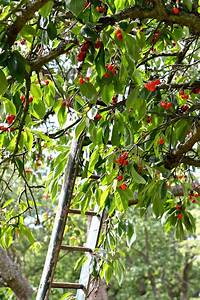
A requirement to pick cherries – a tall ladder.

Now what, you may ask, is ‘the spur’?” It’s a flexible knobby growth at the end of a branch or stem and if it’s pulled off, that spot will not produce cherries the next year. My father the orchardist was rather persnickety about those spurs being preserved, so I was careful. And slow.

By noon time – now having been there working since 5 a.m. – the heat would have arrived and I would have picked… drum roll please – seven whole buckets of fruit. That’s 2,420 cherries each day of harvest… and be paid seven whole dollars. So one dollar for a bucket of cherries. Some of the seasonal migrant workers could pick up to 200 buckets a day. I’ve never figured out how.

Yes, the job truly sucked. Although seven bucks went farther in nineteen seventy something than it does today. But it wasn’t a lot of money even then. I was lucky if I could pick for six or seven days and earn in the vicinity of $50.

I will say that a couple of summers as a cherry picker made me appreciate the delicious fruit even more. In the early 1990’s, my sister and her husband took over the reigns of the orchard which meant that each year there were delicious cherries to be had. More than once she brought a bag of the freshly picked delights to me.

A few days ago I broke down and purchased a bag at my local Freddies as I was not willing to wait until a visit to Yakima in a couple of weeks. I jealously guard my cherries, making the bounty last until late July or even early August. As luck would have it they are not the hubby’s favorite fruit.

By the time August rolls around I will have satisfied my craving for the fleshy fruit for another year. Maybe.

But the best part? I didn’t have to pick them!

A couple of links for you:

https://en.wikipedia.org/wiki/Cherry

http://memory.loc.gov/diglib/legacies/loc.afc.afc-legacies.200003151/default.html
The Artichoke

A culinary delight consumed for centuries

May 28, 2024

When I think about improbable foods, the artichoke is at the top of my list. Afterall, who would have looked at this thistle and thought, “I wonder if I can eat that without poking holes in my mouth?”

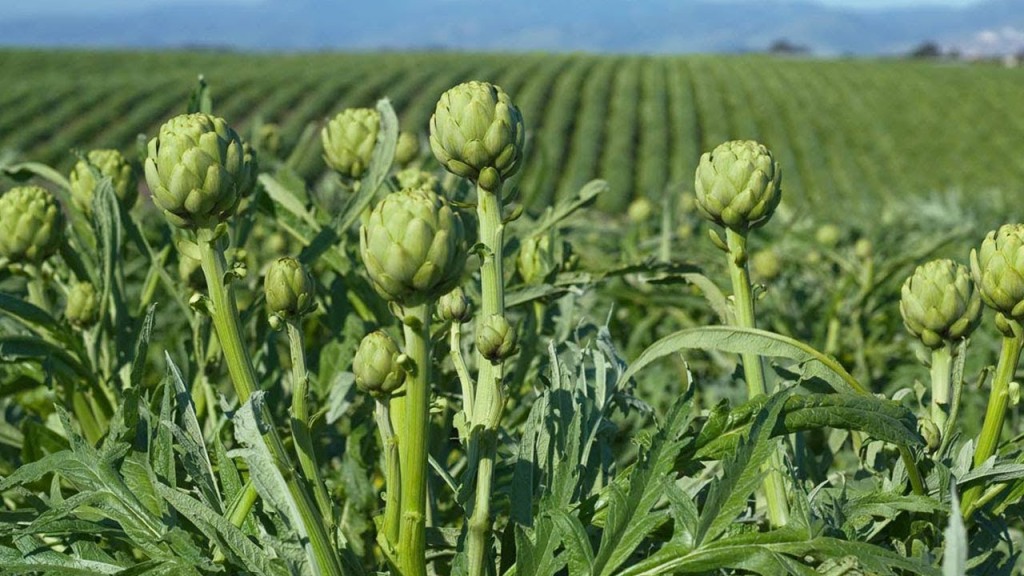
A field of artichokes

Yet, artichokes have been grown and cultivated since at least the eighth century BC.

The Infallible Wikipedia helpfully tells us:

“The (globe) artichoke is a domesticated variety of the wild cardoon (Cynara cardunculus), which is native to the Mediterranean area. There was debate over whether the artichoke was a food among the ancient Greeks and Romans, or whether that cultivar was developed later, with Classical sources referring instead to the wild cardoon. The cardoon is mentioned as a garden plant in the eighth century BCE by Homer and Hesiod.”

Based on further information in the Infallible Wikipedia, I came to the conclusion that the plant was, for centuries, considered a luxury food for royalty and the wealthy. It also developed a reputation as having aphrodisiac qualities.

It was the Dutch who brought them to England where they were successfully grown in Henry VIII’s palace garden in 1530. In the 19th century, immigrants transported the plant to the new world: Louisiana by the French and California by the Spanish.

Despite Henry VIII’s garden, until recently, the artichoke has only been successfully grown in warmer climates. If you look at a latitude map of the world which shows the areas where they cultivated, most are found in about a 350 mile wide band between the 30th and 37th parallels both north and south. Heartier varieties of the plant are being developed with promise of being able to be grown in northern climates.

Also from the Infallible Wikipedia:

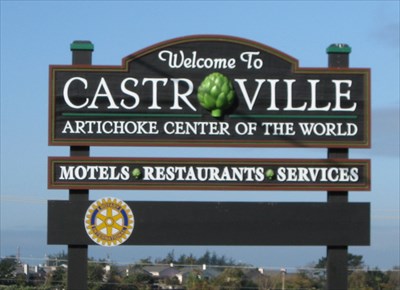
“Cultivation of the globe artichoke is concentrated in the Americas and the countries bordering the Mediterranean basin. The main European producers are Italy, Spain, and France and the main American producers are Argentina, Peru and the United States. In the United States, California provides nearly 100% of the U.S. crop, with about 80% of that being grown in Monterey County; there, Castroville proclaims itself to be “The Artichoke Center of the World” and holds the annual Castroville Artichoke Festival.”

The 2024 poster for the Castroville Artichoke Festival on June 8-9

I’m making a mental note to take in the Artichoke Festival which, apparently, is held the second weekend in June each year. This makes sense since artichoke ‘season’ is from March until June.

My first memory of artichokes is from when I was about six years old. One night when the family (Two parents and four kids ages 6, 8, 10, 15) sat down to dinner and in bowls at my parents’ places – and perhaps my oldest brother’s – were these green vegetable things with prickly ends and tough looking leaves.

Of course it begged the question “What are those?”

“Artichokes,” my mother replied, “but I don’t think you’d like them.”

Now anyone who understands reverse psychology would know that IF she wanted to save money she would have made artichokes for all and forced us to eat them. It likely would have been a one and done. But no. Instead the verbal gauntlet was tossed on the table like an, er, discarded artichoke leaf, and we begged to try the vegetable.

Every one of us liked them. A lot. That might have had something to do with the fact that we were allowed to dip the soft leaf ends in mayonnaise and smother the heart in whatever was left.

Over the years artichokes were a springtime treat for the family. And they still are. I continue to prepare them like my mom did, steamed for up to 40 minutes but instead of mayo, we dip the soft ends and the heart in melted butter.

I also love, love, love, pretty much anything that includes artichokes as an ingredient. Artichokes on pizza, artichokes in dips, or even artichokes preserved in olive oil eaten plain are all favorites.

There was, however, one thing artichoke which wasn’t so great. Back in the 1980’s the hubby and I hosted, for several years, an April Fool’s Day party. We invited family and friends and one main feature of the party was the opportunity for attendees to tell their best joke in hopes of winning the prize.

At the end of the joke telling the judges (that would be me and hubby) would decide – usually based on the groans and reactions from the crowd – as to who had told the ‘best’ joke and who told the ‘worst’ joke. But there was a twist. Since it was April Fool’s Day, the winner of the ‘best’ joke got the worst prize and vice versa.

The competition (it was either 1985 or 1986) was particularly hot this one year and Tom, the younger brother of Paul – who I worked with – came loaded with jokes. Tom told bad joke after bad joke and pretty much earned a lifetime achievement award for his repertoire and the judges decided he was the ‘best’ that night.

Yes, it really exists…

Winner of the worst joke earned a bottle of scotch. Winner of the best joke? A bottle of this exotic liqueur I found called Cynar. For those paying attention you may have seen the word ‘Cynar’ a bit earlier in this article… Cynara cardunculus. Otherwise known as the globe artichoke.

Tom was thrilled to have won and opened his bottle there and then to savor his sweet win. We provided a shot glass and he took a sip… and nearly spit it out. So older brother Paul also tried it, as did several others. All with the same result. Having seen enough I passed on trying Cynar – the artichoke liqueur – and, thankfully, the bottle went home with Tom that night.

When talking with Paul over this past weekend, he reminded me of what happened after. For a time Paul and Tom were roommates and whenever a new, unsuspecting friend would come to their apartment, out would come the bottle of Cynar and they’d lay it on thick. They’d expound on how great it was and they would invite the ‘new guy’ to have some with them. Everyone would get a small glass and then Paul and Tom – and any others who had been previous victims – would raise their glass to drink. But none of them ever did, instead watching the ‘new guy’ take a slug and… nearly spit it out. This was followed with raucous laughter and telling the story of they came to possess the Cynar.

What prompted Paul to share this story with me (He’d shared it years before, but it never gets old) was that he was on a business trip and sitting at a bar recently and happened to look up at the shelf behind the bartender and, lo and behold, there was a bottle of Cynar. I asked him if he ordered a shot but he said he hadn’t. Can’t imagine why.

I suppose one of these days I really should try Cynar. But I think I will look up how, exactly, it should be consumed first. Probably with a whole lot of orange juice or used sparingly in some fruity cocktail.

In honor of the artichoke this week, however, I skipped the Cynar and instead bought a raw one at Freddies for the hubby and me for dinner last night.

As I began preparing it, I thought of my mother and, as I have done hundreds of times, copied how she cooked them: cut them in half, then remove the tiny ‘hairs’ that grow from the heart. I rinsed between the leaves, spreading them out just a bit, then started them to steam in my double boiler pan. Later, as I dipped the tender pieces in butter I gave a salute to the wonderful globe artichoke, always a treat.

And when you are in Castroville be sure to visit the Giant Artichoke…

The links:

https://en.wikipedia.org/wiki/Artichoke

https://en.wikipedia.org/wiki/Castroville,_California

https://en.wikipedia.org/wiki/Cynar

https://www.foodandwine.com/what-is-cynar-6503431

Hedonic Escalation

What is the magic combination?

March 19, 2024

A Tuesday Newsday Classic updated

I can think of nothing which tastes better and scientific study now backs up my claim.

Salted caramel is the number one food that people can’t seem to stop eating.

Termed ‘hedonic escalation’ the research confirms what people experience when they are unable to stop eating a particular food. This article from the UK Independent – and  not from the Infallible Wikipedia – draws its conclusions from a test conducted at the University of Florida a few years ago:

“Marketing analysts Dr. Cammy Crolic and Professor Chris Janiszewski revealed that eating it actually causes a rare phenomenon called ‘hedonic escalation.’

Here, our instinctive brains keep craving more and more with every mouthful as it detects new flavours with each bite.

By contrast, with other foods we tend to experience ‘hedonic adaptation’ – the point where your appetite says you’ve had enough.

‘Hedonic escalation is more likely to occur when a palatable food consists of a complex combination of flavours, and a person is motivated to taste additional flavours on each successive bite,’ the researchers write. ‘Hedonic escalation can also increase consumption and influence food choice.’”

So what is this mystery food?

Salted Caramel.

Today, March 19th, is National Chocolate Caramel day, the perfect day to enjoy two perfect foods together.

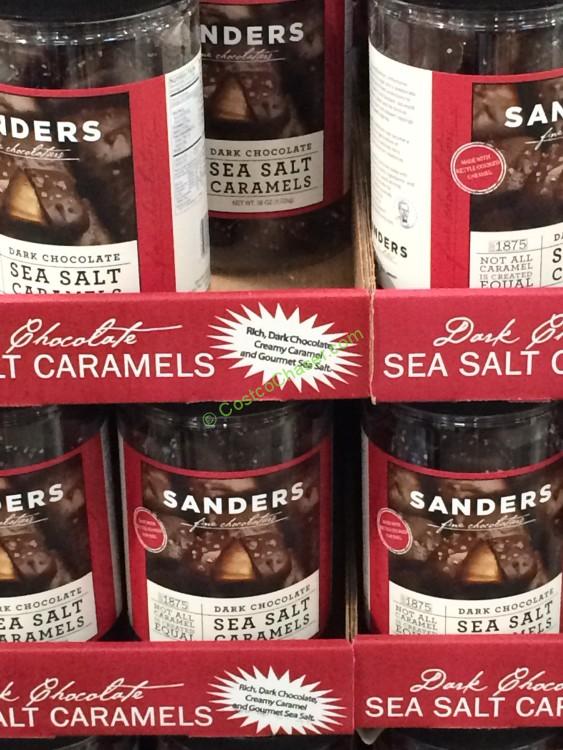
I’ve noticed more and more foods touting the substance in recent years. In December 2018, during a pre-Christmas shopping trip to Costco, I happened upon a jar of Dark Chocolate Sea Salt caramels. Over the past several years I have found that when, given a choice of chocolates, I tended to seek out the dark ones with caramel. So when I saw this large jar AND it was dark chocolate, I had to have them.

A palette of delight awaits at Costco. You can also now buy them online.

Once home, I selected a morsel from the jar and took a bite. The first taste was wonderful, the second was heaven, and by the time the morsel was consumed I was addicted.  Fortunately for me I have pretty good discipline when it comes to eating. So I was good and did not eat the entire jar.

Over the next couple months I showed, in my opinion, amazing restraint.  Each day I would have one; at most. Soon Christmas gave way to January but the jar of deliciousness remained. Committed to the ‘only one a day’ program – and sometimes none – the supply lasted. By the time early March rolled around, however, one day I stared forlornly at the nearly empty vessel

I knew I would miss my Dark Chocolate Sea Salt Caramels because, Costco being Costco they were, no doubt, only available for the holiday season.

Then a couple of days later a miracle occurred. The hubby and I were at Costco (one or the other of us seems to be there at least once a week…) and on a whim I haul him over to the candy and chocolate aisle to see if there was anything else which might fill the void in my life.

 And then I spied them!

A glorious Costco size stack of jar after jar after jar of Sanders Dark Chocolate Sea Salt Caramels beckoned to me. Oh, sweet mysteries of life!

Being that I was obsessed, I shared far and wide – with anyone who would listen about the wonders of this perfect food –  of the joys of hedonic escalation. When I first published this article in March 2019 I imagine I snagged at least a few folks who went in search themselves.

Even so, my biggest fear since 2018 has been that Costco will run out (Regular price is about $18 but you can get your own 36 ounces of wonder for about $14 on sale) or cease to carry this product. Thus far, it has been a perennial selection all seasons of the year. More than a few of my friends and families now also keep it on hand.

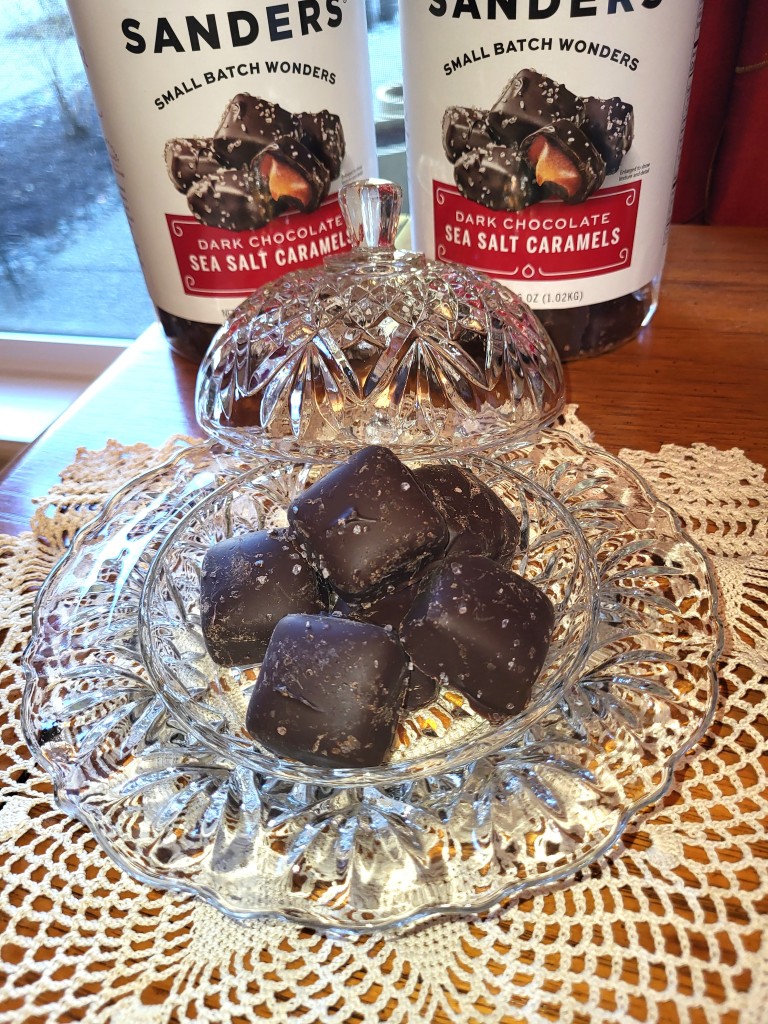
My current supply of Sanders Dark Chocolate Sea Salt Caramels. Thanks to the hubby there are two full jars waiting for me when the last of the current jar are gone (sometime this week likely)

But this article is a call to action. What I urge everyone who reads my blog to do is this: go to Costco today and buy at least one jar. It’s the least you can do to properly celebrate National Chocolate Caramel day. Plus, if I know anything about Costco, the more they sell, the higher the likelihood they will keep them on the shelves forever. Do it for you. Do it for me. Do it for all of America.

A couple of important links:

On Hedonic Escalation:

https://academic.oup.com/jcr/article-abstract/43/3/388/2199201?redirectedFrom=fulltext

https://www.independent.co.uk/life-style/salted-caramel-not-stop-eating-science-university-florida-hedonic-sugar-fat-a8078296.html

You don’t even have to leave home! If Amazon or some other retailer is your preferred dealer, a quick internet search reveals many who now sell this product.

https://www.costco.com/Sanders-Dark-Chocolate-Sea-Salt-Caramels-36-oz.%2c-2-pack.product.100321779.html

p.s. – I considered writing about the history of chocolate and caramel but tossed that out the window. For those who do not know, Chocolate’s origins can be traced to MesoAmerica some 1500 years ago.

And Caramel? It’s simply cooked sugar! What’s not to like?

All Tortellini All The Time

Navel Gazing in Italy

February 13, 2024

It often amazes me as to ‘what’ things have their own ‘day,’ ‘week,’ or ‘month.’ In the past I’ve written about “National Nothing Day –January 16th,” “National Cleaning Week –March 24th,” and “World Turtle Day – May 23rd,” to name a few.

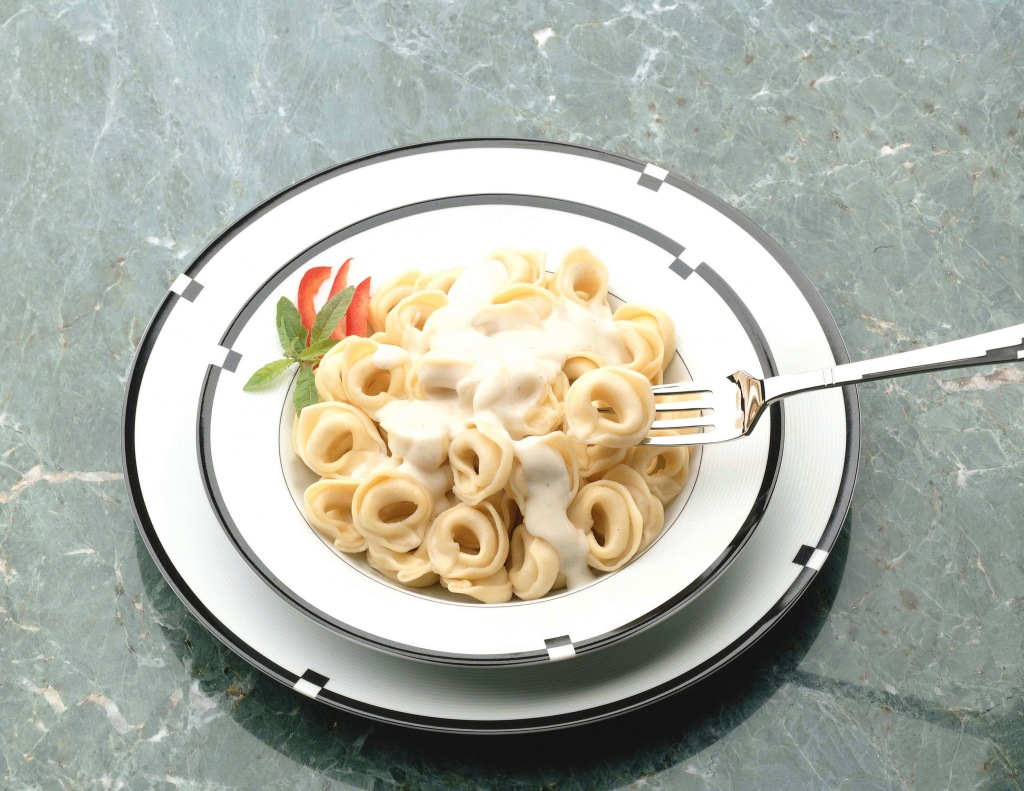
Photo courtesy of https://www.freeimages.com/

But when my brother shared with me that February 13th is “National Tortellini Day” I knew it had to be the topic of this week’s Tuesday Newsday.

So what is, exactly, a ‘tortellini’? The Infallible Wikipedia does not disappoint:

Tortellini are stuffed pasta originally from the Italian region of Emilia (in particular Bologna and Modena). Traditionally they are stuffed with a mix of meat (pork loin, raw prosciutto, mortadella), Parmesan cheese, egg and nutmeg and served in capon broth (in brodo di cappone).

In the area of origin they are usually sold fresh or home-made. Industrially packaged, dried, refrigerated, or frozen, tortellini appears in many locations around the world, especially where there are large Italian communities.”

Additionally, there is a legend that the pasta was concocted by an innkeeper in the small community of Castelfranco Emilia which is located in the same vicinity as an ancient Roman village in the northern section of Italy near Modena.

As the legend is told the goddess Venus stays at the inn and the innkeeper, so enamored with her beauty, spies on her through the keyhole of the door to her room. Yet, all he can see of Venus is her navel which inspires him to create a pasta in the shape of it. Okay, it is kinda creepy. Oh those crazy Italians!

Apparently, to this day, there is a festival held in Castelfranco Emilia to honor tortellini.

Growing up the only pasta which ever seemed to grace my family’s dinner table was spaghetti. I’m pretty certain that I never ate tortellini until I was in my 30’s – not because I had anything against it, just that it wasn’t on my culinary radar.

That all changed one day in 2012 when, as an adult advisor for the Bellevue Rainbow Girls, I was asked by the Worthy Advisor (President) Janessa if the hubby and I would be willing to make and serve the ‘main’ course for a progressive dinner she was planning.

We agreed and then I asked her if there was any particular food she would like us to prepare. Her response: tortellini.

When I was a Rainbow Girl back in the dark ages we also had ‘progressive’ dinners. What happened is that the girls would travel, usually by cars driven by advisors, to one home for appetizers. After that it might be a salad course, followed by the main course, and concluding with dessert.

In my day these were rather tame affairs with everyone sitting properly at the dining room table at the hosts house and that is, I’m certain, what the girls were expecting that spring day of 2012.

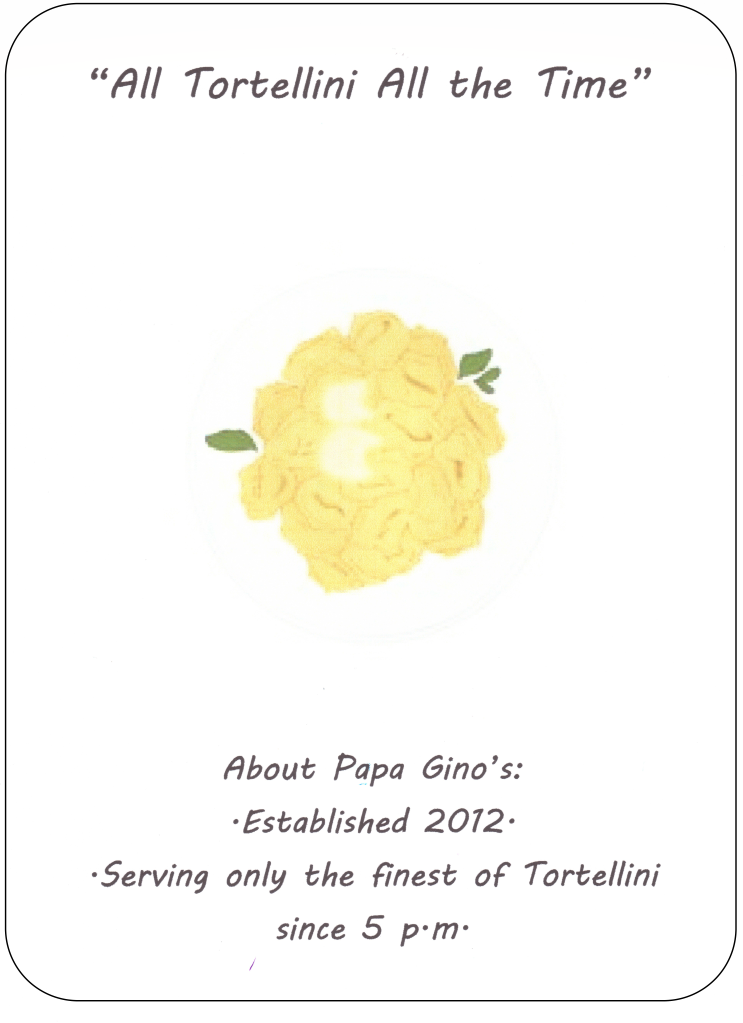
The cover of the 2012 Papa Gino’s Menu

But that is NOT what they got. As the hubby and I contemplated this event we decided to go all in. In our family room I arranged four or five card tables as though in a café and made dark red satin tablecloths to go over them. There were lit pillar candles in the center of each table plus silverware and napkins at each place setting.

In our front hallway I set up a large white board proclaiming that they had arrived at “Papa Gino’s” which served “All Tortellini All The Time.” I created paper menus. But the absolute best part was that the hubby took on the role of the proprietor “Papa Gino” complete with a painted on fake mustache and dressed like we imagined a restaurateur from Italy might appear.

Soon we received word that the girls were leaving their previous stop and would soon arrive. With Papa Gino stationed behind his check in podium, when the door opened there was a look of confusion on the faces of the first group as “Papa” loudly proclaimed in his best ‘worst’ Italian accent, “Welcome to Papa Ginos, how many in your party?”

Oh, but that was not all. From the moment the guests arrived, Papa and the long suffering cook “Mama” bickered with one another. But Papa’s impatience wasn’t confined to Mama, if the guests didn’t answer a question right away, Papa would badger them for an answer. And heaven forbid if they asked for ANYTHING besides tortellini because Papa would shame them and point at the menu suggesting they needed to learn to read as it clearly said “All Tortellini All the Time.”

Both girls and adults were in stitches over the banter that evening and were talking about “Papa Gino’s” for several years.

Back cover of the 2012 menu. I searched and searched for at least one photo I know exists, but alas could not find it! Papa’s identity will remain a mystery.

Fast forward to 2015. In anticipation of my father-in-laws 90th birthday we volunteered to be the hosts. My mother-in-law – having heard the tales of Papa Gino’s previous gig – requested that we present an encore performance. As you wish.

It was a beautiful late September day and my in-laws, three of their children, all six grandchildren, and spouses arrived. Finally, around 5 p.m., everyone was kicked out of the family room, a bed sheet ‘curtain’ was erected and, once again, Papa Gino’s restaurant was brought to life.

Papa was in fine form, showering abuse on his older brother who was attempting, but failing, to pull Papa Gino out of character; Papa suggested to his niece – who, at five months pregnant was the epitome of health and beauty – that perhaps she needed to cut back on the pasta.

Table by table he worked the room, taking orders, engaging the guests, and the gales of laughter told the story of everyone having great fun as if dining at a live performance dinner theatre where Papa taking orders and serving, and with Mama, and their idiot son, Davi, cooking WERE the entertainment.

Papa, Mama, and Davi retired after the 2015 performance but, who knows, they might be willing to reopen… for the right price.

“Right, Papa? Right?”

“Just waiting for you, Mama!”

Davi shrugs.

A few links:

https://en.wikipedia.org/wiki/Tortellini

https://en.wikipedia.org/wiki/Castelfranco_Emilia