Winchester Mystery House

38 Years of continual construction

June 30, 2020
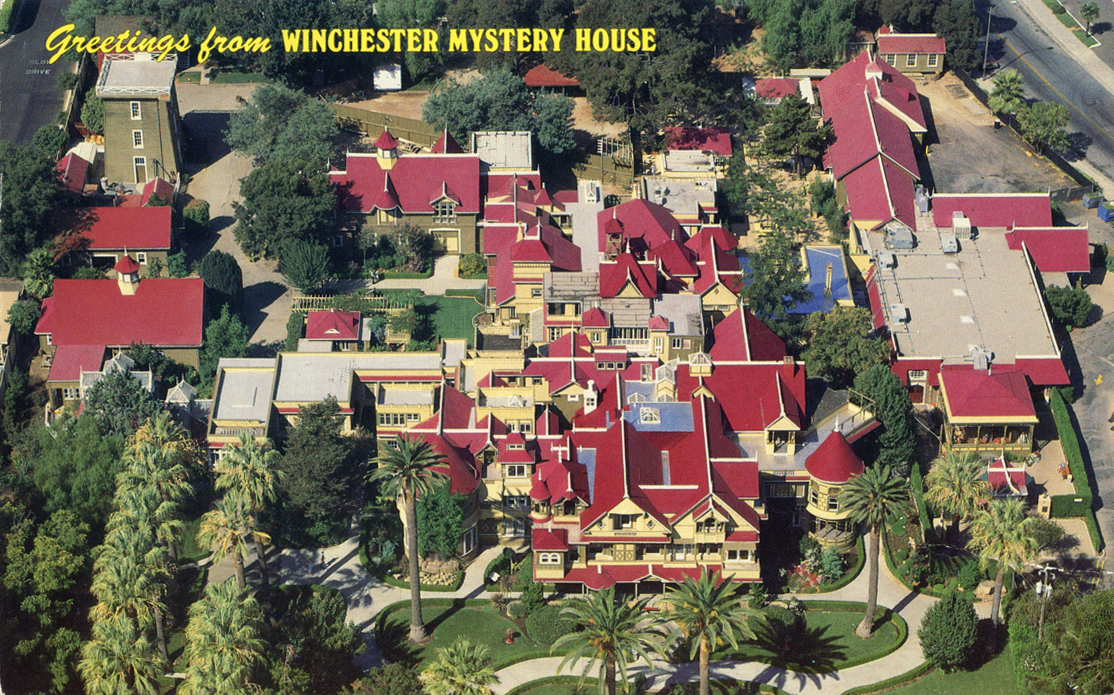
winchester_mystery_house

The sprawling footprint of the Winchester Mystery House, San Jose, California

By the time the last hammer was silenced in 1922, this house comprised a 24,000 sq. ft.  “foot print” which had been added one room at a time over the course of 38 years. It was a short nine months later, on June 30, 1923, when the house opened for its first tours. The Winchester Mystery house – as it known – is a fascinating place to visit. And the story behind its genesis is the stuff of novels.

Sarah Winchester was the heiress to the Winchester Repeating Arms Company. Her husband, William, had died in 1881 of tuberculosis. Sarah, then age 42, had lost her only child 15 years earlier just six weeks after the baby’s birth; she came to believe that the tragedies which had befallen her were due to the immorality associated with the guns manufactured by Winchester Arms.  Like so many of that age, she consulted a psychic who told her to leave Connecticut and go west. Her mission, she came to believe, was to spend the rest of her life spending her considerable fortune to build a house to atone for husband’s company.

Sarah Winchester

Sarah Winchester

She purchased an 8 room house located on a sprawling farm in the Santa Clara valley of California in 1884; she immediately hired workers to transform the structure into a Victorian mansion. No architect was ever engaged and no blueprint ever produced. It was Sarah who designed and added the rooms. From the Infallible Wikipedia:

“There are roughly 161 rooms, including 40 bedrooms, 2 ballrooms (one completed and one unfinished) as well as 47 fireplaces, over 10,000 panes of glass, 17 chimneys (with evidence of two others), two basement levels and three elevators. Winchester’s property was about 162 acres (66 ha) at one time, but the estate has since been reduced to 4.5 acres (1.8 ha) – the minimum necessary to contain the house and nearby outbuildings. It has gold and silver chandeliers, hand-inlaid parquet floors and trim, and a vast array of colors and materials. Due to Mrs. Winchester’s debilitating arthritis, special ‘easy riser’ stairways were installed as a replacement for her original steep construction. This allowed her to move about her home freely as she was only able to raise each foot a few inches. There was only one working toilet for Winchester; it has been said that ‘all other restrooms were decoys to confuse spirits’ and that this is also ‘the reason why she slept in a different room each night’. The home’s conveniences were rare at the time of its construction. These included steam and forced-air heating, modern indoor toilets and plumbing, push-button gas lights, and Mrs. Winchester’s personal (and only) hot shower from indoor plumbing. There are also three elevators, including an Otis electric and one of which was powered by a rare horizontal hydraulic elevator piston. Most elevator pistons are vertical to save space, but Winchester preferred the improved functionality of the horizontal configuration.”

Winchester-Banner-1

Front entry to the estate

Upon Sarah Winchester’s death September 5, 1922, the property and all her belongings were inherited by her niece and personal secretary who took what they wanted and sold the remaining furniture in an estate sale. The house was considered mostly worthless due to damage sustained during the 1906 San Francisco quake and considered unsellable due to the size and nature of the house.

A local investor, however, purchased it for $139K then leased it to a couple who gave the first tours. That couple, John and Mayme Brown, eventually purchased the house ten years later and it is still owned and operated by their heirs.

2709270244_eee185a1feIf you are in the bay area and have a few hours, a visit to the Winchester Mystery House is worth the time and money. Our family visit occurred in 1995. For my daughter – who was two that year – the intricacies of the house were lost. My five year old son, however, was enthralled. Around every corner was another oddity – a set of three stair risers leading to a door. Which, when opened, revealed a wall. There were rooms where, when you looked up, you saw windows into more rooms. Stairs which once led to upper floors… those levels long since removed but the stairs remained. Up and down the many staircases the tour went… room, after room, after room.stairs to nowhere

My son talked about the mystery house for months, intent, I think, on building his own such house. Thankfully, his obsession waned, as we could not afford unending building projects.

Today, my  now 30 year old son is more minimalist, recognizing that one does not need a lot of space to comfortably live. At the time of our visit to Sarah’s mansion, we lived in a nearly 4,000 square foot house. The problem with a large house is that soon you are filling that house with stuff. Always more stuff. In the past two years the hubby and I have made a concerted effort to reduce our stuff.

One of the blessings of the extended stay at home orders of the COVID-19 pandemic is that there has been time to focus on reduction. Each week, it seems, another box is sorted and purged, the proverbial grain separated from the chaff.

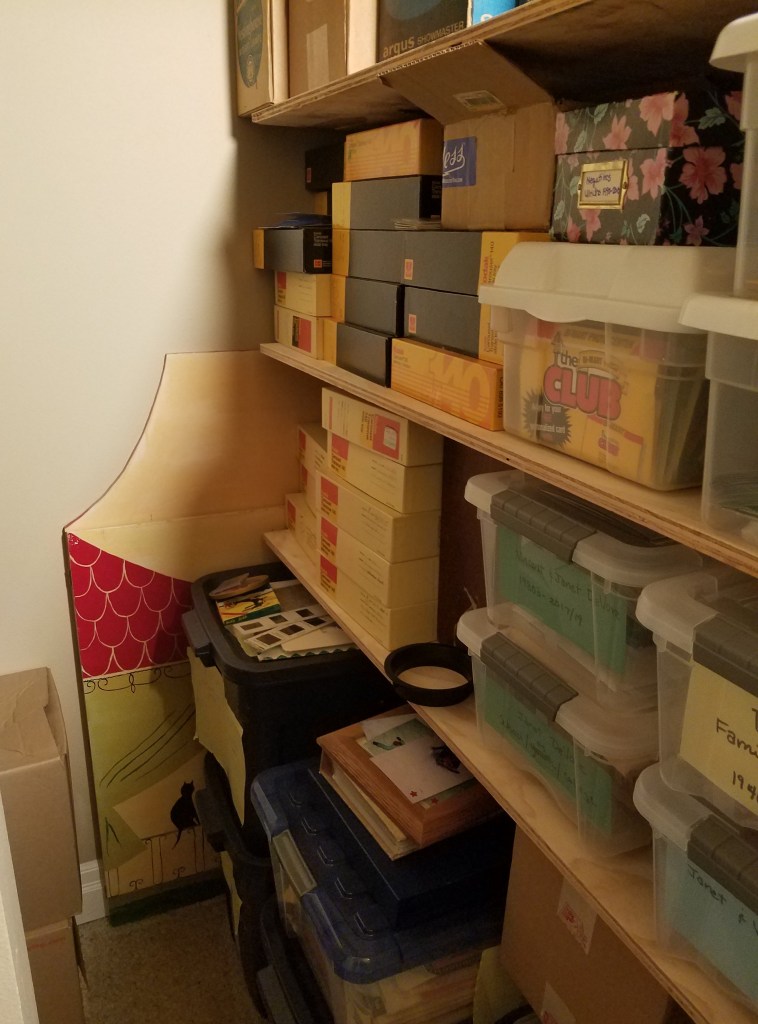
I’m pretty much down to my last big purge: photographs. A couple days ago I ventured in to what I call the “Harry Potter closet” as it is a space under the lower level stairs reminiscent of where the boy wizard lived before discovering his magic powers. Since we moved in it has been the repository for all the bins of family history, the slides of my grandparents as well as our own, 8 and 16 mm movie projectors and reels, VHS and digital camera tapes, and boxes and boxes of photos.

Harry Potter closet

The ‘Harry Potter’ closet after the reorganization. Picture on the left is the entry way.  The picture on this right is what’s stored under the stairs behind the wall from the first photo.

Last Saturday much of the contents of the closet were extricated and then organized and stacked back in the closet for the next purge. Sunday, the first bin of photos dating from the 1990’s to the early 2000’s hit the dining room table.

Ironically, in my first sort, I found photos from our 1995 trip to San Jose but not a single picture from the visit to Sarah Winchester’s house. I wonder what happened to those photos? It’s truly a mystery.

A couple of links:

https://en.wikipedia.org/wiki/Winchester_Mystery_House

https://winchestermysteryhouse.com/

  • Update June 30, 2022 – The Harry Potter closet got an upgrade! Shelves have been built thanks to the hubby and son. Reorganization has taken place but the ongoing photo project is slow going. A few photos of construction and reorg. 
The Harry Potter closet getting shelves
The Harry Potter closet with all the photos, slides, and historical documents
More of the collection…

Funny how a Melody…

… Sounds like a Memory

June 23, 2020

20160802_203234Of all the seasons, summer is the one which seems to take us back to our youth. That sentiment is related, perhaps, to the provenance of children, whose best days happen when that school bell rings on the last day of classes. Ahead stretches a glorious few months of getting to play all day and curfews that seem to follow the long arc of light as it stretches into twilight.
For these reasons, I suppose, the summer solstice is an occasion to wax a bit nostalgic as we recall those childhood evenings playing kick the can until Dad yelled from the front door to come home. It was also the season for teenagers when evenings were spent with friends and, if one was lucky, perhaps a bit of romance was discovered.

Many a musical artist has captured that nostalgia but none, in my opinion, quite as effectively as Eric Church with his number one country hit “Springsteen” which topped that chart on June 23, 2012.

As always, the Infallible Wikipedia shares a bit of information:

“ ‘Springsteen’ received critical acclaim from many music critics. Billy Dukes of Taste of Country gave the song five stars out of five, calling it ‘the best song from one of 2011’s top country albums.’ Matt Bjorke of Roughstock also gave the song five stars of five, writing that ‘the strong, sing-a-long lyrics and driving, percussive melody brings Eric Church to an accessibility that he’s previously never had.’ Noah Eaton of Country Universe gave it an A-, saying that it is ‘a gorgeous, bittersweet anthem-to-be that will likely leave even some more hardened hearts simultaneously smile and cry listening.’  Eaton went on further to say that this song would propel Church’s career to the next level. American Songwriter chose the song for its Lyric of the Week feature, for the week of June 11, 2012.  The song was nominated for two Grammy Awards – Best Country Solo Performance and Best Country Song – on December 12, 2012, but failed to win any of the awards at the ceremony in 2013.

Thom Jerek of AllMusic said the song had ‘a clever, if somewhat cloying, tune, but it gets the feeling across in spades.’  The A.V. Club reviewer Steven Hyden claims that Church ‘is just as effective on slower, more thoughtful songs like ‘Springsteen’ and that the song ‘[reflects] reflecting on music’s power to revive forgotten emotions from the past.’

Bruce Springsteen himself took note of Church’s music, specifically the song ‘Springsteen’, and wrote Church a note on the back of a setlist. Church received the letter from Springsteen after a show on August 19, 2012. In the note, Springsteen explained his and his family’s love of the song and that he hoped to have their paths cross at some point. Church was surprised when receiving the note and said that ‘it’s a long note, takes up the entire back page of this setlist for a show that lasted three hours and 47 minutes.’”

Between the ennui inducing lyrics and the memorable tune, Church’s song sounds as fresh as it did twelve years ago. He nailed it in the refrain with these lyrics:

Springsteen lyrics meme

Church, like so many great songwriters, based his song on a relationship he had. It wasn’t a Springsteen song which provided the actual music, however. That, to the best of my knowledge, is a well kept secret. From the SongFacts website:

“Church told Reuters this is his favorite song from Chief (his third album). He explained: ‘I lived that song. I was 15 years-old and she was 16. We had that love affair where you connect with someone, and the artist that was playing becomes a soundtrack to your relationship. We didn’t stay together, but to this day, when I hear Bruce Springsteen, I think of her and I hope she thinks of me.’”

A few weeks ago, my blog was about the radio (https://barbaradevore.com/2020/06/02/like-a-song-on-the-radio) and how important that was to the teenagers of my era. We listened for many an hour in hopes of hearing our favorite songs over and over and over. It was inevitable, then, that there are songs which instantly transport us back to another place and time; songs which are associated with events and the people who were significant to us then.

When you walk outside some evening this summer – and look up at the lingering colors in the fading light – perhaps you, too, will recall a melody which sounds like a memory to you, like a soundtrack from a July Saturday night.

And a couple of links:

https://en.wikipedia.org/wiki/Springsteen_(song)

https://www.songfacts.com/facts/eric-church/springsteen

Grease!

But, oh, those summer nights…

June 16, 2020

On June 16, 1978, this iconic American film burst onto the scene and soon held the record – for the next 15 years – as the highest grossing film of all time. It hearkened back to a more youthful time of the 1950’s but with a 1970’s twist: innocence was but an illusion and that inside every sweet girl was a naughty one wanting to break out. That movie was Grease which starred John Travolta as Danny Zuko, king of the greasers, and Olivia Newton-John as the naïve Sandy.

The movie was based on the 1971 Broadway musical of the same name and, as such, had a fantasy sort of feel to many of its scenes, especially the musical numbers Grease Lightning, Beauty School Dropout, and We Go Together. The thin plot line is held up by incredible music and the star performance of Travolta.

Review of the film from that time ranged from those who loved it to others who were not as impressed. From the Infallible Wikipedia:

“Gene Siskel gave the film three stars out of four, calling it ‘exciting only when John Travolta is on the screen’ but still recommending it to viewers, adding, ‘Four of its musical numbers are genuine showstoppers that should bring applause.’ Variety praised the ‘zesty choreography and very excellent new plus revived music’, and thought Travolta and Newton-John ‘play together quite well.’ Charles Champlin of the Los Angeles Times was negative, writing, ‘I didn’t see ‘Grease’ onstage, but on the testimony of this strident, cluttered, uninvolving and unattractive movie, it is the ’50s—maybe the last innocent decade allowed to us—played back through a grotesquely distorting ’70s consciousness.’ Gary Arnold of The Washington Post also panned the film, writing, ‘Despite the obvious attempts to recall bits from Stanley Donen musicals or Elvis Presley musicals or Frankie-and-Annette musicals, the spirit is closer to the New Tastelessness exemplified by Ken Russell, minus Russell’s slick visual style … I’ve never seen an uglier large-scale musical.’ David Ansen of Newsweek wrote, ‘Too often, ‘Grease’ is simply mediocre, full of broad high-school humor, flat dramatic scenes and lethargic pacing. Fortunately, there’s nothing flat about John Travolta … Travolta can’t dominate this movie as he did ‘Fever,’ but when he’s on screen you can’t watch anyone else.’”

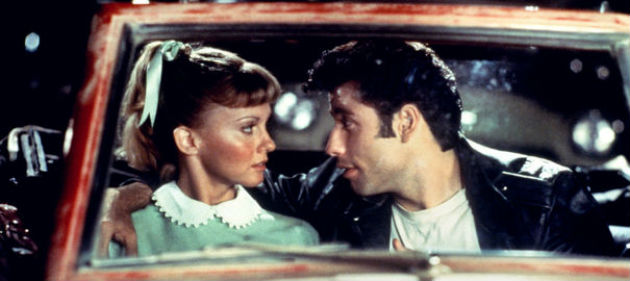
Danny and Sandy drive in sceneEven now, 42 years after its release, Grease enjoys a true fan following. It’s been released in various home video formats over the years, the most recent in 2018 on Blu-Ray DVD for its 40th anniversary.

I’ve seen the movie a number of times but did not see it during its original release. I’m not quite sure what, exactly, I was doing in the summer of 1978 except that it was the year I turned 21 and, really, going to see a musical based on high school students in the 1950’s was not all that cool. Or so I thought. When I did finally see it I was sad I’d missed out that summer.

In thinking about the plot from a writer’s perspective, however, I’ve always had a problem with the final scene of the movie. Sandy’s character – as I wrote above – was of a naïve and innocent teenager. When she gets involved with the Pink Ladies – a group of young women of questionable characters – it doesn’t ring true. Where were Sandy’s parents to put the brakes on her going to a slumber party with these girls? And one look at Danny and her parents – based on her persona – would have been pulling her out of Rydell High.

Despite these obvious disconnects with real life, in the final scene of the end of the year school carnival, we see Danny has now toned down his greaser persona to try and prove to Sandy that he’s the guy for her. Throughout the movie, Danny’s character is portrayed as complex and we suspect that he became a greaser tough guy simply for social status and not because that’s who he truly is.

When Sandy emerges in the final scene, however, she’s suddenly become this black leather clad sexy siren that smokes and is aggressive and suggestive. There is nothing in her character development previously introduced which portends that she is capable of such a transformation.

In the world of a story-teller, this is a big no-no as the reader – or in this case the viewer – feels like they’ve been misled. These inconsistencies are often referred to as ‘plot holes’ and are similar to driving over a pothole on a road in that it can jar you out of the story. Such is the case for this – and several other – scenes in Grease.

With this musical, then, there really is only one thing to do. Ignore the plot and character problems and just enjoy the multitude of toe-tapping, memorable tunes. Think of Grease like a 1950’s root beer float: a fizzy mix of soda and ice cream, but the top two inches are all empty – but tasty – foam; a perfect treat for a summer’s night when you want to immerse yourself in something fun and frivolous.

A link or two:

https://en.wikipedia.org/wiki/Grease_(film)

https://screencraft.org/2018/03/09/do-you-know-the-five-different-types-of-plot-holes/

Rhubarb Roots

June 9, 2020

20200521_211226

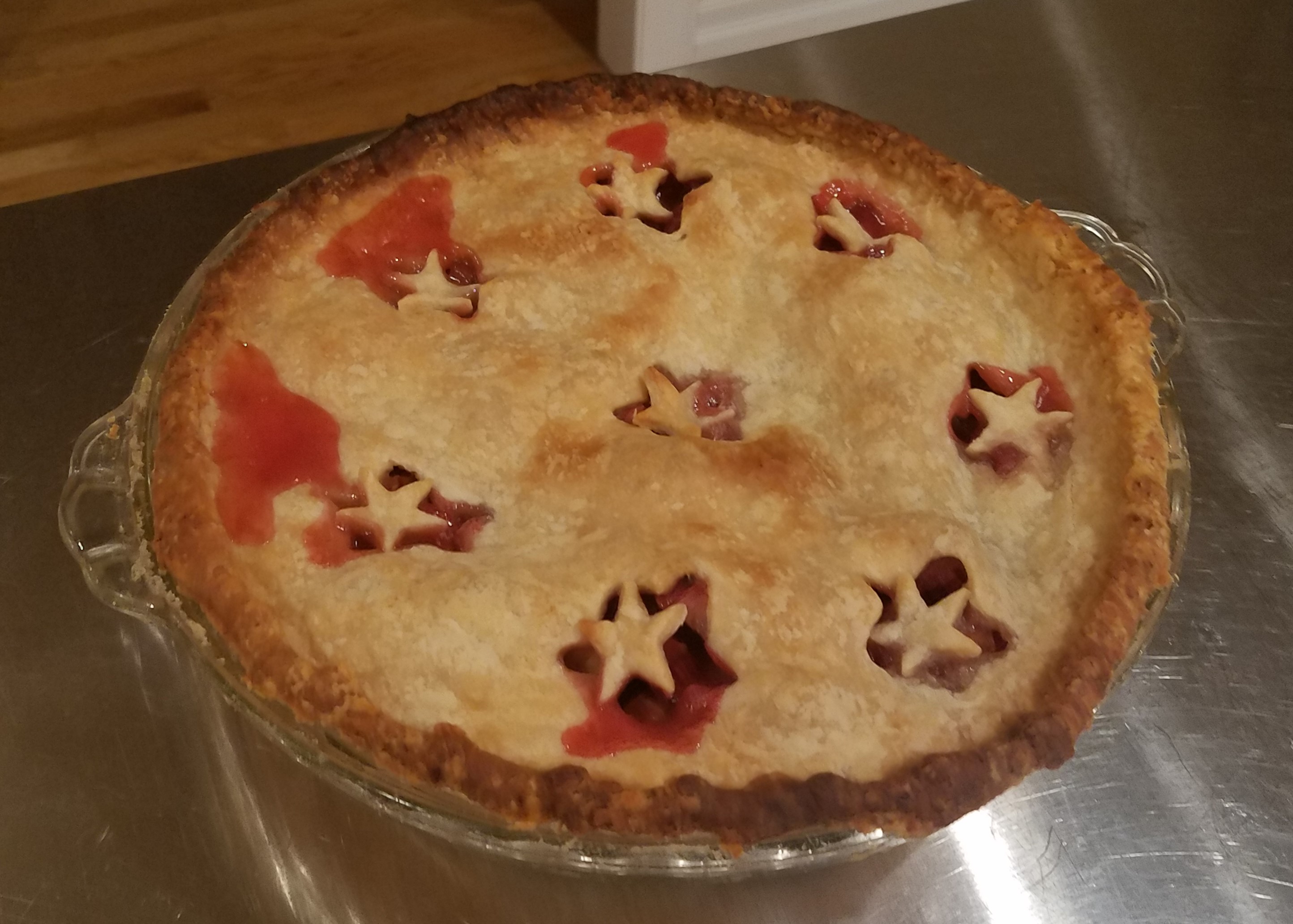
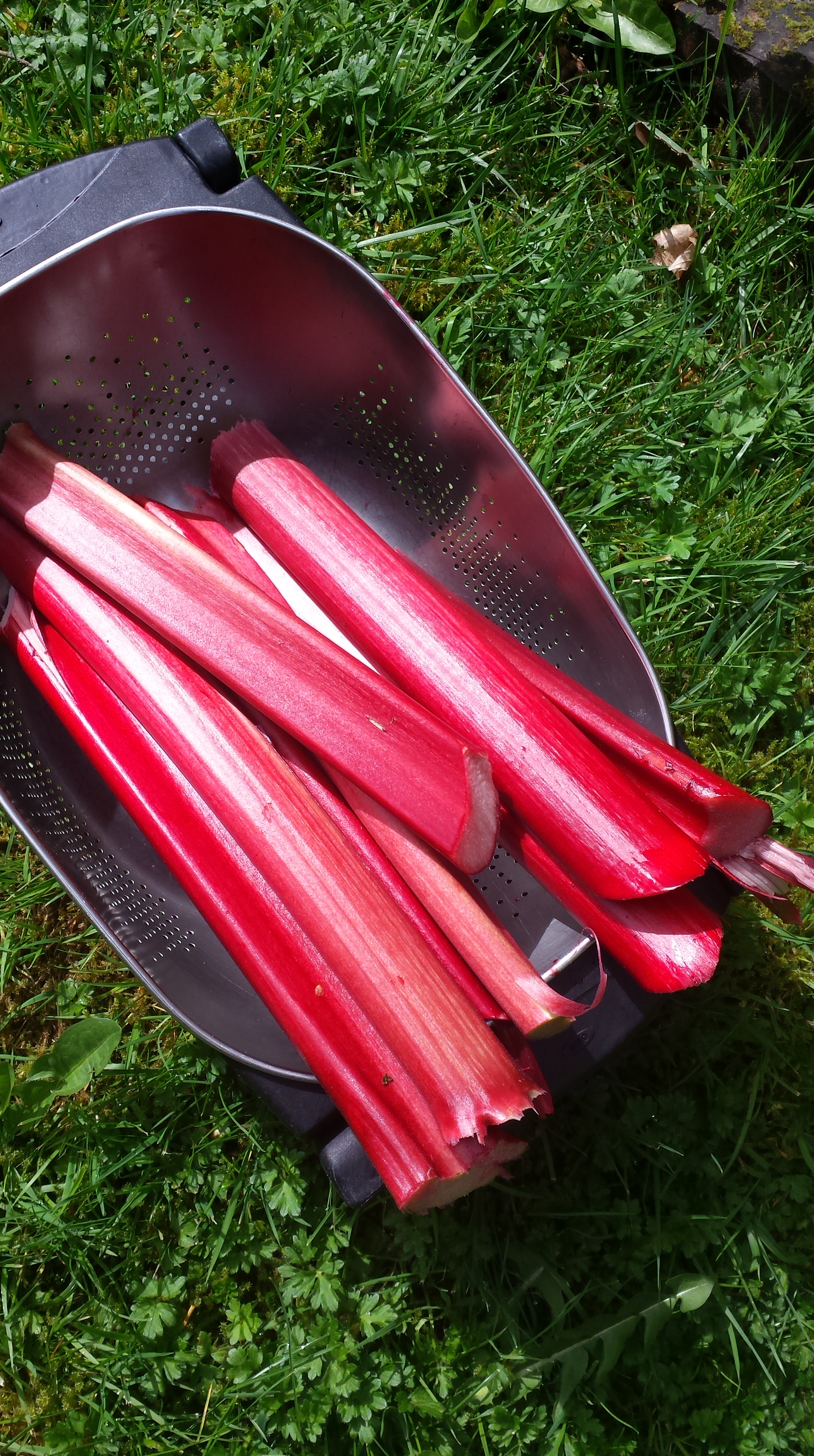
Rhubarb pie (no strawberries!) baked  by the author for Memorial Day weekend 2020

I love pie. I don’t always love making it, but I love eating it. So what better way to celebrate June 9th than to acknowledge the rhubarb plant and national Strawberry Rhubarb pie day?

Rhubarb is an amazing plant. It’s hardy, high in vitamin C, and is touted as a blood pressure reducer.

For centuries it has been recognized for its medicinal purposes and was, during the time of Marco Polo, more expensive than saffron. Historically, its origins can be traced to China. From the Infallible Wikipedia:

“The Chinese call rhubarb “the great yellow” and have used rhubarb root for medicinal purposes for thousands of years. It appears in The Divine Farmer’s Herb-Root Classic which is thought to have been compiled about 1,800 years ago Though Dioscurides’ description of ρηον or ρά indicates that a medicinal root brought to Greece from beyond the Bosphorus may have been rhubarb, commerce in the drug did not become securely established until Islamic times. During Islamic times, it was imported along the Silk Road, reaching Europe in the 14th century through the ports of Aleppo and Smyrna, where it became known as “Turkish rhubarb”. Later, it also started arriving via the new maritime routes, or overland through Russia. The “Russian rhubarb” was the most valued, probably because of the rhubarb-specific quality control system maintained by the Russian Empire. (snip)

The high price as well as the increasing demand from apothecaries stimulated efforts to cultivate the different species of rhubarb on European soil. Certain species came to be grown in England to produce the roots. The local availability of the plants grown for medicinal purposes, together with the increasing abundance and decreasing price of sugar in the 18th century, galvanized its culinary adoption. Grieve claims a date of 1820 in England. Rhubarb was grown in Scotland from at least 1786, having been introduced to the Botanical Garden in Edinburgh by the traveller Bruce of Kinnaird.

Though it is often asserted that rhubarb first came to the United States in the 1820s, John Bartram was growing medicinal and culinary rhubarbs in Philadelphia from the 1730s, planting seeds sent him by Peter Collinson. From the first, the familiar garden rhubarb was not the only Rheum in American gardens: Thomas Jefferson planted R. undulatum at Monticello in 1809 and 1811, observing that it was “Esculent rhubarb, the leaves excellent as Spinach.”

20170420_12275520170420_12250520170420_122452

The rhubarb plant at our home in Kirkland, 2017

Fifteen years ago I enrolled in a class at Bellevue Community College which was touted as one that would explore the various types of articles one could write for publication in magazines. This was, for the most part, before blogs and individual web pages took root.

Each week we were given an assignment to write an article of a specific type such as “How To” or “Humor.” I recall clearly the day I shared my version of a “personal essay” – near the end of the course – and the reaction. When I finished reading my piece aloud, the room was silent; even the instructor did not say anything for several beats. When she did speak she said, “I think this is your strength.”

The development of this blog was the natural result of decades of extrapolating small slices of life and looking for the story gems hidden within. What follows is the article I wrote back in 2004…

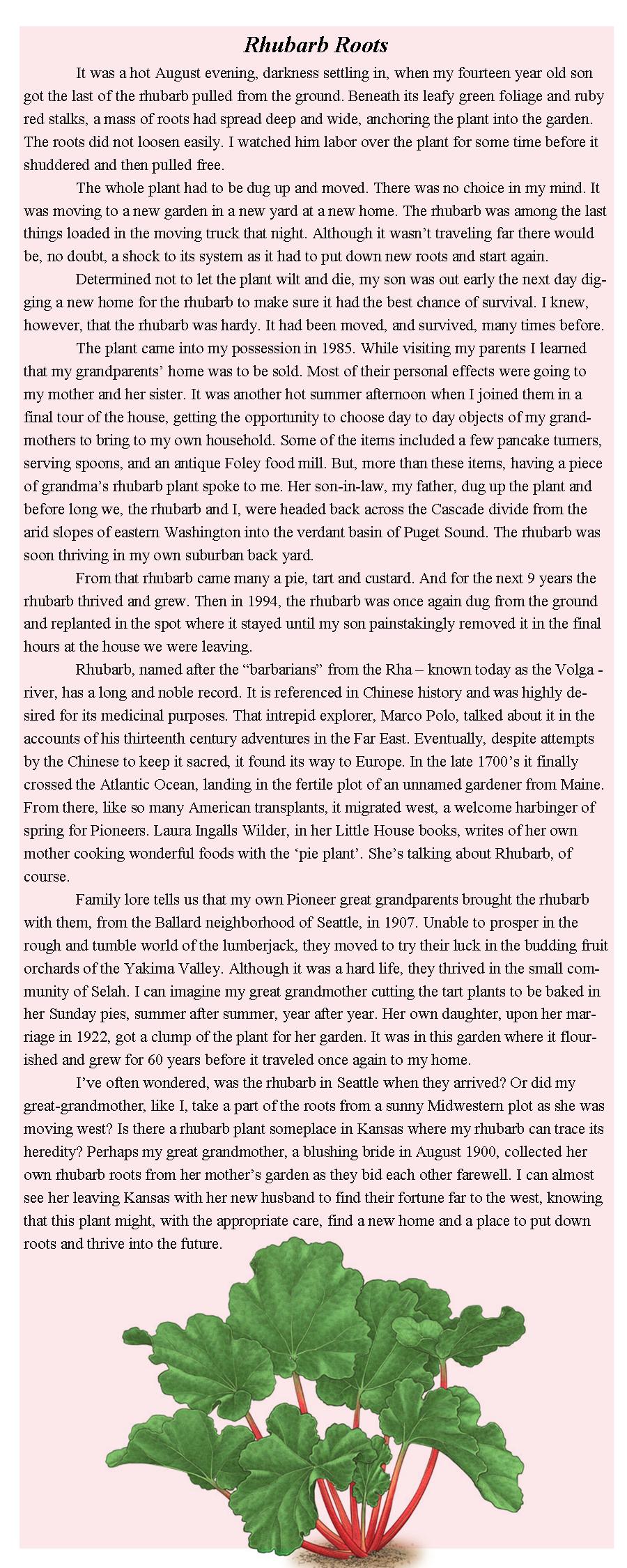
Rhubarb Roots

The story of that rhubarb plant didn’t stop with its transplant to Kirkland, however. Root balls have been gifted to family and friends whenever requested. In fact when my friend Mary – who grew up in Kansas – heard the story of the rhubarb and its connection to her home state, she asked for a piece of it which we gladly shared. Every so often she will post a picture of the VERY healthy plant on social media or send me a message providing updates as to what delectable delight she has created. (Being that she is one of the best cooks I know, no doubt the end result is fabulous!) Our niece Carolyn – who we gave a hunk of it to back in 2016 and another great cook – also recently posted that she had cooked a pie with the rhubarb stalks along with thanks for our sharing of the plant.

When the hubby and I moved yet again in 2018 there was never any doubt that the rhubarb was coming too. But there was a catch. We were moving to a condo/townhouse and there was no spot for a proper garden. Instead, all the rhubarb moved north to the hubby’s family century old farmhouse and acreage in Blaine to be planted there as a means of keeping it for us and future generations.

Rhubarb in the pot

The rhubarb we transplanted to a pot next to our front walk. It is scheduled for a change of scenery to allow it to grow unfettered by the constraints of its environment.

We did manage to plant one root ball in a pot alongside our front walk at the new place. We soon discovered that our next door neighbor, Bob, is a plant guy. I mean a real plant guy in that he has spent his career working with plants and the development of new vegetable varietals. Following his lead of finding space for fruits and vegetables in some of the common spaces, a second section of our rhubarb was recently repatriated and is now taking root at the edge of the back fence. Of course Bob, would like his own rhubarb also, a request which will soon be obliged.

And so it goes… another leg in the journey for my rhubarb roots. I’m pretty sure I have just enough to make another pie.

A couple of links for your edification:

https://nationaldaycalendar.com/days-2/national-strawberry-rhubarb-pie-day-june-9/

https://en.wikipedia.org/wiki/Rhubarb

Like A Song on the Radio

Thank you, Mr. Marconi

June 2, 2020

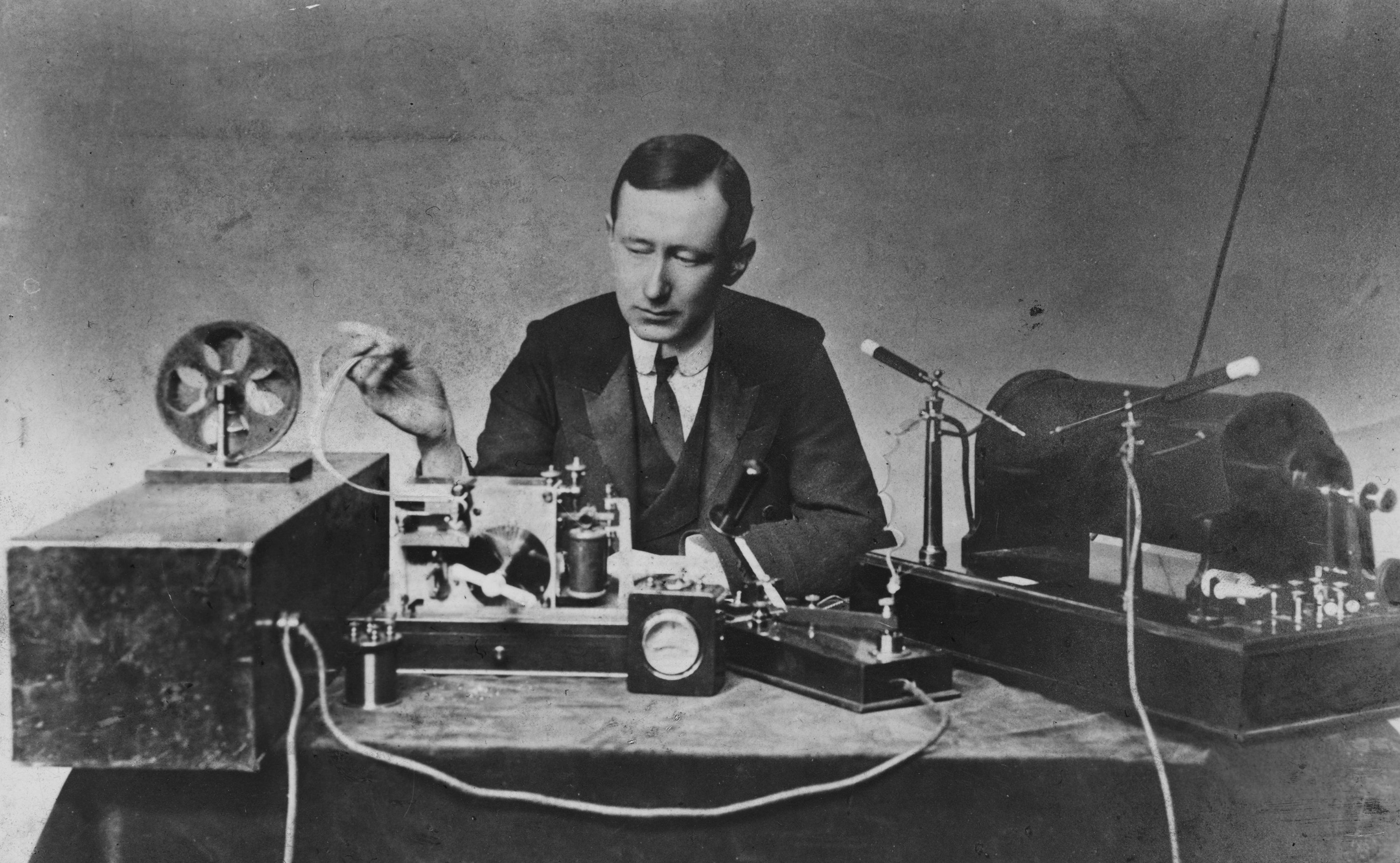
Marconi RadioThere is a saying that he who gets to the patent office first matters more than who invented it. This is likely true for the invention of radio. Guglielmo Marconi – first to the patent office – filed on June 2, 1896, eclipsing others also working on the budding technology.
The story begins decades earlier and, as is often the case, the Infallible Wikipedia sums it up:

“The idea of wireless communication predates the discovery of ‘radio’ with experiments in ‘wireless telegraphy’ via inductive and capacitive induction and transmission through the ground, water, and even train tracks from the 1830s on. James Clerk Maxwell showed in theoretical and mathematical form in 1864 that electromagnetic waves could propagate through free space. It is likely that the first intentional transmission of a signal by means of electromagnetic waves was performed in an experiment by David Edward Hughes around 1880, although this was considered to be induction at the time. In 1888 Heinrich Rudolf Hertz was able to conclusively prove transmitted airborne electromagnetic waves in an experiment confirming Maxwell’s theory of electromagnetism.”

Fascinated by the possibility of transmitting sounds via Hertzian (as radio waves were called at the time) waves, Marconi began experiments building the equipment needed in the attic of his home. He was only 20 years old.

“A breakthrough came in the summer of 1895, when Marconi found that much greater range could be achieved after he raised the height of his antenna and, borrowing from a technique used in wired telegraphy, grounded his transmitter and receiver. With these improvements, the system was capable of transmitting signals up to 2 miles (3.2 km) and over hills. The monopole antenna reduced the frequency of the waves compared to the dipole antennas used by Hertz, and radiated vertically polarized radio waves which could travel longer distances. By this point, he concluded that a device could become capable of spanning greater distances, with additional funding and research, and would prove valuable both commercially and militarily. Marconi’s experimental apparatus proved to be the first engineering-complete, commercially successful radio transmission system.”

Encouraged by his parents, he left Italy for England – his mother accompanied him – and was able to gain the interest of the British Government and, eventually, financial backing. While Marconi’s system was used primarily for short distance maritime communications at first, his company continued to experiment and expand the distance the radio waves traveled. It was Marconi’s system which made it possible for 700 passengers aboard the Titanic to be rescued.

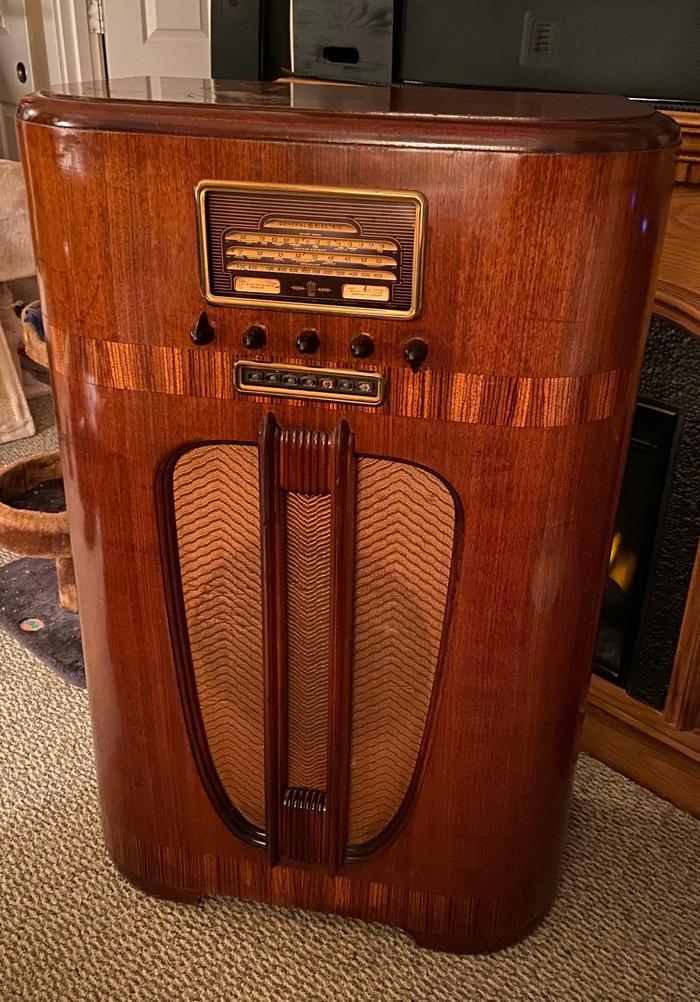
GE F-96

My brother had a radio like this one given to him by our grandparents. His is currently in a storage locker… this beauty belongs to someone who graciously posted it on the internet.

Innovation in radio proceeded at an amazing pace with the commercial side of it soon eclipsing the more mundane maritime uses. By 1938 four of every five homes had a radio. Families gathered around for favorite programs, whether they were music, ‘theater,’ or the news of the day. The radio became an essential part of society.

All of today’s wireless digital communications via phones, pads, and portable computers, began with the invention of the radio.

Marconi – along with Karl Braun – shared the 1909 Nobel Prize “for their contributions to the development of wireless telegraphy.”

transistor radio

My sister was the queen of the transistor radio with one nearly glued to her ear for several years.

By the 1960’s, despite the fairly recent addition of commercial television, radio was still king. Especially for teenagers. It was radio which helped foment the rock and roll revolution; it was radio which unified the baby boom generation. Every town seemed to have at least one radio station and the wise ones were spinning the popular teen records of the day.

In Yakima – where I grew up – there were three stations of note in the later 1960’s and early 1970’s. I remember my dad always wanting to listen to KIT. At 1280 on the dial it featured news and WWII era music. As a card-carrying teen that was not on my list of cool radio stations. There were, however, two stations I listened to: KMWX and KQOT.

Being that I kept a diary (note to my younger self – what you wrote about was mostly ridiculous) and that listening to the radio was so important, I recorded this gem from April 25, 1971:

“Today was Pete’s Birthday. He liked the Grippu Sue and I gave him.* We went on Daylight Savings, so it stays light till almost 8:30. That means KQOT stays on the air until 7:45 and on May 1st, they will stay on until 8:30. That means I get to hear Neal Gray all through the ‘Sommer.’ (Sommer? Get it? Bob Sommers D.J.) YEA!”

Three days later, I posted this entry:

“Today was an interesting day, you see, today was Patty Hooper’s dog’s birthday, so I told her I would dedicate “Me and You and a Dog named Boo” to her dog, Sairy, if I could get through… well I got through and dedicated it but it is really weird to hear Bob Sommer’s voice on the radio and telephone, then your own. Patty was listening and called right after the song was over. Command Performance is kind of fun.”

It was, apparently, about this time that I became radio obsessed, even going so far (Two days after that!) to try to figure out the trick for getting through to the D.J.’s. For one of my dialing adventures, it took me… 292 times to get through.

Scan_20200602

The author at age 14. Cassette recorder, radio (it was an older one my parents had). I’m not sure where the clock radio is… and you can see my blue 1972 diary off to the side. I was kinda messy.

The rest of the 1971 diary has occasional references to the two radio stations. What I do recall during those years is sitting on the bed in my room, listening to the radio and waiting for my favorite songs. I cannot recall what sort of radio it was, but it was my daily companion. I was given a cassette tape recorder for my 13th birthday, and a new clock radio for my 14th. Together they afforded me the opportunity to ‘record’ songs when they came on the air. Many a tape was filled with badly recorded favorite songs AND, often, the D.J.’s playing the live requests. Those tapes were played over and over.

In today’s world, the importance of radio for young people has faded. Kids pop in their earbuds and open their Spotify or Pandora** apps on their phones; in an instant their favorite songs begin to play. Somehow I think they are missing out on the experience of calling the radio station, requesting ‘the’ song, and then listening for hours to hear it.

I’ve included a video of Al Stewart’s ‘Song on the Radio’ as it seems to capture the spirit of the 1970’s

For those of us who grew up during AM radio’s golden age of rock and roll we did not realize at the time that it wouldn’t always be that way. No doubt there will be more amazing innovations for wireless digital communications and, one day, I imagine the teens of today will pine for the good ole days. It’s the way of the world.

*I have no idea what this thing was… in another entry I write that the gripper is ‘a big blow up plastic hand.’ Who knew?

**It’s highly likely that Spotify and Pandora are ‘last year’s’ hot apps. I await correction from those in the know.

A couple of links:

https://en.wikipedia.org/wiki/History_of_radio

https://en.wikipedia.org/wiki/Guglielmo_Marconi

KQOT operated as a ‘rock’ station from 1962 until 1979 and is now Christian station KYAK: https://en.wikipedia.org/wiki/KYAK

The Great American Road Trip

May 26, 2020

Are We There Yet?

Memorial Day is, in the United States, the unofficial beginning of summer; it’s a time for picnics, camping, and outdoor activities. In many ways, however, it is the quintessential automobile road trip which has come to define the American spirit and quest for adventure and the start of summer.

Leaving Pasadena

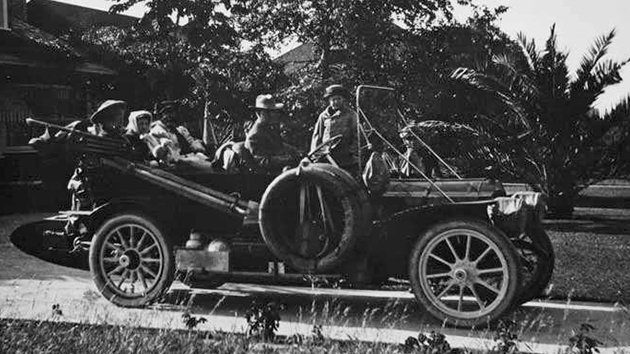
The Murdock family about to leave Pasadena

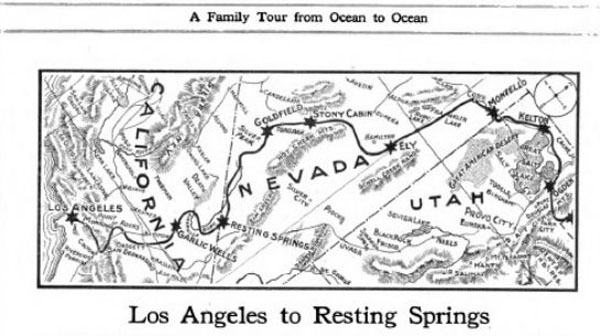
With the advent of cars in the early 1900’s, a few intrepid souls can be credited with establishing that it WAS possible to drive from coast to coast in an automobile. Although not the first to do so, Jacob Murdock, his wife Anna, children Lillian, Alice, and Jacob, Jr., were the first family to embark on such a trip. They, along with their mechanic, Phillip LeMay, departed Los Angeles on April 24, 1908 and arrived in New York City, 32 days, 5 hours, and 25 minutes later on May 26th.

876904lMr. Murdock – much to the joy of this writer who has a love of such history – recorded their travails on the trail in a short book which I found preserved by the University of Michigan. (see the link below). Alas, the Infallible Wikipedia has not heard of Mr. Murdock. Instead, I enjoyed a delightful read while sitting in a comfortable chair trying hard to imagine all the family and the mechanic – along with an occasional sixth passenger found along the way – experienced.

In 1908, paved roads were few, especially through the great American west. Their vehicle was a 1908 “Thirty” Packard with a canvas roof, folding windshield and speedometer. They started in Los Angeles, then followed the path of modern I-15 to Daggett. Those 141 miles were the first day of their journey.

mdp.39015071565041-seq_8As they continued northeast through the Mojave desert and along the southern boundary of Death Valley, they became mired in quicksand, and eventually hit upon the use of heavy rope to create makeshift chains for the tires. This experience helped prepare them for the next day when, as Murdock says in the book, “We soon found that our drift and sand experience at Coyote Lake had been merely a kindergarten for us in the art of tractionless travel.” It took 13 hours to drive 67 miles, many of those “where we again shoveled, groveled, plowed and floundered.”

From there it was northward into Nevada and Utah. They drove around the north end of the Great Salt Lake to Ogden, completing the first leg of their journey, nearly 1000 miles.

I found it interesting to ‘map’ their route. Once they arrived in Wyoming their path was generally along modern day I-80 clear to Iowa before tracking north a bit for a straight line in to Chicago; from there they dropped down into Pennsylvania for a brief stop at their home in Johnstown before completing the trek. On May 26th, they ended their 3,693.8 mile family trip when they arrived on the corner of Broadway and Sixty-first street in New York City.

murdock family new york

The Murdock family on May 26, 1908 upon their arrival in New York City

Along the way they had encountered oppressive heat, a blizzard, and much rain. The tracts they drove on went from sandy, to muddy, to rocky, to impassible in places. They experienced flat tires, mechanical breakdowns, and the car becoming mired in sand and mud. They got lost. While Murdock highlighted these challenges, rarely does he address what riding in that car for eight to fifteen  hours a day was like for the passengers.

Which got me thinking about my first multi-day road trip. It was the summer of 1970 and my parents, my slightly older sister, and I drove from Yakima to California in a 1964 Cadillac Coupe DeVille. My dad had a strong need to connect with his family, having just lost his mother in January. So off we drove to Elk Grove, California, staying in motels along the way and eating most of our meals at Denny’s.

In retrospect, I doubt my parents WANTED to eat every meal at Denny’s. But they had a picky eater along who ordered a French dip sandwich for pretty much every meal. It’s actually surprising that I still like French Dips. I don’t recall much of the scenery along the way. What I do recall is we stayed at my Aunt Arlene and Uncle Dick’s place outside Sacramento and my sister and I got to hang out with my very cool, two years older cousin, Sally. For a couple of days we got to swim in the pool at the apartment complex they managed and do awesome teenage girl stuff like sunbathe and talk about boys.

rawImage

San Francisco’s famous intersection

Our trip next took us to San Francisco where, unfortunately for me, we could not locate a Denny’s. Lunch that day took us to a drive in burger joint in the heart of San Fran (after a ride on the cable cars and navigating Lombard street). As we sat in the car eating our food, either my sister or I noticed the street signs at the intersection: Haight and Ashbury. In 1970 this WAS ground zero for the counter culture movement of the day. It was there I saw my first real hippie.

Further south we continued, arriving in Anaheim where we stayed at the Jolly Roger Inn. The next day we spent at Disneyland. Yes, just one day… enough time in my parents’ book. I know we stood in line a really long time to ride both “Pirates of the Caribbean” (it was the newest attraction then, having opened 3 years earlier) and “The Haunted Mansion.” We also rode on the “Mine Train through Nature’s Wonderland” which was a rather pedestrian trip on a tiny railroad engine through scenes from the American West. It was replaced less than a decade later with one of my favorite roller coasters, “Big Thunder Railroad.”

The perfect pairing

A place for fun and a place to eat!

Along the way, my sister and I were introduced to a bunch of second cousins and our great aunt and after a couple of days, we headed back north, winding our way up the Pacific coast all the way through California and Oregon.

As a young teen, I had zero appreciation for how special that first road trip was. I wish I had been able to drink in all the sights, sounds, and experiences of that time. Alas, as my mother – who was fond of homilies used to opine – ‘youth is wasted on the young.’

There have been many more ‘road trips’ over the years as the hubby and I have made it a mission to travel the vast lands of the United States by car. In other blog posts I have shared some of those adventures (here, here, here, and here) . But it is Jacob Murdock who captures the spirit of the American road trip in this one paragraph:

“If there ever is a national highway from ocean to ocean, the tourist will find many wide perspectives and long, beautifully-colored vistas which are well worth his while. Some of the scenes which we enjoyed were so beautiful that we thought them worth the trouble and hardship to which we had been subject in getting there over districts without any roads at all.”

Indeed, Mr. Murdock. Indeed.

https://babel.hathitrust.org/cgi/pt?id=mdp.39015071565041&view=2up&seq=8

Hummingbirds!

May 19, 2020

If You Fill It, They Will Come

hummingbird 2011 003

Anna’s Hummingbird is a year round resident of Western Washington. The author took this photo in her backyard in 2011.

As one drives through the suburbs this time of year, it is hard to not notice the red topped and bottomed glass or plastic bottles hanging from eaves and hooks.

With apologies to the movie ‘Field of Dreams,’ those of us who hang these bottles know, “If you fill it, they will come.”

Beginning in the middle of March, one sure sign that spring is here is the arrival of hummingbirds.

These tiny birds – the smallest of any bird species – are born entertainers. When they find a food source they will defend it with vigor, putting on a show of swoops and dives, as they zoom to and from the feeder. If one sits quietly nearby, the birds may hover and look at you, or will be observed pausing mid-air before flying off in a burst of speed.

They are truly amazing creatures. There are 338 known species, the majority of which are found in South America. In fact there are as many as 140 different species which co-exist with each other in the Andes range. It is likely the species originated on that continent and have spread from there to North America.

Calliope-Hummingbird-male-1200x800

Calliope Hummingbird photo from the internet

black chinned hummer

Black Chinned Hummingbird photo from the internet

Only a few hummingbird types are usually found in Washington State: Anna’s, Rufous, Black-Chinned, and Calliope. A couple other species have been spotted, but their visits are considered accidental.

There are a number of things which make the birds unique.  One is the enlarged brain region responsible for vision. From the Infallible Wikipedia:

“The enlargement of this region responsible for visual processing indicates an enhanced ability for perception and processing of fast-moving visual stimuli which hummingbirds encounter during rapid forward flight, insect foraging, competitive interactions, and high-speed courtship.”

Additionally, hummingbirds have developed in such a way that they can adapt – in flight – to environmental factors such as wind. Wikipedia continues:

“While hovering, the visual system of a hummingbird is able to separate apparent motion caused by the movement of the hummingbird itself from motions caused by external sources, such as an approaching predator. In natural settings full of highly complex background motion, hummingbirds are able to precisely hover in place by rapid coordination of vision with body position.”

The article does go way down into the weeds with technical terms and scientific explanation; worth the longer read to learn more about these tiny acrobats. One of the most interesting aspects of hummingbirds, I think, is their ability to slow their metabolism enough to go into a state of hibernation.

“The metabolism of hummingbirds can slow at night or at any time when food is not readily available: the birds enter a hibernatory, deep-sleep state (known as torpor) to prevent energy reserves from falling to a critical level. During nighttime torpor, body temperature falls from 40 to 18 °C, with heart and breathing rates both slowed dramatically (heart rate to roughly 50 to 180 beats per minute from its daytime rate of higher than 1000).

During torpor, to prevent dehydration, the GFR ceases, preserving needed compounds such as glucose, water, and nutrients. Further, body mass declines throughout nocturnal torpor at a rate of 0.04 g per hour, amounting to about 10% of weight loss each night. The circulating hormone, corticosterone, is one signal that arouses a hummingbird from torpor.

Use and duration of torpor vary among hummingbird species and are affected by whether a dominant bird defends territory, with nonterritorial subordinate birds having longer periods of torpor.”

Just outside my window there are at least four or five of my favorite birds providing me with inspiration.  Occasionally one will zip past my open window, a barely recognizable streak. On beyond – in the tree next to our house I watch as they perch at the top of slender branches. The Anna’s hummingbirds are also known for their vocal chirps, some of which sound like the warning beep of a smoke detector whose battery has worn out.

Winter20112012 004

Anna’s hummingbird at our feeder in winter

Winter20112012 008

Our cat Purr watching the show from inside the warm house

I first started feeding them in the 1980’s, putting up the feeders in early spring and retiring them in late August. For years I had understood the birds to be seasonal visitors. Then – some ten years ago – I noticed they were still outside my window in the fall. So I kept refilling their food source. And the birds stayed all winter.

In my reading I learned that only the Anna’s variety will remain year round in the mostly temperate climate of Western Washington.

When we moved to Mount Vernon two years ago, of course I put out the feeder in hopes of attracting a few birds. It worked. This year – without the need to be in Yakima half the time – I upped the stakes. For Mother’s Day my son gave me two additional feeders of a design which I had recently purchased and found it encouraged more birds to participate. With three active feeders, I am now cooking nectar about once a day!

I do believe we have three of the four species here: Anna’s, Rufous, and Black-Chinned. It’s possible the other is here also, but further observation is required.

Occasionally I will have a hummingbird hover just outside the window of my second story office. This occurred once last week and its message was clear: our feeder is empty. When I arrived downstairs and checked, the bird was correct. It was time to carry out my part of the bargain… fill it and they will stay.

Update: May 19, 2022 Due to some commitments this year, I opted to not put out my feeders in the winter. Yet, in mid-March the hummers arrived right on schedule and are just as voracious as always, draining a feeder a day. Today is the exception as I’m having to clean and replace nectar in TWO of the feeders!

I shot this video clip last night. Walked out on our front step and this bird flew right at me, intent on warning me off! The video is a little choppy because it was within inches of my face, coming at me with its beak… the sound you hear is it ‘popping’ it’s tail feathers to make that clicking noise. 

A few links:

https://en.wikipedia.org/wiki/Hummingbird

https://en.wikipedia.org/wiki/List_of_hummingbird_species

https://www.beautyofbirds.com/hummingbirdswashingtonstate.html

Does She or Doesn’t She…

Only her hairdresser knows for sure

May 12, 2020

Miss ClairolIn the era of COVID-19 this slogan from a 1960’s home hair coloring commercial has become outdated. With the shuttering of the beauty salon in the name of public safety, women (primarily) of a certain age, are seeing their true hair color for the first time in years.
Which, of course, got me wondering about the history of coloring one’s hair. The first documented use of anything to change a person’s hair color appears to be by the Celtic people between 30 and 60 B.C. From the Infallible Wikipedia:

“Diodorus Siculus, a Greek historian, described in detail how Celtic people dyed their hair blonde: ‘Their aspect is terrifying… They are very tall in stature, with rippling muscles under clear white skin. Their hair is blond, but not naturally so: they bleach it, to this day, artificially, washing it in lime and combing it back from their foreheads. They look like wood-demons, their hair thick and shaggy like a horse’s mane. Some of them are clean-shaven, but others—especially those of high rank—shave their cheeks but leave a moustache that covers the whole mouth…’.

The dyeing of hair is an ancient art that involves treatment of the hair with various chemical  compounds. In ancient times, the dyes were obtained from plants. Some of the most well known are henna (Lawsonia inermis), indigo, Cassia obovata, senna, turmeric and amla. Others include katam (buxus dioica), black walnut hulls, red ochre and leeks. In the 1661 book Eighteen Books of the Secrets of Art & Nature, various methods of coloring hair black, gold, green, red, yellow, and white are explained. The development of synthetic dyes for hair is traced to the 1860s discovery of the reactivity of para-phenylenediamine (PPD) with air. Eugène Schueller, the founder of L’Oréal, is recognized for creating the first synthetic hair dye in 1907. In 1947 the German cosmetics firm Schwarzkopf launched the first home color product, ‘Poly Color’. Hair dyeing is now a multibillion-dollar industry that involves the use of both plant-derived and synthetic dyes.”

Nowadays you will see people with a veritable rainbow of colors in their hair, sporting bright hues of red, orange, green, blue, and purple.

The more traditional application of hair dye, however, still prevails with most using it to change to a preferred color or to hide the gray.

Unfortunately the Infallible Wikipedia’s statistics were from some eight years ago, but an internet search turned up a fun webpage with all sorts of facts on hair. It was one sentence in particular from Hollee Wood, the site’s author, which was most interesting:

“In our world of ever-changing hair color, it’s no secret that nearly 85% of women color their hair at least once every eight weeks (compared to just 7% in 1950). I mean… at that rate, it’s probable that you even color your hair! *gasp*”

Her article had a whole bunch of statistics including the fact that by the time most American’s reach age 60, nearly 60 percent of us will have grey hair.

Barb the towhead

The author in all her towheaded glory at age four

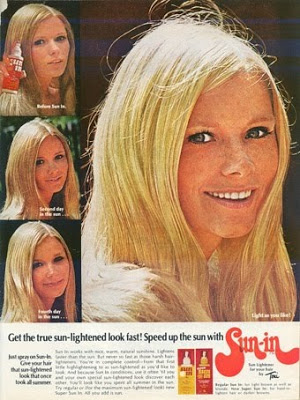
I’ve had a lifelong, on again off again, relationship with hair coloring products. Born a towhead (for those who do not know it’s a term to describe, usually, an extremely blonde child) I was blonde until about fifth grade and then my hair began to turn into a mix which I would describe as dirty blonde. My personal identity, however, was as a blonde and – when I was in ninth grade – I discovered a product which would bring back the blonde: Sun-In. The year was 1972 and both girls and guys did not believe in cutting one’s hair. It was the era of the hippie.

Sun-In 3I started using Sun-In approved by and aided by my mother! Every couple of months we would apply the stuff and, due to probably allowing it to stay on my hair longer than we should, I became blonder and blonder. This continued throughout high school and my first three years of college.
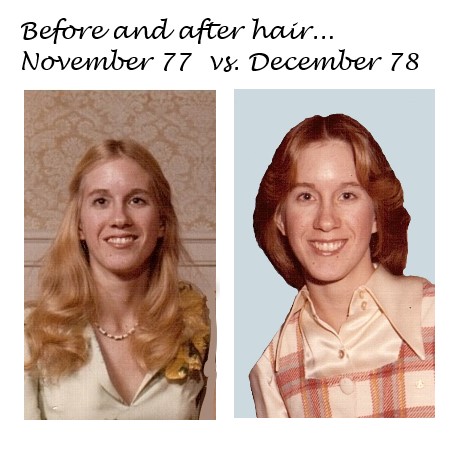
In the summer of 1978, with the long haired hippie era over, I did a very radical thing: I cut my hair. That fall I quit using Sun-In and my roots began to betray me. When I went home for Thanksgiving I did the second radical thing: I dyed my hair darker to try and locate my natural color. When I arrived back at the University of Puget Sound after the break, I got more than a few snapped heads with the total change in my appearance.

1977 vs 1978With the 1980’s came the era of big hair which, for someone whose hair has zero natural curl, required a different chemical process: the permanent wave. Turns out my hair was a fairly light brown and looked even lighter due to the perm.
By the late 1980’s, however, big hair was out and shorter hair was in. With motherhood in 1990 came the need for a practical haircut with little time to fuss over it.

And then, sometime in the mid 1990’s, my sister in law got me re-hooked on hair bleach and every couple of months I’d meet up with her to get my fix. And so it continued for nearly two decades until last fall when I decided it was time to wean myself from blonde (has anyone noticed how blonde starts to look like gray on an older person?) and back to light brown with highlights.

On March 16, 2020, the unthinkable occurred. All hair salons and barbershops in many states were deemed ‘dangerous’ for the spread of the Coronavirus and shut down. You could almost hear the panicked cry of millions of women across the U.S. as their ability to hide their natural hair color came to a crashing halt.

Now, two months later, they are – as the saying goes – showing their true colors. The worst case I saw was a woman with red hair… but the top of her head was pure white for at least an inch on either side of her part.

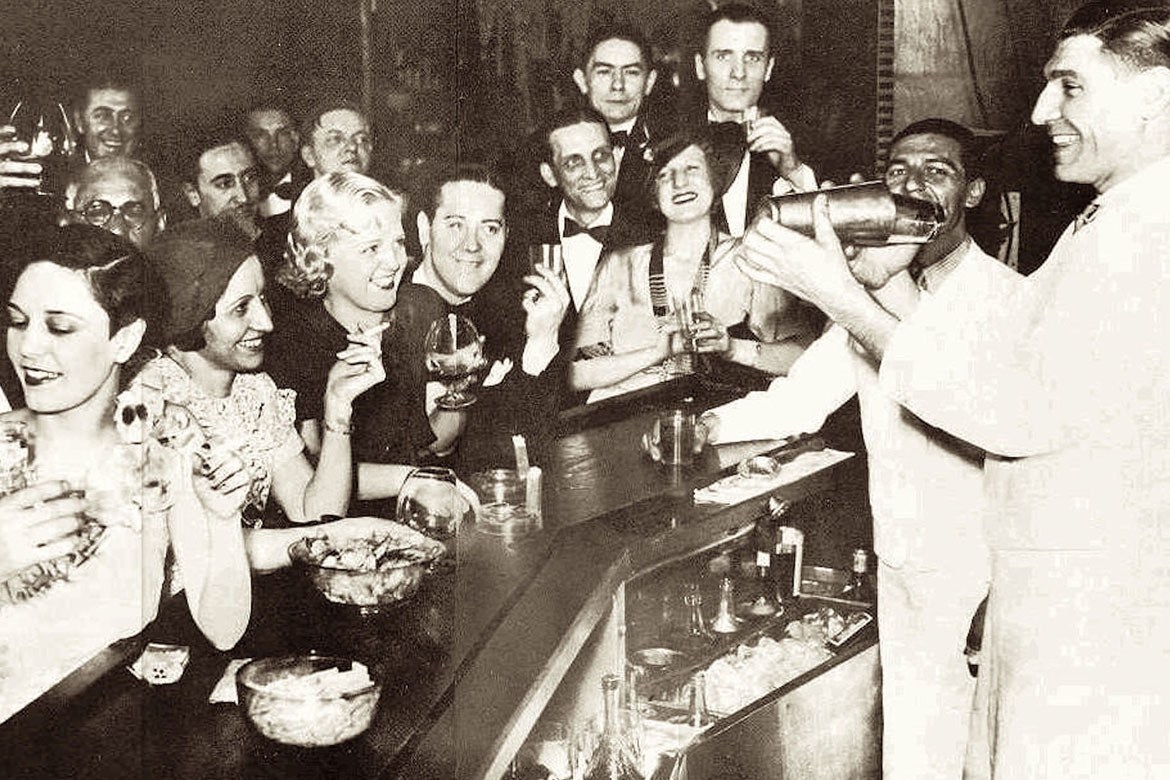
speakeasy

A speakeasy in the 1920’s

This whole thing has sparked what I call the “Speakeasy” of the 2020’s. In the 1920’s – under alcohol prohibition – secret locations where you could go to consume liquor sprang up in cities across the nation. During that time no one spoke publicly of these establishments but they did a booming business as history now tells us.

I find myself looking suspiciously at anyone with a decent haircut or obviously colored hair. “Where did you get your hair done?” I ask. They just smile and shrug their shoulders, unwilling to share their secrets.

As for me, I’m apparently part of the 40 percent who have not gone grey by age 60. Sure there are spots, but overall, I’m weathering the great graying of America okay. I am thinking of growing my hair long, buying some Sun-In, and reliving the glory days of 1974.

The question remains, however, with a twist: ‘will she or won’t she? Only her hairdresser – if she ever gets to see her again – knows for sure.

The links:

https://www.holleewoodhair.com/hair-color-statistics/

https://en.wikipedia.org/wiki/Hair_coloring

https://en.wikipedia.org/wiki/Speakeasy

1974 Olympic National Park

The author at the height of the Sun-in years, 1974, shown here with her first co-conspirator, Mom, and also Dad, who never dyed his hair and never once squeezed the magic potion on my head.

Update May 12, 2022 – Thankfully, hair salons have reopened and we women who want a bit of color have options once again! Here’s to all the hardworking cosmetologists out there who will remain unnamed. Hey, we don’t want to give up our secrets.

Against All Odds

May 5, 2020

Phil Collins

If ever there were a singer songwriter who captured the romantic angst of the 1980’s it was Phil Collins. He recorded a string of hits which listeners purchased in numbers that sent seven of his songs to the top of the Billboard Charts.

Against All Odds was the first number one hit during his solo career. On May 5, 1984 it was in  the top spot for the third week in a row.

Originally, I was going to feature just the song but the more I researched, the more interested I became in learning about Collins and his impact during the 1970’s, 80’s and 90’s. The Infallible Wikipedia states that Collins is:

“an English drummer, singer, songwriter, multi-instrumentalist, record producer, and actor, best known as the drummer/singer of the rock band Genesis and for his solo career. Between 1982 and 1989, Collins scored three UK and seven US number-one singles in his solo career. When his work with Genesis, his work with other artists, as well as his solo career is totalled, he had more US Top 40 singles than any other artist during the 1980s. His most successful singles from the period include ‘In The Air Tonight’, ‘Against All Odds (Take a Look at Me Now)’, ‘One More Night’, ‘Sussidio’, ‘Two Hearts’ and ‘Another Day in Paradise.’

Born and raised in west London, Collins played drums from the age of five… (snip) He then pursued a music career, joining Genesis in 1970 as their drummer and becoming lead singer in 1975 following the departure of Peter Gabriel. Collins began a solo career in the 1980s, initially inspired by his marital breakdown and love of soul music, releasing a series of successful albums, including Face Value (1981), No Jacket Required (1985), and …But Seriously (1989). Collins became ‘one of the most successful pop and adult contemporary singers of the ’80s and beyond’. (snip)

Genesis

Genesis Band members in the early 1970’s, clockwise from bottom left, Phil Collins, Mike Rutherford, Steve Hackett, Peter Gabriel, and Tony Banks.

Collins’s discography includes eight studio albums that have sold 33.5 million certified units in the US and an estimated 150 million worldwide, making him one of the world’s best-selling artists. He is one of only three recording artists, along with Paul McCartney and Michael Jackson, who have sold over 100 million records worldwide both as solo artists and separately as principal members of a band. He has received eight Grammy Awards, six Brit Awards (winning Best British Male Artist three times), two Golden Globe Awards, one Academy Award, and a Disney Legend Award. He was awarded six Ivor Novello Awards from the British Academy of Songwriters, Composers and Authors, including the International Achievement Award. He received a star on the Hollywood Walk of Fame in 1999, and was inducted into the Songwriters Hall of Fame and the Rock and Roll Hall of Fame as a member of Genesis in 2010. He has also been recognised by music publications with induction into the Modern Drummer Hall of Fame in 2012, and the Classic Drummer Hall of Fame in 2013.”

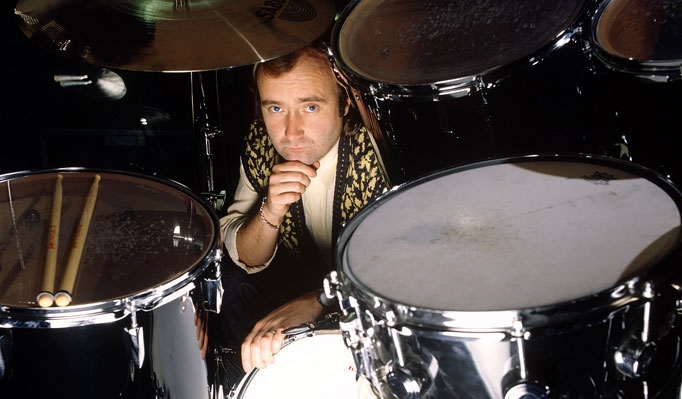
In reading the rather exhaustive Wikipedia article, one is left with the impression that Collins wanted to be everywhere and involved in every creative endeavor during the height of his popularity. In addition to Genesis and his solo work, he managed to play drums and provide vocal backups for many of the other popular groups of the day; he was involved with TV and movies. Did voice work for Disney and wrote songs for the movies. And he paid for his workaholic behavior with the demise of three marriages.

Phil Collins drums

His strong personality and singular career focus has made him the target of much criticism over the years. While his undeniable talent has been lauded by many, there are those in the rock and roll world who derided Collins as a sell out to his acoustic rock roots by taking a more commercial approach to his career in the 1980’s.

When I think about music from the 1980’s it does seem to fall into two camps: the more cutting edge sound of a Michael Jackson or Prince, or the soft ‘pop’ of the era as exemplified by artists such as Collins, John Waite, and Wham!

The music of the cutting edge artists required one to stop and listen, while those in the latter group provided the backdrops for our lives.

I have often said, when the topic of the 80’s and music comes up, that it produced some of the best songs ever. Don’t get me wrong. I love the music of the 1970’s and a lot of the 1960’s. It was in the 1980’s, however, when there was a diversity of sound which appealed to pretty much anyone’s taste.

And, love him or hate him, Phil Collins was a big part of the decade.

The links:

https://en.wikipedia.org/wiki/Phil_Collins

https://en.wikipedia.org/wiki/Against_All_Odds_(Take_a_Look_at_Me_Now)

Nintendo Game and Watch

April 28, 2020

The First handheld Electronic Games

Decades before anyone had ever uttered the phrases Angry Bird, Temple Run, Word’s with Friends, or Candy Crush, the first wave in digital gaming had arrived in the States from Japan.

nintendo_game_and_watch___ball

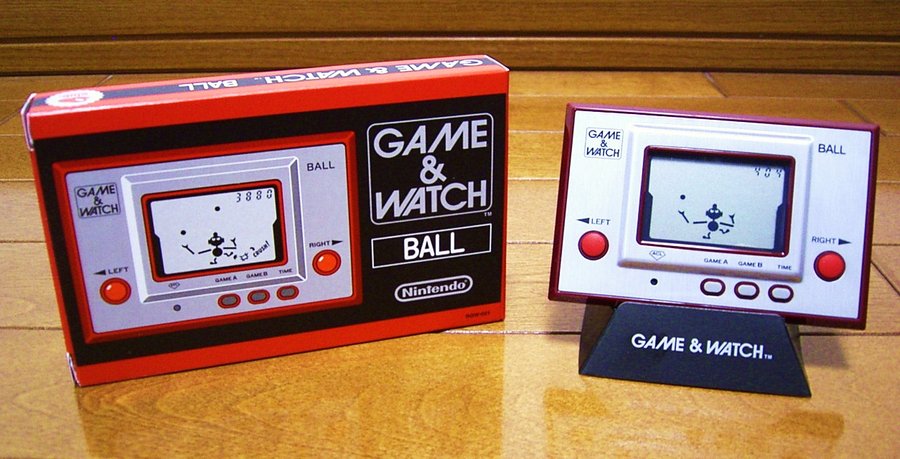
The first Game and Watch released: Ball

On April 28, 1980, a then unknown manufacturer by the name of Nintendo, launched the first of its 4 ½ by 2 ½ handheld electronic game series in the US. And thus the Game and Watch was born, a precursor to the iPhone and Android games of today.

For less than $20 a consumer was able to buy a device which featured – usually – two different games played by pushing tiny buttons to move items around on the screen. From the Infallible Wikipedia:

“The Game & Watch brand is a series of handheld electronic games produced by Nintendo from 1980 to 1991. Created by game designer Gunpei Yokoi, each Game & Watch features a single game to be played on an LCD screen in addition to a clock, an alarm, or both. It was the earliest Nintendo video game product to gain major success.

The units are based on a 4-bit CPU from the Sharp SM5xx family, that include a small ROM and RAM area and an LCD screen driver circuit, although prior to the emulation in MAME there was a misconception in that every unit used a custom ASIC instead of a proper microcontroller.

The series sold a combined of 43.4 million units worldwide.”

Yokoi is said to have conceived the idea while on a bullet train when he observed a fellow traveler playing with his calculator. He reasoned that a small device which would also serve as a clock and alarm and allow the person to play a game could fill the desire for entertainment when unable to do other things.

In all, there were 59 different titles sold. It wasn’t until Nintendo established offices in the United States when the Game and Watch distribution became more widespread in this country.

Our family were early adopters of Game and Watch for one very good reason: The hubby went to work for Nintendo soon after they established their headquarters in Tukwila, Washington. (Yes, it’s true. Their first Washington address was there and NOT Redmond.)

I don’t know why, exactly, we bought all those Game and Watch games, except that Nintendo had an inventory and there was likely an employee discount. Regardless, soon we had friends and family asking for the games and we obliged.

The first one released was called Ball and featured a character later dubbed “Mr. Game & Watch” who juggled balls. He is according to the Infallible Wikipedia: “a generic amalgam of black, open-mouthed, big-nosed cartoonish stick figure silhouettes.” That first game – and three others released in quick succession – sold fewer than 250,000 games worldwide. Two other early games – Vermin and Fire – each sold about a million.

Which is where we enter the story. At the Nintendo warehouse in Tukwila there must have been stacks and stacks of unsold games. It is likely the first one we ever had was Fire and it was one of my favorites. We referred to the game as ‘Burning Babies.’ Yes, politically incorrect but in those days no one had ever uttered that phrase.

My description of the game Fire: On screen you see a cartoonish ambulance on the right side of the screen and a burning multi-story building on the left. Two Mr. Game and Watch characters carry what looks to be a safety net. Their job is to catch the ‘people’ who are literally leaping from the burning building. It starts out benign enough with one tiny person jumping and you must move the firefighters left and right with their net to stop the jumper from hitting the ground. You must then bounce the burning baby across three sections from the building to the ambulance. As the game progresses, a second jumper leaps soon after the first and you must now figure out which one to catch first. It’s like a bad juggling game where soon there are as many as four jumpers on the screen at once! Drop one and you get a tiny little angel icon indicating a lost life. Truly, you have not known stress until you’re frantically trying to save the tiny burning babies. Oh, and as your score increases, so does the speed with which they jump. Yes, that’s me playing the game in the short video below. Yes, it still is stressful when the babies splat on the ground!

Soon, the hubby was bringing home more Game and Watches. The titles included Parachute, Octopus, Fire Attack, Manhole, and Turtle Bridge. Each one seemed to include violent ends to the poor little electronic people or critters if you didn’t do your job. (Which is the common element for the four listed on the FB page!) These were followed by Nintendo’s own characters of Donkey Kong, Donkey Kong, Jr., and Mario’s Cement Factory, as well as licensed character games featuring such cultural icons as Popeye, Mickey Mouse, and Snoopy.

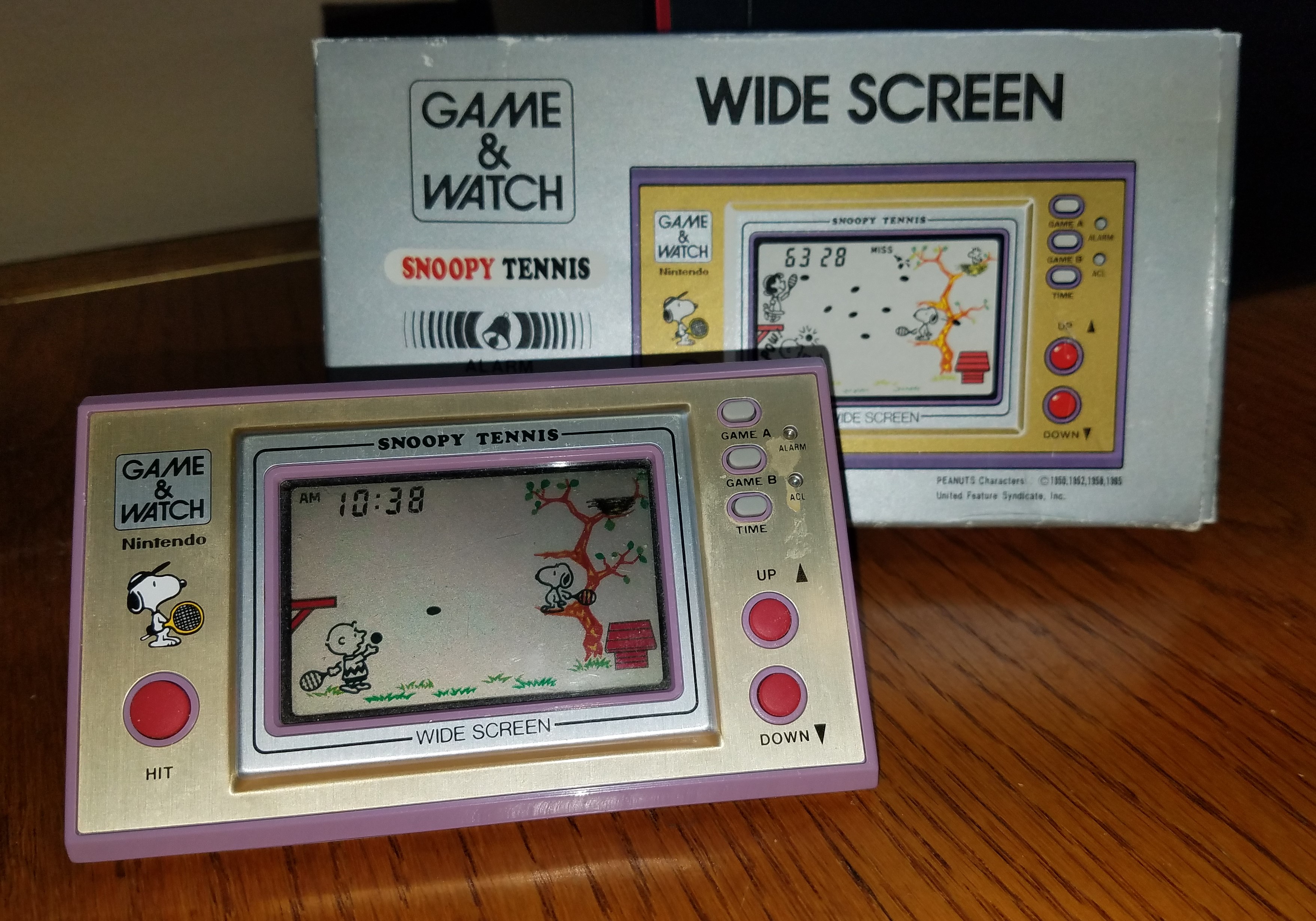
We gave my mother Snoopy Tennis for Christmas in the early 1980’s. It was the perfect game for her as she was a lifelong tennis player and got a real kick out of the tiny Charlie Brown wielding his tiny tennis racket to serve balls to Snoopy who had to jump up and down tree branches to hit it. If he missed, a happily sleeping Woodstock awoke and squawked about it. In the alarm feature, Lucy and piano player Schroeder make an appearance. The best part is that with Snoopy Tennis no tiny imaginary people died.

Snoopy Tennis

Snoopy Tennis was released on April 28, 1982, two years to the day after the first Game and Watch made its appearance.

My mother absolutely owned that game. I think her high score was in the ten thousands and, boy, did those tennis balls come fast and furious. She worked those controls like a boss. Everyone who watched her play was awed. At some point her thumbs got too overworked and she had to give up the game. It bubbled up out of a box when we were going through my parents’ house last summer so we now have two of that game. Hers is the one shown here.

I think about how far electronic games have come since then. I prefer games where when I lose, nothing dies. Which is why I love Candy Crush. Having completed over 5000 levels, I’m in rarefied territory and know of only one friend at a higher level. Like my Mom, I kinda own the game. But I think if my Mom had ever played Candy Crush, she would have given me a run for my money.

The links:

https://en.wikipedia.org/wiki/List_of_Game_%26_Watch_games

https://en.wikipedia.org/wiki/Game_%26_Watch_series