Archives

Roller Skates

‘Rinkmania’ was all the craze in Victorian England

January 4, 2022

There are days in history on which an invention so novel arrives, that it becomes all the rage – at least for a time.

An early ‘concept’ of a roller skate as well as a quite humorous interpretation.

One such invention was the four wheeled roller-skate, patented on January 4, 1863 by American James Plimpton.

Unlike an ice skate, the wheeled variety did not require a flat frozen surface and could be enjoyed in a variety of settings.

During the late 1800’s, it also was the catalyst for a ‘sexual revolution’ of sorts.

The roller skates story begins in 1743 when a pair was used in the theatre in Great Britain. John Joseph Merlin patented his version of the skate in 1760. But they were difficult to steer and, because there was no braking system, stopping at will was problematic.

It was Plimpton’s 1863 design which proved to be commercially successful. The Infallible Wikipedia informs us that Plimpton invented what was known as a rocking skate:

“… (He) used a four-wheel configuration for stability, and independent axles that turned by pressing to one side of the skate or the other when the skater wants to create an edge. This was a vast improvement on the Merlin design, one that was easier to use and drove the huge popularity of roller skating, dubbed ‘rinkomania’ in the 1860s and 1870s, which spread to Europe and around the world, and continued through the 1930s. The Plimpton skate is still used today.

1950’s era roller skaters

Eventually, roller skating evolved from just a pastime to a competitive sport; speed skating, racing on skates, and inline figure skating, very similar to what can be seen in the Olympics on ice. In the mid 1990s roller hockey, played with a ball rather than a puck, became so popular that it even made an appearance in the Olympics in 1992. The National Sporting Goods Association statistics showed, from a 1999 study, that 2.5 million people played roller hockey. Roller skating was considered for the 2012 Summer Olympics but has never become an Olympic event. Other roller skating sports include jam skating and roller derby.

Roller skating popularity exploded during the disco era but tapered off in the 1980s and 1990s. Sales of roller skates increased during the COVID-19 pandemic as people sought safe outdoor activities.

Roller skating saw a revival in the late 2010s and early 2020s, spurred on by a number of viral videos on the popular video sharing app TikTok. Many popular brands sold out to the point of back-order, with many people taking up the hobby during COVID-19 quarantines across the globe.”

One aspect of the roller skates history which intrigued was the claim that it inspired a sexual revolution back in the 1860’s.  This is attributable to the stodgy Victorian moral codes of the day in Great Britain.

I’m not quite sure what the heck was going on here… but everything about this photo is intriguing!

According to one article, the skating rink proved to be the one place where romantically inclined young Brit’s could meet other young people.

“By the mid-1870s, a craze for indoor rollerskating had come to Britain, with 50 rinks in place in London at one point. The press dubbed the phenomenon ‘rinkomania’, but the healthy exercise that Plimpton had boasted of was not all that attracted the young ‘rinkers’.

‘The skating rink is the neutral ground on which the sexes may meet,’ reported Australia’s Port Macquarie News of goings-on in London and elsewhere, ‘without all the pomp and circumstances of society. The rink knows no Mother Grundy, with her eagle eye and sharp tongue, for Mother Grundy dare not trust herself on skates, and so the rinker is happier than the horseman of whom Horace sang.’

Holding hands and whispering sweet nothings became easier without Mother Grundy – a contemporary term for a stern matriarch – and her ilk tagging along. Prolonged eye contact with one’s intended replaced stolen glances.”

Skating rinks were also built all across the United States and remained wildly popular for one hundred years. In the late 1990’s and into the early part of the 21st Century, many were shuttered.

1960’s era metal roller skates. Very adjustable, you could make them fit your tennis shoes exactly.

But thanks to the global pandemic of 2020, roller skating has emerged as a great way to get exercise. Roller rinks are seeing a revival in popularity.

I must admit that when I came across this topic, it produced nostalgia. It’s been about 15 years since I’ve been out roller skating. A fear of falling and breaking something keeps me from pursuing this particular activity.

But as a child, I was fearless. In fact, I cannot remember a time when I didn’t roller skate. It was in 1966 when my parents did a home remodel and our carport was converted to a family room. The driveway was relocated and became a large, flat expanse of concrete. It was perfect for a child with a pair of all metal roller skates which attached to her shoes. I spent many hours in the driveway skating around. No doubt I skinned my knees dozens, if not hundreds, of times. But I was undaunted.

When the weather turned inclement I’d sometimes get to go to my Aunt’s house a couple blocks away and skate in circles around their basement.
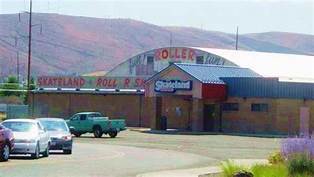
The current exterior of Yakima’s Skateland

But the holy grail of experiences was on the days when I got to go to Skateland, Yakima’s very own roller rink. I loved everything about Skateland. How it smelled. The wood cubbies where one stored their shoes and coat. The flashing lights suspended over the rink. The planked floor with numbers painted on it for when they had a contest. The sound of hundreds of wheels rolling across it. The impossibly loud music. Dancing the hokey pokey.

September 2001 was the last time I went skating at Skateland in Yakima. The occasion was my niece’s ninth birthday. We are pictured skating together at the left side of the photo.

I feel quite confident that roller skating is in my rear view mirror but I wonder if there is some inventor out there who could create a contraption that would allow all us Baby Boomers to skate once again. Places like Skateland in Yakima, or Skagit Skate not too far from where I currently live, could make it a real thing.

What we BB’s need would be akin to training wheels or even a walker like device. Something that would allow all the old fogies to stay upright and be able to recapture a few fleeting moments of our youth. Ah yes, those were the good old days.

A few links:

First up is Jim Croce’s classic ‘Roller Derby Queen’ – his explanation at the beginning is great!
https://en.wikipedia.org/wiki/Roller_skates

https://www.bbc.com/news/magazine-31831110

Same Old Lang Syne

The Iconic song with a twist

December 28th

The end of December is, traditionally, a time to reflect on the year just past. No song is more associated with the ending of the year and the start of a new one than Auld Lang Syne.

It somehow seems appropriate that the origins of this poem and song are steeped in the mysteries of time. It was plucked from obscurity by Scottish poet, Robert Burns, in 1788. He set it to music and added verses which most closely approximate the song familiar to all.

The Infallible Wikipedia shares, of course, a plethora of information:

“Robert Burns sent a copy of the original song to the Scots Musical Museum in 1788 with the remark, ‘The following song, an old song, of the olden times, and which has never been in print, nor even in manuscript until I took it down from an old man.’ Some of the lyrics were indeed ‘collected’ rather than composed by the poet; the ballad ‘Old Long Syne’ printed in 1711 by James Watson shows considerable similarity in the first verse and the chorus to Burns’ later poem, and is almost certainly derived from the same ‘old song’. To quote from the first stanza of the James Watson ballad:

Scottish Poet Robert Burns

Should Old Acquaintance be forgot,
and never thought upon;
The flames of Love extinguished,
and fully past and gone:
Is thy sweet Heart now grown so cold,
that loving Breast of thine;
That thou canst never once reflect
On old long syne.

Chorus:
On old long syne my Jo,
On old long syne,
That thou canst never once reflect,
On old long syne.

It is a fair supposition to attribute the rest of the poem to Burns himself.

There is some doubt as to whether the melody used today is the same one Burns originally intended, but it is widely used in Scotland and in the rest of the world.

Singing the song on Hogmanay or New Year’s Eve very quickly became a Scots custom that soon spread to other parts of the British Isles. As Scots (not to mention English, Welsh and Irish people) emigrated around the world, they took the song with them.”

The song was popularized in the United States by Guy Lombardo who “is remembered for almost a half-century of New Year’s Eve big band remotes, first on radio, then on television. His orchestra played at the Roosevelt Grill in the Roosevelt Hotel in New York City from 1929 (snip) to 1959, and from then until 1976 at the Waldorf Astoria Hotel. Live broadcasts (and later telecasts) of their performances were a large part of New Year’s celebrations across North America; millions of people watched the show with friends at house parties. Because of this popularity, Lombardo was called ‘Mr. New Year’s Eve.’”

You would have had to have been born in a cave and lived in the wilderness your entire life to never have heard the song. In December 1980, another artist came along who wrote an autobiographical song which succeeded in connecting yet another generation to the concept of remembering, with a wistful nostalgia, days and people since gone.

Dan Fogelberg’s addition came about following a chance encounter with an ex-girlfriend on Christmas Eve in 1975. They run in to each other in the grocery store and then proceed to share a six pack of beer while sitting in her car at a mini-mart. It is, I think, the very ordinariness of the encounter which juxtaposes so very well with the emotions just under the surface.

Cover for the 1980 single

Somehow Fogelberg – who claimed to have begun the song more as a joke – ended up transforming the opening music from the 1812 Overture into a nostalgia filled classic that ends with Auld Lang Syne.

Perhaps the thing that makes the song resonate with so many people is that one recognizes – as one matures – that life is a series of binary choices. A first love, for example, is just that. A young person simply does not have the advantage of time and experience to understand that once a relationship is over it is likely to stay that way.

Fogelberg – in his song – encapsulates that moment of recognition and the emotion which comes with it:

We drank a toast to innocence

We drank a toast to now

And tried to reach beyond the emptiness

But neither one knew how

We drank a toast to innocence

We drank a toast to time

Reliving in our eloquence

Another ‘auld lang syne’

It is, though, the final few bars of the song which stops the listener and creates the ennui associated with endings… he leaves the car to walk back to his parents’ home and the ‘snow turns in to rain.’ It is at this moment when Fogelberg uses Auld Lang Syne to such devastating effect through a soulful, blues filled saxophone rendition.

Although many regard the song as a Christmas one due to its taking place on December 24th, I’ve always thought it belonged to the last week of December when, as we take down our calendars and put up the new ones, we reflect on the year just past and remember those who are no longer with us.

So here’s a toast to Auld Lang Syne with a short verse which is one of my favorites:

https://en.wikipedia.org/wiki/Auld_Lang_Syne

https://en.wikipedia.org/wiki/Same_Old_Lang_Syne

The Christmas Card

Curses to the person who started it all

December 14, 2021

I have a lot of friends who love, love, love Christmas. The decorations. The lights. Snow. Music. Truly, all of these things are wonderful and there’s a lot to enjoy this time of year.

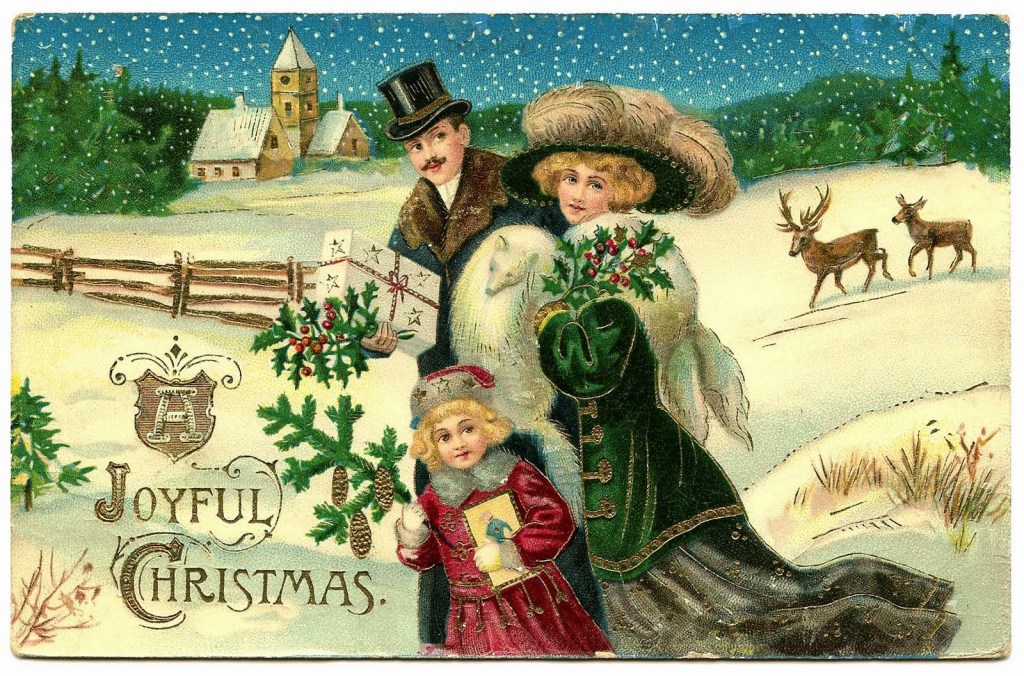
A Victorian era Christmas card

But as the calendar turns from Halloween to Thanksgiving to Christmas, I am filled with a sense of dread. “But, Barb,” you are no doubt exclaiming, “why?”

The answer is simple: Christmas Cards and presents.

Friends of mine who are not writers or ponderers (is that even a word? If not, it should be!) will never understand the anxiety this time of year brings to those of us who are either or both of these things. I’ve heard comments like “Well, you’re a writer, it’s easy for you to jot a note on a card, right?”

The answer, my friends, is “no, it is not.”

So here I sit on November 21* and I have not purchased a single Christmas card to send but I do still have at least a dozen different blank cards of varying quantities from holiday seasons past. Sometimes I send those out to family along with checks because I have no great ideas for presents.

My ‘collection’ of cards from Christmas past… always ‘some’ sent but never all, leaving a mishmash to choose from each year.

Which got me to wondering, “Who can I blame for the tradition of mailing Christmas cards?”

The Infallible Wikipedia, as always, provides some answers. Historians have discovered a Christmas card sent to James I of England in 1611! It is some 200 years later before the next such missive is noted:

“The next cards were commissioned by Sir Henry Cole and illustrated by John Callcott Horsley in London on 1 May 1843. The central picture showed three generations of a family raising a toast to the card’s recipient: on either side were scenes of charity, with food and clothing being given to the poor. Allegedly the image of the family drinking wine together proved controversial, but the idea was shrewd: Cole had helped introduce the Penny Post three years earlier. Two batches totaling 2,050 cards were printed and sold that year for a shilling each.”

The idea caught on and, by 1873, the phenomenon had become a cultural change in both Great Britain and the United States. In the early part of the 20th century, with the advent of mass produced cards, the sending of holiday greeting exploded. Hallmark – the largest manufacturer – posts that 1.6 BILLION Christmas cards are produced annually. Now that’s big business.

The sending of Christmas cards is also more likely to be from, ahem, older people. Younger folks don’t have a problem with digital greetings and messages, forsaking the now ‘old fashioned’ physical letter mailed through the post office.

The adorable stationary I chose for the 2021 Christmas letter

For me, personally, I prefer the ‘Christmas Letter.’ Why? Because when I have a blank card in front of me I feel guilty if I just sign my name and don’t pen a personal note to the recipient. But with the Christmas letter, I can agonize over each word, looking for just the right combination of humor and humility. And I get to type it on a computer which is much easier for a wordsmith.

For those who get one in the mail AND read my weekly Tuesday Newsday blog, the format of this will look familiar. Why, I asked myself, mess around with what works? And why not, I also conjectured, blend the need for Christmas greetings with my regular column?

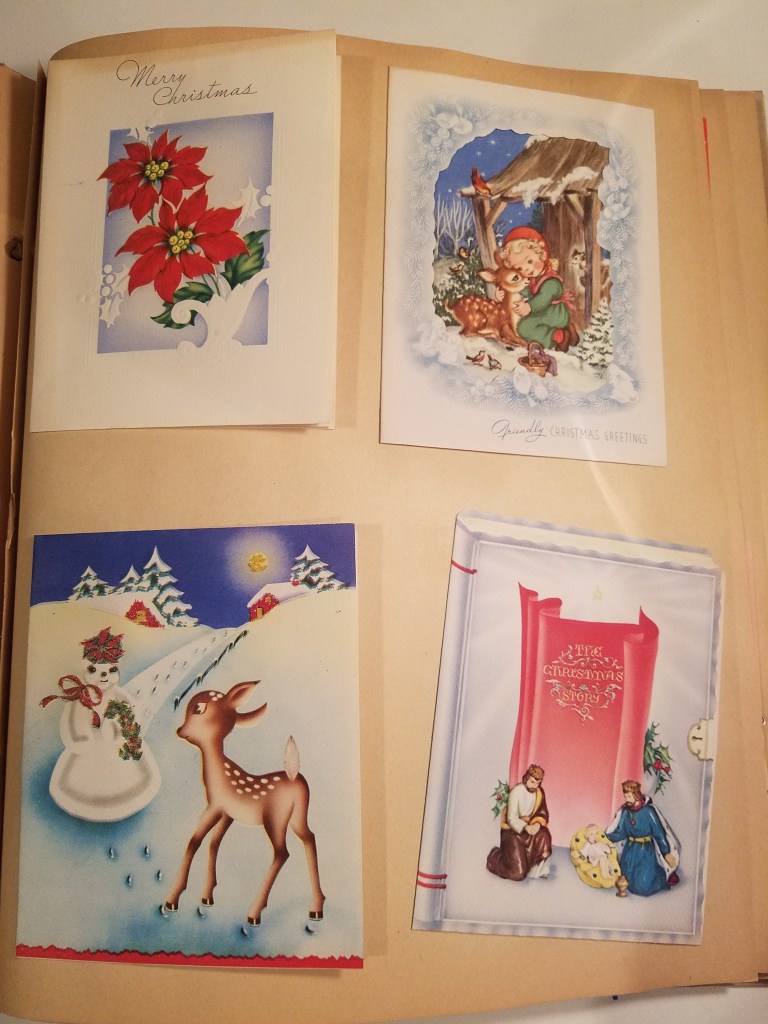
Just one of about a dozen pages of Christmas cards in a scrapbook which belonged to my Great Aunt Frances DeVore. These are from 1945.

Voila! It’s the first annual Tuesday Newsday Christmas blog and greeting letter. A tidy way to accomplish it all.

No Christmas letter would be complete without a bit about the family. So here it goes: both kiddos are off doing their own things. The son is living in Mexico having recently purchased a Mexican fixer upper house. His days are filled with work as a Senior Software Engineer (working remotely) or solving a deluge of plumbing issues. The daughter got married at the height of COVID in December 2020. Not even the bride or groom’s parents attended the ceremony… the party was delayed a year to give close friends and family the opportunity to fete the happy couple. Even better is that the pair moved back to the PNW in April 2020 and both work for Amazon. I do my part to help support them. Sometimes so does the hubby. Thank goodness for that Prime membership!

Speaking of the hubby, he became president of our HOA earlier this year and he and I both manage to stay busy via our involvement with Masonic organizations. As I am a state officer for the Order of the Eastern Star this year, most weekends find us at a reception somewhere in Washington and many a weeknight I’m off to visits. What a wonderful experience it has been!

Photo Christmas Card from my Aunt Helen and Uncle Al to our family December 1956. The stockings behind them were handmade by my grandmother.

When not traveling, I stay busy writing my blog (www.barbaradevore.com), crafting my seventh novel, and cleaning house. Just kidding about that last one. My lazy housekeeper does that. For those wondering, my hope is to finally get a novel or four published. Back in 2005-ish I penned a list of things I wanted to accomplish. First on the list was ‘Write/Publish a Novel.’ Turns out the write part is easier than the publish part. Why? Well, in today’s world, one pretty much has to self-publish and self-promote their book(s). And that takes one commodity which I often find in short supply: time. Until I have the time to do it right, publishing will have to wait.

But I am determined that eventually everyone can meet the Paxton family and find out ‘who’ is The Darling of Delta Rho Chi.

Well, I just looked at my word count and see that I’m about a dozen words from the magic thousand… the amount which fits on a two sided piece of cute holiday stationary. I certainly cannot send out plain paper! Despite my protests over the anxiety of Christmas cards, etc., I love, love, love, stationary. Thanks Amazon!

So Merry Christmas to All, and to All a good night! (Final word count: 988)

https://en.wikipedia.org/wiki/Christmas_card

*Sometimes, but not often, I will write a Tuesday Newsday far in advance. Last year for December 14th was one of those rare times!

National Pumpkin Day

The Ultimate Symbol of Halloween

October 26, 2021

During the last week of October, this item dominates American culture. Its bright orange color and – often large size – make it impossible to miss. I am talking about the pumpkin

National Pumpkin Day is celebrated every year on October 26th.

Believed to be one of the oldest cultivated vegetables, pumpkins originated thousands of years ago in northern Mexico and the southern United States. There is evidence that the gourd was used as early as 7,000 BC!

The average person, however, might think that it came from New England since its first well documented historic use was at the first Thanksgiving held in Plymouth in 1621. (Although it is disputed as to the Massachusetts event being first since a similar celebration reportedly took place in Virginia two years earlier)

The pumpkin was introduced to the Pilgrims by the natives of the area. The Infallible Wikipedia advises:

“An alternate derivation for pumpkin is the Massachusetts word pôhpukun ‘grows forth round’. This term would likely have been used by the Wampanoag people (who speak the Wôpanâak dialect of Massachusett) when introducing pumpkins to English Pilgrims at Plymouth Colony, located in present-day Massachusetts.”

As a food, it is dense and fiber rich; it’s primary nutrients beta-carotene and Vitamins A and C.

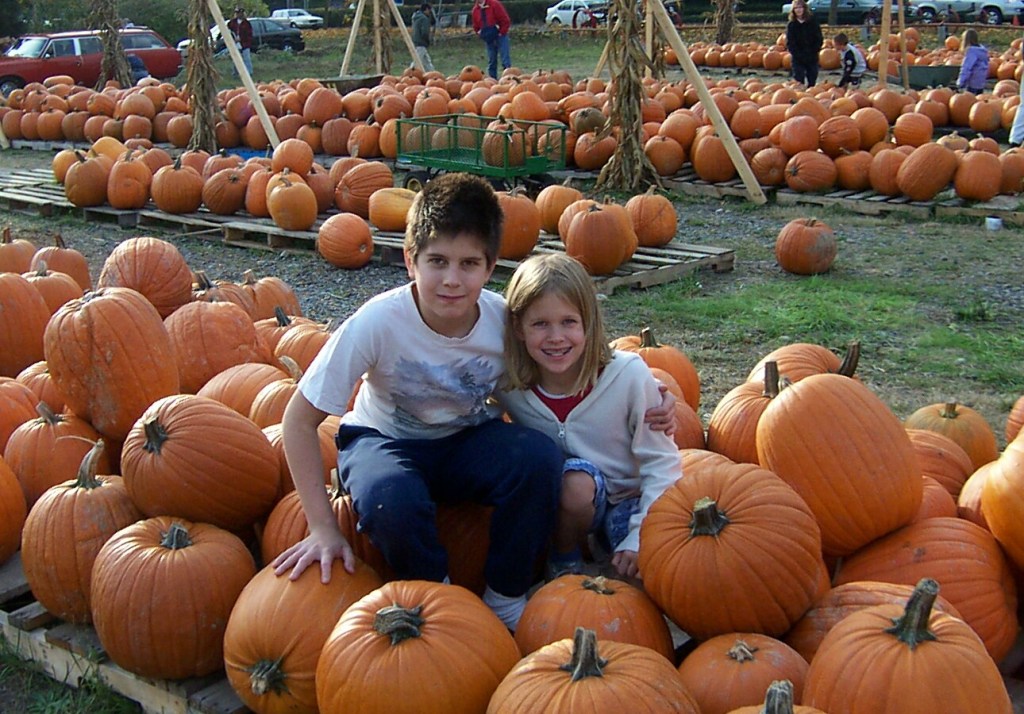
Still one of my favorite photos ever of my children

The thing which catches most people’s attention, however, is its visual allure. This time of year a field of bright orange pumpkins is hard to miss. Their large size and eye catching hues are a visual treat. Also from the Infallible Wikipedia:

“Traditional C. pepo pumpkins generally weigh between 3 and 8 kilograms (6 and 18 lb), though the largest cultivars (of the species C. maxima) regularly reach weights of over 34 kg (75 lb).

The color of pumpkins derives from orange carotenoid pigments, including beta-cryptoxanthin, alpha and beta carotene, all of which are provitamin A compounds converted to vitamin A in the body.”

The largest pumpkin ever documented and the two runners up in Germany in 2016

The heaviest pumpkin ever documented was in Belgium in 2016 and weighed 2,624 pounds! It’s amazing.

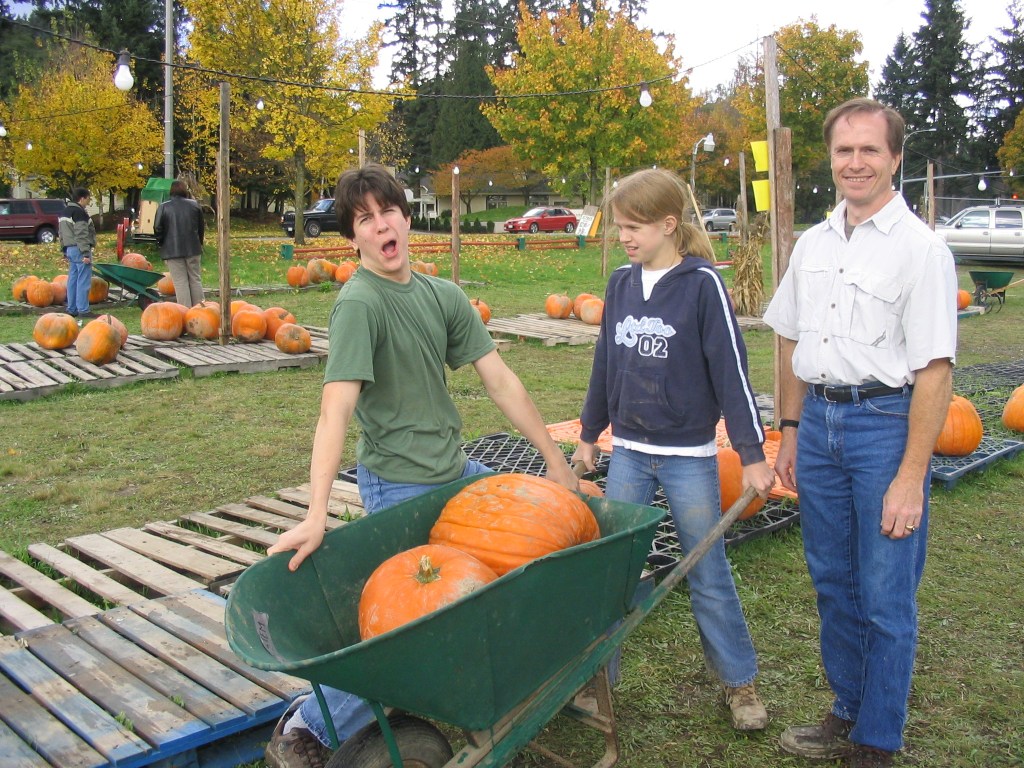
A little horseplay was always in order
One of the last pumpkin carving years

Visiting the pumpkin patch was, for our family, an annual tradition for many years. From the time my children were little we made it a priority to wander out on a sunny weekend day to pick the perfect pumpkin.

One year, while at Remlinger Farms, they had on display a pumpkin which weighed 500 pounds more as either kid. We ended up in the background of a video for one of the news stations as their reporter and cameraman were there at the same time to report on the monster pumpkin.

For a couple of years – when the kids got a bit older – we combined the pumpkin patch visit with exploration of a corn maze which was lots of fun.

Over the years many a photo was snapped of pumpkin patch fun. My favorite photo, however, came from the year we ended up just off Sahalee Way and 202 between Redmond and Sammamish. Our kids were probably around ages 10 and 7 and getting the right gourd was important. The kids – perched on a pallet of pumpkins – are clearly enjoying the event.

Home we would go each year and a day or two before Halloween, the pumpkins were carved and the costumes assembled, all in advance of the big night. But more than any other activity, it was the trip to the pumpkin patch which was my favorite part.

The links:

https://en.wikipedia.org/wiki/Pumpkin

Mork and Mindy

Na-Nu, Na-Nu

September 14, 2021

Na-nu, Na-nu! This phrase – unknown before September 14, 1978 – became a part of the American cultural vernacular thanks to the incomparable Robin Williams in his role as Mork in the sitcom Mork and Mindy.

The show catapulted Williams to fame and fans of the show tuned in every week to see what crazy new thing Mork would do.

The story of Mork began the previous year as a plot line in the popular TV show Happy Days. In one episode Richie encounters Mork – an alien from the planet Ork – who attempts to capture Richie and take him back to his planet for study.

Apparently fans loved the Mork character and the concept. The Infallible Wikipedia tells us:

“Mork appears in the Happy Days season five episode ‘My Favorite Orkan’, which first aired in February 1978 and is a take on the 1960s sitcom My Favorite Martian. The show wanted to feature a spaceman in order to capitalize on the popularity of the then recently released Star Wars film. Williams’ character, Mork, attempts to take Richie Cunningham back to his planet of Ork as a human specimen, but his plan is foiled by Fonzie. In the initial broadcast of this episode, it all turned out to be a dream that Richie had, but when Mork proved so popular, the ending in the syndicated version was re-edited to show Mork erasing the experience from everyone’s minds, thus meaning the event had actually happened and was not a dream.”

The spin off show catapulted to the #3 spot on TV during its inaugural season, leaping ahead of Happy Days in the ratings.

Also from the Infallible Wikipedia:

Mork arrives on earth in an egg

Mork arrives on Earth in an egg-shaped spacecraft. He has been assigned to observe human behavior by Orson, his mostly unseen and long-suffering superior (voiced by Ralph James). Orson has sent Mork to get him off Ork, where humor is not permitted. Attempting to fit in, Mork dresses in an Earth suit, but wears it backwards. Landing in Boulder, Colorado, he encounters 21-year-old Mindy (Pam Dawber), who is upset after an argument with her boyfriend, and offers assistance. Because of his odd garb, she mistakes him for a priest and is taken in by his willingness to listen (in fact, simply observing her behavior). Snip

Culturally, the impact was huge and spawned a variety of toys and games

Storylines usually center on Mork’s attempts to understand human behavior and American culture as Mindy helps him to adjust to life on Earth. It usually ends up frustrating Mindy, as Mork can only do things according to Orkan customs. For example, lying to someone or not informing them it will rain is considered a practical joke (called ‘splinking’) on Ork. At the end of each episode, Mork reports back to Orson on what he has learned about Earth. These end-of-show summaries allow Mork to humorously comment on social norms. Snip

This series was Robin Williams’ first major acting role. Pam Dawber found him so funny that she had to bite her lip in many scenes to avoid breaking up in laughter and ruining the take, often a difficult task with Williams’ talent.”

In the fall of 1978, I was 21 years old and in college so I didn’t see every episode of Mork and Mindy. But the show, specifically Williams’ role, made an impression. My fellow sorority sisters and I loved Mork and soon mimicked some of his outrageous phrases and antics.

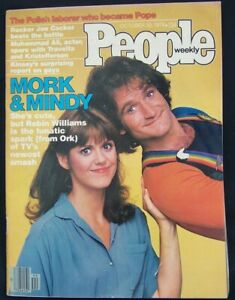
People magazine cover October 1978

We greeted each other with “Na-nu, Na-nu” and the accompanying hand gesture; we used the term “Kay Oh” instead of “Oh Kay.” The crazier male students attempted to ‘sit’ on their heads. In many ways Mork provided a primer on how to be outrageous which, when you are in college, is a goal for many.

Mork and Mindy was like fireworks, bursting onto the television scene, in a soaring arc of sparks and light. Many tuned in just to see what crazy thing Williams would say and do. I can only imagine how exhausting it must have been for Williams to keep it up week after week.

Although the series remained popular in subsequent seasons, nothing quite compared to its meteoric season one.

Occasionally, I still find myself saying “na-nu, na-nu” or “K-O” without even realizing how these terms – so very novel when first uttered – have become a part of American culture. All due to an alien named Mork who conquered the world in September 1978.

The link:

https://en.wikipedia.org/wiki/Mork_%26_Mindy

Answers to the Facebook post: Three’s Company (1976), Mork and Mindy (1978), Taxi (1978), Welcome Back, Kotter (1975), and Laverne and Shirley (1976)

Driving Adventures in Boston: Tips & Tricks

To Wooster and Beyond

September 7th

A Tuesday Newsday Classic

One of the best parts of travel is climbing behind the wheel of a car and exploring interesting historical places. Boston is one of those places where history seems to live on every corner.

The Old North Church, Boston Commons, Bunker Hill, and Paul Revere’s house are but a few of the many  locations one can visit.

Paul Revere statue on a rainy day in April 2008

Boston – which was named as a settled town on September 7, 1630 – was one of the earliest and most influential places in America.

Of course The Infallible Wikipedia has something to say on the subject:

“Boston is one of the oldest municipalities in the United States, founded on the Shawmut Peninsula in 1630 by Puritan settlers from the English town of the same name. It was the scene of several key events of the American Revolution, such as the Boston Massacre, the Boston Tea Party, the Battle of Bunker Hill and the siege of Boston. Upon American independence from Great Britain, the city continued to be an important port and manufacturing hub as well as a center for education and culture. The city has expanded beyond the original peninsula through land reclamation and municipal annexation. Its rich history attracts many tourists, with Faneuil Hall alone drawing more than 20 million visitors per year. Boston’s many firsts include the United States’ first public park (Boston Common, 1634), first public or state school (Boston Latin School, 1635) and first subway system (Tremont Street subway, 1897).

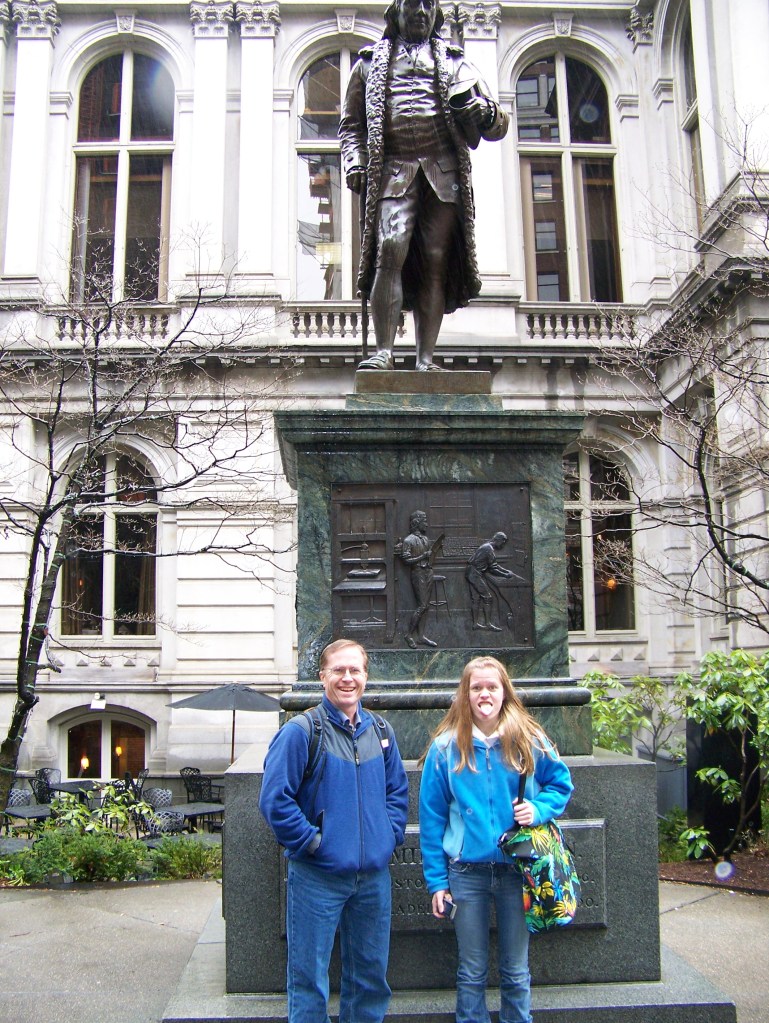
The hubby and daughter at Ben Franklin’s birthplace

Today, Boston is a thriving center of scientific research. The Boston area’s many colleges and universities make it a world leader in higher education, including law, medicine, engineering and business, and the city is considered to be a global pioneer in innovation and entrepreneurship, with nearly 5,000 startups. Boston’s economic base also includes finance, professional and business services, biotechnology, information technology and government activities.

In the United States today, the greater Boston area is the tenth largest Metropolitan Statistical Area and the largest city in New England.

The hubby, daughter, and I had the chance to visit Boston in 2008 when she was the representative for Massachusetts for the Washington Idaho Rainbow Girls. We only had one day in Boston proper, but visited a number of the historic sites. The city was a busy, vibrant place even on that cold and rainy April day. We walked around the city and thoroughly enjoyed the historical immersion.

Now, getting into Boston was a completely different experience. Because our trip would take us into western Massachusetts, renting a car was essential.

On the day we arrived at Logan Airport we picked up our luggage then made our way to the rental car lot. The clerk was not too concerned about which car he assigned us; instead he told us to pick one from this one particular row of vehicles.

So out we wandered to the dozens of identical make cars. How to choose? We decided on one with New York license plates for no other reason than our niece and my sister were visiting in New York while we were in Massachusetts.

New York license plates? Not a good idea.

Soon we were ensconced in the car and off on our adventures. On our second night – after our first down in Plymouth – we stayed in a hotel out in Revere. This afforded us reasonable access to Boston proper with about a 20 minute commute.

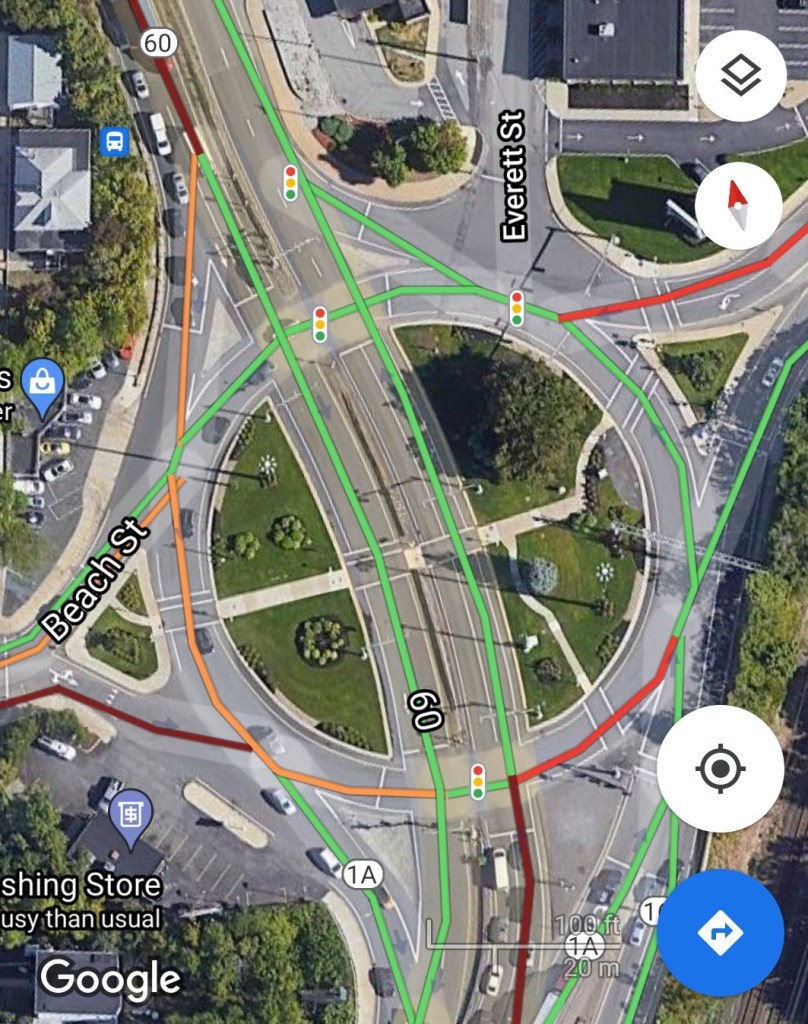
Soon we learned that to get to Boston the most direct way was to head south on Everett Street and then merge into the traffic rotary (we call them roundabouts in Washington) and then on to the 1-A.

It was a great plan in theory. In fact there were two things wrong with our plan. Did I mention that we were driving a car with New York plates?

The death trap rotary as seen from my map App

As it turns out, people in Massachusetts pretty much hate New Yorkers. Might be related to the Red Sox and the Yankees, but I’m speculating. Or it might be that they just have no patience for anyone who does not drive as crazy as they do.

We were honked at, gestured at, and given the double middle finger salute multiple times over the course of the week.

But back to the rotary. This particular roundabout was HUGE… and the cars were doing at least 40 miles per hour and, in some cases, traveling three abreast.

The hubby, like a good granny driver, pulls up to the stop sign and then waits for a break in the traffic; but there is no break in traffic. Cars whiz by at speeds which made my head spin.

Meanwhile there are now cars backing up behind us. Horns are honked at us as if doing so will somehow motivate the hubby to hit the accelerator and dive into the path of oncoming death.

Then the weirdest thing occurs. The car behind us – his patience apparently all used up – pulls around us on the left and, in a life endangering move, zooms into the rotary, squeezing between a truck and a car. This happens a couple more times – honking horns, hand gestures, and illegal passing – while the hubby is evaluating the possibility of success. Eventually he spies two feet of open space, floors the gas pedal and we rocket into the rotary, somehow emerging unscathed.

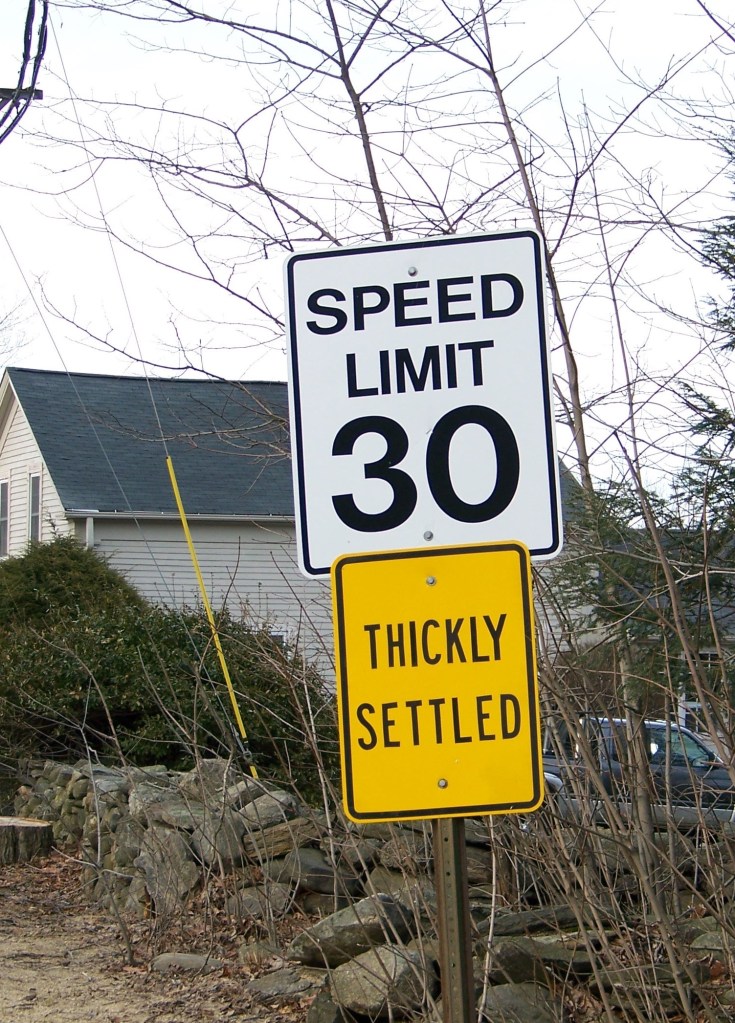
The street signs we found were mostly of this variety…

In fact our visit to Massachusetts was one driving adventure after another. Heaven help you if you miss your exit and end up in Jamaica Plain. But that’s a story for another day. And woe unto you if you are relying on paper maps… by the time we got to Worcester (pronounced Wooster, by the way) street signs had all but disappeared. I guess most people have lived there for so long that they don’t need street signs.

Somehow we made it to Barre (pronounced Barry) for our event despite the navigator (that would be me) making wild guesses as to which road we needed to take.

So just remember this… if you are flying into Boston and need a rental car, never ever, under any circumstances agree to drive one with New York plates. On second thought, hiring an Uber might be a better plan.

A link or two:

https://en.wikipedia.org/wiki/Boston

https://en.wikipedia.org/wiki/Roundabout

Wedding Woes

Karen Carpenter Connections

August 31st

A Tuesday Newsday Classic from 2021 updated

By my count, I have only 43 Tuesday Newsday posts before I hit the magic number of 366. That’s a whole lot of posts. So some days, like for August 31st, it can be difficult to hit on just the right topic.

As I was surfing the web… er, researching… I found myself watching a documentary on The Carpenters. For those who have been reading my blog posts for a while, you know that I’ve featured something about The Carpenters twice so far.

Richard Gere and Debra Winger in the romantic movie ‘An Officer and a Gentleman

To be fair, I WAS researching actor Richard Gere whose birthday is August 31, 1946. I had watched a couple of clips from two of the movies he was in (Looking For Mr. Goodbar and An Officer and a Gentleman) when a Carpenters video popped up and then I remembered a connection between myself and Karen Carpenter.

So, my friends, this is the third post for arguably one of my two favorite musical acts.

It was on August 31, 1980, when Karen Carpenter was married. Unfortunately, her marriage lasted only 14 months and, in many ways accelerated the downward spiral that ended with her death in February 1983 (https://barbaradevore.com/2020/02/04/goodbye-to-love/).

From the Infallible Wikipedia:

“In early interviews, Carpenter showed no interest in marriage or dating, believing that a relationship would not survive constant touring, adding ‘as long as we’re on the road most of the time, I will never marry’. In 1976, she said the music business made it hard to meet people and that she refused to just marry someone for the sake of it. Carpenter admitted to Olivia Newton-John that she longed for a happy marriage and family.(snip) After a whirlwind romance, she married real-estate developer Thomas James Burris on August 31, 1980, in the Crystal Room of The Beverly Hills Hotel. Burris, divorced with an 18-year-old son, was nine years her senior. A few days prior to the ceremony, Karen was taped singing a new song, ‘Because We Are in Love’, and the tape was played for guests during the wedding ceremony. The song, written by her brother and Tom Bettis, was released in 1981. The couple settled in Newport Beach.

James Burris and Karen Carpenter at their August 31, 1980 wedding

Carpenter desperately wanted children, but Burris had undergone a vasectomy and refused to get an operation to reverse it. Their marriage did not survive this disagreement and ended after 14 months. Burris was living beyond his means, borrowing up to $50,000 (the equivalent of $142,000 in 2020) at a time from his wife, to the point where reportedly she had only stocks and bonds left. Carpenter’s friends also indicated he was impatient. Karen Kamon, a close friend, recounted an incident in which she and Carpenter went to their normal hangout, Hamburger Hamlet, and Carpenter appeared to be distant emotionally, sitting not at their regular table but in the dark, wearing large dark sunglasses, unable to eat and crying. According to Kamon, the marriage was ‘the straw that broke the camel’s back. It was absolutely the worst thing that could have ever happened to her.’

In September 1981, Carpenter revised her will and left her marital home and its contents to Burris, but left everything else to her brother and parents, including her fortune estimated at 5–10 million dollars (between $14,000,000 and $28,000,000 in 2020). Two months later, following an argument after a family dinner in a restaurant, Carpenter and Burris broke up. Carpenter filed for divorce on October 28, 1982, while she was in Lenox Hill Hospital.”

By August of 1980, I was no longer obsessed with The Carpenters. My life had moved on. I had graduated college in May 1979 and also met the man who would become my hubby.

That year I took a job in Eatonville, Washington, as the sole reporter (and grunt of all things small town newspaper) for The Dispatch. When I wasn’t out covering a story, weekends often involved driving to Seattle to spend time with my boyfriend. Life was full and busy. Then in May of 1980 we became engaged and planned our wedding for the end of August.

The soon to be hubby and I discussed having an outdoor ceremony in a park in West Seattle. My mother had other plans.

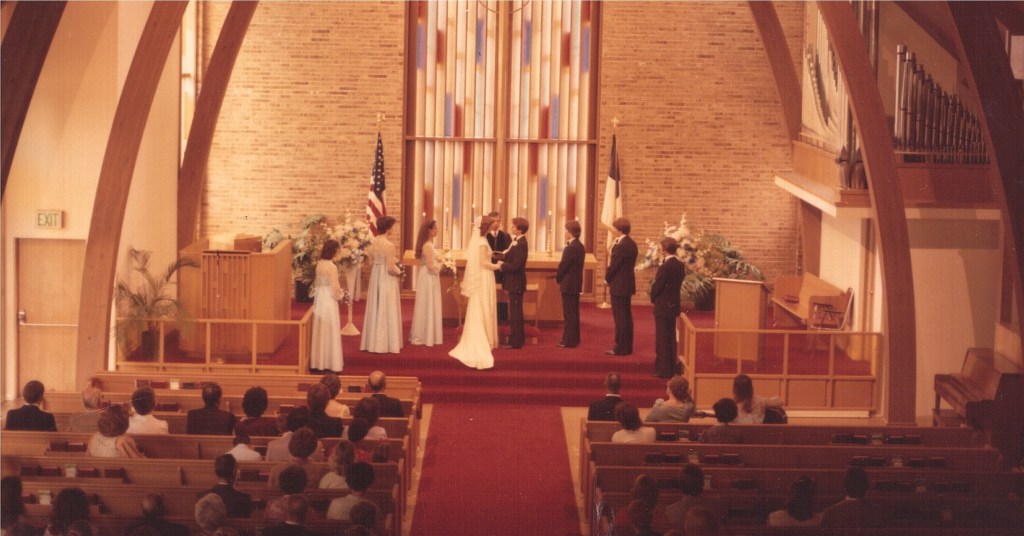
Instead we ended up at Westminster Presbyterian Church in Yakima on August 30th. We had not given much thought to that particular date. As it turned out, that was the Saturday of Labor Day weekend which prompted more than a few guests unable to make it due to other plans.

Reciting our vows at Westminster Presbyterian Church

A couple weeks prior to the ceremony, the soon to be hubby was on the phone with one of his friends, encouraging him to attend. It was in this conversation when one particular phrase was uttered which has come back to haunt the hubby over the years:

“You should definitely come since you’re practically guaranteed great weather.”

According to WeatherUnderground at the time our OUTDOOR reception in my parents backyard was to take place, it was a decidedly un-summerlike 61 degrees with rain. An even more astonishing fact is that the record low temperature for August 30th in Yakima was 36 degrees set on that date in… 1980.

There were a few other glitches that day also. The hubby’s brother never arrived as he was attending a Porsche car rally near Mt. Hood the day before and his car broke down.

Then, as I was literally about to start the traditional walk down the aisle, the photographer whispers to me, “There was a problem with the camera and none of the pictures I took turned out. We’ll have to do them over.”

Pro Tip to photographers everywhere, this is NOT something you tell a bride just before she walks down the aisle.

Turns out that some of the outdoor photos did turn out… like this one of us, our attendants, and our soloist before the rain started. Note the gray stuff in the grass. Yup. Mount St. Helen’s ash – a little more than three months after the eruption – was still everywhere in Yakima.

So there I was, standing in the church on what is supposed to be the perfect day and all I can think about is what the heck are we going to do about the photos AND listening to the rain drops echoing on the skylights overhead wondering how the party next to the pool will turn out.

With our parents… The hubby’s were married 77 years before his dad died in 2023. Mine celebrated their 70th in 2017 a couple months before my mom passed. Dad followed her in 2019. The hubby’s mom will turn 99 in October.

But all things being equal, it actually was a perfect way to start a marriage. Because weddings are not marriages. Marriages are all about overcoming the various challenges which life tosses at you. In the 41 years since that cold and rainy summer day, there have been broken bones, illness, and challenges which have all but swamped us. But there has also been laughter, adventures, and joy.

So Happy 46th Anniversary to the hubby. It’s been quite the ride.

The links:

https://www.wunderground.com/history/daily/us/wa/yakima/KYKM/date/1980-8-30

https://en.wikipedia.org/wiki/Karen_Carpenter

https://en.wikipedia.org/wiki/Richard_Gere

Nostalgic Summer Memories: The Ice Cream Truck

The best thing on a hot August afternoon

August 17th

Lost in the hazy memories of childhood summers are the snippets from hot afternoons spent playing outside with the gaggle of kids who lived on my street.

Our days were filled with pick up softball games, bikes, Barbie Dolls and board games. But there was one distinctive sound which caused our collective to drop everything and run home. That sound was the blare of the song Greensleeves.

In suburban communities throughout the United States, the ice cream truck has been a summer fixture for several generations now.

It seemed to me that the ‘truck’ which roamed our streets was open like this one and the driver turned in his seat to get the treats

They also, according to the Infallible Wikipedia, are very popular in Britain and are described thus:

“An ice cream van (British) or ice cream truck (North American) is a commercial vehicle that serves as a mobile retail outlet for ice cream, usually during the spring and summer. Ice cream vans are often seen parked at public events, or near parks, beaches, or other areas where people congregate. Ice cream vans often travel near where children play — outside schools, in residential areas, or in other locations. They usually stop briefly before moving on to the next street.”

When one is a child, we often take for granted certain things. One of those things was the ice cream truck which came down our street frequently during the summer. Of course I didn’t think about it much. All I thought about was how I was going to get my hands on the nickel (and when the price went up, a dime and a nickel) I needed to buy a treat.

In the houses up and down my street, our mothers’ doled out the coins needed. Soon we all lined up, patiently or not, for our turn to peruse the desired frozen treats, the cloud of cold steam from the dry ice billowing out like some magician’s trick. The truck always stopped between our house and the Tuttle’s house. This strategic location often produced a dozen eager customers as my family boasted four children and the Tuttle’s had six. Added to our ten were several groups of three additional children within a few houses and even more further up the street. That was a lot of potential customers!

Vintage ad for a Creamsicle from the late 1960’s

Soon I’d have the frozen delight in hand and would sit on the curb with the others. I can envision our gangly group, in pedal pusher pants or shorts and the summer footwear of choice: thongs. For those born after about 1970, we never called them flip-flops, they were thongs and every single one of us wore them all summer long despite the occasional bee sting or stubbed toe.

But I digress. Although I often thought about buying something new and different, I always got the same thing: an orange creamsicle.

My mother, no doubt in a futile attempt to cut back on the money spent at the ice cream truck, developed her own frozen treats. She would fill an ice cube tray with (I think) chocolate fudge jello and freeze the little squares. Into each square was inserted a wooden popsicle stick. These would be doled out on hot August afternoons when the ice cream truck did not come up our street.

When my own children were growing up I would often make Koolaid based popsicles in specially designed holders. My daughter could go through several every day.

Of course one of the reasons for this is that there were no ice cream trucks which ventured the steep driveway up to the house where we lived. Unlike the street where I grew up, my pair of children mostly played with one another or with a friend or two invited over for the afternoon.

A delicious fudge bar and ice cream cone.

When we moved to Kirkland in 2004 the kids were 14 and 11 and past the age where the ice cream truck was a motivating factor. Even so, there were many afternoons when I’d hear the familiar Greensleeves, it’s Pavlovian tune beckoning to youngsters.

In the past three years I have yet to hear or notice an ice cream truck in our neighborhood. Perhaps, with the advent of instant grocery deliveries, it’s now been swept into the dustbin of history. I think our society is a little less rich if that is the case.

Perhaps the next time I’m at the store, I’ll purchase a package of creamsicles, blare Greensleeves from Spotify, and then close my eyes and imagine I’m 8 years old once again, sitting on the curb and savoring that wonderful childhood treat.

https://en.wikipedia.org/wiki/Ice_cream_van

Lackadaisical. Loafing. Slacking. Slothful. Idle. Laggard.

Celebrating National Lazy Day

August 10th

By now there is one word which should be at the forefront of your brain: Lazy. Of course I couldn’t be described as lazy and do the research for this week’s Tuesday Newsday. But here I am writing about August 10th, which is National Lazy Day.

It’s that one day a year when we are given permission to sit back and relax.

The Infallible Wikipedia has several entries on laziness, but I got bored reading them as they started discussing all the psychological reasons someone might be perceived as being lazy when in fact they might be depressed, or have ADHD, or a variety of other syndromes.

Instead, the National Day’s Calendar website had the right idea with this tongue in cheek summation on how best to celebrate and observe National Lazy Day:

“Take this test to prepare yourself for the day. Lazy people fact #72432143726413424.

If you were too lazy to read that number, you’re ready to celebrate this day.

The number one rule of any lazy day is if you can’t reach it, you don’t need it.

Don’t break the rule.

We assigned an alternative word for lazy for the day.

We call it very relaxed.

What is the official exercise of #NationalLazyDay?

Diddly squats.

For some tips on how to enjoy a successful lazy day visit A Pint-Sized Life Blog.

We were too lazy to give you our own list.

NATIONAL LAZY DAY HISTORY

The creator and origin of #NationalLazyDay could not be found.

Have a great day!”

I would venture to guess that there is not a person alive who hasn’t used the phrase ‘I’m being lazy today,” when, in fact, what they’re really saying is that they need a break after an intense period of activity.

As I have, ahem, matured, I’ve decided that being ‘lazy’ is necessary. Unlike my younger days, I find that a bit of a nap midway through the day is imperative to getting things done. Although chores may not get completed as quickly as they once did, eventually the things which need to happen are accomplished.

Last year in one of my posts I wrote about keeping house and discussed the luxury of hiring someone to come in and clean for me.( https://barbaradevore.com/2020/03/24/national-cleaning-week/)

I know many of you are familiar with my ‘lazy’ housekeeper and how she eats chocolates all day and reads trashy romance novels rather than work.

But my lazy housekeeper really isn’t that lazy, it’s more that she is easily distracted and can find dozens of other more interesting things to do with her time. I attribute her inefficiency to ADHD because she simply cannot stay focused on one thing for too long.

She might vacuum for 15 minutes and then remember that she needed to send an email to someone, so off she’ll go to take care of that. On her way she might notice that the hummingbird feeder is empty, so will stop to make new nectar. When she returns a half hour later to finish the undone housework, she might actually mop the floor before she remembers she needs a few things from the grocery store or have an inspiration for a scene in a story she’s writing.

These bursts of energy and activity are quite exhausting and soon it’s time to play a game on the phone or, better, shut her eyes for a short respite.

Which, finally, begs the question “Is being ‘lazy’ actually beneficial?”

Internet research provided plenty of articles to support this hypothesis. I decided it was too much work to quote anymore articles on the benefits or pitfalls of laziness but will paraphrase the conclusions.

A person we perceive as lazy might not, in fact, be so. Such an individual is often thinking about the easiest and most time effective way to complete a task. Others might, in fact, be writers. For those who don’t know, writing requires having time to cogitate what it is you are going to write.

Like this article. Before I started to type I spent quite a bit of time considering how I would present the topic and decided to research the synonyms to start it out; additionally, I wanted to find a personal angle on laziness, hence the lazy housekeeper. It really did involve a great deal of deliberation which, to the casual observer, might present as laziness.

So that’s my story and I’m sticking to it. Now, if you’ll excuse me, all this brain work has left me feeling a bit droopy and a nap sounds like a great way to spend August 10th, National Lazy Day.

The links:

https://en.wikipedia.org/wiki/Laziness

https://nationaldaycalendar.com/national-lazy-day-august-10/

http://news.ku.edu/2018/08/15/new-research-suggests-evolution-might-favor-survival-laziest

Memories of Driver’s Ed: Lessons from the 70s

For some it took longer than others!

August 3

At one time this test was an important rite of passage for the American teenager, an indication that they were about to enjoy one of the privileges of adulthood: being able to drive.

For one Mariam Hargrave of Yorkshire, England, no doubt it was an ordeal. It was on August 3, 1970, when the 62 year old finally passed her driving test. Although the Infallible Wikipedia has an article about driver’s tests, they ignore poor Mrs. Hargraves. Instead, I was able to glean this information:

“By April 1970 Mrs. Miriam Hargrave had failed her test thirty-nine times. In the eight preceding years she had received two hundred and twelve driving lessons at a cost of £300. She set the new record while driving triumphantly through a set of red traffic lights in Wakefield, Yorkshire. Disappointingly, she passed at the fortieth attempt (3 August 1970) but eight years later she showed some of her old magic when she was reported as saying that she still didn’t like doing right-hand turns. — Stephen Pile, ‘The Book of Heroic Failures’”

Back in 1970’s Yakima it was a big deal to learn how to drive. By the time I was in high school, they were offering Driver’s Ed classes which involved learning the rules of the road and practicing driving. I doubt there were any braver educators anywhere than those who willingly climbed into a car with a 15 ½ year old, hormone driven, child and allowed them to command a 2,000 pound vehicle on city streets.

Yet, they did. I seem to recall my Driver’s Ed teacher, Mr. Breshears, always popping antacid tablets. I suppose the only thing which gave the instructors any comfort at all was the fact that the cars were equipped with a set of brakes for the front seat passenger.

Our simulators looked something like this set up from 1969.

Three students at a time would go drive with the teacher. It was a bit terrifying since not all budding drivers had the benefit of a parent who worked with them after school. There was one student I recall who tested Mr. Breshears patience each time they got behind the wheel. Those instructor brakes got quite the workout.

But the favorite part of Driver’s Ed class was getting to go to the Simulator. It was a windowless trailer which had been equipped with two parallel rows of seats, separated by an aisle sort of like being on a bus, and all faced forward. Each station had a steering wheels, brakes, etc. to look like the driver’s area of a car. At the front of the trailer was a large screen. Once all the students were settled into their places, the lights would be dimmed and the screen would come to life as though one was behind the wheel, driving down the street. It was our job to accelerate in unison with what we saw on the screen. It was also imperative that we hit the brakes at the right time.

From the IKE Reveille year book, 1972

Driver’s training films seemed to mostly consist of tree lined city blocks which, at first, seemed like lovely enclaves of blissful American life. But no. Those streets were every driver’s worst nightmare. Balls of all sorts would suddenly bounce out into the road followed by adorable tikes chasing them. Woe unto those who didn’t hit the brakes in time!

Sophomore class officers from Eisenhower High School, Yakima, pose for a photo for the 1973 annual.

There were dogs and cats; there were other vehicles; things fell off the backs of trucks, branches crashed down. Who knew how truly hazardous things could be in one bucolic town?

Of course, some cheeky student would purposefully ‘run’ over the simulated hazards and a little red light would illuminate on their console, publically shaming them for an egregious infraction. I always wondered if students who ‘ran’ over cats, dogs, and children, failed the course.

Over the years I have learned just how accurate those simulations were as I’ve encountered many of the hazards portrayed. Thankfully, it’s only occasionally that such things happen. The hubby and I, if we are in the car together, will comment in unison ‘Driver’s Training film!’ when something we experienced in the simulator occurs in real life.

This photo is from the Eisenhower High School 1973 annual. The headline above this proclaimed “380 license-hungry students swamp driver education course this year.” Apparently there were a bunch of us who turned 16 in 1973.

The  instruction I received was successful and on my 16th birthday I took the tests – written and driving – and emerged as a licensed driver and, despite losing points for parallel parking, never came close to Mariam Hargrave’s, 212 lessons, eight years of time, and over $700 (US) spent.

The links:

An entertaining look at early simulators:

https://www.dmv-written-test.com/washington/practice-test-1.html?utm_source=bing&utm_medium=cpc&utm_term=%2Bwa%20%2Bstate%20%2Bdriver%27s%20%2Btest%20%2Bpractice&utm_campaign=DMV%20-%20Search%20-%20WA%20-%20EN%20-%20CAR~Driver%20Question%20Test&msclkid=ee5a27bd586710c0735246b5495d31f5# (Can you pass the written test for Washington State?)

https://en.wikipedia.org/wiki/Driving_test

https://en.wikipedia.org/wiki/The_Book_of_Heroic_Failures