Tag Archive | Yakima Washington

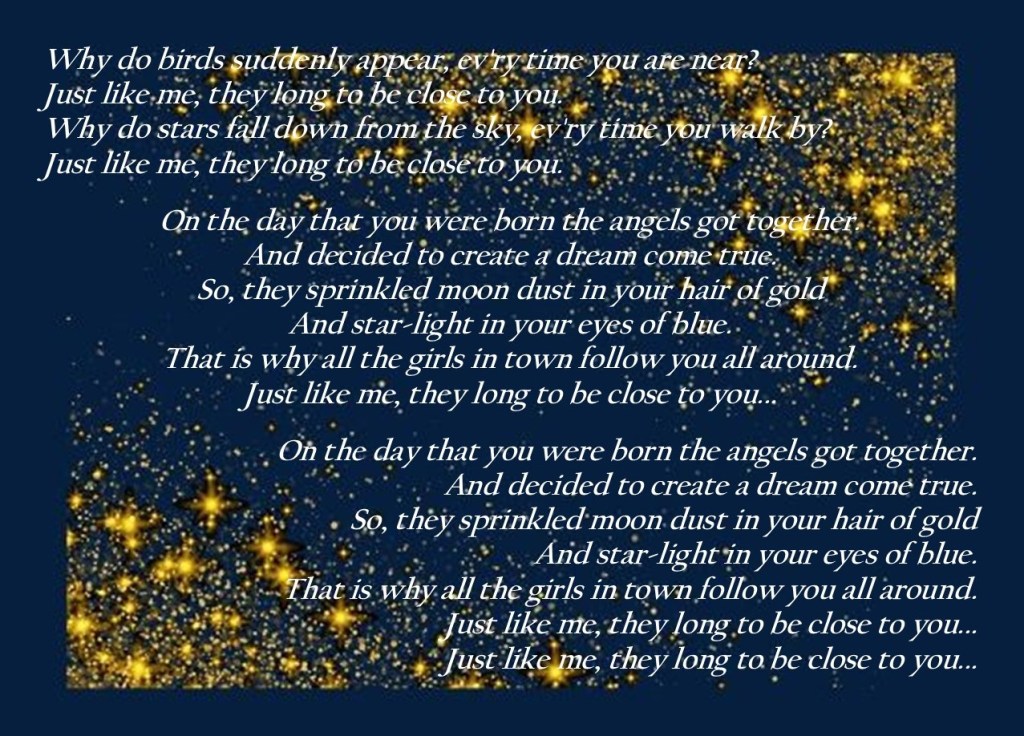
Close To You

The first hit for the 1970’s duo “The Carpenters”

July 30, 2024

A Tuesday Newsday Classic Updated
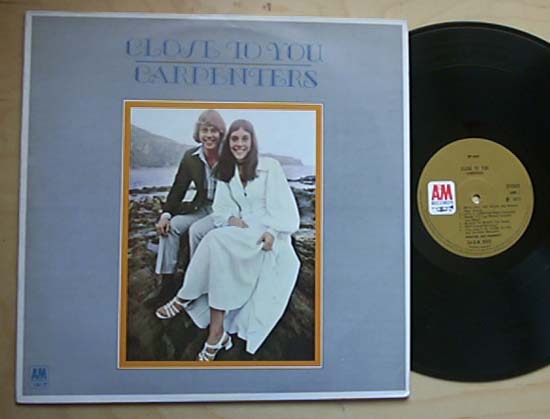
The Carpenters 1970 album “Close To You”

In the spring of 1970, there were approximately 17 million Americans between the ages of 12 and 16 and, of those, some 8.5 million were female. It was the height of the teenage Baby Boomer era when AM radio was king and the only place to hear the hits of the day.  It was also the dawn of a musical period dominated by a form of music known as soft rock.

According to the Infallible Wikipedia:

“The Hot 100 and Easy Listening charts became more similar again toward the end of the 1960s and into the early and mid-1970s, when the texture of much of the music played on Top 40 radio once more began to soften. The adult contemporary format began evolving into the sound that later defined it, with rock-oriented acts as ChicagoThe Eagles and Elton John becoming associated with the format. The Carpenters‘ hit version of ‘(They Long to Be) Close to You’ was released in the summer of 1970, followed by Bread‘s ‘Make It with You’, both early examples of a softer sound that was coming to dominate the charts.”

It was during the last week of July 1970 when Close To You topped the Billboard Hot 100 and held the number one position for four weeks. It marked the ascension of The Carpenters as one of the defining musical acts of the early 1970’s.
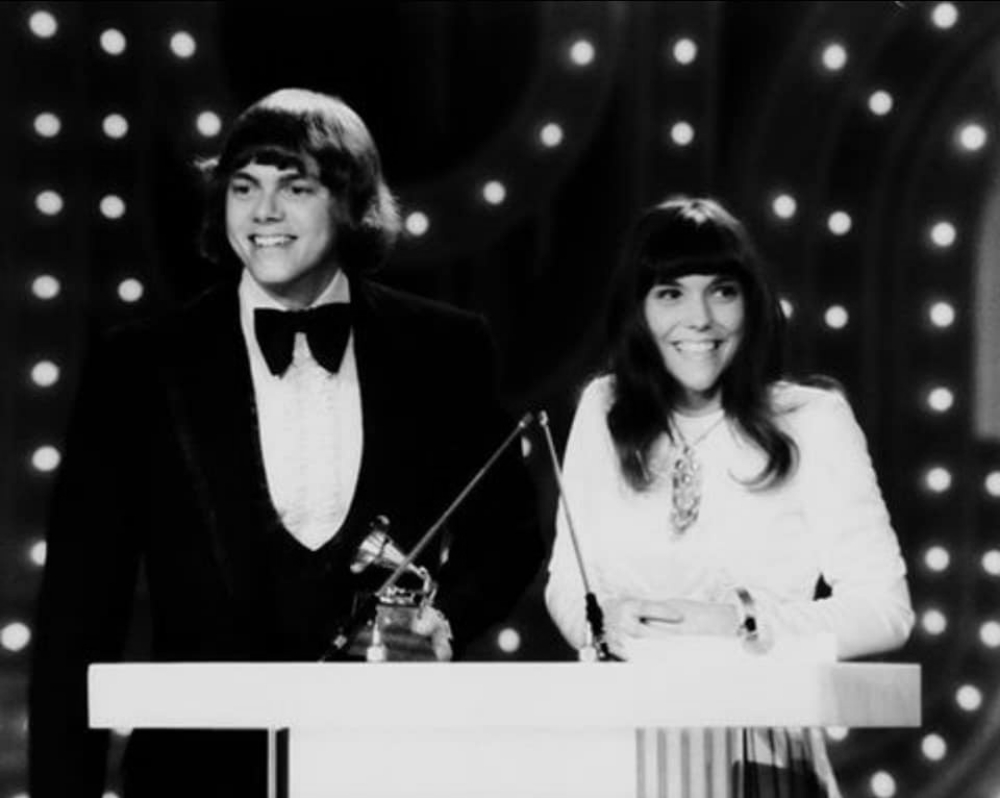
Close to You” was nominated for Record of the Year and Album of the Year at the 1971 Grammy awards. They won for Best New Artist and also for Best Contemporary Vocal Performance by a Duo, Group or Chorus.

Despite the group being derided as saccharin at the time, their musical success is undisputed. Much has been written about Karen Carpenter’s voice, her three-octave range, and soulful interpretations. The Carpenters would not, however, have been the Carpenters without older brother Richard who was the genius behind their ‘sound.’

Love ‘em or hate ‘em, The Carpenters’ style was original and Karen’s talent immense, the combination of which propelled them to the top of the pop charts. Also from the Infallible Wikipedia:

“They produced a distinct soft musical style, combining Karen’s contralto vocals with Richard’s arranging and composition skills. During their 14-year career, the Carpenters recorded ten albums, along with numerous singles and several television specials.”

From 1970 through 1973 they achieved their greatest success, appealing to a demographic who purchased their records and made The Carpenters a household name: females aged 13 to 18.

“Their career together ended in 1983 when Karen died from heart failure brought on by complications of anorexia. Extensive news coverage surrounding these circumstances increased public awareness of eating disorders. Though the Carpenters were criticized for their clean-cut and wholesome conservative image in the 1970s, their music has since been re-evaluated, attracting critical acclaim and continued commercial success.”

When I first published this post in 2019 I reserved the right to blog more about the Carpenters at a later date. Which I have on three more occasions (so far): https://barbaradevore.com/2020/02/04/goodbye-to-love/, https://barbaradevore.com/2021/08/31/wedding-woes/, https://barbaradevore.com/2023/12/05/top-of-the-world/.

No doubt they were the most influential musical group for me during my teen years. But this article is only to focus on their launch and the song Close To You. More than any other song, this one literally marks the moment I became a teenager. The start of its four weeks run on the charts coincided with my 13th birthday.

Back in the 1970’s there was really only one way to ‘blog’ – by keeping a diary. Although I couldn’t put my hands on my 1970 diary, I found a reference to this song at the end of my 1971 diary, noting when it was played on the radio.

I was so obsessed with the song that I would record it from the radio. I actually can still visualize my 13-year-old self sitting motionless and silent on my bed, cassette tape recorder on the bedside table, holding the microphone next to the radio’s speaker, while Close To You played and I captured it on tape. Kids today do NOT know how easy they have it!

Eventually I purchased the single and then the album of the same title. A much easier way to listen to it although I had to use my parents’ stereo system and my mother made me listen to my music via headphones.

My obsession even prompted me to think it was a good idea to do a lip-sync version for a competition where I needed a ‘talent.’ (Singing was out of the question and I really had no other performance talents, BTW) Taken from the pages of my 1971 diary on December 31st, I dutifully reported that “I am going to pantomime Close to You like I’m a chorus girl or something. I’m going to wear Sue’s blue velvet formal and silver shoes. If she’ll let me.”

Yes, my older sister did let me wear the dress and the shoes. Yes, it was a total embarrassment. It may have contributed to why I avoid karaoke and limit my singing to the shower and the car although my dance moves were okay.

What a blessing that Karen Carpenter – who suffered from stage fright – was able to overcome it enough to share her amazing voice with the world. But I’m not so sure the price she paid was worth it.
And a couple of links:

https://en.wikipedia.org/wiki/(They_Long_to_Be)_Close_to_You
https://en.wikipedia.org/wiki/Soft_rock

Cherries!

One of summer’s best fruits

July 2, 2024

A Tuesday Newsday Classic Updated

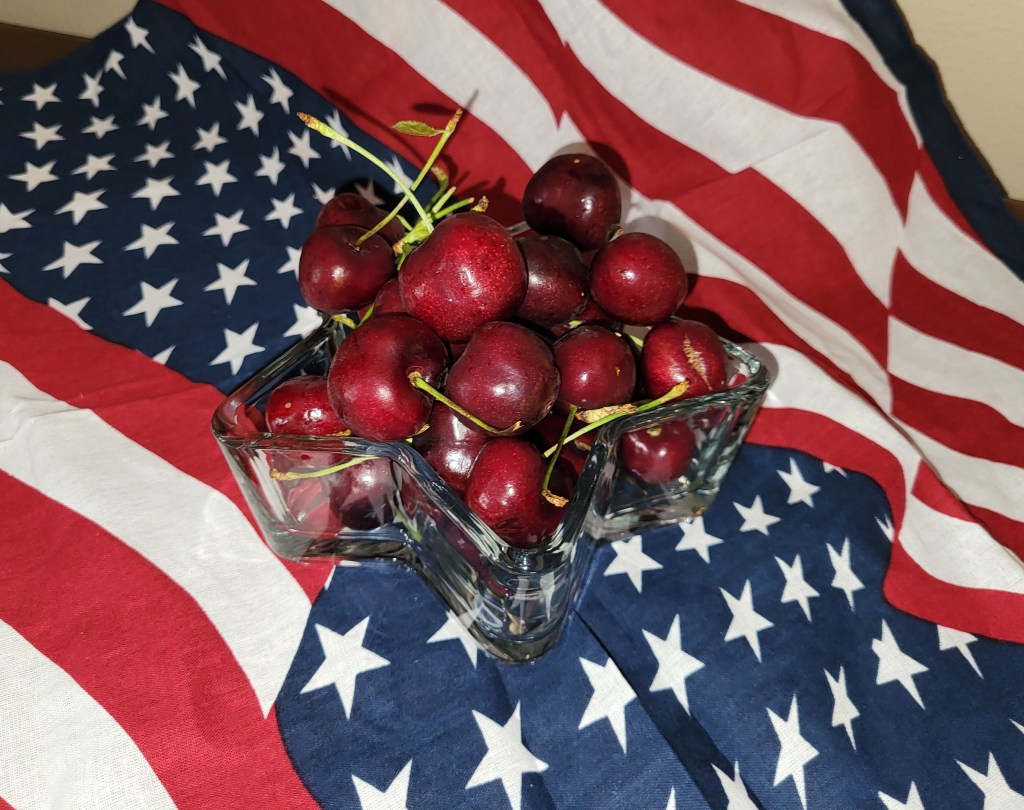
A few cherries purchased, not picked, at Fred Meyer.

The item which caught my attention for this week’s blog is the amusing ‘contest’ of cherry pit spitting. Yes, it’s a thing.

Held annually in Eau Claire, Michigan since 1974, the record ‘spit’ of a cherry pit is 93 ft 6.5 inches. The competition has been dominated by one family with the patriarch, Rick Krause, holding the record for longest spit (over 72 feet) until 1993. Since then, his son, Brian ‘Pellet Gun’ Krause has won 10 times with his record breaking discharge occurring the first week of July in 2003. In recent years Brian’s sons have also competed.

Others have stepped up to put their spitting skills to the test, but the Krause family continues to dominate.

Cherry pit spitter-champion Brian ‘Pellet Gun’ Krause

It is appropriate, therefore, as we celebrate all things red, white, and blue this week, to pay tribute to one of my favorite red things: the cherry.

Every July I can hardly wait for the harvest of this fruit to begin in the Yakima Valley. For there is truly nothing better than picking a cluster of the ruby orbs and (after they’re washed off) biting into the soft, juicy flesh. As a fan of the sweet varieties such as Bing and Sweetheart, an explosion of flavor reminds me how much I’ve missed them since the previous year.

The cherry has a long history of cultivation with evidence that the fruit has been grown since prehistoric times. From the Infallible Wikipedia:

“The English word cherry derives from Old Northern French or Norman cherise from the Latin cerasum, referring to an ancient Greek region, Kerasous (Κερασοῦς) near Giresun, Turkey, from which cherries were first thought to be exported to Europe. The indigenous range of the sweet cherry extends through most of Europe, western Asia, and parts of northern Africa, and the fruit has been consumed throughout its range since prehistoric times. A cultivated cherry is recorded as having been brought to Rome by Lucius Licinius Lucullus from northeastern Anatolia, also known as the Pontus region, in 72 BC.

Cherries were introduced into England at Teynham, near Sittingbourne in Kent, by order of Henry VIII, who had tasted them in Flanders.

Cherries arrived in North America early in the settlement of Brooklyn, New York (then called ‘New Netherland’) when the region was under Dutch sovereignty.”

In the United States, the first record of cherry trees being planted was 1639.

Sweet cherries are grown most successfully in Washington, Oregon, California, Wisconsin, and Michigan (hence the location of the cherry pit spitting contest). Most sour cherry varieties are grown in Michigan, Utah, New York and Washington.

To successfully grow cherries, the climate must have cold winters although varieties have been developed recently which have allowed California to compete in cherry production.

My relationship with the cherry has not always been an enjoyable one. In the 1970’s, my grandfather divested his properties to his two daughters and my father took over managing a cherry orchard. The orchard was repayment to my grandfather – a banker – from a loan gone bad some years earlier.

My Dad had never been a farmer but during the summer – when not a Junior High School history teacher – he was a hands on orchardist. It was natural, then, that my first summer ‘job’ as a teenager was picking cherries.

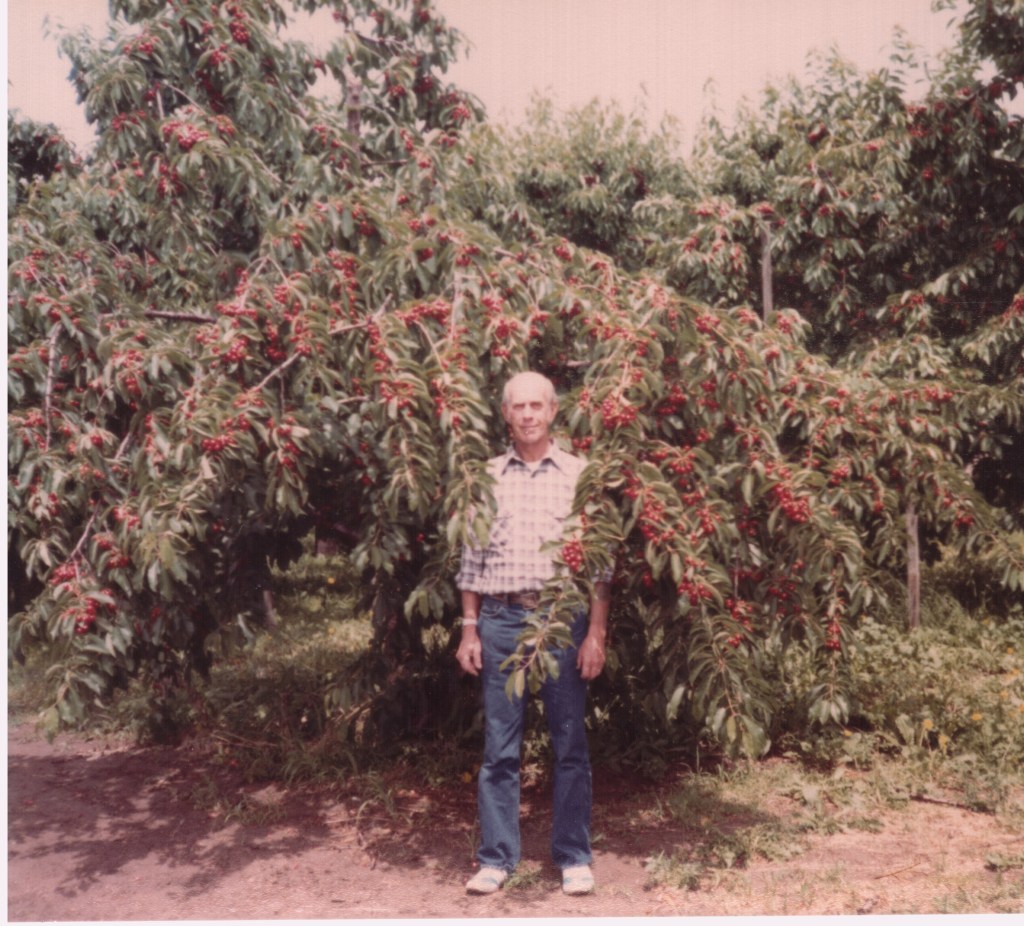
My Dad – schoolteacher turned orchardist – caught by a loaded cherry tree in Selah, Washington, circa 1980.

By early July in Yakima, summer is in full force and the weather usually turns quite warm. It is common for there to be a spate of days when the thermometer inches into the upper 90’s and low 100’s.  It’s then that the cherries ripen and harvest begins. For the pickers, work commences shortly after daybreak while the orchard is still cool.

One early July morning, with my then boyfriend and his younger sister, I arrived – along with all the migrant workers – to begin my job. Each person was assigned a tree, given a ladder and a bucket. Now when I say bucket, we are not talking about a pail like those favored by children at the beach. Nope. The metal buckets I knew held a lot of cherries, some four and half gallons worth. It took FOREVER to fill one up.

Different fruits require being harvested in certain ways. Picking cherries, it turns out, is quite the delicate operation. You must grasp the fruit at the very top of the stem where it is attached to the branch and gently twist so that the stem is removed from the branch without pulling the ‘spur’ off the tree. Then you place – never drop – the fruit into the bucket. Lather, rinse, repeat. My rough estimates are thus: a gallon is about 80 cherries. Multiply 4.5 gallons times 80 which is about 360 cherries for one bucket. For those who have never picked said cherries, it takes a long time to pick 360 cherries. Then there’s the ‘tree’. While about half of the first bucket can be picked while standing under it eventually you have to climb up a ladder – up to heights between 12 to 15 feet – while balancing your bucket of heavy fruit and reaching for the cherries.

A requirement to pick cherries – a tall ladder.

Now what, you may ask, is ‘the spur’?” It’s a flexible knobby growth at the end of a branch or stem and if it’s pulled off, that spot will not produce cherries the next year. My father the orchardist was rather persnickety about those spurs being preserved, so I was careful. And slow.

By noon time – now having been there working since 5 a.m. – the heat would have arrived and I would have picked… drum roll please – seven whole buckets of fruit. That’s 2,420 cherries each day of harvest… and be paid seven whole dollars. So one dollar for a bucket of cherries. Some of the seasonal migrant workers could pick up to 200 buckets a day. I’ve never figured out how.

Yes, the job truly sucked. Although seven bucks went farther in nineteen seventy something than it does today. But it wasn’t a lot of money even then. I was lucky if I could pick for six or seven days and earn in the vicinity of $50.

I will say that a couple of summers as a cherry picker made me appreciate the delicious fruit even more. In the early 1990’s, my sister and her husband took over the reigns of the orchard which meant that each year there were delicious cherries to be had. More than once she brought a bag of the freshly picked delights to me.

A few days ago I broke down and purchased a bag at my local Freddies as I was not willing to wait until a visit to Yakima in a couple of weeks. I jealously guard my cherries, making the bounty last until late July or even early August. As luck would have it they are not the hubby’s favorite fruit.

By the time August rolls around I will have satisfied my craving for the fleshy fruit for another year. Maybe.

But the best part? I didn’t have to pick them!

A couple of links for you:

https://en.wikipedia.org/wiki/Cherry

http://memory.loc.gov/diglib/legacies/loc.afc.afc-legacies.200003151/default.html

Automate This!

The joys of automation in the ladies room

June 4, 2024

A Tuesday Newsday Classic updated

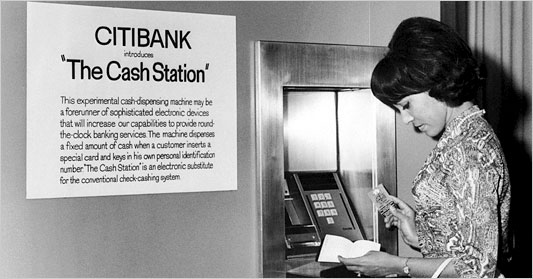
On June 4, 1973, the US patent for the ATM machine was issued to Don Wetzel, Tom Barnes, and George Chastain.

As with many such inventions, it did not spring spontaneously into use as there were others who had conceived of the idea for at least three decades prior. Cash machines were used in both Japan and Great Britain for nearly a decade before they arrived in the United States.

For the purposes of this article, however, we will go with 1973 as the year this form of automation entered our American lives. From the Infallible Wikipedia:

“After looking firsthand at the experiences in Europe, in 1968 the ATM was pioneered in the U.S. by Donald Wetzel, who was a department head at a company called Docutel. Docutel was a subsidiary of Recognition Equipment Inc of Dallas, Texas, which was producing optical scanning equipment and had instructed Docutel to explore automated baggage handling and automated gasoline pumps.

On September 2, 1969, Chemical Bank installed the first ATM in the U.S. at its branch in Rockville Centre, New York. The first ATMs were designed to dispense a fixed amount of cash when a user inserted a specially coded card.  (snip) In 1995, the Smithsonian National Museum of American History recognised Docutel and Wetzel as the inventors of the networked ATM.

By 1974, Docutel had acquired 70 percent of the U.S. market; but as a result of the early 1970s worldwide recession and its reliance on a single product line, Docutel lost its independence and was forced to merge with the U.S. subsidiary of Olivetti.”

Automation, of course, is not limited to the dispensing of money. It’s everywhere in our world. And nowhere is it more frustrating and confusing than in public restrooms.

When one enters such a place it becomes a midway house of horrors as one never knows what is or is not automated. Like the toilet.

auto flush toilet.jpg
Striking fear into the hearts of women in airports everywhere… the self-flushing toilet

Upon entry into the stall I dread seeing the little black or chrome box with the red light attached to the back of the throne. I don’t know if it’s just me but it seems as if the slightest movement will trigger the flushing mechanism and the toilet turns into an unruly bidet, spraying the unsuspecting (me!) customer with a premature shower of love. Sometimes this occurs multiple times sending this user screaming from the stall.

Now I also don’t know about others but I always (ALWAYS!) wash my hands before I leave the restroom. Having survived the automatic flushing toilet, the next gauntlet is the sink. I am never sure if swiping my hands under the faucet will trigger a flow of water or if I must push on the neck of the faucet or, heaven forbid, use an old-fashioned handle. An automatic faucet is a mystery. What is the exact placement of one’s hands to produce the elusive water? Too high or too low and you get nothing, instead looking like a magician swiping your digits back and forth in an attempt to conjure up the desired fluid.

Need soap? The device on the nearby wall never gives any clue as to how its operated. I stare at it and try to guess. My first attempt is yet another magical wave of my hand. If that does not work then I start pressing on what looks like levers and buttons. The mound of gooey gel on the counter below the machine provides evidence that I am not the first to guess incorrectly how to use it.

Now, with soap in hand and an idea of how to get water to flow, I wash and rinse my hands then turn to the scariest step of all: drying.

modern day stocks
With the power of a jumbo jet your hands are certain to be dry with this torture device.

In some restrooms you have a choice between paper towels and, nowadays, the device where you put your hands down into what looks like modern day stocks. The machine springs to life and blasts out a stream of air produced from the engines of a Boeing 747. Despite my reluctance I slip my hands into the device. I watch in fascinated horror as the skin on them wrinkles and moves like the upper arms on Miss Luhman, an infamous teacher at Nob Hill Elementary in Yakima, who – when she was conducting the entire 4th grade each year for the spring music festival – held every child’s rapt attention, all of us mesmerized by the rhythmic swing of her flapping arms as if she was about to take flight.

Or, heaven forbid, it’s an automatic towel dispenser. Usually there are two such devices, side by side, in the restroom which provides the opportunity to do the paper towel dispenser dance (TM). To operate this device I stand a foot away from the silver boxes, extend my arms straight out, and then move my hands simultaneously in a frenetic motion as though doing that 1960’s dance “The Swim.”

At last – if I’m lucky – two inches of blessed brown paper appears. I tear it off, dry three fingers, then start the dance once again. After three or four rounds of wild gyrations, my hands are dry, I’ve gotten the day’s workout, and I escape still slightly wet in a few places, but mostly unscathed.

Ain’t automation grand?

https://en.wikipedia.org/wiki/Automated_teller_machine

Actual footage of me attempting to get a paper towel from an automatic dispenser. I’m the third girl behind Bobby on the left.

Rumours Have It

The journey of Fleetwood Mac

April 2, 2024

A Tuesday Newsday Classic updated

This album sat atop the Billboard charts for 31 non-consecutive weeks in 1977 and early 1978. Its chart dominance began on April 2, 1977 and, according to one of the principles of the group who recorded it, it was “the most important album we ever made.”

The album was Rumours and the group Fleetwood Mac.

Theirs is a story which shows that finding the right blend of talent, relentless commitment, and a lot of hard work, are necessary to make it in the music industry. The Fleetwood Mac story begins in 1967 as explained in the Infallible Wikipedia:

“Fleetwood Mac was founded by guitarist Peter Green, drummer Mick Fleetwood and guitarist Jeremy Spencer. Bassist John McVie completed the lineup for their self-titled debut album. Danny Kirwan joined as a third guitarist in 1968. Keyboardist Christine Perfect, who contributed as a session musician from the second album, married McVie and joined in 1970. At this time it was primarily a British blues band, scoring a UK number one with ‘Albatross’ and had lesser hits with the singles ‘Oh Well’ and ‘Black Magic Woman’. All three guitarists left in succession during the early 1970s, to be replaced by guitarists Bob Welch and Bob Weston and vocalist Dave Walker. By 1974, all three had either departed or been dismissed, leaving the band without a male lead vocalist or guitarist.”

The group was plagued by skullduggery from their manager, drug and alcohol addictions of some band members, departures of multiple guitarists, and an inability to make it big as a British Blues band. Then, in 1974 the band moved to Los Angeles. It was in that moment the magic began to happen. Also from the Infallible Wikipedia:

“After (Bob) Welch announced that he was leaving the band, Fleetwood began searching for a replacement. While Fleetwood was checking out Sound City Studios in Los Angeles, the house engineer, Keith Olsen, played him a track he had recorded in the studio, ‘Frozen Love’, from the album Buckingham Nicks (1973). Fleetwood liked it and was introduced to the guitarist from the band, Lindsey Buckingham, who was at Sound City that day recording demos. Fleetwood asked him to join Fleetwood Mac and Buckingham agreed, on the condition that his music partner and girlfriend, Stevie Nicks, be included. Buckingham and Nicks joined the band on New Year’s Eve 1974, within four weeks of the previous incarnation splitting.”

With the new members in place, the band took to the studio to record their (second!) self titled album, 1975’s “Fleetwood Mac.” It was a commercial success, selling over 7 million copies and featuring the memorable tracks: Over My Head, Say You Love Me (vocals Christine McVie), Rhiannon,  and Landslide (vocals Stevie Nicks).

In many ways, the two women’s distinctive voices came to define the group’s sound and propel their musical style towards mainstream pop.

With the release of Rumours in January 1977 and its subsequent rise to the top of the Billboard album charts, Fleetwood Mac cemented their spot in the Rock and Roll history books. The Infallible Wikipedia gives the details:

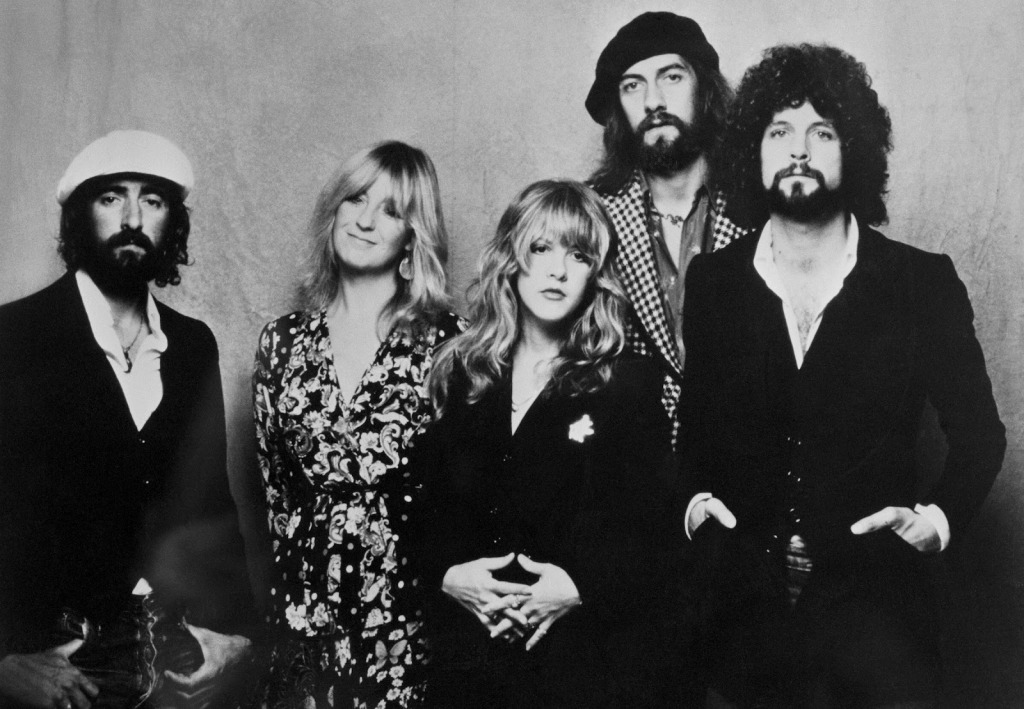
Fleetwood Mac members circa 1975, l to r, John McVie, Christine McVie, Stevie Nicks, Mick Fleetwood and Lindsey Buckingham

“By 1980, 13 million copies of Rumours had been sold worldwide. As of 2013, sales were over 40 million copies. As of May 2016, Rumours has spent 630 weeks in the UK Top 75 album chart and is the 11th best-selling album in UK history and is certified 13× platinum by the British Phonographic Industry, the equivalent of 3.9 million units shipped. The record has received a Diamond Award from the Recording Industry Association of America for a 20× platinum certification or 20 million copies shipped, making it, as of 2012, the joint fifth best-selling album in US history (by number of copies shipped).” (Ed note: it is still, as of 2019, one of the top ten best-selling albums of all time)

Although the group has continued to record and perform over the years, with some members leaving, new ones coming in, and then old ones rejoining, those of us of a certain age no doubt think of Fleetwood Mac as the following five individuals who were the group in 1977: Mick Fleetwood, Christine McVie, John McVie, Stevie Nicks and Lindsey Buckingham.

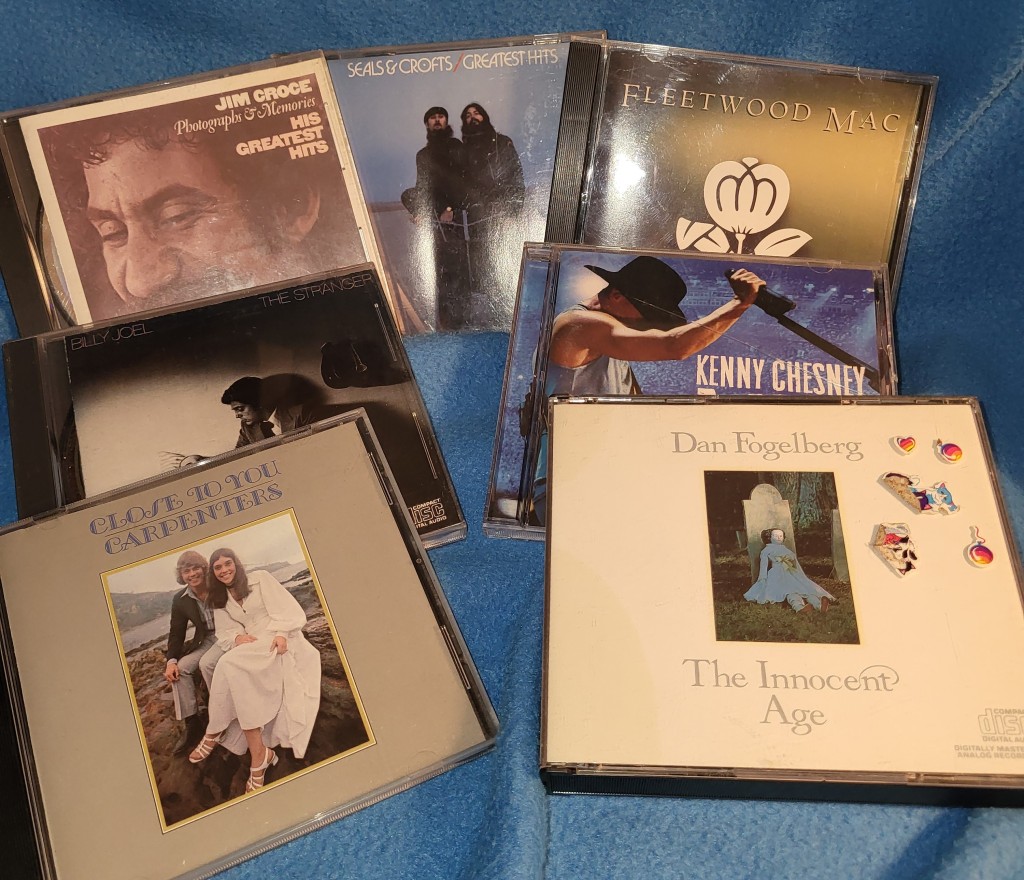
During a foray in to Value Village (a Western Washington thrift store) about a year ago I was – as is my habit – perusing the used CD’s when I spied it: Fleetwood Mac – Greatest Hits. I plucked the CD from the shelf and spirited it home. Last fall when the hubby and I were about to embark on a three week, three thousand mile, road trip, to New Mexico and back, I was forced to reduce down my box of ‘hitchhikers.’ This is what I lovingly dubbed the approximately 25 CD’s which traveled with me to Yakima and back every couple of weeks.

A few of the ‘hitchhikers’ who earned a spot in the box

The purge process involved looking at every CD we own (who knows 100? 150? 200?) and determining which of the entire CD deserved a place in the box and which had a cut or two which needed to be recorded onto a thumb drive. One by one I evaluated with the ‘thumb drive pile’ growing ever higher and the box group getting smaller. “Would I,” I asked myself with each CD, “listen to every song on this?”

There were only a handful which met that standard…  Fleetwood Mac’s Greatest Hits was one of them. Although it was not Rumours, it did have most of my favorites of theirs on it.

 It remained in the box of hitchhikers. When we bought our Hyundai Santa Fe in the summer of 2020 it did not have a CD player. To play my favorites I had to completely switch to the thumb drive.

Six months after this article was published, I lost my dad and the frequent trips to Yakima became a thing of the past. The box of hitchhikers now resides in a cupboard but the thumb drive lives in the center console of the Santa Fe. On the occasional longer trip I often plug it in to spend time with my favorite old friends including, Mick, Christine, Lindsey, and Stevie.

And every so often I peruse the CD collections at Goodwill and Value Village in search of the 1975 self-titled ‘Fleetwood Mac’ CD. Why? Because the song “Landslide” is, sadly, not in my collection and is, by far, my favorite of Fleetwood Mac’s songs. There is still plenty of room on the thumb-drive for a couple more song. Rumours have it.

For those not familiar with “Landslide”, here it is. Enjoy!

The FM story is fascinating and far too much to include in my weekly blog. Thankfully Wikipedia provides exhaustive information for those interested:

https://en.wikipedia.org/wiki/Fleetwood_Mac

https://en.wikipedia.org/wiki/List_of_Billboard_200_number-one_albums_of_1977

https://en.wikipedia.org/wiki/Rumours_(album)

https://en.wikipedia.org/wiki/Landslide_(Fleetwood_Mac_song)

Anne Frank

Diary of A Young Girl

March 12, 2024

A Tuesday Newsday Classic Updated

Margot and Anne Frank

Required reading for all junior high students in the 1970’s, Anne Frank: Diary of a Young Girl, both inspired and dismayed.

Although the exact date of the 15 year olds death is in question, March 12, 1945, is designated as such.

While I tend to avoid controversial and depressing topics, there is no question that this book ranks within the top tier of the most important works of the 20th century and deserves recognition as such.

Anne Frank lived in the Netherlands on June 12, 1942 – her 13th birthday – along with her parents and sister. It was on that date she was given her first ‘diary.’ From the Infallible Wikipedia:

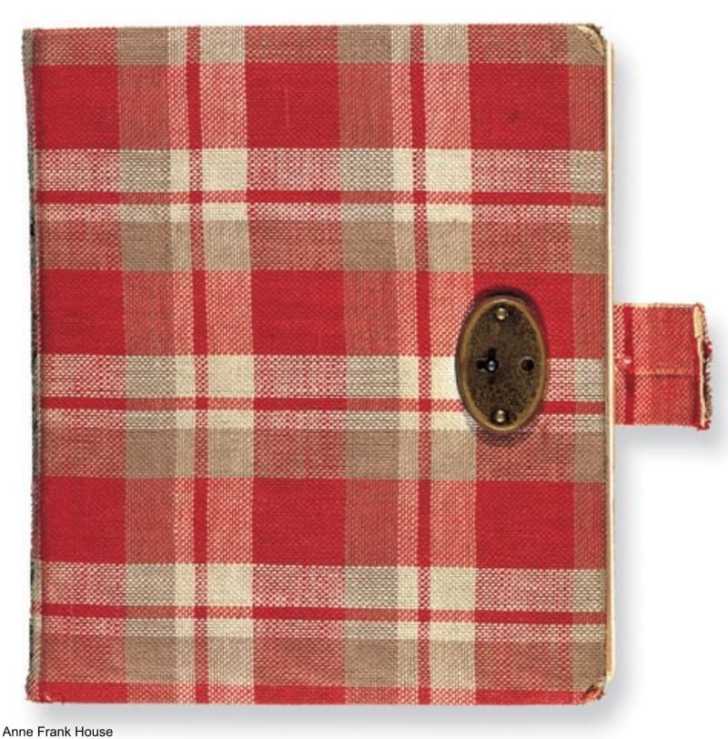
“During the Nazi occupation of the Netherlands, Anne Frank received a blank diary as one of her presents on June 12, 1942, her 13th birthday. According to the Anne Frank House, the red, checkered autograph book which Anne used as her diary was actually not a surprise, since she had chosen it the day before with her father when browsing a bookstore near her home. She began to write in it on June 14, 1942, two days later.

Anne Frank’s Diary which is preserved at the Anne Frank House museum

On July 5, 1942, Anne’s older sister Margot received an official summons to report to a Nazi work camp in Germany, and on July 6, Margot and Anne went into hiding with their father Otto and mother Edith. They were joined by Hermann van Pels, Otto’s business partner, including his wife Auguste and their teenage son Peter. Their hiding place was in the sealed-off upper rooms of the annex at the back of Otto’s company building in Amsterdam. Otto Frank started his business, named Opekta, in 1933. He was licensed to manufacture and sell pectin, a substance used to make jam. He stopped running his business while everybody was in hiding. But once he returned, he found his employees running it. The rooms that everyone hid in were concealed behind a movable bookcase in the same building as Opekta. Mrs. van Pels’s dentist, Fritz Pfeffer, joined them four months later. In the published version, names were changed: The van Pelses are known as the Van Daans, and Fritz Pfeffer as Albert Dussel. With the assistance of a group of Otto Frank’s trusted colleagues, they remained hidden for two years and one month.”

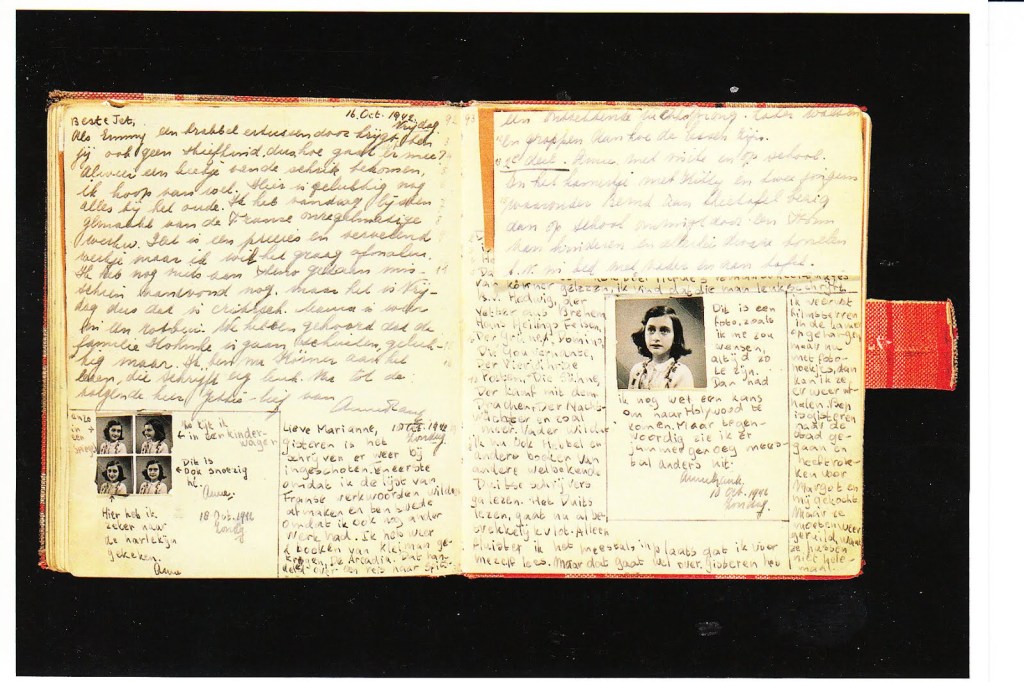
Interior pages of Anne’s Diary

The family and the others were discovered in August 1944 and taken to concentration camps. It was in the Bergen-Belsan camp where Anne, who contracted Typhus, and her sister both died. Of the hidden group, only Otto Frank survived. Those who concealed the family found and saved her diaries and gave the books to her father. It was he who got them published.

I can’t say exactly when I was first required to read the book, but no doubt it was in junior high (middle school to Americans under the age of 40). The timing of it likely coincided with when I became obsessed with keeping a diary. Perhaps I had visions of my musings being enshrined forever in a similar manner. Young teenage girls are, particularly, susceptible to drama and tragedy. Unlike Anne Frank, however, my diary entries included such riveting entries such as this one:

“March 1 (1972)

Well here we go again another month gone by. I’m 14 years, 7 months today. It was strange today we have had about four inches of snow, oh joy! I felt like I was being watched. We had a meeting at Mrs. Hughey’s this evening. We started Co-education volleyball in P.E. but I didn’t take it because I can’t, doctor’s orders. Yea! It can’t be that bad but if you take a look at last year’s diary today, you’d understand!”

When I look back to that first week of March of 1971, the misery of having to play co-ed volleyball with 14 year old boys screams through the pages. I know for certain those boys wanted to play Co-ed volleyball about as much as the girls did. Which was not at all. I imagine they were frustrated by the experience also.

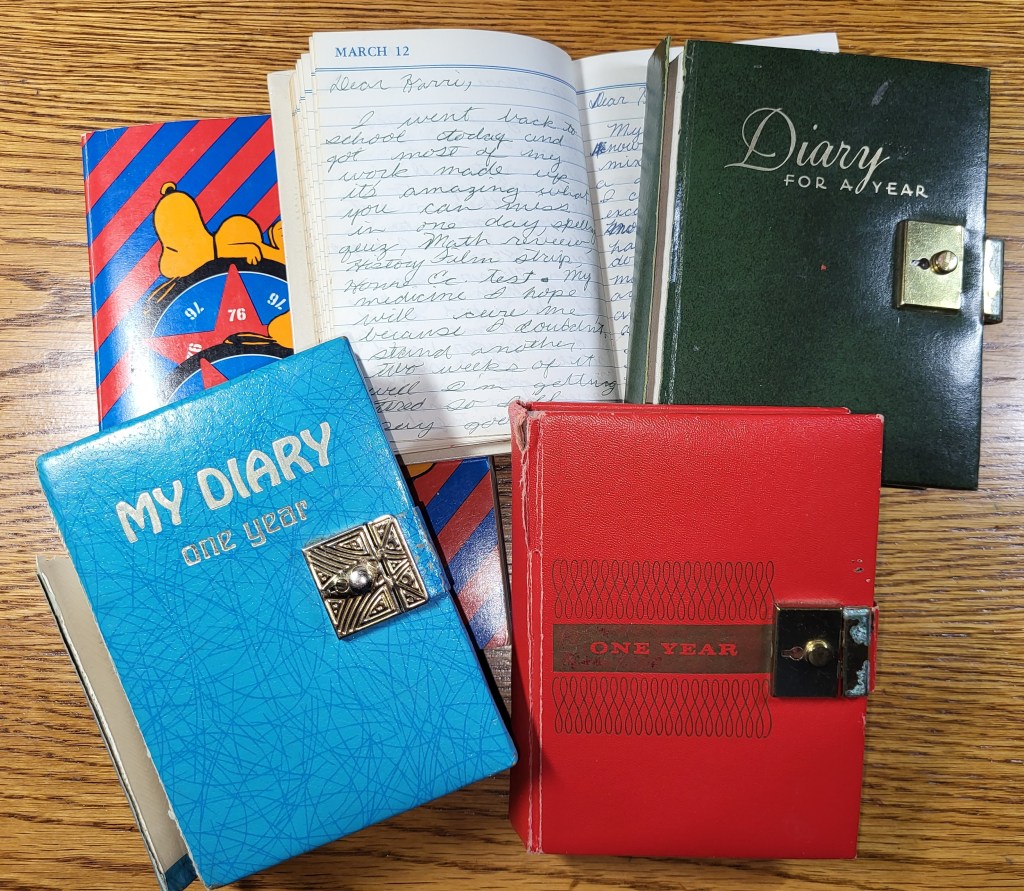
The five diaries I have saved. One year I switched to writing in a looseleaf notebook and ALWAYS used a green Flair pen. I am not sure what happened to that year. The 1976 diary is the last one I kept but by then I was 18 and the entries are few and far between. In 1971 I decided to write to my diary which I named Karri. Who knows!

For me, playing co-ed volleyball when you have the co-ordination and look of a newborn colt, is about the worse torture you can inflict on a teenage girl. The reason I couldn’t play volleyball in 1972 is that I was still recovering from a nine day case of the hard measles. (We didn’t have a measles vaccination then… get your kids vaccinated. Trust me on this) While I was sick I lost approximately 10 pounds… weight I could not afford to lose since I was, according to the identification pages at the front of my diary, 5’7” and 110 pounds. Yes, the colt reference is accurate. And, apparently, getting snow in early March isn’t that uncommon either.

What I do know is that the keeping of a diary galvanized for me a thing which has been a lifelong passion: to write. My musings are juvenile and without finesse and yet I do a credible job in dutifully recording all that was going on in my life at that time.

I am thankful that my teenage years were during an easier time in history; they will never carry the same weight and warnings of Anne Frank. The five years of books which I still have are a reminder that being a teenager is an awkward time in life regardless of the era. I suspect, also, that every teenager experiences some angst to one degree or another. Well, except maybe the most popular girl in my class… I’m certain HER life was perfect. Or not.

Anne Frank’s diaries – despite being written under the most challenging of circumstances – still ring true as to the thoughts and emotions of a girl on the cusp of becoming a woman. While her story had a tragic ending, I am thankful that her father made it his mission to see her words published and to serve as a reminder that each generation must be vigilant as to the dangers of persecution.

For more about Anne Frank and her diary, a couple of links:

https://en.wikipedia.org/wiki/The_Diary_of_a_Young_Girl

https://en.wikipedia.org/wiki/Anne_Frank

“God, You May Have Already Won’

God shows himself in mysterious ways…

February 27, 2024

A Tuesday Newsday Classic updated

A good editor is the key to making sure whatever is written reads right and, well, doesn’t make ridiculous mistakes. In late February 1997 an American Family Publisher’s Sweepstakes entry was received by the Bushnell Assembly of God Church. It began thus:

“God, we’ve been searching for you”

Apparently when dealing with the topic of God the Infallible Wikipedia is silent. Therefore, I share this brief clip from the Spokesman Review:

Cartoon by Jack Ziegler

“If God were to win, the letter stated, ‘What an incredible fortune there would be for God! Could you imagine the looks you’d get from your neighbors? But don’t just sit there, God.’

Sweepstakes officials did not return several telephone calls for comment Thursday.

(Pastor Bill) Brack said his 140-person congregation is considering whether to mail in the entry. The church could use the money.

And if American Family chooses a different winner?

‘God would be disappointed,’ Brack joked.”

This story reminded me of something similar which I experienced a couple of years ago. Over the course of a ten year period, I made frequent trips from Seattle to Yakima to help with my elderly parents. During that time, I had a 10+ year old Garmin GPS which I liked to turn on and use to give me approximate arrival times, elevation, etc. I would play little games in my brain, estimating what time I would arrive at which city, town or exit along the road.

One da, as I was headed back home, I stopped at the westbound Indian John rest area and, since I hadn’t yet sent my husband an update as to my estimated arrival time (ETA) I tapped out a quick text message just before I backed out of the parking spot and put the car into gear. It wasn’t until I read his reply at my next stop that I realized autocorrect on my phone had done this:

“God says I’ll be home at 4:30”

Apparently the terminology “GPS” didn’t exist in my phone’s spelling brain and switched it to the word “God” instead.

My Garmin GPS on October 29, 2016 somewhere on I-82 between Yakima and Ellensburg

I believe I got back a reply something to the effect of “its good God knows when you’re getting home.”

For several years I sent him messages about my ETA I type in “God” instead of “GPS.” I even referred to my arrival time as “God says” to those who did not know the history. I received more than a few strange looks from time to time. The way I see it is that it’s good to have God giving me travel advice.

If I had any doubt that my GPS truly was God my disbelief was dispelled in late October of 2016. I was on my way back from Yakima and was driving up I-82 towards Ellensburg. I glanced over at the GPS but what I saw left no doubt that some higher power was in charge. Instead of an elevation of about 2700 feet as expected “God” let me know I was at over… 50,000 feet!

As Doc Brown says in Back To The Future “Roads? Where we’re going we don’t need… roads!” Although the photo I snapped was a bit fuzzy, you can clearly see the elevation and God’s direction that I continue to an unpaved road. What road, I never did find out. This craziness continued for about 30 miles until I arrived at Thorp when, apparently, I was no longer flying and once again on solid pavement.

Jane Jetson learns to drive a flying car

To be sure, there were many, many times when I wished for the flying car as imagined in the 1960’s cartoon “The Jetsons.” It would have cut down on many hours of driving back and forth to Yakima. In retrospect – now that both my parents are gone – I have come to appreciate those hours in the car. It served, in both directions, as an opportunity to think about whatever challenges I had going on in my life; I listened to a whole lot of music; and sometimes I would simply work out story plots in my head. There were a few trips when I drove east and it was clearly autumn in the mountains only to return five days later and it was winter. Perhaps God was in charge after all.

To read the entire article on God winning the sweepstakes, here’s the link: http://www.spokesman.com/stories/1997/feb/28/god-you-may-have-won-11-million-sweepstakes/

And, of course, the original movie trailer from the 1977 George Burns and John Denver flick “Oh, God.”

Paricutin Volcano

Sometimes a volcano blooms overnight

February 20, 2024

A Tuesday Newsday Classic Updated

Geologically, nine years is a very short time period. But for farmer Dionisio Pulido of Paricutin, Mexico, the event which began at 4 p.m. on February 20, 1943, forever altered his life in a matter of moments.

Paricutin Volcano shortly after it first started erupting

As he is quoted in the Infallible Wikipedia:

“‘At 4 p.m., I left my wife to set fire to a pile of branches when I noticed that a crack, which was situated on one of the knolls of my farm, had opened . . . and I saw that it was a kind of fissure that had a depth of only half a meter. I set about to ignite the branches again when I felt a thunder, the trees trembled, and I turned to speak to Paula; and it was then I saw how, in the hole, the ground swelled and raised itself  2 or 2.5 meters high, and a kind of smoke or fine dust – grey, like ashes – began to rise up in a portion of the crack that I had not previously seen . . . Immediately more smoke began to rise with a hiss or whistle, loud and continuous; and there was a smell of sulfur.’

“He tried to find his family and oxen but they had disappeared so he rode his horse to town where he found his family and friends, happy to see him alive. The volcano grew fast and furiously after this. Celedonio Gutierrez, who witnessed the eruption on the first night reported:

‘…when night began to fall, we heard noises like the surge of the sea, and red flames of fire rose into the darkened sky, some rising 800 meters or more into the air, that burst like golden marigolds, and a rain like artificial fire fell to the ground.’”

And thus began an eruption which provided scientists an opportunity to study and record how a volcano is formed. During this time the volcano not only destroyed Pulido’s farm but forced the permanent evacuation of two towns, caused the deaths of three people (but not the farmer!), grew to 1,341 feet, and allowed scientists to witness the entire life cycle of a volcano.

Paricutin as it is today

Also from the Infallible Wikipedia:

“The importance of the Parícutin eruption was that it was the first time that volcanologists were able to fully document the entire life cycle of a volcano. The event brought geologists from all over the world,  but the principal researchers were William F. Foshag of the Smithsonian Institution and Dr. Jenaro Gonzalez Reyna from the Mexican government, who came about a month after the eruption started and stayed for several years. These two wrote detailed descriptions, drew sketches and maps and took samples and thousands of photographs during this time. Many of these are still used today by researchers. Foshag continued to study the volcano until his death in 1956. Between 1943 and 1948, almost fifty scientific articles were published in major journals about the volcano, with even more since. The worldwide effort to study Parícutin increased understanding of volcanism in general but particularly of scoria cone formation.”

It was quite likely I saw this documentary as a child and it was this that first sparked my interest in volcanoes. Some might call it an unhealthy obsession. But whatever it is I have a distinct memory of sitting in a darkened classroom and learning about this volcano.

Back in the 1960’s, every elementary school had an AV – that is Audio Visual – component. Manned by the kids who, today, rule the tech world, it was an unglamorous job (sort of like being a crossing guard or a hall monitor) which required said geeky boy (it was all boys at the time – just the way it was) to wheel the tall carts into classrooms and get it set up so the class could watch whatever educational program our teacher managed to snag so she (or he) could get a few minutes of down time. To be fair, WE unruly students loved those days also. But I digress.

Atop the cart which we had at Nob Hill Elementary in Yakima was a black and white TV connected by wires to a very crude version of video equipment. Once it was set up, off would go the lights and some item of interest would flicker to life.

While I couldn’t find a photo of the carts, we were all familiar with projectors that looked like this

As a child seeing a volcano literally grow out of the ground where it had just been a field was terrifying. Could that happen in MY backyard? Being that my natural state was to worry about such things I’m pretty certain I became quite concerned for my home. No doubt we learned about other deadly volcanoes: Mount Vesuvius, of course, and the most fascinating of all Krakatoa. Oh, and did I mention that on nice days I’d often see Mt. Adams – one of five Washington State volcanoes – off in the distance?

Of course my mother no doubt assured me that Mt. Adams was a dormant volcano and that Yakima was not prone to sudden volcanic eruptions and my family continued to live in blissful calm. It was only later in a college geology class that I learned Yakima sits on top of what is known as the Columbia River Basalt Group, which was a series of volcanic flows, that eventually covered about 81,000 square miles AND had depths up to 5,900 feet. That’s a whole lot of basalt which no one can take for granite… it was a gneiss fact to know.

Of course that was millions and millions of year prior, so of course there was no danger. Well, that was until May 18, 1980… when THAT myth was blown to pieces. I might have covered stubby Mt. St. Helens in another Tuesday Newsday article or two.

Volcan de Colima – aka Volcan de Fuego or the English translation ‘Fire Volcano’. Photo taken by my son in late January.

A couple of years ago our son moved to Guadalajara, Mexico. And until recently I hadn’t thought much about Mexican volcanoes. Of course I did know that the Pacific ring of fire which, in addition to being earthquake prone, also had a few volcanoes…913 to be exact. Whoa.

Mexico, specifically the region which stretches from the Pacific Ocean to the Caribbean Sea which starts near Puerto Vallarta and extends east to Guadalajara and then Mexico City and ending just north of Veracruz, has 23 of these volcanoes in a region known as the Trans-Mexican Volcanic belt.

So now I have new volcanoes to worry about. Of course I shouldn’t be concerned that Volcan de Colima, also known as Volcan de Fuego, is a mere 78 miles from where my son now lives. Or that Volcan de Fuego erupted as recently as January 2017. Or that our son went hiking on neighboring volcano Nevado de Colima – which is 3 miles north of Volcan de Fuego – in January of this year. I’m sure there’s nothing to worry about!

A map showing the location of the 23 volcanoes which define the Trans-Mexico Volcanic Belt
My son on his recent hike to Volcan Nevado de Colima in front of the ‘you have arrived’ sign

For reference, Paracutin is much, much further away from Guadalajara, more like 150 miles how the crow flies. The next time I’m in Mexico I plan to take a much closer look at the landscape to see how many of Mexico’ volcanoes I can identify.

For those who want to learn more:

https://en.wikipedia.org/wiki/Par%C3%ADcutin

Not sure if this is the video I saw but the music alone is enough to instill terror into a child….

And a few more articles and linkes about one of my favorite topics:

https://en.wikipedia.org/wiki/Columbia_River_Basalt_Group

https://en.wikipedia.org/wiki/Volc%C3%A1n_de_Colima

https://en.wikipedia.org/wiki/Volc%C3%A1n_Nevado_de_Colima_National_Park

https://en.wikipedia.org/wiki/Ring_of_Fire

Elton John

“I never knew me a better time, and I guess I never will.”

January 30, 2024

A Tuesday Newsday Classic Updated

In the past 50 years there has not been an artist, more than this one, who has provided the soundtrack for our lives. He embodies the concept of be ‘an original’ and has, since the beginning of his long career, gone his own way. In addition to his commercial success, he’s been recognized by his own country and was knighted on January 30, 1998.

The musician: the one, the only, and never imitated, Elton John.

Although he was born Reginald Dwight, he changed his name to Elton John in 1967, after several years in the music industry. From the Infallible Wikipedia:

“In 1967, Dwight answered an advertisement in the British magazine New Musical Express, placed by Ray Williams, then the A&R manager for Liberty Records. At their first meeting, Williams gave Dwight an unopened envelope of lyrics written by Bernie Taupin, who had answered the same ad. Dwight wrote music for the lyrics, and then mailed it to Taupin, beginning a partnership that still continues. When the two first met in 1967, they recorded what would become the first Elton John/Bernie Taupin song: ‘Scarecrow’. Six months later Dwight was going by the name ‘Elton John’ in homage to two members of Bluesology: saxophonist Elton Dean and vocalist Long John Baldry.”

The list of memorable songs written by the duo – and performed by Elton John – is amazing. From his very first top 40 hit – Your Song – and continuing on with hit after hit through the 1970’s and 1980’s, the songs are memorable and often poignant.

Your Song – easily my favorite of all of his songs

Ironically, Elton did not win a solo Grammy Award until 1995… 24 years after his first nomination. The 1995 award was for Best Male Performance for the Song Can You Feel the Love Tonight? from the Disney hit movie The Lion King. In all, he has been nominated for Grammy’s 33 times and won five times.

He was honored with the Grammy Legend Award in 1999, an honor given to the select few whose lifetime achievements are notable.

As a teenager in the 1970’s you could not turn on the radio without hearing many of Elton John’s songs. One song in particular stands out for me. It was December of 1972 and I was a sophomore in high school. And there was a guy – Ron – who was in my French class. New to my high school, his family had moved to Yakima sometime that fall. We soon became friends, chatting before and after class and we went to several Eisenhower High School basketball games together that December.

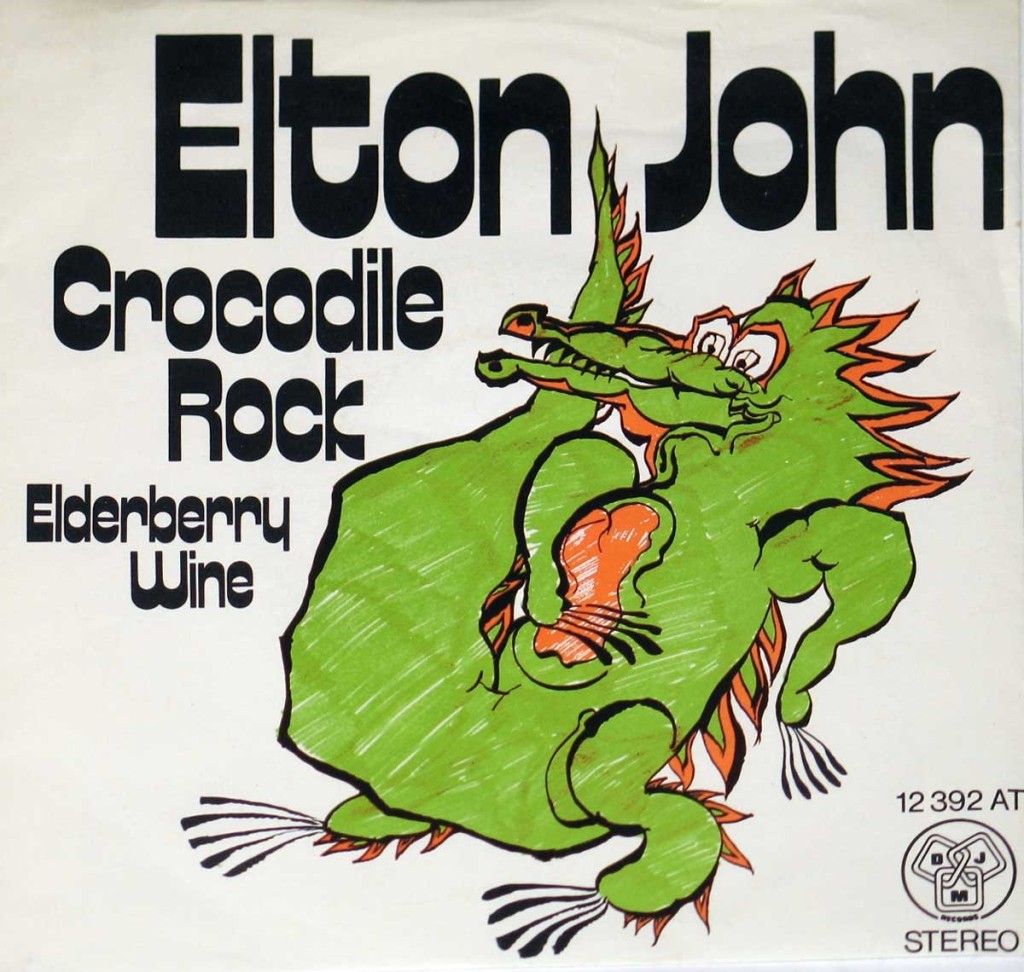
But it was one particular Elton John song which, having been released in the US on November 20, I associate with Ron. Crocodile Rock made the Billboard Hot 100, debuting at number 73. It climbed to #30 by December 18th. Crocodile Rock was Elton John’s first number one hit in the US, staying atop the charts for three consecutive weeks from February 3rd through the 17th in 1973.

To this day, whenever I hear Crocodile Rock I am immediately transported back to December of 1972. Although the song is about an earlier era, for a 15 year old girl garnering male attention for the first time in her life, the song seemed to encapsulate the fun of life: of going to a Friday night basketball game with a guy I liked, talking with him after class and in the library, getting teased by my friends about my new ‘boyfriend,’ and trying -and pretty much failing – to navigate the choppy waters which are teenage romances.

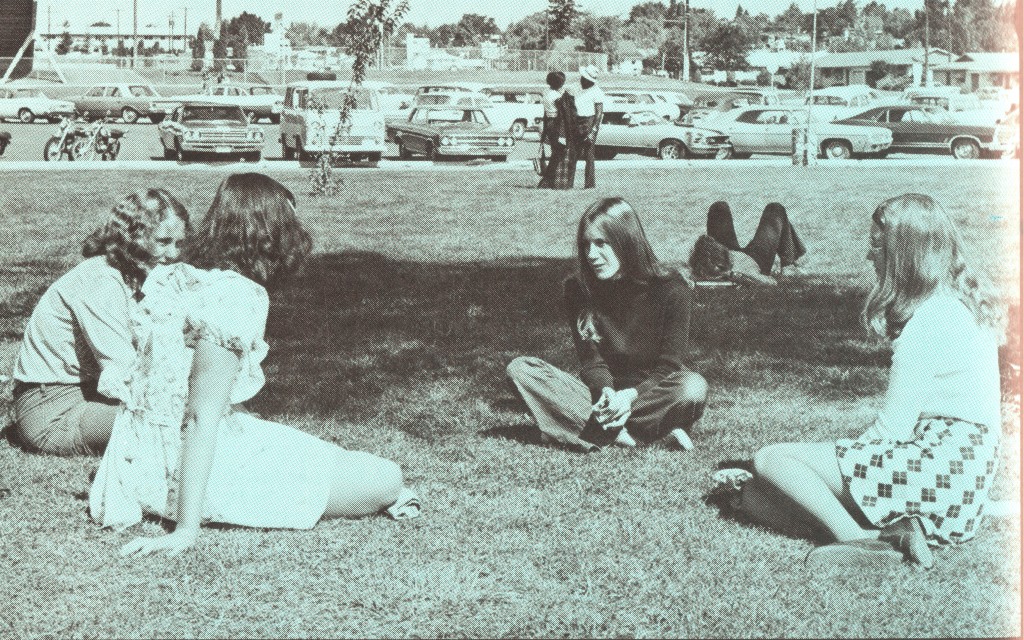
The author (center facing the camera) early fall of 1972 at Eisenhower High school with my friends Cindy, Daphne, and Kathy. This photo appeared on page 8 of the photo essay section of the 1973 annual.

There is a poignancy to the lyrics when one line proclaims “I never knew me a better time, and I guess I never will.” Somehow this song not only laments the slipping away of the rock and roll of the 1950’s and 60’s but speaks to how quickly the teenage years pass us by and how we simply do not appreciate what a unique and special time they are.

Elton John announced in 2018 that he was doing one ‘last’ tour dubbed ‘Farewell Yellow Brick Road’. From the website:

“These dates mark Elton’s last-ever tour, the end of a half a century on the road for one of pop culture’s most enduring performers. The new stage production will take his fans on a musical and highly visual journey spanning a 50-year career of hits like no one has ever seen before.”

True to his word, it WAS his final tour. But he has written a book – ‘Farewell Yellow Brick Road: Memories of My Life on Tour’ – which is scheduled to be released on September 24, 2024.

For more information about Sir Elton, be sure to check out these links:

https://en.wikipedia.org/wiki/Elton_John

https://www.eltonjohn.com/stories/farewell-yellow-brick-road-memories-of-my-life-on-tour-set-for-release

https://en.wikipedia.org/wiki/Elton_John_singles_discography

Raindrops Keep Falling On My Head

BJ Thomas brought the Bacharach and David song to life

January 23, 2024

A Tuesday Newsday Classic updated

Burt Bacharach, BJ Thomas, and Hal David

The powerhouse team of Burt Bacharach and Hal David churned out hit after hit in the late 1960’s and into the 1970’s. They achieved chart gold the week of January 23, 1970, when BJ Thomas’ dulcet voice brought Raindrop’s Keep Falling On My Head to life. The single, introduced in the movie Butch Cassidy and the Sundance Kid was number one on the American Top 40 charts for one week and spent 7 weeks at the top of the Adult Contemporary charts.

From the Infallible Wikipedia:

 “It won an Academy Award for Best Original Song. David and Bacharach also won Best Original Score. The song was recorded by B. J. Thomas in seven takes, after Bacharach expressed dissatisfaction with the first six. In the film version of the song, Thomas had been recovering from laryngitis, which made his voice sound hoarser than in the 7-inch release. The film version featured a separate vaudeville-style instrumental break in double time while Paul Newman performed bicycle stunts.”

At the time I was not exactly sure what the lyrics meant:

I loved this recording so much that this 45 single was one of the first two records I ever bought. The other was Freda Payne’s Band of Gold.

How the original 45 looked

I actually recall the day I purchased the 45. It was at the ValuMart store in Yakima and I had gone with my Dad. Traditionally, when I went to a store with him he would head off and do his shopping and I would go to the toy department and look over the collection of Barbie Doll clothes, carefully selecting the outfit I most wanted. Sometime between the previous fall and the spring of 1970, however, Barbie had been relegated to her case and stored away and I quit spending my allowance money on Barbie Doll clothes.

When I got home that day and for many days to follow, I played this record over and over and over. No doubt if I were to spin it today it would be a mess of static and skips. But to a budding teenager in 1970 it was everything and, really, which of us girls DIDN’T have a crush on BJ Thomas?

My family had a similar looking console for playing records

Even today, when I hear this song (only the BJ Thomas version!), I am transported back to the living room of the house where I grew up, playing the record on the behemoth stereo, a giant cabinet which looked like a dining room buffet. My mother insisted I wear earphones. Guess the music of ‘us kids’ was just too much.

Ultimately, the BJ Thomas version has been given the nod as a significant song. Also from the Infallible Wikipedia:

“In 2004, it finished at number 23 on AFI’s 100 Years…100 Songs survey of top tunes in American cinema. In 2008, the single was ranked 85th on Billboard’s Hot 100 All-Time Top Songs and placed 95th in the 55th Anniversary edition of the All-Time Hot 100 list in 2013. Billboard Magazine also ranked the song 15th on its Top 50 Movie Songs of All Time list in 2014.”

As an angsty pre-teen (I was 12 in January 1970) there was just something special about this song and BJ Thomas’ voice which resonated for me. And yet those lyrics haunted me then perhaps, because, I didn’t have enough life experience to understand what they meant.

Now, from the perspective of an adult I think I’ve come to know that ‘raindrops’ – which are troubles – come into everyone’s life. But it is up to each individual to decide how to handle them. We can chose to let our troubles paralyze us and keep us from pursuing what makes us satisfied and fulfilled; or we can vow to continue on, refusing to allow life’s obstacles to stop us from fulfilling our hopes and dreams. I think I prefer the latter option.

As always a link to the Infallible Wikipedia:

https://en.wikipedia.org/wiki/Raindrops_Keep_Fallin%27_on_My_Head

National Nothing Day

Long celebrated as a day to sit back and relax

January 16, 2024

A Tuesday Newsday Classic updated

January 16th, it turns out, is historically one of the most boring days in history. The tree most exciting things I could find for this date were:

  1. Debut of the Donny and Marie Show in 1976
  2. Cher and Greg Allman’s divorce finalized in 1979
  3. Wayne Newton performs his 25,000th show in Las Vegas in 1996.
From left to right: Wayne Newton, Donny & Marie Osmond, Greg Allman and Cher

Truly riveting events. Which is why January 16th being “National Nothing” Day seems appropriate.*

The day was started in 1972 by San Francisco Examiner columnist Harold Pullman Coffin. The day was created, according to the Infallible Wikipedia as a way:

“…to provide Americans with one National day when they can just sit without celebrating, observing or honoring anything.”

There truly is no lack of irony with what I discovered about this event. Wikipedia’s article is what’s known as an ‘orphan’ with not a single link to anything about this event. Yet the ‘day’ was significant enough to be included in the 1973 printing of Chase’s Calendar of Events (first published in 1957).

For just $103 you can get the paper copy of Chase’s Calendar or go digitally for a mere $97.50

Chase’s Calendar was also started by someone in the newspaper business. Bill Chase worked for the Flint (Michigan) Journal in the library. Hours and Hours of clipping and filing news stories prompted the idea of the publication which, as of 2012, had been updated and produced annually for 55 years.

There are a couple of takeaways from all this. First, is that if you are a writer and love trivial facts there’s probably a book inside of you. It amazes me the things that someone has turned into a book. Second, is that unless I’m sick, I can’t possibly sit and do ‘nothing’ all day. But, of course when one looks at the description of the day it doesn’t literally mean to not do anything.

I can’t think of anything more boring than sitting around and doing ‘nothing.’

When I was in high school I had a fabulous teacher by the name of Mrs. Renn. Sadly, the year I was in her class she was diagnosed with terminal cancer. But that did not stop her from coming to school every day and imparting her knowledge and wisdom to a bunch of ungrateful teenagers. One day I recall one of the students must have complained about the literature we were discussing and that she was bored. Mrs. Renn didn’t get mad at the student but took the opportunity to impart her philosophy on life.

I paraphrase but the message was this “there is no excuse to EVER be bored; if you have your mind, you can always find something interesting to read, or write, or do.”

The impact on me, personally, was huge. I’ve carried that message and that day with me all these years and I’m eternally grateful to Mrs. Renn for giving me wisdom at a time in my life when I needed to hear it.

So my plans for National Nothing Day is to seize the opportunity to use that time to have the very best day possible ‘doing’ all sorts of interesting (to me) things.

Update for 2024: I wrote this article in January 2018 and, since there’s still nothing new to share for January 16th, I’m sharing it again. I will add this. I’m a member of a Facebook Group for alumni from my high school, Eisenhower, in Yakima, Washington.

A random student took this photo of my dad teaching, probably from the late 1960’s to early 1970’s. Dad taught 9th grade Washington State history at Franklin Jr. High school in Yakima, Washington

Recently one of my classmates, Rick C., posted a question to the group: “Nominations are open for BEST (or worst) ADVICE by a staff member. For me Mrs. Renn’s advice immediately came to mind, so I posted pretty the same thing as I did in this 2018 article.  That was just a few days ago. There were many comments, so Rick’s post obviously resonated with many. But his response to what I posted touched my heart:

(Rick C.-Author)

Barbara DeVore  – I totally agree. She was so gentle and thoughtful. You wanted to please her. I credit her for my love of writing.

The only other one I could mention who was on that level, is your dear father from Franklin. I will never forget him! –R

So get out there and do ‘nothing’ spectacularly!

I enjoyed this article about the man who started Chase’s Calendar: http://www.annarbor.com/news/chasing-down-days-ann-arbor-founder-of-chases-calendar-of-events-turns-90/

And the Wikipedia article: https://en.wikipedia.org/wiki/National_Nothing_Day

*Martin Luther King Day (he was born January 15th) was designated as a Federal holiday in 1983 and it was not until the year 2000 when all 50 states observed it. Since it falls on the third Monday in January it has occurred on January 16th five times since its creation (1989, 1995, 2006, 2012, 2017) now making the January 16th designation as “Nothing Day” erroneous some years.