Tag Archive | Shakespeare

Exploring Romeo and Juliet: A Timeless Love Story

Perhaps Shakespeare’s most famous play

March 11

To try and take on this play is, I would conjecture, pure folly. Afterall, it is probably the most recognized literary work in the world. It is the story of two young lovers who forsake all else to be together. They risk the disapproval of family and friends and, ultimately, meet their demise all because they chose that which was forbidden.
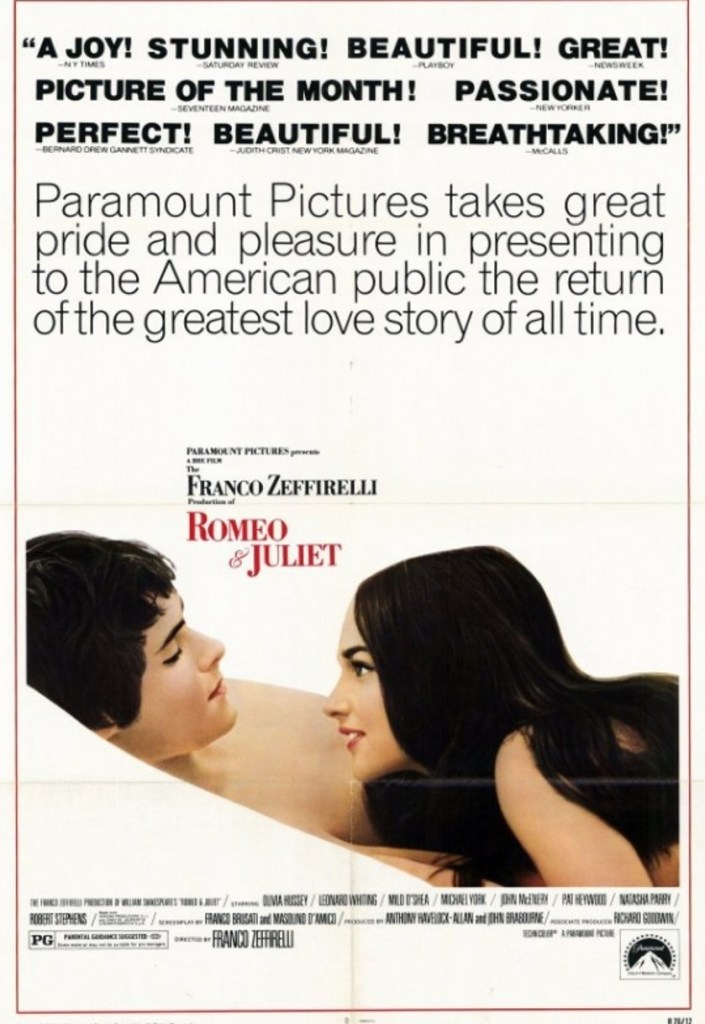
1968 Poster of Romeo and Juliet

“Romeo and Juliet” is William Shakespeare’s most famous works and March 11, 1302, is – according to OnThisDay.com – considered to be the date of the young lover’s marriage.

As is often the case, that is disputed since contextual clues from the play itself place the wedding date as being in mid to late July.

Regardless, today is as good a day as any to feature this iconic work.

For anyone who is unfamiliar with the storyline you can certainly access the Infallible Wikipedia. Which I did only to discover that the article there is 10,604 words long. Egads.

Instead, I found this one paragraph synopsis from the site Shakespeare.org.uk much easier to digest:

“An age-old vendetta between two powerful families erupts into bloodshed. A group of masked Montagues risk further conflict by gatecrashing a Capulet party. A young lovesick Romeo Montague falls instantly in love with Juliet Capulet, who is due to marry her father’s choice, the County Paris. With the help of Juliet’s nurse, the women arrange for the couple to marry the next day, but Romeo’s attempt to halt a street fight leads to the death of Juliet’s own cousin, Tybalt, for which Romeo is banished. In a desperate attempt to be reunited with Romeo, Juliet follows the Friar’s plot and fakes her own death. The message fails to reach Romeo, and believing Juliet dead, he takes his life in her tomb. Juliet wakes to find Romeo’s corpse beside her and kills herself. The grieving family agree to end their feud.”

But, honestly, only if you lived as a hermit in a rock cave on a remote island in the south Pacific would you NOT know about Romeo and Juliet (R&J).
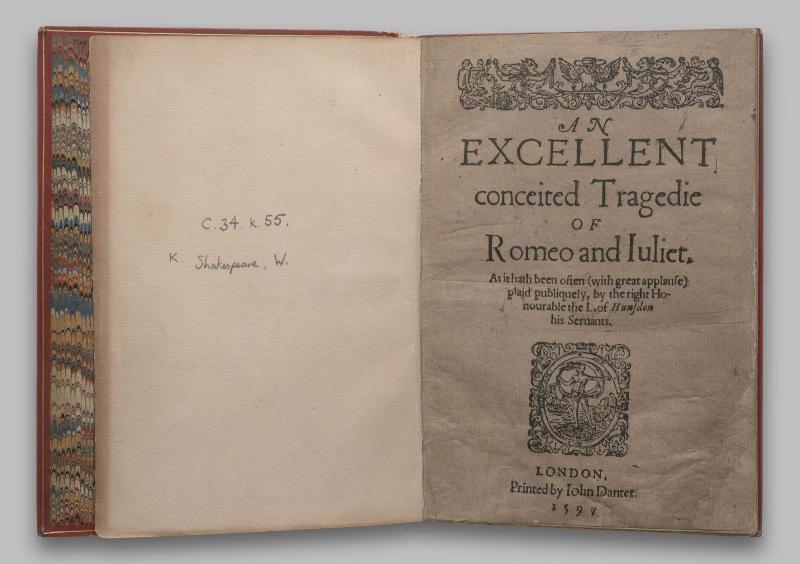
First edition Romeo and Juliet

When I started thinking about R&J, my mind drifted back to the early 1970’s and my experience at Wilson Junior High School in Yakima, Washington.
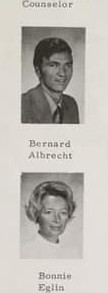
Wilson Junior High teachers 1971

It was there that I was introduced to R&J. At the time I had no appreciation for Shakespearean literature or for the incredible foundation which was given me by a trio of dedicated Jr. High English teachers.  For my entire 8th grade year, my English teacher was Mr. Albrecht. To us students he seemed quite mature. When, in fact, he was the ripe old age of 27 that first year. We respected him because he treated us as intelligent people regardless of our limited years on earth; he rewarded those who worked hard and did their best.

The next year my English class experience was split into two segments. For the fall/winter semester I drew the formidable grammar teacher, Mrs. Eglin. I think she likely made students rip out their hair and cry at times. But, by God, you were going to learn: all the parts of grammar, how to diagram a sentence, and how to construct a proper paragraph. It was in her class that I discovered the evils of dangling participles, all about verbs, adverbs, nouns (both proper and pro-), adjectives, and every other part of speech. In other words, I learned how to write the correct way. She made me think about my writing in ways I’d never considered. I might not have always followed her methods, and I’m not perfect, but not for lack of instruction on Mrs. Eglin’s part.
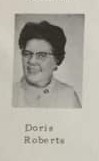
Mrs. Roberts 1971 yearbook photo

In the second half of the year, I had an even more demanding teacher – which I hadn’t thought possible after being with Mrs. Eglin – Mrs. Roberts. First name Doris. Which is telling. No one in my age demographic, or even a few years older, was named Doris. The name had, however, been the 8th most popular name for girls in the 1920’s. Mrs. Roberts was born in 1922 and was an ancient 50 that year. Ah perspective.

Mrs. Roberts assigned us every classical piece of literature she could find and we explored such themes as ‘man’s inhumanity to man’, ethics, morality, death and dying, cruelty, poverty… yes, we read some very dark stories. Like “Flowers for Algernon”, “The Grapes of Wrath”, “Fahrenheit 451”, and “Romeo and Juliet”.

The clever thing which this band of teachers managed to accomplish was to make the course work relevant to the teenagers of the day. Somehow, they convinced the administration that it was educational to load some 250 ninth graders into school busses and send them to the movie theatre to see films based on what we were reading.
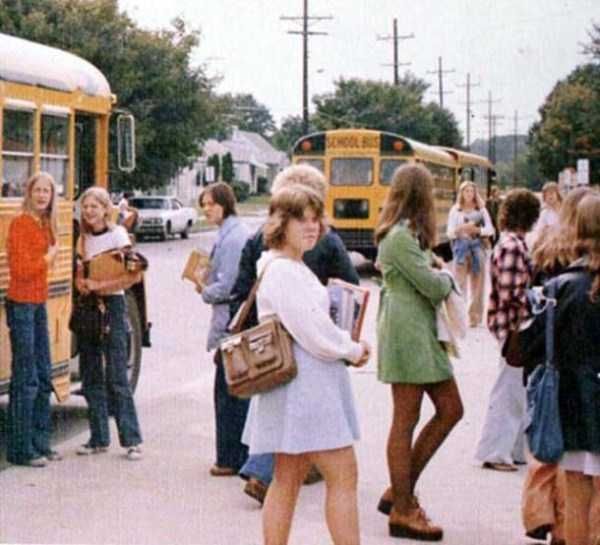
Pretty much how teenagers dressed in 1971-72. Found this photo on Pinterest.

Spoiler alert: it worked.

Of course, we kids thought we’d gotten a free pass for the day. Personally, I returned from those outings thinking about the films but also contemplating the books we read and then writing papers on the theme we thought was the best fit.

Sometime in the fall of 1971 I’m pretty certain we were whisked away in the busses to see the 1968 film version of Romeo and Juliet with Leonard Whiting and Olivia Hussey. Such clever English teachers, using the pop culture of the day to get us to learn. I did find a reference in my 1972 diary for both “Farenheit 451” and “Mary, Queen of Scots.” Sadly, my diary from 1971 does not seem to exist any longer, which surprises me as I was a faithful diary writer.

Now a few fun facts. I was able to find 49 times R&J was made into a movie in the Shakespearean tradition (from 1908-2021); an additional 118 films were produced which adapted the works in modern ways or with odd twists (like the truly bizarre 2011 Gnomeo and Juliet); there are also a few films which utilize R&J’s overarching theme in some new way (like the charming 2019 movie “Letters from Juliet”).

I owe a lot to my Junior High School English teachers for the great foundation they laid. It was the gift that has continued to give and bless me.

As always a few links:

https://www.onthisday.com/weddings/march/11
https://en.wikipedia.org/wiki/Romeo_and_Juliet

https://www.shakespeare.org.uk/explore-shakespeare/shakespedia/shakespeares-plays/romeo-and-juliet/#:~:text=An%20age-old%20vendetta%20between%20two%20powerful%20families%20erupts,to%20marry%20her%20father%E2%80%99s%20choice%2C%20the%20County%20Paris.

World Book & Copyright Day

A reason for authors to celebrate

April 23, 2024

A Tuesday Newsday Classic Updated

Near and dear to this author’s heart is World Book and Copyright Day – celebrated annually on April 23. Created in 1995 the purpose of the day is to “recognize the scope of books – a link between the past and the future, a bridge between generations and across cultures.”

One of the more interesting aspects of World Book Day, however, is how the date was chosen and why. The Infallible Wikipedia, as it so often does, offers some insight:

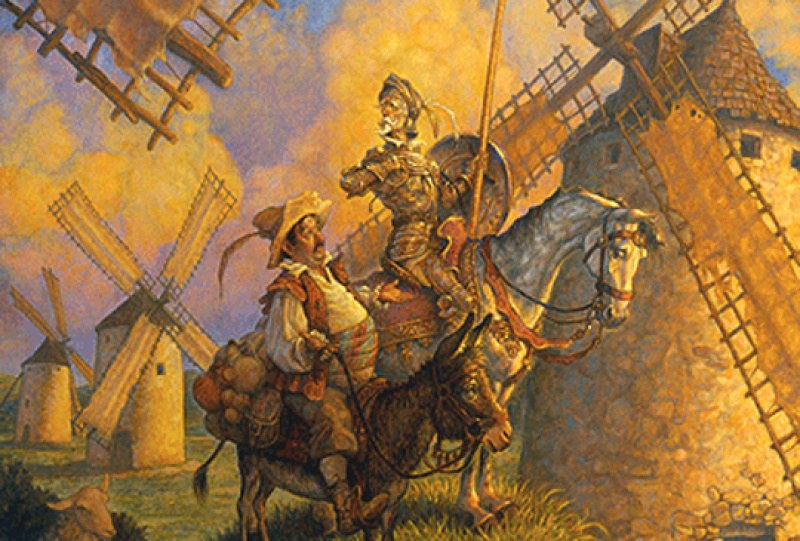
Cervantes is considered the most influential Spanish language author. His most famous work depicted here: Don Quixote.

“The original idea was of the Valencian writer Vicente Clavel Andrés as a way to honour the author Miguel de Cervantes, first on 7 October, his birth date, then on 23 April, his death date. In 1995 UNESCO decided that the World Book and Copyright Day would be celebrated on 23 April, as the date is also the anniversary of the death of William Shakespeare and Inca Garcilaso de la Vega, as well as that of the birth or death of several other prominent authors. (In a historical coincidence, Shakespeare and Cervantes died on the same date — 23 April 1616 — but not on the same day, as at the time, Spain used the Gregorian calendar and England used the Julian calendar; Shakespeare actually died 10 days after Cervantes died, on 3 May of the Gregorian calendar.)”

Shakespeare, perhaps more than any person who has ever lived, was the most impactful of authors. He published 37 plays and 154 sonnets and today, 503 years after his death, his works are still being performed and his written works analyzed and contemplated. Talk about staying power!

William Shakespeare

Several years ago I read a book which made the claim that every plot line ever imagined was written by Shakespeare. Modern writers, it stated, might as well give it up and quit writing stories since they cannot match Shakespeare.

To me, this was a very sad and cynical thought. Plus it misses the point about the human mind, heart, and the individual’s desires – I would argue need – to pursue one’s passions in life.

When I reflect back on my earliest interests, one stands out: the desire to write. What better way to capture one’s thoughts and the emotions of a time and place? I dabbled in fiction writing while in high school and penned a thinly cloaked autobiographical story titled “Another Lunch.” It told the story of Bernice, Deborah, and Cynthia, three friends whose singular focus seemed to be the pursuit of, and interactions with, boys.

I would add to the ‘book’ as new adventures occurred, writing them by hand in a three prong paper keeper over the weekend, then bringing the updated story to school for the ‘real’ Deborah and Cynthia to read. Eventually word of the story got out there and some of the ‘boys’ and other peripheral characters – perhaps recognizing themselves in the story – clamored to read the tome. It was passed around like an annual at graduation for everyone to peruse.

Sadly, “Another Lunch” disappeared in the spring of my Senior year, no doubt carried home and lost in the hovel of some student’s bedroom destined to be discarded by an irritated mother who saw it as worthless. As for me, I kept all my writings from those early years and find them, at times, a somewhat painful reminder of my perspective and (lack of) writing abilities.

Although I dabbled in writing the beginnings of stories a various times over the years, my ‘fiction’ writing mostly lay dormant for years. Then the day came when I walked into a novel writing class at Bellevue Community College.

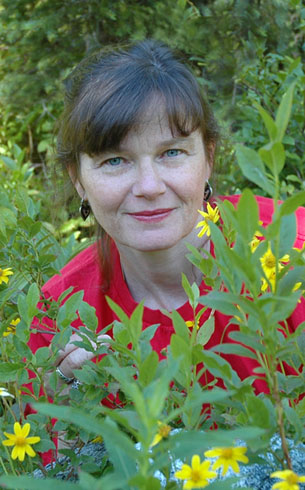
Author Janet Lee Carey

Taught by published author Janet Lee Carey, it was structured into two parts. The first was a 45 minute lecture on the various elements of writing fiction: plotting, sentence, paragraph, and sentence structure; deciding what sort of book you were going to write; character development; effective dialogue; avoiding cliches. The things one needed to know and learn was extensive. I soaked it up like a teenager getting a tan during summer break.

The second half of each class was an opportunity for all of us aspiring authors to read a scene or two from our current work in progress. It was what happened in the second part of the class that day which confirmed for me that I was a closet novelist who had finally found her home.

I listened to the stories which my classmates shared for critique and a voice inside my own head whispered to me, “You can write just as well…”

Later that day I started on my first novel, determined to find a way to complete a 90,000-word book – standard length. I took inspiration from Janet when she said – and I paraphrase – “If you can write a sentence, then you can write a paragraph… and if you can write a paragraph, then you can write a chapter. After all a novel is just sentences, paragraphs, and chapters all connecting together.”

 There was no better feeling than when, months later, I wrote the words “The End.” I had done it! But it was more than that. Writing provided an outlet for the jumble of thoughts which crowded my brain, a virtual sieve to separate the chaff from the grain.

Now, nearly twenty years later, I am still compelled to write. That class was truly a life changing event.

In addition to fiction, my Tuesday Newsday blog has taken on a life of its own. Now in its eighth year I’ve published 314 articles covering unique topics in categories such as Historical Happenings, My Home Town, Screen Shots, Music Makers, and – a personal favorite – Geeky Musings. I’ve updated a number of articles as I await next year and the opportunity to fill in those 52 dates which have not yet fallen on a Tuesday!

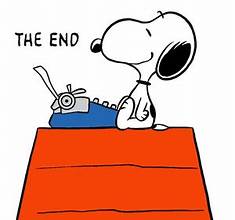
Famous author Snoopy inspires me

But, for me, it doesn’t matter if its novels or short personal essays (such as this one) it’s the writing that matters. I’m truly happiest when I get to spend a portion of the day writing creatively.

Finally, a nod to my fellow ‘Anonymous Authors’, who for the past 20 years have brightened my Tuesday mornings with their stories, critiques, and friendship, especially: Roger, Jette, and Ward my current compadres who meet on Zoom most Tuesday mornings. But also to those who once shared those Tuesdays: Irene, Daphne, Steve S., Steve D. (what she said!), Dee, Joe, and May.

A bit of information about World Book and Copyright day:

https://en.wikipedia.org/wiki/World_Book_Day

https://en.unesco.org/commemorations/worldbookday

Not So Anonymous Authors

April 23, 2019

Near and dear to this author’s heart is World Book and Copyright Day – celebrated annually on April 23. Created in 1995 the purpose of the day is to “recognize the scope of books – a link between the past and the future, a bridge between generations and across cultures.”

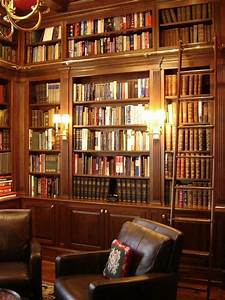
book wall.jpg

One of the more interesting aspects of World Book day, however, is how the date was chosen and why. The infallible Wikipedia, as it so often does, offers some insight:

“The original idea was of the Valencian writer Vicente Clavel Andrés as a way to honour the author Miguel de Cervantes, first on 7 October, his birth date, then on 23 April, his death date. In 1995 UNESCO decided that the World Book and Copyright Day would be celebrated on 23 April, as the date is also the anniversary of the death of William Shakespeare and Inca Garcilaso de la Vega, as well as that of the birth or death of several other prominent authors. (In a historical coincidence, Shakespeare and Cervantes died on the same date — 23 April 1616 — but not on the same day, as at the time, Spain used the Gregorian calendar and England used the Julian calendar; Shakespeare actually died 10 days after Cervantes died, on 3 May of the Gregorian calendar.)”

shakespeare.jpg            Shakespeare, perhaps more than any person who has ever lived, was the most prolific of authors. He published 37 plays and 154 sonnets and today, 503 years after his death, his plays are still being performed and his written works analyzed and contemplated. Talk about staying power!

Several years ago I read a book which made the claim that every plot line ever imagined was written by Shakespeare. Modern writers, it stated, might as well give it up and quit writing stories since they cannot match Shakespeare.

To me, this was a very sad and cynical thought. Plus it misses the point about the human mind and heart and the individual’s desire – I would argue need – to pursue one’s passions in life.

When I reflect back on my earliest interests, one stands out: the desire to write. What better way to capture thoughts and the emotions of a time and place? I dabbled in fiction writing while in high school and penned a thinly cloaked autobiographical story titled “Another Lunch.” It told the story of Bernice, Deborah, and Cynthia, three friends whose singular focus seemed to be the pursuit of boys.

journal.jpg            I would add to the ‘book’ as new adventures occurred, writing them down over the weekend, then bringing the updated story to school for the ‘real’ Deborah and Cynthia to read. In time some of the ‘boys’ and other peripheral characters – perhaps recognizing themselves in the story – also started to read the book. It was passed around like an annual at graduation for everyone to peruse.
Sadly, “Another Lunch” disappeared in the spring of my Senior year, no doubt lost in the hovel of some student’s bedroom destined to be discarded by an irritated mother who saw it as worthless.

My ‘fiction’ writing lay dormant for years until the day I walked into a novel writing class at Bellevue Community College. Taught by published author Janet Lee Carey, it was structured into two parts. The first was a 45 minute lecture on the elements of writing fiction. The second half was an opportunity for all of us aspiring authors to read a scene or two from our current work in progress.


That very first class I devoured everything which Janet shared as if I was encountering a feast after a years’ long fast. It was what happened in the second part of the class that day which confirmed for me that I was a reluctant writer who had finally found her home.

I listened to the stories which my classmates shared for critique and a voice inside my own head whispered to me, “You can write just as well as them.”

Later that day I started on my first novel, determined to find a way to complete a 90,000 word book – standard length. There was no better feeling than when, months later, I wrote the words “The End.” I had done it! But it was more than that. Writing provided an outlet for the jumble of thoughts which crowd my brain, a virtual sieve to separate the chaff from the grain.

Today I am still compelled to write. In addition to fiction, my Tuesday Newsday blog has taken on a life of its own. Now in the third year, this post is the 106th that I’ve published. For me it doesn’t matter if its novels or short personal essays (such as this one) it’s the writing that matters.

Finally, a nod to my fellow Anonymous Authors, who brighten my Tuesday mornings with their stories, critiques, and friendship: Roger, Jette, Ward, Daphne, Irene, Steve, and May.

A bit of information about World Book and Copyright day:

https://en.wikipedia.org/wiki/World_Book_Day

https://en.unesco.org/commemorations/worldbookday