Tag Archive | Bellevue Washington

Microsoft Millionaires

My ‘Forrest Gump-esque’ experience in the 1980’s

January 21, 2025

A Tuesday Newsday Classic Updated
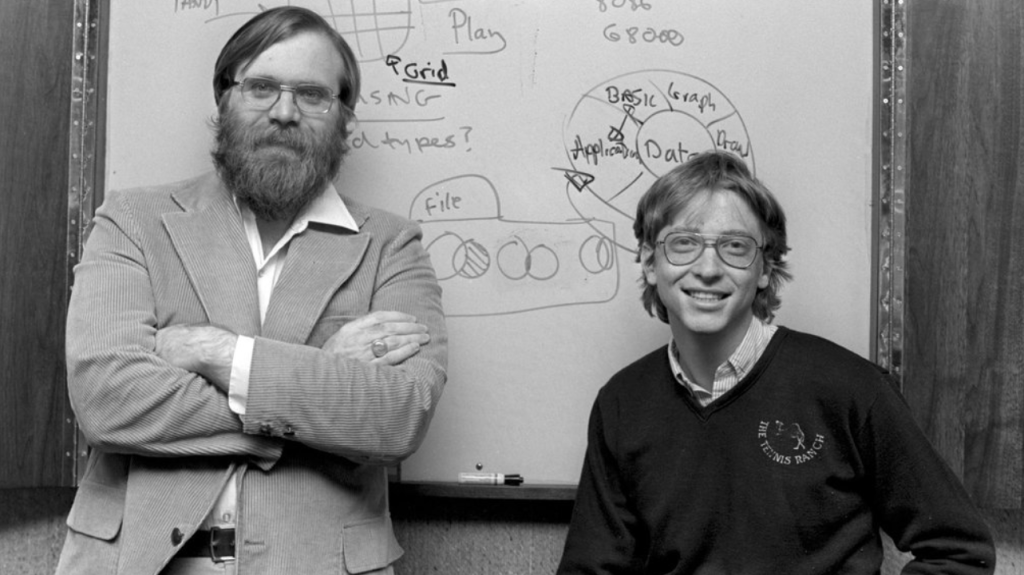
Paul Allen and Bill Gates in the late 1970’s and how I picture both of them in my memory.

When this young man dropped out of college, I’m sure it was a huge disappointment to his family. After all, he’d scored a perfect 1600 on his SAT’s and graduated from the prestigious Lakeside School in Seattle. But the world was changing rapidly in the early to mid-1970’s and he had bigger visions than attending classes and frat parties.

Of course, we all know his story. Along with a close friend, he went on to become a co-founder of one of the world’s most successful computer software development companies: Microsoft.

Early 1980’s Company Logo

But I’m not writing about Bill Gates. This is about Paul Allen, the less ‘famous’ of the Microsoft pair. And without whom Microsoft would never have existed.

If he were alive today, he would be celebrating his 72nd birthday.

According to the Infallible Wikipedia:

“He attended Lakeside School, a private school in Seattle where he befriended Bill Gates, with whom he shared an enthusiasm for computers, and they used Lakeside’s Teletype terminal to develop their programming skills on several time-sharing computer systems. They also used the laboratory of the Computer Science Department of the University of Washington, doing personal research and computer programming; they were banned from the laboratory in 1971 for abuse of their privileges there.

Gates and Allen joined with Ric Weiland and Gates’ childhood best friend and first collaborator, Kent Evans, to form the Lakeside Programing Club and find bugs in Computer Center Corporation’s software, in exchange for extra computer time. In 1972, After Evan’s sudden death due to a mountain climbing accident, Gates turned to Allen for help finishing an automated system of Lakeside’s entire class scheduling procedure. They then formed Traf-O-Data to make traffic counters based on the Intel 8008 processor. According to Allen, he and Gates would go ‘dumpster diving’ in their teenage years for computer program code.
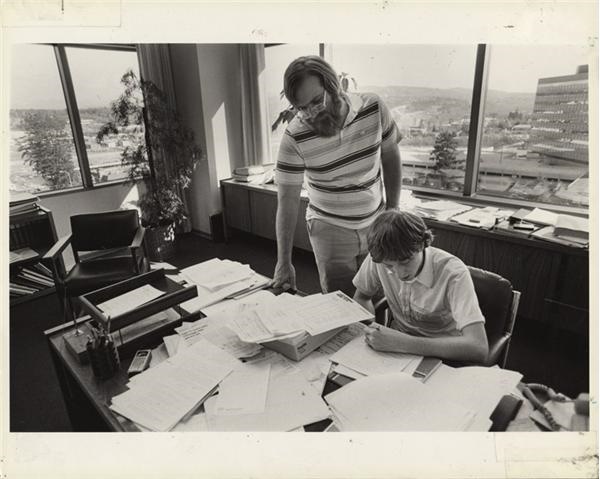
This photo purports to be from 1984. If so, it was likely right after the company moved ‘across’ I-520 to Corporate Campus East. This would have been my final year at Microsoft.

Allen attained a perfect SAT score of 1600 and went to Washington State University, where he joined the Phi Kappa Theta fraternity.”

Allen was hired by Honeywell, located in Boston, as a computer programmer and left WSU. Gates, now attending nearby Harvard, and Allen reconnected. It was Allen who convinced Gates to leave Harvard, move to Albuquerque, New Mexico and form Micro-Soft (To combine the two terms microcomputer and software). In January 1979, the company moved to Bellevue, Washington.

Also from the Infallible Wikipedia:

“The relationship became less close between Allen and Gates as they argued even over small things. Allen effectively left Microsoft in 1982 after being diagnosed with Hodgkin’s lymphoma, though he remained on the board of directors as vice chairman. Gates reportedly asked Allen to give him some of his shares to compensate for the higher amount of work that Gates was doing. According to Allen, Gates said that he ‘did almost everything on BASIC and the company should be split 60–40 in his favor. Allen agreed to this arrangement, which Gates later renegotiated to 64–36. In 1983, Gates tried to buy Allen out at $5 per share, but Allen refused and left the company with his shares intact; this made him a billionaire when Microsoft went public. Gates later repaired his relationship with Allen, and the two men donated $2.2 million to their childhood school Lakeside in 1986. They retained a friendship for the rest of Allen’s life.”
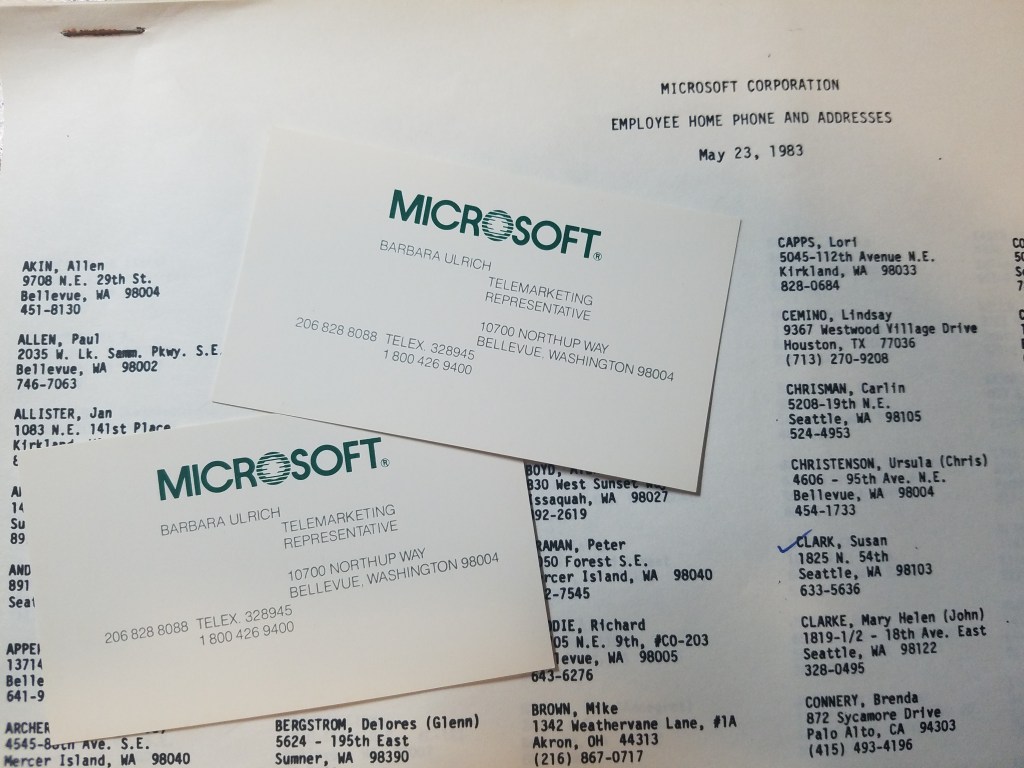
Being that I keep anything which might be historical in nature, I still have several Microsoft employee address lists and a few of my business cards. When I joined the company in early January 1983 there were 205 people at corporate and 21 field sales reps. Which means I was one of the first 250 employees of Microsoft.

Allen went on to do many great things for the world including donating over $2 Billion towards science, technology, education, wildlife conservation, the arts, and community services.

You can read more about Allen’s extraordinary life and find links to his biography here:

https://en.wikipedia.org/wiki/Paul_Allen

In the past eight years of writing my Tuesday Newsday blog I’ve shared only a few stories about my ‘Forest Gump-esque’ experiences at Microsoft. I was hired there in early 1982 as part of a group of three young women who would be launching a retail telemarketing division for the company.

Our trio faced nearly insurmountable odds – which we did not know when we took the jobs – as we were tasked with calling out to every retail store in our region (I had the west coast. The. Entire. West. Coast.), working in conjunction with Microsoft’s field sales reps, to sell such programs as Basic, Fortran, and Cobol compilers, the always popular Flight Simulator and Typing Tutor, and the early spreadsheet program, MultiPlan.

The phone calls were often brutal with the stores’ buyers either not taking our calls or, more often, asking if we sold Lotus 1-2-3, our competitors sizzling hot multi-functional program which dwarfed Microsoft’s Multiplan. Word Processing program? Bah. Didn’t exist then.
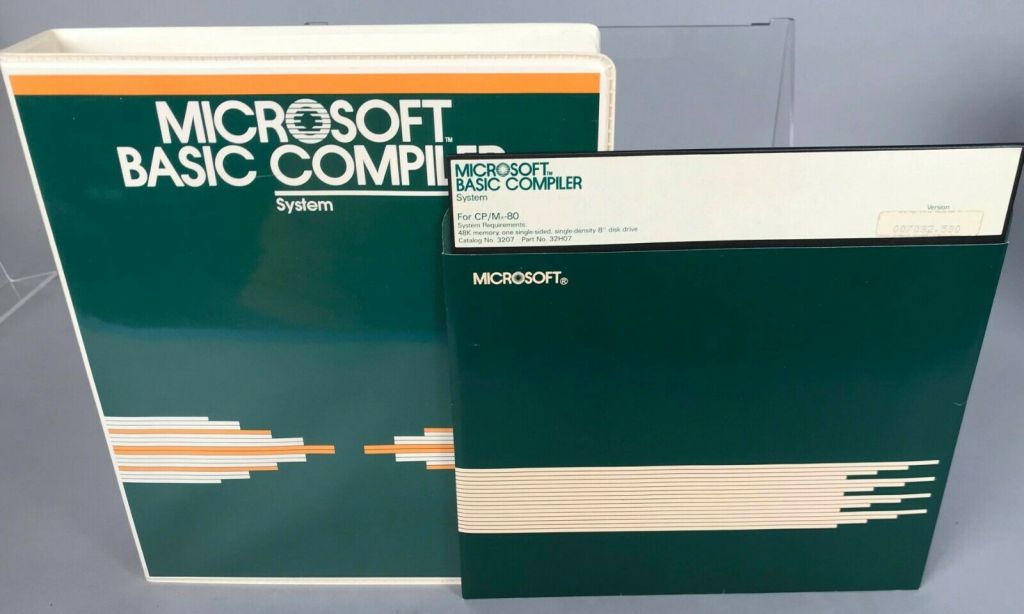
There was nothing sleek OR sexy about the early Microsoft products. But they were green…

We worked hard, we played hard, and the burnout rate was high.

I left Microsoft, having experienced that same mentioned burnout, in the fall of 1984 and went to work for another computer company located in Kirkland six weeks later. One day, likely the summer of 1986, my then boss, Tom, took me to lunch for my birthday. We went to a favorite Japanese sushi place in Totem Lake called Izumi.

We sat up at the small sushi bar, the only people in the restaurant when we arrived. We had just gotten our food when a group of 4 or 5 men also arrived, and took a table nearby. I didn’t pay much attention to the group as Tom and I were talking. Tom, being a loud and gregarious individual, dominated the exchange and the room.

Izumi was a favorite where the hubby and me liked to go

Somehow our conversation got on to Microsoft and Tom asked why I had left the company. Before I could answer, I noticed the table of nearby men had gone silent and were all looking at us, and one of them said “I can’t escape it, no matter where I go.” That man was Paul Allen.

Perhaps that moment, more than any other, illuminated how he felt about Microsoft – at least in 1986 when he and Gates were still working to repair their relationship – and summed up for me my Microsoft experience also. For anyone living in the Seattle area, you either worked for, know someone who worked for, or you once worked for, Microsoft. It was inescapable. And not particularly pleasant.

I wanted to say something to Paul Allen that day, but felt that if I had it would have been about as welcome as a drunk fan asking a movie star for an autograph. Instead – as if by mutual agreement – he returned his attention to his group and Tom and I changed our topic.

I left Applied Computer Sciences and the corporate world in the late 1980’s, putting my energies in to raising my kids and doing volunteer work.

If I had any regrets in leaving Microsoft it was, perhaps – unlike Paul Allen – that I was never eligible for stock options, a nice perk that would have made life a bit easier.

I did, however, learn something much more valuable and it is a mantra I’ve carried through my life which goes like this:

Bill Gates and Paul Allen were wildly successful. Microsoft was wildly successful. But just because I worked for the company, however, was not enough to make me wildly successful. It is up to each of us, individually, to follow our own path, pursue our own dreams and interests, and find those things which bring us joy and fulfillment. That, I think, is the true definition of success.

It was a hard lesson but I’m forever thankful for learning it and those brief, brutal, and impactful, Microsoft years.
https://en.wikipedia.org/wiki/Paul_Allen

https://en.wikipedia.org/wiki/Microsoft

World Book & Copyright Day

A reason for authors to celebrate

April 23, 2024

A Tuesday Newsday Classic Updated

Near and dear to this author’s heart is World Book and Copyright Day – celebrated annually on April 23. Created in 1995 the purpose of the day is to “recognize the scope of books – a link between the past and the future, a bridge between generations and across cultures.”

One of the more interesting aspects of World Book Day, however, is how the date was chosen and why. The Infallible Wikipedia, as it so often does, offers some insight:

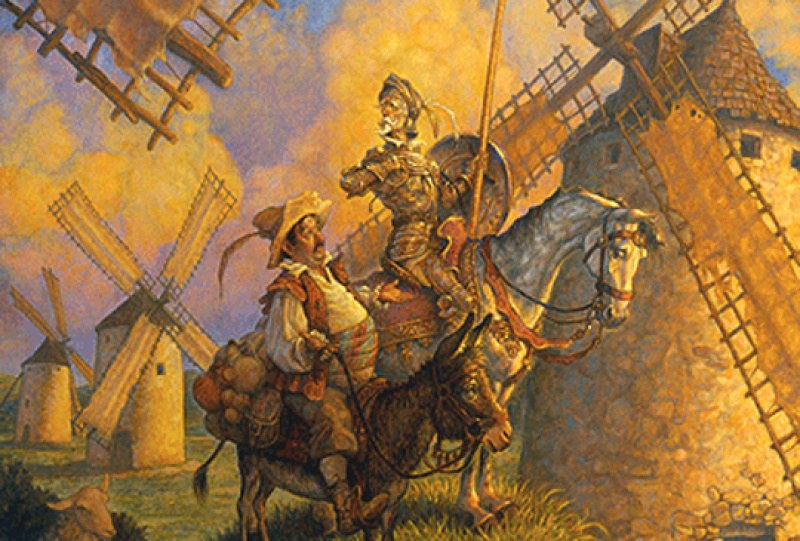
Cervantes is considered the most influential Spanish language author. His most famous work depicted here: Don Quixote.

“The original idea was of the Valencian writer Vicente Clavel Andrés as a way to honour the author Miguel de Cervantes, first on 7 October, his birth date, then on 23 April, his death date. In 1995 UNESCO decided that the World Book and Copyright Day would be celebrated on 23 April, as the date is also the anniversary of the death of William Shakespeare and Inca Garcilaso de la Vega, as well as that of the birth or death of several other prominent authors. (In a historical coincidence, Shakespeare and Cervantes died on the same date — 23 April 1616 — but not on the same day, as at the time, Spain used the Gregorian calendar and England used the Julian calendar; Shakespeare actually died 10 days after Cervantes died, on 3 May of the Gregorian calendar.)”

Shakespeare, perhaps more than any person who has ever lived, was the most impactful of authors. He published 37 plays and 154 sonnets and today, 503 years after his death, his works are still being performed and his written works analyzed and contemplated. Talk about staying power!

William Shakespeare

Several years ago I read a book which made the claim that every plot line ever imagined was written by Shakespeare. Modern writers, it stated, might as well give it up and quit writing stories since they cannot match Shakespeare.

To me, this was a very sad and cynical thought. Plus it misses the point about the human mind, heart, and the individual’s desires – I would argue need – to pursue one’s passions in life.

When I reflect back on my earliest interests, one stands out: the desire to write. What better way to capture one’s thoughts and the emotions of a time and place? I dabbled in fiction writing while in high school and penned a thinly cloaked autobiographical story titled “Another Lunch.” It told the story of Bernice, Deborah, and Cynthia, three friends whose singular focus seemed to be the pursuit of, and interactions with, boys.

I would add to the ‘book’ as new adventures occurred, writing them by hand in a three prong paper keeper over the weekend, then bringing the updated story to school for the ‘real’ Deborah and Cynthia to read. Eventually word of the story got out there and some of the ‘boys’ and other peripheral characters – perhaps recognizing themselves in the story – clamored to read the tome. It was passed around like an annual at graduation for everyone to peruse.

Sadly, “Another Lunch” disappeared in the spring of my Senior year, no doubt carried home and lost in the hovel of some student’s bedroom destined to be discarded by an irritated mother who saw it as worthless. As for me, I kept all my writings from those early years and find them, at times, a somewhat painful reminder of my perspective and (lack of) writing abilities.

Although I dabbled in writing the beginnings of stories a various times over the years, my ‘fiction’ writing mostly lay dormant for years. Then the day came when I walked into a novel writing class at Bellevue Community College.

Author Janet Lee Carey

Taught by published author Janet Lee Carey, it was structured into two parts. The first was a 45 minute lecture on the various elements of writing fiction: plotting, sentence, paragraph, and sentence structure; deciding what sort of book you were going to write; character development; effective dialogue; avoiding cliches. The things one needed to know and learn was extensive. I soaked it up like a teenager getting a tan during summer break.

The second half of each class was an opportunity for all of us aspiring authors to read a scene or two from our current work in progress. It was what happened in the second part of the class that day which confirmed for me that I was a closet novelist who had finally found her home.

I listened to the stories which my classmates shared for critique and a voice inside my own head whispered to me, “You can write just as well…”

Later that day I started on my first novel, determined to find a way to complete a 90,000-word book – standard length. I took inspiration from Janet when she said – and I paraphrase – “If you can write a sentence, then you can write a paragraph… and if you can write a paragraph, then you can write a chapter. After all a novel is just sentences, paragraphs, and chapters all connecting together.”

 There was no better feeling than when, months later, I wrote the words “The End.” I had done it! But it was more than that. Writing provided an outlet for the jumble of thoughts which crowded my brain, a virtual sieve to separate the chaff from the grain.

Now, nearly twenty years later, I am still compelled to write. That class was truly a life changing event.

In addition to fiction, my Tuesday Newsday blog has taken on a life of its own. Now in its eighth year I’ve published 314 articles covering unique topics in categories such as Historical Happenings, My Home Town, Screen Shots, Music Makers, and – a personal favorite – Geeky Musings. I’ve updated a number of articles as I await next year and the opportunity to fill in those 52 dates which have not yet fallen on a Tuesday!

Famous author Snoopy inspires me

But, for me, it doesn’t matter if its novels or short personal essays (such as this one) it’s the writing that matters. I’m truly happiest when I get to spend a portion of the day writing creatively.

Finally, a nod to my fellow ‘Anonymous Authors’, who for the past 20 years have brightened my Tuesday mornings with their stories, critiques, and friendship, especially: Roger, Jette, and Ward my current compadres who meet on Zoom most Tuesday mornings. But also to those who once shared those Tuesdays: Irene, Daphne, Steve S., Steve D. (what she said!), Dee, Joe, and May.

A bit of information about World Book and Copyright day:

https://en.wikipedia.org/wiki/World_Book_Day

https://en.unesco.org/commemorations/worldbookday

Remembering Karen Carpenter: The Voice That Captivated a Generation

February 4

Karen Carpenter

A Tuesday Newsday Classic

February 3, 1959. August 16, 1977. December 8, 1980. February 4, 1983. April 5, 1994.

For any person who is a true fan, any one of these dates might invoke an unpleasant memory of the ‘day the music died’ for them. Each date marks the passing of a well loved and famous musical artist. Do you recall where you were and what you were doing on any one of these days?

My brother – who is a disc jockey – still talks about August 16, 1977. The day Elvis died. For Nirvana fans it’s April 5, 1994. Beatles devotees recall December 8, 1980 as a day which shocked the world. And, of course, February 3, 1959, marks the tragic date when Buddy Holly died in a plane crash along with a few others.

Karen Carpenter early 1970s

Karen Carpenter in the early 1970’s

If you don’t recognize February 4, 1983, you can be forgiven. But for me that was the date when the first artist whose voice and music truly captured me, died: Karen Carpenter.

To this day I wonder it was an avoidable outcome if only…  if only her mother had been more loving and less controlling… if only she hadn’t been forced to come out from behind her drums… if only the press had not been so awful to her… if only she could have loved herself the way her fans loved her.

By all accounts, Karen’s life could have become a fairy-tale come true. At the age of nineteen Karen, as one half of The Carpenters, saw their first big hit “Close To You” rocket to the top of the pop charts. Fame and financial success followed with a string of Top Ten records. Concerts, TV specials, and an invitation to the White House were all a part of those heady years.

And yet. Karen was particularly sensitive to body image. From the Infallible Wikipedia:

“Carpenter began dieting while in high school. Under a doctor’s guidance, she began the Stillman diet, eating lean foods, drinking eight glasses of water a day, and avoiding fatty foods. She reduced her weight to 120 pounds and stayed approximately at that weight until around 1973, when the Carpenters’ career reached its peak.  That year, she happened to see a photo of herself taken at a concert in which her outfit made her appear heavy. Carpenter hired a personal trainer who advised her to change her diet. The new diet caused her to build muscle, which made her feel heavier instead of slimmer. Carpenter fired the trainer and began her own weight loss program using exercise equipment and counting calories. She lost about 20 pounds and intended to lose another five pounds. Her eating habits also changed around this time, with Carpenter trying to get food off her plate by offering it to others at the meal as a taste.”

With increased success, came increased pressure to look and be perfect. By most accounts it seems that Karen spent her life trying to gain her mother’s love and approval. Older brother Richard was the focus of the family’s attention. At age 3 he was playing the piano and had been identified as a child prodigy with immense talent. It must have come as a huge shock to her parents when it was Karen and her amazing voice that proved to be the secret to success. Also from the Infallible Wikipedia:

“(Karen) Carpenter had a complicated relationship with her parents. They had hoped that Richard’s musical talents would be recognized and that he would enter the music business, but were not prepared for Karen’s success. She continued to live with them until 1974. In 1976, Carpenter bought two Century City apartments which she combined into one; the doorbell chimed the opening notes of ‘We’ve Only Just Begun’.”

Karen carpenter in grip of her disease

In this photo, you can clearly see that she is not at a healthy weight.

Most of the focus on Anorexia Nervosa came after Karen’s untimely death. In the decades since there has been research and a public push to find solutions for those who are afflicted by the disorder. Karen Carpenter’s struggle has been largely responsible for this.

One of the things I would have loved would have been to attend a Carpenter’s concert. Alas, being only 13 when they hit the top of the charts, it was not going to happen. My mother believed rock and roll concerts (the Carpenters were not exactly rock and roll BTW) were not appropriate places for young women. In fact, the first concert I attended was a decade later, long after the Carpenters were no longer touring.

For several years in the 1970’s, however, I purchased every one of their albums and would listen to Karen’s dulcet tones for hours on end. I loved her voice.

Fast forward to Friday, February 4, 1983. I was working at Microsoft – then located near the Burger Master on Northup Way in Belleuve, Washington – paying more attention to selling computer software and not listening to music for hours each day.

It was payday and at lunchtime one of my fellow Microsofties, Sue C., and me decided to go deposit our paychecks in the bank. We headed to downtown Kirkland, a few miles north. Once our banking was complete, we drove south on Lake Washington Boulevard. We likely had the radio on – background to our chatting – when I heard the announcement “Pop star Karen Carpenter has died.”

I think Sue was behind the wheel and immediately stopped the car as we both exclaimed shock and dismay. How could it be? What I most recall about that day is that it seemed dark to me. In reality, according to the weather history, it was a fairly mild, clear day. But in my mind, it’s dark.

Karen Carpenter was such a part of our growing up experience; she was 32 years old, a mere seven years older than ourselves.

In 1989 I watched with interest the CBS TV movie The Karen Carpenter Story. In the years since her death I had not listened much to The Carpenters. The moment I heard those favorite songs and her voice, however, it was as if I was transported back to the early 1970’s. What a voice. It was filled with emotion and able to convey a sadness that transcended the years. Like so many artists who died young, I wonder what wonderful songs the world missed out on when Karen Carpenter left us on February 4, 1983.

A few links:

https://en.wikipedia.org/wiki/Karen_Carpenter

I couldn’t make up my mind as to which of these two songs to share… so I did both. I think Superstar also captures the depth of whatever pains she felt in life.

Superstar: https://youtu.be/SJmmaIGiGBg

Links to three other posts I’ve made about Karen Carpenter:

Wedding Woes

Just like me, they long to be…