Tag Archive | 1982

Jack & Diane

October 24, 2017

Life Goes On…

A Tuesday Newsday Classic Updated

Perhaps the most powerful medium a person experiences is music. After all, I imagine each of us has at least one song we associate with a specific time, event and person. And then there are songs which, although they may not inspire a specific memory, become so much an ingrained part of our culture, they transcend place and time.

One such song spent four weeks at number one the month of October 1982 and, in 2012, made the Recording Industry of America’s list of top songs of the century.

The song starts with the words “A little diddy about Jack and Diane…”

And it continues on to tell the story of two American teenagers trying to figure out life. I think the song resonates because the experience is universal. It matters not if you were a teenager in 1962, 1982, 2012, or 2022, a part of you yearns to break free of that place where you grew up; and a part of you longs to be loved and find that one other person who you can share your life and your love.

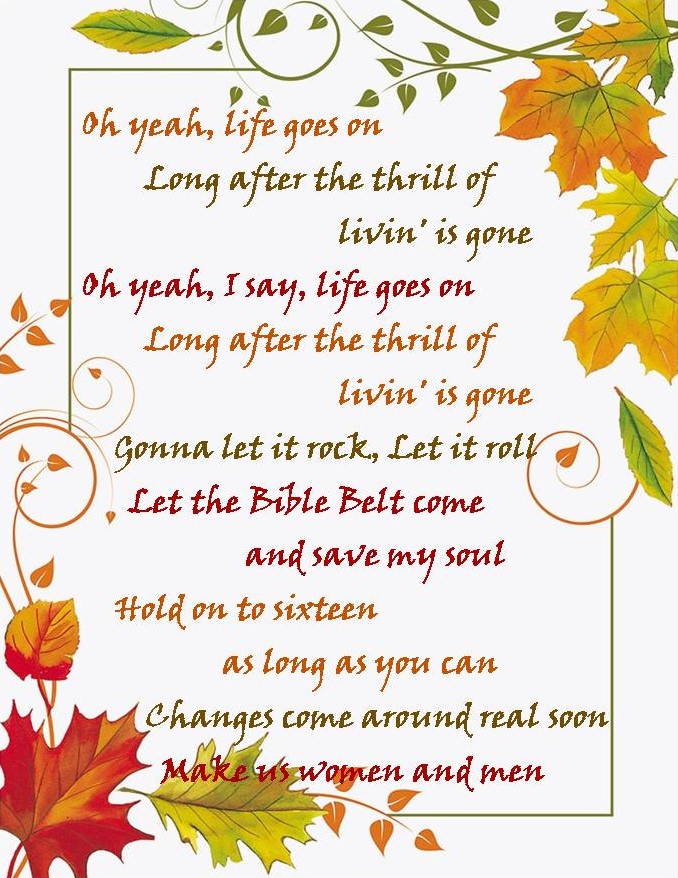
Jack and Diane – by John “Cougar” Mellencamp – effectively captures the ambivalence of first love. From the song:
The song was almost never recorded. According to Mellencamp, he struggled with how to perform the song to achieve the sound he desired. From the Infallible Wikipedia:

Jack & Diane was based on the 1962 Tennessee Williams film Sweet Bird of Youth. He said of recording the song: ‘Jack & Diane was a terrible record to make. When I play it on guitar by myself, it sounds great; but I could never get the band to play along with me. That’s why the arrangement’s so weird. Stopping and starting, it’s not very musical.’ Mellencamp has also stated that the clapping wasn’t supposed to be included in the finished song. It was recorded with the clapping in order to help keep tempo and then it was to be removed. However, he realized the song did not work without it.”

For me, the song does not inspire specific memories but, instead, evokes the emotion of the loss of one’s youth. At 16, 17, 18 years old, there’s nothing quite like that first more serious relationship. It’s a heady time in life when that connection takes control and you think it will always be like that. While there are those who spend their lives with their first love, for most the two individuals involved change and eventually grow apart.

Which is why the youthful memory of a warm summer’s night, a blustery fall day, a walk in the snow, or a soft spring evening, spent with that person evokes such an unexpected melancholy. “Jack and Diane” is like a snapshot into a moment in time which can never be regained. There are no ‘do over’s.’ Life’s experiences are transitory. It’s recognizing these truths which makes the song so enduring.

I know you would all be disappointed if there’s not a link to the Infallible Wikipedia, so here it is:

https://en.wikipedia.org/wiki/Jack_%26_Diane

Pac Man Fever

… and the Donkey Kong King of the Arcade

October 10, 2023

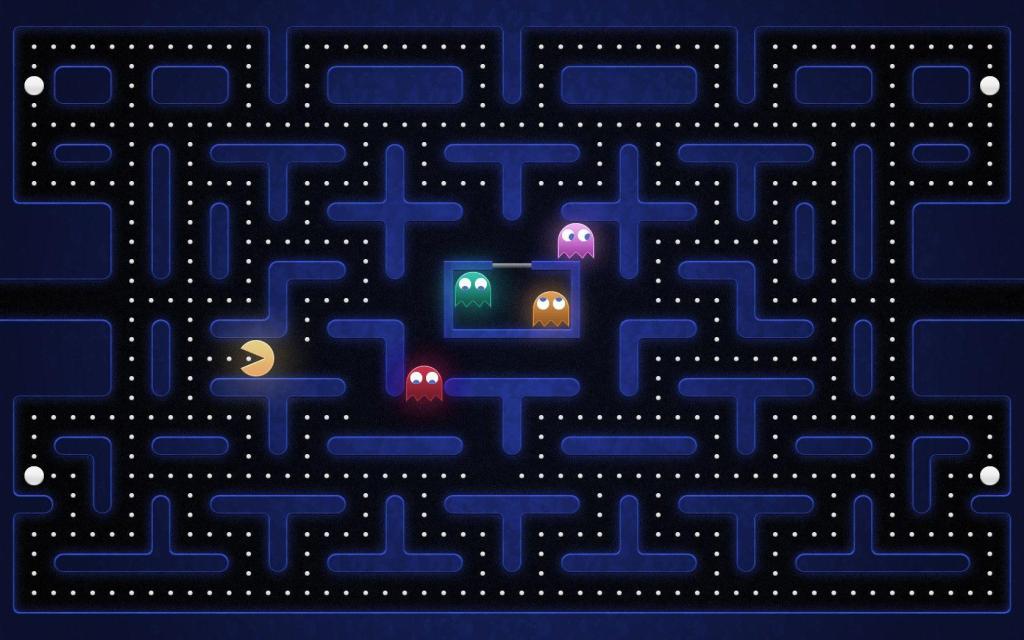
It was in October of 1980 when the United States was truly invaded by the Japanese. We are not talking about the military here. No, the first wave of this invasion featured four ghosts named Inky, Blinky, Pinky, and Clyde and a round yellow fellow with a huge pie shaped mouth dubbed Pac-Man. The game, which had been released in Japan a little over four months earlier, was an instant hit. Young people flocked to arcades and taverns where Pac-Man eagerly gobbled up their quarters.

Staples of the Video Arcade were Pac-Man and Donkey Kong. Ms. Pac-Man – a spin off of PacMan – and the perennial favorite Space Invaders rounded out this game room.

Soon, Pac-Man merchandise flooded America as did other Japanese companies looking to capitalize on Pac-Man fever.

From the Infallible Wikipedia:

 “When Pac-Man was released, the most popular arcade video games were space shooters—in particular, Space Invaders and Asteroids. The most visible minority were sports games that were mostly derivatives of PongPac-Man succeeded by creating a new genre. Pac-Man is often credited with being a landmark in video game history and is among the most famous arcade games of all time. It is also one of the highest-grossing video games of all time, having generated more than $2.5 billion in quarters by the 1990s.

The character has appeared in more than 30 officially licensed game spin-offs, as well as in numerous unauthorized clones and bootlegs.According to the Davie-Brown Index, Pac-Man has the highest brand awareness of any video game character among American consumers, recognized by 94 percent of them. Pac-Man is one of the longest running video game franchises from the golden age of video arcade games. It is part of the collection of the Smithsonian Institution in Washington, D.C. and New York’s Museum of Modern Art.”

There were a number of other Japanese companies which, seeing the success of Pac-Man released arcade games, but there were two companies which dominated the market in 1982: Sega (Pac Man) and Nintendo. While Sega established its US headquarters in Irvine, California, Nintendo first landed in Tukwila, Washington

And that’s where my hubby enters the scene. In 1981 he was hired by a CPA firm in Burien who had a client that needed an auditor. So he was sent out to do the job and thus began a seven year relationship with a different Japanese invader: Donkey Kong.

Iconic characters Donkey Kong and the damsel Pauline.

While many think of Nintendo as a behemoth company, when Donkey Kong was first sold into the US market they had a grand total of six employees: two Seattle based salesmen; the company president (Mr. A – the son in law of Nintendo’s Japanese founder); two Japanese developer/engineers; and one American to assemble and make the arcade games compatible for the US market.

It was in June 1982, as Donkey Kong’s popularity skyrocketed to the top of the arcade market (and made the two US salesmen millionaires), that the hubby was hired as the company’s US controller. Those were crazy days with incredible long hours but also a real sense of family within the fledgling company.

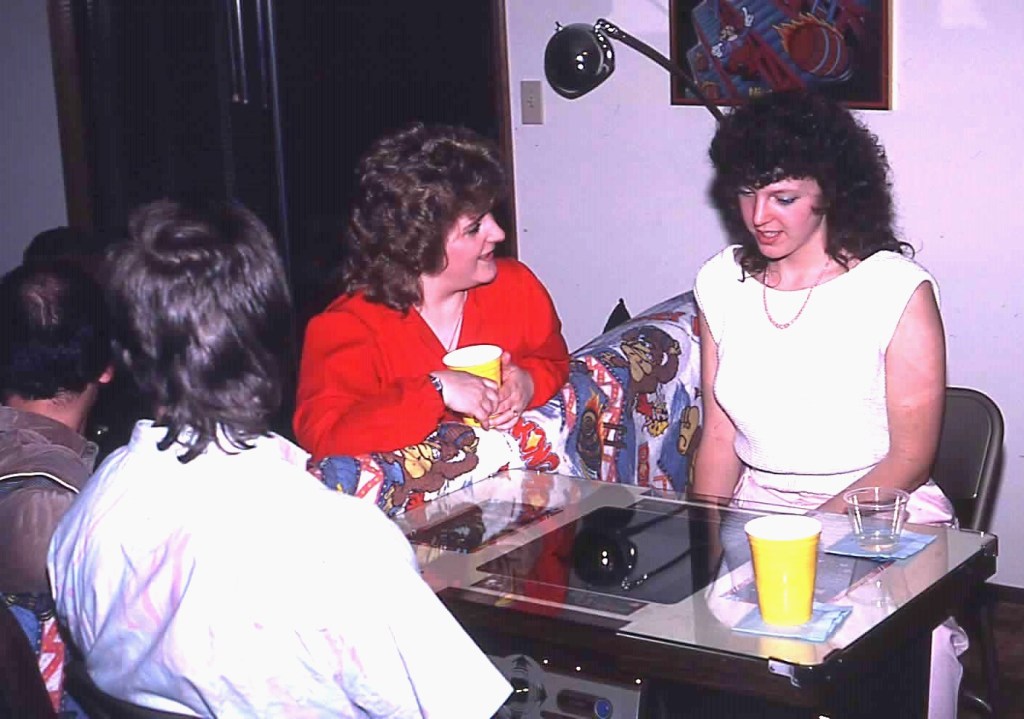
In 1982 we hosted an April Fool’s day party the theme of which was bad jokes and to play video games. The hubby was even able to have a couple of full size arcade games (borrowed from Nintendo) for the attendees to enjoy. We continued this tradition for several years.

Friends at the 1987 April Fools Day party enjoying a game of Donkey Kong on our Cocktail Table game console. Note the blanket on the back of the couch and the framed DK poster.

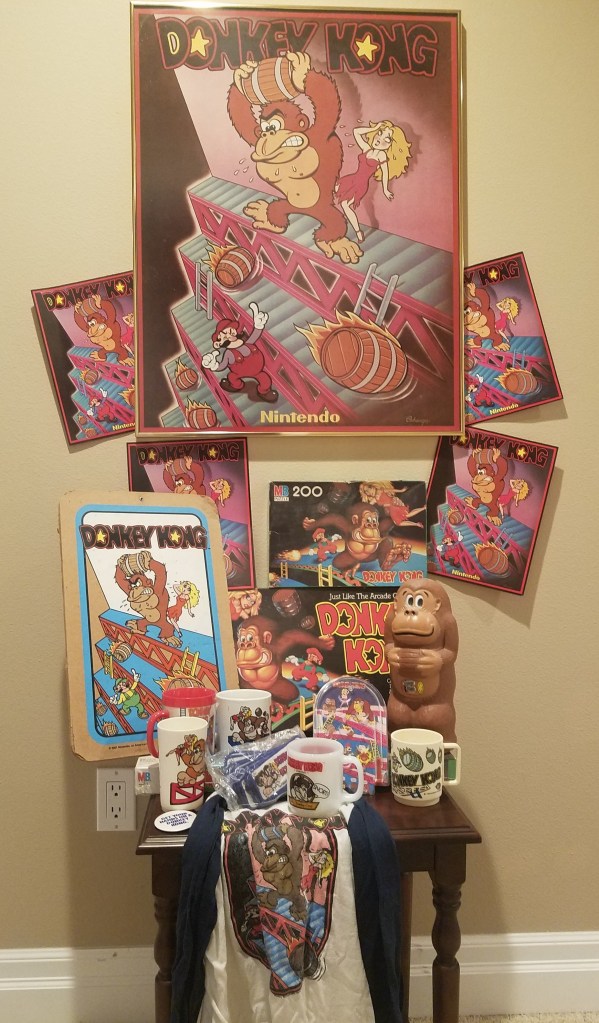
By the time he left the company in the late 1980’s we had acquired a variety of Donkey Kong themed items: mugs, cups, socks, both electronic and board games, shirts, a bulletin board, an aped shaped ‘bank’ and, the most prized possession of all: an electronic cocktail tabletop Donkey Kong game.

Over the years all of the Donkey Kong stuff has moved with us several times. Perhaps the items are worth some money. But that was never the point. More that these things are reminders of that crazy chapter in our lives, some good, some not so good. So I keep them in a cupboard because… well, just because it’s part of our history.

Our Donkey Kong merchandise collection (minus the blanket)

When the daughter and her (then boyfriend) hubby moved back to the PNW in 2020, we gifted them the cocktail table Donkey Kong Game. Of course it came with the stipulation that we could visit it if we were so inclined. But that rarely happens. Our son-in-law does sometimes fire the game up when they have friends over. Unlike the days of Pac-Man and Donkey Kong fever, however, quarters are no longer needed. All you have to do is plug the thing in, press a button, and soon Donkey Kong has abducted the maiden with Mario chasing them up the steel girder, jumping over the never ending barrels.

When the machine comes to life, one is struck by the simplicity of the 40 year old computer graphics, long ago eclipsed by more sophisticated games and machines. Even so, every once in a while it’s fun to escape back to the 1980’s when arcade games were king and the Japanese took the country by storm.

To read more about these two arcade phenomenon’s click here:

https://en.wikipedia.org/wiki/Pac-Man

https://en.wikipedia.org/wiki/Donkey_Kong_(video_game) (there are errors in this not-so Infallible  Wikipedia article. Specifically, Nintendo’s first headquarters were in Tukwila, not Redmond, Washington)

Honda Civic

Popular for four decades

July 14, 2020

1972 civic ad 2July 14, 1972 marks the date the Honda Civic was introduced. The Civic was, arguably, the beneficiary of a number of factors which catapulted it to the top of the small car class.
It was, however, the energy crisis which gripped the United States in late 1973 and into 1974 that proved to be its best marketing.

Without going down into the weeds as to the political reasons why, in 1974 the world experienced a gas shortage. The typical American of the day drove heavy, gas-guzzling automobiles. With gas costing around 50 cents a gallon, the amount of money it took to fill a tank was very affordable and not something most people considered when purchasing a car. By 1974, however, the price of gas had skyrocketed to $3 and $4 a gallon.

Enter the introduction of the compact and sub-compact car. While the big American automakers quickly rolled out such contenders as the Ford Pinto and the Chevy Vega, it was Japan’s Honda who found the winning formula.  The Civic’s cost, size, and great gas mileage marked a change in thinking in regards to the type of car a large portion of the American public wanted.

In 1973 – its first year being sold in the United States – just under 33,000 Civic’s were purchased. The following year sales were 43,000. Then in 1975, there was a 137 percent increase in sales with over 102,000 of the cars hitting the road. Since its introduction to the U.S. in 1973 until 2015, over 7.3 million have been sold.

Honda Civic’s were everywhere. Their distinctive look – sort of a tiny, boxy car – made them hard to miss. At the time, however, it was other features which made them popular. From the Infallible Wikipedia:

“It was equipped with a 1,169 cc (71.3 cu in) four-cylinder water-cooled engine and featured front power disc brakes, reclining vinyl bucket seats, simulated wood trim on the dashboard, as well as optional air conditioning and an AM/FM radio. The Civic was available as a two- or four-door fastback sedan, three- and a five-door hatchback, as well as a five-door station wagon. Due to the 1973 oil crisis, consumer demand for fuel efficient vehicles was high, and due to the engine being able to run on either leaded or unleaded fuel, it gave drivers fuel choice flexibility over other vehicles.”

EPSON MFP image

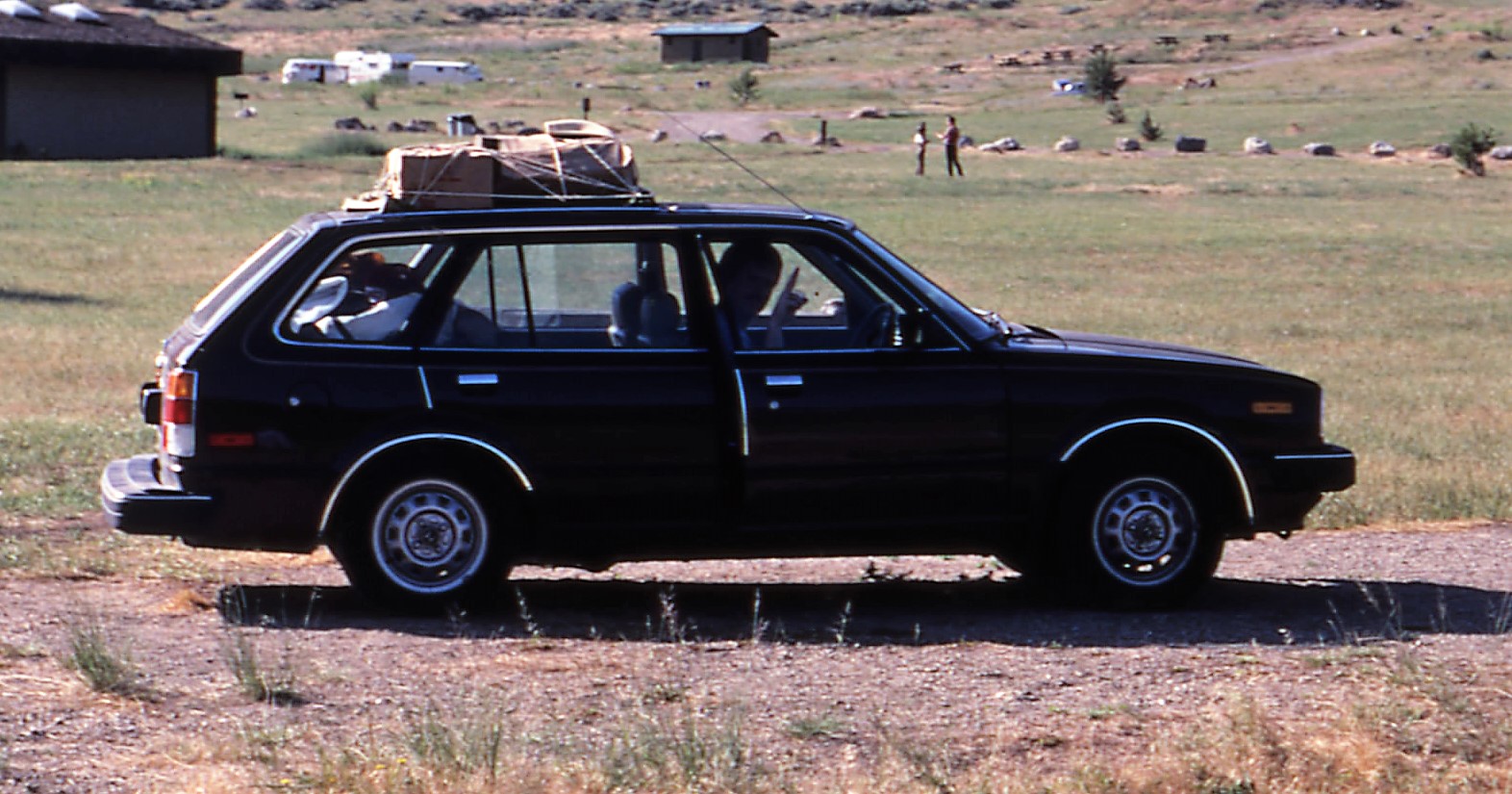
On the road in July 1982 at Lewis and Clark Caverns, Montana

In 1982, the hubby and I became a part of the Honda Civic family. The five-door station wagon seemed a great choice. During those years we often took off on weekends to go camping or for brief getaways. That summer, we embarked on a two week trip which took us to several National Parks, including Yellowstone, Grand Teton, and the Grand Canyon. Our little brown wagon served us well, conveying us over 3600 miles. The next year it took us to Vancouver Island and the year after that to Colorado and back.

EPSON MFP image

At Mesa Verde, Colorado, in 1984. The hubby is getting something from the car we need for dinner.

It was a great commuter car also: reliable, comfortable, and the always good gas mileage. When we retired the car in 1986 it was not because the car was no longer working but because we had purchased a boat and needed a vehicle capable of towing.

I do wonder if trading in the Honda so we could buy a boat was the right decision, however. There’s a saying that the two happiest days in a boat owner’s life are the day they buy it… and the day they sell it. Our first boat quickly earned its nickname – the Boat From Hell – or BFH as it was abbreviated. But that’s a totally different story.

Our Honda was never the car from hell, but a reliable friend, always ready to travel on a new adventure, never once letting us down. No wonder there were millions of them out on the road.

https://en.wikipedia.org/wiki/Honda_Civic

https://en.wikipedia.org/wiki/1973_oil_crisis

EPSON MFP image

July 31, 1982 at the Gardiner, Montana, entrance to Yellowstone.