Gordon Lightfoot: A music legend

Carefree Highway

November 17, 2020

This Canadian born singer-songwriter wrote more than 200 published songs in the folk-rock/country genre and was one of several who pioneered what became known as soft rock in the 1970’s.

Gordon Lightfoot’s distinctive voice and style – with a penchant for melancholy – made him a favorite for angsty teenage girls of the era. If You Could Read My Mind – his first US hit – was released in December 1970, rising to number five on the Top 40 and number one on the US Easy Listening charts in February 1971. Other hits followed including Sundown – his only number one Top 40 hit – was immediately followed up by Carefree Highway (#10 on the Top 40 and #1 on the Easy Listening Charts). The hits continued for several years and the classic Wreck of the Edmund Fitzgerald reached the Top 40 number two spot the week of November 20, 1976.

Gordon Lightfoot was born on November 17, 1938.

Lightfoot is considered by many Canadians to be their greatest songwriter. From the Infallible Wikipedia:

“Gordon Lightfoot’s music career has spanned more than six decades, producing more than 200 recordings. He helped define the folk-pop sound of the 1960s and 1970s, with his songs recorded by artists such as Bob Dylan, Gene Clark, Dan Fogelberg, Jimmy Buffett, and Jim Croce. The Canadian band The Guess Who recorded a song called ‘Lightfoot’ on their 1968 album Wheatfield Soul; the lyrics contain many Lightfoot song titles.

Bob Dylan made this comment about the artist: ‘I can’t think of any Gordon Lightfoot song I don’t like. Every time I hear a song of his, it’s like I wish it would last forever…. Lightfoot became a mentor for a long time. I think he probably still is to this day.’

In June 2017, Lightfoot rated fifth in the CBC’s list of the 25 best Canadian songwriters ever.

Lightfoot’s biographer, Nicholas Jennings, sums up his legacy this way: ‘His name is synonymous with timeless songs about trains and shipwrecks, rivers and highways, lovers and loneliness. His music defined the folk-pop sound of the 1960s and 1970s. He is unquestionably Canada’s greatest songwriter.’”

Perhaps the thing one most admires about Lightfoot is that it has, apparently, always been about the music and the songs. Even when the folk rock sound lost popularity, he stayed true to his roots and his passion, keeping his base of loyal fans who have continued to attend his performances. Sadly, some health issues in the past few years have impacted his ability to perform but one suspects that as long as he walks this earth he will continue to sing, write music, and share that music. (See notes at bottom)

It was the song If You Could Read My Mind which first brought Lightfoot to my attention. As a young teenager, it was the folk rock/soft rock songs which I preferred. I recall going to Valu-Mart in Yakima where I bought my first 45 records. Three were purchased that day, one of those the aforementioned If You Could Read My Mind.
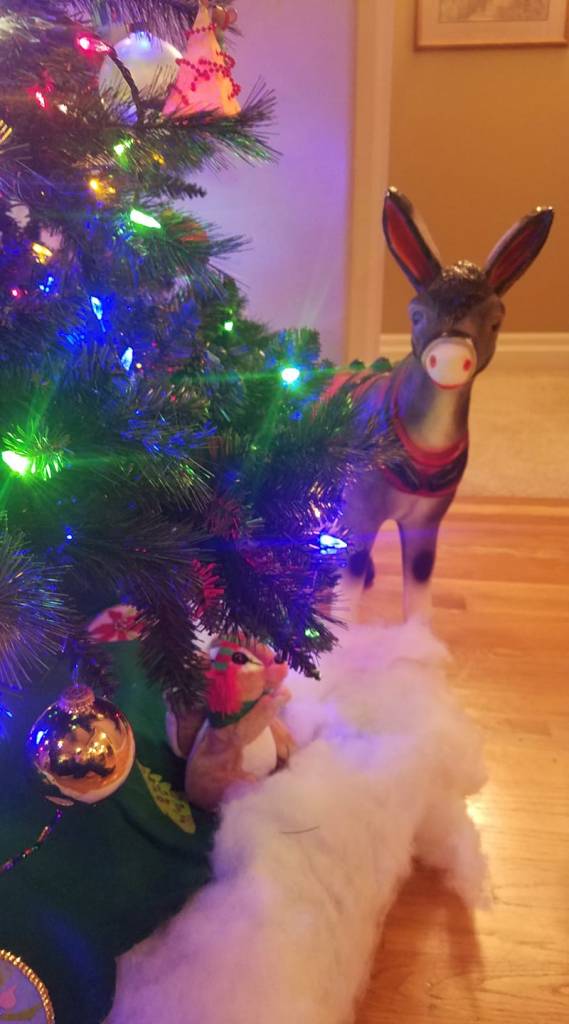
The wonky donkey spent several weeks at our house before being returned to my mother-in-law.

For my regular readers, you know that I like to weave a story which ties in to the person or theme of each week’s blog. I’ve had this topic set for November 17th for some time now and even when I began writing it I wasn’t sure where it would take me.

As the hubby said this evening, serendipity was at work this week. For the past 11 days, he and I have been on a mission which brought us to Arizona. We’d been tasked with the job of packing up and sending back to his parents all their personal belongings from a trailer home they’ve owned in Apache Junction for the past 16 years. Due to some health concerns the decision was made to sell the place. But someone had to go in person to do it.

On November 5th, The hubby and me left Washington State headed south. We traveled 500 miles a day, and navigated the Covid world with as few personal interactions as possible. The job was huge: make sure that we get everything back to his parents that they wanted, clean it up, sell a car and sell the trailer. All in just over 6 days if possible.

On Saturday, November 14th, we crammed the car with things that simply were not shippable (we packed and sent 21 shipping boxes!) including an outdoor metal floral piece and a roughly 2 ½ foot long by 1 ½ foot tall ceramic donkey which I dubbed the wonky donkey.

We headed north on Highway 17, headed for a detour to see Sedona (worth it!) and then to spend the first night of the return trip in Flagstaff. After getting gas at the last Costco in north Phoenix, we continued up the free way for about 17 miles and ended up on highway 76… also known as The Carefree Highway.
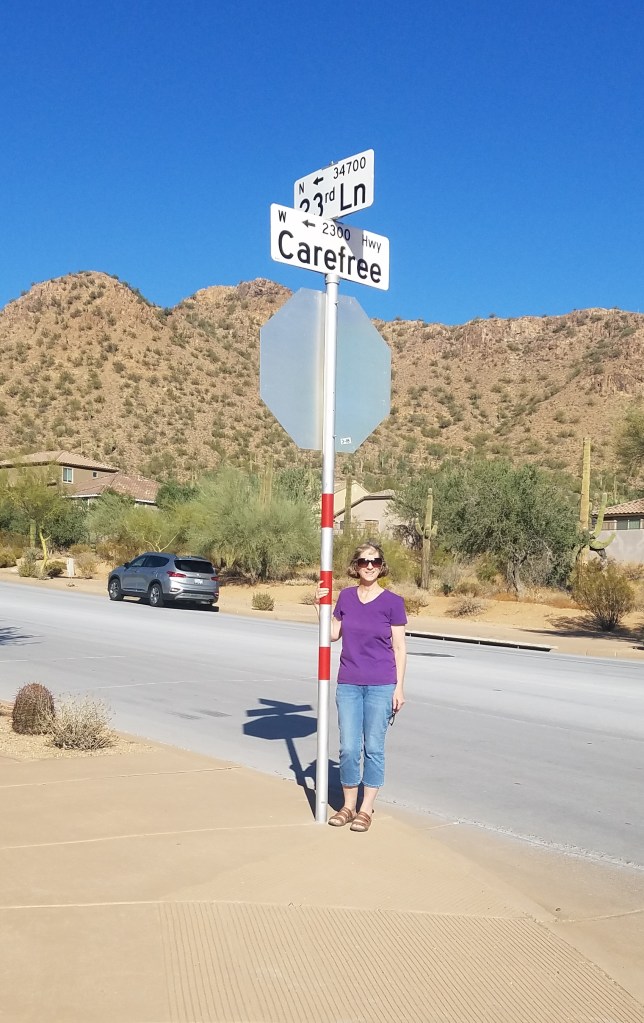
This author on the Carefree highway in Arizona

Sure enough, we had found the place which inspired one of Gordon Lightfoot’s most popular songs. The hubby obliged when I asked him to take a photo of me at one of the intersections. Of course I then had to look up the lyrics. As is typical of many of Lightfoot’s songs, the lyrics are a bit of conundrum. But this section seemed somewhat appropriate to the task at hand:

Turnin’ back the pages to the times I love best
I wonder if she’ll ever do the same
Now the thing that I call livin’ is just bein’ satisfied
With knowin’ I got no one left to blame
Carefree highway, got ta see you my old flame
Carefree highway, you seen better days
The mornin’ after blues from my head down to my shoes
Carefree highway, let me slip away
Slip away on you.

There was sadness for the hubby and me as we drove away from his parents’ place, knowing that everyone would have preferred that they could spend another winter there. As I packed up every single personal item, I came to understand this place was so much more than just a winter getaway, for them is was their Carefree Highway and a special place they truly called home.

November 17, 2025 – Gordon Lightfoot passed away in 2023. Thanks to Pandora his music lives on for me as I am able to sing along with my favorites whenever they turn up in the rotation.

https://en.wikipedia.org/wiki/Gordon_Lightfoot

Anything Goes

Take A Bow

November 10, 2020

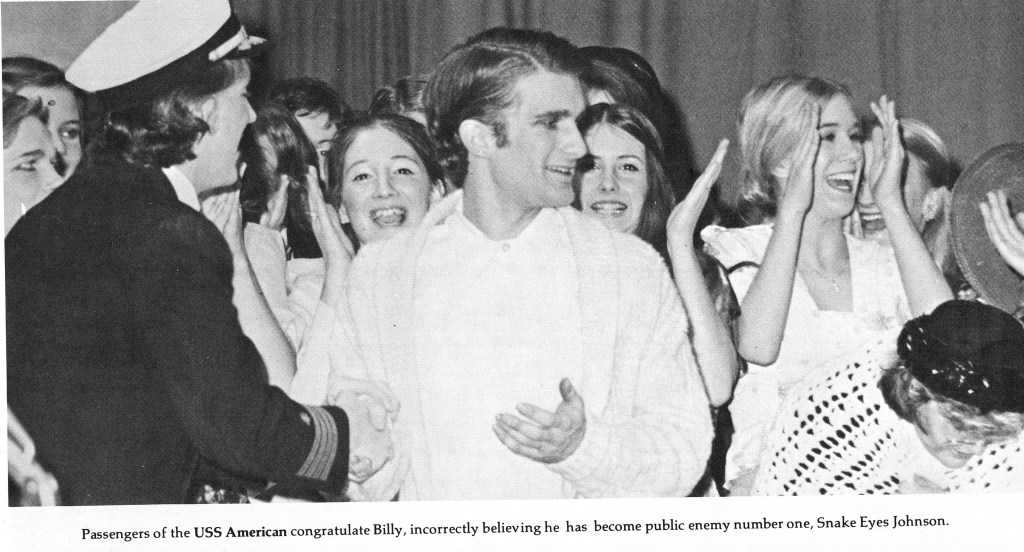
The cover from Eisenhower’s production of Anything Goes in 1975

Now, 86 years after the fact, the musical Anything Goes is showing its age. One thing about it has aged well, however, and that would be the music of Cole Porter. For those unfamiliar with the musical, here’s some background from the Infallible Wikipedia:

“Anything Goes is a musical with music and lyrics by Cole Porter. The original book was a collaborative effort by Guy Bolton and P. G. Wodehouse, heavily revised by the team of Howard Lindsay and Russel Crouse.The story concerns madcap antics aboard an ocean liner bound from New York to London. Billy Crocker is a stowaway in love with heiress Hope Harcourt, who is engaged to Lord Evelyn Oakleigh. Nightclub singer Reno Sweeney and Public Enemy Number 13, ‘Moonface’ Martin, aid Billy in his quest to win Hope. The musical introduced such songs as ‘Anything Goes,’ ‘You’re the Top,’ and ‘I Get a Kick Out of You.’

Since its 1934 debut at the Alvin Theatre (now known as the Neil Simon Theatre) on Broadway, the musical has been revived several times in the United States and Britain and has been filmed twice. The musical has long been a popular choice for school and community productions.”

The best way to describe Anything Goes is as a wild adventure with hidden identities, love triangles, and a whole lot of sexual innuendo. It was, in its day, considered inappropriate. Hence the title.

Despite its racy themes, Porter’s lyrics are masterfully written and crisp and so very sing able.

My readers will be forgiven if they’ve never heard of the show.

I had never heard of it either until December of 1974 when my high school choir director, Mr. Jim Durado, announced that our spring musical would be Anything Goes.

To be clear, I never had a shot for any sort of solo singing role in the production. In fact, Mr. Durado was legendary at our high school for somehow selecting musicals which seemed to ‘fit’ the students who filled the leads. That was, I’m certain, by design.

And so it was for Anything Goes. The lead role was for a female and he had a very talented vocalist who he cast as Reno Sweeney. More about that a bit later.

My role, however, was also a rather important one and I was selected by Mr. Durado specifically for it as surely as he picked any particular cast member.

It all began the previous spring when he asked me if I would be his Teacher’s Assistant (TA) for the following year. It required me to have TA as one of my classes. I said yes.

During the course of that year, I ran every errand, copied copious amounts of sheet music, tracked down students, kept attendance records, and made sure things happened on time. If there was a job to do, he gave it to me to get it done. When it came time to start rehearsals, my post was to sit at the mid-point of the theatre, three rows back from the stage, and follow along in the script. If someone needed prompting, I was the one to do it.

My photo was in the program along side all the lead actors

Every day after school – for three months – we rehearsed. I swear it became a muscle memory thing because to this day I can sing most of the songs without missing a word. For a number of years I could even say all the lines of every character.

It was a great experience and I am forever indebted to Mr. Durado for trusting me to do the job.

For Mr. Durado, however, 1975 turned out to be a time fraught with conflict. As a student, I was not privy as to what was going on his life. All I know is that there were moments when I would wonder what I had done to make him so sullen and incommunicative. It took months to learn the truth.

We were only a couple weeks in to rehearsals when the lead he’d chosen to portray Reno Sweeney told him she couldn’t take the role as she was very uncomfortable with the innuendo and believed it violated her faith. Thus the scrambling began to find a replacement. Another senior, Jennifer, was quickly selected and her part was then given to Mr. Durado’s own daughter. There was some amount of complaint from the cast who felt that a different girl deserved the role.

Reno and Sir Evelyn – aka Jennifer and Doug – during a performance

But the show, as they say, must go on. The next couple of months saw the production come together and, on March 19, 1975, Anything Goes opened. The page in my yearbook states:

“The eighty member cast worked three months in preparation for the standing ovations they justly received. Mr. Jim Durado proudly produced and directed his tenth musical production, one which originally opened on Broadway in 1934.”

By April, the intense schedule of rehearsals and a successful musical behind us, it was time to focus on recruitment for the next year. In addition to the main choir, there was a 16 person four part harmony swing choir, called Lancers. It was THE premiere vocal group at the school and dozens would vie for a coveted spot. Tryouts were looming for that and several performances by both groups were on the schedule.

One morning in mid-May, however, Mr. Durado was not at school. I cannot to this day recall exactly how I heard the news. It was probably announced to the whole choir when we arrived for class. But Mr. Durado had been shot by his wife. The bullet hit near his shoulder. He was alive and was in the hospital and that was all we were told.

That afternoon – in spite of the shock – the entire choir went to Franklin Junior High to perform a scheduled show. Somehow we got through it with a substitute teacher. The memory which sticks in my head from that day is that a group of a half dozen girls were walking out of the Junior High after the performance and everyone was talking about it; some of the girls were crying. All of us were upset.

I did go see Mr. Durado in the hospital a day or two later. He was making jokes about how bad a shot his wife was. It was surreal.

Less than a month after I graduated and heard little more about my teacher. The next year there was a new choir director who had huge shoes to fill. From Mr. Durado’s first musical production in 1966 until his last in 1975, he had built a dynasty.

Being in choir was cool. Those who were selected for Lancers were the coolest (I was not in that group!) It was getting to participate in the musical, however, that was everything. My oldest brother was in Funny Girl – which was Mr. Durado’s second production – in 1967. My cousin Susan was selected for the role of Mrs. Paroo in 1973’s The Music Man. That was also my sister’s first of two years in the cast; in 1974 both my sister and I were in The Most Happy Fella. I closed out our family participation with Anything Goes.

Mr. Durado moved back to his home state of Montana after he recovered from his wounds. From an adult perspective I cannot even begin to imagine how difficult the whole situation must have been for the family, especially for his daughters. No shortage of victims in this story but it seems as if it’s often the kids who are most hurt.

Mr. Durado lived out his days in Montana, taking his final bow on March 19, 2013…38 years to the day from the opening night of the last musical he produced and directed, Anything Goes.

A couple of links:

https://www.findagrave.com/memorial/195146855/james-rocco-durado

https://en.wikipedia.org/wiki/Anything_Goes

Fiddler On The Roof

Tradition!

November 3, 2020

Until November 3, 1971, this musical play could only be viewed on Broadway or in a community or school production. With the release of the movie, however, Fiddler On The Roof, cemented its place as one of the best musicals ever.

The 1971 Movie Poster

Prior to being made into a film Fiddler was a Broadway staple. The Infallible Wikipedia sheds a bright spotlight on its history:

“The original Broadway production of the show, which opened in 1964, had the first musical theatre run in history to surpass 3,000 performances. Fiddler held the record for the longest-running Broadway musical for almost 10 years until Grease surpassed its run. The production was extraordinarily profitable and highly acclaimed. It won nine Tony Awards, including best musical, score, book, direction and choreography. It spawned five Broadway revivals and a highly successful 1971 film adaptation and has enjoyed enduring international popularity.”

What’s so captivating about Fiddler is its unique story. The audience – from the first notes of the fiddle’s haunting tunes – is immersed in the pre-Russian revolution community of Anatevka.

Soon the viewer sees the world through the eyes of Tevye, a Jewish peasant ‘blessed’ with five daughters and no sons. Tevye narrates the entire play through words and song in an often humorous yet bittersweet evaluation of his – and his fellow villager’s – life.

What ties it all together, however, is the incredible music. From the foot tapping lament of If I were A Rich Man, to the witty Matchmaker, and the wistful Sunrise, Sunset, each song expertly captures the feeling of a unique time and place in history.

Fiddler – perhaps more than any other musical to grace the silver screen – is a serious film which explores the foibles of human nature and one’s ability to adapt to change.

I know I saw the film in the theater as a teenager and also a production of it at Eisenhower Sr. High (IKE) in Yakima in the spring of 1972. The IKE production, in fact, was the event which inspired my resolve to be in the choir since you had to be in that group if you wanted to perform in the musical.

I was in my ninth grade year – in junior high – when I wrote this diary entry on March 24, 1972:

“I went to ‘Fiddler on the Roof.’ It was very good, we had front row seats and I felt like the lead was singing to us in some parts. It was really neat.”

First of all, a big thank you to my parents for being first in line and purchasing the front row seats. Second, that is not the most eloquent bit of writing, but I’ll forgive my 14 year old self…at least she captured the moments. I bought a book of Fiddler songs on sheet music and learned to play many of them on the piano. I even sang Matchmaker for a talent competition… I no longer recall WHY I thought this was a good idea (it wasn’t) or the specific event… but I was much more fearless then.

A page from the 1972 IKE yearbook, Reveille, of the Fiddler on The Roof production. I wanted to be just like this group, on stage singing in a musical.

Years later, when my kids got to about ages 8 and 11, I hatched an idea. The hubby and I ordered and installed an 8 foot by 8 foot movie screen. A speaker system was set up to create surround sound and thus we created a part time media center in our living room.

This all coincided with my discovery that the King County Library ‘rented’ to anyone who held a library card films on DVD and VHS. And when I say rent, I mean for free. The catch was that you had to put a hold on the movies you wanted and then wait until the email notice arrived advising that a particular one was ready to be picked up. Much less expensive than Blockbuster and with an element of surprise; we never knew which movie would be the one for any particular Saturday night.

And thus began my mission to introduce my kids to every musical ever produced. My budding film critics soon developed opinions about every selection I brought home. My daughter, for example, declared the musical Carousel as The Worst. Musical. Ever. Personally, I would put it up against The Fantasticks for that title.

The Worst. Musical. Ever.

On the night of Fiddler, the sights and sounds of 1905 Russia filled the room and the whole family was enthralled. For me it was as if visiting with an old friend for a couple of hours. I tamped down my temptation to sing along and once again enjoyed the wonderful story and characters.

Finally, when I had exhausted all the musicals available through the library, I asked my children one day of all those we had watched, which was their favorite? While I don’t recall what my daughter said, my son did not hesitate: Fiddler On The Roof. An opinion he confirmed recently.

As for me and my dream of being in the cast of my high school’s musical… well, that’s a story for next week.

To learn more about the incomparable Fiddler, one needs only to access The Infallible Wikipedia:

https://en.wikipedia.org/wiki/Fiddler_on_the_Roof

https://en.wikipedia.org/wiki/Fiddler_on_the_Roof_(film)

L’Chaim!

Akwa-Skees

Teenage rite of passage

October 27, 2020

As any native Pacific Northwestener knows, boating is a top activity in this region. You can be forgiven if you think that the rainy, gray skies so common here might preclude water activities. But you would be wrong. Westsiders, particularly, are a hardy lot when it comes to aquatic sports. And no sport better epitomizes this than water skiing. It was on October 27, 1925 when the water ski was patented.

Ralph Samuelson, the inventor of water skis

The individual who first donned a pair of ‘skis’ and be pulled behind a boat on the water was one Ralph Samuelson who tried a variety of materials and designs for his devices. It was 1922 when the Minnesotan invented the sport. He spent the next 15 years performing and teaching people how to water ski. But he failed to patent his designs.

The Infallible Wikipedia, however, tells us:

“The first patent for water skis was issued to Fred Waller, of Huntington, NY, on 27 October 1925, for skis he developed independently and marketed as ‘Dolphin Akwa-Skees.’ Waller’s skis were constructed of kiln-dried mahogany, as were some boats at that time. Jack Andresen patented the first trick ski, a shorter, fin-less water ski, in 1940.”

The original Akwa-Skees

There must have been something in the water, so to speak, since on the opposite side of the United States, a Washingtonian had similar ideas. Also from the IW:

“In 1928, Don Ibsen developed his own water skis out in Bellevue, Washington, never having heard of Samuelson or Waller. In 1941, Ibsen founded The Olympic Water Ski Club in Seattle, Washington. It was the first such club in America. Ibsen, a showman and entrepreneur, was one of the earliest manufacturers of water skis and was a leading enthusiast and promoter of the sport. In 1983, he was inducted into the Water Ski Hall of Fame in Winter Haven, Florida.”

It wasn’t until the 1940’s and 50’s, however, before water skiing began to gain popularity with the average person, thanks to a Floridian who took advantage of his state’s abundance of sunshine and water:

“Water skiing gained international attention in the hands of famed promoter, Dick Pope, Sr., often referred to as the ‘Father of American Water Skiing’ and founder of Cypress Gardens in Winter Haven, Florida. Pope cultivated a distinct image for his theme-park, which included countless photographs of the water skiers featured at the park. These photographs began appearing in magazines worldwide in the 1940s and 1950s, helping to bring international attention to the sport for the first time. He was also the first person to complete a jump on water skis, jumping over a wooden ramp in 1928, for a distance of 25 feet. His son, Dick Pope, Jr., is the inventor of bare-foot skiing. Both men are in the Water Ski Hall of Fame. Today, Winter Haven, Florida, with its famous Chain of Lakes, remains an important city for water skiing, with several major ski schools operating there.”

As a teenager in the 1970’s it was likely one was friends with at least one other teenager whose Dad owned a boat. And, with any luck, you got the opportunity to try water skiing. My opportunity arrived in August of 1972 when a large contingent of fellow participants in the Masonic youth groups, descended upon Hood Park at the Snake River near Pasco, Washington.

It was a hot day, perfect for water sports. I watched as kid after kid donned the water skis and, with seemingly little effort, popped up out of the water on the skis and cut and angled their way across the glassy water. Sometime in the early afternoon, my opportunity arrived and one of the dads, as helper for beginners, tossed out instruction after instruction: “Get your tips out of the water… no, no, not that far. Less. Okay, that’s good.” “Lean back and relax… no, no, not that far. A little further forward… oh, NO! Too far.”

My first time ever on water skis… August 12, 1972. Not sure who had my camera but they immortalized that day for me.

And so it went until that moment when he declared I was in the correct position and all I had to do was yell “hit it.”

Which I did. And promptly lurched forward, ending up face down in the Snake River. This went on for hours… okay, probably not hours. It only FELT like hours. I could hear the exasperation in the spotter’s voice. Could hear the frustration of the boat’s motor as it circled back to get into position once more. I just knew that they were thinking ‘how uncoordinated can one teenage girl be.”

About to faceplant in the Snake River. Back of the photo says “try, try, again.’

But I persisted and, finally, after about a half hour of trying the rope grew taut, the ski tips glided up onto the water’s surface and then, miraculously, so did I. I would have jumped for joy except to do so would have landed my sorry behind in the water once again. I would have given thumbs up except to do so would mean I’d lose my already shaky and precarious hold on the tow rope. Instead I hung on for dear life and attempted to enjoy the ride.

In the ensuing years I did have some opportunities to water ski. The year I turned 16 I skied Crescent Lake. Crescent Lake, for those who do not know, is one of the deepest, glacier carved lakes in the United States. At its deepest it is nearly 600 feet. To say the water is cold is like saying Minnesota gets a little snow each winter.

But the real waterskiing adventure was the first year I was dating the hubby. He and his brother had purchased a boat in the spring of 1979 which was named “Beat Boat.” It was purple and it was sleek and fast. Every weekend that summer it was off to water ski, mostly on Lake Washington and Lake Sammamish, or camping and skiing further north at Lake Goodwin.

Beat Boat on Lake Tapps August 1979

While I was never as good as either my hubby or brother-in-law, it was a lot of fun. Mostly I served as the spotter when it wasn’t my turn.

All that fun came to a crashing – literally – halt on Memorial Day 1981. We had been down at Lake Tapps but the weather turned rainy and cold. The decision was made to pack it up and head back to West Seattle where everyone lived. The boat never made it. On a slick corner along West Marginal way, the vehicle and boat carrying trailer behind it jackknifed, sending the beloved purple beat boat skidding across the road, irreparably damaged.

“Hit It!” – the hubby before he was the hubby at Lake Goodwin, 1979

The hubby and I, a few years later, bought a boat for fishing and waterskiing… but it was never quite the same as beat boat. My hubby’s Wiley slalom water-ski has been carted from house to house whenever we moved since, perhaps, it would be used once again. But, alas, it has not; instead it is relegated to a corner of the garage to pay homage to the great American pastime of waterskiing, a reminder that waterskiing is best done when one is young and foolish.

https://en.wikipedia.org/wiki/Water_skiing

Relegated to a corner of the garage

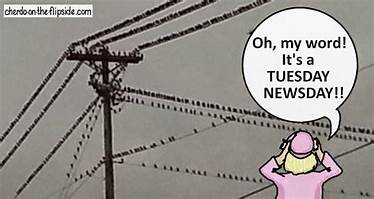
Tuesday Newsday

Do you enjoy these stories? As of June 8, 2022 there have been 269 posted here.

At times I look at this body of musings and marvel that I’ve been posting one a week for over five years now. As you might imagine, it does take some planning and contemplation to come up with a new and interesting (well, at least to me!) topic each week. Which is what I was researching this afternoon when I hit on a topic that strikes at a problem I will encounter in less than a year.

When I began I did not count on the issue of Leap Year… and the fact that there will be some dates which never fall on a Tuesday and others which will ‘duplicate’ dates for which I’ve already written something

What to do, what to do? I have some ideas but ultimately one of my goals is to have an article for every calendar day of the year. So only 94 more to achieve the goal.

tuesday newsday cartoon

Cartoon by Cherdo of the Flipside. http://www.cherdoontheflipside.com/

Bigfoot: Fact or Fiction?

60 Seconds of Film that went Viral

October 20, 2020

In the now 53 years since this film clip was released to the public, the debate rages:  is Bigfoot real or just a myth?

It was on October 20, 1967, when a grainy 16 mm film was recorded, elevating public consciousness of Bigfoot into the national consciousness. In subsequent days and years it made headlines as it purported to provide proof that Sasquatch did, indeed, exist.

The film was shot by Roger Patterson, along with Bob Gimlin, in the mountains near Bluff Creek in coastal Del Norte County California, about 40 miles south of the Oregon border. While most people likely believe that Patterson, and Gimlin who is shown riding a horse in the clip, were somehow randomly in this spot and happened to see Bigfoot, the real story pushes the bounds of believability.

We visit the Infallible Wikipedia and learn:

“Patterson said he became interested in Bigfoot after reading an article about the creature by Ivan T. Sanderson in True magazine in December 1959. In 1961 Sanderson published his encyclopedic Abominable Snowmen: Legend Come to Life, a worldwide survey of accounts of Bigfoot-type creatures, including recent track finds, etc. in the Bluff Creek area, which heightened his interest. Thereafter, Marian Place wrote:

‘In 1962 he visited Bluff Creek and talked with a whole host of Bigfoot-believers. In 1964 he returned and met a timber-cruiser named Pat Graves, who drove him to Laird Meadows. There Patterson saw fresh tracks—for him an almost unbearably exciting, spine-chilling experience. What a tremendous feat it would be—what a scientific breakthrough—if he could obtain unshakable evidence that these tracks were not the work of a prankster, but the actual mark of a hitherto unknown creature! If he succeeded, he would be famous! And rich! Alas, fame and fortune were not gained that year, nor the next, nor the next. Patterson invested thousands of hours and dollars combing Bigfoot and Sasquatch territory. He fought constant ridicule and a shortage of funds. … he founded … the Northwest Research Foundation. Through it he solicited funds . … The response was encouraging and enabled him to lead several expeditions. … In 1966 he published a paperback book at his own expense. … He added the income from its sales and his lectures to the search fund. As each wilderness jaunt failed to see or capture the monster, one by one the thrill-seekers dropped out. But Patterson never gave up.’
Patterson’s book, Do Abominable Snowmen of America Really Exist?, was self-published in 1966. The book has been characterized as ‘little more than a collection of newspaper clippings laced together with Patterson’s circus-poster style prose’. The book, however, contains 20 pages of previously unpublished interviews and letters, 17 drawings by Patterson of the encounters described in the text, 5 hand-drawn maps (rare in subsequent Bigfoot books), and almost 20 photos and illustrations from other sources. It was first reprinted in 1996 by Chris Murphy, and then again re-issued by Murphy in 2005 under the title The Bigfoot Film Controversy, with 81 pages of additional material by Murphy.”

Signs such as this one abound in the Pacific Northwest

What comes through is a man on a quest to prove Bigfoot existed and, perhaps, was willing to do anything in service of that ambition.

Over the years, researchers have studied Patterson’s film in an effort to prove or debunk its veracity.

At least one person, who knew Patterson, claimed he had rented a costume to use in the shooting of his film. Is it a huge creature or just a man in costume which is seen in the roughly minute long footage? No record of that costume rental exists and, like so many of the Bigfoot legends, is shrouded in mystery and a chain of unverifiable events.

Patterson’s footage seemed to ignite the public’s interest in Bigfoot and what has followed are a decades’ long series of individuals who claim to have seen Bigfoot. Added to the Patterson legacy are stories of Bigfoot captures, as well as recovery of a deceased Bigfoot. None have ever come to fruition. Hollywood got in on the action with the production of Harry and the Henderson’s, a fictional film which chronicled the story of a family who befriend one of the creatures and bridge the gap between humans and Bigfoot.
Wood carving of “Harry” from Harry and the Hendersons on Highway 2 in Washington State.

The debate rages to this day. A brief perusal of all the newspaper articles and citations in the Wikipedia article alone provides insight into the fact that one could spend their entire life just investigating this one topic, as was the case for Roger Patterson.

Patterson died in 1972 of cancer, just five years after the capture of the infamous footage.

Now, full disclosure: I thought it would be kind of fun to write an account of a possible Bigfoot encounter of my own and then say at the end ‘just kidding.’ I was prepared to do so but in the world of crazy connections I learned something about Roger Patterson which I had never known. He grew up, lived and died in my own hometown: Yakima, Washington.

Not only that, but getting the film footage out to the public was only possible due to Patterson’s brother in-law Albert DeAtley who provided the funding needed.

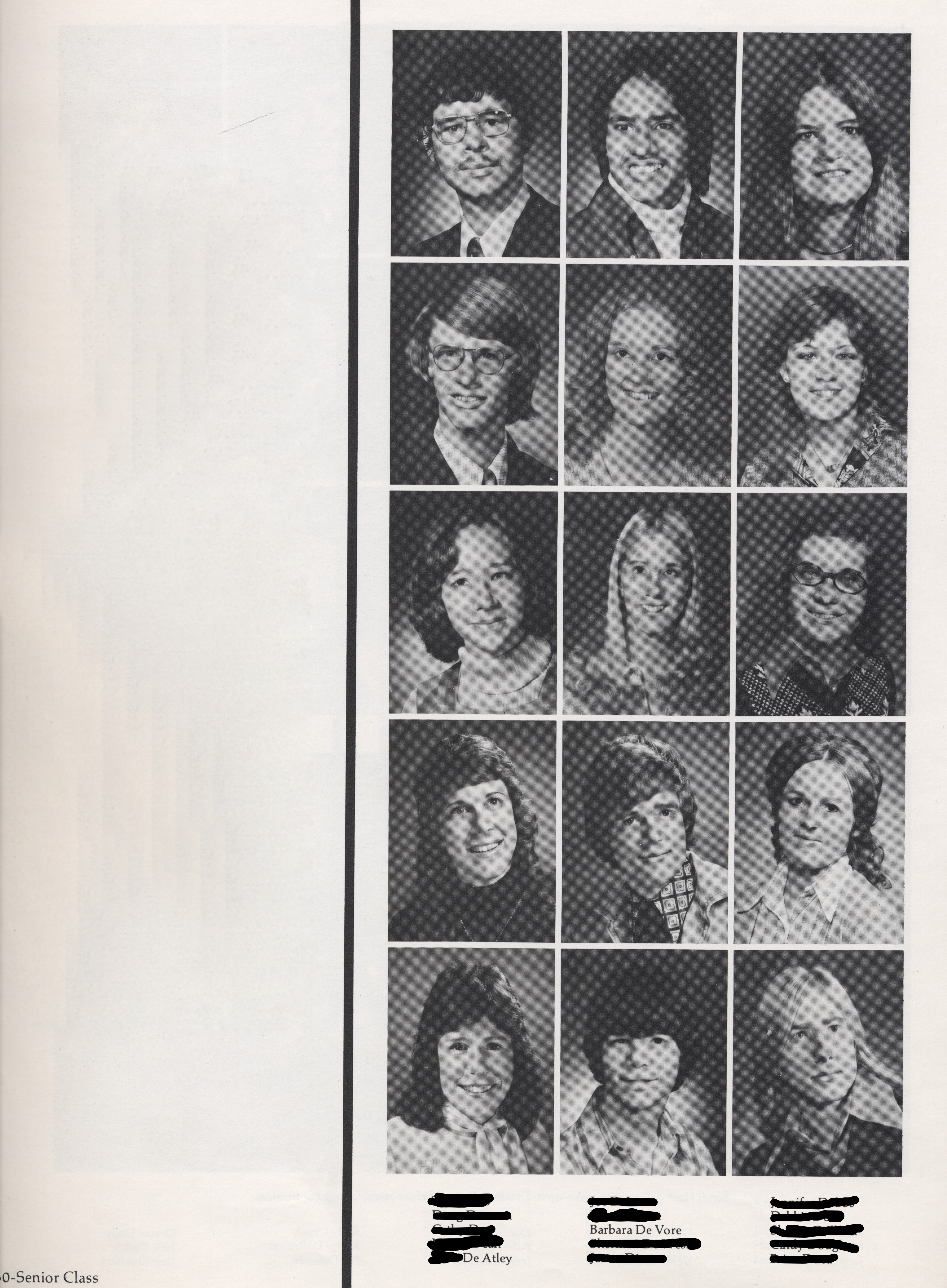
Page from my High School Yearbook. This author is middle photo, three up from bottom. Roger Patterson’s niece is bottom left.

Hmmm, I thought, I went to school with a DeAtley. Which sent me to my high school annual and, sure enough two spots down and one spot over from where my own Senior picture appears is a picture of Roger Patterson’s niece.

How is it possible that I was in classes with her, graduated the same year, and never knew of this connection?

I have, however, had a couple ‘real’ Bigfoot ‘encounters.’ The most memorable one occurred a few years ago during a visit to Long Beach, Washington. Little did I know that day when Bigfoot appeared before me that I would be able to chronicle my own experience with the creature… thankfully I got away despite Mr. Bigfoot’s attempts at capture as shown in this photo…

Bigfoot attempting to capture me… circa 2016

The one and only ‘Bigfoot’ link I’m sharing today is about the Patterson-Gimlin film (shown above). Thank you Wikipedia for the always exhaustive- and infallible – information on important subjects.

https://en.wikipedia.org/wiki/Patterson%E2%80%93Gimlin_film

Prime Meridian

Time Is a Construct

October 13, 2020

When one thinks of impressive British cities, London immediately comes to mind. It is, after all, steeped in rich tradition, full of historical buildings, awash in history.

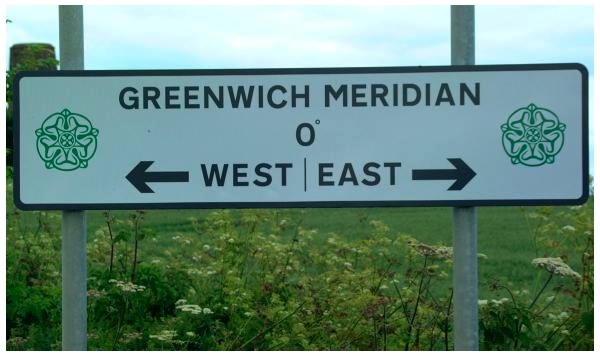
A few miles west of central London, however, is a place also with rich traditions, historical buildings, and brimming with history. It is a place whose name has become common due primarily to the decision by the International Meridian Conference on October 13, 1884.

It was on that date that Greenwich was declared as ground zero, so to speak, for determining – literally – the longitudinal address of every place on earth.

The story began hundreds of years earlier when Greenwich, located a little over 7 miles west of Parliament Square in London, developed into an important maritime port. At the time, it was a separate entity from the capital although it has long since been annexed into the city of London. Its location on a broad section of the Thames river, and proximity to the seat of power, made it a logical location as it is a short 50 miles to the North Sea. It was from this location the British Empire launched its navy and, arguably, several hundred years as the world’s greatest power.

One of the challenges that the seafarers encountered was to develop an accurate navigation system. Using the position of the sun during the day, and astronomical star charts at night, sailors were able to determine their location based on where they started or the “Prime Meridian.”

Of course, it was not only the British who needed this technology. Dozens of “Prime Meridians” were established throughout history. From the Infallible Wikipedia:

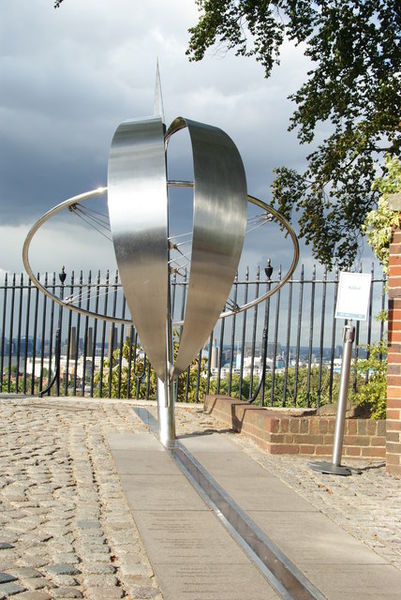
Sphere sculpture and ‘prime meridian’ line where you can locate 0 degrees longitude. Photo from Wikimedia

“The notion of longitude was developed by the Greek Eratosthenes (c. 276 BC – c. 195 BC) in Alexandria, and Hipparchus (c. 190 BC – c. 120 BC) in Rhodes, and applied to a large number of cities by the geographer Strabo (64/63 BC – c. 24 AD). But it was Ptolemy (c. AD 90 – c. AD 168) who first used a consistent meridian for a world map in his Geographia.

Ptolemy used as his basis the ‘Fortunate Isles’, a group of islands in the Atlantic, which are usually associated with the Canary Islands (13° to 18°W), although his maps correspond more closely to the Cape Verde islands (22° to 25° W). The main point is to be comfortably west of the western tip of Africa (17.5° W) as negative numbers were not yet in use. His prime meridian corresponds to 18° 40′ west of Winchester (about 20°W) today. At that time the chief method of determining longitude was by using the reported times of lunar eclipses in different countries.”

By the 1800’s, the whole Prime Meridian thing was a mess with dozens of civilized countries establishing their own locations. In Germany it was Berlin, France had Paris, Denmark had Copenhagen and, of course, Britain had Greenwich.

It was the British, however, who led the way. The Infallible Wikipedia continues:

“Between 1765 and 1811, Nevil Maskelyne published 49 issues of the Nautical Almanac based on the meridian of the Royal Observatory, Greenwich. ‘Maskelyne’s tables not only made the lunar method practicable, they also made the Greenwich meridian the universal reference point. Even the French translations of the Nautical Almanac retained Maskelyne’s calculations from Greenwich—in spite of the fact that every other table in the Connaissance des Temps considered the Paris meridian as the prime.’

In 1884, at the International Meridian Conference in Washington, D.C., 22 countries voted to adopt the Greenwich meridian as the prime meridian of the world. The French argued for a neutral line, mentioning the Azores and the Bering Strait, but eventually abstained and continued to use the Paris meridian until 1911.”

Once the French came around, so did the entire world with the term ‘prime meridian’ and Greenwich synonymous.

Personally, I have always found the concept of an arbitrary line stretching from top to bottom of earth kind of weird. And then there is the whole plus/minus hours to figure out how many hours ahead or behind one might be from Greenwich.

Here in Washington State we are eight hours behind until we are not. I find myself constantly having to count on my fingers whenever I read something that establishes a particular event happening at, for example, 11.45 UTC. Which stands for Coordinated Universal Time. Shouldn’t the acronym be CUT? But I digress.

In 2018, the autumnal equinox arrived at 1:54 a.m. on September 23rd in Greenwich. But it was still September 22nd here when it arrived at 6:54 p.m.

Although I’ve never crossed the International Date Line (located in the middle of the Pacific Ocean and drawn in such a way as to not cross any populated islands), my one trip to England involved getting on a plane in Seattle around 9 p.m. Pacific Daylight Time, flying up and over Canada and Greenland, then landing in London the next morning.

My parents’ – who had traveled to Europe before that trip – had a method worked out. They’d arranged for our hotel to be ready earlier in the day. When we arrived it was agreed that we’d all go to sleep for about 3 hours, then get up in the afternoon, and proceed with the local time.

That afternoon, we did a bit of walking about London, went to dinner, and then retired at the same time as most of England’s citizens would. The adjustment was easy.

Of course on the return trip we arrived back home earlier than we left. Talk about mind bending. It took me a solid three days to readjust.

Nowadays I try to avoid taking any flight which involves leaving at night and arriving at my destination the next morning. My theory is that we are only allotted so many ‘all-nighters’ in our lives and I’ve used most of mine. I pulled more than one all-nighter during college and too many to count from when my children were babies.

My children are both now grown so they are no longer inclined to keep me awake all night. It’s my oldest, however, who has coined the phrase “Time Is a Construct.” After all, in the grand scheme of life, does it really matter if it’s 1:53 p.m. or 12:53 p.m.? Perhaps we will find out in a few weeks when ‘time’ falls back.

The one thing I do think I will need to make an exception to are the overnight flight rules. I am sorry I missed visiting Greenwich when I was there before. I’ve decided that, for at least once in my life, I really want to be in the right time and place. Literally.

For those other geeky musers like the author, a couple links:

https://en.wikipedia.org/wiki/Prime_meridian_(Greenwich)

https://en.wikipedia.org/wiki/Greenwich_Mean_Time

The Quarantine Fifteen

One in Three are doing it

October 6, 2020

When the whole world went in to lockdown in March of this year due to Covid-19, I started to see posts on social media with people lamenting what they called the “Quarantine 15.” It was a reference to the phenomenon that folks, now sedentary and with little else to do, had started to eat more than usual and added 15 pounds to their weight.

This has led to even more people doing the one thing which it’s estimated one out of every three Americans are doing on any given day: Dieting.

Aunty Acid by Ged Backlund

No doubt for as long as people have dealt with excess weight, the enterprising individual has sought out solutions to deal with the issue. As of 2014, according to an article in Nutrition in Clinical Practice, there have been more than 1000 published diets.

The Infallible Wikipedia tells us this:

“…the word diet comes from the Greek diaita, which represents a notion of a whole way healthy lifestyle including both mental and physical health, rather than a narrow weight-loss regimen.

One of the first dietitians was the English doctor George Cheyne. He himself was tremendously overweight and would constantly eat large quantities of rich food and drink. He began a meatless diet, taking only milk and vegetables, and soon regained his health. He began publicly recommending his diet for everyone suffering from obesity. In 1724, he wrote An Essay of Health and Long Life, in which he advises exercise and fresh air and avoiding luxury foods.

The Scottish military surgeon, John Rollo, published Notes of a Diabetic Case in 1797. It described the benefits of a meat diet for those suffering from diabetes, basing this recommendation on Matthew Dobson’s discovery of glycosuria in diabetes mellitus. By means of Dobson’s testing procedure (for glucose in the urine) Rollo worked out a diet that had success for what is now called type 2 diabetes.

The first popular diet was ‘Banting’, named after the English undertaker William Banting. In 1863, he wrote a booklet called Letter on Corpulence, Addressed to the Public, which contained the particular plan for the diet he had successfully followed. His own diet was four meals per day, consisting of meat, greens, fruits, and dry wine. The emphasis was on avoiding sugar, sweet foods, starch, beer, milk and butter. Banting’s pamphlet was popular for years to come, and would be used as a model for modern diets. The pamphlet’s popularity was such that the question ‘Do you bant?’ referred to his method, and eventually to dieting in general. His booklet remains in print as of 2007.

The first weight-loss book to promote calorie counting, and the first weight-loss book to become a bestseller, was the 1918 Diet and Health: With Key to the Calories by American physician and columnist Lulu Hunt Peters.”

In today’s world, one cannot go on the internet or watch television without reading or hearing ads for whatever the latest trendy diet might be. When I typed “diet programs” into my search bar it came back with 172 MILLION results. That’s a lot of diet choices.

To cut down on calories in a home cooked egg and sausage muffin sandwich, cut a frozen sausage patty in half and break into chunks. You get the full flavor but fewer calories.

The two best known seem to be Weight Watchers and NutriSystems. Other diet programs tend to tout food intake based on a variety of factors including low carb, low fat, or high protein. There’s the Mediterranean Diet, the Keto Diet, and diet’s specific to those with Diabetes, thyroid problems, and heart disease. Truly, there’s a diet for every situation and person.

Of course, NO ONE should take the information shared here and make their health decisions based on my layman’s take or the Infallible Wikipedia. Those who are regular readers understand that the Infallible Wikipedia really is not.*

Okay, I’ve posted my consumer warning.

As pretty much the skinniest child ever, I never dreamed that at some point in my life I’d end up going on a diet.

Until I landed on a college campus and was exposed to the high carb foods endemic to such an environment, my problem was the exact opposite of most dieters. I could not gain weight. At five foot nine and only weighing 115 pounds, I struggled to maintain even that. I was not anorexic or bulimic, just genetically programmed to be skinny.

Or so I thought. While at the University of Puget Sound, I did add the ‘Freshman fifteen’ and my weight jumped up to 130 pounds. Which was, I thought, just about perfect for me.

I dropped down 10 pounds the year I got married as I had gone on the ‘strep throat’ diet. I don’t recommend it.

But then I settled in to that 130 weight and remained there until pregnancy at age 32 impacted my body. I lost most of what I gained after baby number one and even after the second child.

I was doing okay in the weight department, but by the time I hit age 40 I weighed about 140 pounds.

Mostly I blame the weight gains on slowing metabolism and having teenagers.

A funny thing happens when you are cooking for a family, especially when there’s a teenage boy present. Those creatures eat a LOT of food, heaping their plates with goodies such as Macaroni and Cheese, Spaghetti, Lasagna, Pizza…

A typical diet dinner features between two and three ounces of noodles. Yes, I weigh everything.

It’s a bit mesmerizing, really, to sit down to dinner and somehow you end up matching them bite for bite.

And soon another 10 pounds were added; and then another 10 after that. I started joking that I’d gained 10 pounds for each additional decade since I’d turned 20. It had gotten to the point where I didn’t step on scales because I didn’t like the number I saw. I convinced myself that I wasn’t eating excessively and no matter what I did I just couldn’t lose the weight.

Then the quarantine arrived. Where once I was out and about attending events on weekends and various meetings during the week, there was nothing going on. No potluck dinners or buffet lines. Restaurants were, for a time, shut down. There literally was no place to go except the grocery store and those shelves – in the first month – had large empty spaces in lieu of products.

On April 10, I decided that perhaps I might use the shutdown as an opportunity to drop a few pounds. But how did one go about it? I had zero experience with dieting. Of course I went to the one place where expert advice was to be found: the internet. It was enough to make one’s head swim. And then I remembered my Android phone and thought, perhaps, there might be a weight loss application. Bingo.

Of the several dozen available, I ended up picking the highest rated one I found which happened to be MyNetDiary.

Actual screenshot of the MyNetDiary program tracking my food on October 4

It allowed me to set a weight loss goal of up to 15 pounds (no more – I tried!) and then gave me a date, three months in the future, July 7 to lose the weight.

I became, one might say, singularly focused, and followed the program to the letter, careful to never go over the daily calorie count. I learned some interesting things about how much particular foods ‘cost’ in calories. I weighed everything. And with only a certain number of calories allowed each day I started to think about what foods I valued and wanted in my life.

Gone was my beloved Dr. Pepper (240 calories for a 16 oz can! Or 17 percent of the daily calorie allowance). Pasta, Rice, and starchy foods were seriously reduced. Instead of two pieces of toast, slathered with butter, and an egg for breakfast, I had one slice of toast (the one slice about 120 and the egg 90 calories) and I measured out a reasonable quantity of butter (.18 oz which is 37 calories).

I learned that my most favorite food is… drum roll please… white cheddar cheese Cheez-its. But just 20 of those delicious little crackers cost me 120 calories. So now, instead of eating however many I wanted, I counted out each and every one, making the conscious choice to consume them as one of my daily ‘treats’ or as part of my lunch.

My favorite food… white cheddar cheezits

By the end of April I’d lost my first five pounds and I was motivated. A month later, I was down ten pounds overall. My version of the Quarantine 15 – that is losing rather than gaining that amount – arrived a few days ahead of schedule on July 1st.

But I wasn’t done. I reset the program to lose another 15… my new date to achieve that: November 7. I expect I will have lost 30 pounds overall sometime this week… the scale tells me that I’m really, really close.

I guess it gets back to finding the good in a not great situation. Had we never ended up in ‘quarantine’ I doubt I would have taken the action I did.

Oh! Did you see the time? Only a half hour to lunch… I’m really looking forward to those 20 Cheez-its!

A couple of links:

https://en.wikipedia.org/wiki/Dieting

https://onlinelibrary.wiley.com/doi/abs/10.1177/0884533614550251

https://www.mynetdiary.com/

*Before taking on any weight loss program, be sure to check with your doctor!

Pigmania!

Pass The Pigs

September 29, 2020

This ancient game was first played some 3000 years ago and, according to the official rules, in the ‘renowned land of Pigalonia.’

I suppose all my readers can be forgiven their ignorance of pig tossing as an enjoyable pastime as we now live in an era when doing so would immediately draw the scrutiny of the PETA police directly to your abode.

Since most civilized people in the United States no longer have a pig or two residing in a sty or a corner of their cabin, we can assume that had it not been for Dr. Cyrus Whopper, who discovered the game while traveling in Germany, it would have been lost in the mists of time.

How the game looked in 1977.

A debt of gratitude is owed to said doctor who introduced a more mundane version of pig tossing in a game he named ‘Pigmania!’. According to the literature included with the game:

“In 1977, Cy Whopper, a lover of kosher bacon since boyhood, decided to enhance the rather tarnished image of pigs by introducing Pigmania to the modern world. ‘After all,’ snorted Whopper, ‘pigs have been pushed around long enough. Every day you hear people saying ‘you look like a pig,’ ‘you eat like a pig,’ ‘you dress like a pig,’ ‘you smell like a pig,’ ‘you’re a male chauvinist pig,’ ‘you have swine flu.’

In truth pigs are the most intelligent creatures on earth, only exceeded by some human beings and all dolphins.

Pigs are lucky, pigs are useful, pigs have class.

It is time something is done on their behalf… thus Pigmania.”

To play the game, each player takes turns tossing a pair of tiny plastic pigs out of a cup labeled ‘pig sty.’ To earn points, the players are seeking to have their pigs land in any of the following ways:

A mixed combo…. hoofer and razorback.

Siders – two pigs laying on their sides, facing the same direction

Hoofer – a single pig standing on its feet.

Double Hoofer – yes, two pigs standing on their feet.

Snouter – a single pig leaning on it’s snout and two front feet.

Double Snouter – two pigs resting on their snouts..

Razorback – a single pig laying feet up.

Double Razorback – two pigs on their backs.

Leaning Jowler – a single pig, listing to the left, using it’s left ear and left leg for support.

The rare Double Leaning Jowler

Double Leaning Jowler – the rarest and most difficult to achieve toss.

Mixed Combo – Any combination of both pigs being in two different aforementioned positions.

If the pigs land on the table with their snouts facing opposite directions, then that’s called a ‘Pig Out’ and your turn is over. Same thing if you end up “Makin’ Bacon’ which is the pigs land touching one another!

Alas, the original Pigmania! was acquired – as is the way with pretty much any successful game idea – by a much bigger farmer.

Now, if you thought the Infallible Wikipedia might draw blanks on this topic, you would be wrong:

“Pass the Pigs is a commercial version of the dice game Pig, but using custom asymmetrical throwing dice, similar to shagai. It was created by David Moffatt and published by Recycled Paper Products as Pig Mania! in 1977. The publishing license was later sold to Milton Bradley and the game renamed Pass the Pigs. In 2001, publishing rights for North America were sold to Winning Moves, which acquired the game outright from David Moffat Enterprises in early 2017.”

Pass The Pigs is also available with more pigs, giant pigs, and in a handy travel game

It was sometime in the early 1980’s when the hubby and I were introduced to Pigmania! I can no longer recall who introduced us. Undoubtedly when that person reads this article they will take their rightful credit and shout ‘soo-eee!”

Simple in its concept and play, it provided some fun as an amusing parlor game. Over time, it was relegated to the game ‘cupboard’ which was actually a repurposed credenza from a business office. When our son was about 1 ½ , he discovered the wondrous credenza full of mystery boxes. A daily favorite activity was to excavate all his favorites (which was all of them unfortunately) and soon there was a mess of Monopoly money, Clue markers and weapons, poker chips, and tiny soldiers, scattered across the floor. 

Being a first time Mom I put up with this for a while then decided that a few games could be sacrificed to the enthusiasm of a toddler. The rest, however, were stowed away on a high shelf. It was several years, and a second child, later before the games reappeared. 

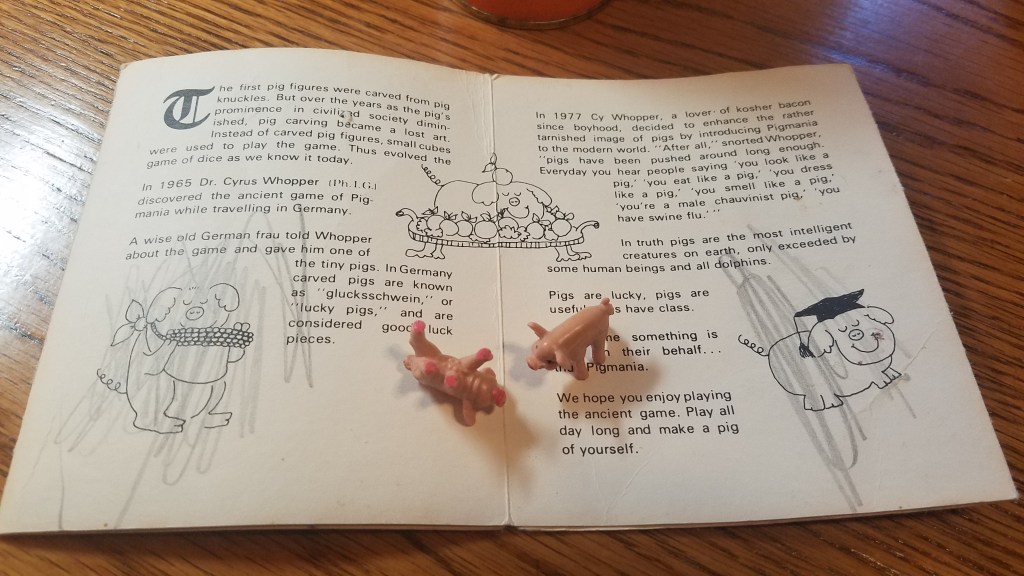
Turns out that the tiny Pigmania! pigs were highly popular. Said second child left her mark on the directions, ‘coloring’ the pictures of pigs with a Number 2 pencil. At some point she either used a thumb tack to post the story and rules to a wall or poked the pencil through the paper.

Our well loved Pigmania! directions ‘colored’ by my youngest child.

Over time the obsession faded and Pigmania! – rather worse for the wear – returned to the game cupboard, forgotten. Or so I thought. 

This past weekend we had a planned trip with our daughter and her fiance to the beach. Being that it was the beach, and the weather is always a question mark, I asked her if there were any games the hubby and I should bring along in case of inclement weather. Her response: Uno!

Her reply was followed with this text message exchange:

Me: “Only Uno?”

Her: “I don’t really know what the other options are.”

Me: “Well, I’ll bring Uno. Padre is willing to play that. I put in a couple decks of cards also. There’s Sequence. And Skipbo.”

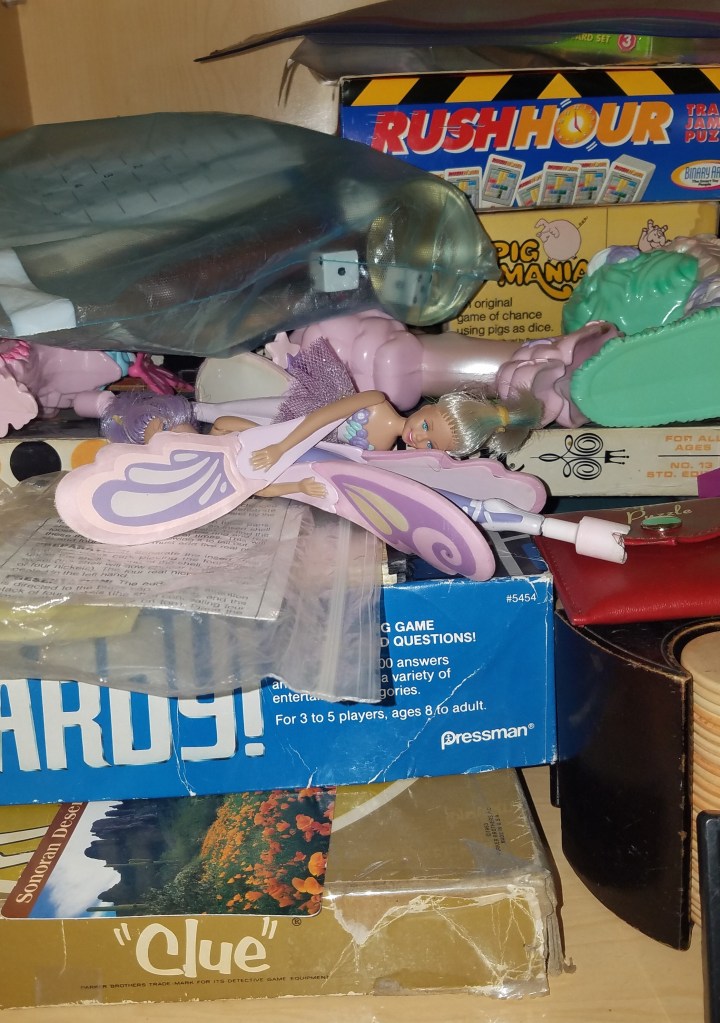
Then I sent a photo of our current game cupboard. The following one word reply was all she included:

Her: “Pigmania!!”

Me: “I didn’t get it and we are in the car. Do I need to go back? I can. We haven’t left the driveway.”

The middle shelf of the game cupboard. As you can see it took some doing for the daughter to pick out Pigmania! from the jumble.

Her: “Nope.”

Of course, I could almost hear the disappointment through the text message. And even though it was raining Noah and his ark sort of rain, I returned to the house and got Pigmania.

On Saturday, my 27 year old daughter, her fiancé, and I played Pigmania! We competed, we threw shade at one another, we laughed, and we connected. 

For both she and I it was reliving just a bit of her childhood in the very best of ways. When the mud had settled from our three way Pig Sty battle, the daughter and I each had a pair of victories in our columns, while her poor fiancé was left out in the cold.

Even more than that, however, is that I was glad Pigmania! had survived the purges of a couple of moves as well as the enthusiastic scribblings of a little girl. In the process it became a tangible symbol of the best of childhood and will always have a home in our game cupboard, no matter how shabby. Pass The Pigs! and may your Pig Out’s be few.

Looking rather worse for the wear is our Pigmania! box.

https://en.wikipedia.org/wiki/Pass_the_Pigs

https://en.wikipedia.org/wiki/Pig_(dice_game)

The History of Canning

The Great Canned Peaches Escapade

September 22, 2020

A stroll down most any aisle in a modern grocery store reveals shelf after shelf of this item which is taken for granted in today’s world.

Yet, this method for the preservation of food has only been around for 200 years and, without it, our way of life would not be possible.

The process of canning foods was invented in 1809 by Frenchman Nicholas Appert. Appert – a brewer and confectioner – “observed that food cooked inside a jar did not spoil unless the seals leaked, and developed a method of sealing food in glass jars.”

The French Government was in need of a reliable food source for its troops during the Napoleonic War and had offered a cash reward for anyone who could successfully develop one. Ironically, the war was over before canned foods were available. Regardless, it was an invention whose time had come.

From the Infallible Wikipedia:

“The original fragile and heavy glass containers presented challenges for transportation, and glass jars were largely replaced in commercial canneries with cylindrical tin can or wrought-iron canisters (later shortened to “cans”) following the work of Peter Durand (1810). Cans are cheaper and quicker to make, and much less fragile than glass jars. Glass jars have remained popular for some high-value products and in home canning. Can openers were not invented for another thirty years – at first, soldiers had to cut the cans open with bayonets or smash them open with rocks. Today, tin-coated steel is the material most commonly used. Laminate vacuum pouches are also used for canning, such as used in MREs and Capri Sun drinks.

Image from Press Connect

To prevent the food from being spoiled before and during containment, a number of methods are used: pasteurisation, boiling (and other applications of high temperature over a period of time), refrigeration, freezing, drying, vacuum treatment, antimicrobial agents that are natural to the recipe of the foods being preserved, a sufficient dose of ionizing radiation, submersion in a strong saline solution, acid, base, osmotically extreme (for example very sugary) or other microbially-challenging environments.

Other than sterilization, no method is perfectly dependable as a preservative. For example, the spores of the microorganism Clostridium botulinum (which causes botulism) can be eliminated only at temperatures above the boiling point of water.”

This time of year, with fruits and vegetables in abundance, the industrious individuals who like to do such things might turn their efforts to canning their favorites at home. Caution, of course, is always a necessity to avoid improper methods and exposing themselves and others to botulism.

From the pioneers of the 1800’s to the thrifty housewives of the Great Depression, canning was a necessary activity each summer and fall.

My mother was never one of those. I think she endured more than her share of  rugged independence growing up from the late 1920’s until she left for college in the 1940’s. There was, however, one food she adored and canned it every year: peaches.

The Yakima Valley is fertile grounds for fruit orchards, its main crops being cherries, apricots, peaches, plums, pears, and apples. We each have our own favorites. For me, as a child, I have a distinct memory of biting into a fresh peach and declaring to my mother it was ‘my favorite fruit.’ I would say that they now share the ‘favorite’ status with cherries, blueberries, and raspberries.

They were, I’m guessing, my mother’s favorite also. Because it was the ONE thing that she canned every year. When the fuzzy orbs were finally ripe, a flat or two of them would make their way to our house and for one or two hot afternoons, she’d can the peaches.

By the time I was about 10, she discovered that there were a couple of custom canneries in the area where she could take her peaches and let them do the final part of the process. For a few years I was ‘employed’ as one of her helpers and she, my dad, and me and my sister, would go to Toppenish for an afternoon of canning. 32 ounce cans, purchased from the cannery, were supplied to us sterilized and ready to go.

The peaches would be blanched and we would remove the skins, cut them in half, pull out the seed and the roughage in the middle, before sliding the slippery fruit into big tubs. It seems as if my dad was in charge of packing the halves into the cans and my mom would add the requisite sugar. Once a dozen cans were filled it was on to the conveyer belt and off to be cooked and sealed.

A few days later our hard work was rewarded when Mom would arrive home with stacks and stacks of canned peaches in the large tin cans.

Of course one issue was where to store said peaches. Growing up in a late 1950’s, 1300 square foot house (after an addition!) provided no pantry space. So the next best place was in the unused bottom of my older brother’s closet.

The date is September 25, 1970 and I – now age 13 – have spent the entire day at home by myself. My brother, age 17, is at work and then has gone out with friends. My sister, age 15, is at an all day event and slumber party. My parents have gone to Seattle to attend the opera and will not be home until well after midnight.

The tiny house as it looked in the 1960’s – before the addition and before new chairs.

Somewhere around two in the afternoon I am in my room just sort of hanging out when I hear a loud ‘thump.’ Being home and alone there is a niggle of fear which this noise inspires. So I leave my room and walk the entire house. Which doesn’t take long since it is a ranch house and, as I said, only 1300 square feet. The doors are all secure and I can find no evidence of anyone trying to break in.

I return to my room and  some time later I hear another ‘thump.’ I am truly mystified. I know it’s coming from somewhere within the house, but cannot figure out where.

By this time there’s another phenomenon in play. There’s a yeasty sort of smell permeating the air, as if someone is baking bread. But, since I do not know how to cook and no one else is home, that is also a mystery.

Fast forward to about midnight. My brother arrives home. I tell him about the two thumps (verified by my Diary entry from the next day, September 26th) but, like me, he’s mystified. A short time later he goes to his room and opens the closet and I think some sort of expletive may have escaped his lips.

Of course I hurry across the hall and peer into the closet. There’s yellow slime on everything and what appears to be a couple of cans of my mom’s precious peaches with their side seams opened up.

The brother – who’s tired after working all day – decides to shut the closet door and go to bed. Right.

And then our parents get home and my mom immediately notices the smell. We tell them about the slime, the split cans, and the thumps. An evaluation of the canned peaches reveals a swelling of the containers and its determined they need to be removed from the closet to the outside. While my parents are doing this, I’m in my brother’s room. He’s in bed and I’m standing about four feet from the open closet. According to the diary:

“one box was still in there (the closet). I heard a fizzing sound, said ‘oh no’ and a can blew up on us.”

My diary entry does not begin to describe what actually occurred. My brother and I heard the sound at the same moment and locked eyes in mutual understanding of what was about to happen. I dove for the side of the bed away from the open closet while my brother yanked the blankets over his face for protection. The can blew. Little bits of vomited peach rained down on us, splattering the walls and ceiling. And then we started to laugh hysterically.

The last flat of botulism laden peaches were expedited to the back yard where my dad – in some sort of sacrificial ritual worthy of Brits at Stonehenge – used an ice pick and a hammer to puncture each and every can. From the small hole an arcing stream of peach guts formed an impressive pureed rainbow across the crisp, black September night.

My mother never went back to that cannery. She found one in Ellensburg it seems and went there for a few years until they closed down. From then on, canned peaches were purchased from the grocery store shelves. Which is kind of anti-climatic after the great exploding peaches event of 1970.

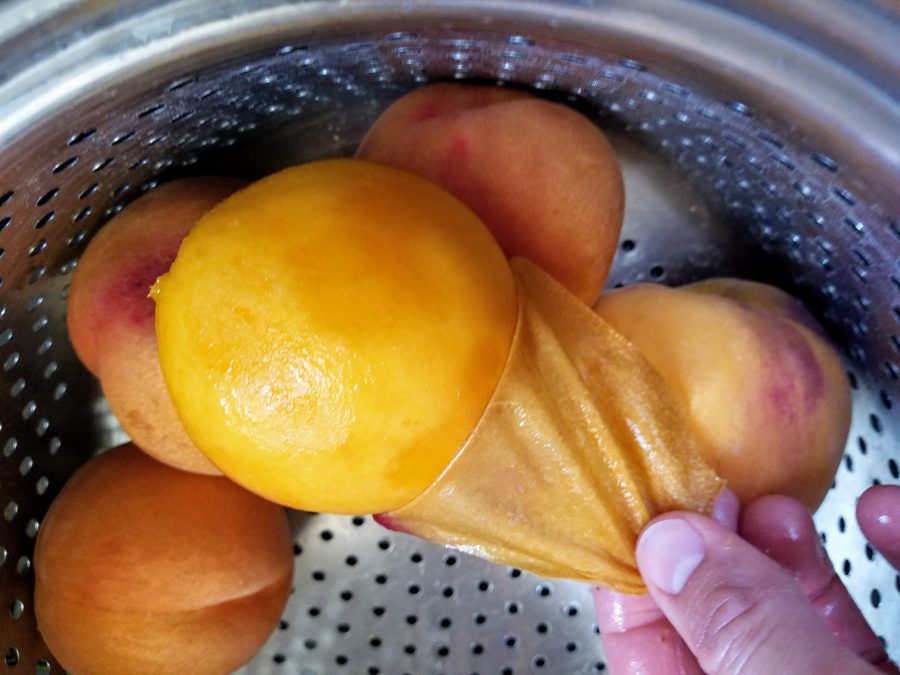
Okay, I’m weird. There’s something satisfying about being able to get the peel of a peach removed in one piece.

A couple of useful links:

https://en.wikipedia.org/wiki/Canning

https://visitfarmfreshfun.com/yakima-valley-produce-schedule.asp