Jane Eyre

Groundbreaking book by Charlotte Bronte

August 24, 2021

It was on August 24, 1847, when Charlotte Brontë finished her manuscript Jane Eyre. Less than two months later, the novel was published.
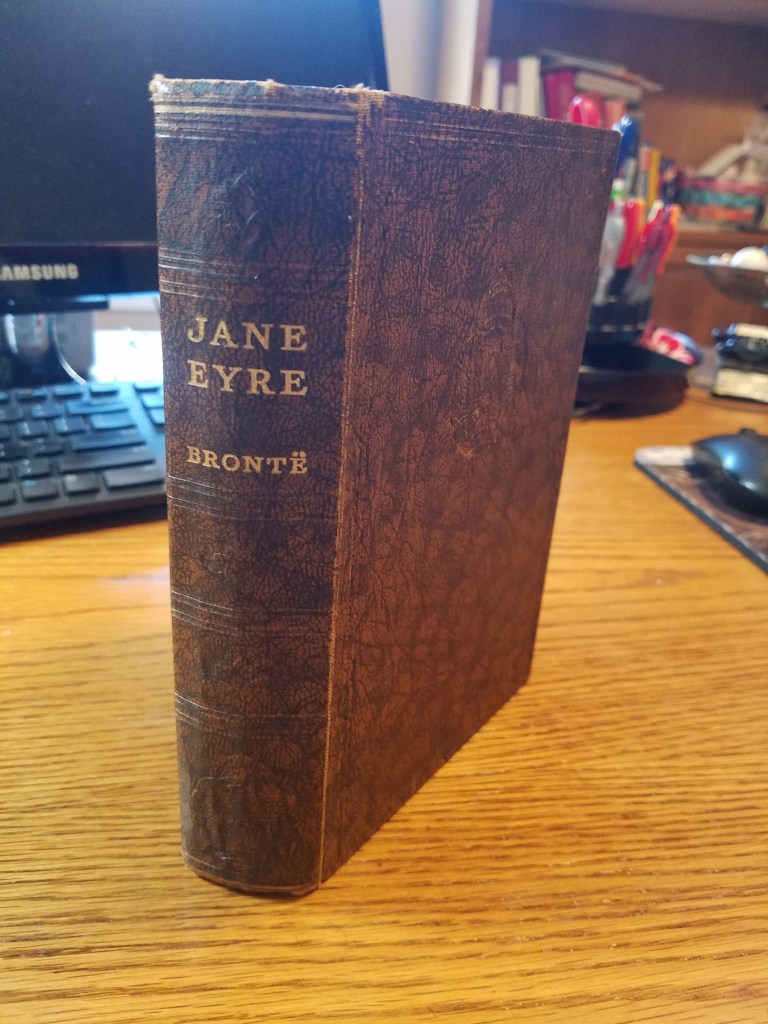
My 1920’s era copy of Jane Eyre which I purchased in a British bookshop the summer of 1980.

For those writers, like myself, who aspire to having our works in print, the pace with which she saw success and the subsequent praise for her novel, inspires.

Victorian England serves as the backdrop for Jane Eyre. From page one the reader sees a harsh world where one’s circumstances dictate where life will take them. The first person protagonist, orphan Jane, learns these lessons early due to poor treatment at the hands of her cousins and aunt. She is sent off to a boarding school where additional cruel handling awaits her; it’s a central tenet of the novel.

The book was considered groundbreaking as to its style and themes. Unlike most literature of the day, Jane Eyre delves into the deeper thoughts of the heroine. The Infallible Wikipedia tells us:

“The novel revolutionised prose fiction by being the first to focus on its protagonist’s moral and spiritual development through an intimate first-person narrative, where actions and events are coloured by a psychological intensity. Charlotte Brontë has been called the ‘first historian of the private consciousness,’ and the literary ancestor of writers like Proust and Joyce.

The book contains elements of social criticism with a strong sense of Christian morality at its core, and it is considered by many to be ahead of its time because of Jane’s individualistic character and how the novel approaches the topics of class, sexuality, religion, and feminism. It, along with Jane Austen’s Pride and Prejudice, is one of the most famous romance novels of all time.”
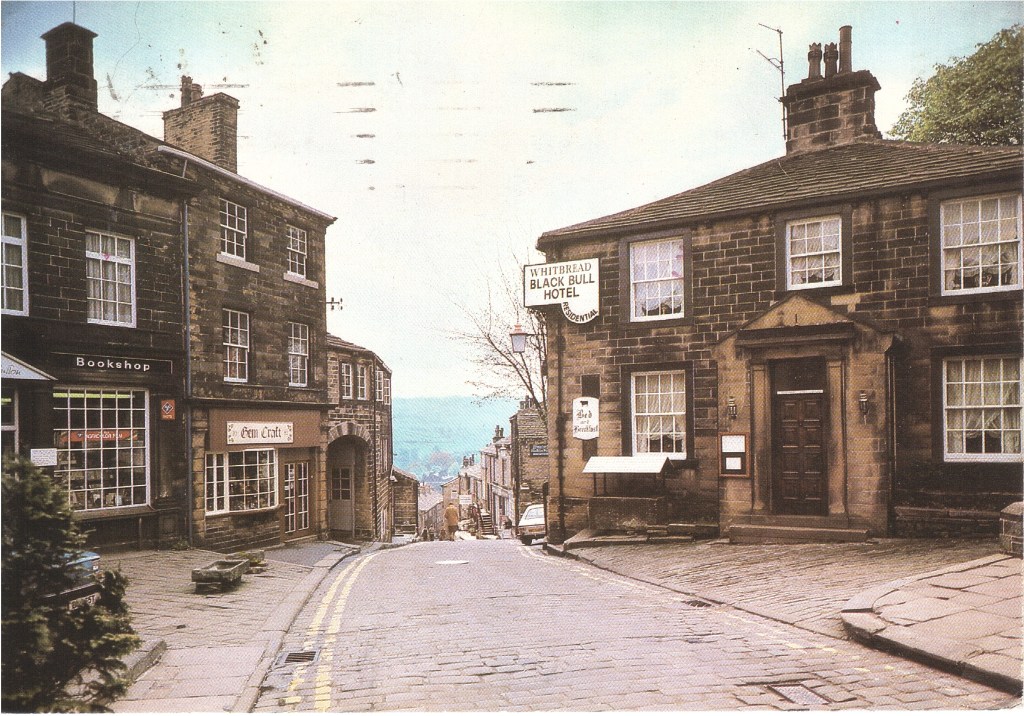
Haworth, Yorkshire Postcard circa 1980

Jane Eyre – along with Wuthering Heights by Charlotte’s sister Emily Brontë, – was among a handful of novels which inspired my interest in the romance genre. At the time I first read the books, I did not truly understand how these two sisters had to overcome societal gender prejudices to live a very non-traditional life. Jane Eyre was initially published under the pen name of Currer Bell to provide legitimacy to the novel since female writers were unheard of at that time.

Also from the Infallible Wikipedia:

“Brontë’s first manuscript, ‘The Professor’, did not secure a publisher, although she was heartened by an encouraging response from Smith, Elder & Co. of Cornhill, who expressed an interest in any longer works Currer Bell might wish to send. Brontë responded by finishing and sending a second manuscript in August 1847. Six weeks later, Jane Eyre was published. It tells the story of a plain governess, Jane, who, after difficulties in her early life, falls in love with her employer, Mr Rochester. They marry, but only after Rochester’s insane first wife, of whom Jane initially has no knowledge, dies in a dramatic house fire. The book’s style was innovative, combining Romanticism, naturalism with gothic melodrama, and broke new ground in being written from an intensely evoked first-person female perspective. Brontë believed art was most convincing when based on personal experience; in Jane Eyre she transformed the experience into a novel with universal appeal.

Jane Eyre had immediate commercial success and initially received favourable reviews. G. H. Lewes wrote that it was ‘an utterance from the depths of a struggling, suffering, much-enduring spirit’, and declared that it consisted of ‘suspiria de profundis! (sighs from the depths). Speculation about the identity and gender of the mysterious Currer Bell heightened with the publication of Wuthering Heights by Ellis Bell (Emily) and Agnes Grey by Acton Bell (Anne). Accompanying the speculation was a change in the critical reaction to Brontë’s work, as accusations were made that the writing was ‘coarse’, a judgement more readily made once it was suspected that Currer Bell was a woman. However, sales of Jane Eyre continued to be strong and may even have increased as a result of the novel developing a reputation as an ‘improper’ book.

Charlotte Bronte was only 38 when she died.

In the summer of 1980, while on a trip to Europe with my parents and sisters, we stopped into a bookstore in a town a bit south of London. My mother, particularly, was a huge fan of Victorian and Edwardian novels and loved nothing better than time spent perusing the stacks in a library or bookstore.

It was there, this particular July day, where I found a used copy of Jane Eyre. What a great choice of a book to read while touring the English countryside.

Soon I was lost in its pages, absorbed by Jane’s story. And soon my father – behind the wheel of the car we had rented – began chastising me for having my nose in a book rather than looking out the window.

For me, reading the book while traveling in Bronte’s homeland was the ultimate experience. One can only imagine what a place might look like unless they have been in that location. By the time we visited Haworth, Yorkshire, I knew what a moor looked and smelled like. I could see Jane struggling across them, sleeping among the crags, enduring the rain. I could envision the town, the church, and the geography.

To glance up from the pages and then out the window of the car stimulated my imagination in ways which induced the images to remain long after my return home.

I often see the book on the shelf in my office, a reminder of that trip so many years prior. Bound in a mottled brown and black leather, the volume at the time seemed contemporary to Bronte’s own life.

When I showed the book to my son our curiosity emerged as to the date of the printing. The only hint was ‘Printed and Bound in Great Britain by Greycaine Limited, Watford, Herts.’ A Google search revealed that the book was likely produced sometime between 1927 and 1936.  Even so, its cover, pages, and typestyle bespeaks of a different era.

I’m certain for Charlotte Bronte her fiction was borne of personal experience as to how the world was in her time. As a contemporary fiction writer, my own prose is reflective of my own time. Perhaps some future reader will be able to glimpse, if only for a short time, what the world of today looked like.

The links:

https://en.wikipedia.org/wiki/Jane_Eyre

https://en.wikipedia.org/wiki/Charlotte_Bront%C3%AB

From the Facebook post: Emily – Wuthering Heights; Charlotte – Jane Eyre; Anne – Agnes Grey.

The Ice Cream Truck

The best thing on a hot August afternoon

August 17, 2021

Lost in the hazy memories of childhood summers are the snippets from hot afternoons spent playing outside with the gaggle of kids who lived on my street.

Our days were filled with pick up softball games, bikes, Barbie Dolls and board games. But there was one distinctive sound which caused our collective to drop everything and run home. That sound was the blare of the song Greensleeves.

In suburban communities throughout the United States, the ice cream truck has been a summer fixture for several generations now.

It seemed to me that the ‘truck’ which roamed our streets was open like this one and the driver turned in his seat to get the treats

They also, according to the Infallible Wikipedia, are very popular in Britain and are described thus:

“An ice cream van (British) or ice cream truck (North American) is a commercial vehicle that serves as a mobile retail outlet for ice cream, usually during the spring and summer. Ice cream vans are often seen parked at public events, or near parks, beaches, or other areas where people congregate. Ice cream vans often travel near where children play — outside schools, in residential areas, or in other locations. They usually stop briefly before moving on to the next street. Along the sides, a large sliding window acts as a serving hatch, and this often displays pictures of the available products and their prices. Most ice cream vans tend to sell both pre-manufactured ice pops in wrappers, and soft serve ice cream from a machine, served in a cone, and often with a chocolate flake (in Britain), a sugary syrup, or toppings such as sprinkles. While franchises or chains are rare within the ice cream truck community (most trucks are independently owned and run), some do exist.”

When one is a child, we often take for granted certain things. One of those things was the ice cream truck which came down our street frequently during the summer. Of course I didn’t think about it much. All I thought about was how I was going to get my hands on the nickel (and when the price went up, a dime and a nickel) I needed to buy a treat.

In the houses up and down my street, our mothers’ doled out the coins needed. Soon we all lined up, patiently or not, for our turn to peruse the desired frozen treats, the cloud of cold steam from the dry ice billowing out like some magician’s trick. The truck always stopped between our house and the Tuttle’s house. This strategic location often produced a dozen eager customers as my family boasted four children and the Tuttle’s had six. Added to our ten were several groups of three additional children within a few houses and even more further up the street. That was a lot of potential customers!

Vintage ad for a Creamsicle from the late 1960’s

Soon I’d have the frozen delight in hand and would sit on the curb with the others. I can envision our gangly group, in pedal pusher pants or shorts and the summer footwear of choice: thongs. For those born after about 1970, we never called them flip-flops, they were thongs and every single one of us wore them all summer long despite the occasional bee sting or stubbed toe.

But I digress. Although I often thought about buying something new and different, I always got the same thing: an orange creamsicle.

My mother, no doubt in a futile attempt to cut back on the money spent at the ice cream truck, developed her own frozen treats. She would fill an ice cube tray with (I think) chocolate fudge jello and freeze the little squares. Into each square was inserted a wooden popsicle stick. These would be doled out on hot August afternoons when the ice cream truck did not come up our street.

When my own children were growing up I would often make Koolaid based popsicles in specially designed holders. My daughter could go through several every day.
Of course one of the reasons for this is that there were no ice cream trucks which ventured the steep driveway up to the house where we lived. Unlike the street where I grew up, my pair of children mostly played with one another or with a friend or two invited over for the afternoon.

A delicious fudge bar and ice cream cone.

When we moved to Kirkland in 2004 the kids were 14 and 11 and past the age where the ice cream truck was a motivating factor. Even so, there were many afternoons when I’d hear the familiar Greensleeves, it’s Pavlovian tune beckoning to youngsters.

In the past three years I have yet to hear or notice an ice cream truck in our neighborhood. Perhaps, with the advent of instant grocery deliveries, it’s now been swept into the dustbin of history. I think our society is a little less rich if that is the case.

Perhaps the next time I’m at the store, I’ll purchase a package of creamsicles, blare Greensleeves from Spotify, and then close my eyes and imagine I’m 8 years old once again, sitting on the curb and savoring that wonderful childhood treat.

https://en.wikipedia.org/wiki/Ice_cream_van

Lackadaisical. Loafing. Slacking. Slothful. Idle. Laggard.

August 10, 2021

By now there is one word which should be at the forefront of your brain: Lazy. Of course I couldn’t be described as lazy and do the research for this week’s Tuesday Newsday. But here I am writing about August 10th, which is National Lazy Day.

It’s that one day a year when we are given permission to sit back and relax.

The Infallible Wikipedia has several entries on laziness, but I got bored reading them as they started discussing all the psychological reasons someone might be perceived as being lazy when in fact they might be depressed, or have ADHD, or a variety of other syndromes.

Instead, the National Day’s Calendar website had the right idea with this tongue in cheek summation on how best to celebrate and observe National Lazy Day:

“Take this test to prepare yourself for the day. Lazy people fact #72432143726413424.

If you were too lazy to read that number, you’re ready to celebrate this day.

The number one rule of any lazy day is if you can’t reach it, you don’t need it.

Don’t break the rule.

We assigned an alternative word for lazy for the day.

We call it very relaxed.

What is the official exercise of #NationalLazyDay?

Diddly squats.

For some tips on how to enjoy a successful lazy day visit A Pint-Sized Life Blog.

We were too lazy to give you our own list.

NATIONAL LAZY DAY HISTORY

The creator and origin of #NationalLazyDay could not be found.

Have a great day!”

I would venture to guess that there is not a person alive who hasn’t used the phrase ‘I’m being lazy today,” when, in fact, what they’re really saying is that they need a break after an intense period of activity.

As I have, ahem, matured, I’ve decided that being ‘lazy’ is necessary. Unlike my younger days, I find that a bit of a nap midway through the day is imperative to getting things done. Although chores may not get completed as quickly as they once did, eventually the things which need to happen are accomplished.

Last year in one of my posts I wrote about keeping house and discussed the luxury of hiring someone to come in and clean for me.( https://barbaradevore.com/2020/03/24/national-cleaning-week/)

I know many of you are familiar with my ‘lazy’ housekeeper and how she eats chocolates all day and reads trashy romance novels rather than work.

But my lazy housekeeper really isn’t that lazy, it’s more that she is easily distracted and can find dozens of other more interesting things to do with her time. I attribute her inefficiency to ADHD because she simply cannot stay focused on one thing for too long.

She might vacuum for 15 minutes and then remember that she needed to send an email to someone, so off she’ll go to take care of that. On her way she might notice that the hummingbird feeder is empty, so will stop to make new nectar. When she returns a half hour later to finish the undone housework, she might actually mop the floor before she remembers she needs a few things from the grocery store or have an inspiration for a scene in a story she’s writing.

These bursts of energy and activity are quite exhausting and soon it’s time to play a game on the phone or, better, shut her eyes for a short respite.

Which, finally, begs the question “Is being ‘lazy’ actually beneficial?”

Internet research provided plenty of articles to support this hypothesis. I decided it was too much work to quote anymore articles on the benefits or pitfalls of laziness but will paraphrase the conclusions.

A person we perceive as lazy might not, in fact, be so. Such an individual is often thinking about the easiest and most time effective way to complete a task. Others might, in fact, be writers. For those who don’t know, writing requires having time to cogitate what it is you are going to write.

Like this article. Before I started to type I spent quite a bit of time considering how I would present the topic and decided to research the synonyms to start it out; additionally, I wanted to find a personal angle on laziness, hence the lazy housekeeper. It really did involve a great deal of deliberation which, to the casual observer, might present as laziness.

So that’s my story and I’m sticking to it. Now, if you’ll excuse me, all this brain work has left me feeling a bit droopy and a nap sounds like a great way to spend August 10th, National Lazy Day.

The links:

https://en.wikipedia.org/wiki/Laziness

https://nationaldaycalendar.com/national-lazy-day-august-10/

http://news.ku.edu/2018/08/15/new-research-suggests-evolution-might-favor-survival-laziest

Memories of Driver’s Ed: Lessons from the 70s

For some it took longer than others!

August 3

At one time this test was an important rite of passage for the American teenager, an indication that they were about to enjoy one of the privileges of adulthood: being able to drive.

For one Mariam Hargrave of Yorkshire, England, no doubt it was an ordeal. It was on August 3, 1970, when the 62 year old finally passed her driving test. Although the Infallible Wikipedia has an article about driver’s tests, they ignore poor Mrs. Hargraves. Instead, I was able to glean this information:

“By April 1970 Mrs. Miriam Hargrave had failed her test thirty-nine times. In the eight preceding years she had received two hundred and twelve driving lessons at a cost of £300. She set the new record while driving triumphantly through a set of red traffic lights in Wakefield, Yorkshire. Disappointingly, she passed at the fortieth attempt (3 August 1970) but eight years later she showed some of her old magic when she was reported as saying that she still didn’t like doing right-hand turns. — Stephen Pile, ‘The Book of Heroic Failures’”

Back in 1970’s Yakima it was a big deal to learn how to drive. By the time I was in high school, they were offering Driver’s Ed classes which involved learning the rules of the road and practicing driving. I doubt there were any braver educators anywhere than those who willingly climbed into a car with a 15 ½ year old, hormone driven, child and allowed them to command a 2,000 pound vehicle on city streets.

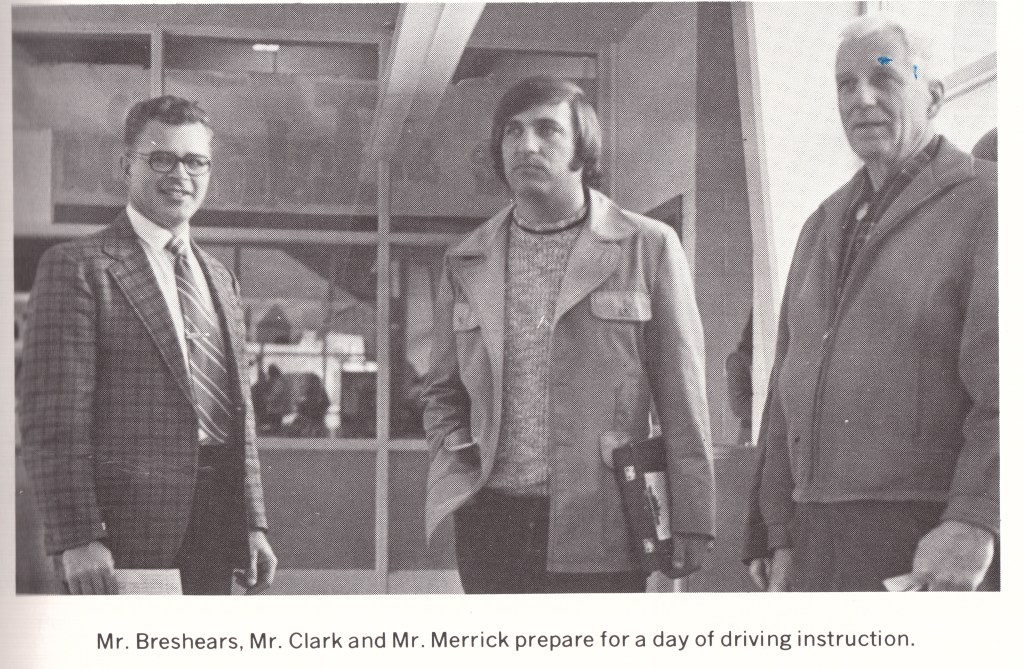
Yet, they did. I seem to recall my Driver’s Ed teacher, Mr. Breshears, always popping antacid tablets. I suppose the only thing which gave the instructors any comfort at all was the fact that the cars were equipped with a set of brakes for the front seat passenger.

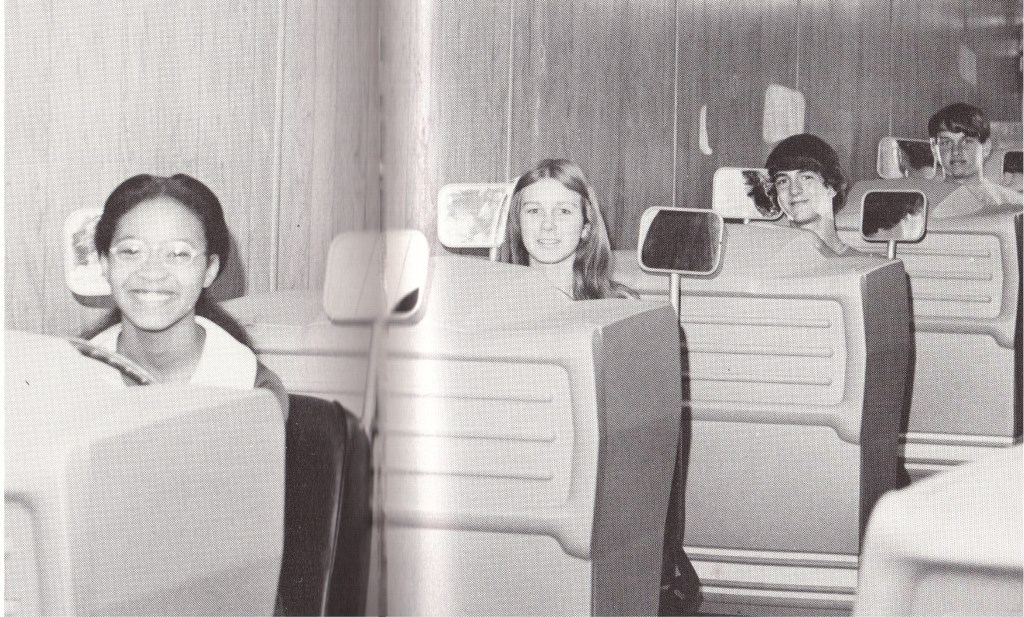
Our simulators looked something like this set up from 1969.

Three students at a time would go drive with the teacher. It was a bit terrifying since not all budding drivers had the benefit of a parent who worked with them after school. There was one student I recall who tested Mr. Breshears patience each time they got behind the wheel. Those instructor brakes got quite the workout.

But the favorite part of Driver’s Ed class was getting to go to the Simulator. It was a windowless trailer which had been equipped with two parallel rows of seats, separated by an aisle sort of like being on a bus, and all faced forward. Each station had a steering wheels, brakes, etc. to look like the driver’s area of a car. At the front of the trailer was a large screen. Once all the students were settled into their places, the lights would be dimmed and the screen would come to life as though one was behind the wheel, driving down the street. It was our job to accelerate in unison with what we saw on the screen. It was also imperative that we hit the brakes at the right time.

From the IKE Reveille year book, 1972

Driver’s training films seemed to mostly consist of tree lined city blocks which, at first, seemed like lovely enclaves of blissful American life. But no. Those streets were every driver’s worst nightmare. Balls of all sorts would suddenly bounce out into the road followed by adorable tikes chasing them. Woe unto those who didn’t hit the brakes in time!

Sophomore class officers from Eisenhower High School, Yakima, pose for a photo for the 1973 annual.

There were dogs and cats; there were other vehicles; things fell off the backs of trucks, branches crashed down. Who knew how truly hazardous things could be in one bucolic town?

Of course, some cheeky student would purposefully ‘run’ over the simulated hazards and a little red light would illuminate on their console, publically shaming them for an egregious infraction. I always wondered if students who ‘ran’ over cats, dogs, and children, failed the course.

Over the years I have learned just how accurate those simulations were as I’ve encountered many of the hazards portrayed. Thankfully, it’s only occasionally that such things happen. The hubby and I, if we are in the car together, will comment in unison ‘Driver’s Training film!’ when something we experienced in the simulator occurs in real life.

This photo is from the Eisenhower High School 1973 annual. The headline above this proclaimed “380 license-hungry students swamp driver education course this year.” Apparently there were a bunch of us who turned 16 in 1973.

The  instruction I received was successful and on my 16th birthday I took the tests – written and driving – and emerged as a licensed driver and, despite losing points for parallel parking, never came close to Mariam Hargrave’s, 212 lessons, eight years of time, and over $700 (US) spent.

The links:

An entertaining look at early simulators:

https://www.dmv-written-test.com/washington/practice-test-1.html?utm_source=bing&utm_medium=cpc&utm_term=%2Bwa%20%2Bstate%20%2Bdriver%27s%20%2Btest%20%2Bpractice&utm_campaign=DMV%20-%20Search%20-%20WA%20-%20EN%20-%20CAR~Driver%20Question%20Test&msclkid=ee5a27bd586710c0735246b5495d31f5# (Can you pass the written test for Washington State?)

https://en.wikipedia.org/wiki/Driving_test

https://en.wikipedia.org/wiki/The_Book_of_Heroic_Failures

The Birthday Paradox

What are the odds?

July 27, 2021

The next time you are in a group of 30 or more people and you want to have an icebreaker activity, have the group line up by the day of the month they are born. Odds are 70 percent that two of the people in the group will share the same day.

This is a phenomenon known as the Birthday Paradox or Birthday Problem. It’s all based on exponents and probabilities. According to the Infallible Wikipedia (who got the information from a whole bunch of smart scientists), this is how it works:

“In probability theory, the birthday problem or birthday paradox concerns the probability that, in a set of n randomly chosen people, some pair of them will have the same birthday. In a group of 23 people, the probability of a shared birthday exceeds 50%, while a group of 70 has a 99.9% chance of a shared birthday. (By the pigeonhole principle, the probability reaches 100% when the number of people reaches 367, since there are only 366 possible birthdays, including February 29.)

These conclusions are based on the assumption that each day of the year is equally probable for a birthday. Actual birth records show that different numbers of people are born on different days. In this case, it can be shown that the number of people required to reach the 50% threshold is 23 or fewer.

The birthday problem is a veridical paradox: a proposition that at first appears counterintuitive, but is in fact true. While it may seem surprising that only 23 individuals are required to reach a 50% probability of a shared birthday, this result is made more intuitive by considering that the comparisons of birthdays will be made between every possible pair of individuals. With 23 individuals, there are (23 × 22) / 2 = 253 pairs to consider, which is well over half the number of days in a year (182.5 or 183). (snip)

The history of the problem is obscure. The result has been attributed to Harold Davenport; however, a version of what is considered today to be the birthday problem was proposed earlier by Richard von Mises.”

Personally, my brain kinda goes ‘tilt’ when I see cryptic scientific characters and formulas which show me how to calculate all of this. So I leave that to you brainiac statistics folks and share my own personal experience with this phenomenon.

The first time I encountered this was as a 13 year old in my 8th grade English class. More about that in a bit. Often, when I’m in a group situation and looking for a way to engage people in conversation, I will ask them their birthday (not the year, just the day) and talk about the paradox. This will often get others interested and soon the entire group is comparing days until, and it usually happens, we find the pair with the same birthday.

Over the years I have been the person who matches another who shares my birthday fairly often. I can think of at least five times this has occurred.

But it was that first time which I think might have the odds makers scrambling to figure out the possibilities.

Back to 8th grade English class. In the room there are probably 5 rows with six desks in each row, so 30 possible students. I do not believe we had 30, more like 24. On this particular day I was in my chair in the front row (I’ve always been one to sit in front in a class) with my friend Bonnie behind me and a girl I didn’t really know, Alice, behind her.

We are working independently on something and Mr. Albrecht, our teacher, doesn’t care if we are talking to one another. So I’m working on my project and can hear Bonnie and Alice chatting away. The two of them, who had only recently met in that class, had taken an instant liking to one another and were becoming fast friends.

Then one of them, I think Alice, asks Bonnie her birth date. To which Bonnie replies, “August First.” Alice squeals and says, “No way. My birthday is also August First.”

By now, they have my full attention. I turn around and reply, “You’re not going to believe this, but my birthday is also August First!”

“No it’s not!” Bonnie objects, “You’re joking. You’re just saying that because Alice and I the same birthday.”

I shake my head and say, “No, it really is August First.”

The debate continues for several minutes as they simply do not believe me. Finally we all agree to bring in copies of our birth certificates to prove it.

The next class day I had mine in hand and eagerly awaited the moment when I would show them I did, in fact, share the same birthday (and in this case, year) as the other two.

Pages 8 and 9 of the Wilson Junior High annual. Birthday buddies and me have checkmarks on our ‘lovely?’ photos.

We huddle together at the end of class and each produce our documents. Bonnie and Alice shake their heads in disbelief as they examine my certificate. Yes, all three of us were born on August First of the same year. It turned out, however, that I was the oldest of the trio having arrived a mere 43 minutes after midnight to make the cut.

María Laura, María Emilia and María Eugenia Fernández Roussee (born 5 July 1960). The triplets are a well known musical group in Argentina

It was a rather amazing coincidence. In all the years since I’ve never heard of another situation like it. In my Google explorations to calculate the odds of such a thing happening, it was nearly impossible to make the search engine understand what I was asking. So, all you readers out there, what ARE the odds of three random people in a group of 24 sharing the same birthday and year?

Yes, I do personally know two sets of triplets… and for the purpose of the Birthday Paradox those don’t count.

I think it is a rather narrow probability and that maybe, our little unrelated trio, defied the odds. It truly is a paradox.

A few links:

https://en.wikipedia.org/wiki/Birthday_problem

https://betterexplained.com/articles/understanding-the-birthday-paradox/

Disneyland

The Happiest Place On Earth

July 20, 2021

Where oh where to begin with this week’s topic? For those of us born from the mid-1950’s on, there was never a time when this, the ‘happiest place on earth’ did not exist.

We learned about Disneyland via Sunday night’s Wonderful World of Color which featured Disneyland’s Sleeping Beauty’s castle against a back drop of colorful fireworks. It was an aspirational sort of thing, I suppose, instilling in our Baby Boomer hearts the desire to go to Disneyland and find our own happiness there.

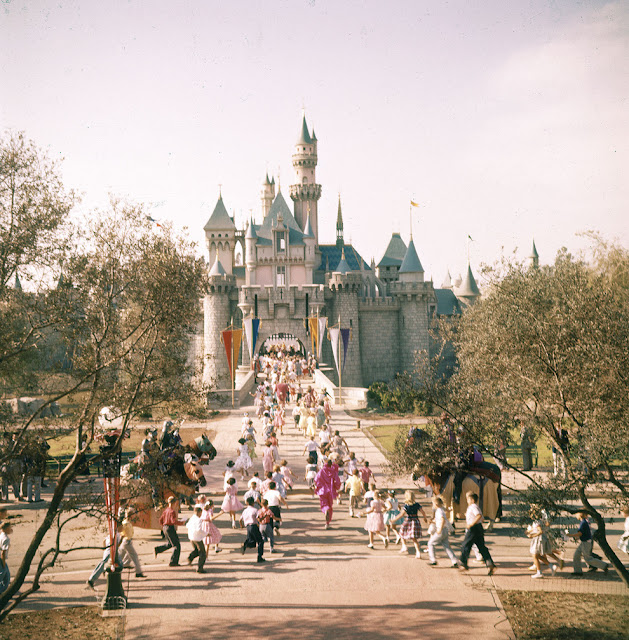
The crowd running towards Sleeping Beauty’s castle July 17, 1955

It was the third week of July 1955, when the park officially opened, one year and one day from when construction began. Walt Disney’s concept came while sitting on a bench at a park one day and watching his two daughters play. Instead of parents just observing from the sidelines, he mused, wouldn’t it be great to have a place where kids and parents could have fun together?

It would be nearly 20 years before Disneyland would finally become a reality.

The Disneyland most people know today would be nearly unrecognizable to Disney himself. The first rides were, for lack of a better term, rather bland. There was not a roller coaster to be found anywhere within the park. It’s most popular early attractions were “Jungle Cruise,” “Autopia,” and “Rocket to the Moon” (later to Mars). Guests strolled along Main Street, hopped aboard the Disneyland Railroad, or sailed the raft over to Tom Sawyer Island for fun. There were a few carnival type rides but by today’s standards those would be considered ‘kiddie’ rides.

Opening day was a disaster. From the Infallible Wikipedia:

Walt Disney and his grandson taking a break from the 101 degree temperatures on opening day

“Traffic was delayed on the two-lane Harbor Boulevard. Famous figures who were scheduled to show up every two hours showed up all at once. The temperature was an unusually high 101 °F (38 °C), and because of a local plumbers’ strike, Disney was given a choice of having working drinking fountains or running toilets. He chose the latter, leaving many drinking fountains dry. This generated negative publicity since Pepsi sponsored the park’s opening; disappointed guests believed the inoperable fountains were a cynical way to sell soda, while other vendors ran out of food. The asphalt that had been poured that morning was soft enough to let women’s high-heeled shoes sink into it. Some parents threw their children over the crowd’s shoulders to get them onto rides, such as the King Arthur Carrousel.

In later years, Disney and his 1955 executives referred to July 17, 1955, as ‘Black Sunday’. After the extremely negative press from the preview opening, Walt Disney invited attendees back for a private ‘second day’ to experience Disneyland properly.”

Despite the inauspicious start, Disney persevered, never resting and always looking for innovative ideas and opportunities to improve the park and thus the experience for paying guests.

The first roller coaster, the now iconic Matterhorn, opened in 1959. It was eventually joined by a second coaster, Space Mountain, in 1977.

The Matterhorn under construction 1959

Although many of the original attractions are still a part of Disneyland, the Disney company has never been afraid to update and upgrade to keep pace with the changing technology or the desires of the public. Many of the attractions kids of the 1960’s and 70’s remember fondly are long since gone.

As a child – and knowing about Disneyland – it was a place I wanted to go. For my family, however, it was not within reach. It was only after the passing of my grandmother in January 1970 that the wheels were set in motion for a trip which took my Dad, Mom, Sister, and me south to Anaheim. I chronicled my first Disneyland visit in a previous blog post https://barbaradevore.com/2020/05/26/the-great-american-road-trip/.

Having gotten a taste of the Disney experience, I was excited when – along with the Rainbow Girls – I had another day at the park in late July 1976. And much like the first visit, it was a one day visit. The rides were few and mostly I recall riding the Matterhorn and meeting the Big Bad Wolf.

My sister encounters the Big Bad Wolf

It was after the hubby and I had been married for nearly eight years when we hatched our ultimate Disneyland plan. We flew to California in January 1988 to spend three entire days at the theme park. While there, we agreed, we would ride EVERY ride they had to offer; see every show; eat all the food. We would immerse ourselves in all Disney, all the time.

A few things stand out from that trip. One, when we arrived at John Wayne airport it was probably 8 or 9 p.m. and 60 degrees. To us, coming from 40 and rain Seattle in January, it seemed like summer. We laughed at a woman standing near the open air luggage carousel who was, literally, wearing a parka, fur hat, and big mittens.

Second, we videotaped pretty much every ride. Alas, without the magic of the machine which can convert VHS those tapes are consigned to a dusty box in the Harry Potter closet. (see article here: https://barbaradevore.com/2020/06/30/winchester-mystery-house/) One of these days I do plan to get those old tapes digitized!

Third, it was truly one of the best vacations the hubby and I took. We were 30 and 31 years old, did not yet have children, could afford to pay for whatever we wanted, and for three days we got to act like teenagers but better. Not only did we go on ALL the rides (yes, even the ‘kiddie’ rides), but we did several of the best ones multiple times. Space Mountain? check/check. Matterhorn? check/check/check. Haunted Mansion? check/check/check. Big Thunder Railroad? check/check/check/check/check.

In the years since, we’ve taken our children to Disneyland a couple of times and to DisneyWorld once. The hubby and I even had a solo day at Epcot a few years ago. But I’m not so keen on roller coasters any more. Those are, sadly, more the province of the young and less fragile among us. Even so, I think it would be fun to return to Disneyland with our adult children (neither of whom have any children at this point) during a time of year when the crowds are reduced and we can once again ride any ride we like as many times as we want. That, to me, would be magical.

Hubby and me with the two littlest ones on the Disneyland railroad 1995
Hubby and kids waiting for Big Thunder Railroad roller coaster circa 1998
Disneyland circa 1998

As Walt Disney said on opening day in 1955:

“To all who come to this happy place: Welcome. Disneyland is your land. Here age relives fond memories of the past, and here youth may savor the challenge and promise of the future.”

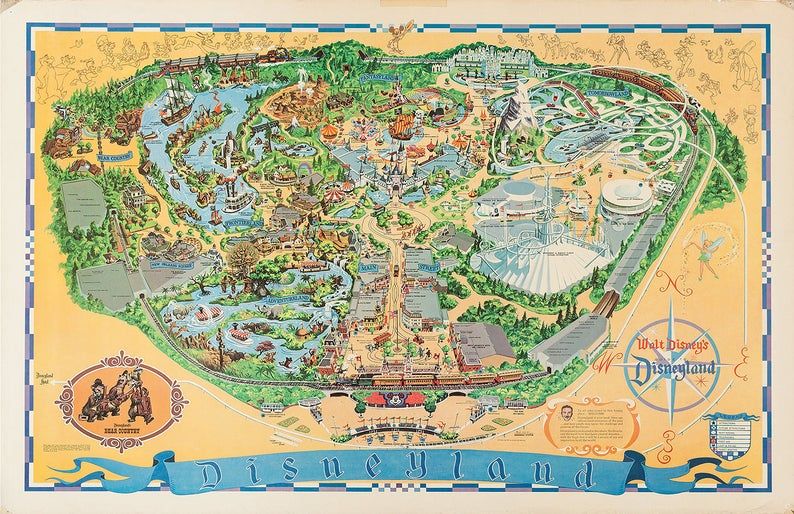
Disneyland Map 1970

https://en.wikipedia.org/wiki/Disneyland

A Puzzle for the Ages

The Rubiks Cube

July 13, 2021

Choices, choices. That’s what today, July 13, gives us. A number of Tuesday Newsday worthy people are celebrating birthday’s today. I thought I had it all figured out until my brother, who is a disc jockey and sends me his show prep once a week, included the birthday of a person whose invention changed the toy landscape of the world.

The yummy Indiana Jones aka Harrison Ford

So what to do? First of all, I say Happy Birthday to actor Harrison Ford who is 79. Ford, for those might have been living in a monastery in Tibet, is known for multiple memorable roles: Bob Falfa in American Graffiti, Han Solo in the Star Wars films, Jack Ryan in The Patriot Games, and the swashbuckling Indiana Jones. There is much more to Ford’s career which has now spanned 51 years. There is currently another Indiana Jones movie being filmed.

To learn more about Ford and his career, the Infallible Wikipedia can be accessed here:

https://en.wikipedia.org/wiki/Harrison_Ford

On a personal note, the closest I ever got to Ford was during a trip to Disneyland the third week of February 1995. The Temple of the Forbidden Eye ride – based on the Indiana Jones movies – was slated to open in early March. That’s when we learned about ‘soft openings.’ On our last day at the park they opened the ride… two weeks before its official opening date. I was jazzed and the hubby and I figured out how to take turns on the attraction since our daughter was only two and not tall enough to participate.

My sister and nieces outside the brand new Temple of the Forbidden Eye attraction, February 1995

Once the ride was over, it was time to head back to the hotel for some down time and we worked our way to Main Street and the exit. Our plans were thwarted – in a good way – when a parade halted our progress. The crowd was excited and we asked someone what was going on. “Harrison Ford is in the parade,” one enthusiastic woman said. Yes, it was a parade to celebrate the opening of the newest Disneyland attraction.

Sure enough a few minutes later both Ford and Carrie Fischer (who had no role in the Indiana Jones movie but was still there) rode by in a pair of convertibles.

Now on to the second birthday of note. Until I looked at his Wikipedia page I could not have picked this person out of a police lineup. Yet one of his inventions lives at our house and has done so since nineteen eighty something. Happy 77th Birthday to Erno Rubik, inventor of the popular cube puzzle.

For most people I imagine their cubes look like this most of the time.

Rubik is a Hungarian inventor, architect, and professor of architecture. The invention of the Rubik’s cube came about, according to the Infallible Wikipedia, when Rubik, using blocks of wood and rubber bands:

“…set out to create a structure which would allow the individual pieces to move without the whole structure falling apart. Rubik originally used wood for the block because of the convenience of a workshop at the university and because he viewed wood as a simple material to work with that did not require sophisticated machinery. Rubik made the original prototypes of his cube by hand, cutting the wood, boring the holes and using elastic bands to hold the contraption together.

Erno Rubik

Rubik showed his prototype to his class and his students liked it very much. Rubik realized that, because of the cube’s simple structure, it could be manufactured relatively easily and might have appeal to a larger audience. Rubik’s father possessed several patents, so Rubik was familiar with the process and applied for a patent for his invention. Rubik then set out to find a manufacturer in Hungary, but had great difficulty due to the rigid planned economy of communist Hungary at the time. Eventually, Rubik was able to find a small company that worked with plastic and made chess pieces. The cube was originally known in Hungary as the Magic Cube.

Rubik licensed the Magic Cube to Ideal Toys, a US company in 1979. Ideal rebranded The Magic Cube to the Rubik’s Cube before its introduction to an international audience in 1980. The process from early prototype to significant mass production of the Cube had taken over six years. The Rubik’s Cube would go on to become an instant success worldwide, winning several Toy of the Year awards, and becoming a staple of 1980s popular culture. To date, over 350 million Rubik’s Cubes have been sold, making it one of the best selling toys of all time.”

Since that article was posted, an additional 100 million cubes have been sold which places it as THE bestselling toy of all time.

The Rubik’s cube has been a true conundrum for the average person. It’s unsolvable unless one understands and applies at least two algorithms as they move the pieces around. In fact, according to an article on Ruwix.com, there are 43 quintillion possible combinations. Another interesting note is that it took Rubik himself over a month to solve it once he invented it!

Over the years there have been books written as to ‘how’ to solve the puzzle. There are now links on the internet providing the algorithms for free.

One Felix Zemdegs of Australia holds the world record for the fastest solving time. His record: 4.75 seconds. It’s pretty amazing to watch:

As I said, we have had a cube floating around our house over the years. After our son arrived, he became fascinated with all the games we owned. It was a daily affair for the game cupboard to be unloaded. Of course the cube was of interest. When he was probably 5 or 6, he became frustrated in his cube solving attempts. No amount of telling him that adults (including his mother) were incapable of solving the puzzle appeased him.

Who knew Ford was a Rubik’s master?

Then one day he walks into the kitchen and proudly shows me the ‘solved’ cube. I was impressed until I detected that some of the colored paper stickers on each cube were a bit crooked. On closer inspection it was obvious someone found the ‘easy’ way to solve it.

But his engineering brain was not to be deterred. We got him a new cube a couple of years later for his birthday and then he set about learning the final algorithms needed to solve the puzzle.

I’ve been able to get one face and then two rows of color correct, but that’s as far as I’ve ever gone. I’m okay with that. As someone who does not have an ‘engineering’ brain I’m content to watch in awe as those that do solve the Rubik’s cube, the world’s most famous puzzle.

A couple more links:

https://en.wikipedia.org/wiki/Ern%C5%91_Rubik

https://en.wikipedia.org/wiki/Rubik%27s_Cube

Pokémon Go

Gotta Catch ‘Em All

July 6, 2021

Until early 1999, I had never heard the word “Pokémon” which is a shortened version of the Japanese term for the iconic Gameboy creatures, Pocket Monsters, created in 1996.

Pikachu – the iconic symbol of Pokémon .

It was in the spring of 1999 when Pokémon trading cards took over the elementary school where my son was in the third grade. For a number of months we made frequent treks to the card store so that my son could buy a packet of the cards to add to his collection and, ostensibly, trade with his school mates.

Like all such fads, the trading card obsession faded and by Fourth grade year, it was over. Or so I thought.

If everyone thought the Pokémon cards were a big deal they had not, in the words of the Bachman Turner Overdrive song You Ain’t Seen Nothing Yet.

It was on July 6, 2016 when Pokémon Go was launched and became a worldwide experience.

From the Infallible Wikipedia:

“The game was referred to as a ‘social media phenomenon’ which has brought people together from all walks of life. 231 million people engaged in 1.1 billion interactions that mentioned Pokémon Go on Facebook and Instagram in the month of July. Numerous media outlets referred to the surge in popularity as ‘Pokémon Go Mania’, or simply ‘Pokémania’.The massive popularity of the game resulted in several unusual positive effects. For example, the game placed players where they can help catch criminals and report crimes in progress, although it has also placed some in harm’s way, and has even aided law enforcement’s community relations. albeit with caveats. Businesses also benefited from the nearby presence of PokéStops (or them being PokéStops themselves) with the concomitant influx of people, and the intense exploration of communities has brought local history to the forefront.

The highly coveted Charizard trading card

For those unfamiliar with the game, it popularized AR – Augmented Reality –with users being able to find and capture the Pokémon which appeared as animated creatures on an i-phone or Android device. Think of it this way: when you open the Pokémon Go app on your phone, the world appears in a cartoonish form with grass, trees, water, and buildings. If a Pokémon is nearby it will materialize on the screen and provide the user an opportunity to ‘catch’ it by throwing a Pokéball at the creature. Once caught, the Pokémon is added to the user’s collection. The goal, initially, is to catch at least one of every Pokémon. These, most often, can be evolved into a new Pokémon – so long as you have earned enough points to do so by capturing many, many of the original Pokémon.

PokéStops can be found in every community, and when accessed give the user rewards in the form of additional Pokéballs and other game enhancers.

Despite many of the initial players not continuing, the game’s early success garnered a number of firsts. Also from the Infallible Wikipedia:

“The game was awarded five Guinness World Records in August 2016: most revenue grossed by a mobile game in its first month ($206.5 million); most downloaded mobile game in its first month (130 million downloads); most international charts topped simultaneously for a mobile game in its first month (top game in 70 different countries); most international charts topped simultaneously for a mobile game in its first month (top grossing in 55 countries simultaneously); and fastest time to gross $100 million by a mobile game (reached in 20 days on July 26). By September 2016, Pokémon Go had been downloaded over 500 million times worldwide, and became the fastest game to make over $500 million in revenue. Pokémon Go was awarded the App Store’s breakout hit of 2016. Pokémon Go was reported to be the most searched game on Google in 2016.

The crowd which descended upon us in search of Charizard on August 21, 2016 in Bellevue.

Pokémon Go arrived at my house about a month after its release. I’d been in Yakima and arrived back in Kirkland about 7 p.m. one August evening and just as I turned down our street I notice my son out walking. I pull to the curb and ask him where he’s going. At that moment he admits his friend Vincent had gotten him started on Pokémon Go.

Curious, I went out walking with him the next night to see how it all worked. This went on for two weeks and then I cracked and loaded the app on my phone. Soon my son and I were venturing out in search of rare Pokémon, making trips to parks and other places to ‘catch them all.’

The ‘oldest’ creature in my collection is the Charizard I caught on August 21, 2016. AR allows one to take ‘pictures’ with your Pokémon

The most amazing Pokémon day of all was on August 21, 2016. We had driven to the Downtown Park in Bellevue (across from Bellevue Square) and there – with hundreds of our ‘best’ friends – wandered about the park capturing digital monsters.

And then it happened. The rarest of rare Pokémon, the ONE everyone had coveted from way back in the card collecting days of 1999, pops up on our screen and we are standing – literally – a few feet away from the GPS location where it spawned.

A collective roar goes up across the park and – I kid you not – the pounding of hundreds of pairs of feet headed our way shake the ground like an earthquake. My hands are trembling as I attempt to capture Charizard (I’m still a very green novice at this point), ignoring the masses who are descending upon us in their frenzy to capture the beast. Of course I am attempting the same thing. On the third attempt, the elusive fire dragon is locked in my Pokéball and the son and I emerge from behind the bushes to an unreal scene. I did have the presence of mind to snap a couple of photos of the massive crowd that evening.

Since that day both my son and daughter have quit playing the game. I admit it has lost a lot of its appeal; it was a fun way to spend time with my adult children. Even so, I still play it as it gives me something to do when a passenger on a trip. But nothing will ever replace the thrill of the hunt on that August night in the summer of 2016 when Pokémon ruled the world.

https://en.wikipedia.org/wiki/Pok%C3%A9mon_Go

https://en.wikipedia.org/wiki/Pok%C3%A9mon

The conversation is between my son and I after the great Charizard spawn and capture on August 21, 2016

Update July 6, 2022: I have, for the most part, quit playing Pokémon Go and removed the app from my phone. That said, my data still exists out there on some database. If I’m truly bored I can simply reload the game and see what’s new in Pokéworld.

Olympic National Park

Rhode Island has nothing on this place

June 29, 2021

At 922,649 acres – about 1,411 square miles – Olympic National Park (ONP) is roughly the same size as Rhode Island. Comparing something to Rhode Island is, of course, what American’s do.

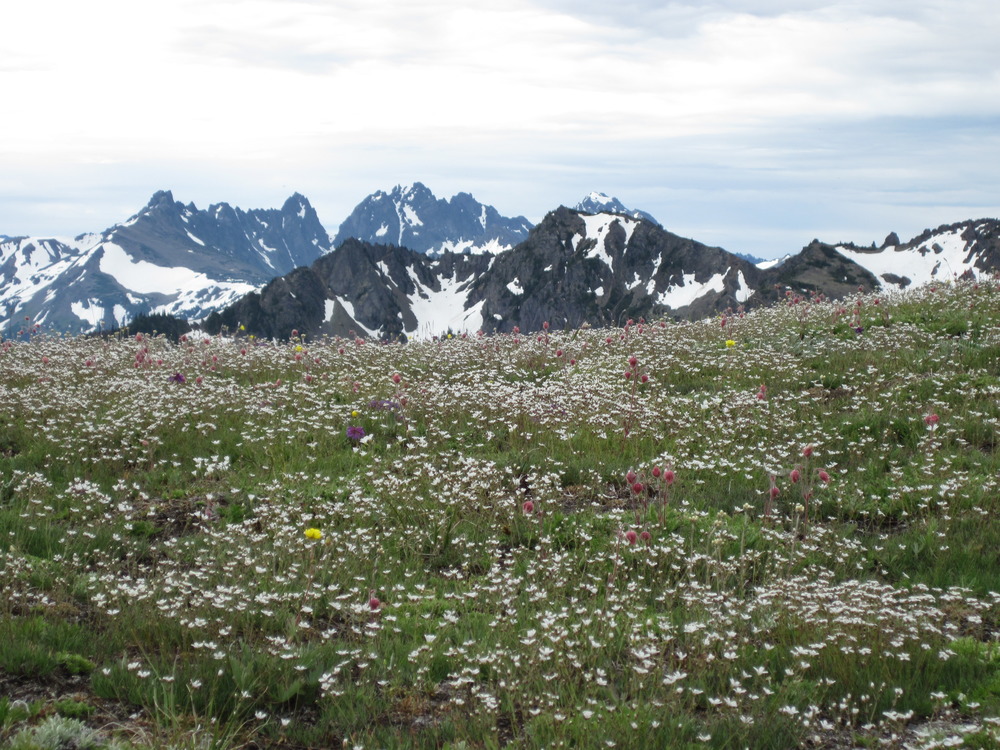
The Olympic mountains dressed up for summer with wildflowers.
Photo from ONP official website

Beyond the fact that Rhode Island borders an ocean, that’s where the similarity ends. Its highest and lowest points range from sea level to just over 800 feet. Olympic National Park, on the other hand, ranges from sea level to just under 8,000 feet with 7,965 foot tall Mount Olympus in the heart of the Olympic Mountains, the center of the park.

While one could traverse all of Rhode Island in a short span of time, to travel around Olympic NP requires planning for a variety of terrains with summer, fall, winter, and spring all possible this time of year.

It was on June 29, 1938 when the area became a National Park, the 13th largest U.S. National Park and the seventh largest in the contiguous US.

The Olympic Marmot

ONP is a true gem in the National Park system. It has a number of distinct animal species found nowhere else in the world including the snow mole, Mazama pocket gopher, Olympic chipmunk, and Olympic marmot. The Hoh River rain forest looks like a scene from a fantasy film with its moss draped trees – the result of receiving 150 inches of rain a year – making it the wettest National Park. The park also features glaciers in the mountains and over 60 miles of pristine beaches.

From the Infallible Wikipedia:

“The beach has unbroken stretches of wilderness ranging from 10 to 20 miles (16 to 32 km). While some beaches are primarily sand, others are covered with heavy rock and very large boulders. Bushy overgrowth, slippery footing, tides and misty rain forest weather all hinder foot travel. The coastal strip is more readily accessible than the interior of the Olympics; due to the difficult terrain, very few backpackers venture beyond casual day-hiking distances.

Tree framed sea stacks.

The most popular piece of the coastal strip is the 9-mile (14 km) Ozette Loop. The Park Service runs a registration and reservation program to control usage levels of this area. From the trailhead at Ozette Lake, a 3-mile (4.8 km) leg of the trail is a boardwalk-enhanced path through near primal coastal cedar swamp. Arriving at the ocean, it is a 3-mile walk supplemented by headland trails for high tides. This area has traditionally been favored by the Makah from Neah Bay. The third 3-mile leg is enabled by a boardwalk which has enhanced the loop’s visitor numbers.”

Unlike its Washington State counterpart, Rainier National Park, Olympic is not overrun with visitors each year. One can visit Olympic and encounter the occasional hiker and a handful of intrepid souls who trek to the beach for its incomparable vistas. One often feels as though they are an explorer from another century, viewing the landscape in much the same way those first settlers saw it.

I first went to ONP as a teenager on a day trip up to Hurricane Ridge. Most of what I recall about that trip was my dad stopping the car in a wide spot so we could get out and visit with a local – that is a deer – who was unafraid of people.

Me and the kids at Heart of the Hills campground in 2004

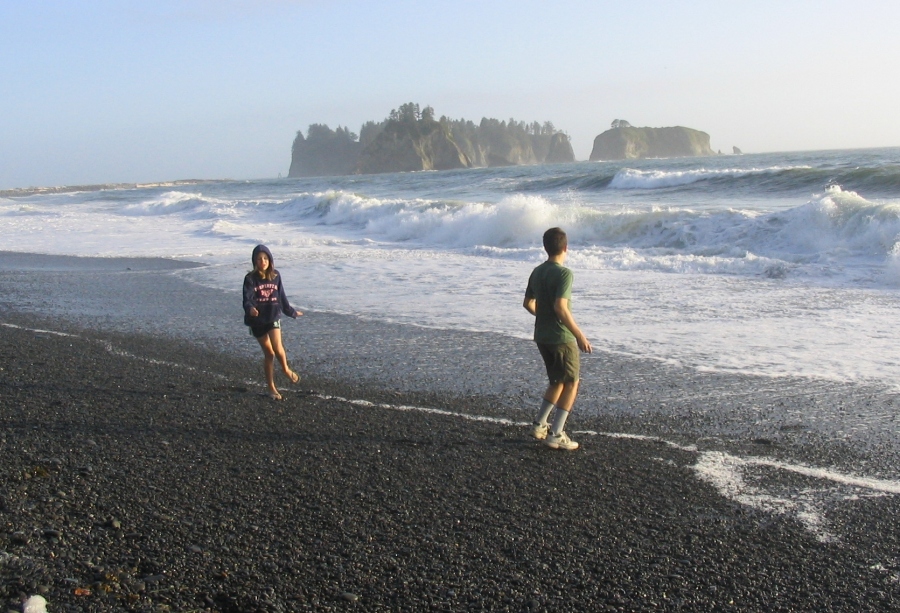
Although I’ve made the foray into the park a number of times, I still feel as though I don’t really know it. Of the 60 miles of beaches I’ve only ever seen the areas near Klaloch, Ozette, and Rialto. There is a stunning beauty when you stand at the Pacific Ocean’s edge and see the sea stacks, crashing waves, and hundreds of birds soaring overhead.

During a 2004 trip with the kids and hubby, we found ourselves communing with a herd of elk – again the elk were unconcerned at the human’s among them – an event which I’m certain the kids still recall. We marveled at the Hoh river rain forest, and all of us got a little bit fatigued at the driving required to traverse the sheer distance between places.

Even so, we still only experienced a tiny portion of the park.

The hubby and I have had on our bucket list to visit every National Park and although we’ve been to Olympic several times, it definitely deserves another trip or ten.

But don’t tell anyone – us Washingtonians like having Olympic all to ourselves.

The kid’s on Rialto Beach summer 2004

The links:

https://en.wikipedia.org/wiki/Olympic_National_Park

https://www.nps.gov/olym/index.htm

Dairy Queen Days

A summertime tradition

June 22, 2021

Dairy Queen’s famous soft serve vanilla cone

Nothing says ‘summer’ to me more than a trip to a drive in burger restaurant on a warm afternoon for something cold and frosty. Back in 1960’s Yakima, Washington there were only two places our family went when we wanted an ice cream based treat. The first was the A&W root beer stand for a float. The second was Dairy Queen. McDonald’s didn’t come to Yakima until the 1970’s and I’d never heard of Burger King or Wendy’s during my childhood.

Dairy Queen was the quintessential fast food joint for a hamburger, fries, and a milk shake. But more than that it was the only place one could get a soft serve ice cream cone.

It was the development of soft serve which led to the founding of the first Dairy Queen, in Joliet, Illinois, on June 22, 1940.

The Infallible Wikipedia shares:

“The soft-serve formula was first developed in 1938 by John Fremont ‘J.F.’ ‘Grandpa’ McCullough and his son Alex. They convinced friend and loyal customer Sherb Noble to offer the product in his ice cream store in Kankakee, Illinois. On the first day of sales, Noble dished out more than 1,600 servings of the new dessert within two hours. Noble and the McCulloughs went on to open the first Dairy Queen store in 1940 in Joliet, Illinois. While this Dairy Queen has not been in operation since the 1950s, the building still stands at 501 N Chicago Street as a city-designated landmark.

Since 1940, the chain has used a franchise system to expand its operations globally from ten stores in 1941 to one hundred by 1947, 1,446 in 1950, and 2,600 in 1955.”

On the Dairy Queen website they list 4,421 locations in 49 states. Texas boasts the largest number of restaurants with 594 stores. It continues to be a popular chain throughout the Midwest and the South with between 130 and 260 stores in each state. The only state without a DQ is Vermont. Washington State has the largest number of Dairy Queen restaurants of the Western states with 101 locations. Any way you scoop it, that’s a lot of ice cream.

When I became a teenager my friend Karen and I would sometimes walk to the Dairy Queen which was less than a mile from my house – and only four blocks from hers – just for one of those soft serve cones or, even better, one dipped in chocolate.

The summer my kids were 9 and 6 I dubbed it the Dairy Queen summer. Once a week we’d go through the drive through at the Redmond Way Dairy Queen for those same soft serve cones. In those days I would often just get a Dr. Pepper. What was I thinking?!

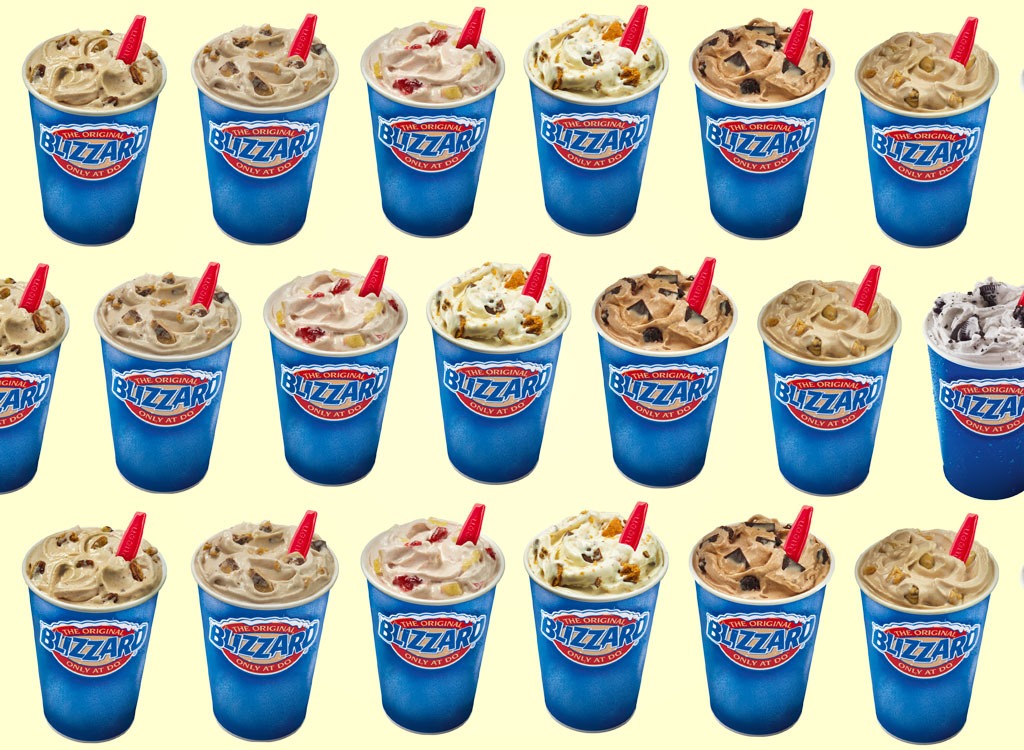
In the last year of my Dad’s life his world grew smaller and smaller. But some things never changed. One of those was the joy he got from getting a chocolate chip Blizzard from Dairy Queen. He’d been having increasing difficulties swallowing and the treat seemed to help soothe his throat.

One afternoon in August of 2019, I decided to take him on an outing to Dairy Queen for a Blizzard. This was no small task since getting him to the car, settled into the passenger seat, and then stowing his walker, was always an ordeal.

As we were headed to the restaurant, located out in West Yakima, he grew more and more agitated, questioning where the ‘he**’ I was taking him and proclaiming the adventure as ridiculous. “Dairy Queen,” I answered him, but he was not to be placated. That was NOT the right Dairy Queen.

The west Yakima Dairy Queen which caused so much angst

At the time I didn’t realize there were actually a half dozen stores in the town. I only knew of two. One in downtown Yakima and the one where I was heading.

Those were the longest 5.2 miles I’ve ever driven; eventually we arrived and got the treat but he carped about the amount of time it took all the way there and then the 5. 2 miles back again to his adult family home.

A few weeks later I had the chance to redeem myself. Off we headed to Dairy Queen, but this time I was taking no chances. I headed to the one I was sure he wanted; located in downtown Yakima it was a much closer 3.2 miles.

We were stopped by every traffic light in town (it was late afternoon and folks were headed home from work) and the carping started up, with a repeat of the previous trip. When we FINALLY got to the Dairy Queen some 20 minutes later, there was a bit of a line for the drive through. I figured the car ahead of us must have been ordering for a family of 15 based on how long it took. But I was desperate. No way was I exiting that line and driving anywhere else without that Blizzard. Eventually he got the treat and was placated for a few minutes. I needed a nap.

It was only after we were back – nearly an hour later – and he was dozing in his chair that I put Dairy Queen into the map application on my phone. I was dismayed to discover that the nearest store to where he lived was… 1.4 miles away. Next time, I promised, we would go there.

Alas, the weather changed and the Dairy Queen trips were done for the summer. By the end of October he was gone.

One of these warm June or July days I think I will splurge and raise a chocolate dipped cone in a toast to Dairy Queen for its place in our family history. Maybe I’ll even try a chocolate chip Blizzard in honor of Dad.

Naw. I’m a chocolate dipped ice cream cone girl all the way. Some things never change.

The link: https://en.wikipedia.org/wiki/Dairy_Queen