Trick or Treat

A tradition which spans centuries

October 25, 2022

My brothers trick or treating circa 1958

For children everywhere, dressing up for Halloween and getting to go out trick or treating is almost as great as Christmas. After all, what’s not to like about a day when you can put on a costume, roam the streets of your neighborhood in the dark, and have people fill your outstretched bag with candy?

For anyone who grew up in the 1950’s and later, Halloween has been a day to embrace the joys of childhood.

Which got me to wondering this week “When, exactly, did the tradition of trick or treating begin?”

For the answer we turn, of course, to the Infallible Wikipedia:

“Since the Middle Ages, a tradition of mumming on a certain holiday has existed in parts of Britain and Ireland. It involved going door-to-door in costume, performing short scenes or parts of plays in exchange for food or drink. The custom of trick-or-treating on Halloween may come from the belief that supernatural beings, or the souls of the dead, roamed the earth at this time and needed to be appeased.”

Mummers – those who participate in costumes in pantomime plays- depicted

Okay, so it was not invented recently. Today’s current trend in the United States has its roots some 80 years ago:

“Almost all pre-1940 uses of the term ‘trick-or-treat’ are from the United States and Canada. Trick-or-treating spread throughout the United States, stalled only by World War II sugar rationing that began in April, 1942 and lasted until June, 1947.

Early national attention to trick-or-treating was given in October 1947 issues of the children’s magazines Jack and Jill and Children’s Activities, and by Halloween episodes of the network radio programs The Baby Snooks Show in 1946 and The Jack Benny Show and The Adventures of Ozzie and Harriet in 1948. Trick-or-treating was depicted in the Peanuts comic strip in 1951. The custom had become firmly established in popular culture by 1952, when Walt Disney portrayed it in the cartoon Trick or Treat, and Ozzie and Harriet were besieged by trick-or-treaters on an episode of their television show. In 1953 UNICEF first conducted a national campaign for children to raise funds for the charity while trick-or-treating.

(snip) The National Confectioners Association reported in 2005 that 80 percent of adults in the United States planned to give out confectionery to trick-or-treaters, and that 93 percent of children, teenagers, and young adults planned to go trick-or-treating or participating in other Halloween activities.

My own earliest memories of Trick or Treating on Halloween were likely from the second fall after we moved to Yakima. That would have been the year I was five. It is all a bit fuzzy but I remember getting to dress up as a gypsy and wearing a hard plastic face mask with the face of a smiling lady wearing a scarf and large earrings painted on it.
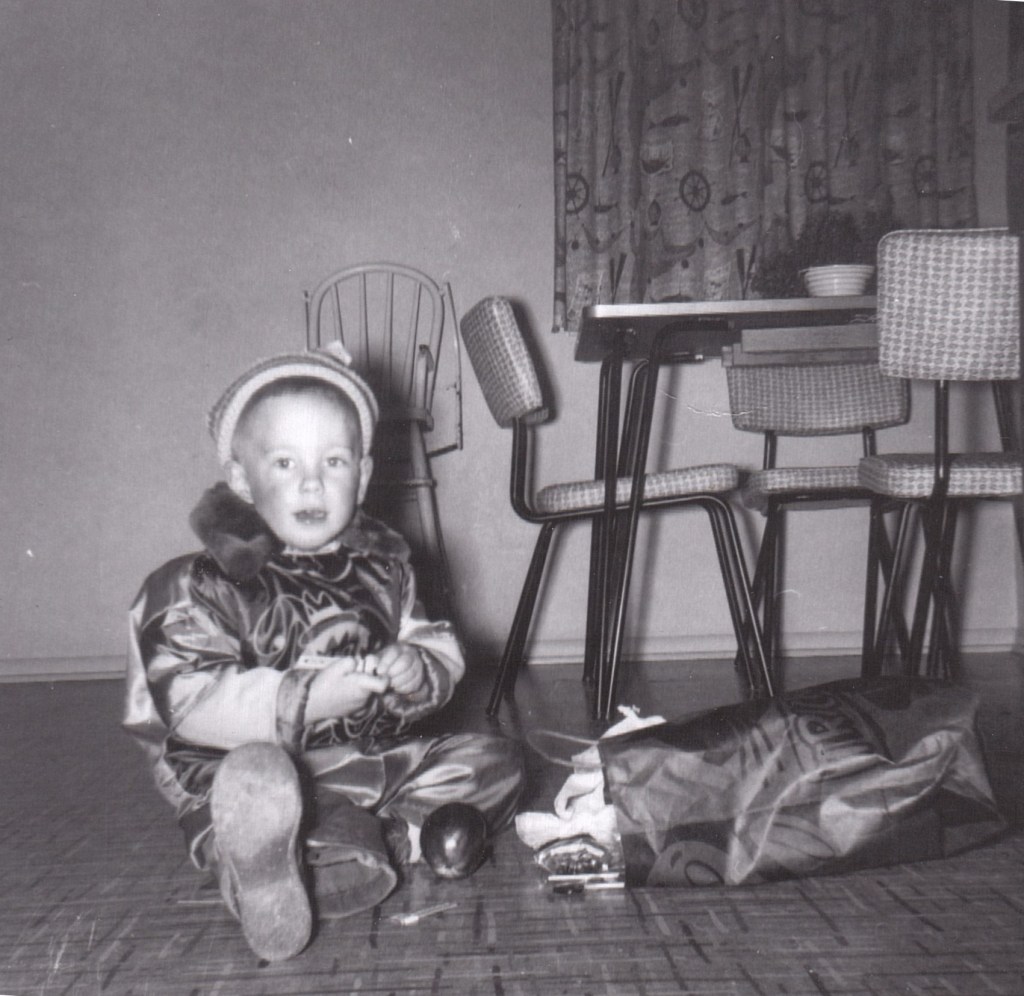
My older brother evaluating his loot circa 1958

It was my father who walked with my sister and me around the neighborhood. I’m pretty sure my older brother got to trick or treat with friends. The best part was when we got home and we dumped our prizes out on the living room floor and sorted the bounty.

This went on for the next five or six years. Eventually, my older brother ‘aged’ out since my mother had a rule that once you turned twelve you were too old for trick or treating. By the time I first went trick or treating, my oldest brother had been relegated to the passing out of candy.

When the year arrived I turned twelve, my mother had apparently been worn down by all her children because somehow I was allowed to go out trick or treating. The last year I remember participating was the year I was… 16! In my diary entry that year I wrote the following:

“In Reveille (yearbook class) we had a party, and it started to snow. The snow stuck, 2 inches of it. Andi & Vicki came down & we went out Trick or treating.”

I knew that it snowed the last year I went trick or treating but was surprised at how old I was!

Eventually the allure of trick or treating faded away… until October of 1990… and it was time to share the tradition with my offspring.

A few days before Halloween my son (in his tux, tail, and top hat) and I joined our Mom and Baby group for a party.

My son turned nine months old that Halloween and I dressed him up in a baby onesie which looked like a tiny tuxedo. I made him a black top hat and he was quite dapper. Then the hubby carted him to a few neighbors’ houses so he could trick or treat.

In the ensuing years, Halloween was ALWAYS a big deal for the kids, a tradition to be embraced. Each year they both would plan their costumes and this mom was frequently pressed into sewing services to create their vision.

My kids and nieces, ready to head out trick or treating. My son is dressed as the Pokemon Marawok and my daughter as a can-can girl. One of the years I did not make costumes.

By the time my daughter was a teenager, we were involved with the Rainbow Girls and Halloween was an opportunity to help the community. For most of those years, our group planned a food collection event. The girls, most of them now too old to be trick or treating, would distribute fliers a week to ten days before the holiday to about 300 houses asking for people to donate canned items for the food bank. Then, on Halloween night, the girls would go in pairs to the houses and collect the food. An adult would be in a car on the road so the girls had a place to put the collected items.

When I asked my daughter what her most memorable Halloween was, here’s what she wrote:

“Not sure if this counts but my most memorable Halloween from my youth was the year I was worthy advisor (president) and we collected like 600lbs of canned goods for NW Harvest.”

Although the photo is a bit fuzzy, you can see the 600K+ pounds of food collected by the Rainbow Girls. 2009

Although I miss the excitement of Halloween night with my children, it is fun to see a new generation ring my doorbell and shout “Trick Or Treat!” when I open it.

The link:

https://en.wikipedia.org/wiki/Trick-or-treating

The Eyes Have It

Contact Lenses

October 18, 2022

Add for contact lenses circa 1970

It was on October 18, 1964 when President Lyndon Johnson did something on live TV which benefitted the optically challenged: he wore contact lenses.

Now, for those of you who do not need corrective lenses and have never had to struggle with fogged up or rained on glasses or have never found yourself patting around your nightstand looked for spectacles, the then President of the United States wearing contact lenses might seem like a nothing burger.

But I, like hundreds of millions of people, do rely on devices to provide vision correction and contact lenses are a wonderful invention which has changed, literally, the way we see life.

The idea of being able to correct vision by placing an artificial lens on the eye can be traced back to 1508 when Leonardo da Vinci illustrated his concept in Codex of the eye, Manual D. It was unworkable. Other inventors also tried over the next few centuries.  

Workable contact lenses made their way into use gradually. Thanks to the Infallible Wikipedia we learn the following:

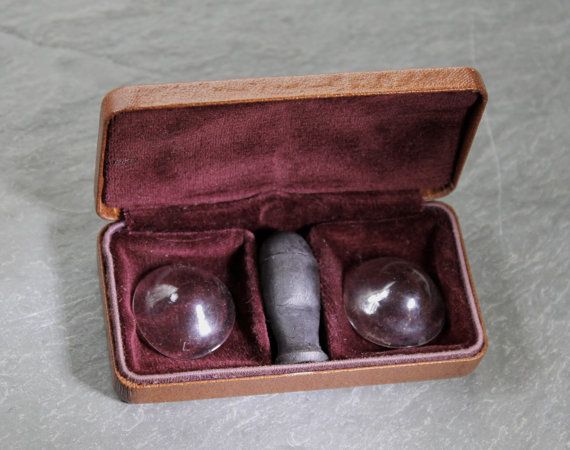
Vintage contact lenses

“Although Louis J. Girard invented a scleral contact lens in 1887, it was German ophthalmologist Adolf Gaston Eugen Fick who in 1888 fabricated the first successful afocal scleral contact lens. Approximately 18–21 mm (0.71–0.83 in) in diameter, the heavy blown-glass shells rested on the less sensitive rim of tissue surrounding the cornea and floated on a dextrose solution. He experimented with fitting the lenses initially on rabbits, then on himself, and lastly on a small group of volunteers, publishing his work, ‘Contactbrille’, in the March 1888 edition of Archiv für Augenheilkunde. Large and unwieldy, Fick’s lens could be worn only for a couple of hours at a time. August Müller of Kiel, Germany, corrected his own severe myopia with a more convenient blown-glass scleral contact lens of his own manufacture in 1888.

The development of polymethyl methacrylate (PMMA) in the 1930s paved the way for the manufacture of plastic scleral lenses. In 1936, optometrist William Feinbloom introduced a hybrid lens composed of glass and plastic, and in 1937 it was reported that some 3,000 Americans were already wearing contact lenses. In 1939, Hungarian ophthalmologist Dr.István Györffy produced the first fully plastic contact lens. The following year, German optometrist Heinrich Wöhlk produced his own version of plastic lenses based on experiments performed during the 1930s.”

Types of Contact lenses available today

Contact lenses were, however, expensive and only the wealthy could afford them.

That started to change in the 1960’s but even then one needed to purchase contact lens insurance in order to replace lost or broken lenses (which happened all the time!)

The next breakthrough in technology – which was twofold – was the development of rigid gas permeable lenses and of soft contact lenses. Both allowed oxygen to pass through the lenses making it possible to keep the lenses on their eyes for longer periods of time. Some soft contact lenses can be worn up to 30 consecutive days.

As we’ve come to expect from the Infallible Wikipedia, there is exhaustive and detailed information regarding this topic. A link is provided below.

You can even get contacts with a creepy look.

When I entered fifth grade it was discovered, due to the fact that my teacher, Miss Crosslin, kept the lights turned off in her classroom a great deal of the time. I couldn’t read the blackboard. Soon visits to the eye doctor commenced and a prescription was written for glasses.

For a gangly pre-pubescent girl, having to get ugly glasses was a disaster. I HATED wearing glasses. I had to endure it for two full years until, thanks to my older sister, I became aware of the miracle known as contact lenses.

Then the lobbying began. My sister had been relentless in convincing our mother that she needed contacts, finally getting them while in eighth grade.

The summer between my seventh and eighth grade year, I too was allowed to join the contact lens wearing community.

I showed my niece these two photos and she said I ‘glowed up’ with the addition of contact lenses.

Which sounds much simpler than it was. In those days you had to ‘train’ your eyes to wear them, only being allowed certain amounts of time each day.

The very first day it was a whopping… fifteen minutes.

But I was determined to be done with glasses. All that summer I dutifully followed everything the eye doc told me to do. Fifteen minutes for week one, then twenty minutes for week two, then 30 minutes, then an hour. On and on it went until I was finally able to wear them for most of the day.

It truly was a miracle. But not without problems. The lenses didn’t fit particularly well and had an annoying propensity to pop out of my eye. I refer you back to the contact lens insurance thing. Yes, I had that. But even so, those little pieces of plastic were treated like gold.

A lost contact prompted getting down on hands and knees and scouring all surfaces in search of the errant lens.

The year I was 19 was particularly bad for lost lenses. I was traveling with the Rainbow Girls that year and I can’t recall how many times I seemed to lose a contact in my car while driving. I even had to have another girl drive me home one day when I couldn’t find the lost lens. I did unearth it later but a misplaced contact meant having to buy a new one. It was a pain.

But I didn’t care. Being able to wear contacts was always preferable to the alternative.

With the advent of Lasik, contact lens wearers had a new choice which allowed them to get out of their contacts altogether. For me, I have stayed old school, and still wear contacts. I figure I will wear them until the day arrives when I need to have cataract lens replacement.

The advancements in technology have made it so that the gas permeable lenses – for those of us who still wear them –stay in the eye and don’t pop out. Looking for a lost lens is a rare event these days.

But I kind of miss the thrill of hunting for something clear, thin, and ½ inch in diameter all while being blind in one eye. How else can I get in my calisthenics work out each day?

https://en.wikipedia.org/wiki/Contact_lens

October 1582

Ten Days Erased from History

October 11, 2022

In today’s world people are more connected than ever to time. We hardly go anywhere without our phones or there being a clock of some sort telling us the exact time, often down to the 100th of a second.

Yet, there are also moments in our lives when we lose track of time. Maybe a few minutes here and there. An hour or two. Possibly even a day. 

But to lose ten whole days requires a pretty major event.

This singular event, which took place in October 1582, corrected a worldwide problem over 1200 years in the making. Imagine this: you go to bed on October 4th and you wake up and it’s now October 15.

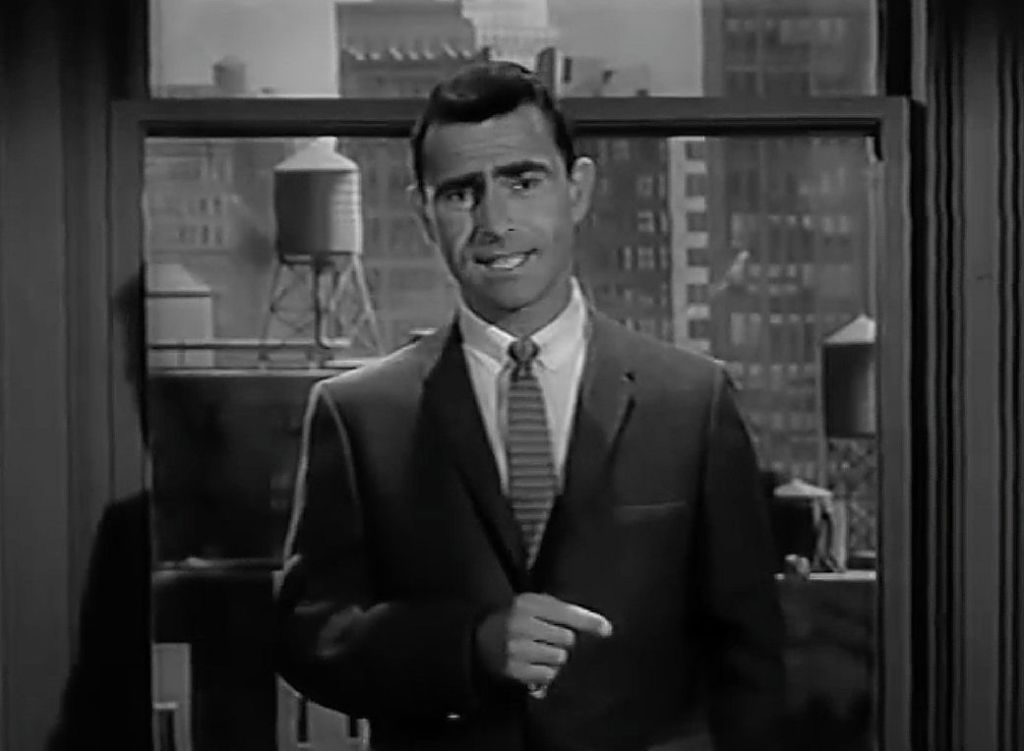
Like last week’s post, you might think it could only happen in The Twilight Zone. But the ten days between those two dates in 1582 were, literally, erased from the calendar as though they never happened.

What was ushered in was a new calendar which we still follow 440 years later. The Infallible Wikipedia helpfully tells us:

“The Gregorian calendar is the calendar used in most parts of the world. It was introduced in October 1582 by Pope Gregory XIII as a modification of, and replacement for, the Julian calendar. The principal change was to space leap years differently so as to make the average calendar year 365.2425 days long, more closely approximating the 365.2422-day ‘tropical’ or ‘solar’ year that is determined by the Earth’s revolution around the Sun. (snip)

There were two reasons to establish the Gregorian calendar. First, the Julian calendar assumed incorrectly that the average solar year is exactly 365.25 days long, an overestimate of a little under one day per century, and thus has a leap year every four years without exception. The Gregorian reform shortened the average (calendar) year by 0.0075 days to stop the drift of the calendar with respect to the equinoxes.

Use of the Julian calendar had caused many problems, not the least of which being that the seasons no longer aligned with the longest and shortest days of the year or the spring or autumn equinoxes.

The most innovative part of the calendar adjustment had to do with the calculation of leap years. Since we experience a 366 day year once every four years, leap years were the perfect vehicle to make adjustments.

So every four years we gain a day… except when we don’t. If the leap year is set to occur in a ‘century’ year (1800, 1900, 2000, etc) then there is NOT a leap year. But with one exception. Any ‘century’ year which can be divided by 400 IS a leap year. Which is why the year 2000 was a leap year but 2100, 2200, and 2300 will NOT be. The next ‘century’ leap year does not occur until 2400.

In thinking about those ten days simply being erased got me thinking about a few times in my own life when time lost all meaning and a series of days squished together without definition.

There were several times when severe illness did that for me. An allergic reaction to penicillin in the sixth grade caused me to miss the Central Washington Fair as I lay in bed for a week and half; contracting the hard measles the year I was in 8th grade (https://barbaradevore.com/2020/03/03/seasons-in-the-sun/); The two weeks I came home from college in January of 1978 with the chicken pox; and, more recently, in late February 2020 when I had Covid 19.

But there was one particular event which occurred when the whole world seemed to stop for ten days. I had been in Yakima in September and October 2019 nearly full time as my Dad’s health deteriorated and he had been placed on hospice. Although I had returned home for a couple days, the call came from the hospice that the end was approaching.

My message to my siblings from Tuesday, October 15, 2019:

“Dad is in bed now and minimally responsive. He is not opening his eyes on command. The only time he does respond is when the staff needs to take care of his physical needs such as changing him, etc. He dislikes being touched although he did let her hold his hand. But he does not want to be rubbed, etc.

His BP is still good and he still has some fight left in him…. However, Lecia (the hospice nurse) said she expects him to pass within the next few days and would be surprised if he makes it through the weekend.”

As it turned out Lecia, and everyone else, were completely wrong.

Dad had slipped into a comatose state… and remained that way for a total of ten days. Over the course of those days, all of his children and various family members came to see him.

Even though the days seemed to morph together, I was moved enough by the fall colors in Yakima to pull to the side of the road and snap a couple shots looking west towards the mountains where an early snowfall had dusted their tops. October 19 2019

It was a weird scene. Dad lay in bed, eyes closed, unresponsive, as family visited and reminisced. And he hung on. Day after day. Night after night. Every day the caregivers at Apple Creek (a wonderful and caring place!) were baffled by how long he was able to survive without food or water. His mouth was moistened with an oral sponge on a stick.

Time morphed into episodes of light and dark and lost all meaning. Eventually, family members had to return to their lives and, on the last few days, it was just three of us – my brother, my sister, and me – who were there, taking turns in our vigil.

My sister and I did two ‘overnights’ together, each using one of the recliners so we could sleep.

Finally, a night arrived where, due to her job as teacher and the need to make lesson plans for the substitute, my sister could not stay overnight. So I volunteered to take on the duty solo. When I fell asleep that night, I could not have told you the date or the time. All I know is that I was going to be there with dad.

Then, around 4 a.m., things started to change. In those ten days of sameness dad never moved, never ate, never talked, never drank. It was just always the same.

Except that when, suddenly, it was no longer the same. At the moment of death, an electric impulse vibrated through his entire body for several seconds, his whole being coming to life; it was as if it was his final resistance to death.

When it was over I knew I had experienced something extraordinary; even so I was shaken by the ordeal. And yet the first thing I did after that event was to look at the clock and note the time and the day.

It was 5:06 a.m. on Thursday, October 24. As surely as the ten days which were erased in October 1582, so had time been reset for me in October 2019.

The link:

https://en.wikipedia.org/wiki/Gregorian_calendar

The Twilight Zone

The Dimension of Imagination

October 4, 2022

By the late 1950’s television programming experienced an explosion of creativity. New and innovative shows were being introduced. It was the first week of October, 1959, when one such show debuted. It went on to leave a huge cultural impact. The show: The Twilight Zone.

The Infallible Wikipedia explains that it “is an American science fiction horror anthology television series created and presented by Rod Serling, which ran for five seasons on CBS from October 2, 1959, to June 19, 1964. Each episode presents a stand-alone story in which characters find themselves dealing with often disturbing or unusual events, an experience described as entering ‘the Twilight Zone,’ often with a surprise ending and a moral. Although predominantly science-fiction, the show’s paranormal and Kafkaesque events leaned the show towards fantasy and horror. The phrase ‘twilight zone,’ inspired by the series, is used to describe surreal experiences.”

The show was truly groundbreaking and, since I was a very small child at the time and my mother forbid us from watching anything on TV she felt we could not handle, I never saw the show live, only a few reruns years later.

But even then, many of the episodes were disturbing. I present for your consideration the case of “Talking Tina,” a doll who seems to come to life. It’s a very creepy episode with a creepy doll. There’s just something about dolls which make them a rich target for horror.

Despite the often macabre nature of The Twilight Zone, it was highly successful and impactful. Also from the Infallible Wikipedia:

The person most associated with the Twilight Zone: Rod Serling

“The Twilight Zone is widely regarded as one of the greatest television series of all time. In 2002, the series was ranked No. 26 on TV Guide‘s 50 Greatest TV Shows of All Time. In 2004, it was ranked No. 8 on TV Guide’s Top Cult Shows Ever, moving to No. 9 three years later. In 2013, the Writers Guild of America ranked it as the third best-written TV series and TV Guide ranked it as the fourth greatest drama, the second greatest sci-fi show and the fifth greatest show of all time. In 2016, the series was ranked No. 7 on Rolling Stone‘s list of the 100 greatest shows of all time and was ranked No. 12 in 2022.”

One day, in the summer of 2003, I was in Yakima for the Rainbow Girls annual convention. On a whim, I decided to drive by the house where I grew up: 406 South 31st Avenue. I had done this from time to time out of interest as to how the house and neighborhood might look. Now most of us think that the place where we grew up will never change. But on that warm June afternoon I discovered things had changed.

I turned right onto 31st off Tieton Drive. I looked for the Osteopathic hospital where we’d ridden our bikes as kids; the small brick church next door; the Winterringer’s mid-century modern house across the street on the left.

At first, all seemed normal. But then, as I looked right again, something was off. The duplex where Mrs. Shaw lived wasn’t quite how I recalled it. I drove on and looked left. The house I grew up in was similar enough to how it had been when I was a kid to bring me comfort.

The author dressed for Easter? With the Goodhue house – one of the houses moved to a new location in 2003 – in the background. On beyond one can see the five story Memorial Hospital and its smokestack. Circa 1970

But across the street where the Shockley, and then the Goodhue, families lived, was a place I did not recognize. The house – which I had looked at nearly everyday from the time we moved there in 1961 until I moved away in the fall of 1977 – was still there but now it was perched on boards, lifted above the ground by several feet. The yard and plants, which Mr. Goodhue took meticulous care of, were gone. In their place were dirt and a backhoe.

I stopped the car and stared up and down the right side of the street. House after house was in a similar condition: up on boards sitting askew. It continued this way the entire block. The Dohrman’s house. The Bluhm’s. Everything on the right was in a state of disarray. Everything on the left was how I remembered.

Yes, the thought which dominated was that I had, in fact, entered the Twilight Zone. I was in a place I knew, but similar to a dream, the details were wrong. I continued my slow roll up the street and, although still shaken, drove on to my parent’s house where I was meeting them, my sister, my nieces and daughter for swim time.

Only then did I learn that Memorial Hospital, a block to the east, had purchased all of the houses on the right side of the street and that they were being moved, as a group, to a new part of Yakima. I had happened upon the project in the midst of extracting the houses just prior to when the move was to take place.

Photo from the Yakima Herald Republic 2003 of the excavation
One of the houses impacted by the Hospital expansion in the process of being moved. Yakima Herald Republic photo 2003

It took some digging, but I did find photographic evidence of the event in the Yakima Herald Republic newspaper which confirmed that this took place in the summer of 2003. Today, the right side of the street is adorned with an attractive fence and lovely trees and foliage.

Screenshot capture of how the street looks today from Google Maps. The house on the left with the flag is the one I grew up in. Note the lovely foliage on the right.

Except for those of us who, unsuspecting, happened upon it in the summer of 2003, it seems perfectly normal. But I know better. I know that it was once a part of the Twilight Zone.

A few links:

https://en.wikipedia.org/wiki/The_Twilight_Zone_(1959_TV_series)

https://en.wikipedia.org/wiki/List_of_The_Twilight_Zone_(1959_TV_series)_episodes

https://youtu.be/If3SXJeZzMQ (Twilight Zone Opening monologue)

MeatLoaf

Two Out Of Three Ain’t Bad

September 27, 2022

When reading the Infallible Wikipedia about this artist, who was born on September 27, 1947, what comes across is a larger than life personality whose personal excesses drove his incredible success but also his failures.

As a child, Marvin (Michael) Lee Aday*, was the target of other children for his physical appearance. He once stated in an interview that when he was born, he was “ ‘bright red and stayed that way for days’ and that his father said he looked like ‘nine pounds of ground chuck’, and convinced hospital staff to put the name ‘Meat’ on his crib. He was later called ‘M.L.’ in reference to his initials, but when his weight increased, his seventh-grade classmates referred to him as ‘Meatloaf’, referring to his 5-foot, 2 inches, 240 pound stature. He also attributed the nickname to an incident where, after he stepped on a football coach’s foot, the coach yelled ‘Get off my foot, you hunk of meatloaf!’.”

The name stuck and, as a performer, “Meatloaf” became the name by which he was famous. In fact, until I started researching this article, I did not know his real name.

His story, like so many other artists, was one of forming a band and playing every gig he could get. He landed singing roles in several musicals including The Rocky Horror Show and Hair. These successes eventually led to teaming up with Jim Steinman, a composer, lyricist, and producer; together they put together Meatloaf’s most iconic album Bat Out of Hell. Also from the Infallible Wikipedia:

The official video for Two Out Of Three Ain’t Bad

“Meat Loaf and Steinman spent time seeking a record deal; however, their approaches were rejected by each record company, because their songs did not fit any specific recognized music industry style. Todd Rundgren, under the impression that they already had a record deal, agreed to produce the album as well as play lead guitar along with other members of Rundgren’s band Utopia and Max Weinberg. They then shopped the record around, but they still had no takers until Steve Popovich’s Cleveland International Records took a chance, releasing Bat Out of Hell in October 1977.”

It was a great decision. That album went on to sell an estimated 43 million copies, making it one of the best selling albums of all time. It has spent an incredible 485 weeks on the UK’s Album Chart, only two weeks less than Fleetwood Mac’s Rumors.

Meatloaf with his composer, lyricist, and producer, Jim Steinman

Like many artists, it seems as if his over the top persona was, perhaps, a way to overcome some of the teasing he endured as a child. In an interview he once said, “Being too fat to play with the other children, I had to spend a lot of time alone, which probably has a lot to do with the way I am today. I’m usually alone in my hotel room from right after the show until the next day’s sound check. And I’m never bored; I don’t get bored. Probably because mothers wouldn’t let their kids play with me.”

Sadly, he died suddenly on January 20, 2022 at the age of 74. He’d had Covid several weeks earlier, but no specific cause of death was listed.

Somewhat belatedly Meatloaf’s Bat Out of Hell album joined my hitchhiker music list when I found the CD at Value Village one day a few years ago. I admit that I had only heard his iconic Paradise By the Dashboard Lights a few times previously, preferring his ballads, particularly Two Out of Three Ain’t Bad.

I think that one of the reasons that song resonated with so many of my generation might have been due to the pain which the artist experienced early in life. To listen to his interpretation of the song there is absolutely no doubt that he understands what rejection feels like.

Two Out of Three Ain’t Bad is a song I can listen to again and again, appreciating Meatloaf’s vocal ability and soulful rendition. The year the song charted, I experienced a failed relationship and could truly relate to the words and music.

Rest In Peace Michael Lee Addy. The world was made better by your contributions.

*He changed his name to Michael as an adult.

A link:

https://en.wikipedia.org/wiki/Meat_Loaf

Happy Days

Fonzie Jumps the Shark

September 20, 2022

There was, perhaps, no more popular and successful Sitcom of the 1970’s than Happy Days. In its eleven years on the air it was culture defining.

Its early success played off the nostalgia of the 1950’s, portraying a traditional family of that era. The Infallible Wikipedia tells us:

“Happy Days originated during a time of 1950s nostalgic interest as evident in 1970s film, television, and music. In late winter of 1971, Michael Eisner was snowed in at Newark airport where he bumped into Tom Miller, head of development at Paramount. Eisner has stated that he told Miller, ‘Tom, this is ridiculous. We’re wasting our time here. Let’s write a show.’ The script treatment that came out of that did not sell. But in spite of the market research department telling them that the 1950s theme would not work, they decided to redo it, and this was accepted as a pilot. This unsold pilot was filmed in late 1971 and titled New Family in Town. (snip) Paramount passed on making it into a weekly series, and the pilot was recycled with the title Love and the Television Set (later retitled Love and the Happy Days for syndication), for presentation on the television anthology series Love, American Style. Also in 1971, the musical Grease had a successful opening in Chicago, and by the following year became successful on Broadway. Also in 1972, George Lucas asked to view the pilot to determine if Ron Howard would be suitable to play a teenager in American Graffiti, then in pre-production. Lucas immediately cast Howard in the film, which became one of the top-grossing films of 1973.”

It was on September 20, 1977, however, when one Happy Days episode aired which has become a cultural catch phrase to describe a moment when a TV series, particularly, has passed its prime. That phrase is “jumping the shark.”

We can trace the moment back to a scene where Fonzie – arguably the most popular character from Happy Days – accepts a challenge from a character called ‘The California Kid’ to water ski over a tiger shark.

The ‘Kid’ chickens out but Fonzie, who feels he has something to prove, continues with the challenge, and is seen in his iconic leather jacket water skiing, successfully jumping the shark.

To be clear, Happy Days continued for seven additional seasons. It was only in 1985 when the phrase ‘jumping the shark’ was introduced.

Also from the Infallible Wikipedia:

“The idiom ‘jumping the shark’ was coined in 1985 by Jon Hein in response to a 1977 episode from the fifth season of the American sitcom Happy Days, in which Fonzie (Henry Winkler) jumps over a shark while on water-skis. The phrase is pejorative and is used to argue that a creative work or outlet appears to be making a stunt in a seemingly exhaustive attempt to generate elevated attention or publicity to something that was once perceived as popular, but is no longer.”

I can’t recall when, exactly, I became familiar with the phrase. But for me the term has come to be representative of what I refer to as a cultural reference.

Henry Winkler, aka Fonzie, about to jump the shark

When my kids were about six and nine years old, I found myself using what I believed were common cultural references only to discover that my kids did NOT know them.

Thus I began a program of renting – actually I would check them out from the King County Public Library – movies which I felt they should see.

At first it was all the old musicals from the 1950’s and 1960’s which kept us entertained for a number of years. Then, when the kids were a bit older, I decided to introduce them to movies like Top Gun, Blazing Saddles, Animal House, and Risky Business.

There were more than a few awkward moments when my 13 year old daughter would hide her face behind a pillow when some inappropriate scene would appear on screen.

Note to parents out there: be sure to preview all movies before showing them to young teens.

Thinking that they needed to know about Monty Python, we gave our son the complete Monty Python DVD set one year for his birthday. Soon he was the one making cultural references and for years would quote famous lines from the show, my efforts successful.

I’ve always felt that I contributed significantly to my children’s general knowledge base.

That said, there were many times when I would comment on what I thought of as a common cultural reference only to discover my children staring at me, blank looks on their faces.

Inevitably that would lead to me trotting over to the computer and searching the internet to find the clip or explanation so they could learn it too.

There are times, nowadays, when my daughter, particularly, is on the receiving end of the blank stare. Yes, I am frequently the one who does not know a current cultural reference.

Rather than admitting I don’t know the reference, I often make a mental note to check it out later. FWIW, its how I’ve learned what the pervasive acronyms splattered throughout social media mean. (FWIW= For What It’s Worth).

After experiencing an unfamiliar cultural reference, I’ve often returned home to watch a movie or TV show which their generation all know and, in some cases, I can see the attraction. But not always.

But I do think making a sincere effort to understand another person’s cultural references is important. After all, I’m not quite ready to jump the shark. Not Yet. WBU?

A few links for your cultural reference education:

https://en.wikipedia.org/wiki/Happy_Days

https://en.wikipedia.org/wiki/Jumping_the_shark

Alpha Phi

Celebrating 150 years of Sorority Life

September 13, 2022

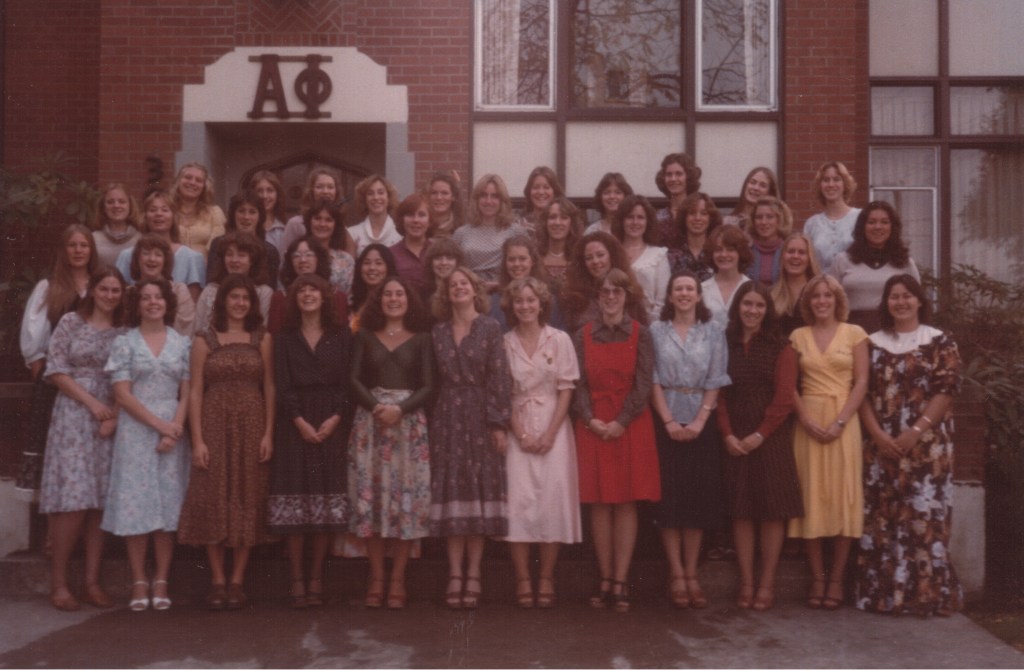
The front of my Alpha Phi Pledge book and a photo of our house at the University of Puget Sound. 1977

The formation of Greek letter societies on college campuses can be traced back to 1776. The idea behind the first such group – Phi Beta Kappa – was to provide a place for like minded individuals in the pursuit of academic excellence. Phi Beta Kappa continues today as a prestigious academic honor society.

Over the next century Fraternities, as they came to be called, were social groups formed for men. It wasn’t until 1870 when the first actual Greek letter group for women was established. That honor goes to Kappa Alpha Theta which was formed in January 1870 at Indiana’s DePauw University; close on their heels was Kappa Kappa Gamma founded in October of the same year at Monmouth College in Illinois.*

Third on that list was Alpha Phi Fraternity, established on September 18, 1872 at Syracuse University in Syracuse, New York.

The term Sorority had not yet been coined to represent the female version of a Fraternity which is why the first three such groups for women were formed as Fraternities.

When I pledged Alpha Phi at the University of Puget Sound in the fall of 1977, I knew little of the Greek organizations. Yes, my mother had been a member of Delta Delta Delta but had talked little of her time in the sorority.

I also knew that my grandmother had been a housemother for the Sigma Kappa sorority on the University of Washington campus in the early to mid-1960’s.

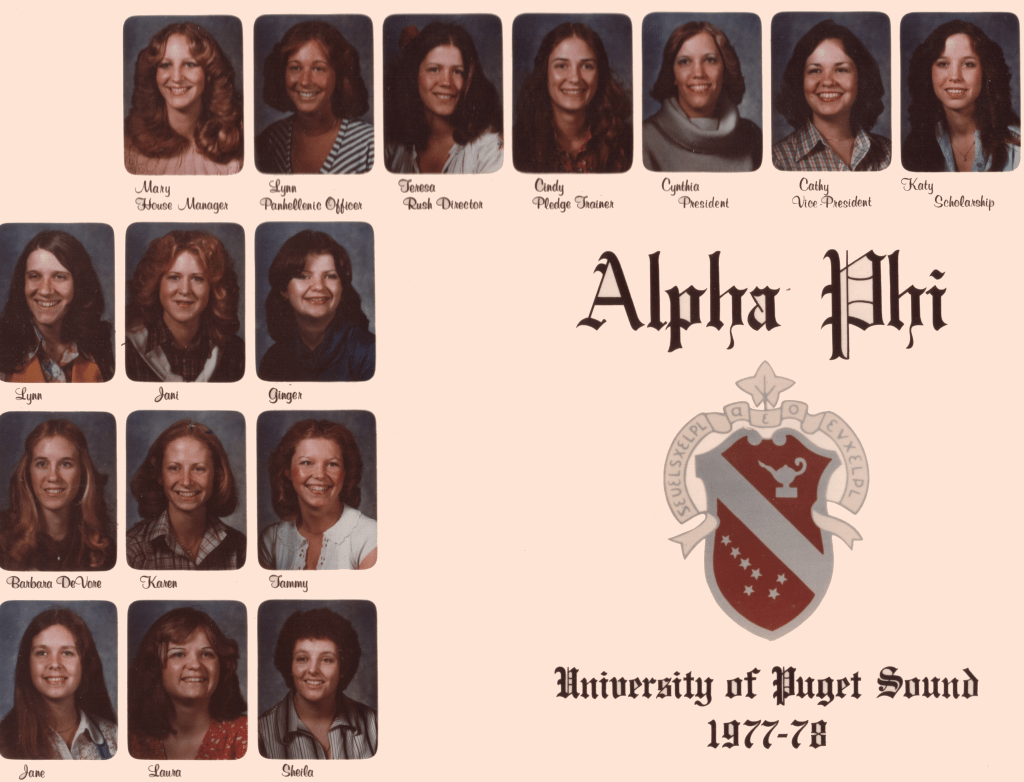
A few of my sorority sisters from the official composite of the members in 1977-78

Knowing this, and having stayed at the Sigma Kappa house a couple of times while my grandmother was there, I had long wished to join a sorority when I attended college. More on that in a bit.

First, the Infallible Wikipedia tells us this about Alpha Phi:

“At the time of the founding there were only 666 women attending Syracuse; ten of them eventually formed Alpha Phi to create an organization ‘on the principles of the promotion of growth in character; unity of feeling, sisterly affection, and social communion among the members.’ Although the actual founding date is September 18, 1872, Alpha Phi has been celebrating their Founders Day on October 10 since 1902, since many colleges and universities were not open for classes in mid-September at that time. Alpha Phi considers itself a women’s fraternity because its founding date predates the invention of the word ‘sorority.’ (snip)

Like many other women’s fraternities, Alpha Phi recognizes multiple types of symbols, with the Ivy Leaf as their primary symbol. The fraternity’s official colors are Bordeaux and silver. The colors were originally blue and gold; however, these colors were similar to those of Delta Upsilon Fraternity so they were changed. The official flowers are the Lily of the Valley and the Forget-me-not. Alpha Phi lists its ideals as ‘Sisterhood, Generosity, Innovation, and Character.’ Alpha Phi’s public motto is ‘union hand in hand’.”

My roomies from my first semester atop the bunk beds: Dee, Susie, and Connie.

All of these things I learned after becoming a pledge. A pledge is someone who commits to joining the organization once they have completed a probationary period. I successfully completed my probation and was initiated into Alpha Phi in January 1978.

The two years I was a member of Alpha Phi were, perhaps, the most influential and memorable times of my life. I loved everything about Sorority life. The Monday night chapter meetings; the Friday and Saturday night functions with the Fraternities; the crazy antics of my roomies; having roomies; living on Greek row.

Unlike most students, I was a junior when I arrived on the UPS campus. I had spent the previous two years at Yakima Valley College (YVC). I discovered, spring of my sophomore year at that institution, that I was a few credits short of what I needed for my AA degree. Having the AA was essential to avoid spending an extra year – and extra money – getting my BA degree.

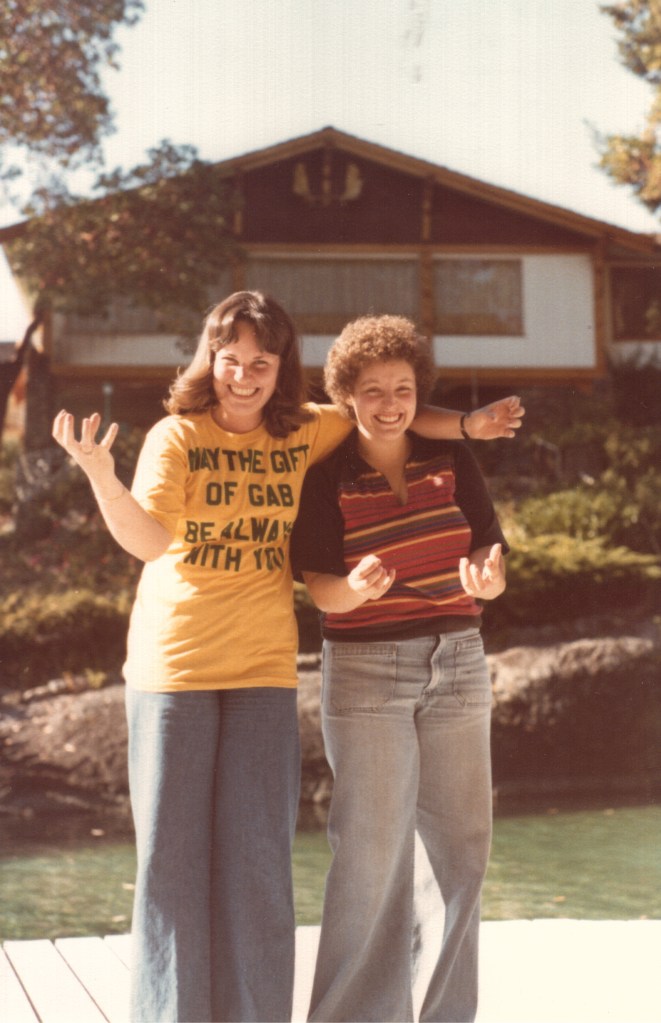
With Roomies Cathy and Sheila at Sheila’s home in Sooke, B.C., summer of 1978

The summer before UPS, I took a Spanish class at YVC to get those credits and ended up meeting a gal name Toni. Unbeknownst to me, Toni was a member of Alpha Phi at UPS and, due to her own issues getting her degree from UPS, had signed up for the YVC class also. I so appreciate Toni as she took the time and effort to write a recommendation for me, paving the way for my membership in Alpha Phi.

I assumed I would join Delta Delta Delta (Tri-Delta) as both my mother and my aunt had been members. There were rules regarding how a ‘legacy’ – someone who had a mother, sister, or grandmother who belonged to a particular sorority – was processed through ‘Rush.’ (Rush was a multi-day process where the Rushees would go, in groups of 25 to 30, to each and every sorority on campus. There you would meet and talk to members of a particular house before being ushered out and then herded to the next house.) Later, I came to understand, the members of each house would meet and decide ‘who’ to invite back the next day as they were limited in the number of young women they could choose.

Not knowing how Rush worked, I found out too late that having letters of reference were essential to receiving an invitation to return. For the second day of Rush, I was asked back to three of the seven Sororities on campus: Tri Delta, Alpha Phi, and Chi Omega. I did not have the recommendations needed for the others.

Undaunted, I show up at the appointed time at each and I think it’s gone pretty well. But, when the dust settled, the Tri-Delts had not invited me back to day three. I learned later that, as a Legacy, you were guaranteed an invite back for day two, but if they invited you back after that they were required to issue you an invitation to join. Being that I was a junior meant I would only be in the sorority for two – rather than four – years. The Tri-Delts were, I think, looking only for freshmen.

Ready for the alumni open house Fall 1978

Although disappointed, I crossed my fingers that the Alpha Phi’s would keep me to the end. While Toni had opened the first door, I was also helped along by Alpha Phi member I knew through the Rainbow Girls. I have no doubt that her influence was a deciding factor in the sorority inviting me to join. Thus I became a proud pledge of Alpha Phi, excited to have the sorority experience.

Alpha Phi’s dressed and ready for a cowboy function with one of the Fraternities

There’s little doubt in my mind that I probably would have been a more serious student had I NOT joined the sorority. But I also believe that one’s lessons in life come in many different forms. For me Alpha Phi was the perfect vehicle for transition from teenager to adult. It became my family. True it was a family of all sisters, but we looked out for each other; we were there to listen to tales of woe in regards to guys. We were there to give each other hugs of encouragement and dry the occasional tears. We had someone to walk to class with and there was always someone to eat a meal with. There were the after lunch TV sessions to watch All My Children and the weekend late night gatherings for Saturday Night Live. There were the runs to the “Pig” – aka Piggly Wiggly grocery store – for snacks; and the occasional pizza outings to Shakey’s. There were dances and social events with the Fraternities.

In the spring of 1979, with graduation looming, some of my sisters would say they couldn’t wait to be done. But not me. I knew I would miss everything about Sorority life and Alpha Phi.

But it wasn’t over; not really. The experiences live on in my memory and, perhaps, one or a dozen of those experiences may have become part of the book series I’m currently prepping for publication.

I owe it all to my sisters and the two magical years I spent with them as a member of the Gamma Zeta chapter of Alpha Phi at the University of Puget Sound.

A few links:

https://en.wikipedia.org/wiki/Alpha_Phi

https://en.wikipedia.org/wiki/Fraternities_and_sororities#Establishment_and_early_history

https://en.wikipedia.org/wiki/University_of_Puget_Sound

*Although both Pi Beta Phi (Pi Phi) and Alpha Delta Phi (ADPi) can claim earlier formation dates than the three listed, neither adopted Greek letter names when created. Pi Phi – originally called I.C. Sorosis – switched to a Greek letter name in 1888, and ADPi – originally the Adelphean Society – in 1905.

The Typewriter

The quick brown fox jumps over the lazy dog

September 6, 2022

No one can point to the exact date when this item was invented. Without it, computers as we know them would not exist. Without it, many great works of literature would never have been written.

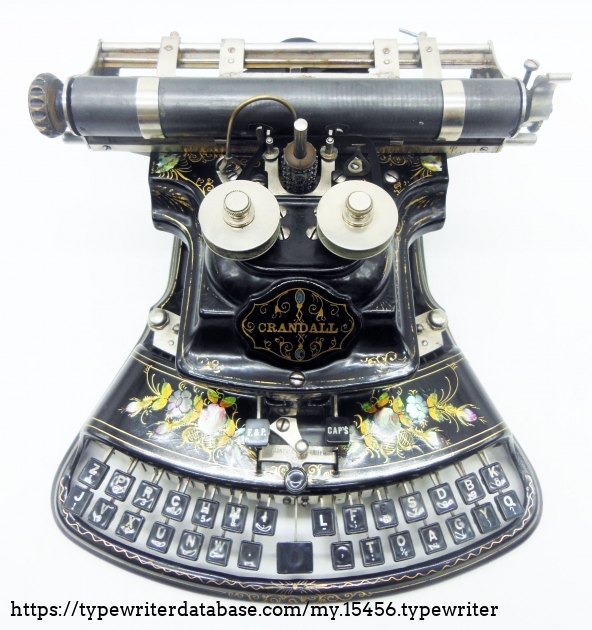
The Crandall -an 1884 typewriter

The concept for the typewriter can be traced back to as early as the late 1500’s when an Italian, Francesco Rampazetto, invented a device called scrittura tattile, a machine used to impress letters in papers.

The Infallible Wikipedia shares this:

“Although many modern typewriters have one of several similar designs, their invention was incremental, developed by numerous inventors working independently or in competition with each other over a series of decades. As with the automobile, telephone, and telegraph, a number of people contributed insights and inventions that eventually resulted in ever more commercially successful instruments. Historians have estimated that some form of typewriter was invented 52 times as thinkers tried to come up with a workable design.”

It was not until the 1870’s when the machine which became the modern typewriter began its ascent. Also from the Infallible Wikipedia:

“The first commercial typewriters were introduced in 1874, but did not become common in offices until after the mid-1880s. The typewriter quickly became an indispensable tool for practically all writing other than personal handwritten correspondence. It was widely used by professional writers, in offices, business correspondence in private homes, and by students preparing written assignments.

Typewriters were a standard fixture in most offices up to the 1980s. Thereafter, they began to be largely supplanted by personal computers running word processing software. Nevertheless, typewriters remain common in some parts of the world. In many Indian cities and towns, for example, typewriters are still used, especially in roadside and legal offices due to a lack of continuous, reliable electricity.

The QWERTY keyboard layout, developed for typewriters in the 1870s, remains the standard for computer keyboards. The origins of this layout remain in dispute.”

By the time I was in junior high, no doubt there were papers to be written which required use of a typewriter. The first one I ever used belonged to my mother. Made by Remington, it was their Envoy model. While I’m not sure why there were different models since they all looked the same, no doubt there were features added each year which improved on the previous model.

My mother’s 1941 Remington Envoy… and the device which replaced the typewriter… 80 years later.

I will admit right now that I just spent 15 minutes looking for the serial number on her typewriter. Yes, they had serial numbers. Turns out this machine, number S1161669, was manufactured in 1941. My mother was 16 that year.

From an early age I developed a love/hate relationship with the typewriter. I loved the feeling of rolling a blank piece of paper into the platen, its emptiness beckoning creation. Then with the first few pushes of the keys, words would magically appear on the paper. It was a rush!

By word three, however, a horrible thing would happen. Instead of typing say, “Amelia skipped merrily down the path,” what often occurred would be something which looked like this:

Amelia skip[ed merruly down teeh path”

Magic fixer solution

Unlike word processing on the computer, once those letters hit the page, you were stuck. Then you had a choice. Rip the paper from the roller in frustration, crumple it up, stomp on it and scream, and then start over OR go digging for that little bottle of the magic fixer, whiskey. Ha ha… just kidding. I’m talking about White Out, aka Liquid Paper.

If your mistake was early enough, replacing the paper was best. But woe unto you if it happened way down the page.

My papers were ALWAYS a mess of white out.

But I digress. I believe it was my sophomore year of high school when I got an electric typewriter. Which really only meant that I could now make mistakes much more quickly.

Me with the IBM Selectric in 1979

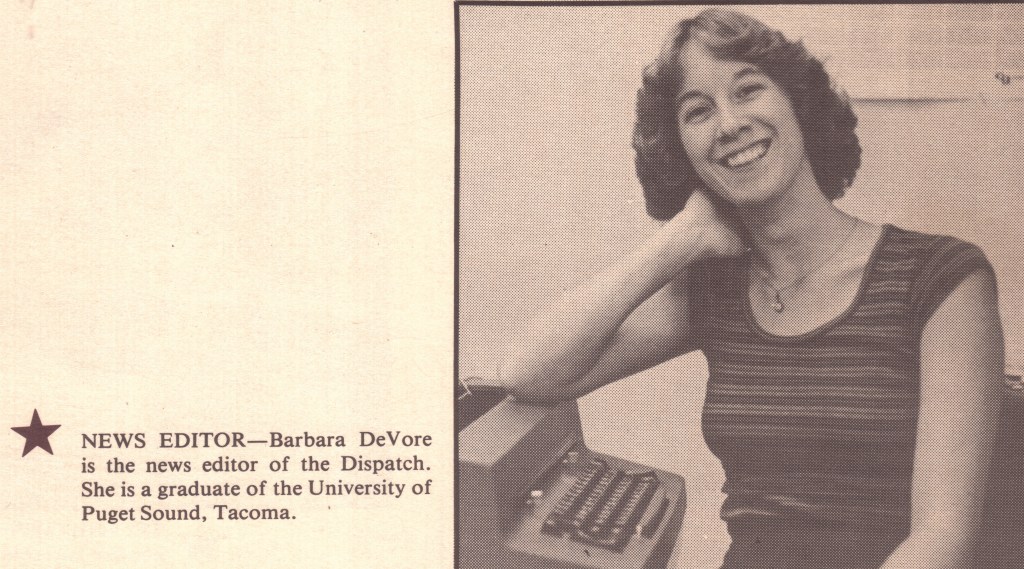
That machine served me well throughout high school and college. Then, in 1979 I was hired as a reporter and editor for the Eatonville Dispatch and I can still recall my first day on the job when there, on what was now my desk, sat a shiny IBM Selectric.

For those who don’t know, the Selectric was the gold standard of typewriters in that era for one very important reason: you could change the fonts.

Up until then typewriters pretty much featured one font and one font only: Courier.

The Selectic did not have a static set of keys. Instead, all the letters were on a ball – imagine a small metal disco ball covered in raised letters and numbers – which could be popped off and a different ball put on.

Oh the joy of being able to choose between Presitge Elite and Courier Italic! Serif versus San Serif.

IKE sophomores in Mrs. Rigo’s typing I class, 1974

After leaving Eatonville, typewriter use becomes fuzzy. I know I worked on them at various jobs right up until I joined Microsoft in January 1982. It was only then that we had a rudimentary internal email system which I figured out how to make work like a typewriter. The best part of that was the ability to correct mistakes. It only took a few times of painting the screen with white out to learn that the liquid saver was no longer needed.

By the mid-1980’s typewriters had pretty much become obsolete in most business environments. Like the horse and buggy, the teletype, Victrolas, and a whole host of other products which once dominated the culture, the typewriter was sent to the dustbin of history. (hmmm… I think a dustbin is part of that list of obsolete things also)

One final thought on typewriters. Of all the classes I took in high school, it was typing which benefited me more than any others. Kudos to Mrs. Rigos and typing teachers everywhere.

To you I say… jjjj… ffff…iiii… aaaa … and ‘The quick brown fox jumps over the lazy dog*.’

A few links:

https://en.wikipedia.org/wiki/Typewriter

https://en.wikipedia.org/wiki/E._Remington_and_Sons  (Guess they had the first AND second amendments covered)

https://en.wikipedia.org/wiki/IBM_Selectric_typewriter

https://en.wikipedia.org/wiki/The_quick_brown_fox_jumps_over_the_lazy_dog

https://dispatchnews.com/

* ‘The quick brown fox jumps over the lazy dog’ is a sentence used in typing classes as it contains all 26 letters of the English language.

Seeking a Friend for the End of the World

It’s a Universe full of objects hurtling through space

August 30, 2022

Chalk this week’s post up to ‘things I never knew.’ It was on August 30, 1979, when a comet collided with the sun. Whoa.

Artwork from TodayinHistory.com

How do scientists know the date? According to an article in the New York Times from October 10, 1981, it was over two years after that the event was uncovered:

“A comet collided violently with the Sun two years ago, generating tremendous energy and scattering debris millions of miles across the solar system, scientists at the Naval Research Laboratory reported today.

The event, recorded by satellite instruments, is the first known instance of a celestial body colliding with the Sun, said Dr. Donald J. Michels. It also marks the first time a comet has been discovered by a satellite.

Dr. Michels said the collision, which occurred Aug. 30, 1979, was recorded by an experiment called Solwind. Because of delays in analyzing the spacecraft data, the event was not discovered until recently, he said.

Captured images of the comet colliding with the sun August 30, 1979

Solwind monitors activity in the Sun’s outer corona, part of its atmosphere, by using an occulting disk that creates the effect of a permanent solar eclipse. Sun’s Heat Disintegrated Comet

‘Total eclipses observed from the Earth last no more than a few minutes,’ Dr. Michels said. ‘Solwind has been able to observe the Sun’s corona through these artificial eclipses night and day for nearly three years.’

He said the comet had passed through the instrument’s field of vision as it streaked toward the Sun and was quickly disintegrated by the Sun’s blazing heat. ‘We estimate that when the comet hit the Sun, the energy released was about 1,000 times the energy used in the United States during an entire year,’ Dr. Michels said.”

Of course even thinking about such an event is likely to cause anxiety for some of us. I’m in that camp. A few months ago my brother loaned me a movie from his collection. I wasn’t entirely sure what to expect from Seeking a Friend for the End of the World. It was an oddly compelling movie which explored the concept of what individuals might do if they knew the world would be destroyed by a comet in three weeks time.

It is upon this premise the audience enters a Dystopian world where the rules and norms no longer apply. We see the coming apocalypse through the viewpoint of a character named Dodge and his ‘friend’ for the end of the world, Penny.

Poster from the movie

Thanks to the Infallible Wikipedia we also learn:

“Seeking a Friend for the End of the World is a 2012 American apocalyptic romantic comedy-drama film, written and directed by Lorene Scafaria, in her feature directorial debut. The film stars Steve Carell and Keira Knightley as a pair of strangers who meet and form an unexpected bond as they help each other find closure in their lives before an asteroid wipes out life on Earth. The inspiration for the title comes from a line in Chris Cornell’s song ‘Preaching the End of the World’, from his 1999 debut solo album Euphoria Morning.

The film was theatrically released on June 22, 2012, in the United States by Focus Features. It received mixed reviews from critics and was a box-office bomb, earning $9.6 million on a $10 million budget.”

Had I read the review on the Infallible Wikipedia prior to watching the movie, I probably would not have watched it. Somehow, even as all sorts of insane events occurred, I kept hoping for a happy ending. Spoiler alert: there isn’t one.

Now, for those who are interested, the next close comet/asteroid encounter that earth is predicted to have is on Friday, April 13, 2029. But we don’t need to worry – or so NASA tells us. Although it will be one of the closest encounters ever, it won’t hit earth.

Carpe Diem! I have things to do and books to write!

https://en.wikipedia.org/wiki/Seeking_a_Friend_for_the_End_of_the_World

https://science.nasa.gov/science-news/science-at-nasa/2005/13may_2004mn4/

https://en.wikipedia.org/wiki/99942_Apophis

Class Reunion

A snapshot in time

August 16, 2022

It occurred to me, after attending a class reunion this weekend, that somehow I’m pretty certain I’ve managed to attend all of the ones for my high school class.

A reunion book was produced for both our 10 and 20 year reunions

I suppose that’s not really a surprise, after all I was Editor of our yearbook my Senior year and have always had a keen interest in people’s stories. Attending a reunion is simply a continuation of those stories; an opportunity to get a snapshot every few years of those who were a part of the early years of our lives.

Before I go much further, however, I know all my regular readers will be glad to learn that the Infallible Wikipedia has a page for the topic ‘class reunion’ as follows:

“A class reunion is a meeting of former classmates, often organized at or near their former high school or college by one or more class members. It is scheduled near an anniversary of their graduation, e.g. every 5 or 10 years. Their teachers and administrators may also be invited. Those attending reminisce about their student days and bring one another up to date on what has happened since they last met.”

But I don’t think the Infallible Wikipedia’s description does the topic justice. So I started thinking about my Eisenhower High School reunions through the years. At our ten year reunion – the first one we had – there were easily a couple hundred who attended. Our venue was one of the buildings at the Central Washington State Fair Grounds and, besides a dinner and dancing, included a photographer who was taking photos which could be purchased.

At the time, the hubby and I were DINKY’s (back in the 1980’s a DINKY stood for Double Income No Kids Yet). The snapshot of that night was one of people in their late 20’s, still trying to figure out their place in the world. Some had children and, although I did not, I can still see the look of complete exhaustion on the faces of those women. But I didn’t yet understand what that was like, as careers were everything in my world that reunion. At ten years, there was a weird game of one-upmanship still in play.

Truly, few of us had yet experienced some of life’s harder lessons. Perhaps the most sobering aspect of the 10 year reunion was the short list of those with whom we had graduated but who had already left this earth.

Fast forward five years, and the organizers (we have been blessed to have a team of, primarily, women who have made all of these happen!) planned a half decade reunion. This one, held in the early fall, included attending a home football game on Friday night and a picnic on Saturday.

Now, as a mother with an 8 month old baby, I left my son with the most reliable babysitters in the universe, his grandparents, and headed out to the stadium. Partway through the game, I look down from the bleachers only to see my Dad standing below motioning at me. My night out was over!

The next day, my not yet walking son and I attended the picnic and enjoyed the more casual setting and smaller numbers, getting advice from experienced moms and meeting many of their children also.

Year twenty the reunion was held in a big outdoor tent at a country club. At the ten and the 20 year reunions, A “tell us about your life” booklet had been produced and by year 20, the cliques and the labels of high school had started to blur.

The crowd at the 20 year reunion. Definitely a ‘Where’s Waldo’ sort of exercise to find myself in the photo.

One of my favorite snapshot moments was when I was talking to another girl when one of the guys from our class came over to talk to her. Still standing there and feeling a bit like a third wheel, there was suddenly a lull in the conversation and I blurted out to the guy, who we will call Adam, “I had the worst crush on you in Junior High.” I seem to recall he choked on his drink and nearly spit it out.

With my BFF’s from high school on our way to the 40 year reunion in 2015

Onward the years have marched. Our group celebrated with a 35 and also a 40 and then, in 2020, a planned 45 year reunion was sidetracked.

Two years passed but our fearless organizers pressed on and proclaimed that 2022 would be our “Medicare Reunion.”

Suddenly, all those 17 and 18 year old kids I attended high school with were starting to retire. Most everyone had lost one or both parents; more names have been added to the dreaded ‘list’; there have been triumphs and disappointments; incredible joy and devastating sorrow; the loss of siblings; the loss of spouses; the loss of children. The cliques and labels have disappeared and what’s left are people who can simply enjoy a few hours of telling their stories and hearing other’s stories.

It’s the context which matters. These are the people who shared beginnings either in elementary school, junior high, or high school. When we look at each other we can remember the person and how they looked then. We can see past the wrinkles and gray hair. Their essence is still very much the same but is, I think, tempered by the experiences of life. We are kinder and more forgiving.

One of my classmates – who traveled from California for the event – said it best. My apologies for the paraphrase: It’s about the people and making connections with each other. And it’s important.

Our 2022 ‘Medicare’ reunion

Time – and Covid – have taught us all these things and can be summed up in my favorite Latin phrase: Carpe Diem.

So the next time your high school or college, sorority or fraternity, or any other group you’ve belonged to, plans a reunion, Go. Go and connect with the people who knew you ‘when.’ Laugh. Cry. Enjoy. Hug. And be sure to tell them how much you appreciate them having been a part of your life.

https://en.wikipedia.org/wiki/Class_reunion