Archives

The Charm of Kliban Cats: A Collector’s Journey

“Frequently mistaken for a meatloaf”

June 3rd
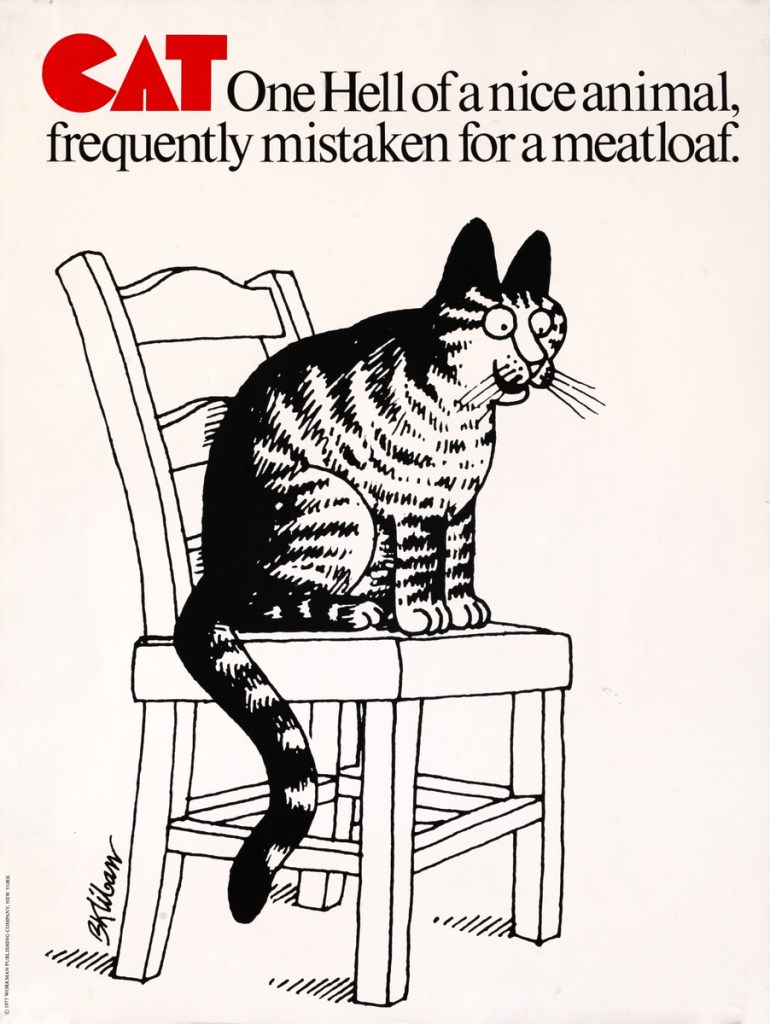
One of the earliest iterations of the Kliban Cat.

While I cannot remember the exact date, it seems to me that I was introduced to the works of this artist sometime in 1979 or early 1980 by my then boyfriend (and now hubby). I was immediately enamored with this rotund pen and ink drawn animal with the big eyes titled, simply, “Cat.”

“Cat” was created by B. Kliban who, at the time, worked as a cartoonist for Playboy Magazine.

The Infallible Wikipedia tells us:
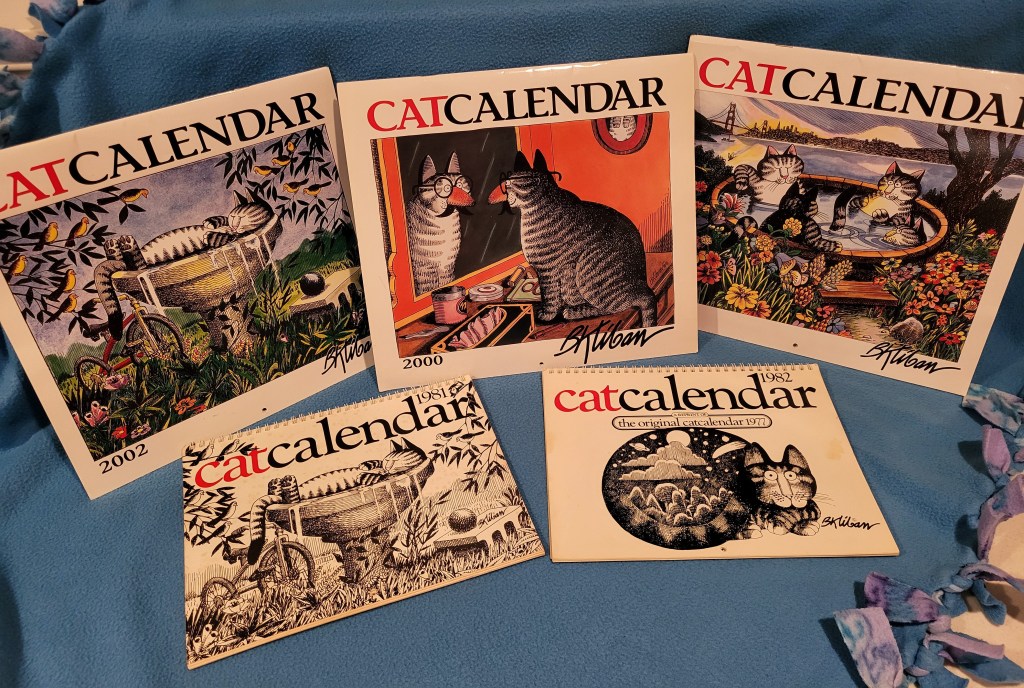
My five CATCALENDARS. The 2003 calendar is currently being used as it is the same as 2025.

“In 1962, Kliban became a Playboy cartoonist, contributing cartoons until his death (in 1990). Michelle Urry, Playboy’s cartoon editor, visiting his studio, reviewed his drawings, mostly cats. She thought they should be compiled into a book, introduced him to an agent, who found a publisher, resulting in the 1975 book Cat. This led to several other books of cartoons ending with Advanced Cartooning in 1993. Since Cat, his cartoons have adorned many products including stickers, calendars, mugs, and t-shirts.”

Ah yes, the calendars, mugs, and t-shirts.

I have all of these things and, I admit, I am to this day a collector of all things Kliban Cat. This cat is, simply, irresistible.

One of my first Kliban pieces was a blue t-shirt. It’s pretty beat up these days – after all it is 40 plus years old – but I still have it. It was given to me by above mentioned boyfriend/now hubby with this inspiring sentiment: 
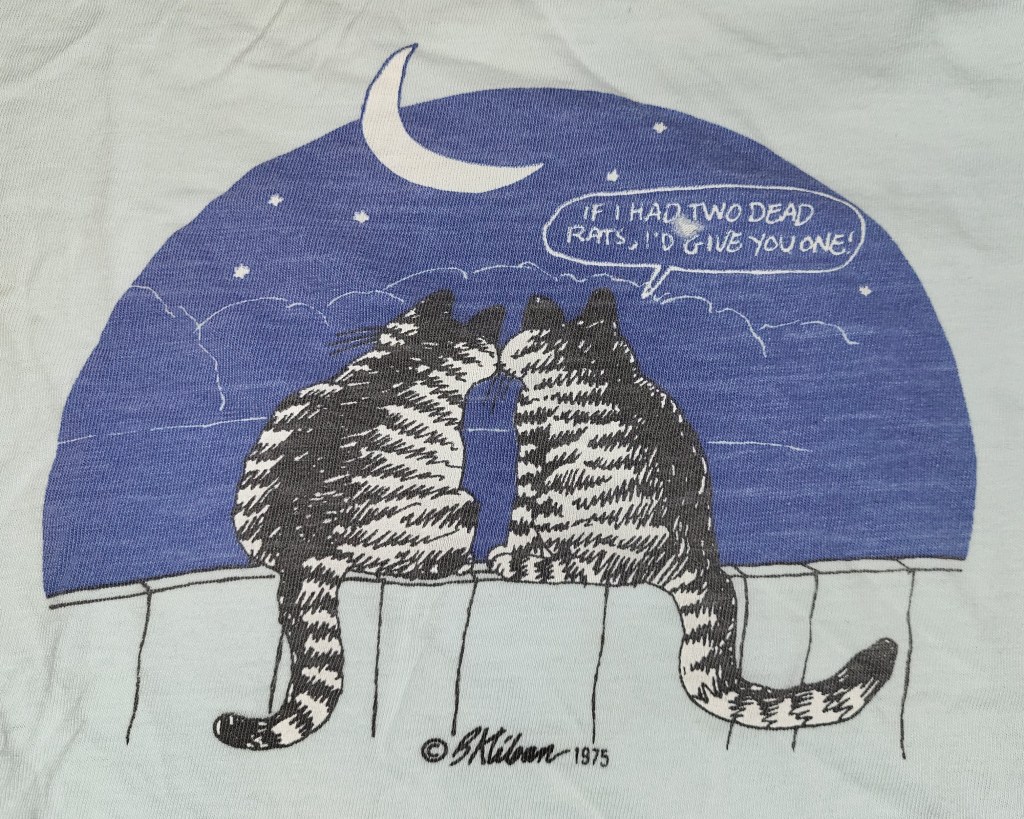
For those unfamiliar with Kliban’s works, this is about as sappy as it ever gets.
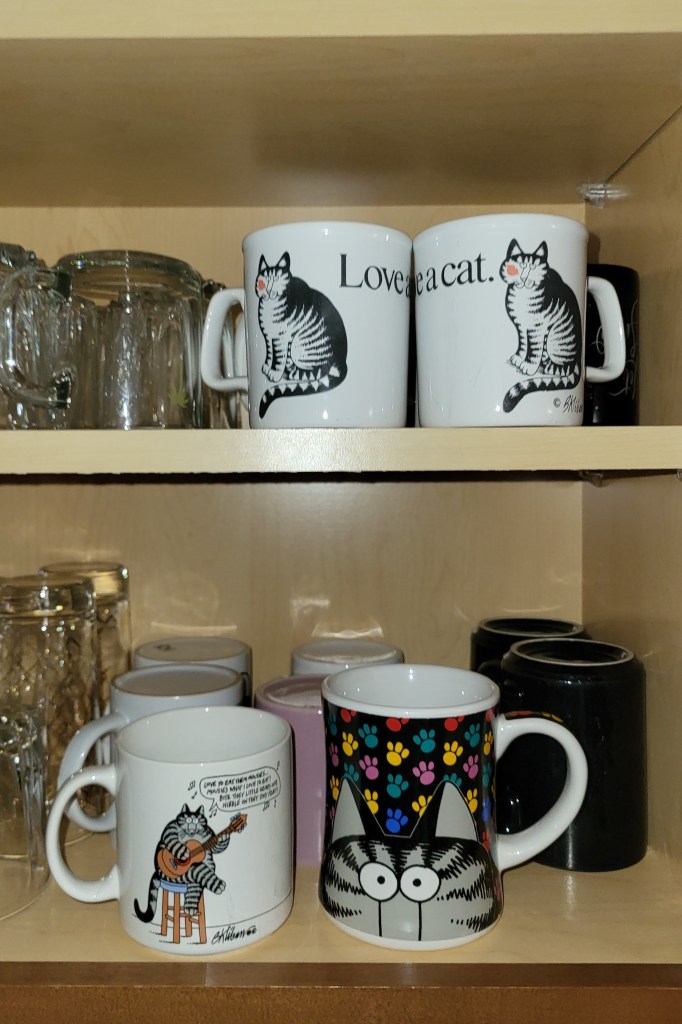
Kliban cat mugs came as gifts over the years. The pair on the upper shelf were a wedding gift in 1980.

“Cat” occupies our house in all sorts of places. When I went looking for the t-shirt I found two additional ones plus a sweatshirt. Then I stopped in the kitchen to share with the hubby about today’s topic. He immediately opened the mug cupboard and pulled out our newest one (less than 10 years old!) but then I one-upped him and dug out three more mugs.

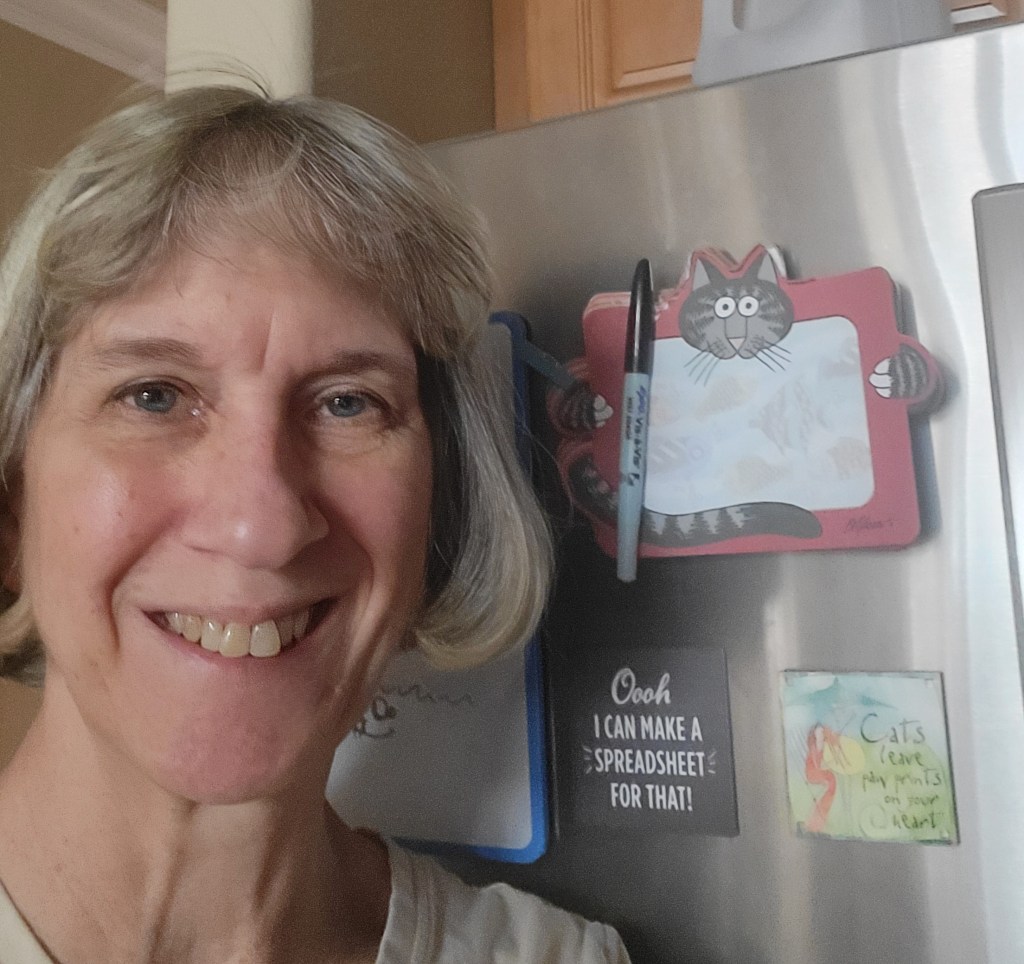
As I turned towards him to gloat, there was yet another ‘Cat’ staring at me from the fridge where a notepad of ‘Cat’ themed list paper lives.

Then it was back upstairs to my office. This set of stairs has two 90-degree landings. When I turn right from the first landing, above me on the next landing is, perhaps, my most-favorite ‘Cat’ of all, the one titled “Momcat.”

In the early 1980’s my brother lived with us for a while and, when he moved out, he left in my care a four and half foot tall by three foot wide “Momcat.” I was happy to have it and it has moved with us to each different house. It greets me every day when I report to my office.
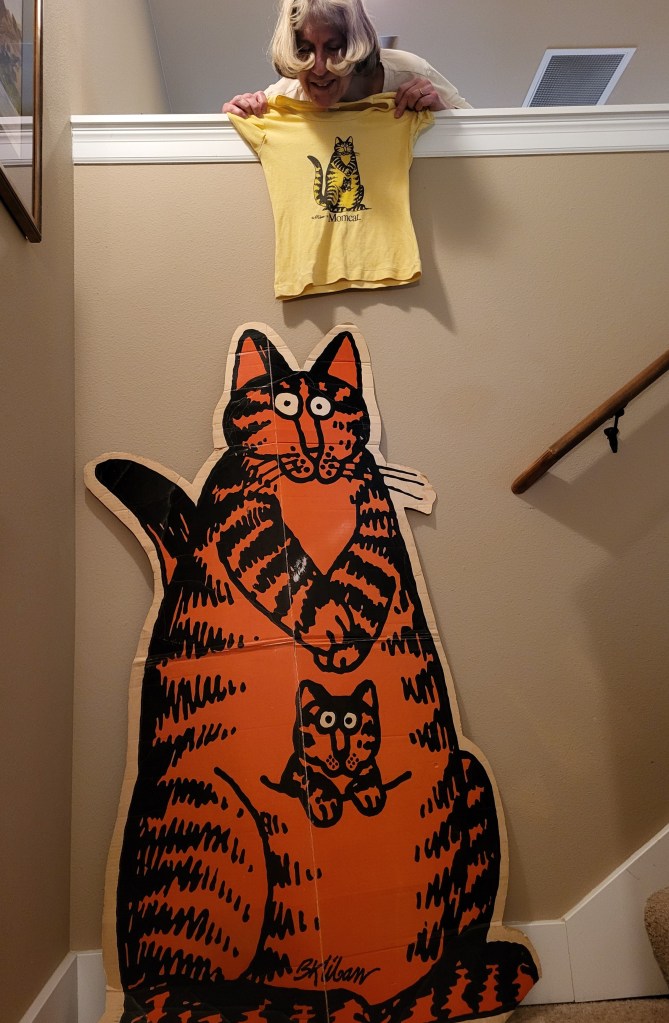
“Momcat” who greets all visitors coming upstairs to the author’s office.

I have saved my ‘Cat’ calendars (1981, 1982, 2000, 2002, 2003, so far). I have notecards, postcards, and Christmas cards. I have two – very precious to me – ‘Cat’ Ornaments.

But there is one thing I do not have which, to this day, I still regret.

The year is 1981 and we have recently purchased our first house. We are ‘house poor’ and adhere to a very strict budget, tracking down to the penny how much we can spend on groceries as well as all the other necessities in life.

At the time I work for a company called Radar Electric, located at the base of Queen Anne hill at 168 Western Avenue in Seattle. I bring my lunch to work pretty much every day and, because it’s an hour break, if the weather is nice I will walk the six or so blocks up to the kitschy retail area on Queen Anne Avenue and wander the shops.

One day, as I am browsing, I see a set of Kliban Cat salt and pepper shakers. They are two cats hatching from eggs. Weird, right? One is stretched out as if about to grab something and the other sits upright in a half an eggshell. I’m instantly in love with these and pick them up to look at the price. $15.95. I set them back down. There’s no way we can afford to spend $16.00 on something so frivolous (in today’s dollars, that’s about $62.00).
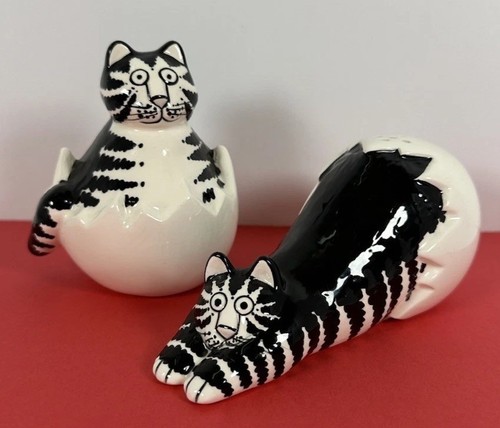
The salt and pepper shakers I didn’t buy

Later I tell my hubby about the salt and pepper shakers and he thinks I should go ahead and get them. But I argue back that they are something which is a desire, not a need. Even so, with his urging, I return a few days later, but they are gone. I let it go.

Sometimes I think about those and wish I had them for my collection of both Kliban cats and salt and pepper shakers. So I decided to search on ebay just for laughs and now I regret doing that too.

Two sets are currently available, one for only $345 and the other for $575 (that one at least has free shipping!). Yea, they are still cute but not hundreds of dollars cute. Now, if it were a ‘Momcat’ salt and pepper shakers, I might consider it. It is, after all, my favorite.
A few links:

https://en.wikipedia.org/wiki/B._Kliban

https://i.ebayimg.com/images/g/s9oAAOSw655oNG~6/s-l1600.webp (one of the ornaments)
Exploring Romeo and Juliet: A Timeless Love Story

Perhaps Shakespeare’s most famous play

March 11

To try and take on this play is, I would conjecture, pure folly. Afterall, it is probably the most recognized literary work in the world. It is the story of two young lovers who forsake all else to be together. They risk the disapproval of family and friends and, ultimately, meet their demise all because they chose that which was forbidden.

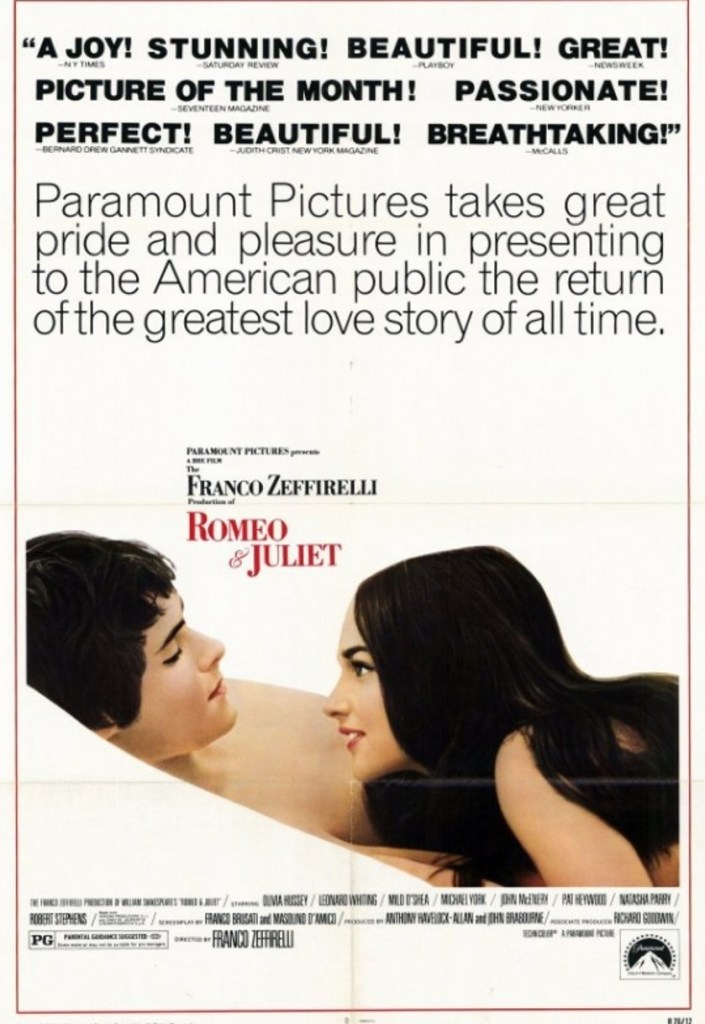
1968 Poster of Romeo and Juliet

“Romeo and Juliet” is William Shakespeare’s most famous works and March 11, 1302, is – according to OnThisDay.com – considered to be the date of the young lover’s marriage.

As is often the case, that is disputed since contextual clues from the play itself place the wedding date as being in mid to late July.

Regardless, today is as good a day as any to feature this iconic work.

For anyone who is unfamiliar with the storyline you can certainly access the Infallible Wikipedia. Which I did only to discover that the article there is 10,604 words long. Egads.

Instead, I found this one paragraph synopsis from the site Shakespeare.org.uk much easier to digest:

“An age-old vendetta between two powerful families erupts into bloodshed. A group of masked Montagues risk further conflict by gatecrashing a Capulet party. A young lovesick Romeo Montague falls instantly in love with Juliet Capulet, who is due to marry her father’s choice, the County Paris. With the help of Juliet’s nurse, the women arrange for the couple to marry the next day, but Romeo’s attempt to halt a street fight leads to the death of Juliet’s own cousin, Tybalt, for which Romeo is banished. In a desperate attempt to be reunited with Romeo, Juliet follows the Friar’s plot and fakes her own death. The message fails to reach Romeo, and believing Juliet dead, he takes his life in her tomb. Juliet wakes to find Romeo’s corpse beside her and kills herself. The grieving family agree to end their feud.”

But, honestly, only if you lived as a hermit in a rock cave on a remote island in the south Pacific would you NOT know about Romeo and Juliet (R&J).

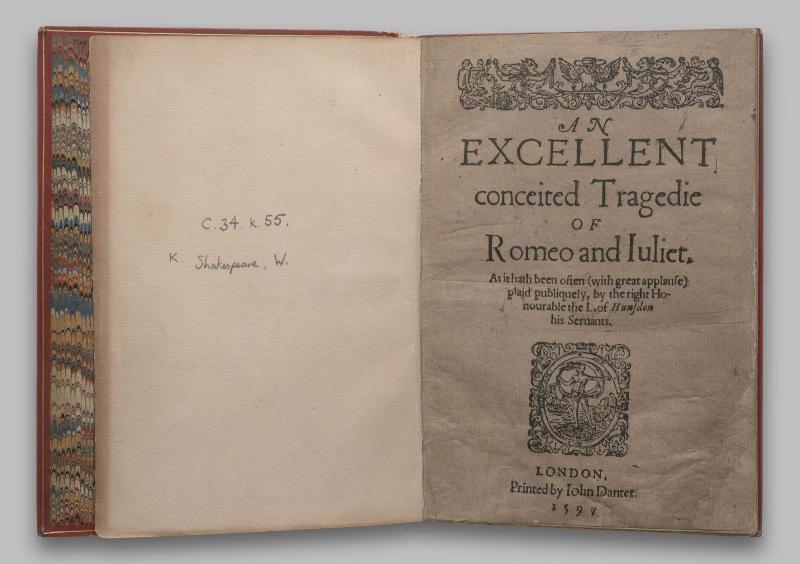
First edition Romeo and Juliet

When I started thinking about R&J, my mind drifted back to the early 1970’s and my experience at Wilson Junior High School in Yakima, Washington.

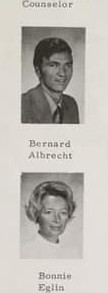
Wilson Junior High teachers 1971

It was there that I was introduced to R&J. At the time I had no appreciation for Shakespearean literature or for the incredible foundation which was given me by a trio of dedicated Jr. High English teachers.  For my entire 8th grade year, my English teacher was Mr. Albrecht. To us students he seemed quite mature. When, in fact, he was the ripe old age of 27 that first year. We respected him because he treated us as intelligent people regardless of our limited years on earth; he rewarded those who worked hard and did their best.

The next year my English class experience was split into two segments. For the fall/winter semester I drew the formidable grammar teacher, Mrs. Eglin. I think she likely made students rip out their hair and cry at times. But, by God, you were going to learn: all the parts of grammar, how to diagram a sentence, and how to construct a proper paragraph. It was in her class that I discovered the evils of dangling participles, all about verbs, adverbs, nouns (both proper and pro-), adjectives, and every other part of speech. In other words, I learned how to write the correct way. She made me think about my writing in ways I’d never considered. I might not have always followed her methods, and I’m not perfect, but not for lack of instruction on Mrs. Eglin’s part.

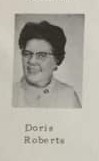
Mrs. Roberts 1971 yearbook photo

In the second half of the year, I had an even more demanding teacher – which I hadn’t thought possible after being with Mrs. Eglin – Mrs. Roberts. First name Doris. Which is telling. No one in my age demographic, or even a few years older, was named Doris. The name had, however, been the 8th most popular name for girls in the 1920’s. Mrs. Roberts was born in 1922 and was an ancient 50 that year. Ah perspective.

Mrs. Roberts assigned us every classical piece of literature she could find and we explored such themes as ‘man’s inhumanity to man’, ethics, morality, death and dying, cruelty, poverty… yes, we read some very dark stories. Like “Flowers for Algernon”, “The Grapes of Wrath”, “Fahrenheit 451”, and “Romeo and Juliet”.

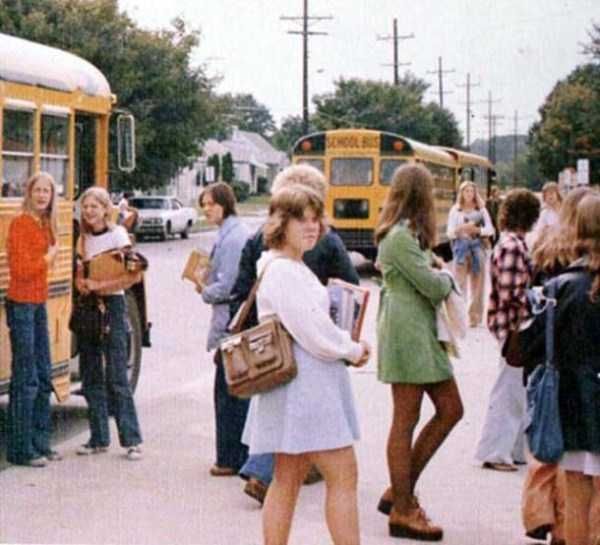
The clever thing which this band of teachers managed to accomplish was to make the course work relevant to the teenagers of the day. Somehow, they convinced the administration that it was educational to load some 250 ninth graders into school busses and send them to the movie theatre to see films based on what we were reading.

Pretty much how teenagers dressed in 1971-72. Found this photo on Pinterest.

Spoiler alert: it worked.

Of course, we kids thought we’d gotten a free pass for the day. Personally, I returned from those outings thinking about the films but also contemplating the books we read and then writing papers on the theme we thought was the best fit.

Sometime in the fall of 1971 I’m pretty certain we were whisked away in the busses to see the 1968 film version of Romeo and Juliet with Leonard Whiting and Olivia Hussey. Such clever English teachers, using the pop culture of the day to get us to learn. I did find a reference in my 1972 diary for both “Farenheit 451” and “Mary, Queen of Scots.” Sadly, my diary from 1971 does not seem to exist any longer, which surprises me as I was a faithful diary writer.

Now a few fun facts. I was able to find 49 times R&J was made into a movie in the Shakespearean tradition (from 1908-2021); an additional 118 films were produced which adapted the works in modern ways or with odd twists (like the truly bizarre 2011 Gnomeo and Juliet); there are also a few films which utilize R&J’s overarching theme in some new way (like the charming 2019 movie “Letters from Juliet”).

I owe a lot to my Junior High School English teachers for the great foundation they laid. It was the gift that has continued to give and bless me.

As always a few links:

https://www.onthisday.com/weddings/march/11

https://en.wikipedia.org/wiki/Romeo_and_Juliet

https://www.shakespeare.org.uk/explore-shakespeare/shakespedia/shakespeares-plays/romeo-and-juliet/#:~:text=An%20age-old%20vendetta%20between%20two%20powerful%20families%20erupts,to%20marry%20her%20father%E2%80%99s%20choice%2C%20the%20County%20Paris.

Nostalgic Shiny Brite Christmas Ornaments

Adorning American Christmas Trees since 1937

December 17th

A Tuesday Newsday Classic

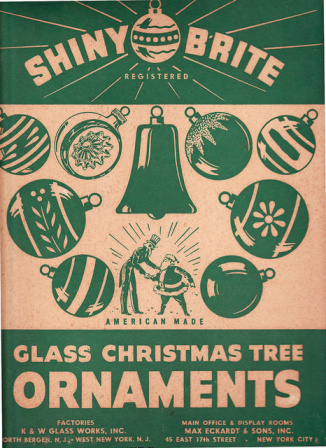
Long before Hallmark introduced their line of annual Christmas ornaments, another American Company had taken the market by storm, selling millions of baubles every year from 1940 to 1962. Marketed as Shiny Brite, the distinctive green boxes which featured Santa Claus shaking Uncle Sam’s hand were a fixture in the average home of the 1950’s and 60’s.

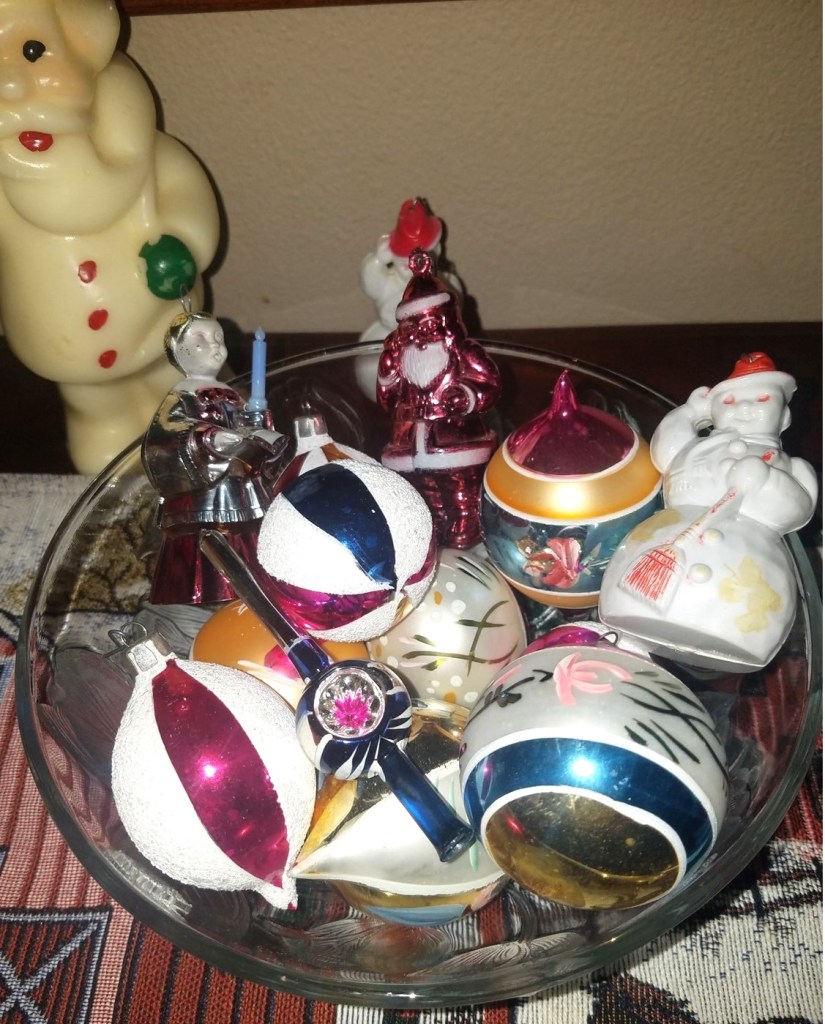
My mother’s Christmas ornaments from the 1950’s and 60’s

The story begins in 1937 with importer Max Eckhardt who, seeing the clouds of war encroaching and feared that his supply line would be cut, went to the Corning Glass company in Pennsylvania and made a deal with them to begin producing ornaments. Thus, was born Shiny Brite. From the Infallible Wikipedia:

“Eckardt had been importing hand-blown glass balls from Germany since around 1907, but had the foresight to anticipate a disruption in his supply from the upcoming war. Corning adapted their process for making light bulbs to making clear glass ornaments, which were then shipped to Eckardt’s factories to be decorated by hand. The fact that Shiny Brite ornaments were an American-made product was stressed as a selling point during World War II.

Dating of the ornaments is often facilitated by studying the hook. The first Shiny Brite ornaments had the traditional metal cap and loop, with the hook attached to the loop, from which the ornament was hung from the tree.

Wartime production necessitated the replacement of the metal cap with a cardboard tab, from which the owner would use yarn or string to hang the ornament. These hangers firmly place the date of manufacture of the ornament to the early 1940s. (snip)

Shiny Brite ornaments were first manufactured at Corning’s plant in Wellsboro, Pennsylvania, and continued there for many decades. During its peak, Shiny Brite also had factories in New Jersey, located in the cities of Hoboken, Irvington, North Bergen, and West New York. The company’s main office and showroom were located at 45 East 17th Street in New York city.

The classic cover of the Shiny Brite box with Uncle Sam shaking Santa’s hand

Shiny Brite’s most popular ornaments have been reissued under the same trademark by Christopher Radko since 2001.”

Although there were other companies which manufactured and sold ornaments in that era, Shiny Brite was by far the largest player.

As a child in the 1960’s I loved the December day when our family’s fresh cut pine tree would be set into its stand in a place of honor. I always watched as my father strung the C-7 bulbs on the branches. It seemed as though it took forever for my mother to declare the moment when the decorations could be hung. Out would come the green Shiny Brite and other boxes, their lids lifted, and one by one the delicate glass ornaments would soon dangle from the branches.

Each year it was as if seeing old friends arrive for the holidays. By the 1980’s – with their children all moved away – my parents quit hanging ornaments on a tree. Instead, they kept an artificial tree – lights already placed on the branches – in their basement storage room. Mid-December my dad would carry it out through the garage and then up the outside stairs and into the living room. Once the lights were plugged in they called it good.

The ornaments of my youth were squirreled away in a box in the storage room where they remained untouched for some 30 years.

In the summer of 2019, as we worked to clean out my parent’s home since my dad now lived in an Adult Family home, my sister and me anxiously awaited the Christmas Box to be unearthed.

My mother’s precious ceramic angels and bells. It was not Christmas until the angels were set on the buffet.

Finally, in late August, that day arrived. The two of us sat on the floor and opened the ornament boxes, each picking out those we wanted to bring to our own homes.

By the time Christmas 2019 was upon us, both my parents were gone and, after my tree was up, I went search of the ornaments. I looked in box after box which had been stored in my garage since summer, but no ornaments.

Finally, after my two days search, I lamented to my son that I could not find them. He, however, said he had seen them and a few minutes later produced a small box from a section of the garage I had missed.

Just like when I was a little girl, I opened the box and said hello to my old friends. But unlike during my childhood, I could not bear to hang them on my tree, fearful one might fall and break. Amazing how something so ordinary and familiar had now become precious and irreplaceable. Instead, I carefully lay the treasured ornaments in a crystal bowl and, along with a pair of ceramic angels and two ceramic bells, set them in a place of honor. 

I can only hope that one day my own children might also cherish the heirlooms passed down from generation to generation.

The links:

https://en.wikipedia.org/wiki/Shiny_Brite

I loved this story about Wellsboro, PA, where Shiny Brite’s were manufactured: https://pawilds.com/wellsboro-the-town-that-saved-christmas/

And a nice story about Shiny Brite: https://www.retrochristmascardcompany.com/the-history-of-shiny-brite-ornaments/

Arches National Park

One of several amazing National Parks in Utah

November 12, 2024

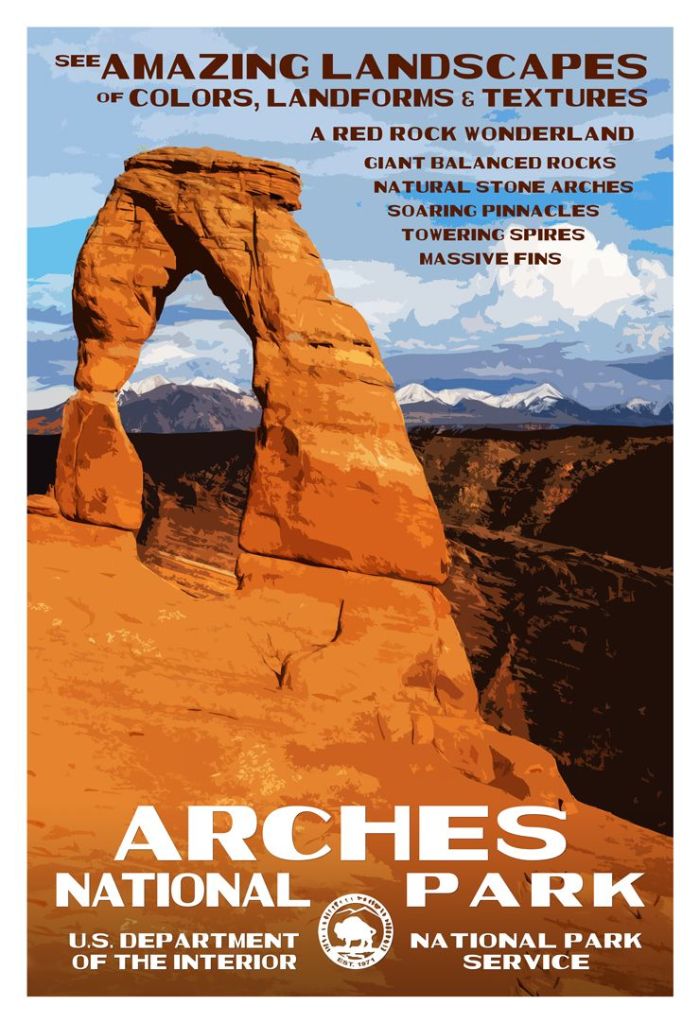
I’ve always loved these historical NP posters

A Tuesday Newsday Classic

With more than 2,000 natural sandstone arches located within, Arches National Park has the highest concentration of these features in the world. Although it had been named a National Monument in 1929, it was on November 12, 1971, when Arches National Park was created.

 Situated in eastern Utah, it’s remote location and rugged terrain make getting there a challenge. The Utah park, however, has become a magnet for hikers, climbers, and nature lovers, attracting some 1.6 million visitors in 2018.

 According to the Infallible Wikipedia:

 “The Arches area was first brought to the attention of the National Park Service by Frank A. Wadleigh, passenger traffic manager of the Denver and Rio Grande Western Railroad. Wadleigh, accompanied by railroad photographer George L. Beam, visited the area in September 1923 at the invitation of Alexander Ringhoffer, a Hungarian-born prospector living in Salt Valley. Ringhoffer had written to the railroad in an effort to interest them in the tourist potential of a scenic area he had discovered the previous year with his two sons and a son-in-law, which he called the Devils Garden (known today as the Klondike Bluffs). Wadleigh was impressed by what Ringhoffer showed him, and suggested to Park Service director Stephen T. Mather that the area be made a national monument.”

Over the years, like so many of our nation’s National Parks, Arches has been loved to the point of fragile features being in danger of destruction. Consequently, there are now bans within the park which make climbing some of the more famous arches illegal.

The hubby and I have visited Arches twice. The first time was in the summer of 1984. We arrived on a hot July day which was not conducive to outdoor activities. Being young and in decent shape, however, we exited the car and hiked in the Windows region of the park.

The author on a wet October morning at Arches NP. 2018.

The second trip was in October of 2018 along with hundreds of those 1,599,998 other visitors on a rainy – which is rare since the park gets less than 10 inches of precipitation a year – weekday. What struck me about the differences between those two visits is that the park had been ‘discovered’ in the intervening years. On the first trip we saw maybe a half dozen other cars and some 12 tourists.  In 2018, despite the inclement weather and a number of flooded roads, the place was crawling with people. Finding a place to park the car at some of the stops proved challenging.

At Balanced rock. We didn’t stay out long as it was rainy and cold.

Our method of touring, 24 years later, has also changed. In eighty-four, I crammed as many activities into our travels as possible, never allowing nearly enough time to pause and marvel at nature’s grandeur. In 2018, our inclinations to be mountain goats now subdued, getting out and hiking for a mile or two wasn’t happening. Instead, rather than the slap and dash tourists of yesteryear, we stopped frequently and walked short paths to where we could pause and simply appreciate the amazing features; listen for birds and insects; find joy in the moment.

The term ‘Stop and Smell the Roses’ may be cliché, but the idea behind it is solid. Too often we rush to the airport, wait in lines to be stuffed into a plane, then fly to a destination where the modern amenities make our lives easy. There’s nothing easy about getting to Arches or many of Utah’s spectacular landscapes… but it is so very worth the trip.

Grand Ole’ Opry

Will The Circle Be Unbroken?

November 28, 2023

A Tuesday Newsday Classic Updated

Son and daughter standing in ‘the circle’ at the Grand Ole Opry 2013

It was called the Golden Age of Radio and one of the best known programs was first produced on November 28, 1925. In fact, that program is still heard every week as a live stream on the internet and is the longest running radio broadcast in US history.

WSM  radio called the program a ‘barn dance.’ The name we all know it by: The Grand Ole Opry.

From the Infallible Wikipedia:

“The phrase ‘Grand Ole Opry’ was first uttered on the air on December 10, 1927.  At the time, Barn Dance followed the NBC Red Network’s Music Appreciation Hour, a program of classical music and selections from grand opera presented by classical conductor Walter Damrosch. On that particular night, Damrosch had remarked that ‘there is no place in the classics for realism.’ In response, Opry presenter George Hay said:

‘Friends, the program which just came to a close was devoted to the classics. Doctor Damrosch told us that there is no place in the classics for realism. However, from here on out for the next three hours, we will present nothing but realism. It will be down to earth for the earthy.’

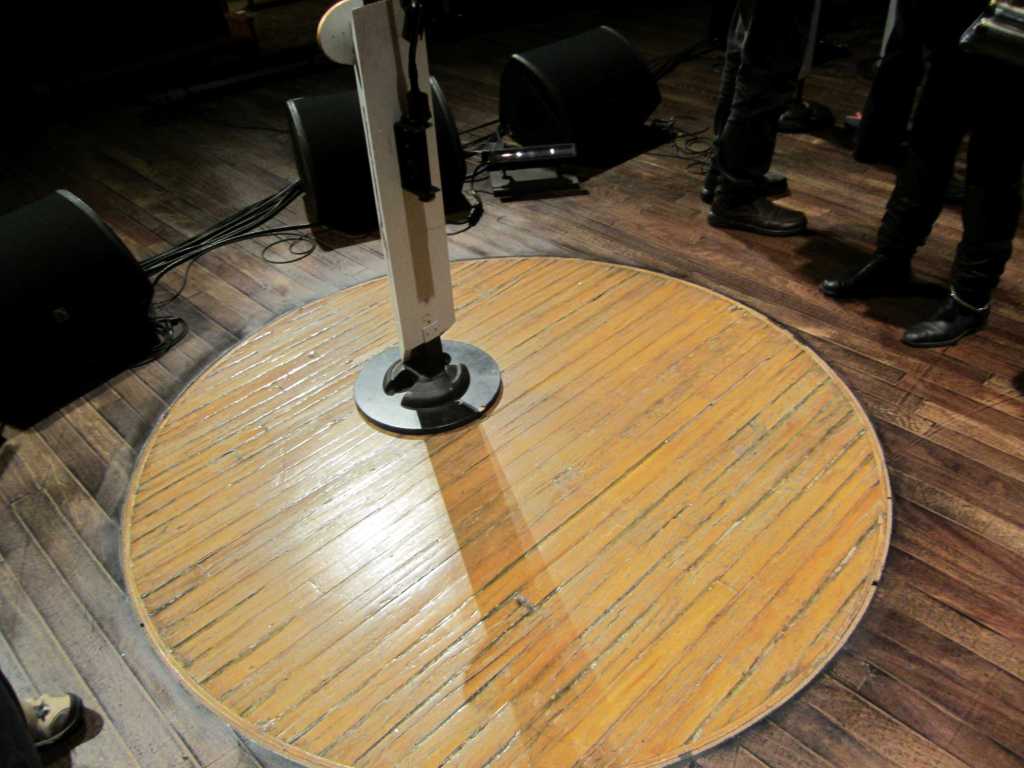
The circle which was cut from the Ryman auditorium stage and moved to the new location in 1974

Hay then introduced DeFord Bailey, the man he had dubbed the ‘Harmonica Wizard’, saying:

‘For the past hour, we have been listening to music taken largely from Grand Opera. From now on, we will present the Grand Ole Opry.’

Bailey then stepped up to the mike to play ‘The Pan-American Blues,’ his song inspired by the Pan-American, a premier L&N Railroad passenger train.”

The Opry’s popularity soared and soon it outgrew its original locale. It moved a half dozen times over the next two decades – to larger and larger facilities – before finding a home in the 3,000 seat Ryman Auditorium in 1943.

Backstage at the Grand Ole Opry, giant guitar picks are used for dressing room numbers

Then, in 1956, a new medium entered the equation and once a month, for the next few years, the Opry was broadcast on television. This exposure had the effect of even more people wanting to attend an in-person performance.

In the 1960’s it was determined that the Ryman – old and falling into disrepair – was no longer adequate. Additionally, Nashville’s central core suffered from urban decay and the show’s owners made the decision to build a new facility on farmland east of town. The 4,400 seat facility opened in June 1974 and, despite catastrophic flooding of the Cumberland River in May 2010, continues as the home of the Grand Ole Opry.

Everything’s bigger in Nashville… One of two giant guitars greet visitors to the Opry.

One interesting thing is that a circle was cut from the floor of the Ryman Theater and installed in the center of the new Opry stage. When our family visited Nashville in March 2013 we toured the facility and stood in the famous ‘circle.’ Later that evening we attended a show which featured Craig Morgan as that night’s main act. I was surprised, however, by the number of long time Opry acts which were still being performed including a ‘Minnie Pearl’ impersonator and also Little Jimmy Dickens who, until he died in 2015, was the oldest Opry member.

One thing I learned when visiting the Grand Ole’ Opry and the Country Music Hall of Fame is that the Opry has a ‘theme’ song. One might assume it would be a twangy sort of tune from the 1930’s. Instead it is a gospel song which was adapted by the Nitty Gritty Dirt Band in 1972. The idea behind it was to honor those Country Singers of previous decades and to bridge the gap from these pioneers to a new generation. “Will the Circle Be Unbroken?” is now a staple of the Grand Ole Opry and sung following the induction of new members into the Opry ranks.

Generations… September 1997 with Mom, daughter, and granddaughter

November 28, 2023 – Over the years of writing this blog if I’ve learned one thing, it’s that certain topics seem to rise to the top and coincide with monumental life events. When I posted this on Tuesday, November 28, 2017, it was with the knowledge that my mother was not long for this earth. Two days later she passed, giving personal significance to this song and the concept of the unbroken circle of life.

 A few links:

https://en.wikipedia.org/wiki/Grand_Ole_Opry

https://en.wikipedia.org/wiki/List_of_Grand_Ole_Opry_members

https://en.wikipedia.org/wiki/Will_the_Circle_be_Unbroken_(Nitty_Gritty_Dirt_Band_album)

Dick Francis

Prolific Mystery Writer

October 31, 2023

A Tuesday Newsday Classic Updated

Witches, goblins and small children in costumes begging for candy. Ah, it must be Halloween. It’s a ‘hard-to-miss’ day and all of us, no doubt, know of its history.

So, instead of a rehash, today’s topic involves one of my favorite authors. Born October 31, 1920, he wrote more than 40 novels in his lifetime. He did not begin his novel writing career until he was 40 years old. All of his books centered on the world of horseracing. That author: Dick Francis.

From the Infallible Wikipedia:

“In 1962, he published his first thriller, Dead Cert, set in the world of racing. Subsequently he regularly produced a novel a year for the next 38 years, missing only 1998 (during which he published a short-story collection). Although all his books were set against a background of horse racing, his male heroes held a variety of jobs including artist (In the Frame and To the Hilt), investigator for the Jockey Club (The Edge), pilot (Rat Race and Flying Finish), wine merchant (Proof) and many others. All the novels are narrated by the hero, who in the course of the story discovers himself to be more resourceful, brave, tricky, than he had thought, and usually finds a certain salvation for himself as well as bestowing it on others.”

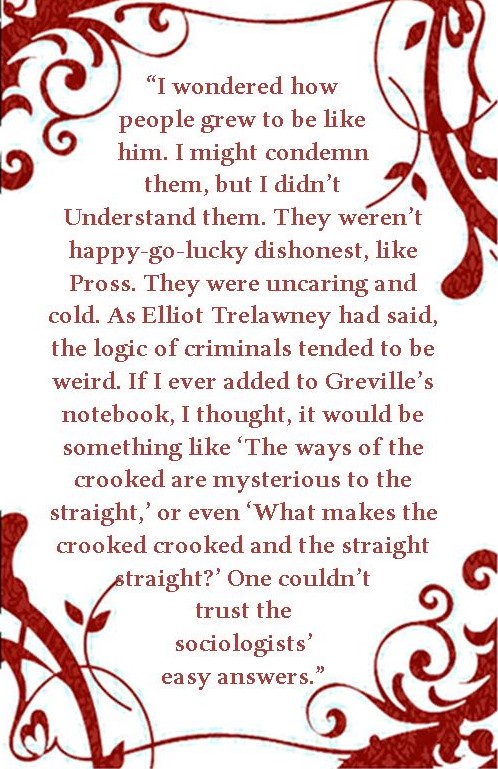
My favorite book of his is titled “Straight” and tells the story of a man, Derek Franklin, who inherits his brother’s (Greville Franklin) life when the latter dies in a freak accident. Near the end of the book Derek muses about one of his antagonists, Thomas Rollway:

Dick Francis was one of my mother’s favorite authors also. So beloved, in fact, that she collected his books whenever she found used copies for sale from the library. I inherited the collection after both she and my father were gone. She died one month after this article was originally posted in 2017.

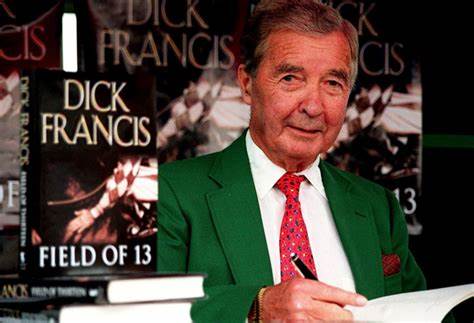
In 1995 I learned that Dick Francis was having a book signing at Tower Records and Books on Queen Anne Avenue in Seattle. So I took my two year old daughter and drove in to the city to purchase and get signed a copy of his most recent book to give to my mother for Christmas. There was a line when we arrived. I learned a couple things about Dick Francis that day. First, that he didn’t much like chit-chatting with his fans; and, second, that book signings required a glass of Merlot for him to get through the event. The store manager brought him one glassful while I was there.

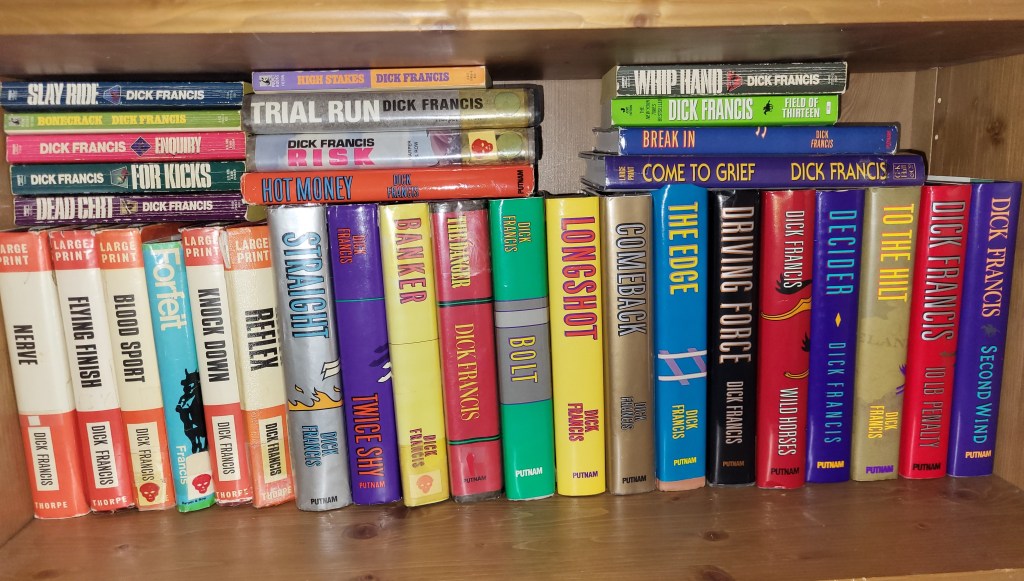
33 different titles make up my mother’s collection. There are two copies of Wild Horses (only one shown) as the autographed copy has never been read.

Eventually my daughter and I make it to the front of the line and I hand him the book with the request that he sign it for my mother. He asks me why I wasn’t getting a second book for myself. Well! That would have required going and buying the second book then getting back in line once again while trying to keep a two year old entertained. I only bought the one book.

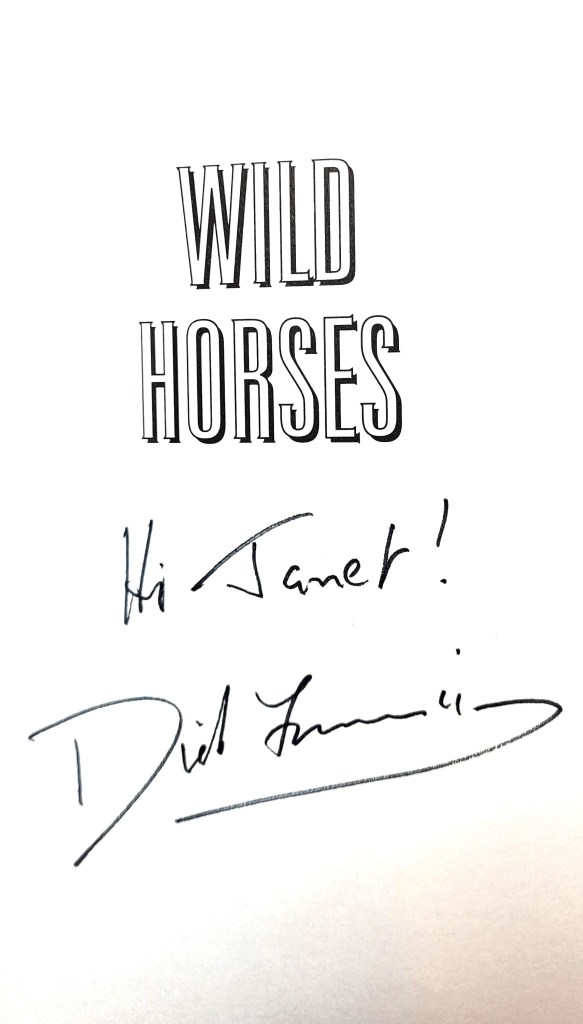
On the title page of Wild Horses he wrote “Hi Janet” and then signed his name.

And my mother’s collection? It’s an impressive mix of paperback and hardback books with publication dates from 1962 to 1999.

If you have not read any of his books they are, I think, a good example of how to mix narrative, dialogue and action. His research, the character development, and the details are always outstanding. So get one of Francis’ books the next time you want to curl up with a good one for the weekend! Well worth the time.

A couple of interesting links:

https://en.wikipedia.org/wiki/Dick_Francis

His son, Felix, who co-wrote with Dick for ten years, carries on with writing novels in the same style. I’ve read a couple of his solo novels and I think he’s done a good job honoring his father’s legacy!  http://www.felixfrancis.com/index.php

https://www.salon.com/2022/11/19/dick-francis-felix-mary-mystery-novels/

Tuesday Newsday

Do you enjoy these stories? As of June 8, 2022 there have been 269 posted here.

At times I look at this body of musings and marvel that I’ve been posting one a week for over five years now. As you might imagine, it does take some planning and contemplation to come up with a new and interesting (well, at least to me!) topic each week. Which is what I was researching this afternoon when I hit on a topic that strikes at a problem I will encounter in less than a year.

When I began I did not count on the issue of Leap Year… and the fact that there will be some dates which never fall on a Tuesday and others which will ‘duplicate’ dates for which I’ve already written something

What to do, what to do? I have some ideas but ultimately one of my goals is to have an article for every calendar day of the year. So only 94 more to achieve the goal.

tuesday newsday cartoon

Cartoon by Cherdo of the Flipside. http://www.cherdoontheflipside.com/

Musings on being a writer

“I write not because I want to but because I am destined to.”― Jules Haigler

An interesting aspect of life is that in order to move forward one must be open to new experiences, expanded knowledge and change. I’ve always been a writer (not the greatest in the world, mind you, but that never deterred me) yet it was about a dozen or so years ago when I realized writing was the ONE thing to which I always returned.

I engaged in a little personal experiment. I went into the library and wandered through the non-fiction stacks. Which books, which topics drew me in? Not the ‘zeros’ or the ‘ones’, ‘twos’ or ‘threes’. It wasn’t until I came to the 808’s when I found my home. I’ve read the book “Self-editing for Fiction Writers” no less than a half dozen times. (808.3) Every time I read it I learn something new and discover ways to improve my writing. The subject matter is of endless interest to me. How does one construct an effective novel? What is an adverb and why are they considered lazy writing? How does one go about turning a gerund into an active verb? Why does any of this matter?

To a writer – an author – this MUST matter because it is at the heart of the craft. Yet, ultimately, it’s about being able to weave an interesting story which captures a reader and compels them to read it until the very end. For me, that will be enough.

884439_1378102442429752_1931651225_o


Barbara DeVore, March 2017