One of the joys of being an author is in the inventing of fictional worlds in real places. When I started thinking about this story this is what went through my head:
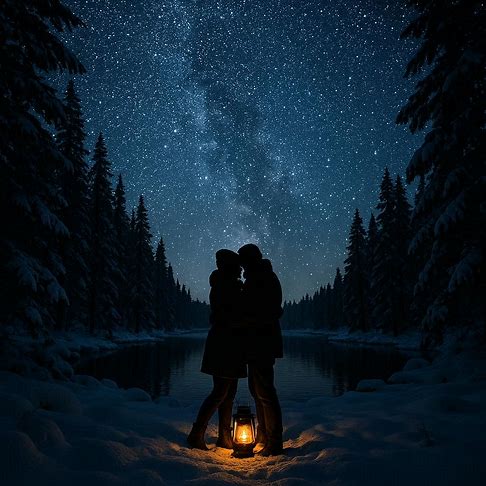
Nicole’s journey took her into the mountains of Montana on the winter solstice.
“What If?” I mused, a young man wanted to break out on his own and move to a place where he knew no one and just started his life over? I know! He answers an ad in a magazine and a few months later he’s living in the boondocks of Montana or Idaho or some other remote western state.
Oh yeah, he also needs to have a tie in to The Darling of Delta Rho Chi, since it needs to be part of series. Sam Paxton is the obvious choice. A young man living in the shadow of his older half-sister, Riley, who we met in book one.
Next, I needed a heroine; a heroine suffering from a calamitous event … who has a very good reason to drive all the way from the Gamma Alpha Beta house at the University of Washington to the boondocks of, er, someplace. Let’s call her Nicole.
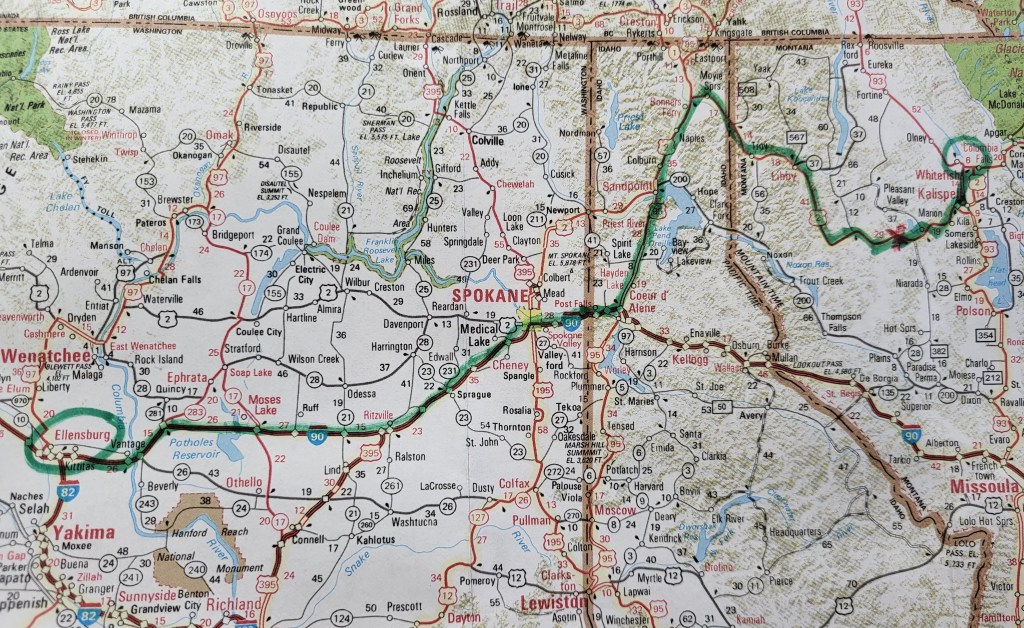
Nicole’s intended journey that fateful December day from Ellensburg to Big Mountain. She ends up stranded at the red ‘X.’
Out came the maps. Being that the story is set in December and during Christmas break, Nicole needed a hometown someplace in Washington. I picked Ellensburg. It’s a nice town and one I was familiar with, having grown up in nearby Yakima. From there she could travel eastward to the mystery destination. What about Sun Valley, Idaho? I soon learned it was over 500 miles and 8 plus hours of travel from the heroine’s hometown. Plus, I knew Nicole’s parents would NEVER agree to that trip.
I Googled ski resorts in Montana and up popped quite a few. Red Lodge was 716 miles east of Ellensburg and Big Sky was 604. Whitefish, at 425 miles, seemed just far enough to make it difficult for Nicole to get home but still had the elements needed to make it work.
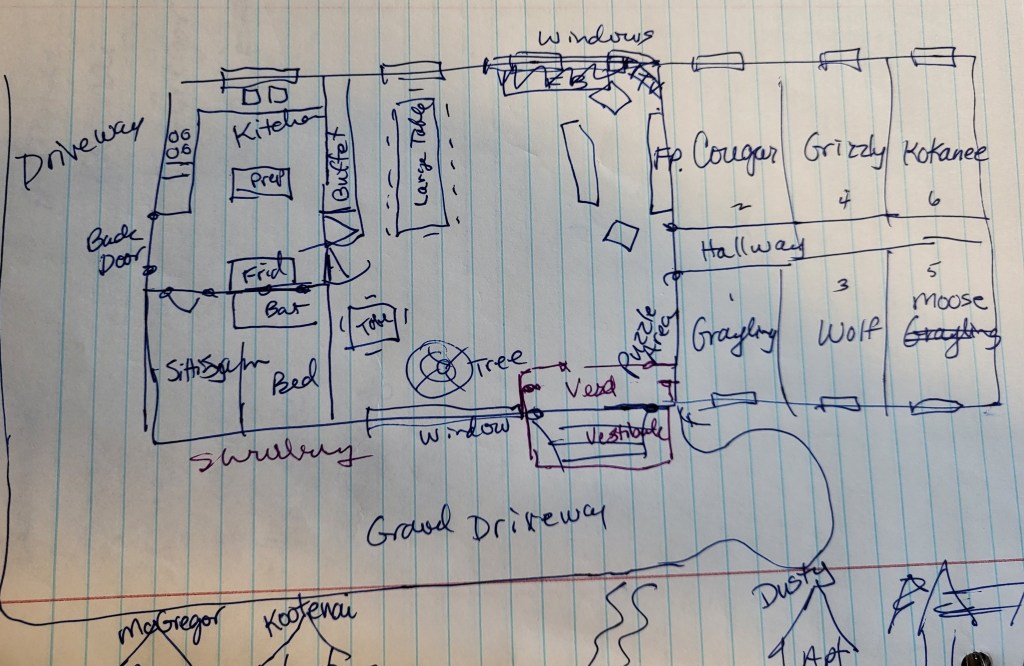
When I was 12 years old I became obsessed with designing the layout of houses. I used graph paper and would spend hours drawing them. This is my rough layout of the fictional Malloy’s Lakeside Lodge.
As the story took shape, more research was needed. Like knowing the specific weather on specific days. What was the layout of the lodge? Where could that lodge be located? What was the floor plan of Nicole’s family home?
All those details are, to me, part of the fun of story creation and I hope that you, my readers, will enjoy being immersed in the fictional world of Sam, Nicole, Dusty, and Beej! – Barbara DeVore
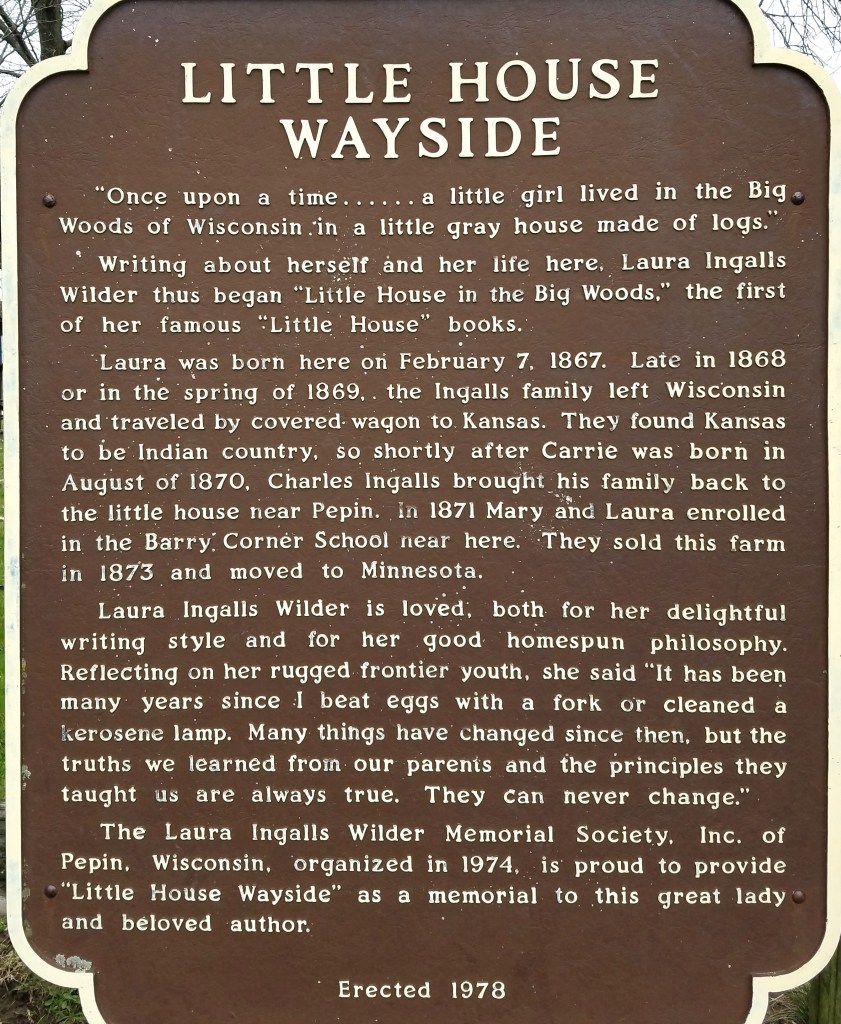
Sign at the “little house” that started it all in Pepin, Wisconsin
Perhaps more than any other books I’ve ever read, this series captured my young imagination and inspired me to want to write and record my world.
The first “Little House” book was published in 1932. Six more followed over the next decade and Laura Ingalls Wilder was propelled from a farmer’s wife to one of the most beloved children’s book authors in history.
As a child I was entranced by the thought of living in a cabin in the big woods of Wisconsin, or in a dugout carved into the banks of Plum Creek in Minnesota, or in a claim shanty on the wind swept prairies of South Dakota. What adventures awaited!
I’ve had as a goal to visit the many homestead sites. In September 2013 I, along with my 20 year old daughter, went to Mansfield, Missouri, and toured the museum and also the house where Laura lived as an adult. This past week was round two when the hubby and me meandered from Wisconsin to South Dakota and traced a portion of the Ingalls family pioneer journey.
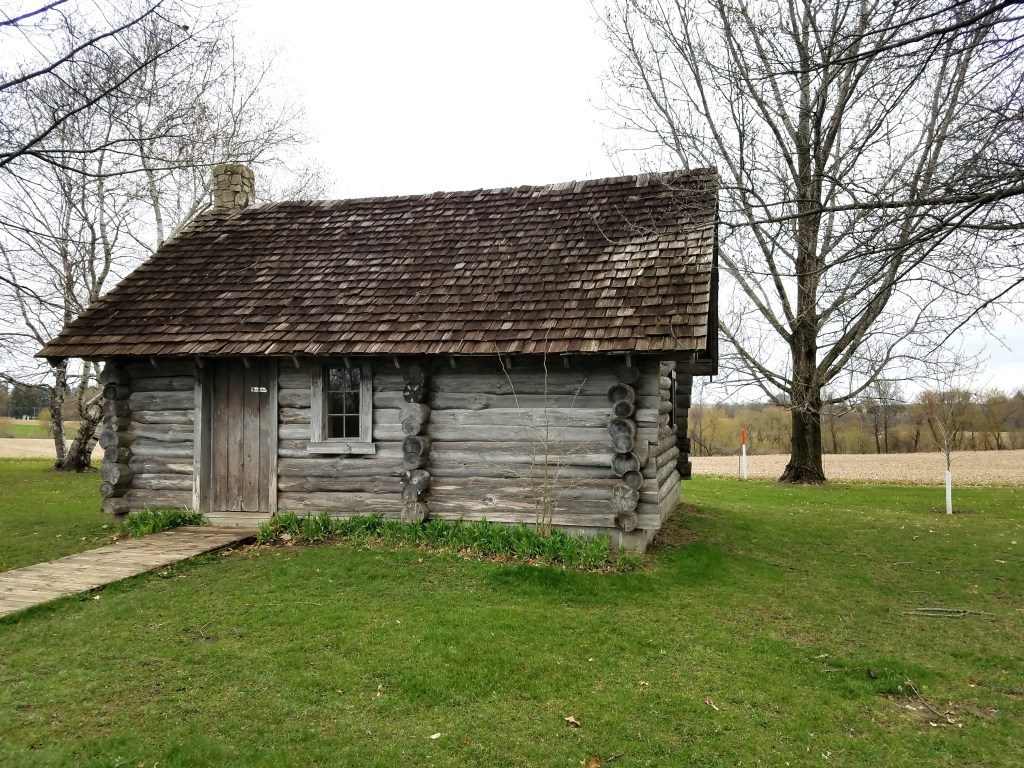
The Little House in the Big Woods in Pepin, Wisconsin
The takeaway for me as an adult – considering it from the perspective of a wife and mother – is how very difficult it must have been, especially for Laura’s mother, Caroline.
Our first stop was in Wisconsin. Although the Ingalls’ cabin is long gone, those who preserved the sites have erected faithful reproductions of the original structures. The little house in Wisconsin was certainly that: little. The main room was no bigger than a small bedroom by today’s standards. For the pioneers, this room was kitchen, dining room, living room, and laundry room (at least half the year). The entire family slept in a room the size of a closet.
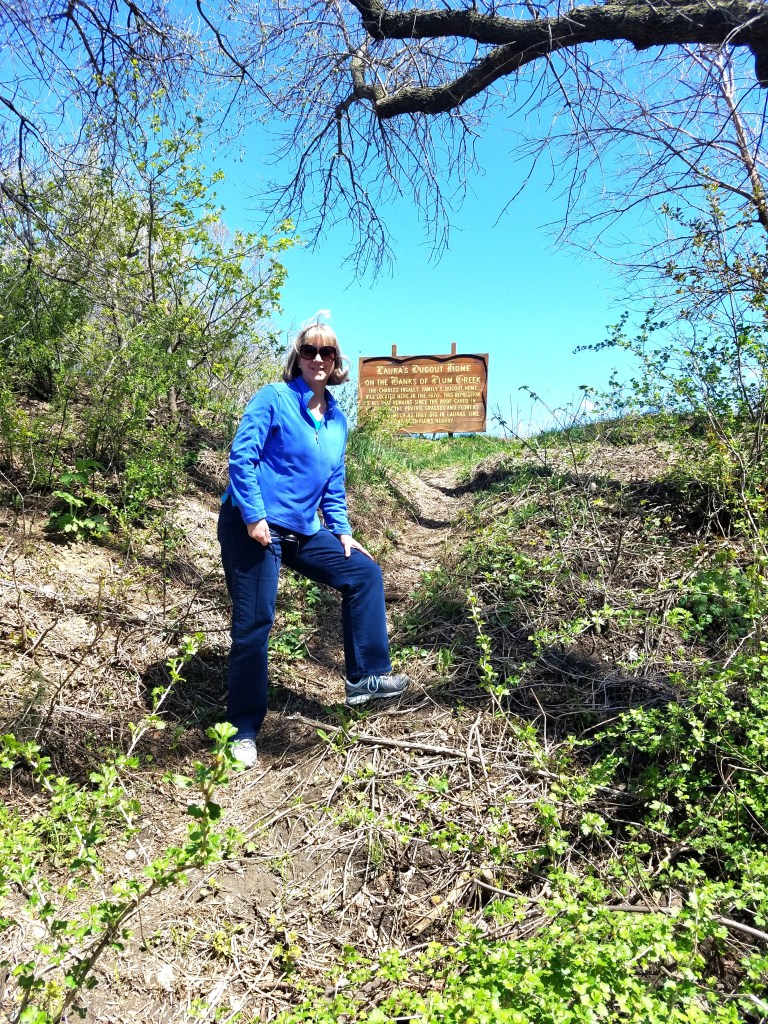
This author standing about where the dugout door was located on Plum Creek, Minnesota.
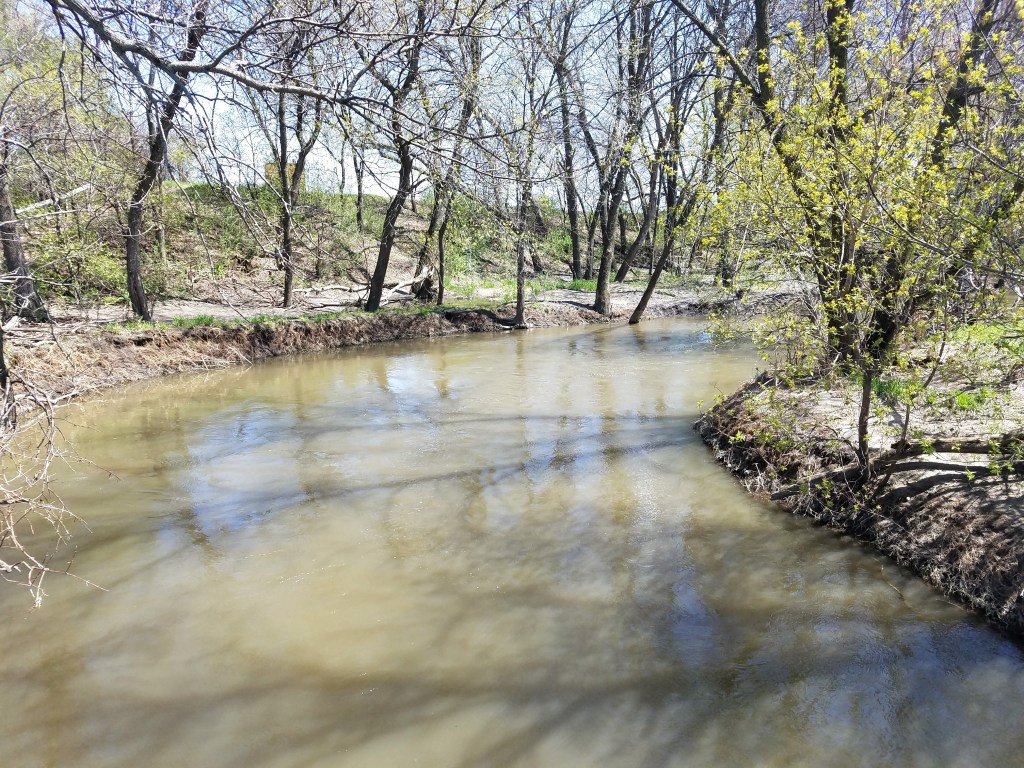
Plum Creek how it looks now
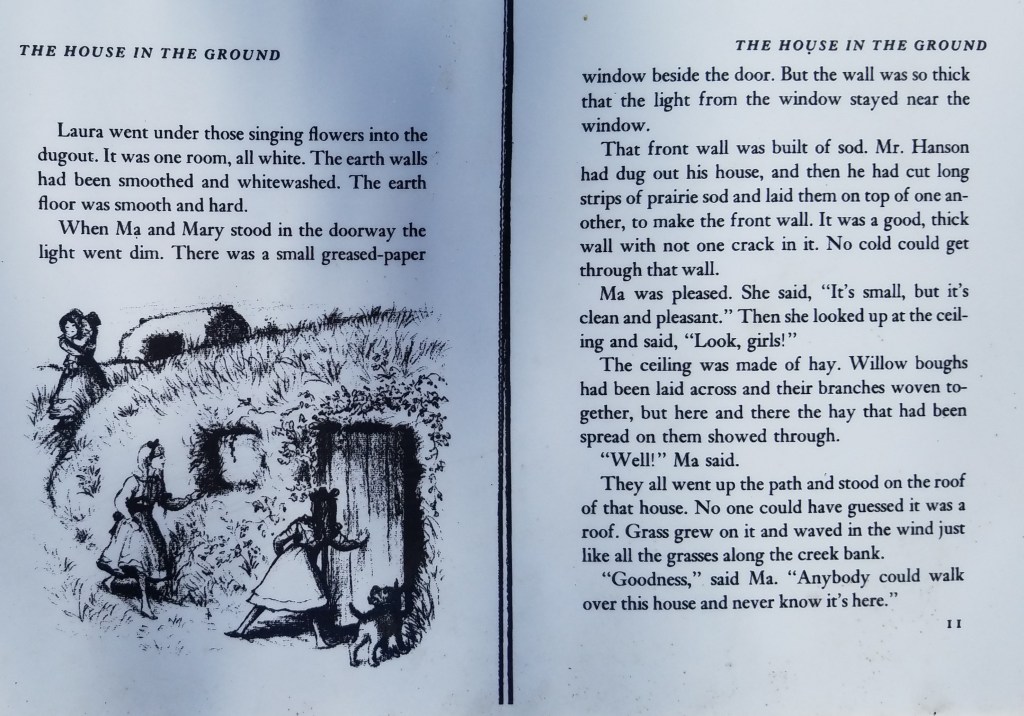
Excerpt from On The Banks of Plum Creek where Laura describes the ‘house.’
It was the next ‘house’, however, that really gave me pause. Laura’s family purchased a farm near Walnut Grove, Minnesota… but there was no ‘house.’ Instead, the family lived for some months in a ten by twelve ‘room’ dug out of a bank above a creek. The actual dugout collapsed years ago, but a reproduction exists in South Dakota. When I walked in to that room two days later I was struck by two things in particular. The first was the smell. It was a combination of earth, mold, and damp. It was depressing and dark. As Laura describes life in the dugout she shares how her mother whitewashed the dirt walls and floor with a lime mixture. I imagine the lime served several purposes including, foremost, pest control and to brighten the room. How hard it must have been for Caroline Ingalls to cook, clean, and care for her children in that tiny, tiny space.
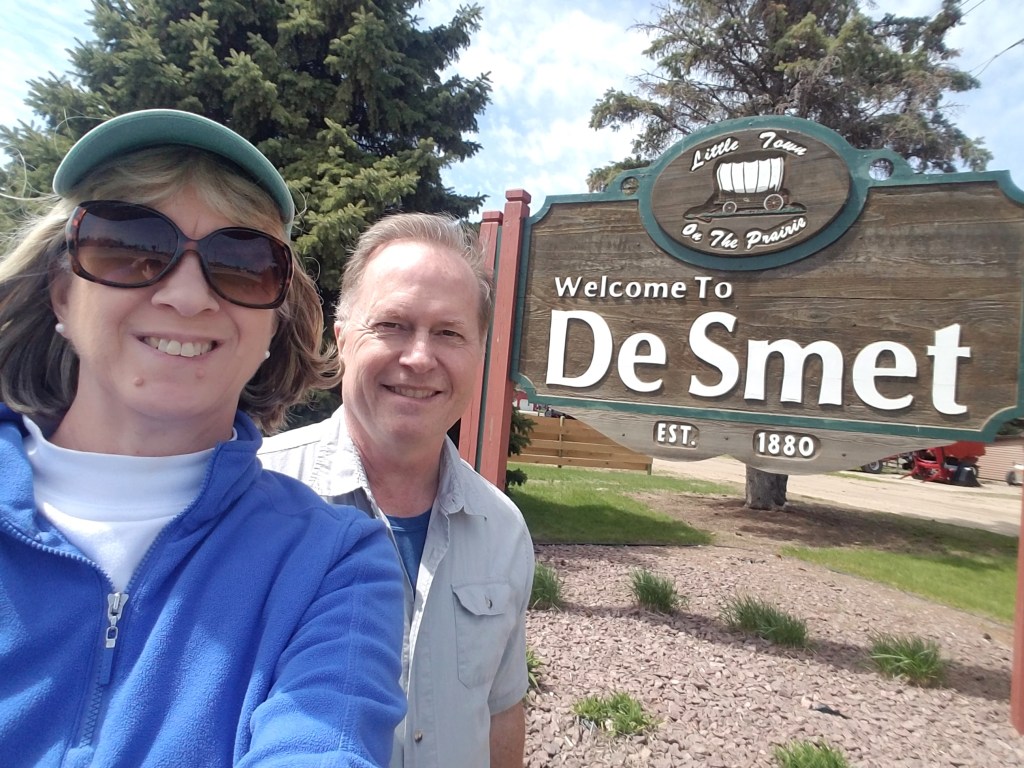
The author and hubby at DeSmet, South Dakota
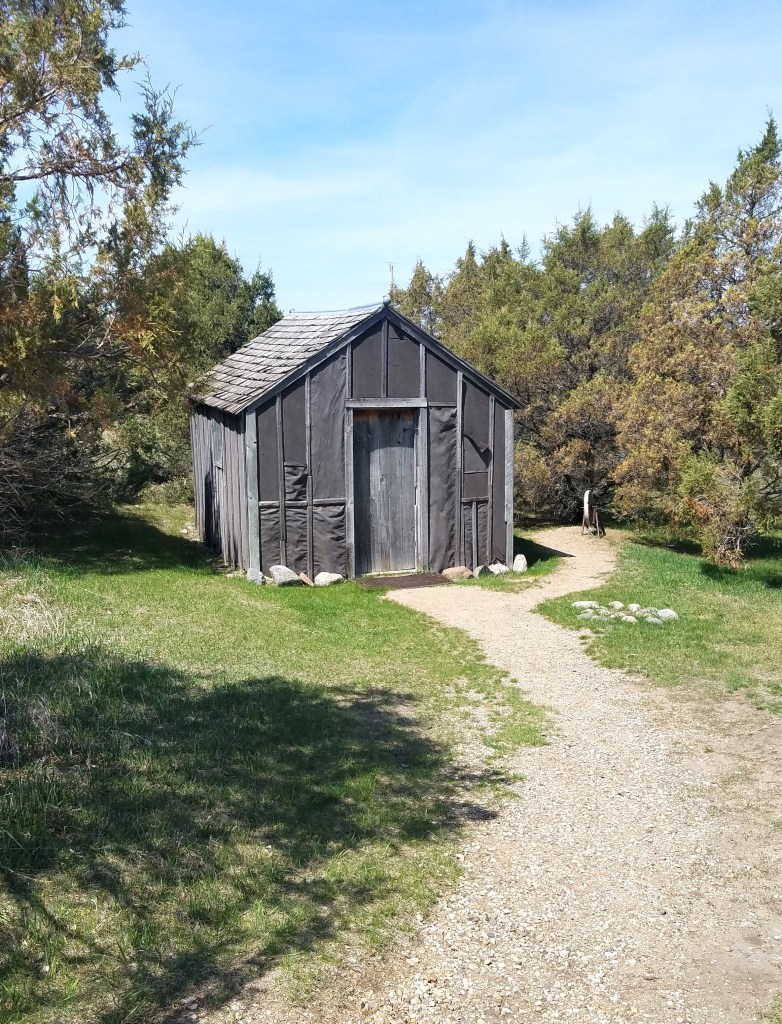
In South Dakota the Ingalls family had to, once again, start from scratch. It was not hard to imagine how alone and desolate Caroline must have felt as one of the first pioneers in DeSmet. Their homestead was 160 acres – one quarter mile square – and it was a half mile south of the town. There were no neighbors, just the wildlife which called the prairie home. The Ingalls claim shanty was just that: a shanty. Unlike the cabin in Pepin, this home was a tiny one room shack with the beds for a family of six in every corner, a stove in the center, and a few chairs and a table. The thin walls not much protection against the persistent winds and cold. Over time the shanty was expanded to include 2 small bedrooms and a 12 by 16 living room.
Replica of the ‘shanty’ where the Ingalls family of six lived the first summer so Pa could ‘claim’ his land.
What resilience these people possessed!
When we stopped at the Ingalls homestead near DeSmet, the woman who owns and runs the property came by to speak to us. I said to her I suspected when the Ingalls family arrived there that Caroline told Charles she was done moving and carving out homes in the wilderness. Our hostess confirmed my supposition. Laura’s parents lived the rest of their lives in that community, eventually moving to a proper house in the town eight years after their arrival.
It is impossible to truly capture these places on paper. But Laura Ingalls Wilder’s narrative description of each location comes close. I felt as if her spirit was there with us in South Dakota, especially, as I mapped out some travels to the spots she describes in her books.
The roiling waters of Lake Henry during the spring perch hatch
It was at Lake Henry when the magic occurred. The hubby and I noticed the water in a nearby slough was roiling. Upon closer examination we discovered hundreds of fish flopping and thrashing about! We walked close to the spectacle, mesmerized by the yellow perch which spawn this time of year once the water raises to a certain temperature.
From there we meandered across the back-roads, and observed white tailed deer, a muskrat which waddled across the road, and hundreds of birds: pelicans, herons, eagles, hawks, geese, and all variety of smaller ones.
We were reluctant to leave but how very glad we were to be able to experience a tiny portion of the Ingalls family journey.
So which of the three ‘little houses’ would have been the best ? Probably the cabin in Wisconsin. As we returned from our adventures I found myself thankful, yet again, for modern amenities: electricity, running water, flushing toilets, refrigeration, automobiles, and airplanes. What a blessed era in which I live.
Near and dear to this author’s heart is World Book and Copyright Day – celebrated annually on April 23. Created in 1995 the purpose of the day is to “recognize the scope of books – a link between the past and the future, a bridge between generations and across cultures.”
One of the more interesting aspects of World Book Day, however, is how the date was chosen and why. The Infallible Wikipedia, as it so often does, offers some insight:
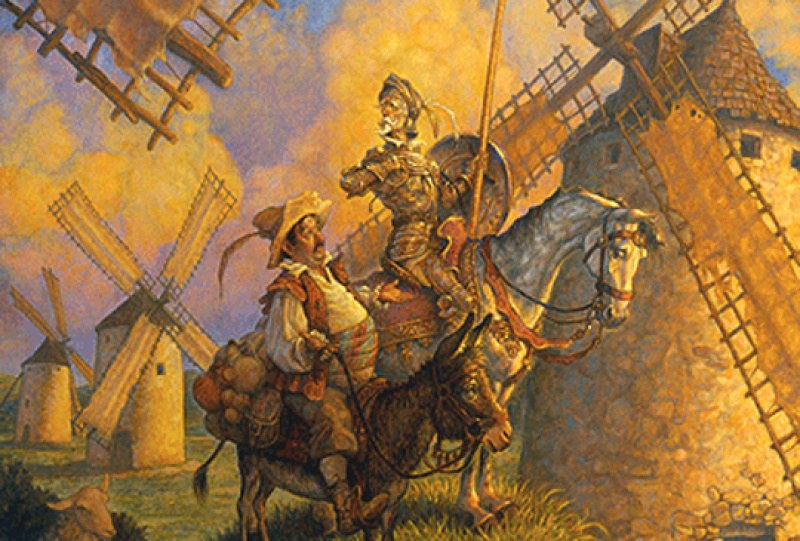
Cervantes is considered the most influential Spanish language author. His most famous work depicted here: Don Quixote.
“The original idea was of the Valencian writer Vicente Clavel Andrés as a way to honour the author Miguel de Cervantes, first on 7 October, his birth date, then on 23 April, his death date. In 1995 UNESCO decided that the World Book and Copyright Day would be celebrated on 23 April, as the date is also the anniversary of the death of William Shakespeare and Inca Garcilaso de la Vega, as well as that of the birth or death of several other prominent authors. (In a historical coincidence, Shakespeare and Cervantes died on the same date — 23 April 1616 — but not on the same day, as at the time, Spain used the Gregorian calendar and England used the Julian calendar; Shakespeare actually died 10 days after Cervantes died, on 3 May of the Gregorian calendar.)”
Shakespeare, perhaps more than any person who has ever lived, was the most impactful of authors. He published 37 plays and 154 sonnets and today, 503 years after his death, his works are still being performed and his written works analyzed and contemplated. Talk about staying power!
William Shakespeare
Several years ago I read a book which made the claim that every plot line ever imagined was written by Shakespeare. Modern writers, it stated, might as well give it up and quit writing stories since they cannot match Shakespeare.
To me, this was a very sad and cynical thought. Plus it misses the point about the human mind, heart, and the individual’s desires – I would argue need – to pursue one’s passions in life.
When I reflect back on my earliest interests, one stands out: the desire to write. What better way to capture one’s thoughts and the emotions of a time and place? I dabbled in fiction writing while in high school and penned a thinly cloaked autobiographical story titled “Another Lunch.” It told the story of Bernice, Deborah, and Cynthia, three friends whose singular focus seemed to be the pursuit of, and interactions with, boys.
I would add to the ‘book’ as new adventures occurred, writing them by hand in a three prong paper keeper over the weekend, then bringing the updated story to school for the ‘real’ Deborah and Cynthia to read. Eventually word of the story got out there and some of the ‘boys’ and other peripheral characters – perhaps recognizing themselves in the story – clamored to read the tome. It was passed around like an annual at graduation for everyone to peruse.
Sadly, “Another Lunch” disappeared in the spring of my Senior year, no doubt carried home and lost in the hovel of some student’s bedroom destined to be discarded by an irritated mother who saw it as worthless. As for me, I kept all my writings from those early years and find them, at times, a somewhat painful reminder of my perspective and (lack of) writing abilities.
Although I dabbled in writing the beginnings of stories a various times over the years, my ‘fiction’ writing mostly lay dormant for years. Then the day came when I walked into a novel writing class at Bellevue Community College.
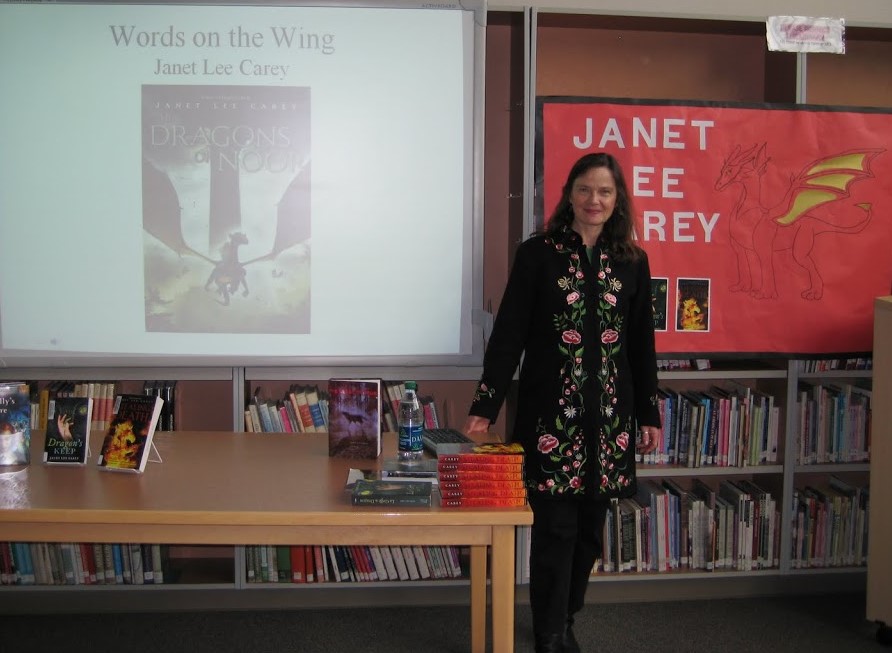
Author Janet Lee Carey
Taught by published author Janet Lee Carey, it was structured into two parts. The first was a 45 minute lecture on the various elements of writing fiction: plotting, sentence, paragraph, and sentence structure; deciding what sort of book you were going to write; character development; effective dialogue; avoiding cliches. The things one needed to know and learn was extensive. I soaked it up like a teenager getting a tan during summer break.
The second half of each class was an opportunity for all of us aspiring authors to read a scene or two from our current work in progress. It was what happened in the second part of the class that day which confirmed for me that I was a closet novelist who had finally found her home.
I listened to the stories which my classmates shared for critique and a voice inside my own head whispered to me, “You can write just as well…”
Later that day I started on my first novel, determined to find a way to complete a 90,000-word book – standard length. I took inspiration from Janet when she said – and I paraphrase – “If you can write a sentence, then you can write a paragraph… and if you can write a paragraph, then you can write a chapter. After all a novel is just sentences, paragraphs, and chapters all connecting together.”
There was no better feeling than when, months later, I wrote the words “The End.” I had done it! But it was more than that. Writing provided an outlet for the jumble of thoughts which crowded my brain, a virtual sieve to separate the chaff from the grain.
Now, nearly twenty years later, I am still compelled to write. That class was truly a life changing event.
In addition to fiction, my Tuesday Newsday blog has taken on a life of its own. Now in its eighth year I’ve published 314 articles covering unique topics in categories such as Historical Happenings, My Home Town, Screen Shots, Music Makers, and – a personal favorite – Geeky Musings. I’ve updated a number of articles as I await next year and the opportunity to fill in those 52 dates which have not yet fallen on a Tuesday!
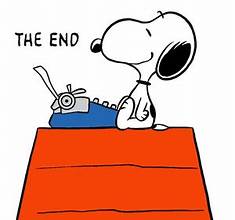
Famous author Snoopy inspires me
But, for me, it doesn’t matter if its novels or short personal essays (such as this one) it’s the writing that matters. I’m truly happiest when I get to spend a portion of the day writing creatively.
Finally, a nod to my fellow ‘Anonymous Authors’, who for the past 20 years have brightened my Tuesday mornings with their stories, critiques, and friendship, especially: Roger, Jette, and Ward my current compadres who meet on Zoom most Tuesday mornings. But also to those who once shared those Tuesdays: Irene, Daphne, Steve S., Steve D. (what she said!), Dee, Joe, and May.
A bit of information about World Book and Copyright day:
327 Tuesday Newsday Articles and 2 published novels
January 9th
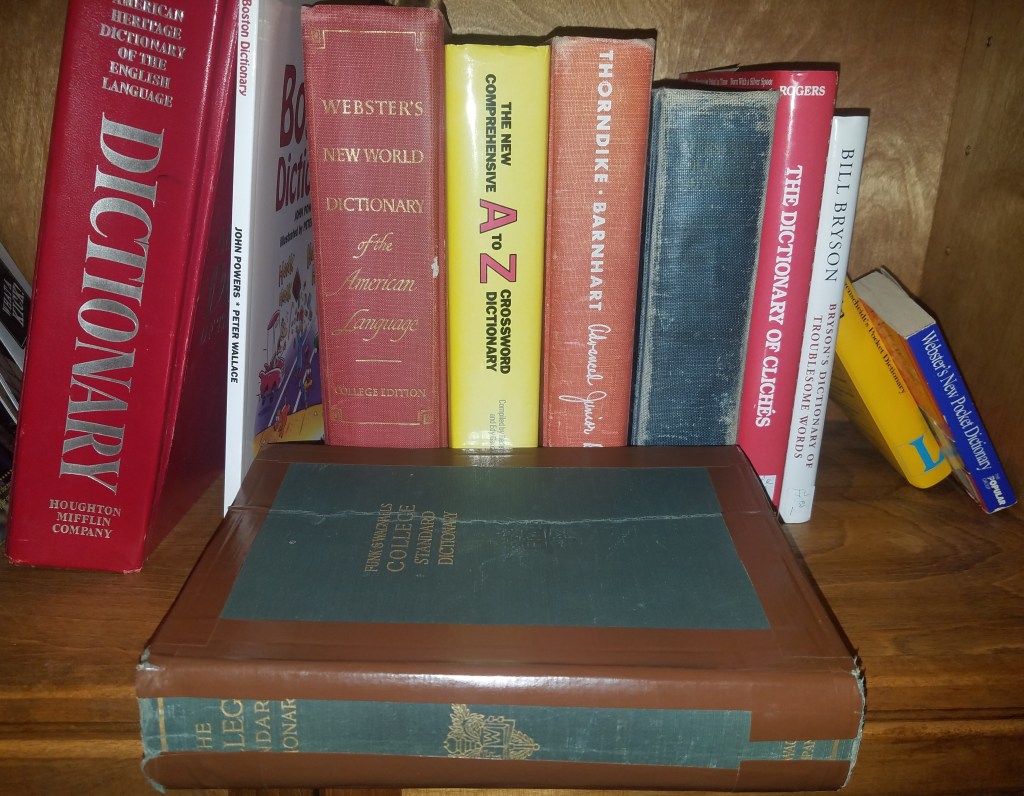
The author’s collection of dictionaries. The Webster’s New World Dictionary, third from the left, was often used for playing ‘Dictionary.’
A Tuesday Newsday Classic
Back in the early 1980’s I was introduced to a game my hubby and his family loved to play. There was no game board or markers to move around. Instead it required a dictionary, a piece of paper for each player, and a pen. They called the game Dictionary.
A search of the internet reveals, from the Infallible Wikipedia, that the genre is more commonly known by another name: Fictionary. In the years since being introduced to this delightful pastime there have been actual games developed and sold. As noted by the Infallible Wikipedia:
“The board games Balderdash, Dictionary Dabble, Flummoxed, and Weird Wordz are based on Fictionary. In one round of the board game Derivation, players describe or fabricate a word’s etymology; players who provide a correct etymology receive one point for doing so, but their entries are then removed from play, and they lose their chance to receive multiple points by drawing multiple votes from other players. Similarly, in the board game Wise and Otherwise, the Picker randomly chooses a quotation and reads the beginning, and other players try to create realistic endings to the quotation.”
It’s amazing what interesting words one can find when perusing a dictionary.
While these games have been successful, I rather like how we played it: Get a group of people together (the more the better) and then pick one person each round who looks through the dictionary until they find a sufficiently obscure word. They then announce the word to the group and each person has to come up with a definition for that word. The chooser writes down the REAL definition.
Once everyone has written his or her definition, the papers are passed to the person who picked the word and they read each entry aloud, being sure to hide the papers from others. Each participant then decides which might be the real meaning of the word. Those who guess correctly get one point. The chooser gets one point for every incorrect guess.
Now, I’m sure you are wondering what this has to do with the title of this week’s Tuesday Newsday, Coddiwomple. Up until the hubby and I were driving home from Yakima on New Year’s Day this year I had never heard of Coddiwomple. But it immediately made me think of playing Dictionary and probably the most favorite word I ever found and used which is ‘gardyloo.’
The hubby had read an article on the term Coddiwomple and shared it with me. What I learned, from author and philosopher David Marlowe – who coined the term – is this:
I was immediately struck by the rhythm of the word and how it seems to fit its definition. Of course the purpose of the word is to help people stop and contemplate what, exactly, they are each trying to accomplish in life.
It was on this date in 2017 when I wrote my first Tuesday Newsday article. At that time I had no idea where I was going with it; only that, via a very decidedly Coddiwomple experience, I had been nudged to take the path of starting a website for ‘someday.’
That ‘someday’ was aimed for that moment, in the murky future, when I would have a book published and be able to share it on my website.
And thus began a Coddiwomple journey toward a vague destination. My first Tuesday Newsday was all about one of my favorite musical artists, Jim Croce.
Of course I screwed it up a bit on that first go round – being unfamiliar with WordPress and how it all worked – and accidently posted it on Wednesday, January 10th instead of that Tuesday, January 9th. So I ended up with TWO articles about Jim Croce a year apart, with the other one on January 11th the following year. (here’s the link to both which I combined into one for ONLY January 10th): https://barbaradevore.com/2017/01/10/jim-croce/)
But that was okay because, well, Jim Croce. One of his best songs… and so bittersweet.
What I did know after that first post is that in addition to the fiction stories which invade my brain and compel me to write, I had a whole lot of personal stories which came pouring forth.
Some have been funny, some philosophical; they range from recounting early childhood memories to recent impactful events. They cover music, TV, movies, nature, history, geeky musings, and cultural references. War and politics are never included.
But what do any of these ramblings have to do with traveling purposefully toward a vague destination?
For me, no matter what think I chose to do, it is the desire to fully embrace each experience in life. New opportunities frequently present themselves and, as someone who probably has undiagnosed ADHD, I am often distracted by such shiny objects.
Yet, as I have matured, I’ve come to understand a universal truth: our most precious commodity is TIME. I’ve become quite protective of my time. And the one thing in life which is elemental to who I am and where I want to spend my time is writing. It’s been that way since I first put a piece of chalk to a chalkboard desk I received as a Christmas present at age three when my family still lived in Clarkston, Washington.
The author, age 3, with her chalk board. Captured with a cell phone camera from the home movies my dad took.
So now I begin year nine of my blog in basically the same way as I did in 2017, traveling in a purposeful manner toward a vague destination. Coddiwomple.
Now, if you’ll excuse me I need to go write Nicole out of the entanglement in which she finds herself. Who will she choose: Nathan, Sam, or ???. And how will her parents react? I’m not sure she has quite embraced Coddiwomple but then again she’s only 21 and has a lifetime ahead of her.
Sneak preview of just a bit of the cover art for ‘Rivals’!
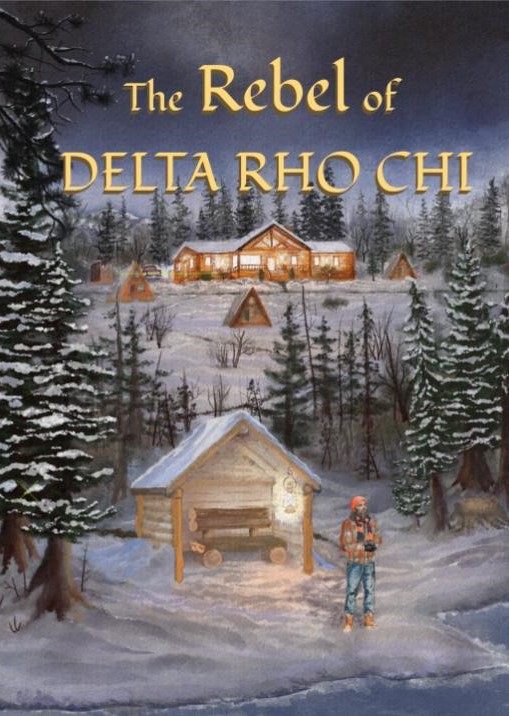
Well, that was LAST year’s dilemma. Since then, Nicole and company made their appearance with the publication of “The Rebel of Delta Rho Chi” on September 16, 2025. Now I’m thick in the lives of Kara, Brooke, Jason, and Erik who, as early twenty college students, are challenged to figure out the eternal question, “Who am I and what am I doing here?” I think they’ll get there but currently things are a bit messy in “The Rivals of Delta Rho Chi.” Look for their story this summer.
Finally, for those who have read all the way to the bottom, here’s your reward. Gardyloo is, according to Dictionary.com, “a cry formerly used in Scotland to warn pedestrians when slops were about to be thrown from an upstairs window.” Oh those crazy Scots. You’re welcome. Of course if you looked closely at the photos, you already knew the definition.
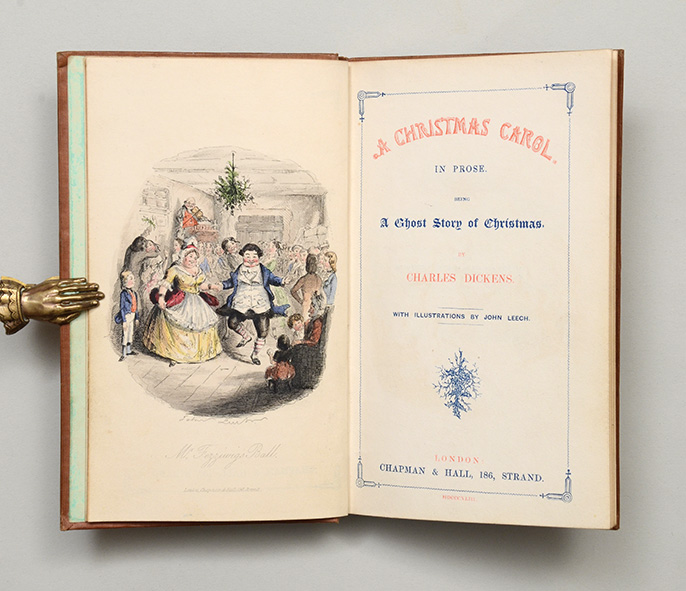
It took the author only six weeks to complete this novella which was published on December 19, 1843. All 6,000 of the original copies sold out in less than six days and the book, arguably, is one of the most famous literary works in history.
A Christmas Carol in Prose, Being a Ghost-Story of Christmas – the full title – is known better by the simpler name ‘A Christmas Carol.’
Charles Dickens was appalled by the conditions he saw at a school for the poor and was inspired to write the story. From the Infallible Wikipedia:
“Dickens had written three Christmas stories prior to the novella, and was inspired to write the story following a visit to the Field Lane Ragged school, one of several establishments for London’s half-starved, illiterate street children. The treatment of the poor and the ability of a self-interested man redeeming himself by transforming into a more sympathetic character are the key themes of the story. There is discussion among academics as to whether this was a fully secular story, or if it is a Christian allegory.”
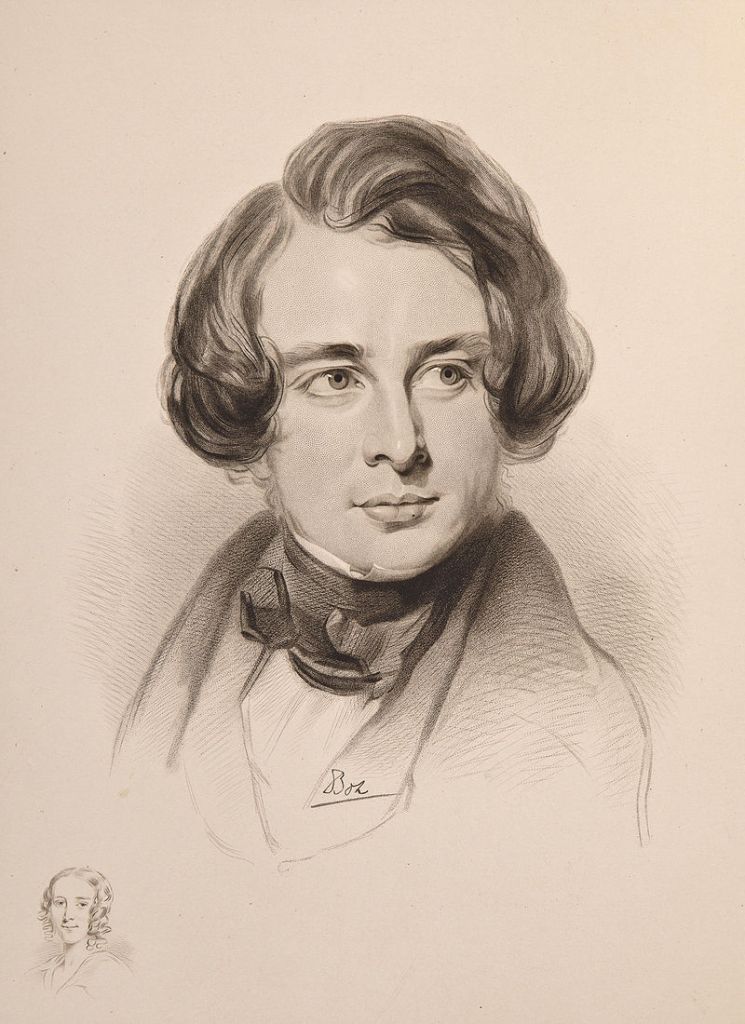
A sketch of Charles Dickens circa 1843
The book had an additional 13 publication runs in 1844, obviously resonating with the reading public in Victorian England. Since its first edition, the book has never been out of print and has been translated into several languages and adapted for theatre, movies and TV.
The path to success for Dickens, however, was not an easy one. Despite being a successful author, by mid-1843 he encountered financial problems. In those days authors were paid a salary by publishers and the author’s writings didn’t truly belong to them. Dickens’ publishers, Chapman and Hall, were about to reduce his salary by 50 pounds as sales of his current book had fallen. Also from the Infallible Wikipedia:
“As the result of the disagreements with Chapman and Hall over the commercial failures of Martin Chuzzlewit Dickens arranged to pay for the publishing himself, in exchange for a percentage of the profits. Production of A Christmas Carol was not without problems. The first printing contained drab olive endpapers that Dickens felt were unacceptable, and the publisher quickly replaced them with yellow endpapers, but, once replaced, those clashed with the title page, which was then redone. The final product was bound in red cloth with gilt-edged pages, completed only two days before the publication date of 19 December 1843.”
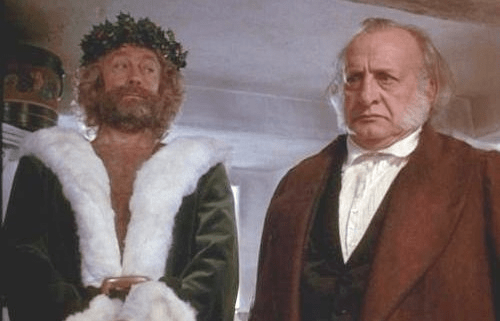
The Ghost of Christmas Present and Scrooge in the 1984 version featuring George C. Scott
Perhaps my favorite part of this story is how Dickens, despite setbacks, prevailed as a self-published author. He also, apparently, understood how to promote and, in 1852, started a tradition of reading an abbreviated version of the story as a public performance every Christmas season until his death in 1870. In fact he read A Christmas Carol in this manner 127 times.
I’ve seen a number of different versions of “A Christmas Carol.” Although many critics laud the 1954 film with Alistair Cook as Scrooge as the best adaptation, I’m partial to the George C. Scott version from 1984. What’s your favorite version?
2023 Update:
Unbeknownst to me, a movie was released in November 2017 (just weeks before the original post) about the writing of “A Christmas Carol.” I only first saw the movie last week. Titled “The Man Who Invented Christmas” it tells the story of Dickens struggles as an author and how the concept of one of his most beloved works came to be.
What I most appreciate about the film is how it portrays the writer’s journey. In the six weeks it takes for Dickens to pen the manuscript he struggles with the characters, especially the character of Scrooge who Dickens originally felt was not redeemable.
To me, one of the joys of writing fiction is breathing life into those characters who take up residence in your head during the creative process. One of my favorite characters arrived in my kitchen one morning as I was doing dishes. I was about 18,000 words into the novel and I was stuck. I needed something to occur which disrupted the budding relationship between my male and female protagonists.
So there I was, hands in the soapy water and, although I would look out the window every so often, my brain was thinking about the story. I hear an unfamiliar male voice behind me and I immediately know who it is. But it’s not someone from my household. Oh no, it’s a character from an earlier novel who the last time we met he was a baby. And he says “Put me in the story.” I froze and I contemplated the suggestion. Then I dried my hands and headed up to my computer to see what that looked liked. He was absolutely right. Turns out he was definitely a bit of a scoundrel but quite lovable and you like him in spite of his flaws. (Well, at least I do)
These past few months I’ve been doing a complete rewrite of this particular novel prepping it to send to my editor. (Note to my editor – the rewrite has been more involved than I anticipated…) And I still love this character. It’s been fun to spend time with him once again.
However, I am putting “The Man Who Invented Christmas” on my list of movies to be sure to watch each holiday season. God Bless Us, Everyone!
“You have been my friend,” replied Charlotte, “That in itself is a tremendous thing.”
The cover of my 1959 copy of Charlotte’s Web – complete with crayon marks and tears.
It is rare to find a writer whose impact on both children and adults is so impactful, but E.B. White – who was born on July 11, 1899 – was such a writer.
For a writer there is no more monumental handbook than “Elements of Style.” Its dog-eared pages a testament to any author’s quest to use punctuation and grammar correctly. The book was first published in 1918 by William Strunk, Jr. It was in 1959 when it was revised and enlarged by White and now bore both contributors’ names. When a question arises as to ‘how’ to write something correctly, most writer’s will say, colloquially, ‘what does Strunk and White say?’
White spent his life as a writer, the bulk of that on staff with “The New Yorker” magazine. It was when he turned to the writing of children’s literature and, especially, with the publication of Charlotte’s Web, that he became a household name.
My collection of E.B. White books. Doesn’t every writer have not one, but at least two copies, of ‘Elements’?
According to the Infallible Wikipedia:
“White’s editor Ursula Nordstrom said that one day, in 1952, E. B. White handed her a new manuscript, the only version of Charlotte’s Web then in existence, which she read soon after and enjoyed. Charlotte’s Web was published three years after White began writing it. (snip)
Written in White’s dry, low-key manner, Charlotte’s Web is considered a classic of children’s literature, enjoyable to adults as well as children. The description of the experience of swinging on a rope swing at the farm is an often cited example of rhythm in writing, as the pace of the sentences reflects the motion of the swing. In 2000, Publishers Weekly listed the book as the best-selling children’s paperback of all time.”
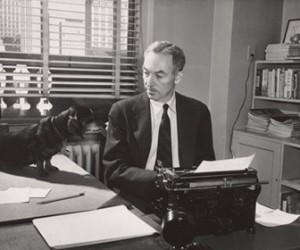
Author E.B. White at work. One of the many dachshunds he had as pets over the years provides editorial supervision.
The book, at one time, was one of the most widely read books by elementary aged children. Somewhere in a dusty box in my parent’s basement is a copy of this wonderful book. A book which I read over and over again, falling in love with a pig named Wilbur and his friend, the spider Charlotte.
The above paragraph is what I wrote when this article was posted on my Blog on July 11, 2017. Two years later, in August of 2019, I did find that copy of Charlotte’s Web and brought it to my house. When I pulled it from the shelf to update this article, I was struck by its appearance. The paper cover was far more dog-eared than I recalled and also bore a couple of crayon marks courtesy of me, no doubt.
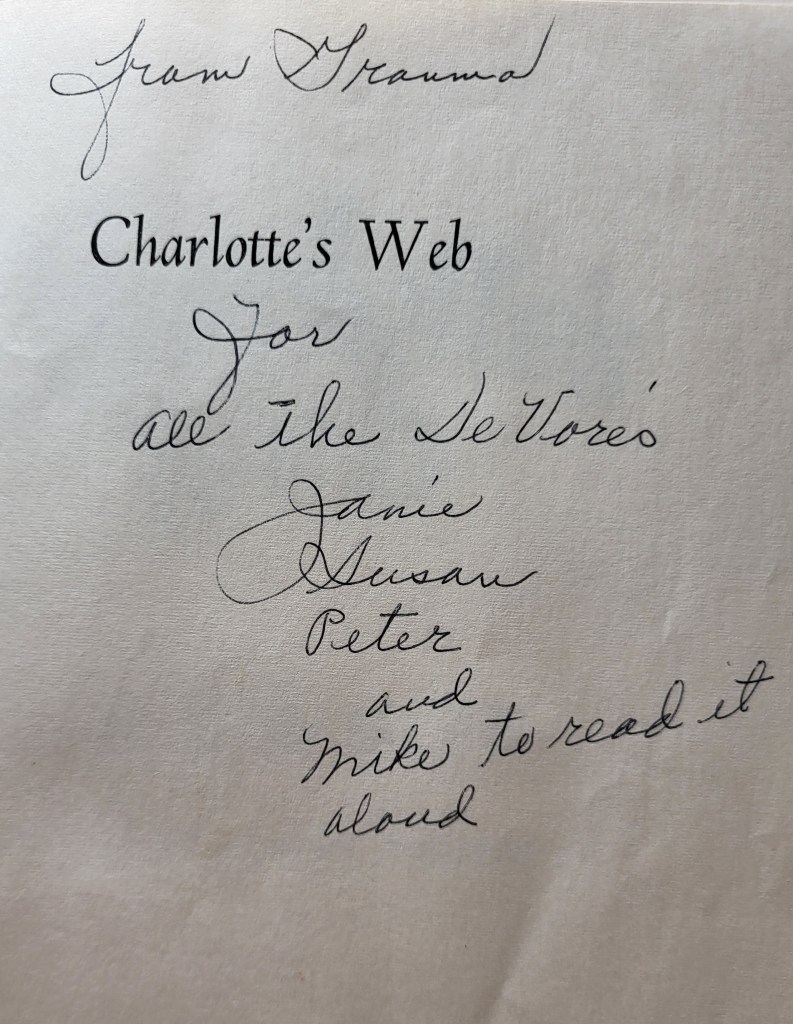
But then I opened the book and there on the first page I was treated to this gem of an inscription: ‘From Gramma For All the DeVore’s’ and our names are listed: ‘Janie, Susan, Peter, and Mike to read it aloud.’
Based on that information I know that the book arrived in my family’s home during the years our family lived in Clarkston, Washington. We were there from late 1958 until the summer of 1961. I was called Janie – my middle name being Jane – during those years as there was an older girl in the neighborhood named Barbara. I’m guessing I was about two at the time which made my siblings four, six, and eleven.
The inscription in the late 1950’s Charlotte’s Web given to me and my siblings from our Grandmother.
But the real story of “Charlotte’s Web” is that it addresses the topic of life and death in a way that made it personal and real for children. We experience grief right along with Wilbur as he learns that his beloved Charlotte is nearing the end. White summed it up in this moving paragraph following Charlotte’s demise:
“Wilbur thought often of Charlotte. A few strands of her old web still hung in the doorway. Every day Wilbur would stand and look at the torn, empty web, and a lump would come to his throat. No one had ever had such a friend – so affectionate, so loyal, and so skillful.”
White handled the topic with gentleness for his young readers, giving us all a great lesson: to love and appreciate those we call family and friends for every day we have with them. And when the day arrives when we have to say goodbye we know that their impact on us and on others was real and meaningful.
In a five day span the last week of June/first week of July I lost not one, but two, such friends. The grief is still raw and palpable. So give out hugs freely, always speak words of kindness, and remember, to love one another.
“Let us go forth, the tellers of tales, and seize whatever prey the heart long for, and have no fear. Everything exists, everything is true, and the earth is only a little dust under our feet.”
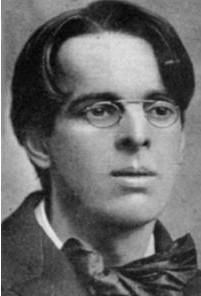
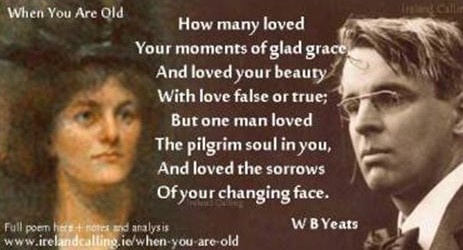
Awarded the Pulitzer Prize for literature in 1923, William Butler Yeats interpreted the honor as belonging to his beloved Ireland. The poet was born on June 13, 1865 and, despite a number of years in England, his writing and politics were inspired by his early life on the Emerald Isle.
William Butler Yeats
His poetry should be read through the lens of Yeats fascination with the occult. From the Infallible Wikipedia:
“Yeats had a life-long interest in mysticism, spiritualism, occultism and astrology. He read extensively on the subjects throughout his life, became a member of the paranormal research organisation “The Ghost Club” (in 1911) and was especially influenced by the writings of Emanuel Swedenborg. As early as 1892, he wrote: “If I had not made magic my constant study I could not have written a single word of my Blake book, nor would The Countess Kathleen ever have come to exist. The mystical life is the centre of all that I do and all that I think and all that I write.”
Personally, I find his own life’s story even more implausible than his writing. He met Maud Gonne, the woman who most inspired him, when he was 24 years old. Thus began a relationship which spanned over 30 years, involved four marriage proposals and four rejections AND a fifth proposal to Maud’s 21 year old daughter. Maud’s own story is book worthy and she must have been one heck of a woman!
In fairness to Yeats – who seemed to have some warped code of honor – the fourth proposal to her involved terms and conditions which he hoped she would find unacceptable. Once that final offer was rejected he sought out a younger woman (he was 51 by then) who could produce an heir. Since Maud’s daughter, who at the age of 15 had herself proposed to him, upon his proposal said no he found another woman:
“That September, Yeats proposed to 25-year-old Georgie Hyde-Lees (1892–1968), known as George, whom he had met through Olivia Shakespear. Despite warnings from her friends—‘George … you can’t. He must be dead’—Hyde-Lees accepted, and the two were married on 20 October. Their marriage was a success, in spite of the age difference, and in spite of Yeats’ feelings of remorse and regret during their honeymoon. The couple went on to have two children, Anne and Michael. Although in later years he had romantic relationships with other women, Georgie herself wrote to her husband ‘When you are dead, people will talk about your love affairs, but I shall say nothing, for I will remember how proud you were.’”
Truly any fiction writer could not conceive of a plot line as convoluted as the true life of WB Yeats. Multiple proposals, unrequited love, political intrigue, and the execution of his romantic and political rival, connect the pieces of the tale!
One of the challenges in being a writer is deciding which of the myriad of ideas which populate my brain to bring to the page, so to speak. When I first read of Yeats life I thought, ‘now that would be interesting to research and write a fictionalized account of his life’.
But for anyone who has ever attempted – and completed – a novel, you know that it’s not enough to simply be interested. You have to be passionate about your topic.
The average mainstream fiction novel is between 75,000 and 90,000 words. To put that in perspective, I am capable – on my most prolific days – of writing about 2,500 words. It would take 36 days of doing that to get a 90,000 word novel written. Realistically, about 1,600 words per day are how many words I write before my brain starts getting lazy. Now it’s up to 56 days. As you can see, based on the amount of time you will spend with the story and the characters, you need to really love your story.
It is said that there are two types of writers: ‘plotters’ and ‘pantsters.’
The first, the plotter, is someone who maps out their entire novel, chapter by chapter, and writes little summaries of what’s going to happen.
The second is the author who writes by the ‘seat of their pants’, usually with a general idea of where they intend to go but it’s as much a mystery to them as it might be to someone who reads their work.
I discovered early on that I am firmly in the second category!
For every one of the seven novels I’ve completed, (For those keeping score at home I would say I land at about 85,000 words per novel, so I’ve written and KEPT 595,000 words) I’ve only ever had a concept of the story, not knowing where it would take me. For the plotters out there reading this you are, no doubt, running away in terror just about now.
But hear me out. I was about 30,000 words into one particular novel when I hit the dreaded sagging middle. For the non-novelist, this is the spot in the book when you run out of steam and ideas and your plot comes to a grinding halt. What to do?
The answer, almost always, is to introduce a new character.
The sink where I was doing the dishes…
So I was standing at my kitchen sink this one morning doing the dishes and contemplating how to get through the sagging middle. All of the sudden a voice – it was a man’s voice – says to me “Put me in the story.”
There is not anyone else in the house or the kitchen. But I knew who was talking to me. It was a character, introduced as a baby in the first book of the series I was writing, and he was definite about the request. He should be in the story.
And he was right. To this day, he’s one of my most favorite characters in, arguably, my favorite book which I’ve written, and his personality arrived fully formed and known.
So, despite knowing that someone could take Yeats story and write one heck of a fiction story based on his life, it won’t be me. I have too many characters living in my head that are waiting for their turn to help me do the dishes and convince me they need a voice.
For those of us who are compelled to write, it’s nice to know that there is a National Author’s Day. Today, November First, is that day. The event was created by a woman who, as an avid reader, wanted to thank one particular author for writing a book she absolutely loved.
The Infallible Wikipedia, however, snubs this topic so I cite NationalToday.com for the following information:
“In 1928, the president of the Illinois Women’s Club, Nellie Verne Burt McPherson, came up with the idea to create a day that recognized American authors. She was an educator and quite an avid reader. The inspiration for the holiday came while she was in the hospital during the First World War. She had just read Irving Bacheller’s ‘Eben Holden’s Last Day A-Fishing’ and sent a letter to him expressing her love for the book.
After receiving the letter, responded by forwarding a signed copy of another one of his stories to her. McPherson, overwhelmed by his generosity, thought of a way to repay the gesture. She concluded that a National day for authors would do the trick and presented the idea to the Generation Federation of Women’s Clubs. The club approved, and in May 1929, issued an endorsement to celebrate American Authors on National Author’s Day.”
It actually took another 20 years before the US Department of Commerce acknowledged the day. After McPherson died in 1968, her granddaughter – Sue Cole – picked up the torch and encourages people to send notes to their favorite authors to thank them for their contributions which help make life a little bit brighter.
I love hearing the stories from people as to ‘when’ they knew they were – at heart – writers. Each of us comes to it in our own time and our own way but there is a universal thread. Writers are compelled to write. For those who are not compelled to write, perhaps that compunction does not seem obvious.
One of my earliest memories is receiving a ‘desk diary’ from my grandfather for a Christmas present. In reality, it was a marketing give away for his insurance company. For me it was an invitation to unlock the thoughts which coursed through my brain. My seven year old self, of course, did not possess the vocabulary or the skill to produce anything of value. Mostly, I was frustrated by my inabilities.
And yet, I was compelled to write, even if the writing was bad.
It was the fall of 2004 when the journey to author a book really took hold. It had been years in the making as the need to write things down was ever present. While I cannot recall the date of when I knew I needed to compose fiction, I do recall this odd thing which had started to occur.
At night I had the habit of reading to bring my brain ‘down’ before going to sleep. Most nights I would fall asleep with the book still in front of me, only waking up a bit later to set it aside.
One night when I reawakened, I clearly recalled that I was dreaming about the book I had been reading. But instead of my brain following the plot which the author had written, I had ‘rewritten’ one of the scenes in my mind!
Author Janet Lee Carey – who so generously shared her knowledge with an untold number of fledgling authors
Soon, instead of being engaged by stories others had written, my own imagination began to craft characters and plots.
I enrolled in a novel writing course at Bellevue Community College. It was being taught by author Janet Lee Carey. On October 5, 2004, I walked into that classroom for the first time and took a seat. The first 45 minutes were used by Janet Lee to share information on ‘how’ to write a novel. Over the next eight weeks, she covered everything from character building, to plot development, to types of sentences, grammar, and punctuation. She emphasized how to use dialogue, action, and narrative to move a story along.
And she said something profound which has stuck with me: “If you can write a paragraph, you can write a novel.” A book is, she explained, just many, many paragraphs strung together.
During the second half of each week’s session, the would-be authors in the class were encouraged to share up to six pages of their work-in-progress for Janet Lee and their classmates to critique.
As I listened to – and followed along on the pages the readers provided – I had an epiphany: I could write just as well as anyone in that class!
I went home that afternoon and started to write a novel. It was a heady moment some six months – and 90,000 words – later when I typed the words “The End.” And then I started to write another one. And then another. Each one was a bit better than the previous one. Each time I embarked on a new novel, I learned more about what to do and what not to do.
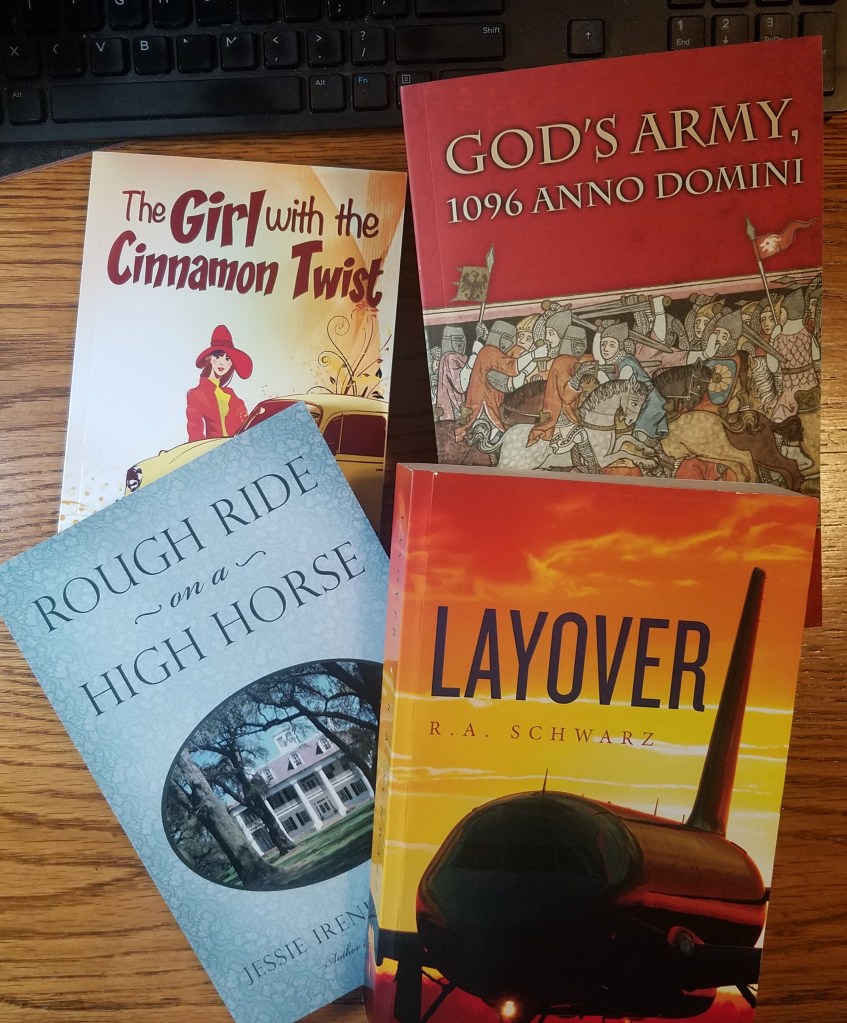
A few of the books published by some of our Anonymous Authors both current and past.
And I found camaraderie among my classmates and a few others we collected along the way. We dubbed our group the “Anonymous Authors” and met weekly to share our musings and make suggestions on one another’s work.
I am truly thankful for their input and, especially, their friendship. Even when our in person meetings came to a crashing halt in March 2020, several of us activated or installed cameras on our computers and we learned to Zoom.
I am currently one of two ‘hold outs’ from our current Zoom crew who has not yet published a novel. But that doesn’t mean I’ve abandoned the idea. Of the seven novels I’ve written, I’m working my way through my editor’s suggestions and corrections on the first one I plan to publish. The particular book is actually the fourth one I’ve written and part of a four book series (Book four in the series is actually a complete rewrite of novel #1)
Editing and rewriting is just another piece of the process essential to the writer’s journey. And, with a bit of luck, on November 1, 2023, I’ll be celebrating National Author’s day having joined the ranks of published authors; who knows, maybe someone will be sending me a note to let me know they loved my book. And maybe I’ll be able to send them an autographed copy back.
A bunch of links:
Novels published by several of the Anonymous Authors who are or, have been, a part of our group:
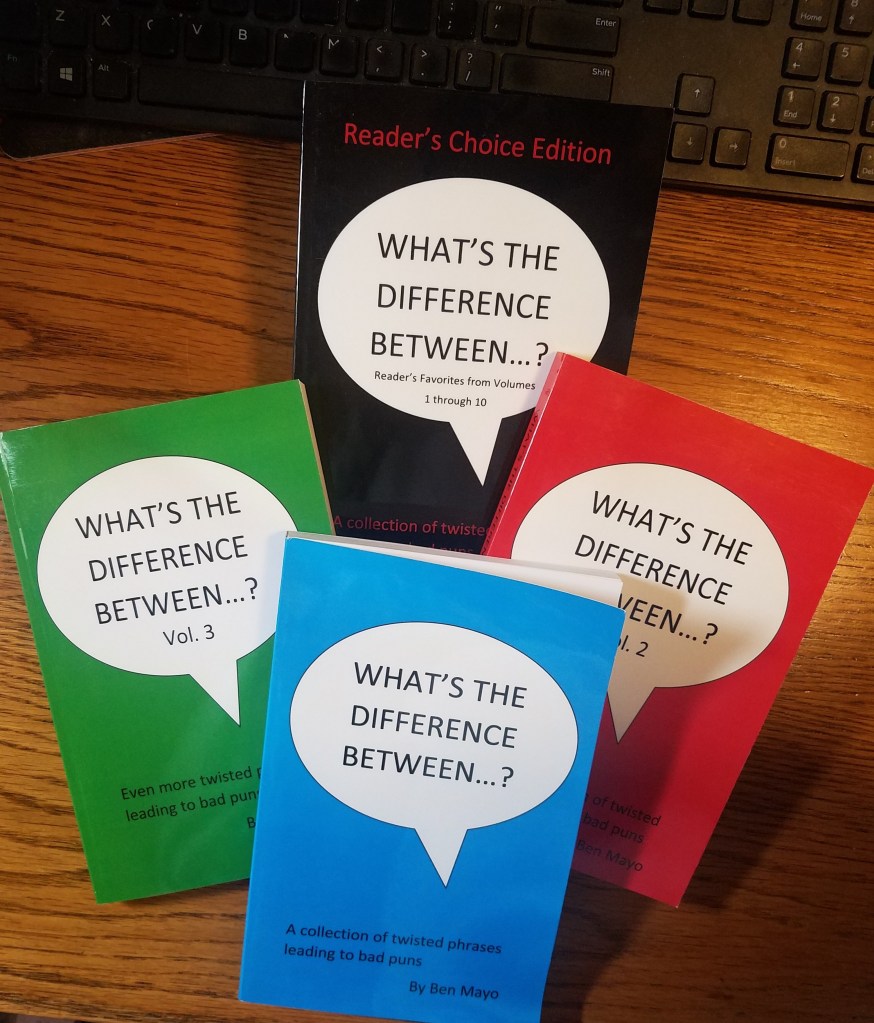
If you love puns and word play, then you might enjoy these books from my high school friend, Ben Mayo. If you’d like to get his books email him at: 27benjo@gmail.com
The Most Comprehensive Dictionary of the English Language
February 1, 2022
Lord of the Rings. Les Miserables. Gone With The Wind. Harry Potter and the Sorcerer’s Stone. Each of these books took six or more years to be written with the Lord of the Rings trilogy taking JRR Tolkien 16 years.
But in the world of publishing, there was one project which was conceived 23 years before the first pages were published: The Oxford English Dictionary. Also known as OED.
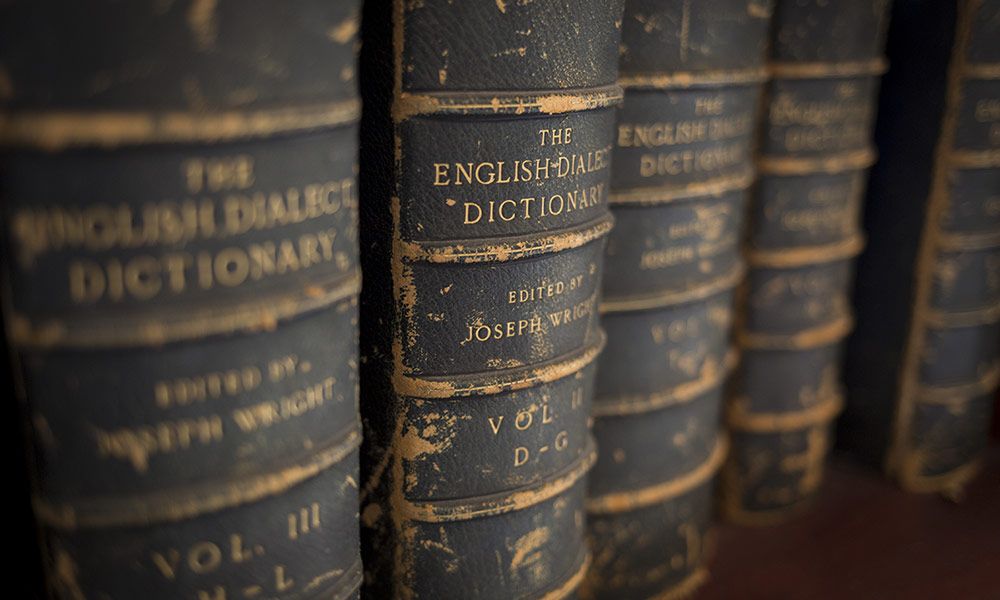
Historical copies of a few of the Oxford English Dictionary
The OED is THE definitive authority on the English language, providing an etymology on the origins of every English word. The idea was conceived in 1857 but the first ‘fascicle’* was not published until February 1, 1884.
The Infallible Wikipedia shares:
“The dictionary began as a Philological Society project of a small group of intellectuals in London (and unconnected to Oxford University): Richard Chenevix Trench, Herbert Coleridge, and Frederick Furnivall, who were dissatisfied with the existing English dictionaries. The society expressed interest in compiling a new dictionary as early as 1844, but it was not until June 1857 that they began by forming an “Unregistered Words Committee” to search for words that were unlisted or poorly defined in current dictionaries. In November, Trench’s report was not a list of unregistered words; instead, it was the study On Some Deficiencies in our English Dictionaries, which identified seven distinct shortcomings in contemporary dictionaries:
· Incomplete coverage of obsolete words
· Inconsistent coverage of families of related words
· Incorrect dates for earliest use of words
· History of obsolete senses of words often omitted
· Inadequate distinction among synonyms
· Insufficient use of good illustrative quotations
· Space wasted on inappropriate or redundant content.
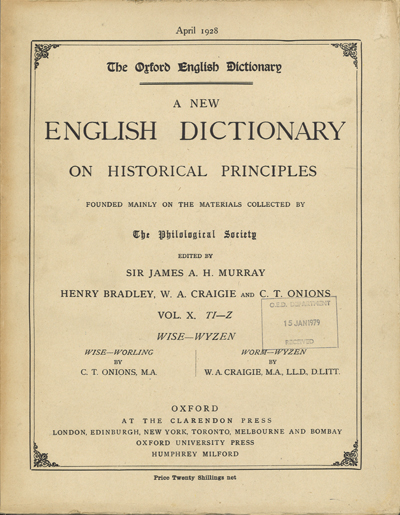
The final fascicle 1928
The society ultimately realized that the number of unlisted words would be far more than the number of words in the English dictionaries of the 19th century, and shifted their idea from covering only words that were not already in English dictionaries to a larger project. Trench suggested that a new, truly comprehensive dictionary was needed. On 7 January 1858, the society formally adopted the idea of a comprehensive new dictionary.”
There is much more to the story and it took another 44 years for the work to be completed. The last fascicle, which ranged from the words Wand to Wise, was the 125th installment. The complete dictionary – in bound volumes – soon followed.
Interestingly, Tolkien worked on the OED and even wrote a parody based on some of the editors who he called ‘The Four Wise Clerks of Oxenford’ in the story Farmer Giles of Ham.
The OED is not, of course, the only dictionary in the world. But even today it is considered the gold standard.
From the time I could read, I have been fascinated with dictionaries. Currently I have 11 books on my shelves with the word ‘dictionary’ in their titles. These include not only standard dictionaries, but also The Boston Dictionary, Bryson’s Dictionary of Troublesome Words, and The Dictionary of Clichés.
My most prized dictionary, however, is a Funk & Wagnalls College Standard Dictionary. From 1925.
It is still in amazingly good shape, its edges now bound with 1960’s era brown electrical tape. This particular dictionary was a part of my childhood as it belonged to my maternal grandmother and was kept in the family cabin at Rimrock Lake. I suspect it was an early addition to my grandparent’s summer escape place and arrived about the same time as the Scrabble game.
The authors collection. The oldest – from 1925 – is at the front. Also included is my mother’s college dictionary from 1944 (the blue one) and others from the late 1950’s forward.
My grandmother and mother loved to play Scrabble together. I can see them, in my mind’s eye, puzzling over their letters to arrive at the word with the most points. But if one or the other challenged the other’s word, the 1925 dictionary would come off the shelf. It was the final authority.
When the cabin was sold two years ago, I was the lucky one who was privileged to add this family heirloom to my collection.
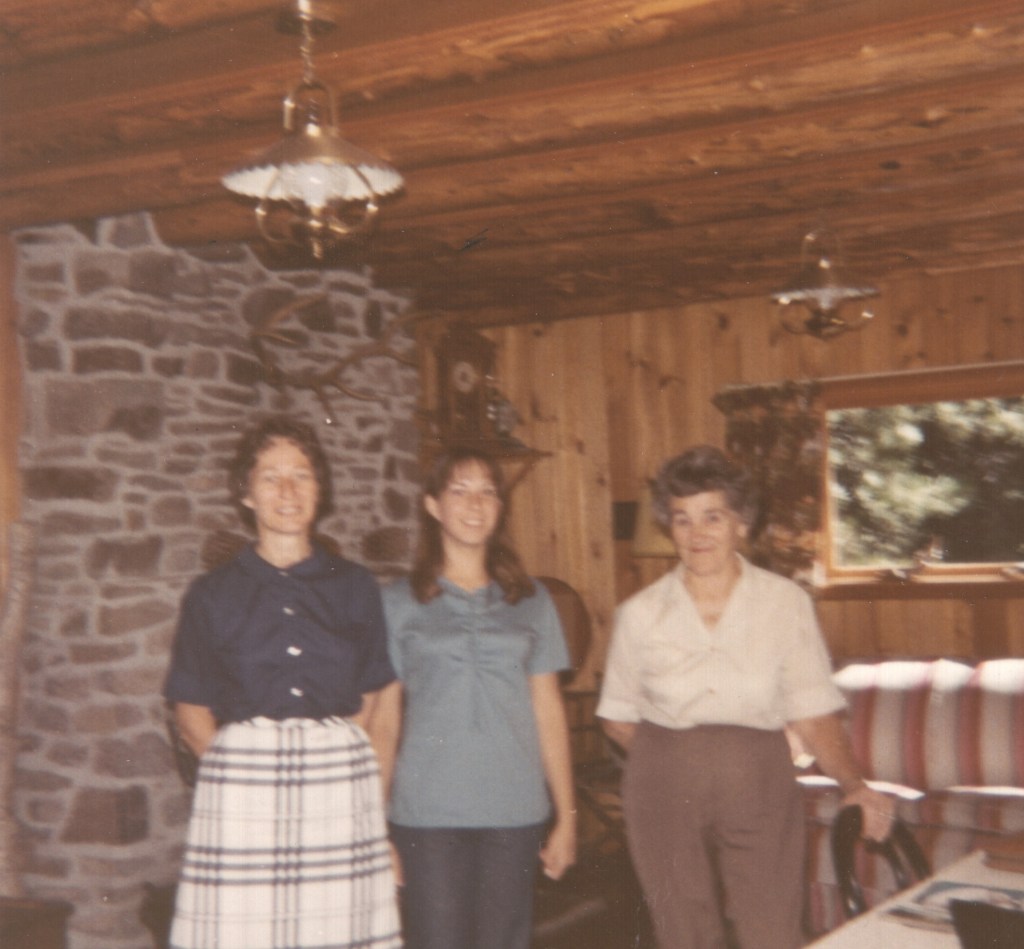
With my mother, sister, and grandmother at the cabin in 1971. You can see the Scrabble board holder behind them.
Every once in a while I will randomly read a page of a dictionary, looking for new and unfamiliar words. But, perhaps the most entertaining thing about perusing an old dictionary is to find words which existed then but have come to mean something different today.
I give you, as an example, the word ‘Computer’.
Dictionary.com provides this as the first definition: a programmable electronic device designed to accept data, perform prescribed mathematical and logical operations at high speed, and display the results of these operations. Mainframes, desktop and laptop computers, tablets, and smartphones are some of the different types of computers.
But the 1925 F&W dictionary definition is ‘One who computes; particularly one who makes astronomical or other special calculations.’ There was no computer machine to be found in 1925!
I postulate that there is never a reason to be bored. In fact, just now my attention drifted a bit from the task at hand and I found myself reading words from the aforementioned 1925 dictionary. Have you ever heard of a Hackmatack? It sounds like something which would happen to your email if the wrong person found your password.
Hackmatack trees…
But, no, it is an actual word, a noun, of native American origins which means ‘The American larch; Tamarack.’ From now on I’m calling the Tamarack the Hackmatack. Or perhaps I will incorporate it into my world and use it randomly when the mood strikes. I wonder what other awesome and amazing words I can learn today?
When, on January 10, 2017, I posted my first Tuesday Newsday, I had no idea that five years later, I could say I’ve written 248 weekly articles which average about 1,000 words each. For those keeping score at home that is a quarter of a million words. Guess I’ve had something to say.
Every so often I get into a discussion with someone about my blog and why I started writing it.
Back in the fall of 2016, I was actively looking for a publisher for my novels. Friends of mine, Jim and Sandy, suggested that I go with them to Portland and meet their friend, Judith Glad, who had published several novels of her own AND also published novels for a handful of other authors.
So off we went. We had lunch with Judith (or ‘Jude’ as they affectionately call her) and she and I sat down that day and discussed writing and publishing and what our particular journey’s looked like. It was a delightful adventure.
Author Judith Glad
One of the topics which came up was whether or not I had a webpage.
“No!” I exclaimed. “I haven’t published any of my novels. What would be the purpose?”
Jude gently explained that, as a writer, you still create the webpage and then it is ‘ready’ when you do get to the point of publishing your books.
This made total sense to me: do those things you will want to have in place for when you do publish.
Even though my books were not quite in line with the type of books she and her daughter’s publishing company takes on, I left that day feeling buoyed and determined to launch my own webpage and blog.
In early January I created an account on WordPress and started the painstakingly slow task of building my own webpage.
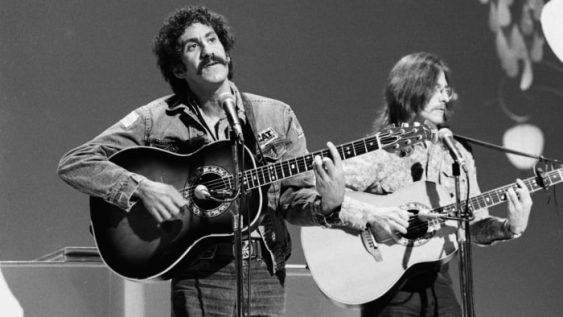
The first article was all about Jim Croce, whose birthday was January 10. It was a grand total of 348 words long.
The subject of my first post, Jim Croce
Since that first, rather short, article, I’ve developed a template of sorts as to how I approach most weeks. I search the web for things which occurred on the particular date. Last week, for example, I learned the patent for the roller skate was granted on January 4th and it piqued my interest enough that I decided to write about it. I try to look for topics which I can relate to my own experiences since a huge part of each week’s article is making the connection to something personal for me or others.
And I always mention the Infallible Wikipedia. One of my favorite weeks was a year ago on January 15 when I wrote all about… the Infallible Wikipedia! For those that do not know WHY I refer to it as the Infallible Wikipedia, be sure to visit my post which explains it: https://barbaradevore.com/2021/01/12/the-infallible-wikipedia/
The Infallible Wikipedia logo
Now, for those keeping score, those 248 posts represent about 68 percent of the number of days in a year. By my calculations I will have a post for every day of the year in a little over two years from now… or will I? That’s where this has gotten tricky. Thanks to Leap Years, there are some dates which simply do not fall on a Tuesday within my time frame and, of course, others which already have articles for that date but will soon have a second Tuesday.
In 2023, the Tuesdays start to repeat themselves. I was kind of hit or miss for the first two months of 2017 but starting mid-March that year the dates begin to repeat. Since those dates once again fall on Tuesdays and I can’t usurp the old articles for new ones. And what about those other dates which will be skipped over? Surely they deserve their moment of glory?
What to do, what to do? I’m actually still debating that question.
This was something I did not consider when I started writing Tuesday Newsday. Of course the reason for doing the webpage, originally, was to create a place where I could share when and where people could get my books. Obviously I have to make sure to have the first book – at least – published by then!
Creating my author’s webpage has truly brought me joy. It’s become, in many ways, a vehicle by which to pluck snippets of memories; captured in words for my children and others who might have a glimpse of what the world looked like five, ten, twenty, or more years ago.
That, more than anything, appeals to this historian’s heart. As one ages you realize that the world is NOT the same as it was when you were a child or even a young adult.
Perhaps my favorite author, Laura Ingalls Wilder, captured that sentiment in the last section of her first book Little House In the Big Woods:
“When the fiddle had stopped singing Laura called out softly, ‘What are days of auld lang syne, Pa?’
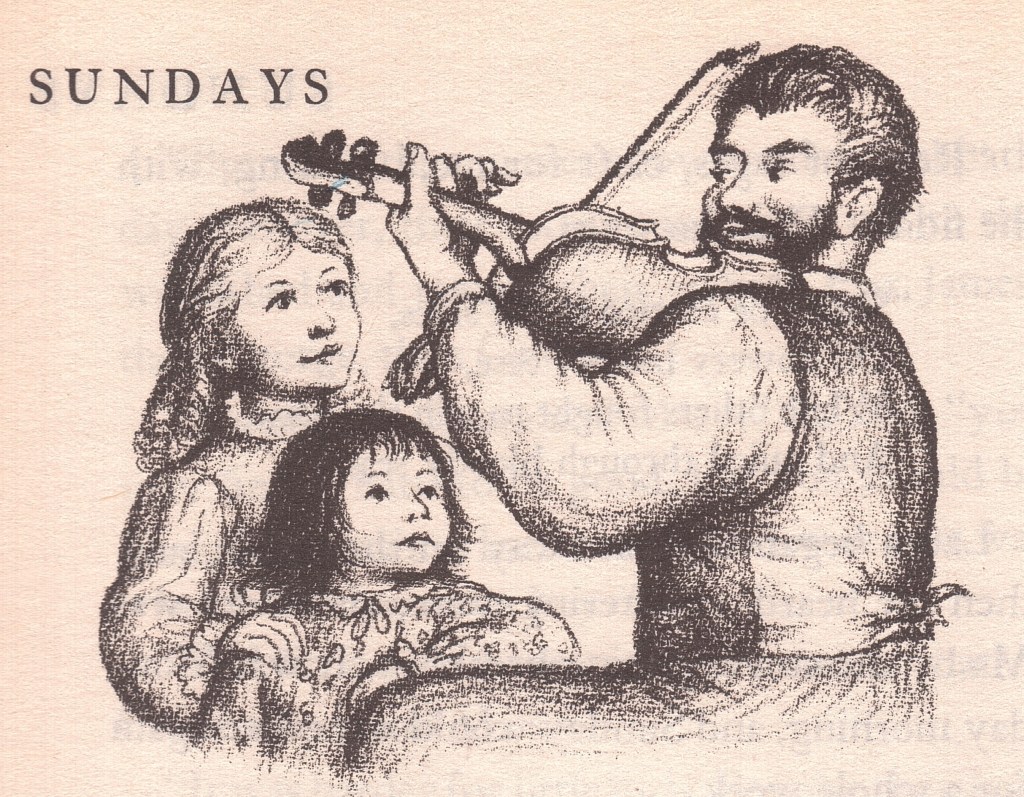
One of the wonderful Garth William’s illustrations from Little House In the Big Woods
‘They are the days of a long time ago, Laura,’ Pa said. ‘Go to sleep, now.’
But Laura lay awake a little while, listening to Pa’s fiddle softly playing and to the lonely sound of the wind in the Big Woods. She looked at Pa sitting on the bench by the hearth, the firelight gleaming on his brown hair and beard and glistening on the honey-brown fiddle. She looked at Ma, gently rocking and knitting.
She thought to herself, ‘This is now.’
She was glad that the cosy house, and Pa and Ma and the firelight and the music, were now. They could not be forgotten, she thought, because now is now. It can never be a long time ago.”
But, alas, the days of our childhood disappear into the mists of time, and one day you wake up and you’re 25 or 45 or 65 and your head is filled with bits and pieces of memories and of people and times gone by.
Thank you to my many readers for indulging me these past five years. None of us know what next year or the year after that, or even the next week might bring. So do that thing which brings you joy and fulfillment!
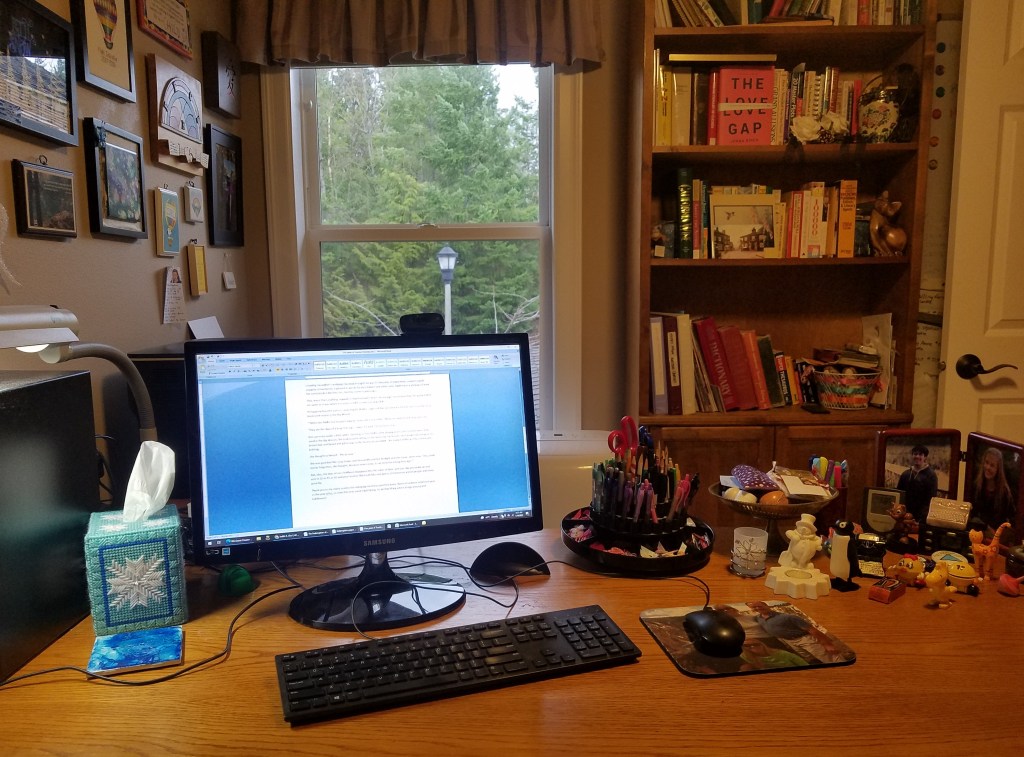
My little corner of the world where imagination takes flight.
As always a link or two:
Although I didn’t get into the weeds on blogging and how many blogs there are, the Infallible Wikipedia does, in fact, have a page about it for those who wish to learn more:
Update January 11, 2023 – I inch ever closer to getting that first book published. I’m now racing my self imposed deadline. More on The Darling of Delta Rho Chi coming soon!











 barbaradevore.com