Archives

Don’t It Make My Brown Eyes Blue

And a few musings on Blue vs. Brown eyes

June 24th
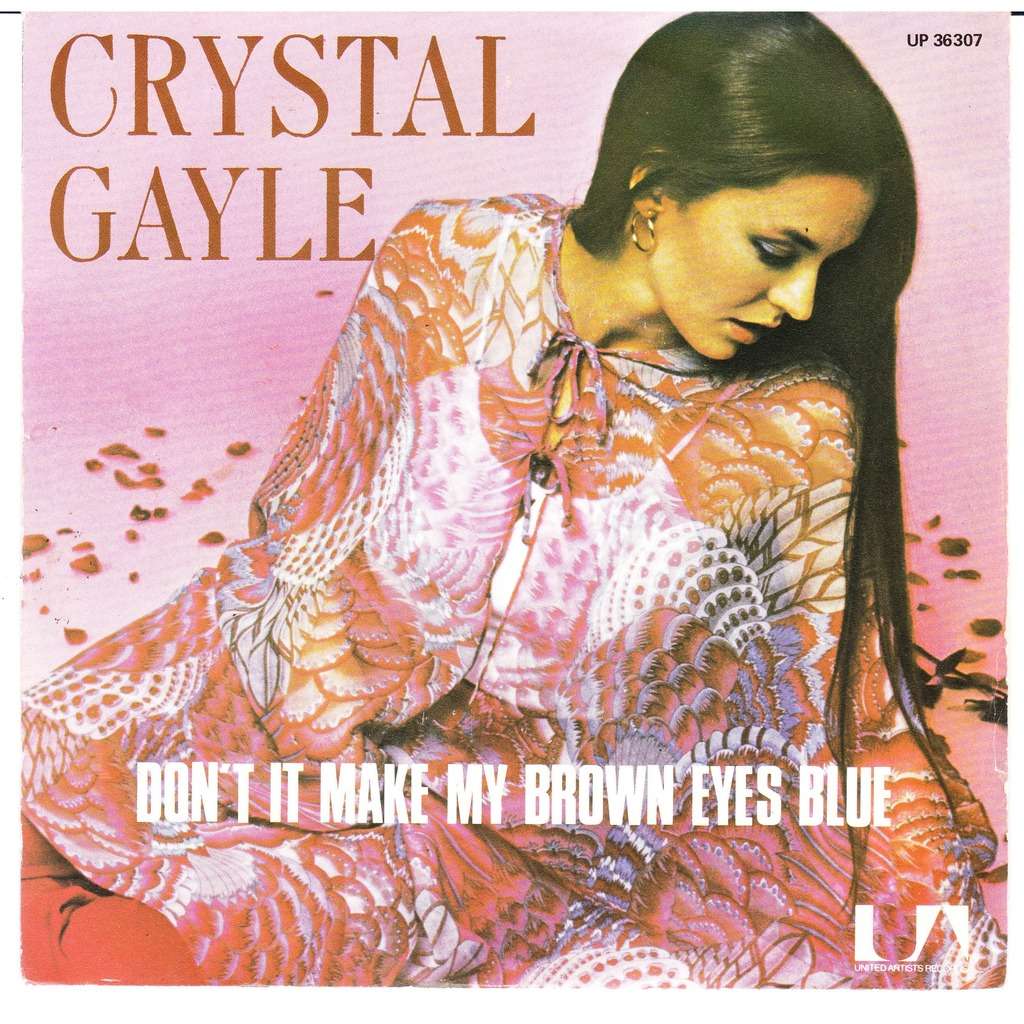
This song, released in June 1977, was one of those rare pieces which successfully crossed over from country to pop. It was number one on the country chart for five weeks in the summer of 1977 and peaked at number two on the Billboard Hot 100 chart in late November 1977. It was kept from the top position by Debby Boone’s You Light Up My Life (YLUML). As I wrote in my blog about that song, there were any number of infinitely better songs during the number one run of YLUML, including this one. https://barbaradevore.com/2024/11/19/you-light-up-my-life-2/

Don’t It Make My Brown Eyes Blue catapulted artist Crystal Gale into stardom and she had a series of commercially successful songs which followed.

The Infallible Wikipedia shares:

“In 1975, ‘Wrong Road Again’ became Gayle’s first major hit. However, it was in 1977 when Gayle achieved her biggest success with ‘Don’t It Make My Brown Eyes Blue’. The single topped the Billboard country chart, crossed over to the top five of the Billboard Hot 100 and became a major international hit.

Gayle continued having success from the late 1970s and through late 1980s. Her biggest hits included ‘Ready for the Times to Get Better’ (1977), ‘Talking in Your Sleep’ (1978), ‘Half the Way’ (1979) and ‘You and I’ (1982).”

Don’t It Make My Brown Eyes Blue is one of those songs which has gained in popularity and critical acclaim over time. Also from the Infallible Wikipedia:

“The song became Gayle’s signature piece throughout her career. In 1978, the song won Gayle a Grammy Award for Best Female Country Vocal Performance. In 1999, the song was recognized by ASCAP as one of the ten most-performed songs of the 20th century. (snip)

In 2024, Rolling Stone ranked the song at #109 on its 200 Greatest Country Songs of All Time ranking.”

I had not intended to feature this as today’s Tuesday Newsday topic. But sometimes things just sort of take a serendipitous route. Yesterday, while on our way to Seattle, the hubby, my son, and me were driving south on I-5 from Mount Vernon and my son – who has been visiting for the past week – commented about the low cloud ceiling and gray skies and how, since it was the first full day of summer, shouldn’t be happening. I think he’s forgotten what it’s like here since he lives in Guadalajara, Mexico, and he’s acclimated to the sunny and hot climate.

Being that it was June 22 and one of the longest days of the year, one might think it should be sunny and bright. But nope. Over the weekend we got a ‘welcome to summer’ soaking from Mother Nature.

As we approach the Stillaguamish River, the cloud cover has now lifted and is several hundred feet higher. Of course I do what any self-respecting, blue-eyed, Western Washingtonian would do, I put on my sunglasses.

Just like my hubby and son did. Or not. Why? Because they do not have blue eyes.

Of course, that sends me down the rabbit hole of mental gymnastics and I start thinking about blue eyes vs. brown eyes and that then led me to start humming today’s featured song. See how easy that was?

But back to the brown vs. blue eyes and the problem blue eyed people have: light sensitivity.

According to Health.com:

“Several studies have found that people with light-colored eyes are more sensitive to the effects of light than people with dark-colored eyes. Researchers speculate this may be due to lower amounts of melanin (pigment) in light-colored eyes. Less melanin in the eyes may increase their susceptibility to the negative effects of sun and light exposure.”
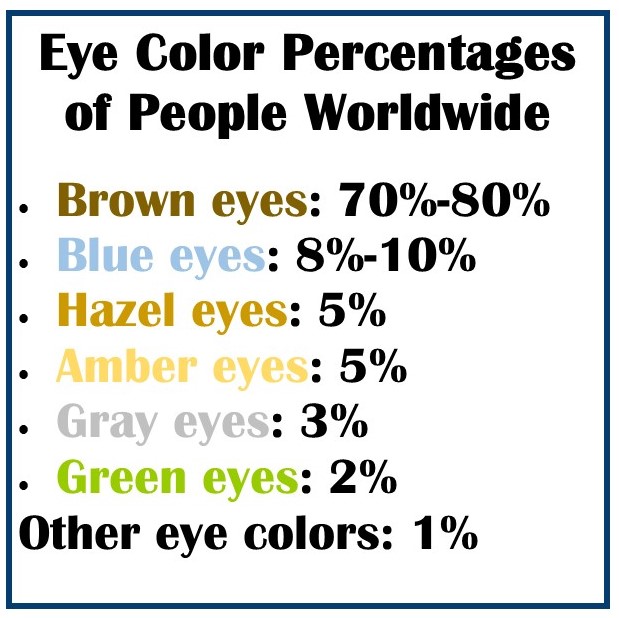
My son has teased me over the years about being a ‘blue-eyed freak.’ He’s not totally wrong. People with blue eyes make up only 8 to 10 percent of the human population as shown in the chart to the right:

Those of us who have blue eyes can trace the majority of our ancestry to northern European and Scandinavian countries. Finland, according to one report I saw, leads the world with a whopping 89 percent of its population boasting blue eyes.

I took a peek at my DNA results and learned that of the top 10 countries with the highest percentage of people with blue eyes, I match to seven of those countries – which makes up 93 percent of my DNA – including Finland with 13 percent of the total.

But back to the light problem. From the time I was a little girl, bright lights have always made me squint or even close my eyes. Bright lights when my eyes have adjusted to the darkness are just downright painful.

The hubby calls me a ‘darkie’ because I often move about the house without turning on lights. The way our lower level is set up is that we have a closet across from the bathroom near our bedroom. That closet has a motion-detecting light that is designed to turn on when one enters the closet. But sometimes, if you fly too close to the sun – er, opening – it will spring to life, flooding the area with blinding light. Okay, maybe that’s a bit hyperbolic.


Eventually we got a reasonable photo… notice the hubby is unfazed by the light.
It took several attempts to get photos that day due to my inability to keep from painful squinting…

But I have learned to be very, very careful how I walk past that doorway when I get up in the mornings so as to not trigger the light and cause painful, but temporary, blindness. I keep as close to the wall opposite as possible and slow my gait as I float past, nearly a ghost in the predawn dark.

It’s either that or wear sunglasses at night. But that’s a whole different song for another Tuesday Newsday.

So, I think my mantra, rather than “Don’t It Make My Brown Eye’s Blue” is really, “Don’t it Make my Blue Eyes Squint.” Somehow that’s not nearly as catchy as Crystal Gayle’s 1977 hit song.

The links:

https://en.wikipedia.org/wiki/Don%27t_It_Make_My_Brown_Eyes_Blue

https://en.wikipedia.org/wiki/Crystal_Gayle

https://en.wikipedia.org/wiki/List_of_Hot_Country_Singles_number_ones_of_1977

https://www.health.com/are-blue-eyes-more-sensitive-to-light-11690558

https://www.insidermonkey.com/blog/top-10-countries-that-have-the-most-blondes-and-blue-eyes-as-a-percentage-of-population-605109/?singlepage=1

https://worldpopulationreview.com/country-rankings/eye-color-percentage-by-country

A Fasten-ating Beginning: Velcro

The Velvet Hook

May 13th

I suppose that this Tuesday Newsday topic falls in the category of ‘Geeky Musings’ as I doubt this product, which was patented in 1955, is ever given much – if any – thought for most people. It was on May 13, 1958, when the term ‘Velcro’ was trademarked by its inventor.

Inspired by burrs which clung to his dog, the inventor spent over a decade in search of how to replicate one of nature’s stickiest plants. The Infallible Wikipedia tells us:

“The original hook-and-loop fastener was conceived in 1941 by Swiss engineer George de Mestral, which he named velcro. The idea came to him one day after he returned from a hunting trip with his dog in the Alps. He took a close look at the burs of burdock that kept sticking to his clothes and his dog’s fur. He examined them under a microscope, and noted their hundreds of hooks that caught on anything with a loop, such as clothing, animal fur, or hair.”

What followed was a period of trial and error as he sought to make his tiny hook and eye concept a reality. Also from the Infallible Wikipedia:

“The fastener consisted of two components: a lineal fabric strip with tiny hooks that could ‘mate’ with another fabric strip with smaller loops, attaching temporarily, until pulled apart. Initially made of cotton, which proved impractical, the fastener was eventually constructed with nylon and polyester.

Up close and personal with velcro

De Mestral gave the name Velcro, a portmanteau of the French words velours (‘velvet’) and crochet (‘hook’), to his invention, as well as to the Swiss company he founded; Velcro SA.

At first, the applications for Velcro were astronauts space suits and then for ski clothing. For me, however, Velcro really came into its own when it was incorporated into children’s shoes and clothing. It was, for mothers everywhere, a game changer.

When I was a child there was no greater accomplishment than learning how to tie my shoe laces, or being able to buckle my shoe strap, somewhere around age 4 or 5. My mother mostly put me in slip on tennis shoes, thus avoiding the tedious task of tying and then re-tying the laces of shoes on small children.

Even small girls can enjoy Adidas shoes with velcro fasteners

As I was contemplating Velcro, I could not recall any exact moment or time when it came into my conscious, although it was probably when my children were babies. While the first shoes my son had when he started to walk did have laces, my daughters footwear featured a hook and loop fastener. At some point both my children learned to tie their laces but nowadays I do wonder if that is a skill which has been lost with the proliferation of Velcro fastened shoes.

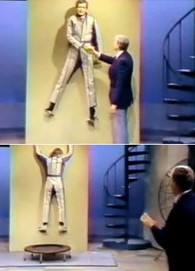
David Letterman attached to a wall with the aid of Velcro.

The first shoes I recall having Velcro were a pair of black Skechers in a ‘Mary Jane’ style. Instead of a buckle on the narrow strap, it was secured with Velcro. Which worked fine for a time, but eventually it started to fail as the Velcro lost its stickiness. The technology from those early 2000’s pair of shoes to now has been greatly improved. I easily have a half dozen pairs of sandals, particularly, which all have Velcro straps and none have the failure problem like those early Skechers.

Of course, Velcro is not just for shoes. As I look around my house I find it in a variety of applications. Like the narrow strips I have in my office to control unruly cords. Or the ones which hold our Good-To-Go pass to the windshield of our vehicle. There’s Velcro on the pockets of bags and cases which I use daily. I have a Ziplock bag full of hook and loop fasteners in various colors and sizes as one never knows when they will be needed.

Taking outdoor inflatibles to a new level with velcro ‘barfly’ suits

Back in the 80’s a phenomenon known as ‘Velcroing’ became popular when late night TV personality David Letterman featured it on his program. The concept was simple, a person wears clothing with one side of the Velcro facing out and then using a trampoline jumps up onto a wall with the other half of the Velcro connection and becomes attached to the wall some 10 to 15 feet high.

It has since become entertainment for parties and in drinking establishments and is known, colloquially, as “Bar Fly” or “human wall jumping.” What could possibly go wrong? But leave it to people to always come up with new and innovative ways to use a product, especially one like Velcro which has stuck around for 70 years and shows no sign of loosening its grip anytime soon.

So cheers to George de Mestral whose curiosity and dogged persistence led to the invention of Velcro, a creation we might be able to live without, but should be thankful we don’t have to.

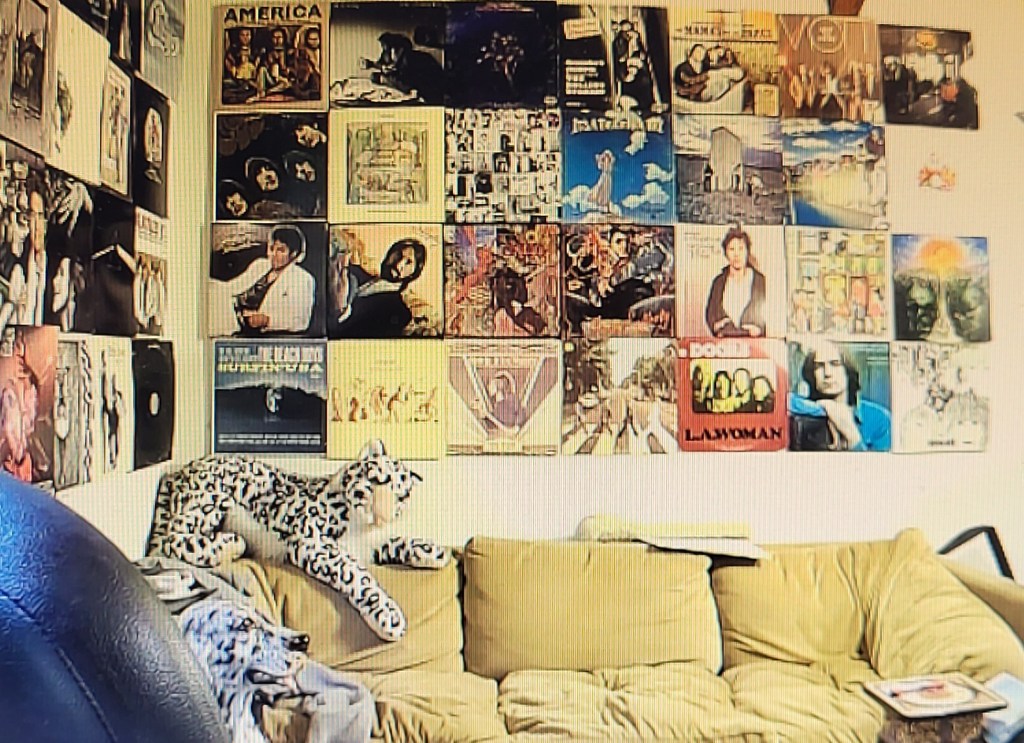
My friend Roger shared that he used Velcro to attach his vinyl album collection to the wall of his office. Very creative!

A few links:

https://en.wikipedia.org/wiki/Velcro_Companies

https://en.wikipedia.org/wiki/Hook-and-loop_fastener

https://scholar.lib.vt.edu/VA-news/ROA-Times/issues/1992/rt9201/920127/01250332.htm

https://knockoutentertainments.com/bar-fly/

https://youtu.be/-SGhBvwLGIs?si=0b0EikqUtRW-41k1 (David Letterman show)

Jo-Ann Fabrics: The End of an Era

The 82 year icon is closing all stores this month

May 6th

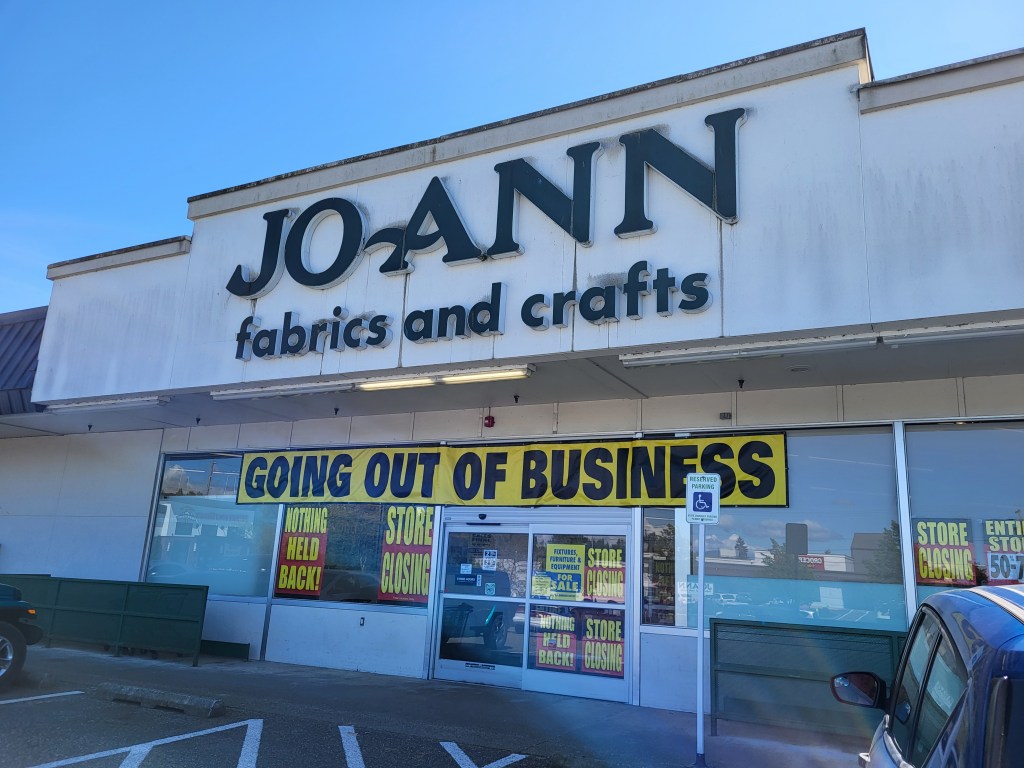
Over the past few months, I have been mourning the end of an era. One day, very soon, Jo-Ann Fabrics will be out of business.

The Mount Vernon, Washington Jo-Ann Fabrics will soon be gone.

The demise of the fabric store giant is, in my opinion, a sign of the times. Like woodshop and home economics, the era of learning how to build a table or sew a garment is no longer something the majority of young people learn.

Certainly, there will still be specialty fabric stores where quilters can go to buy their fabric but, it seems, the days of a high school girl sewing her own homecoming or prom outfit are over.

Jo-Ann Fabrics was founded in 1943. It was a venture for two families and, when they expanded in the early 1960’s, changed the name to Jo-Ann Fabrics. Yes, there is an Infallible Wikipedia page which shares the following:

“German immigrants Hilda and Berthold Reich, Sigmund and Mathilda Rohrbach, and Justin and Alma Zimmerman opened the Cleveland Fabric Shop in Cleveland, Ohio in 1943. After further expansion, the store’s name was changed to Jo-Ann Fabrics in 1963. The store’s name was created by combining the names of the daughters from both families: Joan and Jacqueline Ann.

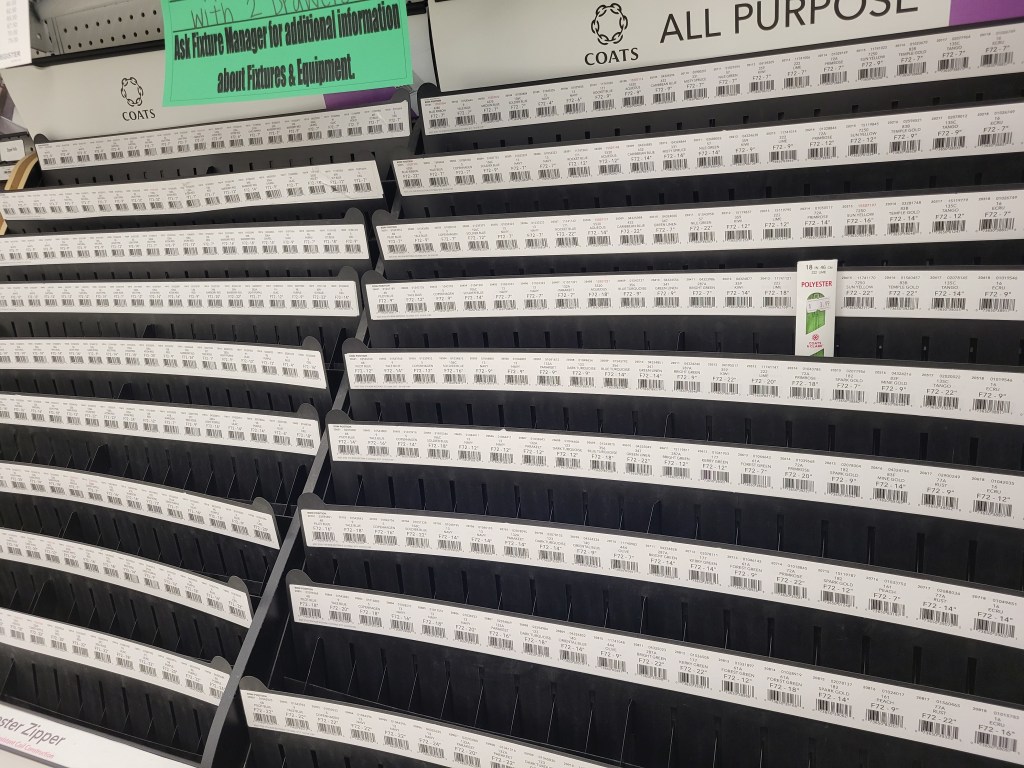
There were a total of two neon green zippers available for sale last weekend

Jo-Ann Fabrics became a publicly held corporation traded on the American Stock Exchange under the name of Fabri-Centers of America, Inc. in 1969. The company made its first acquisition with the purchase of Cloth World, a 342-store southern company, in 1994. At the time of the acquisition, Fabri-Centers operated 655 stores.”

There are many reasons for the decline of Jo-Ann Fabrics – non-profitable stores, too much debt, inability to find an investor – to name the primary reasons.

But I get back to what I think is the biggest reason: people are simply not learning, or interested in learning, how to sew.

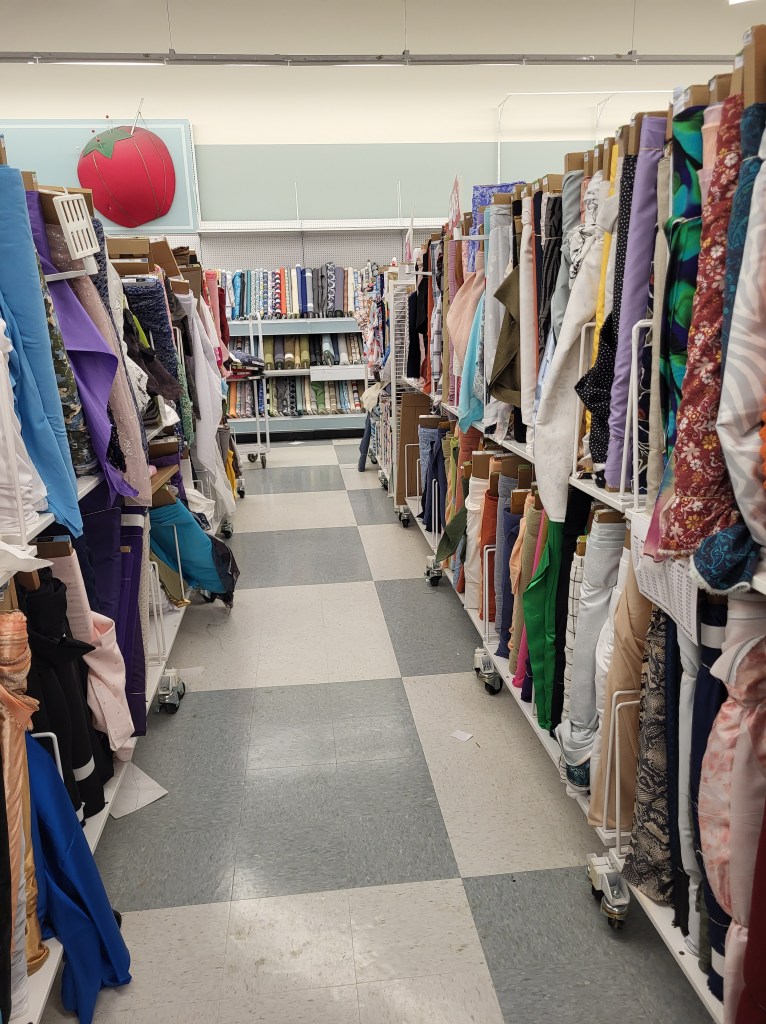
Still quite a bit of fabric to be had.

My seventh grade year I attended Wilson Junior High school (no middle schools in those days!) in Yakima, Washington, and there was no greater shock to my system than having what had been a half mile, approximately 15-minute walk, to Nob Hill Elementary school, to now making a daily 1.3 mile hike each way to my new Junior High.

I pretty much hated it but there was NOT a choice. My mother was not going to be driving me to school every day, so I just had to suck it up.

Another thing I absolutely hate is being late. So every morning – and believe me some of those mornings were dark and cold, sometimes snowy – I would haul my 12- to 14-year-old self out the door to make sure I made it to Wilson on time.

But afternoons were another story. My route home, just in reverse, always – yes ALWAYS – included a stroll through the strip mall where a Safeway was located. The layout of the stores was, actually, pretty clever. You entered at the west end, for example, and could walk through every store and exit on the east end, enjoying heat in the cold months and air conditioning in the warm months. Plus, there were interesting things to see.

So every afternoon I would start with Discount Fabrics on the west, then buy a Big Hunk candy bar or a bag of Corn Nuts at Tieton Village Drugs, make my way through Safeway and, sometimes, go into Wigwam (think Dollar Tree but more eclectic), before continuing on my way home.

Tieton Village Shopping Center as it looks on May 6, 2025. When I was in Junior High, Discount Fabrics was on the far right, then the drug store, Safeway, and Wigwam.

When I was in eighth grade, I took my first Home Economics class and the first half of the year was sewing. When we were assigned the task of getting a yard of fabric because we were going to be making a dress, my world was opened up and suddenly Discount Fabrics became a very important place.

Over the next four years, I spent many hours there looking at, feeling, considering, contemplating, and buying fabric, thread, zippers, and buttons. Except for collecting pens and stationery, there was nothing I loved more than looking at and thinking about fabric. I even considered, when applying for my first job, working in either an office supply store or a fabric store. I ended up as a filing clerk for a Ford dealership which probably saved me spending all my earnings on office supplies or fabric.

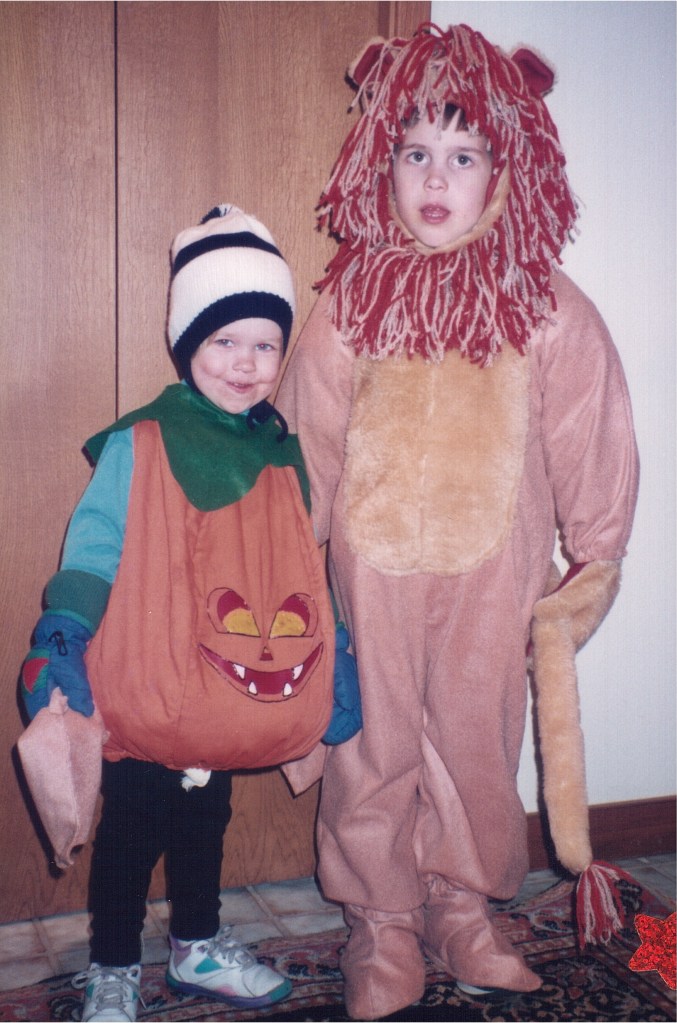
Halloween 1994. I sewed both the lion costume and the pumpkin costume for my kids.

It turned out that I was good at sewing and it filled a creative need. I’ve made tablecloths and placements, sewn children’s costumes, put together bean bags and stuffed animals, made what’s known as a ‘puff’ quilt and tied fleece blankets. And I pretty much never got rid of any of the leftover fabric remnants.

Best of all, there was always a nearby fabric store to feed my version of sourdough starter. When the hubby and I first got married, I was introduced to Hancock Fabrics at the corner of Fauntleroy Way and Alaska street in West Seattle. It was there I bought most of the fabric to make the hubby the aforementioned puff quilt. That quilt took me four years to complete, by the way, but we still have it.

When we moved to what is now Sammamish, the nearest fabric store was Jo-Anns in Bellevue, about a twenty minute drive from our home on the Sammamish plateau. Up until our kids were born, those were the years of making tablecloths, napkins, and placements. I also made an adorable teddy bear themed baby quilt which I gave to my sister-in-law when she was expecting my niece.

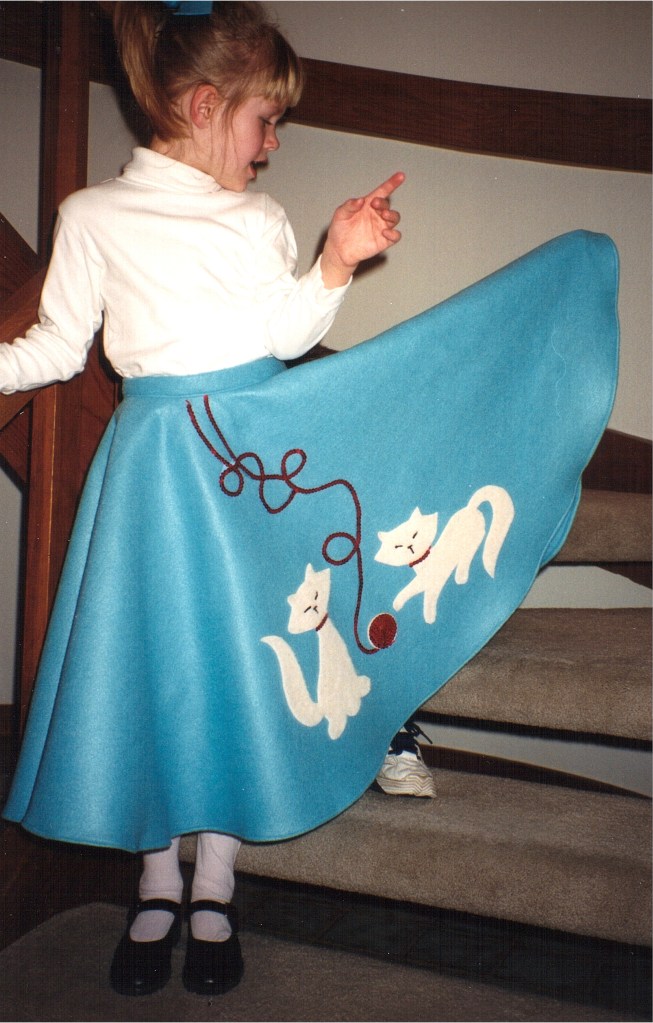
A felt poodle skirt for a father daughter-dance 1998 ish.

In the 1990’s I sewed costumes for my daughter and son, including a princess dress and wizard robes for them to wear at her seventh birthday party, as well as many other garments for school events and Halloween.

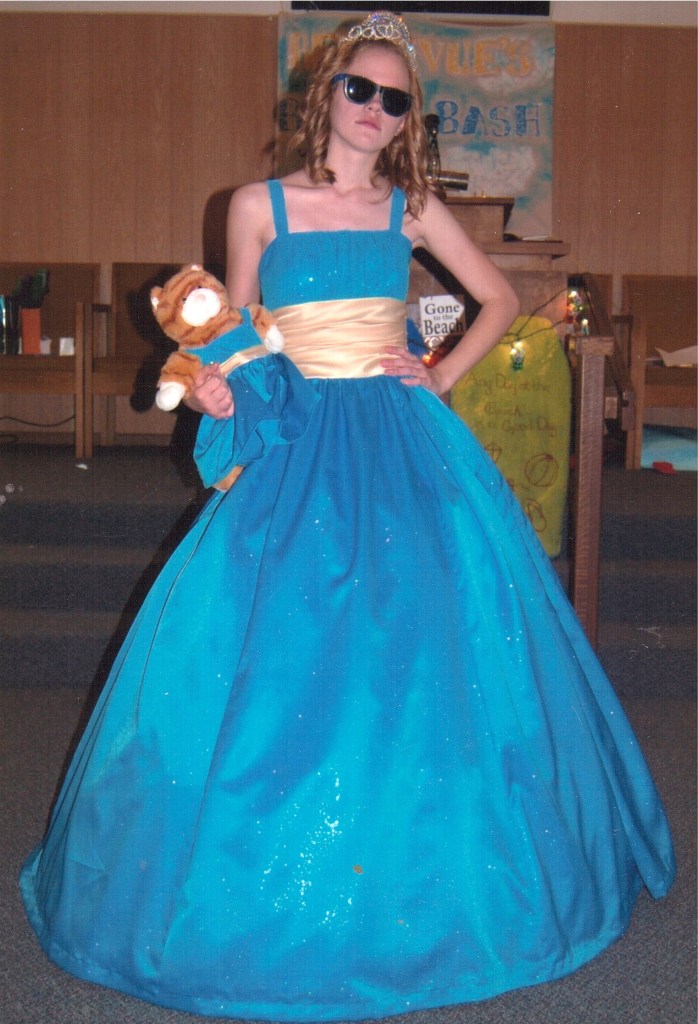
I sewed the dress for my daughter’s installation as the Worthy Advisor of the Rainbow Girls… and the matching one for her ‘mascot.’ 2009.

When we moved to Kirkland in 2004, our house was about a half mile from Hancock Fabrics and, being that the Rainbow Girls I advised needed custom dresses, this marked my peak sewing years. I was at Hancock’s at least twice a week, or so it seemed, for about seven years. The chain went bankrupt in 2016 and it was back to JoAnn’s whenever I needed something.

After our move to Mount Vernon, there were the occasional projects which required a visit to Jo-Anns, a short ten-minute drive. And while I have made the occasional trek there for a project, my days of intense sewing are now past me.

Saying goodbye to an old friend. I’m wearing a scarf I made with material from Jo-Ann’s.

I’ve discovered that sewing had become something I did out of necessity, not because it’s been my true passion. I know people whose passion it is and you can hear it in their voice and see it on their face when they start talking about their projects.

For sure there was always a sense of pride when I finished a beautiful dress. But. There was something else there too. A sense of relief that it was finished. The number of people asking me to sew them a dress got to be so many that I finally had to impose an oath on anyone I DID sew for to promise to never disclose who their seamstress was.

My sewing days are – mostly – over. But for some reason I still have a small stack of Rubbermaid bins with fabric remnants from years of projects. You just never know when some new inspiration will hit and that fabric will come in handy.

A few links:

https://en.wikipedia.org/wiki/Jo-Ann_Stores

https://en.wikipedia.org/wiki/Hancock_Fabrics

https://en.wikipedia.org/wiki/Wigwam_Stores_Inc.

In a previous blog post about the invention of the sewing machine and I delve into some of my sewing adventures and mishaps: https://barbaradevore.com/2019/09/10/howe-its-made/

April 29, 1965: The Day Seattle Shook

April 29th

If you are older than the age of 60 and you have lived in the Pacific Northwest most, if not all, of your life, I simply have to give you this date and time, you will immediately be able to tell me where you were and what you were doing: April 29, 1965, 8:29 a.m.

I can almost hear you exclaiming to your computer: that was the date of the first earthquake you experienced and/or remember.

A number of grocery stores were hard hit during the 1965 earthquake

It was, after all, a pretty significant event. At the time it was the third strongest earthquake since the arrival of European settlers into the area. A quake estimated at magnitude 7.3 occurred in 1872 and another magnitude 7.1 in 1949. The 1965 quake registered 6.5 on the Richter scale.

While the Infallible Wikipedia does offer some information, Historylink.org – which has in depth articles about the Pacific Northwest – shares the following:

“The ground shook for about 45 seconds and was felt over a 190,000 square mile area including all of Washington state, northwest Oregon, southwest corner of British Columbia, north Idaho panhandle. The quake’s epicenter was located near Des Moines, Washington, at 47 degrees, 24 minutes North Latitude and 122 degrees, 24 minutes West Longitude. Total damage is estimated at $12,500,000 (approximately $65,000,000 in 1999), most of it in Seattle. In Olympia, the State Capitol Building was temporarily closed and government departments move to nearby motels while buildings are being repaired.”

The nearest I could come to identifying the epicenter of the quake is 202nd Street SW and Marine View Drive in the Normandy Park neighborhood, not far from Burien and Sea-Tac International airport.

Which becomes an important detail. On April 29, 1965, the hubby’s family lived in West Seattle, about 6 miles north of the epicenter.

For years, family gatherings often included discussion of that day and the months and years leading up to it.

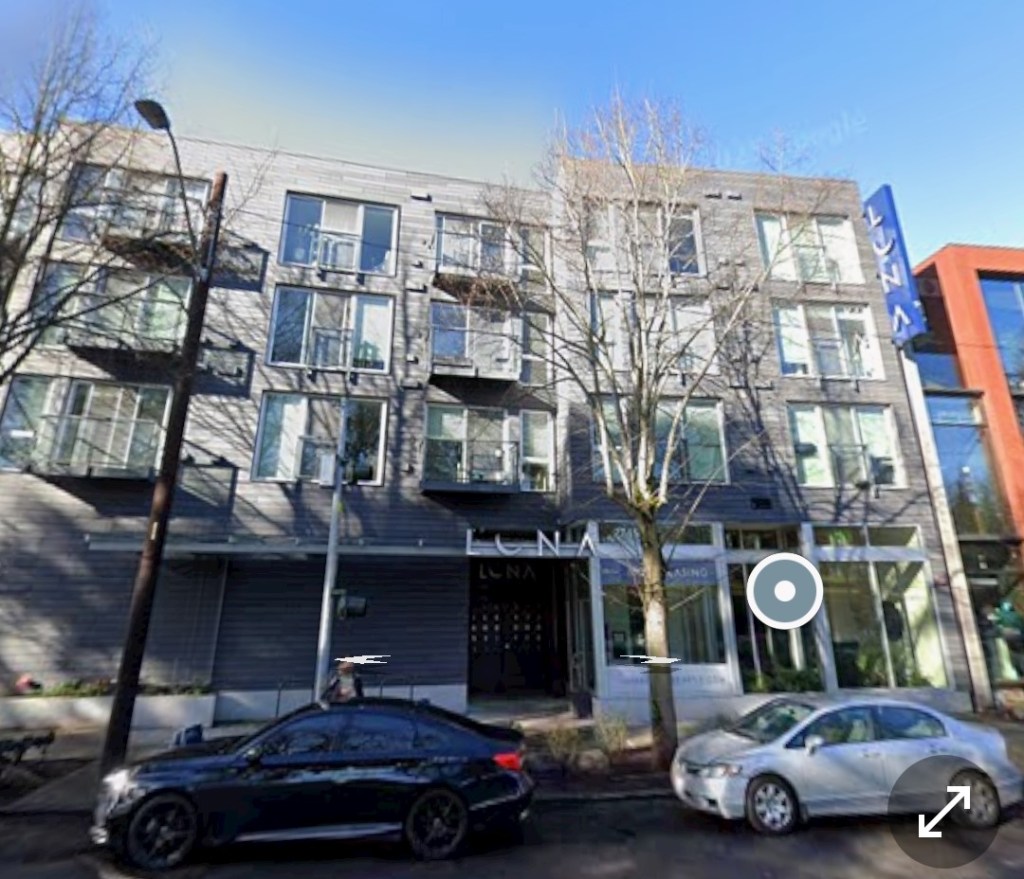
If you were to visit West Seattle today, the LUNA apartments are now located at approximately 2751 California Avenue SW. Up until six months before the April 29, 1965 quake there was a house at that address and it belonged to a trio of women: my hubby’s two Great-Great Aunts – Nelly and Ethel – and his Great Grandmother – Queenie Mae. All three were born in the 1880’s.

From the families collection is this photo of the Miss Burien limited hydroplane as it looked in the summer of 1960. This photo was taken from the house located at 2751 California Avenue SW, directly across from Hiawatha Park in West Seattle.

In the mid-1960’s, Queenie Mae had been deceased for about 8 years, so only Nellie and Ethel still lived in the house and, since they were now in their 70’s, it was decided to sell it. Which they did in the fall of 1964.

Soon the house was razed and a grocery store was erected and had opened, according to family lore, mere weeks before the earthquake hit. The damage to the store was severe.

The hubby recalls visiting the great aunts at that house as a child and every once in a while, the China dishes and tea cups stored in the display cabinet would ‘tinkle’ as if the earth was moving just a bit. Perhaps it was from traffic on California Avenue but the family always claimed that an earthquake fault ran under that house.

April 29th was a Thursday that year and, less than a mile north, the hubby – age 8 – had just gotten his breakfast and was leaving the kitchen, headed for the dining room table.

He was mid-step when the earthquake started and described what happened next:

“My recollection is that I was in the doorway to the living room holding a plate of scrambled eggs. Aunt Nell, who I think must have cooked the food for me, was sitting in the living room on a daybed we used as a couch. I stopped and was looking at her when the initial jolt bounced her up in the air. To this day, that is what I see.”

The spot where the house with the ‘tinkling’ china in the cabinet was once located.

Aunt Nell wasn’t the only one who went airborne as the hubby’s younger sister – who was just two weeks shy of her 4th birthday – was sleeping only to wake up on the floor. As she has always said “my bed threw me on the floor.”

The damage in West Seattle that day was extensive. According to Historylink.org, the worst damage was in West Seattle, Harbor Island, Duwamish River Industrial Area, and South Seattle. 

“In West Seattle a survey was made of damaged chimneys. In a portion of West Seattle out of a total of 5,005 chimneys in 188 city blocks, the earthquake damaged 1,712 chimneys (34 percent of the chimneys). At Alki Beach, a part of West Seattle not surveyed, ‘virtually every chimney was down’ (U.S. Earthquakes 1965 p 98).”

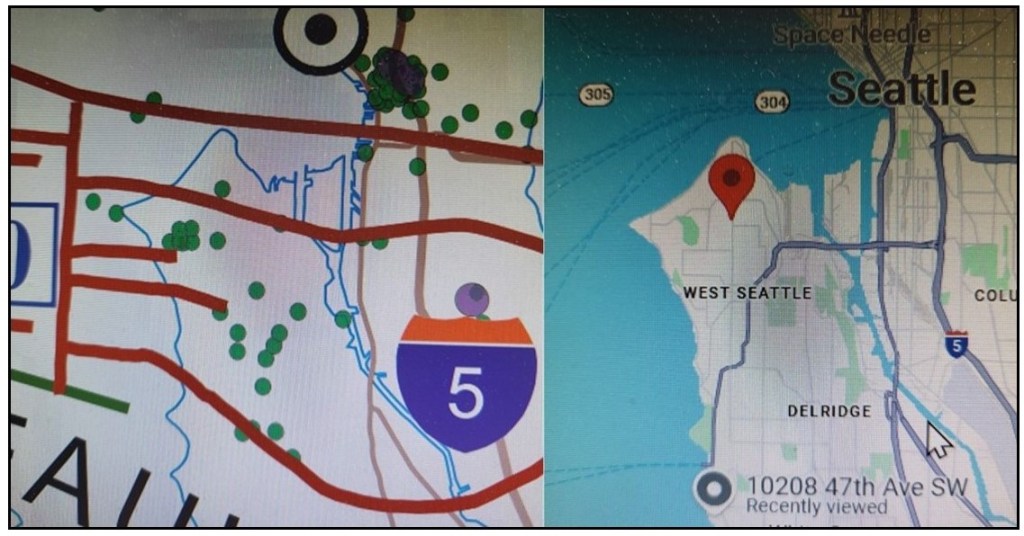
The map on the left shows the fault lines which run under West Seattle. The red marker on the right is the location of the house on California Avenue with the Earthquakes epicenter the gray dot to the south. When the two maps are overlaid, the fault line runs directly under where the house once stood.

The hubby believes he went to school after the earthquake as if nothing significant had just occurred. Oh, how times have changed!

As for the fault line under West Seattle? Yes, it does exist and was mapped in 2014 and when you overlay it onto that location, it runs pretty much under where their house once stood.

So where were you on April 29, 1965? I was in Yakima getting ready for school when that quake struck and our house shook. My mom was brushing my hair and she told me to hang on to the counter. Thankfully, I wasn’t tossed in the air.

The links:

https://www.historylink.org/File/1986

https://en.wikipedia.org/wiki/1965_Puget_Sound_earthquake

https://assets.pnsn.org/HIST_CAT/1965.html

https://www.dnr.wa.gov/publications/ger_ofr2014-05_fault_earthquake_map.pdf?o91ywfh

The Great Planet Debate: Pluto’s Plight

February 18, 2020

What the heck does Bubble Tape have to do with it?

If ever you want to start an argument, be sure to bring up this topic. No, I’m not talking about politics. Or whether Tom Brady really cheated during “Deflategate.” The topic which really gets people animated is whether Pluto is or is not a planet.

maxresdefault

Our NOT ninth planet, Pluto

It was on February 18, 1930, when astronomer Clyde Tombaugh announced the confirmation of a planet just beyond Neptune. The solar system got its ninth and school children everywhere were soon making models of the sun surrounded by Mercury, Venus, Earth, Mars, Jupiter, Saturn, Uranus, Neptune, and Pluto.

The real story began a number of years earlier. According to the Infallible Wikipedia:

“In 1906, Percival Lowell—a wealthy Bostonian who had founded Lowell Observatory in Flagstaff, Arizona, in 1894—started an extensive project in search of a possible ninth planet, which he termed ‘Planet X‘. By 1909, Lowell and William H. Pickering had suggested several possible celestial coordinates for such a planet. Lowell and his observatory conducted his search until his death in 1916, but to no avail. Unknown to Lowell, his surveys had captured two faint images of Pluto on March 19 and April 7, 1915, but they were not recognized for what they were. (snip)

Tombaugh’s task was to systematically image the night sky in pairs of photographs, then examine each pair and determine whether any objects had shifted position. Using a blink comparator, he rapidly shifted back and forth between views of each of the plates to create the illusion of movement of any objects that had changed position or appearance between photographs. On February 18, 1930, after nearly a year of searching, Tombaugh discovered a possible moving object on photographic plates taken on January 23 and 29. A lesser-quality photograph taken on January 21 helped confirm the movement. After the observatory obtained further confirmatory photographs, news of the discovery was telegraphed to the Harvard College Observatory on March 13, 1930. Pluto has yet to complete a full orbit of the Sun since its discovery, as one Plutonian year is 247.68 years long.”

For the putative ninth planet, however, controversy was ever present. Despite the initial excitement at the evidence of its existence, the questions soon arose: was it truly a planet, or was it a Neptunium moon gone astray?

For years scientists sought out photographic evidence of the planet, made possible as telescopes were improved.  Then in August 2006, the International Astronomical Union (IAU) decided to officially define what makes a planet in our solar system a planet. Their three criteria are:

  1. The object must be in orbit around the Sun.
  2. The object must be massive enough to be rounded by its own gravity. More specifically, its own gravity should pull it into a shape defined by hydrostatic equilibrium.
  3. It must have cleared the neighborhood around its orbit.

k-belt1

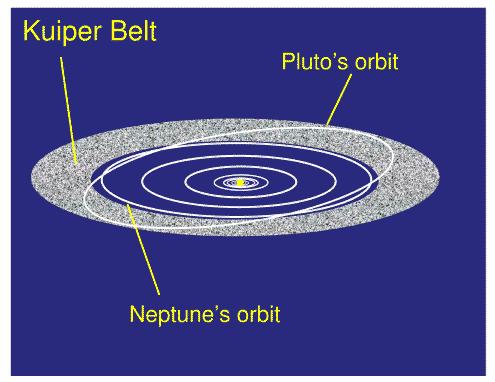
It is the third criteria which caused Pluto a problem. The object exists as part of the Kuiper Belt, an astronomical conglomeration of ice fragments which – like planets – are in orbit around the sun. It is here where Pluto exists.

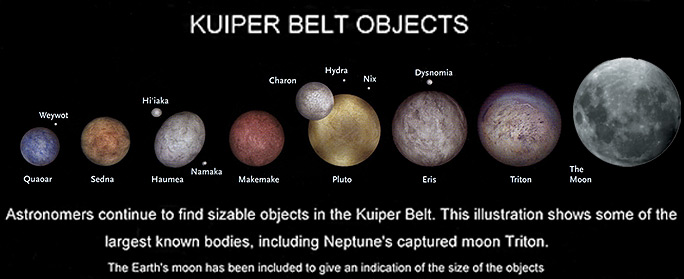
Over the years, scientists have identified other planet like objects which, like Pluto, circle the sun from within the Kuiper Belt. Along with Pluto are other large spheres. Were these also planets?

The answer came back ‘no.’ Also from the Infallible Wikipedia:

“The IAU further decided that bodies that, like Pluto, meet criteria 1 and 2, but do not meet criterion 3 would be called dwarf planets. In September 2006, the IAU included Pluto, and Eris and its moon Dysnomia, in their Minor Planet Catalogue, giving them the official minor planet designations “(134340) Pluto’, ‘(136199) Eris’, and ‘(136199) Eris I Dysnomia’. Had Pluto been included upon its discovery in 1930, it would have likely been designated 1164, following 1163 Saga, which was discovered a month earlier.

kbos

There has been some resistance within the astronomical community toward the reclassification. Alan Stern, principal investigator with NASA’s New Horizons mission to Pluto, derided the IAU resolution, stating that ‘the definition stinks, for technical reasons’. Stern contended that, by the terms of the new definition, Earth, Mars, Jupiter, and Neptune, all of which share their orbits with asteroids, would be excluded. He argued that all big spherical moons, including the Moon, should likewise be considered planets. He also stated that because less than five percent of astronomers voted for it, the decision was not representative of the entire astronomical community. Marc W. Buie, then at the Lowell Observatory petitioned against the definition. Others have supported the IAU. Mike Brown, the astronomer who discovered Eris, said ‘through this whole crazy circus-like procedure, somehow the right answer was stumbled on. It’s been a long time coming. Science is self-correcting eventually, even when strong emotions are involved.”

And so it remains. Pluto is no longer considered the ninth planet in our solar system. But don’t tell that to Pluto lovers.

Of course, anyone who grew up in the 1930’s through to the early 2000’s, may be hard to convince. In the last blissful year of Pluto being a planet, my daughter was in 7th grade. Like generations of students before her she was to build a model of the solar system using some unique material to do so. Since she was between rounds of braces the material she opted to use was the ONE thing she loved more than anything else at that time: Bubble Tape chewing gum.

In her mind, I’m positive, what better way to fulfill her Bubble Tape habit – AND have Mom and Dad pay for it – than to build a solar model out of gum? Over many weeks she chewed gum and saved it. Then chewed more and saved it. Soon massive amounts of masticated Bubble Tape began to be shaped into sun and planets. A plywood board was acquired, painted black, and marker lines put down showing the planets and their orbit. The Sun, Mercury, Venus, Earth and Mars proved simple. Planet by planet the sticky blobs were shaped into tiny little spheres and glued to the board.

When it dawned on her the amount of gum it would take to complete the model it was back to the store for more Bubble Tape. She chewed until her jaw hurt to create Jupiter, Saturn, and Neptune. By the end of the project I believe she would have been relieved had Pluto NOT been a planet.

At last the day arrived and I helped her carry the massive solar masterpiece to class. I can still see the look on her teacher’s face when she realized it was created from chewed gum. She declared it the most unique material she had ever seen for a solar system project.

My daughter’s sore jaw and unique gambit paid off as she was awarded an “A.” And although she continued to chew Bubble Tape occasionally, her obsession ended with the creation of her solar system model.

child's 3D solar system

This is NOT my daughter’s solar system project. Try to imagine this made out of gross globs of chewed gum and you would have it… Alas, no photographic evidence exists as we lost all photos I had of it in a computer hard drive crash in 2006

So be sure to share Pluto’s story and ask the question: Is Pluto our ninth planet? You’re sure to have a lively debate.

A couple of links: https://en.wikipedia.org/wiki/Pluto

https://en.wikipedia.org/wiki/Kuiper_belt


Although Bubble Tape comes in many flavors and colors, my daughter’s favorite was the pink.

Microsoft Millionaires

My ‘Forrest Gump-esque’ experience in the 1980’s

January 21, 2025

A Tuesday Newsday Classic Updated

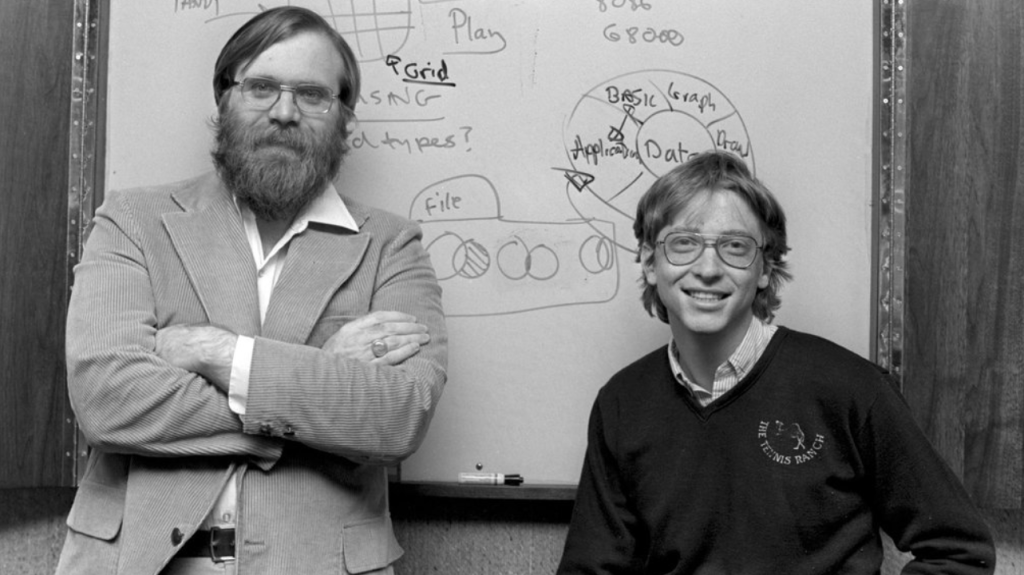
Paul Allen and Bill Gates in the late 1970’s and how I picture both of them in my memory.

When this young man dropped out of college, I’m sure it was a huge disappointment to his family. After all, he’d scored a perfect 1600 on his SAT’s and graduated from the prestigious Lakeside School in Seattle. But the world was changing rapidly in the early to mid-1970’s and he had bigger visions than attending classes and frat parties.

Of course, we all know his story. Along with a close friend, he went on to become a co-founder of one of the world’s most successful computer software development companies: Microsoft.

Early 1980’s Company Logo

But I’m not writing about Bill Gates. This is about Paul Allen, the less ‘famous’ of the Microsoft pair. And without whom Microsoft would never have existed.

If he were alive today, he would be celebrating his 72nd birthday.

According to the Infallible Wikipedia:

“He attended Lakeside School, a private school in Seattle where he befriended Bill Gates, with whom he shared an enthusiasm for computers, and they used Lakeside’s Teletype terminal to develop their programming skills on several time-sharing computer systems. They also used the laboratory of the Computer Science Department of the University of Washington, doing personal research and computer programming; they were banned from the laboratory in 1971 for abuse of their privileges there.

Gates and Allen joined with Ric Weiland and Gates’ childhood best friend and first collaborator, Kent Evans, to form the Lakeside Programing Club and find bugs in Computer Center Corporation’s software, in exchange for extra computer time. In 1972, After Evan’s sudden death due to a mountain climbing accident, Gates turned to Allen for help finishing an automated system of Lakeside’s entire class scheduling procedure. They then formed Traf-O-Data to make traffic counters based on the Intel 8008 processor. According to Allen, he and Gates would go ‘dumpster diving’ in their teenage years for computer program code.

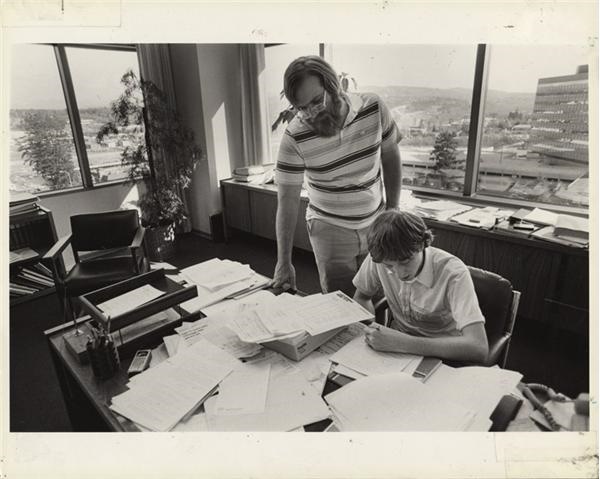
This photo purports to be from 1984. If so, it was likely right after the company moved ‘across’ I-520 to Corporate Campus East. This would have been my final year at Microsoft.

Allen attained a perfect SAT score of 1600 and went to Washington State University, where he joined the Phi Kappa Theta fraternity.”

Allen was hired by Honeywell, located in Boston, as a computer programmer and left WSU. Gates, now attending nearby Harvard, and Allen reconnected. It was Allen who convinced Gates to leave Harvard, move to Albuquerque, New Mexico and form Micro-Soft (To combine the two terms microcomputer and software). In January 1979, the company moved to Bellevue, Washington.

Also from the Infallible Wikipedia:

“The relationship became less close between Allen and Gates as they argued even over small things. Allen effectively left Microsoft in 1982 after being diagnosed with Hodgkin’s lymphoma, though he remained on the board of directors as vice chairman. Gates reportedly asked Allen to give him some of his shares to compensate for the higher amount of work that Gates was doing. According to Allen, Gates said that he ‘did almost everything on BASIC and the company should be split 60–40 in his favor. Allen agreed to this arrangement, which Gates later renegotiated to 64–36. In 1983, Gates tried to buy Allen out at $5 per share, but Allen refused and left the company with his shares intact; this made him a billionaire when Microsoft went public. Gates later repaired his relationship with Allen, and the two men donated $2.2 million to their childhood school Lakeside in 1986. They retained a friendship for the rest of Allen’s life.”

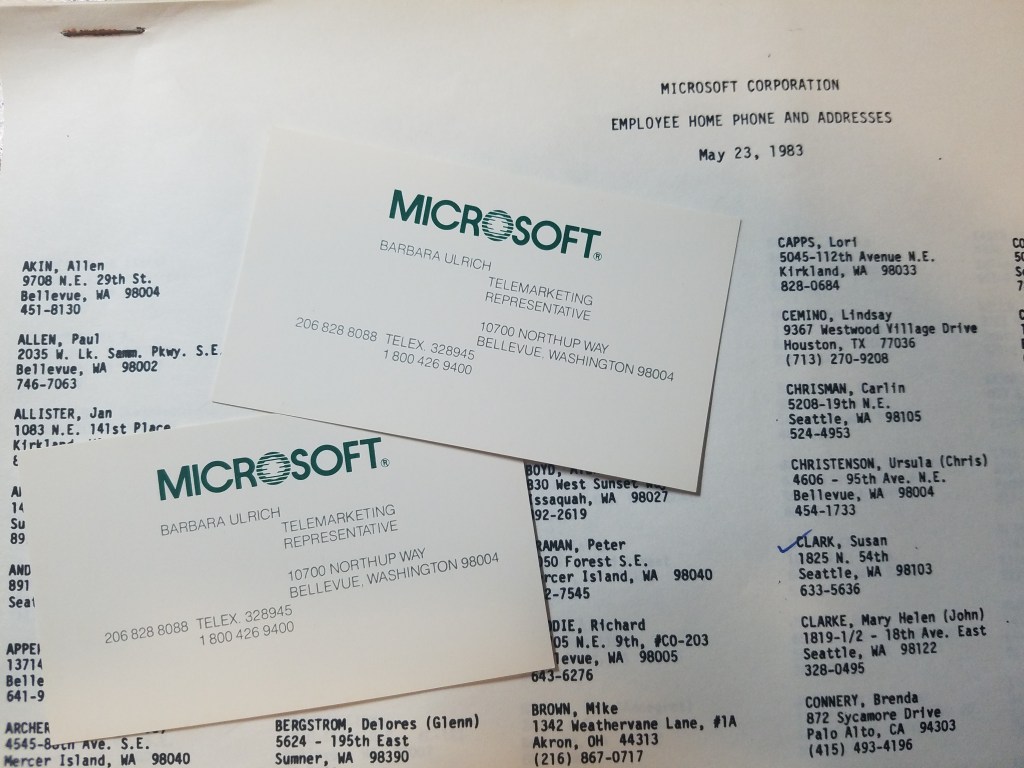
Being that I keep anything which might be historical in nature, I still have several Microsoft employee address lists and a few of my business cards. When I joined the company in early January 1983 there were 205 people at corporate and 21 field sales reps. Which means I was one of the first 250 employees of Microsoft.

Allen went on to do many great things for the world including donating over $2 Billion towards science, technology, education, wildlife conservation, the arts, and community services.

You can read more about Allen’s extraordinary life and find links to his biography here:

https://en.wikipedia.org/wiki/Paul_Allen

In the past eight years of writing my Tuesday Newsday blog I’ve shared only a few stories about my ‘Forest Gump-esque’ experiences at Microsoft. I was hired there in early 1982 as part of a group of three young women who would be launching a retail telemarketing division for the company.

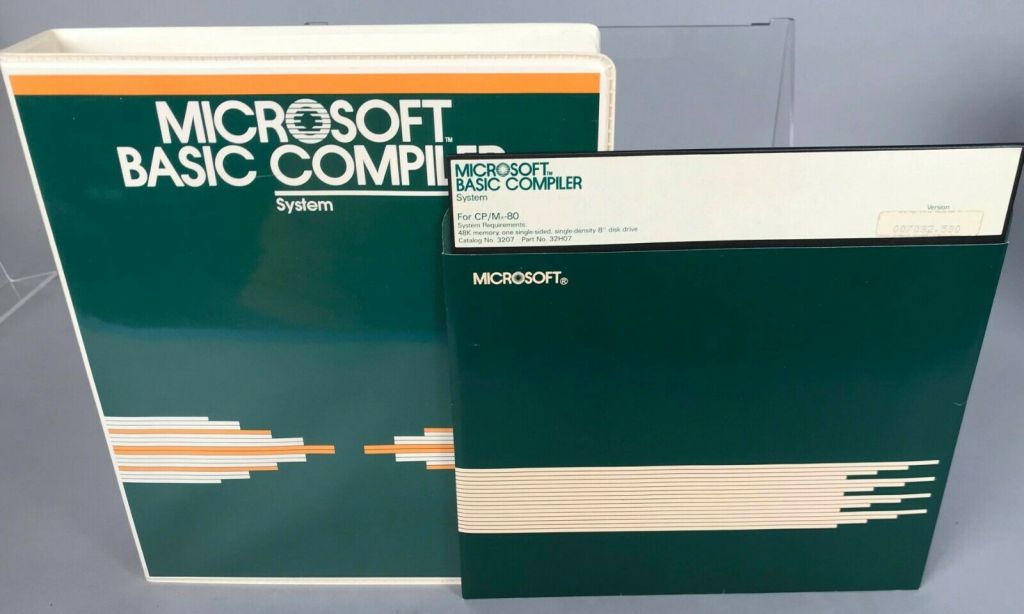
Our trio faced nearly insurmountable odds – which we did not know when we took the jobs – as we were tasked with calling out to every retail store in our region (I had the west coast. The. Entire. West. Coast.), working in conjunction with Microsoft’s field sales reps, to sell such programs as Basic, Fortran, and Cobol compilers, the always popular Flight Simulator and Typing Tutor, and the early spreadsheet program, MultiPlan.

The phone calls were often brutal with the stores’ buyers either not taking our calls or, more often, asking if we sold Lotus 1-2-3, our competitors sizzling hot multi-functional program which dwarfed Microsoft’s Multiplan. Word Processing program? Bah. Didn’t exist then.

There was nothing sleek OR sexy about the early Microsoft products. But they were green…

We worked hard, we played hard, and the burnout rate was high.

I left Microsoft, having experienced that same mentioned burnout, in the fall of 1984 and went to work for another computer company located in Kirkland six weeks later. One day, likely the summer of 1986, my then boss, Tom, took me to lunch for my birthday. We went to a favorite Japanese sushi place in Totem Lake called Izumi.

We sat up at the small sushi bar, the only people in the restaurant when we arrived. We had just gotten our food when a group of 4 or 5 men also arrived, and took a table nearby. I didn’t pay much attention to the group as Tom and I were talking. Tom, being a loud and gregarious individual, dominated the exchange and the room.

Izumi was a favorite where the hubby and me liked to go

Somehow our conversation got on to Microsoft and Tom asked why I had left the company. Before I could answer, I noticed the table of nearby men had gone silent and were all looking at us, and one of them said “I can’t escape it, no matter where I go.” That man was Paul Allen.

Perhaps that moment, more than any other, illuminated how he felt about Microsoft – at least in 1986 when he and Gates were still working to repair their relationship – and summed up for me my Microsoft experience also. For anyone living in the Seattle area, you either worked for, know someone who worked for, or you once worked for, Microsoft. It was inescapable. And not particularly pleasant.

I wanted to say something to Paul Allen that day, but felt that if I had it would have been about as welcome as a drunk fan asking a movie star for an autograph. Instead – as if by mutual agreement – he returned his attention to his group and Tom and I changed our topic.

I left Applied Computer Sciences and the corporate world in the late 1980’s, putting my energies in to raising my kids and doing volunteer work.

If I had any regrets in leaving Microsoft it was, perhaps – unlike Paul Allen – that I was never eligible for stock options, a nice perk that would have made life a bit easier.

I did, however, learn something much more valuable and it is a mantra I’ve carried through my life which goes like this:

Bill Gates and Paul Allen were wildly successful. Microsoft was wildly successful. But just because I worked for the company, however, was not enough to make me wildly successful. It is up to each of us, individually, to follow our own path, pursue our own dreams and interests, and find those things which bring us joy and fulfillment. That, I think, is the true definition of success.

It was a hard lesson but I’m forever thankful for learning it and those brief, brutal, and impactful, Microsoft years.

https://en.wikipedia.org/wiki/Paul_Allen

https://en.wikipedia.org/wiki/Microsoft

Deer Danger!

A Public Service Announcement

October 8, 2024

One of my ‘neighbors’ saying ‘Hi”

A Tuesday Newsday Classic

This week’s blog is really more of a public service announcement (PSA). Each year when I turn the calendar page to October, I know it is time once again to think about the very scary…. Cervidae. Or, as most people know the species, deer.

With approximately 21 million deer living in the United States, it should surprise no one that conflicts between people and deer will arise. Back to that in a moment. But first a little information on the Mule deer species, the most common Cervidae in the Pacific Northwest, as told by the Infallible Wikipedia:

“Deer are browsers. During the winter and early spring, they feed on Douglas fir, western red cedar, red huckleberry, salal, deer fern, and lichens growing on trees. Late spring to fall, they consume grasses, blackberries, apples, fireweed, pearly everlasting, forbs, salmonberry, salal, and maple. The mating or ‘rutting’ season occurs during November and early December. Bucks can be observed running back and forth across the roads in the pursuit of does. After the rut, the bucks tend to hide and rest, often nursing wounds. They suffer broken antlers, and have lost weight. They drop their antlers between January and March. Antlers on the forest floor provide a source of calcium and other nutrients to other forest inhabitants. Bucks regrow their antlers beginning in April through to August.

(snip)

At dawn, dusk, and moonlit nights, deer are seen browsing on the roadside. Wooded areas with forests on both sides of the road and open, grassy areas, i.e. golf courses, attract deer. Caution when driving is prudent because often as one deer crosses, another one or two follow.”

The last line brings me back to the PSA. From October through December you are much more likely to see deer near or on the road and are much more likely to hit one with your car. We can conclude that the need to forage farther and farther for food to sustain them through the winter, combined with the urge to mate, increases their interactions with people.

At the ripe old age of 22 I learned the hard way a universal truth about deer. Driving home from Tacoma to the small town of Eatonville (population 1005) one early October night in my trusty Ford Pinto, a deer leaped out in front of me. I braked and barely missed the animal… then I made a classic mistake. Thinking the danger was past, I put my foot on the gas and sped up. Yep. I hit the second deer.

Over the years I’ve encountered many deer on the roads and have been known to freak out a bit when driving, especially at dusk. I’m constantly watching the sides of the highway looking for the critters.

My concern is justified. About 7 years later, I hit another deer one morning in spring while on my way to work. Yes, I’m paranoid.

My most illustrative encounter occurred on a late September evening while driving a group of teenage girls to a weekend camp out on Hood Canal. It was a Friday and by the time we had the group organized, stopped for fast food, and then crawled our way through the Seattle/Tacoma metro traffic, it was dark.

As we made our way along state Highway 106 and approached Twanoh State Park, the young woman who was riding shotgun asked why I was driving so slowly.

“I’m looking for deer,” I replied, then continued, “They are active this time of year and day.”

I then proceeded to tell her about my two deer related accidents and issued the following warning:

“So if you are ever driving and a deer jumps out in front of you, STOP, because they always travel in pairs.”

“Always?” she questioned.

“Pretty much always,” I replied.

And then, not three minutes later, it happened.

From my left a deer bounded across the road in front of the van. I hit the brakes and stopped. A moment later the second deer crossed exactly where the car would have been had I not stopped.

“How did you do that?” she asked, a look of awe on her face in the low glow of the dashboard lights.

“It’s my deer karma,” I replied.

Yes, deer karma is a thing. I have another friend who is certain that I attract the critters. On a different road trip a few years earlier, I was a passenger in her car, driving from Moscow, Idaho, to Seattle one summer night. It was late June and we had been talking about my deer encounters. After hearing my stories, the poor woman was panicked, worried about ‘when’ (not if!) some random buck or doe would pop up in front of us.

For 240 miles everything was fine and I kept saying that I was not capable of conjuring up random deer… that was until the very top of Snoqualmie Pass. Just as the car swept around the last curve to the summit, smack dab in the middle lane of Interstate 90, was a deer. Just standing there as though waiting for me.

View from my office window watching a few of my spirit animals passing through

“I knew it! I knew it!” she exclaimed. “It’s you. They’re your totem animal.”

As for me I had no explanation. I’d never before seen a deer standing in the middle of Snoqualmie Pass and never have again. Yet, there the deer was, confirming to her that I had some mystical ability to conjure up my patronus animal, the mule deer.

Personally, I think it would be much easier to have a dog, a cat, or a chipmunk, for my totem animal. Or a sloth. A sloth would be nice as it would never jump out in front of me while driving.

The links:

The Sewing Machine

An invaluable invention which changed women’s lives

September 10, 2024

A Tuesday Newsday Classic

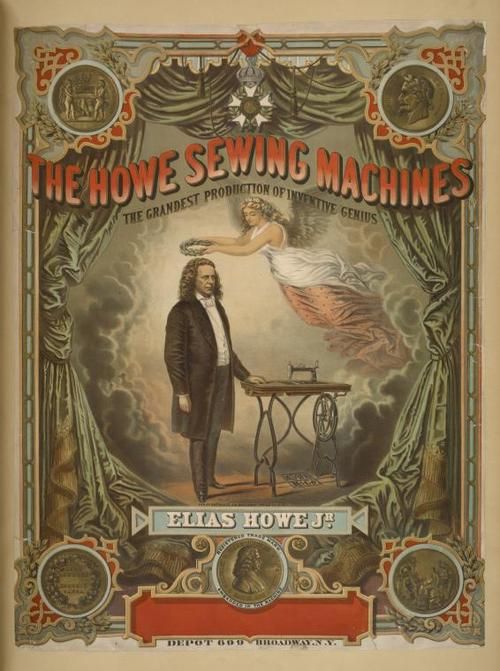
This invention truly revolutionized American life. The sewing machine was granted a patent on September 10, 1846. While most people associate the name Singer with the sewing machine it was actually an inventor by the name of Elias Howe who conceived of and created the first such machine. From the Infallible Wikipedia:

“He almost beggared himself before he discovered where the eye of the needle of the sewing machine should be located. It is probable that there are very few people who know how it came about. His original idea was to follow the model of the ordinary needle, and have the eye at the heel. It never occurred to him that it should be placed near the point, and he might have failed altogether if he had not dreamed he was building a sewing machine for a savage king in a strange country. Just as in his actual working experience, he was perplexed about the needle’s eye. He thought the king gave him twenty-four hours in which to complete the machine and make it sew. If not finished in that time death was to be the punishment. Howe worked and worked, and puzzled, and finally gave it up. Then he thought he was taken out to be executed. He noticed that the warriors carried spears that were pierced near the head. Instantly came the solution of the difficulty, and while the inventor was begging for time, he awoke. It was 4 o’clock in the morning. He jumped out of bed, ran to his workshop, and by 9, a needle with an eye at the point had been rudely modeled. After that it was easy. That is the true story of an important incident in the invention of the sewing machine.”

Alas, Elias Howe had competition in the development of the sewing machine and another, much more recognized name, came to dominate the industry. Also from the Infallible Wikipedia:

“Despite his (Howe) efforts to sell his machine, other entrepreneurs began manufacturing sewing machines. Howe was forced to defend his patent in a court case that lasted from 1849 to 1854 because he found that Isaac Singer with cooperation from Walter Hunt had perfected a facsimile of his machine and was selling it with the same lockstitch that Howe had invented and patented. He won the dispute and earned considerable royalties from Singer and others for sales of his invention.”

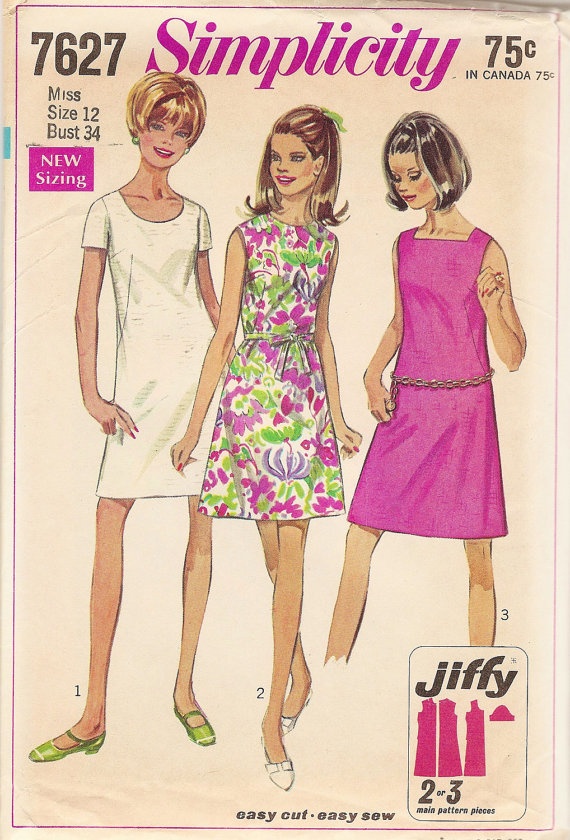
An A-line pattern that beginning seamstresses could master as they learned to sew.

Howe, like Singer, ended up a multimillionaire.

Before this society altering machine was invented, it took some 14 hours for a person – usually a woman – laboring at home and sewing each seam by hand to make a shirt. Those hours were invested after all other chores were done: cooking, cleaning, washing, and child care. The sewing machine, which at first was used in factories, eventually made its way to the home allowing women to sew stronger, better garments, and saving hundreds of hours of valuable time.

For me, my relationship with the sewing machine is a love/hate affair. When in Junior High I took Home Economics classes which, at Wilson Junior High in Yakima, were split into two segments. One was to learn all the skills needed to cook. The other was to learn how to sew. I was in eighth grade in the sewing segment when I received my first lessons.

Our initial project was to sew a basic A-line dress. For those unfamiliar with the term, what that meant was a dress of three pieces: front, and two mirror image back pieces with a zipper down the middle. No sleeves, just armholes with armhole facings; darts at the bodice completed the fitting. In all, the pattern consisted of 8 pieces. Five of those pieces were facings around the arms and neck.

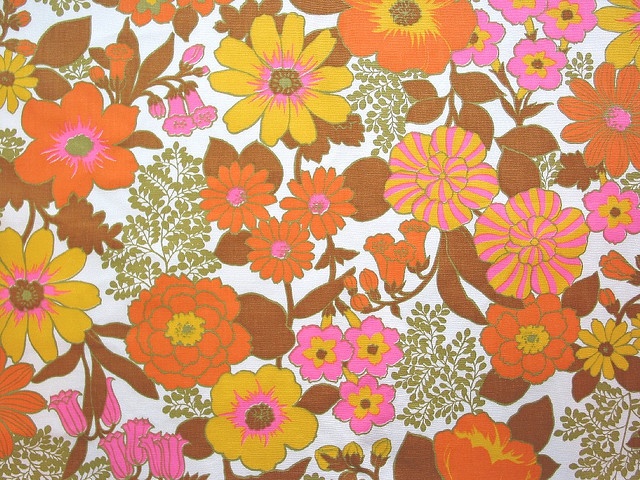
Our teacher sent us out on the mission to purchase material for our dresses. I acquired a very loud, very late 1960’s/early 1970’s fabric, with colorful and bold flowers on a white background. Day by day we labored. One day the pattern pieces had to be carefully laid out and pinned down, paying attention to concepts such as grain lines as we learned how to ‘read’ the pattern. The next step, after our teacher approved our work, was to cut the fabric, making sure to follow the printed lines of the pattern and the little tabs to be matched. Day by day we succeeded in sewing together our creation. We learned the proper way to sew darts (the dress had four of them), install a zipper, finish edges, tack down the facings, and to sew (by hand) a hem.

Typical of Popular fabrics designs from the early 1970’s

When my dress was complete that fall I was excited to wear it… only to discover that due to my physical similarity to a long-legged colt, the length of the dress was such that all anyone noticed were my knock-kneed legs extending a mile from the hem to the floor.

This might have been due to the fact that the mini skirt was the dominant fashion in the late 1960’s. Or it might have been that between my 8th and 9th grade years of school I grew, literally, six inches in height. From the time I started the dress to when it was finished, I had gained most of this height.

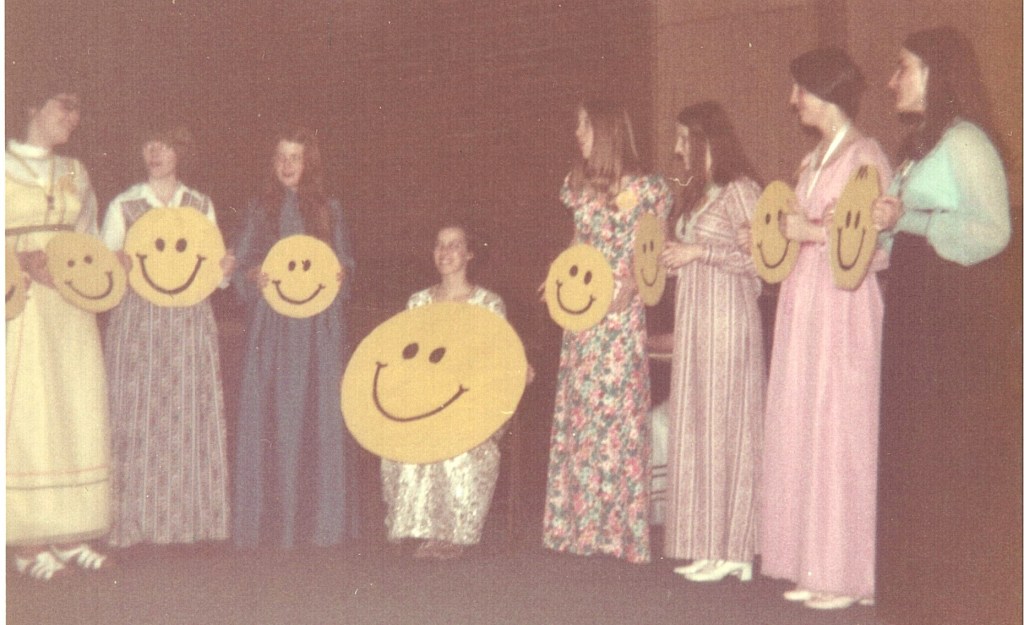
But I was not discouraged as I had discovered I now possessed a valuable ability. Soon I had a bit of a cottage industry going. As a member of the Rainbow Girls the need for custom dresses for its members provided clients. The very first dress I made for someone else was for my friend, Wende, who paid me $15 to sew a dress.

March 1972. This was taken at a Rainbow Girls meeting in Yakima. I’m standing immediately to the right of the girl seated and wearing a dress I sewed using popular bright floral colors. I wrote in my diary that day “I wore my new formal that I made and everyone seemed to like it.
.

Over the years knowing how to sew has come in handy. I can mend pretty much anything and can create clothing. I’ve made costumes for my children, dresses for countless Rainbow girls, and my most recent project (in 2019) of sewing 21 identical aprons for gifts.

The most painful experience occurred, however, in January 2010. Sewing is, despite Mr. Howe’s invention, a time consuming process.

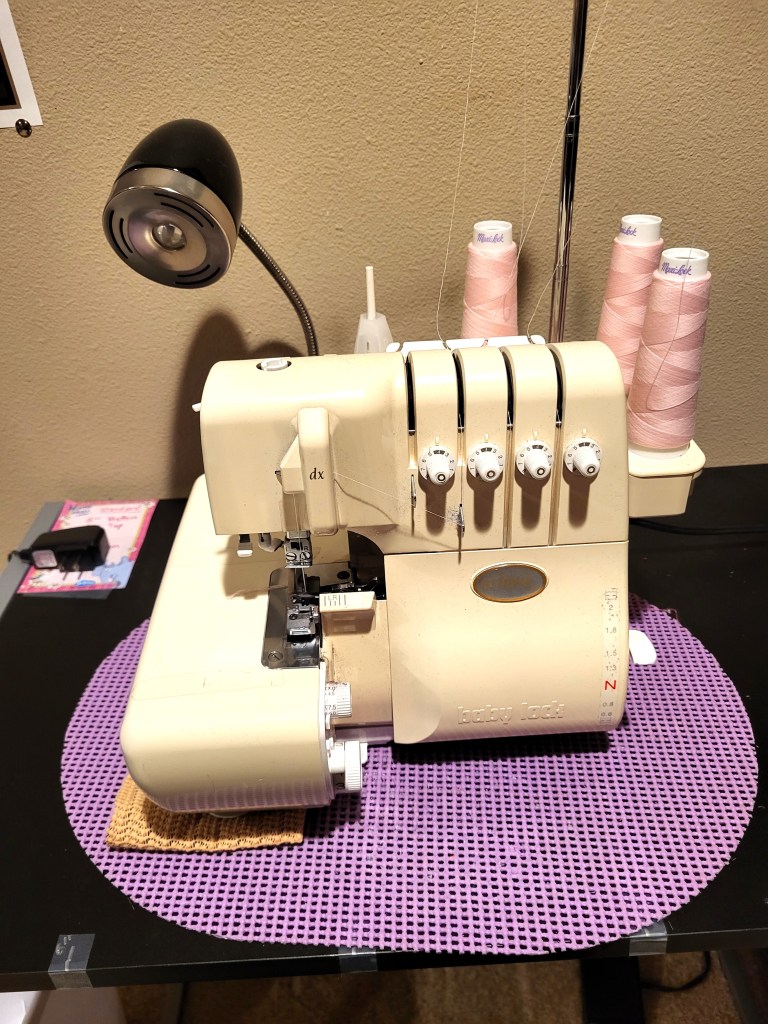
My Baby Lock serger – a Christmas present to myself – purchased in early 2010 and still being used.

Enter into my world the serger. Improving on the functionality of the sewing machine, a serger completely binds a seam, cutting and simultaneously sewing together two pieces of fabric into a never to be undone union. The addition of the serger was a miracle for me. Seams which before had taken 20 minutes each now required but a few minutes.

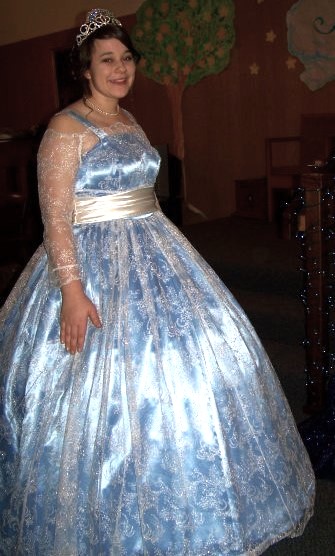
Until. Until I was sewing my first project using the serger in January 2010. It was to be a rather delicate and beautiful blue dress using a pattern in the same style as the wedding dress worn by Kate Middleton for her marriage to Prince William. There was lace. There was satin. It was going to be stunning. I was happily serging the seams in anticipation of the dress being completed when my foot slipped on the pedal and the serger went one stitch too far. I looked down at the garment and there, in the nearly completed dress, was a perfect cut into the midriff in the shape of a small upside-down V.

I stared in horror at the incision and wondered how to fix the mistake. Could I bind the edge to repair it? Could I tuck in under?

The reality of the situation hit me. There was no way to ‘fix’ the mistake. The dress would have to be taken apart, a complete new section cut out and replacing the irreparably damaged midriff piece.

The dress which the serger attacked…

The memory of that day is forever seared into my brain. I continued to study the ruined bodice for what seemed like several minutes. At last I stood. I turned off the machine. I left the dress right where it was, a testament to the old adage “A stitch in time saves nine.”  I left my sewing room for the rest of day, literally sick over the fact that I would have to recreate the destroyed section, learning in that moment that a serger was but a tool which, if not used correctly, was no more useful than any other tool in the wrong hands.

The next day I returned to the sewing room, cut out the new section and was able to recreate the damaged piece. My mistake had added a couple of hours to the project. The dress? It turned out beautifully, a true masterpiece on the lovely young woman who wore it. Because I knew that sometimes ‘things happened’, I had enough extra material to fix what had been so easily destroyed.

As for me, sewing is something I do because it serves an end, but it’s not my life’s passion. My passion is this: writing.

I do find, however, that when my brain is tired from the creative process of writing, sewing can provide a comfort in the sheer rote of its methods. Seams are seams. There are only so many ways to put a garment together and once you master that you can make pretty much anything so long as you respect the machines which make it possible.

But writing… well, that taps into my creative mind as I’m always looking for new and different ways to share ancient truths.

So I leave the sewing to those whose passion it is. Artistry comes in many forms.  Except for an occasional project, my 10 hour sewing days are behind me and I’ve closed the shop.

I also think it’s time to bring back Home Ec. classes like sewing. We’ve now raised a couple generations of people, the majority of whom seem to lack basic life skills. Being able to sew a seam, and put up a hem is just one example of valuable ability. Cooking, carpentry, and mechanical aptitude should be added to that list also.

So I salute Elias Howe and his vision for the modern sewing machine. It truly changed the life of women.

The Infallible Links:

https://en.wikipedia.org/wiki/Sewing_machine

https://en.wikipedia.org/wiki/Elias_Howe

The First Tuesday in September

Pee Chees, Saddle Shoes, and Fear

September 3, 2024

A Tuesday Newsday Classic

The first Tuesday of September was always a day which struck fear in my heart. In fact, no other day of the year caused more anxiety and distress than this one.

The reason, of course, was due to the fact that when I was growing up school always started on this day.

The ubiquitous Pee-Chee – an indispensible back to school item

Unlike in today’s world, where we are inundated with back-to-school ads for supplies and equipment beginning in late July, in the 1960’s and 70’s, we didn’t much think about going back to school. That was until one day in late August my mother would ominously announce that school started the next week.

So off we would go to get things. Our back-to-school supply list included Pee Chee folders, notebook paper, #2 pencils, and BIC pens. That was it.

For clothing, I was lucky to get one new outfit for the first day of school. And the most evil of all footwear ever invented: saddle shoes.

I’ll get back to those in a bit.  First off, however, I imagine you are wondering about the Pee Chee.  What is a Pee Chee? And why do so many people my age wax nostalgic over a folded in half piece of cardstock? I knew it deserved Tuesday Newsday status. Since I couldn’t find the official day they were introduced, the first Tuesday in September seemed the perfect opportunity to learn about them. From the Infallible Wikipedia:

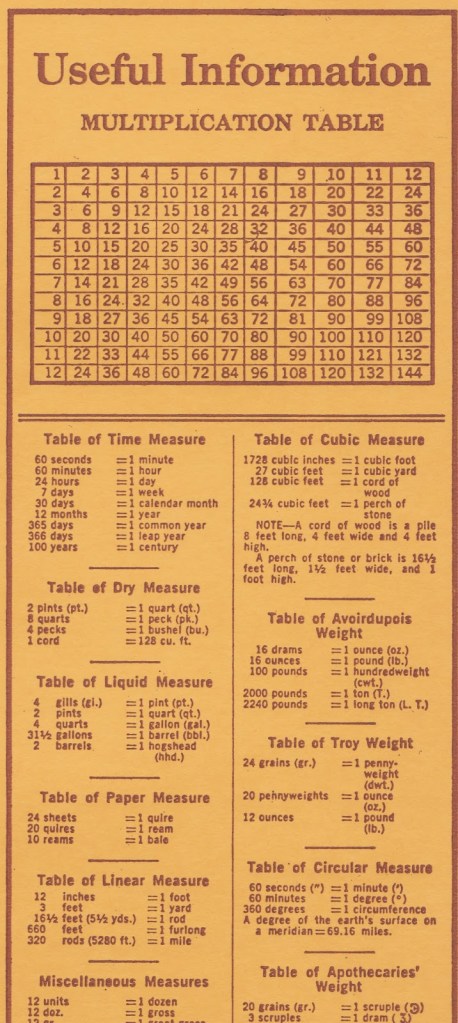
How we learned our multiplication tables and other useful information

“The yellow Pee-Chee All Season Portfolio was a common American stationery item in the second half of the 20th century, commonly used by students for storing school papers. It was first produced in 1943 by the Western Tablet and Stationery Company of Kalamazoo, Michigan. Pee-Chees were later produced by the Mead Corporation. (snip) These inexpensive folders are made of card stock with two internal pockets for the storage of loose-leaf paper. The pockets are printed with a variety of reference information including factors for converting between Imperial and metric measurement units, and a multiplication table. The folders had fallen out of general use by the 2000s, but are available from Mead as of 2014.”

Note the words “multiplication table.” This was probably the most valuable thing a Pee Chee provided as we were expected to memorize this table. By the time you arrived at the twelves, it got a bit difficult. The handy dandy Pee Chee came to your rescue. Of course, our teachers knew this and we had to put our Pee Chee’s away during test time.

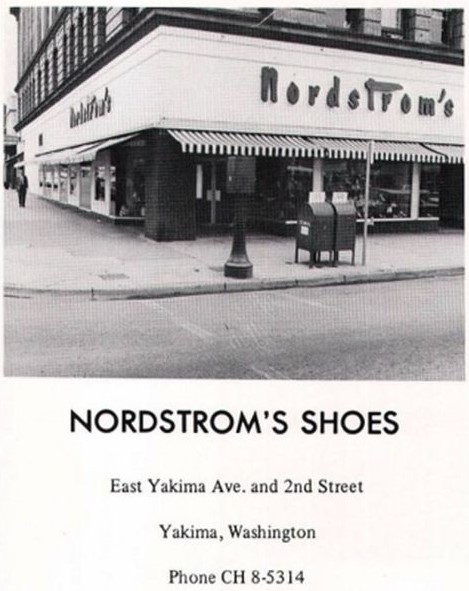
One of the eight Nordstrom shoe stores in the 1960’s

Every day, when I walked home from elementary school, I only carried a Pee Chee and rarely any books unless it was one checked out from the school library. By the time I was in Junior High and High School, books were part of the equation. Along with the Pee Chee of course.

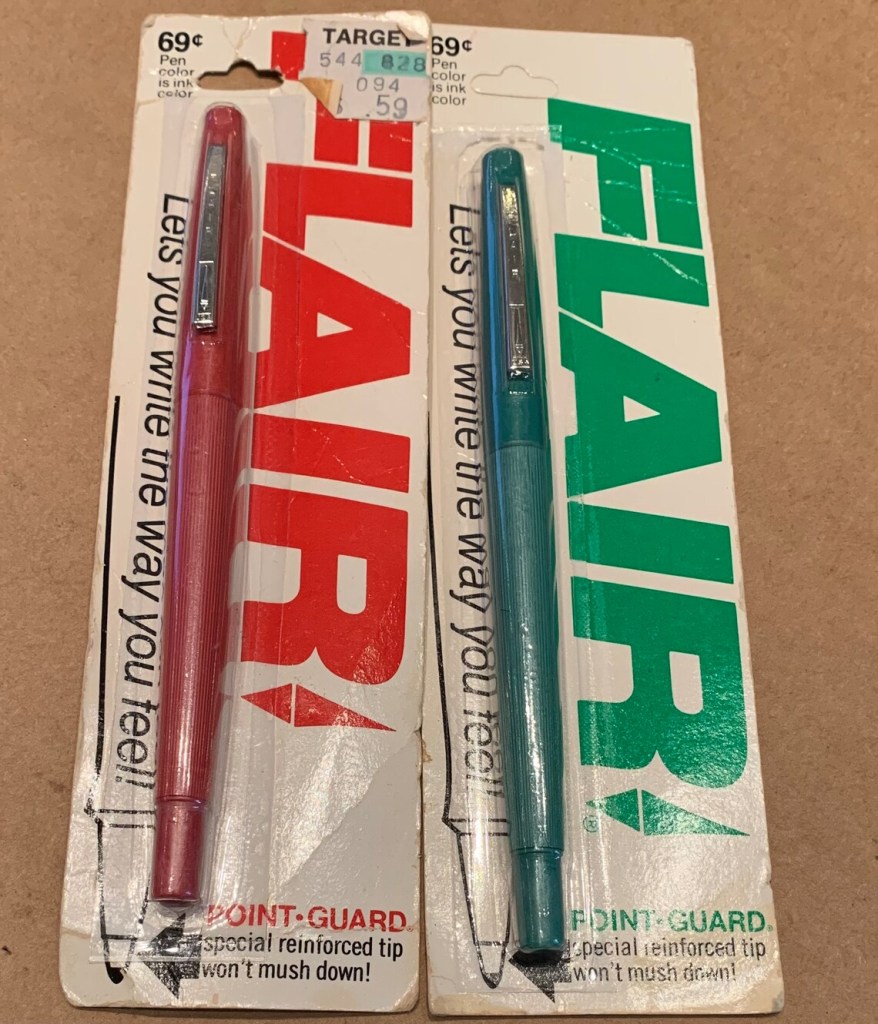
That brand new, unmarked, non-dog-eared Pee Chee was the best part of being forced to go back to school. And paper, pencils and BIC pens, of course. The best addition were colored Flair pens starting in Junior High! My favorite was the green one.

But the worst part? From first grade through sixth I was subjected to torture by being forced to wear saddle shoes. Whoever invented this shoe should have been required to wear a new pair every week for their entire lives just so they would know what pain they subjected multiple generations of girls to endure.

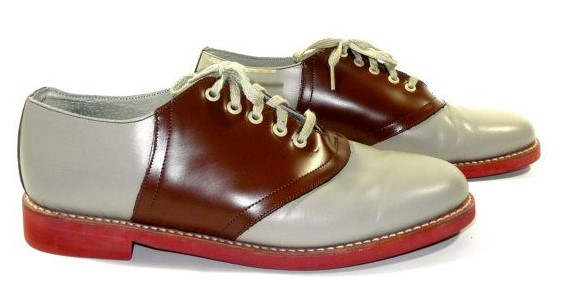
The evil saddle shoe…

My mother would take me and my sister to Nordstrom’s Shoe store… in the 1960’s in Yakima that’s all it was… a shoe store. We would bypass all the beautiful shiny black patent leather shoes and the cute Mary Janes and go directly to the rack of clunky saddle shoes. There they sat, big, bulky, and ugly. They had brown soles thicker than a slice of French toast. Across their beige bodies was a second strip of stiff brown leather, with laces through the holes, just waiting to cinch your foot into bondage. Heaven forbid that you got shoes which fit… no, they had to be a bit big so you’d grow in to them and not grow out of them before the following June.

We would wear them around the house for several days before school started in a futile effort to ‘break’ them in. It never worked. The first few weeks of school our feet bore witness to the horrors of saddle shoes; oozing red blisters were covered with adhesive tape and we’d limp through the day. Eventually the leather softened and the blisters abated… usually by October. Kids today just don’t realize how lucky they are to have been spared the scourge of saddle shoes.

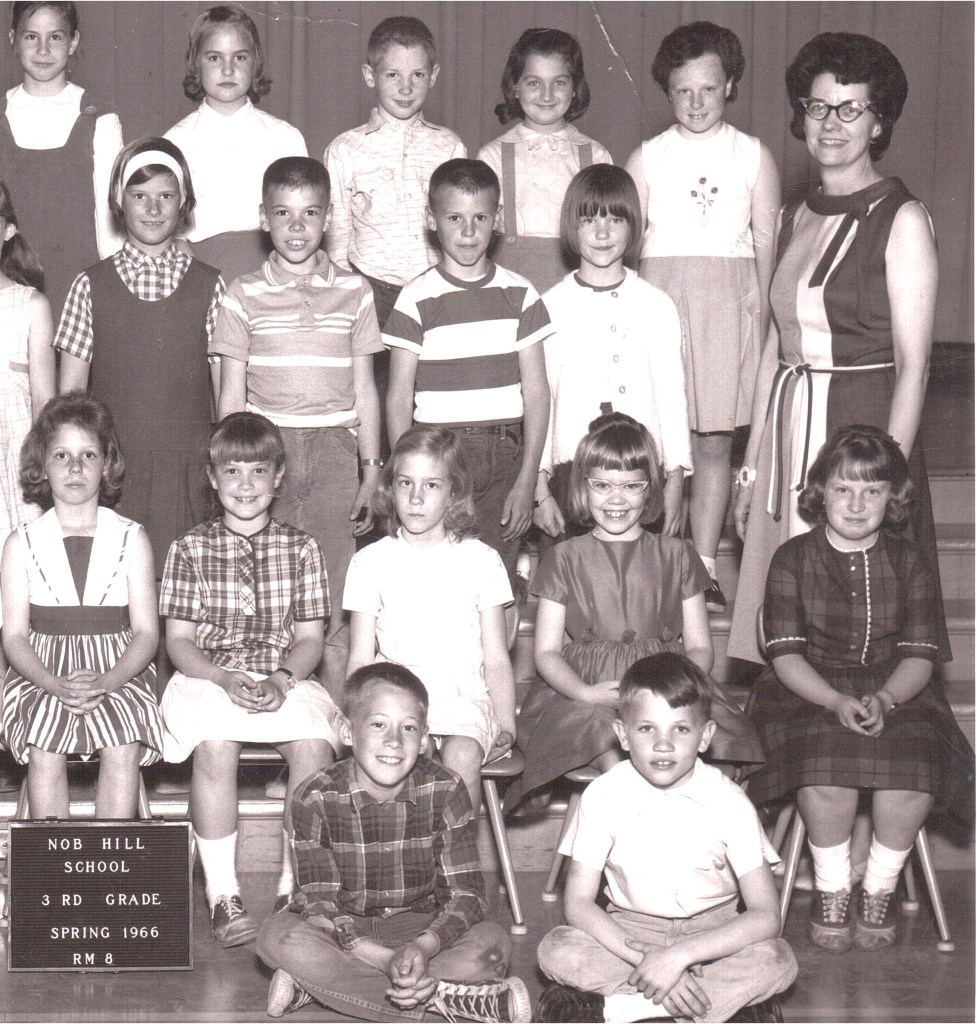
Note the saddle shoes on the two girls seated, Marla on the left and Rinda on the far right. This author is next to Marla undoubtedly also wearing saddle shoes. The girl in the glasses next to me? That was Kelly who NEVER had saddle shoes but always cute black patten leather shoes.
Flair pens were IT! Especially the green ones.

Even now the first week of September is my least favorite time of the year; despite the fact I do not have to go back to school nor do my children.

I am, however, very, very tempted to go hang out in the office supply store and indulge myself in the smell of paper and ink and the plethora of notebooks, papers, pens, and paperclips. Anyone who has seen my office knows that I have stacks of spiral notebooks, hundreds of colored paperclips (many with decorative tops), and a collection of G-2 pens of every hue. In fact, just writing about it inspires me to head to my nearest Office Depot Max to see what’s on sale. Unlike saddle shoes, office supplies never go out of fashion!

As always a couple of links:

https://en.wikipedia.org/wiki/Pee_Chee_folder

https://en.wikipedia.org/wiki/Saddle_shoe

Yes, it is true. In 1960 Nordstrom’s only sold shoes. The store in Yakima was one of only 8 stores at the time.

https://shop.nordstrom.com/content/company-history

Cherries!

One of summer’s best fruits

July 2, 2024

A Tuesday Newsday Classic Updated

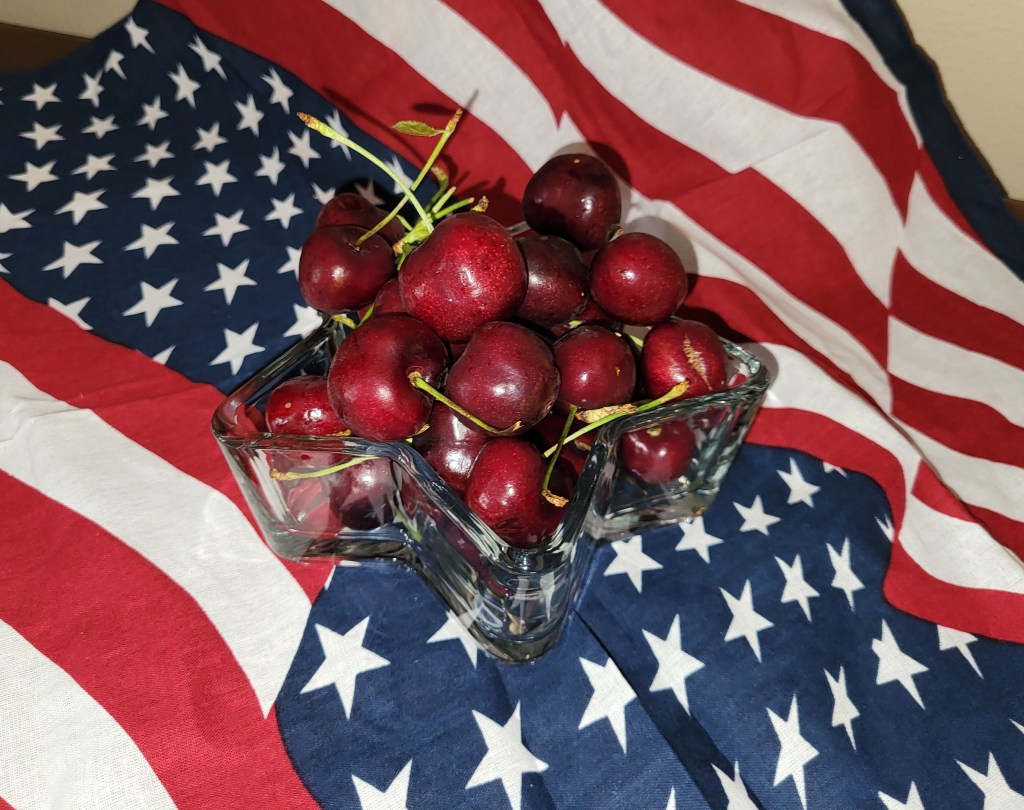
A few cherries purchased, not picked, at Fred Meyer.

The item which caught my attention for this week’s blog is the amusing ‘contest’ of cherry pit spitting. Yes, it’s a thing.

Held annually in Eau Claire, Michigan since 1974, the record ‘spit’ of a cherry pit is 93 ft 6.5 inches. The competition has been dominated by one family with the patriarch, Rick Krause, holding the record for longest spit (over 72 feet) until 1993. Since then, his son, Brian ‘Pellet Gun’ Krause has won 10 times with his record breaking discharge occurring the first week of July in 2003. In recent years Brian’s sons have also competed.

Others have stepped up to put their spitting skills to the test, but the Krause family continues to dominate.

Cherry pit spitter-champion Brian ‘Pellet Gun’ Krause

It is appropriate, therefore, as we celebrate all things red, white, and blue this week, to pay tribute to one of my favorite red things: the cherry.

Every July I can hardly wait for the harvest of this fruit to begin in the Yakima Valley. For there is truly nothing better than picking a cluster of the ruby orbs and (after they’re washed off) biting into the soft, juicy flesh. As a fan of the sweet varieties such as Bing and Sweetheart, an explosion of flavor reminds me how much I’ve missed them since the previous year.

The cherry has a long history of cultivation with evidence that the fruit has been grown since prehistoric times. From the Infallible Wikipedia:

“The English word cherry derives from Old Northern French or Norman cherise from the Latin cerasum, referring to an ancient Greek region, Kerasous (Κερασοῦς) near Giresun, Turkey, from which cherries were first thought to be exported to Europe. The indigenous range of the sweet cherry extends through most of Europe, western Asia, and parts of northern Africa, and the fruit has been consumed throughout its range since prehistoric times. A cultivated cherry is recorded as having been brought to Rome by Lucius Licinius Lucullus from northeastern Anatolia, also known as the Pontus region, in 72 BC.

Cherries were introduced into England at Teynham, near Sittingbourne in Kent, by order of Henry VIII, who had tasted them in Flanders.

Cherries arrived in North America early in the settlement of Brooklyn, New York (then called ‘New Netherland’) when the region was under Dutch sovereignty.”

In the United States, the first record of cherry trees being planted was 1639.

Sweet cherries are grown most successfully in Washington, Oregon, California, Wisconsin, and Michigan (hence the location of the cherry pit spitting contest). Most sour cherry varieties are grown in Michigan, Utah, New York and Washington.

To successfully grow cherries, the climate must have cold winters although varieties have been developed recently which have allowed California to compete in cherry production.

My relationship with the cherry has not always been an enjoyable one. In the 1970’s, my grandfather divested his properties to his two daughters and my father took over managing a cherry orchard. The orchard was repayment to my grandfather – a banker – from a loan gone bad some years earlier.

My Dad had never been a farmer but during the summer – when not a Junior High School history teacher – he was a hands on orchardist. It was natural, then, that my first summer ‘job’ as a teenager was picking cherries.

My Dad – schoolteacher turned orchardist – caught by a loaded cherry tree in Selah, Washington, circa 1980.

By early July in Yakima, summer is in full force and the weather usually turns quite warm. It is common for there to be a spate of days when the thermometer inches into the upper 90’s and low 100’s.  It’s then that the cherries ripen and harvest begins. For the pickers, work commences shortly after daybreak while the orchard is still cool.

One early July morning, with my then boyfriend and his younger sister, I arrived – along with all the migrant workers – to begin my job. Each person was assigned a tree, given a ladder and a bucket. Now when I say bucket, we are not talking about a pail like those favored by children at the beach. Nope. The metal buckets I knew held a lot of cherries, some four and half gallons worth. It took FOREVER to fill one up.

Different fruits require being harvested in certain ways. Picking cherries, it turns out, is quite the delicate operation. You must grasp the fruit at the very top of the stem where it is attached to the branch and gently twist so that the stem is removed from the branch without pulling the ‘spur’ off the tree. Then you place – never drop – the fruit into the bucket. Lather, rinse, repeat. My rough estimates are thus: a gallon is about 80 cherries. Multiply 4.5 gallons times 80 which is about 360 cherries for one bucket. For those who have never picked said cherries, it takes a long time to pick 360 cherries. Then there’s the ‘tree’. While about half of the first bucket can be picked while standing under it eventually you have to climb up a ladder – up to heights between 12 to 15 feet – while balancing your bucket of heavy fruit and reaching for the cherries.

A requirement to pick cherries – a tall ladder.

Now what, you may ask, is ‘the spur’?” It’s a flexible knobby growth at the end of a branch or stem and if it’s pulled off, that spot will not produce cherries the next year. My father the orchardist was rather persnickety about those spurs being preserved, so I was careful. And slow.

By noon time – now having been there working since 5 a.m. – the heat would have arrived and I would have picked… drum roll please – seven whole buckets of fruit. That’s 2,420 cherries each day of harvest… and be paid seven whole dollars. So one dollar for a bucket of cherries. Some of the seasonal migrant workers could pick up to 200 buckets a day. I’ve never figured out how.

Yes, the job truly sucked. Although seven bucks went farther in nineteen seventy something than it does today. But it wasn’t a lot of money even then. I was lucky if I could pick for six or seven days and earn in the vicinity of $50.

I will say that a couple of summers as a cherry picker made me appreciate the delicious fruit even more. In the early 1990’s, my sister and her husband took over the reigns of the orchard which meant that each year there were delicious cherries to be had. More than once she brought a bag of the freshly picked delights to me.

A few days ago I broke down and purchased a bag at my local Freddies as I was not willing to wait until a visit to Yakima in a couple of weeks. I jealously guard my cherries, making the bounty last until late July or even early August. As luck would have it they are not the hubby’s favorite fruit.

By the time August rolls around I will have satisfied my craving for the fleshy fruit for another year. Maybe.

But the best part? I didn’t have to pick them!

A couple of links for you:

https://en.wikipedia.org/wiki/Cherry

http://memory.loc.gov/diglib/legacies/loc.afc.afc-legacies.200003151/default.html