Archives

The International Order of the Rainbow for Girls

April 6, 2021

99 years young

The official emblem of the Order

My mother in law has often said that the toughest job in the world is being a kid. Her argument being that kids have so much to learn and are faced with ever changing rules and expectations, that figuring it all out is a difficult job.

I would add, however, that it is the teenage years which are the most challenging for any young person. You take hundreds of puberty driven boys and girls and put them in giant Petri dish called school and, well, it’s a tough few years.

For many teenagers – if they are lucky – find their salvation through sports, music, other arts, or outdoor programs like Scouts. My saving activity was The International Order of the Rainbow for Girls. It was founded on April 6, 1922, now just one year short of its 100th anniversary.

Its beginnings were humble enough. A group of adults who belonged to the Mason and Eastern Star organizations in McAlester, Oklahoma, had learned of a group for teenage boys, The Order of DeMolay, and decided that they would start their own similar program but for girls.

At the time, it was vogue for such groups to have ceremonies of initiation as well as those which were followed to open and close their meetings. Thus it was a Methodist minister, the Reverend W. Mark Sexson, who wrote the ceremonies for the organization, basing them on the Biblical story of Noah, the great flood, and the rainbow of promise.

Each Assembly consists of 20 officers who include the president, known as the Worthy Advisor, and a set of four additional elected officers who, in succession, become Worthy Advisor. Additionally, there are a Secretary, Treasurer, Chaplain, Drill Leader, Musician and Choir Director. There are also seven officers who represent the seven colors of the rainbow and, finally, two officers who let people in and out during the meetings.

Fun activities such as a weekend at Potts of Gold – a Rainbow Camp on Hood Canal – make up the varied program.

For the record, I do consider myself an expert on the organization and was able to write all of the above without research. Even so, I was curious what the Infallible Wikipedia had to say on the subject. I discovered the following:

“The International Order of the Rainbow for Girls has Assemblies in 46 states in the United States as well as in several other countries. The states that do not currently have Assemblies are Delaware, Minnesota, Utah, and Wyoming.

The countries outside the United States that have assemblies are are Aruba, Australia (in Queensland, New South Wales and South Australia), Bolivia, Brazil (in Parana, São Paulo, Distrito Federal, Minas Gerais, Mato Grosso do Sul, Tocantins, Para, Espírito Santo and Santa Catarina, Canada (in Ontario and New Brunswick), the Philippines, Italy, Mexico, and Romania. Rainbow has had assemblies in the following countries, mostly due to American military presence: Cuba, Germany, France, Panama and Vietnam.

Its headquarters are at the International Temple in McAlester, Oklahoma built in 1950-1951 for the Order’s use.”

Over the years, the focus of the organization has changed. The early years were ones of expansion with the opening of more and more assemblies being the primary mission.
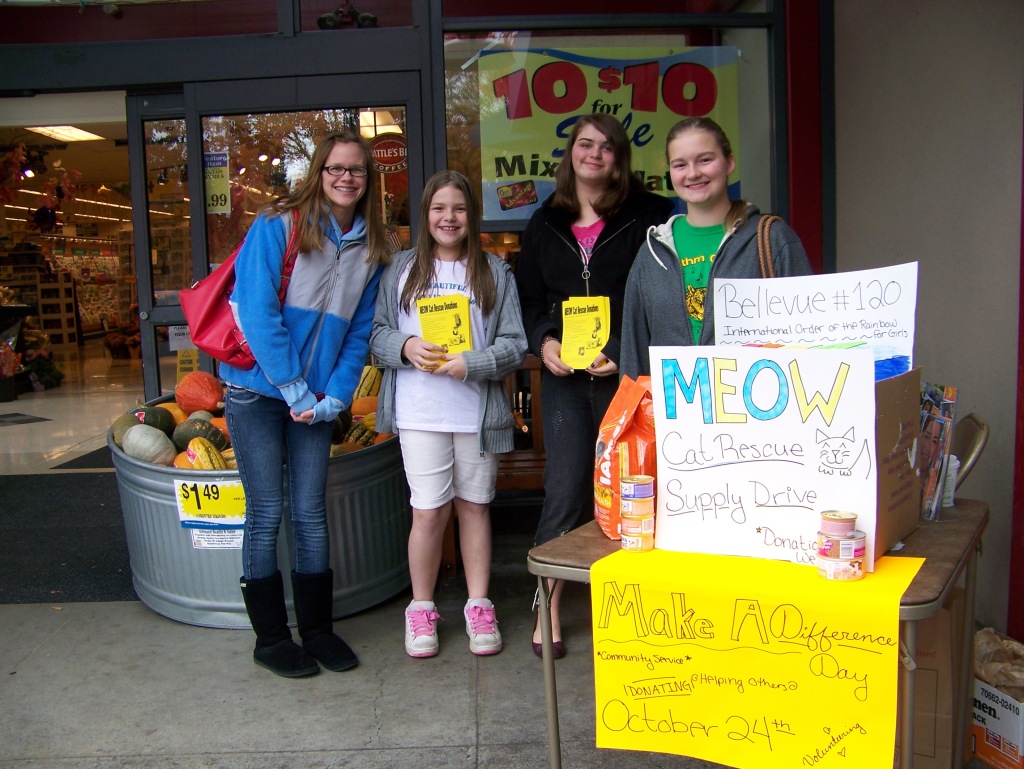
Community Service is a huge part of the organization’s focus. Here the girls’ are collecting donations for MEOW cat rescue.

By the 1940’s and WWII, the first indicators of a change of mission were seen with the members stepping up to aid in the war effort. After the war, the social aspects took precedence. The organization grew to its largest in the 1950’s boasting an international membership of over 250,000 girls. Today the group primarily emphasizes community service, public speaking, and personal development of the young women who are its members.

I became aware of the Rainbow Girls through my older sister who was invited to join by a friend. Off my sister would go to this mysterious place every two weeks and was often gone for activities on the weekend. So, like any self-respecting younger sister, I bugged her until she relented and brought home a membership application one day in March 1971.

It is a very distinct memory I have of sitting on the floor of my room, the sun streaming in the western window, as I filled out the paperwork. I was stumped when I got to the first blank.

“What’s the name and number of the Assembly?” I yelled to my sister in the next room.

“Yakima number one,” the shouted reply proclaimed.

Well, that’s cool, I thought. Who wouldn’t want to be in the number ONE assembly?*

I finished the application and it was turned in and then, one month later on April 19 I became a member. It was love at first sight. Everything about the Rainbow Girls appealed to me and played to my strengths (which were not sports, band, or wilderness survival!). It was Rainbow where I learned to plan and organize things; I loved being with just girls at a time in my life when boys were icky and awful. I got to hang out with older girls and adults who were patient in teaching me how to be a valuable member of a team. I had activities that were wholesome. Mostly, I seized every opportunity to improve myself, take on responsibility, and learn to be a leader.

In January of 1974 I was my Assembly’s Worthy Advisor and then repeated that job when one of the members had to step down in May 1975. I supported my sister when she became the president – the Grand Worthy Advisor – of the state level program for Washington and Idaho the next month. A year later I was selected to serve as the Editor of the jurisdiction newspaper and then subsequently elected to one of the top five jobs at the state level the next year, completing my time in the order.

My sister presents me to be installed as Worthy Advisor of Yakima Assembly #1, January 1974

Or so I thought. Over the next decades I found a multitude of ways to give back to the organization which gave me so much. I served as an adult advisor in a variety of capacities, motivated to insure Rainbow would be there for my own daughter when she arrived in those perilous teenage years. My stated mission was to successfully get her from childhood to adulthood in a safe place without falling prey to the many temptations modern society presents. In that mission I succeeded.

There’s a song which was written for the order and it has a line in it which is “Rainbow, you’ll always be mine.” For so many of the women I know who have belonged, this thought – more than any other – encapsulates just exactly how we feel about The International Order of the Rainbow For Girls.

My final meeting as Mother Advisor for Bellevue Assembly #120, January 2010

*Yakima was the first Assembly in the state of Washington, not the world. I plan to tell that story on August 3, 2021… so stay tuned.

A couple of links:

https://en.wikipedia.org/wiki/International_Order_of_the_Rainbow_for_Girls

https://www.gorainbow.org/

www.nwrainbow.org

Scott Hamilton: The Inspiring Journey of an Olympic Champion

King of the Ice

February 16, 2021

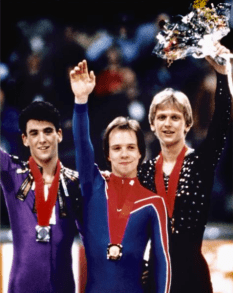
The 1984 Olympic Men’s Skate medalists, left to right: Brian Orser(2nd), Scott Hamilton(1st), Jozef Sabovčík(3rd)

A Tuesday Newsday classic

This 1984 Olympic Gold medalist was, perhaps, the most unlikely of stars to achieve brilliance. To this day he is, however, one of the most popular U.S. men’s figure skaters ever; an individual who is a testament to the power of determination, hard work, and a positive attitude.

It was on February 16, 1984, when 25 year old Scott Hamilton won Olympic Gold at the games in Sarajevo, Yugoslavia (Now Bosnia and Herzegovina)

His skating story began 14 years earlier when he first took to the ice at age 11. Two years later, he was entering skating competitions. For the athletically inclined Hamilton, choosing an appropriate sport was likely a challenge.

When he was two years old he stopped growing. What followed were tests and speculation over why. From the Infallible Wikipedia:

“After numerous tests and several wrong diagnoses (including a diagnosis of cystic fibrosis that gave him just six months to live), the disease began to correct itself. His family physician sent him to Boston Children’s Hospital to see a Dr. Shwachman. He was told the doctor had no idea what was wrong and to go home and stop the diets in order to live a normal life. Years later, it was determined that a congenital brain tumor was the root cause of his childhood illness.”

The impact was huge. During the years of his greatest amateur skating success he was only 5 feet 2 ½ inches tall and weighed 108 pounds. Obviously, playing football or ice hockey was not an option.

Hamilton parlayed his small stature – what many would see as a liability – into his greatest asset. Not only was he was fast on the ice, but he developed his athleticism such that he made the jumps and his intricate footwork look effortless. Although not allowed in competition, his signature back flip at the end of his exhibition routines always brought fans to their feet. Only the strongest and most daring of skaters can successfully execute the move.

When he retired from amateur skating, he was the 1984 reigning world champion in the Men’s division. From there he went on to have a successful professional career and has, arguably, done more to elevate the sport of ice skating than any other individual ever. Also from the Infallible Wikipedia:

“After turning professional, Hamilton toured with the Ice Capades for two years, and then created ‘Scott Hamilton’s American Tour,’ which later was renamed Stars on Ice. He co-founded, co-produced and performed in Stars on Ice for 15 years before retiring from the tour in 2001 (though he still returns for occasional guest performances).

He has been awarded numerous skating honors, including being the first solo male figure skater to be awarded the Jacques Favart Award (in 1988). In 1990 he was inducted into the United States Olympic Hall of Fame.”

His road in life has not been easy. He survived testicular cancer in 1997 only to have a second brain tumor be discovered in 2004. After a successful surgery for the benign tumor, yet a third tumor was found in 2016. So far he’s been successful in shrinking the tumor through dietary changes.

Although I’d watched Olympic figure skating before, it was the 1984 Olympics and Scott Hamilton particularly, which became the impetus for a decade of following the sport. And what better place to be for watching the Olympics than in a magical place such as Whistler.

The hubby and I – along with his sister and mother – had joined a Whatcom Community college group for a weekend skiing sojourn. Yes, I was 26 years old when I took my first lessons… at Whistler. At the end of each day, we’d return to the rental house (a precursor to the AirBnB concept) for food and fellowship and to watch the Olympics. And what an Olympics it was. We rooted for hometown favorites Rosalyn Summers, Phil and Steve Mahre, and Oregonian Bill Johnson.

The memory that sticks with me most is of the hubby and my sister-in-law out at a pub in Whistler Village. The TV is on over the bar and we are watching the events. But we can’t hear the play by play because there is no sound. Instead, dance music is blaring through the bar. And the pair of them – hubby and sister – are ‘dancing’ while sitting in their chairs, and making quite the spectacle. I imagine the pub owners had second thoughts about those chairs as they were on wheels which allowed the chair dancing shenanigans. Shenanigans which, I might add, nearly got us kicked out of that bar.

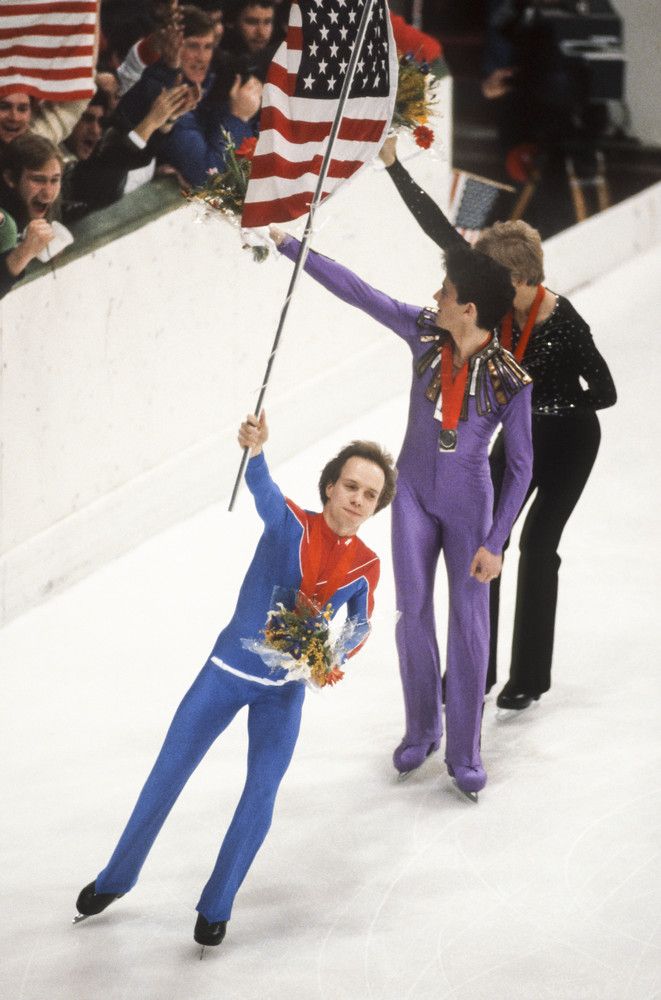
Home a few days later, I cheered as I watched Scott Hamilton win the Gold medal, the first US man to do so in the Olympics in 24 years.

What followed over the next six years was attending the US National championships at the Tacoma dome in 1987, and seeing “Stars On Ice” at least twice at the Seattle Center Arena. It was during Stars on Ice that we finally saw Hamilton skate in person. It was worth it. What an amazing skater and showman, his performances unforgettable.

I leave you with this from a publication titled ‘CancerTutor.com.’

“Hamilton is a firm believer in ‘getting up’ after the fall. He pointed to a chapter in his book, The Great Eight, titled ‘Fall Down, Get Up, Smile Like Kristi Yamaguchi.’

‘In one of her [skating] programs, she took a hard fall on a really difficult jump — and she got up, went right back to her program like nothing happened. I realized in that moment there’s a life lesson: I’m gonna fall down. I’m gonna make mistakes. But it’s what’s next — it’s how you get up. The more times you get up, the stronger you are.’”

Some links:

https://en.wikipedia.org/wiki/Scott_Hamilton_(figure_skater)

https://www.scotthamilton.com/

The Infallible Wikipedia

The World’s greatest Encyclopedia

January 12, 2021

Back when the internet first started there was an explosion of new programs and new concepts. Connections were slow and done only via dial up. Pretty much anyone over the age of 40 no doubt recalls the noise the computer made as it connected you right before the computer generated AOL voice intoned, “You’ve got mail.”

Wikipedia’s familiar logo

In those days, all of our information came from traditional sources like newspapers, television, and books. Who among us – having grown up in the 1950’s through to the 1980’s – did NOT have a set of encyclopedias we used for research when those pesky term papers were due?

The physical encyclopedia was replaced in the late 1990’s by a CD program you loaded whenever you needed information. But it was not long – with the advent of higher speed internet and improvements in technology – a few people figured out that the internet itself was the most massive library in the world. Enter The Infallible Wikipedia.

It was on January 12, 2001, when Wikipedia was registered as a business. The rest, as one might say, is history.

In the early days there were a number of online encyclopedias which popped up. Several of those were offshoots from traditional encyclopedias. But they could not keep up with Wikipedia’s unique structure.

From The Infallible Wikpedia about The Infallible Wikipedia:

“Wikipedia is a multilingual open-collaborative online encyclopedia created and maintained by a community of volunteer editors using a wiki-based editing system. It is one of the 15 most popular websites as ranked by Alexa, as of January 2021 and The Economist magazine placed it as the ’13th-most-visited place on the web’. Featuring no advertisements, it is hosted by the Wikimedia Foundation, an American non-profit organization funded primarily through donations.

A person reading a Wikipedia article. From http://www.playfm.gr

Wikipedia was launched on January 15, 2001, by Jimmy Wales and Larry Sanger. Sanger coined its name as a portmanteau of ‘wiki’ and ‘encyclopedia.’ It was initially an English-language encyclopedia, but versions in other languages were quickly developed. With 6.2 million articles, the English Wikipedia is the largest of the more than 300 Wikipedia encyclopedias. Overall, Wikipedia comprises more than 55 million articles, attracting 1.7 billion unique visitors per month. (snip)

 In 2006, Time magazine stated that the open-door policy of allowing anyone to edit had made Wikipedia the biggest and possibly the best encyclopedia in the world, and was a testament to the vision of Jimmy Wales. The project’s reputation improved further in the 2010s as it increased efforts to improve its quality and reliability, based on its unique structure, curation and absence of commercial bias.”

Since its founding, Wikipedia has done much to improve accuracy. That said – as with everything – it is up to each researcher to verify their sources. I have found that the links at the bottom of each Wikipedia article is a good place to start.

A set of traditional encyclopedias

For me – as an information junkie – I love that Wikipedia exists. While it doesn’t have articles on every topic in the world, the amount it does have is stunning. My parents’ set of 1950 something Encyclopedia Americanas can’t even begin to compare.

By the time I was using our family’s Encyclopedia set they were at least 10 to 15 years out of date

I do think I must credit my son with coining the phrase ‘The Infallible Wikipedia’ It was likely around 2002 or 2003 – as Wikipedia was just starting to take off – when our family became aware of the site. Every time one of us would often go to the internet in search of information, it seemed as if Wikipedia would be one of the hits. Because of the unique way Wikipedia uses its volunteer editors, however, one never knew if the information one found was accurate or not.

So my son started referring to any information we found on the site as being Infallible. Of course it was anything but Infallible.

The nickname stuck and not a one of us: hubby, son, or daughter, refers to Wikipedia without adding the moniker ‘Infallible.’

Four years ago when I wrote my very first blog post about musical legend Jim Croce, here’s what I said:

“You can visit the Jim Croce website for more information: http://jimcroce.com/ and there’s always the infallible Wikipedia: https://en.wikipedia.org/wiki/Jim_Croce

Since that day – January 10, 2017 – I have now written 198 blog posts. And every single one of them references “The Infallible Wikipedia” in some way. There have been a few occasions where The Infallible Wikipedia was silent on the topic I chose. But, fortunately for me and my loyal readers, those occasions are rare.

Although it may sound like I’m mocking it, I’m not. Wikipedia is an amazing resource and it sure beats the heck out of trying to find relevant information in a 20 year old encyclopedia or searching through card catalogs at the library, both being methods I had to use during  youth and into adulthood.

So it is with great sincerity that I wish a Happy 20th anniversary to the Amazing, Helpful, Incredible, Irreplaceable, Infallible Wikipedia.

A link to the Infallible Wikipedia on, er, the Infallible Wikipedia

https://en.wikipedia.org/wiki/Wikipedia

Bonus question: How many times did I use the term Infallible Wikipedia in this article? The answer is 11 – a new record!

Awkward Embarrassing Moment: My Trivial Pursuit Story

Trivial Pursuit – The Game

December 15th

A Tuesday Newsday Classic

There is a saying that your greatest embarrassment is merely someone else’s momentary amusement.

Such is the case for today’s Tuesday Newsday and the introduction on December 15, 1979 of a game which is a verifiable cultural phenomenon. It was on that date when the game Trivial Pursuit (TP) made its first appearance.

Created by two Canadians, Chris Haney, a photo editor for Montreal’s The Gazette, and Scott Abbott, a sports editor for The Canadian Press, the game was invented when the pair wanted to play Scrabble but discovered a number of pieces missing. Why, they mused, don’t we just make up our own game? One does wonder if alcohol was involved that night. Certainly this author – who eschews dangling participles – has been highly critical of the plethora of them for which TP is legend. You would think that people involved in communications and writing might know better. But I digress.

Thanks to the Infallible Wikipedia, we learn that:

“The object of the game is to move around the board by correctly answering trivia questions. Questions are split into six categories, with each one having its own color to readily identify itself; in the classic version of Trivial Pursuit, the Geography category is blue, Entertainment is pink, History is yellow, Arts & Literature is originally brown, later purple, Science & Nature is green, and Sports & Leisure is orange. The game includes a board, playing pieces, question cards, a box, small plastic wedges to fit into the playing pieces, and a die.

TORONTO “Trivial Pursuit” inventors, former journalists Chris Haney (l), brother John Haney, and Scott Abott (r), play their board game based on trivia questions. The game in great demand in the U.S.A. and Canada, is sold out in many retail outlets. Photo dated Feb. 6, 1984.

Playing pieces used in Trivial Pursuit are round and divided into six sections like wedges of pie. A small plastic wedge, sometimes called cheese (like cheese triangles), can be placed into each of these sections to mark each player’s progress.

During the game, players move their playing pieces around a track which is shaped like a wheel with six spokes. This track is divided into spaces of different colors, and the center of the board is a hexagonal “hub” space. At the end of each spoke is a “category headquarters” space. When a player’s counter lands on a square, the player answers a question according to its color, which corresponds to one of the six categories. If the player answers the question correctly, his turn continues; a correct answer on a category headquarters space awards a wedge of that color if the player does not yet have one. (snip)

Once a player has collected one wedge of each color and filled up his playing piece, he must return to the hub and answer a question in a category selected by the other players. If this question is answered correctly, that player wins the game. Otherwise, the player must leave the center of the board and try again on the next turn.”

By the time the hubby and I were married in 1980, TP was all the rage. Of course we purchased the game and played it often with family and friends.

After awhile we became familiar with some of the games less desirable traits. Things like the fact that it could drag on forever and the players would lose interest. Or that there were some topics which were so ridiculous that there was no way any normal person would ever know the answer.

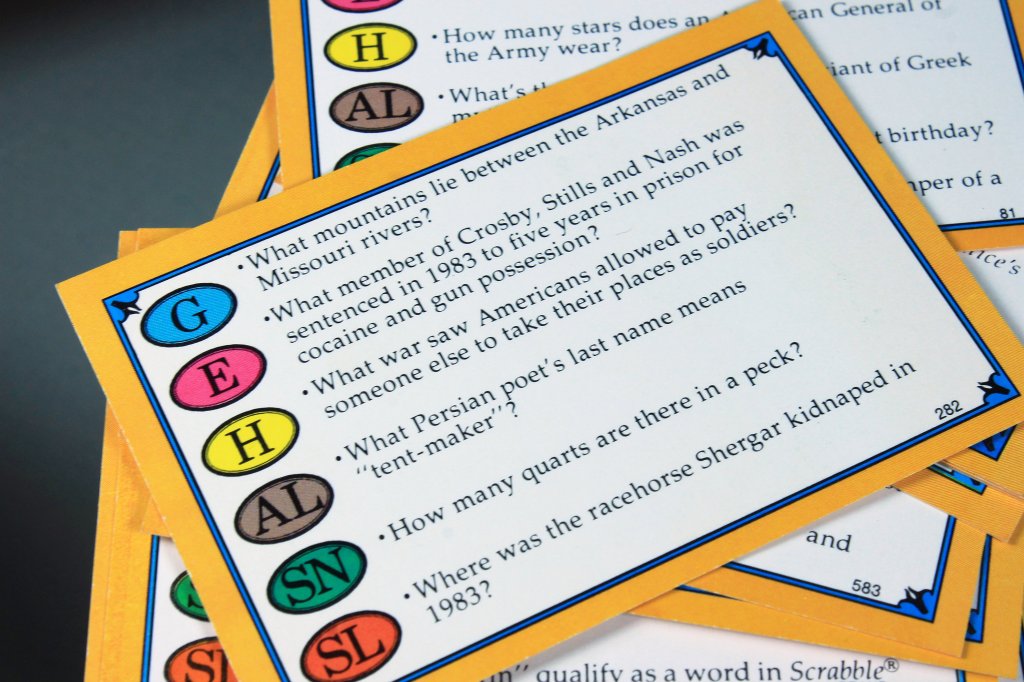
A typical Obscure Author question next to the brown AL bubble… Persian poets? Really?

In fact, to this day, we refer to the original Arts and Literature ‘brown’ segment as Obscure Authors. Now, my hubby is a trivia brain so this game was right up his alley. Except for the Obscure Authors category, that is.

For me, well, my knowledge of stuff was more broad based and mostly I would venture WAG’s* if I had no clue to the answer.

Sometime in the mid-1980’s, during a rather robust game of TP with a group of friends, I was getting close to the finish and the opportunity to win the game when I landed on green, Science and Nature. It should have been my first clue.

I got a question which, when I answered it, turned into a moment of great embarrassment.

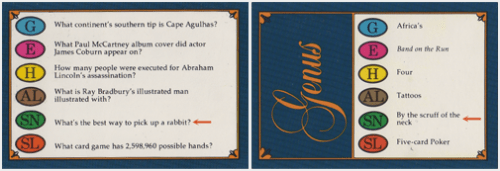
For those familiar with TP you know that, except for the occasional true or false, you simply have to know the answer. Here’s a sample:

Note that there are no ‘multiple choice’ options. Just a whole series of ridiculous questions that most people do not know. Also note not one but TWO questions with those dangling participles!

We return to the game where I was given the Science and Nature question but, unfortunately, answered it as if it was from the Geography section.

Here’s what I was asked: Where is the Coccyx located?

To which I answered: Egypt.

Contrary to popular belief, the Coccyx is nowhere to be found in this photo…

Guess I should have taken a class in anatomy and physiology.

There are many, in fact now over 100 million coccyx’s in Egypt, so the answer was, technically, correct. The answer on the back of the card, however, informed me that the coccyx is one’s tailbone.

I was pretty much laughed out of the room.

When the hubby and I moved a few years ago, our copy of TP and all the add on card sets we’d acquired were among the things which we donated, having not played the game in years.

And, for the record, there were two other answers which caused family squabbles. The answers were ‘Higher and Higher’ and ‘Cherry Cola.’ Can’t recall the exact questions, but at the time it was a huge controversy. In retrospect it truly was a trivial pursuit.

*WAG = Wild A** Guess

https://en.wikipedia.org/wiki/Trivial_Pursuit

Hallmark Ornaments

Not A Creature Was Stirring, Not Even Chris Mouse

December 8, 2020

When Hallmark introduced these in 1973, no one could even begin to imagine how, over the next 40 plus years, the company would lead the industry through an unprecedented demand for Christmas ornaments.

A display in a Hallmark store, circa 2013

That first year, Hallmark only had 18 different ornament designs available for sale. Apparently buoyed by the success of sales that year, however, the collectible ornaments were expanded the next year. Betsey Clark – a popular artist featuring whimsical big eyed children- had two entries that year, up from one the year before. Seen also for the first time were scenes from Currier & Ives as well as an iconic Norman Rockwell holiday painting. The number of balls was tripled but yarn figures – prominent the first year – were only half of what they’d been in 1973.

It went this way for several more years with more and more Ornament balls being offered… but with a catch. A shopper could not just walk into a Hallmark store or retailer and purchase the exact same ornament they saw the previous year. Each ornament incorporated the production year into the design. Once the baubles were sold out, that was it.

The introduction of annual ornament series spurred interest. Each fall, collectors would rush to the store to snap up the newest one.

My sister’s 1978 Betsey Clark ornament

Surprisingly (at least to this author) is that the Infallible Wikipedia does not have a page devoted just to the Hallmark phenomenon. It does, however, offer up this information on a more generic page:

“In 1973, Hallmark Cards started manufacturing Christmas ornaments. The first collection included 18 ornaments, including six glass ball ornaments. The Hallmark Keepsake Ornament collection is dated and available for just one year. By 1998, 11 million American households collected Hallmark ornaments, and 250,000 people were member of the Keepsake Ornament Collector’s Club. There were as many as 400 local Keepsake Ornament Collector’s Club chapters in the US.  One noted Christmas ornament authority is Clara Johnson Scroggins who has written extensively on the topic and has one of the largest private collections of Christmas ornaments.

In 1996, the ornament industry generated $2.4 billion in total annual sales, an increase of 25% over the previous year. Industry experts estimated more than 22 million US households collected Christmas ornaments, and that 75% of those households collected Hallmark Keepsake Ornaments.”

And, according to the official Hallmark webpage, “What began as glass balls and yarn figurines has grown to more than 8,500 ornaments past and present, and a reputation for quality, craft, and above all, spirit.”

My first foray into the world of Hallmark ornaments began, coincidentally, the year I got married. During a trip into Hallmark I happened to go peruse the ornament section and, there it was, the perfect ornament to commemorate a couple’s first Christmas together.

Our first Hallmark ornament… the reverse says
“Christmas Is A Love Story Written In Our Hearts.”

I had to have it despite the fact that it was an extravagance not in the budget. The hubby was okay with the purchase of it and even another one which featured everyone’s favorite Christmas mouse, Mickey.

From that initial addictive purchase came more. Two more Hallmark ornaments were acquired in 1981. It was 1985, however, when things started to ramp up in my household.

That year saw the introduction of an ornament titled ‘Chris Mouse.’

Mr. Mouse was just about the most adorable creature you’d ever seen. His tiny little self was wearing what looked to be a sky blue night shirt and a red night cap. In his teeny hands he held a hunter green book with ‘1985’ on the cover in gold. But best of all was that he was sitting at the base of an old fashioned gold candle holder, leaning against a 4 inch tall red candle. At the top of the candle glows a yellow ‘flame’ which, when the ornament’s cord is plugged into a socket on a string of Christmas lights, is lit up.

I was enchanted and had to have that ornament.

Chris Mouse #1 who captured my heart

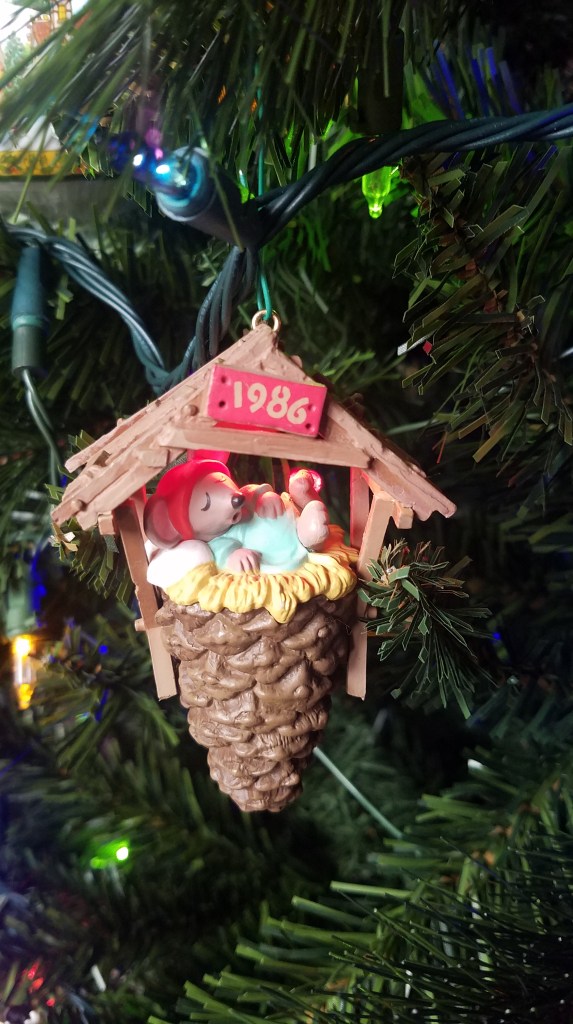
Soon I discovered that my Chris Mouse was only the first in the series. I eagerly looked forward to the next year’s entry. When it arrived in the stores the next fall I wandered in one day to take a look. Like the previous year, it was cute and this time featured Mr. Mouse asleep in a pinecone house, a tiny night light adding to the magic. I didn’t like it quite as well as the first one so I decided I might wait until after Christmas to buy it, maybe even find it on sale.

Sometimes, however, things work against you and such was the case in 1986. Just before Christmas I came down with a bad cold and was laid up for several days including on Christmas. The mouse was forgotten until, a few days after the holiday, I ventured out to the stores to do some bargain hunting. Alas, the second in the series was nowhere to be found.

In the following years, my lesson learned, I always purchased the ornaments I wanted well before Christmas. The Chris Mouse series? Ended up being 13 ornaments in all, each starring the adorable mouse in the blue nightshirt and red cap, each time doing something which featured a lovely little lighted object. It just so happened that I only had 12 of them and, every Christmas, I lamented not having the missing ornament.

Chris Mouse #2 who took years to join the line up

That was until a few years ago when there, under the tree for me one Christmas, was an unexpected surprise. Santa’s helper – who I call hubby – had located the missing Chris Mouse and bought it for me. The prodigal rodent joined his brother’s on the tree, the series now complete.

It takes several large Rubbermaid totes to house all the Hallmark ornaments in their original boxes. One bin is full of the lighted and motion ornaments, the other primarily a collection of whimsical critters. A third tote holds glass balls but only a dozen or so are part of the Hallmark collection.

By the late 1990’s with more than enough decorations to fill at least two trees, I stopped buying ornaments.

2020, however, seems like the perfect excuse to purchase a new bauble with which to commemorate this unusual year. An online search revealed that my local dealer is just down the hill. Time for a shopping adventure…

The links:

https://en.wikipedia.org/wiki/Christmas_ornament

https://www.hallmark.com/ornaments/

Dr Pepper

‘Wouldn’t you like to be a Pepper too?’

December 1, 2020

When this product was granted a US patent on December 1, 1885, no one had ever heard of Coca-Cola. In fact, it was a year later before that iconic product was patented.

But for people in Waco, Texas, Dr Pepper was wildly popular. Despite over a century of being in monolith Coke’s shadow, the soft drink has an almost cult-like following.

The current logo

The story begins with one Charles Alderton, a pharmacist, at Morrison’s Old Corner Drug Store in Waco. The owner of the Drug store, upon trying it, soon added it to the menu and the local folks would order a “Waco.”

Like so many products of the late 1800’s, all sorts of wild claims which touted Dr Pepper as a healthful drink abounded. From the Infallible Wikipedia:

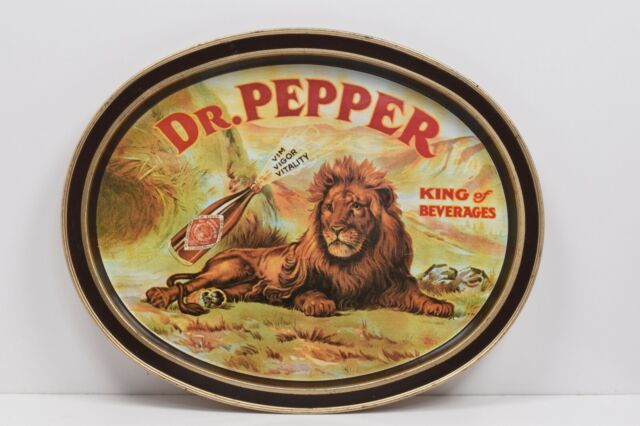
“Early advertisements for this soft drink made medical claims, stating that it ‘aids digestion and restores vim, vigor, and vitality.’

As with Coca-Cola, the formula for Dr Pepper is a trade secret, and allegedly the recipe is kept as two halves in safe deposit boxes in two separate Dallas banks. A persistent rumor since the 1930s is that the drink contains prune juice, but the official Dr Pepper FAQ refutes this with ‘Dr Pepper is a unique blend of natural and artificial flavors; it does not contain prune juice.’ The origin of the rumor is unknown; some believe it was started by a deliveryman for a competitor trying to cast aspersions based on prune juice’s laxative effects, but it may simply be because many people feel that Dr Pepper tastes similar to prune juice.

Early Dr Pepper Advertising slogan

In 2009, an old ledger book filled with formulas and recipes was discovered by Bill Waters while shopping at antiques stores in the Texas Panhandle. Several sheets and letterheads hinted it had come from the W.B. Morrison & Co. Old Corner Drug Store (the same store where Dr Pepper was first served in 1885) and faded letters on the book’s cover spelled out ‘Castles Formulas’. John Castles was a partner of Morrison’s for a time and worked at that location as early as 1880. One recipe in the book titled ‘Dr Peppers Pepsin Bitters’ was of particular interest, and some speculated it could be an early recipe for Dr Pepper. However, Keurig Dr Pepper insists it is not the formula for Dr Pepper, but is instead a medicinal recipe for a digestive aid. The book was put up for auction in May 2009, but no one purchased it.”

Over the years Dr Pepper has earned its spot on the grocery store shelves despite a century long effort by Coca Cola to eliminate the competitor. Coke even went so far as to introduce a similar tasting soda in the early 1970’s they named “Peppo.” Dr Pepper successfully sued Coke for copyright infringement. When the competing product’s name was changed to Dr Pibb it was determined even that was still infringement. Coke finally settled on Mr Pibb. As hard as Coke might try, Mr Pibb just doesn’t taste the same.

Which brings us to my take on Dr Pepper. I grew up in a Coke or 7-Up household with an occasional orange or root beer for variety. I doubt my mother had ever heard of Dr Pepper. But in the mid 1970’s a memorable jingle wormed its way into the American consciousness and suddenly everyone wanted to be ‘a Pepper too.’

And still I had not ever tried Dr Pepper! But I really liked the jingle even adapting the song as a promotion for an event I was working on.

When I met my future hubby in 1979 I finally tried Dr Pepper. At first sip I was hooked.

The Dr soon became our ‘go to’ beverage. In the summer of 1981, we traveled to Sacramento for a long weekend and a DeVore family reunion. When we left Sacramento that hot Sunday morning, it was to drive all 751 miles to Seattle since we had to both be at work the next day.

The evolution of the Dr Pepper ‘look’

Oh, and did I mention that the hubby’s 1975 Audi had windows? Which was a good thing since it did not have air conditioning.

So we headed north with a six pack of Dr Pepper and the wind through the open windows as the only way to stay even remotely comfortable as the temperature soared to 106 degrees.

On we drove, downing the Dr Pepper and not once having to stop for a restroom break.

Over the years every trip has always required we have at least a few cans or bottles in the cooler.

In recent years I had to curtail my Dr Pepper consumption due to the caffeine. Instead of sharing an entire six pack, I now might have a half a can. That was until I went on a diet in April. The Dr might be good for restoring ‘vim, vigor, and vitality’ but it wasn’t the leader in weight loss products. The cost – caloric wise – was higher than I was willing to pay.

A Dr Pepper t-shirt from the 1970’s

Now before y’all start telling me that I can get Dr Pepper in caffeine and sugar free versions, I know that. My worry is that it just won’t be the same taste I love.

One of these days I might try it. I’ve missed being a Pepper… and really would like to be a Pepper too (again!)

The video above is the 30 second commercial from the 1970’s when I became aware of Dr Pepper’s existence. And, just so you know, it is Dr Pepper without a period after the word ‘Dr’ so that’s not a typo. And, of course, even more trivia courtesy of The Infallible Wikipedia:

https://en.wikipedia.org/wiki/Dr_Pepper

Bigfoot: Fact or Fiction?

60 Seconds of Film that went Viral

October 20, 2020

In the now 53 years since this film clip was released to the public, the debate rages:  is Bigfoot real or just a myth?

It was on October 20, 1967, when a grainy 16 mm film was recorded, elevating public consciousness of Bigfoot into the national consciousness. In subsequent days and years it made headlines as it purported to provide proof that Sasquatch did, indeed, exist.

The film was shot by Roger Patterson, along with Bob Gimlin, in the mountains near Bluff Creek in coastal Del Norte County California, about 40 miles south of the Oregon border. While most people likely believe that Patterson, and Gimlin who is shown riding a horse in the clip, were somehow randomly in this spot and happened to see Bigfoot, the real story pushes the bounds of believability.

We visit the Infallible Wikipedia and learn:

“Patterson said he became interested in Bigfoot after reading an article about the creature by Ivan T. Sanderson in True magazine in December 1959. In 1961 Sanderson published his encyclopedic Abominable Snowmen: Legend Come to Life, a worldwide survey of accounts of Bigfoot-type creatures, including recent track finds, etc. in the Bluff Creek area, which heightened his interest. Thereafter, Marian Place wrote:

‘In 1962 he visited Bluff Creek and talked with a whole host of Bigfoot-believers. In 1964 he returned and met a timber-cruiser named Pat Graves, who drove him to Laird Meadows. There Patterson saw fresh tracks—for him an almost unbearably exciting, spine-chilling experience. What a tremendous feat it would be—what a scientific breakthrough—if he could obtain unshakable evidence that these tracks were not the work of a prankster, but the actual mark of a hitherto unknown creature! If he succeeded, he would be famous! And rich! Alas, fame and fortune were not gained that year, nor the next, nor the next. Patterson invested thousands of hours and dollars combing Bigfoot and Sasquatch territory. He fought constant ridicule and a shortage of funds. … he founded … the Northwest Research Foundation. Through it he solicited funds . … The response was encouraging and enabled him to lead several expeditions. … In 1966 he published a paperback book at his own expense. … He added the income from its sales and his lectures to the search fund. As each wilderness jaunt failed to see or capture the monster, one by one the thrill-seekers dropped out. But Patterson never gave up.’

Patterson’s book, Do Abominable Snowmen of America Really Exist?, was self-published in 1966. The book has been characterized as ‘little more than a collection of newspaper clippings laced together with Patterson’s circus-poster style prose’. The book, however, contains 20 pages of previously unpublished interviews and letters, 17 drawings by Patterson of the encounters described in the text, 5 hand-drawn maps (rare in subsequent Bigfoot books), and almost 20 photos and illustrations from other sources. It was first reprinted in 1996 by Chris Murphy, and then again re-issued by Murphy in 2005 under the title The Bigfoot Film Controversy, with 81 pages of additional material by Murphy.”

Signs such as this one abound in the Pacific Northwest

What comes through is a man on a quest to prove Bigfoot existed and, perhaps, was willing to do anything in service of that ambition.

Over the years, researchers have studied Patterson’s film in an effort to prove or debunk its veracity.

At least one person, who knew Patterson, claimed he had rented a costume to use in the shooting of his film. Is it a huge creature or just a man in costume which is seen in the roughly minute long footage? No record of that costume rental exists and, like so many of the Bigfoot legends, is shrouded in mystery and a chain of unverifiable events.

Patterson’s footage seemed to ignite the public’s interest in Bigfoot and what has followed are a decades’ long series of individuals who claim to have seen Bigfoot. Added to the Patterson legacy are stories of Bigfoot captures, as well as recovery of a deceased Bigfoot. None have ever come to fruition. Hollywood got in on the action with the production of Harry and the Henderson’s, a fictional film which chronicled the story of a family who befriend one of the creatures and bridge the gap between humans and Bigfoot.

Wood carving of “Harry” from Harry and the Hendersons on Highway 2 in Washington State.

The debate rages to this day. A brief perusal of all the newspaper articles and citations in the Wikipedia article alone provides insight into the fact that one could spend their entire life just investigating this one topic, as was the case for Roger Patterson.

Patterson died in 1972 of cancer, just five years after the capture of the infamous footage.

Now, full disclosure: I thought it would be kind of fun to write an account of a possible Bigfoot encounter of my own and then say at the end ‘just kidding.’ I was prepared to do so but in the world of crazy connections I learned something about Roger Patterson which I had never known. He grew up, lived and died in my own hometown: Yakima, Washington.

Not only that, but getting the film footage out to the public was only possible due to Patterson’s brother in-law Albert DeAtley who provided the funding needed.

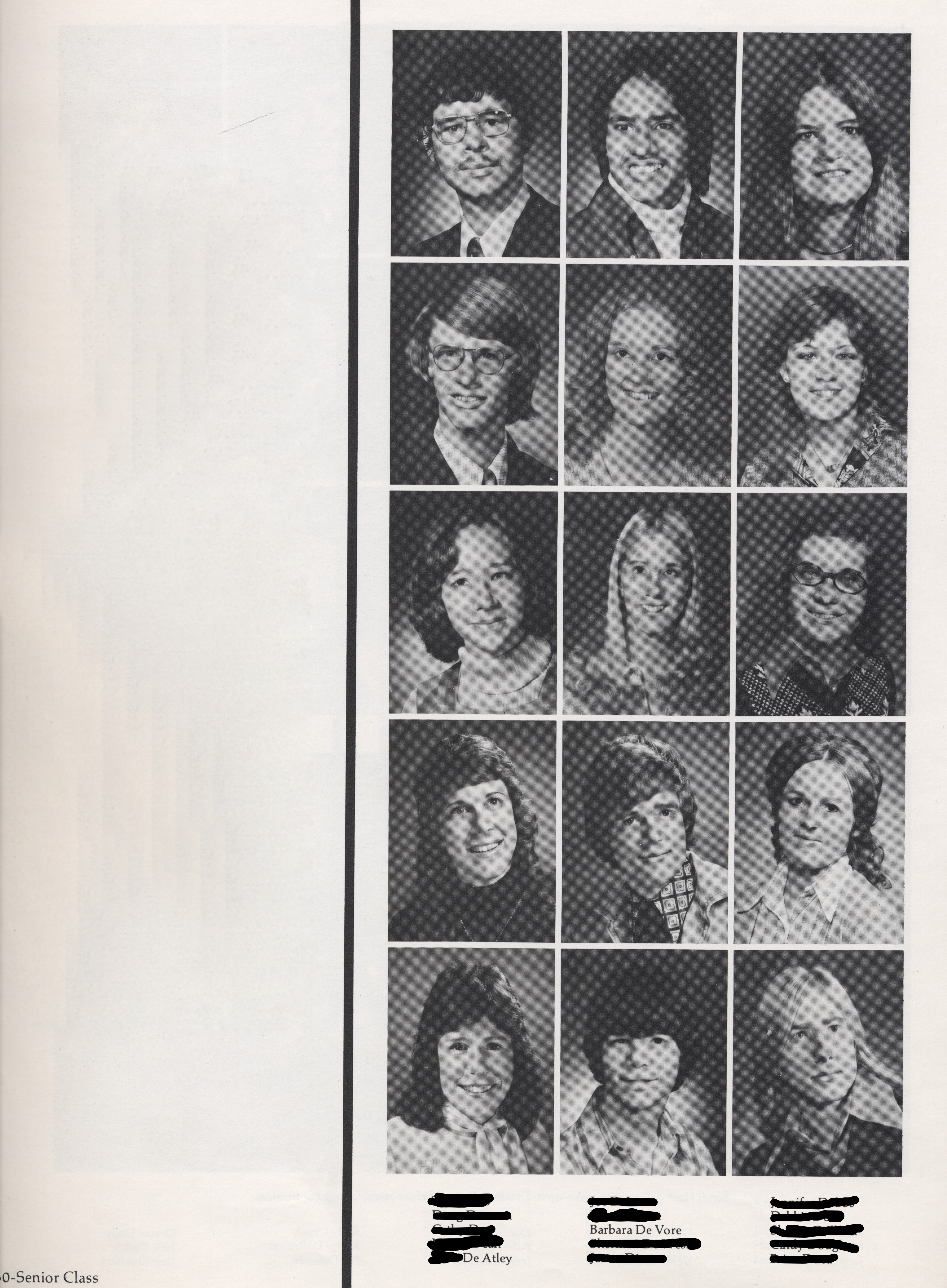
Page from my High School Yearbook. This author is middle photo, three up from bottom. Roger Patterson’s niece is bottom left.

Hmmm, I thought, I went to school with a DeAtley. Which sent me to my high school annual and, sure enough two spots down and one spot over from where my own Senior picture appears is a picture of Roger Patterson’s niece.

How is it possible that I was in classes with her, graduated the same year, and never knew of this connection?

I have, however, had a couple ‘real’ Bigfoot ‘encounters.’ The most memorable one occurred a few years ago during a visit to Long Beach, Washington. Little did I know that day when Bigfoot appeared before me that I would be able to chronicle my own experience with the creature… thankfully I got away despite Mr. Bigfoot’s attempts at capture as shown in this photo…

Bigfoot attempting to capture me… circa 2016

The one and only ‘Bigfoot’ link I’m sharing today is about the Patterson-Gimlin film (shown above). Thank you Wikipedia for the always exhaustive- and infallible – information on important subjects.

https://en.wikipedia.org/wiki/Patterson%E2%80%93Gimlin_film

The Quarantine Fifteen

One in Three are doing it

October 6, 2020

When the whole world went in to lockdown in March of this year due to Covid-19, I started to see posts on social media with people lamenting what they called the “Quarantine 15.” It was a reference to the phenomenon that folks, now sedentary and with little else to do, had started to eat more than usual and added 15 pounds to their weight.

This has led to even more people doing the one thing which it’s estimated one out of every three Americans are doing on any given day: Dieting.

Aunty Acid by Ged Backlund

No doubt for as long as people have dealt with excess weight, the enterprising individual has sought out solutions to deal with the issue. As of 2014, according to an article in Nutrition in Clinical Practice, there have been more than 1000 published diets.

The Infallible Wikipedia tells us this:

“…the word diet comes from the Greek diaita, which represents a notion of a whole way healthy lifestyle including both mental and physical health, rather than a narrow weight-loss regimen.

One of the first dietitians was the English doctor George Cheyne. He himself was tremendously overweight and would constantly eat large quantities of rich food and drink. He began a meatless diet, taking only milk and vegetables, and soon regained his health. He began publicly recommending his diet for everyone suffering from obesity. In 1724, he wrote An Essay of Health and Long Life, in which he advises exercise and fresh air and avoiding luxury foods.

The Scottish military surgeon, John Rollo, published Notes of a Diabetic Case in 1797. It described the benefits of a meat diet for those suffering from diabetes, basing this recommendation on Matthew Dobson’s discovery of glycosuria in diabetes mellitus. By means of Dobson’s testing procedure (for glucose in the urine) Rollo worked out a diet that had success for what is now called type 2 diabetes.

The first popular diet was ‘Banting’, named after the English undertaker William Banting. In 1863, he wrote a booklet called Letter on Corpulence, Addressed to the Public, which contained the particular plan for the diet he had successfully followed. His own diet was four meals per day, consisting of meat, greens, fruits, and dry wine. The emphasis was on avoiding sugar, sweet foods, starch, beer, milk and butter. Banting’s pamphlet was popular for years to come, and would be used as a model for modern diets. The pamphlet’s popularity was such that the question ‘Do you bant?’ referred to his method, and eventually to dieting in general. His booklet remains in print as of 2007.

The first weight-loss book to promote calorie counting, and the first weight-loss book to become a bestseller, was the 1918 Diet and Health: With Key to the Calories by American physician and columnist Lulu Hunt Peters.”

In today’s world, one cannot go on the internet or watch television without reading or hearing ads for whatever the latest trendy diet might be. When I typed “diet programs” into my search bar it came back with 172 MILLION results. That’s a lot of diet choices.

To cut down on calories in a home cooked egg and sausage muffin sandwich, cut a frozen sausage patty in half and break into chunks. You get the full flavor but fewer calories.

The two best known seem to be Weight Watchers and NutriSystems. Other diet programs tend to tout food intake based on a variety of factors including low carb, low fat, or high protein. There’s the Mediterranean Diet, the Keto Diet, and diet’s specific to those with Diabetes, thyroid problems, and heart disease. Truly, there’s a diet for every situation and person.

Of course, NO ONE should take the information shared here and make their health decisions based on my layman’s take or the Infallible Wikipedia. Those who are regular readers understand that the Infallible Wikipedia really is not.*

Okay, I’ve posted my consumer warning.

As pretty much the skinniest child ever, I never dreamed that at some point in my life I’d end up going on a diet.

Until I landed on a college campus and was exposed to the high carb foods endemic to such an environment, my problem was the exact opposite of most dieters. I could not gain weight. At five foot nine and only weighing 115 pounds, I struggled to maintain even that. I was not anorexic or bulimic, just genetically programmed to be skinny.

Or so I thought. While at the University of Puget Sound, I did add the ‘Freshman fifteen’ and my weight jumped up to 130 pounds. Which was, I thought, just about perfect for me.

I dropped down 10 pounds the year I got married as I had gone on the ‘strep throat’ diet. I don’t recommend it.

But then I settled in to that 130 weight and remained there until pregnancy at age 32 impacted my body. I lost most of what I gained after baby number one and even after the second child.

I was doing okay in the weight department, but by the time I hit age 40 I weighed about 140 pounds.

Mostly I blame the weight gains on slowing metabolism and having teenagers.

A funny thing happens when you are cooking for a family, especially when there’s a teenage boy present. Those creatures eat a LOT of food, heaping their plates with goodies such as Macaroni and Cheese, Spaghetti, Lasagna, Pizza…

A typical diet dinner features between two and three ounces of noodles. Yes, I weigh everything.

It’s a bit mesmerizing, really, to sit down to dinner and somehow you end up matching them bite for bite.

And soon another 10 pounds were added; and then another 10 after that. I started joking that I’d gained 10 pounds for each additional decade since I’d turned 20. It had gotten to the point where I didn’t step on scales because I didn’t like the number I saw. I convinced myself that I wasn’t eating excessively and no matter what I did I just couldn’t lose the weight.

Then the quarantine arrived. Where once I was out and about attending events on weekends and various meetings during the week, there was nothing going on. No potluck dinners or buffet lines. Restaurants were, for a time, shut down. There literally was no place to go except the grocery store and those shelves – in the first month – had large empty spaces in lieu of products.

On April 10, I decided that perhaps I might use the shutdown as an opportunity to drop a few pounds. But how did one go about it? I had zero experience with dieting. Of course I went to the one place where expert advice was to be found: the internet. It was enough to make one’s head swim. And then I remembered my Android phone and thought, perhaps, there might be a weight loss application. Bingo.

Of the several dozen available, I ended up picking the highest rated one I found which happened to be MyNetDiary.

Actual screenshot of the MyNetDiary program tracking my food on October 4

It allowed me to set a weight loss goal of up to 15 pounds (no more – I tried!) and then gave me a date, three months in the future, July 7 to lose the weight.

I became, one might say, singularly focused, and followed the program to the letter, careful to never go over the daily calorie count. I learned some interesting things about how much particular foods ‘cost’ in calories. I weighed everything. And with only a certain number of calories allowed each day I started to think about what foods I valued and wanted in my life.

Gone was my beloved Dr. Pepper (240 calories for a 16 oz can! Or 17 percent of the daily calorie allowance). Pasta, Rice, and starchy foods were seriously reduced. Instead of two pieces of toast, slathered with butter, and an egg for breakfast, I had one slice of toast (the one slice about 120 and the egg 90 calories) and I measured out a reasonable quantity of butter (.18 oz which is 37 calories).

I learned that my most favorite food is… drum roll please… white cheddar cheese Cheez-its. But just 20 of those delicious little crackers cost me 120 calories. So now, instead of eating however many I wanted, I counted out each and every one, making the conscious choice to consume them as one of my daily ‘treats’ or as part of my lunch.

My favorite food… white cheddar cheezits

By the end of April I’d lost my first five pounds and I was motivated. A month later, I was down ten pounds overall. My version of the Quarantine 15 – that is losing rather than gaining that amount – arrived a few days ahead of schedule on July 1st.

But I wasn’t done. I reset the program to lose another 15… my new date to achieve that: November 7. I expect I will have lost 30 pounds overall sometime this week… the scale tells me that I’m really, really close.

I guess it gets back to finding the good in a not great situation. Had we never ended up in ‘quarantine’ I doubt I would have taken the action I did.

Oh! Did you see the time? Only a half hour to lunch… I’m really looking forward to those 20 Cheez-its!

A couple of links:

https://en.wikipedia.org/wiki/Dieting

https://onlinelibrary.wiley.com/doi/abs/10.1177/0884533614550251

https://www.mynetdiary.com/

*Before taking on any weight loss program, be sure to check with your doctor!

Star Trek: From Cancellation to Cult Classic

To boldly go where no man has gone before

September 8

Space: the final frontier. These are the voyages of the starship Enterprise. Its five-year mission: to explore strange new worlds, to seek out new life and new civilizations, to boldly go where no man has gone before.

And so they did, at least in the world of 1960’s television series. Star Trek – which premiered September 8, 1966 – was a show ahead of its time, and as such, struggled to resonate with the viewing public of the day. More on the reasons why in a bit.

For those unfamiliar with the show, the premise was this: It’s 300 years in the future and the United States has commissioned a large, interstellar spaceship and crew to explore the Milky Way galaxy. Led by a cadre of futuristic cowboy space explorers into a rough and tumble world, the viewer experiences all of the things touted in the opening statement: strange new words, new life forms, and new civilizations.

The crew– save pointy eared Vulcan Mr. Spock – all look exactly like one might expect Americans from that era to appear. The elaborate costuming department, however, created an assortment of aliens such as the fierce and hairy Klingons, the blue skinned Andorians, the pointy eared, unabrow militaristic Romulans, and the fuzzy and rapidly producing Tribbles; it was these and other strange creatures the crew encountered each week.

The primary cast of the original Star Trek.
Front row: Leonard Nimoy, William Shatner, DeForest Kelley.
Second row, George Takei, Nichelle Nichols, Majel Barret, Walter Koenig, James Doohan

The most formidable foe the captain and crew of the USS Enterprise faced, however, were the NBC executives who could not figure out how to promote and market this strange new program. Gene Roddenberry, Star Trek’s creator, did all he could to keep the crew out exploring new worlds, but his earthbound benefactors shut the program down at the end of the third season and 79 episodes.

One might have asked the following question: who was the most likely viewing audience for a cowboy-esque show set in the future? Hint: Probably not the mom’s and dad’s of the day. So if you want to appeal to elementary and junior high kids, when might you air the program? Weeknights from 8:30 to 9:30 might not have been the best time. Certainly not at 10 p.m. on Friday night as it was during its final season.

In spite of the thick headedness of the NBC exec’s, the show acquired a dedicated audience whose demographics surprised the studio. From the Infallible Wikipedia:

“The enthusiasm of Star Trek‘s viewers surprised NBC. The show was unusual in its serious discussion of contemporary societal issues in a futuristic context, unlike Lost in Space which was more campy in nature. The network had already received 29,000 fan letters for the show during its first season, more than for any other except The Monkees. When rumors spread in late 1967 that Star Trek was at risk of cancellation, Roddenberry secretly began and funded an effort by Bjo Trimble, her husband John, and other fans to persuade tens of thousands of viewers to write letters of support to save the program.  Using the 4,000 names on a mailing list for a science-fiction convention, the Trimbles asked fans to write to NBC and ask 10 others to also do so. NBC received almost 116,000 letters for the show between December 1967 and March 1968, including more than 52,000 in February alone; according to an NBC executive, the network received more than one million pieces of mail but only disclosed the 116,000 figure.”

Cal Tech students protest for Star Trek. Photo from archives of the LA Times.

The threat of cancellation inspired fans not only to write letters but some 200 sign carrying CalTech students marched to NBC’s studios in Burbank in 1968; protests appeared in other cities also. New York State Governor Nelson Rockefeller even wrote a letter to the studio. Also, according the Infallible Wikipedia:

“Much of the mail came from doctors, scientists, teachers, and other professional people, and was for the most part literate–and written on good stationery. And if there is anything a network wants almost as much as a high Nielsen ratings, it is the prestige of a show that appeals to the upper middle class and high-brow audiences.”

Alas, the show’s final episode aired in May 1969 and that was the end of it. Or not.

Despite the rule of thumb that a show needed at least four seasons to justify syndication, the show was soon seen during the late afternoon and a whole new demographic was hooked: school age kids. By the early 1970’s it was affecting the culture. Yes, the Infallible Wikipedia once again:

“Fans of the show became increasingly organized, gathering at conventions to trade merchandise, meet actors from the show, and watch screenings of old episodes. Such fans came to be known as “trekkies”, who were noted (and often ridiculed) for their extreme devotion to the show and their encyclopedic knowledge of every episode. Because fans enjoyed re-watching each episode many times, prices for Star Trek rose over time, instead of falling like other syndicated reruns.:  People magazine commented in 1977 that the show “threatens to rerun until the universe crawls back into its little black hole”. By 1986, 17 years after entering syndication, Star Trek was the most popular syndicated series; by 1987, Paramount made $1 million from each episode; and by 1994, the reruns still aired in 94% of the United States.”

Mr. Spock and his famous Vulcan salute.

As a teenager in the 1970’s, Star Trek was part of my daily world. I really had no choice, as my sister – a mere 21 months older than me – was one of those crazed Trekkie’s of the day and the program aired most afternoons. In our household, we frequently flashed the Vulcan hand symbol (middle and ring finger separated to form a “V”) and would intone, “Live long and prosper.” Another favorite was to parrot Dr. McCoy who said – in multiple episodes – “Dammit Jim, I’m a doctor, not a _____________.” This sentence was finished with ‘bricklayer,’ ‘engineer’, and ‘escalator’ to name the most famous ones.

Perhaps my favorite, yet macabre, part of Star Trek, was when the crew would be transported to the surface of some planet. Literally, the landing crew always seemed to be Captain Kirk, First Officer Spock, Dr. McCoy, and at least one or two ‘new’ crew members. Unlike the trio of stars who donned gold or blue uniforms, these hapless souls seemed to always wear red shirts and were always the ones who lost their lives. Which gave Dr. McCoy the opportunity to intone his famous “He’s dead, Jim.”

Now, 54 years later, Star Trek has weathered the test of time. Like the troublesome Tribbles, it’s multiplied way beyond its original 79 episodes. Over the years there have been additional TV series, big budget movies, and cartoon programs; these have captured the imagination of new generations of fans, a cultural phenomenon that lives on… unlike the guys in the red shirts.

 The links:

https://en.wikipedia.org/wiki/Star_Trek%3A_The_Original_Series

https://en.wikipedia.org/wiki/List_of_Star_Trek_races

Instant Ramen: A College Staple and Cultural Phenomenon

A once banned food now a beloved Japanese favorite

August 25th

According to one Japanese poll, this food was named as the greatest invention of the 20th century.  Since a package of this costs between 50 cents and a dollar, it’s not only inexpensive, but it is easily one of the most adaptable instant foods you can purchase. Yes, I’m talking about the staple of college dorms everywhere: instant ramen noodles.

It was on August 25, 1958, when the first packages of the instant noodles were sold. But the history of ramen began much earlier.

How the first ramen was packaged, 1958

According to the Infallible Wikipedia:

“Ramen is a Japanese adaptation of Chinese wheat noodles. One theory says that ramen was first introduced to Japan during the 1660s by the Chinese neo-Confucian scholar Zhu Shunsui who served as an advisor to Tokugawa Mitsukuni after he became a refugee in Japan to escape Manchu rule and Mitsukuni became the first Japanese person to eat ramen, although most historians reject this theory as a myth created by the Japanese to embellish the origins of ramen. The more plausible theory is that ramen was introduced by Chinese immigrants in the late 19th or early 20th century at Yokohama Chinatown. According to the record of the Yokohama Ramen Museum, ramen originated in China and made its way over to Japan in 1859. Early versions were wheat noodles in broth topped with Chinese-style roast pork.”

Interestingly, it was in post WWII Japan, when the product really took off. Faced with rice shortages and a disrupted food supply line, inventive Japanese food vendors began making the noodles with cheap wheat purchased on the black market. Despite government attempts to keep vendors from making and selling the dish – they arrested thousands for doing so – it was one of the few things people could find to eat inexpensively. By 1950, the Japanese government relented, thus allowing the wheat noodles to find a place in the rice dominated culture.

In 1958,  Momofuku Ando – the founder of Nissan foods – developed a method by which the noodles were flash cooked, dried, and then sold in small blocks.

Also from the Infallible Wikipedia:

“Instant ramen allowed anyone to make an approximation of this dish simply by adding boiling water.

Beginning in the 1980s, ramen became a Japanese cultural icon and was studied around the world from many perspectives. At the same time, local varieties of ramen were hitting the national market and could even be ordered by their regional names. A ramen museum opened in Yokohama in 1994.

Who wouldn’t want to visit the Ramen museum just to see this giant bowl?

Today ramen is arguably one of Japan’s most popular foods, with Tokyo alone containing around 5,000 ramen shops, and more than 24,000 ramen shops across Japan.”

I became intimately acquainted with ramen soon after setting foot on the campus at the University of Puget Sound in 1977. Every member of my sorority, it seemed, had a small kettle and a stock of ramen packages in a desk drawer. It was one of two foods that seemed to dominate evening study time, the other being popcorn.

Soon, I too owned a West Bend electric teapot and a stock of ramen packets. I found one ad from 1979 where you could purchase it for a quarter a packet, but I do recall finding the coveted 10 for a dollar sales even into the 1990’s.

I think my pot was green but it might have been this lovely yellow

In my early ramen eating years, I was a purist; I’d boil my water, then drop the dried noodles into the pot and cook until they softened, finally adding the sodium laced flavoring.

After I met the man who would become my hubby, I learned that ramen could be so much more. He elevated ramen to an art form.

In Japan, the traditional way is as a soup of ramen and pork. But in our household, ramen is a vehicle for serving every sort of leftover. All meats can be added to it; stir in an egg for poor man’s egg flower soup. Tomatoes, celery, carrots, onions? All good in ramen. Perhaps the hubby’s favorite thing to add would be canned ‘Vienna’ sausages or hot dogs.

He recalls one college incident which revolved around ramen. Senior year he and two friends rented an apartment; one evening he was making a ramen concoction for his dinner. One of his roomie’s parents arrived on the scene to take their son to dinner. The roomie’s mom – upon seeing the ramen feast being prepared – was so horrified at this being my hubby’s dinner, insisted on taking him to dinner also.

The family ramen legacy was eventually passed to the next generation. Our daughter discovered the joys of ramen when she was an always hungry pre-teen and teen. Instead of asking Mom what was to eat, she learned early that she could fix it herself and probably consumed at least one package of it daily for many years. Cooked or dry did not matter. She loved it either way.

As an adult advisor for the Rainbow Girls, there was a parade of youth who showed up at our house regularly during those years. One girl was such a fixture that she knew exactly where the ramen was kept. Her arrival often meant that her first stop was the pantry where the Costco box of ramen occupied one end of the shelf. A few minutes later, the ramen cooked, we would settle around the table to chat. To this day she claims this as one of her favorite memories of our house.

The ubiquitous Costco 48 pack

The days of teens raiding the cupboards behind us, and my husbands ramen consumption reduced, the last Costco case of the stuff (48 packets – half beef, half chicken) is now gone. In fact, for the first time in the 40 years we’ve been married, there’s not a single package of ramen in the household.

When I inquired as to why, the hubby explained that he intended to get a ‘few’ packages at the grocery store instead of the industrial size Costco case. And there’s that pesky salt thing. One package of ramen is 1600 mg, a whopping 69 percent of the recommended daily salt intake.

Even so, it doesn’t seem right for us not to have a few packets of ramen just in case. Earthquake… Wind Storm… Pandemic…all good reasons to keep some on hand. Adding it to the grocery list. Who am I to argue with those who claim it to be the greatest invention of the 20th Century?

Costco’s supply of ramen takes up almost as much space as the Ramen museum

Yes, there really is a page on Ramen on the Infallible Wikipedia.:

https://en.wikipedia.org/wiki/Ramen