For kids growing up in the 1950’s and 60’s reading comic books was a universal experience. From Mickey Mouse to Marvel, there was a flavor for everyone. While Marvel comics were not my thing, I did enjoy one comic book series immensely: Archie.
Always a difficult choice for female obsessed Archie: Betty or Veronica?
It was on February 11, 1942, when Archie and his pals got their very own series. From the Infallible Wikipedia:
“Archie (also known as Archie Comics) is an ongoing comic book series featuring the Archie Comics character Archie Andrews. (snip)
Archie first appeared in Pep Comics #22 in 1941 and soon became the most popular character for the comic. Due to his popularity, he was given his own series which debuted in winter 1942 titled Archie Comics. Starting with issue #114, the title was shortened to simply Archie. The series ended with issue #666 (June 2015) to make way for a new series set in Archie Comics’ ‘New Riverdale’.”
Unlike the Superhero comics of the day, Archie featured a popular red-headed teenager who seemed to attract trouble. Most of that trouble was centered on the rivalry between the wholesome Betty Cooper and the privileged Veronica Lodge. Archie – the object of both their affections – is the clueless pawn in their game of romantic chess.
Moose with Miss Grundy
With Archie’s friends: the hapless Jughead Jones, dumb jock Moose Mason, and manipulative Reggie Mantle, added to the mix, the opportunity for the comic’s writers to dream up creative teenager life story lines carried the series for decades.
An additional dozen plus characters also inhabit Riverdale – the fictional Midwest town where Archie lives – and have smaller recurring roles.
The comic book series was published for 73 consecutive years with its final issue in June 2015. It was relaunched that same year and is known as the “New Riverdale.” It sports an updated look with the characters taking on more realistic human features and also, according to the Infallible Wikipedia, “harken back to the comic’s roots by showcasing more edgy and humorous stories as well as present the origins for the character and his friends as well as how the famous love triangle between Archie, Betty, and Veronica began.”
What’s amazing is that the comic book remained as popular as it was for over seven decades. I first discovered it in the mid-1960’s in the stacks of comic books my two older brother’s owned. They had lots of the superhero variety but probably no more than a half dozen Archie’s. But I read every single one of the redheaded hero’s adventures multiple times.
Archie was, however, soon forgotten once I became a teenager myself and then an adult. At least until one day when I was at the store with my ten year old daughter. I happened to look up as we stood in the checkout line and there were the familiar drawings of my old friends Archie, Veronica, and Betty. On a whim I purchased the comic book for my daughter.
She was hooked, often spending some of her allowance money on the magazine. Archie comics were stuffed into her Christmas stocking and purchased for her when she was home sick. I may have even given her a subscription one year for her birthday.
I discovered a dozen of them during the purge process when we moved a couple years ago. Did she want them any longer? Now an adult, the answer was the same as it had been for me: no.
Reggie, Betty, Archie, Veronica, and Jughead
But Archie and gang had been good companions for a few short years. As for the issues we had, they were donated. I imagine some young girl and her parent finding some of those issues and enjoying the adventures of the accident prone, yet lovable, Archie, and it brings a smile to my face.
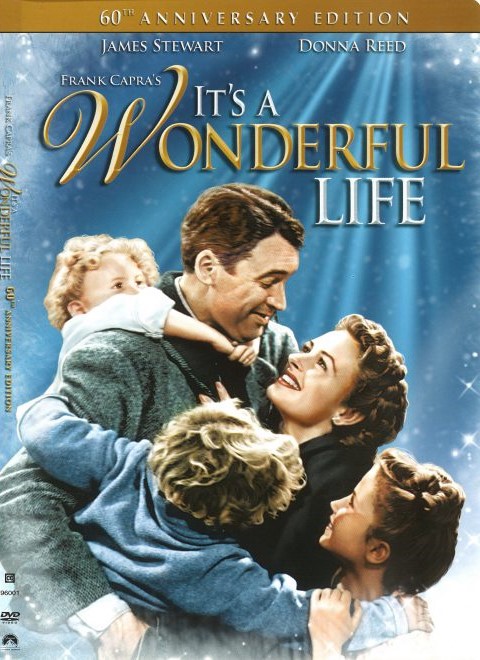
Cover of the 60th Anniversary DVD featuring George and Mary Bailey and three of their children
This film, officially released in theaters on January 7, 1947, was plagued with missteps from the start. Its history of challenges, actually, seem appropriate as it is a film about failure and redemption and has become one of the world’s most beloved Christmas classics. The movie: It’s a Wonderful Life.
Its story begins in 1939 when Philip Van Doren Stern writes a short story he titles The Greatest Gift. Unable to find a publisher, Stern self publishes 200 booklets which he gives as presents to friends during Christmas 1943.
The story ended up being read by Carey Grant who was interested in adapting the story into film with him as the lead. RKO, a movie studio, purchased the rights in April 1944 to do just that. Work commenced on the screenplay. For whatever reasons, Grant went on to other projects and the partially completed script was eventually sold to Frank Capra’s production company in 1945.
Capra – recognizing the potential in the story – hired a writing team to work on the script. But there were problems. From the Infallible Wikipedia:
“Capra salvaged a few scenes from Odets’ earlier screenplay and worked with writers Frances Goodrich and Albert Hackett, Jo Swerling, Michael Wilson, and Dorothy Parker (brought in to ‘polish’ the script), on many drafts of the screenplay.
It was not a harmonious collaboration. Goodrich called Capra ‘that horrid man’ and recalled, ‘He couldn’t wait to get writing it himself.’ Her husband, Albert Hackett, said, ‘We told him what we were going to do, and he said ‘That sounds fine.’ We were trying to move the story along and work it out, and then somebody told us that [Capra] and Jo Swerling were working on it together, and that sort of took the guts out of it. Jo Swerling was a very close friend of ours, and when we heard he was doing this we felt rather bad about it. We were getting near the end and word came that Capra wanted to know how soon we’d be finished. So my wife said, ‘We’re finished right now.’ We quickly wrote out the last scene and we never saw him again after that. He’s a very arrogant son of a bitch.’
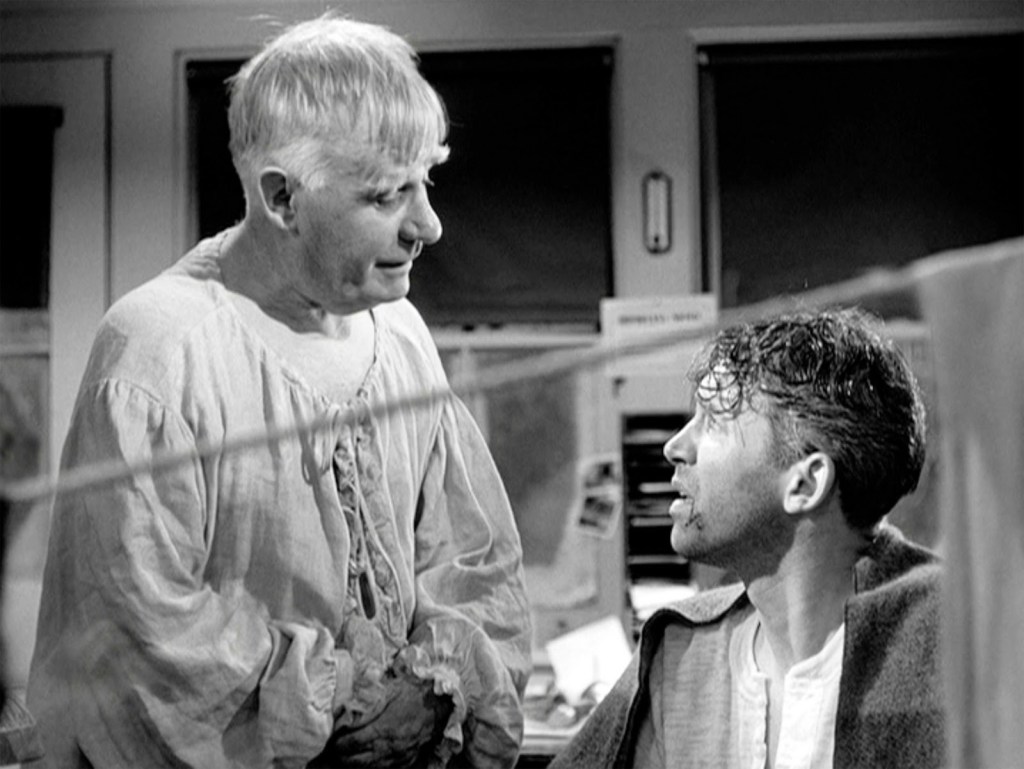
George telling Clarence he wished he’d never been born
Later, a dispute ensued over the writing credits. Capra said, ‘The Screen Writers’ Arbitration committee decided that Hackett and Goodrich, a married writing team, and I should get the credit for the writing. Jo Swerling hasn’t talked to me since. That was five years ago.’ The final screenplay, renamed by Capra It’s a Wonderful Life, was credited to Goodrich, Hackett, and Capra, with ‘additional scenes’ by Jo Swerling.”
In order to make the film ‘Oscar’ eligible it was released at the Globe Theatre in New York on December 20, 1946 rather than wait until early 1947 as originally planned. The change likely cost It’s a Wonderful Life a Best Picture Oscar as the competition for 1946 was much more difficult. Best Picture winner was a movie titled The Lost Weekend, a movie now pretty much lost in time. It’s a Wonderful Life ended up with five nominations including for Best Picture and Best Actor for Jimmy Stewart.
The movie was under water some $525,000 at the box office.
It wasn’t until the late 1970’s when the copyright expired and the movie was ‘discovered.’ Also from the Infallible Wikipedia:
“The film’s elevation to the status of a beloved classic came three decades after its initial release, when it became a television staple during Christmas season in 1976. This came as a welcome surprise to Frank Capra and others involved with its production. ‘It’s the damnedest thing I’ve ever seen’, Capra told The Wall Street Journal in 1984. ‘The film has a life of its own now, and I can look at it like I had nothing to do with it. I’m like a parent whose kid grows up to be President. I’m proud … but it’s the kid who did the work. I didn’t even think of it as a Christmas story when I first ran across it. I just liked the idea.’ In a 1946 interview, Capra described the film’s theme as ‘the individual’s belief in himself’ and that he made it ‘to combat a modern trend toward atheism’.”
The house at 5417 40th Ave SW in Seattle as it looks now. When we moved there the right side of the yard had been dug out and turned into a driveway that heaven help you if you took a wrong step at the top.
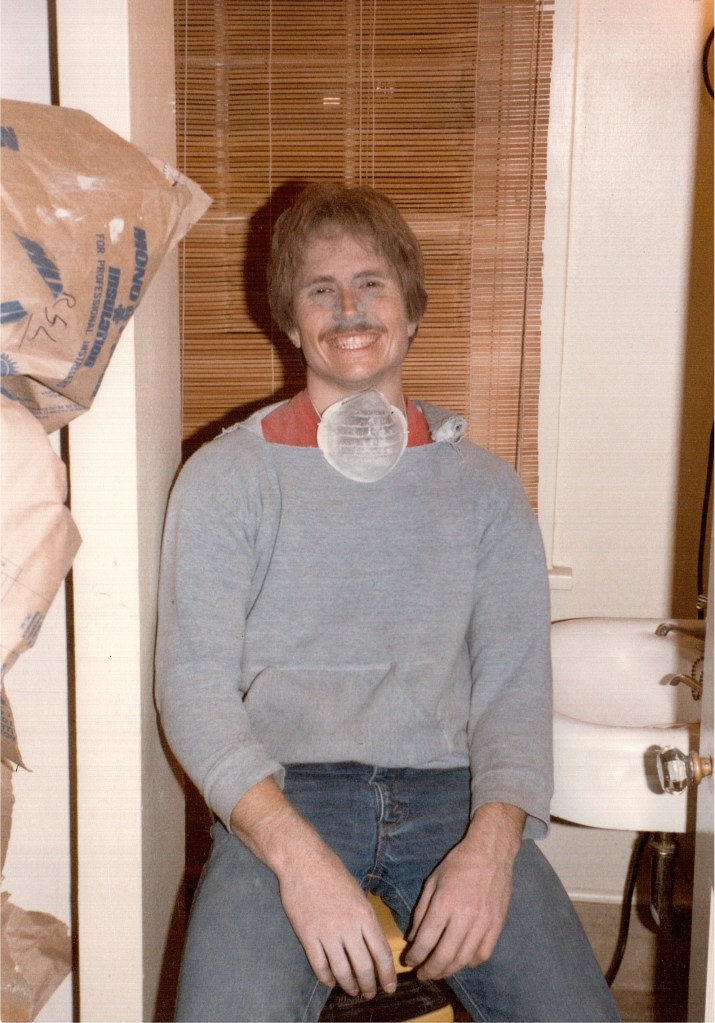
The hubby covered in dust after an evening blowing insulation into the attic
It was in December 1981 when I first saw the movie. The hubby and I had purchased our first house six months earlier. It was a 1910 fixer upper in West Seattle and a hodge-podge of never-ending projects. Our initial weekend in the house involved ripping out pet urine-soaked carpets and removing part of the narrow, with a 90 degree turn staircase, in order to get our queen size bed up to the bedroom. Behind the 1960’s era kitchen cabinets we unearthed a painted over window with the curtain rod still attached to the wall. Unfortunately, the curtains – mostly rags – also still hung there. The fix list went on and on. During the time we owned that house, it was one critical project after another.
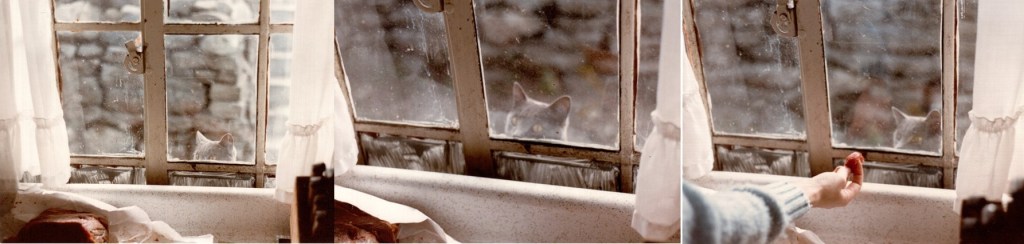
Our cat, Porsche, was peering through the kitchen window watching as I worked with some steak and we inadvertently captured those horrible old windows, painted at the bottom and half covered up by ill-fitting counters.
Forward to the week before Christmas 1981. I was home sick from work with a bad cold, puttering around our drafty old house, doing what I could to get ready for the holiday. I had the TV on to keep me company when this old black and white film appeared.
Within moments I was hooked and soon I gave up my puttering and snuggled up on the couch under a blanket. I watched the whole thing. The already dim afternoon light faded to night just as George Bailey descended into his own winter solstice crisis. There I sat, commiserating with poor George over a house that needed constant fixing and worried about how he was going to find the money that Uncle Billy lost. I could relate as money was tight for a pair of house poor, married barely a year, kids.
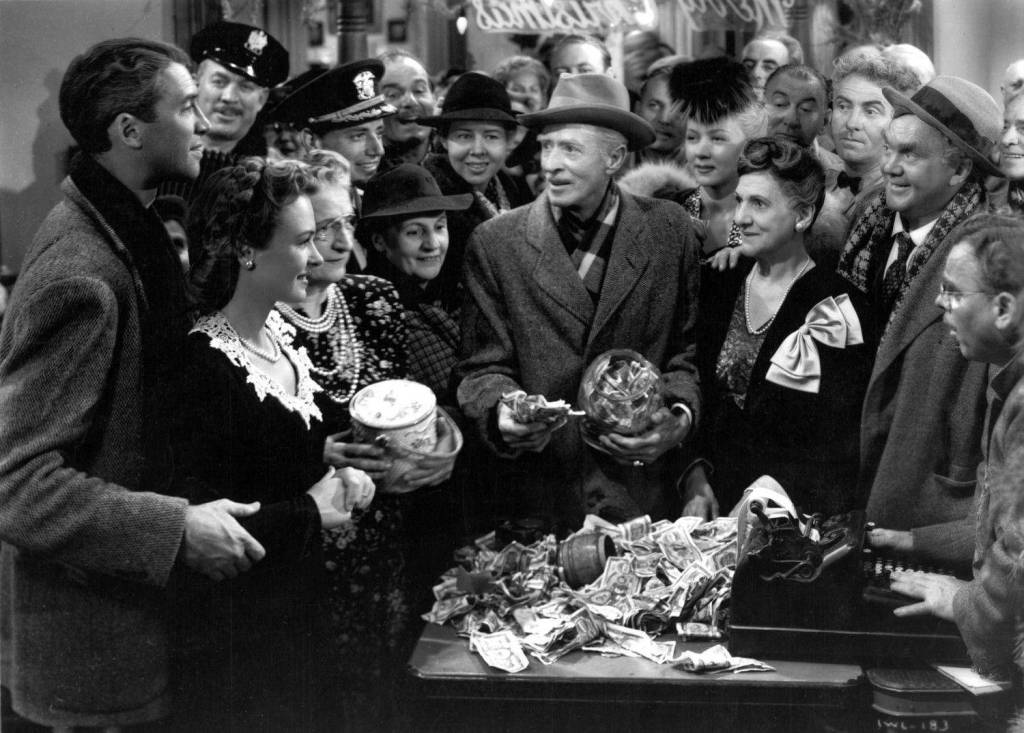
The townspeople of Bedford Falls coming together to help George
There’s a moment in that film which sums it all up. It’s when George arrives back home – alive once again – and hugs the kids but cannot find Mary, his wife. The bank examiners arrive and tell George they are going to arrest him and his response is just the best. He tells them how wonderful it is for no other reason than because he’s alive and that is enough.
Just then, Mary bursts through the door, she and George embrace and he tells her how much he cherishes her. But she has a surprise for him – the community has come to their rescue and raised more than enough money to cover the missing funds.
It’s this scene which had me bawling. What a gift it is to be so loved, so valued, that your friends and family will do anything to ease your burden. Every time I watch It’s A Wonderful Life I hold it together until that scene comes on and George receives a gift from his Guardian Angel, Clarence, with the following sentiment:
“Dear George, remember no man is a failure who has friends. Thanks for the wings, Love Clarence.”
The celebration of harvest by setting aside a day of ‘thanksgiving’ is a tradition long observed by people the world over. Most Americans embrace the idea that the first Thanksgiving was held in Plymouth, Massachusetts, by the pilgrims who settled the wilderness there in 1621.
But a historical look at ‘thanksgiving’ celebrations indicates a more haphazard approach. In fact, colonists in Virginia also held feasts of ‘thanksgiving’ during the early years of European settlements and a number of years before the New England events. In subsequent years such feasts were declared from time to time, occurring whenever it seemed a good idea for a few days of eating and celebration.
It was George Washington, as the first president, who by proclamation made Thursday, November 26, 1789, a ‘National Day of Thanksgiving.’
From the Infallible Wikipedia:
“As President, on October 3, 1789, George Washington made the following proclamation and created the first Thanksgiving Day designated by the national government of the United States of America:
Whereas it is the duty of all Nations to acknowledge the providence of Almighty God, to obey his will, to be grateful for his benefits, and humbly to implore his protection and favor, and whereas both Houses of Congress have by their joint Committee requested me ‘to recommend to the People of the United States a day of public thanksgiving and prayer to be observed by acknowledging with grateful hearts the many signal favors of Almighty God especially by affording them an opportunity peaceably to establish a form of government for their safety and happiness.’
Now therefore I do recommend and assign Thursday the 26th day of November next to be devoted by the People of these States to the service of that great and glorious Being, who is the beneficent Author of all the good that was, that is, or that will be.’”
Although additional ‘days of thanksgiving’ were proclaimed over the years, it was during the Civil War when the last Thursday of November became the traditional celebration date. And, in a coincidence, it was also November 26th for that official celebration.
Controversy arose, however, when – during Franklin Roosevelt’s term as President –there was a ‘fifth’ Thursday. Also from the Infallible Wikipedia:
“On October 6, 1941, both houses of the U.S. Congress passed a joint resolution fixing the traditional last-Thursday date for the holiday beginning in 1942. However, in December of that year the Senate passed an amendment to the resolution that split the difference by requiring that Thanksgiving be observed annually on the fourth Thursday of November, which was usually the last Thursday and sometimes (two years out of seven, on average) the next to last. The amendment also passed the House, and on December 26, 1941, President Roosevelt signed this bill, for the first time making the date of Thanksgiving a matter of federal law and fixing the day as the fourth Thursday of November.
For several years some states continued to observe the last-Thursday date in years with five November Thursdays (the next such year being 1944), with Texas doing so as late as 1956.”
Royal Doulton china similar to my Aunt’s set of dishes
Eventually, however, everyone got on board with the change which, of course, made the planning of parades, retail sales, and football games much easier.
For me, Thanksgiving was always a long-anticipated day. My family moved to Yakima in 1961 and, as a small girl of four years, I had no prior memories of the event. All my recollections are of the two holidays – Thanksgiving and Christmas – being spent at either my family’s house or that of my cousins.
Being that my cousins’ house was a short walk down 31st Avenue, it became tradition that our two families of six each – along with my maternal grandparents – would spend Thanksgiving together.
My uncle owned a piano and organ store for a time. While he didn’t sell these, there was an antique pump organ in their basement.
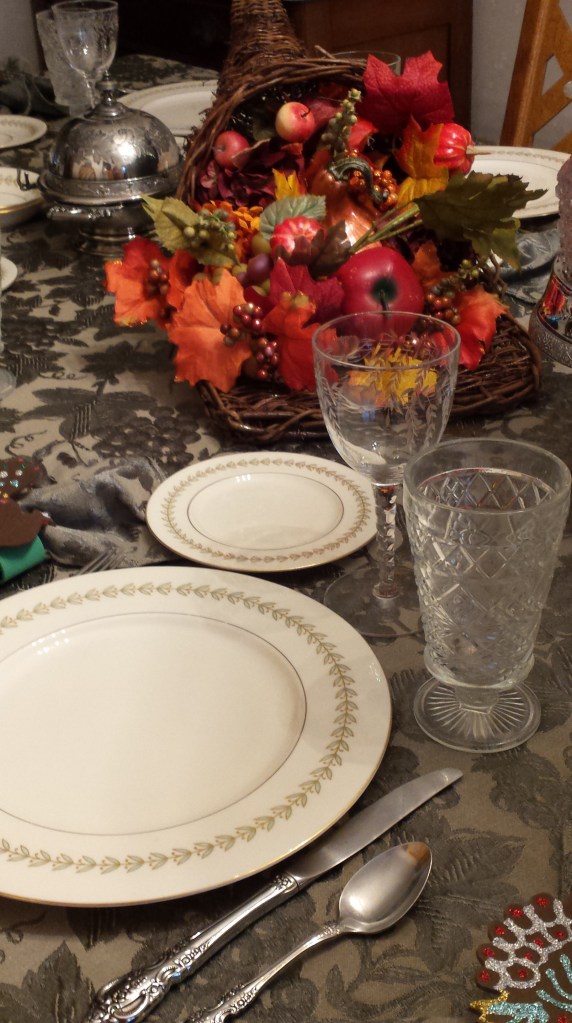
I loved going to their house for the holiday for a number of reasons, the first being that my Aunt Helen set the most gorgeous table. Even as a child I loved china and hers was exquisite. It might have been Royal Doulton Country Roses – or a knockoff – but I recall it was bold, fussy, and beautiful. She had enough place settings to accommodate 14 people but not enough seats at the main table… so the five younger children (2 boys, 3 girls) were relegated to the kitchen table WITH the pocket door closed. It was glorious. Behind that closed door, mischief abounded with my brother – who was four years older than I – the main mischief maker. There were jokes told, inappropriate noises, and much laughter. We thought we were the lucky ones not having to endure the boring adult conversations which seemed to center on who was sick or had died that year.
The third, and my favorite, reason I loved going to the cousins’ house was because of their basement. After dinner (which was ALWAYS served at 1 p.m. and over by 1:45) we were sent downstairs. That basement was the one place in my fastidious Aunt’s house where we could play without concern over too much noise.
In 2018, a year after my mother’s death, we had Thanksgiving in Yakima with my dad. Shown here is my mother’s china which I used to set the table that year.
Oh, the adventures we had! Like the time we set up the Ouija Board and invoked spirits (of the dead relatives discussed at dinner) only to have the basement window bang open at the exact moment of contact. And the time that my sister and cousin Tim put on a play in the basement, complete with a curtain and props, and a surprise ending. My uncle had an old pump organ down there which fascinated me as I pumped the pedals and pulled on knobs to create different sounds as I ‘played’ the instrument. We never ran out of things to do and I was always sad when the hour grew late and we had to return home.
When I think of my many blessings in life, I’m especially thankful for my childhood and those special holidays I spent with my siblings and cousins. At the time I did not appreciate the transitory nature of life and thought it would always be that way.
I’ve come to cherish Thanksgiving and have to say that it’s truly my favorite holiday. At no other time do we pause to give thanks for all our blessings and the people who make our lives richer and better.
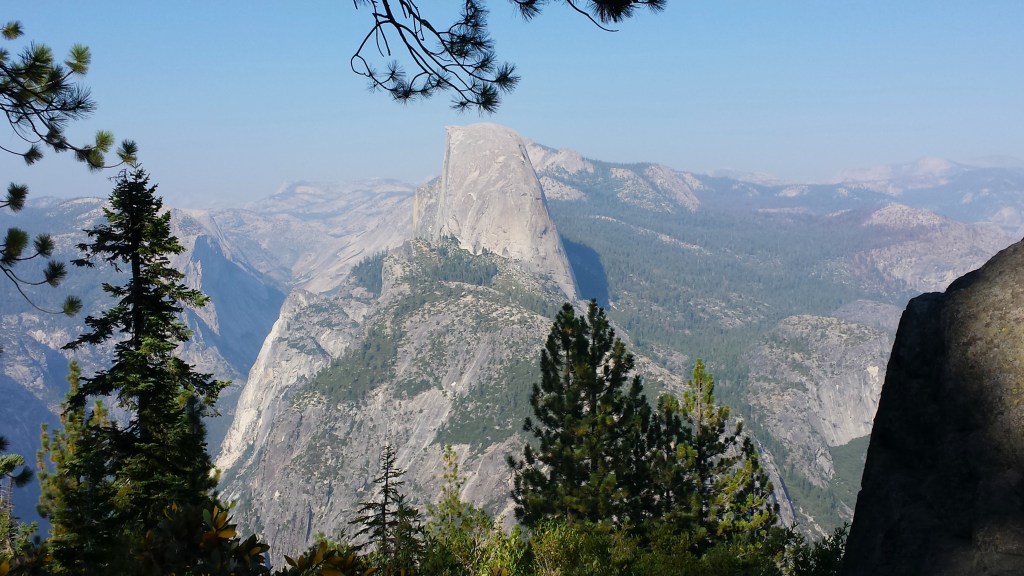
Half Dome, Yosemite National Park, from Glacier Point overlook September 2015
October 1, 1890 marked the official inclusion of this region into the newly formed National Park System. Long before that, however, the Yosemite Valley had inspired the natives who resided in the area as well as the early white settlers.
It was, contrary to popular belief, James Mason Hutchings and artist Thomas Ayres who were the first Americans to tour the area in 1855.
From the Infallible Wikipedia:
“Hutchings and Ayres were responsible for much of the earliest publicity about Yosemite, writing articles and special magazine issues about the Valley. Ayres’ style in art was highly detailed with exaggerated angularity. His works and written accounts were distributed nationally, and an art exhibition of his drawings was held in New York City. Hutchings’ publicity efforts between 1855 and 1860 led to an increase in tourism to Yosemite.”
Although the greater Yosemite area had been set aside by Congress in 1864, the Valley and Mariposa Grove were ceded to California to manage as a state park. The two areas had seen an influx of homesteaders and were being rapidly commercialized as well as being used for the grazing of sheep and cattle; the old growth sequoias were being logged.
The iconic El Capitan
Most people associate the founding of Yosemite with early environmentalist John Muir. Rightly, he is credited with not only pushing for park expansion but also lobbied for the federal government to take back the iconic valley and grove.
Also from the Infallible Wikipedia:
“It was because of Muir that many National Parks were left untouched, such as Yosemite Valley National Park. One of the most significant camping trips Muir took was in 1903 with then president Theodore Roosevelt. This trip persuaded Roosevelt to return ‘Yosemite Valley and Mariposa Grove to federal protection as part of Yosemite National Park.’”
The years long efforts paid off when, in 1906, Roosevelt signed a bill which stripped the two areas still managed by California from the state and they were returned to the federal government which finally created a unified Yosemite National Park.
One trip to Yosemite is all it takes for a person to understand the grandeur and how special a place it is. From towering El Capitan, to the massive Half Dome, or the fascinating Tuolumne Meadows, Yosemite is a visual feast.
And the hubby and I wondered, when we visited in September 2015, how come it had taken us so long to get there. We arrived on the day after Labor Day which was a good thing as the summer crowds were gone. Reservations are generally required months – if not a year – in advance for the various hotels. I figured we were out of luck but checked anyway as we drove south a few days before our planned stay. What a surprise! There were rooms available at the Wawona Hotel or space in ‘dry’ tents. We opted for the hotel.
It was only after we arrived at the park that it dawned on me that the Wawona Hotel was nowhere near the Yosemite Valley. That day had turned into a driving ordeal. My hubby suffers from vertigo. Being close to any ledge can trigger a sensation of spinning as well as nausea. Knowing this, it was my duty to do the driving so that he could close his eyes as needed when navigating cliff-side roads.
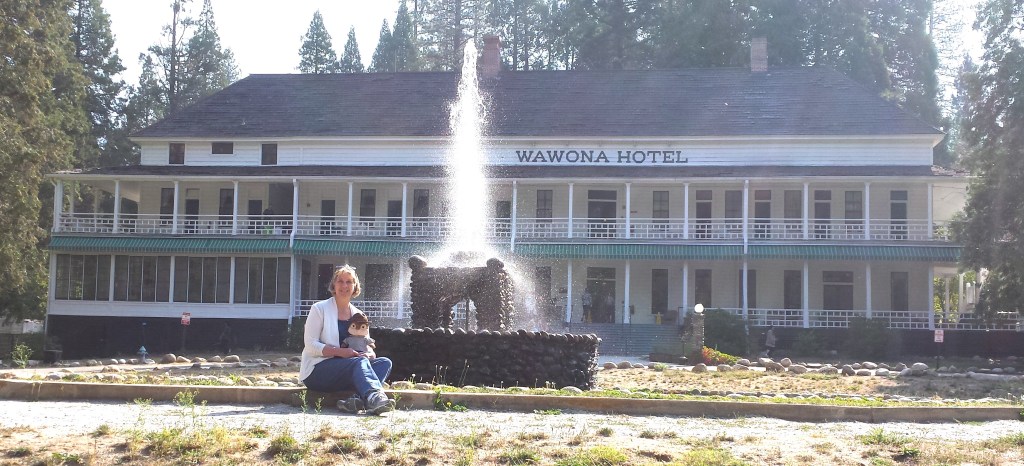
The author, along with Alvin the Chipmunk traveling companion, at the Wawona Sept. 2015
Up, up, up we traveled from the eastern side of the park to the 9,943-foot-high Tioga Pass – the highest mountain pass in California. Come to find out, THAT was the easiest road. From there we wound our way through Yosemite’s high country. Then we had to go down. From Tuolumne Meadows – elevation 8,619 feet – to the Valley floor was a 4,619 foot descent. And all of it seemed to be a series of endless switchbacks and curvy roads carved in to the sides of mountains.
It was with a sense of relief we reached the bottom when it hit me… Wawona was another 30 miles which we had to add to the 230 we’d already traveled that day. No rest for the driver as the road climbed back up the other side through yet another series of switchbacks, cliffs, and amazing vistas.
Now close to sunset, we found the hotel and were charmed at the thought of staying in an 1870’s structure.
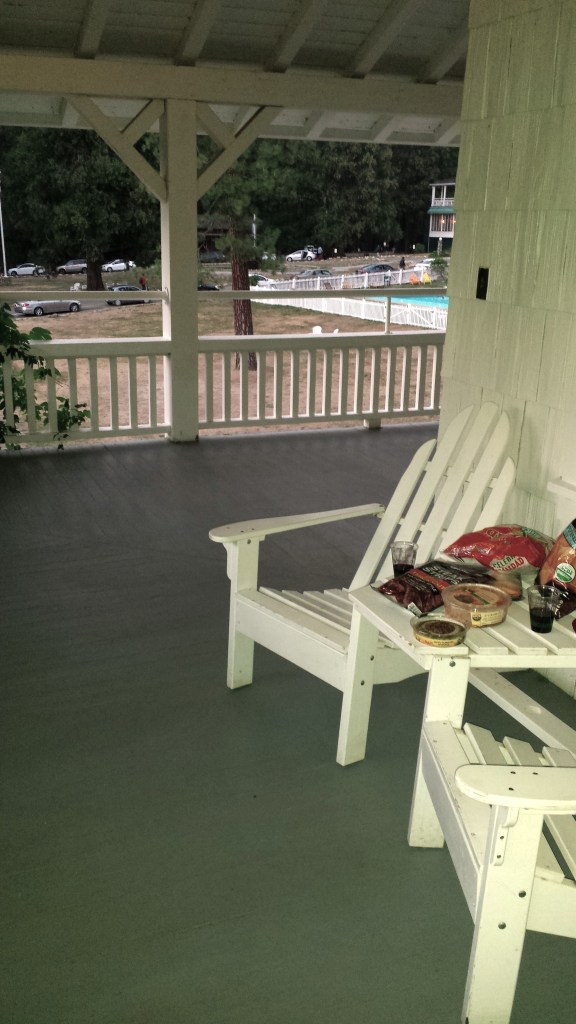
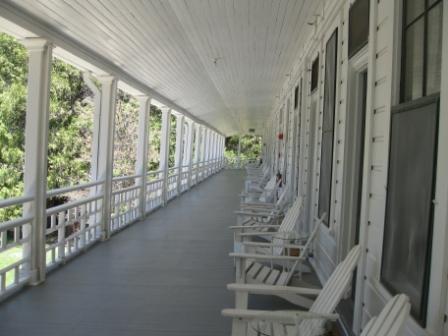
Our room was in the more recently added section… built at the turn of the last century. Located at the far western end of the first floor, the room opened out on to a wide veranda adorned with honeysuckle.
But that’s where the charm ended. The room itself featured a double bed and a twin bed. There was a sink attached to the wall next to the twin bed with a door in the wall next to it. The door, however, was locked.
Table for two on the verandah
The room was completed with a small square closet, small dresser and a table and chair. No TV and no phone. But we were up for the adventure and the price – less than $70 a night – was a steal even with having to use the bathroom down the stairs.
As we went to bed that night we could hear, through the thin walls, talking in the room next door; two men were conversing in German. We laughingly dubbed them Hans and Fritz and, although the hubby had taken German in high school, were unable to decipher their conversation.
The next day, after breakfast in the hotel dining room, we headed out for a full day of touring. That evening we bought deli meats, fruits, crackers, and a bottle of wine which we ate and drank while sitting in the Adirondack chairs outside our room on the veranda. A pink and purple sunset was the perfect icing on a wonderful day.
View to the west from the verandah outside our room
Despite the older beds and somewhat rustic accommodations we slept well… that was until about 7:30 the next morning when our German neighbors’ talking awoke us. It was then we discovered where the locked door next to the sink led. When the hotel was built, the rooms all shared Jack and Jill bathrooms. To accommodate a more modern customer the bathrooms had been designated as a private bath for one of the rooms only, and the door to the adjacent room was locked.
We had the room without a private bath. Our German neighbors, Hans and Fritz, had the bathroom. Did I mention that the walls were paper-thin and not insulated?
Soon, some rather unfortunate sounds penetrated into our hearing range. We dressed as quickly as we could and headed to breakfast… and decided that the Germans would hereafter be known as Fritz… and a scatological term which rhymes with Fritz.
Staying at the Wawona harkens back to a different time
Of course the thing one most recalls about any trip are the occurrences which are out of the ordinary. Our stay at the Wawona turned out to be the most memorable part. And we wouldn’t change a thing.
Update 2024: A few weeks ago it was announced that the Wawona Hotel would be closing for an indefinite period of time as they evaluate the structure. The news article said it needs a new roof but with some more in-depth evaluation the repairs could be more extensive.
In the 1970’s it was the TV program Happy Days which took us back to the 1950’s. Then there were The Wonder Years which aired in the late 80’s but was set from 1968 to 1974.
Great storytellers often revert to their youth as a way to mine for fictional gems.
For anyone who grew up in the 1980’s they can tune in to ABC’s current program The Goldberg s and see their childhood come to life. It premiered on September 24, 2013.
Created by Adam F. Goldberg, the show is based on people he knew and events which happened to him while he was growing up. Season 7 begins on Wednesday (Sept. 25) (For 2020, Season 8 begins October 21)
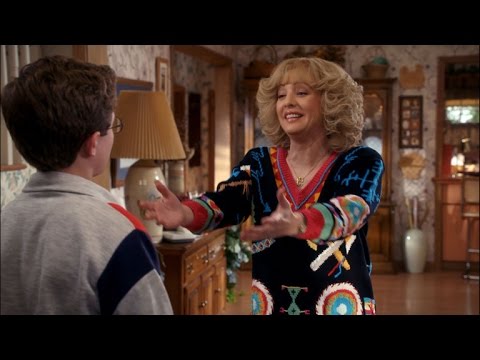
Like all great TV shows, excellent writing and casting are key. Adam’s is a wacky family which begins with his father, Murray, whose main goal in life is to be able to relax in his recliner (sans trousers) and watch TV undisturbed by his three children, who he calls ‘morons.’ The heart of the family is the ultimate intrusive mother, Beverly, who Adam and his siblings, Erica and Barry, call the ‘Smother.’ Although she ‘could have been a lawyer’, her only focus in life is finding ways to stay inappropriately relevant in her teenage children’s’ lives. The travails of the three siblings are fleshed out by a host of friends and rivals.
Beverly Goldberg, played by Wendy McLendon-Covey, a true ‘smother’
From the Infallible Wikipedia:
“The Goldberg’s is set in the 1980’s in Jenkintown, Pennsylvania. The show is loosely based on the show runner’s childhood, during which he videotaped events, many of which are reenacted throughout the program. It shows the reality of the 1980’s through a young boy’s eyes.
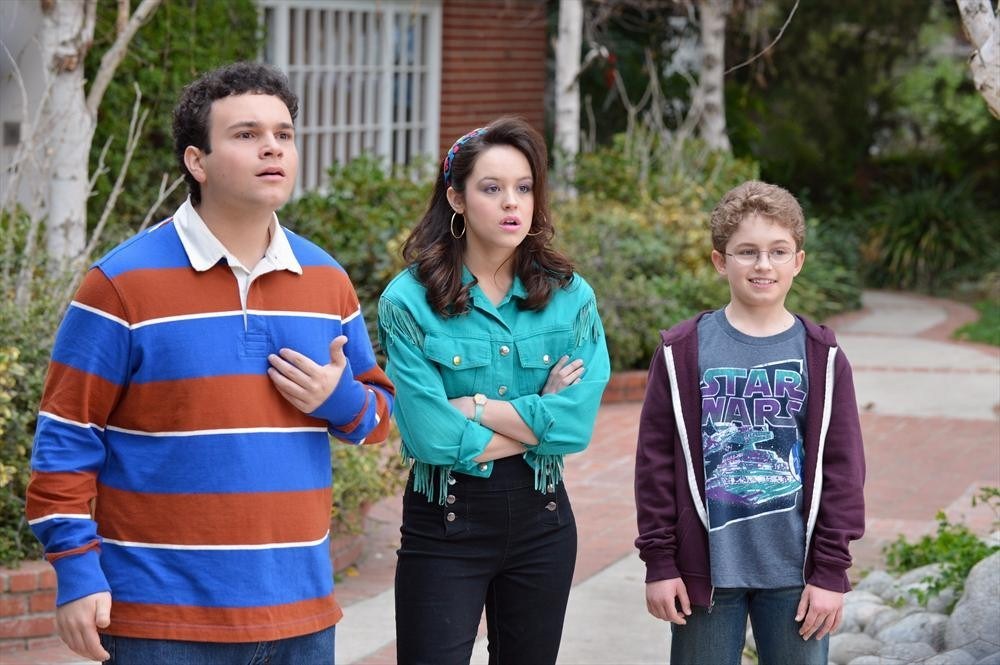
The series stars Jeff Garlin as patriarch Murray and Wendi McLendon-Covey as matriarch Beverly. Their two older children are Erica (Hayley Orrantia) and Barry (Troy Gentile). The youngest child, Adam (Sean Giambrone), documents his family life with his video camera. Beverly’s father, Albert “Pops” Solomon (George Segal), is frequently around to provide advice or to help out his grandchildren (often behind his daughter’s back).
The present-day ‘Adult Adam’ (Patton Oswalt) narrates every episode as taking place in ‘1980-something’.
The Goldberg children, Barry, Erika, and Adam as portrayed by Troy Gentile, Hayley Orrantia, and Sean Giambrone.
Many references to real-life Philadelphia-area businesses are made, including the Wawa Inc. convenience store chain, Gimbel’s department store, Willow Grove Park Mall, and Kremp’s Florist of Willow Grove, Pennsylvania.”
It was halfway through season six that I saw my first ‘Goldberg’s.’ Over the past 10 years, I have traveled frequently to Yakima to assist my parents. What started as an every five or six weeks visit to cook meals for my dad has shortened over the years as the needs increased. I’ve literally spent hundreds of days there helping both of them and dealing with a variety of crises. There have been hospital stays for both my parents, my mother living in multiple care facilities for 8 years, legal battles, her passing in November 2017, and now the decline of my 96-year-old father.
In January 2019, my dad took ill and ended up in the hospital. Upon his release my siblings and I recognized that we needed to place him into a facility as my brother, who had lived with him for the previous five years, was not able to provide the level of care needed.
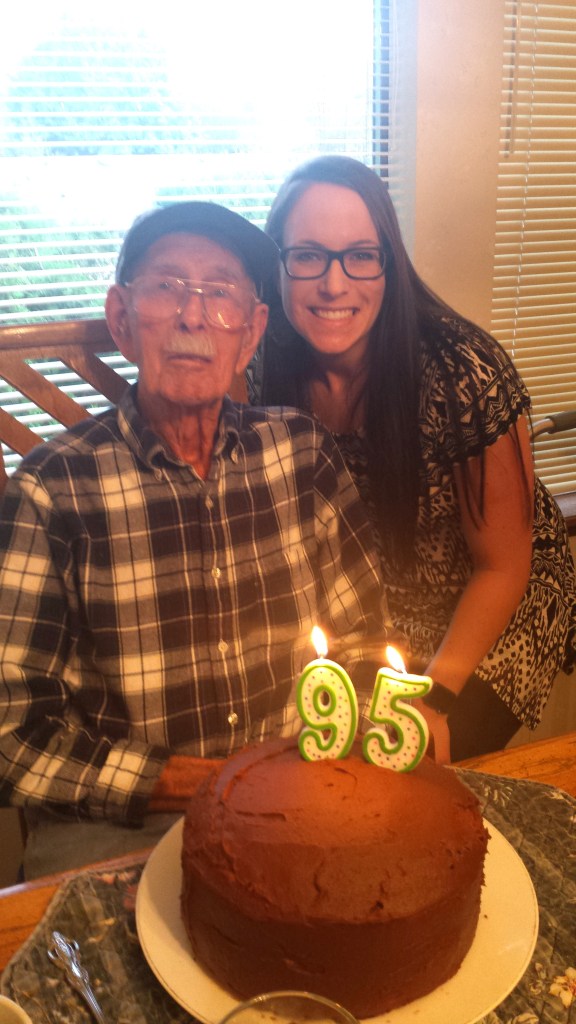
My niece with Dad on his 95th birthday. This was in 2018, the last year in his house.
I was in Yakima to facilitate dad’s move and arrived back at my Dad’s place one evening sometime the last week of January. My brother told me he had discovered a new TV show and asked if I wanted to watch. I did and, like him, was soon hooked on The Goldberg’s.
For most people it’s a simple thing to be able to watch and enjoy a TV program. That was not the case at my Dad’s house.
While Dad was still at home, the TV was his main activity, particularly after my mother died, and there were only two things he watched: Sports and News.
During the five years my brother lived there those were the choices during the hours Dad was present.
In those first weeks after Dad moved to Assisted Living, an odd quiet descended over the house. I think both my brother and I were in a bit of state of shock as the new reality settled in.
Enter the Goldberg’s. My brother set up the TV to record every episode as it played since season’s one through five were being rebroadcast. Many evenings in the next few months during the days and weeks I was in Yakima, I’d arrive back after visiting Dad and my brother and I would binge watch, often staying up way too late.
In many ways it was a lifeline and a way to deal with the stress. Laughter and the occasional cry do that for you.
On another level there was a more subtle lesson to be learned. One that comes through from the Goldberg’s in every episode:
Sure, stuff happens in life and we’re not always at our best with our family and friends, but in the end cherish your family because things change – sometimes in an instant – and you cannot get it back.
We recently completed an estate sale at my parents’ house. Soon the condo will be on the market. As we went through the process of sorting everything last summer, we’d come upon items which triggered emotional responses. When I handed the electric griddle to my sister-in-law to use for her grandkids it hit me that I would never cook another pancake (I made thousands in those 10 years) or a pot pie for Dad in that kitchen, or stay there, or hear my dad’s walker thumping overhead in the morning. Everything had changed.
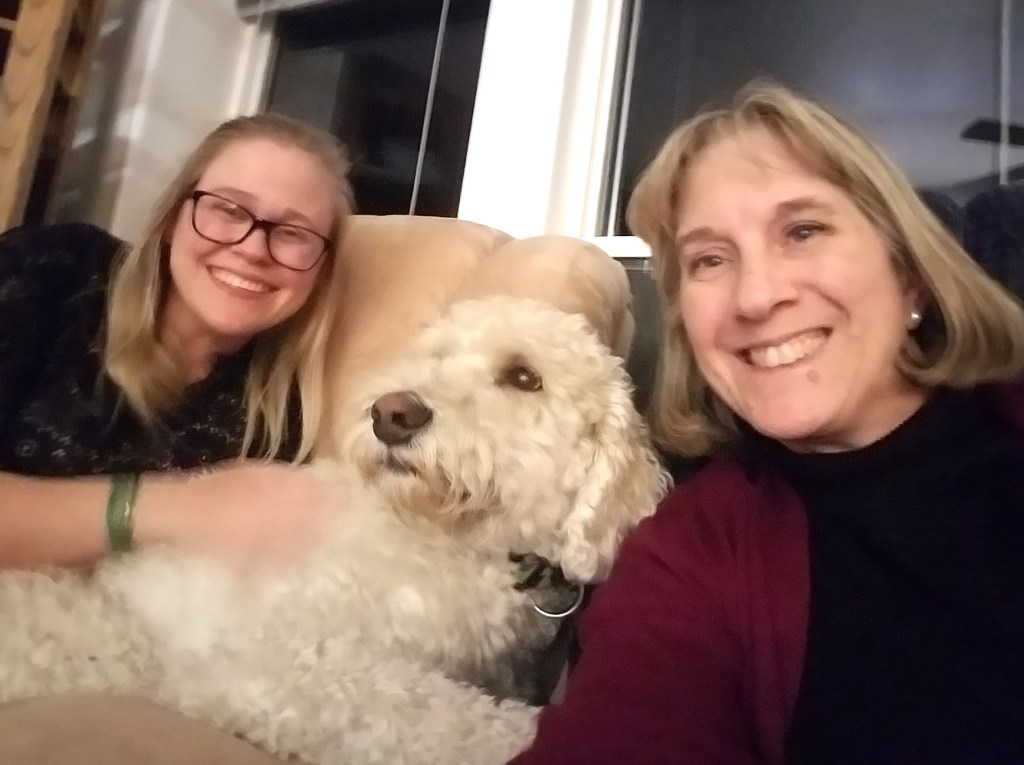
My Daughter, Reggie the Double Doodle, and the author hanging out.
But a new and different way of loving and supporting family has emerged. When I’m over there I now stay with my sister and her husband. Herbert and Teddy, their two dogs, announce every arrival in a cacophony of barking. Shop Cat – who is an outdoor pet – will come and hang out on the deck and has decided I’m okay, rubbing against my legs and looking to be petted. My sister’s adult daughter – who lives nearby – arrives most every evening, bringing with her Reggie and Rex, the Double Doodle dogs, who join in the melee.
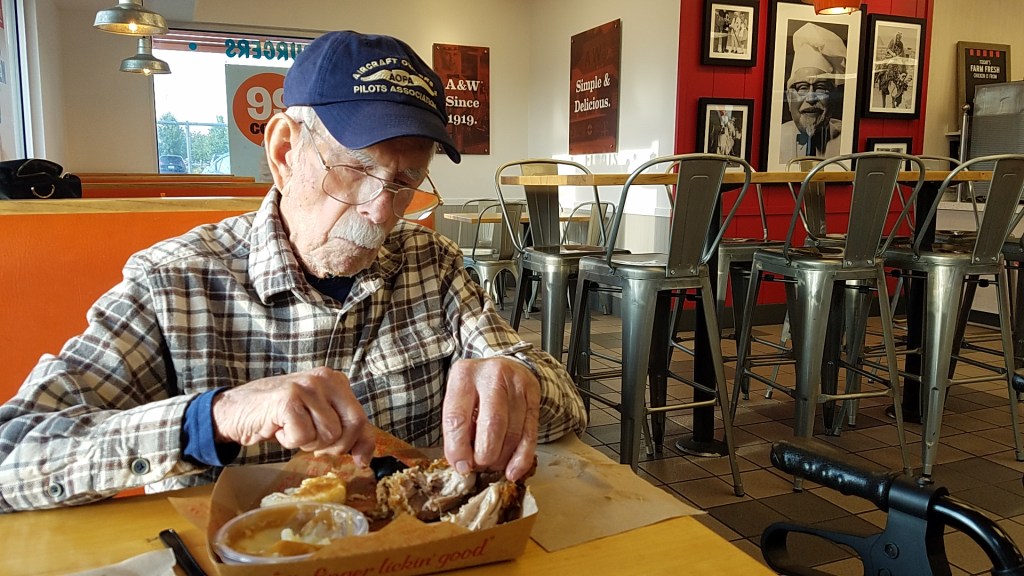
I visit dad at least once a day when over there. He has good days and bad days… last week he had one particularly good day and insisted he wanted to have Kentucky Fried Chicken for dinner. So what the heck? I loaded him and his walker into the car and we went to KFC. Was it easy? No. But I recognize his days are short and doing something so simple made him happy for a little while. And that makes it all worthwhile. No regrets.
Dinner out with Dad September 2019
2019 has been a hard year, but it was made better thanks to the Goldberg’s and my own family.
Here’s the link to Wikipedia, but really, it does not do justice to the show. Give yourself a treat and watch an episode.
Update 2024: When I posted this on September 24, 2019, I had no idea that exactly one month later my Dad would take his last breath. The Goldberg’s last episode was aired in May 2023.
From the moment this TV show premiered, on September 17, 1964, a spell was cast over the American public and everyone fell in love with a beautiful witch named Samantha.
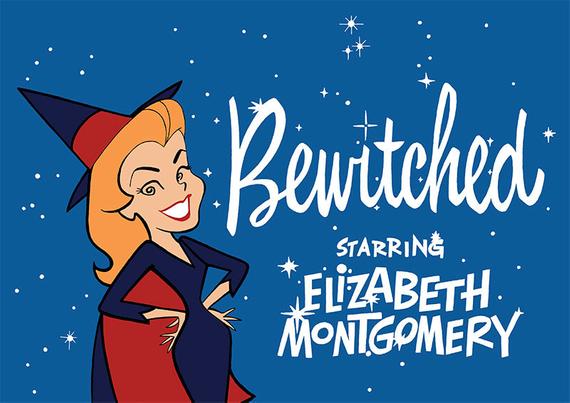
Screenshot from the opening credits
Bewitched was an instant hit, drawing everyone in to its crazy premise:
What if a witch were to fall in love with a mortal and give up her magical world to become a modern-day housewife?
Of course that’s not quite how it worked out. Week after week we were given a glimpse into the life and marriage of Darrin and Samantha Stevens who, with interference from her mother Endora and a wide cast of other relatives, seemed to stir up trouble for poor Darren. Add to that mix the nosy neighbor, Gladys Kravitz, and Darrin’s demanding boss, Larry Tate, and you had the recipe for a sitcom which aired for the next eight years.
From the Infallible Wikipedia:
“The witches and their male counterparts, warlocks, are very long-lived; while Samantha appears to be a young woman, many episodes suggest she is actually hundreds of years old. To keep their society secret, witches avoid showing their powers in front of mortals other than Darrin. Nevertheless, the effects of their spells – and Samantha’s attempts to hide their supernatural origin from mortals – drive the plot of most episodes. Witches and warlocks usually use physical gestures along with their incantations. To perform magic, Samantha often twitches her nose to create a spell. Special visual effects are accompanied by music to highlight such an action.”
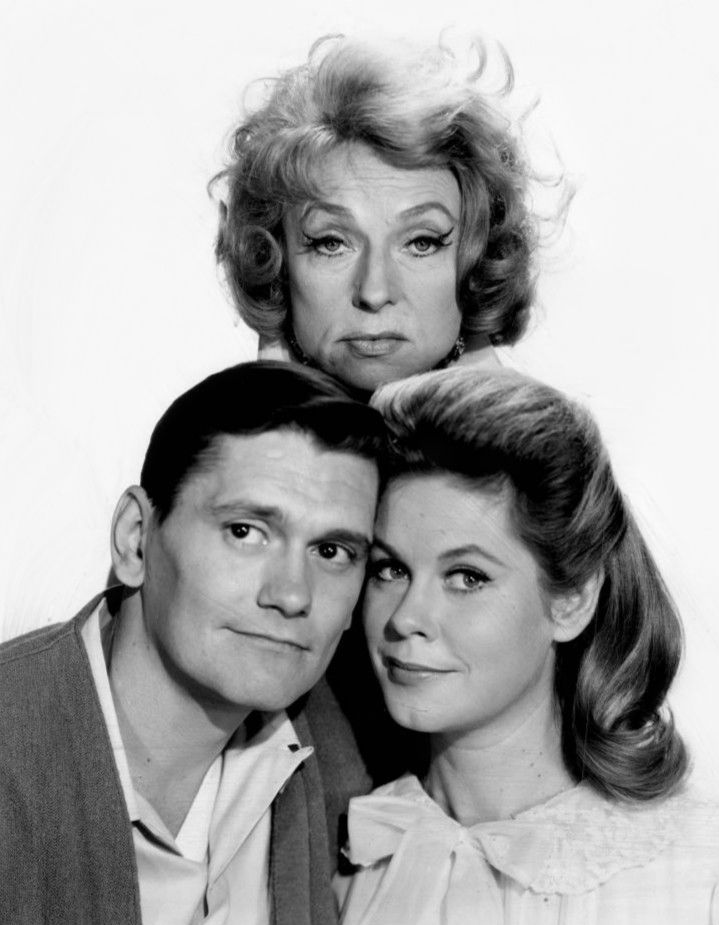
The three main characters: Dick York as Darrin and Elizabeth Montgomery as Samantha (front) with the irreplaceable Agnes Moorehead as Endora.
The combination of great script writers coupled with outstanding casting was, no doubt, key to the series success. Elizabeth Montgomery, as Samantha, is frequently seen using her nose to make the dishes wash themselves, clean up a mess, or handle some mundane chore. Darrin was frustrated each week at his wife’s use of magic to handle life.
Personally, as a child, I very badly wanted to live in that world. My bedroom was ALWAYS a disaster of toys, books, and games, with never enough space to store them. If, of course, I was inclined to be tidy, which I was not.
My sister, who is 21 months older, forbade me from stepping foot onto her side of the room during those years. An invisible line was drawn between our matching twin beds and across that boundary I dared not venture. Oh to have Samantha’s nose which I could just twitch and get everything cleaned up in an instant! Then I might have been allowed across the magic threshold.
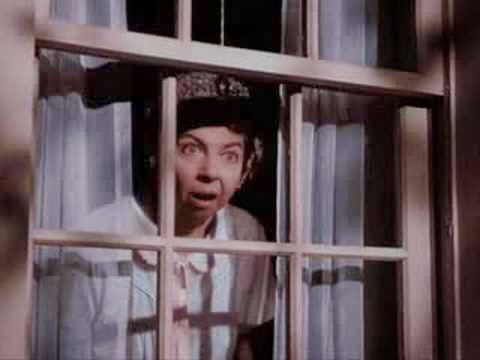
But my favorite character on the show had to have been the ever-vigilant neighbor Gladys. The woman epitomized the term busy body and was often seen skulking around the Steven’s house. She would climb into the shrubbery and peer through windows, certain that all sorts of strange things were going on inside. Of course, she was right but she never succeeded in convincing her disinterested husband, Abner, or the occasional law enforcement officer she would call, of the shenanigans which took place.
In her portrayal of Gladys Kravitz, Alice Pearce brought the meaning of a nosy neighbor to new heights
In fact, when I encounter a nosy person, I usually refer to them as Gladys. In a loving way, of course, but the name does sum up that one person which members of my generation instantly recognize.
No doubt, when the show went off the air in 1972, it was with a whimper. The original Darrin had left in 1969 due to complications from a severe back injury 10 years earlier which made working impossible. The original Gladys died in 1966 as had Samantha’s confused Aunt Clara. These hits to the cast affected the show profoundly. In many ways, in retrospect, it was almost as if a spell had been placed on the show. Elizabeth Montgomery died in 1995 at the age of 64 from colon cancer. Dick York succumbed at age 63 from emphysema. Agnes Moorehead, who played Endora, was stricken with uterine cancer which took her life in 1974 at age 74.
Bewitched lives on in syndication and, subsequently, on DVD and the internet. Although there was a movie made based on the characters which was cute, and there are proposals for a new TV series, no remake will ever be able to replicate and achieve the success of the original.
As someone born into a family with an uncommon last name, I notice whenever I see that name. Several years ago I wrote about my ignorance of Washington State geology when I admitted I did not realize Glacier Peak was this state’s ‘fifth’ volcano. (You can read all about it at https://barbaradevore.com/2018/06/12/glacier-peak-washington/)
DeVore Peak – Glacier Peak Wilderness, North Cascades, Washington State
Fast forward to August 3, 2019… when I receive the following text from the hubby:
“Just saw on King 5 there is a Devore Creek fire near Stehiken. Comes down from Devore Peak.”
What!?
How is it I never knew of this Devore Peak or Creek? Yet, here it has been, hiding out 20 miles northeast of Glacier Peak, undoubtedly since the time the first settlers imparted their names on things.
From the Infallible Wikipedia:
“Devore Peak is an 8,360+ ft (2,550+ m) mountain summit located in the Glacier Peak Wilderness of the North Cascades in Washington State. The mountain is situated in Chelan County, on land managed by Wenatchee National Forest. Its nearest higher peak is Martin Peak, 3.36 mi (5.41 km) to the southwest, and Tupshin Peak lies 1.55 mi (2.49 km) to the north-northeast. Precipitation runoff from the peak drains to nearby Lake Chelan via tributaries of the Stehekin River.”
So it got me thinking… where else are things named Devore (or DeVore as my family spells it) that I do not know about?
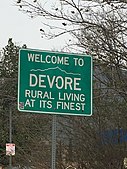
Of course I know about DeVore, California although I’ve never been there. The town was a stop on historic Route 66. It has since been incorporated into sprawling, 81 square mile, San Bernardino. Much of the DeVore neighborhood was leveled by a wildfire in 2003, with 904 homes destroyed.
If you travel 1,723 miles to the east you will find a dot-on-the-road community in Indiana also named Devore. Originally named Mill Creek, some interloper relative of mine got a post office located there and probably named it after himself.
Lovely little falls in Devore, Indiana
But back to Devore Peak. Despite my extensive internet research, I cannot find any ancestor or relative after whom the mountain is named although I suppose it could be the Reverend John DeVore. He was the first minister to establish a church north of the Columbia River in Steilacoom. From the Washington State History link site:
Monument in Steilacoom, Washington to Reverend John DeVore and the Methodist Church
“(Lafayette)Balch (Steilacoom’s founder) persuaded Reverend John F. DeVore (1817-1889) and his wife Jane Devore (d. 1860) to relocate to Steilacoom in 1853. DeVore built a two-story Methodist Episcopal church that also served as a school and meeting hall. When the church bell, ordered from the East, arrived with a balance due, residents took up a collection. Afterward the bell became town property, used to signal emergencies and public meetings along with the call to worship.”
When a college student, I drove down there one day from nearby University of Puget Sound (which was founded as a Methodist college) and located the marker for Reverend DeVore. Alas, the Reverend is not a direct ancestor and I was never able to establish any relationship.
But it does make one wonder – unless you have a very common last name – how many others share yours?
DEVORE is ranked as the 3,242nd most popular family name in the United States with an estimated population of 12,319.
This name is in the 99th percentile, this means that nearly 0% of all the last names are more popular.
There are 3.86 people named DEVORE for every 100,000 Americans.
This name is most often used as a last name, 99% of the time.
Based on US Census Bureau data the estimated population of people named DEVORE is 13,030, the rank is 3,005 and the proportion per 100k Americans named DEVORE is 4.09.
When you consider that there are some 329 million in the country that’s only .004 percent of all people with the same last name. If I extrapolate that even further and Google both my first and last names, there are 128 other people named Barbara DeVore in the U.S. currently.
Growing up I knew of only one other person with the last name DeVore who was not related to our family. That would be the butcher who worked at the Safeway on 36th and Tieton Drive in Yakima. I was always so very amused when I would go to the store with my mother. If the shopping trip involved a visit to the meat counter inevitably the exchange would go something like this:
Butcher: “Good Afternoon, Mrs. DeVore.”
Mom: “Good Afternoon, Mr. Devoir.”
And then they both would laugh.
Yes, Mr. Devoir the butcher spelled it different. But the two of them obviously enjoyed the inside joke of having the ‘same’ last name.
As I was writing this article, I could not think of a single person I’ve met casually with the last name DeVore. Through my genealogy research and DNA matching, I’ve found quite a number of cousins and have enjoyed getting to know many of them on Facebook.
Occasionally I will have someone ask do you know ‘fill-in-the-blank’ DeVore? Often, I am able to say he/she is my second cousin, once removed. But mostly it doesn’t come up.
I rather like the unique name and the mystery of it all. According to a book about the DeVore families compiled by Betty DeVore Mann in 1992, the history of the name is this:
Chateau de Vore near Remalard, France
“There is a small, stately chateau in Normandy, near Alencon and 3 kilometers from Remalard, named Chateau de Vore. The de Vore family left in the 17th century. Several American Devores have interviewed the 2 remaining de Vores in Paris. They knew very little about their ancestry, because their grandfather was the illegitimate son of a wealthy family and he was sent away when he was very young. He carried his mother’s maiden-name. And so the story goes…”
She also adds “the Huguenot Society tells us that Devore is of Huguenot origin. The Huguenots were the French Protestants who were persecuted and made a mass exodus from France between 1550 and 1780.”
When I first submitted my DNA information it stated that I was 3 percent French. Ancestry, however, frequently updates their estimates based on new DNA submissions to see who matches who and my specific French connection has long since disappeared.
When I looked at my most recent results, it suggested that I was 22 percent from England and northwestern Europe. Curious, I located Chateau de Vore in Remalard, France. It is about 85 miles from the Eiffel tower. When I overlaid my DNA profile to the region included as “northwestern Europe” I discovered that Chateau de Vore was within my DNA range. It is not outside the realm of possibility that the family lore just might be right.
While the DeVore family history will likely remain hidden in the mists of time, the pursuit of it has dogged me since I became old enough to ask “Who am I? And what am I doing here?”
Who knows, maybe there’s an historical novel in there, the intrigue of an illegitimate child who grows to a man. It is the story of a man who must disavow his country for his religion, never able to claim his true heritage, who must establish a new life in a distant land.
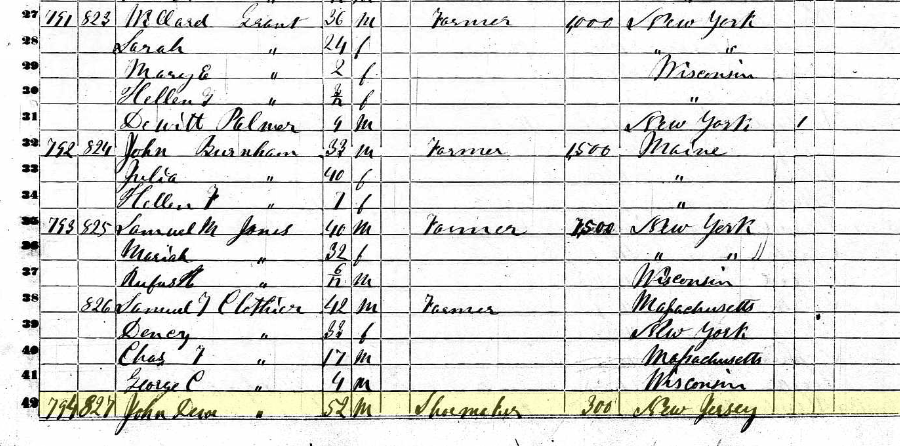
Perhaps not my family’s story… after all I do know that my great-great-great grandfather John DeVore was a shoemaker in Wisconsin in 1850. Not nearly as romantic as a swashbuckling Frenchman, right?
“This Is… American Idol!” These four words burst into our collective consciousness on June 11, 2002 and launched one of the most successful reality TV franchises in American History.
The American Idol stage
The show was an instant hit, showcasing the talent of people looking for their big break. Week after week fans tuned in to follow the stories of the lucky few selected to compete in the contest. The premise was, according to the Infallible Wikipedia, this:
The original American Idol judges Randy Jackson, Paula Abdul and Simon Cowell
“Each season premieres with the audition round, taking place in different cities. The audition episodes typically feature a mix of potential finalists, interesting characters and woefully inadequate contestants. Each successful contestant receives a golden ticket to proceed on to the next round in Hollywood. Based on their performances during the Hollywood round (Las Vegas round from the tenth through twelfth seasons), 24 to 36 contestants are selected by the judges to participate in the semifinals. From the semifinals onward the contestants perform their songs live, with the judges making their critiques after each performance. The contestants are voted for by the viewing public, and the outcome of the public votes is then revealed during a results segment. The results segment feature group performances by the contestants as well as guest performers. The Top-three results also feature homecoming events for the Top 3 finalists. The season reaches its climax in a two-hour results finale show, where the winner of the season is revealed.”
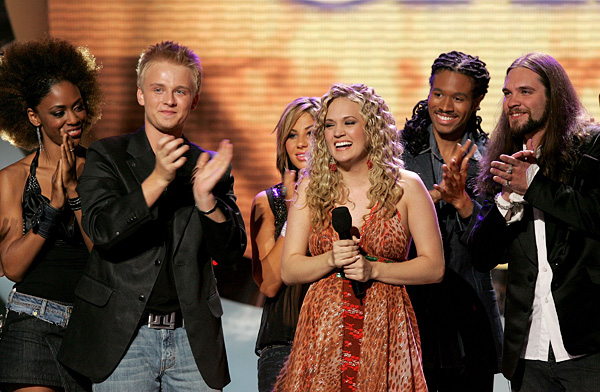
Carrie Underwood as seen during the 2005 American Idol competition
Along with the judges, viewers at home became music critics, repeating such phrases as “that was pitchy,” and “You’re going to Hollywood.” The judge everyone loved to hate, however, was Simon Cowell, who un-apologetically skewered the singing of contestants with such pithy remarks like “It was all a little bit like angry girl in the bedroom screaming on the guitar.”
I would argue that the high-water mark for the show was in 2005 with the crowning of Carrie Underwood as the winner. She has been, by far, the most successful AI alum and her win and subsequent stardom created much excitement and interest in the show. That excitement coalesced into the 2007 season with it being the number one show on TV that year. Also from the Infallible Wikipedia:
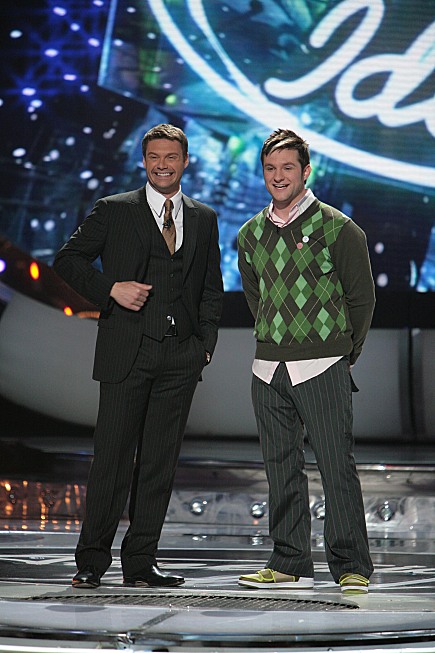
AMERICAN IDOL: Blake Lewis and Ryan Seacrest at the Kodak Theatre in Hollywood, CA, on Tuesday, May 22 on FOX.1508
“American Idol ended the season as the top show of the 2006–2007 TV season. Its Wednesday episodes ranked first with an average of 30.02 million viewers, followed by the Tuesday episodes which averaged 29.54 million. The premiere episode became the series’ highest rated debut episode, viewed by 37.44 million viewers and receiving a 15.8/36 Nielsen rating in the Adult 18-49 demographic.”
In my household AI fever kicked in to high gear when my teenage daughter became enthralled with it and AI took over our lives. Just before 8 o’clock each evening I’d hear the thunder of her footsteps coming down the stairs and soon we were wrapped up in the drama.
That year there was extra interest as a contestant from Bothell – six miles north of where we lived – was making a name for himself on the show.
Blake Lewis was, at the time, a local Seattle musician whose beat-boxing ability provided enough novelty that he earned a golden ticket to Hollywood. At first, it seemed, the judges viewed him as a one trick pony who would not survive the first round of performances. Week after week, however, Lewis proved that he could sing. He made each song his own with original arrangements, and defied the odds, advancing in each round.
Blake Lewis at the Bothell hometown visit in May 2007
For my 14-year-old daughter and a couple of her friends, Lewis became almost an obsession like the Beatles were in the 1960’s, or David Cassiday in the 1970’s, or the Backstreet Boys in the 1990’s (It’s what 14-year-old girls are known to do!)
Of course, Mom was pulled in to that universe also, as we then had to vote for him every week. And I’m not talking about dialing the phone one time and being done. Oh no. On American Idol they encouraged the viewers to vote many, many times. Hundreds of times. Once the performances were over we’d start dialing and continue until they closed them down.
And Lewis became the last man, literally, standing.
When the contest is down to the final three it’s time for the ‘hometown’ visit. Or, as the cynic in me believes, just another way to market the AI franchise to the public.
The Blaker Girls trio the afternoon of Lewis’ Hometown visit in Bothell
In the week before Lewis was to arrive in Bothell, my daughter and her friends “L” and “D” spent a couple of afternoons making t-shirts and posters and plotting the big event. Lewis’ female fans called themselves “Blaker Girls.”
During that week I became the ‘cool’ mom. I bought the many supplies and, on a warm, sunny afternoon on May 11, drove the trio of girls to Bothell so they could see ‘their’ American Idol. I figured there would be a crowd so we got there several hours in advance, secured a parking spot and joined the throng of over 7000.
The girls were not disappointed. The fans were amped up for the parade and, after a long wait, there he was… riding on the back of a Mustang convertible, smiling and waving to the crowd.
After the parade, we moved with the hoards down to the park where he was to perform live and receive his hometown hero’s welcome.
From the Seattle Time’s article:
The Bothell crowd of more than 7,000 was growing restless. Where was its American Idol?
Some teens chanted “We want Blake!” Others hoisted “We Ache for Blake” or “Bothell Boy, You Rock!” signs. And then, off in the distance, the twirling lights of police cars, the thundering beats of the Inglemoor Marching Band and Blake Lewis, all smiles and waves and two-fingered kisses, sailing down Main Street in a Mustang convertible with his beaming parents.
It was a highlight in a full day of events for Lewis that started at 8 a.m. at KCPQ/Fox studios for a television performance on the morning newscast. There was a lunchtime “mini-concert” at Seattle’s Westlake Center, a parade through downtown Bothell and another performance at the Park at Bothell Landing in the afternoon.”
Not sure who took this photo but my nephew found it… Mom with the always present camera.
Lewis ended up finishing second the next week, much to our disappointment.
For the next couple of years my daughter faithfully watched American Idol and even went to the American Idol tour with a friend in 2009. For me there has never been a more fun season than that one. I no longer watch the show, but for a few months in the spring of 2007, it was a magic time.
Update 2024: When I first posted this article in 2019, I thought that the photos and video from that day was lost. Then, during the 2020 COVID lockdown I sorted, organized, and sorted again. Lo and behold, video evidence of the visit to Blake’s Hometown parade exists!
Many thanks to my nephew Chris, who put together the photos I took that day as well as found at least one I did not take. Not sure who did, but the author appears at the 2:19 mark with camera in hand next to the screaming teens. Enjoy!
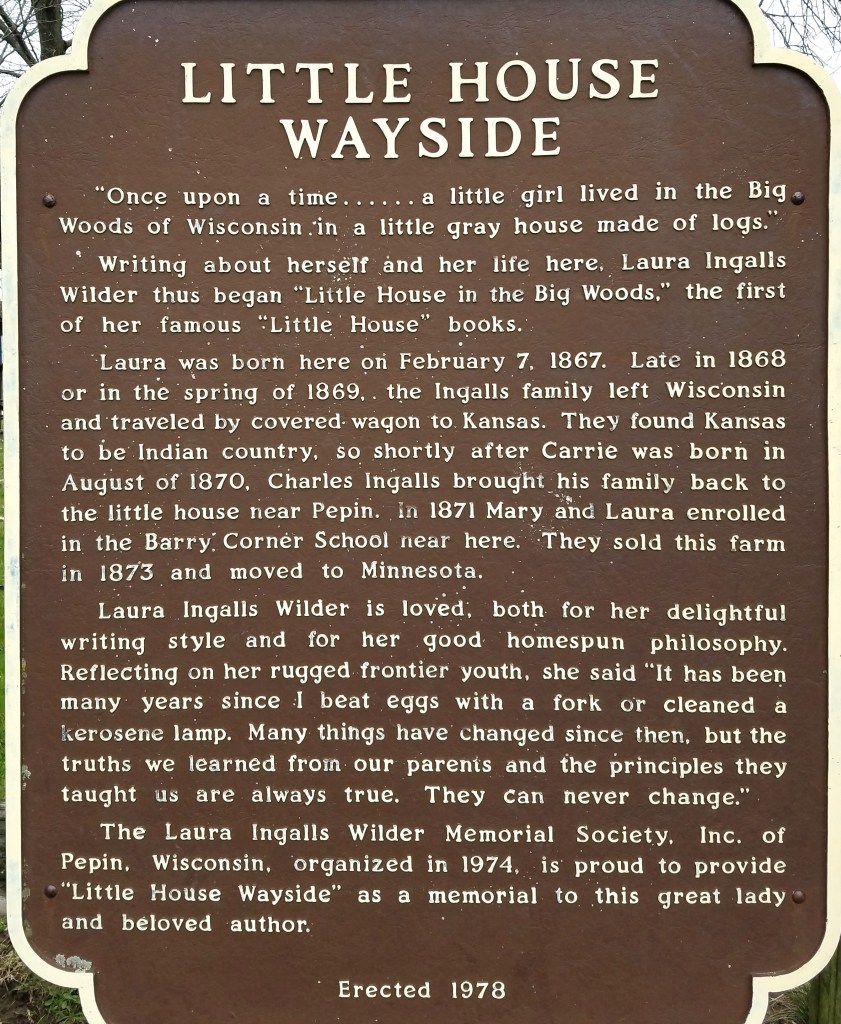
Sign at the “little house” that started it all in Pepin, Wisconsin
Perhaps more than any other books I’ve ever read, this series captured my young imagination and inspired me to want to write and record my world.
The first “Little House” book was published in 1932. Six more followed over the next decade and Laura Ingalls Wilder was propelled from a farmer’s wife to one of the most beloved children’s book authors in history.
As a child I was entranced by the thought of living in a cabin in the big woods of Wisconsin, or in a dugout carved into the banks of Plum Creek in Minnesota, or in a claim shanty on the wind swept prairies of South Dakota. What adventures awaited!
I’ve had as a goal to visit the many homestead sites. In September 2013 I, along with my 20 year old daughter, went to Mansfield, Missouri, and toured the museum and also the house where Laura lived as an adult. This past week was round two when the hubby and me meandered from Wisconsin to South Dakota and traced a portion of the Ingalls family pioneer journey.
The Little House in the Big Woods in Pepin, Wisconsin
The takeaway for me as an adult – considering it from the perspective of a wife and mother – is how very difficult it must have been, especially for Laura’s mother, Caroline.
Our first stop was in Wisconsin. Although the Ingalls’ cabin is long gone, those who preserved the sites have erected faithful reproductions of the original structures. The little house in Wisconsin was certainly that: little. The main room was no bigger than a small bedroom by today’s standards. For the pioneers, this room was kitchen, dining room, living room, and laundry room (at least half the year). The entire family slept in a room the size of a closet.
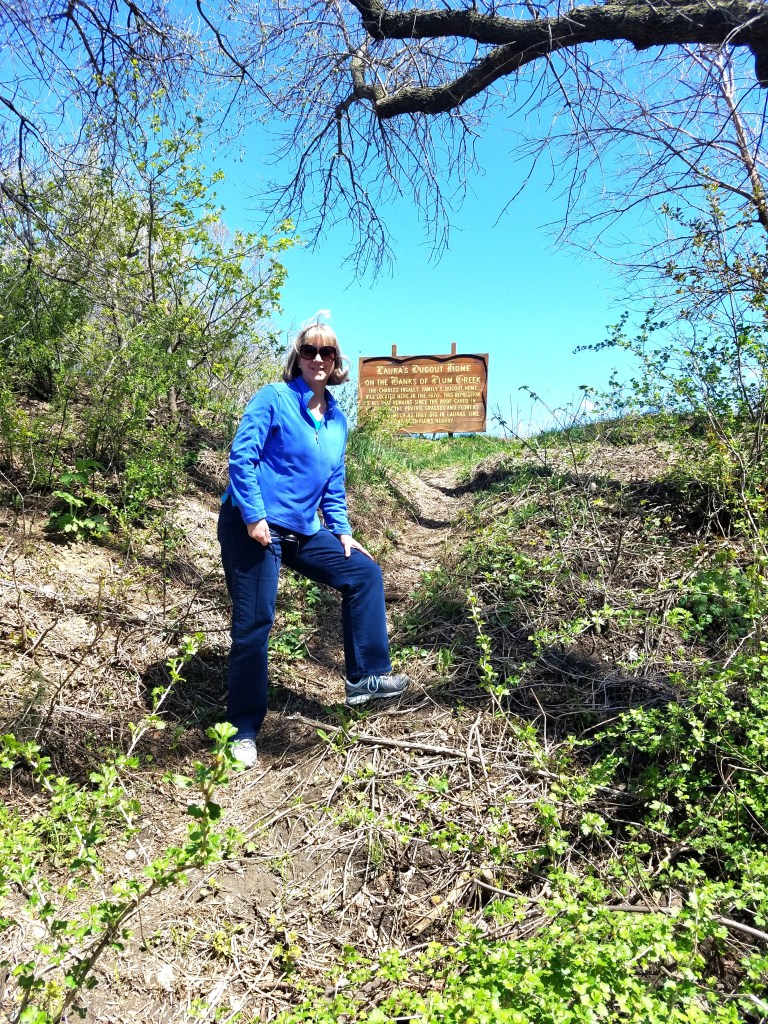
This author standing about where the dugout door was located on Plum Creek, Minnesota.
Plum Creek how it looks now
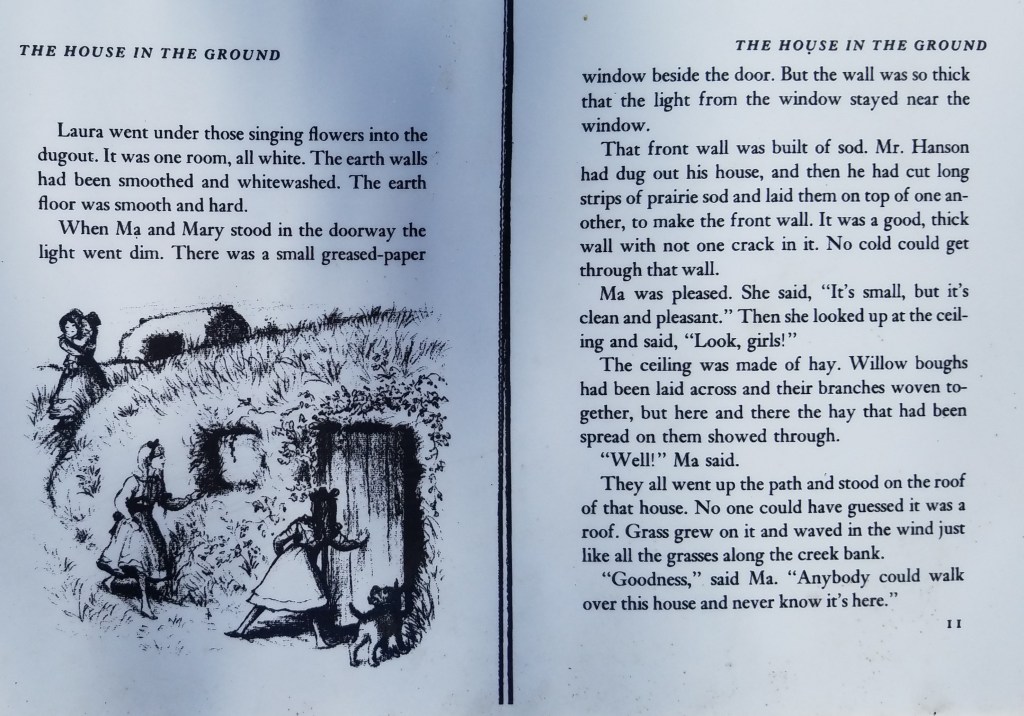
Excerpt from On The Banks of Plum Creek where Laura describes the ‘house.’
It was the next ‘house’, however, that really gave me pause. Laura’s family purchased a farm near Walnut Grove, Minnesota… but there was no ‘house.’ Instead, the family lived for some months in a ten by twelve ‘room’ dug out of a bank above a creek. The actual dugout collapsed years ago, but a reproduction exists in South Dakota. When I walked in to that room two days later I was struck by two things in particular. The first was the smell. It was a combination of earth, mold, and damp. It was depressing and dark. As Laura describes life in the dugout she shares how her mother whitewashed the dirt walls and floor with a lime mixture. I imagine the lime served several purposes including, foremost, pest control and to brighten the room. How hard it must have been for Caroline Ingalls to cook, clean, and care for her children in that tiny, tiny space.
The author and hubby at DeSmet, South Dakota
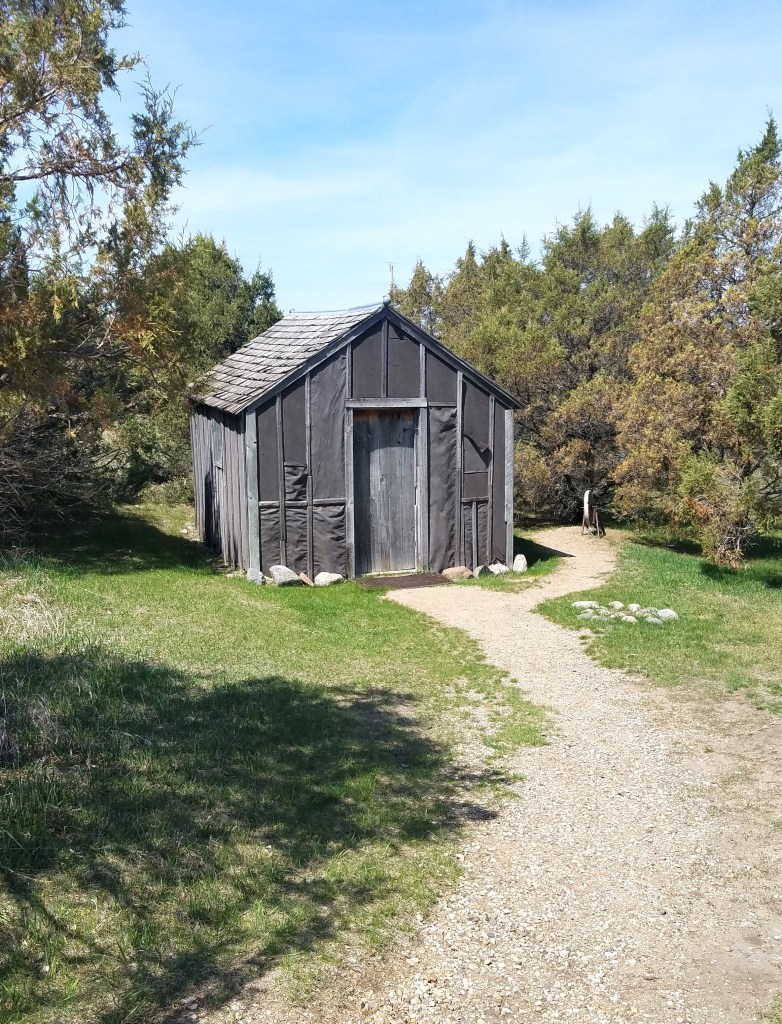
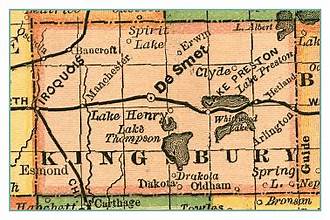
In South Dakota the Ingalls family had to, once again, start from scratch. It was not hard to imagine how alone and desolate Caroline must have felt as one of the first pioneers in DeSmet. Their homestead was 160 acres – one quarter mile square – and it was a half mile south of the town. There were no neighbors, just the wildlife which called the prairie home. The Ingalls claim shanty was just that: a shanty. Unlike the cabin in Pepin, this home was a tiny one room shack with the beds for a family of six in every corner, a stove in the center, and a few chairs and a table. The thin walls not much protection against the persistent winds and cold. Over time the shanty was expanded to include 2 small bedrooms and a 12 by 16 living room.
Replica of the ‘shanty’ where the Ingalls family of six lived the first summer so Pa could ‘claim’ his land.
What resilience these people possessed!
When we stopped at the Ingalls homestead near DeSmet, the woman who owns and runs the property came by to speak to us. I said to her I suspected when the Ingalls family arrived there that Caroline told Charles she was done moving and carving out homes in the wilderness. Our hostess confirmed my supposition. Laura’s parents lived the rest of their lives in that community, eventually moving to a proper house in the town eight years after their arrival.
It is impossible to truly capture these places on paper. But Laura Ingalls Wilder’s narrative description of each location comes close. I felt as if her spirit was there with us in South Dakota, especially, as I mapped out some travels to the spots she describes in her books.
The roiling waters of Lake Henry during the spring perch hatch
It was at Lake Henry when the magic occurred. The hubby and I noticed the water in a nearby slough was roiling. Upon closer examination we discovered hundreds of fish flopping and thrashing about! We walked close to the spectacle, mesmerized by the yellow perch which spawn this time of year once the water raises to a certain temperature.
From there we meandered across the back-roads, and observed white tailed deer, a muskrat which waddled across the road, and hundreds of birds: pelicans, herons, eagles, hawks, geese, and all variety of smaller ones.
We were reluctant to leave but how very glad we were to be able to experience a tiny portion of the Ingalls family journey.
So which of the three ‘little houses’ would have been the best ? Probably the cabin in Wisconsin. As we returned from our adventures I found myself thankful, yet again, for modern amenities: electricity, running water, flushing toilets, refrigeration, automobiles, and airplanes. What a blessed era in which I live.
Nicknamed “The Granddaddy of them All” – the annual football contest known as “The Rose Bowl” debuted on January 1, 1902.
It was an uneven matchup with Michigan defeating Stanford 49-0. Apparently the gridiron battle was devised to help fund the Pasadena Rose Parade. But that first game was such a disaster – Stanford quit after three quarters – that the football game was abandoned for more than a decade. From the Infallible Wikipedia:
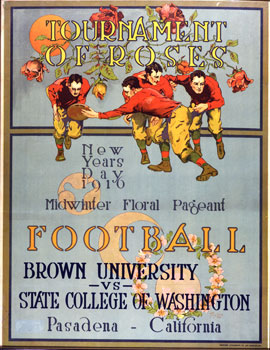
1916 Rose Bowl promotion piece
“The game was so lopsided that for the next thirteen years, the Tournament of Roses officials ran chariot races, ostrich races, and other various events instead of football. But, on New Year’s Day 1916, football returned to stay as the State College of Washington (now Washington State University) defeated Brown University in the first of what was thereafter an annual tradition.”
The Rose Bowl, as those of us knew it in the 1960’s through the 1990’s had understood, wasn’t always a match between the Pac-8 (and then the Pac -10 with the addition of Arizona and Arizona State in 1978) and the Big-10. That tradition began in 1959 after a ‘Pay to Play’ scandal derailed the previous agreement in place since 1947.
And the tradition worked well with the Pac-10 champion meeting the Big 10 winner on New Year’s Day. Then, in 1998, with the creation of the Bowl Championship Series (BCS), things changed. In both 2002 and 2006, the National Championship game was played in Pasadena. But it was not without controversy. Also from the Infallible Wikipedia:
“The 2002 game served as the BCS championship game between the BCS No. 1–ranked Miami, then a member of the Big East Conference, and the BCS No. 2–ranked Nebraska, then a member of the Big 12 Conference. The Nebraska selection as the BCS No. 2 team was controversial because Oregon was ranked No. 2 in both the AP and Coaches Polls, while Nebraska was ranked No. 4 in both polls and did not play in its conference championship game (No. 3 Colorado, who would play Oregon in that year’s Fiesta Bowl, did and won the Big 12’s automatic bid to the BCS). This prevented a West Coast team playing in the Rose Bowl for the first time, and it also marked the first matchup since 1946 not to feature the traditional pairing of Pac-10 vs. Big Ten teams.”
Since 2014, and the advent of the College Football Playoffs, the Rose Bowl traditions have seen further modifications. Now, every three years, it features one of the two playoff games. In 2015 and again in 2018, there was not a traditional Pac-10/Big-10 matchup.
For those of us who prefer tradition, the 2019 matchup of #9 Washington and #6 Ohio State is everything the Rose Bowl is supposed to be. It will be Ohio State’s 15th appearance and Washington’s 16th visit. But the two teams have never met in the Rose Bowl.
Pin issued for the 1978 Rose Bowl featuring the “Rose Bowl Roses”
I have two distinct memories associated with the Rose Bowl. The first occurred at the Apple Cup on November 19, 1977. My sister, then a student at Washington State University, came to Seattle to attend the game and took her sister (I was attending the University of Puget Sound) along. It was a brilliantly sunny, but cold, day. As we approached the stadium there was a tall guy dressed all in black who held long stem red roses in his hand and was shouting “Rose Bowl Roses. Get your Rose Bowl Roses.”
We, of course, were offended by the presumption that the Huskies were going to the Rose Bowl BEFORE the game with WSU was even played! After all, Washington had to beat WSU and USC had to beat UCLA for the Huskies to earn a trip to Pasadena.
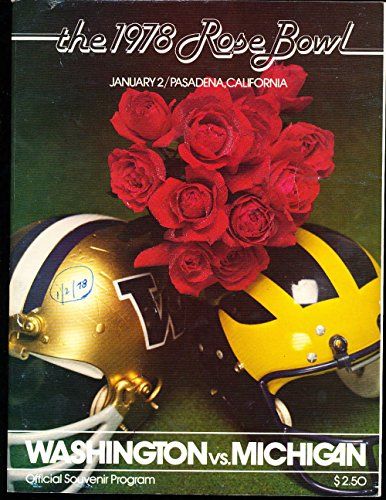
Souvenir program from the 1978 Rose Bowl. Washington defeated Michigan in their first of four Rose Bowl matchups.
No Rose Bowl Roses were purchased by us that day. But we definitely needed the extra warmth and fortitude provided by the flask she smuggled into the stadium. We were seated in the visitors horseshoe at the far west end of the stadium. The buttressing of our spirits from the extra spirits was required as the Huskies hammered the Cougs 35-15 and USC dispatched the Bruins the next weekend. Washington flew to Southern California and, on January second (the Rose Bowl is played on the second if the first falls on a Sunday), upset heavily favored Michigan 27-20.
The other memorable Rose Bowl was 1998. We didn’t need anything warm to drink that day as my family – Parents, siblings, spouses, children, nieces and nephews – spent 10 days in Maui to celebrate our parents’ 50th wedding anniversary. My parents had arranged for condo units for each of us four siblings and our families in the Hale Hui Kai complex. Since my sister and I both had young children (they were ages 4 to 8) we were assigned ground floor units so as not to have to deal with stairs. The down side was that my unit had absolutely no view . Everyone assumed we would be at the beach with our kids most of the time. Hah! My daughter had become obsessed with the Disney animated movie Sleeping Beauty. So most every afternoon I ended up hanging out in the unit while she watched Sleeping Beauty. Unless, of course, she was across the breezeway playing Barbie’s with the cousins. Except on New Year’s Day when Sleeping Beauty was relegated to the back burner and all the guys – Dad, brothers, husband and brother in law – descended upon our unit to watch the #8 WSU Cougs take on #1 Michigan.
WSU encountered a thorn of rose brambles when they lost to Michigan in the 1998 Rose Bowl Game. Thankfully Sleeping Beauty distracted me from noticing.
Although the Cougars launched a valiant effort in what was their third of four Rose Bowl appearances, they fell to the soon to be crowned national champions 21-16.
And my daughter? A couple of things are no longer true. She’s not obsessed with Sleeping Beauty; she’d be horrified at the thought of spending a Hawaiian vacation holed up in a condo; and if she had friends who started a college football fantasy league she’d participate and soon know everything about the teams and players.
I’ll be rooting for the Huskies (don’t tell the die-hard Coug fans in my family, okay?) to prevail over Ohio State, but I’m really worried about QB Dwayne Haskins and the OS offensive line. Plus with their coach, Urban Meyer, retiring they will be the sentimental pick. Currently Ohio State is favored to win but, who knows, it might just be the Huskies year for an upset. The only thing better would be to spend New Year’s Day on the beaches of Maui.
Update January 2, 2019: The Huskies lost the 2019 Rose Bowl game, falling to the Buckeyes 28-23. My Dad was happy about this as in his entire life he never once rooted for the Huskies to win…
2024 Update:
Well here we are in 2024 and the college football landscape was shaken by an earthquake earlier this fall. With the dissolution of the Pac-12 and the dismantling over the years of the traditional bowl matchups, we find ourselves in a very ironic situation.
Now, even though the 2024 Rose Bowl wasn’t a Big 10-Pac12 matchup, I have to admit that those two conferences are getting the last laugh.
It is somehow fitting that when the National Championship Game is played on Monday, January 9, 2024, it will feature –likely for the last time – a traditional Rose Bowl matchup when #1 Michigan faces off against #2 Washington.
The two teams have met four times in the Rose Bowl with the following results:
1978 – Washington 27, Michigan 20
1981 – Michigan 23, Washington 6
1992 – Washington 34, Michigan 14
1993 – Michigan 38, Washington 31
If it continues to follow the pattern, then Washington will emerge victorious. I’m not sure I can actually watch the game as viewing the contest at the Sugar Bowl between Washington and Texas last night just about did me in. So much stress!
Even so, I will be rooting for the Huskies to win and take home the National Championship. Go Dawgs!
Of course the Infallible Wikipedia has so much more to share:
























 barbaradevore.com