Tag Archive | Yakima Washington

The Sigma Kappa Connection

The actual place which inspired the fictional Gamma Alpha Beta Sorority
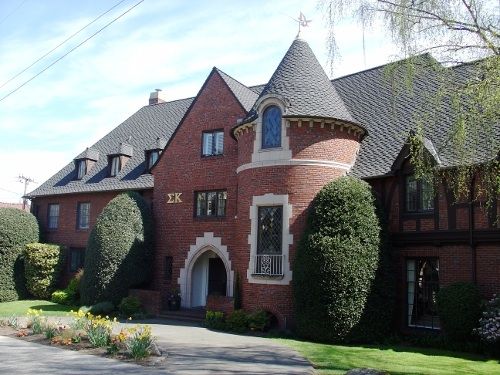
The Sigma Kappa sorority house at the University of Washington is on the National Historic Site.

The Sigma Kappa sorority house at the University of Washington is an enchanted place. The grandeur begins outside the front of the house with its classy brick façade and a stunning mix of Victorian and Tudor architecture. Truly notable is the three-story high round turret.

Once inside, the turret does not disappoint with its centerpiece being a wide and sweeping circular staircase which invites all eyes upward towards a magnificent crystal chandelier.

For a starry-eyed child, that staircase invited you into a place of fantasy and daydreams; up the stairs one would climb and promenade down them as if a princess, creating stories in one’s head.
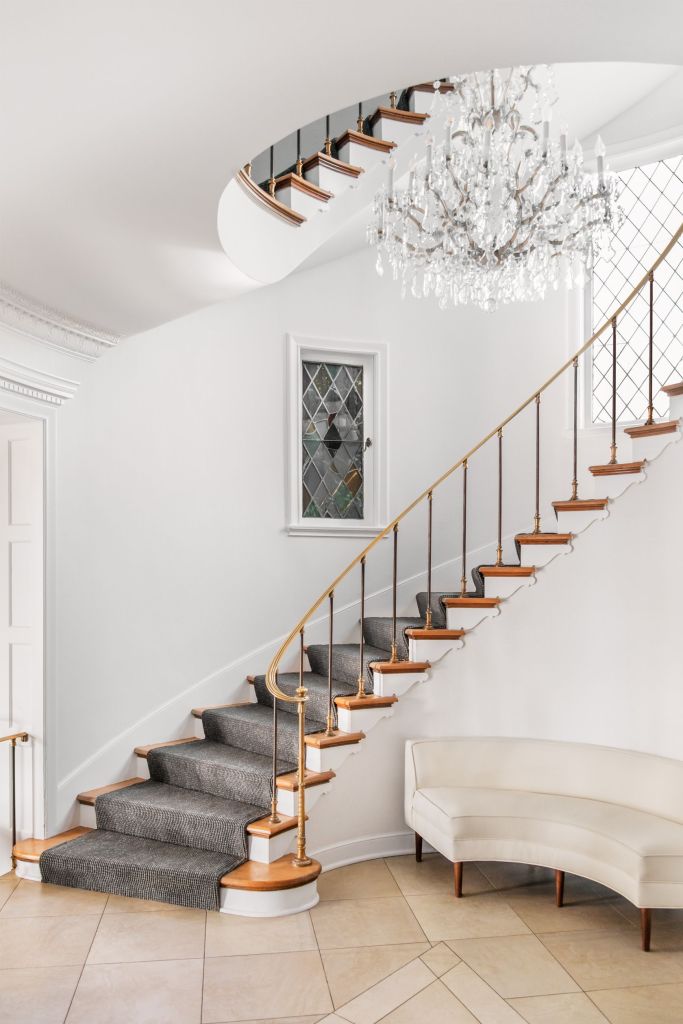
Photo of the staircase as found on Pinterest

My first visit to this magical place was likely in the early summer of 1963. My grandmother, Alma DeVore, had taken a job as the housemother and, with the students gone for the summer, invited my family to come visit her at her new job.

I have no idea how many days we stayed, or if we even slept at the house. My older by two years sister says we stayed nearby at our uncle’s house. I was five at the time and I remember little about the visit to Seattle and the Woodland Park Zoo and more about the Sigma Kappa house.

There was a skybridge which connected the formal living areas to the dining hall and kitchen. In the basement were all sorts of mysterious rooms including one painted bright purple which we were told was the chapter room. Around every nook there was another cranny.

The author captured on a grainy video from 16 mm home movies 1963

Hallways were lined with closed doors to, undoubtedly, the private rooms of the members. At the very top level was a long sleeping porch with parallel rows of bunk beds where all the members slept. There was a back staircase leading to new and interesting spaces. It was the ultimate place to play hide and seek as you could scurry up one set of stairs and down another and through different corridors.

Through photos and documents which she had kept – and are now in my genealogy collection – I’ve determined that my grandmother must have arrived as the housemother beginning in January of 1963.

In 1946, the opportunities for women to earn a living were limited. On September 17th of that year she found herself a widow. Here she was, 46 years old, and with – at most – a high school education; she had no marketable skills beyond having raised three children: my uncle Lyle, my dad, Vince, and their younger sister, Arlene; and managing her own household.

Fortunately for her, she lived in Walla Walla, Washington at the time and was hired as the housemother for the Tau Kappa Epsilon (TKE) fraternity.
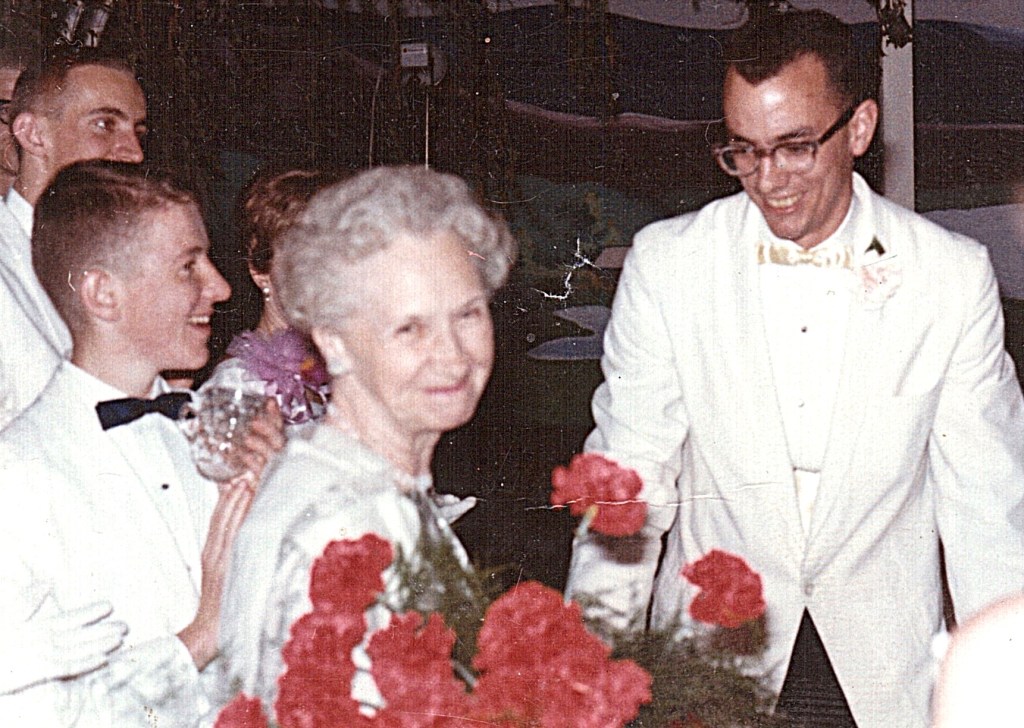
My grandmother with the TKE fraternity members at Whitman College in late 1962 at her Farewell party.

The TKE years were good ones for her from what I’ve been told. She enjoyed the young men who were members and there was a camaraderie with the other housemothers. I can’t say for sure why, exactly, she left Whitman and took the job at the Sigma Kappa house except that it brought her closer to my Uncle Lyle and his family who moved to the Ravenna neighborhood in Seattle in the mid-1950’s. Although my parents lived in Walla Walla after both graduating from Whitman and by oldest brother having been born there, my family had left the community shortly after his birth as my dad had been transferred to Moscow, Idaho with his job at National Cash Register.
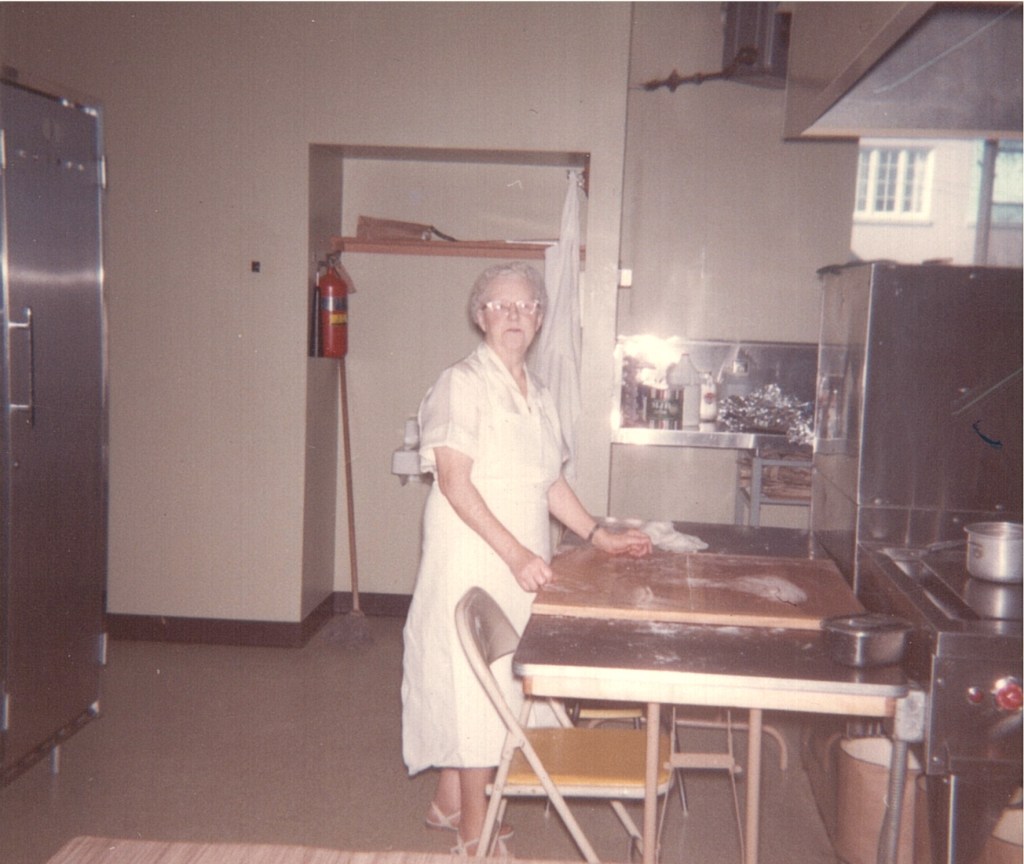
Cook Anna Blomgren in the Sigma Kappa kitchen 1965
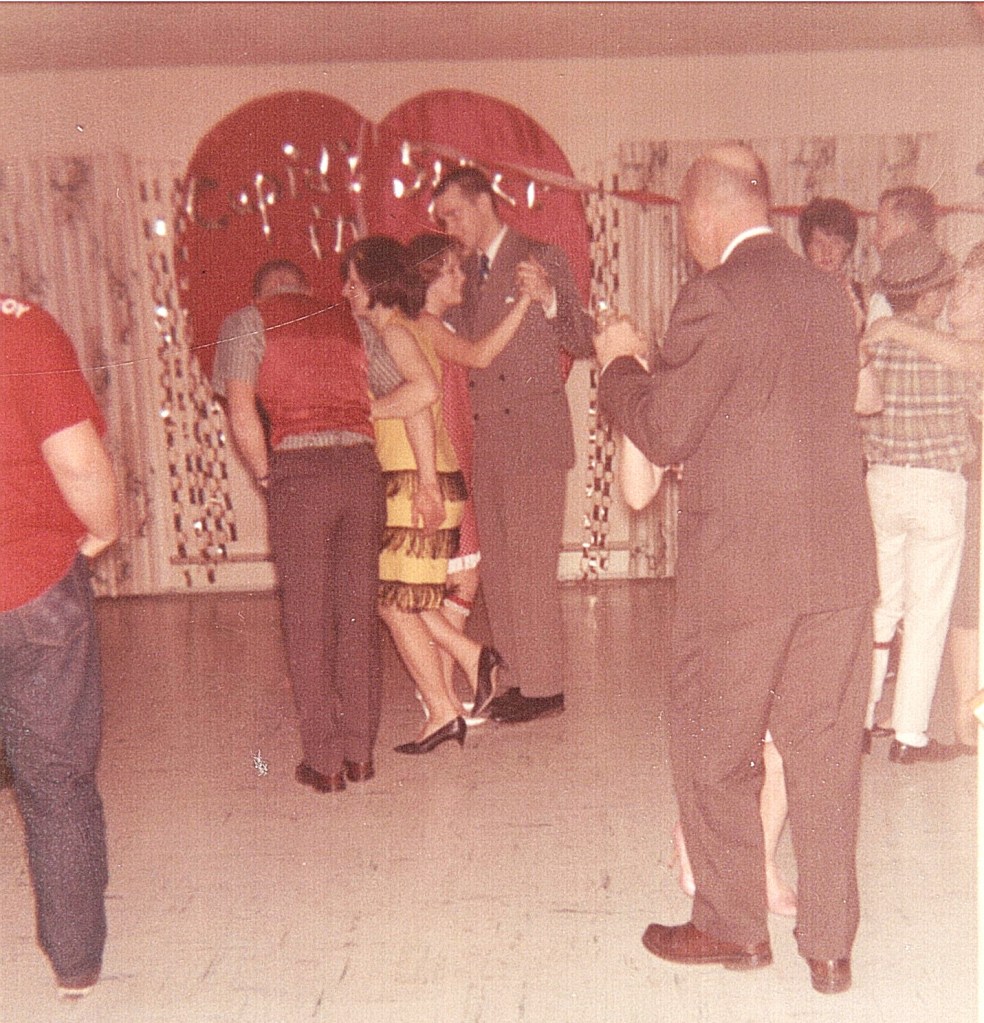
Valentine’s Day ‘Gay 90’s’ shared dance with the Zeta Tau Alpha sorority February 1966

The only other time I know for sure we visited her there is in March 1965. That winter, in Yakima, Washington, where I grew up, the entire town is abuzz. Competing in the State AA Basketball playoffs were our crosstown rivals: D.D. Eisenhower (Ike) and A.C. Davis high schools.

The University of Washington was, I suspect, the best possible choice to be closer to one of her children and family and be able to support herself.

My dad, who had left National Cash Register 1961, returned to college to get a degree in Education, now taught Washington State History to ninth graders. He loved teaching and was invested, particularly, in the local sports community. At the end of the Region 4 semi-final round on March 13th, Ike lost to Davis who was now poised to play at the Seattle Center Coliseum the next Friday.

Although neither of my brothers went with us – my oldest brother attended Ike and would not have anything to do with Davis – my Dad was undeterred and my sister and me – now ages 9 and 7 – were loaded in the 1960 pink Dodge station wagon, and drove with our parents to Seattle on Friday, March 19th.

While I don’t recall a lot of the details, I do know that it was the UW’s Spring break, so the house was empty of sorority girls. And I got to live out every fantasy I had about that house. I was in heaven.
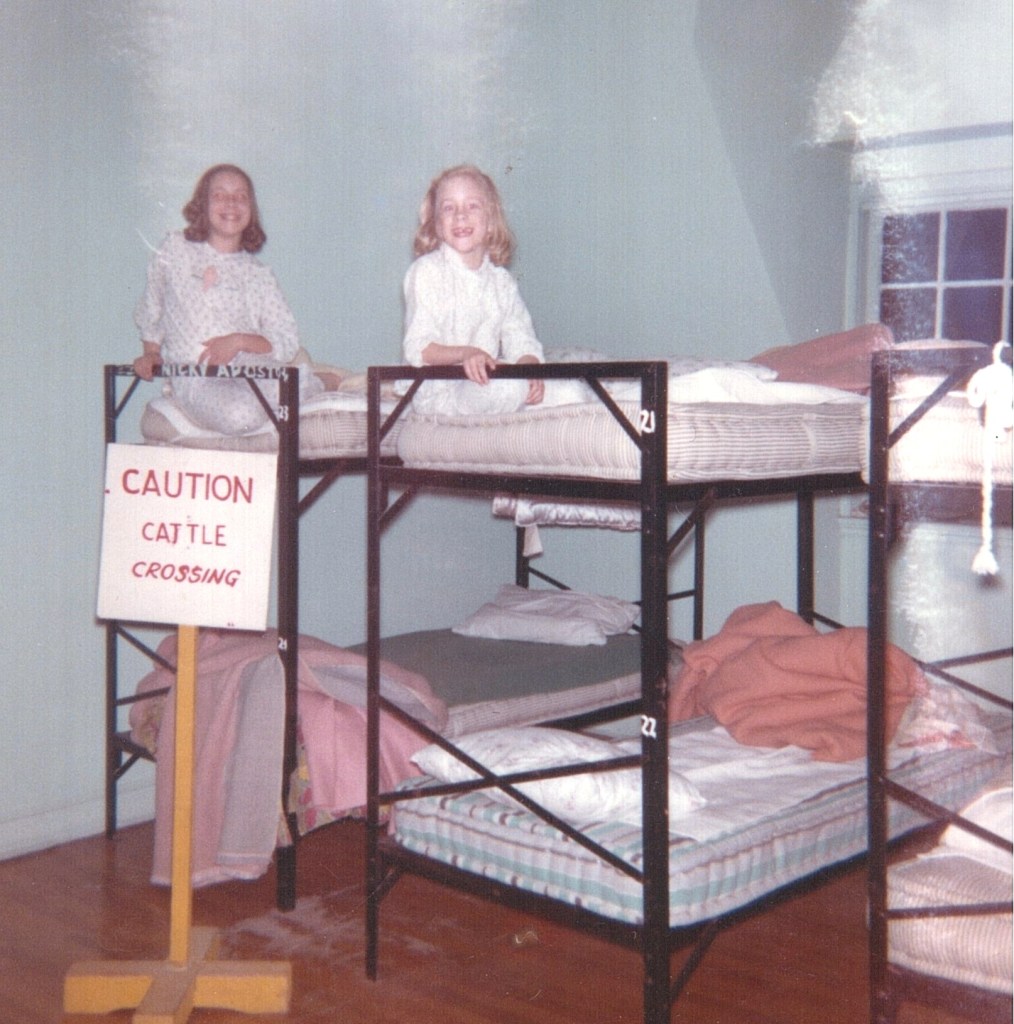
My older sister (left) and me on the Sigma Kappa sleeping porch March 19, 1965.

That evening, while our parents went to the basketball games, my sister and I stayed with our grandmother and even got to sleep on the sleeping porch!

Davis won and would be in the championship game the next evening! Once again, we hung out with grandma while my parents went to the game, my dad thrilled when Davis beat Roosevelt 66-49 for the 1965 AA state basketball championship.

Sometime late that evening, our parents arrived back at the Sigma Kappa House, and put my sister and me to ‘bed’ in the back of the Dodge station wagon. We traveled home that way, snuggled in sleeping bags with our heads on pillows that let us look up at the sky while we drove through the dark mid-March night.

My last memory of that trip is of looking up at the snow falling that night on Snoqualmie Pass, swirling in mesmerizing chaos, with the thick flakes illuminated by car headlights shining through the window behind our heads.
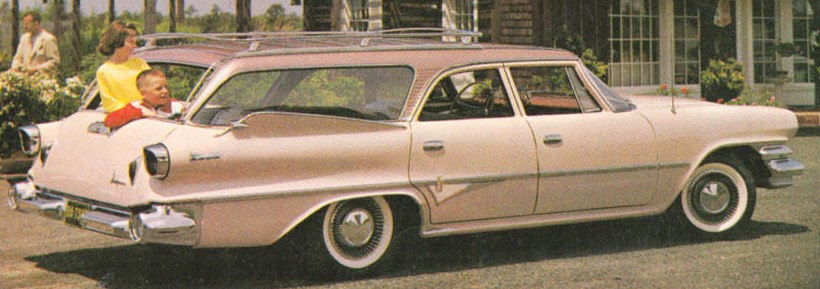
Not the DeVore family car, but ours WAS this same pink color and, apparently, those children also rode without seat belts in the back of the wagon.

My grandmother, born March 15, 1900, seems to have retired at the end of the 1966 academic year. Some 15 years earlier she had bought a house in Spokane. She had it converted to a duplex which she rented out for all those years when she was a housemother! In going through her papers, it was apparent that, despite not having a college degree, she was a determined woman who did not wallow in her grief, but pulled on her work boots to insure her own future. She retired to Spokane and lived in the left half of the duplex, renting the right half out until her much too early death in January 1970.

I have never gone back to the Sigma Kappa house. I think if I did it would seem smaller and less grand than my memories. Instead, it has morphed into the Gamma Alpha Beta sorority, as much a ‘character’ in ‘The Darling of Delta Rho Chi’ as Elise, Riley, Jack, and Virginia.

A few links:

Designation as a National Historic Site:

Have to have one from the Infallible Wikipedia https://en.wikipedia.org/wiki/Sigma_Kappa

A link to the official chapter page: http://washington.sigmakappa.org/

Program from the 1965 State AA basketball championship: https://issuu.com/tacomasportsmuseum/docs/2018.29.02

Article from the Yakima Herald Republic:

The First Thanksgiving

The Fourth Thursday In November

November 26, 2024

A Tuesday Newsday Classic

The celebration of harvest by setting aside a day of ‘thanksgiving’ is a tradition long observed by people the world over.  Most Americans embrace the idea that the first Thanksgiving was held in Plymouth, Massachusetts, by the pilgrims who settled the wilderness there in 1621.

But a historical look at ‘thanksgiving’ celebrations indicates a more haphazard approach. In fact, colonists in Virginia also held feasts of ‘thanksgiving’ during the early years of European settlements and a number of years before the New England events. In subsequent years such feasts were declared from time to time, occurring whenever it seemed a good idea for a few days of eating and celebration.

It was George Washington, as the first president, who by proclamation made Thursday, November 26, 1789, a ‘National Day of Thanksgiving.’

From the Infallible Wikipedia:

“As President, on October 3, 1789, George Washington made the following proclamation and created the first Thanksgiving Day designated by the national government of the United States of America:

Whereas it is the duty of all Nations to acknowledge the providence of Almighty God, to obey his will, to be grateful for his benefits, and humbly to implore his protection and favor, and whereas both Houses of Congress have by their joint Committee requested me ‘to recommend to the People of the United States a day of public thanksgiving and prayer to be observed by acknowledging with grateful hearts the many signal favors of Almighty God especially by affording them an opportunity peaceably to establish a form of government for their safety and happiness.’

Now therefore I do recommend and assign Thursday the 26th day of November next to be devoted by the People of these States to the service of that great and glorious Being, who is the beneficent Author of all the good that was, that is, or that will be.’”

Although additional ‘days of thanksgiving’ were proclaimed over the years, it was during the Civil War when the last Thursday of November became the traditional celebration date. And, in a coincidence, it was also November 26th for that official celebration.

Controversy arose, however, when – during Franklin Roosevelt’s term as President –there was a ‘fifth’ Thursday.  Also from the Infallible Wikipedia:

“On October 6, 1941, both houses of the U.S. Congress passed a joint resolution fixing the traditional last-Thursday date for the holiday beginning in 1942. However, in December of that year the Senate passed an amendment to the resolution that split the difference by requiring that Thanksgiving be observed annually on the fourth Thursday of November, which was usually the last Thursday and sometimes (two years out of seven, on average) the next to last. The amendment also passed the House, and on December 26, 1941, President Roosevelt signed this bill, for the first time making the date of Thanksgiving a matter of federal law and fixing the day as the fourth Thursday of November.

For several years some states continued to observe the last-Thursday date in years with five November Thursdays (the next such year being 1944), with Texas doing so as late as 1956.”

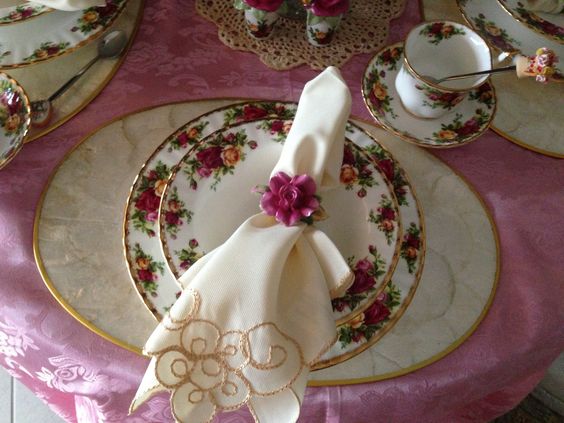
Royal Doulton china similar to my Aunt’s set of dishes

Eventually, however, everyone got on board with the change which, of course, made the planning of parades, retail sales, and football games much easier.

For me, Thanksgiving was always a long-anticipated day. My family moved to Yakima in 1961 and, as a small girl of four years, I had no prior memories of the event.  All my recollections are of the two holidays – Thanksgiving and Christmas – being spent at either my family’s house or that of my cousins.

Being that my cousins’ house was a short walk down 31st Avenue, it became tradition that our two families of six each – along with my maternal grandparents – would spend Thanksgiving together.

My uncle owned a piano and organ store for a time. While he didn’t sell these, there was an antique pump organ in their basement.

I loved going to their house for the holiday for a number of reasons, the first being that my Aunt Helen set the most gorgeous table.  Even as a child I loved china and hers was exquisite. It might have been Royal Doulton Country Roses – or a knockoff – but I recall it was bold, fussy, and beautiful. She had enough place settings to accommodate 14 people but not enough seats at the main table… so the five younger children (2 boys, 3 girls) were relegated to the kitchen table WITH the pocket door closed. It was glorious. Behind that closed door, mischief abounded with my brother – who was four years older than I – the main mischief maker. There were jokes told, inappropriate noises, and much laughter. We thought we were the lucky ones not having to endure the boring adult conversations which seemed to center on who was sick or had died that year.

The third, and my favorite, reason I loved going to the cousins’ house was because of their basement.  After dinner (which was ALWAYS served at 1 p.m. and over by 1:45) we were sent downstairs. That basement was the one place in my fastidious Aunt’s house where we could play without concern over too much noise.

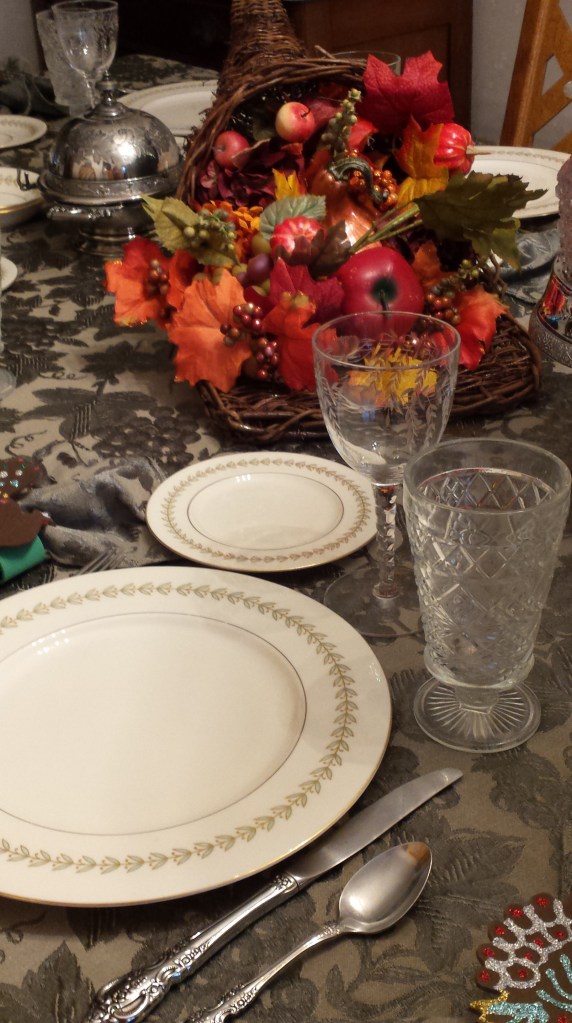
In 2018, a year after my mother’s death, we had Thanksgiving in Yakima with my dad. Shown here is my mother’s china which I used to set the table that year.

Oh, the adventures we had! Like the time we set up the Ouija Board and invoked spirits (of the dead relatives discussed at dinner) only to have the basement window bang open at the exact moment of contact. And the time that my sister and cousin Tim put on a play in the basement, complete with a curtain and props, and a surprise ending. My uncle had an old pump organ down there which fascinated me as I pumped the pedals and pulled on knobs to create different sounds as I ‘played’ the instrument.  We never ran out of things to do and I was always sad when the hour grew late and we had to return home.

When I think of my many blessings in life, I’m especially thankful for my childhood and those special holidays I spent with my siblings and cousins. At the time I did not appreciate the transitory nature of life and thought it would always be that way.

I’ve come to cherish Thanksgiving and have to say that it’s truly my favorite holiday. At no other time do we pause to give thanks for all our blessings and the people who make our lives richer and better.

I wish you all a wonderful Thanksgiving.

As always, a link:

The Energizer Bunny

Still Going…

October 29, 2024

A Tuesday Newsday Classic Updated

In the world of advertising, this campaign was particularly brilliant. The story begins in 1983 when Duracell featured a dozen stationary, identical light pink bunnies, all battery powered, drumming on snare drums. The announcer intoned that the one with the Duracell battery would last longer. Eventually, all the batteries die with the exception of the one powered by Duracell.

On October 30, 1988, however, a new bunny emerged on the advertising scene and stole the show from Duracell.

The Energizer Bunny was also pink but instead of being one of a crowd which outlasts the others, this rabbit had attitude. It wore hip sunglasses. It was hot pink. It moved around the room on blue flip flop sandals. And it had a big ole bass drum with the word “ENERGIZER” emblazoned across the surface. In short, it had important elements of a great advertising campaign in that it was memorable and humorous. The bunny has appeared in over 100 commercials and has been featured on TV shows and in movies.

From the Infallible Wikipedia:

“Commercials after the first started out with the Bunny leaving the studio it performed the ‘Drumming Bunny’ ad in, then wandering into the sets of a couple of realistic-looking commercials for fictional products, interrupting them. As the campaign progressed, many of these ads were standalone (for fake products such as ‘Sitagin Hemorrhoid Remedy’, ‘Nasotine Sinus Relief’, ‘TresCafe Coffee’, ‘Alarm’ deodorant soap, etc.) (snip) only to have the Bunny march through, beating his drum, because he was ‘still going’. Eventually real-life products and icons would do a crossover with the Energizer Bunny (Michael J. Fox doing a Pepsi ad, and the opening of TV shows such as Alfred Hitchcock Presents and ABC’s Wide World of Sports). The Energizer Bunny has appeared in more than 115 television commercials.”

A fun look at how the Energizer Bunny got a makeover in the 2000’s

The Energizer Bunny has come to represent something or someone which keeps going and going, seemingly without end.

In late November 2010 I was in Yakima staying to take care of my parents who were in crisis that week. My mom – who had dementia and mobility issues due to a stroke a year earlier – needed round the clock assistance. Between my dad, a part time caregiver, plus help from both my sister and me, they had been managing okay.

Dad and Mom in 2015. By then my mother lived at Apple Creek Adult Family home. Always devoted, my father visited her every day, usually twice a day.

The Tuesday before Thanksgiving, however, Dad collapsed and was discovered by the caregiver. 9-1-1 was summoned and he spent three days in the hospital. A difficult patient, he convinced the doctor to release him earlier than the Doc thought prudent, and arrived home on Friday, November 26th proclaiming he was just fine.

A little after 10 p.m., he went in to take a shower. I heard him calling for help a few minutes later and rushed in to discover him collapsed on the floor. After many struggles I was able to get him up onto the seat of my mother’s walker, but he was slumped to one side. He objected to the thought of calling 9-1-1 (again!) so I called my sister who, along with her husband, came over. Eventually we did call the medics who arrived and discovered his heart was pounding at about 200 BPM and suggested he go to the hospital.

No way was he agreeing to that and kept insisting that the medics just put him to bed. Which they did. Convinced by the EMT’s that he might not survive the night, my sister and me took turns with an all-night vigil.

Dad didn’t like using a walker, but he had places to go and using it was better than falling. Pictured here on his 96th birthday in 2019 with my brother.

Around 8 a.m., and with Dad still with us, I was up and out in the kitchen contemplating how to cope with two parents in need of assistance. A noise to my left drew my attention. I looked up and here came my dad, using my mom’s smaller aluminum walker, advancing with purpose and determination and seemingly unfazed by all which had happened. That entire day he moved with frenetic energy, straightening things, switching from one thing to another, hardly sitting down all day.

I described the whole thing to my sister this way: “Dad is like the Energizer Bunny.”

For the next nine years, this has been the way we’ve described our dad. There have been countless episodes of the pounding heart which takes him down for a day or two. When he’s recovered, though, watch out! Because it was always back to Energizer Bunny mode.

Eventually, however, even the strongest, most durable batteries run out of energy. And so it was for my father on October 24, 2019. His strong heart – in spite of what I am now certain were Tachycardia events – was the battery which kept him going to the age of 96 and a half.

It’s hard to believe that it’s been five years since we said goodbye to our Energizer Bunny. My sister, brothers, and me, often find ourselves reminiscing and laughing over the many stories of our dad – who we also refer to as “hell or high-water Vince.” He was truly one of a kind, nearly impossible to manage, but never boring.

When Covid shut down the world in 2020, I was glad my dad was no longer here. He never would have been able to stand the social distancing, the masks, or – most of all – the forced isolation.

During the year following his death, there were events and moments when we felt as if his spirit was still with us. From the time in August of 2020 when we saw his beloved Mustang a half mile from my sister’s house (EEE 161 Rides Again https://barbaradevore.com/2021/03/09/eee-161-rides-again/) to the next day when visiting the cemetery – after looking at headstones for several hours – and being hit by a literal whirlwind as we were deciding what color granite to choose; it felt as if he still had a hand in our lives and decisions.

When the internment business was finally able to be completed – with the installation of his and our mother’s headstones – on October 24, 2020, things have been much quieter. I think, perhaps, he was pleased with how we honored them both.

The links:

https://en.wikipedia.org/wiki/Energizer_Bunny

https://www.shawandsons.com/obituary/vincent-devore

The Darling of Delta Rho Chi

October 27, 2024

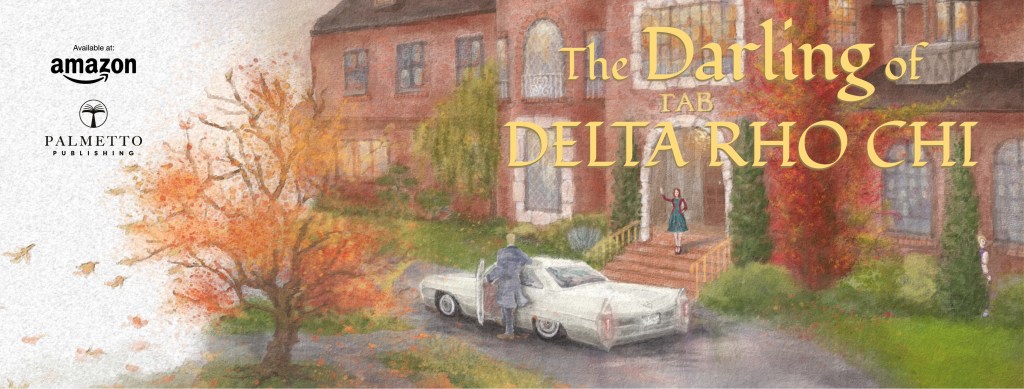
There’s a bit of a thrill to do a search on both Amazon and Barnes & Noble and see one’s novel available for presale… it’s a dream a long time in the making! For more information and the links to both click here: https://barbaradevore.com/the-darling-of-delta-rho-chi/.

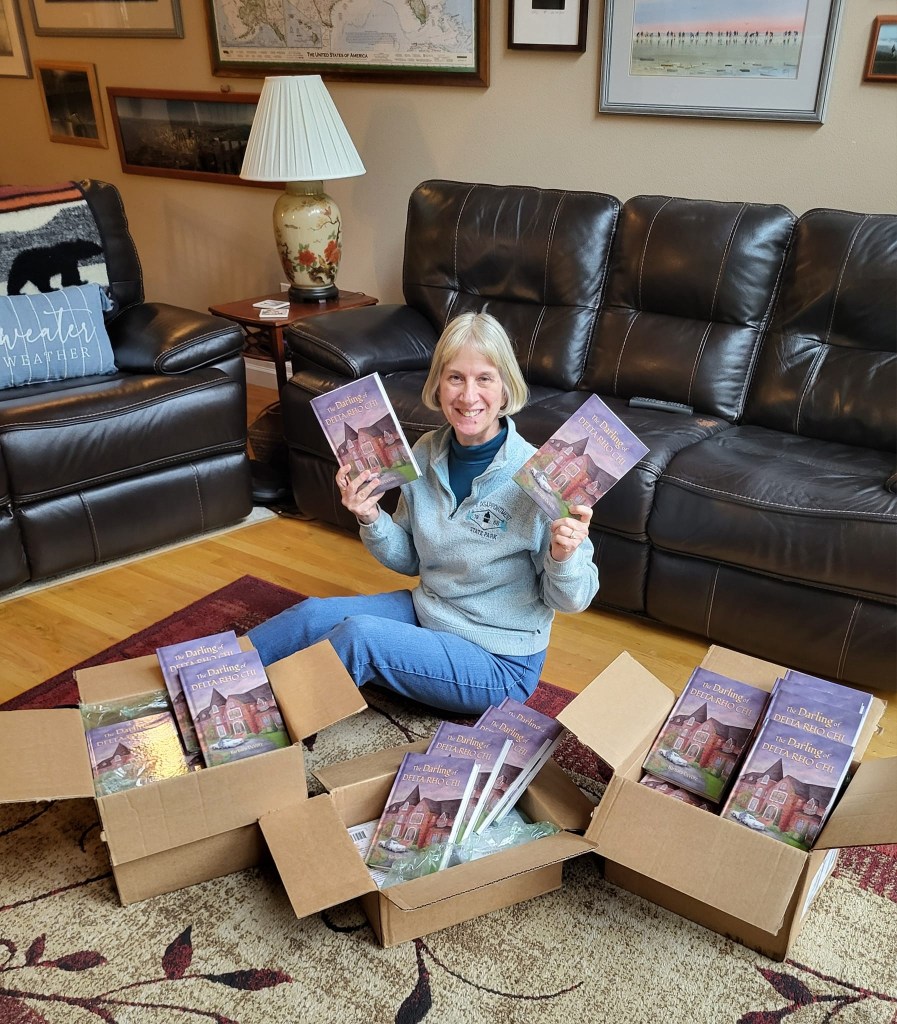
The first order of hardcover books!

November 25, 2024

The long awaited day has arrived! My shipment of hardcover books. One step closer to the launch party.

December 1, 2024

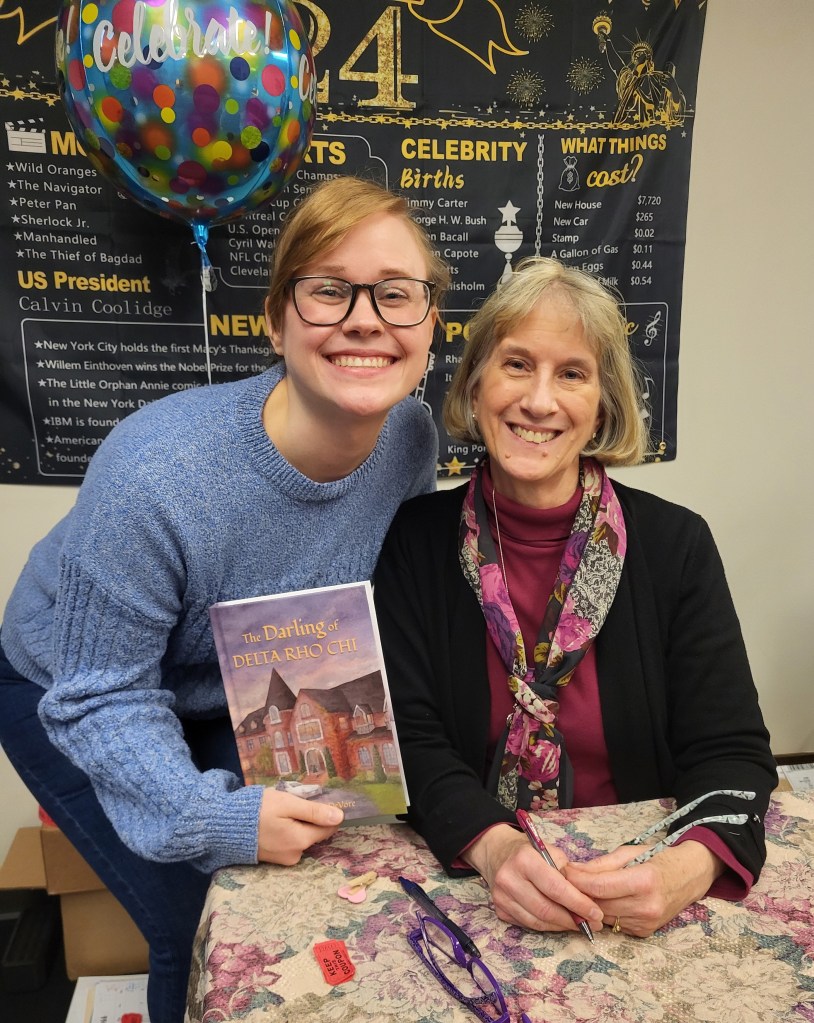
Hosted my Book Launch Party yesterday! Great success. Thank you to all who attended and shared in the celebration. Thank you to all who have purchased books and have left me reviews. My heart swells!

My most recent review on Amazon!

5.0 out of 5 stars Must readReviewed in the United States on November 28, 2024

I absolutely adored this two-for-one father/daughter book. It’s the story of Elise and her sorority troubles, as well as her father Jack finding his way to new love and dreams coming true for both. The characters are well developed, and I became invested in what happened to them. I fully appreciated the place and period accurate references to people and places I remember from living in the state. I felt the author nailed the social mores and values of the time period written about. I thoroughly enjoyed this book.”

January 27, 2025

First of all – thank you to EVERYONE who has ordered The Darling of Delta Rho Chi. I had no idea what this journey would look like. It’s been everything I hoped it would be and more. I’m especially appreciative of the conversations with friends who have sought me out to share with me their impressions of the novel.

A couple of favorite verbal comments:

It’s kinda spicy. I never expected that from you.”

“I stayed up until 2 a.m. finishing it. I never do that.”

“When is the next book coming out?”

And then there was this, the comment which truly floored me:

“Your writing reads a lot like Jodi Picoult.”

For those unfamiliar with Jodi Picoult, I think she is one of the best fiction writers I’ve ever read: carefully crafted characters, compelling story lines, crisp and clean scene setting and descriptions. To be included in the same sentence is humbling, flattering, and brought a lump to my throat.

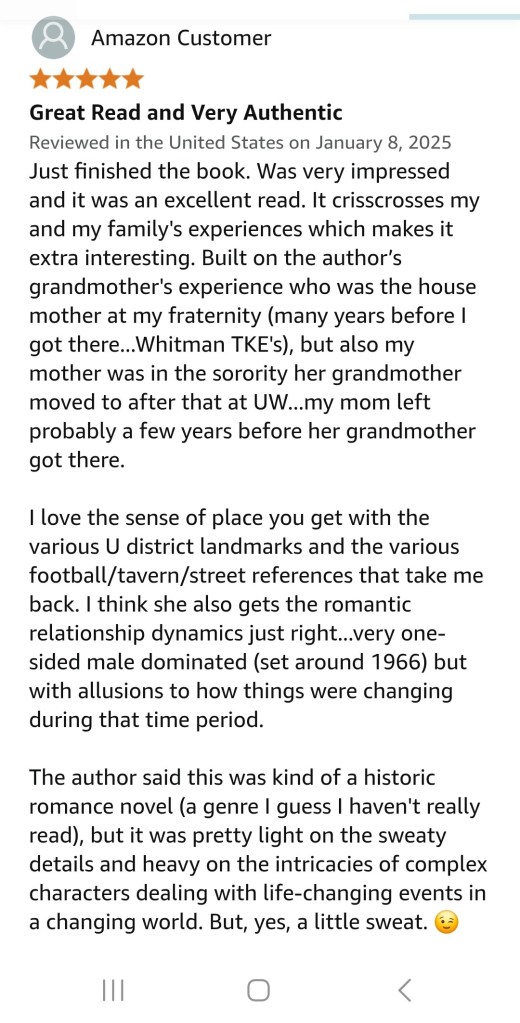
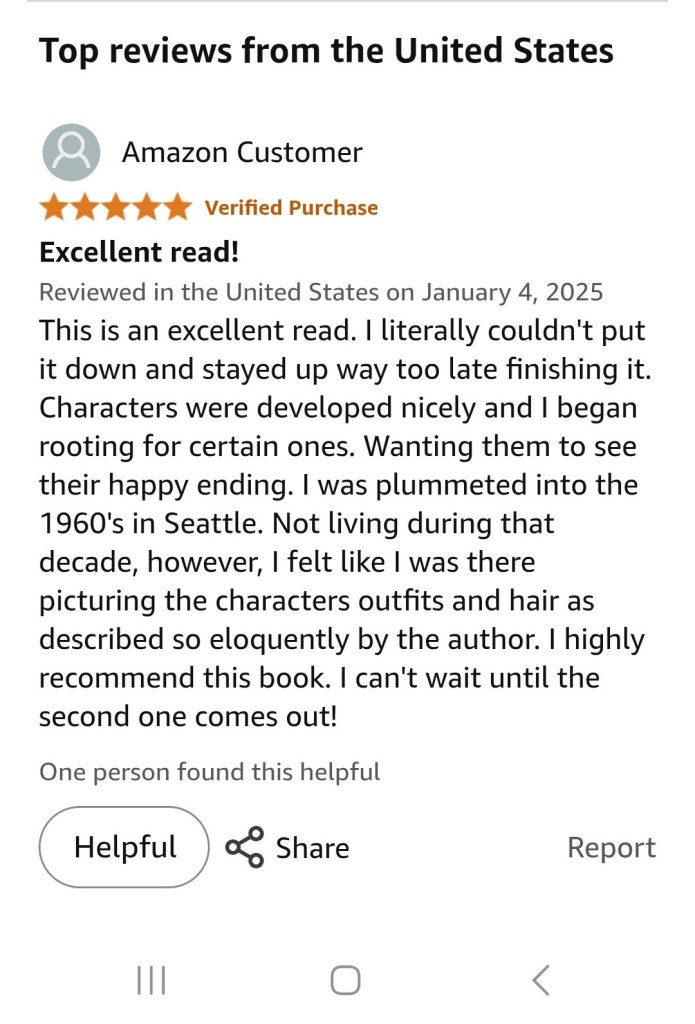
Heartfelt thanks to all who took the time to leave a review, send me a message, or seek me out to tell me what you thought. Here are three recent reviews on Amazon:

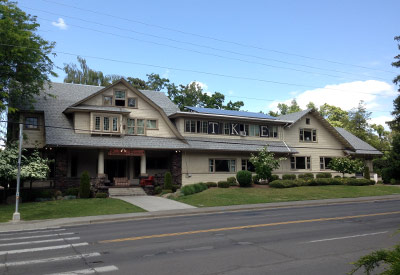
The TKE house at Whitman College

Ninety-eighty Something

The Goldberg’s

September 24, 2024

A Tuesday Newsday Classic

In the 1970’s it was the TV program Happy Days which took us back to the 1950’s. Then there were The Wonder Years which aired in the late 80’s but was set from 1968 to 1974.

Great storytellers often revert to their youth as a way to mine for fictional gems.

For anyone who grew up in the 1980’s they can tune in to ABC’s current program The Goldberg s and see their childhood come to life. It premiered on September 24, 2013.

Created by Adam F. Goldberg, the show is based on people he knew and events which happened to him while he was growing up.  Season 7 begins on Wednesday (Sept. 25) (For 2020, Season 8 begins October 21)

Like all great TV shows, excellent writing and casting are key. Adam’s is a wacky family which begins with his father, Murray, whose main goal in life is to be able to relax in his recliner (sans trousers) and watch TV undisturbed by his three children, who he calls ‘morons.’ The heart of the family is the ultimate intrusive mother, Beverly, who Adam and his siblings, Erica and Barry, call the ‘Smother.’ Although she ‘could have been a lawyer’, her only focus in life is finding ways to stay inappropriately relevant in her teenage children’s’ lives. The travails of the three siblings are fleshed out by a host of friends and rivals.

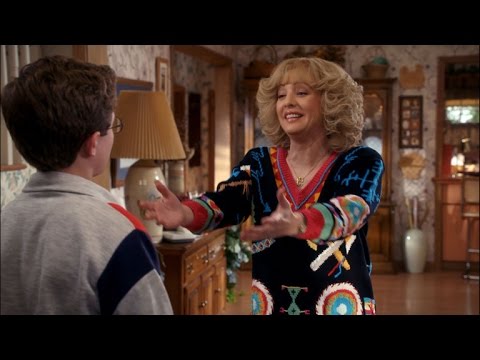
Beverly Goldberg, played by Wendy McLendon-Covey, a true ‘smother’

From the Infallible Wikipedia:

“The Goldberg’s is set in the 1980’s in Jenkintown, Pennsylvania. The show is loosely based on the show runner’s childhood, during which he videotaped events, many of which are reenacted throughout the program. It shows the reality of the 1980’s through a young boy’s eyes.

The series stars Jeff Garlin as patriarch Murray and Wendi McLendon-Covey as matriarch Beverly. Their two older children are Erica (Hayley Orrantia) and Barry (Troy Gentile). The youngest child, Adam (Sean Giambrone), documents his family life with his video camera. Beverly’s father, Albert “Pops” Solomon (George Segal), is frequently around to provide advice or to help out his grandchildren (often behind his daughter’s back).

The present-day ‘Adult Adam’ (Patton Oswalt) narrates every episode as taking place in ‘1980-something’.

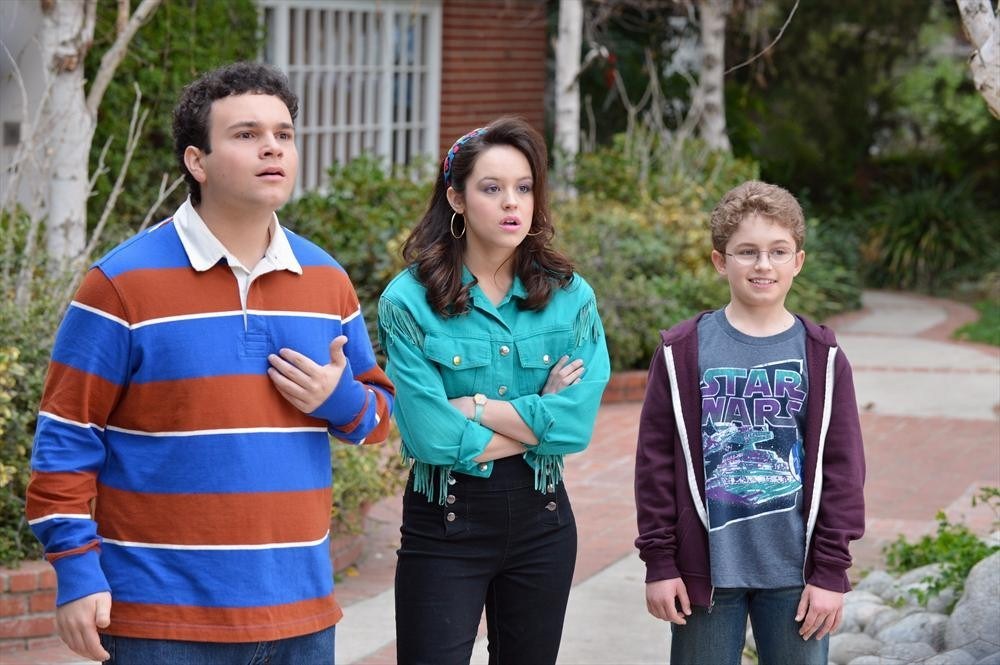
The Goldberg children, Barry, Erika, and Adam as portrayed by Troy Gentile, Hayley Orrantia, and Sean Giambrone.

Many references to real-life Philadelphia-area businesses are made, including the Wawa Inc. convenience store chain, Gimbel’s department store, Willow Grove Park Mall, and Kremp’s Florist of Willow Grove, Pennsylvania.”

It was halfway through season six that I saw my first ‘Goldberg’s.’ Over the past 10 years, I have traveled frequently to Yakima to assist my parents. What started as an every five or six weeks visit to cook meals for my dad has shortened over the years as the needs increased. I’ve literally spent hundreds of days there helping both of them and dealing with a variety of crises. There have been hospital stays for both my parents, my mother living in multiple care facilities for 8 years, legal battles, her passing in November 2017, and now the decline of my 96-year-old father.

In January 2019, my dad took ill and ended up in the hospital. Upon his release my siblings and I recognized that we needed to place him into a facility as my brother, who had lived with him for the previous five years, was not able to provide the level of care needed.

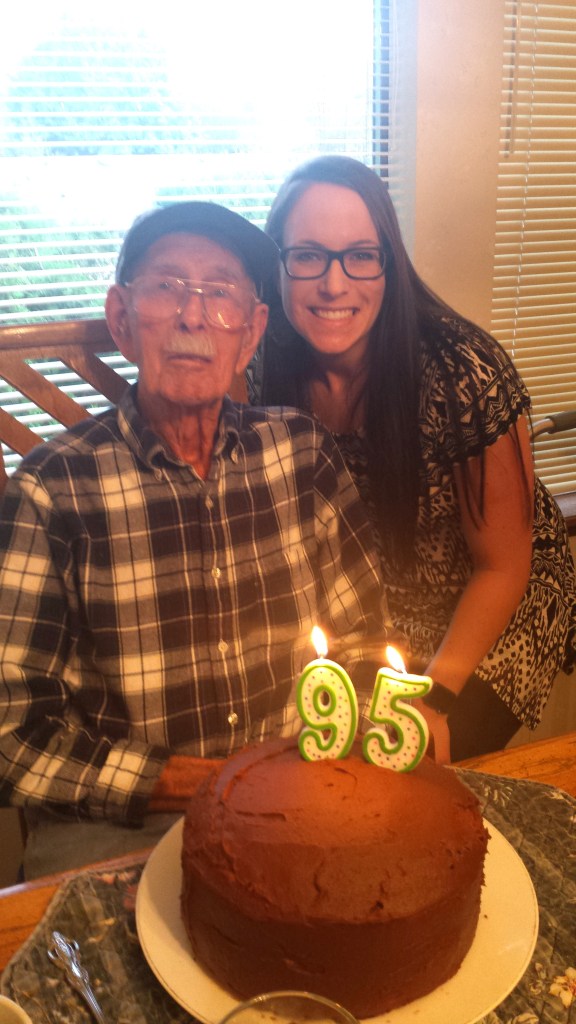
My niece with Dad on his 95th birthday. This was in 2018, the last year in his house.

I was in Yakima to facilitate dad’s move and arrived back at my Dad’s place one evening sometime the last week of January. My brother told me he had discovered a new TV show and asked if I wanted to watch. I did and, like him, was soon hooked on The Goldberg’s.

For most people it’s a simple thing to be able to watch and enjoy a TV program. That was not the case at my Dad’s house.

While Dad was still at home, the TV was his main activity, particularly after my mother died, and there were only two things he watched: Sports and News.

During the five years my brother lived there those were the choices during the hours Dad was present.

In those first weeks after Dad moved to Assisted Living, an odd quiet descended over the house. I think both my brother and I were in a bit of state of shock as the new reality settled in.

Enter the Goldberg’s. My brother set up the TV to record every episode as it played since season’s one through five were being rebroadcast. Many evenings in the next few months during the days and weeks I was in Yakima, I’d arrive back after visiting Dad and my brother and I would binge watch, often staying up way too late.

In many ways it was a lifeline and a way to deal with the stress. Laughter and the occasional cry do that for you.

On another level there was a more subtle lesson to be learned. One that comes through from the Goldberg’s in every episode:

Sure, stuff happens in life and we’re not always at our best with our family and friends, but in the end cherish your family because things change – sometimes in an instant – and you cannot get it back.

We recently completed an estate sale at my parents’ house. Soon the condo will be on the market. As we went through the process of sorting everything last summer, we’d come upon items which triggered emotional responses. When I handed the electric griddle to my sister-in-law to use for her grandkids it hit me that I would never cook another pancake (I made thousands in those 10 years) or a pot pie for Dad in that kitchen, or stay there, or hear my dad’s walker thumping overhead in the morning. Everything had changed.

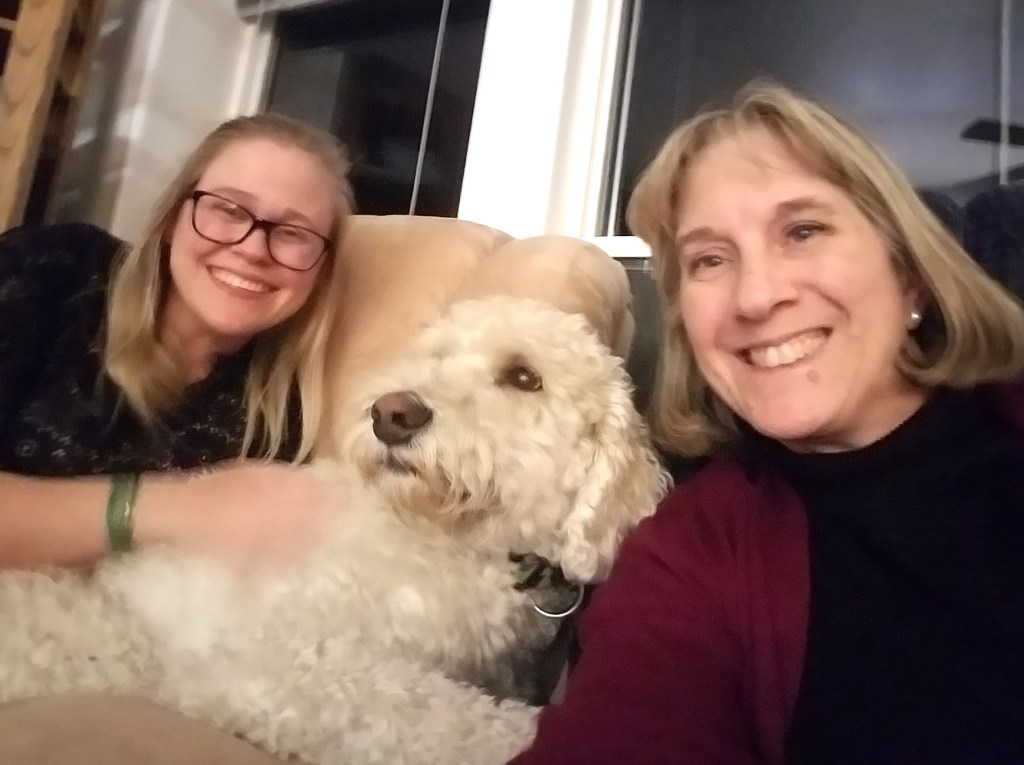
My Daughter, Reggie the Double Doodle, and the author hanging out.

But a new and different way of loving and supporting family has emerged. When I’m over there I now stay with my sister and her husband. Herbert and Teddy, their two dogs, announce every arrival in a cacophony of barking. Shop Cat – who is an outdoor pet – will come and hang out on the deck and has decided I’m okay, rubbing against my legs and looking to be petted. My sister’s adult daughter – who lives nearby – arrives most every evening, bringing with her Reggie and Rex, the Double Doodle dogs, who join in the melee.

I visit dad at least once a day when over there. He has good days and bad days… last week he had one particularly good day and insisted he wanted to have Kentucky Fried Chicken for dinner. So what the heck? I loaded him and his walker into the car and we went to KFC. Was it easy? No. But I recognize his days are short and doing something so simple made him happy for a little while. And that makes it all worthwhile. No regrets.

Dinner out with Dad September 2019

2019 has been a hard year, but it was made better thanks to the Goldberg’s and my own family.

Here’s the link to Wikipedia, but really, it does not do justice to the show. Give yourself a treat and watch an episode.

https://en.wikipedia.org/wiki/The_Goldbergs_(2013_TV_series)

Update 2024: When I posted this on September 24, 2019, I had no idea that exactly one month later my Dad would take his last breath. The Goldberg’s last episode was aired in May 2023.

The Day We Were Bewitched

A Beloved 1960’s Sitcom

September 17, 2024

A Tuesday Newsday Classic

From the moment this TV show premiered, on September 17, 1964, a spell was cast over the American public and everyone fell in love with a beautiful witch named Samantha.

Screenshot from the opening credits

Bewitched was an instant hit, drawing everyone in to its crazy premise:

What if a witch were to fall in love with a mortal and give up her magical world to become a modern-day housewife?

Of course that’s not quite how it worked out. Week after week we were given a glimpse into the life and marriage of Darrin and Samantha Stevens who, with interference from her mother Endora and a wide cast of other relatives, seemed to stir up trouble for poor Darren. Add to that mix the nosy neighbor, Gladys Kravitz, and Darrin’s demanding boss, Larry Tate, and you had the recipe for a sitcom which aired for the next eight years.

From the Infallible Wikipedia:

“The witches and their male counterparts, warlocks, are very long-lived; while Samantha appears to be a young woman, many episodes suggest she is actually hundreds of years old. To keep their society secret, witches avoid showing their powers in front of mortals other than Darrin. Nevertheless, the effects of their spells – and Samantha’s attempts to hide their supernatural origin from mortals – drive the plot of most episodes. Witches and warlocks usually use physical gestures along with their incantations. To perform magic, Samantha often twitches her nose to create a spell. Special visual effects are accompanied by music to highlight such an action.”

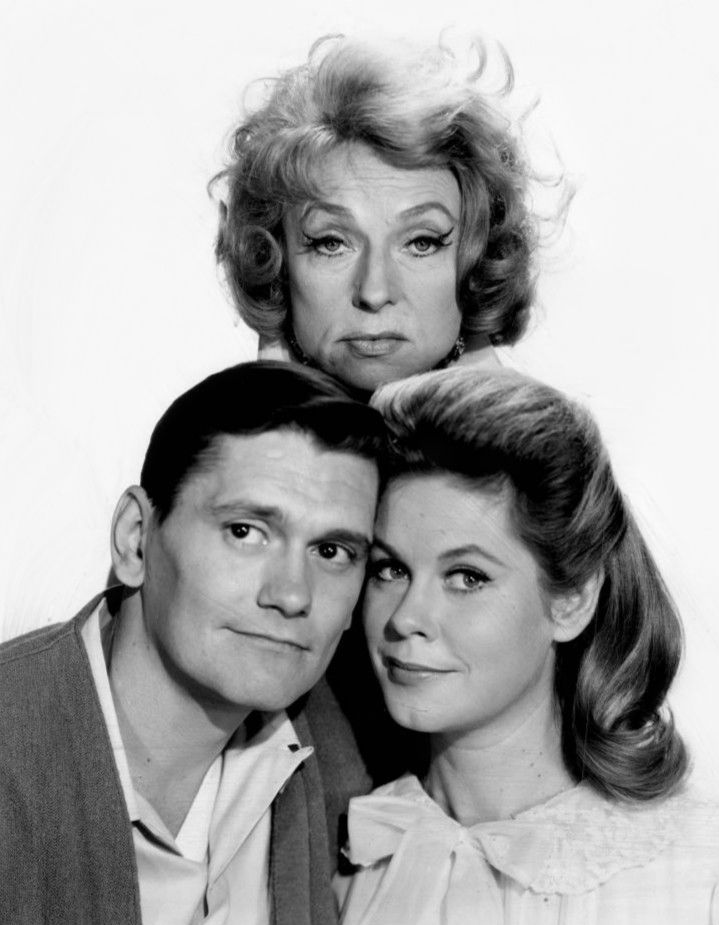
The three main characters: Dick York as Darrin and Elizabeth Montgomery as Samantha (front) with the irreplaceable Agnes Moorehead as Endora.

The combination of great script writers coupled with outstanding casting was, no doubt, key to the series success. Elizabeth Montgomery, as Samantha, is frequently seen using her nose to make the dishes wash themselves, clean up a mess, or handle some mundane chore. Darrin was frustrated each week at his wife’s use of magic to handle life.

Personally, as a child, I very badly wanted to live in that world. My bedroom was ALWAYS a disaster of toys, books, and games, with never enough space to store them. If, of course, I was inclined to be tidy, which I was not.

My sister, who is 21 months older, forbade me from stepping foot onto her side of the room during those years. An invisible line was drawn between our matching twin beds and across that boundary I dared not venture. Oh to have Samantha’s nose which I could just twitch and get everything cleaned up in an instant! Then I might have been allowed across the magic threshold.

But my favorite character on the show had to have been the ever-vigilant neighbor Gladys. The woman epitomized the term busy body and was often seen skulking around the Steven’s house. She would climb into the shrubbery and peer through windows, certain that all sorts of strange things were going on inside. Of course, she was right but she never succeeded in convincing her disinterested husband, Abner, or the occasional law enforcement officer she would call, of the shenanigans which took place.

In her portrayal of Gladys Kravitz, Alice Pearce brought the meaning of a nosy neighbor to new heights

In fact, when I encounter a nosy person, I usually refer to them as Gladys. In a loving way, of course, but the name does sum up that one person which members of my generation instantly recognize.

No doubt, when the show went off the air in 1972, it was with a whimper. The original Darrin had left in 1969 due to complications from a severe back injury 10 years earlier which made working impossible. The original Gladys died in 1966 as had Samantha’s confused Aunt Clara. These hits to the cast affected the show profoundly. In many ways, in retrospect, it was almost as if a spell had been placed on the show. Elizabeth Montgomery died in 1995 at the age of 64 from colon cancer. Dick York succumbed at age 63 from emphysema. Agnes Moorehead, who played Endora, was stricken with uterine cancer which took her life in 1974 at age 74.

Bewitched lives on in syndication and, subsequently, on DVD and the internet. Although there was a movie made based on the characters which was cute, and there are proposals for a new TV series, no remake will ever be able to replicate and achieve the success of the original.

Sometimes magic only happens once.

For more about Bewitched:

https://en.wikipedia.org/wiki/Bewitched

The First Tuesday in September

Pee Chees, Saddle Shoes, and Fear

September 3, 2024

A Tuesday Newsday Classic

The first Tuesday of September was always a day which struck fear in my heart. In fact, no other day of the year caused more anxiety and distress than this one.

The reason, of course, was due to the fact that when I was growing up school always started on this day.

The ubiquitous Pee-Chee – an indispensible back to school item

Unlike in today’s world, where we are inundated with back-to-school ads for supplies and equipment beginning in late July, in the 1960’s and 70’s, we didn’t much think about going back to school. That was until one day in late August my mother would ominously announce that school started the next week.

So off we would go to get things. Our back-to-school supply list included Pee Chee folders, notebook paper, #2 pencils, and BIC pens. That was it.

For clothing, I was lucky to get one new outfit for the first day of school. And the most evil of all footwear ever invented: saddle shoes.

I’ll get back to those in a bit.  First off, however, I imagine you are wondering about the Pee Chee.  What is a Pee Chee? And why do so many people my age wax nostalgic over a folded in half piece of cardstock? I knew it deserved Tuesday Newsday status. Since I couldn’t find the official day they were introduced, the first Tuesday in September seemed the perfect opportunity to learn about them. From the Infallible Wikipedia:

How we learned our multiplication tables and other useful information

“The yellow Pee-Chee All Season Portfolio was a common American stationery item in the second half of the 20th century, commonly used by students for storing school papers. It was first produced in 1943 by the Western Tablet and Stationery Company of Kalamazoo, Michigan. Pee-Chees were later produced by the Mead Corporation. (snip) These inexpensive folders are made of card stock with two internal pockets for the storage of loose-leaf paper. The pockets are printed with a variety of reference information including factors for converting between Imperial and metric measurement units, and a multiplication table. The folders had fallen out of general use by the 2000s, but are available from Mead as of 2014.”

Note the words “multiplication table.” This was probably the most valuable thing a Pee Chee provided as we were expected to memorize this table. By the time you arrived at the twelves, it got a bit difficult. The handy dandy Pee Chee came to your rescue. Of course, our teachers knew this and we had to put our Pee Chee’s away during test time.

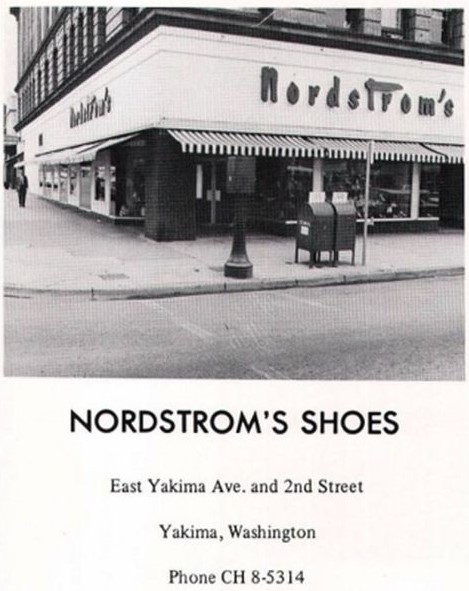
One of the eight Nordstrom shoe stores in the 1960’s

Every day, when I walked home from elementary school, I only carried a Pee Chee and rarely any books unless it was one checked out from the school library. By the time I was in Junior High and High School, books were part of the equation. Along with the Pee Chee of course.

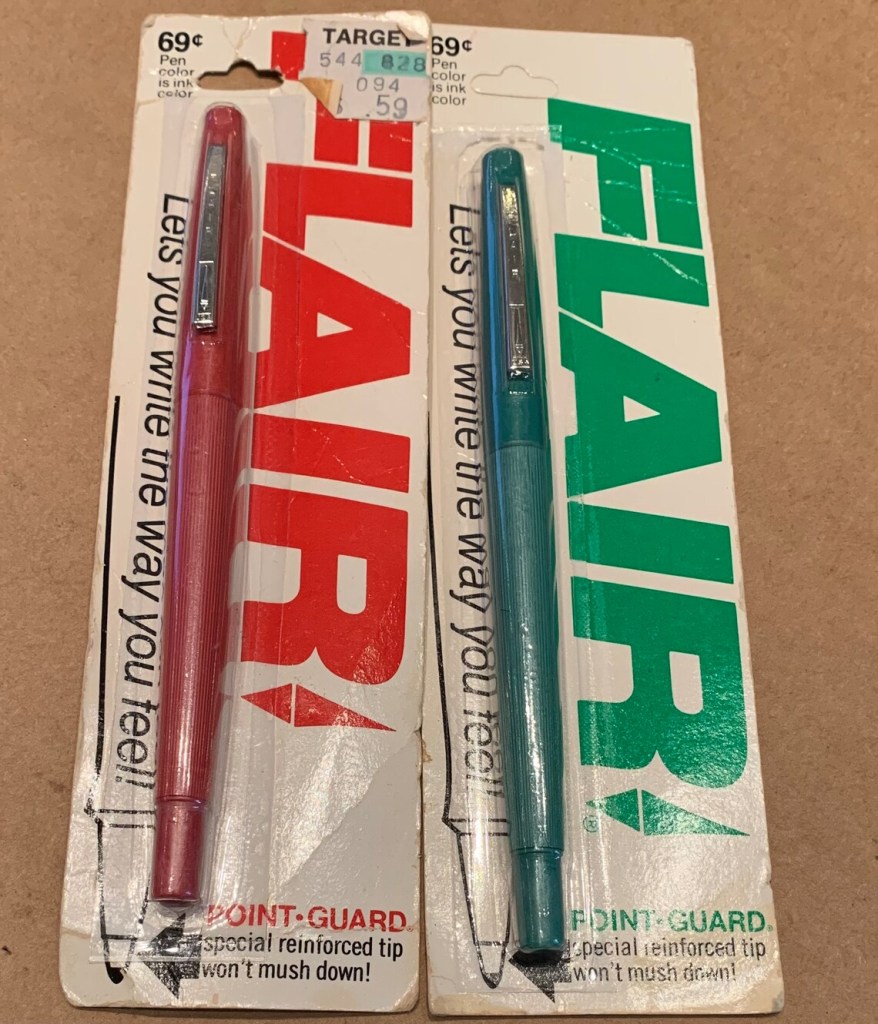
That brand new, unmarked, non-dog-eared Pee Chee was the best part of being forced to go back to school. And paper, pencils and BIC pens, of course. The best addition were colored Flair pens starting in Junior High! My favorite was the green one.

But the worst part? From first grade through sixth I was subjected to torture by being forced to wear saddle shoes. Whoever invented this shoe should have been required to wear a new pair every week for their entire lives just so they would know what pain they subjected multiple generations of girls to endure.

The evil saddle shoe…

My mother would take me and my sister to Nordstrom’s Shoe store… in the 1960’s in Yakima that’s all it was… a shoe store. We would bypass all the beautiful shiny black patent leather shoes and the cute Mary Janes and go directly to the rack of clunky saddle shoes. There they sat, big, bulky, and ugly. They had brown soles thicker than a slice of French toast. Across their beige bodies was a second strip of stiff brown leather, with laces through the holes, just waiting to cinch your foot into bondage. Heaven forbid that you got shoes which fit… no, they had to be a bit big so you’d grow in to them and not grow out of them before the following June.

We would wear them around the house for several days before school started in a futile effort to ‘break’ them in. It never worked. The first few weeks of school our feet bore witness to the horrors of saddle shoes; oozing red blisters were covered with adhesive tape and we’d limp through the day. Eventually the leather softened and the blisters abated… usually by October. Kids today just don’t realize how lucky they are to have been spared the scourge of saddle shoes.

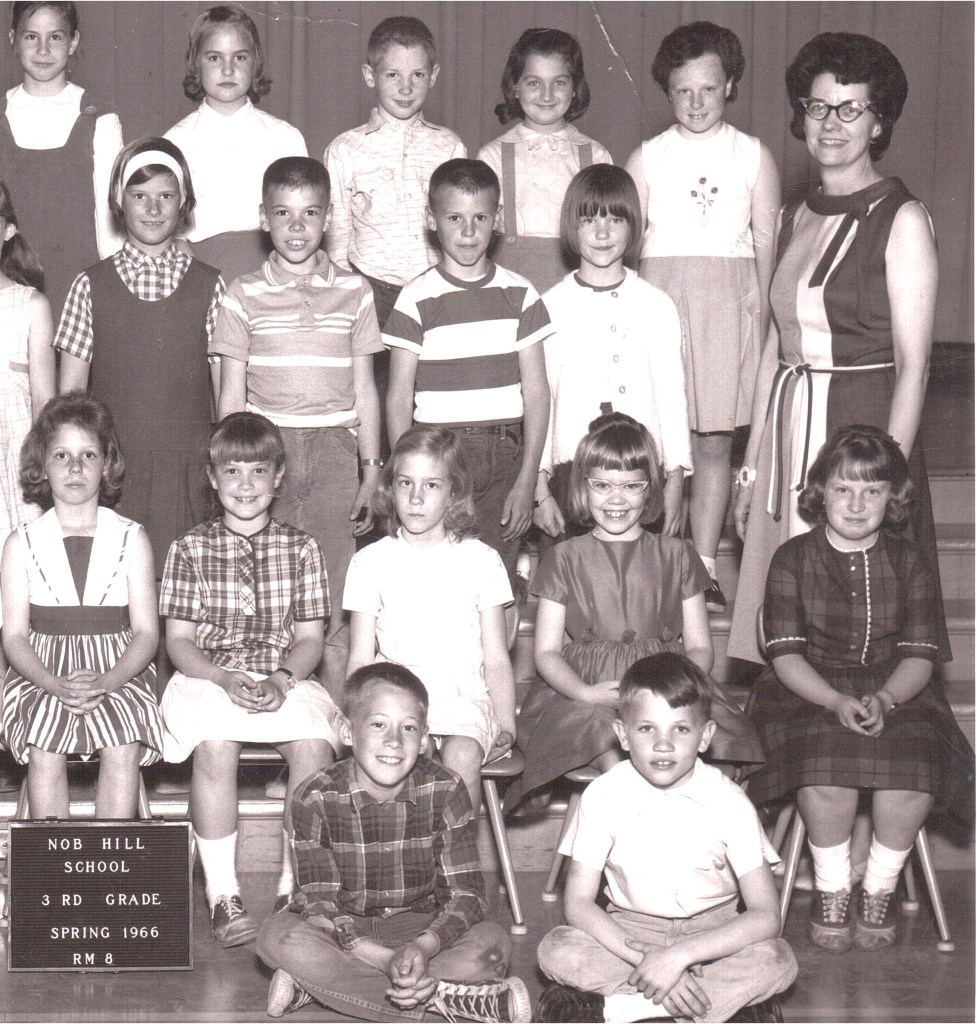
Note the saddle shoes on the two girls seated, Marla on the left and Rinda on the far right. This author is next to Marla undoubtedly also wearing saddle shoes. The girl in the glasses next to me? That was Kelly who NEVER had saddle shoes but always cute black patten leather shoes.
Flair pens were IT! Especially the green ones.

Even now the first week of September is my least favorite time of the year; despite the fact I do not have to go back to school nor do my children.

I am, however, very, very tempted to go hang out in the office supply store and indulge myself in the smell of paper and ink and the plethora of notebooks, papers, pens, and paperclips. Anyone who has seen my office knows that I have stacks of spiral notebooks, hundreds of colored paperclips (many with decorative tops), and a collection of G-2 pens of every hue. In fact, just writing about it inspires me to head to my nearest Office Depot Max to see what’s on sale. Unlike saddle shoes, office supplies never go out of fashion!

As always a couple of links:

https://en.wikipedia.org/wiki/Pee_Chee_folder

https://en.wikipedia.org/wiki/Saddle_shoe

Yes, it is true. In 1960 Nordstrom’s only sold shoes. The store in Yakima was one of only 8 stores at the time.

https://shop.nordstrom.com/content/company-history

Mary Poppins

Why is using an umbrella to fly not a thing?

August 27, 2024

A Tuesday Newsday Classic

Unlike most of the musical films of the previous decades, this one was aimed at children. It introduced new words into our collective vocabulary and catapulted its two stars into the stratosphere. Children everywhere wanted a nanny just like Mary Poppins and her chimney sweep friend Bert.

Mary Poppins debuted on the silver screen sixty years ago on August 27, 1964, and soon everyone was exclaiming Supercalifragilisticexpialidocious and singing Chim-Chim-Cheree.

The movie was based on a children’s book by P.L. Travers. It was the song writing brothers of Robert and Richard Sherman who created over 30 songs for the movie. Of those, 14 made the final cut.

It was, however, the superb casting, particularly of Julie Andrews and Dick Van Dyke, which provided the magic needed for the story.  Andrews, who was a Broadway actress at the time, transitioned to film and would, the next year, define the iconic Maria Von Trapp in the Sound of Music.

Between the incredible casting, the musical score, and the script, it proved a recipe for success. From the Infallible Wikipedia:

“It received a total of 13 Academy Awards nominations, including Best Picture – a record for any film released by Walt Disney Studios – and won five: Best Actress for Andrews, Best Film Editing, Best Original Music Score, Best Visual Effects, and Best Original Song for ‘Chim Chim Cher-ee’. In 2013, the film was selected for preservation in the United States National Film Registry by the Library of Congress as being ‘culturally, historically, or aesthetically significant’. Mary Poppins is considered Walt Disney’s crowning live-action achievement, and is the only one of his films which earned a Best Picture nomination during his lifetime.”

For a seven-year-old, getting to go to a theater and see a movie was a big deal. Especially when it was the very FIRST movie that seven-year-old had ever seen in a theater.

I have a distinct memory of being dropped off at the Capitol Theater in Yakima along with my older siblings to watch the movie. I doubt my then 15 year old brother was thrilled at being the designated baby sitter for the event. Of course that mattered not to me. I was enthralled from the moment Mary Poppins, umbrella unfurled and carpet bag in hand, floated down to the Banks house.

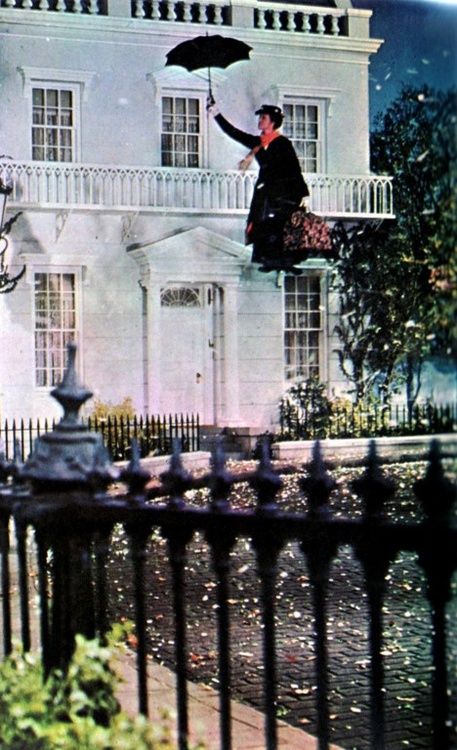
My childhood goal: to fly using an umbrella

In the days, weeks, and months which followed, I strove to be Mary Poppins. If I was outside playing it was with an umbrella in hand, running down the street wishing to be lifted from the ground so that I could float away to magical places. Alas, despite some pretty strong winds at times, my Mary Poppins dreams went unfulfilled although I did manage to get airborne quite often.

After I had children of my own I made it one of my missions to expose them to the cultural phenomenon of Musicals. Although they enjoyed Mary Poppins I do not believe it impacted them quite the same way.

On a trip to Disneyland when my daughter was near the magical age of seven, we were on Main Street early one morning. Across the plaza I spied Mary Poppins. Determined to get her autograph for the daughter’s book, we hurried over.

The daughter proffered the souvenir and asked ‘Mary’ if she would sign it. A nanny’s eye landed on my daughter, said good morning, then proceeded – in character – to instruct the child to stand up straight, feet together, toes turned slightly out, with the admonishment of “spit spot.” Although my daughter was slightly flummoxed by the encounter, I was enchanted.

The whole nanny thing, I decided, might still be a good idea for seven-year-old children although I don’t think it’s a great idea for those same children to take flying leaps into the air in an effort to fly.

 No article is complete without a link to the Infallible Wikipedia:I

https://en.wikipedia.org/wiki/Mary_Poppins_(film)

I suggest you do a search for Mary Poppins “Let’s Go fly a Kite” to see the final scene where Mary flies away. I tried to find a youtube clip but, alas, many are protected. Try these two links: https://youtu.be/BA-g8YYPKVo?si=8lCS4VWswAp0OPvZ

The Rotary Telephone

The only downside was the cord

August 20, 2024

A Tuesday Newsday Classic Updated

A vintage rotary dial possibly from the state of Washington.

For young people in the 1960’s and 70’s, this device was as essential to teenagers as the smart phones of today.

The difference being that this device was tethered to a specific location and it allowed you to do but one thing: talk.

Nearly every household in middle America had one and, by the early 1960’s, all featured a rotary dial, the patent for which was applied for on August 20, 1896. The device was, of course, the telephone.

It was, however, the addition of the rotary dial which made it possible for the telephone to become a common household essential. As is often the case, controversy surrounded the granting of patents. The first rotary style was developed in 1891. According to the Infallible Wikipedia:

“Almon Brown Strowger was the first to file a patent for a rotary dial on December 21, 1891, which was awarded on November 29, 1892, as U.S. Patent 486,909. The early rotary dials used lugs on a finger plate instead of holes, and the pulse train was generated without the control of spring action or a governor on the forward movement of the wheel, which proved to be difficult to operate correctly.”

It was only a few short years later when three inventors in Kansas – brother’s Charles and Frank Erickson along with their friend Frank Lundquist – provided the refinement needed and the rotary dial with finger holes that we know was invented. Different enough from Strowger’s design, it became the standard. From the historical files of the Kansas Collection:

We had a beauty like this one in both the kitchen and my parents bedroom

“The most dramatic contribution of the Ericksons in telephony is associated with the invention and development of the dial telephone. Application for the patent was made by (A.E.) Keith and the Ericksons on August 20, 1896, and Patent No. 597,062 was granted on January 11, 1898. The dial method was based upon a finger wheel dial instead of the push buttons, which were cumbersome and impractical. The dial method, with the switching and trunk systems, provided full access to the vast resources of a telephone exchange. R. B. Hill, an authority in telephony, has described this important development as follows: ‘Dialing a number wound up a spring whose tension, when the finger was withdrawn, caused the dial to return to its normal position. The return rotation was limited to a moderate speed by an escapement mechanism, and, during the return, the required number of circuit interruptions took place to control the movement of the central office apparatus.’”

Telephone numbers in the 1960’s were identified by a combination of letters and numbers. Eight of the finger holes on the phone had 3 letters. My phone number growing up, then, was listed as follows: Glencourt 2-4100, or in its phone book listed form, GL2-4100. Translation for the kids of today: 452-4100. Area Codes were added in 1947 but unlike today were not needed for all calls.

In my household the phone was strategically placed in the kitchen. When it rang, you answered as there was no answering machine. Up until about 1971 the phone was never for me and the conversations were usually brief as the device was a method for setting up an appointment or such other daily business.

With teenagers in the house, however, its use ballooned. My sister used it, especially, for the higher purpose of dialing in to radio stations to make song requests and to try to win things. With transistor radio on one ear and the telephone on the other she’d dial incessantly to be the 10th or 20th or 93rd caller. She seemed to win. A lot.

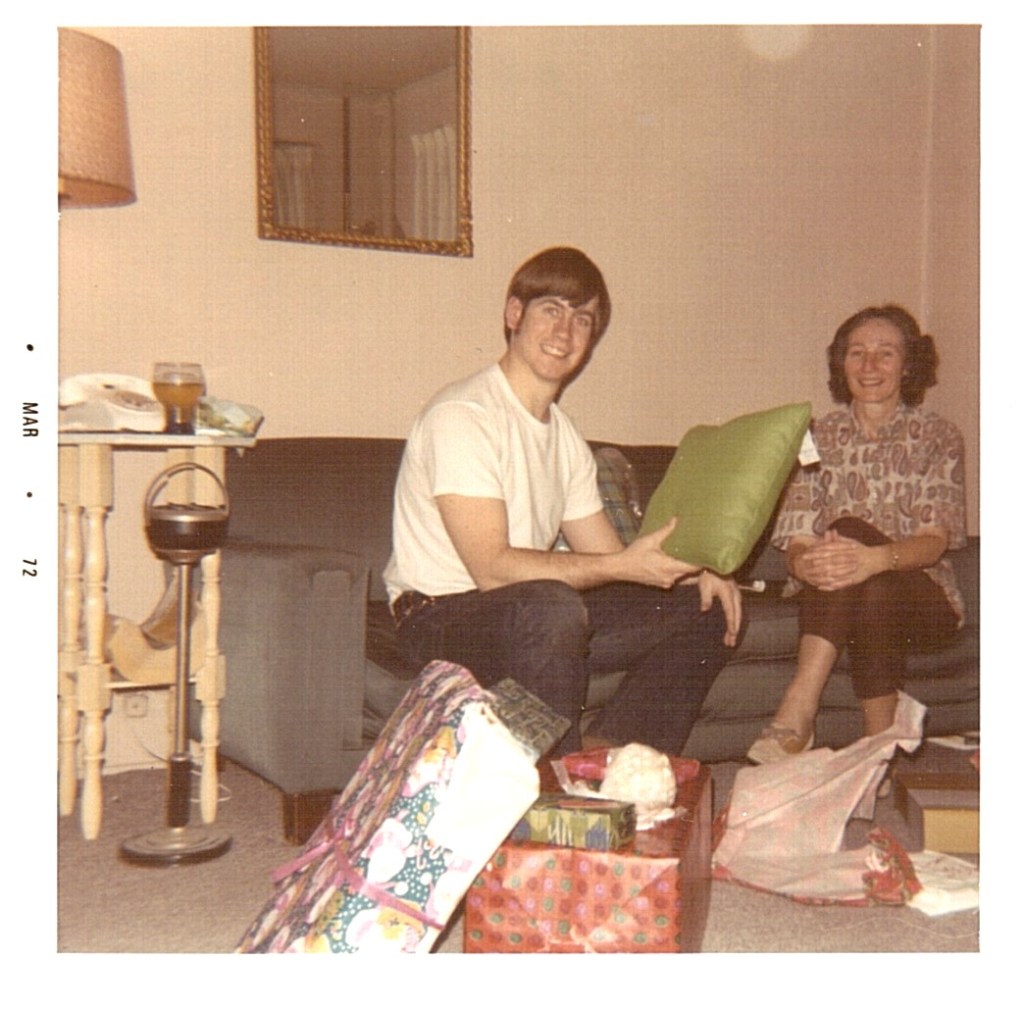
Unlike today, photos of people with phones was uncommon. In going through old photo albums this was the only picture I found with a phone in it. I took this photo at my older brother’s apartment (he was 24) when me and my parents drove to Seattle on December 27, 1971, to bring him Christmas. Mom is on the right. Rotary dial phone is on the left.

My long-suffering parents finally tired of chatty teenagers doing their teenager business in the middle of the family area and a second phone was installed.

This phone was the holy grail of all things teen. Located in my parents’ bedroom it provided the one thing we craved: privacy.

When boys started to call my older sister – and eventually me – we were allowed to use the phone in my parent’s bedroom. There was no chair next to the phone, just the bed and the floor. Many an hour was spent sitting on that floor, back against the bed, talking to the boy of the month… at least until Mom would come in to the room and give us the sign to wrap it up.

We envied the few friends who had their own phone in their room, usually a princess style and pink or white. What a luxury!

The most envied of all devices: a pink princess phone

When I became a parent and cell phones (before the smart phones took over) were a thing it became very difficult to monitor what the child was doing. No doubt it’s even more difficult now with text messages, unfettered internet access, and apps like Instagram and TikTok. It was much easier for my parents as they could cut the conversation off at any time and when the household went to bed no teen was sneakily talking or texting on the phone.

No doubt my most memorable event with a corded, old-style phone, came in 1992 when my son was two years old. Although cordless phones for use in a house had made some inroads by that time, I found them unreliable and they would often have static and bad reception. So, as a mother with a young child, I had hit on the perfect solution: a phone with a 25-foot-long cord.

It afforded me the ability to talk on the phone while also being able to get to my child anywhere in the kitchen/family room. Which was important since my first born being a VERY curious child required my eternal vigilance as he had a propensity for getting into places and things which he shouldn’t. In fact I discovered, to my great dismay, that there was not a baby lock you could install on a cupboard or drawer which could deter him.

One particular morning, I get a phone call from my best friend in Yakima, Daphne. My son is happily playing and Daphne and I have been chatting for about 10 minutes. I happened to be standing and looking out the window of our dinette area between the kitchen and the family room when all of the sudden the phone line goes dead.

I pull the phone away from my ear and stare at the now silent receiver, wondering what might have happened. Only then did I turn around and standing in front of me, scissors in hand and a cut in half phone cord laying at his feet, is my two-year-old.

A mixture of emotions course through me. Anger at this child who had the audacity to end my phone call but also awe at the problem-solving ability he had just displayed. And, of course, fear at the fact that he had dragged a chair to the kitchen, climbed on it, opened the drawer – with the baby lock on it – and retrieved the tool he understood was needed to complete his mission.

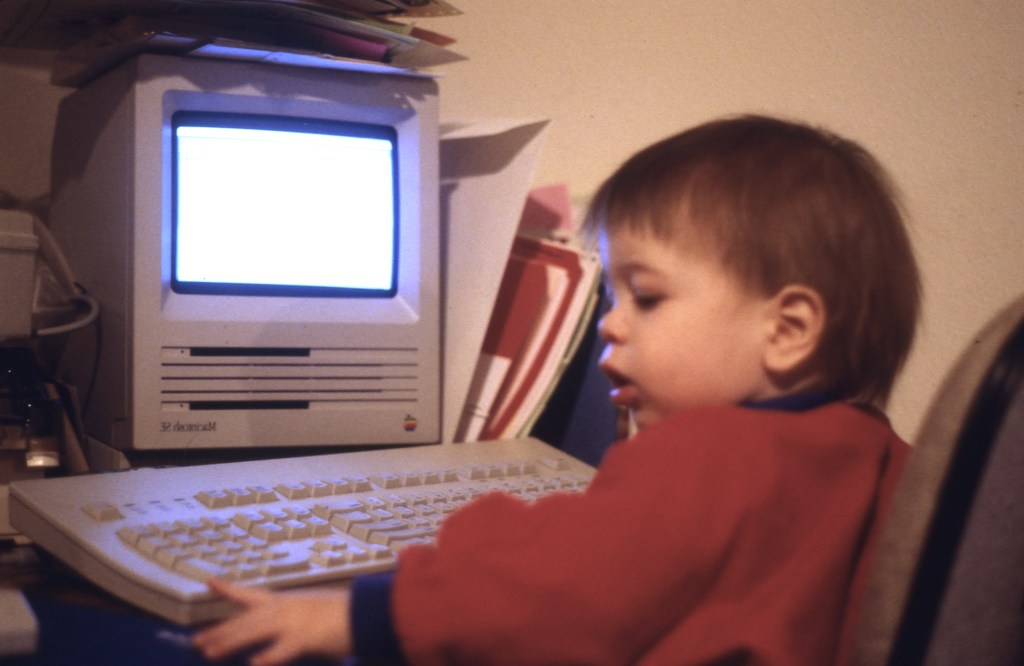
My curious child also learned how to use a computer early when he wasn’t cutting telephone cords.

Trying to reason with a one or two-year old is like trying to reason with a cat and was out of the question so in the end I came down on the side of awe. That was the one and only time he ever cut the phone cord… but there WAS the whole apple incident. That’s a story for another Tuesday Newsday. Eventually the technology improved and the cordless phone became the norm. Nowadays, very few people even have ‘land lines’ and phones are radically different than they were 30 years ago.

But back to the advantage of growing up with a device on which the only thing you could do was talk. I attribute my ability to pick up a phone and call anyone to the training I received as a teenager. Back then the only way anything was going to happen was by grabbing the phone and twisting those 10 little holes to make a call. Ah, the good old days.

A couple of links for those who wish to learn more about phones and the rotary dial:

https://en.wikipedia.org/wiki/Rotary_dial

https://en.wikipedia.org/wiki/Rotary_dial

Peak DeVore

Who Am I and Where do I come from?

August 6, 2024

A Tuesday Newsday Classic Updated

As someone born into a family with an uncommon last name, I notice whenever I see that name. Several years ago I wrote about my ignorance of Washington State geology when I admitted I did not realize Glacier Peak was this state’s ‘fifth’ volcano. (You can read all about it at https://barbaradevore.com/2018/06/12/glacier-peak-washington/)

DeVore Peak – Glacier Peak Wilderness, North Cascades, Washington State

Fast forward to August 3, 2019… when I receive the following text from the hubby:

“Just saw on King 5 there is a Devore Creek fire near Stehiken. Comes down from Devore Peak.”

What!?

How is it I never knew of this Devore Peak or Creek? Yet, here it has been, hiding out 20 miles northeast of Glacier Peak, undoubtedly since the time the first settlers imparted their names on things.

From the Infallible Wikipedia:

“Devore Peak is an 8,360+ ft (2,550+ m) mountain summit located in the Glacier Peak Wilderness of the North Cascades in Washington State. The mountain is situated in Chelan County, on land managed by Wenatchee National Forest. Its nearest higher peak is Martin Peak, 3.36 mi (5.41 km) to the southwest, and Tupshin Peak lies 1.55 mi (2.49 km) to the north-northeast. Precipitation runoff from the peak drains to nearby Lake Chelan via tributaries of the Stehekin River.”

So it got me thinking… where else are things named Devore (or DeVore as my family spells it) that I do not know about?

Of course I know about DeVore, California although I’ve never been there. The town was a stop on historic Route 66. It has since been incorporated into sprawling, 81 square mile, San Bernardino. Much of the DeVore neighborhood was leveled by a wildfire in 2003, with 904 homes destroyed.

If you travel 1,723 miles to the east you will find a dot-on-the-road community in Indiana also named Devore. Originally named Mill Creek, some interloper relative of mine got a post office located there and probably named it after himself.

Lovely little falls in Devore, Indiana

But back to Devore Peak. Despite my extensive internet research, I cannot find any ancestor or relative after whom the mountain is named although I suppose it could be the Reverend John DeVore. He was the first minister to establish a church north of the Columbia River in Steilacoom. From the Washington State History link site:

Monument in Steilacoom, Washington to Reverend John DeVore and the Methodist Church

“(Lafayette)Balch (Steilacoom’s founder) persuaded Reverend John F. DeVore (1817-1889) and his wife Jane Devore (d. 1860) to relocate to Steilacoom in 1853. DeVore built a two-story Methodist Episcopal church that also served as a school and meeting hall. When the church bell, ordered from the East, arrived with a balance due, residents took up a collection. Afterward the bell became town property, used to signal emergencies and public meetings along with the call to worship.”

When a college student, I drove down there one day from nearby University of Puget Sound (which was founded as a Methodist college) and located the marker for Reverend DeVore. Alas, the Reverend is not a direct ancestor and I was never able to establish any relationship.

But it does make one wonder – unless you have a very common last name – how many others share yours?

I found the following information on https://www.mynamestats.com/Last-Names:

  • DEVORE is ranked as the 3,242nd most popular family name in the United States with an estimated population of 12,319.
  • This name is in the 99th percentile, this means that nearly 0% of all the last names are more popular.
  • There are 3.86 people named DEVORE for every 100,000 Americans.
  • This name is most often used as a last name, 99% of the time.
  • Based on US Census Bureau data the estimated population of people named DEVORE is 13,030, the rank is 3,005 and the proportion per 100k Americans named DEVORE is 4.09.

When you consider that there are some 329 million in the country that’s only .004 percent of all people with the same last name. If I extrapolate that even further and Google both my first and last names, there are 128 other people named Barbara DeVore in the U.S. currently.

Growing up I knew of only one other person with the last name DeVore who was not related to our family. That would be the butcher who worked at the Safeway on 36th and Tieton Drive in Yakima. I was always so very amused when I would go to the store with my mother. If the shopping trip involved a visit to the meat counter inevitably the exchange would go something like this:

Butcher: “Good Afternoon, Mrs. DeVore.”

Mom: “Good Afternoon, Mr. Devoir.”

And then they both would laugh.

Yes, Mr. Devoir the butcher spelled it different. But the two of them obviously enjoyed the inside joke of having the ‘same’ last name.

As I was writing this article, I could not think of a single person I’ve met casually with the last name DeVore. Through my genealogy research and DNA matching, I’ve found quite a number of cousins and have enjoyed getting to know many of them on Facebook.

Occasionally I will have someone ask do you know ‘fill-in-the-blank’ DeVore? Often, I am able to say he/she is my second cousin, once removed. But mostly it doesn’t come up.

I rather like the unique name and the mystery of it all. According to a book about the DeVore families compiled by Betty DeVore Mann in 1992, the history of the name is this:

Chateau de Vore near Remalard, France

“There is a small, stately chateau in Normandy, near Alencon and 3 kilometers from Remalard, named Chateau de Vore. The de Vore family left in the 17th century. Several American Devores have interviewed the 2 remaining de Vores in Paris. They knew very little about their ancestry, because their grandfather was the illegitimate son of a wealthy family and he was sent away when he was very young. He carried his mother’s maiden-name. And so the story goes…”

She also adds “the Huguenot Society tells us that Devore is of Huguenot origin. The Huguenots were the French Protestants who were persecuted and made a mass exodus from France between 1550 and 1780.”

When I first submitted my DNA information it stated that I was 3 percent French. Ancestry, however, frequently updates their estimates based on new DNA submissions to see who matches who and my specific French connection has long since disappeared.

When I looked at my most recent results, it suggested that I was 22 percent from England and northwestern Europe. Curious, I located Chateau de Vore in Remalard, France. It is about 85 miles from the Eiffel tower. When I overlaid my DNA profile to the region included as “northwestern Europe” I discovered that Chateau de Vore was within my DNA range. It is not outside the realm of possibility that the family lore just might be right.

For those interested, I covered the topic of DNA for ancestor searches here: https://barbaradevore.com/2022/07/26/ancestor-hunting-dna/

While the DeVore family history will likely remain hidden in the mists of time, the pursuit of it has dogged me since I became old enough to ask “Who am I? And what am I doing here?”

Who knows, maybe there’s an historical novel in there, the intrigue of an illegitimate child who grows to a man. It is the story of a man who must disavow his country for his religion, never able to claim his true heritage, who must establish a new life in a distant land.

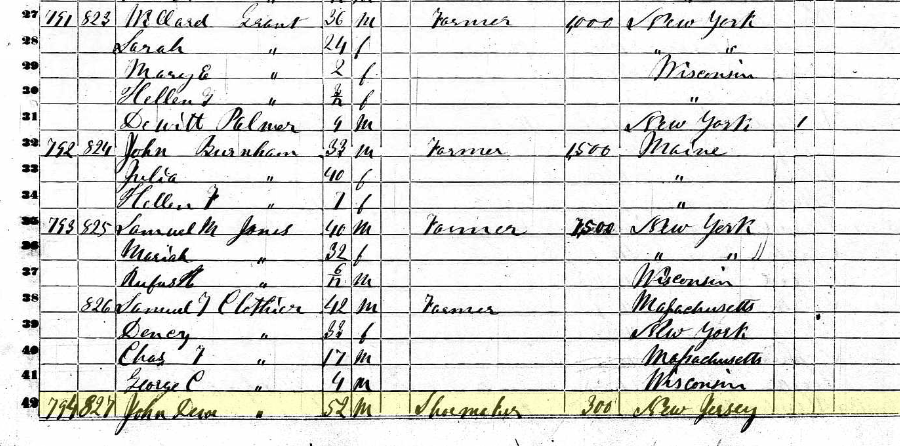
Perhaps not my family’s story… after all I do know that my great-great-great grandfather John DeVore was a shoemaker in Wisconsin in 1850. Not nearly as romantic as a swashbuckling Frenchman, right?

As always, links:

https://en.wikipedia.org/wiki/Devore_Peak

https://en.wikipedia.org/wiki/Devore,_California

https://en.wikipedia.org/wiki/Devore,_Indiana