To boldly go where no man has gone before
September 8
Space: the final frontier. These are the voyages of the starship Enterprise. Its five-year mission: to explore strange new worlds, to seek out new life and new civilizations, to boldly go where no man has gone before.
And so they did, at least in the world of 1960’s television series. Star Trek – which premiered September 8, 1966 – was a show ahead of its time, and as such, struggled to resonate with the viewing public of the day. More on the reasons why in a bit.
For those unfamiliar with the show, the premise was this: It’s 300 years in the future and the United States has commissioned a large, interstellar spaceship and crew to explore the Milky Way galaxy. Led by a cadre of futuristic cowboy space explorers into a rough and tumble world, the viewer experiences all of the things touted in the opening statement: strange new words, new life forms, and new civilizations.
The crew– save pointy eared Vulcan Mr. Spock – all look exactly like one might expect Americans from that era to appear. The elaborate costuming department, however, created an assortment of aliens such as the fierce and hairy Klingons, the blue skinned Andorians, the pointy eared, unabrow militaristic Romulans, and the fuzzy and rapidly producing Tribbles; it was these and other strange creatures the crew encountered each week.
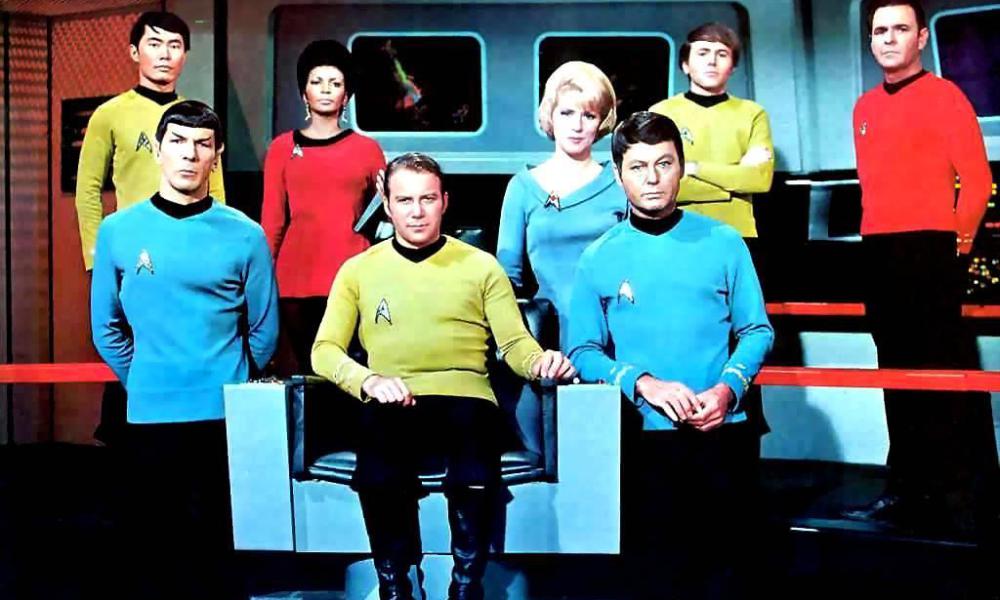
Front row: Leonard Nimoy, William Shatner, DeForest Kelley.
Second row, George Takei, Nichelle Nichols, Majel Barret, Walter Koenig, James Doohan
The most formidable foe the captain and crew of the USS Enterprise faced, however, were the NBC executives who could not figure out how to promote and market this strange new program. Gene Roddenberry, Star Trek’s creator, did all he could to keep the crew out exploring new worlds, but his earthbound benefactors shut the program down at the end of the third season and 79 episodes.
One might have asked the following question: who was the most likely viewing audience for a cowboy-esque show set in the future? Hint: Probably not the mom’s and dad’s of the day. So if you want to appeal to elementary and junior high kids, when might you air the program? Weeknights from 8:30 to 9:30 might not have been the best time. Certainly not at 10 p.m. on Friday night as it was during its final season.
In spite of the thick headedness of the NBC exec’s, the show acquired a dedicated audience whose demographics surprised the studio. From the Infallible Wikipedia:
“The enthusiasm of Star Trek‘s viewers surprised NBC. The show was unusual in its serious discussion of contemporary societal issues in a futuristic context, unlike Lost in Space which was more campy in nature. The network had already received 29,000 fan letters for the show during its first season, more than for any other except The Monkees. When rumors spread in late 1967 that Star Trek was at risk of cancellation, Roddenberry secretly began and funded an effort by Bjo Trimble, her husband John, and other fans to persuade tens of thousands of viewers to write letters of support to save the program. Using the 4,000 names on a mailing list for a science-fiction convention, the Trimbles asked fans to write to NBC and ask 10 others to also do so. NBC received almost 116,000 letters for the show between December 1967 and March 1968, including more than 52,000 in February alone; according to an NBC executive, the network received more than one million pieces of mail but only disclosed the 116,000 figure.”
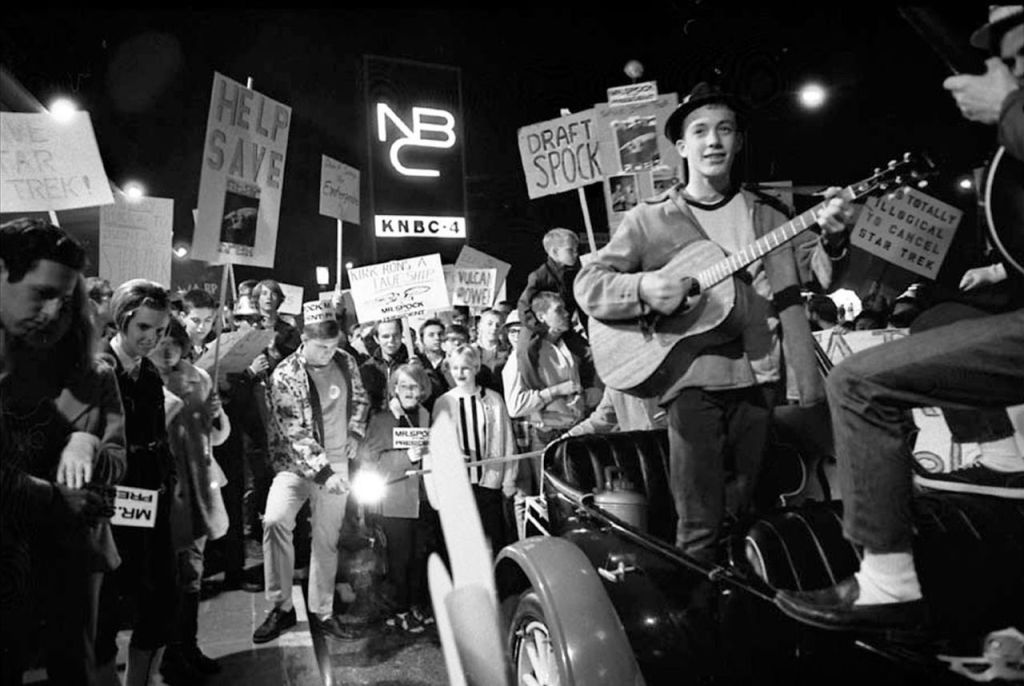
The threat of cancellation inspired fans not only to write letters but some 200 sign carrying CalTech students marched to NBC’s studios in Burbank in 1968; protests appeared in other cities also. New York State Governor Nelson Rockefeller even wrote a letter to the studio. Also, according the Infallible Wikipedia:
“Much of the mail came from doctors, scientists, teachers, and other professional people, and was for the most part literate–and written on good stationery. And if there is anything a network wants almost as much as a high Nielsen ratings, it is the prestige of a show that appeals to the upper middle class and high-brow audiences.”
Alas, the show’s final episode aired in May 1969 and that was the end of it. Or not.
Despite the rule of thumb that a show needed at least four seasons to justify syndication, the show was soon seen during the late afternoon and a whole new demographic was hooked: school age kids. By the early 1970’s it was affecting the culture. Yes, the Infallible Wikipedia once again:
“Fans of the show became increasingly organized, gathering at conventions to trade merchandise, meet actors from the show, and watch screenings of old episodes. Such fans came to be known as “trekkies”, who were noted (and often ridiculed) for their extreme devotion to the show and their encyclopedic knowledge of every episode. Because fans enjoyed re-watching each episode many times, prices for Star Trek rose over time, instead of falling like other syndicated reruns.: People magazine commented in 1977 that the show “threatens to rerun until the universe crawls back into its little black hole”. By 1986, 17 years after entering syndication, Star Trek was the most popular syndicated series; by 1987, Paramount made $1 million from each episode; and by 1994, the reruns still aired in 94% of the United States.”
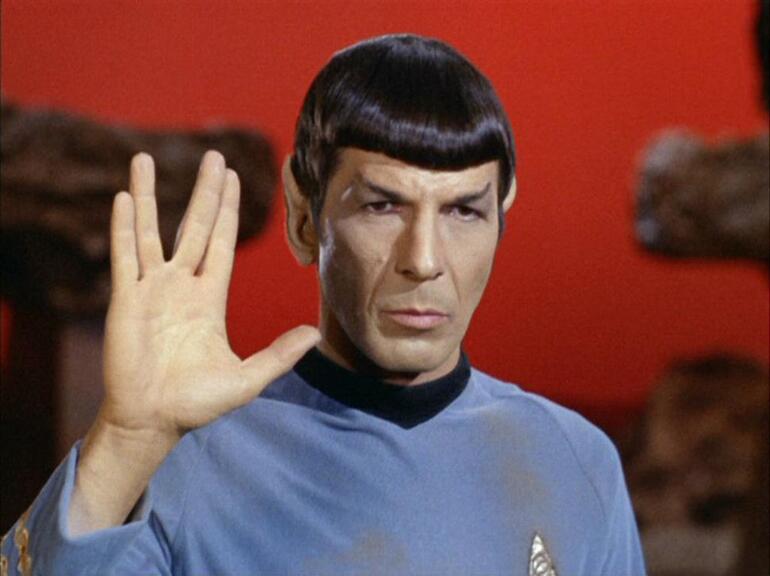
As a teenager in the 1970’s, Star Trek was part of my daily world. I really had no choice, as my sister – a mere 21 months older than me – was one of those crazed Trekkie’s of the day and the program aired most afternoons. In our household, we frequently flashed the Vulcan hand symbol (middle and ring finger separated to form a “V”) and would intone, “Live long and prosper.” Another favorite was to parrot Dr. McCoy who said – in multiple episodes – “Dammit Jim, I’m a doctor, not a _____________.” This sentence was finished with ‘bricklayer,’ ‘engineer’, and ‘escalator’ to name the most famous ones.
Perhaps my favorite, yet macabre, part of Star Trek, was when the crew would be transported to the surface of some planet. Literally, the landing crew always seemed to be Captain Kirk, First Officer Spock, Dr. McCoy, and at least one or two ‘new’ crew members. Unlike the trio of stars who donned gold or blue uniforms, these hapless souls seemed to always wear red shirts and were always the ones who lost their lives. Which gave Dr. McCoy the opportunity to intone his famous “He’s dead, Jim.”
Now, 54 years later, Star Trek has weathered the test of time. Like the troublesome Tribbles, it’s multiplied way beyond its original 79 episodes. Over the years there have been additional TV series, big budget movies, and cartoon programs; these have captured the imagination of new generations of fans, a cultural phenomenon that lives on… unlike the guys in the red shirts.
The links:
https://en.wikipedia.org/wiki/Star_Trek%3A_The_Original_Series
 If you’ve never seen the movie Miss Congeniality, I encourage you to request it from your local library, rent it on Netflix or your preferred movie provider. I have always found the movie to be funny, poignant and effectively showcase the human spirit. The casting was superb with Candice Bergen who tries to hold on to her glory days as a former beauty queen turned pageant director; William Shatner is priceless as Stan Fields, the smarmy host of the show; Heather Burns as the naïve Miss Rhode Island; and, of course, Sandra Bullock, as Gracie Hart, FBI agent turned pageant contestant to get to the bottom of an evil plot to take down the fictional Miss United States pageant.
 barbaradevore.com