Tag Archive | reading

…On the Road to The Little House

Exploring the world of Laura Ingalls Wilder

May 7, 2024

A Tuesday Newsday Classic
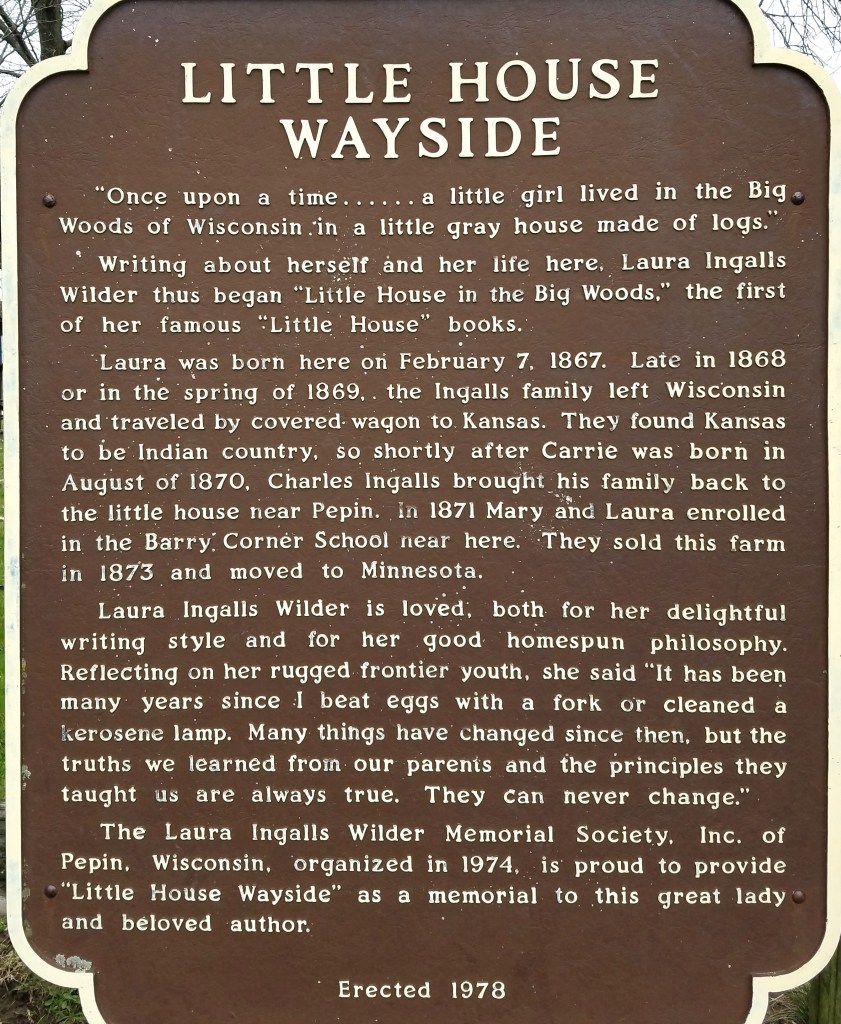
Sign at the “little house” that started it all in Pepin, Wisconsin

Perhaps more than any other books I’ve ever read, this series captured my young imagination and inspired me to want to write and record my world.

The first “Little House” book was published in 1932. Six more followed over the next decade and Laura Ingalls Wilder was propelled from a farmer’s wife to one of the most beloved children’s book authors in history.

As a child I was entranced by the thought of living in a cabin in the big woods of Wisconsin, or in a dugout carved into the banks of Plum Creek in Minnesota, or in a claim shanty on the wind swept prairies of South Dakota. What adventures awaited!

I’ve had as a goal to visit the many homestead sites. In September 2013 I, along with my 20 year old daughter, went to Mansfield, Missouri, and toured the museum and also the house where Laura lived as an adult. This past week was round two when the hubby and me meandered from Wisconsin to South Dakota and traced a portion of the Ingalls family pioneer journey.
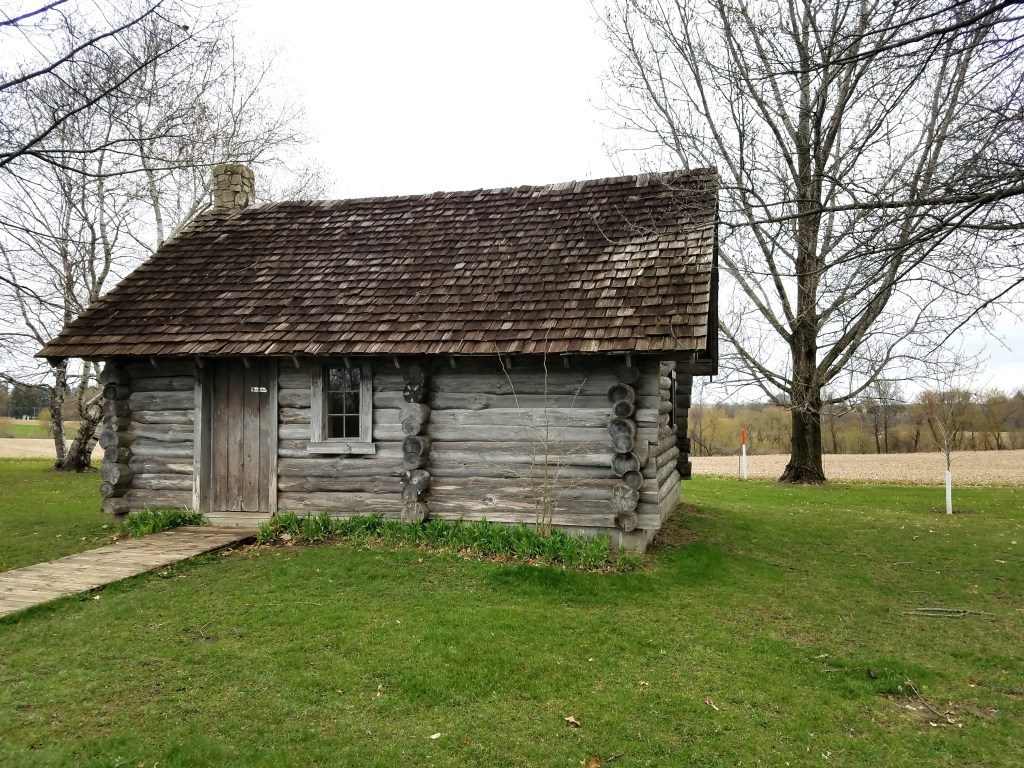
The Little House in the Big Woods in Pepin, Wisconsin

The takeaway for me as an adult – considering it from the perspective of a wife and mother – is how very difficult it must have been, especially for Laura’s mother, Caroline.

Our first stop was in Wisconsin. Although the Ingalls’ cabin is long gone, those who preserved the sites have erected faithful reproductions of the original structures. The little house in Wisconsin was certainly that: little. The main room was no bigger than a small bedroom by today’s standards. For the pioneers, this room was kitchen, dining room, living room, and laundry room (at least half the year). The entire family slept in a room the size of a closet.
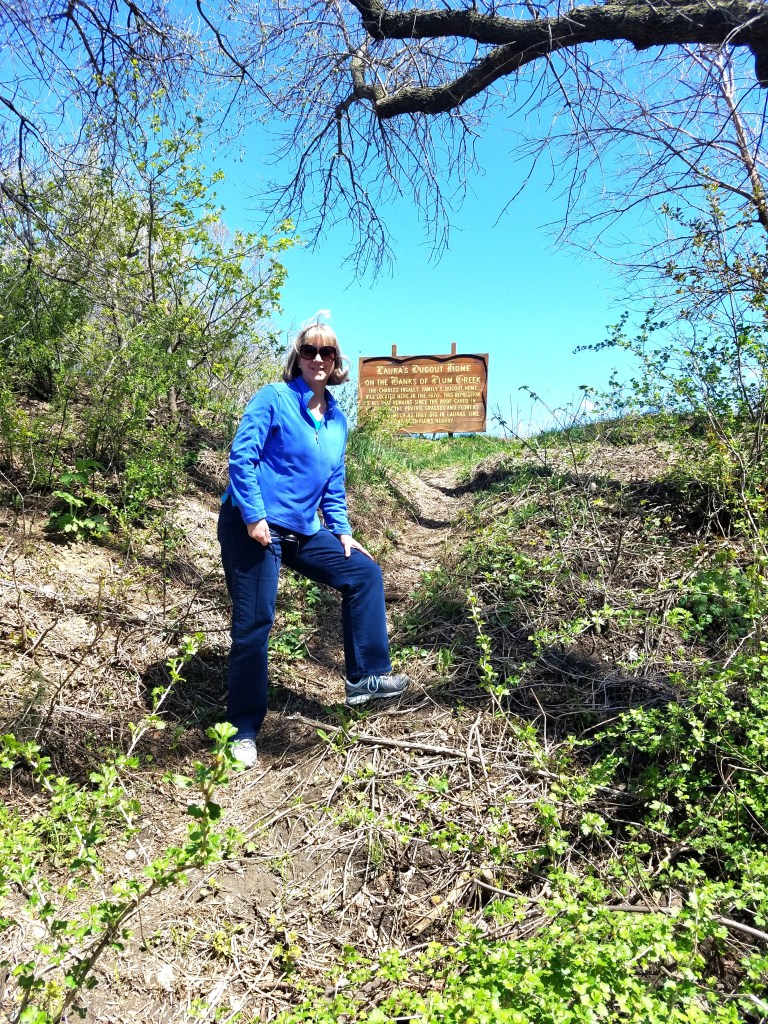
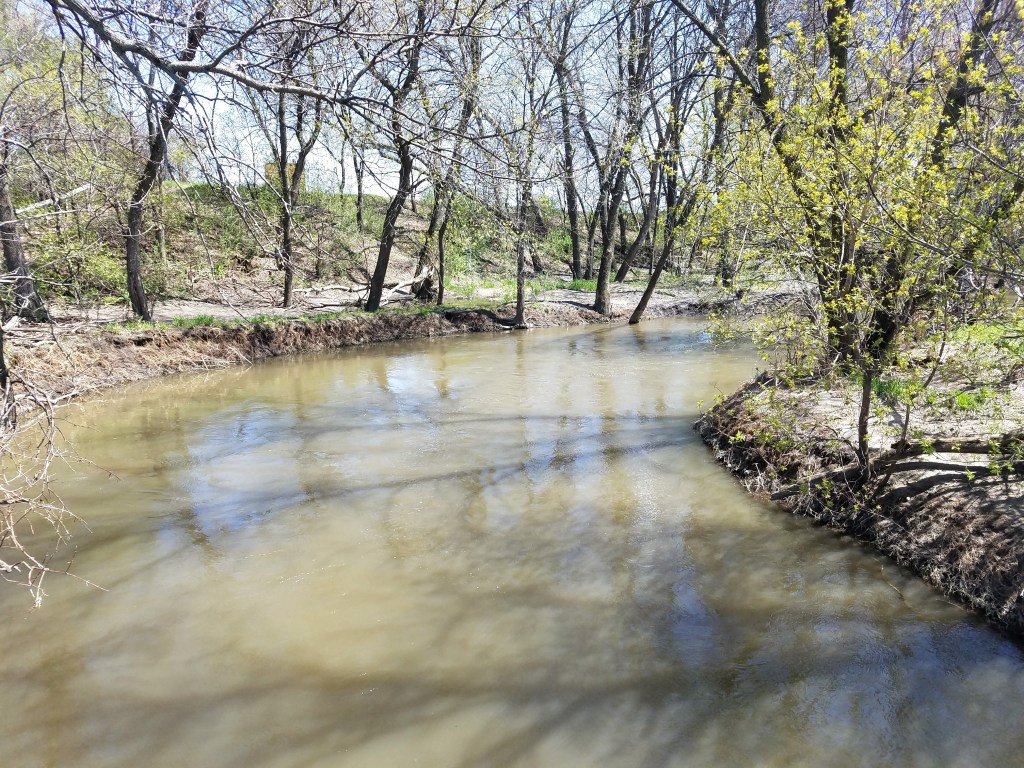
This author standing about where the dugout door was located on Plum Creek, Minnesota.
Plum Creek how it looks now
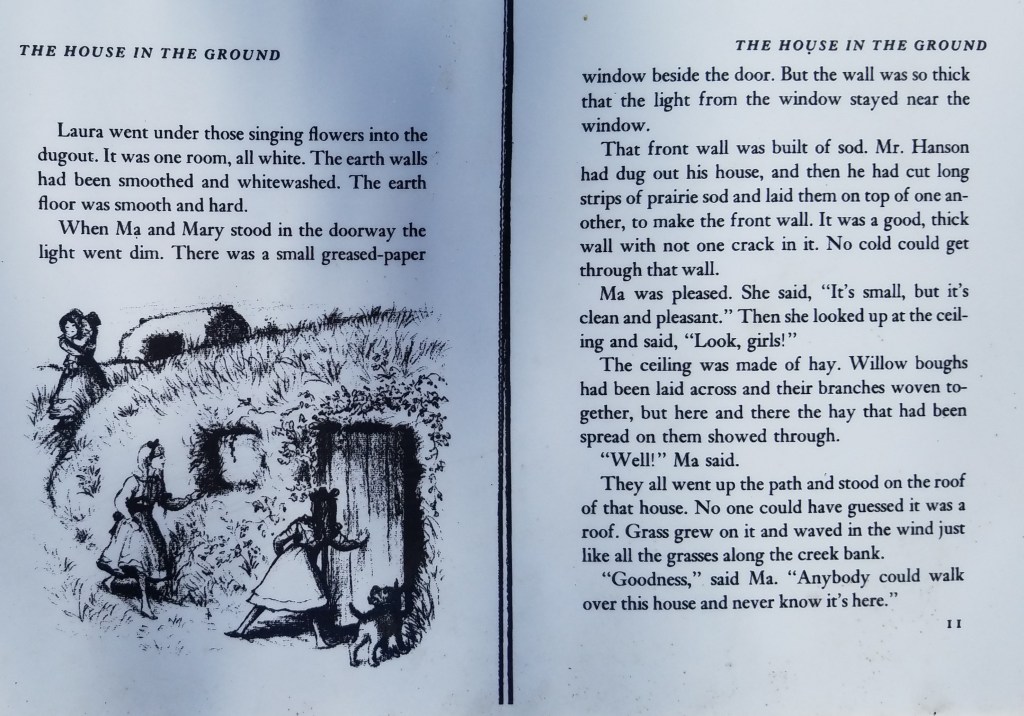
Excerpt from On The Banks of Plum Creek where Laura describes the ‘house.’

It was the next ‘house’, however, that really gave me pause. Laura’s family purchased a farm near Walnut Grove, Minnesota… but there was no ‘house.’ Instead, the family lived for some months in a ten by twelve ‘room’ dug out of a bank above a creek. The actual dugout collapsed years ago, but a reproduction exists in South Dakota. When I walked in to that room two days later I was struck by two things in particular. The first was the smell. It was a combination of earth, mold, and damp. It was depressing and dark. As Laura describes life in the dugout she shares how her mother whitewashed the dirt walls and floor with a lime mixture. I imagine the lime served several purposes including, foremost, pest control and to brighten the room. How hard it must have been for Caroline Ingalls to cook, clean, and care for her children in that tiny, tiny space.
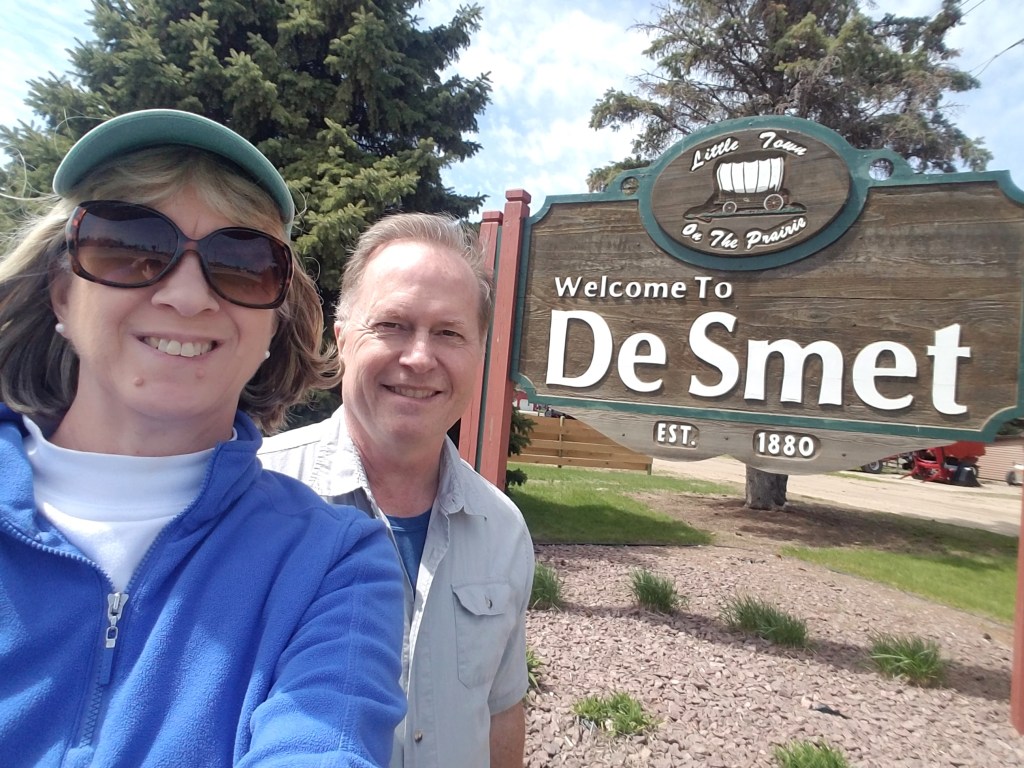
The author and hubby at DeSmet, South Dakota

In South Dakota the Ingalls family had to, once again, start from scratch. It was not hard to imagine how alone and desolate Caroline must have felt as one of the first pioneers in DeSmet. Their homestead was 160 acres – one quarter mile square – and it was a half mile south of the town. There were no neighbors, just the wildlife which called the prairie home. The Ingalls claim shanty was just that: a shanty. Unlike the cabin in Pepin, this home was a tiny one room shack with the beds for a family of six in every corner, a stove in the center, and a few chairs and a table. The thin walls not much protection against the persistent winds and cold. Over time the shanty was expanded to include 2 small bedrooms and a 12 by 16 living room.
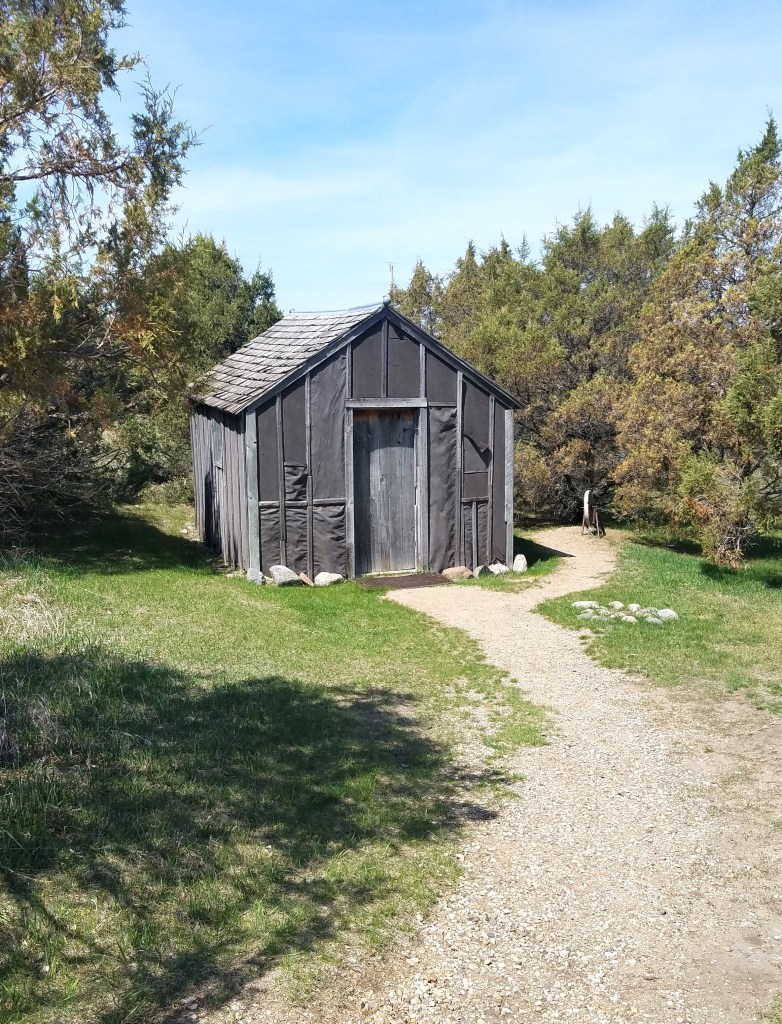
Replica of the ‘shanty’ where the Ingalls family of six lived the first summer so Pa could ‘claim’ his land.

What resilience these people possessed!

When we stopped at the Ingalls homestead near DeSmet, the woman who owns and runs the property came by to speak to us. I said to her I suspected when the Ingalls family arrived there that Caroline told Charles she was done moving and carving out homes in the wilderness. Our hostess confirmed my supposition. Laura’s parents lived the rest of their lives in that community, eventually moving to a proper house in the town eight years after their arrival.

It is impossible to truly capture these places on paper. But Laura Ingalls Wilder’s narrative description of each location comes close. I felt as if her spirit was there with us in South Dakota, especially, as I mapped out some travels to the spots she describes in her books.

The roiling waters of Lake Henry during the spring perch hatch

It was at Lake Henry when the magic occurred. The hubby and I noticed the water in a nearby slough was roiling. Upon closer examination we discovered hundreds of fish flopping and thrashing about! We walked close to the spectacle, mesmerized by the yellow perch which spawn this time of year once the water raises to a certain temperature.

From there we meandered across the back-roads, and observed white tailed deer, a muskrat which waddled across the road, and hundreds of birds: pelicans, herons, eagles, hawks, geese, and all variety of smaller ones.

We were reluctant to leave but how very glad we were to be able to experience a tiny portion of the Ingalls family journey.
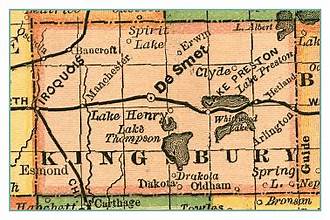
So which of the three ‘little houses’ would have been the best ? Probably the cabin in Wisconsin. As we returned from our adventures I found myself thankful, yet again, for modern amenities: electricity, running water, flushing toilets, refrigeration, automobiles, and airplanes. What a blessed era in which I live.

A few links. First is to my blog article from February 7, 2017 about Laura Ingalls Wilder: https://barbaradevore.com/2017/02/07/laura-ingalls-wilder/

And some links to the various historical sites:   

https://www.lauraingallspepin.com/big-woods-cabin.html

http://walnutgrove.org/ingalls-dugout-site.html

https://www.ingallshomestead.com/history

I know everyone would be disappointed if there was not at least one link to the Infallible Wikipedia:

https://en.wikipedia.org/wiki/Laura_Ingalls_Wilder

Coddiwomple

Traveling in a purposeful direction

January 9, 2024

The author’s collection of dictionaries. The Webster’s New World Dictionary, third from the left, was often used for playing ‘Dictionary.’

Back in the early 1980’s I was introduced to a game my hubby and his family loved to play. There was no game board or markers to move around. Instead it required a dictionary, a piece of paper for each player, and a pen. They called the game Dictionary.

A search of the internet reveals, from the Infallible Wikipedia, that the genre is more commonly known by another name: Fictionary. In the years since being introduced to this delightful pastime there have been actual games developed and sold. As noted by the Infallible Wikipedia:

“The board games BalderdashDictionary DabbleFlummoxed, and Weird Wordz are based on Fictionary. In one round of the board game Derivation, players describe or fabricate a word’s etymology; players who provide a correct etymology receive one point for doing so, but their entries are then removed from play, and they lose their chance to receive multiple points by drawing multiple votes from other players. Similarly, in the board game Wise and Otherwise, the Picker randomly chooses a quotation and reads the beginning, and other players try to create realistic endings to the quotation.”

It’s amazing what interesting words one can find when perusing a dictionary.

While these games have been successful, I rather like how we played it: Get a group of people together (the more the better) and then pick one person each round who looks through the dictionary until they find a sufficiently obscure word. They then announce the word to the group and each person has to come up with a definition for that word. The chooser writes down the REAL definition.

Once everyone has written his or her definition, the papers are passed to the person who picked the word and they read each entry aloud, being sure to hide the papers from others. Each participant then decides which might be the real meaning of the word. Those who guess correctly get one point. The chooser gets one point for every incorrect guess.

Now, I’m sure you are wondering what this has to do with the title of this week’s Tuesday Newsday, Coddiwomple. Up until the hubby and I were driving home from Yakima on New Year’s Day this year I had never heard of Coddiwomple. But it immediately made me think of playing Dictionary and probably the most favorite word I ever found and used which is ‘gardyloo.’

The hubby had read an article on the term Coddiwomple and shared it with me. What I learned, from author and philosopher David Marlowe – who coined the term – is this:

I was immediately struck by the rhythm of the word and how it seems to fit its definition. Of course the purpose of the word is to help people stop and contemplate what, exactly, they are each trying to accomplish in life.

It was exactly seven years ago today when I wrote my first Tuesday Newsday. At that time I had no idea where I was going with it; only that, via a very decidedly Coddiwomple experience, I had been nudged to take the path of starting a website for ‘someday.’

That ‘someday’ was aimed for that moment, in the murky future, when I would have a book published and be able to share it on my website.

And thus began a Coddiwomple journey toward a vague destination. My first Tuesday Newsday was all about one of my favorite musical artists, Jim Croce.

Of course I screwed it up a bit on that first go round – being unfamiliar with WordPress and how it all worked – and accidently posted it on Wednesday, January 10th instead of that Tuesday, January 9th. So I ended up with TWO articles about Jim Croce a year apart, with the other one on January 11th the following year. (here’s the link to both which I combined into one for ONLY January 10th): https://barbaradevore.com/2017/01/10/jim-croce/)

But that was okay because, well, Jim Croce. One of his best… and so bittersweet.

What I did know after that first post is that in addition to the fiction stories which invade my brain and compel me to write, I had a whole lot of personal stories which came pouring forth.

Some have been funny, some philosophical; they range from recounting early childhood memories to recent impactful events. They cover music, TV, movies, nature, history, geeky musings, and cultural references. War and politics are never included.

But what do any of these ramblings have to do with traveling purposefully toward a vague destination?

For me, no matter what think I chose to do, it is the desire to fully embrace each experience in life. New opportunities frequently present themselves and, as someone who probably has undiagnosed ADD, I am often distracted by such shiny objects.

Yet, as I have matured, I’ve come to understand a universal truth: our most precious commodity is TIME. I’ve become quite protective of my time. And the one thing in life which is elemental to who I am and where I want to spend my time is writing. It’s been that way since I first put a piece of chalk to a chalkboard desk I received as a Christmas present at age three when my family still lived in Clarkston, Washington.

The author, age 3, with her chalk board. Captured with a cell phone camera from the home movies my dad took.

So now I begin year eight of my blog in basically the same way as I did in 2017, traveling in a purposeful manner toward a vague destination. Coddiwomple.

Now, if you’ll excuse me I need to go write Nicole out of the entanglement in which she finds herself. Who will she choose: Nathan, Sam, or ???. And how will her parents react? I’m not sure she has quite embraced Coddiwomple but then again she’s only 21 and has a lifetime ahead of her.

Finally, for those who have read all the way to the bottom, here’s your reward. Gardyloo is, according to Dictionary.com, “a cry formerly used in Scotland to warn pedestrians when slops were about to be thrown from an upstairs window.” Oh those crazy Scots. You’re welcome. Of course if you looked closely at the photos, you already knew the definition.

The links:

David Marlowe’s substack: https://ikiquest.substack.com/p/coddiwomple

The Infallible Wikipedia never lets me down: https://en.wikipedia.org/wiki/Fictionary