Tag Archive | nature

Deer Danger!

A Public Service Announcement

October 8, 2024
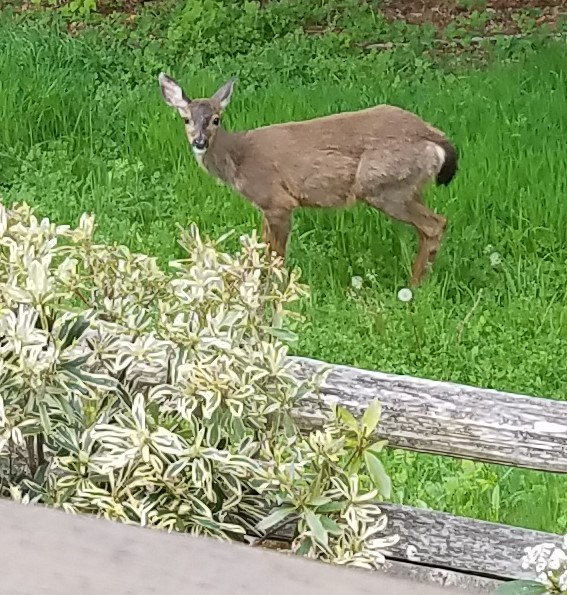
One of my ‘neighbors’ saying ‘Hi”

A Tuesday Newsday Classic

This week’s blog is really more of a public service announcement (PSA). Each year when I turn the calendar page to October, I know it is time once again to think about the very scary…. Cervidae. Or, as most people know the species, deer.

With approximately 21 million deer living in the United States, it should surprise no one that conflicts between people and deer will arise. Back to that in a moment. But first a little information on the Mule deer species, the most common Cervidae in the Pacific Northwest, as told by the Infallible Wikipedia:

“Deer are browsers. During the winter and early spring, they feed on Douglas fir, western red cedar, red huckleberry, salal, deer fern, and lichens growing on trees. Late spring to fall, they consume grasses, blackberries, apples, fireweed, pearly everlasting, forbs, salmonberry, salal, and maple. The mating or ‘rutting’ season occurs during November and early December. Bucks can be observed running back and forth across the roads in the pursuit of does. After the rut, the bucks tend to hide and rest, often nursing wounds. They suffer broken antlers, and have lost weight. They drop their antlers between January and March. Antlers on the forest floor provide a source of calcium and other nutrients to other forest inhabitants. Bucks regrow their antlers beginning in April through to August.

(snip)

At dawn, dusk, and moonlit nights, deer are seen browsing on the roadside. Wooded areas with forests on both sides of the road and open, grassy areas, i.e. golf courses, attract deer. Caution when driving is prudent because often as one deer crosses, another one or two follow.”
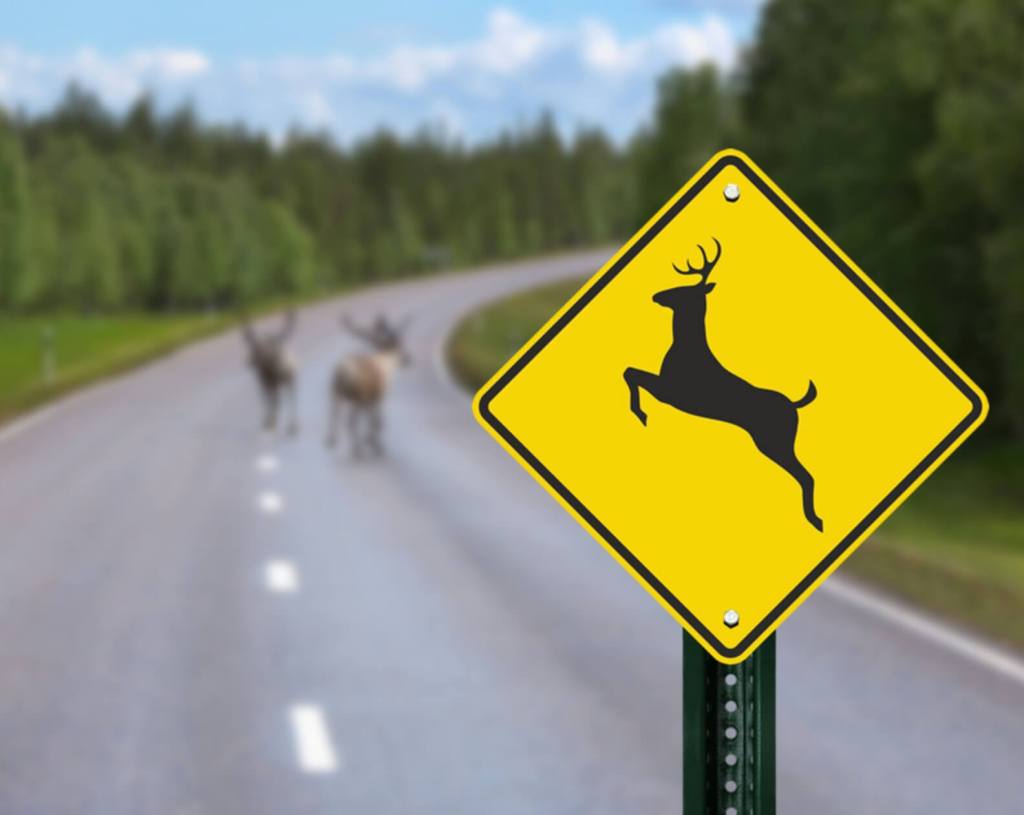
The last line brings me back to the PSA. From October through December you are much more likely to see deer near or on the road and are much more likely to hit one with your car. We can conclude that the need to forage farther and farther for food to sustain them through the winter, combined with the urge to mate, increases their interactions with people.

At the ripe old age of 22 I learned the hard way a universal truth about deer. Driving home from Tacoma to the small town of Eatonville (population 1005) one early October night in my trusty Ford Pinto, a deer leaped out in front of me. I braked and barely missed the animal… then I made a classic mistake. Thinking the danger was past, I put my foot on the gas and sped up. Yep. I hit the second deer.

Over the years I’ve encountered many deer on the roads and have been known to freak out a bit when driving, especially at dusk. I’m constantly watching the sides of the highway looking for the critters.

My concern is justified. About 7 years later, I hit another deer one morning in spring while on my way to work. Yes, I’m paranoid.

My most illustrative encounter occurred on a late September evening while driving a group of teenage girls to a weekend camp out on Hood Canal. It was a Friday and by the time we had the group organized, stopped for fast food, and then crawled our way through the Seattle/Tacoma metro traffic, it was dark.

As we made our way along state Highway 106 and approached Twanoh State Park, the young woman who was riding shotgun asked why I was driving so slowly.

“I’m looking for deer,” I replied, then continued, “They are active this time of year and day.”

I then proceeded to tell her about my two deer related accidents and issued the following warning:

“So if you are ever driving and a deer jumps out in front of you, STOP, because they always travel in pairs.”

“Always?” she questioned.

“Pretty much always,” I replied.

And then, not three minutes later, it happened.

From my left a deer bounded across the road in front of the van. I hit the brakes and stopped. A moment later the second deer crossed exactly where the car would have been had I not stopped.

“How did you do that?” she asked, a look of awe on her face in the low glow of the dashboard lights.

“It’s my deer karma,” I replied.

Yes, deer karma is a thing. I have another friend who is certain that I attract the critters. On a different road trip a few years earlier, I was a passenger in her car, driving from Moscow, Idaho, to Seattle one summer night. It was late June and we had been talking about my deer encounters. After hearing my stories, the poor woman was panicked, worried about ‘when’ (not if!) some random buck or doe would pop up in front of us.

For 240 miles everything was fine and I kept saying that I was not capable of conjuring up random deer… that was until the very top of Snoqualmie Pass. Just as the car swept around the last curve to the summit, smack dab in the middle lane of Interstate 90, was a deer. Just standing there as though waiting for me.
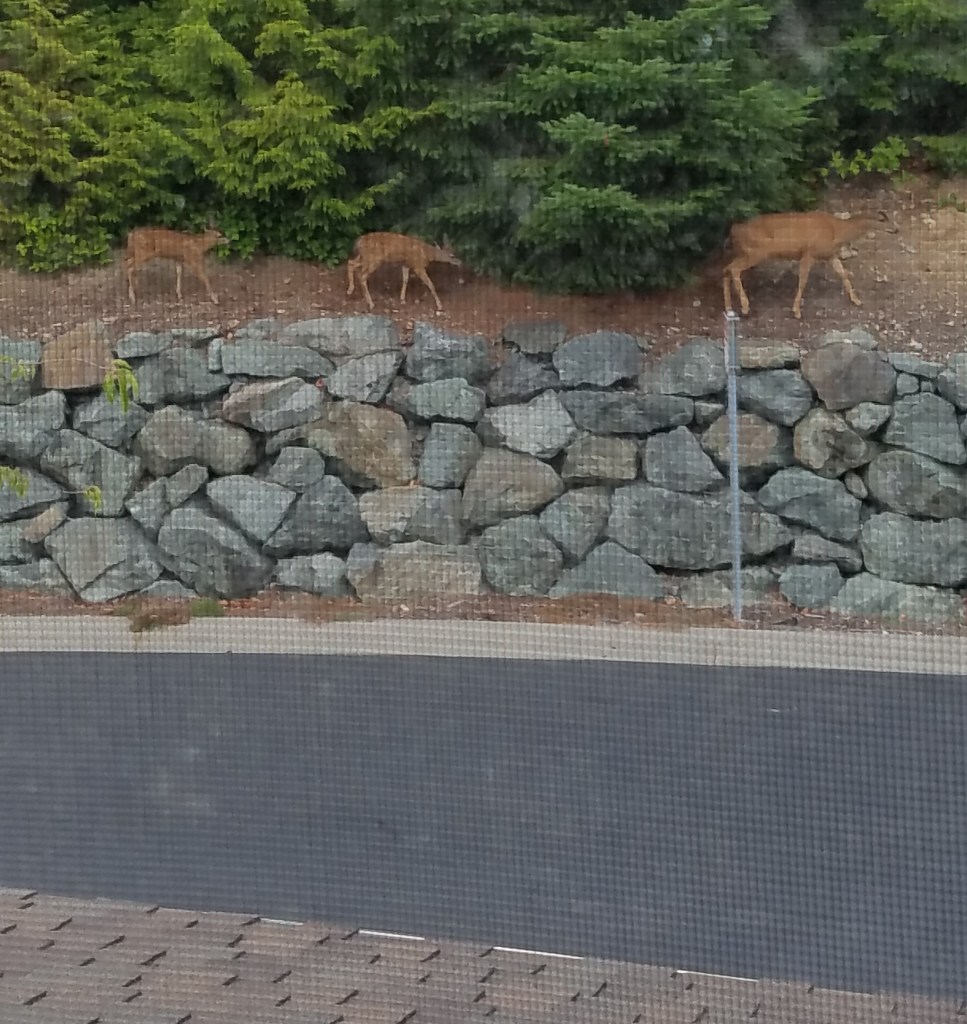
View from my office window watching a few of my spirit animals passing through

“I knew it! I knew it!” she exclaimed. “It’s you. They’re your totem animal.”

As for me I had no explanation. I’d never before seen a deer standing in the middle of Snoqualmie Pass and never have again. Yet, there the deer was, confirming to her that I had some mystical ability to conjure up my patronus animal, the mule deer.

Personally, I think it would be much easier to have a dog, a cat, or a chipmunk, for my totem animal. Or a sloth. A sloth would be nice as it would never jump out in front of me while driving.

The links:
The Artichoke

A culinary delight consumed for centuries

May 28, 2024

When I think about improbable foods, the artichoke is at the top of my list. Afterall, who would have looked at this thistle and thought, “I wonder if I can eat that without poking holes in my mouth?”

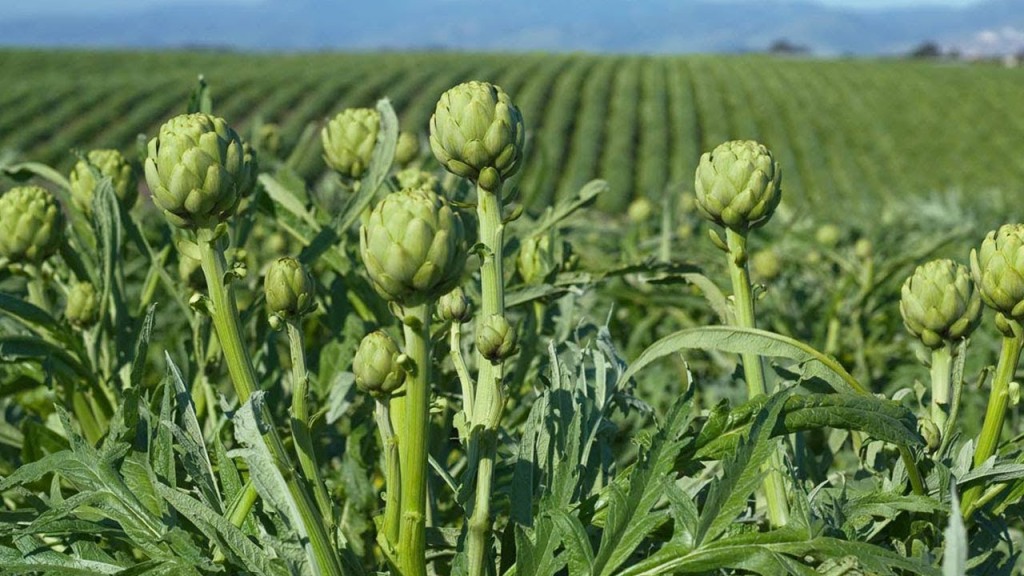
A field of artichokes

Yet, artichokes have been grown and cultivated since at least the eighth century BC.

The Infallible Wikipedia helpfully tells us:

“The (globe) artichoke is a domesticated variety of the wild cardoon (Cynara cardunculus), which is native to the Mediterranean area. There was debate over whether the artichoke was a food among the ancient Greeks and Romans, or whether that cultivar was developed later, with Classical sources referring instead to the wild cardoon. The cardoon is mentioned as a garden plant in the eighth century BCE by Homer and Hesiod.”

Based on further information in the Infallible Wikipedia, I came to the conclusion that the plant was, for centuries, considered a luxury food for royalty and the wealthy. It also developed a reputation as having aphrodisiac qualities.

It was the Dutch who brought them to England where they were successfully grown in Henry VIII’s palace garden in 1530. In the 19th century, immigrants transported the plant to the new world: Louisiana by the French and California by the Spanish.

Despite Henry VIII’s garden, until recently, the artichoke has only been successfully grown in warmer climates. If you look at a latitude map of the world which shows the areas where they cultivated, most are found in about a 350 mile wide band between the 30th and 37th parallels both north and south. Heartier varieties of the plant are being developed with promise of being able to be grown in northern climates.

Also from the Infallible Wikipedia:

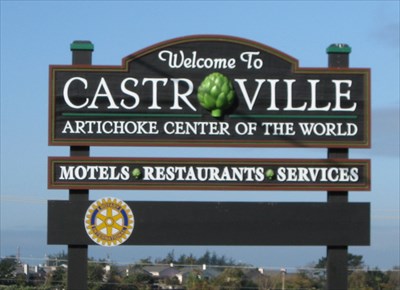
“Cultivation of the globe artichoke is concentrated in the Americas and the countries bordering the Mediterranean basin. The main European producers are Italy, Spain, and France and the main American producers are Argentina, Peru and the United States. In the United States, California provides nearly 100% of the U.S. crop, with about 80% of that being grown in Monterey County; there, Castroville proclaims itself to be “The Artichoke Center of the World” and holds the annual Castroville Artichoke Festival.”

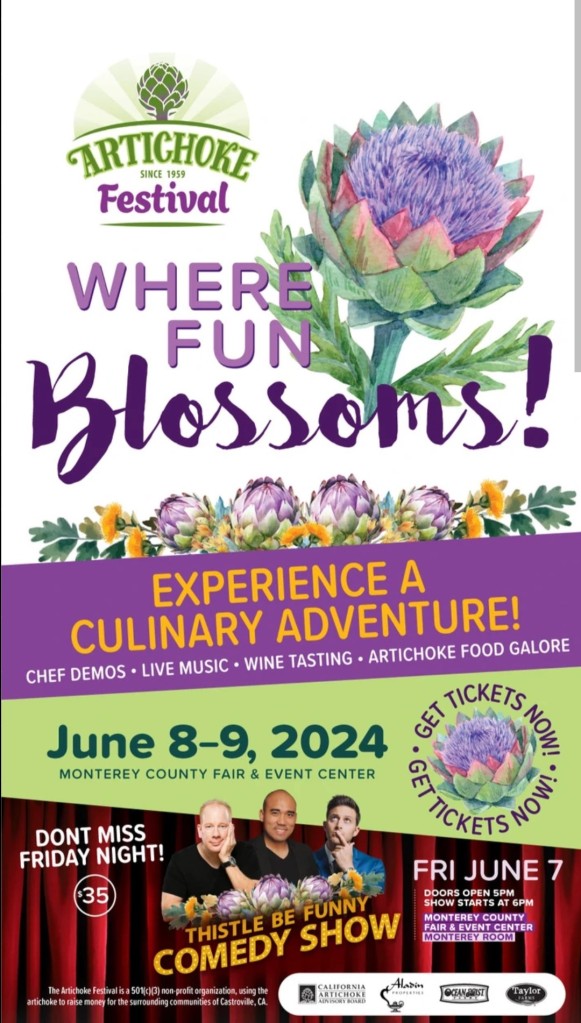
The 2024 poster for the Castroville Artichoke Festival on June 8-9

I’m making a mental note to take in the Artichoke Festival which, apparently, is held the second weekend in June each year. This makes sense since artichoke ‘season’ is from March until June.

My first memory of artichokes is from when I was about six years old. One night when the family (Two parents and four kids ages 6, 8, 10, 15) sat down to dinner and in bowls at my parents’ places – and perhaps my oldest brother’s – were these green vegetable things with prickly ends and tough looking leaves.

Of course it begged the question “What are those?”

“Artichokes,” my mother replied, “but I don’t think you’d like them.”

Now anyone who understands reverse psychology would know that IF she wanted to save money she would have made artichokes for all and forced us to eat them. It likely would have been a one and done. But no. Instead the verbal gauntlet was tossed on the table like an, er, discarded artichoke leaf, and we begged to try the vegetable.

Every one of us liked them. A lot. That might have had something to do with the fact that we were allowed to dip the soft leaf ends in mayonnaise and smother the heart in whatever was left.

Over the years artichokes were a springtime treat for the family. And they still are. I continue to prepare them like my mom did, steamed for up to 40 minutes but instead of mayo, we dip the soft ends and the heart in melted butter.

I also love, love, love, pretty much anything that includes artichokes as an ingredient. Artichokes on pizza, artichokes in dips, or even artichokes preserved in olive oil eaten plain are all favorites.

There was, however, one thing artichoke which wasn’t so great. Back in the 1980’s the hubby and I hosted, for several years, an April Fool’s Day party. We invited family and friends and one main feature of the party was the opportunity for attendees to tell their best joke in hopes of winning the prize.

At the end of the joke telling the judges (that would be me and hubby) would decide – usually based on the groans and reactions from the crowd – as to who had told the ‘best’ joke and who told the ‘worst’ joke. But there was a twist. Since it was April Fool’s Day, the winner of the ‘best’ joke got the worst prize and vice versa.

The competition (it was either 1985 or 1986) was particularly hot this one year and Tom, the younger brother of Paul – who I worked with – came loaded with jokes. Tom told bad joke after bad joke and pretty much earned a lifetime achievement award for his repertoire and the judges decided he was the ‘best’ that night.

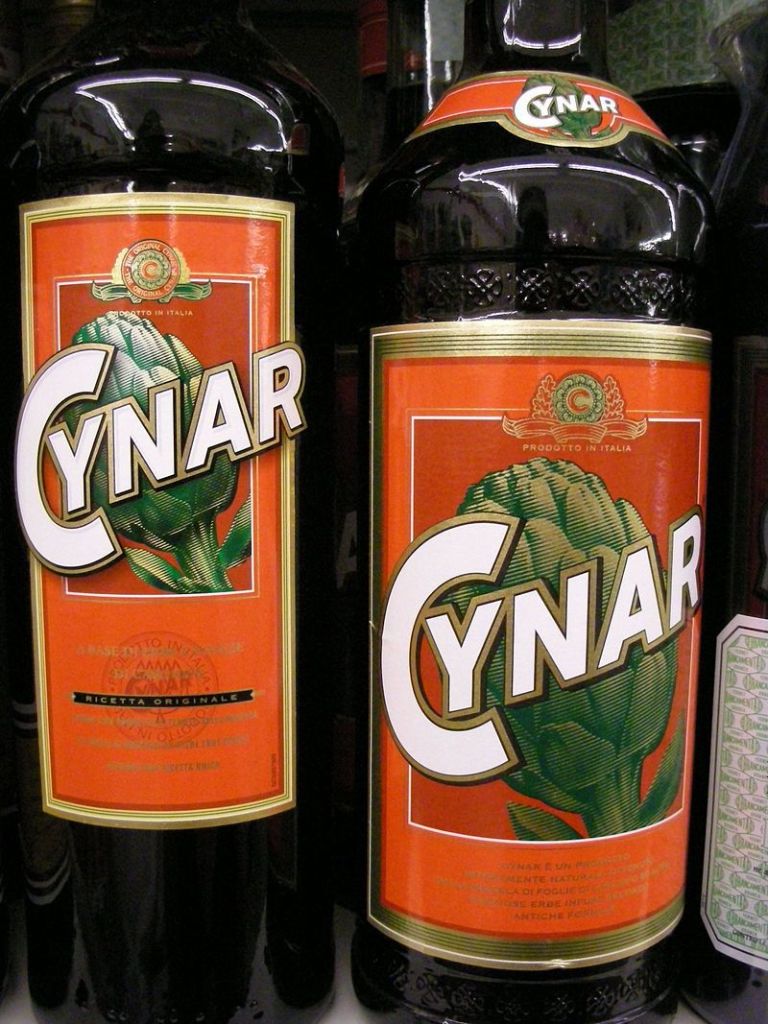
Yes, it really exists…

Winner of the worst joke earned a bottle of scotch. Winner of the best joke? A bottle of this exotic liqueur I found called Cynar. For those paying attention you may have seen the word ‘Cynar’ a bit earlier in this article… Cynara cardunculus. Otherwise known as the globe artichoke.

Tom was thrilled to have won and opened his bottle there and then to savor his sweet win. We provided a shot glass and he took a sip… and nearly spit it out. So older brother Paul also tried it, as did several others. All with the same result. Having seen enough I passed on trying Cynar – the artichoke liqueur – and, thankfully, the bottle went home with Tom that night.

When talking with Paul over this past weekend, he reminded me of what happened after. For a time Paul and Tom were roommates and whenever a new, unsuspecting friend would come to their apartment, out would come the bottle of Cynar and they’d lay it on thick. They’d expound on how great it was and they would invite the ‘new guy’ to have some with them. Everyone would get a small glass and then Paul and Tom – and any others who had been previous victims – would raise their glass to drink. But none of them ever did, instead watching the ‘new guy’ take a slug and… nearly spit it out. This was followed with raucous laughter and telling the story of they came to possess the Cynar.

What prompted Paul to share this story with me (He’d shared it years before, but it never gets old) was that he was on a business trip and sitting at a bar recently and happened to look up at the shelf behind the bartender and, lo and behold, there was a bottle of Cynar. I asked him if he ordered a shot but he said he hadn’t. Can’t imagine why.

I suppose one of these days I really should try Cynar. But I think I will look up how, exactly, it should be consumed first. Probably with a whole lot of orange juice or used sparingly in some fruity cocktail.

In honor of the artichoke this week, however, I skipped the Cynar and instead bought a raw one at Freddies for the hubby and me for dinner last night.

As I began preparing it, I thought of my mother and, as I have done hundreds of times, copied how she cooked them: cut them in half, then remove the tiny ‘hairs’ that grow from the heart. I rinsed between the leaves, spreading them out just a bit, then started them to steam in my double boiler pan. Later, as I dipped the tender pieces in butter I gave a salute to the wonderful globe artichoke, always a treat.

And when you are in Castroville be sure to visit the Giant Artichoke…

The links:

https://en.wikipedia.org/wiki/Artichoke

https://en.wikipedia.org/wiki/Castroville,_California

https://en.wikipedia.org/wiki/Cynar

https://www.foodandwine.com/what-is-cynar-6503431