Tag Archive | National Parks

My Wawona

Like Yosemite National Park, it’s a treasure

October 1, 2024

A Tuesday Newsday Classic
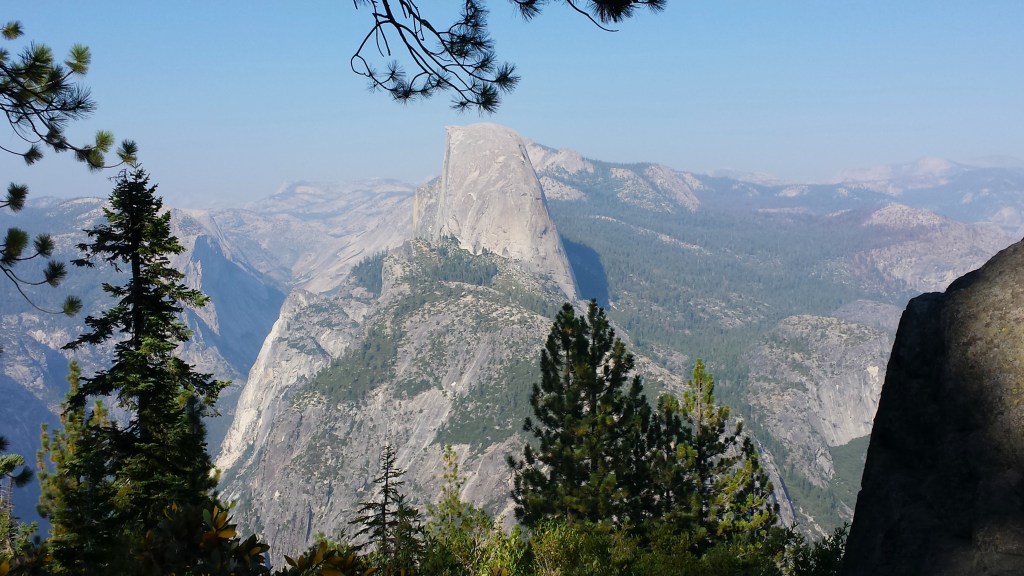
Half Dome, Yosemite National Park, from Glacier Point overlook September 2015

October 1, 1890 marked the official inclusion of this region into the newly formed National Park System. Long before that, however, the Yosemite Valley had inspired the natives who resided in the area as well as the early white settlers.

It was, contrary to popular belief, James Mason Hutchings and artist Thomas Ayres who were the first Americans to tour the area in 1855.

From the Infallible Wikipedia:

“Hutchings and Ayres were responsible for much of the earliest publicity about Yosemite, writing articles and special magazine issues about the Valley. Ayres’ style in art was highly detailed with exaggerated angularity. His works and written accounts were distributed nationally, and an art exhibition of his drawings was held in New York City. Hutchings’ publicity efforts between 1855 and 1860 led to an increase in tourism to Yosemite.”

Although the greater Yosemite area had been set aside by Congress in 1864, the Valley and Mariposa Grove were ceded to California to manage as a state park. The two areas had seen an influx of homesteaders and were being rapidly commercialized as well as being used for the grazing of sheep and cattle; the old growth sequoias were being logged.
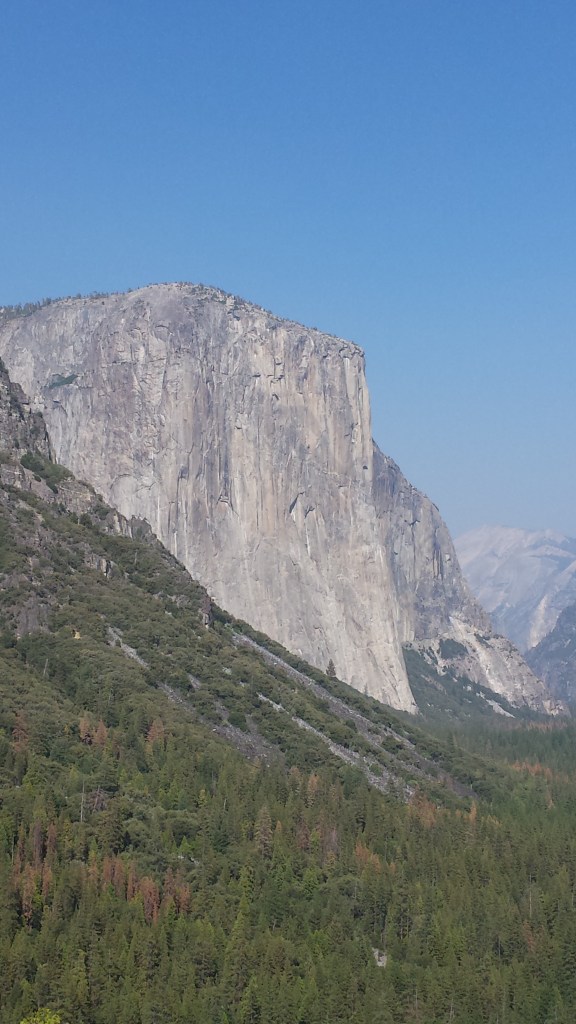
The iconic El Capitan

Most people associate the founding of Yosemite with early environmentalist John Muir. Rightly, he is credited with not only pushing for park expansion but also lobbied for the federal government to take back the iconic valley and grove.

Also from the Infallible Wikipedia:

“It was because of Muir that many National Parks were left untouched, such as Yosemite Valley National Park. One of the most significant camping trips Muir took was in 1903 with then president Theodore Roosevelt. This trip persuaded Roosevelt to return ‘Yosemite Valley and Mariposa Grove to federal protection as part of Yosemite National Park.’”

The years long efforts paid off when, in 1906, Roosevelt signed a bill which stripped the two areas still managed by California from the state and they were returned to the federal government which finally created a unified Yosemite National Park.

One trip to Yosemite is all it takes for a person to understand the grandeur and how special a place it is. From towering El Capitan, to the massive Half Dome, or the fascinating Tuolumne Meadows, Yosemite is a visual feast.

And the hubby and I wondered, when we visited in September 2015, how come it had taken us so long to get there. We arrived on the day after Labor Day which was a good thing as the summer crowds were gone. Reservations are generally required months – if not a year – in advance for the various hotels. I figured we were out of luck but checked anyway as we drove south a few days before our planned stay. What a surprise! There were rooms available at the Wawona Hotel or space in ‘dry’ tents. We opted for the hotel.

It was only after we arrived at the park that it dawned on me that the Wawona Hotel was nowhere near the Yosemite Valley. That day had turned into a driving ordeal. My hubby suffers from vertigo. Being close to any ledge can trigger a sensation of spinning as well as nausea. Knowing this, it was my duty to do the driving so that he could close his eyes as needed when navigating cliff-side roads.
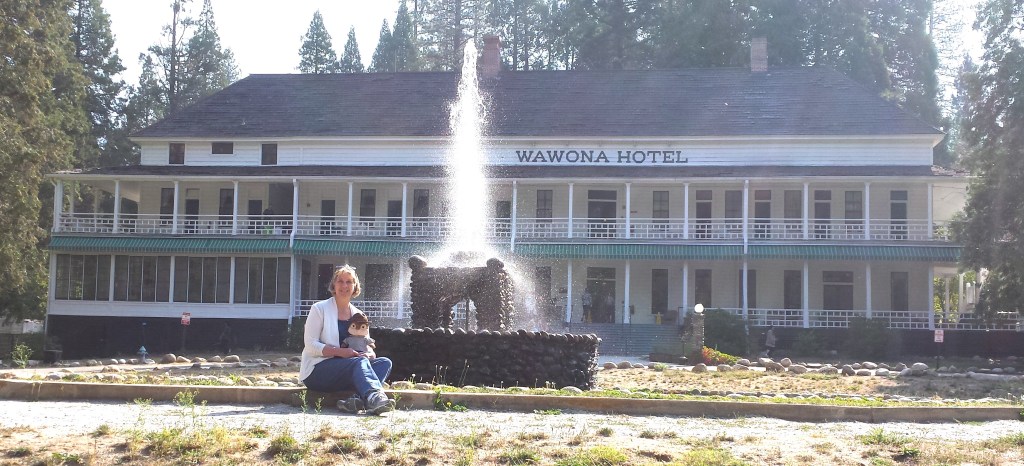
The author, along with Alvin the Chipmunk traveling companion, at the Wawona Sept. 2015

Up, up, up we traveled from the eastern side of the park to the 9,943-foot-high Tioga Pass – the highest mountain pass in California. Come to find out, THAT was the easiest road. From there we wound our way through Yosemite’s high country. Then we had to go down. From Tuolumne Meadows – elevation 8,619 feet – to the Valley floor was a 4,619 foot descent. And all of it seemed to be a series of endless switchbacks and curvy roads carved in to the sides of mountains.

It was with a sense of relief we reached the bottom when it hit me… Wawona was another 30 miles which we had to add to the 230 we’d already traveled that day. No rest for the driver as the road climbed back up the other side through yet another series of switchbacks, cliffs, and amazing vistas.

Now close to sunset, we found the hotel and were charmed at the thought of staying in an 1870’s structure.

Our room was in the more recently added section… built at the turn of the last century. Located at the far western end of the first floor, the room opened out on to a wide veranda adorned with honeysuckle.

But that’s where the charm ended. The room itself featured a double bed and a twin bed. There was a sink attached to the wall next to the twin bed with a door in the wall next to it. The door, however, was locked.
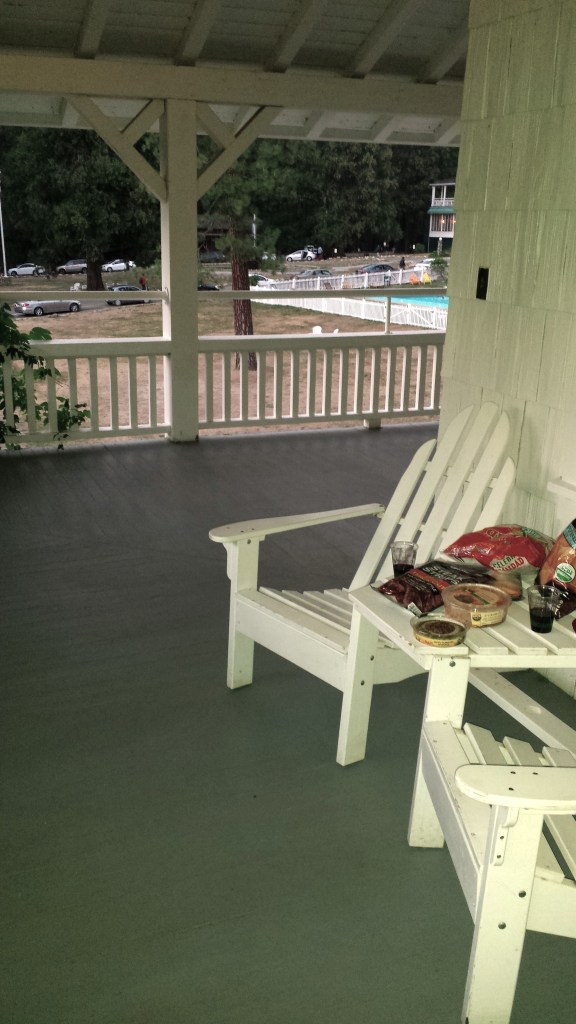
Table for two on the verandah

The room was completed with a small square closet, small dresser and a table and chair. No TV and no phone. But we were up for the adventure and the price – less than $70 a night – was a steal even with having to use the bathroom down the stairs.

As we went to bed that night we could hear, through the thin walls, talking in the room next door; two men were conversing in German. We laughingly dubbed them Hans and Fritz and, although the hubby had taken German in high school, were unable to decipher their conversation.

The next day, after breakfast in the hotel dining room, we headed out for a full day of touring. That evening we bought deli meats, fruits, crackers, and a bottle of wine which we ate and drank while sitting in the Adirondack chairs outside our room on the veranda. A pink and purple sunset was the perfect icing on a wonderful day.
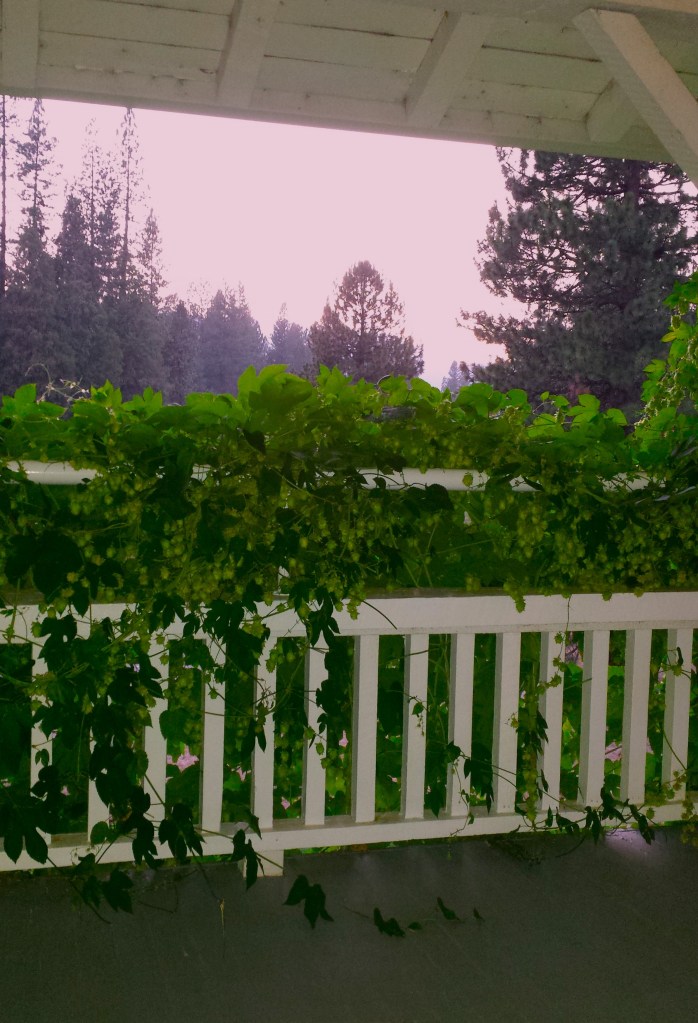
View to the west from the verandah outside our room

Despite the older beds and somewhat rustic accommodations we slept well… that was until about 7:30 the next morning when our German neighbors’ talking awoke us. It was then we discovered where the locked door next to the sink led. When the hotel was built, the rooms all shared Jack and Jill bathrooms. To accommodate a more modern customer the bathrooms had been designated as a private bath for one of the rooms only, and the door to the adjacent room was locked.

We had the room without a private bath. Our German neighbors, Hans and Fritz, had the bathroom. Did I mention that the walls were paper-thin and not insulated?

Soon, some rather unfortunate sounds penetrated into our hearing range. We dressed as quickly as we could and headed to breakfast… and decided that the Germans would hereafter be known as Fritz… and a scatological term which rhymes with Fritz.
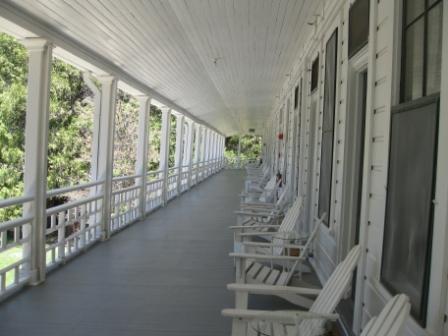
Staying at the Wawona harkens back to a different time

Of course the thing one most recalls about any trip are the occurrences which are out of the ordinary. Our stay at the Wawona turned out to be the most memorable part. And we wouldn’t change a thing.

Update 2024: A few weeks ago it was announced that the Wawona Hotel would be closing for an indefinite period of time as they evaluate the structure. The news article said it needs a new roof but with some more in-depth evaluation the repairs could be more extensive.

A couple of websites to visit:
https://en.wikipedia.org/wiki/Yosemite_National_Park
https://en.wikipedia.org/wiki/Wawona_Hotel
For those who want to see the Wawona Hotel’s claim to fame, be sure to check out the movie “36 Hours.”
https://en.wikipedia.org/wiki/36_Hours_(1965_film)
The Great American Road Trip

May 26, 2020

Are We There Yet?

Memorial Day is, in the United States, the unofficial beginning of summer; it’s a time for picnics, camping, and outdoor activities. In many ways, however, it is the quintessential automobile road trip which has come to define the American spirit and quest for adventure and the start of summer.

Leaving Pasadena

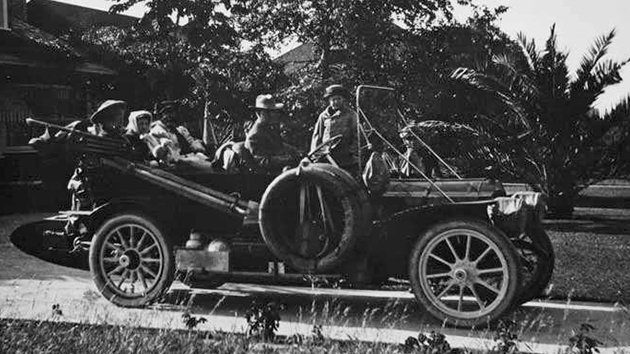
The Murdock family about to leave Pasadena

With the advent of cars in the early 1900’s, a few intrepid souls can be credited with establishing that it WAS possible to drive from coast to coast in an automobile. Although not the first to do so, Jacob Murdock, his wife Anna, children Lillian, Alice, and Jacob, Jr., were the first family to embark on such a trip. They, along with their mechanic, Phillip LeMay, departed Los Angeles on April 24, 1908 and arrived in New York City, 32 days, 5 hours, and 25 minutes later on May 26th.

876904lMr. Murdock – much to the joy of this writer who has a love of such history – recorded their travails on the trail in a short book which I found preserved by the University of Michigan. (see the link below). Alas, the Infallible Wikipedia has not heard of Mr. Murdock. Instead, I enjoyed a delightful read while sitting in a comfortable chair trying hard to imagine all the family and the mechanic – along with an occasional sixth passenger found along the way – experienced.

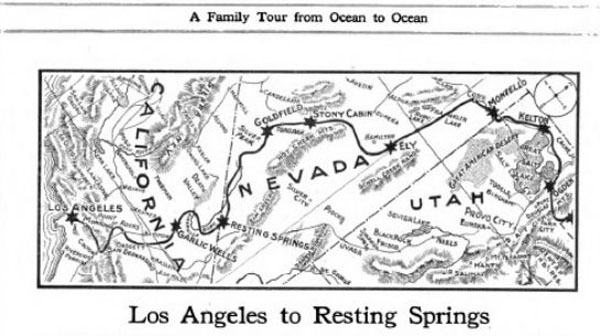
In 1908, paved roads were few, especially through the great American west. Their vehicle was a 1908 “Thirty” Packard with a canvas roof, folding windshield and speedometer. They started in Los Angeles, then followed the path of modern I-15 to Daggett. Those 141 miles were the first day of their journey.

mdp.39015071565041-seq_8As they continued northeast through the Mojave desert and along the southern boundary of Death Valley, they became mired in quicksand, and eventually hit upon the use of heavy rope to create makeshift chains for the tires. This experience helped prepare them for the next day when, as Murdock says in the book, “We soon found that our drift and sand experience at Coyote Lake had been merely a kindergarten for us in the art of tractionless travel.” It took 13 hours to drive 67 miles, many of those “where we again shoveled, groveled, plowed and floundered.”

From there it was northward into Nevada and Utah. They drove around the north end of the Great Salt Lake to Ogden, completing the first leg of their journey, nearly 1000 miles.

I found it interesting to ‘map’ their route. Once they arrived in Wyoming their path was generally along modern day I-80 clear to Iowa before tracking north a bit for a straight line in to Chicago; from there they dropped down into Pennsylvania for a brief stop at their home in Johnstown before completing the trek. On May 26th, they ended their 3,693.8 mile family trip when they arrived on the corner of Broadway and Sixty-first street in New York City.

murdock family new york

The Murdock family on May 26, 1908 upon their arrival in New York City

Along the way they had encountered oppressive heat, a blizzard, and much rain. The tracts they drove on went from sandy, to muddy, to rocky, to impassible in places. They experienced flat tires, mechanical breakdowns, and the car becoming mired in sand and mud. They got lost. While Murdock highlighted these challenges, rarely does he address what riding in that car for eight to fifteen  hours a day was like for the passengers.

Which got me thinking about my first multi-day road trip. It was the summer of 1970 and my parents, my slightly older sister, and I drove from Yakima to California in a 1964 Cadillac Coupe DeVille. My dad had a strong need to connect with his family, having just lost his mother in January. So off we drove to Elk Grove, California, staying in motels along the way and eating most of our meals at Denny’s.

In retrospect, I doubt my parents WANTED to eat every meal at Denny’s. But they had a picky eater along who ordered a French dip sandwich for pretty much every meal. It’s actually surprising that I still like French Dips. I don’t recall much of the scenery along the way. What I do recall is we stayed at my Aunt Arlene and Uncle Dick’s place outside Sacramento and my sister and I got to hang out with my very cool, two years older cousin, Sally. For a couple of days we got to swim in the pool at the apartment complex they managed and do awesome teenage girl stuff like sunbathe and talk about boys.

rawImage

San Francisco’s famous intersection

Our trip next took us to San Francisco where, unfortunately for me, we could not locate a Denny’s. Lunch that day took us to a drive in burger joint in the heart of San Fran (after a ride on the cable cars and navigating Lombard street). As we sat in the car eating our food, either my sister or I noticed the street signs at the intersection: Haight and Ashbury. In 1970 this WAS ground zero for the counter culture movement of the day. It was there I saw my first real hippie.

Further south we continued, arriving in Anaheim where we stayed at the Jolly Roger Inn. The next day we spent at Disneyland. Yes, just one day… enough time in my parents’ book. I know we stood in line a really long time to ride both “Pirates of the Caribbean” (it was the newest attraction then, having opened 3 years earlier) and “The Haunted Mansion.” We also rode on the “Mine Train through Nature’s Wonderland” which was a rather pedestrian trip on a tiny railroad engine through scenes from the American West. It was replaced less than a decade later with one of my favorite roller coasters, “Big Thunder Railroad.”

The perfect pairing

A place for fun and a place to eat!

Along the way, my sister and I were introduced to a bunch of second cousins and our great aunt and after a couple of days, we headed back north, winding our way up the Pacific coast all the way through California and Oregon.

As a young teen, I had zero appreciation for how special that first road trip was. I wish I had been able to drink in all the sights, sounds, and experiences of that time. Alas, as my mother – who was fond of homilies used to opine – ‘youth is wasted on the young.’

There have been many more ‘road trips’ over the years as the hubby and I have made it a mission to travel the vast lands of the United States by car. In other blog posts I have shared some of those adventures (here, here, here, and here) . But it is Jacob Murdock who captures the spirit of the American road trip in this one paragraph:

“If there ever is a national highway from ocean to ocean, the tourist will find many wide perspectives and long, beautifully-colored vistas which are well worth his while. Some of the scenes which we enjoyed were so beautiful that we thought them worth the trouble and hardship to which we had been subject in getting there over districts without any roads at all.”

Indeed, Mr. Murdock. Indeed.

https://babel.hathitrust.org/cgi/pt?id=mdp.39015071565041&view=2up&seq=8

To The Bat Cave

Carlsbad Caverns

May 14, 2019

This spectacle occurs at sunset daily from mid-spring until late fall. And if you ever go to Carlsbad Caverns National Park, it’s a sight to behold. What is it? The nightly flight of nearly a half million bats.

20181004_145630.jpg

The flight of the bats is but one thing to recommend a visit to the 20th National Park established on May 14, 1930. The caverns themselves are spectacular with the main event Big Room providing incredible sights around every turn in the path.

From the Infallible Wikipedia:

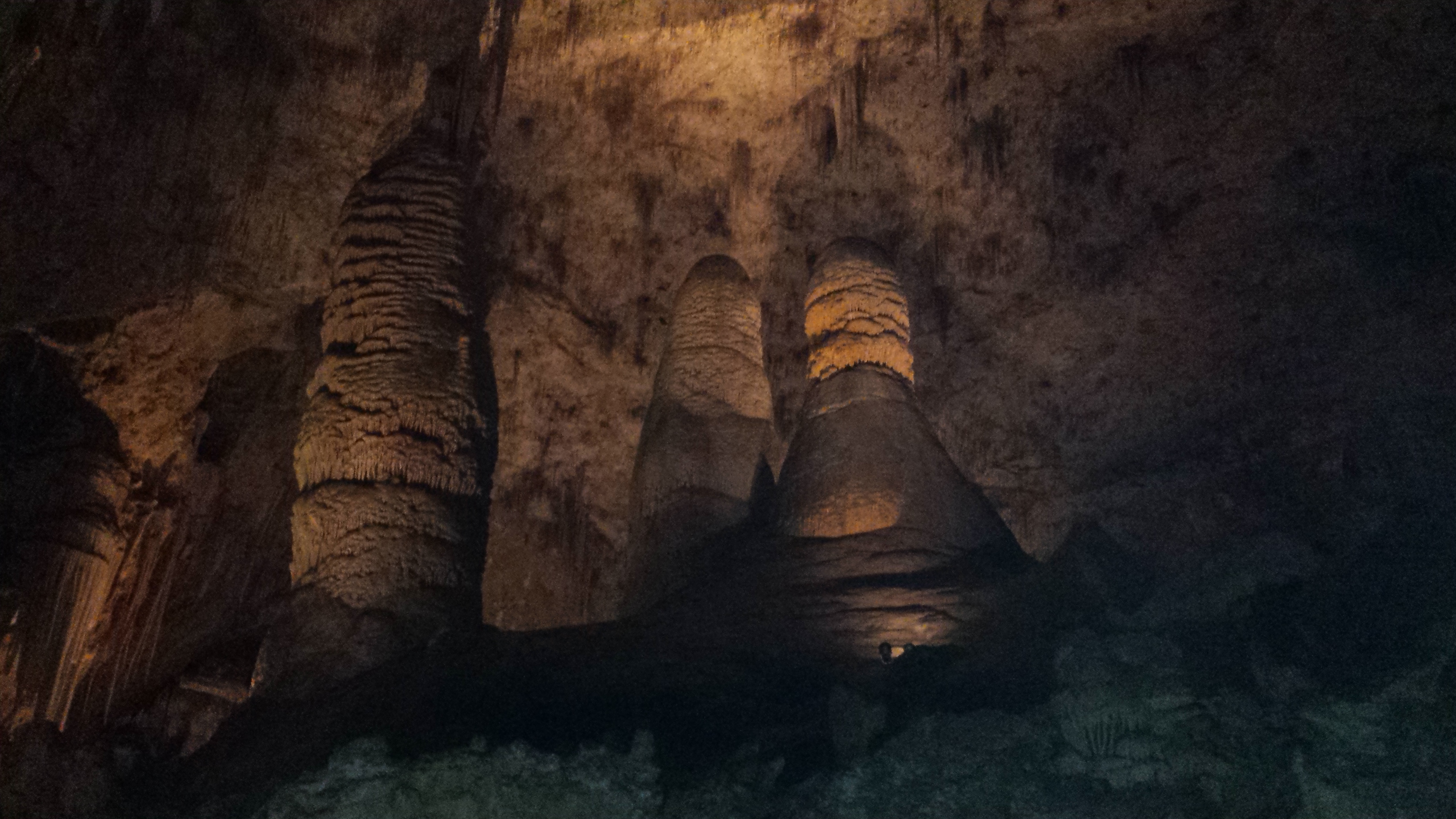
“Carlsbad Cavern includes a large limestone chamber, named simply the Big Room, which is almost 4,000 feet (1,220 m) long, 625 feet (191 m) wide, and 255 feet (78 m) high at its highest point. The Big Room is the fifth largest chamber in North America and the twenty-eighth largest in the world.”

20181004_103246.jpg

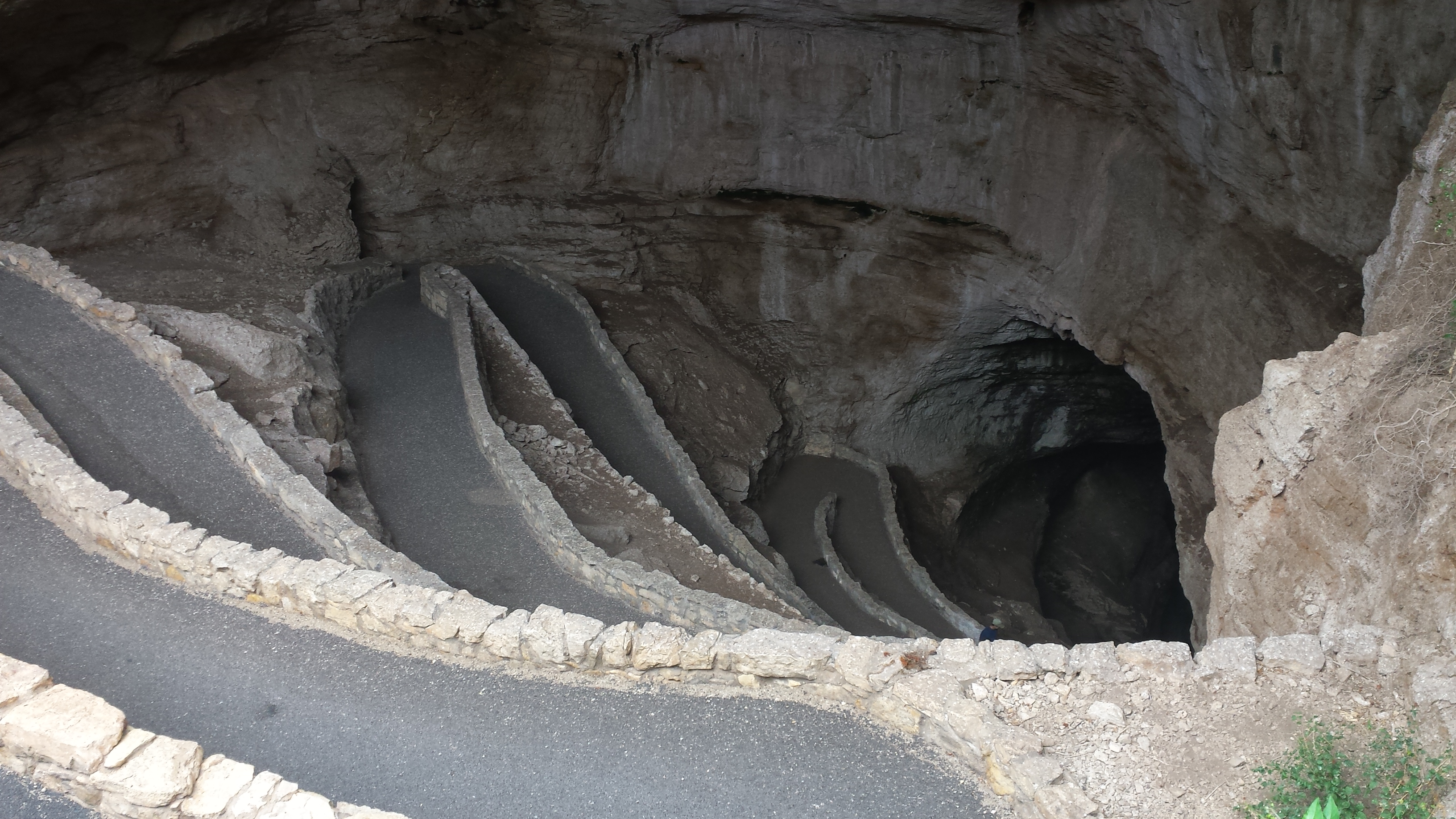
The top of the natural entry way… only 725 to the bottom.

Visitors to the cave have two options for entry. Two years after it opened, elevators were installed to take tourists some 725 feet down to the Big Room. The traditional entry involves hiking down a switchback trail over a mile long and takes well over an hour.

When the hubby and I visited Carlsbad last October we opted for the switchback trail down which, in my opinion, enhanced the experience. By the time we arrived at the Big Room, our appetites were whetted.  It’s impossible to describe how large the space is and, at times, it was easy to forget we were in a cave. The ceiling soared high above our heads and many of the stalagmites and columns were the size of redwoods. In contrast there were also delicate formations known as ‘straws’ – thin tubes of limestone formed by centuries of slowly dripping calcite and ribbons. There were small lakes and ponds and fantastically named features like the Giant Dome and the Bottomless Pit. It took us well over three hours for the descent into and tour of the Big Room.

20181004_121935

A fraction of the spectacular sights to see in Carlsbad.

After our tour we returned to the surface via the elevators and then back to our motel to rest up before returning for the nightly bat flight. If you want to be awed by nature, then this phenomenon will capture your imagination. We arrived at the stone amphitheater near sunset. The ranger on duty explained to the assembled group what was about to happen. We were instructed  to watch the cavern opening – aptly named the bat cave – for the emergence of the bats.

(I did not shoot this video. The night we were there it was our understanding that recording it was not allowed)

The ranger cautioned that he would talk only until the first bats appeared and instructed the audience that when someone saw the bats they were to raise their hand and spin it in a circular motion. A few minutes later several arms shot into the air and the group fell silent. All you could hear and see was the sound of thousands of bat wings whirring and the twilight skies filled with the silhouettes of the tiny creatures as they flew away in search of food.

From the National Park Service:

“What triggers emergence of the bats from the cave at night is something of a mystery. The only scientific correlation found with the emergence of bats is civil twilight (28 minutes past sunset). Bats flying around the roost site can see light entering Bat Cave from Carlsbad Cavern’s second natural entrance. But based on the variability of the bats emergence, civil twilight is not the only explanation.

20181004_122734

Stalactites cling to the ceiling

The out flight can last up to three hours, depending on a variety of factors, including the number of bats in the colony. Bats can begin returning at any time, particularly when they have pups to nurse (in which case they typically head out to feed again before morning). The number of bats returning usually peaks around dawn. When the bats fly over the amphitheater, you can hear their wings and also smell them. The Brazilian (Mexican) free-tail bats have a unique odor—not all bat species have an obvious odor. The bats spiral out of the cave in a counter-clockwise direction. It is not known why they choose to spiral counter-clockwise, but current research suggest a variety of factors play roles. One of these may be an internal ‘compass’ in the bats that is based on the earth’s magnetic poles.”

20181004_103032.jpgWe stayed until it was too dark to really see the bats any longer. Even then we were reluctant to depart. Mark another place off my list of places I’ve always wanted to visit!

A couple of links:

https://www.nps.gov/cave/index.htm

https://en.wikipedia.org/wiki/Carlsbad_Caverns_National_Park