Tag Archive | Long Beach washington

How to Roast Perfect Marshmallows: A Family Tradition

Plus a bit of history about this delicious treat

June 10th

The marshmallow plant

If you have ever wondered how the marshmallow got its name, just read a bit further as we explore this tasty treat, most associated with being roasted during summer nights around a campfire with friends and family.

The fluffy round white confection made of sugar, water, gelatin, and a coating of cornstarch, is nothing at all like the original marshmallow. For our purposes we will call the original a marsh-mallow, as it is a plant which is native to Europe, North Africa, and Asia. As the name indicates it grows in wetlands and the roots proved to be an effective medicinal for treating coughs and sore throats.

According to the Infallible Wikipedia, there is evidence that the plant was used by ancient Egyptians some 4000 years ago. Now that’s staying power!

The entry tells us:

“Whether used for candy or medicine, the manufacture of marsh-mallows was limited to a small scale. In the early to mid-19th century, the marsh-mallow had made its way to France, where confectioners augmented the plant’s traditional medicinal value. Owners of small confectionary stores would whip the sap from the mallow root into a fluffy candy mold. This candy, called Pâte de Guimauve, was a spongy-soft dessert made from whipping dried marsh-mallow roots with sugar, water, and egg whites. It was sold in bar form as a lozenge.
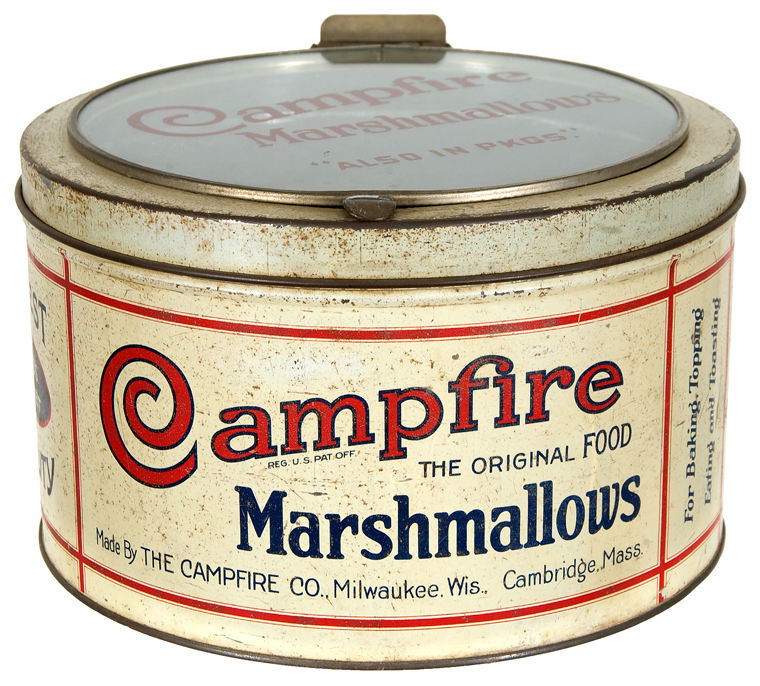
Campfire Marshmallows have been a favorite for over 100 years.

Drying and preparation of the marsh-mallow took one to two days before the final product was produced. In the late 19th century, candy makers started looking for a new process and discovered the starch mogul system, in which trays of modified corn starch had a mold firmly pushed down in them to create cavities within the starch. The cavities were then filled with the whipped marsh-mallow sap mixture and allowed to cool or harden. At the same time, candy makers began to replace the mallow root with gelatin, which created a stable form of marshmallow.”

Eventually, the modified marshmallow – the one which did not contain any of the plant – made its way across the ocean. It was in 1956 when an entrepreneur by name of Alex Doumak invented an extrusion device where the ingredients were sent through a tube and long ropes of marshmallows came out the other end. From there, they were cut in to the fluffy white rounds known as marshmallows.

Our family favorite marshmallows are the Jet-Puffed brand

The Infallible Wikipedia tried to figure out when, exactly, the roasting of marshmallows over a campfire began, but the origins are iffy. They were able to find a reference to it in a New Jersey newspaper from 1892. I imagine it probably started by accident when someone accidentally browned one and thought “Hey, this tastes really good.” Thus, the tradition of roasting marshmallows began.

There are any number of variations on how to use marshmallows: cooks have used them as toppings on Jello, added at the last minute to Thanksgiving sweet potatoes, floating on a steamy mug of hot chocolate, or taking the roasted campfire varieties and sandwiching a couple between two graham cracker squares and a hunk of chocolate.

Marshmallows also find their way into a variety of children’s craft projects such as gingerbread houses and winter snowmen.

I am, however, a traditionalist. While I will have a s’more at a beach or camp fire, I find that I prefer a perfectly toasted marshmallow eaten in a very specific manner.
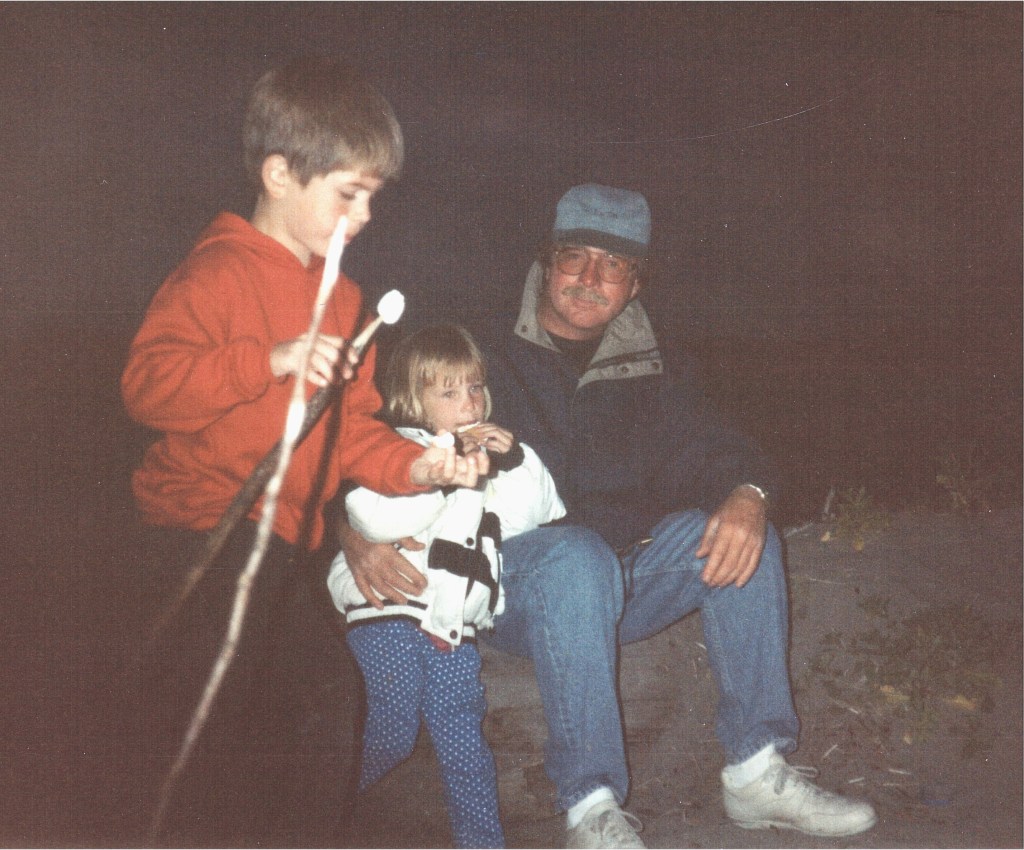
Family at a Long Beach marshmallow roast, circa 1998

Here’s the recipe:

Start a campfire. Let it burn hot for about 45 minutes until coals accumulate at the base. Let the flames die down enough that you can sit about a foot away from the fire. Using a stick you have found, whittle the narrower end into a point with a pocket knife until the white wood shows and the bark is removed (make sure to pick a non-toxic wood!).

Sit on a log, camp chair, or old blanket. Open a bag of 1 inch diameter marshmallows, remove one from the bag, and press it firmly onto the pointed end of the whittled stick.

Study the coals to determine the perfect spot to cook the marshmallow. Turn it so one side is about two to three inches from the hot coals. Hold it next to the coals until the skin starts to turn gold then rotate your stick a quarter turn and toast the second side. Repeat until all sides have been roasted.

Remove the marshmallow and evaluate. If there are white spots, return it to the coal area and give it a couple of seconds to brown.

Finally, tip the head of the marshmallow toward your coals and cook the top until it puffs up and is golden brown.

If you happen to lose control of the cooking process and, heaven forbid, your marshmallow erupts in flame, remove immediately and wave in the air, and then offer it to the lazy person who doesn’t want to cook their own.
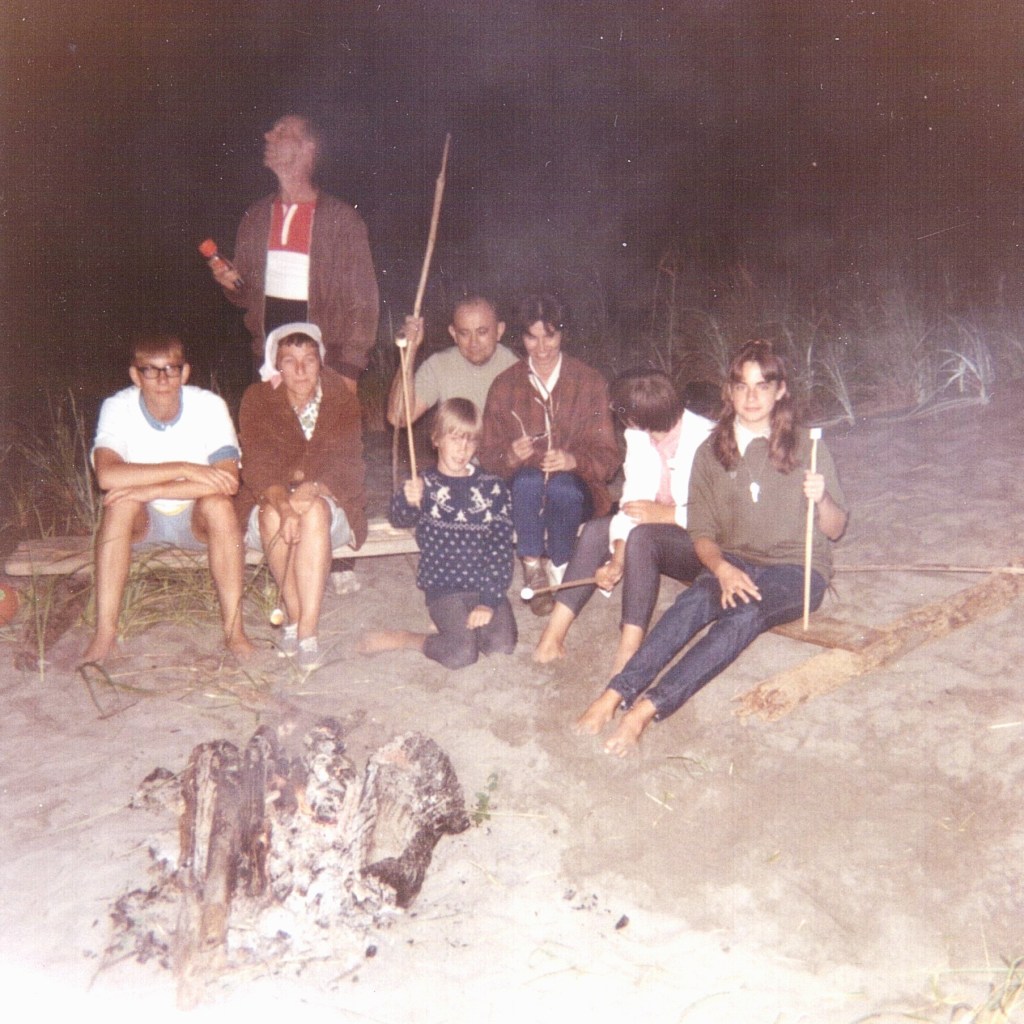
Brother, Mom, Dad, Uncle, Aunt, sister, and cousin – author in the middle wearing the blue ski sweater – enjoying a marshmallow roast at the beach. Photo taken by the author’s grandmother.

Repeat.

When you finally have the perfectly roasted marshmallow, it is time to pull the roasted outer layer up and off the stick, and eat just that thin layer. Once eaten, it is back to the fire to roast the gooey middle and then eat it too.

It’s a funny thing, when I started thinking about this topic, I could not remember a time when roasting marshmallows was not a part of my family’s annual vacation to Long Beach, Washington, for two weeks each summer.

So long as it wasn’t raining, after dinner was finished and everyone was dressed appropriately, we would walk down past the dunes and onto the beach for our nightly fire. In my minds eye I can see my mom in her pedal-pushers, head scarf, jacket, and keds, walking ahead of me (in a single line as the path was narrow), the bag of marshmallows in one hand and a half dozen roasting sticks in the other. My dad would lead the way with newspaper, matches, and a shovel, ready to start the fire.

We kids were assigned the task of searching for pieces of wood to serve as kindling and, if luck was on our side, we’d also retrieve the occasional larger pieces left behind by some other campfire builder from a previous night.

Soon my dad had the fire going and the adults would tend it while the kids built sandcastles or played hide and seek in the nearby dunes.
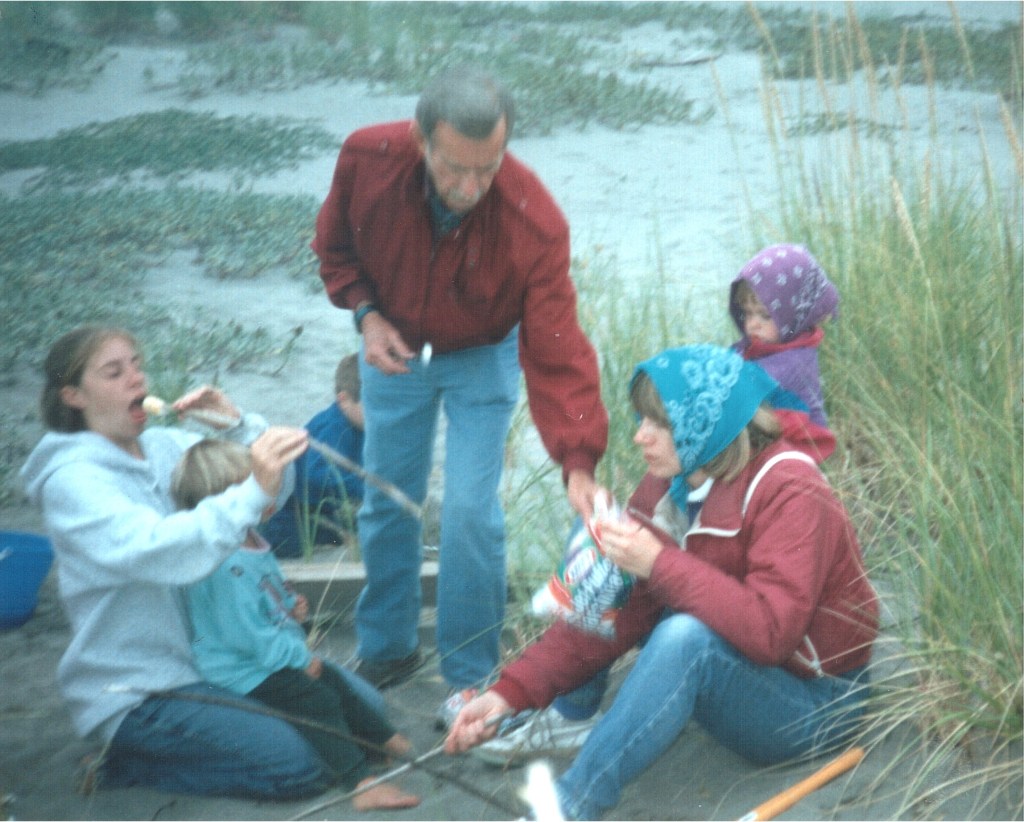
Marshmallow roast 1995. The participants shown are the author, my kids, two of my nieces and my dad – aka Grandpa.

Just as the sky got dusky (in Washington state the sun sets as late as 9:14 p.m. in mid-June making for longer light filled evenings) it was time. We’d all assemble around the fire, jockeying for the best ‘spot’ and my mom would push a marshmallow onto the end of our sticks.

After we had our fill and the sky was fully dark, the uncooked marshmallows would be safely stored in their bag, and then my dad would shovel sand onto the remnants of the beach fire. Soon we reversed our earlier trip, following the beam of the flashlight my dad now held as he led the family back through the night to the rented cabin.

It was the simplest of traditions, but also the best. For the price of a bag of marshmallows everyone was entertained for the evening. No cell phones. No TV. Just two glorious weeks of fun at the beach capped off each night by roasting marshmallows around a fire. It doesn’t get much better than that.

https://en.wikipedia.org/wiki/Marshmallow

Manhattan vs. New England: The Great Clam Chowder Debate

February 25

The search for the perfect chowder

A Tuesday Newsday Classic

By the end of February, most people are longing for spring to arrive. Alas, the warmer days still elude in the northern hemisphere. So what better way to celebrate on February 25th than with a steaming bowl of Clam Chowder. Today is National Clam Chowder day.

Clam-Chowder-664In thinking about this particular soup I cannot recall a time when I did not know of it or eat it. Always a staple in my household growing up, my mother used to make it from the frozen razor clams my family dug each summer.
Which got me to wondering, what WAS the history of clam chowder?

As always, the Infallible Wikipedia sheds some light for us:

Clam chowder is any of several chowder soups containing clams and broth. In addition to clams, common ingredients include diced potatoes, onions, and celery. Other vegetables are not typically used, but small carrot strips or a garnish of parsley might occasionally be added primarily for color. A garnish of bay leaves adds both color and flavor. It is believed that clams were used in chowder because of the relative ease of harvesting them. Clam chowder is usually served with saltine crackers or small, hexagonal oyster crackers.

The dish originated in the Eastern United States, but is now commonly served in restaurants throughout the country, particularly on Fridays when American Catholics traditionally abstained from meat. Many regional variations exist, but the two most prevalent are New England or ‘white’ clam chowder and Rhode Island / Manhattan or ‘red’ clam chowder. (snip)

The earliest-established and most popular variety of clam chowder, New England clam chowder, was introduced to the region by French, Nova Scotian, or British settlers, becoming common in the 18th century. The first recipe for another variety, Manhattan clam chowder, known for using tomatoes and its consequently distinctly red coloring, was published before 1919, but it did not take on the current name until 1934. In 1939, the New England state of Maine debated legislation that would outlaw the use of tomatoes in chowder, thereby essentially prohibiting the ‘Manhattan’ form.”

I chuckled to myself when I read that last sentence about Maine considering a way to keep Manhattan chowder out of New England. Having grown up on New England style clam chowder, the red kind does seem a bit blasphemous.

My mother cooked wonderful clam chowder but me, not so much. I have, though, made it one of my fairly recent life’s missions to try clam chowder whenever I find myself in a coastal town which features the soup.

Fannizis Provincetown

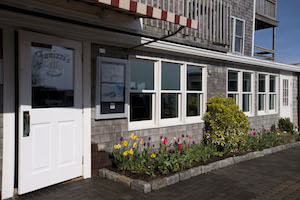
Fanizzi’s in Provincetown was, I think, the restaurant where we ate.

While on Cape Cod in 2008 with my hubby, and then 15 year old daughter, we happened into a quaint restaurant in Provincetown and enjoyed steamy bowls  of the nectar on a cool, but clear, early April afternoon.

Provincetown, for those unfamiliar with Massachusetts geography, sits at the very furthest away (by land) part of Cape Cod. It was where the Pilgrims first landed in 1620. Although I can no longer recall the name of the restaurant where we had lunch, it was that trip which began the quest for perfect chowder.

One summer, while on an annual trip to Long Beach Washington with my sister, we went to several local eateries to try the clam chowder. I was surprised when the place where we had always gone turned out to not be my favorite.

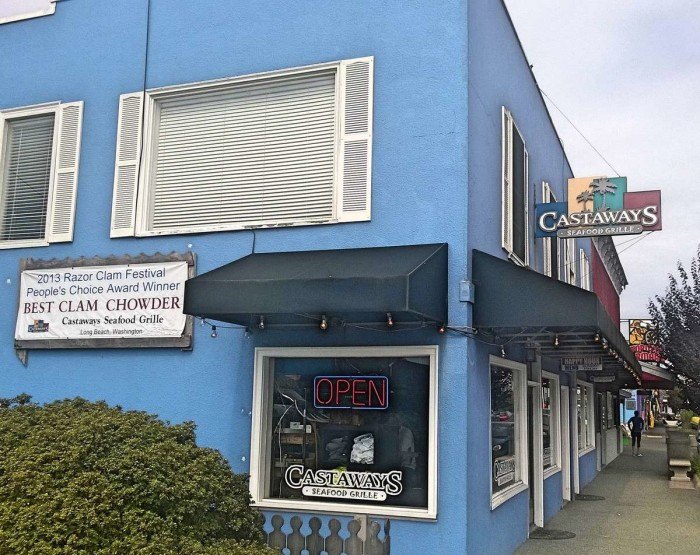
castaway-700x555

Not as flashy as Fannizi’s – but their chowder is top rate.

It was on the fourth day – and fourth restaurant – I declared a winner. Castaway’s has been a fixture on Pacific Avenue for years. But I’d never been there. So my sister and I got a high table in the bar rather than wait for seating in the restaurant portion which seems to always be full up. I ordered the clam chowder in a bread bowl.

From the first bite I knew it was a winner. Even better was getting to consume every last drop which the soft interior of the bread bowl had absorbed. It was heavenly.

Now, whenever I am lucky enough to visit the beach, Castaway’s is a required stop for a bowl of their clam chowder.

Writing this article inspired me to look for recipes and, perhaps, try my hand at recreating the very best chowder I can. The following claims to be the BEST clam chowder ever. One of these days I will mosey out to the fresh fish market on Highway 20 (between Burlington and Anacortes) and buy some clams to make the chowder.

The recipe includes butter, half and half, bay leaves, and Tabasco sauce. What’s not to like? Here is the link:

https://www.favfamilyrecipes.com/best-clam-chowder-ever/

And a couple more links on the history and variations of the eponymous clam chowder:

https://en.wikipedia.org/wiki/Clam_chowder

https://nationaldaycalendar.com/national-clam-chowder-day-february-25/

Jake The Alligator Man

A Long Beach, Washington Icon since 1967

August 1, 2023

A Tuesday Newsday Classic updated

Happy Birthday to that northwest icon, symbol of blatant commercialism, and resident of Long Beach, Washington… Jake the Alligator Man!

An Alligator Man postcard – one of many such items

How fun it was, on August 1, 2014, to be at Long Beach and join in the parade for Jake’s 75th birthday, be given free cupcakes, and really celebrate this once in a lifetime event.

Or not. As it turns out the town of Long Beach celebrates Jake’s 75th birthday EVERY year and has been doing so for the past 11 years. So maybe it’s really Jake’s 86th birthday? Call me cynical but I’m starting to think that this is all a ploy for tourists to spend more money on Jake gear and at local motels and restaurants.

I’ve also learned that his birthday is not always on August First but seems to coincide with whichever date the first Saturday in August might fall.

Jake’s murky beginnings are just that, murky. What we do know is that Jake was discovered in 1967 at an antique shop in San Francisco. He was adopted by the owners of Marsh’s Free Museum for a mere $750 dollars and has lived in Long Beach ever since.

The creepy two headed calf

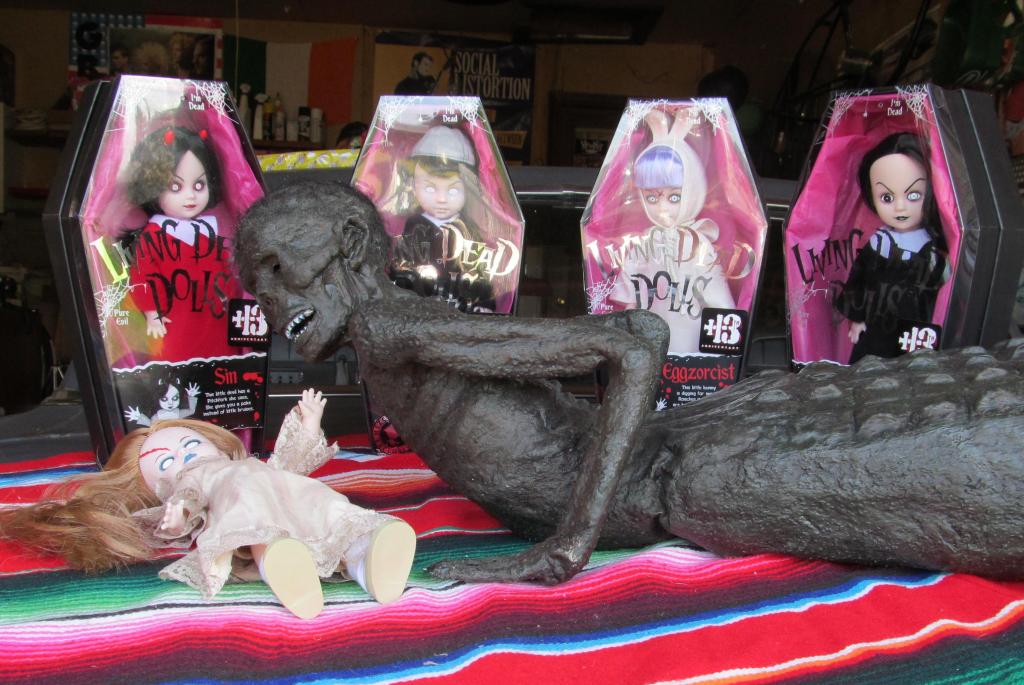
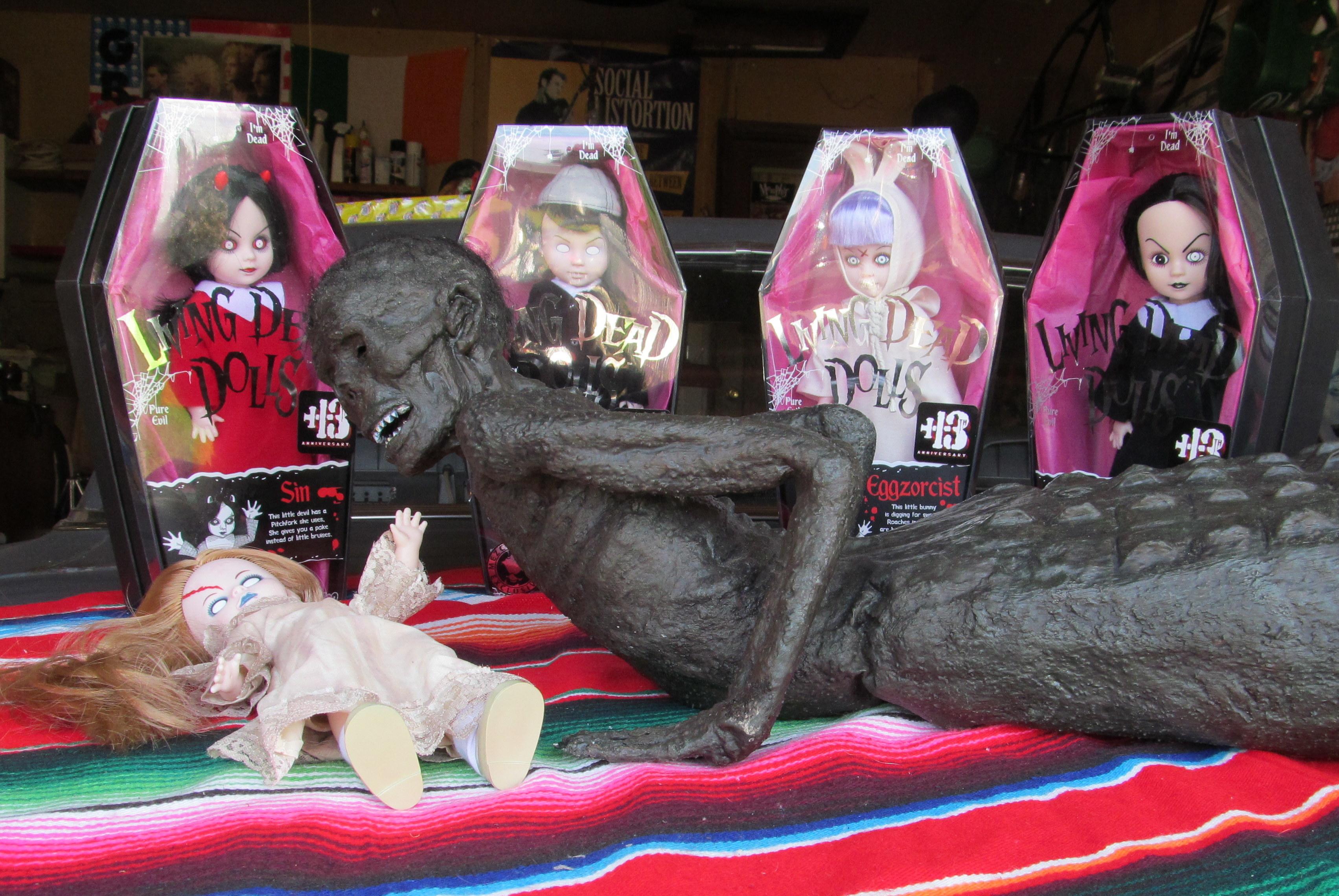
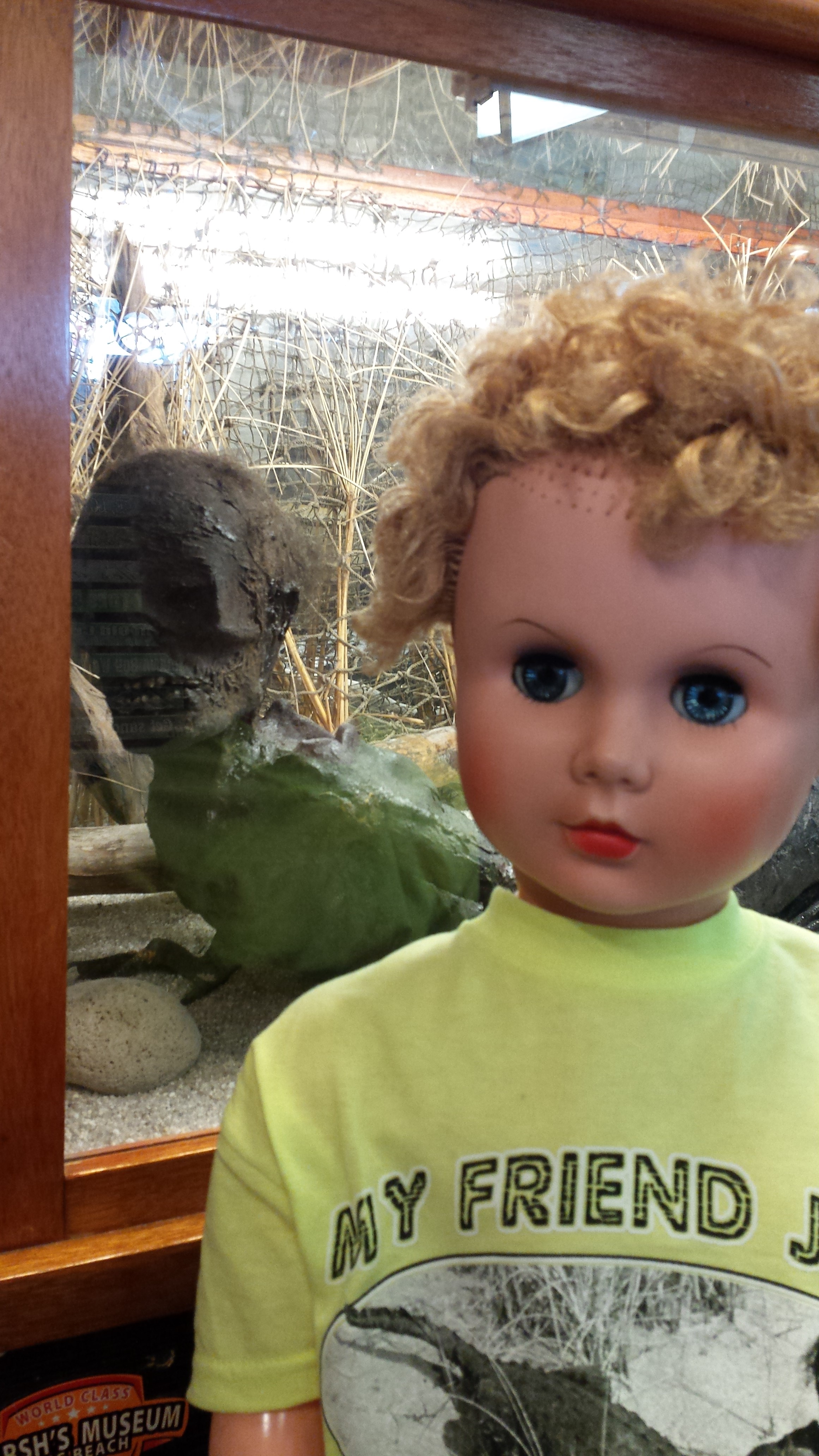
I feel pretty certain that I probably saw Jake that first year as my family spent two weeks every summer on the Peninsula. Shopping at Marsh’s during a Long Beach visit was a must do. Although Jake was once relegated to a dusty corner of Marsh’s Free Museum – along with the two-headed calf and the shrunken head – his celebrity is such that he now has a whole display area with a variety of t-shirts, bumper stickers, posters, key chains and glassware dedicated to the Gatorman. And Creepy Dolls like him also.

The Infallible Wikipedia has done a poor job of telling the whole history of Jake. What’s up with that Infallible One?

Jake communing with an assortment of creepy dolls

So I will skip them this week and instead share the article which catapulted Jake into legend status back in 2008 when that paper of international renown and impeccable credentials – the World Weekly News – published an article titled “Manigator Found.”

Sandy the Creepy doll dons her Jake t-shirt and visits her ‘friend’

“MIAMI, Florida — The discovery of a bizarre half-human, half-alligator in the Florida Everglades has flabbergasted scientists who say the creature is alive, at least moderately intelligent and possibly even a distant ancestor of modern man!

That’s the word from paleontologist Dr. Paul Ledbrader, who studied the creature in his laboratory for almost three hours before state wildlife officials seized the 5-foot, 11-inch, 180-pound beast and airlifted it to a research facility just west of Miami.

Nobody at the state wildlife commission is talking. But Dr. Ledbrader says the U.S. Forest Service sent no fewer than five experts to the facility to study the reptile in the hope of determining exactly where it came from — and what it might be.

‘I know what it isn’t — and that’s an ordinary alligator,’ said Dr. Ledbrader.”

To read more of their amazing discovery and the highly credible, and certainly not made up Dr. Ledbrader, click here:

http://weeklyworldnews.com/headlines/1717/manigator-found/

Be sure to make plans to attend Jake’s 12th annual 75th birthday party in 2018: http://jakethealligatorman.com/

*2020 Update!

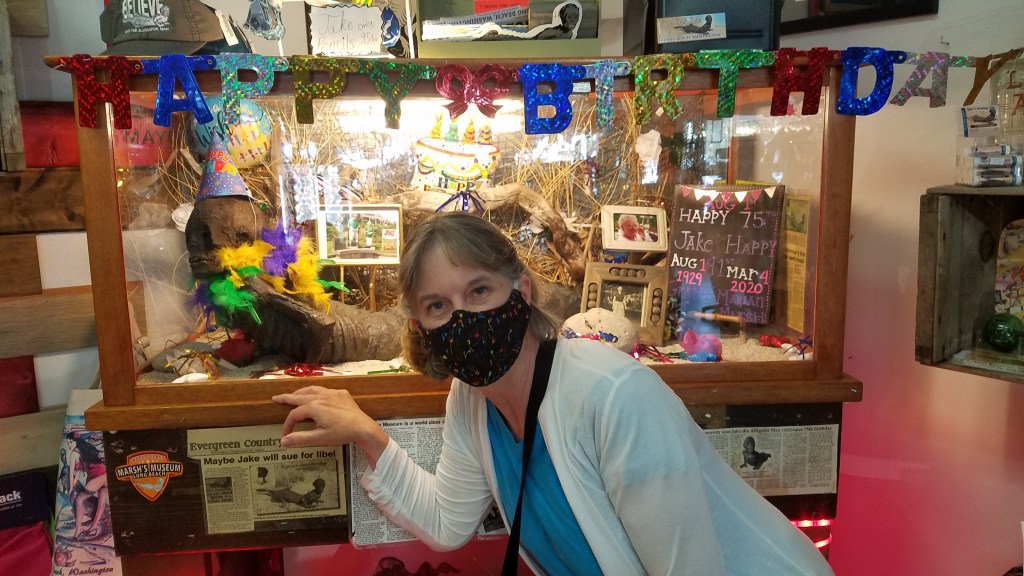
Sadly, Jake’s birthday celebration – once again scheduled for Saturday, August 1st – was cancelled. But that did not stop Mr. Gator from donning a birthday hat, a couple feather boas, and celebrating with friends and fans that just might happen to stop by his house. Of course, HE was NOT socially distancing but this friend was. Perhaps next year. Be sure to mark your calendars for August 7, 2021. It’ll be a party.

The author visiting Jake in 2020

*2021 Update – Jake’s birthday celebration has been cancelled for this year. Man, poor Jake is not feeling the love these days.

*2023 Update – Well, Jake’s celebration SHOULD be on Saturday, August 5. This internet sleuth searched and searched and there was nothing posted regarding Jake’s birthday. So I traveled to Long Beach and to the source, Marsh’s Free Museum, on July 31st and asked the guy behind the counter. This is what I learned! Covid pretty much ended the party as the person who had organized the event each summer left. Alas, no one has taken up the banner and Jake is now living a much quieter life.

https://www.thrillist.com/travel/nation/jake-the-alligator-man-long-beach-washington

World’s Largest Frying Pan?

No. But its history is fascinating

March 7, 2023

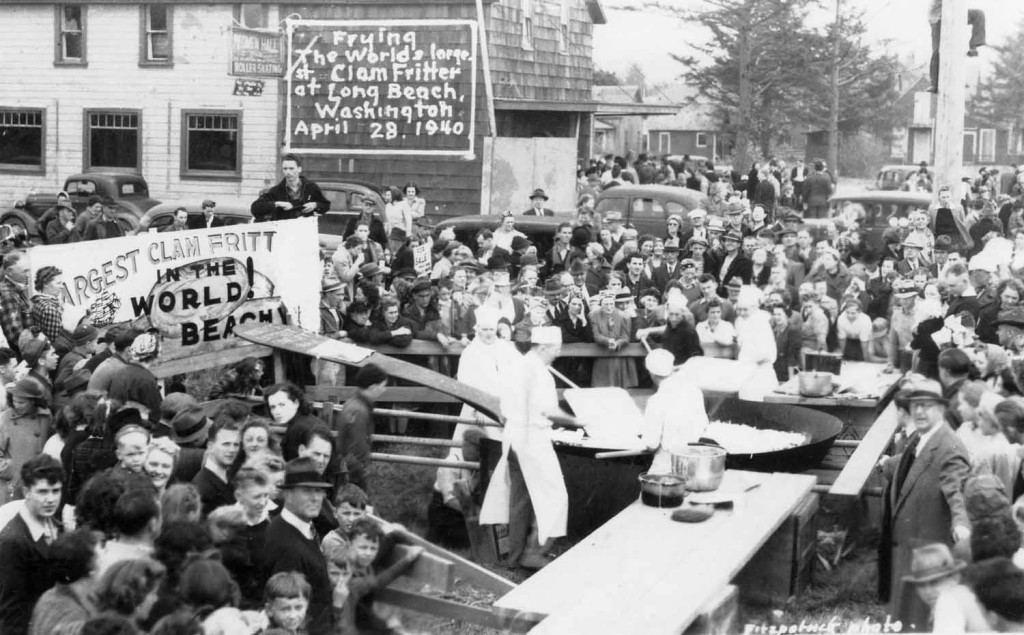
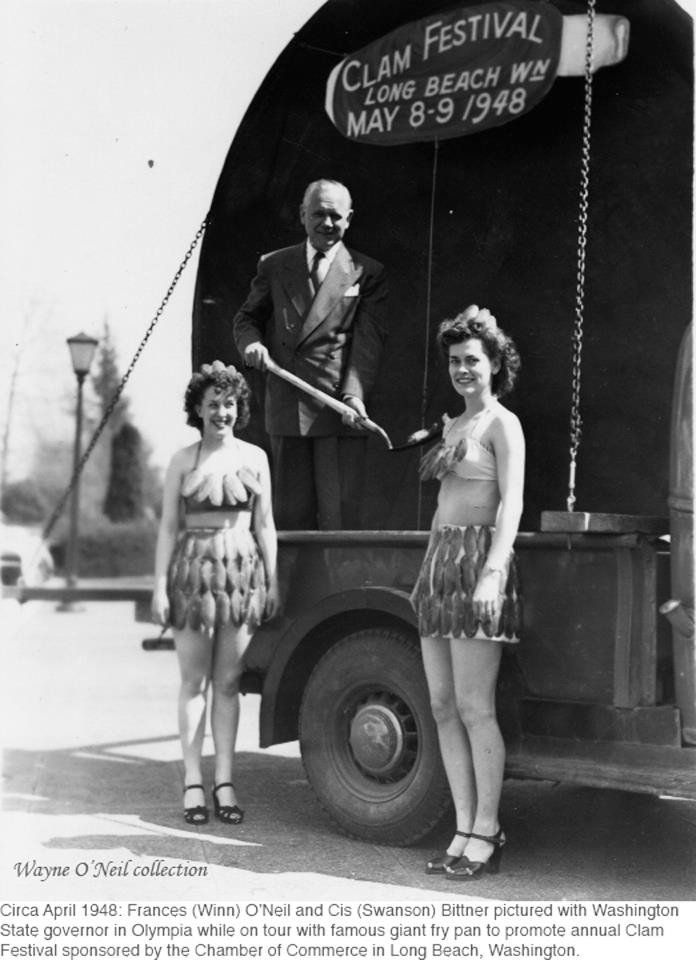
April 29, 1940 – the first Clam Festival cooking the fritter on a borrowed giant frying pan
No explanation needed…

My brother shared a blurb with me recently which piqued my interest: “It was on March 7, 1992 when the world’s largest crepe was baked and flipped in Bloemfontein, South Africa. It was 41 feet 2 inches in diameter, an inch and-a-half deep, and weighed 5,908 pounds. Sounds like the special at Denny’s.”

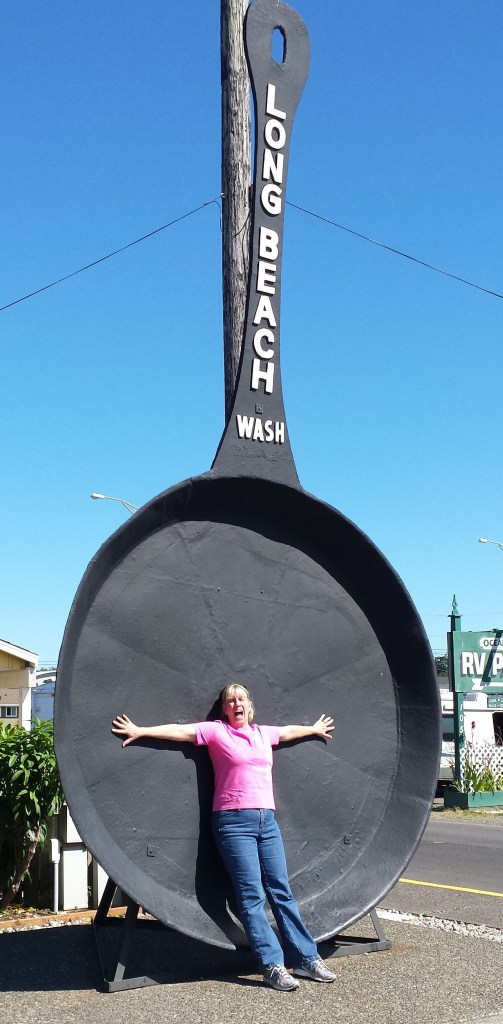
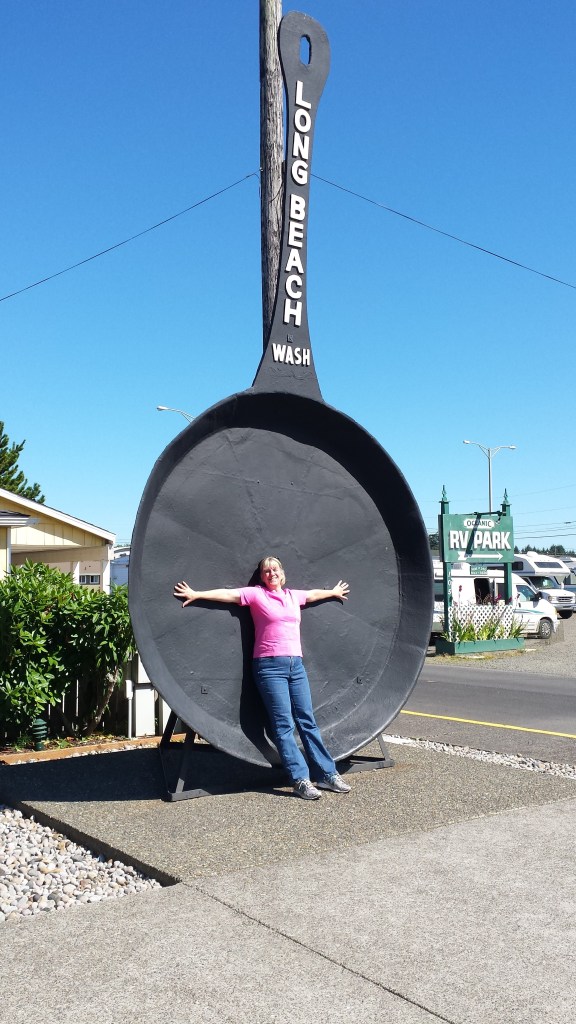
So it got me thinking about a large item a bit closer to home. Down in Long Beach, Washington, there is a frying pan. It’s a huge frying pan and it is propped upright on large metal stand in the middle of town. Needless to say, it’s quite noticeable and tourists who flock to the peninsula every year will often have their photo taken in front of the pan.

Why, I asked, was the pan even made and what is its history? Research reveals that in 1941, local leaders conceived of the idea of a Clam Festival. Someone, likely Wellington Marsh, Sr., a successful businessman and owner of Marsh’s Free Museum, suggested that they bake a giant clam fritter. The community borrowed the first pan from the city of Chehalis, a couple hours to the northeast.

Although the Infallible Wikipedia is silent on the matter, the Long Beach Razor Clam Festival webpage is not. Here’s what they say about that first event:

“The fritter was constructed using 200 pounds of razor clams, 20 dozen eggs, 20 pounds each of flour, cracker meal, and cornmeal, 10 gallons of milk, and 13 gallons of salad oil. Ralph Smith, and numerous other locals, would dig the clams and donate them to the Festival. (snip)

The stories hold that a couple of girls helped grease the pan by ‘skating on large slabs of butter’ across the surface of the pan. The cooks even used garden hoes and two-foot-square shovels to maneuver the fritter in the pan. (snip)

The following year a new frying pan was unveiled; this time Long Beach would have their very own frying pan to boast as the ‘World’s Largest.’ This was made possible through the Chamber of Commerce and was manufactured by Northwest Copper and Sheet Metal Works of Portland. The Pan, from base to handle, measured in at a whopping 14.6 feet long.”

The ‘Clam Queens’ in their rather unique clam shell bathing suits. Looks to me like those are actual razor clam shells…

And thus began the annual clam festival. People would flock to the beach for the event, all wanting their share of the delicious fritter. This event seemed to get bigger and bigger. There was even a group of people who took the frying pan on a tour of the state, complete with two ‘Bathing Clam Beauties’, to promote interest in the event.

The success of it all did exactly as expected and the tourism to Long Beach exploded. It was the unintended consequences which eventually shut it down.

The last year of the original festival was 1948 with two factors which came into play. First, local restaurants complained that the tourists were not frequenting their establishments; after all, if the people can eat the giant fritter for free, they won’t go buy a meal somewhere else.

But the biggest factor was an alarming decrease in the availability of razor clams.

Also from the webpage:

“The Washington State Director of Fisheries warned that the coastal Razor Clam populations could not withstand the current level of harvest. It had been estimated that in 1946, that clam diggers had taken six million pounds of clams from the beaches of Copalis, Grayland, and Long Beach.”

In the following years, the state Fisheries division instituted limits on razor clams and, eventually, limited digs to a few selected dates each year.

And that was the end of the Clam Festival until, in 1994, an attempt was made to revive the event. Unfortunately it was discovered that the base of the pan had all but rusted away and was no longer viable for cooking. Instead, it was repaired with fiberglass and then hung at its current location as a tourist attraction.

The town “commissioned a welding company in Astoria to construct a new aluminum pan. This pan was inaugurated, cooking a giant fritter, at the Main Street Dedication in 1994. It was then placed in Fish Alley downtown, and was used as a small stage. In 2014, the second year of the Annual Long Beach Razor Clam Festival’s revival, the pan was refurbished and is still used for the giant fritter cook-off done by students.”

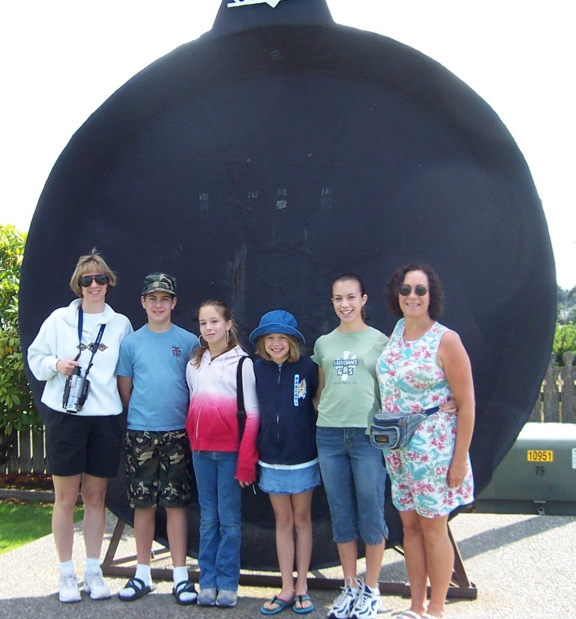
My sister and I – with our kids – at the frying pan the summer of 2003

Over the years, my family has had many photos snapped in front of that giant frying pan, the kids growing up chronicled every few years.

Whenever we visit Long Beach our tradition is to drive up the main drag of town (there is a road on the bay side of the peninsula which is faster to our family condo). When we get to the light at Sid Snyder Drive that is what I think of as being at Long Beach.

Some distance ahead are the colorful kites twirling on buildings and American flags which line the sidewalks flapping in the ever constant breeze. The sidewalks are almost always awash with pedestrians and cars clog the roads.

And soon we are driving past all that makes Long Beach, well, Long Beach.

 Marshs’ Free Museum on the left, the giant squirting clam and Frying Pan on the right. The arcade and the rides (although those were shut down during the pandemic and have not reopened) up next. Then a multitude of restaurants, clothing, and novelty stores. Our favorites, Castaways, Stormin’ Norman’s, and Beachcombers on the left, Dylan’s Cottage Bakery on the right. And then we arrive at Bolstad Avenue. A quick glance to the left and we see “The World’s Longest Beach” sign and then its past Scoopers where one night during our summer visit we will enjoy an amazing ice cream cone. And, finally, downtown is behind us.

The Clam Festival was revived in 2013. Although I have not had a chance to attend, it’s now on my radar and I hope to get there next year. So if you have the time and the inclination, make your reservations now to spend the weekend of April 8 and 9, 2023, at Long Beach for the event. And be sure to wave at the frying pan when you drive into town.

After all, nothing quite says ‘you’re here’ than the first glimpse of that giant frying pan.

The links:

https://www.longbeachrazorclamfestival.com/ (official site)

https://www.visitlongbeachpeninsula.com/giant-frying-pan/ (more history plus links to other activities)

https://www.guinnessworldrecords.com/world-records/84803-largest-frying-pan (some crazy person who used his pan to cook calf livers. I kid you not)

https://www.ranker.com/list/biggest-foods-in-the-world/chef-jen

(An interesting list)

(Where we stay when at Long Beach)

Dominoes: From Childhood Memories to Modern Gameplay

An ancient game still popular today

August 9

From the time I was a wee tyke, this game was part and parcel of my life. There was something fascinating about these little black tiles with white dots on them. No doubt they helped me learn to count and add.

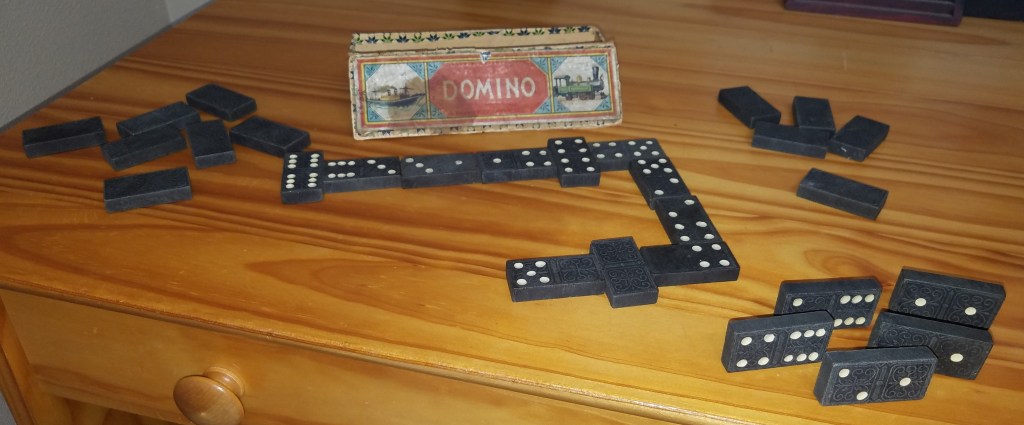
A typical set up for a game of traditional dominoes.

Additionally, they were often employed as bricks for tiny doll houses and set up in rows only to be knocked down.

The domino was first mentioned over 700 years ago. It is, no doubt, one of the oldest games known to man.

Yes, the Infallible Wikipedia has a page devoted to it:

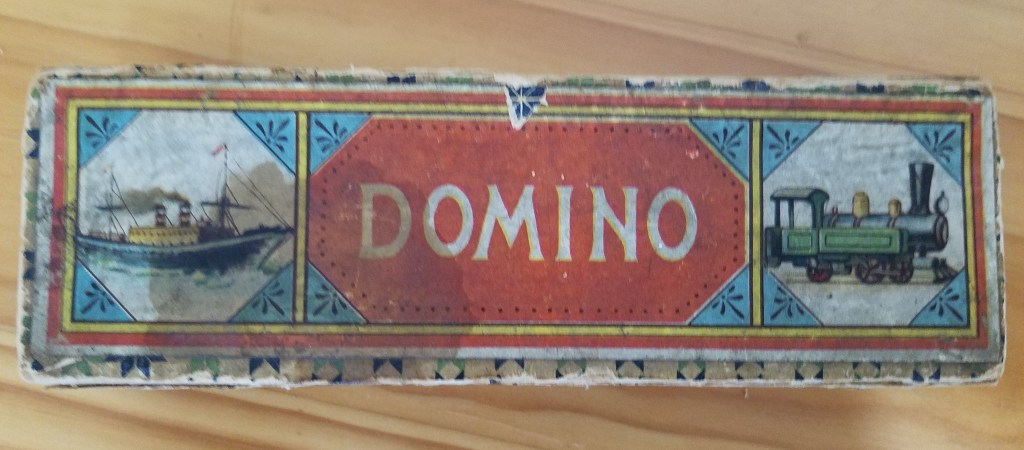
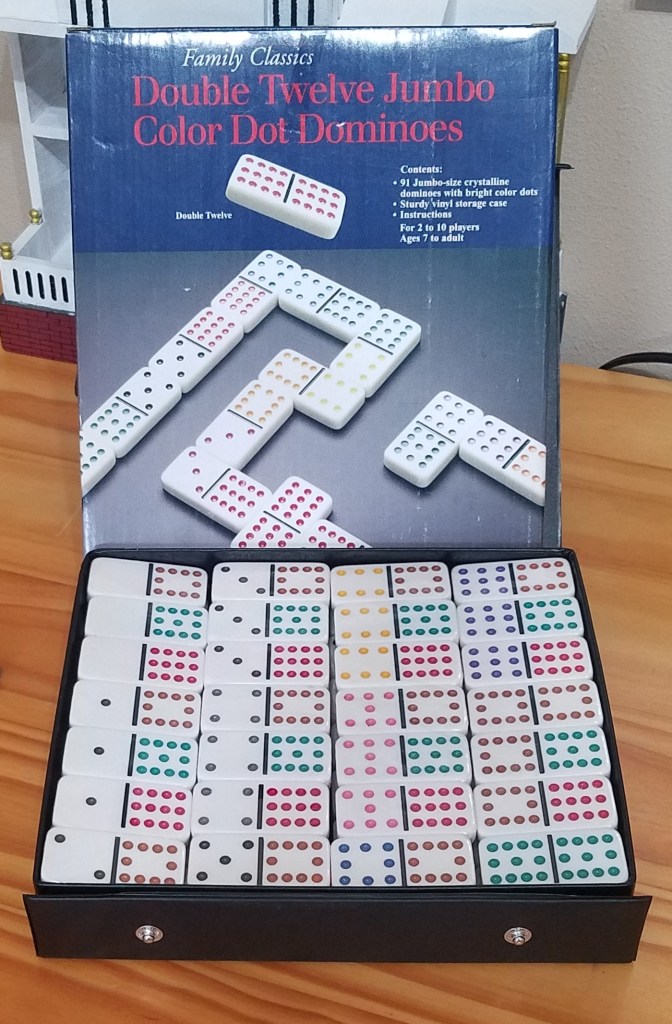
The cover of a domino box which we discovered among my parents’ things. The inside box cover (below) is signed and has a date of 1910 in it.

“The earliest mention of dominoes is from Song dynasty China found in the text Former Events in Wulin by Zhou Mi (1232–1298). Modern dominoes first appeared in Italy during the 18th century, but they differ from Chinese dominoes in a number of respects, and there is no confirmed link between the two. European dominoes may have developed independently, or Italian missionaries in China may have brought the game to Europe.

The name ‘domino’ is probably derived from the resemblance to a kind of carnival costume worn during the Venetian Carnival, often consisting of a black-hooded robe and a white mask. Despite the coinage of the word ‘polyomino’ as a generalization, there is no connection between the word ‘domino’ and the number 2 in any language. The most commonly played domino games are Domino Whist, Matador, and Muggins (All Fives). Other popular forms include Texas 42, Chicken Foot, Concentration, Double Fives, and Mexican Train.”

Now, on the minute chance there are readers who are not familiar with dominos, the most common configuration features a set of 28 tiles. Each tile has two faces featuring from zero to six ‘spots’ on either face. The lowest denomination is double zero (blank on both faces), while the greatest is a double six (a six at either end). In between is every single combination of numbers such as one-five, three-four, two-six, etc.

The traditional game I learned was that each participant drew seven tiles and the one with the highest double would start the game by laying down their tile face up. The person to their left would either play a domino which matched their number (For example, if they played a double five, then the second player had to also play a tile with a five at one end) or draw if they did not have a play.

The game continued until one person was able to play all of their tiles before anyone else.

I have a distinct childhood memory of playing dominoes with my mother and grandmother at the family cabin. My grandmother was a keen game player and, it seemed to me, that she always won. But I’m certain my mother won her fair share also. As a kid, I never stood a chance against them!

After my mother’s dementia had taken over her brain, dominoes was the last game she was capable of playing and my sister would often get out the dominoes set which had been acquired just for Mom and engage her in the activity.

The set of dominoes acquired for Mom after her dementia diagnosis.

More recently, my sister, niece, and my niece’s hubby, introduced me to a domino game which I would describe as being on steroids. The game: Mexican Train.

Mexican Train, however, uses dominoes with zero up to twelve dots on each face, so there are 91 tiles. We turn to the Infallible Wikipedia once again to learn how the game is played:

“With a standard double-twelve set the double twelve is placed in the station. In each successive round the next lower double is used until all doubles are used. The double-blank is the final round.

Play continues to the left. Each person lays one legally placed domino per turn, or two if the player’s first domino is a double. If they are unable to, they must draw a domino from the boneyard. If they are able to lay that domino, they must do so immediately. Otherwise, their turn is over and play continues to the left, each player trying to place all their dominoes by playing matching dominoes one at a time, end to end.

A train can be as long as the players can make it; it ends only when all dominoes that could match its endpoint have already been played. As a result, trains can become quite long, especially with an extended domino set. It is acceptable to ‘bend’ the train 90° or 180° to keep the train on the playing surface, as long as it does not interfere with the endpoints of other trains.

All trains begin the game as ‘public’, and all players may play on them. When a player plays a domino on their train it then becomes ‘private.’ When a player draws a domino and is unable to play it, they must mark their train as ‘public’ by placing a marker on their train.

The Mexican train is an additional train that anyone may play on during their turn. They can start the train by playing a domino matching the engine (i.e. the double played at the beginning of the round) or add to the train.”

I must admit I was curious about how it became known as Mexican train. One last blurb from the Infallible Wikipedia:

The new Mexican Train dominos set up and ready for customers

“‘Mexican Train’ is a name typically used only in the United States. It is believed Mexican Train Dominoes is a variation on a Chinese game called Pai gow, which means ‘make nine’. Chinese laborers brought the game to Latin America once they began working in sugar fields in the mid to late 1800s. Cubans and other Latin American players adopted the game to use dominoes and called it ‘Domino Cubano’. It later arrived in the United States around the 1860s once Cuban laborers began working on U.S. railroads. Americans began referring to the game as ‘Mexican Train Dominoes’ because of its growing popularity among Cuban, Mexican, and other Latin American laborers brought to the United States.”

Playing the game with my sister and her gang has become one of my favorite things to do when we get together. This is in spite of the fact that the final score of the first round of 13 I ever played resulted in me taking high score honors. Oh, did I mention that you are trying to earn the ‘least’ amount of points? Exactly.  

My high score – which was somewhere in the high 600’s – has not, to my knowledge, been eclipsed by anyone else in our quartet. My niece tried hard to get there last week when the four of us spent a few days at the beach. I have yet to check with her to see if, from the past score sheets which are kept, if she is the new high score champ.

In years past, she has brought the Mexican train set she owns with her on the annual trip. But this year it was accidentally left behind. As fate would have it, the first day we were there was my birthday and, after a stop at Fred Meyer, there appeared a shiny new metal tin full of dominos as a gift.

Now one might think that since it was my birthday week, they would at least let me win the game. One would be wrong. Despite my best efforts, it was my sister who came out on top for this two day round of Mexican Train, followed by her son-in-law, then me, and then my niece.

Since I started playing with them, however, I would say each one of us has been the victor at least once.

Ultimately, however, I always come away from the game feeling as though I’m the winner, regardless of the score. For me being able to experience the joy of simply playing games with family and friends is the real win.

As for the new set of tiles, I opted to leave them in the owner’s closet at the family condo for all to enjoy when at the beach.

The links:

https://en.wikipedia.org/wiki/Dominoes

https://en.wikipedia.org/wiki/Mexican_Train

If you have a few minutes take a look at this YouTube video of dominoes set up and then getting knocked down. I don’t possess the patience to do something like this.

Long Beach, Washington

A wonderful resort town

January 18, 2022

Although there is no definitive answer as to when something becomes a tradition, I can state unequivocally that my family has a tradition to visit this Washington State city at least once a year; we’ve been doing so for generations now.

My daughter under the World’s Longest Beach sign 2009

The city of Long Beach was incorporated 100 years ago today on January 18, 1922. We go to the Infallible Wikipedia for a bit of history:

“Long Beach began when Henry Harrison Tinker bought a land claim from Charles E. Reed in 1880. He platted the town and called it ‘Tinkerville.’ (snip) From 1889 to 1930, a narrow gauge railroad called the Ilwaco Railway and Navigation Company ran up the whole peninsula.

The Long Beach depot was built between First and Second Streets on the east side of the track, which ran north along ‘B’ Street. A major destination in Long Beach was Tinker’s Hotel, later renamed the Long Beach Hotel, and built very close to the station. (snip)

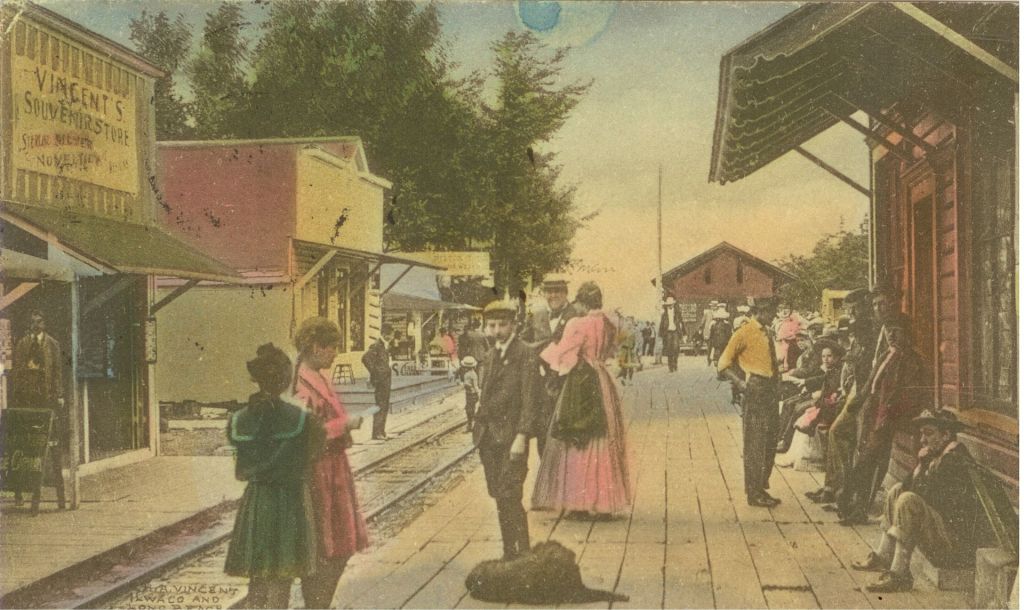
Photo from: Unknown author – From old postcard, postmark on back states mailed July 31, 1909
Long Beach, Washington, ca 1909, looking north along the line of the Ilwaco Railway and Navigation Company, at an early tourist area called “Rubberneck Row”.

The boardwalk area near the station was known as ‘Rubberneck Row.’ Businesses existing in August 1911 that can be identified along Rubberneck Row from photographs (see images in this article) include, on the west side of the tracks, an establishment advertising ‘Baths’ (possibly the Crystal Baths, an indoor swimming pool), Milton York Candies, a ‘Postal Shop,’ and a soda fountain just across from the station advertising ‘Milk Shake.’”

This description of Long Beach could, in many ways, fit nearly any small beach resort town throughout the United States. Hotels and eateries were soon joined by shops and activities all designed with the seasonal tourist in mind.

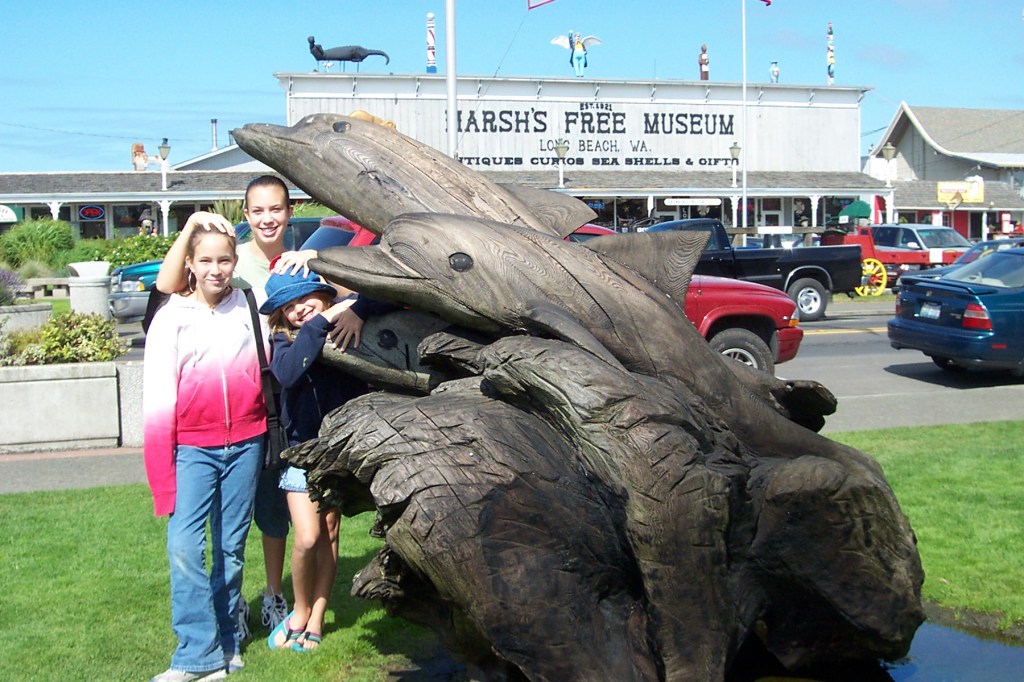
The cousins with Marsh’s Free Museum in the background. 2010

Over the years, attractions in Long Beach have come to include carnival rides, an arcade, museums, go carts, bike and surrey rentals, mini golf, and horseback rides. No doubt I’ve missed an attraction or three.

Riding the mopeds 2005

Driving through downtown Long Beach is one of those traditions which has to be honored upon arrival. In summertime, the main drag through town is a visual feast, awash in brightly colored kites and flags, firmly tethered, usually slapping in the near constant wind. The storefronts display a rainbow of souvenir products: clothes, beach toys, and every knickknack imaginable.

Flower boxes spill over in a confusion of pinks, purples, and green, inviting visitors to sit on the adjacent benches and rest for a moment or two. Tourists stroll along, licking ice cream cones, snacking on elephant ears, or savoring a doughnut from the local bakery.

The main draw for Long Beach is, however, found in its name: beach. At the north end of the business district, a left turn brings into view the large arch which proclaims that you have arrived at The World’s Longest Beach. Ahead of you are sand dunes and, finally, the mighty Pacific Ocean.

Having a sizzling good time visiting some of the sights a few years back

My first trip to Long Beach was 1961… at least that’s the first preserved photographic evidence. There are 8 mm home movies of our family along with my parent’s good friends,Walt and Barbara Lloid, and their family at Long Beach that summer.

While that was the only time we vacationed with the Lloid’s, over the next ten to fifteen years, we went every summer, joining my grandparents, who also stayed at the Klipsan Beach cottages. Every day of those two weeks was an adventure for a child: digging in the sand, playing at the ocean’s edge, beach fires every night.

But the special days were those when we drove to downtown Long Beach. We would visit Marsh’s Free Museum, drive the bumper cars and go to the carnival, see the World’s Largest Frying Pan, and buy candy at Milton York. It was a highlight of every visit.

By my own estimation, I’ve been to Long Beach at least once a year for 50 of the last 61 years. My parents gave our family a gift beyond compare when, in 1991, they decided to purchase a condominium at Long Beach. That year, my sister and I took our (then) two children – ages two and one and a half – to the beach and thus brought another generation into our long family tradition.

It would be impossible to encapsulate every single experience at Long Beach in this article. Even as I contemplated what to write, I simply could not pluck the most memorable event from the dozens which floated to the top.

Surry fun with the hubby and kids 2003

As it turned out, I needn’t have worried. When I put Long Beach on my article calendar, I noted that it dovetailed with a planned trip with the hubby and sister. Great, I thought, I can get a current photo. We arrived on Wednesday, January 12, took care of some condo business, walked on the beach, met up with some friends, and then nature said ‘here’s your experience.’ On Friday, January 14,  a mostly underwater volcano in Tonga erupted, it produced tsunami waves which spread across the Pacific Ocean. We heard the news on Friday night just before bed.

The author January 13, 2022

It didn’t take long for the Infallible Wikipedia to share:

“The National Tsunami Warning Center issued a tsunami advisory along the West Coast of the United States and British Columbia, Canada. The advisory contained all U.S. areas along the West Coast from Southern California to Alaska. Beaches were closed, and coastal residents were requested to move to higher grounds. A surfing contest with over 100 participants was cancelled in Santa Cruz, California. Tsunami waves measuring 0.30–0.61 metres (1–2 ft) were expected to hit the shores as early as 7:30 a.m. Pacific Standard Time (UTC−8) along the Central Coast. San Francisco was expected to receive waves at 8:10. The highest tsunami waves are expected one to two hours after the arrival of the first waves. A tsunami advisory was put in place for the entirety of Hawaii. Advisories in Canada were issued along the North and Central coasts of British Columbia, along with the Haida Gwaii archipelago and Vancouver Island. No evacuation order was issued, but people were urged to avoid beaches and marinas. The warning level was low due to the height of reported waves, as they were below the 91 centimetres (36 in) threshold which would warrant an upgrade.

National Weather Service alert from January 15, 2022

Anyone who has been on the west coast has, no doubt seen, the blue tsunami evacuation route signs. I had considered, many times, what my strategy would be IF a tsunami were ever to come ashore while I was at Long Beach. Which is why I was always careful to have my wallet, car keys, shoes, and any other ‘can’t live without’ items next to the bed each night. Even if I was only going for a walk to the beach I always had the car key, ID and a credit card ‘just in case’ safely zipped in a pocket.

As I lay in bed about to go to sleep, I wondered if that would be the night when the sirens would wake us and we’d have to evacuate. Thankfully, that was not the case. We did have to leave fairly early the next morning so we did not get to see any of the impacts.

And, although it wasn’t a full tsunami event, yet another Long Beach experience is added to the already rich storehouse of memories. Thanks Mother Nature, that was enough excitement for 2022.

The links:

https://en.wikipedia.org/wiki/Long_Beach%2C_Washington

https://en.wikipedia.org/wiki/2022_Hunga_Tonga_eruption_and_tsunami#:~:text=After%20being%20relatively%20inactive%20since%202014%2C%20the%20Hunga,about%2070%20km%20%2845%20mi%29%20from%20the%20volcano.

… The Astor Street Opry Company

Shanghaied In Astoria

August 7, 2018

Shanghaiing or crimping: the practice of kidnapping people to serve as sailors by using  trickery, intimidation, or violence.  A crimp is someone who uses these methods to conscript a person against their will. A related term, press gang, refers specifically to impressment practices in Great Britain’s Royal Navy.

shanghaied1.jpgNow, while I have not been kidnapped in the form of shanghaiing, I did enjoy being in Astoria this past weekend and watching a performance of “Shanghaied In Astoria” – a musical melodrama now in its 35th season.

It’s good old fashioned, politically incorrect fun with over the top characters and toe tapping tunes. From the Infallible Wikipedia:
 

“Shanghaied In Astoria is a musical melodrama that is performed by the Astor Street Opry Company every summer in Astoria, Oregon. It has run since 1984, and has been attended by over 55,000 people. Traditionally the play is performed three days a week from July to September. (snip)

The story is set in 1904 Astoria around the Scandinavian Midsummer Festival. The Norwegian hero, Eric Olson, must rescue his sweetheart Miss Virginia Sweet from Max Krooke, her ward.”


Sneak Not Snake

A couple of sturdy women with the character Sneak. He knocked it out of the park!

I’ve attended the play five times now and can sing along with the cast. In fact, I even participated in a walk on role a couple of summers ago.

 
During intermission of each performance (the past four years at the least) they sell auction tickets for baskets.
 
The first year I bought tickets to be entered in a drawing for a walk on part. I won the honor of getting to play the part of the sheriff! I was given a badge, a play gun, and had one line: “Stop Krooke you crook!”
 
When I attended with my sister, niece and her fiance the next year, I once again purchased tickets and, once again, won the role of the sheriff!
 
Having done it the previous year, I didn’t want to do it again so I offered it to the members of my group but no one (not even my niece’s now husband who, ironically, is a police officer) wanted the role. So I gave it to a guy sitting next to me. He was thrilled!
 
Due to some family circumstances I was unable to attend last year, but we did make it this year. But, alas, they were not raffling off the role of the sheriff so I bought tickets for one of the baskets and… won.
 
Sturdy women.jpgSo I have a 100 percent success rate for raffles at Shanghaied. What’s not to like?
 
If you are ever visiting Long Beach or Astoria in the summer, it’s a fun evening of tossing popcorn at the villains, booing, hissing and cheering the hero (Sweet but Dumb!)
 
 
And be sure to enter the raffle drawing – who knows you might just get your big break on the stage!
 
A few links:
The Astor Street Opry Company:  http://asocplay.com/
 
A brief explanation on Wikipedia (of course):  https://en.wikipedia.org/wiki/Shanghaied_in_Astoria
 
And a video from a few years ago about the production: https://www.youtube.com/watch?v=sR0xTIsV8vQ


… A Mountain Climbing Grandma

July 24, 2018

There are times in life when a real life story comes along that is so wonderful, you just have to share it. This is one of those stories.

Hulda crooks Mount fuji.jpgIt was on July 24, 1987 when 91 year old Hulda Crooks of California successfully scaled 12,388 foot tall Mount Fuji. She was the oldest woman to ever summit that mountain.

In fact, she was affectionately called Grandma Whitney due to the fact that she had climbed Mount Whitney – at 14,495 feet it’s the tallest mountain in the continental United States – twenty three times… all after the age of 65!

From the Infallible Wikipedia:

Mount Whitney peaks“In 1990, Day Needle, one of the peaks in the Whitney area was, by an Act of Congress, renamed Crooks Peak in her honor.  On July 24, 1987, at the age of 91, she became the oldest woman to complete the ascent of Mt. Fuji in Japan. She hiked the entire 212 mile John Muir Trail in the high Sierras, completing the hike in segments over five years.

Hulda Crooks was a long-time resident of Loma Linda, California and a Seventh-day Adventist. She often spent time with children in the community, encouraging them to appreciate nature and stay active. In 1991 Loma Linda dedicated a park at the base of the south hills as Hulda Crooks Park.

‘Early to bed and early to rise. Out jogging about 5:30am. Jog a mile and walk it back briskly. It takes me 12 minutes to jog the mile and 15 minutes to walk it. Do some upper trunk exercises, work in the yard, and walk to the market, and work.’ — Hulda Crooks describing life at 80

According to Congressman Jerry Lewis (R California), one of her hiking companions,

Hulda crooks hiking‘No mountain was ever too high for this gentle giant. With a twinkle in her eye, and purpose in her step, Grandma Whitney showed the world that mental, physical and spiritual health is attainable at any age.’”

This remarkable woman lived to the age of 101. Even more remarkable is that she did NOT start climbing mountains until she was 66 years old.

In the obituary for her from Loma Linda University it said, “She held eight world records for women over the age of 80 including Senior Olympic events in marathon and road races. In addition she climbed a total of 86 different Southern California peaks, each over 5,000 feet between 1977 and 1983. When Mrs. Crooks spoke about the advantage of a good diet, proper exercise, and a positive mental attitude, she was speaking from experience. It was during a period of poor health while a student at Loma Linda that she changed her lifestyle. During her retirement years, she would give up to a dozen talks a month on health and physical fitness. She would walk up to 100 miles each month to stay in shape.”

Back in 1997 there was a movie released which featured a heroine named Rose. The movie: Titanic.

For those unfamiliar with the plot line: Rich girl, Rose, meets poor boy, Jack, and they fall in love. Both are passengers on the Titanic but, due to societal pressures, it’s a hidden love affair. When the boat hits an iceberg, their love – and pretty much everyone on board – is doomed. In the final moments of the movie, we see Jack succumb to the frigid waters of the north Atlantic. But his ultimate sacrifice saves Rose.

It always struck me, as we got the briefest of glimpses into Rose’s life after Jack, that the real gift he gave her was the understanding that life is to be lived to its fullest. She promised him to live her life that way – and she did.

Which is why Hulda’s story is so inspiring. No matter what your passion might be, go out and pursue it! For me it’s writing novels. Haven’t published a single one. Yet. But I’ve completed five and am halfway through number six. And I have no shortage of ideas and plots for seven, eight, nine, and ten.

Now, climbing a mountain? Not on my bucket list. Or riding a horse now that you mention it.

For years my sister, Susan, and I have spent anywhere from two weeks to a few days each summer at Long Beach, Washington. It all started in the summer of 1991 when, with her then two year old daughter and my one and half year old son in tow, we made our first ‘girls’ trek. Over the years our activities changed depending on the age and interests of the kids. Sometime in the early to mid-2000’s her two daughters decided they wanted to ride horses. In Long Beach there are a couple of outfits where you can sign up for a guide led trot to the beach.  The first year we opted for the half hour ride. This consisted of riding a horse with an attitude in a single file line over bumpy, sandy terrain to the beach. Once at the beach the horses were allowed to fight with each other and trot a little bit horse ride views long beachbefore the whole pack turned around and went back.

The next year the girls’ wanted a longer ride so we opted for the hour and half adventure. Which just meant more time doing exactly the same thing as the previous year. The only real difference was that I walked like a chafed cowboy for two days instead of one.

When the third year rolled around I had made a decision. The night before the proposed ride I said to my sister, “So here’s the deal. I’m not going horseback riding this year. In fact, I’m never going horseback riding ever again. Tomorrow morning my plan is to put the girls on those horses then wave goodbye. After that I’m driving to Laurie’s Homestead Café and having breakfast. If you want to go on the horses, then that’s fine, but I’d love to have you join me for breakfast.”Girls with horses 2008.jpg

So if you are ever in Long Beach, Laurie’s has the BEST hash browns.*  Which my sister found out that fateful morning when we marked horseback riding off our bucket list along with climb a volcano. I’ll leave that activity to the Hulda Crook’s of this world.Laurie's breakfast

After all, I can always tap into my imagination if I need a new adventure.

And, of course, a few links:

https://en.wikipedia.org/wiki/Hulda_Crooks

https://web.archive.org/web/20101212011154/http://www.anderson.ucla.edu/faculty_pages/romain.wacziarg/climbing/crooks.html

Two scenes from Titanic:

https://www.youtube.com/watch?v=9sErVyGeQrQ

https://www.youtube.com/watch?v=m7IBCKCKVO0

And if you’re on the peninsula: https://www.yelp.com/biz/lauries-homestead-breakfast-house-seaview

* With the continued shutdowns from the COVID19 Pandemic I am unsure as to the status of Laurie’s Homestead cafe. I will check it out next time I’m in Long Beach and provide and update here.

Tsunami!

December 26, 2017

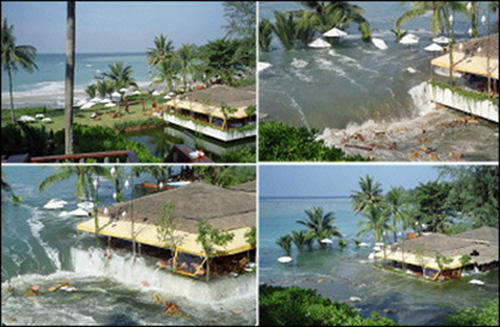
TsunamifloodBigI admit it. I’m a complete nerd when it comes to natural disasters. I’m fascinated by tornadoes and all nature related phenomenon. And while we are mostly able to deal with windstorms, snowstorms and the occasional earthquake here in the Pacific Northwest, it’s impossible to imagine what December 26, 2004 must have been like for the people who experienced a rare mega-thrust earthquake and the devastating tsunami which struck near Sumatra in the Indian Ocean.

According to the infallible Wikipedia:

“It is the third-largest earthquake ever recorded on a seismograph and had the longest duration of faulting ever observed, between 8.3 and 10 minutes. It caused the entire planet to vibrate as much as 1 centimeter (0.4 inches) and triggered other earthquakes as far away as Alaska. Its epicenter was between Simeulue and mainland Indonesia. The plight of the affected people and countries prompted a worldwide humanitarian response. In all, the worldwide community donated more than US$14 billion (2004) in humanitarian aid. The event is known by the scientific community as the Sumatra–Andaman earthquake. The resulting tsunami was given various names, including the 2004 Indian Ocean tsunami, South Asian tsunami, Indonesian tsunami, the Christmas tsunami, and the Boxing Day tsunami.”

What was particularly remarkable about this particular earthquake is that this was the first tsunami of this magnitude which was so widely filmed and seen in ‘real time.’ This scenario was repeated on March 11, 2011 when another mega thrust earthquake triggered yet another deadly tsunami, this time in Japan.

Until the videos started to pour in, I could only imagine what a tsunami might look like. To see how the water literally overpowers everything in its path is truly unfathomable. For the scientific community the knowledge gained is, no doubt, invaluable but we are made somber with the understanding that over 230,000 people were lost in this one event.

There have, of course, been other mega thrust quakes and tsunamis in the world. Scientists now believe that the west coast of the United States and Canada was hit by such an event on January 26, 1700. Information on the Cascadia quake has been pieced together through written Japanese records of a tsunami which did not correlate with a known earthquake in the region on that date. Evidence of the event has been  via oral stories of the indigenous peoples of the Pacific Northwest and also physical evidence from British Columbia south to Northern California.

Is the Pacific Northwest at risk for a mega-thrust quake? Such an event strikes the coast, on average, every 500 years and scientists believe there have been at least seven such events in the past 3,500 years. It is now 317 years since the 1700 quake.

Tsunami evacuation sign.pngDown at Long Beach, Washington, there are the blue tsunami signs which direct people to routes that would, ostensibly, lead them to higher ground. Recently I saw a program on HGTV where a family was purchasing a vacation home ten miles north in Ocean Park. Personally, I would buy something no more than a mile north of Long Beach; in lesser known Seaview would be better. From that location there is a road which quickly gets you up on top of a rather tall promontory. If, however, one happens to be on the north end of the peninsula when such an earthquake occurs it’s probably best to carry an auto- inflatable rubber boat with you when visiting the coast.
For all you other science nerds out there, here are two Wikipedia links for you:

https://en.wikipedia.org/wiki/2004_Indian_Ocean_earthquake_and_tsunami

https://en.wikipedia.org/wiki/Cascadia_subduction_zone

And two YouTube videos of the 2004 Boxing Day tsunami:

https://www.youtube.com/watch?v=my4UD9Wfqvk

…Jake The Alligator Man

Happy Birthday!

August 1, 2017

Happy Birthday to that northwest icon, symbol of blatant commercialism, and

Jake the Alligator Man

Long Beach, Washington’s most famous resident: Jake the Alligator Man

resident of Long Beach… Jake the Alligator Man!

How fun it was, on August 1, 2014, to be at Long Beach and join in the parade for Jake’s 75th birthday, be given free cupcakes and really celebrate this once in a lifetime event.

Or not. As it turns out the town of Long Beach celebrates Jake’s 75th birthday EVERY year and has been doing so for the past 11 years. So maybe it’s really Jake’s 86th birthday? Call me cynical but I’m starting to think that this is all a ploy for tourists to spend more money on Jake gear and at local motels and restaurants.

And his birthday is not always on August First but seems to coincide with whichever date the first Saturday in August might fall.

Jake’s murky beginnings are just that, murky. What we do know is that Jake was purchased in 1967 for $750 from an antique dealer. He has ‘lived’ at Marsh’s Free Museum ever since.

Jake with creepy doll

Jake The Alligator Man inspecting the Creepy Dolls.

Sandy Meets Jake.jpg

Sandy The Creepy Doll inspecting Jake.

I feel pretty certain that I probably saw Jake that first year as my family spent many a summer on the Peninsula. Shopping at Marsh’s during a Long Beach visit is a must. Although Jake was once relegated to a dusty corner along with the two-headed calf and the shrunken head, he now has a whole display area with a variety of t-shirts, bumper stickers, posters, key chains and glassware dedicated to the Gatorman. And Creepy Dolls like him also.

The Infallible Wikipedia has done a poor job of telling the whole history of Jake.  What’s up with that?

So I will skip them this week and instead share the article which catapulted Jake into legend status back in 2008 when the World Weekly News published an article titled “Manigator Found.”

“MIAMI, Florida — The discovery of a bizarre half-human, half-alligator in the Florida Everglades has flabbergasted scientists who say the creature is alive, at least moderately intelligent and possibly even a distant ancestor of modern man!

That’s the world from paleontologist Dr. Paul Ledbrader, who studied the creature in his laboratory for almost three hours before state wildlife officials seized the 5-foot, 11-inch, 180-pound beast and airlifted it to a research facility just west of Miami.

Nobody at the state wildlife commission is talking. But Dr. Ledbrader says the U.S. Forest Service sent no fewer than five experts to the facility to study the reptile in the hope of determining exactly where it came from — and what it might be.

‘I know what it isn’t — and that’s an ordinary alligator,’ said Dr. Ledbrader.”

To read more of their amazing discovery, click here:

http://weeklyworldnews.com/headlines/1717/manigator-found/

Be sure to make plans to attend Jake’s 12th annual 75th birthday party in 2018: http://jakethealligatorman.com/

*2020 Update!*

Sadly, Jake’s birthday celebration – scheduled for Saturday, August 1st – was cancelled. But that did not stop Mr. Gator from donning a birthday hat, a couple feather boas, and celebrating with friends and fans who might happen to stop by his house. Of course, HE was NOT socially distancing but this friend was.  Perhaps next year. Be sure to mark your calendars for August 7, 2021. It’ll be a party.

20200802_120921

2021 Update – Jake’s birthday celebration has been cancelled for this year. Man, poor Jake is not feeling the love these days.