Tag Archive | history

A Font of Fun? No Fooling!

April 1st

You’d pretty much have to be living on an island far from civilization to NOT know that today is April Fool’s Day. It’s celebrated each year on April 1st.
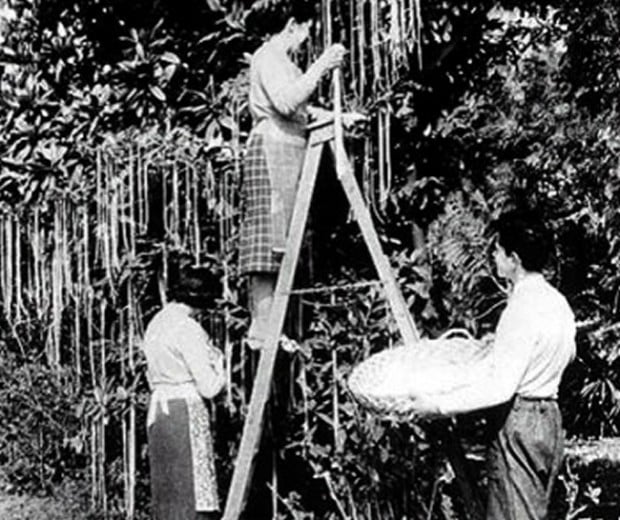
Considered by many as the greatest hoax of all time is this 1957 BBC documentary about harvesting spaghetti from trees. https://en.wikipedia.org/wiki/Spaghetti-tree_hoax

The day has murky beginnings which date back hundreds of years. Some say that Geoffrey Chaucer, in the unreadable ‘Canterbury Tales’, makes reference to the day. But that’s disputed. In 1508 some obscure French poet I’ve never heard of wrote about ‘poisson d’avril’ – translated ‘April’s Fish’ – which apparently doesn’t mean fish but ‘fool.’ Yet another theory is that at one time the new year was marked as being on March 25th but was then changed to January 1st (Actually March 25th makes more sense what with spring, birth, and renewal, but whatever). Those who clung to their old traditions were derided as Fool’s and I guess it took 6 days of their protests against moving New Years before someone decided to take any action.

The previous paragraph is, however, as in depth as I plan to go regarding the origins as, quite honestly, it’s a bit boring for this day devoted to mirth and mischief. Sadly, I found the Infallible Wikipedia article to be deadly serious and who wants that?

Anyway, I had soon climbed down the rabbit hole that is the internet and found a website truly worthy of April Fool’s Day: The Museum of Hoaxes. OMG. I knew I could spend hours reading about all the clever things people have conjured up to fool others. Decisions, decisions. WHICH of the hundreds of hoaxes was worthy of Tuesday Newsday fame? It was a weighty decision.
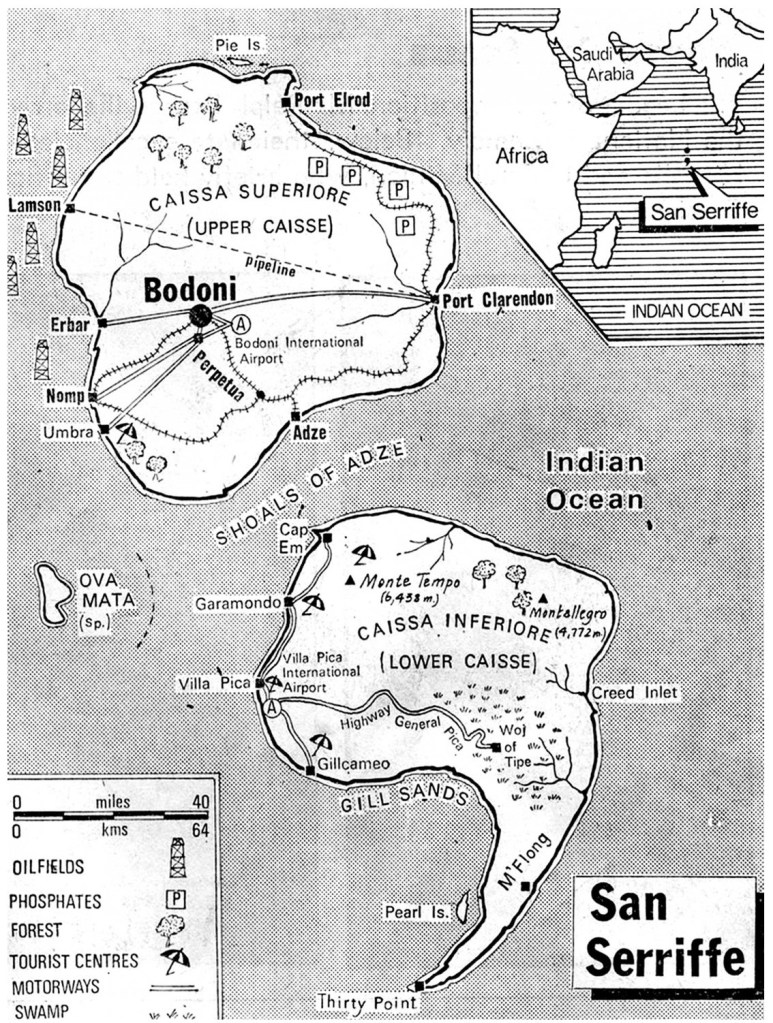
The islands of San Serriffe are a Perpetua(l) delight

Presenting the Island of San Serriffe!

As a writer, word nerd, and someone whose earliest childhood goal was to be able to create programs, newsletters, flyers, etc., the name San Serriffe resonated.

The year was 1977 and the British newspaper, The Guardian, was looking for something fun as a joke for their April Fool’s Day edition. Brainstorming occurred and the results were hilarious. From the hoaxes.org website:

“On April 1, 1977 the British newspaper The Guardian published a seven-page ‘special report’ about San Serriffe, a small republic located in the Indian Ocean consisting of several semi-colon-shaped islands. A series of articles described the geography and culture of this obscure nation.

The report generated a huge response. The Guardian‘s phones rang all day as readers sought more information about the idyllic holiday spot. However, San Serriffe did not actually exist. The report was an elaborate April Fool’s Day joke — one with a typographical twist, since numerous details about the island (such as its name) alluded to printer’s terminology.

The success of this hoax is widely credited with inspiring the British media’s enthusiasm for April Foolery in subsequent years.”

The best part of this story is, for me, the map. These people had waaaaaay too much time on their hands apparently.

The capital of San Serriffe: Bodoni; There’s Monte Tempo and Montallegro; Creed Inlet and Thirty Point; Villa Pica International airport and a beach town named Garamondo. Truly, the map is a font of fun.

I’m a bit sad that it took me over 40 years to learn about San Serriffe since, in 1977, I was heavily involved in the world of publishing. I was one of three editors for the weekly Yakima Valley Community College “Galaxy” and also the youth editor of the Washington Idaho Rainbow Girls newsletter titled “The Confidential Observer.”
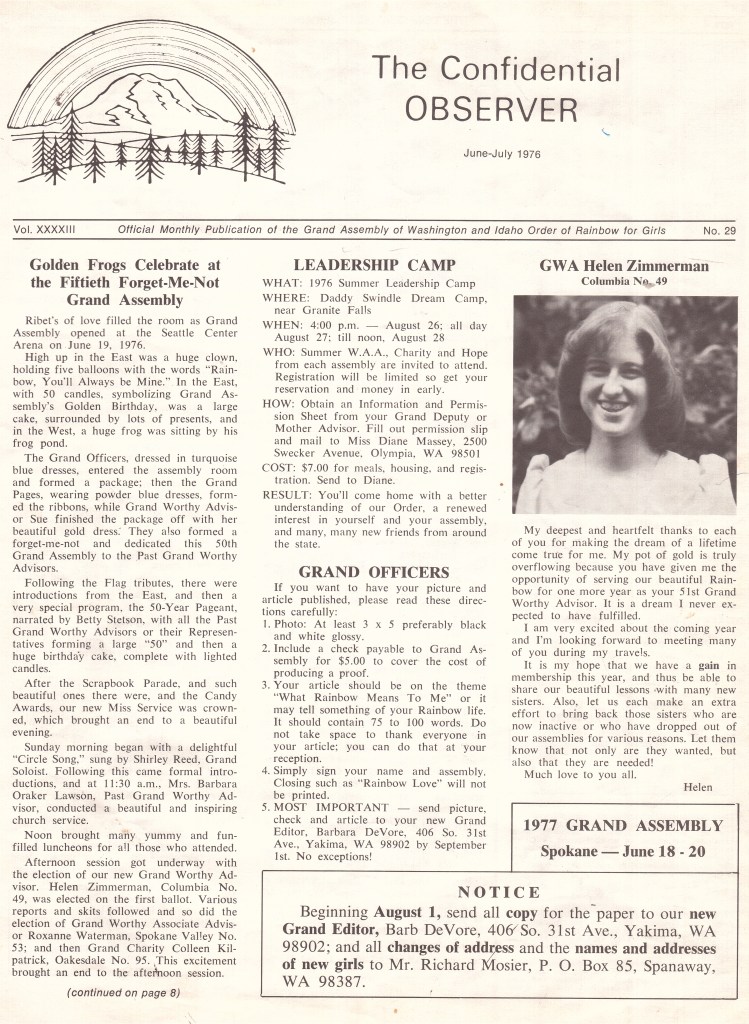
I was hungry to learn everything there was about journalism, writing, and layout. One of my big passions was experimenting with new fonts. I could not get enough of them!

The adult advisors for the Rainbow Girls publication, I’m certain, had no idea what hit them that year as I shook things up, at least in the world of Fonts. Well, and layout and artwork and, pretty much everything I was capable of changing. The fonts went from Helvetica and Times New Roman to Garamond and Bodoni to name a couple of them.

I changed the mast head; I varied the font sizes; I used boxes around things to emphasize and tried to make it more aesthetically pleasing.
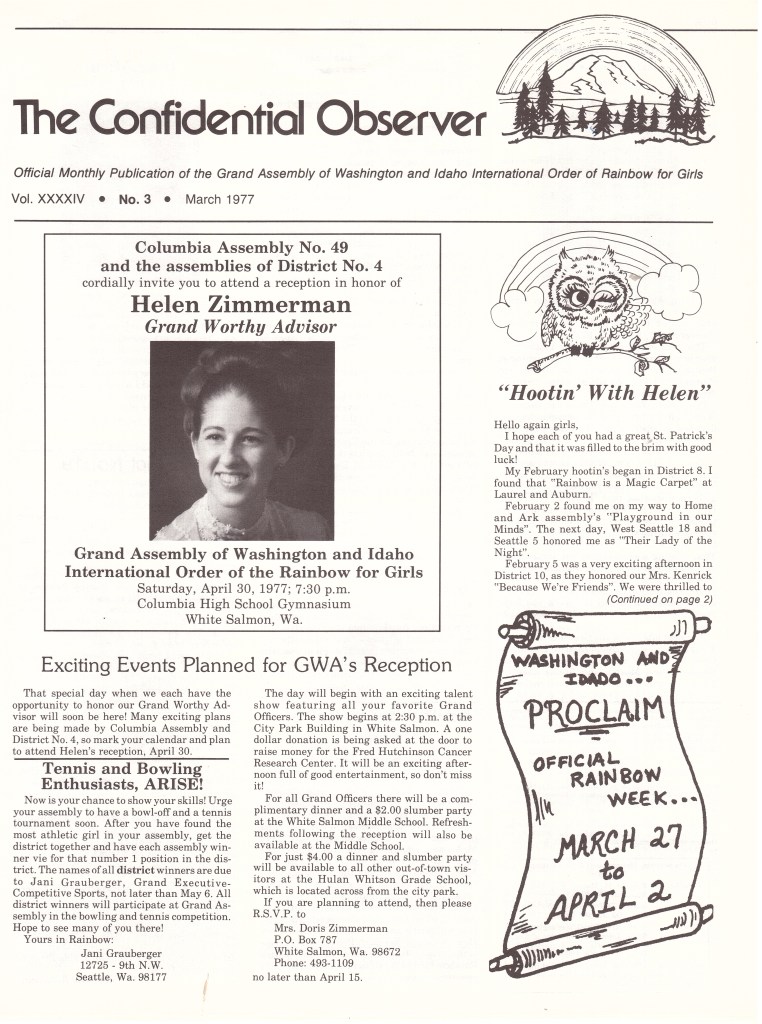
Two versions of the front page of the Rainbow Girls paper. Top is how it looked the issue before I started changing things. Bottom is how it looked six months later.

Now, way back in the dark ages, publication was not a simple thing. First I had to get articles from people from all over the states of Washington and Idaho who mailed them in envelopes. Some of these came handwritten on notebook paper, full of spelling and grammatical errors. I often had to retype and all had to be edited. When that was done I would mail it all from where I lived in Yakima to the printers in Tacoma, who then retyped it (with the fonts I’d chosen) and created galleys to fit our three-column format. These were then returned to me via mail. I would cut – with an exacto knife – the galley articles and glue the proofs on to paper in the correct configuration with everything marked as to where it was supposed to go and then would cross my fingers that they did it right. Spoiler: not always.

It was the fall of 1976 and the artwork that was to top the column for our state president that year had gotten lost by them. I sent in my package a hastily drawn picture (I’m no artist!) with a note attached saying “this is sort of what the artwork looks like that’s missing” and asking them to look around for it. Instead of reaching out, however, they ‘published’ what I had sent. It was awful and upsetting and bothers me to this day. Eventually, they found the missing clipart.
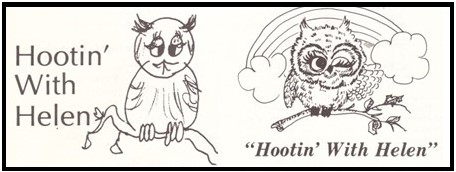
To this day I cannot fathom any professional printer looking at the owl on the left and thinking that’s what they should print…

With the introduction of the Apple Macintosh and their GUI (Graphical User Interface) layout in the mid-1980’s, I was finally able to create a newsletter on a computer and print it out. It was then I got my first laser printer. It was still a clunky process and the clipart was lacking, but it moved me forward.

Over the years as the GUI technology has improved, my ability to create has expanded. Artificial Intelligence has made it even easier.

So hats off to San Serriffe Island. I found the above picture of the island through an easy Google search, saved it as a jpg, and then printed it on my less than $200 Epson printer. I’m sticking it in a frame and hanging it in my office and will look at it often and cheer the fun of April Fool’s Day and 1977, the year of San Seriffe’s creation.

As always a few links:

https://hoaxes.org/archive/permalink/san_serriffe

https://hoaxes.org/af_database/display/category/guardian

https://en.wikipedia.org/wiki/April_Fools’_Day
You Light Up My Life

A mega hit for Debbie Boone

November 19, 2024

A Tuesday Newsday Classic updated

On November 19, 1977, this song was in the middle of a 10 week run as the number one song in America. You Light Up My Life was the one and only Top 40 hit from Debbie Boone, daughter of 50’s teen idol Pat Boone. It reached number one on October 15 and stayed in that position through December 23, making it – at the time – the only recording to stay that long in the top spot in Billboard history.

According to the Infallible Wikipedia:

“Besting her chart performance in Billboard, Boone’s ‘You Light Up My Life’ single topped Record World’s Top 100 Singles Chart for an unbroken record of 13 weeks. On Billboard’s chart, Boone was unseated from #1 by the Bee Gees, with ‘How Deep Is Your Love,’ the first of three #1 singles from the ‘Saturday Night Fever’ soundtrack. On Record World’s chart, Boone kept the Bee Gees out of the number-one spot. In Cash Box Magazine, ‘You Light Up My Life’ managed only an eight-week stay at the top of the chart, before being dethroned by Crystal Gayle’s ‘Don’t It Make My Brown Eyes Blue’.

The single, which was certified Platinum by the Recording Industry Association of America (RIAA), also hit #1 on the Adult Contemporary chart and reached #4 on the Country chart. The single peaked at #48 I’m the UK Singles Chart. Boone’s hit single led to her winning the 1978 Grammy Award for Best New Artist, with additional Grammy nominations for Best Pop Vocal Performance, Female and Record of the Year. Boone also won the 1977 American Music Award for Favorite Pop Single.

Decades after its release, the Debby Boone version is still considered one of the top ten Billboard Hot 100 songs of all time. In 2008, it was ranked at #7 on Billboard’s ’Hot 100 All-Time Top Songs’ list (August 1958 – July 2008). An updated version of the all-time list in 2013 ranked the song at #9.

Although it was written by (Joe) Brooks as a love song, the devout Boone interpreted it as inspirational and proclaimed that it was instead God who ‘lit up her life.’”

The song was tainted by controversy, however, as songwriter Brooks apparently did not want to pay the agreed upon amount owed Kasey Cisyk, the artist who sang it for the movie of the same name, and whose version is included on the 1977 soundtrack.

Boone was told, when recording the song for release as a single, exactly how to sing it and her vocals were dubbed onto the original orchestral track.

At the time, I recall that Boone received much derision and the song was labeled as saccharin. In reading what occurred, however, I feel bad for both the women caught up in the controversy. Perhaps Cisyk was denied her shot at a Top 40 career and, perhaps, Boone was lulled into a sense of inevitability that she would become a star like her father. Although in listening to both versions, I think Boone’s is better.

Boone released additional songs into the pop market, but none ever came close to the success of “You Light Up My Life.” Her career eventually led her back to country music – where she had started – and then to work in the Christian music world.

In the fall of 1977, you simply could not avoid the song. It was played hour after hour on the radio. That autumn was one of the most memorable in my life: I was living away from my parents for the first time, having joined the Alpha Phi sorority at the University of Puget Sound. While I did study, I don’t think I was quite as diligent as I should have been. Instead, I was fraternizing with the fraternity boys most every weekend at mixers, and going on dates! I had never in my life garnered quite so much attention from the males of the species.

There was one particularly memorable November day when, literally, I had calls or visits from five guys all of whom I had been on a date with in recent weeks. That day, I could not say for sure the exact date, I had been headed down to the ‘tunnels’ to get my dinner and I decided it was a good idea to jump down the two steps from the door. I jumped a wee bit too high and… nearly gave myself a concussion.

The ‘award’ I was given for my epic self inflicted concussion

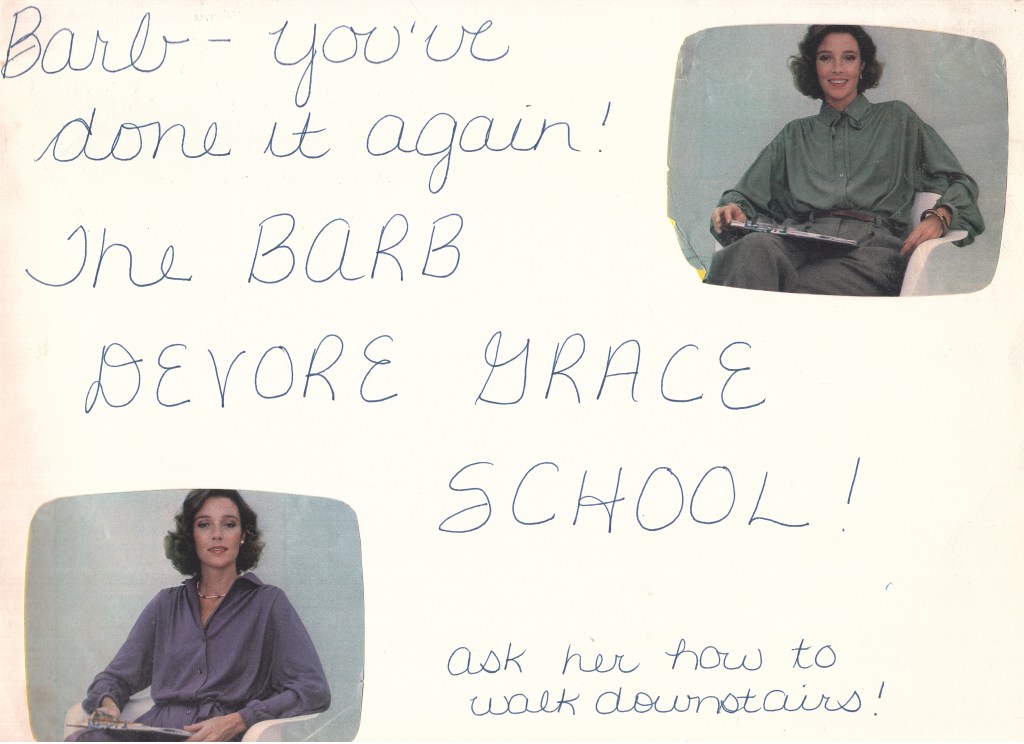
The next Monday at our weekly sorority chapter meeting, I was recognized for my grace (for the stairs) and my charm (for the plethora of phone calls and visits I had). It was what I came to be known for and received endless ribbing about it. Good times.

That era in my life was punctuated by music and whenever I hear “You Light Up My Life” I’m back in the Alpha Phi house and it’s the fall of 1977. There were a few other songs which, in my opinion, were equally as deserving of that number one spot.

These included Billy Joel’s Just The Way You Are – an infinitely better song; Rita Coolidge’s version of We’re All Alone; Carly Simon’s Nobody Does It Better; and Don’t It Make My Brown Eyes Blue by Crystal Gayle. The list of great songs from that year also included big hits – but never number ones – from a whole lot of great bands: Foreigner, Heart, Fleetwood Mac, Styx, Supertramp, and Steely Dan, among others.

And in case you’d like to hear the Casey Cisyk version and really get the worm stuck in your head (it’s been in mine since I wrote this!) here’s that video also. Note that you are seeing Didi Conn on screen – she is doing a lip-sync to Cisyk’s vocals. Enjoy!

The links:

…On the Road to The Little House

Exploring the world of Laura Ingalls Wilder

May 7, 2024

A Tuesday Newsday Classic

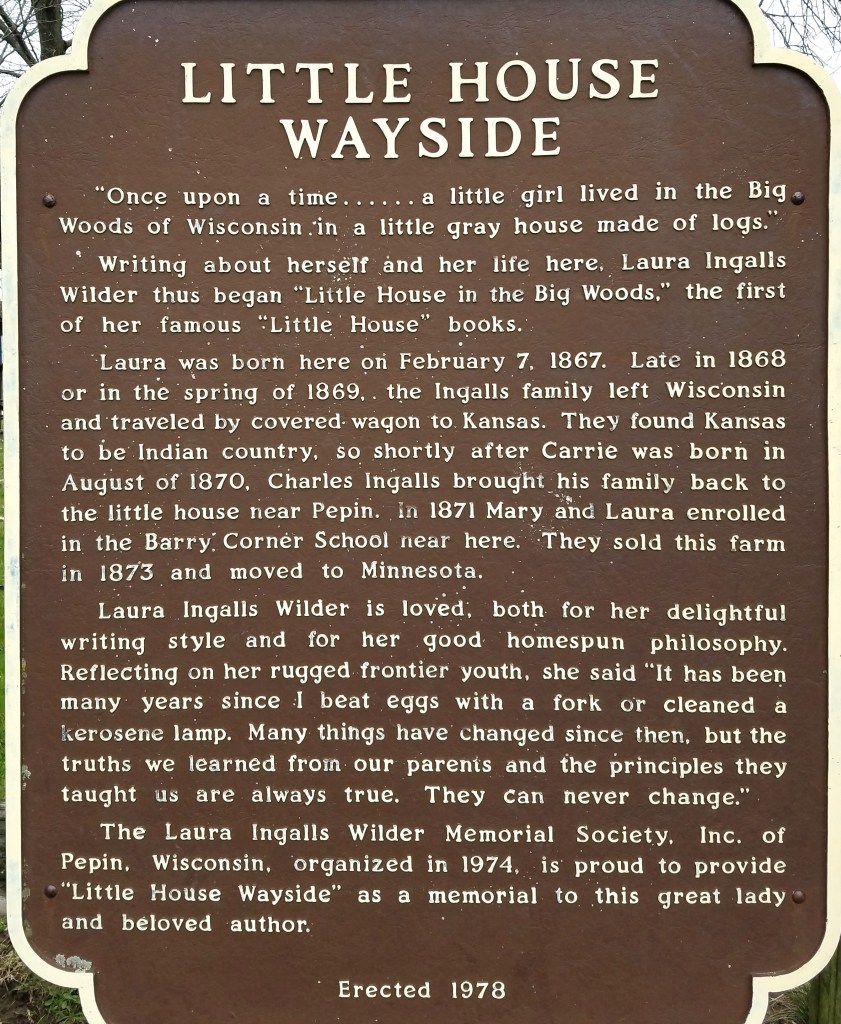
Sign at the “little house” that started it all in Pepin, Wisconsin

Perhaps more than any other books I’ve ever read, this series captured my young imagination and inspired me to want to write and record my world.

The first “Little House” book was published in 1932. Six more followed over the next decade and Laura Ingalls Wilder was propelled from a farmer’s wife to one of the most beloved children’s book authors in history.

As a child I was entranced by the thought of living in a cabin in the big woods of Wisconsin, or in a dugout carved into the banks of Plum Creek in Minnesota, or in a claim shanty on the wind swept prairies of South Dakota. What adventures awaited!

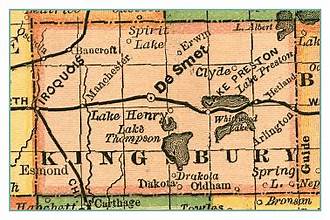
I’ve had as a goal to visit the many homestead sites. In September 2013 I, along with my 20 year old daughter, went to Mansfield, Missouri, and toured the museum and also the house where Laura lived as an adult. This past week was round two when the hubby and me meandered from Wisconsin to South Dakota and traced a portion of the Ingalls family pioneer journey.

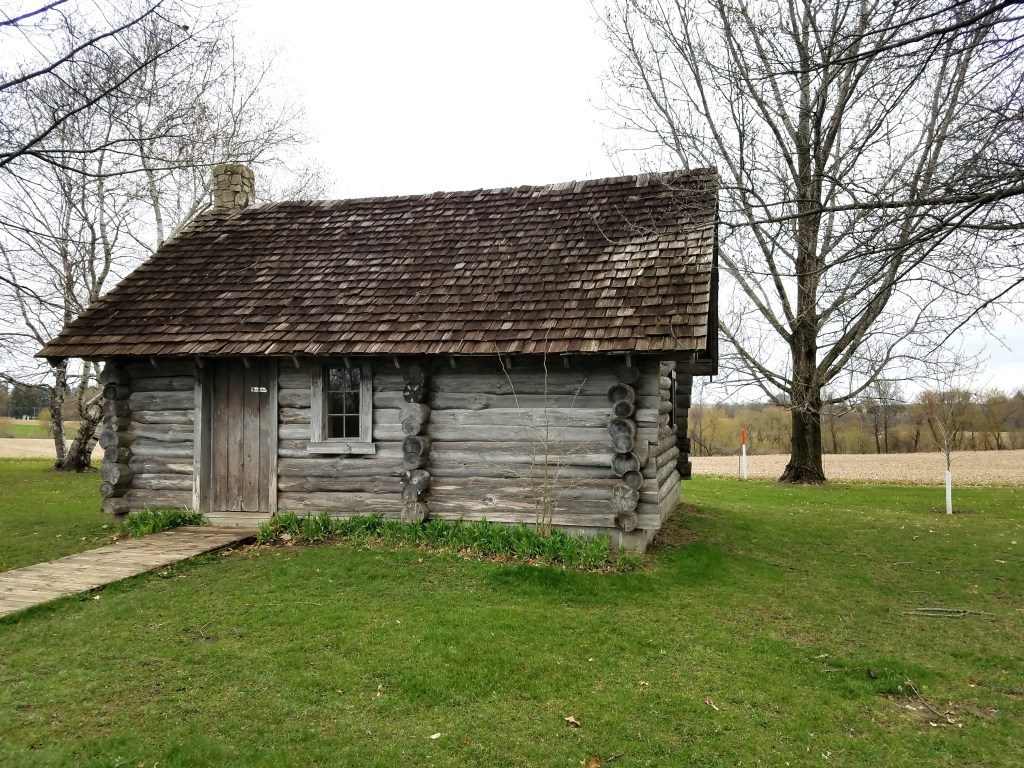
The Little House in the Big Woods in Pepin, Wisconsin

The takeaway for me as an adult – considering it from the perspective of a wife and mother – is how very difficult it must have been, especially for Laura’s mother, Caroline.

Our first stop was in Wisconsin. Although the Ingalls’ cabin is long gone, those who preserved the sites have erected faithful reproductions of the original structures. The little house in Wisconsin was certainly that: little. The main room was no bigger than a small bedroom by today’s standards. For the pioneers, this room was kitchen, dining room, living room, and laundry room (at least half the year). The entire family slept in a room the size of a closet.

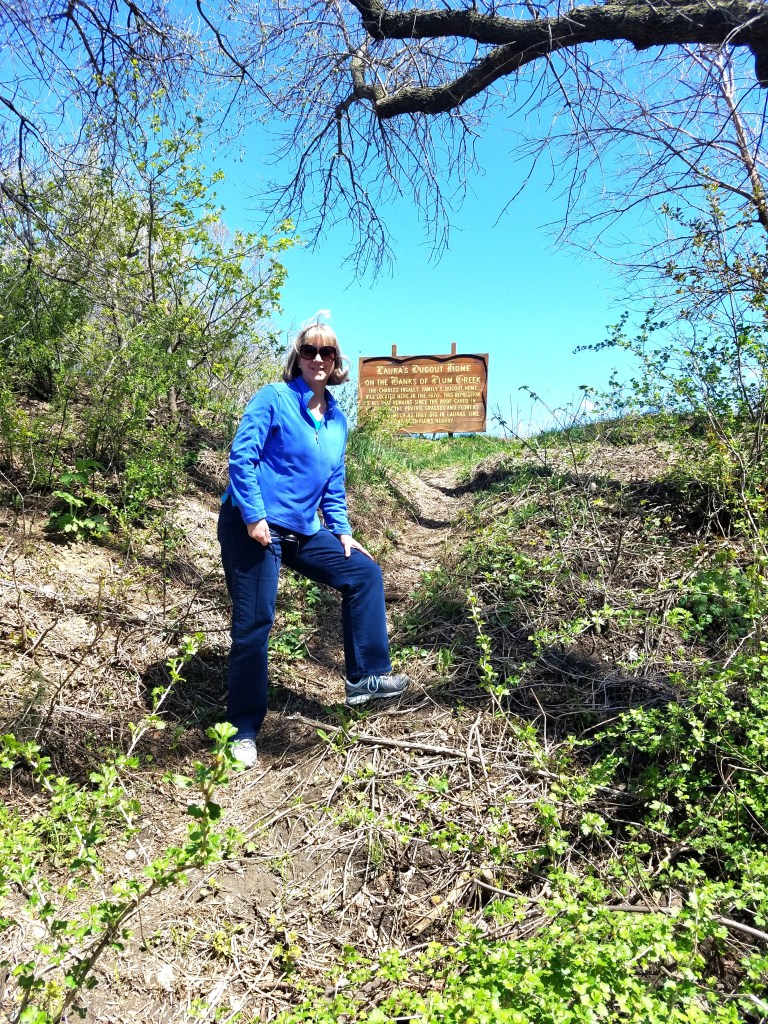
This author standing about where the dugout door was located on Plum Creek, Minnesota.
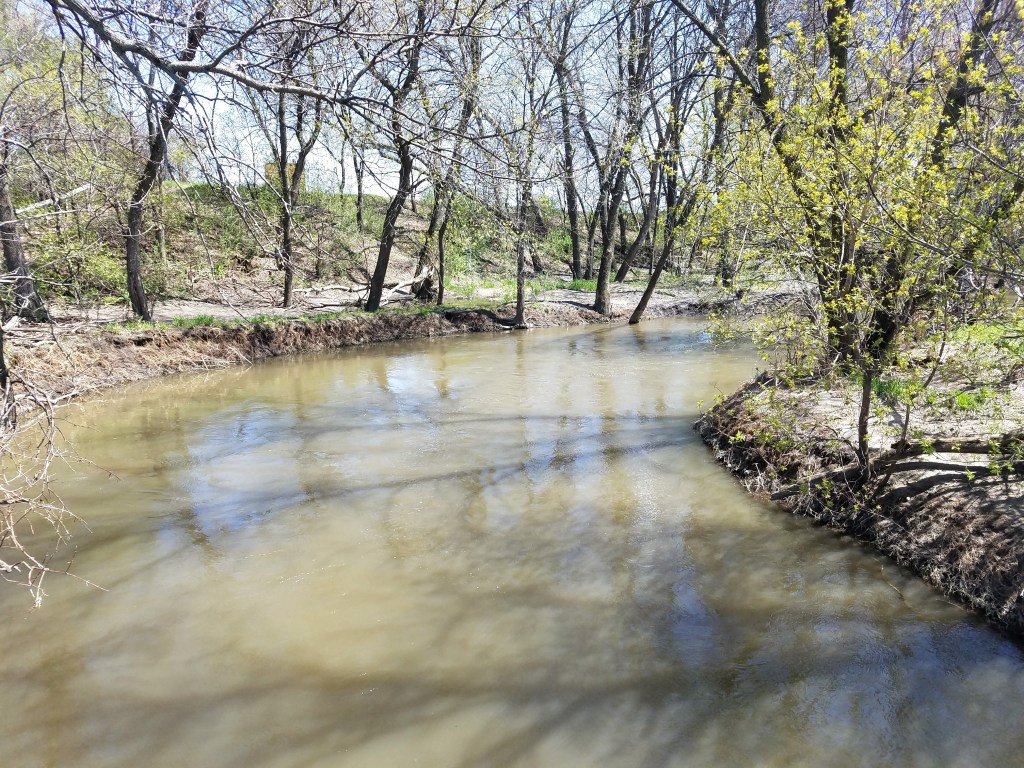
Plum Creek how it looks now
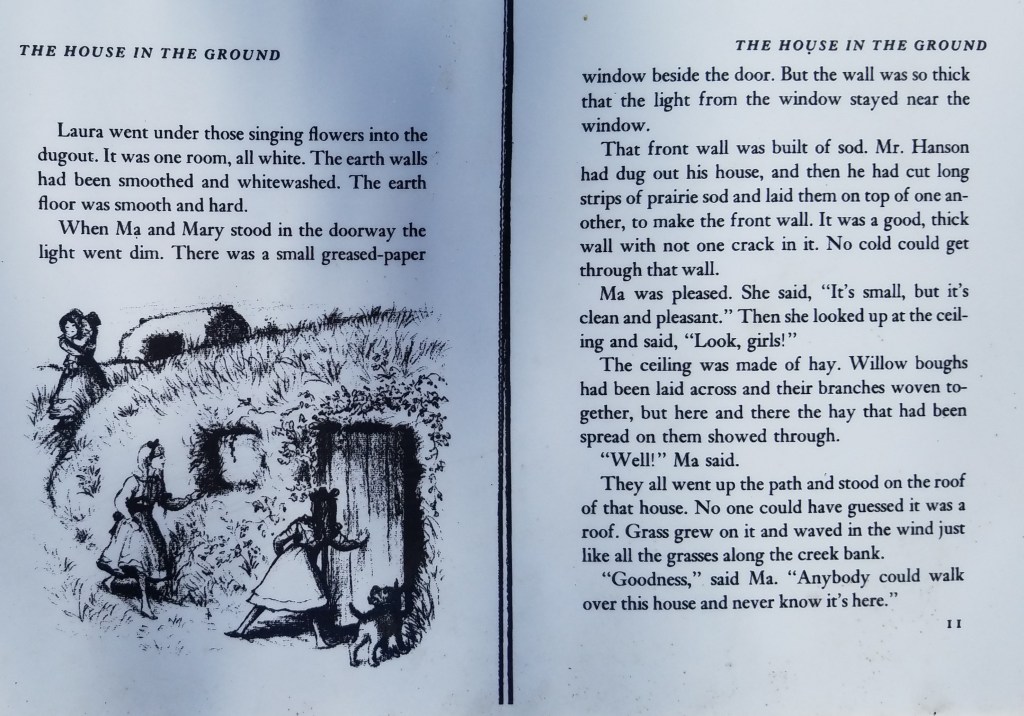
Excerpt from On The Banks of Plum Creek where Laura describes the ‘house.’

It was the next ‘house’, however, that really gave me pause. Laura’s family purchased a farm near Walnut Grove, Minnesota… but there was no ‘house.’ Instead, the family lived for some months in a ten by twelve ‘room’ dug out of a bank above a creek. The actual dugout collapsed years ago, but a reproduction exists in South Dakota. When I walked in to that room two days later I was struck by two things in particular. The first was the smell. It was a combination of earth, mold, and damp. It was depressing and dark. As Laura describes life in the dugout she shares how her mother whitewashed the dirt walls and floor with a lime mixture. I imagine the lime served several purposes including, foremost, pest control and to brighten the room. How hard it must have been for Caroline Ingalls to cook, clean, and care for her children in that tiny, tiny space.

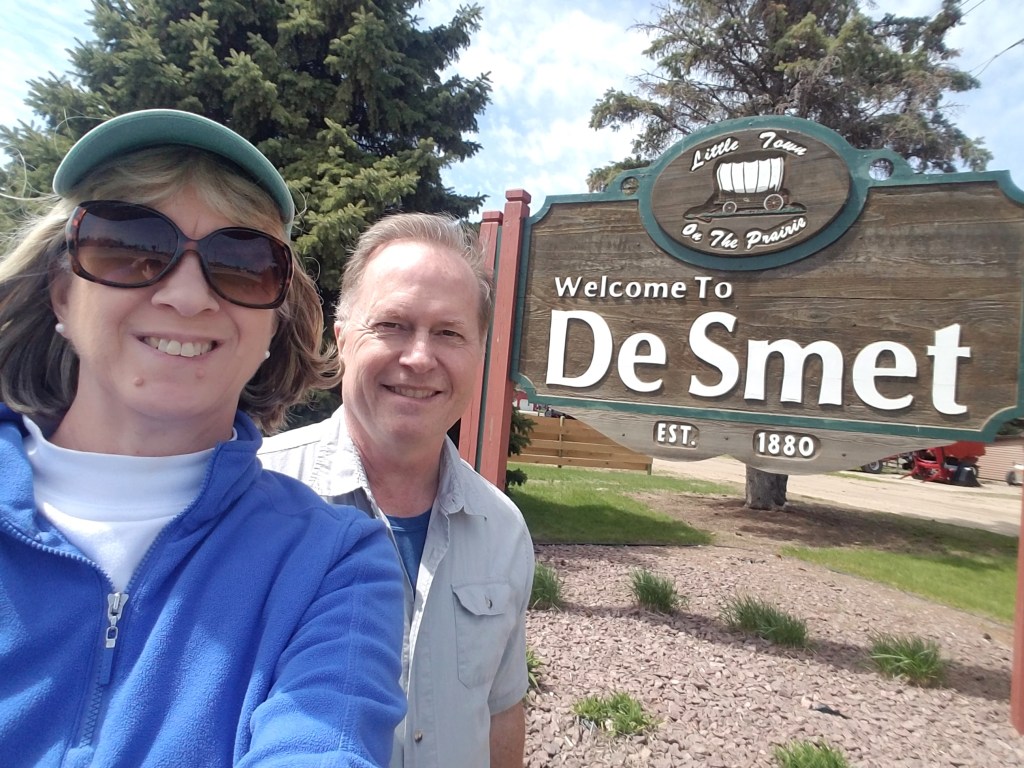
The author and hubby at DeSmet, South Dakota

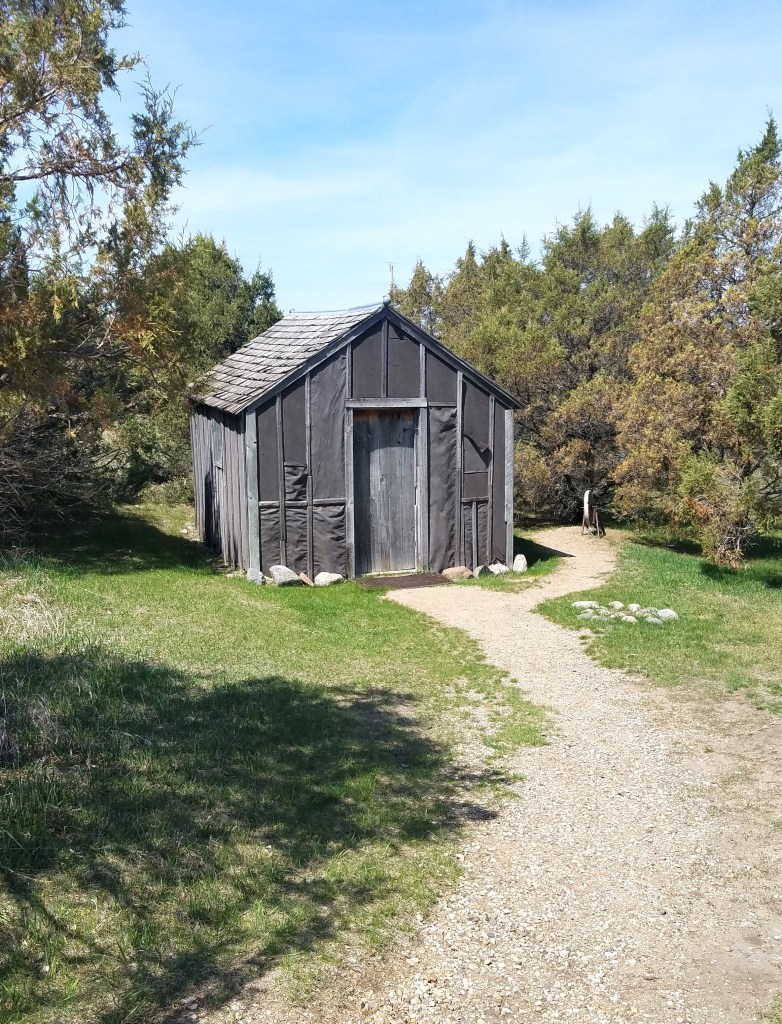
In South Dakota the Ingalls family had to, once again, start from scratch. It was not hard to imagine how alone and desolate Caroline must have felt as one of the first pioneers in DeSmet. Their homestead was 160 acres – one quarter mile square – and it was a half mile south of the town. There were no neighbors, just the wildlife which called the prairie home. The Ingalls claim shanty was just that: a shanty. Unlike the cabin in Pepin, this home was a tiny one room shack with the beds for a family of six in every corner, a stove in the center, and a few chairs and a table. The thin walls not much protection against the persistent winds and cold. Over time the shanty was expanded to include 2 small bedrooms and a 12 by 16 living room.

Replica of the ‘shanty’ where the Ingalls family of six lived the first summer so Pa could ‘claim’ his land.

What resilience these people possessed!

When we stopped at the Ingalls homestead near DeSmet, the woman who owns and runs the property came by to speak to us. I said to her I suspected when the Ingalls family arrived there that Caroline told Charles she was done moving and carving out homes in the wilderness. Our hostess confirmed my supposition. Laura’s parents lived the rest of their lives in that community, eventually moving to a proper house in the town eight years after their arrival.

It is impossible to truly capture these places on paper. But Laura Ingalls Wilder’s narrative description of each location comes close. I felt as if her spirit was there with us in South Dakota, especially, as I mapped out some travels to the spots she describes in her books.

The roiling waters of Lake Henry during the spring perch hatch

It was at Lake Henry when the magic occurred. The hubby and I noticed the water in a nearby slough was roiling. Upon closer examination we discovered hundreds of fish flopping and thrashing about! We walked close to the spectacle, mesmerized by the yellow perch which spawn this time of year once the water raises to a certain temperature.

From there we meandered across the back-roads, and observed white tailed deer, a muskrat which waddled across the road, and hundreds of birds: pelicans, herons, eagles, hawks, geese, and all variety of smaller ones.

We were reluctant to leave but how very glad we were to be able to experience a tiny portion of the Ingalls family journey.

So which of the three ‘little houses’ would have been the best ? Probably the cabin in Wisconsin. As we returned from our adventures I found myself thankful, yet again, for modern amenities: electricity, running water, flushing toilets, refrigeration, automobiles, and airplanes. What a blessed era in which I live.

A few links. First is to my blog article from February 7, 2017 about Laura Ingalls Wilder: https://barbaradevore.com/2017/02/07/laura-ingalls-wilder/

And some links to the various historical sites:   

https://www.lauraingallspepin.com/big-woods-cabin.html

http://walnutgrove.org/ingalls-dugout-site.html

https://www.ingallshomestead.com/history

I know everyone would be disappointed if there was not at least one link to the Infallible Wikipedia:

https://en.wikipedia.org/wiki/Laura_Ingalls_Wilder

Anne Frank

Diary of A Young Girl

March 12, 2024

A Tuesday Newsday Classic Updated

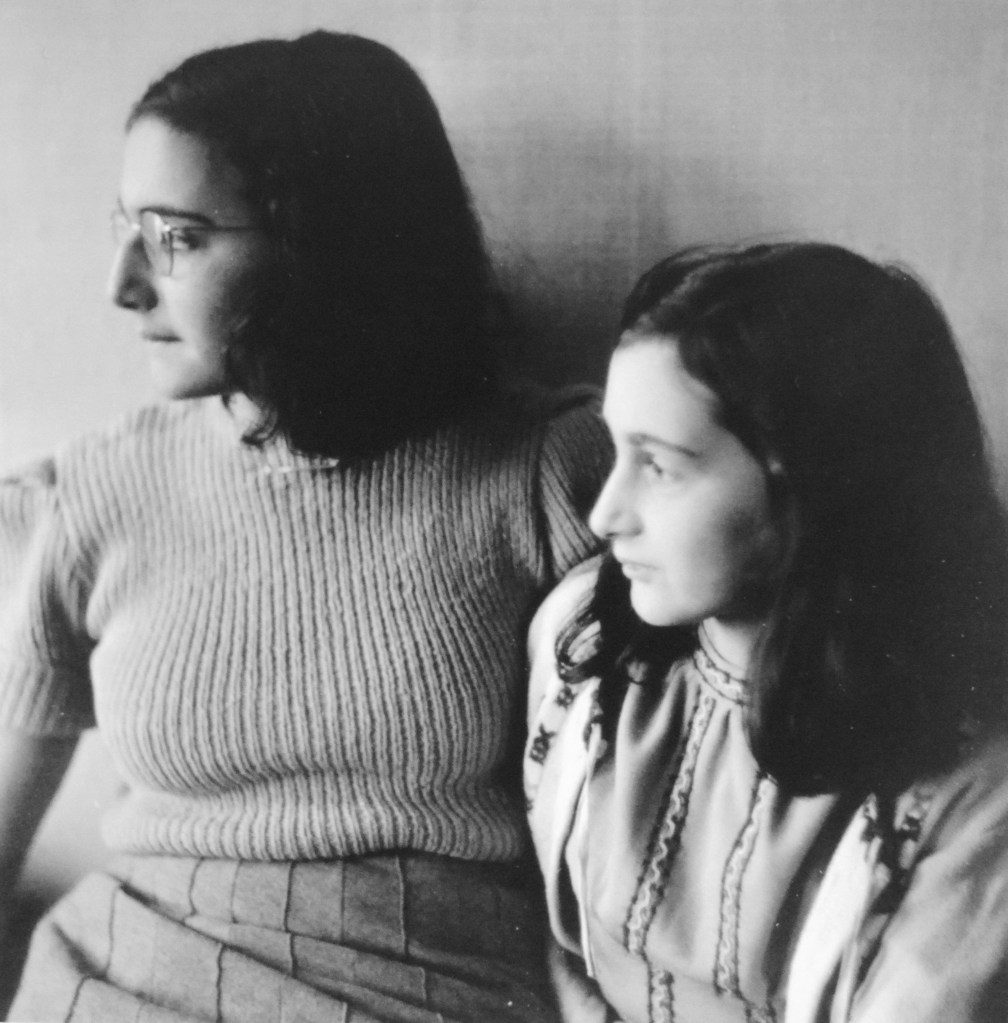
Margot and Anne Frank

Required reading for all junior high students in the 1970’s, Anne Frank: Diary of a Young Girl, both inspired and dismayed.

Although the exact date of the 15 year olds death is in question, March 12, 1945, is designated as such.

While I tend to avoid controversial and depressing topics, there is no question that this book ranks within the top tier of the most important works of the 20th century and deserves recognition as such.

Anne Frank lived in the Netherlands on June 12, 1942 – her 13th birthday – along with her parents and sister. It was on that date she was given her first ‘diary.’ From the Infallible Wikipedia:

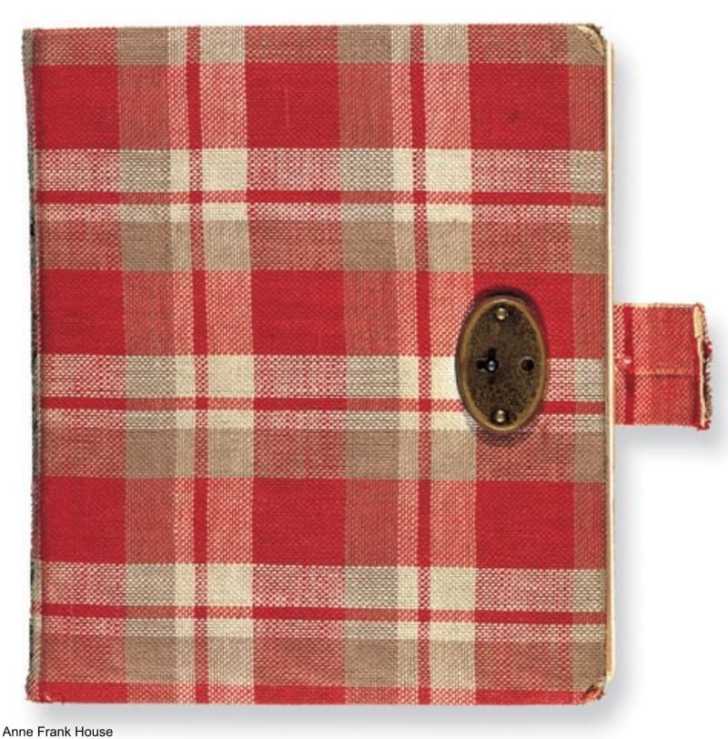
“During the Nazi occupation of the Netherlands, Anne Frank received a blank diary as one of her presents on June 12, 1942, her 13th birthday. According to the Anne Frank House, the red, checkered autograph book which Anne used as her diary was actually not a surprise, since she had chosen it the day before with her father when browsing a bookstore near her home. She began to write in it on June 14, 1942, two days later.

Anne Frank’s Diary which is preserved at the Anne Frank House museum

On July 5, 1942, Anne’s older sister Margot received an official summons to report to a Nazi work camp in Germany, and on July 6, Margot and Anne went into hiding with their father Otto and mother Edith. They were joined by Hermann van Pels, Otto’s business partner, including his wife Auguste and their teenage son Peter. Their hiding place was in the sealed-off upper rooms of the annex at the back of Otto’s company building in Amsterdam. Otto Frank started his business, named Opekta, in 1933. He was licensed to manufacture and sell pectin, a substance used to make jam. He stopped running his business while everybody was in hiding. But once he returned, he found his employees running it. The rooms that everyone hid in were concealed behind a movable bookcase in the same building as Opekta. Mrs. van Pels’s dentist, Fritz Pfeffer, joined them four months later. In the published version, names were changed: The van Pelses are known as the Van Daans, and Fritz Pfeffer as Albert Dussel. With the assistance of a group of Otto Frank’s trusted colleagues, they remained hidden for two years and one month.”

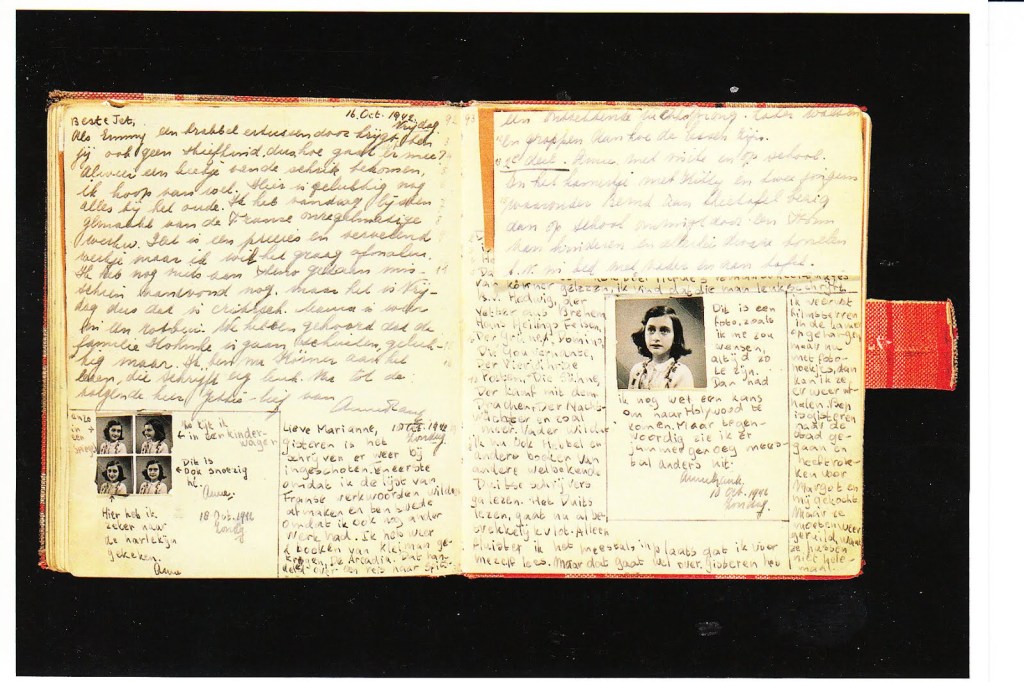
Interior pages of Anne’s Diary

The family and the others were discovered in August 1944 and taken to concentration camps. It was in the Bergen-Belsan camp where Anne, who contracted Typhus, and her sister both died. Of the hidden group, only Otto Frank survived. Those who concealed the family found and saved her diaries and gave the books to her father. It was he who got them published.

I can’t say exactly when I was first required to read the book, but no doubt it was in junior high (middle school to Americans under the age of 40). The timing of it likely coincided with when I became obsessed with keeping a diary. Perhaps I had visions of my musings being enshrined forever in a similar manner. Young teenage girls are, particularly, susceptible to drama and tragedy. Unlike Anne Frank, however, my diary entries included such riveting entries such as this one:

“March 1 (1972)

Well here we go again another month gone by. I’m 14 years, 7 months today. It was strange today we have had about four inches of snow, oh joy! I felt like I was being watched. We had a meeting at Mrs. Hughey’s this evening. We started Co-education volleyball in P.E. but I didn’t take it because I can’t, doctor’s orders. Yea! It can’t be that bad but if you take a look at last year’s diary today, you’d understand!”

When I look back to that first week of March of 1971, the misery of having to play co-ed volleyball with 14 year old boys screams through the pages. I know for certain those boys wanted to play Co-ed volleyball about as much as the girls did. Which was not at all. I imagine they were frustrated by the experience also.

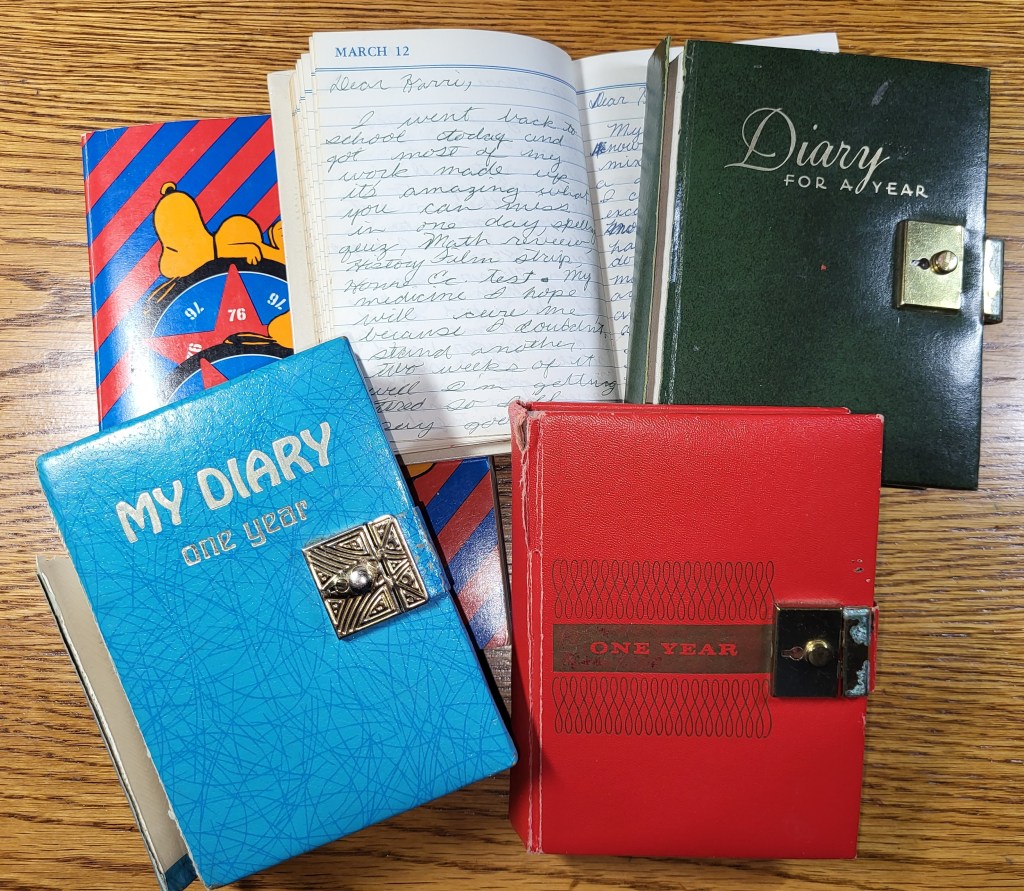
The five diaries I have saved. One year I switched to writing in a looseleaf notebook and ALWAYS used a green Flair pen. I am not sure what happened to that year. The 1976 diary is the last one I kept but by then I was 18 and the entries are few and far between. In 1971 I decided to write to my diary which I named Karri. Who knows!

For me, playing co-ed volleyball when you have the co-ordination and look of a newborn colt, is about the worse torture you can inflict on a teenage girl. The reason I couldn’t play volleyball in 1972 is that I was still recovering from a nine day case of the hard measles. (We didn’t have a measles vaccination then… get your kids vaccinated. Trust me on this) While I was sick I lost approximately 10 pounds… weight I could not afford to lose since I was, according to the identification pages at the front of my diary, 5’7” and 110 pounds. Yes, the colt reference is accurate. And, apparently, getting snow in early March isn’t that uncommon either.

What I do know is that the keeping of a diary galvanized for me a thing which has been a lifelong passion: to write. My musings are juvenile and without finesse and yet I do a credible job in dutifully recording all that was going on in my life at that time.

I am thankful that my teenage years were during an easier time in history; they will never carry the same weight and warnings of Anne Frank. The five years of books which I still have are a reminder that being a teenager is an awkward time in life regardless of the era. I suspect, also, that every teenager experiences some angst to one degree or another. Well, except maybe the most popular girl in my class… I’m certain HER life was perfect. Or not.

Anne Frank’s diaries – despite being written under the most challenging of circumstances – still ring true as to the thoughts and emotions of a girl on the cusp of becoming a woman. While her story had a tragic ending, I am thankful that her father made it his mission to see her words published and to serve as a reminder that each generation must be vigilant as to the dangers of persecution.

For more about Anne Frank and her diary, a couple of links:

https://en.wikipedia.org/wiki/The_Diary_of_a_Young_Girl

https://en.wikipedia.org/wiki/Anne_Frank