Tag Archive | Hawaii

Paricutin Volcano

Sometimes a volcano blooms overnight

February 20, 2024

A Tuesday Newsday Classic Updated

Geologically, nine years is a very short time period. But for farmer Dionisio Pulido of Paricutin, Mexico, the event which began at 4 p.m. on February 20, 1943, forever altered his life in a matter of moments.

Paricutin Volcano shortly after it first started erupting

As he is quoted in the Infallible Wikipedia:

“‘At 4 p.m., I left my wife to set fire to a pile of branches when I noticed that a crack, which was situated on one of the knolls of my farm, had opened . . . and I saw that it was a kind of fissure that had a depth of only half a meter. I set about to ignite the branches again when I felt a thunder, the trees trembled, and I turned to speak to Paula; and it was then I saw how, in the hole, the ground swelled and raised itself  2 or 2.5 meters high, and a kind of smoke or fine dust – grey, like ashes – began to rise up in a portion of the crack that I had not previously seen . . . Immediately more smoke began to rise with a hiss or whistle, loud and continuous; and there was a smell of sulfur.’

“He tried to find his family and oxen but they had disappeared so he rode his horse to town where he found his family and friends, happy to see him alive. The volcano grew fast and furiously after this. Celedonio Gutierrez, who witnessed the eruption on the first night reported:

‘…when night began to fall, we heard noises like the surge of the sea, and red flames of fire rose into the darkened sky, some rising 800 meters or more into the air, that burst like golden marigolds, and a rain like artificial fire fell to the ground.’”

And thus began an eruption which provided scientists an opportunity to study and record how a volcano is formed. During this time the volcano not only destroyed Pulido’s farm but forced the permanent evacuation of two towns, caused the deaths of three people (but not the farmer!), grew to 1,341 feet, and allowed scientists to witness the entire life cycle of a volcano.

Paricutin as it is today

Also from the Infallible Wikipedia:

“The importance of the Parícutin eruption was that it was the first time that volcanologists were able to fully document the entire life cycle of a volcano. The event brought geologists from all over the world,  but the principal researchers were William F. Foshag of the Smithsonian Institution and Dr. Jenaro Gonzalez Reyna from the Mexican government, who came about a month after the eruption started and stayed for several years. These two wrote detailed descriptions, drew sketches and maps and took samples and thousands of photographs during this time. Many of these are still used today by researchers. Foshag continued to study the volcano until his death in 1956. Between 1943 and 1948, almost fifty scientific articles were published in major journals about the volcano, with even more since. The worldwide effort to study Parícutin increased understanding of volcanism in general but particularly of scoria cone formation.”

It was quite likely I saw this documentary as a child and it was this that first sparked my interest in volcanoes. Some might call it an unhealthy obsession. But whatever it is I have a distinct memory of sitting in a darkened classroom and learning about this volcano.

Back in the 1960’s, every elementary school had an AV – that is Audio Visual – component. Manned by the kids who, today, rule the tech world, it was an unglamorous job (sort of like being a crossing guard or a hall monitor) which required said geeky boy (it was all boys at the time – just the way it was) to wheel the tall carts into classrooms and get it set up so the class could watch whatever educational program our teacher managed to snag so she (or he) could get a few minutes of down time. To be fair, WE unruly students loved those days also. But I digress.

Atop the cart which we had at Nob Hill Elementary in Yakima was a black and white TV connected by wires to a very crude version of video equipment. Once it was set up, off would go the lights and some item of interest would flicker to life.

While I couldn’t find a photo of the carts, we were all familiar with projectors that looked like this

As a child seeing a volcano literally grow out of the ground where it had just been a field was terrifying. Could that happen in MY backyard? Being that my natural state was to worry about such things I’m pretty certain I became quite concerned for my home. No doubt we learned about other deadly volcanoes: Mount Vesuvius, of course, and the most fascinating of all Krakatoa. Oh, and did I mention that on nice days I’d often see Mt. Adams – one of five Washington State volcanoes – off in the distance?

Of course my mother no doubt assured me that Mt. Adams was a dormant volcano and that Yakima was not prone to sudden volcanic eruptions and my family continued to live in blissful calm. It was only later in a college geology class that I learned Yakima sits on top of what is known as the Columbia River Basalt Group, which was a series of volcanic flows, that eventually covered about 81,000 square miles AND had depths up to 5,900 feet. That’s a whole lot of basalt which no one can take for granite… it was a gneiss fact to know.

Of course that was millions and millions of year prior, so of course there was no danger. Well, that was until May 18, 1980… when THAT myth was blown to pieces. I might have covered stubby Mt. St. Helens in another Tuesday Newsday article or two.

Volcan de Colima – aka Volcan de Fuego or the English translation ‘Fire Volcano’. Photo taken by my son in late January.

A couple of years ago our son moved to Guadalajara, Mexico. And until recently I hadn’t thought much about Mexican volcanoes. Of course I did know that the Pacific ring of fire which, in addition to being earthquake prone, also had a few volcanoes…913 to be exact. Whoa.

Mexico, specifically the region which stretches from the Pacific Ocean to the Caribbean Sea which starts near Puerto Vallarta and extends east to Guadalajara and then Mexico City and ending just north of Veracruz, has 23 of these volcanoes in a region known as the Trans-Mexican Volcanic belt.

So now I have new volcanoes to worry about. Of course I shouldn’t be concerned that Volcan de Colima, also known as Volcan de Fuego, is a mere 78 miles from where my son now lives. Or that Volcan de Fuego erupted as recently as January 2017. Or that our son went hiking on neighboring volcano Nevado de Colima – which is 3 miles north of Volcan de Fuego – in January of this year. I’m sure there’s nothing to worry about!

A map showing the location of the 23 volcanoes which define the Trans-Mexico Volcanic Belt
My son on his recent hike to Volcan Nevado de Colima in front of the ‘you have arrived’ sign

For reference, Paracutin is much, much further away from Guadalajara, more like 150 miles how the crow flies. The next time I’m in Mexico I plan to take a much closer look at the landscape to see how many of Mexico’ volcanoes I can identify.

For those who want to learn more:

https://en.wikipedia.org/wiki/Par%C3%ADcutin

Not sure if this is the video I saw but the music alone is enough to instill terror into a child….

And a few more articles and linkes about one of my favorite topics:

https://en.wikipedia.org/wiki/Columbia_River_Basalt_Group

https://en.wikipedia.org/wiki/Volc%C3%A1n_de_Colima

https://en.wikipedia.org/wiki/Volc%C3%A1n_Nevado_de_Colima_National_Park
https://en.wikipedia.org/wiki/Ring_of_Fire

Jaws

Just when you thought it was safe to go back in the water

June 20, 2023

A Tuesday Newsday Classic from 2017 – updated

“We started the film without a script, without a cast, and without a shark.”

As quipped by Richard Dreyfuss on the filming of the classic film, Jaws, which premiered on June 20, 1975. Despite its rocky start, technical problems throughout filming, and costing more than double its budget, Jaws is regarded as one of the best films of all times. From the Infallible Wikipedia:

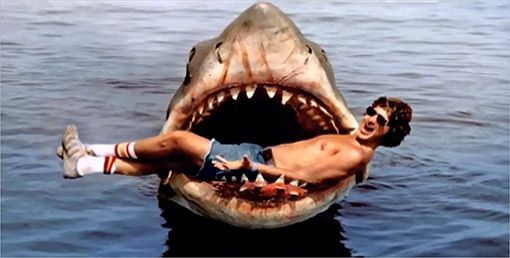
Steven Spielberg getting friendly with ‘Jaws’

“In the years since its release, Jaws has frequently been cited by film critics and industry professionals as one of the greatest movies of all time. It was number 48 on American Film Institute’s 100 Years… 100 Movies, a list of the greatest American films of all time compiled in 1998; it dropped to number 56 on the 10 Year Anniversary list. AFI also ranked the shark at number 18 on its list of the 50 Best Villains. Roy Scheider’s line “You’re gonna need a bigger boat” 35th on a list of top 100 movie quotes, Williams’ score at sixth on a list of 100 Years of Film Scores, and the film as second on a list of 100 most thrilling films, behind only Psycho. In 2003, The New York Times included the film on its list of the best 1,000 movies ever made.”

It took only two weeks for the film to recoup production costs and it is recognized as the first ‘summer blockbuster’ film, setting a template for future filmmakers.

Of course the long term effect was the impact on people’s psyches, preying on our fear of an unknown, unseen killer, lurking in the ocean’s depths. In reality the average number of people killed by great white sharks annually is six. Not exactly an Amity Island level of vicious attacks.

So should we be afraid to go back in the water?

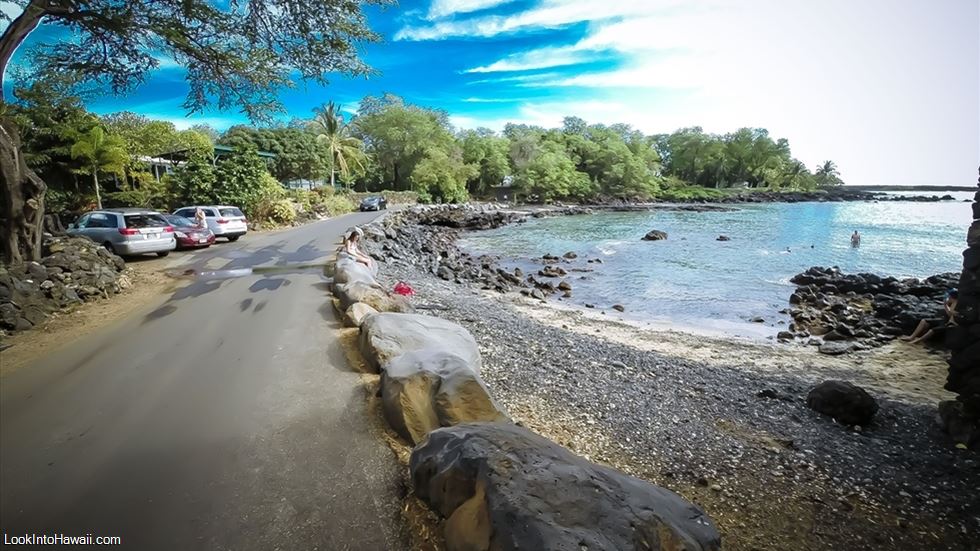
In December 2005 my family and I were about to go snorkeling at a benign looking bay called Kanahena Cove on Maui. It was early in the morning and we were the only four people there: myself, my husband and our son, age 15, and our daughter, age 12. Because we only had two snorkel sets we decided that my husband and son would snorkel first. So my daughter and I were on the lava rocks near where the guys had, a moment earlier, climbed into the water.

This the road where the woman stopped to yell at us. We were on the lava rocks near the trees on the far side. Photo of Kanahena Cove from LookIntoHawaii.com.

Just then, a car drives past on the road, maybe 20 yards away, and screeches to a halt. A woman erupts from the car and launches into a tirade:

“You know, there are sharks in the water,” she yells at us, “and one could take her in a single bite (pointing to my daughter).”

Dumfounded, I stare at the woman, unable to utter a word. She continues her rant:

“The sharks are angry at George Bush for the war in Iraq, which is why there have been increased shark attacks.”

My sister with the two girls braving the non-shark infested waters…

The screed went on for another minute although I don’t recall all she said. What I do know is that my 12 year old daughter WAS then afraid to get in the water. All four of us retain a rather vivid memory of that day.

Personally, I’m skeptical that politics motivate sharks. I would speculate that other factors such as increased human presence, changes in ocean water temperatures, and changes in food sources, are more likely to influence attacks. Even the time of year can affect it.

The daughter and my niece at Kanahena Cove 2006

For the record? In 2015 there were 98 shark attacks worldwide, six of them fatal…and one of those at Kanahena Cove on Maui. Those 98 shark attacks are 40 more than the number of attacks in 2005, nearly double.

But it does beg the question, ‘is it safe to go back in the water?’

I think the answer is that every activity in life involves risk. I read just the other day about several people getting chased and gored by Bison in Yellowstone National Park in 2022. Perhaps those people shouldn’t have been at Yellowstone at all or, more likely, they probably shouldn’t be out walking in the meadow and standing next to a one to two thousand pound animal with horns and mean streak trying to get a selfie.

I sometimes wonder if our era of seeing nature on TV and clips on YouTube has desensitized us to the dangers inherent in life? When watching something on a screen there is no danger.

The hubby says… it’s safe to go back in the water

At Kanahena Cove there is a line of demarcation across which I won’t cross. I snorkel in shallow waters and stay near the edges. The fish are better there in my opinion. And I’m constantly vigilant as to what is around me.

But back to shark attacks. Your chances of being bitten by a shark is 1 in 4.7 million. Maybe it is safe to go back in the water.

For more information about Jaws: https://en.wikipedia.org/wiki/Jaws_(film)

And about the record setting 2015 year: https://www.washingtonpost.com/news/post-nation/wp/2016/02/09/a-record-number-of-people-were-attacked-by-sharks-last-year/?utm_term=.edad50a5906e

Magnum P.I.

A Red Ferrari Is All You Need

December 11, 2018

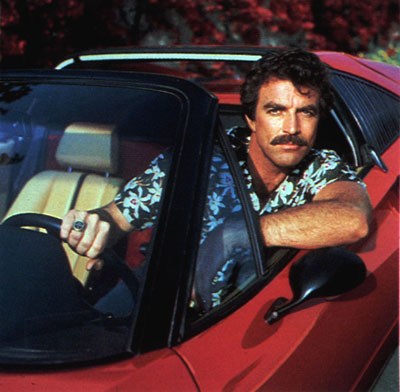
magnum_tom_selleckWomen of the 1980’s loved his impish smile, his seemingly carefree attitude, and the fact that he lived in Hawaii and got to drive a red Ferrari. His name: Thomas Magnum. It was on December 11, 1980, when the world got their first glimpse of Magnum PI and the show was an instant hit.
TV viewers tuned in each week to watch Magnum solve a new crime, spar with Higgins, the caretaker of the estate where he lives in the guest house gratis, and drive the red Ferrari all around Oahu at high speeds.

From the Infallible Wikipedia:

“Thomas Sullivan Magnum IV is a private investigator played by Tom Selleck. He resides in the guest house of a 200-acre (81 ha) beachfront estate called Robin’s Nest, in Hawaii, at the invitation of its owner, Robin Masters, the celebrated, but never-seen, author of several dozen lurid novels. Ostensibly this is quid pro quo for Magnum’s services based upon his expertise in security; the pilot and several early episodes suggest Magnum had done Masters a favor of some kind, possibly when Masters hired him for a case. The voice of Robin Masters, heard only in five episodes, was provided by Orson Welles (one last ‘appearance’ was provided by a different actor, Red Crandell).

“Magnum lives a luxurious life on the estate and operates as a P.I. on cases that suit him. The only thorn in the side of his near-perfect lifestyle is Jonathan Quayle Higgins III, played by John Hillerman. An ex-British Army Sergeant Major, he is on the surface a stern, ‘by-the-book’ caretaker of Robin’s Nest, whose strict ways often conflict with Magnum’s more easy-going methods. He patrols Robin’s Nest with his two highly-trained ‘lads’, Doberman Pinschers named Zeus and Apollo. Magnum has free use of the guest house and the car, a Ferrari 308 GTS Quattrovalvole, but as a humorous aside in various episodes, often has to bargain with Higgins for use of estate amenities such as the tennis courts, wine cellar and expensive cameras.”

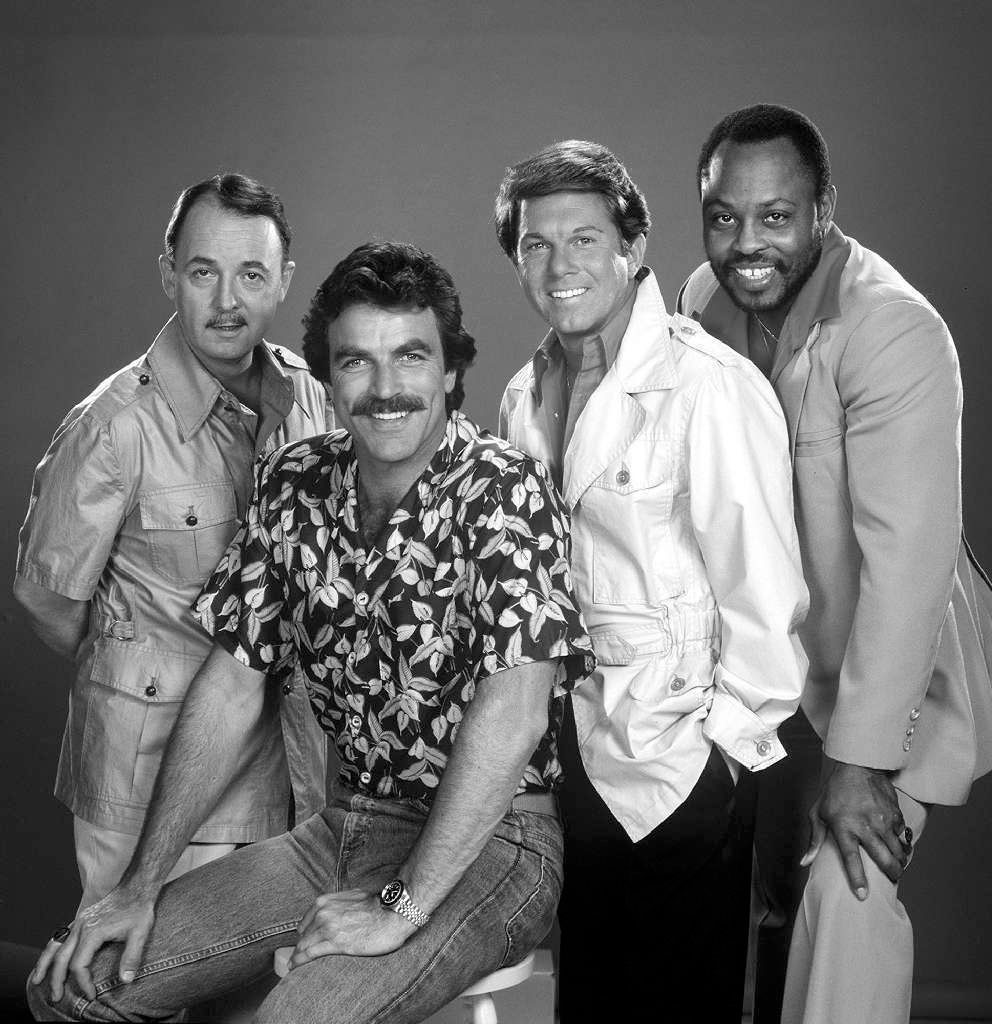
Tom-Selleck-Cast-of-Magnum-PINo doubt the show was a hit due, in part, to the casting of the additional regular characters: bartender Rick and helicopter pilot T.C. who are Magnum’s pals, and the never ending appearances of celebrities of the era. But the real magic was between Magnum and Higgins.

The show was so popular that both Tom Selleck as Magnum and Tony Hillerman as Higgins, were nominated for Emmy and Golden Globe awards multiple times. Selleck won an Emmy in 1984 and a Golden Globe in 1985. In 1982, Hiller won a Golden Globe; his Emmy was awarded in 1987.

Although the producers purportedly killed Magnum in the final episode of 1987 to end the series, the outcry from distraught fans created enough backlash that the show returned for an eighth and final season in 1988 by bringing Magnum back to life…

Also from the Infallible Wikipedia:

“In what was originally meant to be the final episode of the series, Magnum is critically wounded in a dockside warehouse firefight and ends up in a coma. He ‘wakes up’ in Limbo with Mac but refuses to believe that he is dead, insisting that he is only dreaming, even though no one but Mac can hear or see him. Magnum finally accepts that he is dead, and says his goodbyes. Throughout the episode, John Denver’s song ‘Looking for Space’ plays in its entirety and ends as Magnum walks off into the clouds (the song is replaced by another song in subsequent syndicated broadcasts and video releases, a’la other CBS productions Wiseguy and Birds of Prey).”

I guess they figured if they could sell the concept on the TV show Dallas the previous year then it would work for Magnum PI also.

Both my hubby and I were huge fans of Magnum PI and rarely missed an episode. Of course what wasn’t to like about Tom Selleck? Tall, curly dark hair, good looking, great personality… he had it all.

And then, one day in the summer of 1981, we had a close encounter of the Magnum PI kind.

Since my hubby worked in the Belltown neighborhood in Seattle, we decided to park our car at his office and attend the 1981 Seafair Parade. To get to the parade route we walked up Blanchard Street and had to pass a construction zone as well as several trailers which, I assumed, were being used for offices by the companies at work there.

We came upon a trailer and noticed the door was opening. I looked up just as a gorgeous blonde woman descended the stairs, her male companion right behind her. Hubby and I moved closer to the building on the right and the other couple passed to our left in the opposite direction.

We were not more than a half dozen steps past when the hubby leaned over and whispered to me “that was Magnum P.I.” What!? No way. I craned my neck so hard that I nearly gave myself whiplash. But all I saw was the backside of the couple – the beautiful blonde and the tall guy with dark curly hair – retreating down the sidewalk.

“Why didn’t you say something?!” I accused.

“I nodded at him. He knew I recognized him,” hubby replied. “I think he appreciated that I didn’t make a scene.”

So there we were, close enough to TOUCH Tom Selleck, and I’m noticing his date. Sheesh. How lame can one get?

divorce warsThe next night one of the local news stations interviewed Selleck who WAS in Seattle filming the made for TV movie “Divorce Wars” with Jane Curtin. In the interview the topic of fame and recognition came up and Selleck said he liked when people obviously knew who he was but appreciated not being accosted by fans.

Thanks, honey, for saving me from making an idiot of myself with one of the biggest stars of 1981. I owe you. Something. Not sure what. But something.

A link about the show:

https://en.wikipedia.org/wiki/Magnum,_P.I.