Tag Archive | Eisenhower High School Yakima

The Evolution of Denim: Cultural Changes Over Time

May 20th

It was on May 20, 1873 when Levi Strauss and Jacob David patented the denim garment which has, arguably, become the most popular type of clothing in the Western hemisphere: jeans.
The iconic Levi Strauss authenticity tag from the official website.

While the actual origins of the garment are unclear, there are records of the fabric and the type of clothing it was made into in Genoa, Italy, and Nimes, France, as early as the 1500’s.

The Infallible Wikipedia shares some history on the origin of the name:

“Research on the trade of jean fabric shows that it emerged in the cities of Genoa, Italy, and Nîmes, France. Gênes, the French word for Genoa, might be the origin of the word ‘jeans‘. In Nîmes, weavers tried to reproduce jean fabric but instead developed a similar twill fabric that became known as denim, ‘de Nîmes’, meaning ‘from Nîmes’. Genoa’s jeans fabric was a fustian textile of ‘medium quality and of reasonable cost’, very similar to cotton corduroy for which Genoa was famous, and was ‘used for work clothes in general’.”

Modern day jeans were popularized as a workman’s garment, specifically miners, at the time it was patented by Davis and Strauss. And they might have remained that way until popular culture got involved. In the 1950’s both Marlon Brando and James Dean donned jeans in two culturally significant movies: The Wild One and Rebel Without a Cause. The two men were both bad boys of the big screen and exuded a ‘coolness’ which rocketed them to popularity with youth.
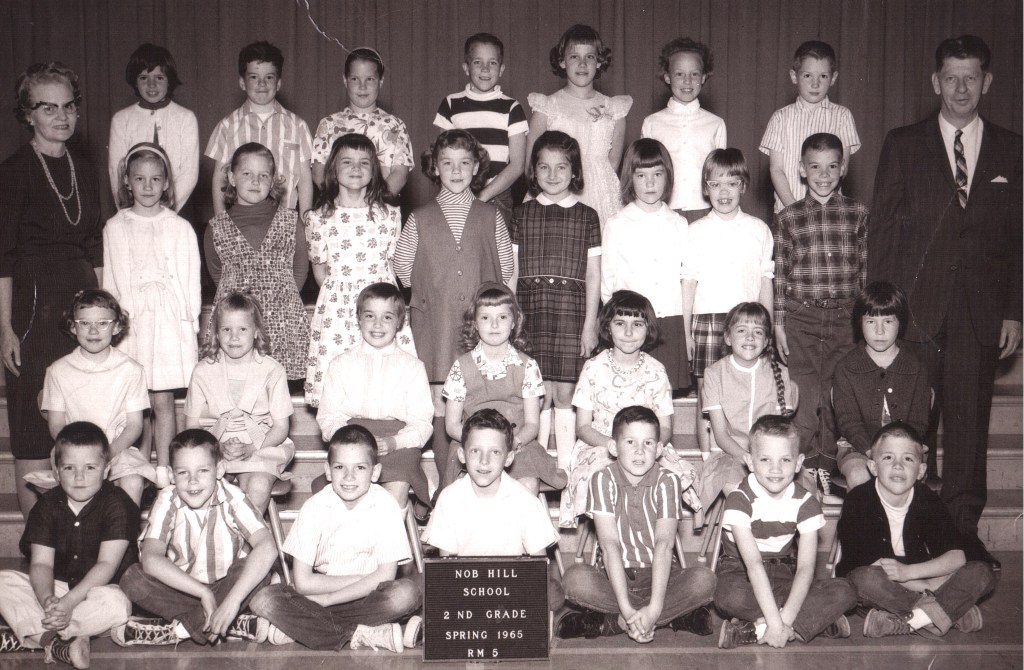
1965 – all the boys in the front row are wearing jeans with the exception of one. All the girls in dresses. 2nd Grade at Nob Hill Elementary school in Yakima, Washington

By the 1960’s, jeans became a popular garment to wear to school for boys. But not for girls. In fact, girls wore dresses to school. The first time I was ever allowed to wear pants was the winter of 1968-69 and only because of extreme cold temperatures. During the week of January 20-24, the overnight lows in Yakima were in the single and minus digits and the day time highs in the low teens. January 23rd, a Thursday, had a high of only 11 degrees, up from minus 7 degrees overnight. The next week wasn’t much better as the cold persisted PLUS it snowed 10 inches.

In those days, school was not cancelled because of weather. Instead, the Yakima School District very generously gave all the girls permission to wear pants to school. But they could NOT be jeans! A popular style that year were knit stretch pants and I can still see, in my minds eye, what those pants looked like. It was a big, big deal to get to wear pants.

It took quite some time for the weather to moderate that year (in the ‘balmy’ mid-30’s by mid-February), and it was back to dresses worn with socks and the dreaded saddle shoes. (Which I wrote about here https://barbaradevore.com/2024/09/03/the-first-tuesday-in-september-3/)
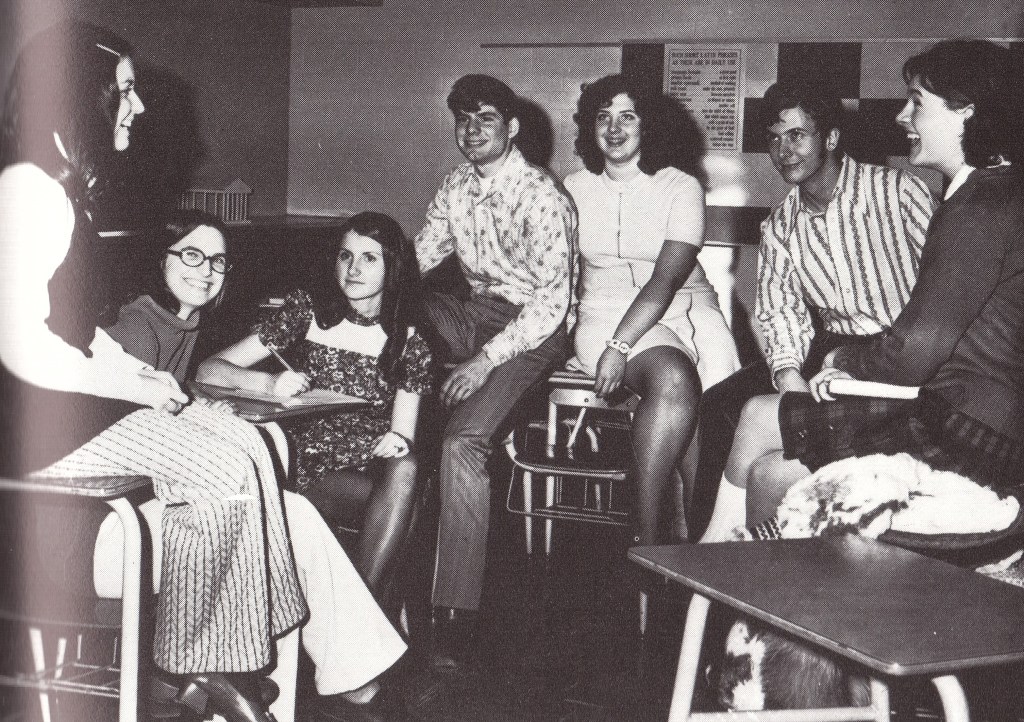
From the 1972 Eisenhower High School Reveille yearbook. A club photo with the guys in in jeans, the girls in dresses except for one, who is wearing fashionable slacks of the day. Yakima, Washington

Then the 1970’s happened. While many people think of the 1960’s as the big social upheaval, the 70’s were the years when all that rebellion was codified. The movement was so huge, that it became a cultural tsunami, washing over every institution we know.

I think it was probably 1971 when girls were allowed to wear pants to school regardless of the weather. But still no jeans that first year. A look through the high school annuals of that era reveal that shift through photos. The 1972 Eisenhower annual shows most girls still wearing dresses to school with a smattering here and there of one in pants and, rarely, jeans.
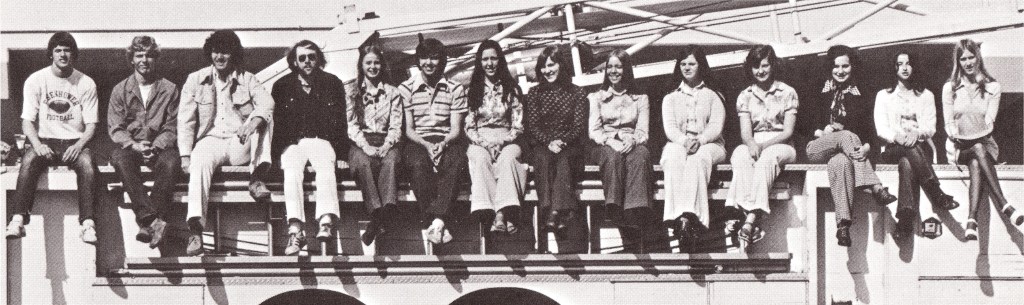
A portion of the 1975 yearbook staff of Eisenhower High school. The girls all in pants, some in jeans, and only one dress. Yakima, Washington

By 1975, easily half to two-thirds of the girls at my school are wearing pants – often jeans – in the day-to-day photos of regular school activities; jeans were the standard for after school clothing.

In today’s world, people wear jeans everywhere; I would posit that pretty much every American teen and adult owns at least one pair, and likely multiple pairs, of jeans.
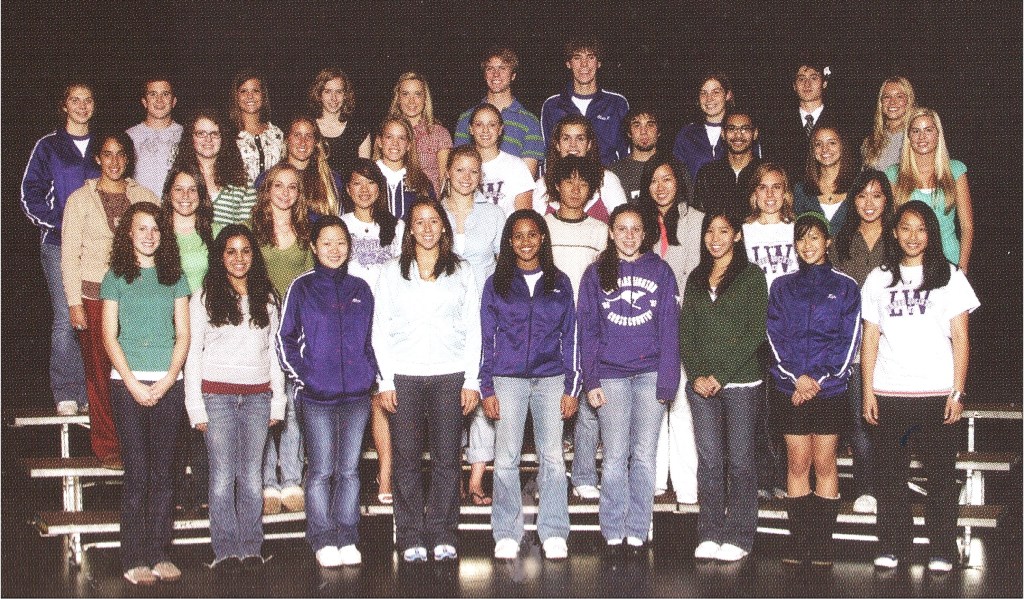
2008 at Lake Washington High School in Kirkland, Washington. A couple of skirts, but most the girls are wearing jeans as their daily ‘go to’ clothing.

I know I have at least three pairs of jeans and two pairs of capri length denim pants that I rotate in my day-to-day wardrobe. I’ve been thinking lately that I really do need another pair. I discovered a Gloria Vanderbilt style that fits well and is comfortable. That is, in my opinion, what the wearing of jeans is all about: comfort. Time to go shopping – on Amazon since I know they have the jeans that fit me – for a new pair of America’s favorite clothing item.

The links:

https://en.wikipedia.org/wiki/Jeans

https://www.smithsonianmag.com/smithsonian-institution/the-origin-of-blue-jeans-89612175/https://www.extremeweatherwatch.com/cities/yakima/year-1969
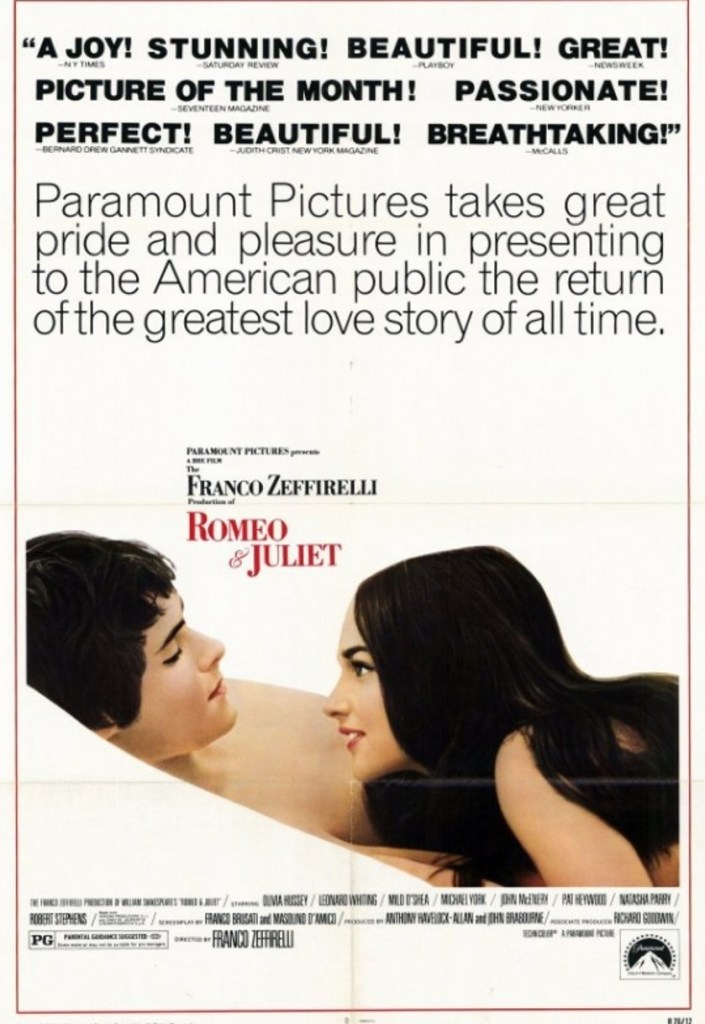
Exploring Romeo and Juliet: A Timeless Love Story

Perhaps Shakespeare’s most famous play

March 11

To try and take on this play is, I would conjecture, pure folly. Afterall, it is probably the most recognized literary work in the world. It is the story of two young lovers who forsake all else to be together. They risk the disapproval of family and friends and, ultimately, meet their demise all because they chose that which was forbidden.

1968 Poster of Romeo and Juliet

“Romeo and Juliet” is William Shakespeare’s most famous works and March 11, 1302, is – according to OnThisDay.com – considered to be the date of the young lover’s marriage.

As is often the case, that is disputed since contextual clues from the play itself place the wedding date as being in mid to late July.

Regardless, today is as good a day as any to feature this iconic work.

For anyone who is unfamiliar with the storyline you can certainly access the Infallible Wikipedia. Which I did only to discover that the article there is 10,604 words long. Egads.

Instead, I found this one paragraph synopsis from the site Shakespeare.org.uk much easier to digest:

“An age-old vendetta between two powerful families erupts into bloodshed. A group of masked Montagues risk further conflict by gatecrashing a Capulet party. A young lovesick Romeo Montague falls instantly in love with Juliet Capulet, who is due to marry her father’s choice, the County Paris. With the help of Juliet’s nurse, the women arrange for the couple to marry the next day, but Romeo’s attempt to halt a street fight leads to the death of Juliet’s own cousin, Tybalt, for which Romeo is banished. In a desperate attempt to be reunited with Romeo, Juliet follows the Friar’s plot and fakes her own death. The message fails to reach Romeo, and believing Juliet dead, he takes his life in her tomb. Juliet wakes to find Romeo’s corpse beside her and kills herself. The grieving family agree to end their feud.”

But, honestly, only if you lived as a hermit in a rock cave on a remote island in the south Pacific would you NOT know about Romeo and Juliet (R&J).

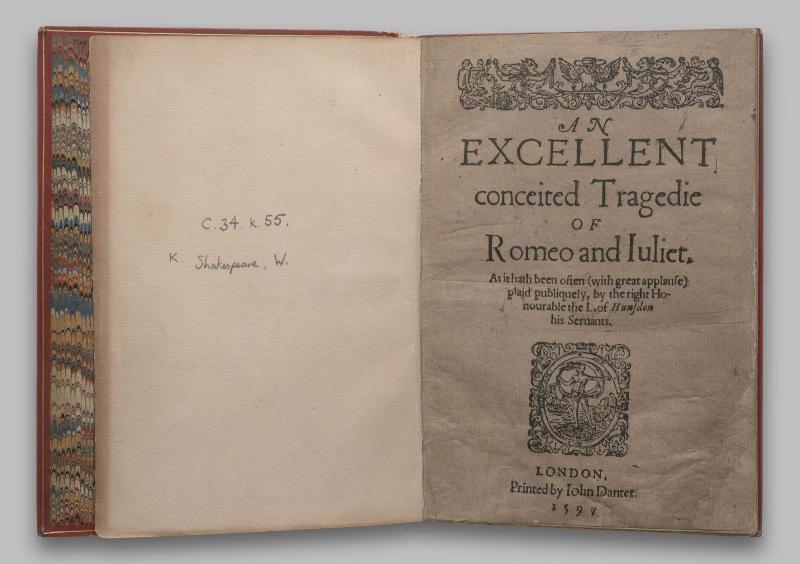
First edition Romeo and Juliet

When I started thinking about R&J, my mind drifted back to the early 1970’s and my experience at Wilson Junior High School in Yakima, Washington.

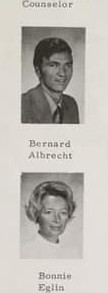
Wilson Junior High teachers 1971

It was there that I was introduced to R&J. At the time I had no appreciation for Shakespearean literature or for the incredible foundation which was given me by a trio of dedicated Jr. High English teachers.  For my entire 8th grade year, my English teacher was Mr. Albrecht. To us students he seemed quite mature. When, in fact, he was the ripe old age of 27 that first year. We respected him because he treated us as intelligent people regardless of our limited years on earth; he rewarded those who worked hard and did their best.

The next year my English class experience was split into two segments. For the fall/winter semester I drew the formidable grammar teacher, Mrs. Eglin. I think she likely made students rip out their hair and cry at times. But, by God, you were going to learn: all the parts of grammar, how to diagram a sentence, and how to construct a proper paragraph. It was in her class that I discovered the evils of dangling participles, all about verbs, adverbs, nouns (both proper and pro-), adjectives, and every other part of speech. In other words, I learned how to write the correct way. She made me think about my writing in ways I’d never considered. I might not have always followed her methods, and I’m not perfect, but not for lack of instruction on Mrs. Eglin’s part.

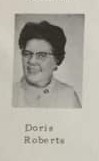
Mrs. Roberts 1971 yearbook photo

In the second half of the year, I had an even more demanding teacher – which I hadn’t thought possible after being with Mrs. Eglin – Mrs. Roberts. First name Doris. Which is telling. No one in my age demographic, or even a few years older, was named Doris. The name had, however, been the 8th most popular name for girls in the 1920’s. Mrs. Roberts was born in 1922 and was an ancient 50 that year. Ah perspective.

Mrs. Roberts assigned us every classical piece of literature she could find and we explored such themes as ‘man’s inhumanity to man’, ethics, morality, death and dying, cruelty, poverty… yes, we read some very dark stories. Like “Flowers for Algernon”, “The Grapes of Wrath”, “Fahrenheit 451”, and “Romeo and Juliet”.

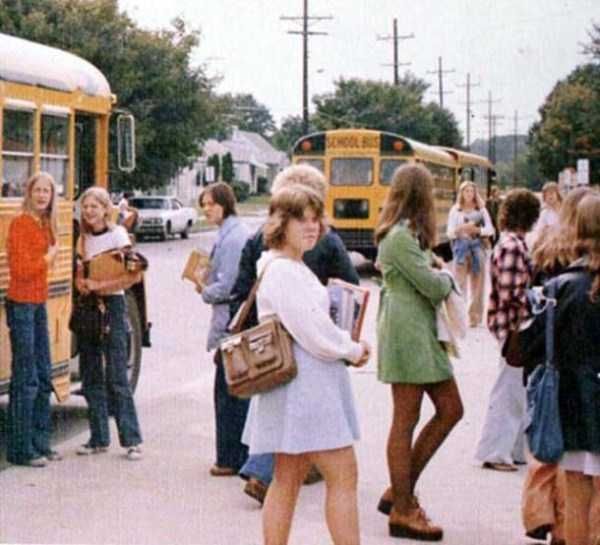
The clever thing which this band of teachers managed to accomplish was to make the course work relevant to the teenagers of the day. Somehow, they convinced the administration that it was educational to load some 250 ninth graders into school busses and send them to the movie theatre to see films based on what we were reading.

Pretty much how teenagers dressed in 1971-72. Found this photo on Pinterest.

Spoiler alert: it worked.

Of course, we kids thought we’d gotten a free pass for the day. Personally, I returned from those outings thinking about the films but also contemplating the books we read and then writing papers on the theme we thought was the best fit.

Sometime in the fall of 1971 I’m pretty certain we were whisked away in the busses to see the 1968 film version of Romeo and Juliet with Leonard Whiting and Olivia Hussey. Such clever English teachers, using the pop culture of the day to get us to learn. I did find a reference in my 1972 diary for both “Farenheit 451” and “Mary, Queen of Scots.” Sadly, my diary from 1971 does not seem to exist any longer, which surprises me as I was a faithful diary writer.

Now a few fun facts. I was able to find 49 times R&J was made into a movie in the Shakespearean tradition (from 1908-2021); an additional 118 films were produced which adapted the works in modern ways or with odd twists (like the truly bizarre 2011 Gnomeo and Juliet); there are also a few films which utilize R&J’s overarching theme in some new way (like the charming 2019 movie “Letters from Juliet”).

I owe a lot to my Junior High School English teachers for the great foundation they laid. It was the gift that has continued to give and bless me.

As always a few links:

https://www.onthisday.com/weddings/march/11

https://en.wikipedia.org/wiki/Romeo_and_Juliet

https://www.shakespeare.org.uk/explore-shakespeare/shakespedia/shakespeares-plays/romeo-and-juliet/#:~:text=An%20age-old%20vendetta%20between%20two%20powerful%20families%20erupts,to%20marry%20her%20father%E2%80%99s%20choice%2C%20the%20County%20Paris.

The Sigma Kappa Connection

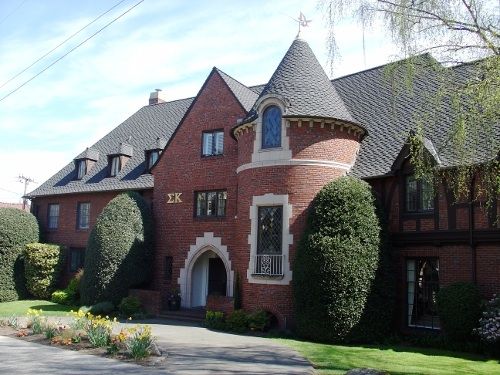
The actual place which inspired the fictional Gamma Alpha Beta Sorority

The Sigma Kappa sorority house at the University of Washington is on the National Historic Site.

The Sigma Kappa sorority house at the University of Washington is an enchanted place. The grandeur begins outside the front of the house with its classy brick façade and a stunning mix of Victorian and Tudor architecture. Truly notable is the three-story high round turret.

Once inside, the turret does not disappoint with its centerpiece being a wide and sweeping circular staircase which invites all eyes upward towards a magnificent crystal chandelier.

For a starry-eyed child, that staircase invited you into a place of fantasy and daydreams; up the stairs one would climb and promenade down them as if a princess, creating stories in one’s head.

Photo of the staircase as found on Pinterest

My first visit to this magical place was likely in the early summer of 1963. My grandmother, Alma DeVore, had taken a job as the housemother and, with the students gone for the summer, invited my family to come visit her at her new job.

I have no idea how many days we stayed, or if we even slept at the house. My older by two years sister says we stayed nearby at our uncle’s house. I was five at the time and I remember little about the visit to Seattle and the Woodland Park Zoo and more about the Sigma Kappa house.

There was a skybridge which connected the formal living areas to the dining hall and kitchen. In the basement were all sorts of mysterious rooms including one painted bright purple which we were told was the chapter room. Around every nook there was another cranny.

The author captured on a grainy video from 16 mm home movies 1963

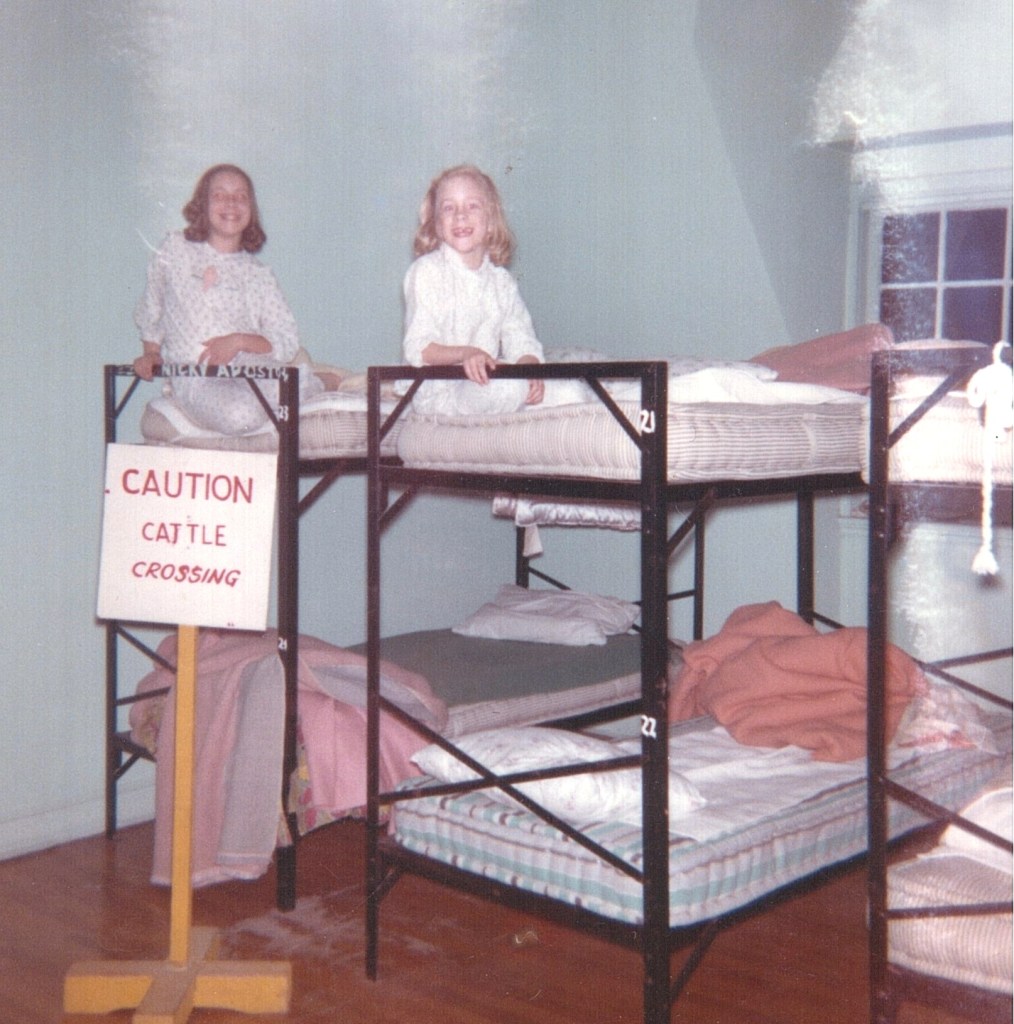
Hallways were lined with closed doors to, undoubtedly, the private rooms of the members. At the very top level was a long sleeping porch with parallel rows of bunk beds where all the members slept. There was a back staircase leading to new and interesting spaces. It was the ultimate place to play hide and seek as you could scurry up one set of stairs and down another and through different corridors.

Through photos and documents which she had kept – and are now in my genealogy collection – I’ve determined that my grandmother must have arrived as the housemother beginning in January of 1963.

In 1946, the opportunities for women to earn a living were limited. On September 17th of that year she found herself a widow. Here she was, 46 years old, and with – at most – a high school education; she had no marketable skills beyond having raised three children: my uncle Lyle, my dad, Vince, and their younger sister, Arlene; and managing her own household.

Fortunately for her, she lived in Walla Walla, Washington at the time and was hired as the housemother for the Tau Kappa Epsilon (TKE) fraternity.

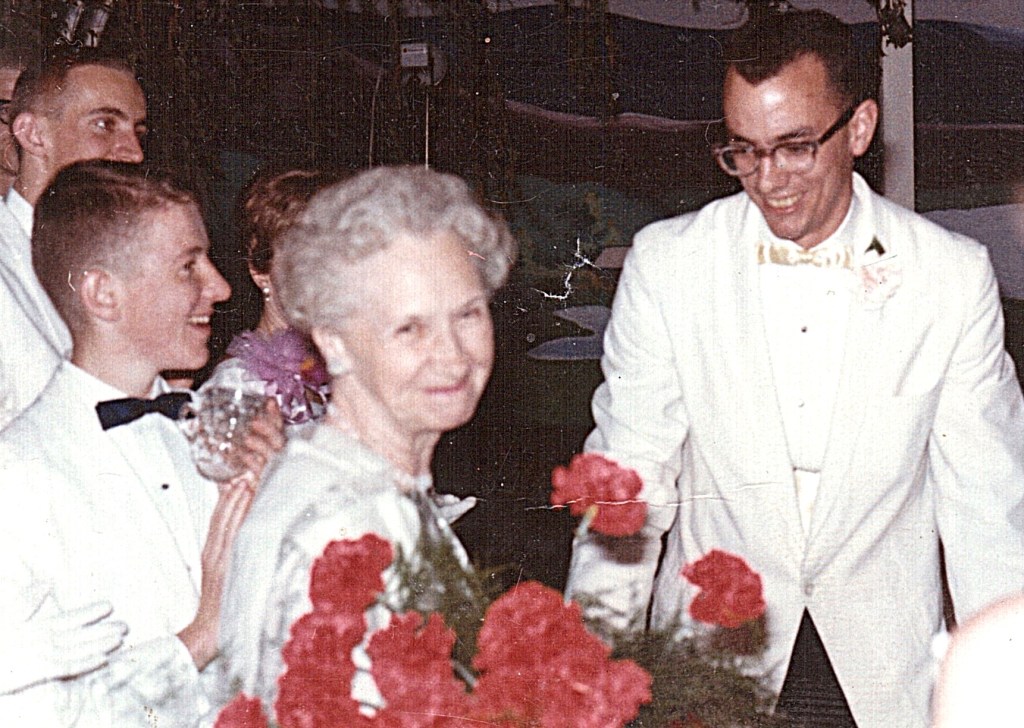
My grandmother with the TKE fraternity members at Whitman College in late 1962 at her Farewell party.

The TKE years were good ones for her from what I’ve been told. She enjoyed the young men who were members and there was a camaraderie with the other housemothers. I can’t say for sure why, exactly, she left Whitman and took the job at the Sigma Kappa house except that it brought her closer to my Uncle Lyle and his family who moved to the Ravenna neighborhood in Seattle in the mid-1950’s. Although my parents lived in Walla Walla after both graduating from Whitman and by oldest brother having been born there, my family had left the community shortly after his birth as my dad had been transferred to Moscow, Idaho with his job at National Cash Register.

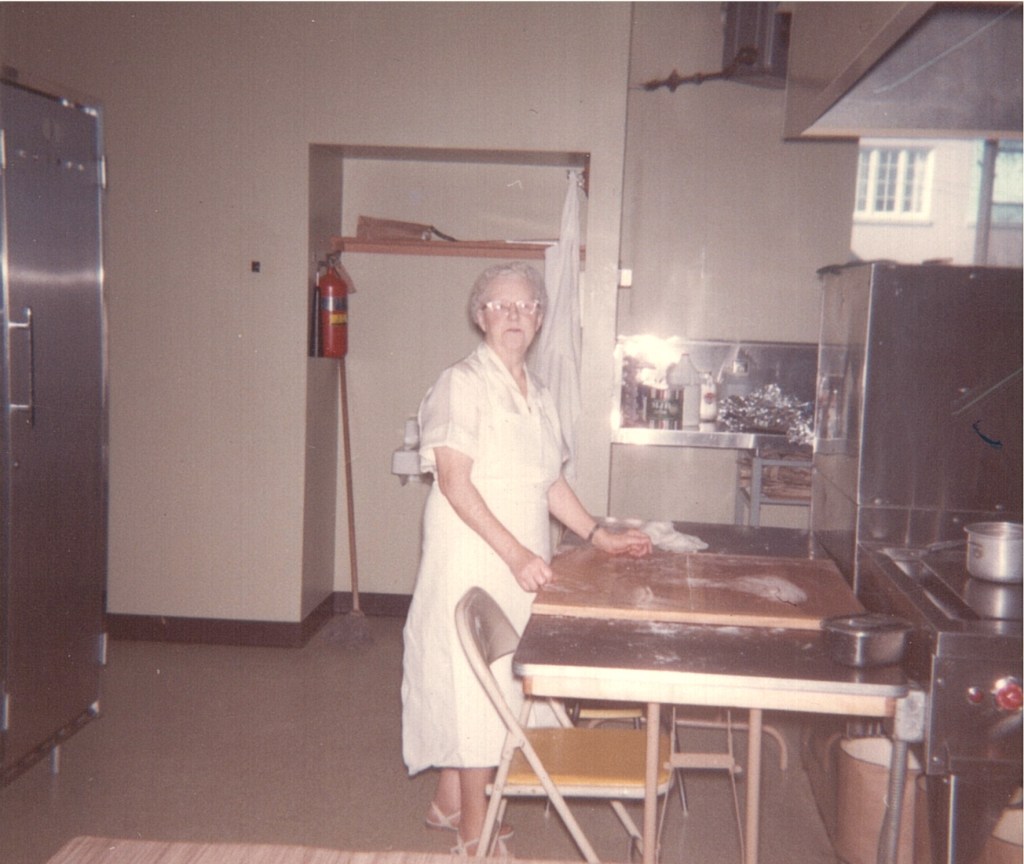
Cook Anna Blomgren in the Sigma Kappa kitchen 1965
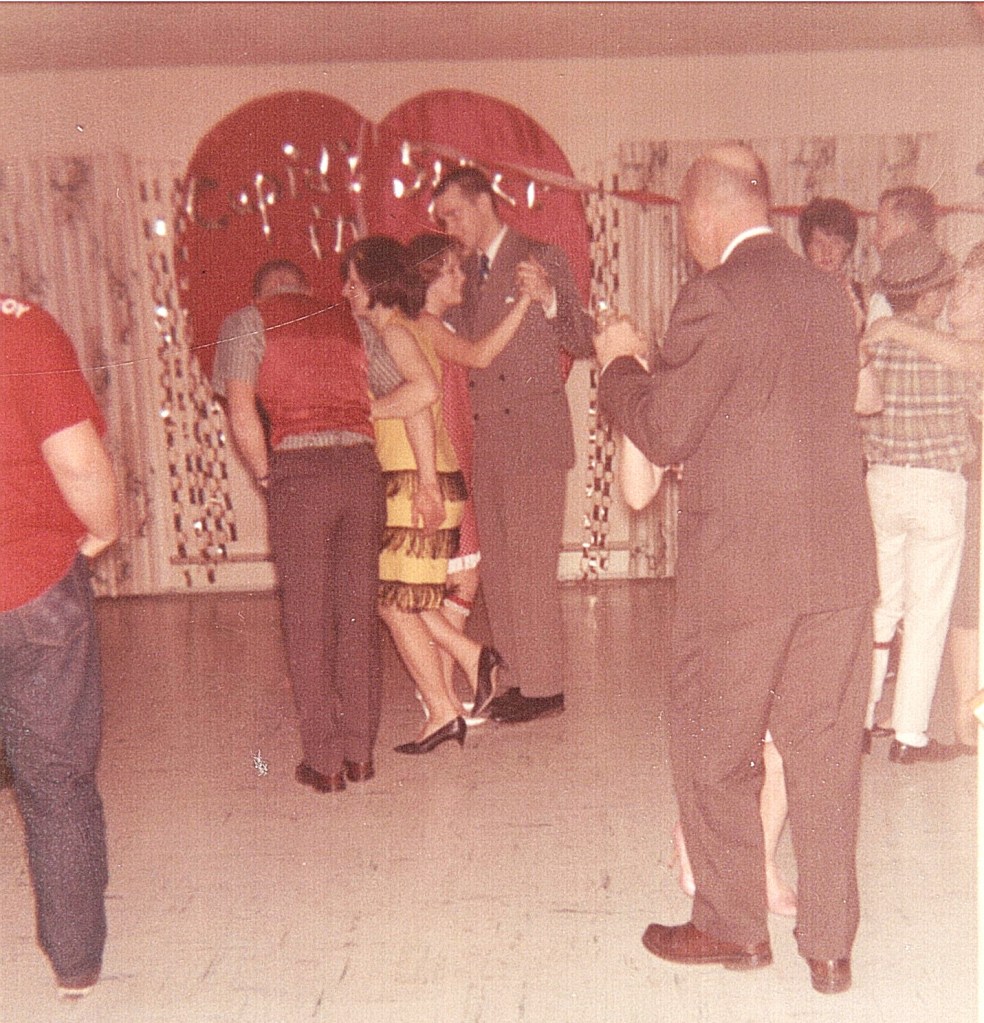
Valentine’s Day ‘Gay 90’s’ shared dance with the Zeta Tau Alpha sorority February 1966

The only other time I know for sure we visited her there is in March 1965. That winter, in Yakima, Washington, where I grew up, the entire town is abuzz. Competing in the State AA Basketball playoffs were our crosstown rivals: D.D. Eisenhower (Ike) and A.C. Davis high schools.

The University of Washington was, I suspect, the best possible choice to be closer to one of her children and family and be able to support herself.

My dad, who had left National Cash Register 1961, returned to college to get a degree in Education, now taught Washington State History to ninth graders. He loved teaching and was invested, particularly, in the local sports community. At the end of the Region 4 semi-final round on March 13th, Ike lost to Davis who was now poised to play at the Seattle Center Coliseum the next Friday.

Although neither of my brothers went with us – my oldest brother attended Ike and would not have anything to do with Davis – my Dad was undeterred and my sister and me – now ages 9 and 7 – were loaded in the 1960 pink Dodge station wagon, and drove with our parents to Seattle on Friday, March 19th.

While I don’t recall a lot of the details, I do know that it was the UW’s Spring break, so the house was empty of sorority girls. And I got to live out every fantasy I had about that house. I was in heaven.

My older sister (left) and me on the Sigma Kappa sleeping porch March 19, 1965.

That evening, while our parents went to the basketball games, my sister and I stayed with our grandmother and even got to sleep on the sleeping porch!

Davis won and would be in the championship game the next evening! Once again, we hung out with grandma while my parents went to the game, my dad thrilled when Davis beat Roosevelt 66-49 for the 1965 AA state basketball championship.

Sometime late that evening, our parents arrived back at the Sigma Kappa House, and put my sister and me to ‘bed’ in the back of the Dodge station wagon. We traveled home that way, snuggled in sleeping bags with our heads on pillows that let us look up at the sky while we drove through the dark mid-March night.

My last memory of that trip is of looking up at the snow falling that night on Snoqualmie Pass, swirling in mesmerizing chaos, with the thick flakes illuminated by car headlights shining through the window behind our heads.

Not the DeVore family car, but ours WAS this same pink color and, apparently, those children also rode without seat belts in the back of the wagon.

My grandmother, born March 15, 1900, seems to have retired at the end of the 1966 academic year. Some 15 years earlier she had bought a house in Spokane. She had it converted to a duplex which she rented out for all those years when she was a housemother! In going through her papers, it was apparent that, despite not having a college degree, she was a determined woman who did not wallow in her grief, but pulled on her work boots to insure her own future. She retired to Spokane and lived in the left half of the duplex, renting the right half out until her much too early death in January 1970.

I have never gone back to the Sigma Kappa house. I think if I did it would seem smaller and less grand than my memories. Instead, it has morphed into the Gamma Alpha Beta sorority, as much a ‘character’ in ‘The Darling of Delta Rho Chi’ as Elise, Riley, Jack, and Virginia.

A few links:

Designation as a National Historic Site:

Have to have one from the Infallible Wikipedia https://en.wikipedia.org/wiki/Sigma_Kappa

A link to the official chapter page: http://washington.sigmakappa.org/

Program from the 1965 State AA basketball championship: https://issuu.com/tacomasportsmuseum/docs/2018.29.02

Article from the Yakima Herald Republic:

Elton John

“I never knew me a better time, and I guess I never will.”

January 30, 2024

A Tuesday Newsday Classic Updated

In the past 50 years there has not been an artist, more than this one, who has provided the soundtrack for our lives. He embodies the concept of be ‘an original’ and has, since the beginning of his long career, gone his own way. In addition to his commercial success, he’s been recognized by his own country and was knighted on January 30, 1998.

The musician: the one, the only, and never imitated, Elton John.

Although he was born Reginald Dwight, he changed his name to Elton John in 1967, after several years in the music industry. From the Infallible Wikipedia:

“In 1967, Dwight answered an advertisement in the British magazine New Musical Express, placed by Ray Williams, then the A&R manager for Liberty Records. At their first meeting, Williams gave Dwight an unopened envelope of lyrics written by Bernie Taupin, who had answered the same ad. Dwight wrote music for the lyrics, and then mailed it to Taupin, beginning a partnership that still continues. When the two first met in 1967, they recorded what would become the first Elton John/Bernie Taupin song: ‘Scarecrow’. Six months later Dwight was going by the name ‘Elton John’ in homage to two members of Bluesology: saxophonist Elton Dean and vocalist Long John Baldry.”

The list of memorable songs written by the duo – and performed by Elton John – is amazing. From his very first top 40 hit – Your Song – and continuing on with hit after hit through the 1970’s and 1980’s, the songs are memorable and often poignant.

Your Song – easily my favorite of all of his songs

Ironically, Elton did not win a solo Grammy Award until 1995… 24 years after his first nomination. The 1995 award was for Best Male Performance for the Song Can You Feel the Love Tonight? from the Disney hit movie The Lion King. In all, he has been nominated for Grammy’s 33 times and won five times.

He was honored with the Grammy Legend Award in 1999, an honor given to the select few whose lifetime achievements are notable.

As a teenager in the 1970’s you could not turn on the radio without hearing many of Elton John’s songs. One song in particular stands out for me. It was December of 1972 and I was a sophomore in high school. And there was a guy – Ron – who was in my French class. New to my high school, his family had moved to Yakima sometime that fall. We soon became friends, chatting before and after class and we went to several Eisenhower High School basketball games together that December.

But it was one particular Elton John song which, having been released in the US on November 20, I associate with Ron. Crocodile Rock made the Billboard Hot 100, debuting at number 73. It climbed to #30 by December 18th. Crocodile Rock was Elton John’s first number one hit in the US, staying atop the charts for three consecutive weeks from February 3rd through the 17th in 1973.

To this day, whenever I hear Crocodile Rock I am immediately transported back to December of 1972. Although the song is about an earlier era, for a 15 year old girl garnering male attention for the first time in her life, the song seemed to encapsulate the fun of life: of going to a Friday night basketball game with a guy I liked, talking with him after class and in the library, getting teased by my friends about my new ‘boyfriend,’ and trying -and pretty much failing – to navigate the choppy waters which are teenage romances.

The author (center facing the camera) early fall of 1972 at Eisenhower High school with my friends Cindy, Daphne, and Kathy. This photo appeared on page 8 of the photo essay section of the 1973 annual.

There is a poignancy to the lyrics when one line proclaims “I never knew me a better time, and I guess I never will.” Somehow this song not only laments the slipping away of the rock and roll of the 1950’s and 60’s but speaks to how quickly the teenage years pass us by and how we simply do not appreciate what a unique and special time they are.

Elton John announced in 2018 that he was doing one ‘last’ tour dubbed ‘Farewell Yellow Brick Road’. From the website:

“These dates mark Elton’s last-ever tour, the end of a half a century on the road for one of pop culture’s most enduring performers. The new stage production will take his fans on a musical and highly visual journey spanning a 50-year career of hits like no one has ever seen before.”

True to his word, it WAS his final tour. But he has written a book – ‘Farewell Yellow Brick Road: Memories of My Life on Tour’ – which is scheduled to be released on September 24, 2024.

For more information about Sir Elton, be sure to check out these links:

https://en.wikipedia.org/wiki/Elton_John

https://www.eltonjohn.com/stories/farewell-yellow-brick-road-memories-of-my-life-on-tour-set-for-release

https://en.wikipedia.org/wiki/Elton_John_singles_discography

National Nothing Day

Long celebrated as a day to sit back and relax

January 16, 2024

A Tuesday Newsday Classic updated

January 16th, it turns out, is historically one of the most boring days in history. The tree most exciting things I could find for this date were:

  1. Debut of the Donny and Marie Show in 1976
  2. Cher and Greg Allman’s divorce finalized in 1979
  3. Wayne Newton performs his 25,000th show in Las Vegas in 1996.
From left to right: Wayne Newton, Donny & Marie Osmond, Greg Allman and Cher

Truly riveting events. Which is why January 16th being “National Nothing” Day seems appropriate.*

The day was started in 1972 by San Francisco Examiner columnist Harold Pullman Coffin. The day was created, according to the Infallible Wikipedia as a way:

“…to provide Americans with one National day when they can just sit without celebrating, observing or honoring anything.”

There truly is no lack of irony with what I discovered about this event. Wikipedia’s article is what’s known as an ‘orphan’ with not a single link to anything about this event. Yet the ‘day’ was significant enough to be included in the 1973 printing of Chase’s Calendar of Events (first published in 1957).

For just $103 you can get the paper copy of Chase’s Calendar or go digitally for a mere $97.50

Chase’s Calendar was also started by someone in the newspaper business. Bill Chase worked for the Flint (Michigan) Journal in the library. Hours and Hours of clipping and filing news stories prompted the idea of the publication which, as of 2012, had been updated and produced annually for 55 years.

There are a couple of takeaways from all this. First, is that if you are a writer and love trivial facts there’s probably a book inside of you. It amazes me the things that someone has turned into a book. Second, is that unless I’m sick, I can’t possibly sit and do ‘nothing’ all day. But, of course when one looks at the description of the day it doesn’t literally mean to not do anything.

I can’t think of anything more boring than sitting around and doing ‘nothing.’

When I was in high school I had a fabulous teacher by the name of Mrs. Renn. Sadly, the year I was in her class she was diagnosed with terminal cancer. But that did not stop her from coming to school every day and imparting her knowledge and wisdom to a bunch of ungrateful teenagers. One day I recall one of the students must have complained about the literature we were discussing and that she was bored. Mrs. Renn didn’t get mad at the student but took the opportunity to impart her philosophy on life.

I paraphrase but the message was this “there is no excuse to EVER be bored; if you have your mind, you can always find something interesting to read, or write, or do.”

The impact on me, personally, was huge. I’ve carried that message and that day with me all these years and I’m eternally grateful to Mrs. Renn for giving me wisdom at a time in my life when I needed to hear it.

So my plans for National Nothing Day is to seize the opportunity to use that time to have the very best day possible ‘doing’ all sorts of interesting (to me) things.

Update for 2024: I wrote this article in January 2018 and, since there’s still nothing new to share for January 16th, I’m sharing it again. I will add this. I’m a member of a Facebook Group for alumni from my high school, Eisenhower, in Yakima, Washington.

A random student took this photo of my dad teaching, probably from the late 1960’s to early 1970’s. Dad taught 9th grade Washington State history at Franklin Jr. High school in Yakima, Washington

Recently one of my classmates, Rick C., posted a question to the group: “Nominations are open for BEST (or worst) ADVICE by a staff member. For me Mrs. Renn’s advice immediately came to mind, so I posted pretty the same thing as I did in this 2018 article.  That was just a few days ago. There were many comments, so Rick’s post obviously resonated with many. But his response to what I posted touched my heart:

(Rick C.-Author)

Barbara DeVore  – I totally agree. She was so gentle and thoughtful. You wanted to please her. I credit her for my love of writing.

The only other one I could mention who was on that level, is your dear father from Franklin. I will never forget him! –R

So get out there and do ‘nothing’ spectacularly!

I enjoyed this article about the man who started Chase’s Calendar: http://www.annarbor.com/news/chasing-down-days-ann-arbor-founder-of-chases-calendar-of-events-turns-90/

And the Wikipedia article: https://en.wikipedia.org/wiki/National_Nothing_Day

*Martin Luther King Day (he was born January 15th) was designated as a Federal holiday in 1983 and it was not until the year 2000 when all 50 states observed it. Since it falls on the third Monday in January it has occurred on January 16th five times since its creation (1989, 1995, 2006, 2012, 2017) now making the January 16th designation as “Nothing Day” erroneous some years.

Top Of The World

The Carpenters second #1 Hit

December 5, 2023

Cover for the 1973 single

This song sat on top of the charts for two weeks in early December 1973. You could say the song sat at the “Top of the World.” It was the second number one song for pop superstars Karen and Richard Carpenter and the only song written by Richard Carpenter and John Bettis to reach number one on the Billboard Top 40 singles charts.

A catchy tune, it captured the interest of country singer Lynn Anderson who recorded and turned it into a number one Country hit in the summer of 1973.

According to the Infallible Wikipedia Karen and Richard were a bit unhappy that they had not already released it as a single:

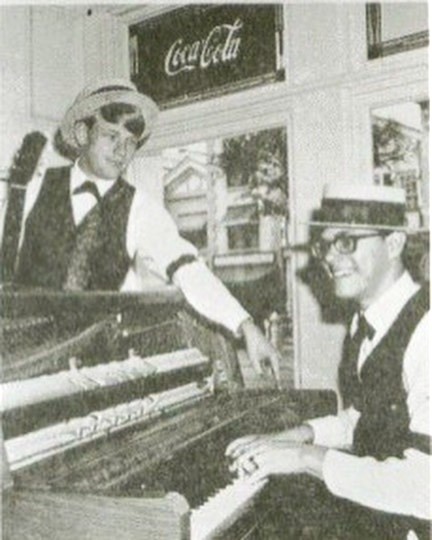
John Bettis (left) and Richard Carpenter met in college and wrote many songs together. Pictured here in the late 1960’s performing at Disneyland.

“Written by Richard Carpenter (music) and John Bettis (lyrics), ‘Top Of The World’ was originally recorded for and released on the duo’s 1972 studio album A Song for You. The song was initially intended to just remain an album cut, however, when Lynn Anderson’s version, released in mid-1973, was a success, the duo was upset that they hadn’t released their version as a single to begin with. The Carpenters’ version was later released as a single on September 17, 1973. Karen Carpenter re-recorded her lead vocal for the single release as she was not quite satisfied with the original. The new version appeared on the duo’s first compilation album, The Singles: 1969-1973.

Following its single release, the song topped the Billboard Hot 100 chart in late 1973, becoming the duo’s second of three No. 1 singles, following ‘(They Long to Be) Close to You‘ and preceding ‘Please Mr. Postman.’”

For my generation you would have had to have lived under a rock to not at least recognize this song.

As my readers know, I loved, loved, loved the Carpenters and their music. Was this song my favorite of theirs? Not by a long shot. Ahead of this one were their more soulful songs (which, I think, took better advantage of Karen’s beautiful voice) such as “We’ve Only Just Begun”, “Rainy Days and Mondays”, “Song For You”, and “Superstar.”

The beauty of this song, in spite of it’s decidedly country vibe, are the upbeat lyrics and the eminently memorable tune.

In the fall of 1973, as a junior in high school, we all knew and could easily sing this song. One of the most important parts of my high school experience was being a part of the nearly 100 member choir. Of course our musical selections were of a more traditional sort, having to sing songs written in Latin and other languages. But those were just part of the deal for the opportunity to participate in the annual musical. One of the rules was that you had to be a member of the Cadet Choir. The other was that in order to try out for a speaking or singing part in the musical you were required to ‘try out’ in front of the entire choir during class.

I finally screwed up the courage to do so during my senior year and I chose “Top of the World” as my song. For weeks prior to the audition I practiced and practiced at home, accompanying myself on the piano. Most of the mid range notes I was fine with since I was an alto.

Finally the big day arrived and I can still see how that room looked with nearly 100 pairs of eyes looking at me as I stood in front of them and gave “Top of the World” my best shot. No doubt my voice cracked a few times. I imagine I went off key a once or twice. My knees knocked together. My hands shook. But I made it through.

Mr. Durado, our teacher, did NOT cast me in a singing role. He did not cast me in an acting role. But he did make me the Director’s Assistant, a job which was definitely more in my wheelhouse. I was not destined to become a singing and acting star of the stage.

The 1975 Cadet Choir. The author is the last one seated, on the ground, at the far right

I have never sung solo in public ever again. And I’m good with that. And so is everyone else.

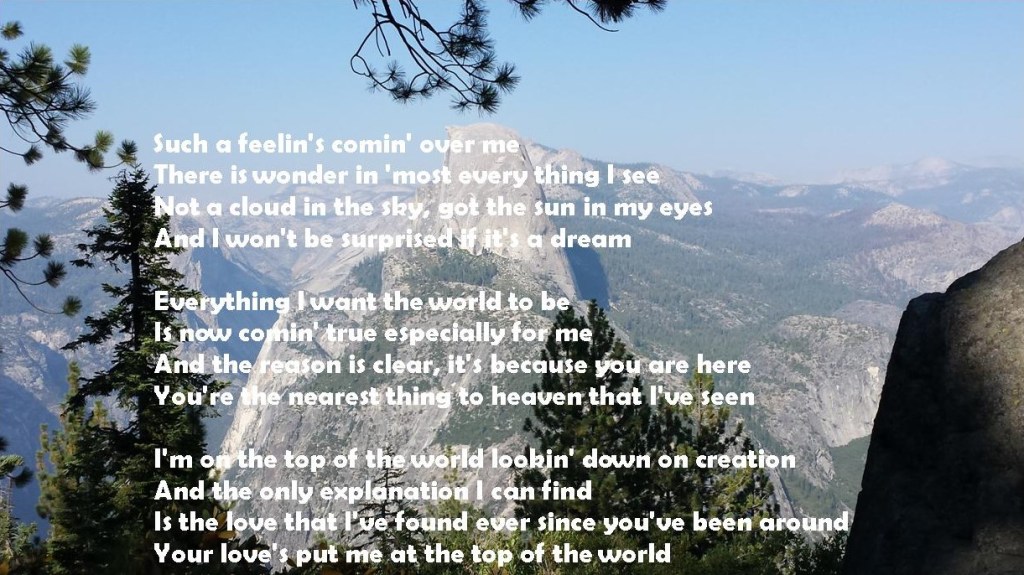
But when I think back on that time in my life, “Top of the World” was sort of anthem. I was 17 years old and life lay before me with unlimited possibilities. Mostly an optimist, I felt as if the lyrics of this song spoke to me and encapsulated how I felt that year:

I suppose that, musically, the song is undoubtedly seen as being a bit simplistic and saccharin. So be it. But I also think that maybe our current society could use a bit more optimism in the world and embrace a feel good song like “Top of the World.”

A couple of links:

https://en.wikipedia.org/wiki/Top_of_the_World_(The_Carpenters_song)

https://www.lyrics.com/lyric/35343699/Carpenters/Top+of+the+World

I’ve written previous articles on the Carpenters Here:

And the musical I auditioned for:

Class Reunion

A snapshot in time

August 16, 2022

It occurred to me, after attending a class reunion this weekend, that somehow I’m pretty certain I’ve managed to attend all of the ones for my high school class.

A reunion book was produced for both our 10 and 20 year reunions

I suppose that’s not really a surprise, after all I was Editor of our yearbook my Senior year and have always had a keen interest in people’s stories. Attending a reunion is simply a continuation of those stories; an opportunity to get a snapshot every few years of those who were a part of the early years of our lives.

Before I go much further, however, I know all my regular readers will be glad to learn that the Infallible Wikipedia has a page for the topic ‘class reunion’ as follows:

“A class reunion is a meeting of former classmates, often organized at or near their former high school or college by one or more class members. It is scheduled near an anniversary of their graduation, e.g. every 5 or 10 years. Their teachers and administrators may also be invited. Those attending reminisce about their student days and bring one another up to date on what has happened since they last met.”

But I don’t think the Infallible Wikipedia’s description does the topic justice. So I started thinking about my Eisenhower High School reunions through the years. At our ten year reunion – the first one we had – there were easily a couple hundred who attended. Our venue was one of the buildings at the Central Washington State Fair Grounds and, besides a dinner and dancing, included a photographer who was taking photos which could be purchased.

At the time, the hubby and I were DINKY’s (back in the 1980’s a DINKY stood for Double Income No Kids Yet). The snapshot of that night was one of people in their late 20’s, still trying to figure out their place in the world. Some had children and, although I did not, I can still see the look of complete exhaustion on the faces of those women. But I didn’t yet understand what that was like, as careers were everything in my world that reunion. At ten years, there was a weird game of one-upmanship still in play.

Truly, few of us had yet experienced some of life’s harder lessons. Perhaps the most sobering aspect of the 10 year reunion was the short list of those with whom we had graduated but who had already left this earth.

Fast forward five years, and the organizers (we have been blessed to have a team of, primarily, women who have made all of these happen!) planned a half decade reunion. This one, held in the early fall, included attending a home football game on Friday night and a picnic on Saturday.

Now, as a mother with an 8 month old baby, I left my son with the most reliable babysitters in the universe, his grandparents, and headed out to the stadium. Partway through the game, I look down from the bleachers only to see my Dad standing below motioning at me. My night out was over!

The next day, my not yet walking son and I attended the picnic and enjoyed the more casual setting and smaller numbers, getting advice from experienced moms and meeting many of their children also.

Year twenty the reunion was held in a big outdoor tent at a country club. At the ten and the 20 year reunions, A “tell us about your life” booklet had been produced and by year 20, the cliques and the labels of high school had started to blur.

The crowd at the 20 year reunion. Definitely a ‘Where’s Waldo’ sort of exercise to find myself in the photo.

One of my favorite snapshot moments was when I was talking to another girl when one of the guys from our class came over to talk to her. Still standing there and feeling a bit like a third wheel, there was suddenly a lull in the conversation and I blurted out to the guy, who we will call Adam, “I had the worst crush on you in Junior High.” I seem to recall he choked on his drink and nearly spit it out.

With my BFF’s from high school on our way to the 40 year reunion in 2015

Onward the years have marched. Our group celebrated with a 35 and also a 40 and then, in 2020, a planned 45 year reunion was sidetracked.

Two years passed but our fearless organizers pressed on and proclaimed that 2022 would be our “Medicare Reunion.”

Suddenly, all those 17 and 18 year old kids I attended high school with were starting to retire. Most everyone had lost one or both parents; more names have been added to the dreaded ‘list’; there have been triumphs and disappointments; incredible joy and devastating sorrow; the loss of siblings; the loss of spouses; the loss of children. The cliques and labels have disappeared and what’s left are people who can simply enjoy a few hours of telling their stories and hearing other’s stories.

It’s the context which matters. These are the people who shared beginnings either in elementary school, junior high, or high school. When we look at each other we can remember the person and how they looked then. We can see past the wrinkles and gray hair. Their essence is still very much the same but is, I think, tempered by the experiences of life. We are kinder and more forgiving.

One of my classmates – who traveled from California for the event – said it best. My apologies for the paraphrase: It’s about the people and making connections with each other. And it’s important.

Our 2022 ‘Medicare’ reunion

Time – and Covid – have taught us all these things and can be summed up in my favorite Latin phrase: Carpe Diem.

So the next time your high school or college, sorority or fraternity, or any other group you’ve belonged to, plans a reunion, Go. Go and connect with the people who knew you ‘when.’ Laugh. Cry. Enjoy. Hug. And be sure to tell them how much you appreciate them having been a part of your life.

https://en.wikipedia.org/wiki/Class_reunion

High School Graduation

Endings and Beginnings

June 7, 2022

For any individual over the age of 18 this event is, perhaps, one of the most seminal and memorable of their life.

Photo from the author’s Senior year annual, the Reveille

The High School Graduation represents so very much. For most it marks the official change from child to adult. It is also a sobering reminder that it is time to either get a job or go on to college. Whichever is the case, it truly represents the end of a phase of life.

The ceremony, known as Commencement, can trace its origins back some 800 years to Europe. At that time, of course, it was a rarefied event and confined to those few scholars who studied at universities AND only in Latin. The awarding of a degree was for the purpose of conferring recognition upon those few who were to be the teachers.

The Infallible Wikipedia tells us:

“Ceremonies for graduating students date from the first universities in Europe in the twelfth century. At that time Latin was the language of scholars. A universitas was a guild of masters (such as MAs) with license to teach. ‘Degree’ and ‘graduate’ come from gradus, meaning ‘step’. The first step was admission to a bachelor’s degree. The second step was the masters step, giving the graduate admission to the universitas and license to teach. Typical dress for graduation is gown and hood, or hats adapted from the daily dress of university staff in the Middle Ages, which was in turn based on the attire worn by medieval clergy.

Graduation Announcement

The tradition of wearing graduation hats in Sweden has been in place since the mid-eighteenth century. The cap is typically a white sailor hat with a black or dark blue band around it, a crown motif, and a black peak at the front. The graduation hat tradition was initially adopted by students at Uppsala University. The headgear then became popular across several other European nations as well.”

In the United States, graduation ceremonies became popular for high schools but, alas, the Infallible Wikipedia tells us nothing as to when that tradition began. In recent years ‘graduations’ have been adopted by Junior High, Middle, and elementary schools. When my children were little, even their ‘pre-schools’ held ‘graduation’ with the tots donning mortar board hats and sharing what they liked best about pre-school.

The months of May and June are prime commencement season. My own high school graduation, from Dwight D. Eisenhower HS, took place on June 6.

What is interesting is how much of that night I remember. My high school had a tradition of the Seniors having an ‘all night’ party following the ceremony. At the time I didn’t recognize the purpose of the party. It was not so the young adults could go crazy… it was to keep them from going crazy and, it was hoped, to keep them safe.

In many ways, my High School graduation encapsulated all of the joys and sorrows of life in a single moment.

It was a typical June day in Yakima. The high was 77 degrees but by graduation time it was in the mid 60’s. There was a steady 16 mph wind blowing with some higher gusts.

The author the afternoon before her graduation

My class of 365 graduates assembled just outside the doors at the north end of the gymnasium and awaited the moment we were to walk in. Our parents and families occupied the bleachers, no doubt fanning themselves with the programs, constantly rearranging themselves on the hard wooden benches.

In our line, there was whispering as thoughts and gossip were exchanged. Someone mentioned that a pair of our classmates had recently gotten married due to her getting pregnant. The young woman of the couple had been a good friend in junior high and, although we had drifted apart, the news rattled me.

But it was the information I heard next which, just as the line started to move, literally shook me to my core.

To this day, I cannot recall who told me. Yet the moment is firmly etched in my mind. The older brother of a good friend had been killed in an automobile accident in the early hours of June 6. Although he had been living with his father (their parents were divorced) in Western Washington, he had a good relationship with his siblings and his mother who did live in Yakima. He was only 20 years old.

That sobering moment likely affected the perception of my graduation. Yes, we still cheered and threw our mortar boards in the air; Yes, we had our all night –and alcohol free – party; yes, all our graduates survived the night – even those who skipped the school approved event.

And sometime in the next few days I went to see my friend and her mother, both of them deep in the grief of losing a brother and a son.

That summer I turned 18 and began to prepare for the next phase of my life: college. The month of June, it turned out, was a time of endings but also beginnings, of learning in classes and out of classes, of sorrow but also joy.

All the years of school leading up to graduation had not quite prepared me for the most important lesson I’ve ever learned: embrace each moment and never, ever take for granted a single day.

The links:

https://en.wikipedia.org/wiki/Graduation

Memories of Driver’s Ed: Lessons from the 70s

For some it took longer than others!

August 3

At one time this test was an important rite of passage for the American teenager, an indication that they were about to enjoy one of the privileges of adulthood: being able to drive.

For one Mariam Hargrave of Yorkshire, England, no doubt it was an ordeal. It was on August 3, 1970, when the 62 year old finally passed her driving test. Although the Infallible Wikipedia has an article about driver’s tests, they ignore poor Mrs. Hargraves. Instead, I was able to glean this information:

“By April 1970 Mrs. Miriam Hargrave had failed her test thirty-nine times. In the eight preceding years she had received two hundred and twelve driving lessons at a cost of £300. She set the new record while driving triumphantly through a set of red traffic lights in Wakefield, Yorkshire. Disappointingly, she passed at the fortieth attempt (3 August 1970) but eight years later she showed some of her old magic when she was reported as saying that she still didn’t like doing right-hand turns. — Stephen Pile, ‘The Book of Heroic Failures’”

Back in 1970’s Yakima it was a big deal to learn how to drive. By the time I was in high school, they were offering Driver’s Ed classes which involved learning the rules of the road and practicing driving. I doubt there were any braver educators anywhere than those who willingly climbed into a car with a 15 ½ year old, hormone driven, child and allowed them to command a 2,000 pound vehicle on city streets.

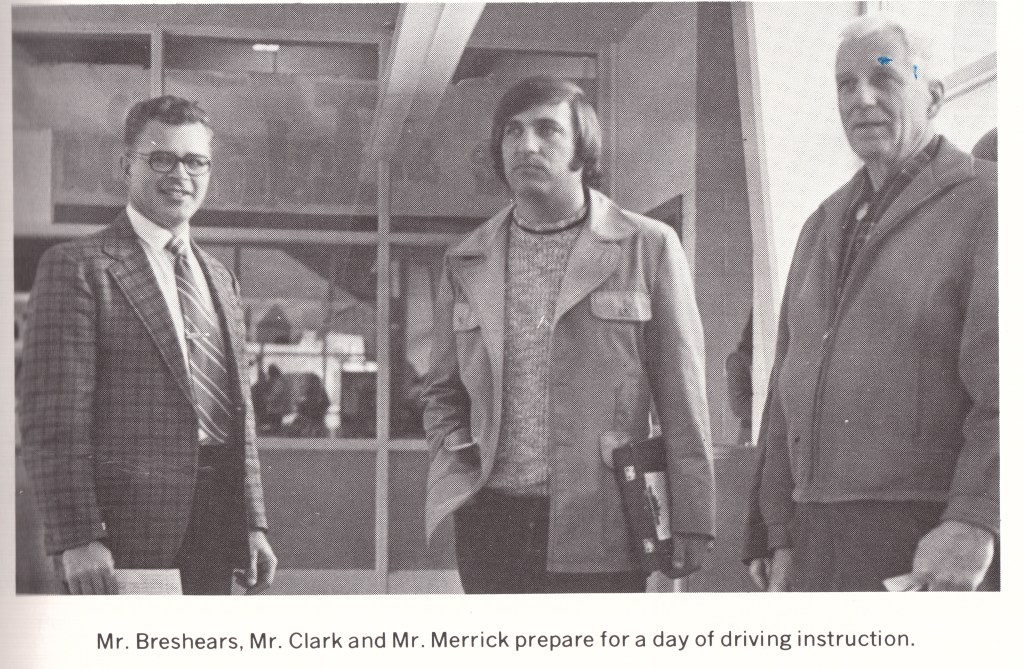
Yet, they did. I seem to recall my Driver’s Ed teacher, Mr. Breshears, always popping antacid tablets. I suppose the only thing which gave the instructors any comfort at all was the fact that the cars were equipped with a set of brakes for the front seat passenger.

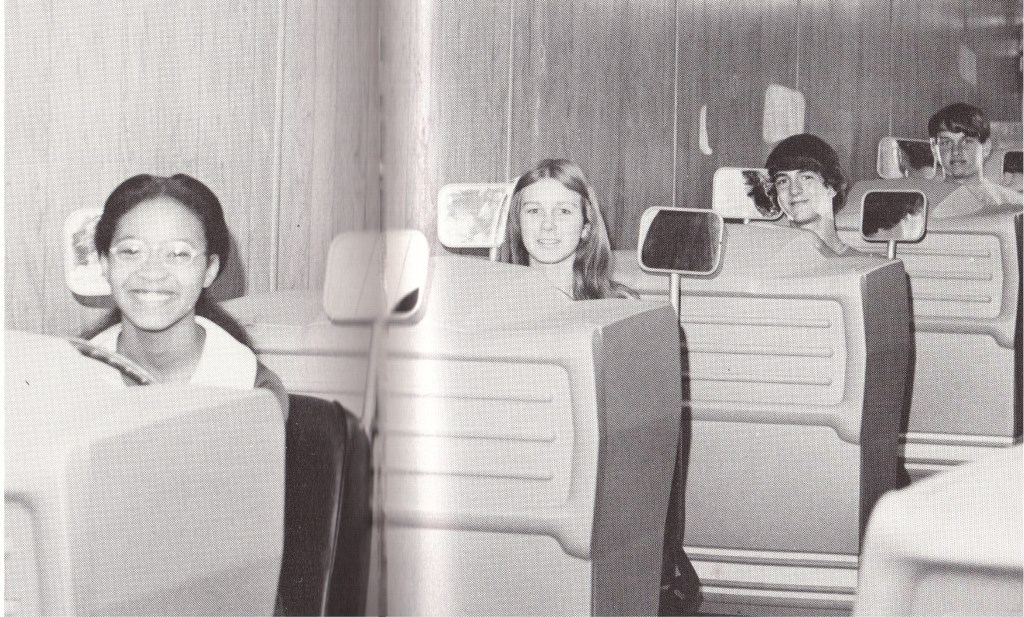
Our simulators looked something like this set up from 1969.

Three students at a time would go drive with the teacher. It was a bit terrifying since not all budding drivers had the benefit of a parent who worked with them after school. There was one student I recall who tested Mr. Breshears patience each time they got behind the wheel. Those instructor brakes got quite the workout.

But the favorite part of Driver’s Ed class was getting to go to the Simulator. It was a windowless trailer which had been equipped with two parallel rows of seats, separated by an aisle sort of like being on a bus, and all faced forward. Each station had a steering wheels, brakes, etc. to look like the driver’s area of a car. At the front of the trailer was a large screen. Once all the students were settled into their places, the lights would be dimmed and the screen would come to life as though one was behind the wheel, driving down the street. It was our job to accelerate in unison with what we saw on the screen. It was also imperative that we hit the brakes at the right time.

From the IKE Reveille year book, 1972

Driver’s training films seemed to mostly consist of tree lined city blocks which, at first, seemed like lovely enclaves of blissful American life. But no. Those streets were every driver’s worst nightmare. Balls of all sorts would suddenly bounce out into the road followed by adorable tikes chasing them. Woe unto those who didn’t hit the brakes in time!

Sophomore class officers from Eisenhower High School, Yakima, pose for a photo for the 1973 annual.

There were dogs and cats; there were other vehicles; things fell off the backs of trucks, branches crashed down. Who knew how truly hazardous things could be in one bucolic town?

Of course, some cheeky student would purposefully ‘run’ over the simulated hazards and a little red light would illuminate on their console, publically shaming them for an egregious infraction. I always wondered if students who ‘ran’ over cats, dogs, and children, failed the course.

Over the years I have learned just how accurate those simulations were as I’ve encountered many of the hazards portrayed. Thankfully, it’s only occasionally that such things happen. The hubby and I, if we are in the car together, will comment in unison ‘Driver’s Training film!’ when something we experienced in the simulator occurs in real life.

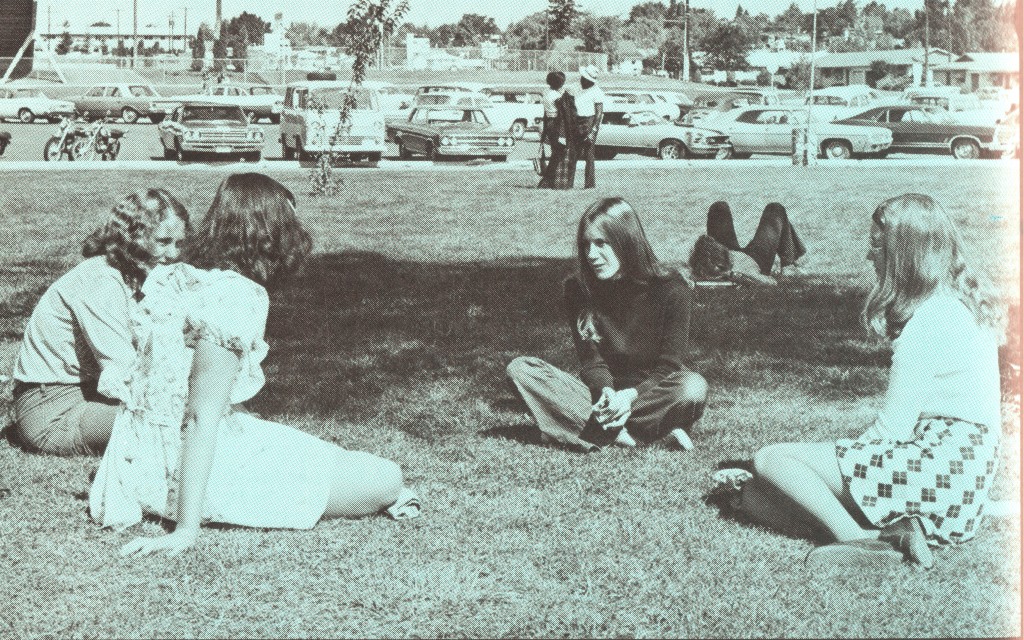
This photo is from the Eisenhower High School 1973 annual. The headline above this proclaimed “380 license-hungry students swamp driver education course this year.” Apparently there were a bunch of us who turned 16 in 1973.

The  instruction I received was successful and on my 16th birthday I took the tests – written and driving – and emerged as a licensed driver and, despite losing points for parallel parking, never came close to Mariam Hargrave’s, 212 lessons, eight years of time, and over $700 (US) spent.

The links:

An entertaining look at early simulators:

https://www.dmv-written-test.com/washington/practice-test-1.html?utm_source=bing&utm_medium=cpc&utm_term=%2Bwa%20%2Bstate%20%2Bdriver%27s%20%2Btest%20%2Bpractice&utm_campaign=DMV%20-%20Search%20-%20WA%20-%20EN%20-%20CAR~Driver%20Question%20Test&msclkid=ee5a27bd586710c0735246b5495d31f5# (Can you pass the written test for Washington State?)

https://en.wikipedia.org/wiki/Driving_test

https://en.wikipedia.org/wiki/The_Book_of_Heroic_Failures

Anything Goes

Take A Bow

November 10, 2020

The cover from Eisenhower’s production of Anything Goes in 1975

Now, 86 years after the fact, the musical Anything Goes is showing its age. One thing about it has aged well, however, and that would be the music of Cole Porter. For those unfamiliar with the musical, here’s some background from the Infallible Wikipedia:

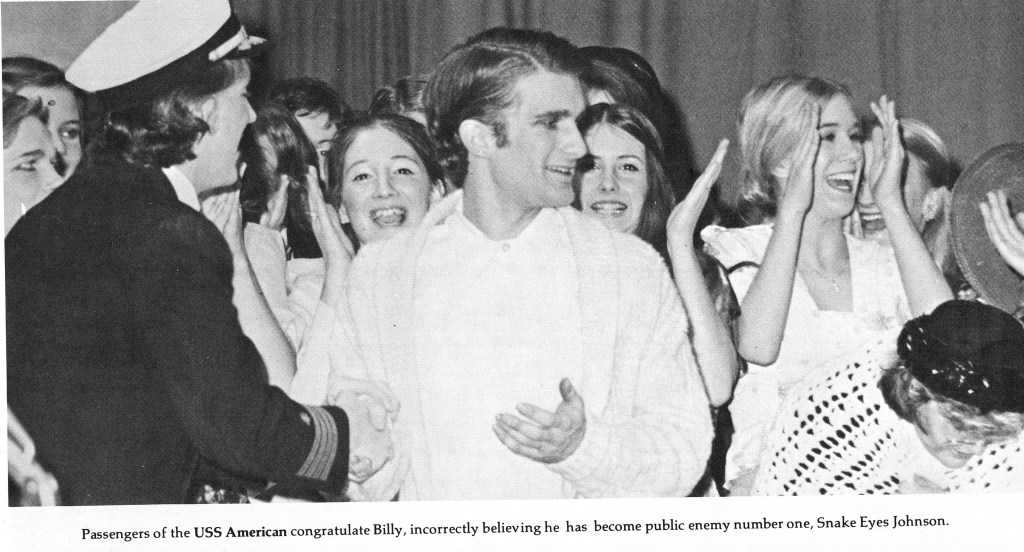
“Anything Goes is a musical with music and lyrics by Cole Porter. The original book was a collaborative effort by Guy Bolton and P. G. Wodehouse, heavily revised by the team of Howard Lindsay and Russel Crouse.The story concerns madcap antics aboard an ocean liner bound from New York to London. Billy Crocker is a stowaway in love with heiress Hope Harcourt, who is engaged to Lord Evelyn Oakleigh. Nightclub singer Reno Sweeney and Public Enemy Number 13, ‘Moonface’ Martin, aid Billy in his quest to win Hope. The musical introduced such songs as ‘Anything Goes,’ ‘You’re the Top,’ and ‘I Get a Kick Out of You.’

Since its 1934 debut at the Alvin Theatre (now known as the Neil Simon Theatre) on Broadway, the musical has been revived several times in the United States and Britain and has been filmed twice. The musical has long been a popular choice for school and community productions.”

The best way to describe Anything Goes is as a wild adventure with hidden identities, love triangles, and a whole lot of sexual innuendo. It was, in its day, considered inappropriate. Hence the title.

Despite its racy themes, Porter’s lyrics are masterfully written and crisp and so very sing able.

My readers will be forgiven if they’ve never heard of the show.

I had never heard of it either until December of 1974 when my high school choir director, Mr. Jim Durado, announced that our spring musical would be Anything Goes.

To be clear, I never had a shot for any sort of solo singing role in the production. In fact, Mr. Durado was legendary at our high school for somehow selecting musicals which seemed to ‘fit’ the students who filled the leads. That was, I’m certain, by design.

And so it was for Anything Goes. The lead role was for a female and he had a very talented vocalist who he cast as Reno Sweeney. More about that a bit later.

My role, however, was also a rather important one and I was selected by Mr. Durado specifically for it as surely as he picked any particular cast member.

It all began the previous spring when he asked me if I would be his Teacher’s Assistant (TA) for the following year. It required me to have TA as one of my classes. I said yes.

During the course of that year, I ran every errand, copied copious amounts of sheet music, tracked down students, kept attendance records, and made sure things happened on time. If there was a job to do, he gave it to me to get it done. When it came time to start rehearsals, my post was to sit at the mid-point of the theatre, three rows back from the stage, and follow along in the script. If someone needed prompting, I was the one to do it.

My photo was in the program along side all the lead actors

Every day after school – for three months – we rehearsed. I swear it became a muscle memory thing because to this day I can sing most of the songs without missing a word. For a number of years I could even say all the lines of every character.

It was a great experience and I am forever indebted to Mr. Durado for trusting me to do the job.

For Mr. Durado, however, 1975 turned out to be a time fraught with conflict. As a student, I was not privy as to what was going on his life. All I know is that there were moments when I would wonder what I had done to make him so sullen and incommunicative. It took months to learn the truth.

We were only a couple weeks in to rehearsals when the lead he’d chosen to portray Reno Sweeney told him she couldn’t take the role as she was very uncomfortable with the innuendo and believed it violated her faith. Thus the scrambling began to find a replacement. Another senior, Jennifer, was quickly selected and her part was then given to Mr. Durado’s own daughter. There was some amount of complaint from the cast who felt that a different girl deserved the role.

Reno and Sir Evelyn – aka Jennifer and Doug – during a performance

But the show, as they say, must go on. The next couple of months saw the production come together and, on March 19, 1975, Anything Goes opened. The page in my yearbook states:

“The eighty member cast worked three months in preparation for the standing ovations they justly received. Mr. Jim Durado proudly produced and directed his tenth musical production, one which originally opened on Broadway in 1934.”

By April, the intense schedule of rehearsals and a successful musical behind us, it was time to focus on recruitment for the next year. In addition to the main choir, there was a 16 person four part harmony swing choir, called Lancers. It was THE premiere vocal group at the school and dozens would vie for a coveted spot. Tryouts were looming for that and several performances by both groups were on the schedule.

One morning in mid-May, however, Mr. Durado was not at school. I cannot to this day recall exactly how I heard the news. It was probably announced to the whole choir when we arrived for class. But Mr. Durado had been shot by his wife. The bullet hit near his shoulder. He was alive and was in the hospital and that was all we were told.

That afternoon – in spite of the shock – the entire choir went to Franklin Junior High to perform a scheduled show. Somehow we got through it with a substitute teacher. The memory which sticks in my head from that day is that a group of a half dozen girls were walking out of the Junior High after the performance and everyone was talking about it; some of the girls were crying. All of us were upset.

I did go see Mr. Durado in the hospital a day or two later. He was making jokes about how bad a shot his wife was. It was surreal.

Less than a month after I graduated and heard little more about my teacher. The next year there was a new choir director who had huge shoes to fill. From Mr. Durado’s first musical production in 1966 until his last in 1975, he had built a dynasty.

Being in choir was cool. Those who were selected for Lancers were the coolest (I was not in that group!) It was getting to participate in the musical, however, that was everything. My oldest brother was in Funny Girl – which was Mr. Durado’s second production – in 1967. My cousin Susan was selected for the role of Mrs. Paroo in 1973’s The Music Man. That was also my sister’s first of two years in the cast; in 1974 both my sister and I were in The Most Happy Fella. I closed out our family participation with Anything Goes.

Mr. Durado moved back to his home state of Montana after he recovered from his wounds. From an adult perspective I cannot even begin to imagine how difficult the whole situation must have been for the family, especially for his daughters. No shortage of victims in this story but it seems as if it’s often the kids who are most hurt.

Mr. Durado lived out his days in Montana, taking his final bow on March 19, 2013…38 years to the day from the opening night of the last musical he produced and directed, Anything Goes.

A couple of links:

https://www.findagrave.com/memorial/195146855/james-rocco-durado

https://en.wikipedia.org/wiki/Anything_Goes