Tag Archive | Christmas

It’s A Wonderful Life

Angels Among Us

January 7, 2025

A Tuesday Newsday Classic

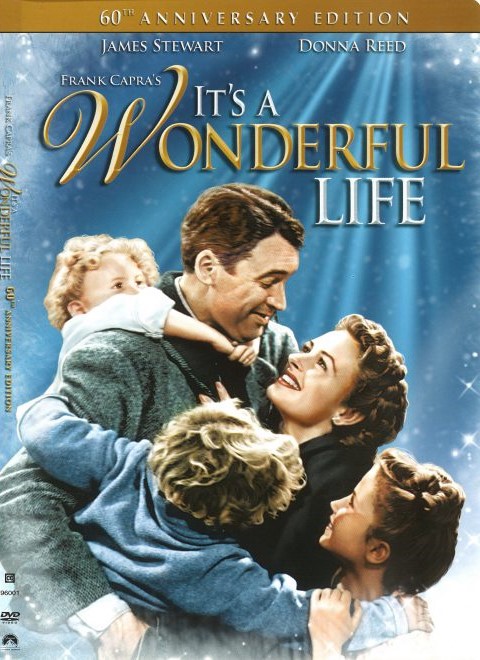
Cover of the 60th Anniversary DVD featuring George and Mary Bailey and three of their children

This film, officially released in theaters on January 7, 1947, was plagued with missteps from the start. Its history of challenges, actually, seem appropriate as it is a film about failure and redemption and has become one of the world’s most beloved Christmas classics. The movie: It’s a Wonderful Life.

Its story begins in 1939 when Philip Van Doren Stern writes a short story he titles The Greatest Gift. Unable to find a publisher, Stern self publishes 200 booklets which he gives as presents to friends during Christmas 1943.

The story ended up being read by Carey Grant who was interested in adapting the story into film with him as the lead. RKO, a movie studio, purchased the rights in April 1944 to do just that.  Work commenced on the screenplay. For whatever reasons, Grant went on to other projects and the partially completed script was eventually sold to Frank Capra’s production company in 1945.

Capra – recognizing the potential in the story – hired a writing team to work on the script. But there were problems. From the Infallible Wikipedia:

“Capra salvaged a few scenes from Odets’ earlier screenplay and worked with writers Frances Goodrich and Albert Hackett, Jo Swerling, Michael Wilson, and Dorothy Parker (brought in to ‘polish’ the script), on many drafts of the screenplay.

It was not a harmonious collaboration. Goodrich called Capra ‘that horrid man’ and recalled, ‘He couldn’t wait to get writing it himself.’ Her husband, Albert Hackett, said, ‘We told him what we were going to do, and he said ‘That sounds fine.’ We were trying to move the story along and work it out, and then somebody told us that [Capra] and Jo Swerling were working on it together, and that sort of took the guts out of it. Jo Swerling was a very close friend of ours, and when we heard he was doing this we felt rather bad about it. We were getting near the end and word came that Capra wanted to know how soon we’d be finished. So my wife said, ‘We’re finished right now.’ We quickly wrote out the last scene and we never saw him again after that. He’s a very arrogant son of a bitch.’
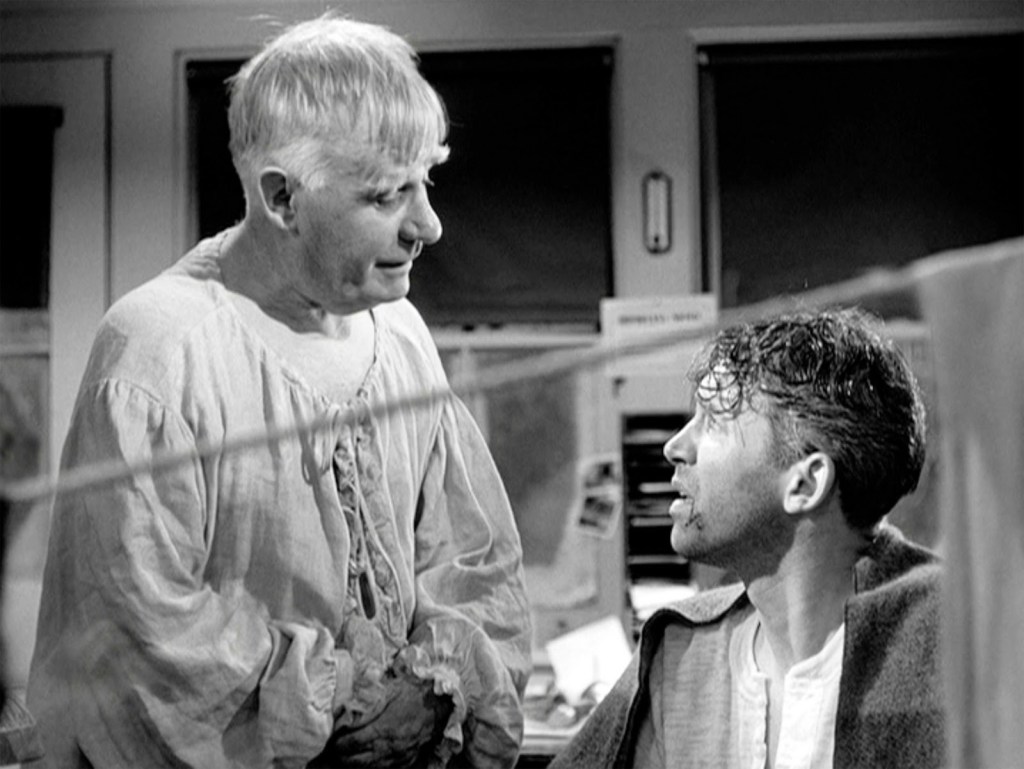
George telling Clarence he wished he’d never been born

Later, a dispute ensued over the writing credits. Capra said, ‘The Screen Writers’ Arbitration committee decided that Hackett and Goodrich, a married writing team, and I should get the credit for the writing. Jo Swerling hasn’t talked to me since. That was five years ago.’ The final screenplay, renamed by Capra It’s a Wonderful Life, was credited to Goodrich, Hackett, and Capra, with ‘additional scenes’ by Jo Swerling.”

In order to make the film ‘Oscar’ eligible it was released at the Globe Theatre in New York on December 20, 1946 rather than wait until early 1947 as originally planned. The change likely cost It’s a Wonderful Life a Best Picture Oscar as the competition for 1946 was much more difficult. Best Picture winner was a movie titled The Lost Weekend, a movie now pretty much lost in time. It’s a Wonderful Life ended up with five nominations including for Best Picture and Best Actor for Jimmy Stewart.

The movie was under water some $525,000 at the box office.

It wasn’t until the late 1970’s when the copyright expired and the movie was ‘discovered.’ Also from the Infallible Wikipedia:

“The film’s elevation to the status of a beloved classic came three decades after its initial release, when it became a television staple during Christmas season in 1976. This came as a welcome surprise to Frank Capra and others involved with its production. ‘It’s the damnedest thing I’ve ever seen’, Capra told The Wall Street Journal in 1984. ‘The film has a life of its own now, and I can look at it like I had nothing to do with it. I’m like a parent whose kid grows up to be President. I’m proud … but it’s the kid who did the work. I didn’t even think of it as a Christmas story when I first ran across it. I just liked the idea.’ In a 1946 interview, Capra described the film’s theme as ‘the individual’s belief in himself’ and that he made it ‘to combat a modern trend toward atheism’.”

The house at 5417 40th Ave SW in Seattle as it looks now. When we moved there the right side of the yard had been dug out and turned into a driveway that heaven help you if you took a wrong step at the top.
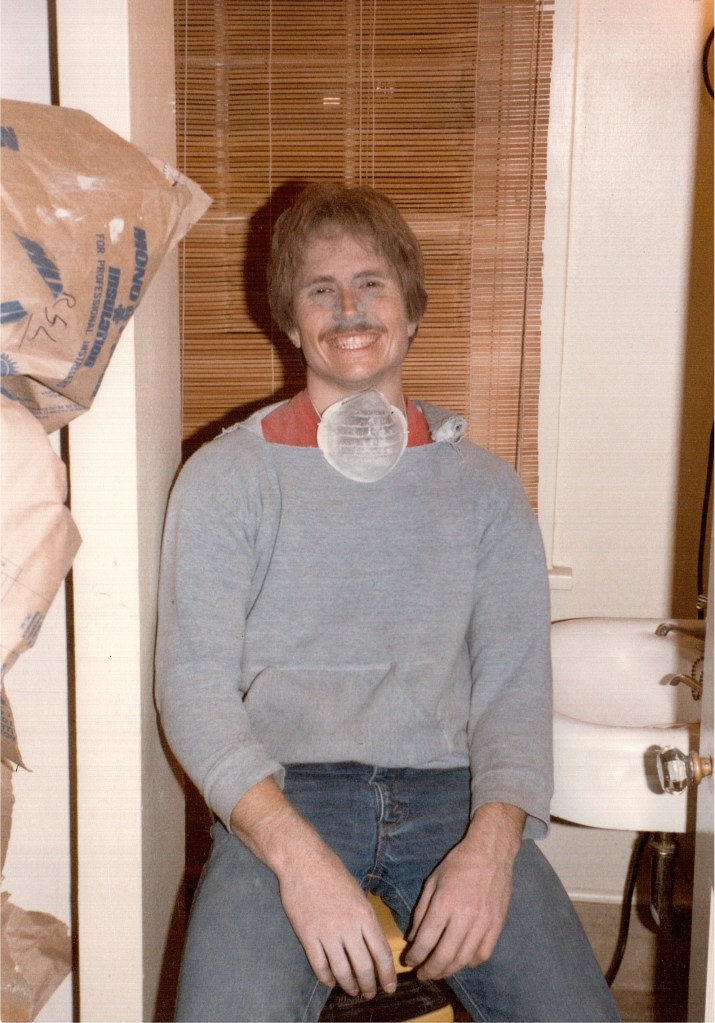
The hubby covered in dust after an evening blowing insulation into the attic

It was in December 1981 when I first saw the movie. The hubby and I had purchased our first house six months earlier. It was a 1910 fixer upper in West Seattle and a hodge-podge of never-ending projects. Our initial weekend in the house involved ripping out pet urine-soaked carpets and removing part of the narrow, with a 90 degree turn staircase, in order to get our queen size bed up to the bedroom.  Behind the 1960’s era kitchen cabinets we unearthed a painted over window with the curtain rod still attached to the wall. Unfortunately, the curtains – mostly rags – also still hung there. The fix list went on and on. During the time we owned that house, it was one critical project after another.
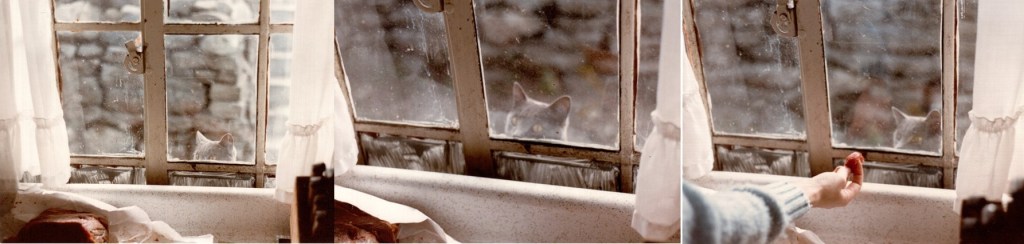
Our cat, Porsche, was peering through the kitchen window watching as I worked with some steak and we inadvertently captured those horrible old windows, painted at the bottom and half covered up by ill-fitting counters.

Forward to the week before Christmas 1981. I was home sick from work with a bad cold, puttering around our drafty old house, doing what I could to get ready for the holiday. I had the TV on to keep me company when this old black and white film appeared.

Within moments I was hooked and soon I gave up my puttering and snuggled up on the couch under a blanket. I watched the whole thing. The already dim afternoon light faded to night just as George Bailey descended into his own winter solstice crisis. There I sat, commiserating with poor George over a house that needed constant fixing and worried about how he was going to find the money that Uncle Billy lost. I could relate as money was tight for a pair of house poor, married barely a year, kids.
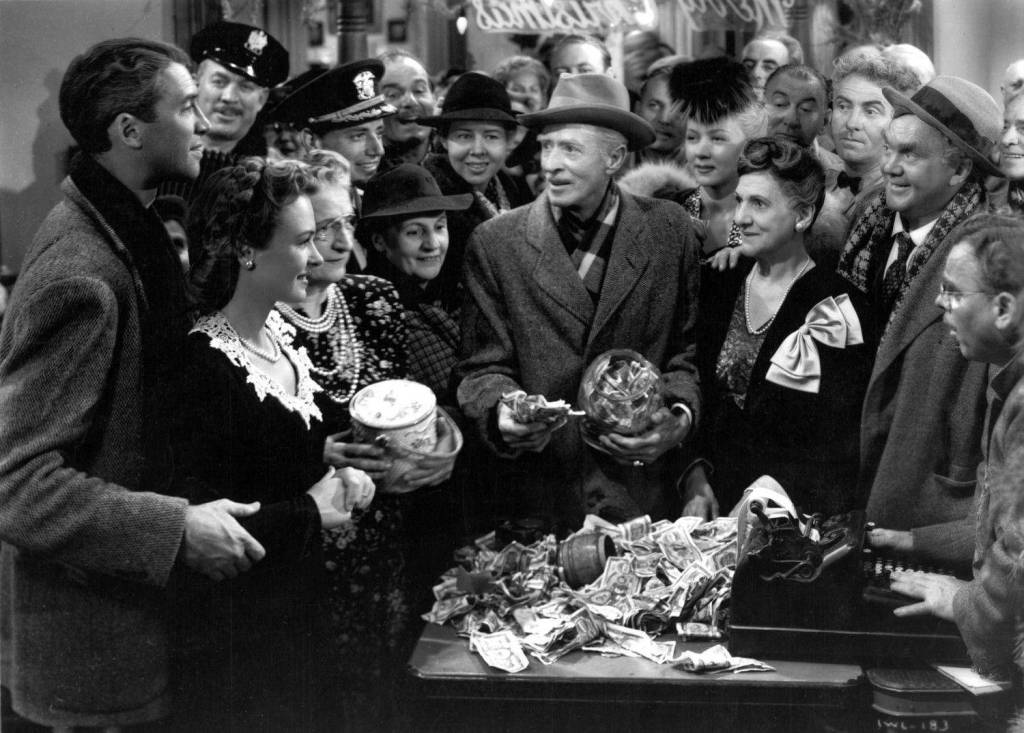
The townspeople of Bedford Falls coming together to help George

There’s a moment in that film which sums it all up. It’s when George arrives back home – alive once again – and hugs the kids but cannot find Mary, his wife. The bank examiners arrive and tell George they are going to arrest him and his response is just the best. He tells them how wonderful it is for no other reason than because he’s alive and that is enough.

Just then, Mary bursts through the door, she and George embrace and he tells her how much he cherishes her. But she has a surprise for him – the community has come to their rescue and raised more than enough money to cover the missing funds.

It’s this scene which had me bawling. What a gift it is to be so loved, so valued, that your friends and family will do anything to ease your burden. Every time I watch It’s A Wonderful Life I hold it together until that scene comes on and George receives a gift from his Guardian Angel, Clarence, with the following sentiment:

“Dear George, remember no man is a failure who has friends. Thanks for the wings, Love Clarence.”

As always – the links:
Nostalgic Shiny Brite Christmas Ornaments

Adorning American Christmas Trees since 1937

December 17th

A Tuesday Newsday Classic

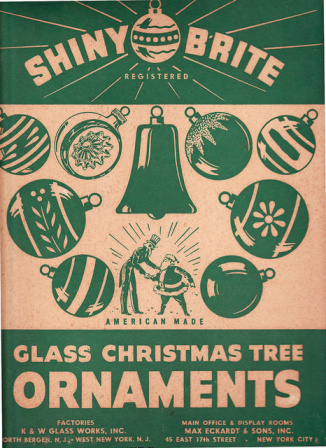
Long before Hallmark introduced their line of annual Christmas ornaments, another American Company had taken the market by storm, selling millions of baubles every year from 1940 to 1962. Marketed as Shiny Brite, the distinctive green boxes which featured Santa Claus shaking Uncle Sam’s hand were a fixture in the average home of the 1950’s and 60’s.

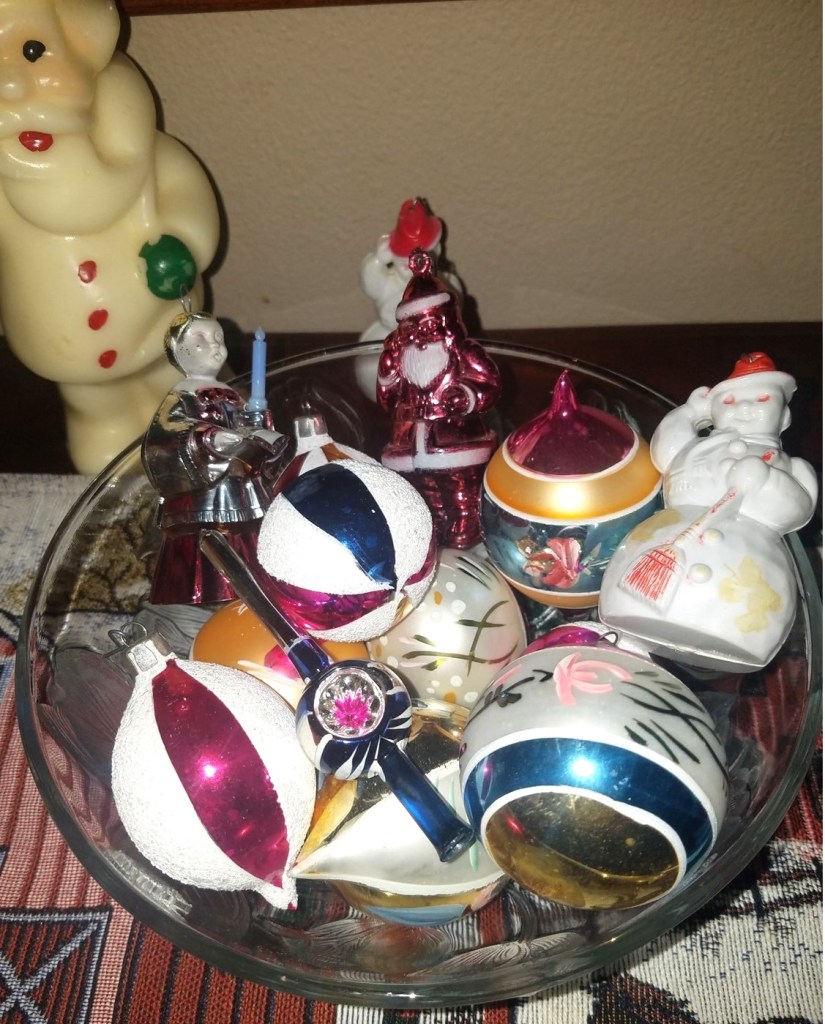
My mother’s Christmas ornaments from the 1950’s and 60’s

The story begins in 1937 with importer Max Eckhardt who, seeing the clouds of war encroaching and feared that his supply line would be cut, went to the Corning Glass company in Pennsylvania and made a deal with them to begin producing ornaments. Thus, was born Shiny Brite. From the Infallible Wikipedia:

“Eckardt had been importing hand-blown glass balls from Germany since around 1907, but had the foresight to anticipate a disruption in his supply from the upcoming war. Corning adapted their process for making light bulbs to making clear glass ornaments, which were then shipped to Eckardt’s factories to be decorated by hand. The fact that Shiny Brite ornaments were an American-made product was stressed as a selling point during World War II.

Dating of the ornaments is often facilitated by studying the hook. The first Shiny Brite ornaments had the traditional metal cap and loop, with the hook attached to the loop, from which the ornament was hung from the tree.

Wartime production necessitated the replacement of the metal cap with a cardboard tab, from which the owner would use yarn or string to hang the ornament. These hangers firmly place the date of manufacture of the ornament to the early 1940s. (snip)

Shiny Brite ornaments were first manufactured at Corning’s plant in Wellsboro, Pennsylvania, and continued there for many decades. During its peak, Shiny Brite also had factories in New Jersey, located in the cities of Hoboken, Irvington, North Bergen, and West New York. The company’s main office and showroom were located at 45 East 17th Street in New York city.

The classic cover of the Shiny Brite box with Uncle Sam shaking Santa’s hand

Shiny Brite’s most popular ornaments have been reissued under the same trademark by Christopher Radko since 2001.”

Although there were other companies which manufactured and sold ornaments in that era, Shiny Brite was by far the largest player.

As a child in the 1960’s I loved the December day when our family’s fresh cut pine tree would be set into its stand in a place of honor. I always watched as my father strung the C-7 bulbs on the branches. It seemed as though it took forever for my mother to declare the moment when the decorations could be hung. Out would come the green Shiny Brite and other boxes, their lids lifted, and one by one the delicate glass ornaments would soon dangle from the branches.

Each year it was as if seeing old friends arrive for the holidays. By the 1980’s – with their children all moved away – my parents quit hanging ornaments on a tree. Instead, they kept an artificial tree – lights already placed on the branches – in their basement storage room. Mid-December my dad would carry it out through the garage and then up the outside stairs and into the living room. Once the lights were plugged in they called it good.

The ornaments of my youth were squirreled away in a box in the storage room where they remained untouched for some 30 years.

In the summer of 2019, as we worked to clean out my parent’s home since my dad now lived in an Adult Family home, my sister and me anxiously awaited the Christmas Box to be unearthed.

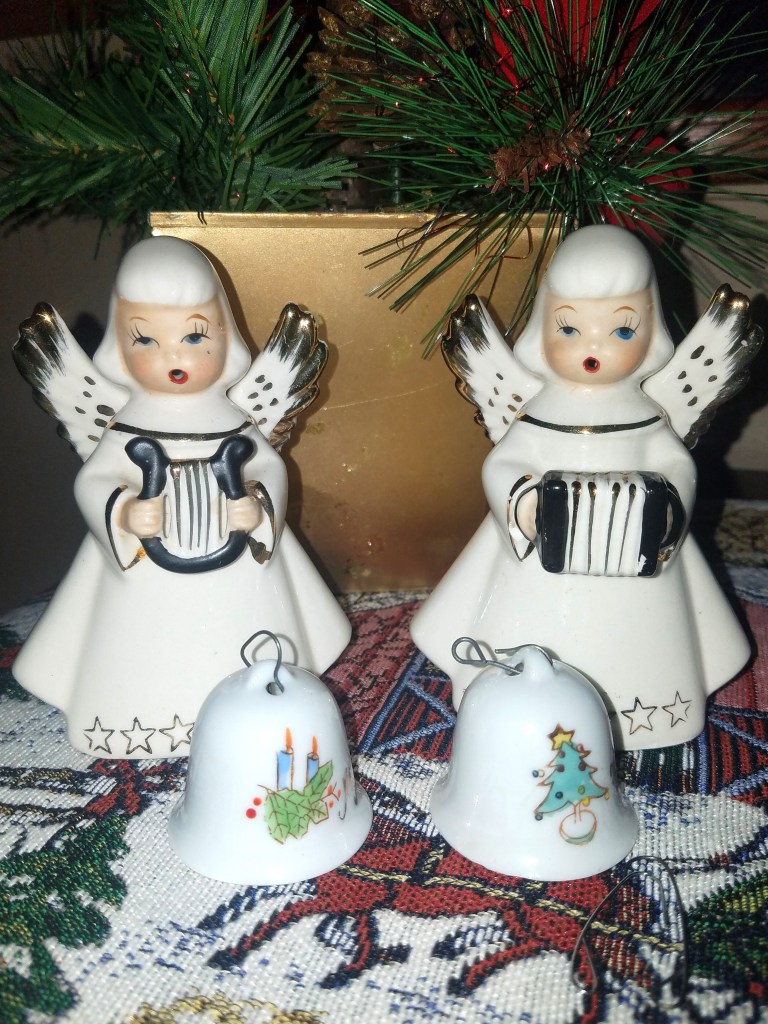
My mother’s precious ceramic angels and bells. It was not Christmas until the angels were set on the buffet.

Finally, in late August, that day arrived. The two of us sat on the floor and opened the ornament boxes, each picking out those we wanted to bring to our own homes.

By the time Christmas 2019 was upon us, both my parents were gone and, after my tree was up, I went search of the ornaments. I looked in box after box which had been stored in my garage since summer, but no ornaments.

Finally, after my two days search, I lamented to my son that I could not find them. He, however, said he had seen them and a few minutes later produced a small box from a section of the garage I had missed.

Just like when I was a little girl, I opened the box and said hello to my old friends. But unlike during my childhood, I could not bear to hang them on my tree, fearful one might fall and break. Amazing how something so ordinary and familiar had now become precious and irreplaceable. Instead, I carefully lay the treasured ornaments in a crystal bowl and, along with a pair of ceramic angels and two ceramic bells, set them in a place of honor. 

I can only hope that one day my own children might also cherish the heirlooms passed down from generation to generation.

The links:

https://en.wikipedia.org/wiki/Shiny_Brite

I loved this story about Wellsboro, PA, where Shiny Brite’s were manufactured: https://pawilds.com/wellsboro-the-town-that-saved-christmas/

And a nice story about Shiny Brite: https://www.retrochristmascardcompany.com/the-history-of-shiny-brite-ornaments/

Grandma Got Run Over By A Reindeer

December 3, 2024

A Christmas Classic?

A Tuesday Newsday Classic Updated

We know that the Christmas season is upon us when the calendar flips to December and those wonderful holiday songs waft nostalgic from the radio. And no song quite embraces the joyful Noel spirit more than… Grandma Got Run Over By a Reindeer.

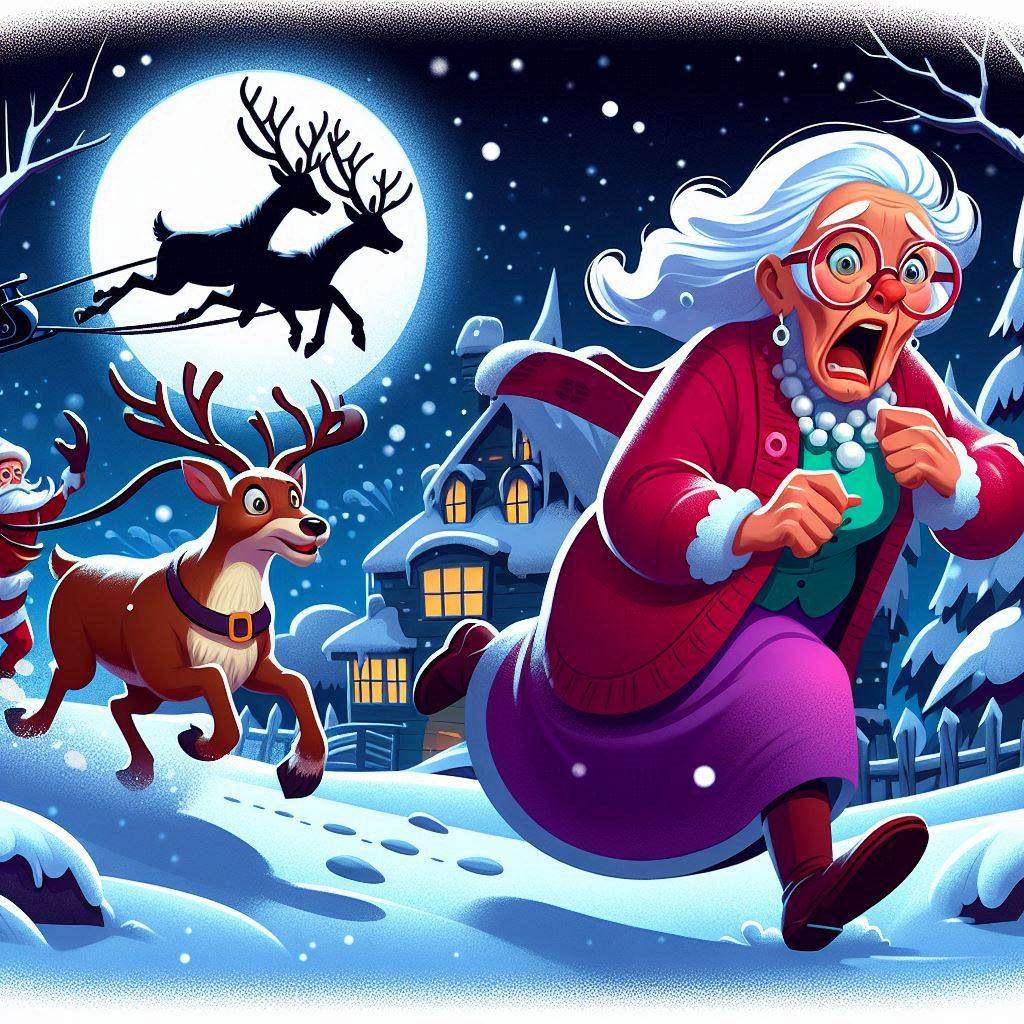
The wonders of AI Image creation thanks to Bing.


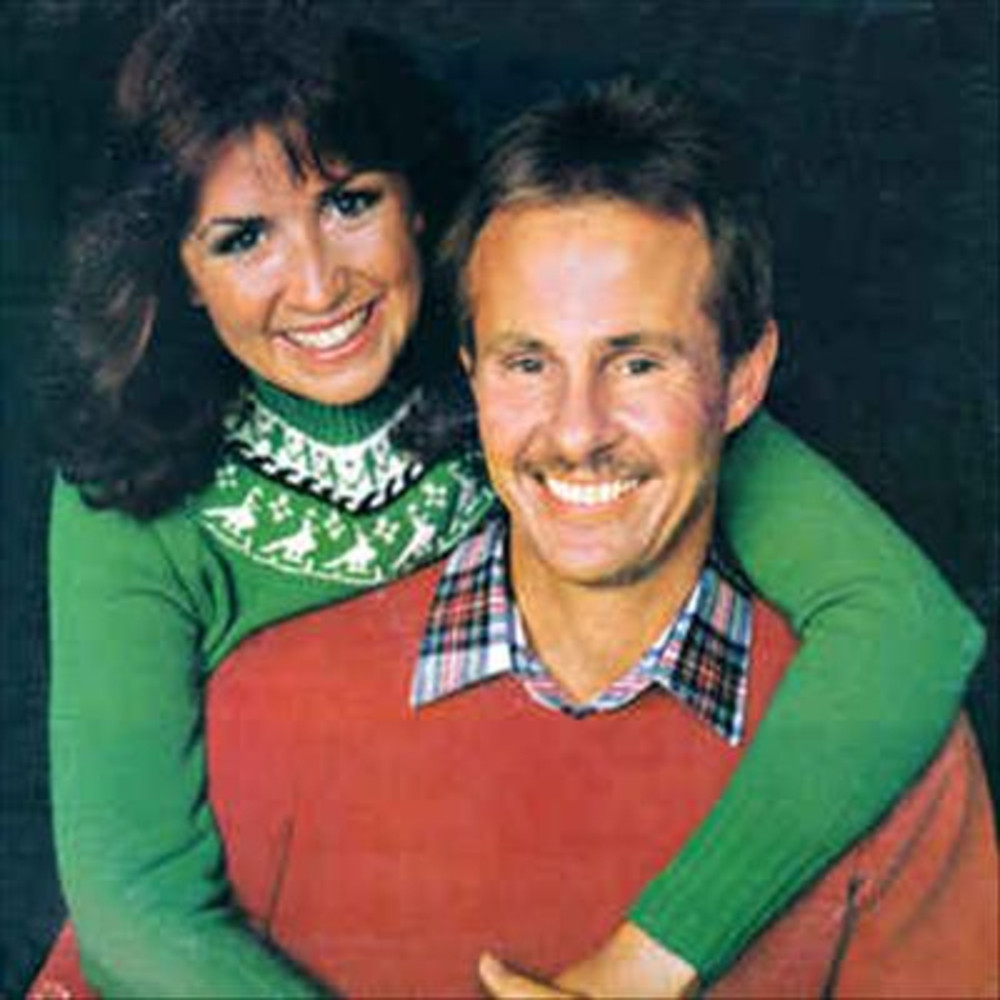
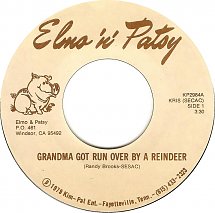
It all began in December 1978 when songwriter/performer Randy Brooks sang the song during a live show at the Hyatt Lake Tahoe with the husband-and-wife duo of Elmo and Patsy Trigg Shropshire. The pair asked for – and received – a tape recording of the song from Brooks after the show. The next year the duo recorded the song and began selling the record during their performances. As much as we can hope this 1979 novelty song will go away it has actually increased in popularity over the years.

From there things spiraled out of control.

By the early 1980’s the song was being played on radio stations during the holiday season. Its popularity on the rise and the records sold out, it has been re-pressed and re-released several times.

The public continues to be split on whether the song is loved or hated. From the Infallible Wikipedia:

“Edison Media Research and Pinnacle Media Worldwide independently survey radio listeners on which Christmas songs they like and dislike. In both surveys, results of which were reported in 2007, the only song that reached the top of both liked and disliked lists was ‘Grandma Got Run Over by a Reindeer.’ Its ‘loved’ ratings in the Edison and Pinnacle polls were relatively high—47 and 32 percent, respectively—but so were the ‘hate’ or ‘dislike’ ratings—17 and 22 percent.

Elmo and Patsy Shropshire

A major Washington, D.C. radio station, WASH (97.1 FM), dropped the song from its playlist. ‘It was too polarizing,’ says Bill Hess, program director. ‘It wasn’t strong, except with a few people, and it had a lot of negatives.’ The song also gained notoriety at Davenport, Iowa radio station WLLR in 1985 when a disc jockey played the song 27 times back-to-back during the morning show before station management was able to stop him. The disc jockey, who was suspended, was reportedly depressed and upset that a co-worker had left employment at the station to work out-of-state.

Shropshire claims it is ‘a beloved holiday favorite.’ The video of the song was ‘a holiday staple on MTV for many seasons.’ It has been ‘incorporated into talking toys and a musical greeting card.’ ‘My royalties are four or five times what they were’ 20 years ago, claims Elmo, who performs the song with his bluegrass group year-round. ‘A lot of younger people say it’s not really Christmas until they hear it.’”

When I first heard it – sometime in the early 80’s – I was amused. It did have a catchy tune and unusual premise. Listening to the lyrics I was appalled by the macabre theme wrapped up in a happy sounding jingle. For me, the song lands firmly in the dislike category and I will switch radio stations whenever it comes on.

For today’s Tuesday Newsday, however, I am taking one for the team so that my loyal readers can know the story behind the worst ‘holiday’ song ever.

Normally, I would put a link to a video up so you can experience the song first hand. Not doing that. Instead, here are the lyrics which do support my supposition that this is NOT a joyful Christmas classic:

Grandma got run over by a reindeer
Walking home from our house Christmas eve
You can say there’s no such thing as Santa
But as for me and grandpa we believe
She’d been drinking too much eggnog
And we begged her not to go
But she forgot her medication
And she staggered out the door into the snow
When we found her Christmas morning
At the scene of the attack
She had hoof-prints on her forehead
And incriminating Claus marks on her back

Chorus: Grandma got run over by a reindeer
Walking home from our house Christmas eve
You can say there’s no such thing as Santa
But as for me and grandpa we believe

Now we’re all so proud of grandpa
He’s been taking this so well
See him in there watching football
Drinking beer and playing cards with cousin Mel
It’s not Christmas without Grandma
All the family’s dressed in black
And we just can’t help but wonder
Should we open up her gifts
Or send them back (send them back)

Chorus

Now the goose is on the table
And the pudding made of fig
And the blue and silver candles
That would just have matched the hair on grandma’s wig
I’ve warned all my friends and neighbors
Better watch out for yourselves
They should never give a license
To a man who drives a sleigh
And plays with elves

Chorus

For those of you who ARE gluttons for punishment and want this ear worm in your head for weeks, here’s the video and, of course, a link to the Infallible Wikipedia article. I’ve also included one about Randy Brooks, the songwriter, as his tales from his childhood and how his family inspired the song is worth a read.

A Christmas Carol

Charles Dicken’s Beloved Literary Masterpiece

December 19, 2023

A Tuesday Newsday Classic Updated

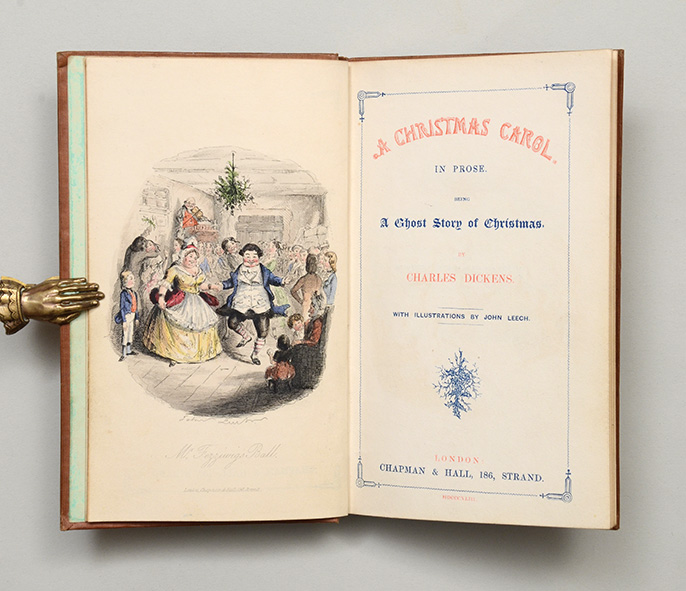
It took the author only six weeks to complete this novella which was published on December 19, 1843. All 6,000 of the original copies sold out in less than six days and the book, arguably, is one of the most famous literary works in history.

A Christmas Carol in Prose, Being a Ghost-Story of Christmas – the full title – is known better by the simpler name ‘A Christmas Carol.’

Charles Dickens was appalled by the conditions he saw at a school for the poor and was inspired to write the story. From the Infallible Wikipedia:

“Dickens had written three Christmas stories prior to the novella, and was inspired to write the story following a visit to the Field Lane Ragged school, one of several establishments for London’s half-starved, illiterate street children. The treatment of the poor and the ability of a self-interested man redeeming himself by transforming into a more sympathetic character are the key themes of the story. There is discussion among academics as to whether this was a fully secular story, or if it is a Christian allegory.”

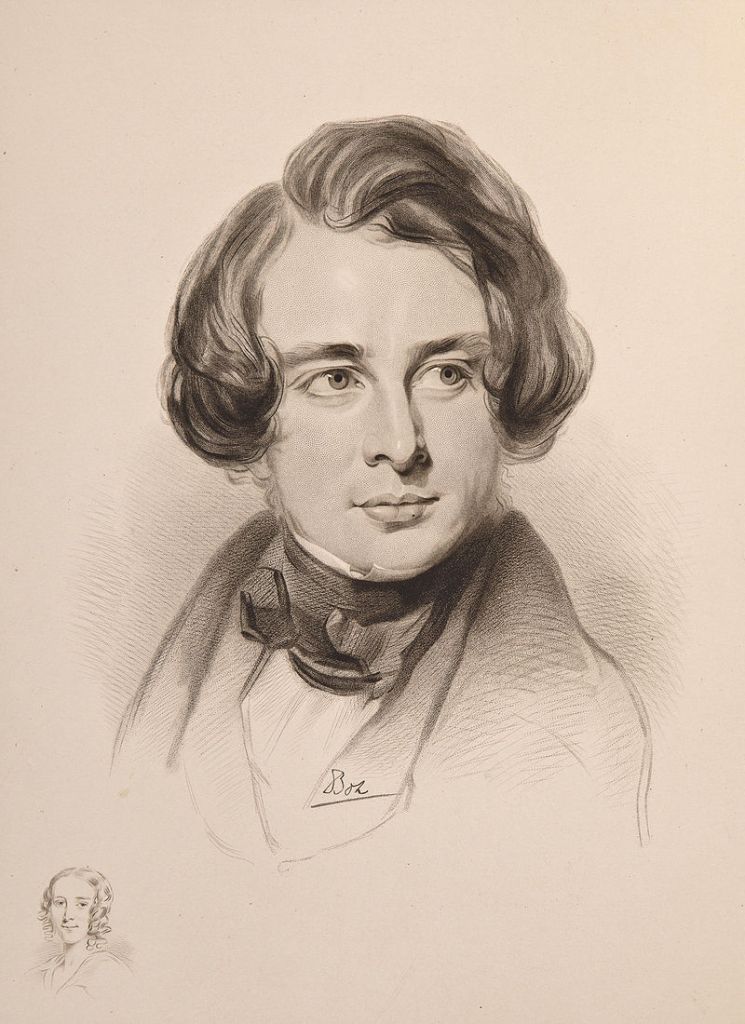
A sketch of Charles Dickens circa 1843

The book had an additional 13 publication runs in 1844, obviously resonating with the reading public in Victorian England. Since its first edition, the book has never been out of print and has been translated into several languages and adapted for theatre, movies and TV.

The path to success for Dickens, however, was not an easy one. Despite being a successful author, by mid-1843 he encountered financial problems. In those days authors were paid a salary by publishers and the author’s writings didn’t truly belong to them. Dickens’ publishers, Chapman and Hall, were about to reduce his salary by 50 pounds as sales of his current book had fallen. Also from the Infallible Wikipedia:

“As the result of the disagreements with Chapman and Hall over the commercial failures of Martin Chuzzlewit Dickens arranged to pay for the publishing himself, in exchange for a percentage of the profits. Production of A Christmas Carol was not without problems. The first printing contained drab olive endpapers that Dickens felt were unacceptable, and the publisher quickly replaced them with yellow endpapers, but, once replaced, those clashed with the title page, which was then redone. The final product was bound in red cloth with gilt-edged pages, completed only two days before the publication date of 19 December 1843.”

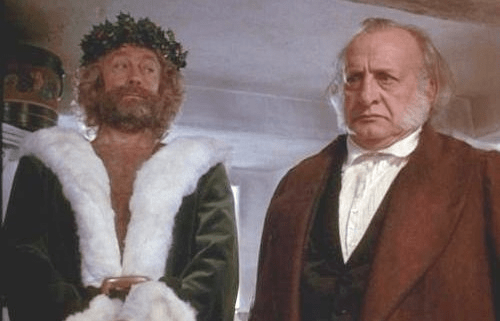
The Ghost of Christmas Present and Scrooge in the 1984 version featuring George C. Scott

Perhaps my favorite part of this story is how Dickens, despite setbacks, prevailed as a self-published author. He also, apparently, understood how to promote and, in 1852, started a tradition of reading an abbreviated version of the story as a public performance every Christmas season until his death in 1870. In fact he read A Christmas Carol in this manner 127 times.

I’ve seen a number of different versions of “A Christmas Carol.” Although many critics laud the 1954 film with Alistair Cook as Scrooge as the best adaptation, I’m partial to the George C. Scott version from 1984. What’s your favorite version?

2023 Update:

Unbeknownst to me, a movie was released in November 2017 (just weeks before the original post) about the writing of “A Christmas Carol.” I only first saw the movie last week. Titled “The Man Who Invented Christmas” it tells the story of Dickens struggles as an author and how the concept of one of his most beloved works came to be.

What I most appreciate about the film is how it portrays the writer’s journey. In the six weeks it takes for Dickens to pen the manuscript he struggles with the characters, especially the character of Scrooge who Dickens originally felt was not redeemable.

To me, one of the joys of writing fiction is breathing life into those characters who take up residence in your head during the creative process. One of my favorite characters arrived in my kitchen one morning as I was doing dishes. I was about 18,000 words into the novel and I was stuck. I needed something to occur which disrupted the budding relationship between my male and female protagonists.

So there I was, hands in the soapy water and, although I would look out the window every so often, my brain was thinking about the story. I hear an unfamiliar male voice behind me and I immediately know who it is. But it’s not someone from my household. Oh no, it’s a character from an earlier novel who the last time we met he was a baby. And he says “Put me in the story.” I froze and I contemplated the suggestion. Then I dried my hands and headed up to my computer to see what that looked liked. He was absolutely right. Turns out he was definitely a bit of a scoundrel but quite lovable and you like him in spite of his flaws. (Well, at least I do)

These past few months I’ve been doing a complete rewrite of this particular novel prepping it to send to my editor. (Note to my editor – the rewrite has been more involved than I anticipated…) And I still love this character. It’s been fun to spend time with him once again.

However, I am putting “The Man Who Invented Christmas” on my list of movies to be sure to watch each holiday season. God Bless Us, Everyone!

A few links:

https://en.wikipedia.org/wiki/A_Christmas_Carol

https://en.wikipedia.org/wiki/The_Man_Who_Invented_Christmas_(film)

https://en.wikipedia.org/wiki/Charles_Dickens

Nutcrackers

A nearly 400 year Christmas tradition

December 13, 2022

An early Nutcracker by Friedrich Fuchtner

I’ve long been fascinated by the thought of how primitive people learned about foods and what was safe to eat. Take nuts, for example. Here were these things encased in shells which grew on trees. I imagine the people watched as animals collected and ate the nuts.

People, being inventive creatures, are always looking for solutions to problems. I suppose they figured out that if they placed the hard shell on a rock and then hit it with another rock that they could get to the seed inside, the nut meat. And nut meats, it turns out, are delicious.

Over the millennia, those ever inventive people devised better ways to get to the nut meats, developing devices which have become known as ‘nutcrackers.’

Some of the earliest ones were forged from metal and became prized items. The Infallible Wikipedia tells us:

“Nuts were historically opened using a hammer and anvil, often made of stone. Some nuts such as walnuts can also be opened by hand, by holding the nut in the palm of the hand and applying pressure with the other palm or thumb, or using another nut.

Manufacturers produce modern functional nutcrackers usually somewhat resembling pliers, but with the pivot point at the end beyond the nut, rather than in the middle. These are also used for cracking the shells of crab and lobster to make the meat inside available for eating. Hinged lever nutcrackers, often called a ‘pair of nutcrackers’, may date back to Ancient Greece. By the 4th century in Europe, nutcrackers were documented in England, including in the Canterbury Tales, and in France. The lever design may derive from blacksmiths’ pincers. Materials included metals such as silver, cast-iron and bronze, and wood including boxwood, especially those from France and Italy. More rarely, porcelain was used. Many of the wooden carved nutcrackers were in the form of people and animals.

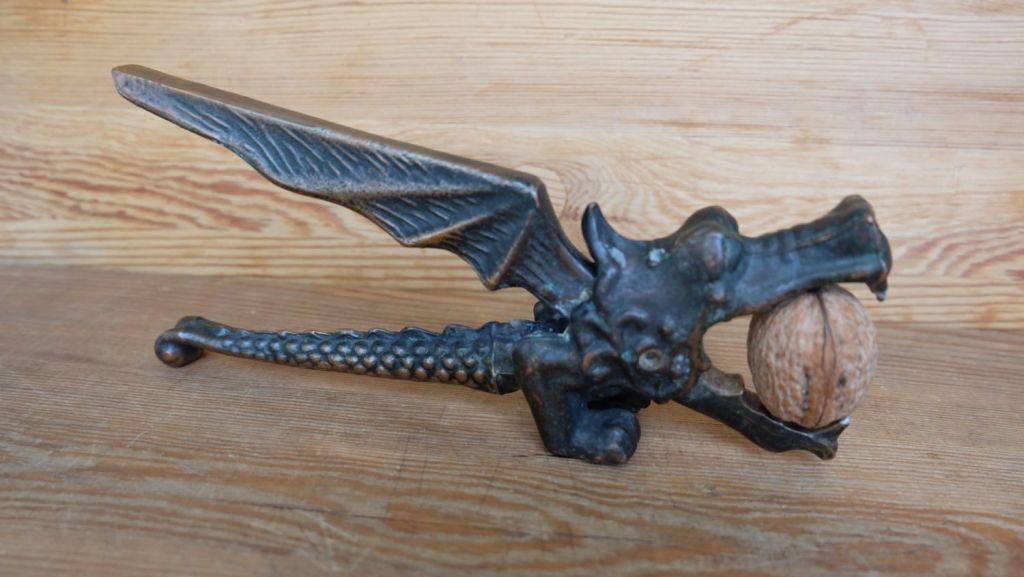
An antique metal dragon nutcracker

During the Victorian era, fruit and nuts were presented at dinner and ornate and often silver-plated nutcrackers were produced to accompany them on the dinner table. Nuts have long been a popular choice for desserts, particularly throughout Europe. The nutcrackers were placed on dining tables to serve as a fun and entertaining center of conversation while diners awaited their final course.”

The wooden nutcrackers we associate with Christmas originated in Germany in the late 17th century in the Ore Mountains. Again, from the Infallible Wikipedia: 

“One origin story attributes the creation of the first nutcracker doll to a craftsman from Seiffen. They were often given as gifts, and at some point they became associated with Christmas season. They grew in popularity around the 19th century and spread to nearby European countries. As the demand grew, nutcracker doll production also began on a mass scale in factories. Friedrich Wilhelm Füchtner  (1844–1923), commonly known in Germany as ‘father of the nutcracker’, began the first mass production of the design (using a lathe) at his workshop in Seiffen in Saxony during 1872.”

As the popularity of the dolls grew, nutcrackers were often given as gifts to children so they could crack the nuts which filled their stockings. Although nowadays stockings are filled with toys and candy, at one time they held nuts and fruits.

Most of the wooden nutcrackers sold today are not equipped to actually crack nuts but are for decorative purposes only. One reason for this is that those always inventive people continued to find better ways to harvest nuts. Today that is done in factories with machines which can crack open large quantity of nuts with efficiency.

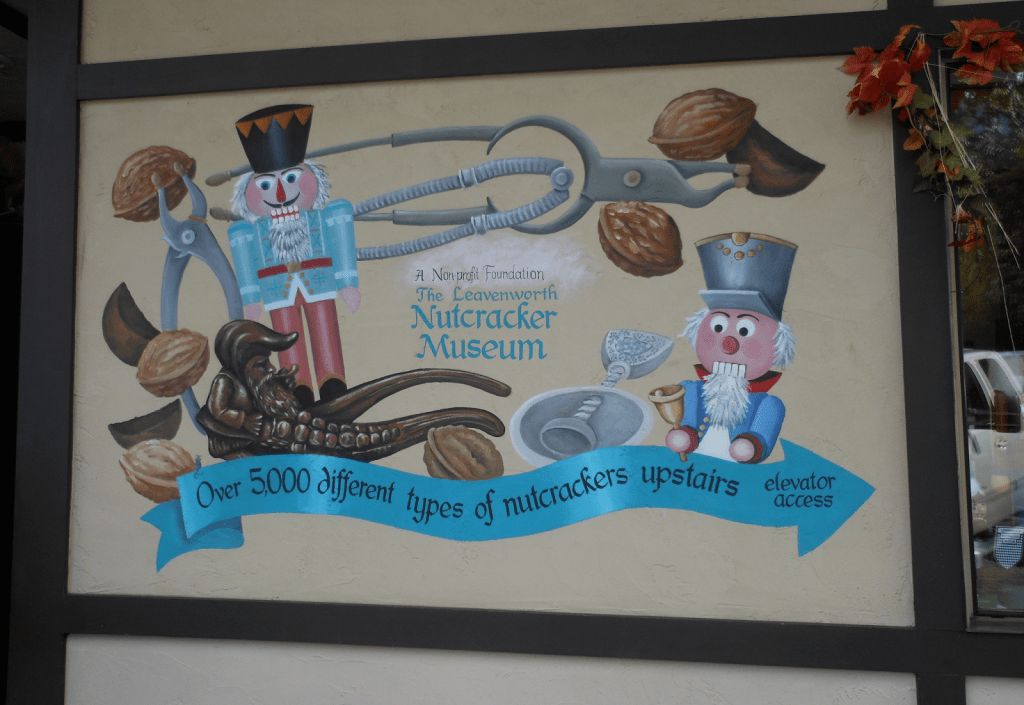
For those who love Nutcrackers a visit to the Leavenworth, Washington, museum is a must see.

I hadn’t much thought about the origin of the soldier nutcrackers until the late 1980’s when the hubby and I lived in the Timberline neighborhood in Sammamish, Washington. (Note – it wasn’t even ‘Sammamish’ at that time, just unincorporated King County!)

As a new development ,Timberline attracted primarily twenty and thirty something professionals who worked in nearby Redmond and Bellevue or commuted to Seattle. Many in the neighborhood were transplants from other states from all over the U.S.

It was never anything official, but Christmas became a big deal in the neighborhood. I suppose that many of us were simply trying to replicate the cozy warmth and hominess of our childhoods by putting up lights and outdoor decorations. Truly, the Timberline neighborhood had more than its share of over the top displays.

But there was one street in particular which gained a reputation for being ‘THE’ must visit lane due, in large part, to resident Peter Johnston and his giant nutcrackers.

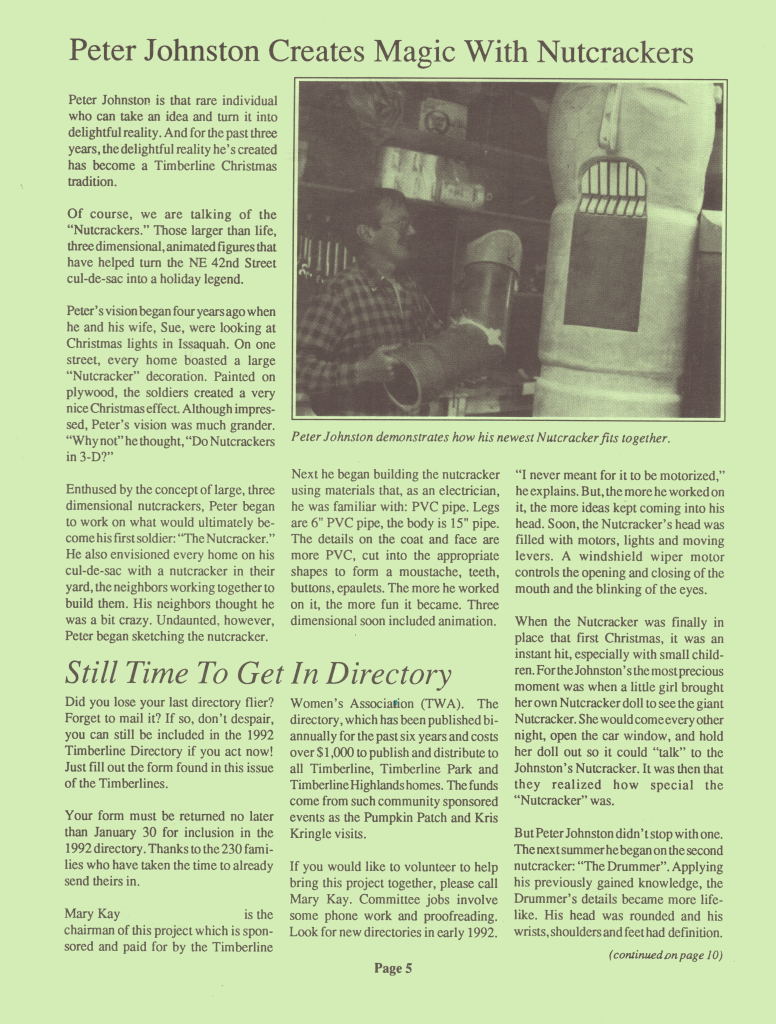
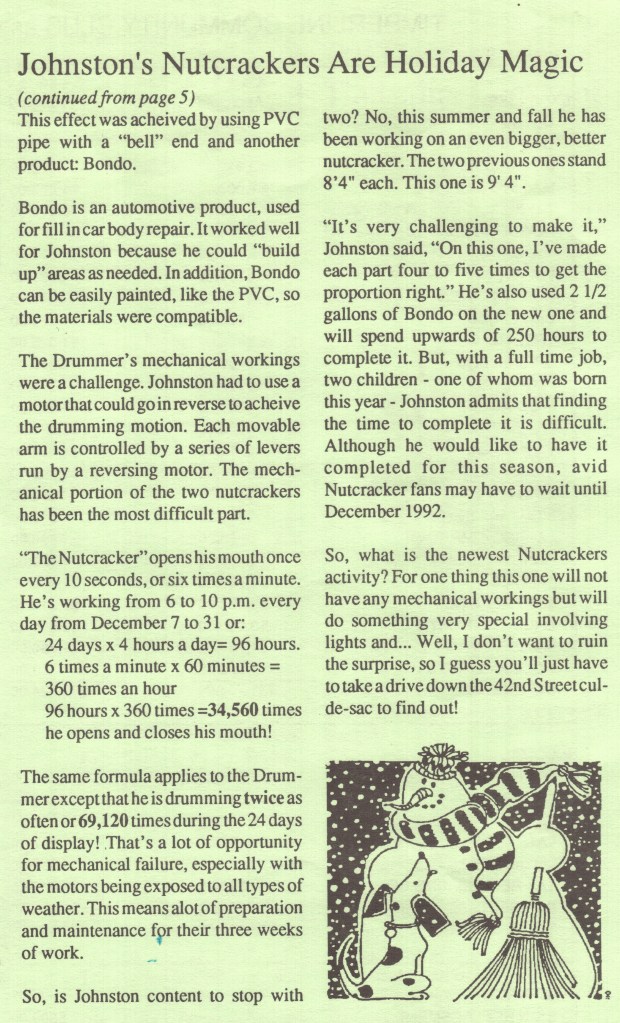
In December 1991, I was the editor of a neighborhood newsletter, The Timberlines, and decided to write a feature story about the Nutcrackers. From my story:

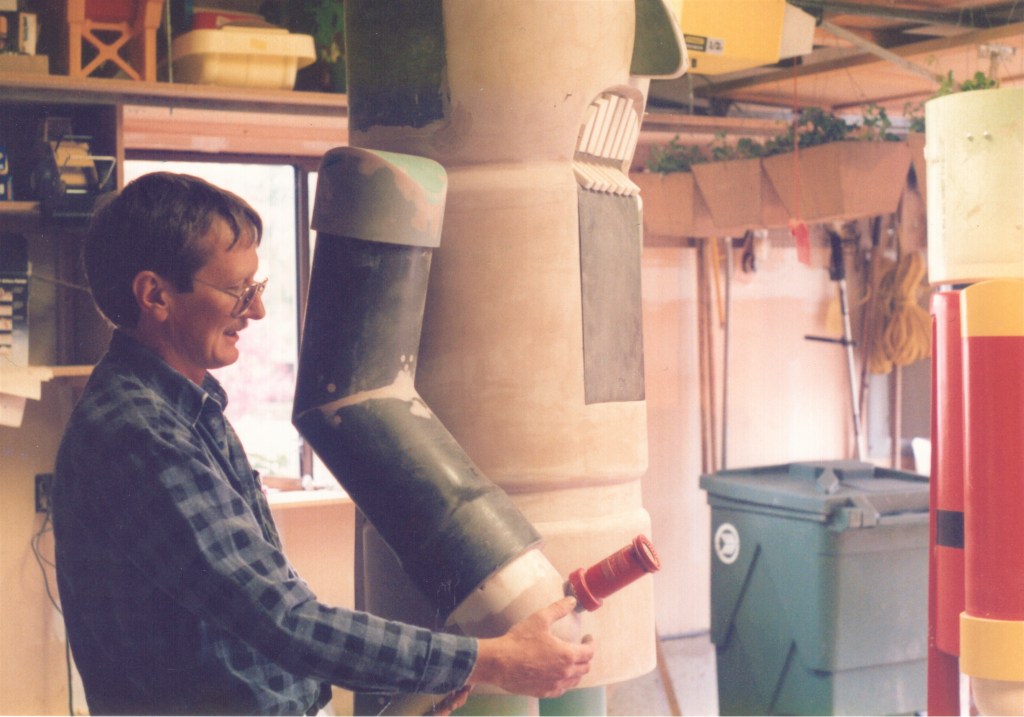
Peter Johnston at work creating his third 3D Nutcracker, the Fireman, in 1991

“Peter’s vision began four years ago when he and his wife, Sue, were looking at Christmas lights in Issaquah. On one street, every home boasted a large ‘Nutcracker’ decoration. Painted on plywood, the soldiers created a very nice Christmas effect. Although impressed, Peter’s vision was much grander. ‘Why not,’ he thought, ‘Do Nutcrackers in 3-D?’”

Peter started creating his 3-D nutcracker using materials he worked with during his day job as an electrician. Soon the ‘Nutcracker’ took on a life of its own and went far beyond simple 3-D. Suffice it to say that when it was finished, the Nutcracker was nearly seven feet tall and its head was filled with motors, lights and moving levers. The mouth opened and closed and the eyes blinked.

Johnston’s original 3D nutcraker how it looked when stored

It was an instant holiday hit. The next year he built a Nutcracker which drummed and the year I wrote the article, he completed a firefighter who held a hose and poured water on a flame.

The article I wrote is far too long to include in its entirety, but I’ve attached it for anyone who wants to read the whole thing.

‘Peak’ Nutcracker was, for us, that Christmas of 1991 when our son was not quite two years old. Every day of December, around five in the late (and dark!) afternoon, we would bundle into the car and he and I would go to see the Nutcrackers. I would have to roll the window down so my son could see them better and talk to them. It was a magical time thanks to the inventiveness of one Nutcracker artist and his vision.

The links:

https://en.wikipedia.org/wiki/Nutcracker

https://en.wikipedia.org/wiki/Nutcracker_doll

Page 1 of the article I wrote in 1991
Page 2 of the 1991 Newsletter article

Leavenworth, Washington

Bavarian Village in the Cascade Mountains

December 21, 2021

This time of year it’s easy to find ‘lists’ of the best holiday and Christmas towns in the U.S. For those who live in Washington State, it’s no surprise to find Leavenworth always on those lists.

A view of downtown Leavenworth during the Christmas light festival, courtesy of Seattlerefined.com

It was named, a few years ago, as the ultimate holiday town by the A&E TV network. No wonder, then, that the place has been overrun in recent years with tourists – especially during November and December.

The Leavenworth story began in 1892 when lumber was king. A sawmill was located on the Wenatchee River and the Great Northern Railway established its terminal there; the last stop before the climb up and over Steven’s Pass to Seattle.

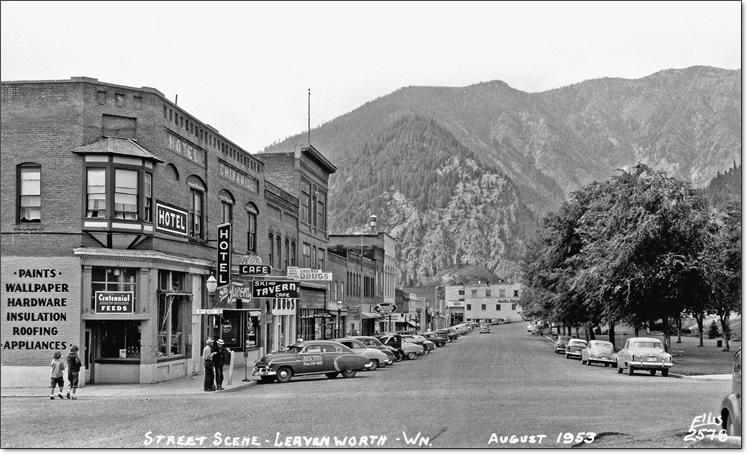
Downtown looking west 1953

The town thrived for several decades until the railway moved the terminal to Wenatchee in 1925. Over the course of the next 25 years the lumber mills closed and residents – with no hope of employment – moved away, leaving much of the town boarded up and abandoned.

Leavenworth could have followed the fate of other small towns, withering away into historical obscurity. But thanks to the vision of two Seattle businessmen, a plan was hatched. The Infallible Wikipedia tells us:

“The city looked to tourism and recreation as a major economy as early as 1929, when they opened a ski jump. In 1962, the Project LIFE (Leavenworth Improvement For Everyone) Committee was formed in partnership with the University of Washington to investigate strategies to revitalize the struggling logging town. The theme town idea was created by two Seattle businessmen, Ted Price and Bob Rodgers, who had bought a failing cafe on Highway 2 in 1960. Price was chair of the Project LIFE tourism subcommittee, and in 1965 the pair led a trip to a Danish-themed town, Solvang, California, to build support for the idea. The first building to be remodeled in the Bavarian style was the Chikamin Hotel, which owner LaVerne Peterson renamed the Edelweiss after the state flower of Bavaria.”

Perhaps the thing which was most compelling for the Bavarian theme is Leavenworth’s incredible natural scenery. At an elevation of 1,170 feet, Leavenworth is noted for its Continental Mediterranean climate. Summer days are primarily sunny and hot but with cool, crisp nights. Winters are typically cold and snowy.

The snowiest winter on record in Leavenworth occurred in 1968-69 when over 18 feet of snow accumulated. The most snow in a single month was December 1996 with 92.3 inches – yes, that’s nearly 8 feet of snow! A typical YEAR is 90 inches.

The mountains to the west rise precipitously, becoming the perfect backdrop for an Alps-like village. In the winter, the picturesque slopes and snow covered trees and hills causes one to stop and ponder.

Leavenworth has, in many ways, become a victim of its success. So popular is the destination that hotel rooms are sold out – often a year or more in advance – for the big festivals and finding a place to park becomes impossible. Seattleites (a generic description of anyone from the Westside of the Cascade mountains) have in recent decades discovered the Bavarian village and cars stream across the mountains in search of a magical experience.

Aerial view of the Icicle Village Resort. The wedding was held on just the otherside of the fence past the pool… lower right of the photo to the left of the parking lot.

As a girl growing up in the 1960’s and 70’s in Yakima, visiting Leavenworth was NOT a thing. The first time I stayed in Leavenworth was when my sister and I hatched a plan to celebrate New Year’s eve there on December 31, 1999 – to ring in the year 2000 (I wrote about that here.)

In the ensuing years, we made the occasional trip to Leavenworth but never again in December. Until this past weekend.

My daughter – having survived the Y2K scare during that 1999 trip – and her fiancé decided they wanted to get married someplace in Washington where there would (they hoped!) be snow. Thus Leavenworth was chosen as the perfect spot. Waaaaaay back in March 2019 right after getting engaged, they visited Leavenworth and reserved their venue at the Icicle Village Resort for December 19th… 2020.

The planning commenced. Save the Date postcards were mailed. A wedding dress was purchased. Attendants secured. All was coming together right up until March 2020 when the world shut down.

There’s nothing quite like a global pandemic to change plans. The ‘wedding’ did happen on December 19, 2020 but with a total of five people present besides the bride and groom: the officiant, the maid of honor, the best man, a photographer, and a videographer.

As the bride’s mother I was not happy with this but also being a realist did not lament over it but resolved to make the best of the situation. As did my daughter and new son in law.

Determination took over and no way were they going to let a little thing like the world being shut down (eat your heart out Y2K – 2020 said ‘hold my beer.’) to stop them from having the wedding event of their dreams.

Fast forward to December 2021. The Pandemic still raged and yet people had finally figured out that the world continued on despite it all.

Thus it was we found ourselves in Leavenworth on Friday, December 17th, preparing for a party. We rehearsed and then picked our way down icy streets to downtown to eat German style sausages and raise glasses of beer (except me – I don’t do beer). The younger folks continued on to a couple other locations while the hubby and I walked back to the resort.

Within a short time of our arrival back, I looked out our window – which had that perfect view of the mountains to the west – and noted that snow had started to fall.

The mothers of the groom and the bride taking care of the garbage bags for chair coverings.

The next morning, the snow continued. Both Stevens and Snoqualmie passes were closed for a time and about a dozen guests opted out.

Even so, just before 4 p.m., those who had made the trek, arrived for the OUTDOOR wedding. Worried about the comfort of the guests, my niece’s husband had graciously – at my behest – gone and purchased white garbage bags so everyone would have dry chairs to sit on. I stood, in my formal dress and snow boots, at where they entered and handed bags to every single person!

And then it was time… first the groom’s mother was escorted down the aisle and then me. The snow fell as if in snow globe, everything blanketed in glittery white.

Next came the officiant and our son-in-law. Then the train of groomsmen followed by the bridesmaids bedecked in shades of blue.

Then, at last, we all stood, turned and watched as my daughter – looking every bit a Bavarian fairytale princess – swept down the aisle on her father’s arm. And I was so very glad she had persisted in her desire to have not one – but two – weddings. It was a magical moment which I will carry with me the rest of my days.

It occurred to me that along the way, Leavenworth would forever hold a special place in our family’s history; an exclamation point for a few important events. I have a suspicion that there’s a whole bunch of Washingtonians who feel the same way.

The Bavarian Bride escorted by her proud Padre.

The links:

https://en.wikipedia.org/wiki/Leavenworth%2C_Washington

https://www.historylink.org/File/9475

https://bestlifeonline.com/american-christmas-towns/

Hallmark Ornaments

Not A Creature Was Stirring, Not Even Chris Mouse

December 8, 2020

When Hallmark introduced these in 1973, no one could even begin to imagine how, over the next 40 plus years, the company would lead the industry through an unprecedented demand for Christmas ornaments.

A display in a Hallmark store, circa 2013

That first year, Hallmark only had 18 different ornament designs available for sale. Apparently buoyed by the success of sales that year, however, the collectible ornaments were expanded the next year. Betsey Clark – a popular artist featuring whimsical big eyed children- had two entries that year, up from one the year before. Seen also for the first time were scenes from Currier & Ives as well as an iconic Norman Rockwell holiday painting. The number of balls was tripled but yarn figures – prominent the first year – were only half of what they’d been in 1973.

It went this way for several more years with more and more Ornament balls being offered… but with a catch. A shopper could not just walk into a Hallmark store or retailer and purchase the exact same ornament they saw the previous year. Each ornament incorporated the production year into the design. Once the baubles were sold out, that was it.

The introduction of annual ornament series spurred interest. Each fall, collectors would rush to the store to snap up the newest one.

My sister’s 1978 Betsey Clark ornament

Surprisingly (at least to this author) is that the Infallible Wikipedia does not have a page devoted just to the Hallmark phenomenon. It does, however, offer up this information on a more generic page:

“In 1973, Hallmark Cards started manufacturing Christmas ornaments. The first collection included 18 ornaments, including six glass ball ornaments. The Hallmark Keepsake Ornament collection is dated and available for just one year. By 1998, 11 million American households collected Hallmark ornaments, and 250,000 people were member of the Keepsake Ornament Collector’s Club. There were as many as 400 local Keepsake Ornament Collector’s Club chapters in the US.  One noted Christmas ornament authority is Clara Johnson Scroggins who has written extensively on the topic and has one of the largest private collections of Christmas ornaments.

In 1996, the ornament industry generated $2.4 billion in total annual sales, an increase of 25% over the previous year. Industry experts estimated more than 22 million US households collected Christmas ornaments, and that 75% of those households collected Hallmark Keepsake Ornaments.”

And, according to the official Hallmark webpage, “What began as glass balls and yarn figurines has grown to more than 8,500 ornaments past and present, and a reputation for quality, craft, and above all, spirit.”

My first foray into the world of Hallmark ornaments began, coincidentally, the year I got married. During a trip into Hallmark I happened to go peruse the ornament section and, there it was, the perfect ornament to commemorate a couple’s first Christmas together.

Our first Hallmark ornament… the reverse says
“Christmas Is A Love Story Written In Our Hearts.”

I had to have it despite the fact that it was an extravagance not in the budget. The hubby was okay with the purchase of it and even another one which featured everyone’s favorite Christmas mouse, Mickey.

From that initial addictive purchase came more. Two more Hallmark ornaments were acquired in 1981. It was 1985, however, when things started to ramp up in my household.

That year saw the introduction of an ornament titled ‘Chris Mouse.’

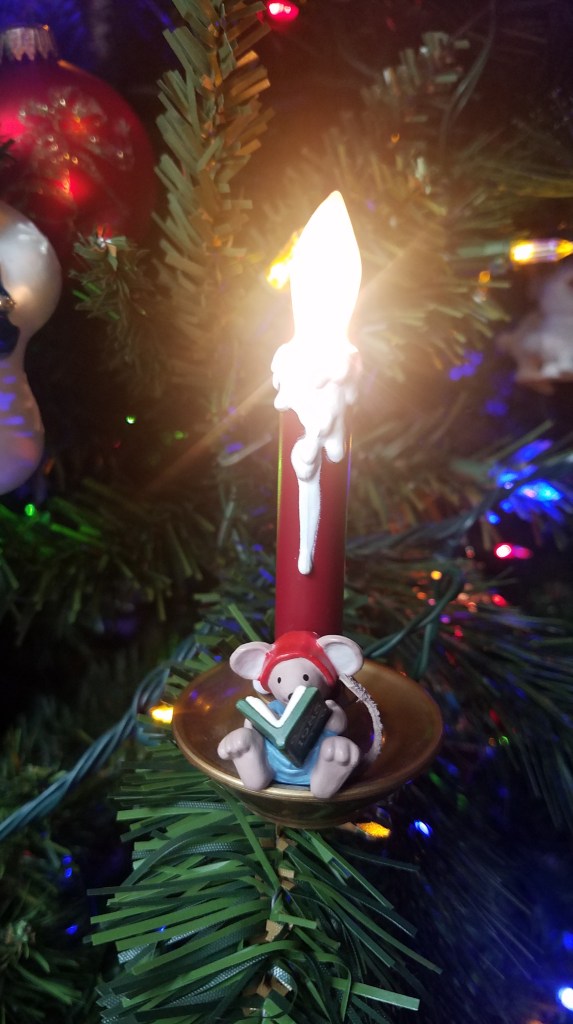
Mr. Mouse was just about the most adorable creature you’d ever seen. His tiny little self was wearing what looked to be a sky blue night shirt and a red night cap. In his teeny hands he held a hunter green book with ‘1985’ on the cover in gold. But best of all was that he was sitting at the base of an old fashioned gold candle holder, leaning against a 4 inch tall red candle. At the top of the candle glows a yellow ‘flame’ which, when the ornament’s cord is plugged into a socket on a string of Christmas lights, is lit up.

I was enchanted and had to have that ornament.

Chris Mouse #1 who captured my heart

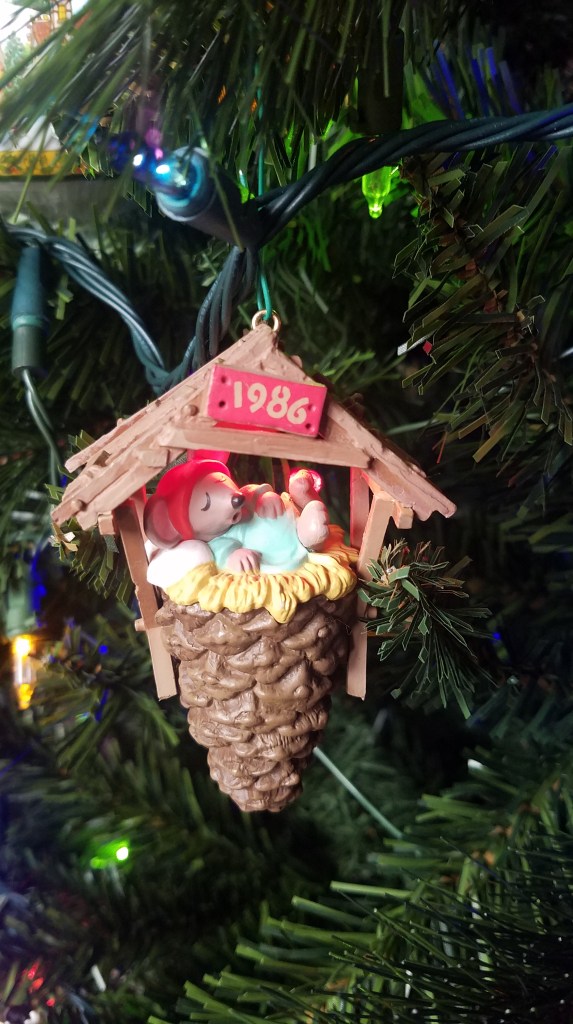
Soon I discovered that my Chris Mouse was only the first in the series. I eagerly looked forward to the next year’s entry. When it arrived in the stores the next fall I wandered in one day to take a look. Like the previous year, it was cute and this time featured Mr. Mouse asleep in a pinecone house, a tiny night light adding to the magic. I didn’t like it quite as well as the first one so I decided I might wait until after Christmas to buy it, maybe even find it on sale.

Sometimes, however, things work against you and such was the case in 1986. Just before Christmas I came down with a bad cold and was laid up for several days including on Christmas. The mouse was forgotten until, a few days after the holiday, I ventured out to the stores to do some bargain hunting. Alas, the second in the series was nowhere to be found.

In the following years, my lesson learned, I always purchased the ornaments I wanted well before Christmas. The Chris Mouse series? Ended up being 13 ornaments in all, each starring the adorable mouse in the blue nightshirt and red cap, each time doing something which featured a lovely little lighted object. It just so happened that I only had 12 of them and, every Christmas, I lamented not having the missing ornament.

Chris Mouse #2 who took years to join the line up

That was until a few years ago when there, under the tree for me one Christmas, was an unexpected surprise. Santa’s helper – who I call hubby – had located the missing Chris Mouse and bought it for me. The prodigal rodent joined his brother’s on the tree, the series now complete.

It takes several large Rubbermaid totes to house all the Hallmark ornaments in their original boxes. One bin is full of the lighted and motion ornaments, the other primarily a collection of whimsical critters. A third tote holds glass balls but only a dozen or so are part of the Hallmark collection.

By the late 1990’s with more than enough decorations to fill at least two trees, I stopped buying ornaments.

2020, however, seems like the perfect excuse to purchase a new bauble with which to commemorate this unusual year. An online search revealed that my local dealer is just down the hill. Time for a shopping adventure…

The links:

https://en.wikipedia.org/wiki/Christmas_ornament

https://www.hallmark.com/ornaments/