Tag Archive | Authors

World Book & Copyright Day

A reason for authors to celebrate

April 23, 2024

A Tuesday Newsday Classic Updated

Near and dear to this author’s heart is World Book and Copyright Day – celebrated annually on April 23. Created in 1995 the purpose of the day is to “recognize the scope of books – a link between the past and the future, a bridge between generations and across cultures.”

One of the more interesting aspects of World Book Day, however, is how the date was chosen and why. The Infallible Wikipedia, as it so often does, offers some insight:
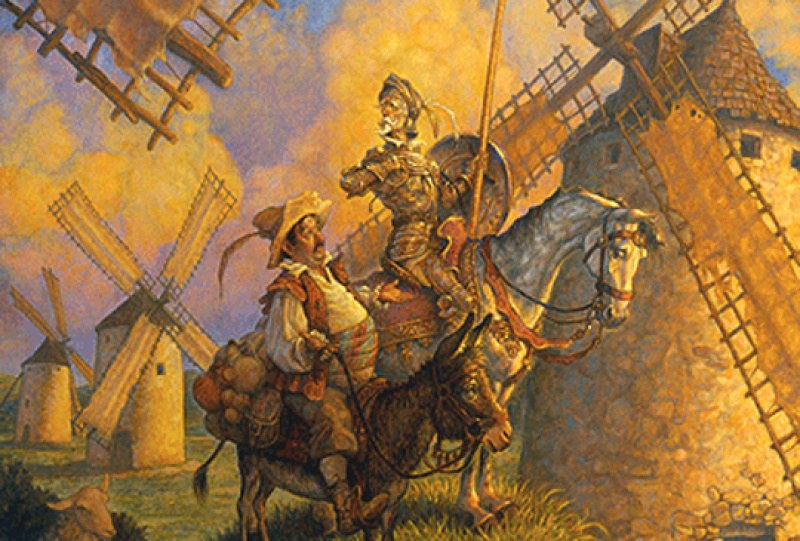
Cervantes is considered the most influential Spanish language author. His most famous work depicted here: Don Quixote.

“The original idea was of the Valencian writer Vicente Clavel Andrés as a way to honour the author Miguel de Cervantes, first on 7 October, his birth date, then on 23 April, his death date. In 1995 UNESCO decided that the World Book and Copyright Day would be celebrated on 23 April, as the date is also the anniversary of the death of William Shakespeare and Inca Garcilaso de la Vega, as well as that of the birth or death of several other prominent authors. (In a historical coincidence, Shakespeare and Cervantes died on the same date — 23 April 1616 — but not on the same day, as at the time, Spain used the Gregorian calendar and England used the Julian calendar; Shakespeare actually died 10 days after Cervantes died, on 3 May of the Gregorian calendar.)”

Shakespeare, perhaps more than any person who has ever lived, was the most impactful of authors. He published 37 plays and 154 sonnets and today, 503 years after his death, his works are still being performed and his written works analyzed and contemplated. Talk about staying power!

William Shakespeare

Several years ago I read a book which made the claim that every plot line ever imagined was written by Shakespeare. Modern writers, it stated, might as well give it up and quit writing stories since they cannot match Shakespeare.

To me, this was a very sad and cynical thought. Plus it misses the point about the human mind, heart, and the individual’s desires – I would argue need – to pursue one’s passions in life.

When I reflect back on my earliest interests, one stands out: the desire to write. What better way to capture one’s thoughts and the emotions of a time and place? I dabbled in fiction writing while in high school and penned a thinly cloaked autobiographical story titled “Another Lunch.” It told the story of Bernice, Deborah, and Cynthia, three friends whose singular focus seemed to be the pursuit of, and interactions with, boys.

I would add to the ‘book’ as new adventures occurred, writing them by hand in a three prong paper keeper over the weekend, then bringing the updated story to school for the ‘real’ Deborah and Cynthia to read. Eventually word of the story got out there and some of the ‘boys’ and other peripheral characters – perhaps recognizing themselves in the story – clamored to read the tome. It was passed around like an annual at graduation for everyone to peruse.

Sadly, “Another Lunch” disappeared in the spring of my Senior year, no doubt carried home and lost in the hovel of some student’s bedroom destined to be discarded by an irritated mother who saw it as worthless. As for me, I kept all my writings from those early years and find them, at times, a somewhat painful reminder of my perspective and (lack of) writing abilities.

Although I dabbled in writing the beginnings of stories a various times over the years, my ‘fiction’ writing mostly lay dormant for years. Then the day came when I walked into a novel writing class at Bellevue Community College.

Author Janet Lee Carey

Taught by published author Janet Lee Carey, it was structured into two parts. The first was a 45 minute lecture on the various elements of writing fiction: plotting, sentence, paragraph, and sentence structure; deciding what sort of book you were going to write; character development; effective dialogue; avoiding cliches. The things one needed to know and learn was extensive. I soaked it up like a teenager getting a tan during summer break.

The second half of each class was an opportunity for all of us aspiring authors to read a scene or two from our current work in progress. It was what happened in the second part of the class that day which confirmed for me that I was a closet novelist who had finally found her home.

I listened to the stories which my classmates shared for critique and a voice inside my own head whispered to me, “You can write just as well…”

Later that day I started on my first novel, determined to find a way to complete a 90,000-word book – standard length. I took inspiration from Janet when she said – and I paraphrase – “If you can write a sentence, then you can write a paragraph… and if you can write a paragraph, then you can write a chapter. After all a novel is just sentences, paragraphs, and chapters all connecting together.”

 There was no better feeling than when, months later, I wrote the words “The End.” I had done it! But it was more than that. Writing provided an outlet for the jumble of thoughts which crowded my brain, a virtual sieve to separate the chaff from the grain.

Now, nearly twenty years later, I am still compelled to write. That class was truly a life changing event.

In addition to fiction, my Tuesday Newsday blog has taken on a life of its own. Now in its eighth year I’ve published 314 articles covering unique topics in categories such as Historical Happenings, My Home Town, Screen Shots, Music Makers, and – a personal favorite – Geeky Musings. I’ve updated a number of articles as I await next year and the opportunity to fill in those 52 dates which have not yet fallen on a Tuesday!
Famous author Snoopy inspires me

But, for me, it doesn’t matter if its novels or short personal essays (such as this one) it’s the writing that matters. I’m truly happiest when I get to spend a portion of the day writing creatively.

Finally, a nod to my fellow ‘Anonymous Authors’, who for the past 20 years have brightened my Tuesday mornings with their stories, critiques, and friendship, especially: Roger, Jette, and Ward my current compadres who meet on Zoom most Tuesday mornings. But also to those who once shared those Tuesdays: Irene, Daphne, Steve S., Steve D. (what she said!), Dee, Joe, and May.

A bit of information about World Book and Copyright day:

https://en.wikipedia.org/wiki/World_Book_Day

https://en.unesco.org/commemorations/worldbookday

Charlotte’s Web

E.B. White’s Magnus Opus

July 11, 2023

An update to a Tuesday Newsday Classic from 2017

“You have been my friend,” replied Charlotte, “That in itself is a tremendous thing.” 

The cover of my 1959 copy of Charlotte’s Web – complete with crayon marks and tears.

It is rare to find a writer whose impact on both children and adults is so impactful, but E.B. White – who was born on July 11, 1899 – was such a writer.

For a writer there is no more monumental handbook than “Elements of Style.” Its dog-eared pages a testament to any author’s quest to use punctuation and grammar correctly. The book was first published in 1918 by William Strunk, Jr. It was in 1959 when it was revised and enlarged by White and now bore both contributors’ names. When a question arises as to ‘how’ to write something correctly, most writer’s will say, colloquially, ‘what does Strunk and White say?’

White spent his life as a writer, the bulk of that on staff with “The New Yorker” magazine. It was when he turned to the writing of children’s literature and, especially, with the publication of Charlotte’s Web, that he became a household name.

My collection of E.B. White books. Doesn’t every writer have not one, but at least two copies, of ‘Elements’?

According to the Infallible Wikipedia:

“White’s editor Ursula Nordstrom said that one day, in 1952, E. B. White handed her a new manuscript, the only version of Charlotte’s Web then in existence, which she read soon after and enjoyed. Charlotte’s Web was published three years after White began writing it. (snip)

Written in White’s dry, low-key manner, Charlotte’s Web is considered a classic of children’s literature, enjoyable to adults as well as children. The description of the experience of swinging on a rope swing at the farm is an often cited example of rhythm in writing, as the pace of the sentences reflects the motion of the swing. In 2000, Publishers Weekly listed the book as the best-selling children’s paperback of all time.”

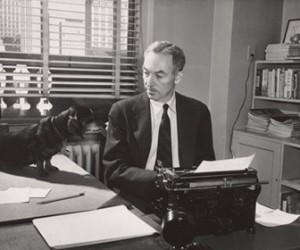
Author E.B. White at work. One of the many dachshunds he had as pets over the years provides editorial supervision.

The book, at one time, was one of the most widely read books by elementary aged children. Somewhere in a dusty box in my parent’s basement is a copy of this wonderful book. A book which I read over and over again, falling in love with a pig named Wilbur and his friend, the spider Charlotte.

The above paragraph is what I wrote when this article was posted on my Blog on July 11, 2017. Two years later, in August of 2019, I did find that copy of Charlotte’s Web and brought it to my house. When I pulled it from the shelf to update this article, I was struck by its appearance. The paper cover was far more dog-eared than I recalled and also bore a couple of crayon marks courtesy of me, no doubt.

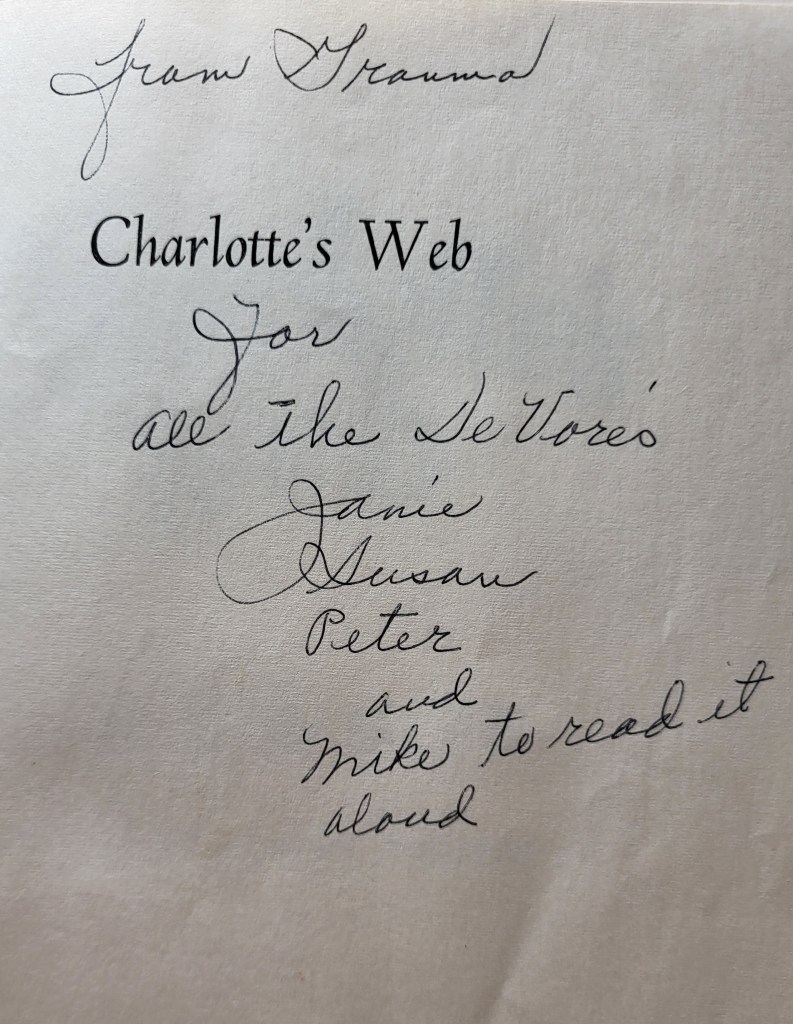
But then I opened the book and there on the first page I was treated to this gem of an inscription: ‘From Gramma For All the DeVore’s’ and our names are listed: ‘Janie, Susan, Peter, and Mike to read it aloud.’

Based on that information I know that the book arrived in my family’s home during the years our family lived in Clarkston, Washington. We were there from late 1958 until the summer of 1961. I was called Janie – my middle name being Jane – during those years as there was an older girl in the neighborhood named Barbara. I’m guessing I was about two at the time which made my siblings four, six, and eleven.

The inscription in the late 1950’s Charlotte’s Web given to me and my siblings from our Grandmother.

But the real story of “Charlotte’s Web” is that it addresses the topic of life and death in a way that made it personal and real for children. We experience grief right along with Wilbur as he learns that his beloved Charlotte is nearing the end. White summed it up in this moving paragraph following Charlotte’s demise:

“Wilbur thought often of Charlotte. A few strands of her old web still hung in the doorway. Every day Wilbur would stand and look at the torn, empty web, and a lump would come to his throat. No one had ever had such a friend – so affectionate, so loyal, and so skillful.”

White handled the topic with gentleness for his young readers, giving us all a great lesson: to love and appreciate those we call family and friends for every day we have with them. And when the day arrives when we have to say goodbye we know that their impact on us and on others was real and meaningful.

In a five day span the last week of June/first week of July I lost not one, but two, such friends. The grief is still raw and palpable. So give out hugs freely, always speak words of kindness, and remember, to love one another.

The links:

https://www.goodreads.com/work/quotes/987048-charlotte-s-web

https://en.wikipedia.org/wiki/E._B._White

Agatha Christie: The Queen of Mystery Novels

What really happened the summer of 1980?

September 15th

Any list of the greatest novelists of the last one hundred years would be incomplete without this person on it. She wrote 66 novels and 14 collections of short stories and also the world’s longest running play, Mousetrap.

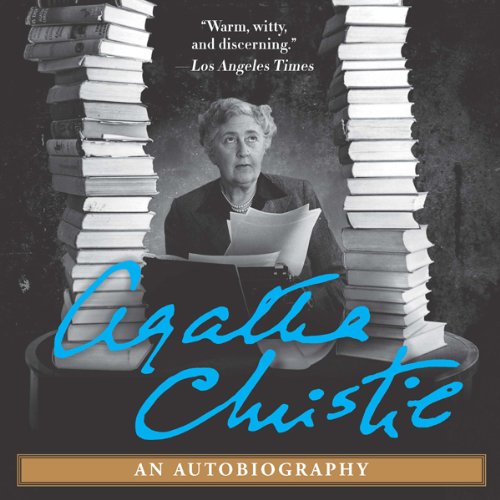
Agatha Christie amid a stack of the
many books she has written

Agatha Mary Clarissa Miller was born on September 15, 1890. We know her as Agatha Christie. The Guinness World Records names her as the fiction author whose books have sold more than any other in history at over 2 billion copies. It’s the sort of success that aspiring novelists can only dream of.

Like most writers, it was a number of years after she began penning her stories before she was published. From the Infallible Wikipedia:

“At eighteen, Christie wrote her first short story, ‘The House of Beauty’, while recovering in bed from an illness. It consisted of about 6,000 words on ‘madness and dreams’, a subject of fascination for her. Her biographer, Janet Morgan, has commented that, despite ‘infelicities of style’, the story was ‘compelling’. (The story became an early version of her story ‘The House of Dreams’.) Other stories followed, most of them illustrating her interest in spiritualism and the paranormal. These included ‘The Call of Wings’ and ‘The Little Lonely God’. Magazines rejected all her early submissions, made under pseudonyms (including Mac Miller, Nathaniel Miller, and Sydney West); some submissions were later revised and published under her real name, often with new titles.

Every aspiring author needs a creepy doll… or two!

Around the same time, Christie began work on her first novel, Snow Upon the Desert. Writing under the pseudonym Monosyllaba, she set the book in Cairo and drew upon her recent experiences there. She was disappointed when the six publishers she contacted declined the work. Clara suggested that her daughter ask for advice from the successful novelist Eden Phillpotts, a family friend and neighbour, who responded to her enquiry, encouraged her writing, and sent her an introduction to his own literary agent, Hughes Massie, who also rejected Snow Upon the Desert but suggested a second novel.

(snip)

Christie had long been a fan of detective novels, having enjoyed Wilkie Collins’s The Woman in White and The Moonstone, and Arthur Conan Doyle’s early Sherlock Holmes stories. She wrote her first detective novel, The Mysterious Affair at Styles, in 1916. It featured Hercue Poirot a former Belgian police officer with ‘magnificent moustaches’ and a head ‘exactly the shape of an egg’, who had taken refuge in Britain after Germany invaded Belgium. Christie’s inspiration for the character came from Belgian refugees living in Torquay, and the Belgian soldiers she helped to treat as a volunteer nurse during the First World War. Her original manuscript was rejected by Hodder & Stoughton and Methuen. After keeping the submission for several months, John Lane at The Bodley Head offered to accept it, provided that Christie change how the solution was revealed. She did so, and signed a contract committing her next five books to The Bodley Head, which she later felt was exploitative.It was published in 1920.”

Until I found this in my image search today,
I did not realize that I wasn’t the only one who adhere’s to this philosophy!

Her personal life was not without strife. When her father died in 1902 – Christie was 11 years old – the family’s financial situation changed. As Christie later said that it marked the end of her childhood.

Despite this, she did manage to participate in British social life and had a number of short lived relationships prior to meeting Archie Christie when she was 22 years old. The two were married on Christmas Eve 1914.

The birth of her only child, a daughter, occurred in 1919. With the death of her mother in 1926 she fell into a deep depression. Two years later she and Archie divorced when he admitted to an extramarital affair.

She did eventually remarry in 1930 to archaeologist Max Mallowan – a marriage which lasted until her death in 1976.

The backdrop to her personal life, however, was always writing. She often incorporated her own experiences and places she’d visited into her novels.

Perhaps the most interesting aspect of this was her work in hospital dispensaries during both World Wars. While there she became familiar with a variety of poisons which found their way into her works. Christie had a real gift in finding creative ways to kill off her characters.

While I cannot recall exactly when I became aware of Christie’s books, I imagine it was probably as a young teenager. Undoubtedly I read a number of her novels but it was the 1974 movie Murder On the Orient Express which truly brought her works to the attention of countless Americans. I have enjoyed all the movies based on her books.

I also believe I saw Mousetrap in London in 1980. Unfortunately, my memory is fuzzy and I’m not sure if I imagined the whole thing. But it does seem as if I did attend the play. It was in mid-July and early August of 1980 when my parents had taken my sister and me on a three week trip to Norway, England, and Scotland.

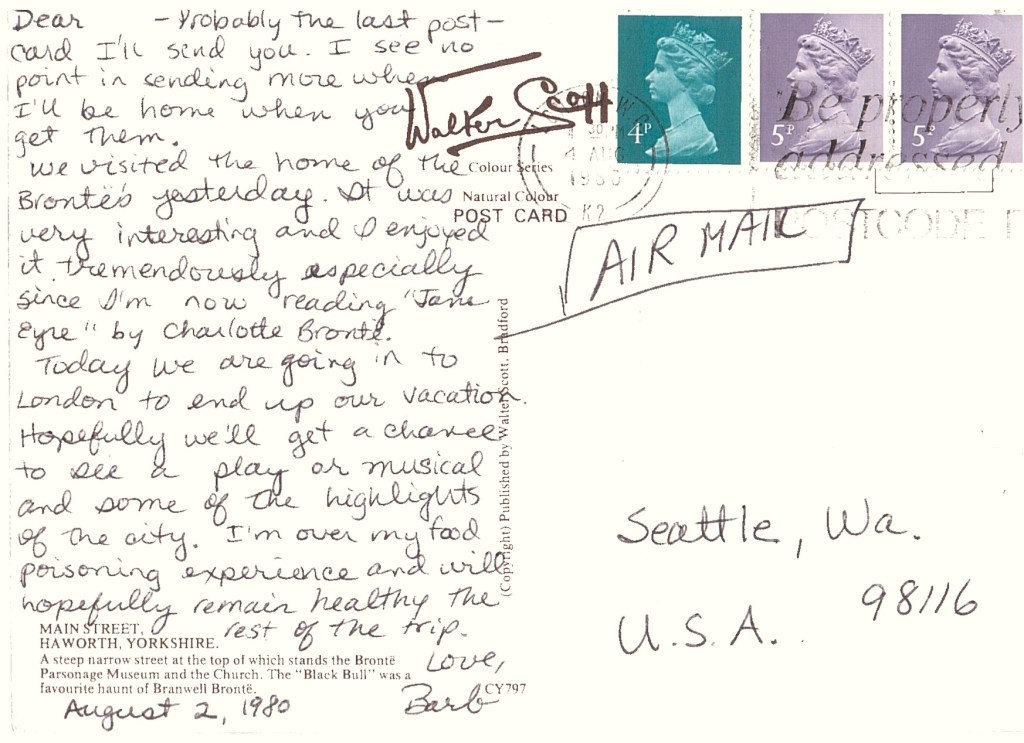
Although we spent the first day in London, the next morning we flew to Bergen, Norway, and began a multi-day bus tour of that country, ending up in Olso. From there, it was fly back to England for car touring as my dad rented a vehicle and we drove up through the countryside to Scotland. After Edinburgh, we returned to London. It was there, on August 2nd, that I write a postcard to my fiancé as follows:

The book I purchased in a London bookshop and read while on the trip; the postcard is the front of the one I sent on my last day in England. This copy of Jane Eyre was likely printed between 1927 and 1936 by Greycaine Ltd., Watford, Herts, Great Britain.

True to what I wrote, it was the final missive I sent. Did I or did I not attend Mousetrap? What was the cause of my malady? Was it truly food poisoning as I believed or had someone doctored my food? Was the ‘poison’ the source of my fuzzy memory? Agatha Christie would, no doubt, approve of such a storyline.

Alas, dear reader, forty years after the fact, it is a mystery which might never be solved. Sounds like the makings of a novel.

The link:

https://en.wikipedia.org/wiki/Agatha_Christie

September 12, 2022 – Update from original post in 2020: The mystery has been solved! Buried in a previously undiscovered box, I found the program from when we attended in 1980. Although it was the 25th year plus three, I still purchased it… for one pound!

The back cover of the program showing St. Martin’s theatre where we saw the Mousetrap in late July 1980
A list of the cast from the evening we were there. I set the paper over the inside facing page for reference