Tag Archive | A.C. Davis High school

The Sigma Kappa Connection

The actual place which inspired the fictional Gamma Alpha Beta Sorority

The Sigma Kappa sorority house at the University of Washington is on the National Historic Site.

The Sigma Kappa sorority house at the University of Washington is an enchanted place. The grandeur begins outside the front of the house with its classy brick façade and a stunning mix of Victorian and Tudor architecture. Truly notable is the three-story high round turret.

Once inside, the turret does not disappoint with its centerpiece being a wide and sweeping circular staircase which invites all eyes upward towards a magnificent crystal chandelier.

For a starry-eyed child, that staircase invited you into a place of fantasy and daydreams; up the stairs one would climb and promenade down them as if a princess, creating stories in one’s head.
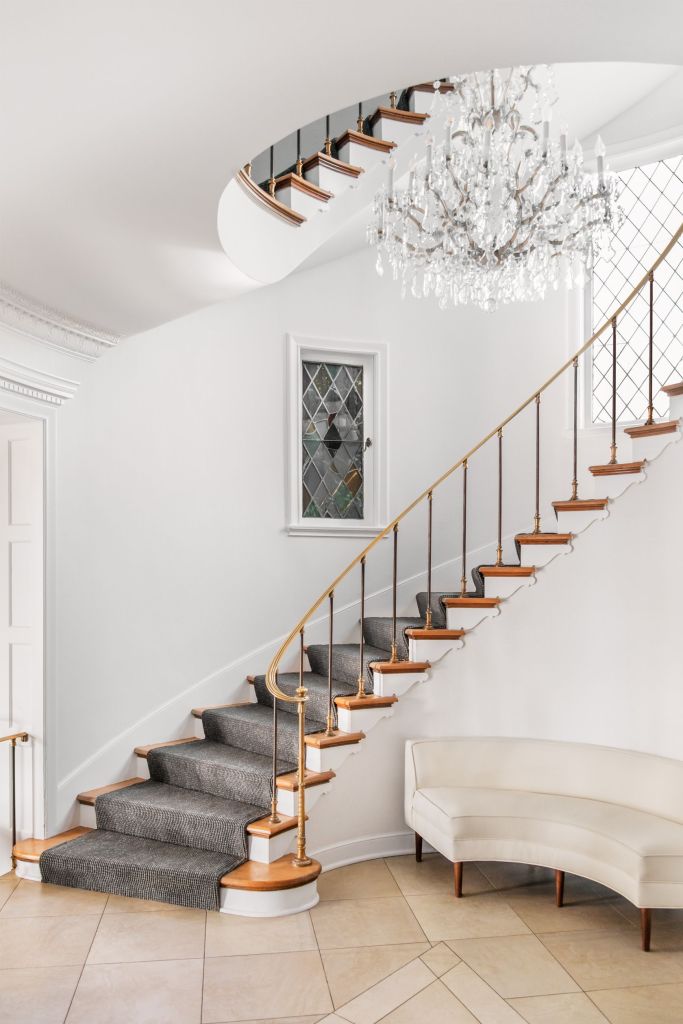
Photo of the staircase as found on Pinterest

My first visit to this magical place was likely in the early summer of 1963. My grandmother, Alma DeVore, had taken a job as the housemother and, with the students gone for the summer, invited my family to come visit her at her new job.

I have no idea how many days we stayed, or if we even slept at the house. My older by two years sister says we stayed nearby at our uncle’s house. I was five at the time and I remember little about the visit to Seattle and the Woodland Park Zoo and more about the Sigma Kappa house.

There was a skybridge which connected the formal living areas to the dining hall and kitchen. In the basement were all sorts of mysterious rooms including one painted bright purple which we were told was the chapter room. Around every nook there was another cranny.

The author captured on a grainy video from 16 mm home movies 1963

Hallways were lined with closed doors to, undoubtedly, the private rooms of the members. At the very top level was a long sleeping porch with parallel rows of bunk beds where all the members slept. There was a back staircase leading to new and interesting spaces. It was the ultimate place to play hide and seek as you could scurry up one set of stairs and down another and through different corridors.

Through photos and documents which she had kept – and are now in my genealogy collection – I’ve determined that my grandmother must have arrived as the housemother beginning in January of 1963.

In 1946, the opportunities for women to earn a living were limited. On September 17th of that year she found herself a widow. Here she was, 46 years old, and with – at most – a high school education; she had no marketable skills beyond having raised three children: my uncle Lyle, my dad, Vince, and their younger sister, Arlene; and managing her own household.

Fortunately for her, she lived in Walla Walla, Washington at the time and was hired as the housemother for the Tau Kappa Epsilon (TKE) fraternity.
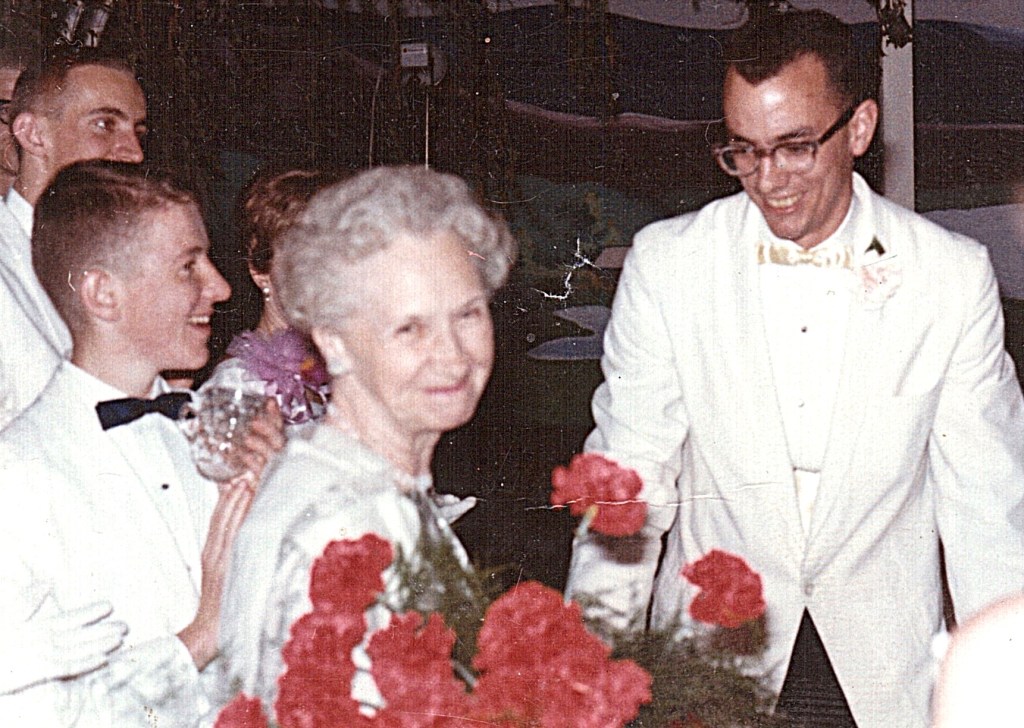
My grandmother with the TKE fraternity members at Whitman College in late 1962 at her Farewell party.

The TKE years were good ones for her from what I’ve been told. She enjoyed the young men who were members and there was a camaraderie with the other housemothers. I can’t say for sure why, exactly, she left Whitman and took the job at the Sigma Kappa house except that it brought her closer to my Uncle Lyle and his family who moved to the Ravenna neighborhood in Seattle in the mid-1950’s. Although my parents lived in Walla Walla after both graduating from Whitman and by oldest brother having been born there, my family had left the community shortly after his birth as my dad had been transferred to Moscow, Idaho with his job at National Cash Register.
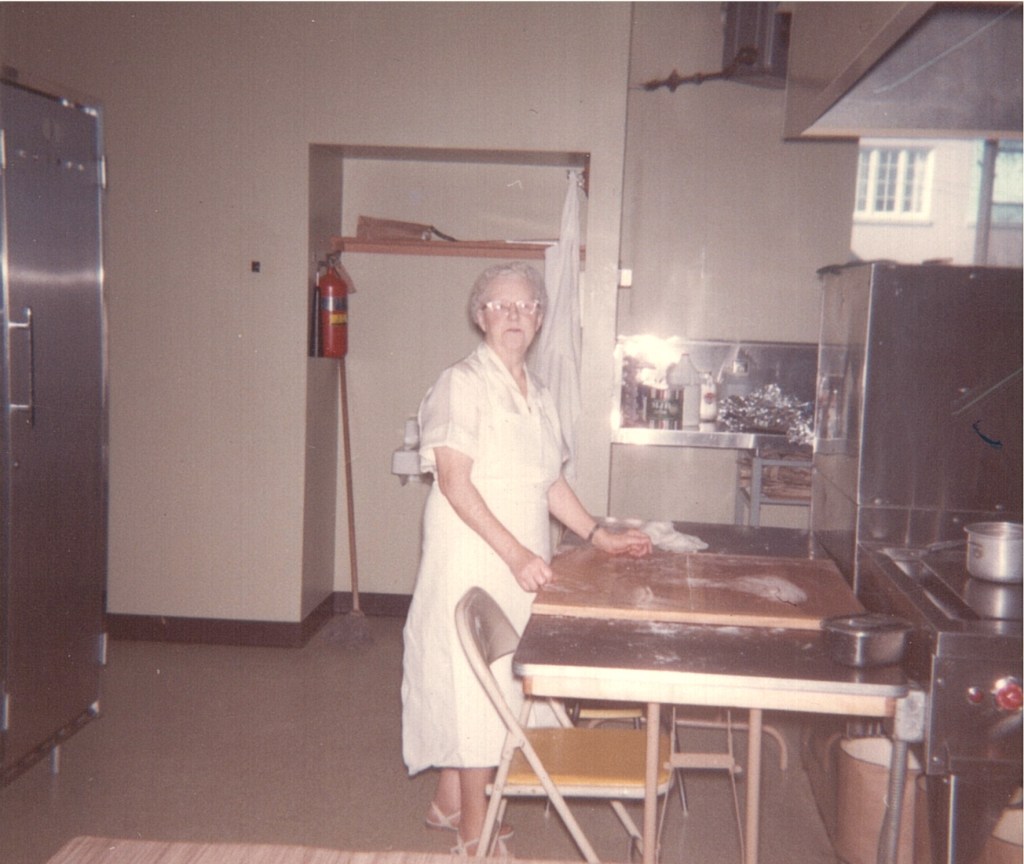
Cook Anna Blomgren in the Sigma Kappa kitchen 1965
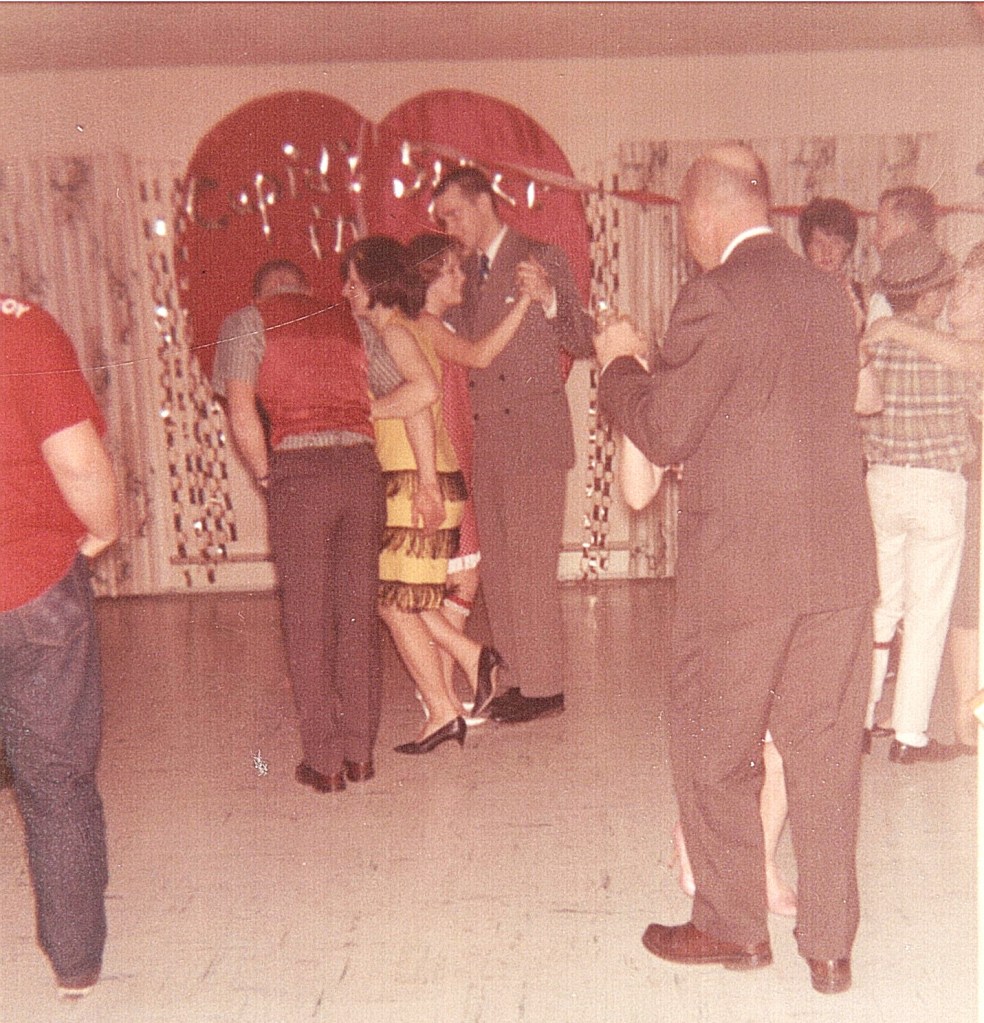
Valentine’s Day ‘Gay 90’s’ shared dance with the Zeta Tau Alpha sorority February 1966

The only other time I know for sure we visited her there is in March 1965. That winter, in Yakima, Washington, where I grew up, the entire town is abuzz. Competing in the State AA Basketball playoffs were our crosstown rivals: D.D. Eisenhower (Ike) and A.C. Davis high schools.

The University of Washington was, I suspect, the best possible choice to be closer to one of her children and family and be able to support herself.

My dad, who had left National Cash Register 1961, returned to college to get a degree in Education, now taught Washington State History to ninth graders. He loved teaching and was invested, particularly, in the local sports community. At the end of the Region 4 semi-final round on March 13th, Ike lost to Davis who was now poised to play at the Seattle Center Coliseum the next Friday.

Although neither of my brothers went with us – my oldest brother attended Ike and would not have anything to do with Davis – my Dad was undeterred and my sister and me – now ages 9 and 7 – were loaded in the 1960 pink Dodge station wagon, and drove with our parents to Seattle on Friday, March 19th.

While I don’t recall a lot of the details, I do know that it was the UW’s Spring break, so the house was empty of sorority girls. And I got to live out every fantasy I had about that house. I was in heaven.
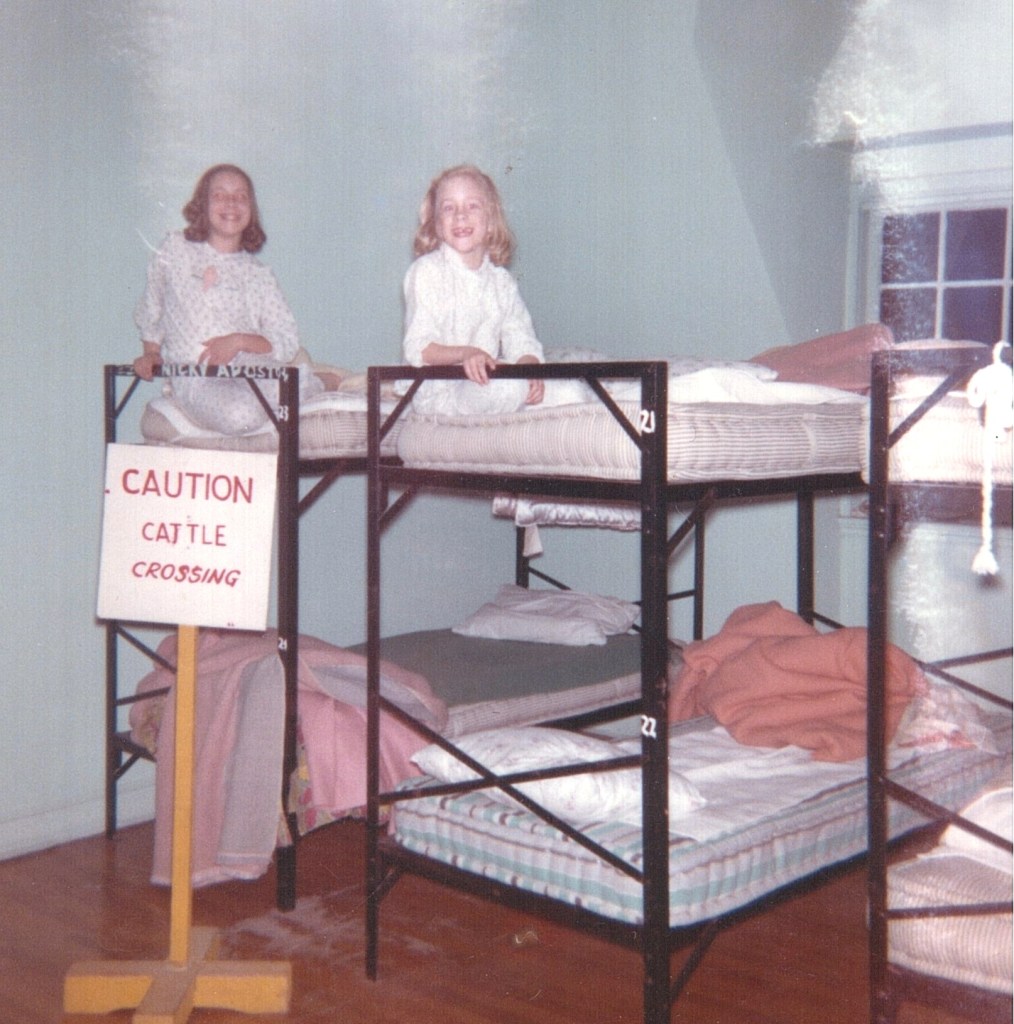
My older sister (left) and me on the Sigma Kappa sleeping porch March 19, 1965.

That evening, while our parents went to the basketball games, my sister and I stayed with our grandmother and even got to sleep on the sleeping porch!

Davis won and would be in the championship game the next evening! Once again, we hung out with grandma while my parents went to the game, my dad thrilled when Davis beat Roosevelt 66-49 for the 1965 AA state basketball championship.

Sometime late that evening, our parents arrived back at the Sigma Kappa House, and put my sister and me to ‘bed’ in the back of the Dodge station wagon. We traveled home that way, snuggled in sleeping bags with our heads on pillows that let us look up at the sky while we drove through the dark mid-March night.

My last memory of that trip is of looking up at the snow falling that night on Snoqualmie Pass, swirling in mesmerizing chaos, with the thick flakes illuminated by car headlights shining through the window behind our heads.

Not the DeVore family car, but ours WAS this same pink color and, apparently, those children also rode without seat belts in the back of the wagon.

My grandmother, born March 15, 1900, seems to have retired at the end of the 1966 academic year. Some 15 years earlier she had bought a house in Spokane. She had it converted to a duplex which she rented out for all those years when she was a housemother! In going through her papers, it was apparent that, despite not having a college degree, she was a determined woman who did not wallow in her grief, but pulled on her work boots to insure her own future. She retired to Spokane and lived in the left half of the duplex, renting the right half out until her much too early death in January 1970.

I have never gone back to the Sigma Kappa house. I think if I did it would seem smaller and less grand than my memories. Instead, it has morphed into the Gamma Alpha Beta sorority, as much a ‘character’ in ‘The Darling of Delta Rho Chi’ as Elise, Riley, Jack, and Virginia.

A few links:

Designation as a National Historic Site:

Have to have one from the Infallible Wikipedia https://en.wikipedia.org/wiki/Sigma_Kappa

A link to the official chapter page: http://washington.sigmakappa.org/

Program from the 1965 State AA basketball championship: https://issuu.com/tacomasportsmuseum/docs/2018.29.02

Article from the Yakima Herald Republic:
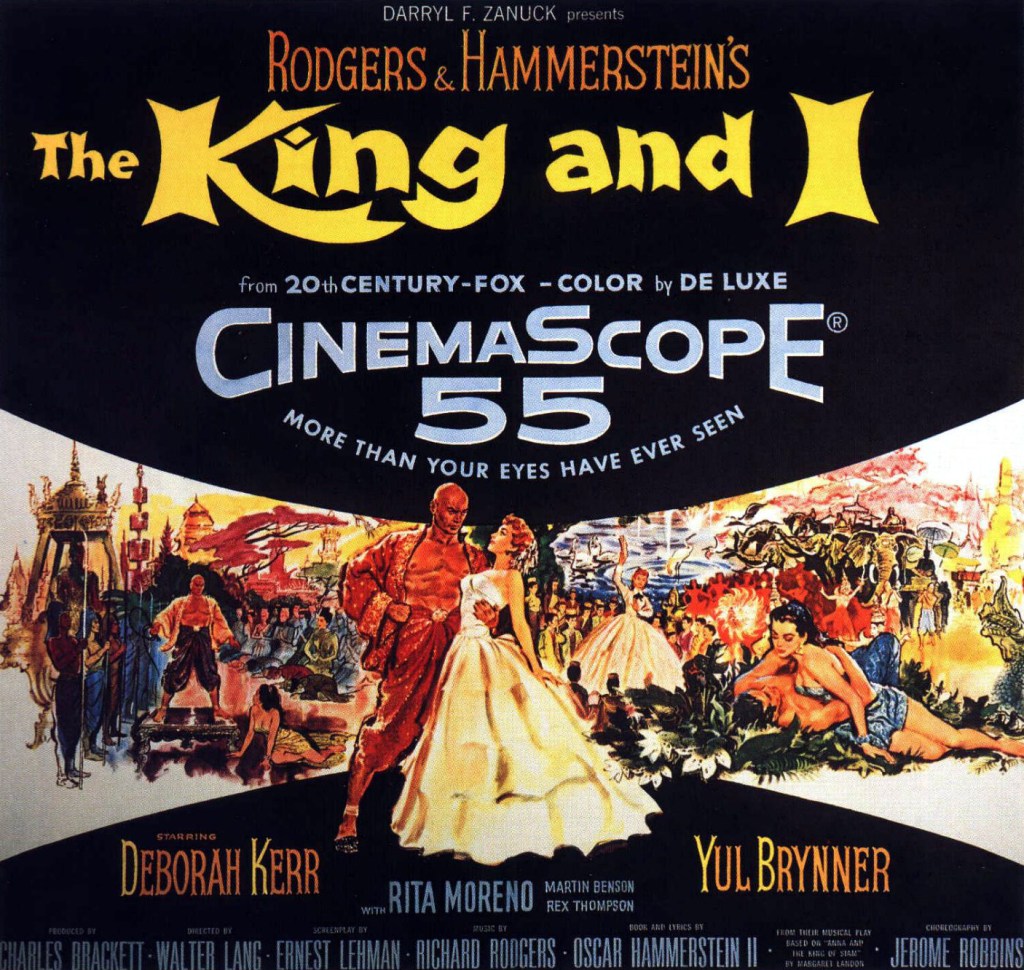
The King and I

Rogers and Hammerstein Hit Musical

March 29, 2022

It is difficult to imagine – in today’s world – this Broadway musical ever being a hit, let alone even being made.

But on March 29, 1951, The King and I opened at the St. James theatre in New York for 1,236 performances. The musical was based on a Civil War era novel which chronicled the travels of widow Anna Leonowens and her two children. From the Infallible Wikipedia:

“In the early 1860s,  (Anna) a widow with two young children, was invited to Siam (now Thailand) by King Mongkut (Rama IV), who wanted her to teach his children and wives the English language and introduce them to British customs. Her experiences during the five years she spent in the country served as the basis for two memoirs, The English Governess at the Siamese Court (1870) and Romance of the Harem (1872).

(Novelist Margaret) Landon took Leonowens’ first-person narratives and added details about the Siamese people and their culture taken from other sources. The book has been translated into dozens of languages and has inspired at least six adaptations into various dramatic media:

  • Anna and the King of Siam (1946 film)
  • The King and I (1951 stage musical)
  • The King and I (1956 film musical)
  • Anna and the King (1972 TV series)
  • The King and I (1999 animated film musical)
  • Anna and the King (1999 film)

At the time of its publication, The New York Times called it ‘an inviting escape into an unfamiliar, exotic past… calculated to transport us instantly.’ The Atlantic Monthly described it as “enchanting” and added that ‘the author wears her scholarship with grace, and the amazing story she has to tell is recounted with humor and understanding.’”

For those of us over a certain age, the iconic actor Yul Brenner will forever be remembered as the epitome of the King of Siam; his blunt manners, assertive personality, and certainty of his God-given right to be the ruler, belonging to a different time and era.

And yet audiences everywhere were charmed by the musical, being drawn into a world that no longer existed, by characters who – in our own time and place – would not exist.

For those unfamiliar with the story, here’s the summary of the musical from The Infallible Wikipedia:

“A widowed schoolteacher, Anna, arrives in Bangkok with her young son, Louis, after being summoned to tutor the many children of King Mongkut. Both are introduced to the intimidating Kralahome, Siam’s prime minister, who escorts them to the Royal Palace, where they will live, although Anna had been promised her own house. The King ignores her objections and introduces her to his head wife, Lady Thiang. Anna also meets a recent concubine, a young Burmese, Tuptim, and the fifteen children she will tutor, including his son and heir, Prince Chulalongkorn. In conversation with the other wives, Anna learns Tuptim is in love with Lun Tha, who brought her to Siam.

Anna still wants her own house and teaches the children about the virtues of home life, to the King’s irritation, who disapproves of the influence of other cultures. She comes across Lun Tha and learns that he has been meeting Tuptim in secret. He asks her to arrange a rendezvous. The lovers meet under cover of darkness, and Lun Tha promises he will one day return to Siam and that they will escape together.

King Mongkut becomes troubled over rumors that the British regard him as a barbaric leader and are sending a delegation, including Anna’s old lover, Sir Edward, possibly to turn Siam into a protectorate. Anna persuades the King to receive them in European style by hosting a banquet with European food and music. In return, the King promises to give Anna her own house.

Sir Edward reminisces with Anna in an attempt to bring her back to British society. The King presents Tuptim’s version of Uncle Tom’s Cabin as a traditional Siamese ballet. However, the King and the Kralahome are not impressed, as the play involves slavery and shows the slaveholding King drowning in the river. During the show, Tuptim left the room to run away with Lun Tha.

After the guests have departed, the king reveals that Tuptim is missing. Anna explains that Tuptim is unhappy because she is just another woman in his eyes. The King retorts that men are entitled to a plenitude of wives, although women must remain faithful. Anna explains the reality of one man loving only one woman and recalls her first dance before she teaches the King how to dance the polka, but the touching moment is shattered when the Kralahome bursts into the room with the news Tuptim has been captured. For her dishonor, the King prepares to whip her despite Anna’s pleas. She implies he is indeed a barbarian. The King then crumples, puts his hand over his heart, and runs out of the room. The Kralahome blames Anna for ruining him as Tuptim is led away in tears after learning Lun Tha was found dead and dumped into the river. That causes Anna to sever all ties as a governess and declare she will leave on the next boat from Siam.

On the night of her departure, Anna learns that the King is dying. Lady Thiang gives Anna his unfinished letter stating his deep gratitude and respect for her, despite their differences. Moments before the ship departs, he gives Anna his ring, as she has always spoken the truth to him, and persuades her and Louis to stay in Bangkok. He passes his title to Prince Chulalongkorn, who then issues a proclamation that ends slavery and states that all subjects will no longer bow down to him. The King dies, satisfied that his kingdom will be all right, and Anna lovingly presses her cheek to his hand.”

I cannot recall if I first saw the musical on TV or if my initial exposure was as an elementary school student during an outing to A.C. Davis High school in the fall of 1968 to see it performed live.

What I do know is that it made an impression on me. A couple of memories stand out. In the fall of 1968 I was in sixth grade. Every fall and spring it was tradition for the elementary school students in the Yakima School District to get to attend the musicals put on by the two high schools: Davis in the autumn and Eisenhower in the spring.

I loved going to Davis for theirs if for no other reason than their building was impressive in a way that Eisenhower’s was not. Davis’ theatre was in a two tiered auditorium with carved columns and an expansive stage that – if you were seated in the balcony – you got to look down on and appreciate the grandeur.

The second reason was, no doubt, due to WHO the choir director was. At the time I did not have an appreciation for what Mrs. (Aletha) Lee Farrell brought to the Yakima community. I do know that my father – by then a teacher at Franklin Junior High – always spoke highly of the woman. What I have learned recently is that Mrs. Farrell was a Julliard trained vocal coach. Yes, Julliard.

A.C. Davis High School productions were always top notch. Due, no doubt, to Lee Farrell’s influence. That particular year she had two female performers who each brought something extra to the stage. The first was a young woman by the name of Nancy Caudill. The other was Oleta Adams. Caudill was the lead as Anna while Adams played the role of the tragic Tuptim.

Both went on to pursue music careers. Nancy in opera and music education and Oleta as a Jazz and Blues singer. Links for both are below.

At the time, of course, it never occurred to me that you don’t have singers of that caliber every year let alone TWO the same year. Whatever Mrs. Farrell was doing at Davis High School she was outstanding at identifying and developing talent.

The two singers in their 1968 yearbook

Which has led me to my musings of today. Somewhat belatedly I’ve come to appreciate the time and society in which I was raised. My generation’s parents and grandparents had a much broader view of what a society should do for its members. Those things involved exposing their children to a more refined culture and elevating such things as music and the arts. Could all of us be outstanding musicians? Of course not. But that was never the point. The Nancy Caudill’s and Oleta Adam’s were the rarity; and while one would likely never experience those sorts of successes, we all benefited by seeing and hearing those whose talent was developed and shared by teachers such as Mrs. Farrell.

I can appreciate the tragic storyline of The King and I and be moved by the Rogers and Hammerstein songs. And I can also appreciate that for one afternoon when I was eleven years old, I got to experience something rich and beautiful; fortunate enough to grow up in a time and place when education immersed us in cultured experiences.

Some links:

https://en.wikipedia.org/wiki/The_King_and_I_(1956_film)

http://www.nancycaudill.com/bio.html

https://en.wikipedia.org/wiki/Oleta_Adams