Tag Archive | 1977

A Font of Fun? No Fooling!

April 1st

You’d pretty much have to be living on an island far from civilization to NOT know that today is April Fool’s Day. It’s celebrated each year on April 1st.

Considered by many as the greatest hoax of all time is this 1957 BBC documentary about harvesting spaghetti from trees. https://en.wikipedia.org/wiki/Spaghetti-tree_hoax

The day has murky beginnings which date back hundreds of years. Some say that Geoffrey Chaucer, in the unreadable ‘Canterbury Tales’, makes reference to the day. But that’s disputed. In 1508 some obscure French poet I’ve never heard of wrote about ‘poisson d’avril’ – translated ‘April’s Fish’ – which apparently doesn’t mean fish but ‘fool.’ Yet another theory is that at one time the new year was marked as being on March 25th but was then changed to January 1st (Actually March 25th makes more sense what with spring, birth, and renewal, but whatever). Those who clung to their old traditions were derided as Fool’s and I guess it took 6 days of their protests against moving New Years before someone decided to take any action.

The previous paragraph is, however, as in depth as I plan to go regarding the origins as, quite honestly, it’s a bit boring for this day devoted to mirth and mischief. Sadly, I found the Infallible Wikipedia article to be deadly serious and who wants that?

Anyway, I had soon climbed down the rabbit hole that is the internet and found a website truly worthy of April Fool’s Day: The Museum of Hoaxes. OMG. I knew I could spend hours reading about all the clever things people have conjured up to fool others. Decisions, decisions. WHICH of the hundreds of hoaxes was worthy of Tuesday Newsday fame? It was a weighty decision.
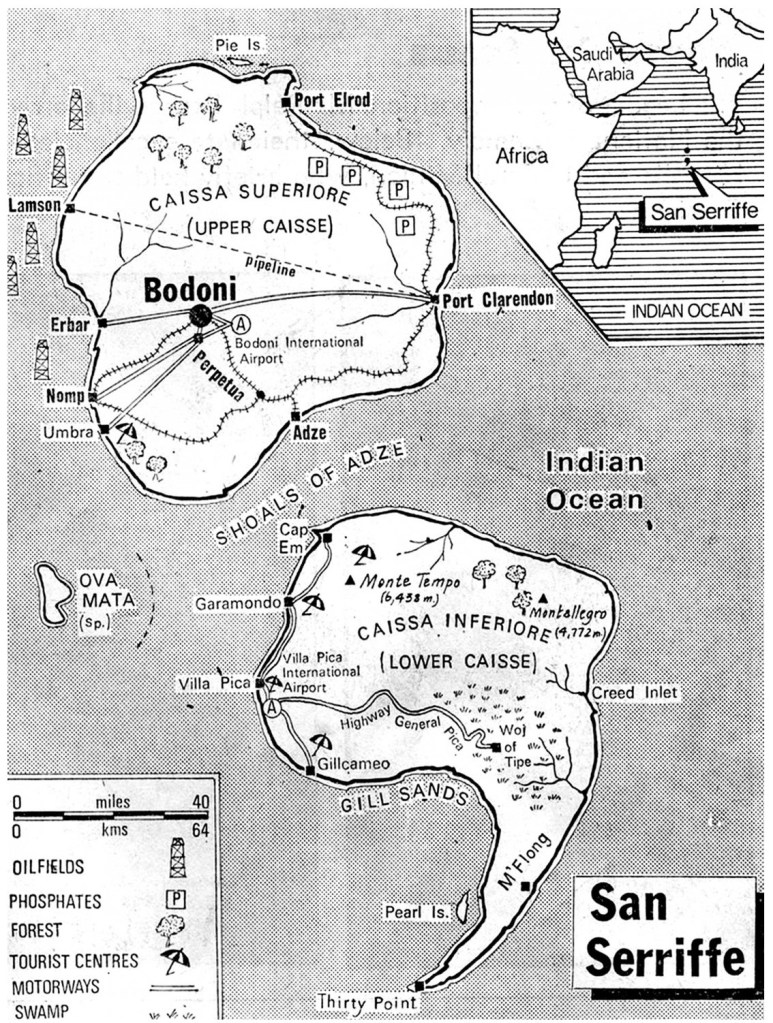
The islands of San Serriffe are a Perpetua(l) delight

Presenting the Island of San Serriffe!

As a writer, word nerd, and someone whose earliest childhood goal was to be able to create programs, newsletters, flyers, etc., the name San Serriffe resonated.

The year was 1977 and the British newspaper, The Guardian, was looking for something fun as a joke for their April Fool’s Day edition. Brainstorming occurred and the results were hilarious. From the hoaxes.org website:

“On April 1, 1977 the British newspaper The Guardian published a seven-page ‘special report’ about San Serriffe, a small republic located in the Indian Ocean consisting of several semi-colon-shaped islands. A series of articles described the geography and culture of this obscure nation.

The report generated a huge response. The Guardian‘s phones rang all day as readers sought more information about the idyllic holiday spot. However, San Serriffe did not actually exist. The report was an elaborate April Fool’s Day joke — one with a typographical twist, since numerous details about the island (such as its name) alluded to printer’s terminology.

The success of this hoax is widely credited with inspiring the British media’s enthusiasm for April Foolery in subsequent years.”

The best part of this story is, for me, the map. These people had waaaaaay too much time on their hands apparently.

The capital of San Serriffe: Bodoni; There’s Monte Tempo and Montallegro; Creed Inlet and Thirty Point; Villa Pica International airport and a beach town named Garamondo. Truly, the map is a font of fun.

I’m a bit sad that it took me over 40 years to learn about San Serriffe since, in 1977, I was heavily involved in the world of publishing. I was one of three editors for the weekly Yakima Valley Community College “Galaxy” and also the youth editor of the Washington Idaho Rainbow Girls newsletter titled “The Confidential Observer.”
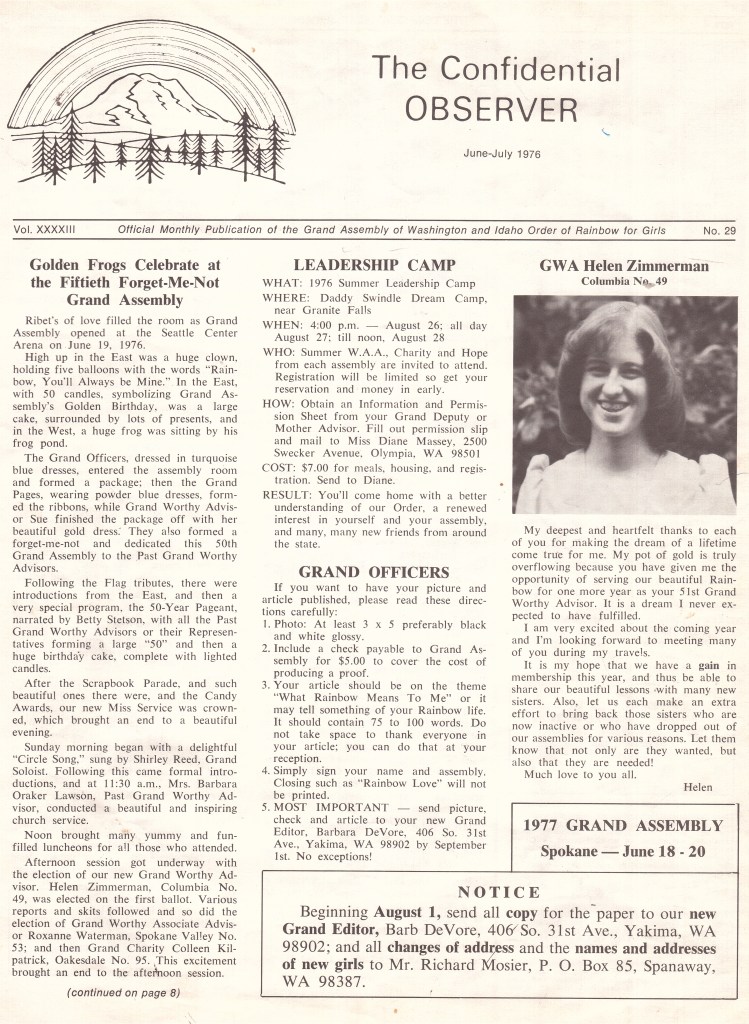
I was hungry to learn everything there was about journalism, writing, and layout. One of my big passions was experimenting with new fonts. I could not get enough of them!

The adult advisors for the Rainbow Girls publication, I’m certain, had no idea what hit them that year as I shook things up, at least in the world of Fonts. Well, and layout and artwork and, pretty much everything I was capable of changing. The fonts went from Helvetica and Times New Roman to Garamond and Bodoni to name a couple of them.

I changed the mast head; I varied the font sizes; I used boxes around things to emphasize and tried to make it more aesthetically pleasing.
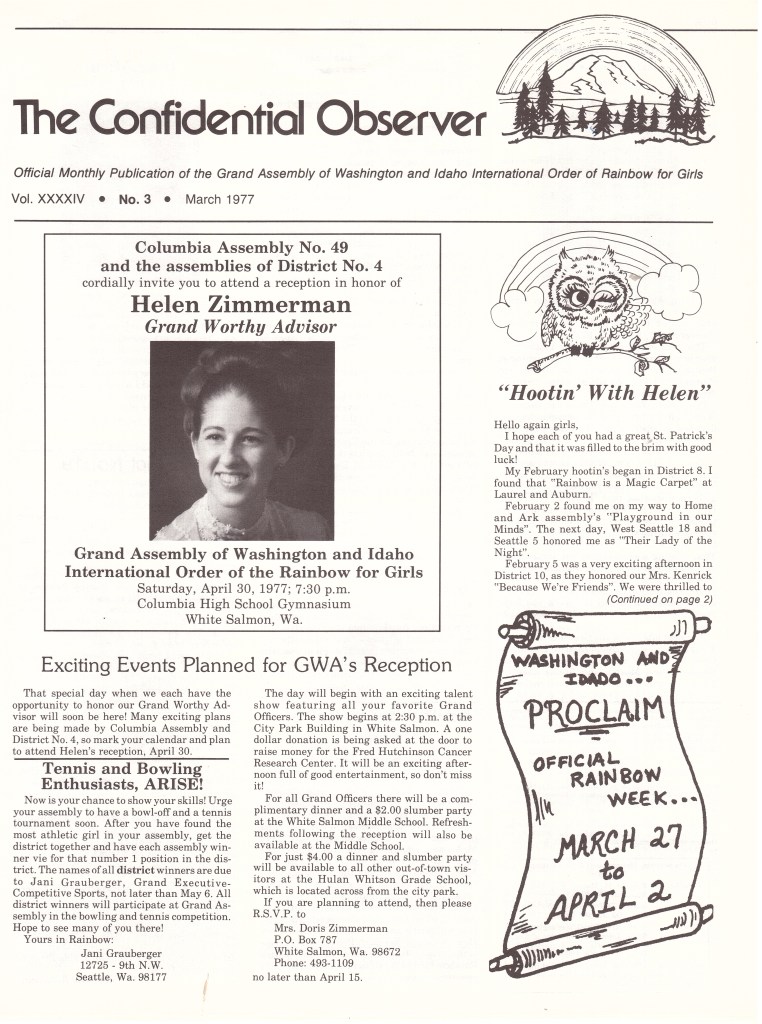
Two versions of the front page of the Rainbow Girls paper. Top is how it looked the issue before I started changing things. Bottom is how it looked six months later.

Now, way back in the dark ages, publication was not a simple thing. First I had to get articles from people from all over the states of Washington and Idaho who mailed them in envelopes. Some of these came handwritten on notebook paper, full of spelling and grammatical errors. I often had to retype and all had to be edited. When that was done I would mail it all from where I lived in Yakima to the printers in Tacoma, who then retyped it (with the fonts I’d chosen) and created galleys to fit our three-column format. These were then returned to me via mail. I would cut – with an exacto knife – the galley articles and glue the proofs on to paper in the correct configuration with everything marked as to where it was supposed to go and then would cross my fingers that they did it right. Spoiler: not always.

It was the fall of 1976 and the artwork that was to top the column for our state president that year had gotten lost by them. I sent in my package a hastily drawn picture (I’m no artist!) with a note attached saying “this is sort of what the artwork looks like that’s missing” and asking them to look around for it. Instead of reaching out, however, they ‘published’ what I had sent. It was awful and upsetting and bothers me to this day. Eventually, they found the missing clipart.
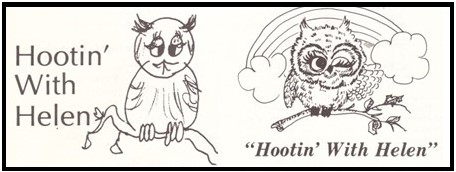
To this day I cannot fathom any professional printer looking at the owl on the left and thinking that’s what they should print…

With the introduction of the Apple Macintosh and their GUI (Graphical User Interface) layout in the mid-1980’s, I was finally able to create a newsletter on a computer and print it out. It was then I got my first laser printer. It was still a clunky process and the clipart was lacking, but it moved me forward.

Over the years as the GUI technology has improved, my ability to create has expanded. Artificial Intelligence has made it even easier.

So hats off to San Serriffe Island. I found the above picture of the island through an easy Google search, saved it as a jpg, and then printed it on my less than $200 Epson printer. I’m sticking it in a frame and hanging it in my office and will look at it often and cheer the fun of April Fool’s Day and 1977, the year of San Seriffe’s creation.

As always a few links:

https://hoaxes.org/archive/permalink/san_serriffe

https://hoaxes.org/af_database/display/category/guardian

https://en.wikipedia.org/wiki/April_Fools’_Day
You Light Up My Life

A mega hit for Debbie Boone

November 19, 2024

A Tuesday Newsday Classic updated

On November 19, 1977, this song was in the middle of a 10 week run as the number one song in America. You Light Up My Life was the one and only Top 40 hit from Debbie Boone, daughter of 50’s teen idol Pat Boone. It reached number one on October 15 and stayed in that position through December 23, making it – at the time – the only recording to stay that long in the top spot in Billboard history.

According to the Infallible Wikipedia:

“Besting her chart performance in Billboard, Boone’s ‘You Light Up My Life’ single topped Record World’s Top 100 Singles Chart for an unbroken record of 13 weeks. On Billboard’s chart, Boone was unseated from #1 by the Bee Gees, with ‘How Deep Is Your Love,’ the first of three #1 singles from the ‘Saturday Night Fever’ soundtrack. On Record World’s chart, Boone kept the Bee Gees out of the number-one spot. In Cash Box Magazine, ‘You Light Up My Life’ managed only an eight-week stay at the top of the chart, before being dethroned by Crystal Gayle’s ‘Don’t It Make My Brown Eyes Blue’.

The single, which was certified Platinum by the Recording Industry Association of America (RIAA), also hit #1 on the Adult Contemporary chart and reached #4 on the Country chart. The single peaked at #48 I’m the UK Singles Chart. Boone’s hit single led to her winning the 1978 Grammy Award for Best New Artist, with additional Grammy nominations for Best Pop Vocal Performance, Female and Record of the Year. Boone also won the 1977 American Music Award for Favorite Pop Single.

Decades after its release, the Debby Boone version is still considered one of the top ten Billboard Hot 100 songs of all time. In 2008, it was ranked at #7 on Billboard’s ’Hot 100 All-Time Top Songs’ list (August 1958 – July 2008). An updated version of the all-time list in 2013 ranked the song at #9.

Although it was written by (Joe) Brooks as a love song, the devout Boone interpreted it as inspirational and proclaimed that it was instead God who ‘lit up her life.’”

The song was tainted by controversy, however, as songwriter Brooks apparently did not want to pay the agreed upon amount owed Kasey Cisyk, the artist who sang it for the movie of the same name, and whose version is included on the 1977 soundtrack.

Boone was told, when recording the song for release as a single, exactly how to sing it and her vocals were dubbed onto the original orchestral track.

At the time, I recall that Boone received much derision and the song was labeled as saccharin. In reading what occurred, however, I feel bad for both the women caught up in the controversy. Perhaps Cisyk was denied her shot at a Top 40 career and, perhaps, Boone was lulled into a sense of inevitability that she would become a star like her father. Although in listening to both versions, I think Boone’s is better.

Boone released additional songs into the pop market, but none ever came close to the success of “You Light Up My Life.” Her career eventually led her back to country music – where she had started – and then to work in the Christian music world.

In the fall of 1977, you simply could not avoid the song. It was played hour after hour on the radio. That autumn was one of the most memorable in my life: I was living away from my parents for the first time, having joined the Alpha Phi sorority at the University of Puget Sound. While I did study, I don’t think I was quite as diligent as I should have been. Instead, I was fraternizing with the fraternity boys most every weekend at mixers, and going on dates! I had never in my life garnered quite so much attention from the males of the species.

There was one particularly memorable November day when, literally, I had calls or visits from five guys all of whom I had been on a date with in recent weeks. That day, I could not say for sure the exact date, I had been headed down to the ‘tunnels’ to get my dinner and I decided it was a good idea to jump down the two steps from the door. I jumped a wee bit too high and… nearly gave myself a concussion.

The ‘award’ I was given for my epic self inflicted concussion

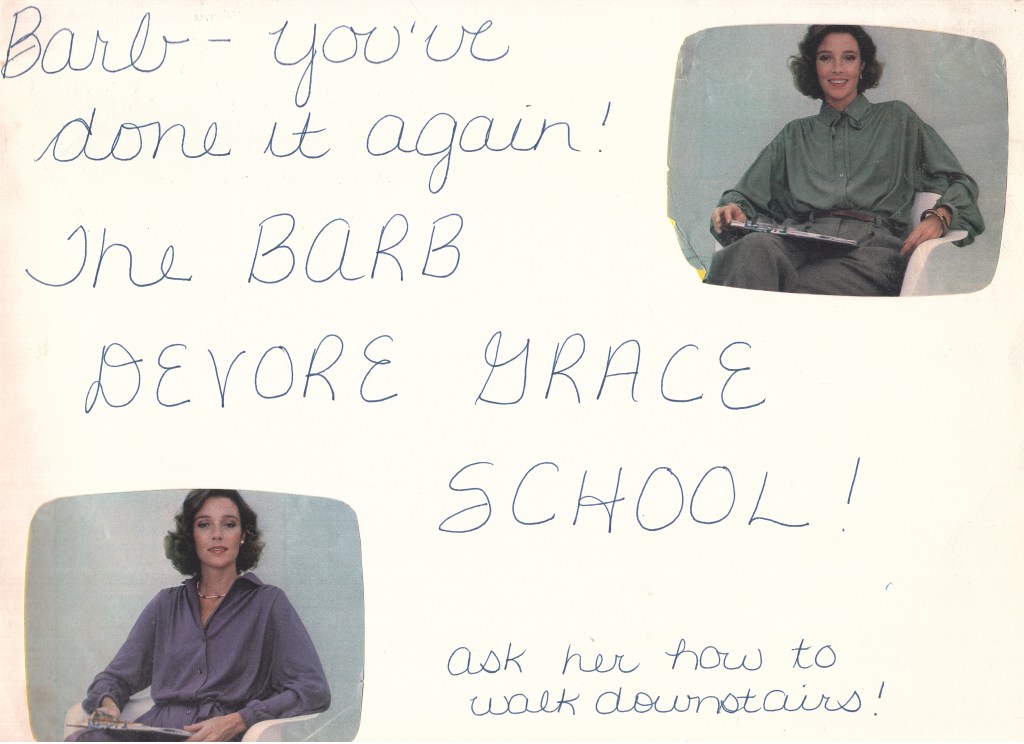
The next Monday at our weekly sorority chapter meeting, I was recognized for my grace (for the stairs) and my charm (for the plethora of phone calls and visits I had). It was what I came to be known for and received endless ribbing about it. Good times.

That era in my life was punctuated by music and whenever I hear “You Light Up My Life” I’m back in the Alpha Phi house and it’s the fall of 1977. There were a few other songs which, in my opinion, were equally as deserving of that number one spot.

These included Billy Joel’s Just The Way You Are – an infinitely better song; Rita Coolidge’s version of We’re All Alone; Carly Simon’s Nobody Does It Better; and Don’t It Make My Brown Eyes Blue by Crystal Gayle. The list of great songs from that year also included big hits – but never number ones – from a whole lot of great bands: Foreigner, Heart, Fleetwood Mac, Styx, Supertramp, and Steely Dan, among others.

And in case you’d like to hear the Casey Cisyk version and really get the worm stuck in your head (it’s been in mine since I wrote this!) here’s that video also. Note that you are seeing Didi Conn on screen – she is doing a lip-sync to Cisyk’s vocals. Enjoy!

The links:

MeatLoaf

Two Out Of Three Ain’t Bad

September 27, 2022

When reading the Infallible Wikipedia about this artist, who was born on September 27, 1947, what comes across is a larger than life personality whose personal excesses drove his incredible success but also his failures.

As a child, Marvin (Michael) Lee Aday*, was the target of other children for his physical appearance. He once stated in an interview that when he was born, he was “ ‘bright red and stayed that way for days’ and that his father said he looked like ‘nine pounds of ground chuck’, and convinced hospital staff to put the name ‘Meat’ on his crib. He was later called ‘M.L.’ in reference to his initials, but when his weight increased, his seventh-grade classmates referred to him as ‘Meatloaf’, referring to his 5-foot, 2 inches, 240 pound stature. He also attributed the nickname to an incident where, after he stepped on a football coach’s foot, the coach yelled ‘Get off my foot, you hunk of meatloaf!’.”

The name stuck and, as a performer, “Meatloaf” became the name by which he was famous. In fact, until I started researching this article, I did not know his real name.

His story, like so many other artists, was one of forming a band and playing every gig he could get. He landed singing roles in several musicals including The Rocky Horror Show and Hair. These successes eventually led to teaming up with Jim Steinman, a composer, lyricist, and producer; together they put together Meatloaf’s most iconic album Bat Out of Hell. Also from the Infallible Wikipedia:

The official video for Two Out Of Three Ain’t Bad

“Meat Loaf and Steinman spent time seeking a record deal; however, their approaches were rejected by each record company, because their songs did not fit any specific recognized music industry style. Todd Rundgren, under the impression that they already had a record deal, agreed to produce the album as well as play lead guitar along with other members of Rundgren’s band Utopia and Max Weinberg. They then shopped the record around, but they still had no takers until Steve Popovich’s Cleveland International Records took a chance, releasing Bat Out of Hell in October 1977.”

It was a great decision. That album went on to sell an estimated 43 million copies, making it one of the best selling albums of all time. It has spent an incredible 485 weeks on the UK’s Album Chart, only two weeks less than Fleetwood Mac’s Rumors.

Meatloaf with his composer, lyricist, and producer, Jim Steinman

Like many artists, it seems as if his over the top persona was, perhaps, a way to overcome some of the teasing he endured as a child. In an interview he once said, “Being too fat to play with the other children, I had to spend a lot of time alone, which probably has a lot to do with the way I am today. I’m usually alone in my hotel room from right after the show until the next day’s sound check. And I’m never bored; I don’t get bored. Probably because mothers wouldn’t let their kids play with me.”

Sadly, he died suddenly on January 20, 2022 at the age of 74. He’d had Covid several weeks earlier, but no specific cause of death was listed.

Somewhat belatedly Meatloaf’s Bat Out of Hell album joined my hitchhiker music list when I found the CD at Value Village one day a few years ago. I admit that I had only heard his iconic Paradise By the Dashboard Lights a few times previously, preferring his ballads, particularly Two Out of Three Ain’t Bad.

I think that one of the reasons that song resonated with so many of my generation might have been due to the pain which the artist experienced early in life. To listen to his interpretation of the song there is absolutely no doubt that he understands what rejection feels like.

Two Out of Three Ain’t Bad is a song I can listen to again and again, appreciating Meatloaf’s vocal ability and soulful rendition. The year the song charted, I experienced a failed relationship and could truly relate to the words and music.

Rest In Peace Michael Lee Addy. The world was made better by your contributions.

*He changed his name to Michael as an adult.

A link:

https://en.wikipedia.org/wiki/Meat_Loaf

I Said oo-oo-oo-wee

Undercover Angel

July 7, 2020

If there was one thing the 1970’s was known for it was the plethora of questionable songs and their popularity. I’ve covered some of these songs in previous articles. Songs like Muskrat Love and The Streak, for example. Another questionable song was at the top of the charts for one week in July 1977.

Alan O’Day – the singer who penned the tune – dubbed it a “nocturnal novelette.” An apt description for this schlocky song.

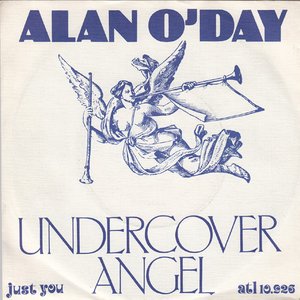
94edeb0026cdb5d69f8eb2db8a0a8709Undercover Angel, in my opinion, should never have made it to number one. Perhaps the lyrics were just racy enough and just cryptic enough to cause the teenagers of the era to listen again and again in an effort to dissect its meaning.

The Infallible Wikipedia offers a brief hint:

“The song begins with a man describing his loneliness, when a woman suddenly appears in his bed and encourages him to make love to her. The rest of the song describes his feelings about her, then he discovers she must leave him, and he is saddened. She tells him to ‘go find the right one, love her and then, when you look into her eyes you’ll see me again’.

It then becomes apparent that he has been telling this story to a woman he is trying to seduce; he tells her he is ‘looking for my angel in your sweet, loving eyes’.”

The internet has been helpful in that the lyrics to pretty much every song ever written can be found with a simple search. Here’s a link https://www.elyrics.net/read/a/alan-o_day-lyrics/undercover-angel-lyrics.html so you can read them yourself if you are so inclined.

That said, the whole premise of this song is a bit disturbing. I would describe it a bit differently: A creepy guy has nocturnal fantasies which he then shares as a way to try and pick up a girl. Then, if the lyrics aren’t bad enough, the actual song itself has a repetitive and suggestive ‘oo-oo-oo-wee’ being sung over and over and over.

I turned 20 the year this record was popular and, being tuned in to music, knew the song but never thought much about it. Until the summer of 2013, that is. My own daughter – who just so happened to be 20 that year too – had started working at Michael’s (craft store).

As the weeks wore on she would come home and complain about the awful ‘70’s music’ which played on continuous loop through the store’s intercom system. I suppose they broadcast music of that era to appease the 40 and 50 something soccer moms who were their biggest customers. But it drove my daughter crazy.

There were two songs which she particularly loathed: Knock Three Times by Tony Orlando and Dawn and the one she dubbed the angel song… Undercover Angel.

screaming-blonde-woman-in-sweater-covering-her-ears-with-closed-eyes_ryckzumfl_thumbnail-full01

This is not my actual daughter… but close enough.

In fact, if I wanted to bug her all I had to do was sing ‘oo-oo-oo-wee’ like O’Day did on the record and she would tell me to stop in no uncertain terms. My fun ended when she moved away at the end of that summer, probably just to escape the music where she worked and, possibly, me for having a little fun at her expense.

Who knew that the worst songs of the 1970’s would live on as earworms* and haunt future generations decades later? It makes me wonder what songs of subsequent eras which were very popular are now seen by today’s teens as ridiculous: Barbie Girl? Macarena? Wannabe?

I think I need to call my daughter and ask her opinion… but not before I sing ‘oo-oo-oo-wee’ to her. It will make her day.

*An earworm, according to the Infallible Wikipedia, is “a catchy piece of music that continually repeats through a person’s mind after it is no longer playing.”

https://en.wikipedia.org/wiki/Undercover_Angel_(song)

The Legacy of Fleetwood Mac’s Rumours Album

I heard some Rumours…

April 2nd

This album sat atop the Billboard charts for 31 non-consecutive weeks in 1977 and early 1978. Its chart dominance began on April 2, 1977 and, according to one of the principles of the group who recorded it, it was “the most important album we ever made.”fleetwood-mac-rumours-album-cover.jpg

The album was Rumours and the group Fleetwood Mac.

Theirs is a story which shows that finding the right blend of talent, relentless commitment, and a lot of hard work, are necessary to make it in the music industry. The Fleetwood Mac story begins in 1967 as explained in the Infallible Wikipedia:

“Fleetwood Mac was founded by guitarist Peter Green, drummer Mick Fleetwood and guitarist Jeremy Spencer. Bassist John McVie completed the lineup for their self-titled debut album. Danny Kirwan joined as a third guitarist in 1968. Keyboardist Christine Perfect, who contributed as a session musician from the second album, married McVie and joined in 1970. At this time it was primarily a British blues band, scoring a UK number one with ‘Albatross’ and had lesser hits with the singles ‘Oh Well’ and ‘Black Magic Woman’. All three guitarists left in succession during the early 1970s, to be replaced by guitarists Bob Welch and Bob Weston and vocalist Dave Walker. By 1974, all three had either departed or been dismissed, leaving the band without a male lead vocalist or guitarist.”

The group was plagued by skullduggery from their manager, drug and alcohol addictions of some band members, departures of multiple guitarists, and an inability to make it big as a British Blues band. Then, in 1974 the band moved to Los Angeles. It was in that moment the magic began to happen. Also from the Infallible Wikipedia:

“After (Bob) Welch announced that he was leaving the band, Fleetwood began searching for a replacement. While Fleetwood was checking out Sound City Studios in Los Angeles, the house engineer, Keith Olsen, played him a track he had recorded in the studio, ‘Frozen Love’, from the album Buckingham Nicks (1973). Fleetwood liked it and was introduced to the guitarist from the band, Lindsey Buckingham, who was at Sound City that day recording demos. Fleetwood asked him to join Fleetwood Mac and Buckingham agreed, on the condition that his music partner and girlfriend, Stevie Nicks, be included. Buckingham and Nicks joined the band on New Year’s Eve 1974, within four weeks of the previous incarnation splitting.”

With the new members in place, the band took to the studio to record their (second!) self titled album, 1975’s “Fleetwood Mac.” It was a commercial success, selling over 7 million copies and featuring the memorable tracks: Over My Head, Say You Love Me (vocals Christine McVie), Rhiannon,  and Landslide (vocals Stevie Nicks).

In many ways, the two women’s distinctive voices came to define the group’s sound and propel their musical style towards mainstream pop.

With the release of Rumours in January 1977 and its subsequent rise to the top of the Billboard album charts, Fleetwood Mac cemented their spot in the Rock and Roll history books. The Infallible Wikipedia gives the details:

“By 1980, 13 million copies of Rumours had been sold worldwide. As of 2013, sales were over 40 million copies. As of May 2016, Rumours has spent 630 weeks in the UK Top 75 album chart and is the 11th best-selling album in UK history and is certified 13× platinum by the British Phonographic Industry, the equivalent of 3.9 million units shipped. The record has received a Diamond Award from the Recording Industry Association of America for a 20× platinum certification or 20 million copies shipped, making it, as of 2012, the joint fifth best-selling album in US history (by number of copies shipped).” (Ed note: it is still, as of 2019, one of the top ten best-selling albums of all time)

Fleetwood-Mac.jpgAlthough the group has continued to record and perform over the years, with some members leaving, new ones coming in, and then old ones rejoining, those of us of a certain age no doubt think of Fleetwood Mac as the following five individuals who were the group in 1977: Mick Fleetwood, Christine McVie, John McVie, Stevie Nicks and Lindsey Buckingham.

During a foray in to Value Village (a Western Washington thrift store) about a year ago I was – as is my habit – perusing the used CD’s when I spied it: Fleetwood Mac – Greatest Hits. I plucked the CD from the shelf and spirited it home. Last fall when the hubby and I were about to embark on a three week, three thousand mile, road trip, I was forced to reduce down my box of ‘hitchhikers.’ This is what I lovingly call the approximately 25 CD’s which travel with me to Yakima and back every couple of weeks.

The purge process involved looking at every CD we own (who knows 100? 150? 200?) and determining which of the CD’s deserved a place in the box and which had a cut or two to be recorded onto a thumb drive. One by one I evaluated with the thumb drive pile growing ever higher and the box group getting smaller. “Would I,” I asked myself with each CD, ” listen to every song on this?”

There were only a handful which met that standard…  FM’s Greatest Hits was one of them. And so it remains in the box of hitchhikers. My only wish is that “Landslide” had been included on the CD as it is, by far, my favorite of their songs.

For those not familiar with it, here it is. Enjoy!

The FM story is fascinating and far too much to include in my weekly blog. Thankfully Wikipedia provides exhaustive information for those interested:

https://en.wikipedia.org/wiki/Fleetwood_Mac

https://en.wikipedia.org/wiki/List_of_Billboard_200_number-one_albums_of_1977

https://en.wikipedia.org/wiki/Rumours_(album)

When I first posted this a few years ago, I had asked a question on Facebook. Couldn’t now tell you the question, but here is the answer: these five albums stayed at number 1 on the album charts longer than any others since the mid-1950s.

Weeks Album Artist Year(s) Source
54 West Side Story Soundtrack 1962-63 [44]
37 Thriller Michael Jackson 1983–84 [45]
31 Rumours Fleetwood Mac 1977–78 [45]
South Pacific Soundtrack 1958–59 [44]
Calypso Harry Belafonte 1956–57 [44]