Tag Archive | 1965

The Evolution of Denim: Cultural Changes Over Time

May 20th

It was on May 20, 1873 when Levi Strauss and Jacob David patented the denim garment which has, arguably, become the most popular type of clothing in the Western hemisphere: jeans.
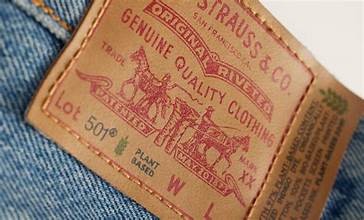
The iconic Levi Strauss authenticity tag from the official website.

While the actual origins of the garment are unclear, there are records of the fabric and the type of clothing it was made into in Genoa, Italy, and Nimes, France, as early as the 1500’s.

The Infallible Wikipedia shares some history on the origin of the name:

“Research on the trade of jean fabric shows that it emerged in the cities of Genoa, Italy, and Nîmes, France. Gênes, the French word for Genoa, might be the origin of the word ‘jeans‘. In Nîmes, weavers tried to reproduce jean fabric but instead developed a similar twill fabric that became known as denim, ‘de Nîmes’, meaning ‘from Nîmes’. Genoa’s jeans fabric was a fustian textile of ‘medium quality and of reasonable cost’, very similar to cotton corduroy for which Genoa was famous, and was ‘used for work clothes in general’.”

Modern day jeans were popularized as a workman’s garment, specifically miners, at the time it was patented by Davis and Strauss. And they might have remained that way until popular culture got involved. In the 1950’s both Marlon Brando and James Dean donned jeans in two culturally significant movies: The Wild One and Rebel Without a Cause. The two men were both bad boys of the big screen and exuded a ‘coolness’ which rocketed them to popularity with youth.

1965 – all the boys in the front row are wearing jeans with the exception of one. All the girls in dresses. 2nd Grade at Nob Hill Elementary school in Yakima, Washington

By the 1960’s, jeans became a popular garment to wear to school for boys. But not for girls. In fact, girls wore dresses to school. The first time I was ever allowed to wear pants was the winter of 1968-69 and only because of extreme cold temperatures. During the week of January 20-24, the overnight lows in Yakima were in the single and minus digits and the day time highs in the low teens. January 23rd, a Thursday, had a high of only 11 degrees, up from minus 7 degrees overnight. The next week wasn’t much better as the cold persisted PLUS it snowed 10 inches.

In those days, school was not cancelled because of weather. Instead, the Yakima School District very generously gave all the girls permission to wear pants to school. But they could NOT be jeans! A popular style that year were knit stretch pants and I can still see, in my minds eye, what those pants looked like. It was a big, big deal to get to wear pants.

It took quite some time for the weather to moderate that year (in the ‘balmy’ mid-30’s by mid-February), and it was back to dresses worn with socks and the dreaded saddle shoes. (Which I wrote about here https://barbaradevore.com/2024/09/03/the-first-tuesday-in-september-3/)
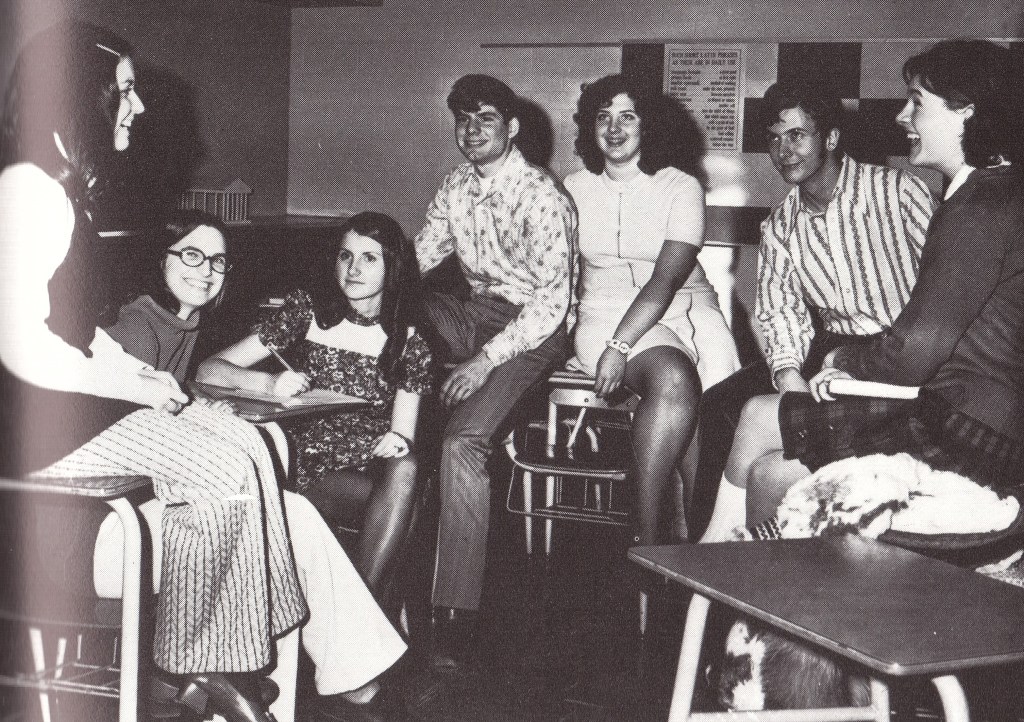
From the 1972 Eisenhower High School Reveille yearbook. A club photo with the guys in in jeans, the girls in dresses except for one, who is wearing fashionable slacks of the day. Yakima, Washington

Then the 1970’s happened. While many people think of the 1960’s as the big social upheaval, the 70’s were the years when all that rebellion was codified. The movement was so huge, that it became a cultural tsunami, washing over every institution we know.

I think it was probably 1971 when girls were allowed to wear pants to school regardless of the weather. But still no jeans that first year. A look through the high school annuals of that era reveal that shift through photos. The 1972 Eisenhower annual shows most girls still wearing dresses to school with a smattering here and there of one in pants and, rarely, jeans.
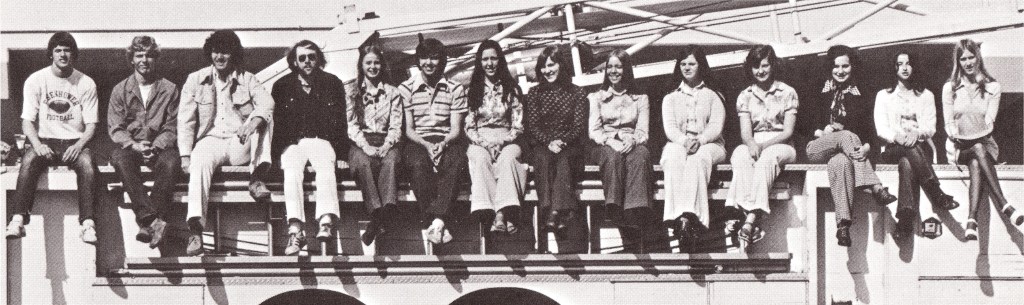
A portion of the 1975 yearbook staff of Eisenhower High school. The girls all in pants, some in jeans, and only one dress. Yakima, Washington

By 1975, easily half to two-thirds of the girls at my school are wearing pants – often jeans – in the day-to-day photos of regular school activities; jeans were the standard for after school clothing.

In today’s world, people wear jeans everywhere; I would posit that pretty much every American teen and adult owns at least one pair, and likely multiple pairs, of jeans.

2008 at Lake Washington High School in Kirkland, Washington. A couple of skirts, but most the girls are wearing jeans as their daily ‘go to’ clothing.

I know I have at least three pairs of jeans and two pairs of capri length denim pants that I rotate in my day-to-day wardrobe. I’ve been thinking lately that I really do need another pair. I discovered a Gloria Vanderbilt style that fits well and is comfortable. That is, in my opinion, what the wearing of jeans is all about: comfort. Time to go shopping – on Amazon since I know they have the jeans that fit me – for a new pair of America’s favorite clothing item.

The links:

https://en.wikipedia.org/wiki/Jeans

https://www.smithsonianmag.com/smithsonian-institution/the-origin-of-blue-jeans-89612175/https://www.extremeweatherwatch.com/cities/yakima/year-1969


April 29, 1965: The Day Seattle Shook

April 29th

If you are older than the age of 60 and you have lived in the Pacific Northwest most, if not all, of your life, I simply have to give you this date and time, you will immediately be able to tell me where you were and what you were doing: April 29, 1965, 8:29 a.m.

I can almost hear you exclaiming to your computer: that was the date of the first earthquake you experienced and/or remember.

A number of grocery stores were hard hit during the 1965 earthquake

It was, after all, a pretty significant event. At the time it was the third strongest earthquake since the arrival of European settlers into the area. A quake estimated at magnitude 7.3 occurred in 1872 and another magnitude 7.1 in 1949. The 1965 quake registered 6.5 on the Richter scale.

While the Infallible Wikipedia does offer some information, Historylink.org – which has in depth articles about the Pacific Northwest – shares the following:

“The ground shook for about 45 seconds and was felt over a 190,000 square mile area including all of Washington state, northwest Oregon, southwest corner of British Columbia, north Idaho panhandle. The quake’s epicenter was located near Des Moines, Washington, at 47 degrees, 24 minutes North Latitude and 122 degrees, 24 minutes West Longitude. Total damage is estimated at $12,500,000 (approximately $65,000,000 in 1999), most of it in Seattle. In Olympia, the State Capitol Building was temporarily closed and government departments move to nearby motels while buildings are being repaired.”

The nearest I could come to identifying the epicenter of the quake is 202nd Street SW and Marine View Drive in the Normandy Park neighborhood, not far from Burien and Sea-Tac International airport.

Which becomes an important detail. On April 29, 1965, the hubby’s family lived in West Seattle, about 6 miles north of the epicenter.

For years, family gatherings often included discussion of that day and the months and years leading up to it.

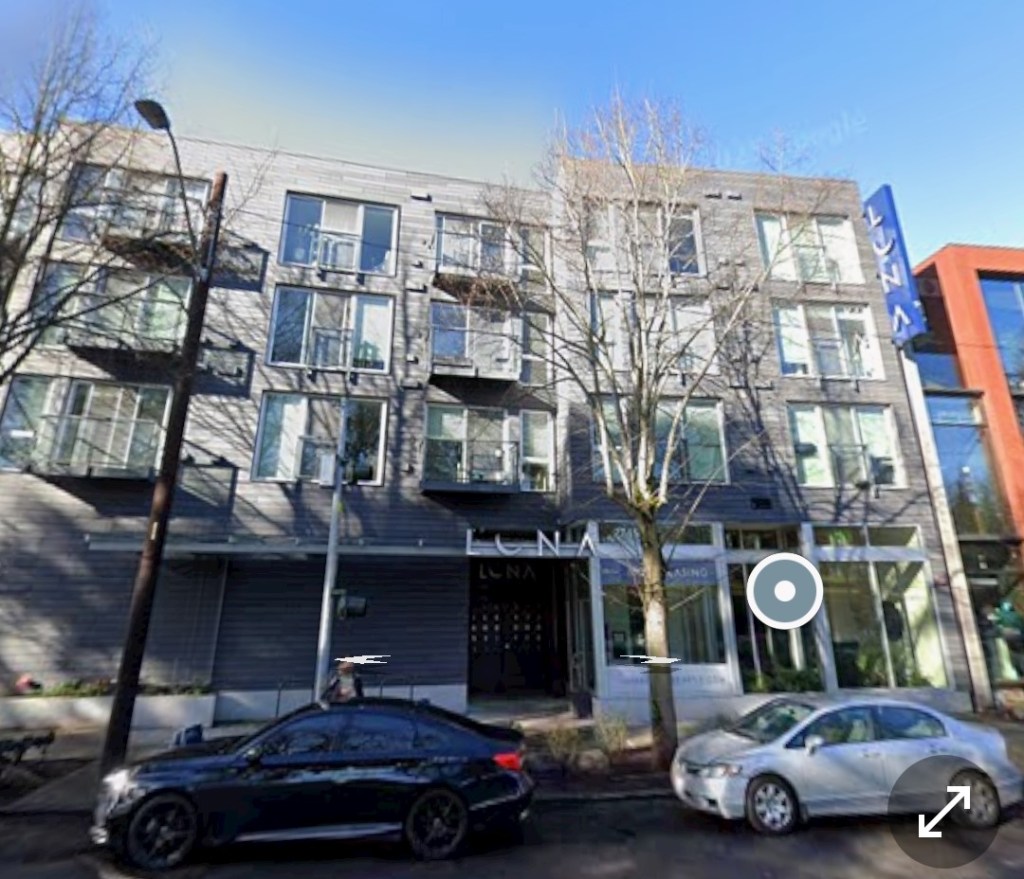
If you were to visit West Seattle today, the LUNA apartments are now located at approximately 2751 California Avenue SW. Up until six months before the April 29, 1965 quake there was a house at that address and it belonged to a trio of women: my hubby’s two Great-Great Aunts – Nelly and Ethel – and his Great Grandmother – Queenie Mae. All three were born in the 1880’s.

From the families collection is this photo of the Miss Burien limited hydroplane as it looked in the summer of 1960. This photo was taken from the house located at 2751 California Avenue SW, directly across from Hiawatha Park in West Seattle.

In the mid-1960’s, Queenie Mae had been deceased for about 8 years, so only Nellie and Ethel still lived in the house and, since they were now in their 70’s, it was decided to sell it. Which they did in the fall of 1964.

Soon the house was razed and a grocery store was erected and had opened, according to family lore, mere weeks before the earthquake hit. The damage to the store was severe.

The hubby recalls visiting the great aunts at that house as a child and every once in a while, the China dishes and tea cups stored in the display cabinet would ‘tinkle’ as if the earth was moving just a bit. Perhaps it was from traffic on California Avenue but the family always claimed that an earthquake fault ran under that house.

April 29th was a Thursday that year and, less than a mile north, the hubby – age 8 – had just gotten his breakfast and was leaving the kitchen, headed for the dining room table.

He was mid-step when the earthquake started and described what happened next:

“My recollection is that I was in the doorway to the living room holding a plate of scrambled eggs. Aunt Nell, who I think must have cooked the food for me, was sitting in the living room on a daybed we used as a couch. I stopped and was looking at her when the initial jolt bounced her up in the air. To this day, that is what I see.”

The spot where the house with the ‘tinkling’ china in the cabinet was once located.

Aunt Nell wasn’t the only one who went airborne as the hubby’s younger sister – who was just two weeks shy of her 4th birthday – was sleeping only to wake up on the floor. As she has always said “my bed threw me on the floor.”

The damage in West Seattle that day was extensive. According to Historylink.org, the worst damage was in West Seattle, Harbor Island, Duwamish River Industrial Area, and South Seattle. 

“In West Seattle a survey was made of damaged chimneys. In a portion of West Seattle out of a total of 5,005 chimneys in 188 city blocks, the earthquake damaged 1,712 chimneys (34 percent of the chimneys). At Alki Beach, a part of West Seattle not surveyed, ‘virtually every chimney was down’ (U.S. Earthquakes 1965 p 98).”

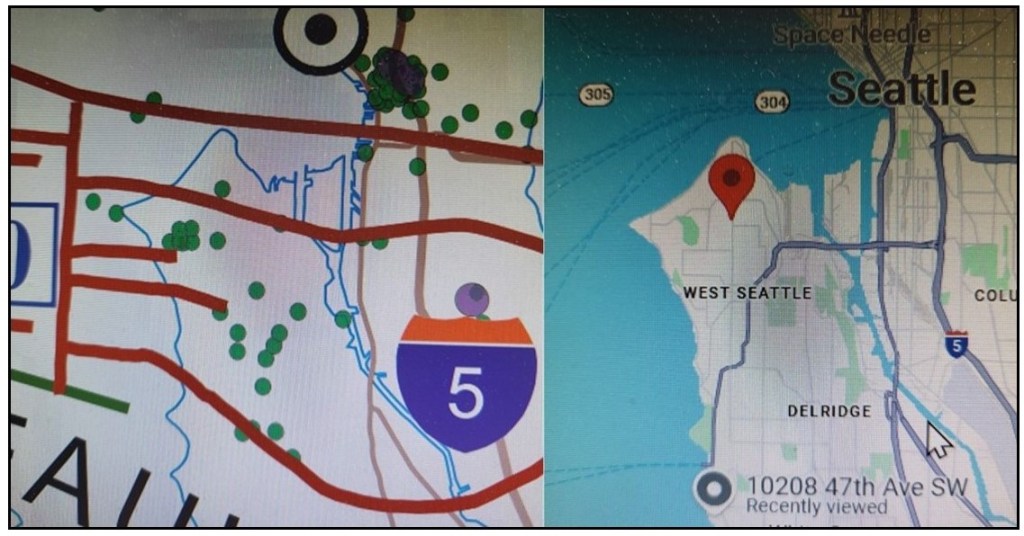
The map on the left shows the fault lines which run under West Seattle. The red marker on the right is the location of the house on California Avenue with the Earthquakes epicenter the gray dot to the south. When the two maps are overlaid, the fault line runs directly under where the house once stood.

The hubby believes he went to school after the earthquake as if nothing significant had just occurred. Oh, how times have changed!

As for the fault line under West Seattle? Yes, it does exist and was mapped in 2014 and when you overlay it onto that location, it runs pretty much under where their house once stood.

So where were you on April 29, 1965? I was in Yakima getting ready for school when that quake struck and our house shook. My mom was brushing my hair and she told me to hang on to the counter. Thankfully, I wasn’t tossed in the air.

The links:

https://www.historylink.org/File/1986

https://en.wikipedia.org/wiki/1965_Puget_Sound_earthquake

https://assets.pnsn.org/HIST_CAT/1965.html

https://www.dnr.wa.gov/publications/ger_ofr2014-05_fault_earthquake_map.pdf?o91ywfh