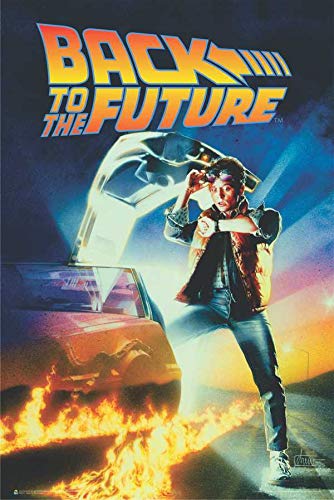
Back To The Future

I am your Density!

November 5, 2024
A Tuesday Newsday Classic

“Your future hasn’t been written yet. No one’s has. Your future is whatever you make it. So make it a good one.” – Doc Brown

To be able to travel through time has long sparked the imagination of mankind.  It has been fictionalized in countless books, TV shows and movies. But there is one movie so original in its interpretation that when it was released it spent 11 weeks in the top box office spot and was the top grossing film of 1985. That film is Back To The Future.

November 5 was not the date the film was released. But for those of us who are cult followers of the film, we know that when Marty McFly stepped into Doc Brown’s DeLorean the date on the computer was set by the Doc to November 5, 1955. With the aid of plutonium stolen from Libyan terrorists, the Doc’s time machine – once it reached 88 mph – sent Marty back 30 years. There he encounters his parents, George and Lorraine, who are both teenagers.

From the Infallible Wikipedia:

“Marty finds himself transported to 1955 without any plutonium to return. He encounters the teen aged George, who is bullied by his classmate Biff. After Marty saves George from an oncoming car, he is knocked unconscious and awakens to find himself tended to by Lorraine, who is infatuated with him.
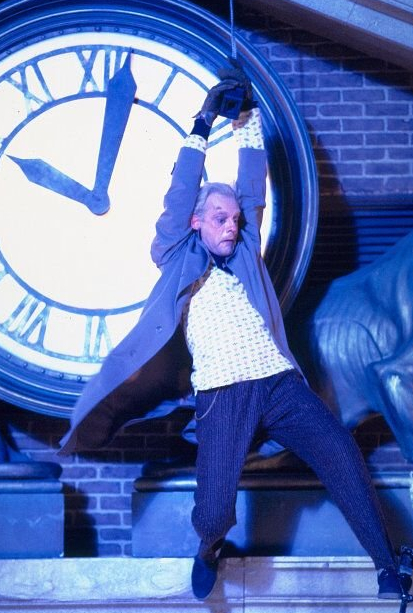
Doc Brown in the iconic closing scene of the movie

Marty tracks down Doc’s younger self for help. With no plutonium, Doc explains that the only power source capable of generating the necessary 1.21 gigawatts (1,620,000 hp) of electricity for the time machine is a bolt of lightning. Marty shows Doc a flyer from the future that recounts a lightning strike at the town’s courthouse due the coming Saturday night. Doc instructs Marty to not leave his house or interact with anyone, as he could inadvertently alter the future; because of this, Doc refuses to heed warnings from Marty about his death in 1985. When they realize that he has prevented his parents from meeting by saving George from the car, Doc warns Marty that he must find a way to introduce George to Lorraine or he will be erased from existence. Doc formulates a plan to harness the power of the lightning, while Marty sets about introducing his parents.

After Lorraine asks Marty to the school dance, Marty devises a plan: he will feign inappropriate advances on Lorraine, allowing George to ‘rescue’ her. The plan goes awry when a drunken Biff gets rid of Marty and attempts to force himself on Lorraine. George, enraged, knocks out Biff, and Lorraine accompanies him to the dance floor, where they kiss while Marty performs with the band.

As the storm arrives, Marty returns to the clock tower and the lightning strikes, sending Marty back to 1985. Doc has survived the shooting, as he had listened to Marty’s warnings and worn a bullet-proof vest. Doc takes Marty home and departs to the future. Marty awakens the next morning to find that his father is now a self-confident and successful author, his mother is fit and happy, his siblings are in their own successful businesses, and Biff is now an obsequious auto valet.”

There is so very much to like about Back To The Future, that I don’t even know where to begin. A couple of great scenes come to mind, however.
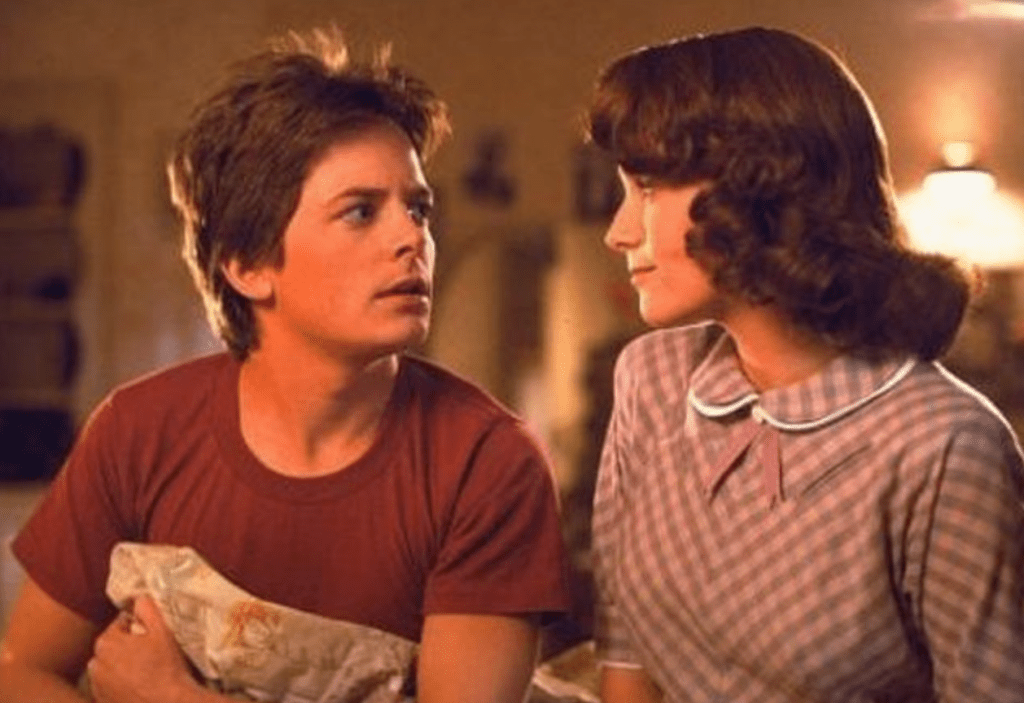
Marty and Lorraine in an awkward moment
  1. Marty is in the soda fountain and tries to order a “Tab” which, of course, is a beverage from 1985. The soda jerk chastises him and tells him he can’t give him a tab when he hasn’t ordered anything. The gag continues with Marty trying to order a ‘Pepsi Free’ which really makes the guy mad.
  2. When he meets his teenage mother she has rescued him after his being hit by his grandfather’s car and Marty wakes up – having been put to bed for recovery from the previously mentioned accident – and she addresses him as ‘Calvin.’ Marty questions Lorraine on why she calls him this and she tells him it’s on his underwear… there was no designer underwear by Calvin Klein in the 1950’s of course. But even more disturbing is the thought of how Lorraine found this information.
  3. Doc Brown, upon meeting Marty, is skeptical as to Marty’s story about traveling from the future and peppers him with questions in the following memorable exchange:

“Then tell me, “Future Boy,” Who’s President in the United States in 1985?”
“Ronald Reagan.”
“Ronald Reagan? The actor? Then who’s Vice-President? Jerry Lewis?”

 When asked for a list of my top ten favorite films, this is one of three films which I love and can watch over and over, never tiring of it.

For my father’s funeral in early November of 2019 and, because my older siblings declined to do so, I was the designated eulogist. It is very difficult to distill someone’s life down into a ten minute speech. Ultimately I decided to share a couple of stories which were illustrative of my dad’s spirit and determination. Upon reflection I realized I had gotten, during the ten years of going to Yakima and staying with him to cook meals and help, my own version of time travel. Although is not possible to actually experience it, this was the next best thing. Here’s what I wrote:
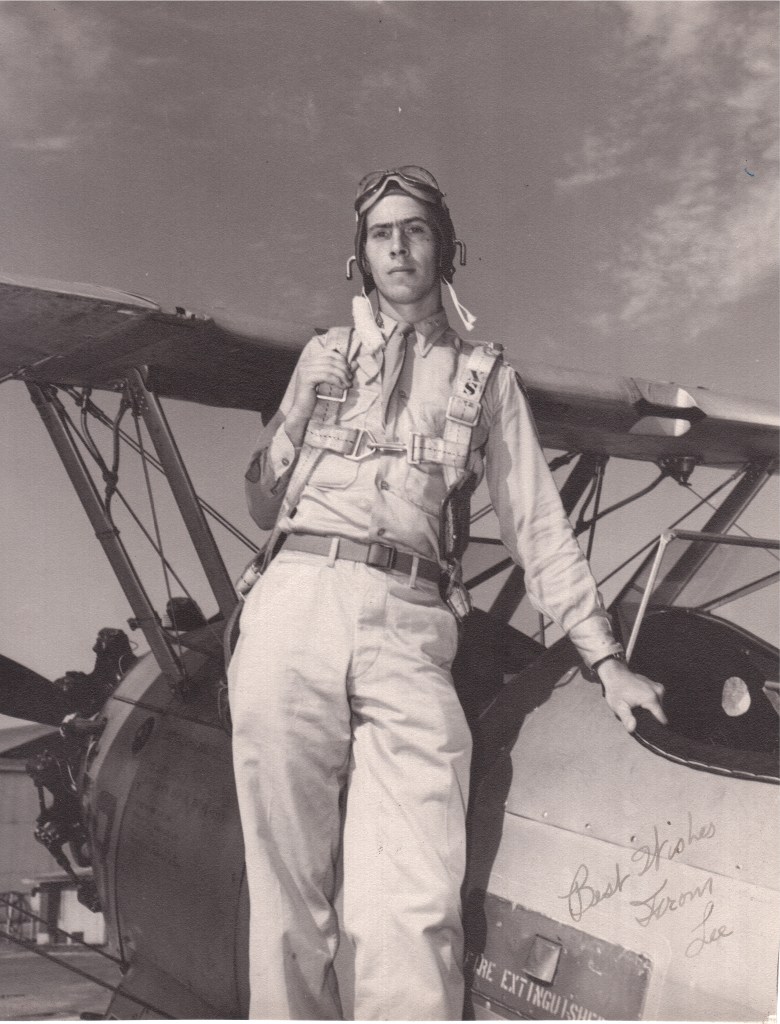
My dad’s official training photo from his time at Lakeland AFB, Florida, circa 1944, with (I believe) a PT-17 Stearmann plane

“In those early days (2009-2014), Dad was starved for conversation and companionship. While I know he appreciated the meals, I think he liked getting to tell his stories and talking with me more.  Over time I heard about his time in the Army Air Corps and the day he buzzed the tower at Chanute Field in Chicago; or the hurricane he went through while stationed in Lakeland Florida in 1943. I learned that before he knew Mom, there were a number of young women he dated – one in every town it seemed – and one of them brought her mother along and followed him from Buffalo New York to Dothan Alabama. Fortunately for all his kids and grand-kids, he was not ‘catchable’ at that point.”
But there was one particularly memorable moment in Back To The Future which has always resonated with me. When Marty returns to the future, his parent’s lives have changed and his father – who never once stood up to anyone before Marty altered the past – is completely different.  Instead of being in a dead end job, George McFly is now a successful author.

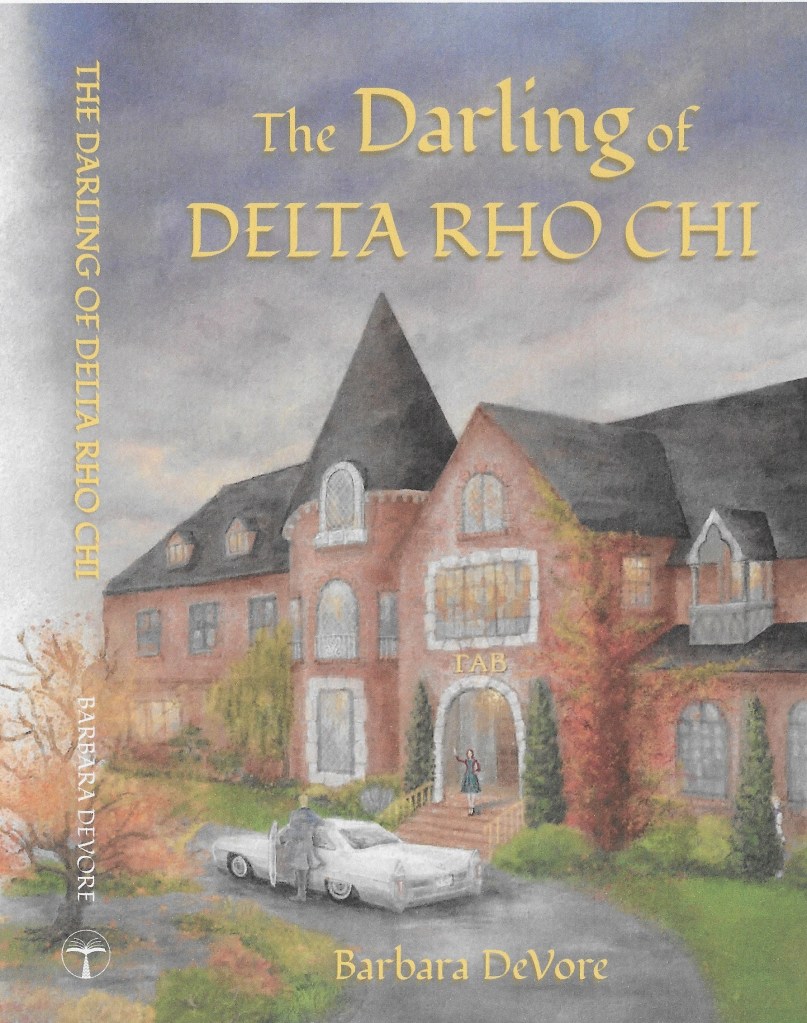
The message is clear: each of us is in charge of our own destiny. My destiny seemed to be that autumn morning when I walked into a novel writing class in 2004. As I sat there listening to the fictional pages others were sharing that day I had an epiphany. I knew – and believed – that I could write the stories which inhabited my brain. Seven completed novels later – with others still knocking about in my cranium –I have, like George McFly, taken that next step. In a few days my debut novel “The Darling of Delta Rho Chi” will be published.

I have created my own personal Back To The Future moment. And its even better than a flying car which runs on trash. Maybe.

The link:

The Energizer Bunny

Still Going…

October 29, 2024

A Tuesday Newsday Classic Updated

In the world of advertising, this campaign was particularly brilliant. The story begins in 1983 when Duracell featured a dozen stationary, identical light pink bunnies, all battery powered, drumming on snare drums. The announcer intoned that the one with the Duracell battery would last longer. Eventually, all the batteries die with the exception of the one powered by Duracell.

On October 30, 1988, however, a new bunny emerged on the advertising scene and stole the show from Duracell.

The Energizer Bunny was also pink but instead of being one of a crowd which outlasts the others, this rabbit had attitude. It wore hip sunglasses. It was hot pink. It moved around the room on blue flip flop sandals. And it had a big ole bass drum with the word “ENERGIZER” emblazoned across the surface. In short, it had important elements of a great advertising campaign in that it was memorable and humorous. The bunny has appeared in over 100 commercials and has been featured on TV shows and in movies.

From the Infallible Wikipedia:
“Commercials after the first started out with the Bunny leaving the studio it performed the ‘Drumming Bunny’ ad in, then wandering into the sets of a couple of realistic-looking commercials for fictional products, interrupting them. As the campaign progressed, many of these ads were standalone (for fake products such as ‘Sitagin Hemorrhoid Remedy’, ‘Nasotine Sinus Relief’, ‘TresCafe Coffee’, ‘Alarm’ deodorant soap, etc.) (snip) only to have the Bunny march through, beating his drum, because he was ‘still going’. Eventually real-life products and icons would do a crossover with the Energizer Bunny (Michael J. Fox doing a Pepsi ad, and the opening of TV shows such as Alfred Hitchcock Presents and ABC’s Wide World of Sports). The Energizer Bunny has appeared in more than 115 television commercials.”

A fun look at how the Energizer Bunny got a makeover in the 2000’s

The Energizer Bunny has come to represent something or someone which keeps going and going, seemingly without end.

In late November 2010 I was in Yakima staying to take care of my parents who were in crisis that week. My mom – who had dementia and mobility issues due to a stroke a year earlier – needed round the clock assistance. Between my dad, a part time caregiver, plus help from both my sister and me, they had been managing okay.

Dad and Mom in 2015. By then my mother lived at Apple Creek Adult Family home. Always devoted, my father visited her every day, usually twice a day.

The Tuesday before Thanksgiving, however, Dad collapsed and was discovered by the caregiver. 9-1-1 was summoned and he spent three days in the hospital. A difficult patient, he convinced the doctor to release him earlier than the Doc thought prudent, and arrived home on Friday, November 26th proclaiming he was just fine.

A little after 10 p.m., he went in to take a shower. I heard him calling for help a few minutes later and rushed in to discover him collapsed on the floor. After many struggles I was able to get him up onto the seat of my mother’s walker, but he was slumped to one side. He objected to the thought of calling 9-1-1 (again!) so I called my sister who, along with her husband, came over. Eventually we did call the medics who arrived and discovered his heart was pounding at about 200 BPM and suggested he go to the hospital.

No way was he agreeing to that and kept insisting that the medics just put him to bed. Which they did. Convinced by the EMT’s that he might not survive the night, my sister and me took turns with an all-night vigil.

Dad didn’t like using a walker, but he had places to go and using it was better than falling. Pictured here on his 96th birthday in 2019 with my brother.

Around 8 a.m., and with Dad still with us, I was up and out in the kitchen contemplating how to cope with two parents in need of assistance. A noise to my left drew my attention. I looked up and here came my dad, using my mom’s smaller aluminum walker, advancing with purpose and determination and seemingly unfazed by all which had happened. That entire day he moved with frenetic energy, straightening things, switching from one thing to another, hardly sitting down all day.

I described the whole thing to my sister this way: “Dad is like the Energizer Bunny.”

For the next nine years, this has been the way we’ve described our dad. There have been countless episodes of the pounding heart which takes him down for a day or two. When he’s recovered, though, watch out! Because it was always back to Energizer Bunny mode.

Eventually, however, even the strongest, most durable batteries run out of energy. And so it was for my father on October 24, 2019. His strong heart – in spite of what I am now certain were Tachycardia events – was the battery which kept him going to the age of 96 and a half.

It’s hard to believe that it’s been five years since we said goodbye to our Energizer Bunny. My sister, brothers, and me, often find ourselves reminiscing and laughing over the many stories of our dad – who we also refer to as “hell or high-water Vince.” He was truly one of a kind, nearly impossible to manage, but never boring.

When Covid shut down the world in 2020, I was glad my dad was no longer here. He never would have been able to stand the social distancing, the masks, or – most of all – the forced isolation.

During the year following his death, there were events and moments when we felt as if his spirit was still with us. From the time in August of 2020 when we saw his beloved Mustang a half mile from my sister’s house (EEE 161 Rides Again https://barbaradevore.com/2021/03/09/eee-161-rides-again/) to the next day when visiting the cemetery – after looking at headstones for several hours – and being hit by a literal whirlwind as we were deciding what color granite to choose; it felt as if he still had a hand in our lives and decisions.

When the internment business was finally able to be completed – with the installation of his and our mother’s headstones – on October 24, 2020, things have been much quieter. I think, perhaps, he was pleased with how we honored them both.

The links:

https://en.wikipedia.org/wiki/Energizer_Bunny

https://www.shawandsons.com/obituary/vincent-devore

The Darling of Delta Rho Chi

October 27, 2024

There’s a bit of a thrill to do a search on both Amazon and Barnes & Noble and see one’s novel available for presale… it’s a dream a long time in the making! For more information and the links to both click here: https://barbaradevore.com/the-darling-of-delta-rho-chi/.

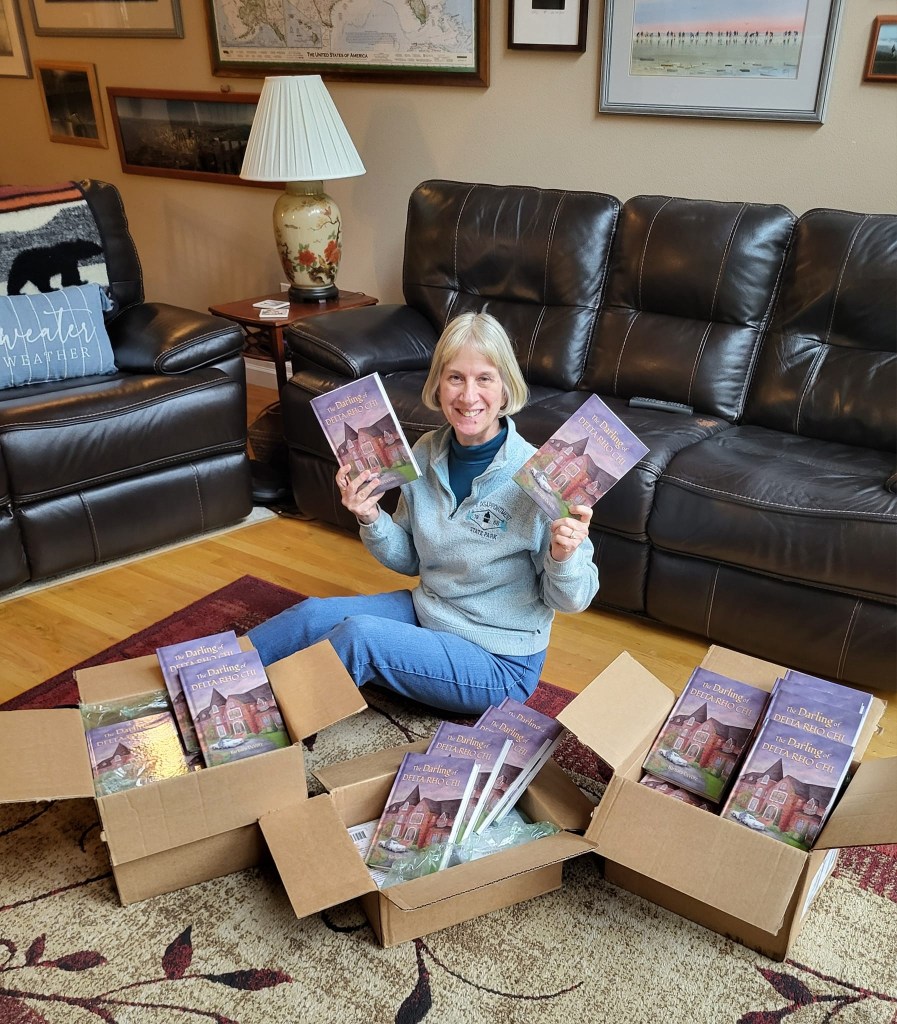
The first order of hardcover books!

November 25, 2024

The long awaited day has arrived! My shipment of hardcover books. One step closer to the launch party.

December 1, 2024

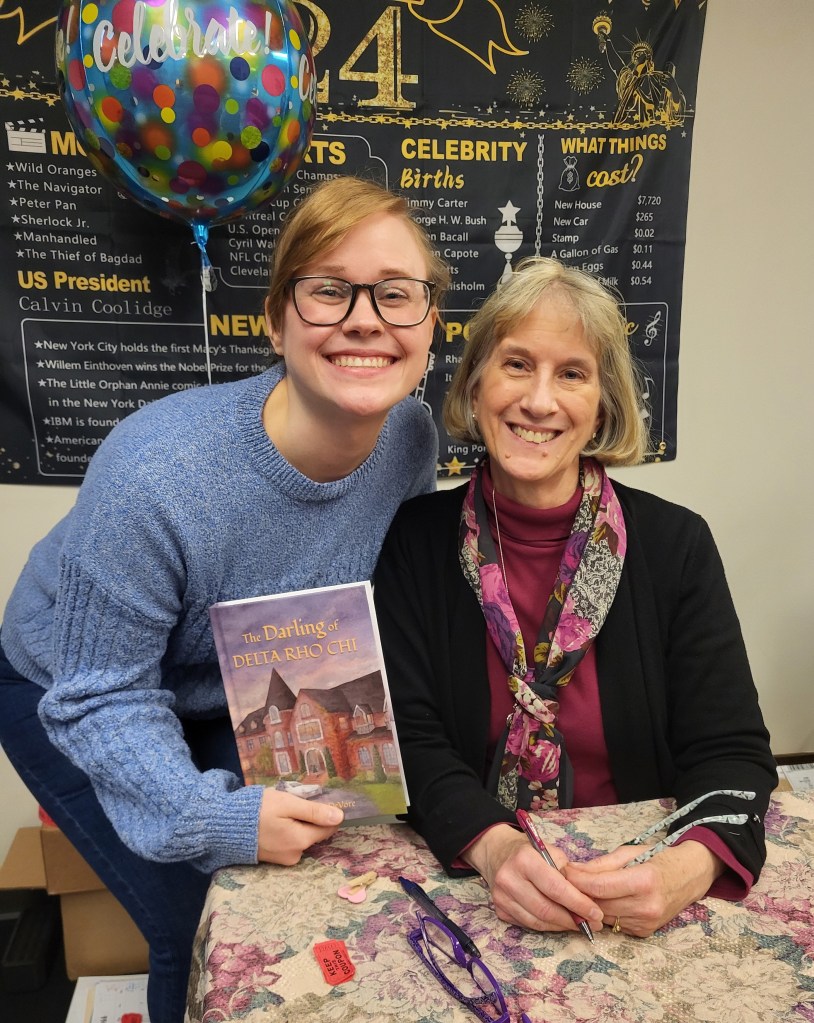
Hosted my Book Launch Party yesterday! Great success. Thank you to all who attended and shared in the celebration. Thank you to all who have purchased books and have left me reviews. My heart swells!

My most recent review on Amazon!

5.0 out of 5 stars Must readReviewed in the United States on November 28, 2024

I absolutely adored this two-for-one father/daughter book. It’s the story of Elise and her sorority troubles, as well as her father Jack finding his way to new love and dreams coming true for both. The characters are well developed, and I became invested in what happened to them. I fully appreciated the place and period accurate references to people and places I remember from living in the state. I felt the author nailed the social mores and values of the time period written about. I thoroughly enjoyed this book.”

January 27, 2025

First of all – thank you to EVERYONE who has ordered The Darling of Delta Rho Chi. I had no idea what this journey would look like. It’s been everything I hoped it would be and more. I’m especially appreciative of the conversations with friends who have sought me out to share with me their impressions of the novel.

A couple of favorite verbal comments:

It’s kinda spicy. I never expected that from you.”

“I stayed up until 2 a.m. finishing it. I never do that.”

“When is the next book coming out?”

And then there was this, the comment which truly floored me:

“Your writing reads a lot like Jodi Picoult.”

For those unfamiliar with Jodi Picoult, I think she is one of the best fiction writers I’ve ever read: carefully crafted characters, compelling story lines, crisp and clean scene setting and descriptions. To be included in the same sentence is humbling, flattering, and brought a lump to my throat.

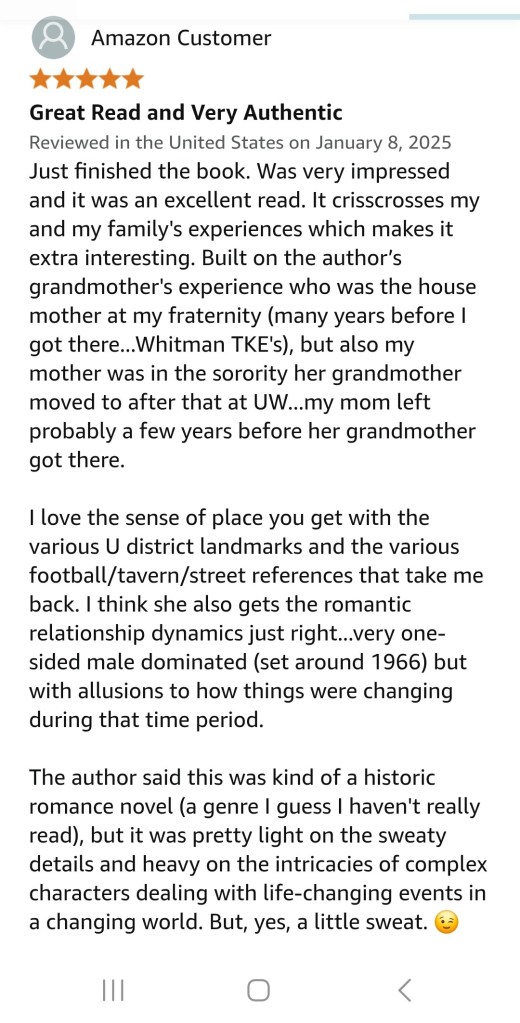
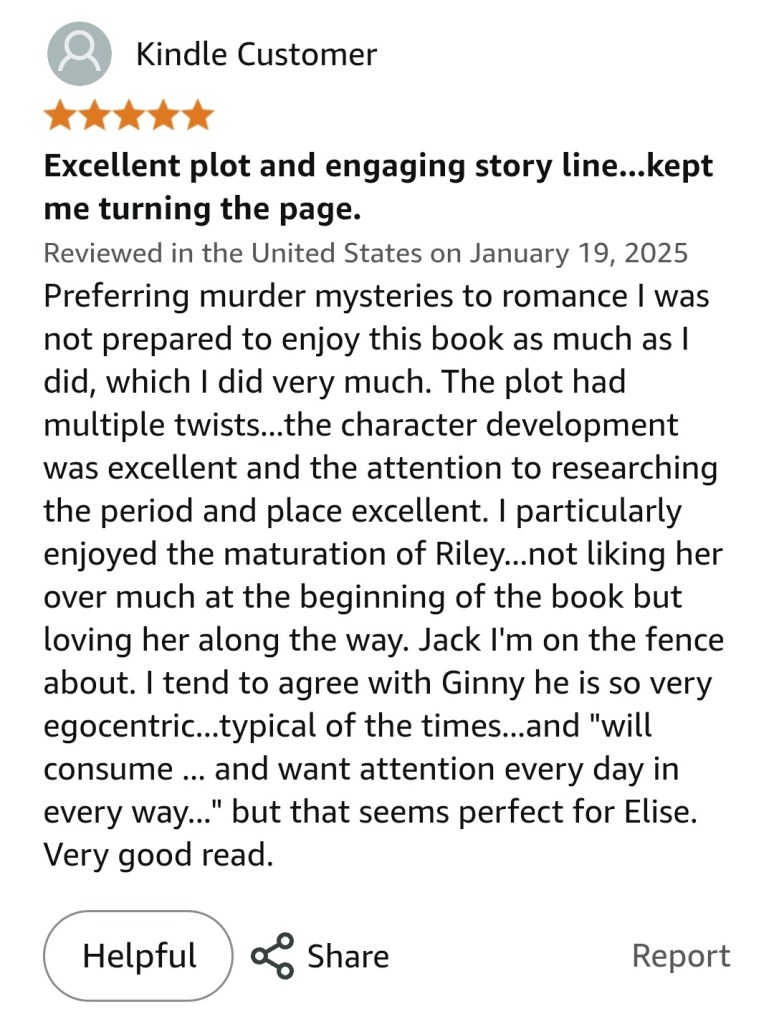
Heartfelt thanks to all who took the time to leave a review, send me a message, or seek me out to tell me what you thought. Here are three recent reviews on Amazon:

The TKE house at Whitman College

What If…

…is the essence of every story an author writes.

October 22, 2024

Whenever I set out to write a novel, I always start with the words ‘What If?” I cannot speak for other authors, only myself, but I can imagine a couple of other authors who might have done just that.

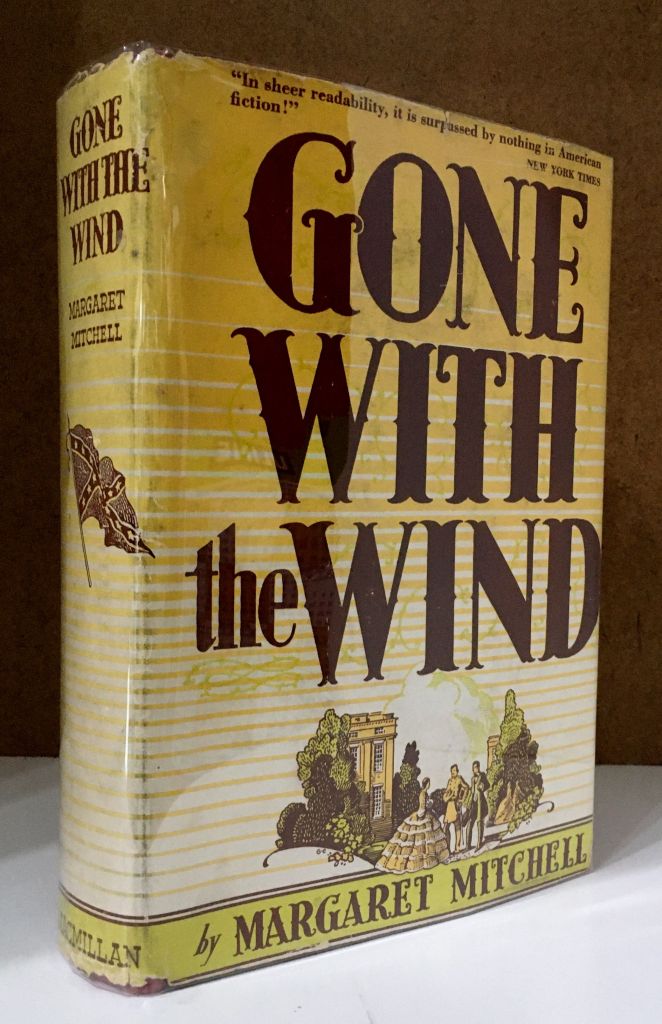
For example, “What if a woman, whose home is nearly destroyed by an invading army, uses her feminine wiles to seduce a rogue of a man who she thinks can save her?” That just might have been the question Margaret Mitchell asked when she wrote Gone With The Wind.

Or, try this one, “What if a young orphan is invited to attend a school because he possesses skills and abilities he doesn’t realize he has? And then he enters a world where wonderful and frightening things happen to him?”  This would be a very broad overview of Harry Potter’s world.

Over ten years ago, I posited the following ‘What If?”

‘What if’ a widow were to become a housemother for a sorority in the 1960’s?’

Since this really happened to my grandmother, Alma Beatrice DeVore, it wasn’t a big stretch to imagine that scenario. But beyond the fact that this was my grandmother’s career from her late forties and into her early sixties, the similarities to the world I’ve built for the Gamma Alpha Beta’s and the Delta Rho Chi’s ends there.

In ‘The Darling of Delta Rho Chi’ we meet Elise Ellingson (in tribute to my grandmother whose maiden name was Ellingson!), a 37 year old widow who finds the job of housemother daunting. Not only is Elise a widow, but she’s never been a mother and is ill-equipped to provide guidance and counsel to the young sorority women given to her care. Enter 18-year-old Riley Paxton, a handful of a girl whose behavior forces her father, Jack, to arrive on the scene to rescue his daughter from the rigid and dictatorial housemother.

None of that happened to my grandmother, who as far as I know, never got romantically involved with a parent nor did she have such a difficult charge in her house. All similarities to real life ended when I started to type the first lines of the story.

Writing a full length novel is one thing. Seeing it through multiple edits, deciding on a publisher, rewrites, perfecting the copy for the back cover, finding someone to bring your vision of the cover art to life, obsessing over the minutiae of a very brief pitch to grab potential readers’ interest on Amazon, and on and on and on, takes a level of dedication you only understand once you’ve done it.

Which brings me to this day. I am thrilled to report that ‘The Darling of Delta Rho Chi’ – the first of a four book series about the men and women who belong to the fictional Greek society world at the University of Washington – is a mere weeks away from birth!

Look for a link very soon on my blog. Who knows, with any luck, the books and the author just end up on the Infallible Wikipedia one day.

Deer Danger!

A Public Service Announcement

October 8, 2024

One of my ‘neighbors’ saying ‘Hi”

A Tuesday Newsday Classic

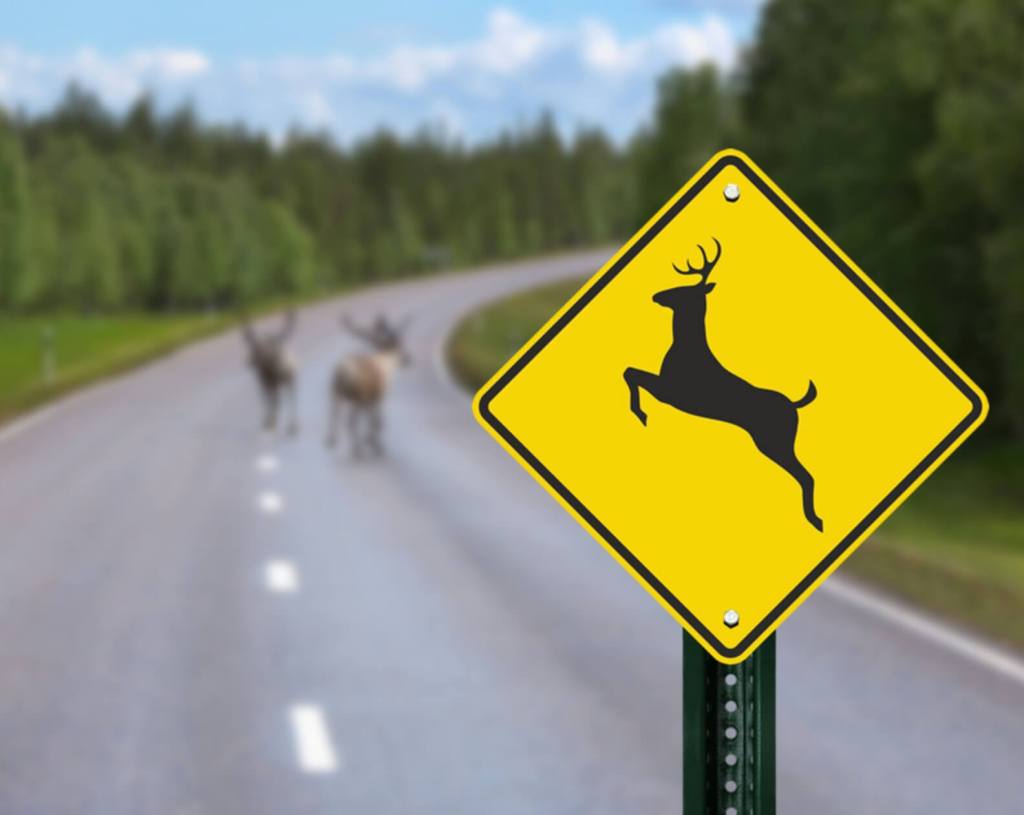
This week’s blog is really more of a public service announcement (PSA). Each year when I turn the calendar page to October, I know it is time once again to think about the very scary…. Cervidae. Or, as most people know the species, deer.

With approximately 21 million deer living in the United States, it should surprise no one that conflicts between people and deer will arise. Back to that in a moment. But first a little information on the Mule deer species, the most common Cervidae in the Pacific Northwest, as told by the Infallible Wikipedia:

“Deer are browsers. During the winter and early spring, they feed on Douglas fir, western red cedar, red huckleberry, salal, deer fern, and lichens growing on trees. Late spring to fall, they consume grasses, blackberries, apples, fireweed, pearly everlasting, forbs, salmonberry, salal, and maple. The mating or ‘rutting’ season occurs during November and early December. Bucks can be observed running back and forth across the roads in the pursuit of does. After the rut, the bucks tend to hide and rest, often nursing wounds. They suffer broken antlers, and have lost weight. They drop their antlers between January and March. Antlers on the forest floor provide a source of calcium and other nutrients to other forest inhabitants. Bucks regrow their antlers beginning in April through to August.

(snip)

At dawn, dusk, and moonlit nights, deer are seen browsing on the roadside. Wooded areas with forests on both sides of the road and open, grassy areas, i.e. golf courses, attract deer. Caution when driving is prudent because often as one deer crosses, another one or two follow.”

The last line brings me back to the PSA. From October through December you are much more likely to see deer near or on the road and are much more likely to hit one with your car. We can conclude that the need to forage farther and farther for food to sustain them through the winter, combined with the urge to mate, increases their interactions with people.

At the ripe old age of 22 I learned the hard way a universal truth about deer. Driving home from Tacoma to the small town of Eatonville (population 1005) one early October night in my trusty Ford Pinto, a deer leaped out in front of me. I braked and barely missed the animal… then I made a classic mistake. Thinking the danger was past, I put my foot on the gas and sped up. Yep. I hit the second deer.

Over the years I’ve encountered many deer on the roads and have been known to freak out a bit when driving, especially at dusk. I’m constantly watching the sides of the highway looking for the critters.

My concern is justified. About 7 years later, I hit another deer one morning in spring while on my way to work. Yes, I’m paranoid.

My most illustrative encounter occurred on a late September evening while driving a group of teenage girls to a weekend camp out on Hood Canal. It was a Friday and by the time we had the group organized, stopped for fast food, and then crawled our way through the Seattle/Tacoma metro traffic, it was dark.

As we made our way along state Highway 106 and approached Twanoh State Park, the young woman who was riding shotgun asked why I was driving so slowly.

“I’m looking for deer,” I replied, then continued, “They are active this time of year and day.”

I then proceeded to tell her about my two deer related accidents and issued the following warning:

“So if you are ever driving and a deer jumps out in front of you, STOP, because they always travel in pairs.”

“Always?” she questioned.

“Pretty much always,” I replied.

And then, not three minutes later, it happened.

From my left a deer bounded across the road in front of the van. I hit the brakes and stopped. A moment later the second deer crossed exactly where the car would have been had I not stopped.

“How did you do that?” she asked, a look of awe on her face in the low glow of the dashboard lights.

“It’s my deer karma,” I replied.

Yes, deer karma is a thing. I have another friend who is certain that I attract the critters. On a different road trip a few years earlier, I was a passenger in her car, driving from Moscow, Idaho, to Seattle one summer night. It was late June and we had been talking about my deer encounters. After hearing my stories, the poor woman was panicked, worried about ‘when’ (not if!) some random buck or doe would pop up in front of us.

For 240 miles everything was fine and I kept saying that I was not capable of conjuring up random deer… that was until the very top of Snoqualmie Pass. Just as the car swept around the last curve to the summit, smack dab in the middle lane of Interstate 90, was a deer. Just standing there as though waiting for me.

View from my office window watching a few of my spirit animals passing through

“I knew it! I knew it!” she exclaimed. “It’s you. They’re your totem animal.”

As for me I had no explanation. I’d never before seen a deer standing in the middle of Snoqualmie Pass and never have again. Yet, there the deer was, confirming to her that I had some mystical ability to conjure up my patronus animal, the mule deer.

Personally, I think it would be much easier to have a dog, a cat, or a chipmunk, for my totem animal. Or a sloth. A sloth would be nice as it would never jump out in front of me while driving.

The links:

My Wawona

Like Yosemite National Park, it’s a treasure

October 1, 2024

A Tuesday Newsday Classic

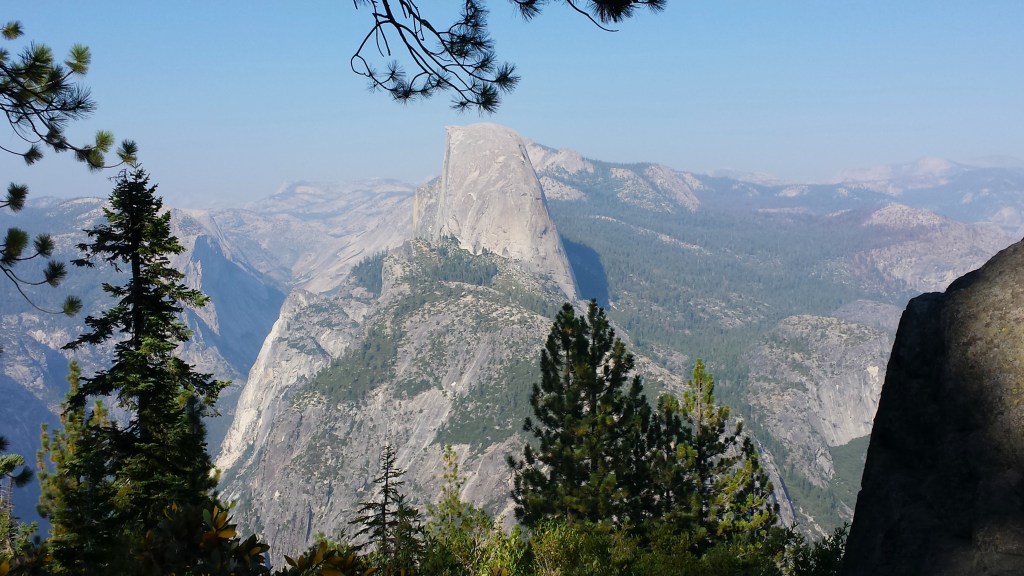
Half Dome, Yosemite National Park, from Glacier Point overlook September 2015

October 1, 1890 marked the official inclusion of this region into the newly formed National Park System. Long before that, however, the Yosemite Valley had inspired the natives who resided in the area as well as the early white settlers.

It was, contrary to popular belief, James Mason Hutchings and artist Thomas Ayres who were the first Americans to tour the area in 1855.

From the Infallible Wikipedia:

“Hutchings and Ayres were responsible for much of the earliest publicity about Yosemite, writing articles and special magazine issues about the Valley. Ayres’ style in art was highly detailed with exaggerated angularity. His works and written accounts were distributed nationally, and an art exhibition of his drawings was held in New York City. Hutchings’ publicity efforts between 1855 and 1860 led to an increase in tourism to Yosemite.”

Although the greater Yosemite area had been set aside by Congress in 1864, the Valley and Mariposa Grove were ceded to California to manage as a state park. The two areas had seen an influx of homesteaders and were being rapidly commercialized as well as being used for the grazing of sheep and cattle; the old growth sequoias were being logged.

The iconic El Capitan

Most people associate the founding of Yosemite with early environmentalist John Muir. Rightly, he is credited with not only pushing for park expansion but also lobbied for the federal government to take back the iconic valley and grove.

Also from the Infallible Wikipedia:

“It was because of Muir that many National Parks were left untouched, such as Yosemite Valley National Park. One of the most significant camping trips Muir took was in 1903 with then president Theodore Roosevelt. This trip persuaded Roosevelt to return ‘Yosemite Valley and Mariposa Grove to federal protection as part of Yosemite National Park.’”

The years long efforts paid off when, in 1906, Roosevelt signed a bill which stripped the two areas still managed by California from the state and they were returned to the federal government which finally created a unified Yosemite National Park.

One trip to Yosemite is all it takes for a person to understand the grandeur and how special a place it is. From towering El Capitan, to the massive Half Dome, or the fascinating Tuolumne Meadows, Yosemite is a visual feast.

And the hubby and I wondered, when we visited in September 2015, how come it had taken us so long to get there. We arrived on the day after Labor Day which was a good thing as the summer crowds were gone. Reservations are generally required months – if not a year – in advance for the various hotels. I figured we were out of luck but checked anyway as we drove south a few days before our planned stay. What a surprise! There were rooms available at the Wawona Hotel or space in ‘dry’ tents. We opted for the hotel.

It was only after we arrived at the park that it dawned on me that the Wawona Hotel was nowhere near the Yosemite Valley. That day had turned into a driving ordeal. My hubby suffers from vertigo. Being close to any ledge can trigger a sensation of spinning as well as nausea. Knowing this, it was my duty to do the driving so that he could close his eyes as needed when navigating cliff-side roads.

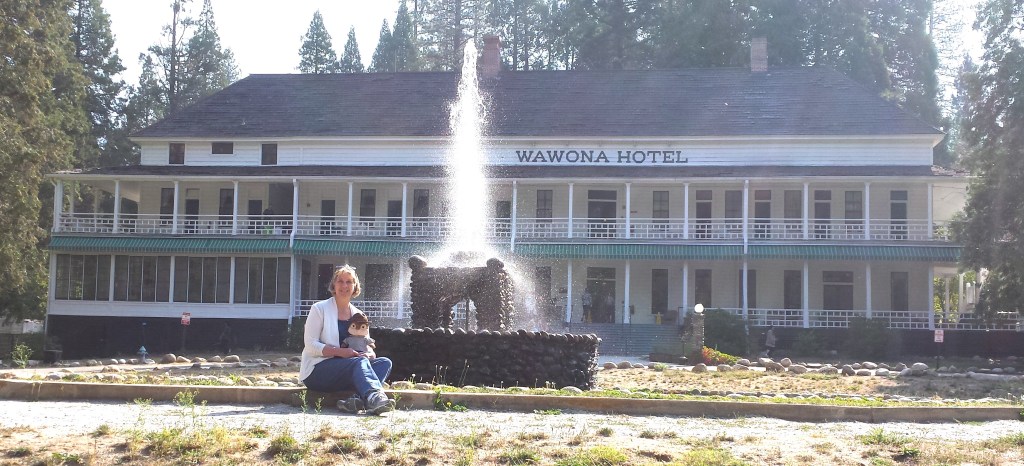
The author, along with Alvin the Chipmunk traveling companion, at the Wawona Sept. 2015

Up, up, up we traveled from the eastern side of the park to the 9,943-foot-high Tioga Pass – the highest mountain pass in California. Come to find out, THAT was the easiest road. From there we wound our way through Yosemite’s high country. Then we had to go down. From Tuolumne Meadows – elevation 8,619 feet – to the Valley floor was a 4,619 foot descent. And all of it seemed to be a series of endless switchbacks and curvy roads carved in to the sides of mountains.

It was with a sense of relief we reached the bottom when it hit me… Wawona was another 30 miles which we had to add to the 230 we’d already traveled that day. No rest for the driver as the road climbed back up the other side through yet another series of switchbacks, cliffs, and amazing vistas.

Now close to sunset, we found the hotel and were charmed at the thought of staying in an 1870’s structure.

Our room was in the more recently added section… built at the turn of the last century. Located at the far western end of the first floor, the room opened out on to a wide veranda adorned with honeysuckle.

But that’s where the charm ended. The room itself featured a double bed and a twin bed. There was a sink attached to the wall next to the twin bed with a door in the wall next to it. The door, however, was locked.

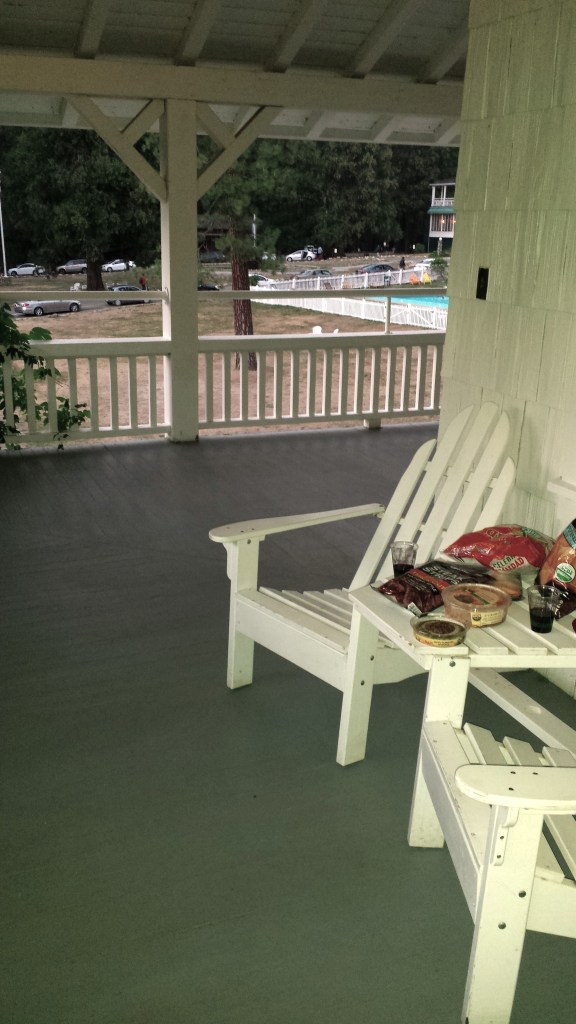
Table for two on the verandah

The room was completed with a small square closet, small dresser and a table and chair. No TV and no phone. But we were up for the adventure and the price – less than $70 a night – was a steal even with having to use the bathroom down the stairs.

As we went to bed that night we could hear, through the thin walls, talking in the room next door; two men were conversing in German. We laughingly dubbed them Hans and Fritz and, although the hubby had taken German in high school, were unable to decipher their conversation.

The next day, after breakfast in the hotel dining room, we headed out for a full day of touring. That evening we bought deli meats, fruits, crackers, and a bottle of wine which we ate and drank while sitting in the Adirondack chairs outside our room on the veranda. A pink and purple sunset was the perfect icing on a wonderful day.

View to the west from the verandah outside our room

Despite the older beds and somewhat rustic accommodations we slept well… that was until about 7:30 the next morning when our German neighbors’ talking awoke us. It was then we discovered where the locked door next to the sink led. When the hotel was built, the rooms all shared Jack and Jill bathrooms. To accommodate a more modern customer the bathrooms had been designated as a private bath for one of the rooms only, and the door to the adjacent room was locked.

We had the room without a private bath. Our German neighbors, Hans and Fritz, had the bathroom. Did I mention that the walls were paper-thin and not insulated?

Soon, some rather unfortunate sounds penetrated into our hearing range. We dressed as quickly as we could and headed to breakfast… and decided that the Germans would hereafter be known as Fritz… and a scatological term which rhymes with Fritz.

Staying at the Wawona harkens back to a different time

Of course the thing one most recalls about any trip are the occurrences which are out of the ordinary. Our stay at the Wawona turned out to be the most memorable part. And we wouldn’t change a thing.

Update 2024: A few weeks ago it was announced that the Wawona Hotel would be closing for an indefinite period of time as they evaluate the structure. The news article said it needs a new roof but with some more in-depth evaluation the repairs could be more extensive.

A couple of websites to visit:
https://en.wikipedia.org/wiki/Yosemite_National_Park
https://en.wikipedia.org/wiki/Wawona_Hotel
For those who want to see the Wawona Hotel’s claim to fame, be sure to check out the movie “36 Hours.”
https://en.wikipedia.org/wiki/36_Hours_(1965_film)

Ninety-eighty Something

The Goldberg’s

September 24, 2024

A Tuesday Newsday Classic

In the 1970’s it was the TV program Happy Days which took us back to the 1950’s. Then there were The Wonder Years which aired in the late 80’s but was set from 1968 to 1974.

Great storytellers often revert to their youth as a way to mine for fictional gems.

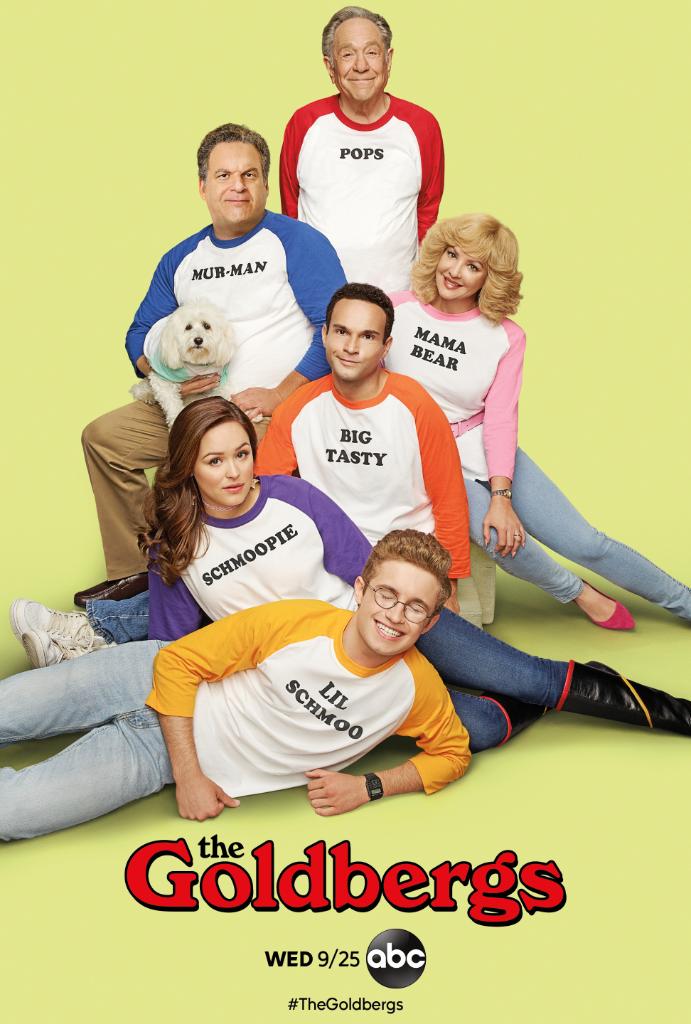
For anyone who grew up in the 1980’s they can tune in to ABC’s current program The Goldberg s and see their childhood come to life. It premiered on September 24, 2013.

Created by Adam F. Goldberg, the show is based on people he knew and events which happened to him while he was growing up.  Season 7 begins on Wednesday (Sept. 25) (For 2020, Season 8 begins October 21)

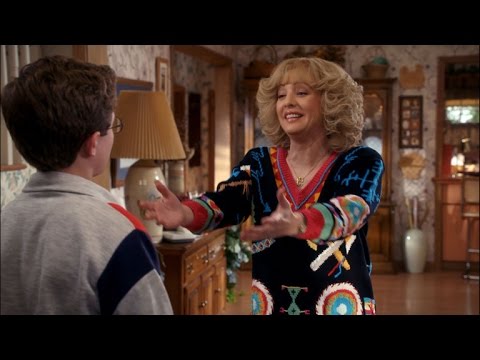
Like all great TV shows, excellent writing and casting are key. Adam’s is a wacky family which begins with his father, Murray, whose main goal in life is to be able to relax in his recliner (sans trousers) and watch TV undisturbed by his three children, who he calls ‘morons.’ The heart of the family is the ultimate intrusive mother, Beverly, who Adam and his siblings, Erica and Barry, call the ‘Smother.’ Although she ‘could have been a lawyer’, her only focus in life is finding ways to stay inappropriately relevant in her teenage children’s’ lives. The travails of the three siblings are fleshed out by a host of friends and rivals.

Beverly Goldberg, played by Wendy McLendon-Covey, a true ‘smother’

From the Infallible Wikipedia:

“The Goldberg’s is set in the 1980’s in Jenkintown, Pennsylvania. The show is loosely based on the show runner’s childhood, during which he videotaped events, many of which are reenacted throughout the program. It shows the reality of the 1980’s through a young boy’s eyes.

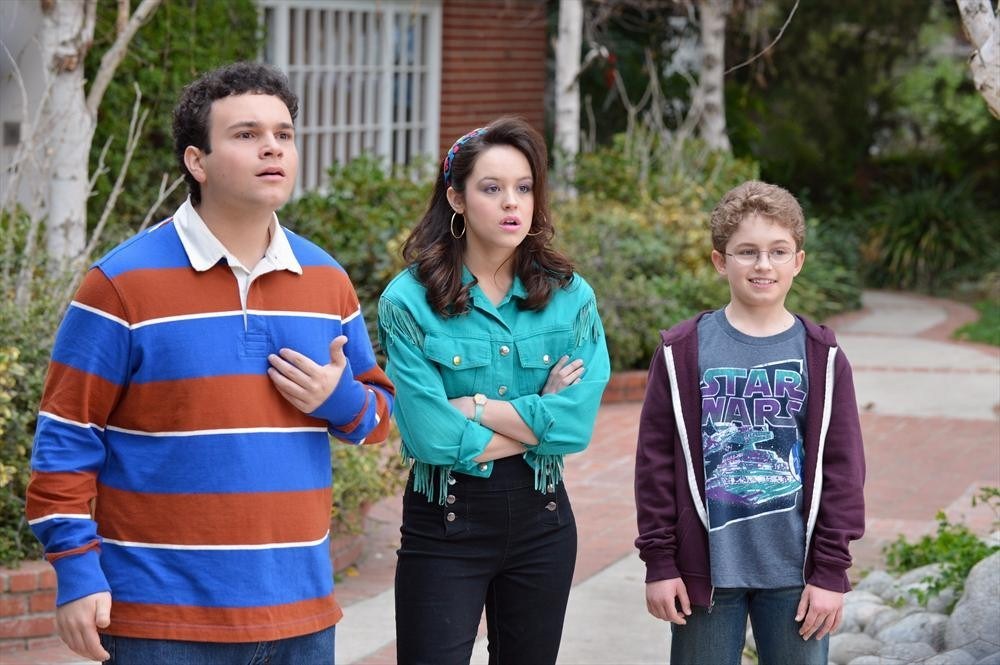
The series stars Jeff Garlin as patriarch Murray and Wendi McLendon-Covey as matriarch Beverly. Their two older children are Erica (Hayley Orrantia) and Barry (Troy Gentile). The youngest child, Adam (Sean Giambrone), documents his family life with his video camera. Beverly’s father, Albert “Pops” Solomon (George Segal), is frequently around to provide advice or to help out his grandchildren (often behind his daughter’s back).

The present-day ‘Adult Adam’ (Patton Oswalt) narrates every episode as taking place in ‘1980-something’.

The Goldberg children, Barry, Erika, and Adam as portrayed by Troy Gentile, Hayley Orrantia, and Sean Giambrone.

Many references to real-life Philadelphia-area businesses are made, including the Wawa Inc. convenience store chain, Gimbel’s department store, Willow Grove Park Mall, and Kremp’s Florist of Willow Grove, Pennsylvania.”

It was halfway through season six that I saw my first ‘Goldberg’s.’ Over the past 10 years, I have traveled frequently to Yakima to assist my parents. What started as an every five or six weeks visit to cook meals for my dad has shortened over the years as the needs increased. I’ve literally spent hundreds of days there helping both of them and dealing with a variety of crises. There have been hospital stays for both my parents, my mother living in multiple care facilities for 8 years, legal battles, her passing in November 2017, and now the decline of my 96-year-old father.

In January 2019, my dad took ill and ended up in the hospital. Upon his release my siblings and I recognized that we needed to place him into a facility as my brother, who had lived with him for the previous five years, was not able to provide the level of care needed.

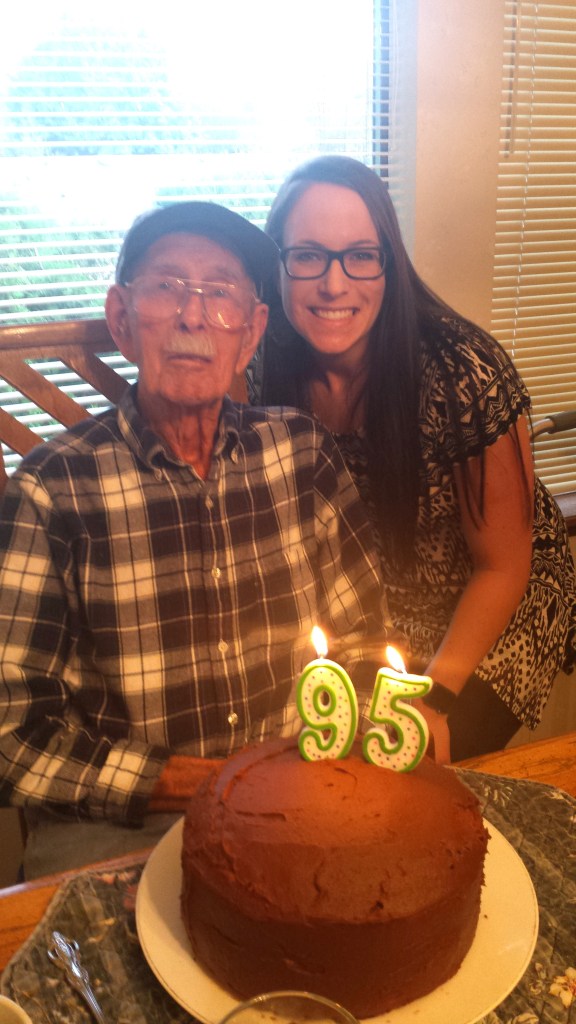
My niece with Dad on his 95th birthday. This was in 2018, the last year in his house.

I was in Yakima to facilitate dad’s move and arrived back at my Dad’s place one evening sometime the last week of January. My brother told me he had discovered a new TV show and asked if I wanted to watch. I did and, like him, was soon hooked on The Goldberg’s.

For most people it’s a simple thing to be able to watch and enjoy a TV program. That was not the case at my Dad’s house.

While Dad was still at home, the TV was his main activity, particularly after my mother died, and there were only two things he watched: Sports and News.

During the five years my brother lived there those were the choices during the hours Dad was present.

In those first weeks after Dad moved to Assisted Living, an odd quiet descended over the house. I think both my brother and I were in a bit of state of shock as the new reality settled in.

Enter the Goldberg’s. My brother set up the TV to record every episode as it played since season’s one through five were being rebroadcast. Many evenings in the next few months during the days and weeks I was in Yakima, I’d arrive back after visiting Dad and my brother and I would binge watch, often staying up way too late.

In many ways it was a lifeline and a way to deal with the stress. Laughter and the occasional cry do that for you.

On another level there was a more subtle lesson to be learned. One that comes through from the Goldberg’s in every episode:

Sure, stuff happens in life and we’re not always at our best with our family and friends, but in the end cherish your family because things change – sometimes in an instant – and you cannot get it back.

We recently completed an estate sale at my parents’ house. Soon the condo will be on the market. As we went through the process of sorting everything last summer, we’d come upon items which triggered emotional responses. When I handed the electric griddle to my sister-in-law to use for her grandkids it hit me that I would never cook another pancake (I made thousands in those 10 years) or a pot pie for Dad in that kitchen, or stay there, or hear my dad’s walker thumping overhead in the morning. Everything had changed.

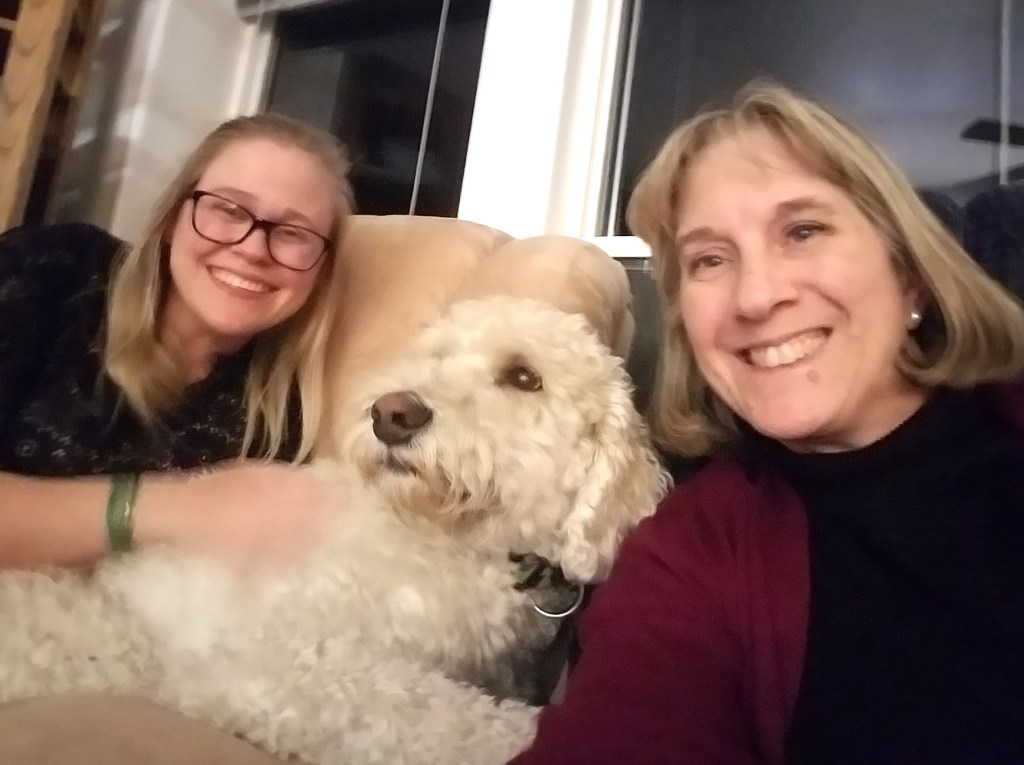
My Daughter, Reggie the Double Doodle, and the author hanging out.

But a new and different way of loving and supporting family has emerged. When I’m over there I now stay with my sister and her husband. Herbert and Teddy, their two dogs, announce every arrival in a cacophony of barking. Shop Cat – who is an outdoor pet – will come and hang out on the deck and has decided I’m okay, rubbing against my legs and looking to be petted. My sister’s adult daughter – who lives nearby – arrives most every evening, bringing with her Reggie and Rex, the Double Doodle dogs, who join in the melee.

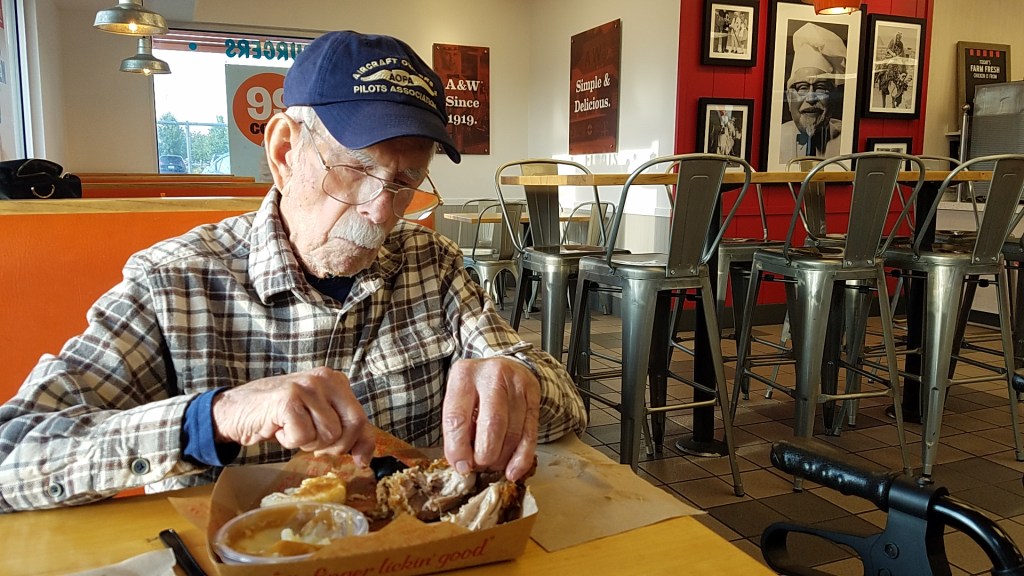
I visit dad at least once a day when over there. He has good days and bad days… last week he had one particularly good day and insisted he wanted to have Kentucky Fried Chicken for dinner. So what the heck? I loaded him and his walker into the car and we went to KFC. Was it easy? No. But I recognize his days are short and doing something so simple made him happy for a little while. And that makes it all worthwhile. No regrets.

Dinner out with Dad September 2019

2019 has been a hard year, but it was made better thanks to the Goldberg’s and my own family.

Here’s the link to Wikipedia, but really, it does not do justice to the show. Give yourself a treat and watch an episode.

https://en.wikipedia.org/wiki/The_Goldbergs_(2013_TV_series)

Update 2024: When I posted this on September 24, 2019, I had no idea that exactly one month later my Dad would take his last breath. The Goldberg’s last episode was aired in May 2023.

The Day We Were Bewitched

A Beloved 1960’s Sitcom

September 17, 2024

A Tuesday Newsday Classic

From the moment this TV show premiered, on September 17, 1964, a spell was cast over the American public and everyone fell in love with a beautiful witch named Samantha.

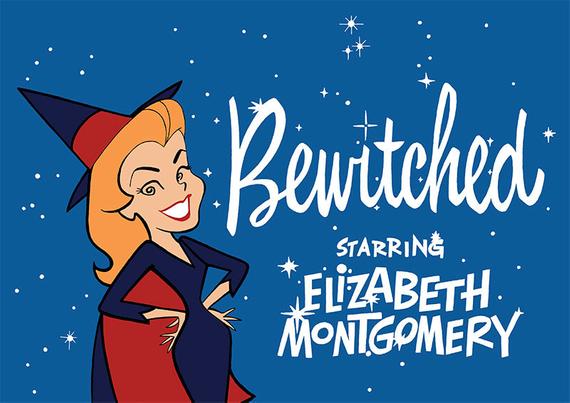
Screenshot from the opening credits

Bewitched was an instant hit, drawing everyone in to its crazy premise:

What if a witch were to fall in love with a mortal and give up her magical world to become a modern-day housewife?

Of course that’s not quite how it worked out. Week after week we were given a glimpse into the life and marriage of Darrin and Samantha Stevens who, with interference from her mother Endora and a wide cast of other relatives, seemed to stir up trouble for poor Darren. Add to that mix the nosy neighbor, Gladys Kravitz, and Darrin’s demanding boss, Larry Tate, and you had the recipe for a sitcom which aired for the next eight years.

From the Infallible Wikipedia:

“The witches and their male counterparts, warlocks, are very long-lived; while Samantha appears to be a young woman, many episodes suggest she is actually hundreds of years old. To keep their society secret, witches avoid showing their powers in front of mortals other than Darrin. Nevertheless, the effects of their spells – and Samantha’s attempts to hide their supernatural origin from mortals – drive the plot of most episodes. Witches and warlocks usually use physical gestures along with their incantations. To perform magic, Samantha often twitches her nose to create a spell. Special visual effects are accompanied by music to highlight such an action.”

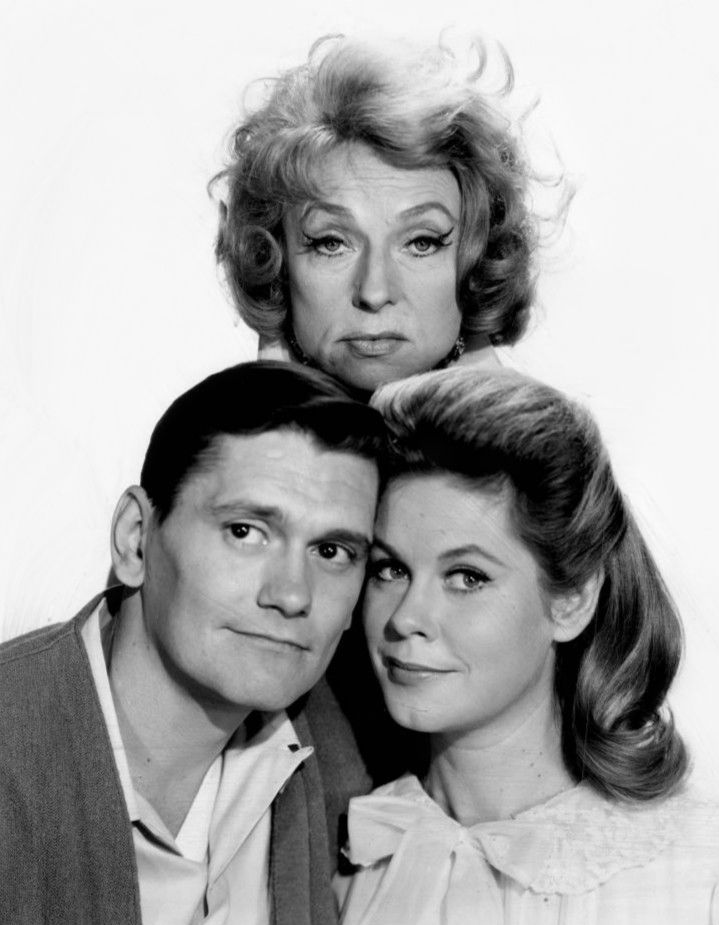
The three main characters: Dick York as Darrin and Elizabeth Montgomery as Samantha (front) with the irreplaceable Agnes Moorehead as Endora.

The combination of great script writers coupled with outstanding casting was, no doubt, key to the series success. Elizabeth Montgomery, as Samantha, is frequently seen using her nose to make the dishes wash themselves, clean up a mess, or handle some mundane chore. Darrin was frustrated each week at his wife’s use of magic to handle life.

Personally, as a child, I very badly wanted to live in that world. My bedroom was ALWAYS a disaster of toys, books, and games, with never enough space to store them. If, of course, I was inclined to be tidy, which I was not.

My sister, who is 21 months older, forbade me from stepping foot onto her side of the room during those years. An invisible line was drawn between our matching twin beds and across that boundary I dared not venture. Oh to have Samantha’s nose which I could just twitch and get everything cleaned up in an instant! Then I might have been allowed across the magic threshold.

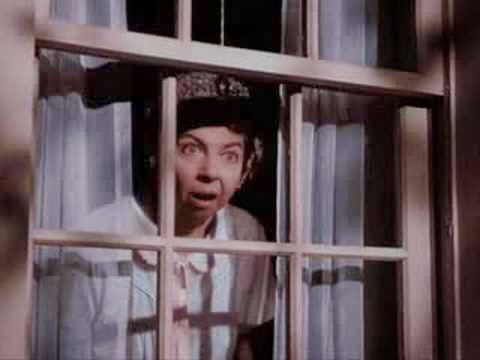
But my favorite character on the show had to have been the ever-vigilant neighbor Gladys. The woman epitomized the term busy body and was often seen skulking around the Steven’s house. She would climb into the shrubbery and peer through windows, certain that all sorts of strange things were going on inside. Of course, she was right but she never succeeded in convincing her disinterested husband, Abner, or the occasional law enforcement officer she would call, of the shenanigans which took place.

In her portrayal of Gladys Kravitz, Alice Pearce brought the meaning of a nosy neighbor to new heights

In fact, when I encounter a nosy person, I usually refer to them as Gladys. In a loving way, of course, but the name does sum up that one person which members of my generation instantly recognize.

No doubt, when the show went off the air in 1972, it was with a whimper. The original Darrin had left in 1969 due to complications from a severe back injury 10 years earlier which made working impossible. The original Gladys died in 1966 as had Samantha’s confused Aunt Clara. These hits to the cast affected the show profoundly. In many ways, in retrospect, it was almost as if a spell had been placed on the show. Elizabeth Montgomery died in 1995 at the age of 64 from colon cancer. Dick York succumbed at age 63 from emphysema. Agnes Moorehead, who played Endora, was stricken with uterine cancer which took her life in 1974 at age 74.

Bewitched lives on in syndication and, subsequently, on DVD and the internet. Although there was a movie made based on the characters which was cute, and there are proposals for a new TV series, no remake will ever be able to replicate and achieve the success of the original.

Sometimes magic only happens once.

For more about Bewitched:

https://en.wikipedia.org/wiki/Bewitched

The Sewing Machine

An invaluable invention which changed women’s lives

September 10, 2024

A Tuesday Newsday Classic

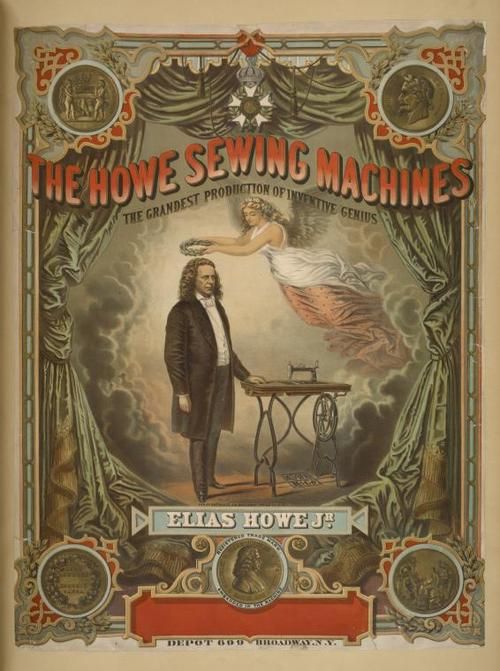
This invention truly revolutionized American life. The sewing machine was granted a patent on September 10, 1846. While most people associate the name Singer with the sewing machine it was actually an inventor by the name of Elias Howe who conceived of and created the first such machine. From the Infallible Wikipedia:

“He almost beggared himself before he discovered where the eye of the needle of the sewing machine should be located. It is probable that there are very few people who know how it came about. His original idea was to follow the model of the ordinary needle, and have the eye at the heel. It never occurred to him that it should be placed near the point, and he might have failed altogether if he had not dreamed he was building a sewing machine for a savage king in a strange country. Just as in his actual working experience, he was perplexed about the needle’s eye. He thought the king gave him twenty-four hours in which to complete the machine and make it sew. If not finished in that time death was to be the punishment. Howe worked and worked, and puzzled, and finally gave it up. Then he thought he was taken out to be executed. He noticed that the warriors carried spears that were pierced near the head. Instantly came the solution of the difficulty, and while the inventor was begging for time, he awoke. It was 4 o’clock in the morning. He jumped out of bed, ran to his workshop, and by 9, a needle with an eye at the point had been rudely modeled. After that it was easy. That is the true story of an important incident in the invention of the sewing machine.”

Alas, Elias Howe had competition in the development of the sewing machine and another, much more recognized name, came to dominate the industry. Also from the Infallible Wikipedia:

“Despite his (Howe) efforts to sell his machine, other entrepreneurs began manufacturing sewing machines. Howe was forced to defend his patent in a court case that lasted from 1849 to 1854 because he found that Isaac Singer with cooperation from Walter Hunt had perfected a facsimile of his machine and was selling it with the same lockstitch that Howe had invented and patented. He won the dispute and earned considerable royalties from Singer and others for sales of his invention.”

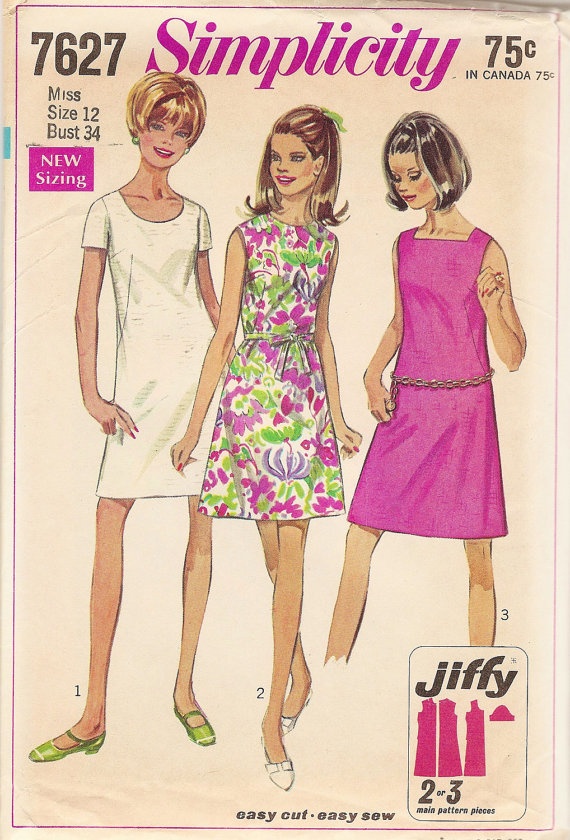
An A-line pattern that beginning seamstresses could master as they learned to sew.

Howe, like Singer, ended up a multimillionaire.

Before this society altering machine was invented, it took some 14 hours for a person – usually a woman – laboring at home and sewing each seam by hand to make a shirt. Those hours were invested after all other chores were done: cooking, cleaning, washing, and child care. The sewing machine, which at first was used in factories, eventually made its way to the home allowing women to sew stronger, better garments, and saving hundreds of hours of valuable time.

For me, my relationship with the sewing machine is a love/hate affair. When in Junior High I took Home Economics classes which, at Wilson Junior High in Yakima, were split into two segments. One was to learn all the skills needed to cook. The other was to learn how to sew. I was in eighth grade in the sewing segment when I received my first lessons.

Our initial project was to sew a basic A-line dress. For those unfamiliar with the term, what that meant was a dress of three pieces: front, and two mirror image back pieces with a zipper down the middle. No sleeves, just armholes with armhole facings; darts at the bodice completed the fitting. In all, the pattern consisted of 8 pieces. Five of those pieces were facings around the arms and neck.

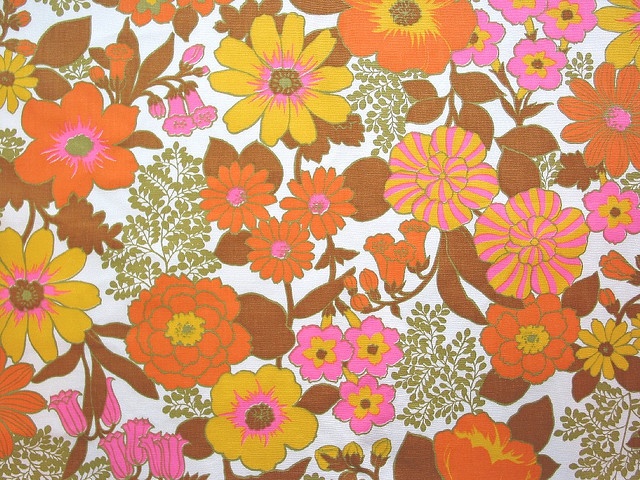
Our teacher sent us out on the mission to purchase material for our dresses. I acquired a very loud, very late 1960’s/early 1970’s fabric, with colorful and bold flowers on a white background. Day by day we labored. One day the pattern pieces had to be carefully laid out and pinned down, paying attention to concepts such as grain lines as we learned how to ‘read’ the pattern. The next step, after our teacher approved our work, was to cut the fabric, making sure to follow the printed lines of the pattern and the little tabs to be matched. Day by day we succeeded in sewing together our creation. We learned the proper way to sew darts (the dress had four of them), install a zipper, finish edges, tack down the facings, and to sew (by hand) a hem.

Typical of Popular fabrics designs from the early 1970’s

When my dress was complete that fall I was excited to wear it… only to discover that due to my physical similarity to a long-legged colt, the length of the dress was such that all anyone noticed were my knock-kneed legs extending a mile from the hem to the floor.

This might have been due to the fact that the mini skirt was the dominant fashion in the late 1960’s. Or it might have been that between my 8th and 9th grade years of school I grew, literally, six inches in height. From the time I started the dress to when it was finished, I had gained most of this height.

But I was not discouraged as I had discovered I now possessed a valuable ability. Soon I had a bit of a cottage industry going. As a member of the Rainbow Girls the need for custom dresses for its members provided clients. The very first dress I made for someone else was for my friend, Wende, who paid me $15 to sew a dress.

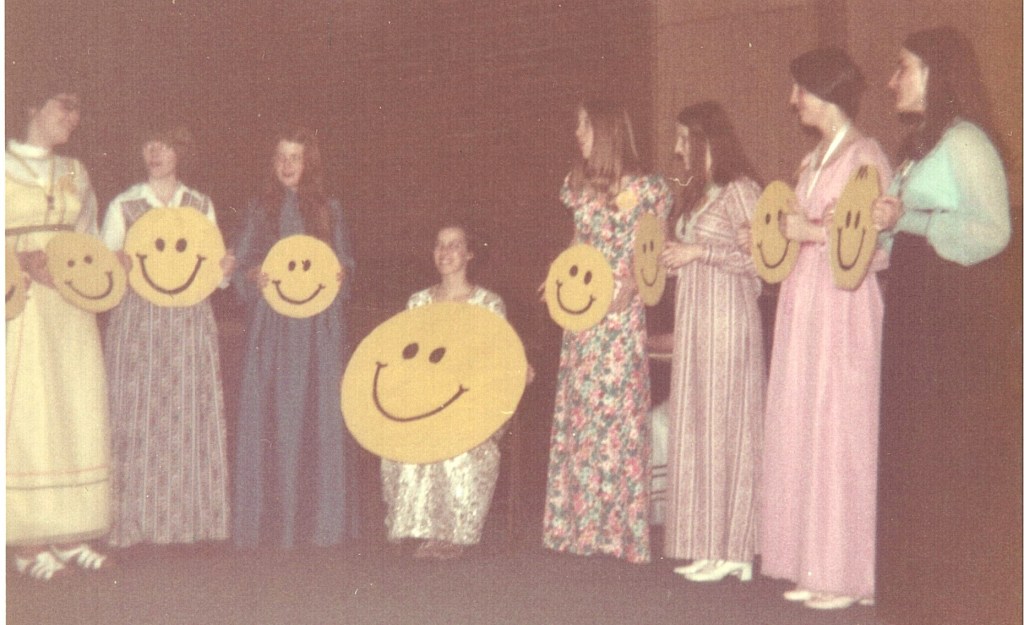
March 1972. This was taken at a Rainbow Girls meeting in Yakima. I’m standing immediately to the right of the girl seated and wearing a dress I sewed using popular bright floral colors. I wrote in my diary that day “I wore my new formal that I made and everyone seemed to like it.
.

Over the years knowing how to sew has come in handy. I can mend pretty much anything and can create clothing. I’ve made costumes for my children, dresses for countless Rainbow girls, and my most recent project (in 2019) of sewing 21 identical aprons for gifts.

The most painful experience occurred, however, in January 2010. Sewing is, despite Mr. Howe’s invention, a time consuming process.

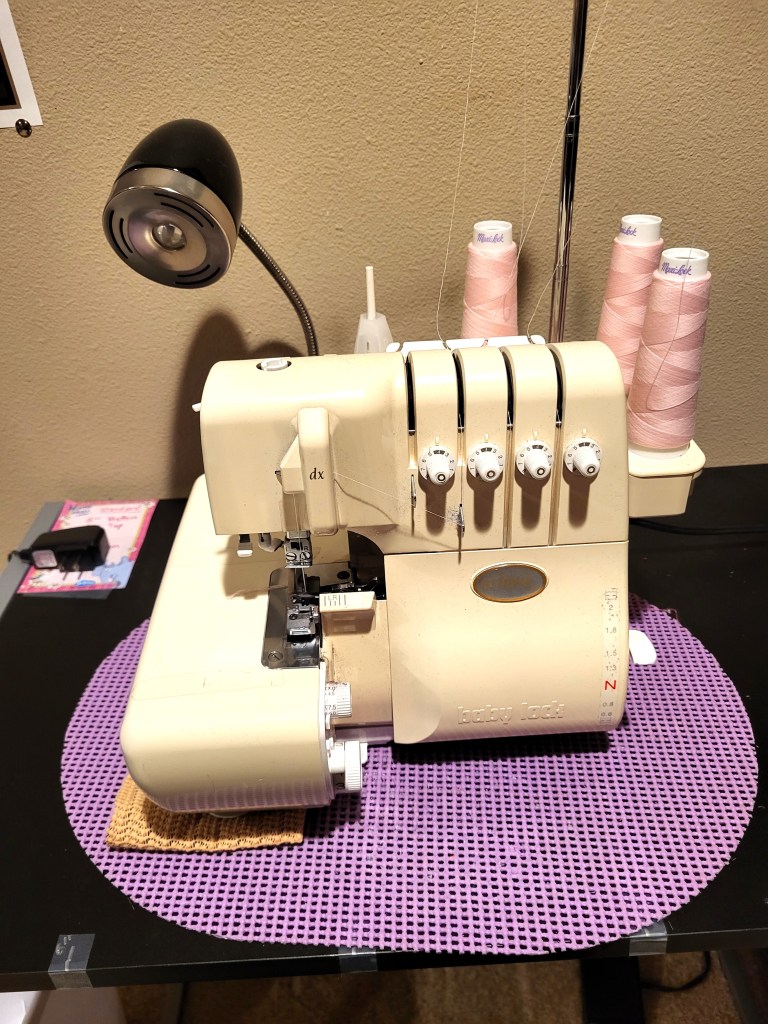
My Baby Lock serger – a Christmas present to myself – purchased in early 2010 and still being used.

Enter into my world the serger. Improving on the functionality of the sewing machine, a serger completely binds a seam, cutting and simultaneously sewing together two pieces of fabric into a never to be undone union. The addition of the serger was a miracle for me. Seams which before had taken 20 minutes each now required but a few minutes.

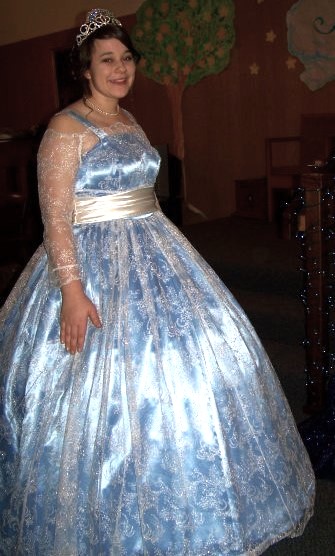
Until. Until I was sewing my first project using the serger in January 2010. It was to be a rather delicate and beautiful blue dress using a pattern in the same style as the wedding dress worn by Kate Middleton for her marriage to Prince William. There was lace. There was satin. It was going to be stunning. I was happily serging the seams in anticipation of the dress being completed when my foot slipped on the pedal and the serger went one stitch too far. I looked down at the garment and there, in the nearly completed dress, was a perfect cut into the midriff in the shape of a small upside-down V.

I stared in horror at the incision and wondered how to fix the mistake. Could I bind the edge to repair it? Could I tuck in under?

The reality of the situation hit me. There was no way to ‘fix’ the mistake. The dress would have to be taken apart, a complete new section cut out and replacing the irreparably damaged midriff piece.

The dress which the serger attacked…

The memory of that day is forever seared into my brain. I continued to study the ruined bodice for what seemed like several minutes. At last I stood. I turned off the machine. I left the dress right where it was, a testament to the old adage “A stitch in time saves nine.”  I left my sewing room for the rest of day, literally sick over the fact that I would have to recreate the destroyed section, learning in that moment that a serger was but a tool which, if not used correctly, was no more useful than any other tool in the wrong hands.

The next day I returned to the sewing room, cut out the new section and was able to recreate the damaged piece. My mistake had added a couple of hours to the project. The dress? It turned out beautifully, a true masterpiece on the lovely young woman who wore it. Because I knew that sometimes ‘things happened’, I had enough extra material to fix what had been so easily destroyed.

As for me, sewing is something I do because it serves an end, but it’s not my life’s passion. My passion is this: writing.

I do find, however, that when my brain is tired from the creative process of writing, sewing can provide a comfort in the sheer rote of its methods. Seams are seams. There are only so many ways to put a garment together and once you master that you can make pretty much anything so long as you respect the machines which make it possible.

But writing… well, that taps into my creative mind as I’m always looking for new and different ways to share ancient truths.

So I leave the sewing to those whose passion it is. Artistry comes in many forms.  Except for an occasional project, my 10 hour sewing days are behind me and I’ve closed the shop.

I also think it’s time to bring back Home Ec. classes like sewing. We’ve now raised a couple generations of people, the majority of whom seem to lack basic life skills. Being able to sew a seam, and put up a hem is just one example of valuable ability. Cooking, carpentry, and mechanical aptitude should be added to that list also.

So I salute Elias Howe and his vision for the modern sewing machine. It truly changed the life of women.

The Infallible Links:

https://en.wikipedia.org/wiki/Sewing_machine

https://en.wikipedia.org/wiki/Elias_Howe

The First Tuesday in September

Pee Chees, Saddle Shoes, and Fear

September 3, 2024

A Tuesday Newsday Classic

The first Tuesday of September was always a day which struck fear in my heart. In fact, no other day of the year caused more anxiety and distress than this one.

The reason, of course, was due to the fact that when I was growing up school always started on this day.

The ubiquitous Pee-Chee – an indispensible back to school item

Unlike in today’s world, where we are inundated with back-to-school ads for supplies and equipment beginning in late July, in the 1960’s and 70’s, we didn’t much think about going back to school. That was until one day in late August my mother would ominously announce that school started the next week.

So off we would go to get things. Our back-to-school supply list included Pee Chee folders, notebook paper, #2 pencils, and BIC pens. That was it.

For clothing, I was lucky to get one new outfit for the first day of school. And the most evil of all footwear ever invented: saddle shoes.

I’ll get back to those in a bit.  First off, however, I imagine you are wondering about the Pee Chee.  What is a Pee Chee? And why do so many people my age wax nostalgic over a folded in half piece of cardstock? I knew it deserved Tuesday Newsday status. Since I couldn’t find the official day they were introduced, the first Tuesday in September seemed the perfect opportunity to learn about them. From the Infallible Wikipedia:

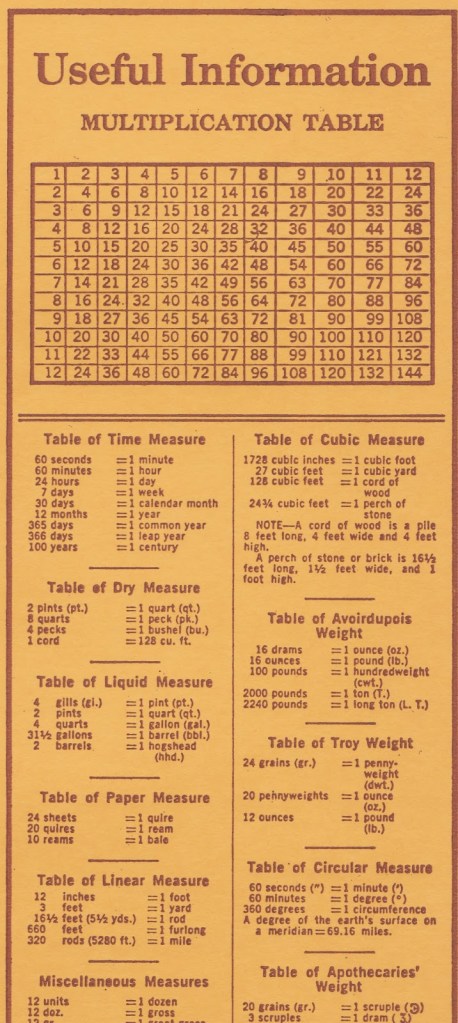
How we learned our multiplication tables and other useful information

“The yellow Pee-Chee All Season Portfolio was a common American stationery item in the second half of the 20th century, commonly used by students for storing school papers. It was first produced in 1943 by the Western Tablet and Stationery Company of Kalamazoo, Michigan. Pee-Chees were later produced by the Mead Corporation. (snip) These inexpensive folders are made of card stock with two internal pockets for the storage of loose-leaf paper. The pockets are printed with a variety of reference information including factors for converting between Imperial and metric measurement units, and a multiplication table. The folders had fallen out of general use by the 2000s, but are available from Mead as of 2014.”

Note the words “multiplication table.” This was probably the most valuable thing a Pee Chee provided as we were expected to memorize this table. By the time you arrived at the twelves, it got a bit difficult. The handy dandy Pee Chee came to your rescue. Of course, our teachers knew this and we had to put our Pee Chee’s away during test time.

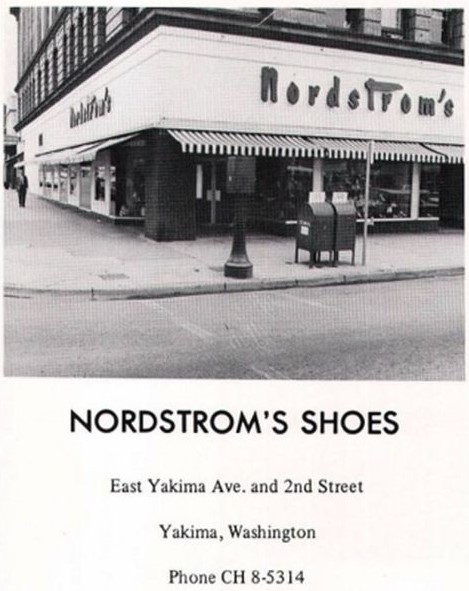
One of the eight Nordstrom shoe stores in the 1960’s

Every day, when I walked home from elementary school, I only carried a Pee Chee and rarely any books unless it was one checked out from the school library. By the time I was in Junior High and High School, books were part of the equation. Along with the Pee Chee of course.

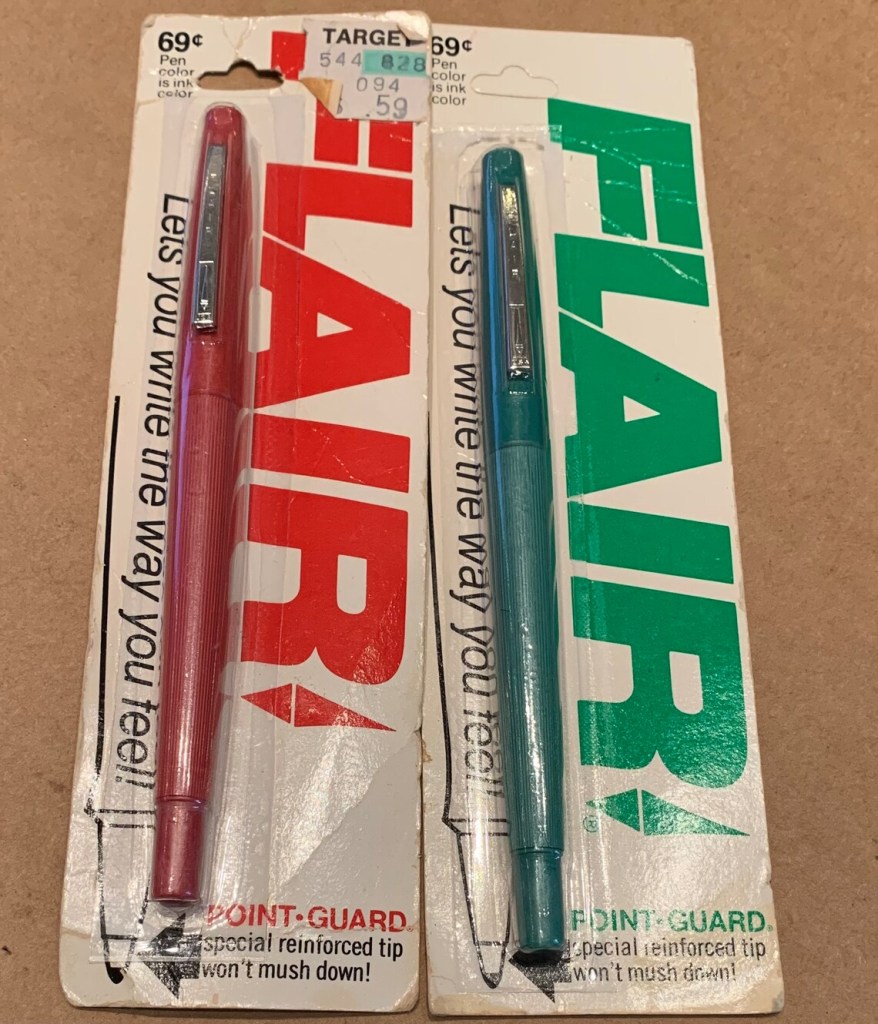
That brand new, unmarked, non-dog-eared Pee Chee was the best part of being forced to go back to school. And paper, pencils and BIC pens, of course. The best addition were colored Flair pens starting in Junior High! My favorite was the green one.

But the worst part? From first grade through sixth I was subjected to torture by being forced to wear saddle shoes. Whoever invented this shoe should have been required to wear a new pair every week for their entire lives just so they would know what pain they subjected multiple generations of girls to endure.

The evil saddle shoe…

My mother would take me and my sister to Nordstrom’s Shoe store… in the 1960’s in Yakima that’s all it was… a shoe store. We would bypass all the beautiful shiny black patent leather shoes and the cute Mary Janes and go directly to the rack of clunky saddle shoes. There they sat, big, bulky, and ugly. They had brown soles thicker than a slice of French toast. Across their beige bodies was a second strip of stiff brown leather, with laces through the holes, just waiting to cinch your foot into bondage. Heaven forbid that you got shoes which fit… no, they had to be a bit big so you’d grow in to them and not grow out of them before the following June.

We would wear them around the house for several days before school started in a futile effort to ‘break’ them in. It never worked. The first few weeks of school our feet bore witness to the horrors of saddle shoes; oozing red blisters were covered with adhesive tape and we’d limp through the day. Eventually the leather softened and the blisters abated… usually by October. Kids today just don’t realize how lucky they are to have been spared the scourge of saddle shoes.

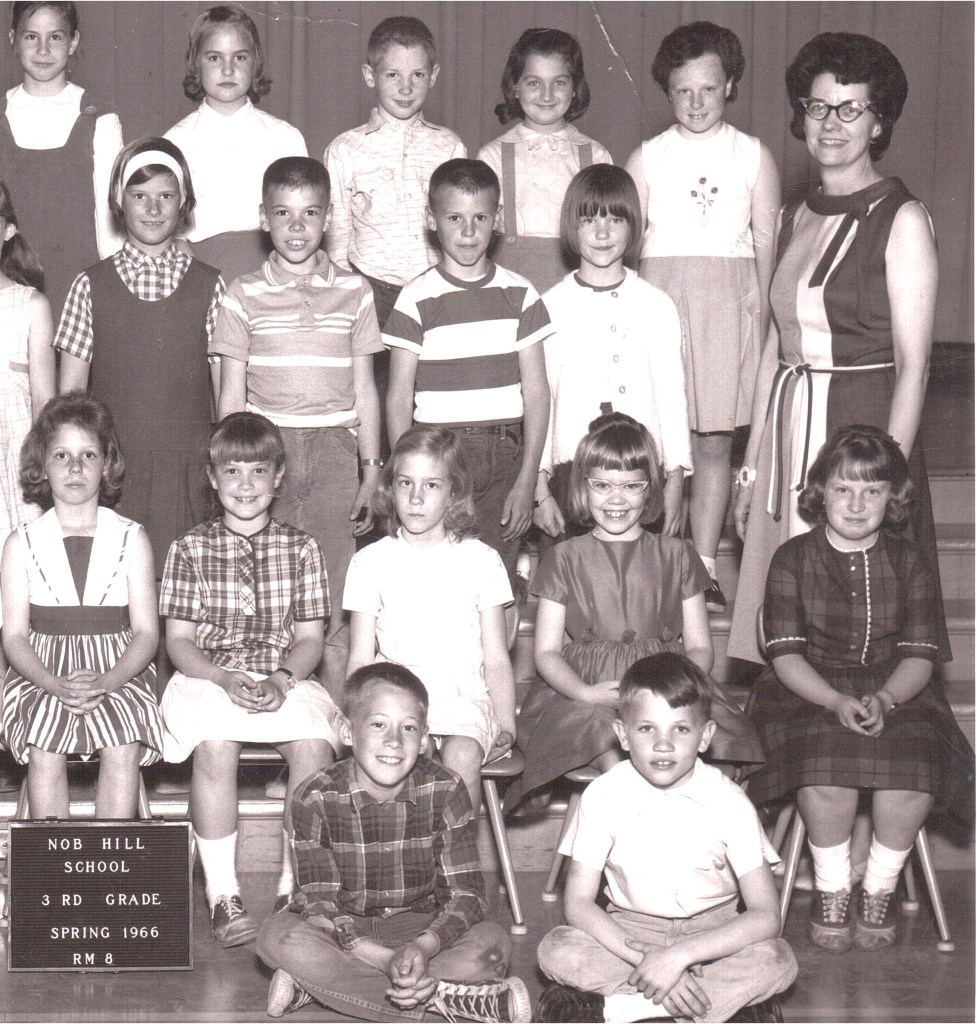
Note the saddle shoes on the two girls seated, Marla on the left and Rinda on the far right. This author is next to Marla undoubtedly also wearing saddle shoes. The girl in the glasses next to me? That was Kelly who NEVER had saddle shoes but always cute black patten leather shoes.
Flair pens were IT! Especially the green ones.

Even now the first week of September is my least favorite time of the year; despite the fact I do not have to go back to school nor do my children.

I am, however, very, very tempted to go hang out in the office supply store and indulge myself in the smell of paper and ink and the plethora of notebooks, papers, pens, and paperclips. Anyone who has seen my office knows that I have stacks of spiral notebooks, hundreds of colored paperclips (many with decorative tops), and a collection of G-2 pens of every hue. In fact, just writing about it inspires me to head to my nearest Office Depot Max to see what’s on sale. Unlike saddle shoes, office supplies never go out of fashion!

As always a couple of links:

https://en.wikipedia.org/wiki/Pee_Chee_folder

https://en.wikipedia.org/wiki/Saddle_shoe

Yes, it is true. In 1960 Nordstrom’s only sold shoes. The store in Yakima was one of only 8 stores at the time.

https://shop.nordstrom.com/content/company-history